They Called Her “Just a Civilian Nurse”—Then Seven Military K9s Dropped at One Word and the Colonel Went Silent
PART3:
The restricted-access warning was there.
She simply did not register it.
Emma pushed through.
The smell stopped her before the sight did.
Dog.
Not one.
Several.
Beneath that came gun oil.
Nylon.
Rubber.
Metal.
Sweat carrying the sharp chemical edge of adrenaline.
Her body went still.
Not frightened.
Recognizing.
She had not smelled that exact combination in years.
A person can forget photographs.
Dates.
Voices.
The body remembers environments.
Emma looked up.
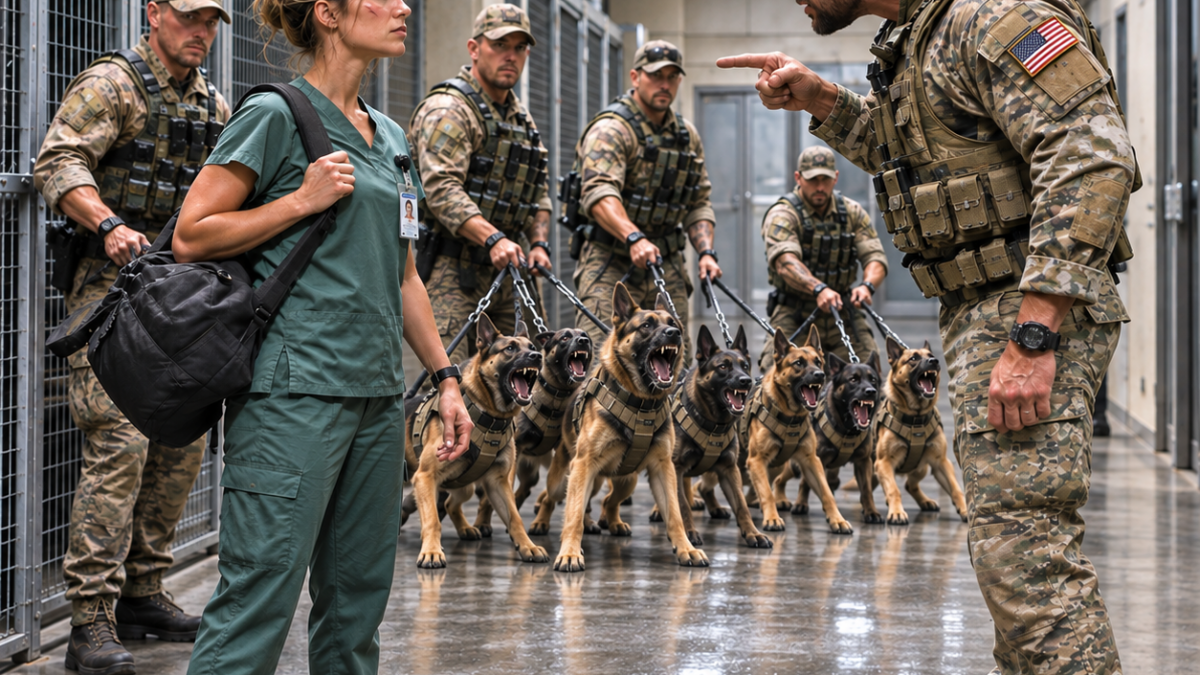
The corridor stretched roughly sixty feet.
Temporary kennel systems lined the right wall.
Handlers in military uniforms stood beside them.
Equipment cases were stacked against the left.
At the far end, two officers were speaking near a secure access door.
Emma counted automatically.
One.
Two.
Three.
Four.
Five.
Six.
Seven.
Belgian Malinois.
Military working dogs.
Youngest maybe three.
Oldest perhaps eight.
Conditioned.
Lean.
Alert.
All operating at an elevated level of environmental stress.
She noticed that before she noticed the weapons.
Emma’s stomach tightened.
She should not be here.
She stepped backward.
Then Dog Four saw her.
He was slightly older than the others.
Dark mask.
Tan coat.
Small scar running through the edge of his left ear.
His handler was turned halfway away, checking paperwork.
The dog’s eyes found Emma.
Every muscle in his body locked.
Emma froze.
She knew that look.
It was not prey drive.
Not defensive aggression.
Not stranger alerting.
Recognition.
Impossible.
But recognition.
The Malinois leaned forward.
A low sound came from his throat.
Not a bark.
Not a growl.
Something almost questioning.
Emma’s chest tightened.
“No.”
The dog’s ears pushed forward.
The sound came again.
Then Kennel Two erupted.
Its dog slammed forward so suddenly the handler staggered.
Kennel Five followed.
Then Six.
Within three seconds, the entire corridor changed.
Seven dogs began reacting at once.
Leashes snapped tight.
Handlers shouted.
Metal kennel panels rattled.
One dog spun violently.
Another hit the gate with both front paws.
A younger female at the far end backed into the corner and began whining.
Emma stood in the doorway.
“Damn it.”
Security officers appeared from both directions.
One reached toward his holster.
Emma saw it.
“Don’t.”
Nobody heard her.
Orders flew.
Handlers tried commands.
German.
English.
Hand signals.
Corrections.
Nothing settled.
Dog Four never looked away from Emma.
He pulled toward her.
Not attacking.
Trying to reach her.
A man broke from the far end of the corridor.
Lieutenant Ethan Cross.
Emma noticed the rank first.
Then the face.
Mid-thirties.
Close-cut hair.
Strong jaw.
Clean uniform.
The physical confidence of someone accustomed to having his instructions followed before people decided whether they agreed.
He stopped four feet from Emma.
“Do not move.”
Emma raised neither hand.
“I was already leaving.”
“Identification.”
“I walked through the wrong door.”
“Identification.”
His tone changed nothing.
Emma opened her carry-on slowly.
Cross watched her hands.
She removed her wallet.
Hospital badge.
Driver’s license.
He took both.
His eyes dropped to the hospital identification.
“Emma Carter.”
“Yes.”
“Emergency nurse.”
“Yes.”
Cross looked at her green scrubs.
Something dismissive moved through his expression.
“What are you doing inside a military staging corridor?”
“I made a wrong turn.”
“You walked past two restricted-access warnings.”
“I missed them.”
Cross stared.
“You expect me to believe a woman who works in an emergency department cannot read a sign?”
Emma was too tired to defend her intelligence.
“Yes.”
His eyes narrowed.
Behind him, Dog Four slammed the panel again.
Emma glanced past Cross.
“Your dog is going to hurt himself.”
Cross followed her gaze.
“Do not concern yourself with my dogs.”
“Hard not to.”
“You triggered them.”
“No.”
That got his attention.
Cross looked back.
“What did you say?”
“I didn’t trigger them.”
Seven dogs continued protesting.
Dog Four pulled so hard against the enclosure that the lower connection point vibrated.
Emma saw the movement.
Small.
Wrong.
Metal fatigue.
She looked at Cross.
“You need to check Four’s lower latch.”
His expression sharpened.
“You need to stop talking.”
Emma watched the latch.
“Fine.”
Cross turned to airport security.
“Escort her back into the public terminal. Log her ID and flag the security incident.”
Emma took her license.
“Do whatever paperwork makes you happy.”
Cross stared.
“Excuse me?”
“I said I’ll leave.”
A woman’s voice interrupted.
“Lieutenant.”
Not loud.
Still enough to cut through the noise.
Master Sergeant Rachel Monroe stood between Kennels Three and Four.
Mid-forties.
Compact.
Dark hair pulled back.
Weathered face.
Emma recognized the posture before anything else.
Operational stillness.
The kind people developed after years of learning that unnecessary movement attracted attention.
Monroe was not looking at Emma’s hospital badge.
She was studying her feet.
Her shoulders.
Hands.
The way Emma had positioned herself relative to the dogs.
Cross turned.
“Sergeant?”
“Give me a second.”
“With respect, we have a civilian security breach.”
“I know what we have.”
Monroe walked toward Emma.
She stopped six feet away.
“You were about to say something.”
Emma shook her head.
“I’m trying to leave.”
“Before that.”
“I don’t remember.”
“Yes, you do.”
Cross exhaled.
“Rachel.”
Monroe ignored him.
“Those dogs reacted when they saw you.”
Emma said nothing.
“Not like strangers.”
Still nothing.
Monroe lowered her voice.
“What do they think you are?”
That question hit differently.
Emma looked at Dog Four.
The Malinois watched her with almost painful intensity.
She answered carefully.
“They’re not afraid of me.”
Cross laughed once.
Nobody else did.
Emma continued.
“They’re trying to resolve recognition.”
Cross stepped forward.
“You’re an ER nurse.”
“Yes.”
“You think that makes you qualified to interpret military working-dog behavior?”
“No.”
“Good.”
“It’s the other experience.”
The words left before Emma could stop them.
Monroe heard.
Cross heard too.
“What other experience?”
Emma adjusted her bag.
“None that matters today.”
Monroe’s eyes moved downward.
Emma’s scrub sleeve had pulled slightly up her right forearm.
A scar showed there.
Jagged.
White.
Not surgical.
Not accidental in any ordinary sense.
Monroe’s face changed.
Only a fraction.
“Where did you get that?”
Emma pulled her sleeve down.
“Old injury.”
“I know what shrapnel scars look like.”
Cross looked between them.
“Sergeant, enough.”
Then the lower latch on Kennel Four broke.
Metal snapped.
The panel swung outward four inches.
The Malinois hit the gap.
Handlers shouted.
Security drew weapons halfway.
Emma’s voice cracked through the corridor.
“Holster them!”
Everyone hesitated.
Cross spun.
“You do not give orders here.”
“If one of those officers fires because he mistakes approach behavior for attack behavior, you’re going to kill a working dog who is trying to reach me.”
“Trying to—”
The dog shoved his muzzle through the opening.
No teeth.
No snarl.
Eyes only for Emma.
His handler hauled the panel back.
“Rex! Back!”
Rex ignored him.
Cross shouted at the handler.
Emma watched the dog’s rear legs.
Watched breathing.
Pupils.
Weight.
A tiny hesitation on the right front foot.
She stored it automatically.
Then the other dogs began escalating again.
The younger female flattened herself.
Emma’s voice lowered.
“Stop yelling.”
Cross stared at her.
“What?”
“You’re feeding the corridor.”
“These are trained animals.”
“Yes.”
“And you’re a civilian nurse.”
Emma met his eyes.
“Then your trained animals are doing a remarkably bad job of respecting my résumé.”
Monroe’s mouth twitched.
Cross’s face reddened.
Emma pointed toward Rex’s latch.
“Fix that first.”
She pointed to the security officers.
“Get unnecessary bodies out of the corridor.”
“You’re not in command.”
“I know.”
“Then stop acting like it.”
Emma looked at Rex.
“Someone should.”
Silence.
That was the moment Cross would remember later.
Not because it humiliated him.
It did.
But because it was the first moment anyone had spoken to him that way in years and he had no immediate answer.
Monroe stepped between them.
“Maintenance to Four.”
Cross turned sharply.
“Sergeant—”
“That latch is visibly compromised.”
He looked.
Saw it.
Monroe continued.
“And she saw it before any of us.”
Cross’s jaw tightened.
“That proves eyesight.”
“No.”
Monroe looked at Emma.
“It proves attention.”
Maintenance arrived.
The corridor cleared except for handlers, Monroe, Cross, and two security staff at the outer doors.
The damaged catch was replaced.
A technician checked the others.
Kennel Two’s lower attachment showed abnormal wear.
So did Six.
Emma had predicted both.
Cross noticed.
He hated that he noticed.
When the maintenance worker finished, Monroe approached Emma.
“Can you settle them?”
Emma looked at the seven dogs.
“No.”
Cross’s expression almost said I knew it.
Emma continued.
“Their handlers settle them.”
Monroe waited.
“I can give them something familiar enough to interrupt the cycle.”
“What?”
Emma hesitated.
There were words she had not spoken since Ironwood ended.
Some memories lived in language.
Once spoken, they tended to unlock rooms Emma preferred closed.
Rex made that low sound again.
Emma took off her gray jacket.
Set down the carry-on.
Walked slowly to the center of the corridor.
Every dog followed her movement.
She stood still.
Hands loose.
Breathing controlled.
Cross watched.
There was nothing obviously military about her.
Green hospital scrubs.
Running shoes.
Tired ponytail.
No rank.
No weapon.
No equipment.
She looked like exactly what he had called her.
A civilian nurse.
Emma spoke one word.
It was not English.
Not German.
Not Dutch.
It belonged to a conditioning protocol removed from official training systems years earlier.
Every dog dropped.
All seven.
At once.
Chest down.
Front paws aligned.
Heads high.
Eyes forward.
No gradual obedience.
No handler corrections.
One second chaos.
The next absolute silence.
A handler whispered, “What the hell?”
Monroe did not move.
Cross looked as if somebody had pulled the floor three inches lower beneath him.
Rex remained completely locked on Emma.
But calm now.
Waiting.
Emma’s heart hammered.
Not because of the dogs.
Because part of her had expected the word not to work.
Ironwood had ended eight years earlier.
Most dogs conditioned during its active period would be retired or dead.
These were younger.
Which meant pieces of the protocol had survived.
Somebody had continued it.
That bothered her.
Monroe whispered, “Ironwood.”
Emma turned.
Monroe’s eyes were wide.
Cross looked between them.
“What?”
Emma picked up her jacket.
“Release them individually in standard sequence after I leave.”
Monroe stepped toward her.
“Wait.”
“My flight is boarding soon.”
“Emma.”
The use of her first name stopped her.
Monroe’s voice changed.
“Were you Ironwood?”
Emma looked away.
Cross said, “What is Ironwood?”
Nobody answered him.
That angered him.
“What is Ironwood?”
Monroe finally looked at him.
“Something you don’t have clearance for.”
“I command this transport.”
“And you still don’t have clearance.”
Cross laughed without humor.
“So a civilian nurse walks in, my dogs lose control, she uses a classified command, and now I’m told I’m not cleared to know why?”
Emma picked up her bag.
“Sounds like a difficult morning.”
Cross stepped in front of her.
“Who are you?”
Emma looked at him.
“Emma Carter.”
“That’s not what I asked.”
“It’s the answer you get.”
She walked around him.
Monroe called after her.
“Emma.”
She stopped at the door.
“Rex is favoring his left side.”
His handler looked up.
“What?”
“Right front foot. Check the dewclaw and adjacent joint before transport.”
Cross almost scoffed again.
This time he stopped himself.
Emma pushed through the door.
The terminal swallowed her.
Families.
Suitcases.
Boarding announcements.
Coffee.
A toddler dragging a stuffed dinosaur by one leg.
Ordinary life.
Emma walked toward Gate 14.
Her pulse was still too fast.
She hated that Ironwood word sitting behind her tongue again.
She had promised herself never to use it.
Four years earlier, when she started at Callaway Regional, she had deleted every old military contact from her phone.
Not because she hated them.
Because she loved them too much.
Ironwood had not ended cleanly.
Programs like that rarely did.
Officially, Emma had been a military trauma nurse attached to joint operational medical support.
Technically true.
In reality, Ironwood had been an experimental special-operations K9 medical integration program.
Handlers were trained to stabilize human casualties.
Selected medics were trained to treat working dogs under austere conditions.
Dogs learned cross-team authority signals so they could accept emergency commands from specific medical personnel if handlers were injured or separated.
It had sounded elegant in Washington.
In the field, it had been blood.
Dust.
Noise.
Animals screaming.
Men screaming.
Sometimes neither.
Emma had been twenty-three when she entered.
Twenty-seven when she left.
Ironwood made her exceptionally good at staying calm while everything around her broke.
It also taught her that government programs could disappear faster than the people damaged by them.
After a mission Emma still refused to remember in sequence, Ironwood was dissolved.
Records compartmentalized.
Personnel reassigned.
Some praised quietly.
Others told to forget.
Emma chose emergency nursing.
People asked why she went from military medicine to civilian ER work.
She always answered the same way.
“Patients are patients.”
The fuller truth was simpler.
Civilian hospitals did not contain military working dogs.
Until today.
Emma reached Gate 14.
Zone Two was boarding.
She sat near the edge of the waiting area.
Back against the wall.
Clear view of both approaches.
Old habit.
She checked her phone.
One unknown message.
WE NEED TO TALK.
Military area code.
Emma locked the screen.
“No.”
The gate agent called another zone.
Her phone rang.
Same number.
Emma let it stop.
Then a second text arrived.
REX HAS A HAIRLINE INJURY IN THE RIGHT FRONT FOOT. VET EN ROUTE.
Emma stared at the words.
“Damn it.”
She looked at the boarding door.
Then the hallway.
“Damn dog.”
She stood.
Master Sergeant Monroe was waiting outside the restricted corridor.
Of course she was.
“You manipulated me.”
Monroe almost smiled.
“I provided relevant medical information.”
“You knew I’d come back.”
“I hoped.”
“How bad?”
“Veterinary liaison’s three minutes out.”
Emma moved toward the door.
“Rex does not travel until imaging clears him.”
Monroe nodded.
“Agreed.”
Cross stood inside.
He had changed.
Not much.
But enough.
The first version of Ethan Cross filled rooms deliberately.
This one seemed to be measuring where he stood within one.
“You came back.”
Emma walked past him.
“For the dog.”
“I assumed.”
“Did you?”
He accepted the hit.
“I pulled the airport-security flag.”
“Good.”
“I shouldn’t have ordered it.”
“No.”
Emma crouched beside Rex.
The dog pressed his nose to the kennel mesh.
She offered her hand.
He inhaled.
His tail hit the floor once.
Cross watched.
“You know him?”
“No.”
“He knows you.”
“He thinks he does.”
“That command—”
“You aren’t cleared.”
His jaw tightened automatically.
Then relaxed.
“Right.”
That impressed Emma more than an apology would have.
A veterinarian named Dr. Leah Yates arrived with portable imaging equipment.
Within minutes she confirmed the injury.
Rex had a small fracture near the right front dewclaw and surrounding inflammation.
No transport.
No operational deployment.
His young handler, Specialist Aaron Kesler, looked devastated.
“I checked his paws this morning.”
Emma said, “This wasn’t obvious standing still.”
Kesler looked at her.
“You saw it from across the corridor.”
“I saw compensation.”
“How?”
“Because he was pulling hard enough to expose it.”
Kesler looked down.
“I should’ve noticed.”
Emma’s voice sharpened slightly.
“Stop.”
He looked up.
“Missing something subtle does not make you a bad handler.”
“But—”
“You know what makes people dangerous?”
Kesler waited.
“Spending so much energy hiding mistakes that nobody can correct them.”
Across the corridor, Cross heard.
Emma knew he heard.
She did not look at him.
Then the inner secure door opened.
Colonel Dennis Hargrove entered.
He was in his late fifties.
Twenty-six years of service had left its architecture on him.
Not physically imposing.
Something more durable.
Rooms became organized when he entered.
Cross immediately straightened.
Monroe did too.
“Colonel.”
Hargrove’s eyes moved over the corridor.
Dogs.
Handlers.
Rex.
Veterinarian.
Then Emma.
He stopped.
“Ms. Carter.”
“Yes, sir.”
“ER nurse.”
“Yes.”
“Callaway Regional.”
“Yes.”
“Four years.”
“Yes.”
Emma felt Cross looking at her.
Hargrove came closer.
“My office ran your name.”
Emma sighed.
“I didn’t ask them to.”
“No.”
His face remained unreadable.
“The first search returned no meaningful military record.”
“Good.”
“The second returned a restricted-record notification.”
Emma said nothing.
“The third generated a callback from a department whose deputy director outranks everyone in this corridor bureaucratically and most of us functionally.”
Monroe looked down.
Hargrove continued.
“I have seen that happen twice in twenty-six years.”
“Congratulations?”
Cross almost inhaled a laugh.
Hargrove did not smile.
“Were you attached to Ironwood?”
The corridor became still.
Emma looked at Monroe.
Then Rex.
Then Cross.
“You should not know that designation.”
“I heard it twelve years ago from a general who told me never to repeat it.”
“That sounds like a hint.”
“Ms. Carter.”
Emma closed her eyes.
Her flight.
Her mother.
Her ordinary weekend.
All moving farther away.
She opened them.
“If you have access to dissolution records, look for Dr. Miriam Voss.”
Hargrove’s expression changed.
Barely.
Enough.
“Voss.”
“Yes.”
“Defense Advanced Research.”
“Formerly.”
Cross looked completely lost now.
“What exactly was Ironwood?”
Hargrove replied without looking away from Emma.
“Above your clearance.”
Cross nodded.
This time immediately.
Emma noticed.
Hargrove’s radio crackled.
A voice reported a secondary screening irregularity at Terminal C.
Trace chemical signature.
Initially logged as equipment error.
Then escalated by an experienced security officer who did not like the pattern.
Hargrove’s attention shifted.
“What was the compound?”
He listened.
His face hardened.
Monroe noticed.
“What?”
Hargrove lowered the radio.
“We have a possible modified explosive precursor signature in cargo staging.”
Emma went very still.
Cross said, “Terminal C?”
“Yes.”
His face changed.
“Our dogs were supposed to sweep C.”
Hargrove looked toward the kennels.
“Correct.”
Nobody needed to say the rest.
The K9 unit had been held in the corridor because of the chaos.
The sweep had not happened.
Emma looked at the dogs.
Six operational.
One grounded.
Handlers shaken.
Time lost.
“What’s the target in C?” she asked.
Hargrove studied her.
“High-value government transfer.”
“How long?”
“Fifty-three minutes.”
Emma began calculating.
Not bomb construction.
Not components.
People.
Resources.
Time.
Dog stress.
Handler confidence.
Movement.
“The six can work.”
Cross immediately said, “They just had a behavioral break.”
Emma looked at him.
“No.”
“They ignored commands.”
“They experienced social-trigger overload in a staging environment that exceeded conditioning time.”
Cross frowned.
“That’s a behavioral break.”
“No. A behavioral break means their operational reliability is compromised.”
She pointed at Kennel Two.
“That dog can still smell.”
Then Six.
“So can that one.”
She looked at Kesler.
“Axis?”
The young handler beside Kennel Two nodded.
“Axis.”
“Axis still knows his job.”
Kesler nodded.
Emma looked at Cross.
“The dogs are not your weak point.”
His face tightened.
“What is?”
“The people holding the leashes.”
Silence.
Monroe understood first.
“The handlers lost confidence.”
“Exactly.”
Cross looked toward his team.
Emma continued.
“They watched seven highly trained dogs ignore them simultaneously. That changes how a handler grips a lead. Changes breathing. Movement. Anticipation. Dogs read all of it.”
“What do you recommend?”
The question came from Hargrove.
Emma respected that.
Not because he deferred to her.
Because he asked.
“Reset the handlers before the sweep.”
“How long?”
“Fifteen minutes.”
“We don’t have fifteen.”
“You definitely don’t have time for a bad sweep.”
Hargrove made the decision.
“Monroe.”
“Yes, sir.”
“You lead reset.”
He looked at Emma.
“You assist.”
Emma nodded.
Correct choice.
If Hargrove had put her in command, the handlers would have learned the wrong thing.
They needed their own chain of trust restored.
Not replaced by a mysterious outsider.
Monroe gathered the six available handlers.
She did not give an inspirational speech.
Good sergeants rarely do.
“What happened was unusual,” she said. “It was not failure.”
Nobody spoke.
“But I need honesty. Who is not operationally where they need to be right now?”
Silence.
Kesler raised his hand first.
“My read got scrambled.”
Monroe nodded.
“Useful.”
A woman named Staff Sergeant Walsh admitted she was overcorrecting.
Another handler admitted he was angry at himself.
Monroe did not punish any answer.
She used them.
Emma moved quietly among the dogs.
She did not command.
She let them observe calm.
Dogs understood dishonesty differently from humans.
A person could fake a smile.
A trained dog cared more about muscle tension, breathing, scent, movement.
Kesler stood beside Axis.
His shoulders were rigid.
Emma said quietly, “Stop pretending you’re confident.”
He looked at her.
“What?”
“Axis knows you’re lying.”
“I’m not lying.”
“You’re trying to look normal.”
Kesler swallowed.
“He doesn’t need normal.”
“What does he need?”
“You.”
Emma nodded toward the dog.
“Not the version of you from before the corridor incident. Not the version worried everybody thinks he failed.”
She met Kesler’s eyes.
“The version standing here now.”
Kesler breathed out.
Long.
Axis’s ears shifted.
Then the dog looked directly up at him.
Something reconnected.
Emma saw it.
“So did he.”
Kesler’s hand relaxed around the lead.
“Good.”
Eighteen minutes later, six teams moved toward Terminal C.
Emma remained with Hargrove.
Rex watched the departing dogs.
His head stayed high.
His body wanted to go.
Emma crouched beside him.
“I know.”
Rex made a small sound.
“You’d probably make it worse.”
His ear twitched.
“Don’t look at me like that.”
Hargrove watched from behind her.
“Do you always argue with dogs?”
“Only arrogant ones.”
His radio activated.
Monroe.
“Terminal C. Gate Seventeen. Axis has a positive indication.”
The entire atmosphere changed.
Hargrove’s hand went to his radio.
Orders began.
Bomb disposal.
Airport command.
Secure movement.
Containment.
Emma stepped back.
This was now someone else’s work.
She preferred it that way.
Cross entered through the secure door.
“They found something.”
“Yes.”
“Because we sent the dogs.”
“Because your handlers did their jobs.”
He looked at her.
“You could take credit.”
“I could also wear a cape.”
Cross almost smiled.
Then his face became serious.
“I owe you an apology.”
“Yes.”
The direct answer surprised him.
Emma continued.
“But now is not the time.”
“When?”
“When nobody’s life depends on what you do next.”
His posture straightened.
She pointed toward the command area.
“Go be useful.”
Cross went.
Emma’s phone rang.
Washington, D.C. area code.
She knew the exchange.
Her heart stopped.
Four years.
She answered.
“Hello?”
A woman’s voice.
“Emma.”
Emma closed her eyes.
“Miriam.”
Dr. Miriam Voss.
Ironwood’s former program director.
The person who had recruited Emma at twenty-three.
The person Emma had not spoken to since leaving.
“I wish we had more time.”
“That sentence has never preceded anything good.”
“Axis found the primary threat.”
“I know.”
“There is a second.”
Emma opened her eyes.
“Where?”
“Main terminal.”
Her entire body went cold.
Hundreds of people.
Families.
Children.
Airport employees.
People buying breakfast.
Nobody knowing.
“What does airport command know?”
“Not enough.”
“Why?”
“Because the second threat appears designed to exploit the response to the first.”
Emma stared through the restricted-corridor door toward the public terminal.
Voss continued.
“We have intelligence indicating an active cell planned both placements. Primary attracts resources. Secondary creates casualties during disruption.”
“How long?”
“Minutes.”
Emma looked at Hargrove.
He saw her expression.
“What?”
Emma held up one finger.
“Location?”
Voss told her.
Emma’s mind shifted.
Not fear.
Clarity.
The old Ironwood part of her had never been bravery.
People called it that afterward.
It was narrowing.
When a problem became immediate enough, irrelevant things disappeared.
Tiredness.
Embarrassment.
History.
She saw only sequence.
“Tell EOD.”
“They’re concentrated in C.”
“Send another team.”
“Already moving.”
“Then what do you need from me?”
A pause.
“You are already closer.”
Emma’s jaw tightened.
“No.”
“Emma.”
“I am a nurse.”
“Yes.”
“And you know why I left.”
“Yes.”
“Then do not turn me into an asset because I walked through a door.”
“I’m asking because people could die.”
“That is exactly how you always ask.”
Voss became quiet.
Emma hated that quiet.
Because Miriam Voss knew her.
Knew the sentence Emma could not walk away from.
People could die.
Emma whispered something under her breath.
Then said, “I’m not touching an explosive device.”
“Agreed.”
“I locate the threat, create distance, relay what I see, and hand it to EOD.”
“Yes.”
“No improvising beyond that.”
“Yes.”
Emma looked at Cross returning from command.
“I need someone who knows the terminal.”
“Take whoever Hargrove gives you.”
“No.”
Emma looked directly at Cross.
“I want him.”
Voss paused.
“The lieutenant who tried to arrest you?”
“Yes.”
“Why?”
“Because he needs to learn the difference between authority and usefulness.”
Emma hung up.
Hargrove approached.
“What did Voss say?”
“Secondary threat in the main terminal.”
His face changed.
“How credible?”
“Enough that she called me.”
“Location?”
“Locker bank near ground transportation.”
Cross arrived.
Emma looked at him.
“You know that area?”
“Yes.”
“Every access route?”
“Yes.”
“Staff corridors?”
“Yes.”
“Then you’re with me.”
Cross stared.
“Why?”
“Because I need local knowledge and because you’ve already had your worst idea today.”
Monroe covered a smile.
Hargrove said, “You are not a bomb technician.”
Emma looked at him.
“No.”
“I need that acknowledged.”
“Completely.”
“You locate. You clear civilians if possible. You do not manipulate anything.”
“Agreed.”
Hargrove looked at Cross.
“You follow her medical and threat-read instructions unless they conflict with direct security protocol.”
Cross nodded.
“Yes, sir.”
Emma saw no resentment.
Good.
They moved.
The main terminal looked obscene in its normality.
A father negotiated with a crying child over a breakfast sandwich.
Two teenagers took photographs near a window.
A woman in business clothes argued quietly into a headset.
A maintenance worker pushed a yellow cart.
Emma and Cross walked rather than ran.
Running creates information.
People notice.
Panic spreads faster than instructions.
“Locker bank is beyond the food court,” Cross said.
“Distance?”
“About ninety seconds.”
“Alternate exits?”
“Ground transport east. Baggage level south.”
Emma looked at him.
“If I ask you to move civilians, no alarms unless command orders one.”
“Understood.”
“You make it boring.”
Cross frowned.
“Boring?”
“Maintenance issue. Water leak. Cleaning. Anything that moves people without making them afraid.”
Cross nodded.
“That I can do.”
“Good.”
They reached the locker bank.
Emma identified the location Voss had described.
Nothing looked unusual.
That was the point.
Danger rarely announces itself.
She stopped twenty feet away.
“Cross.”
“Yes?”
“Start thinning the area.”
“How far?”
“As much as you can without creating a crowd.”
He moved.
Emma watched him approach a family.
His voice became easy.
Almost friendly.
“Sorry, folks. Maintenance problem here. The ground-transport exit on the other side is actually faster.”
No barking commands.
No military theater.
The family moved.
Cross redirected two airport employees.
Then a couple.
Then a man with luggage.
He was good at it.
Emma filed that away.
People are not one thing.
That morning, Cross had been arrogant.
Now he was useful.
Both could be true.
Emma stayed back from the suspected locker.
She did not touch it.
Instead she studied the surroundings and relayed observations through a protected communications line.
EOD told her what they needed.
What she could safely observe.
What she should not approach.
She obeyed.
That mattered.
Heroism and stupidity often wear similar clothes in stories.
Real emergency work depends on knowing the boundary.
Emma’s value was not that she could magically do every profession.
It was that she knew enough to recognize where her competence ended.
The response team arrived.
Quiet.
Fast.
They expanded the perimeter.
Emma stepped away.
Cross joined her.
“That’s it?”
“For us.”
“You’re not going to stay?”
“I enjoy having all my limbs.”
He looked at her.
“I thought Ironwood trained you for this.”
“Ironwood trained me to keep casualties alive around dangerous environments.”
She pointed toward the professionals approaching the device.
“They trained to make dangerous environments less dangerous.”
Cross nodded slowly.
“Different jobs.”
“Exactly.”
Minutes later, confirmation came.
Secondary device.
Real.
Capable of causing serious injuries and a mass-panic event.
Neutralized safely by EOD.
The announcement across the terminal called it a mechanical security issue.
Passengers complained.
Flights delayed.
A man shouted at a gate employee because his connection was ruined.
Emma listened and smiled faintly.
Cross noticed.
“What?”
“That man has no idea how lucky he is to be angry about a flight.”
Cross looked across the terminal.
“No.”
“That’s success.”
Before he could answer, Voss called again.
“The devices were not the mission.”
Emma’s smile disappeared.
“What?”
“They were cover.”
“For what?”
“A source extraction.”
Emma’s stomach tightened.
“Whose source?”
“Ours.”
“Where?”
“Airport parking structure.”
“Why isn’t your team already there?”
“They are eighteen minutes out.”
“And the hostile team?”
“Possibly already watching.”
Emma shut her eyes.
“Miriam.”
“I know.”
“No, you don’t.”
“I do.”
“This is exactly how Ironwood died.”
Cross watched her.
He could hear only half the conversation.
Emma continued.
“Too many contingencies built around people who were supposed to absorb risk because headquarters ran out of cleaner options.”
Voss’s voice softened.
“I remember.”
“You signed those plans.”
“I remember that too.”
The anger surprised Emma.
Four years of silence had not killed it.
It had preserved it.
Voss said, “His name is Paul Greer. Forty-four. Intelligence contractor. He has information connected to the cell that placed the devices. He believes he has been compromised.”
“Medical condition?”
“Unknown.”
“Location?”
Voss told her.
Emma looked at Cross.
Parking structure.
Level Two.
Section G.
“Why me?”
“Because he has been told not to trust uniformed contact unless authenticated.”
“Then I’m the worst possible person. He doesn’t know me.”
“You’re a civilian nurse.”
Emma laughed once.
Bitter.
“There it is.”
“What?”
“The thing everybody keeps using as an insult today.”
“I’m using it as cover.”
“That’s not better.”
“Emma.”
Silence.
Then Voss said, “He may have five minutes before surveillance closes.”
Emma hated the sentence.
People could die.
Five minutes.
A solvable problem.
The combination had owned too much of her life.
Cross asked, “What happened?”
Emma lowered the phone.
“Parking structure.”
“Another device?”
“Person.”
“Who?”
“Compromised intelligence source.”
Cross’s eyes narrowed.
“What do you need?”
That question.
Not Who’s in charge?
Not Why you?
What do you need?
Emma looked at him differently.
“Access.”
“I have it.”
“Fast route that avoids public exits.”
“I know one.”
“Then move.”
They crossed through staff corridors.
Cross used badges.
No speeches.
No questions that did not matter.
In an elevator, Emma finally looked at him.
“Earlier, when I walked into your corridor, why were you so angry?”
Cross seemed surprised.
“Now?”
“We have thirty seconds.”
He stared at the floor indicator.
Then said, “My father was a colonel.”
Emma waited.
“He believed uncertainty was visible weakness.”
“That sounds exhausting.”
“It was.”
“He teach you that civilians are stupid too?”
Cross almost smiled.
“No. I added that myself.”
The elevator opened.
Concrete.
Cold air.
Exhaust.
They moved.
Cross pointed.
“Section G.”
Emma slowed near the interior lane.
A dark blue SUV sat near the far wall.
Engine off.
Windows fogged faintly.
Someone inside.
Emma stopped behind a concrete column.
“Stay here.”
Cross frowned.
“I can—”
“You’re wearing a military uniform.”
“So?”
“Imagine you believe armed people are hunting you.”
He understood.
“I’m not comforting.”
“Correct.”
Cross took position near the elevator.
Emma approached the SUV from the passenger side.
No sudden movement.
She tapped twice.
Nothing.
Again.
The window lowered two inches.
A man’s face appeared.
Mid-forties.
Pale.
Sweating.
Eyes exhausted.
“Paul?”
His gaze sharpened.
“Who are you?”
“Emma Carter.”
“That means nothing.”
“Good.”
His hand remained out of sight.
Emma noticed.
“I’m a nurse.”
“That means even less.”
“Probably.”
He almost looked confused.
“Dr. Voss sent me.”
His face changed.
“What’s the authentication phrase?”
Emma’s stomach dropped.
Voss had not given one.
Of course.
“I don’t have it.”
The window started rising.
Emma said quickly, “Then don’t trust me.”
It stopped.
“Excuse me?”
“Don’t trust me.”
Paul stared.
“Trust the situation.”
She kept her hands visible.
“You sent a short emergency message because you believed your cover had failed. Two incidents inside the airport pulled security resources toward Terminal C. You are sitting in a vehicle that has been stationary long enough for the windows to show it, and you keep checking the driver-side mirror every seven seconds.”
Paul’s eyes widened.
Emma continued.
“If I’m wrong, stay here.”
She stepped back.
“If I’m right, you have very little time.”
The door opened.
Paul stepped out.
He was limping.
Emma noticed immediately.
“What happened to your leg?”
“Nothing.”
“You’re limping.”
“I fell.”
“When?”
“This morning.”
“Can you walk fast?”
“Yes.”
“That’s all I need for now.”
They started.
Cross held the elevator.
Halfway there, Emma heard footsteps.
Two sets.
Coming up the ramp.
Measured.
Too fast for casual.
She did not look back.
“Cross.”
He read her tone.
“Doors ready.”
Emma put one hand lightly on Paul’s arm.
“Walk faster.”
“Are they—”
“Don’t look.”
The footsteps accelerated.
Emma and Paul moved.
Cross kept the doors open.
Twenty feet.
Fifteen.
Ten.
One of the men behind them shouted.
“Mr. Greer!”
Paul instinctively turned.
Emma tightened her grip.
“No.”
They reached the elevator.
Cross hit close.
A hand appeared between the doors at the last second.
Cross slammed the emergency-close control again.
The doors reversed slightly.
Emma saw a face.
No weapon visible.
Cross stepped between Paul and the gap.
The man outside said, “Military police. Hold!”
Cross looked at Emma.
Emma saw the wrong shoes.
Airport maintenance boots.
No visible identification.
No radio.
“Close it.”
Cross did.
The doors sealed.
The elevator dropped.
Paul exhaled so hard his knees nearly buckled.
Emma caught his arm.
“Stay with me.”
Cross looked at her.
“That was not military police.”
“No.”
“How did you know?”
“Because people pretending to belong usually overstate the belonging.”
Cross laughed once.
“That sounds familiar.”
Emma looked at him.
“At least you’re learning.”
Voss met them below.
Four security personnel surrounded Paul.
The moment he saw Miriam, his face collapsed.
Not dramatically.
Tension simply left.
His shoulders fell.
His breathing broke.
Emma recognized it.
The nervous system finally believing safety.
Voss touched his arm.
“You’re out.”
Paul nodded.
Emma pointed toward his right leg.
“Get that examined.”
Paul said, “I’m fine.”
Emma looked at him.
He sighed.
“Right.”
Voss almost smiled.
Cross’s phone rang.
He answered.
His expression hardened.
“The two men from the structure are contained at the ramp.”
Good.
It was over.
Except things like this never truly ended when someone said over.
They became reports.
Investigations.
Debriefs.
Consequences.
At 2:40 that afternoon, Emma sat in an operations room beneath fluorescent lights with the most unlikely collection of people she could imagine.
Colonel Hargrove.
Master Sergeant Monroe.
Lieutenant Cross.
Dr. Voss.
Dr. Yates.
Kesler.
Two security officials.
An EOD representative.
Emma was still wearing hospital scrubs.
Her mother had sent six increasingly irritated text messages.
The latest said:
IF YOU MISS DINNER I AM EATING YOUR PIE.
Emma smiled at it.
Hargrove began.
“We are recording a full chronology.”
He looked at Cross.
“Lieutenant.”
Cross straightened.
He could have protected himself.
Emma knew that.
People in command learn vocabulary that turns mistakes into environmental factors.
Unexpected civilian incursion.
Canine behavioral anomaly.
Security misunderstanding.
Cross said none of those things.
“At approximately 0830, Ms. Carter entered the restricted staging corridor unintentionally.”
He paused.
“I responded inappropriately.”
Hargrove looked up.
“Specify.”
Cross swallowed.
“I assumed incompetence based on her civilian status.”
Emma stared at him.
He continued.
“I spoke to her disrespectfully. Ordered airport security to flag her before establishing whether she posed a threat. Dismissed observations she made regarding the dogs because I had already decided she lacked relevant expertise.”
No excuses.
Monroe watched him.
Cross continued.
“The kennel latch she identified was defective. The injury she identified in Rex was confirmed by veterinary imaging. Her assessment of handler stress was operationally accurate.”
Hargrove asked, “Did Ms. Carter attempt to assume command?”
Cross looked at Emma.
“No, sir.”
“Explain.”
“She repeatedly redirected authority back toward the unit structure once the immediate crisis stabilized.”
Emma did not expect that sentence.
Cross had noticed.
Hargrove nodded.
“What should you have done differently?”
Cross took a breath.
“Asked questions before making conclusions.”
Monroe looked faintly satisfied.
Hargrove turned to Emma.
“Ms. Carter.”
She gave her account.
Simple.
No embellishment.
Wrong door.
Dogs reacted.
Latch failure.
Rex injury.
Ironwood command.
Threat screening.
Handler reset.
K9 sweep.
Device confirmation.
Secondary alert.
Source extraction.
When she finished, Hargrove looked at the recorder.
“For the official record, Ms. Carter’s intervention materially contributed to the successful detection of a security threat, prevention of injury to Military Working Dog Rex, restoration of K9 team readiness, protection of civilian travelers, and recovery of a compromised intelligence source.”
Emma shifted uncomfortably.
Hargrove noticed.
“Problem?”
“I don’t like medals either.”
“This is not a medal.”
“Feels adjacent.”
Voss smiled.
Hargrove did not.
“Your name disappeared from enough records.”
Emma’s expression changed.
He continued.
“I am not putting classified information into public documentation.”
“Good.”
“But the people authorized to know what you did today will know.”
Emma looked down.
For years she had believed anonymity protected her.
Sometimes it did.
Sometimes anonymity also meant nobody had to remember what something cost.
“Okay.”
Hargrove nodded.
Cross spoke unexpectedly.
“Sir.”
Hargrove looked over.
“I also request the record include that Ms. Carter’s initial presence in the corridor occurred because our restricted entrance had inadequate directional separation from the public terminal.”
Emma looked at him.
Cross continued.
“The signs existed. But the door design made accidental access more likely than it should have been.”
Hargrove said, “You’re documenting a unit-security failure.”
“Yes, sir.”
“That will reflect on your command.”
“Yes, sir.”
“Understood.”
Something small settled inside Emma.
Not forgiveness.
Respect beginning.
After the official meeting, Cross found Emma near a vending machine.
She was trying to decide whether airport crackers counted as lunch.
“Carter.”
She turned.
He stood three feet away.
No uniform performance.
Just a tired man.
“I’m sorry.”
“You already put it in the report.”
“That was accountability.”
Emma waited.
“This is personal.”
Cross rubbed his jaw.
“I called you ‘just a civilian nurse.’”
“Yes.”
“I meant it as an insult.”
“Yes.”
“I’ve been trying to figure out why.”
Emma inserted two dollars into the machine.
“Any breakthroughs?”
“I think I needed you to be less capable than me.”
The crackers dropped.
Emma crouched and retrieved them.
“That’s more honest than most people get.”
Cross looked through the window toward the runway.
“If you were just lost, then I was in control.”
Emma opened the package.
“And then the dogs disagreed.”
“Violently.”
She ate one cracker.
Cross continued.
“My father used to say rank exists because somebody has to know more.”
“That is objectively ridiculous.”
“I’m aware.”
“He was a colonel?”
“Yes.”
“That explains many things.”
Cross smiled.
Then became serious.
“I thought authority meant being the person with the answer.”
Emma looked at him.
“No.”
“What does it mean?”
“Being responsible when your answer is wrong.”
He stood quietly.
“That’s unpleasant.”
“Leadership usually is.”
He laughed.
Then nodded.
“Thank you.”
“For what?”
“Not letting me stay stupid.”
Emma looked at him.
“I’m not sure we’re finished.”
“Fair.”
The formal consequences came later.
Cross received an official reprimand for his initial treatment of Emma and for security-management failures that contributed to the overstaging of the dogs.
He was required to complete leadership remediation.
He did not fight it.
That surprised people.
Monroe told Emma months later that it mattered more than the reprimand.
“Most officers spend twice the energy fighting consequences that they spent making the mistake.”
“And Cross?”
“He signed the acknowledgment.”
“No complaint?”
“One.”
Emma raised an eyebrow.
“What?”
“He said the training slides were terrible.”
“That sounds legitimate.”
Rex recovered.
The fracture healed without surgery because it had been caught early.
Kesler sent Emma a photograph six weeks later.
Rex sitting beside a training obstacle.
One ear cocked.
Message beneath it:
HE’S BACK TO WORK. STILL LOOKS FOR GREEN SCRUBS AT AIRPORTS.
Emma saved it.
She told nobody.
The six other dogs continued service.
Axis received formal commendation with Kesler for the Terminal C detection.
Emma insisted Kesler’s name be included whenever anyone mentioned her role.
“The dog didn’t sweep himself.”
Ironwood came back into Emma’s life more quietly.
That was the part she feared most.
Dr. Miriam Voss met her at the airport food court before Emma’s rescheduled evening flight.
Same controlled posture.
Same careful eyes.
Older now.
Gray at the temples.
Emma sat with coffee.
“You look exactly the same,” Emma said.
“You’re lying.”
“Yes.”
Voss sat.
“Paul Greer is safe.”
“Leg?”
“Contusion.”
“Psychological care?”
“Being arranged.”
“No.”
Voss sighed.
“Emma.”
“Not a one-time evaluation.”
“I know.”
“Actual follow-up.”
“I know.”
“Months.”
“Understood.”
Emma stared.
“You used to hate when I did this.”
“I still do.”
“Good.”
Voss folded her hands.
“Greer’s information exposed a wider network.”
Emma said nothing.
“We may need Ironwood expertise.”
“No.”
“I didn’t ask you to return.”
“No.”
“I said expertise.”
“No.”
Voss waited.
Emma hated that.
Miriam Voss had always understood the value of silence.
Emma finally said, “I have a job.”
“I know.”
“I like my job.”
“I know.”
“I am not coming back into a government basement because somebody decided my life is less important than their mission.”
“I know.”
Emma narrowed her eyes.
“You’re agreeing too much.”
“I’m older.”
“Suspicious.”
Voss smiled faintly.
“I am asking whether, in specific situations, with your agreement each time, you would consult.”
Emma looked around.
Ordinary airport evening.
A couple sharing food.
A teenager asleep across three chairs.
A tired mother bouncing a baby.
This was her world now.
Not smaller.
Different.
“I decide each time.”
“Yes.”
“I can say no.”
“Yes.”
“No retaliation.”
“Yes.”
“No surprise activation orders.”
“You’re not military.”
“That never stopped you.”
Voss almost laughed.
“In writing.”
“Yes.”
“Medical and psychological support for sources and personnel is not optional.”
Voss paused.
“That is a broader condition.”
“It’s mine.”
“Fine.”
Emma looked at her.
“Why are you agreeing?”
“Because Ironwood failed partly because we treated human resilience as a renewable resource.”
Emma’s expression went still.
Voss continued.
“We kept asking capable people for one more mission because they kept surviving the previous one.”
Emma looked down at her coffee.
“That isn’t an apology.”
“No.”
“Good.”
Voss waited.
Emma said, “I don’t know if I forgive you.”
“I didn’t come for forgiveness.”
“Also good.”
“Would you consider consulting?”
Emma looked through the glass at the runway.
“Case by case.”
Voss nodded.
“I can live with that.”
“You’ll have to.”
Emma finally boarded at 7:15.
Middle seat.
Of course.
The woman beside her had a toddler who immediately grabbed Emma’s bag strap.
“Sorry,” the mother whispered.
“It’s okay.”
The toddler studied Emma with enormous seriousness.
Then fell asleep against her arm fifteen minutes after takeoff.
Emma did not move.
Her phone was in airplane mode.
For the first time since dawn, nobody could call her.
She looked through the window beyond the sleeping passenger on her other side.
The airport lights receded.
Somewhere inside that terminal, workers were reopening corridors.
Passengers were complaining about delays.
Security teams were writing reports.
Cross was probably discovering that formal reprimands contained many pages.
Rex was being transported to veterinary care.
Axis was sleeping after doing exactly what he had been trained to do.
Paul Greer was safe.
The world had not changed for most people.
That was the point.
Emma thought about Ironwood.
She had spent four years treating it like a previous life.
As though Emma the ER nurse and Emma the Ironwood medic could not occupy the same body without destroying each other.
One had to disappear for the other to exist.
That morning proved otherwise.
She had recognized Rex’s injury because she was a nurse.
She had understood the dogs because of Ironwood.
She had recognized Kesler’s fear because emergency rooms teach you how panic hides.
She had read Cross because years of military hierarchy teach you the difference between authority and control.
She had insisted Paul receive psychological support because she knew what happened when everybody celebrated survival and then went home.
None of those experiences cancelled another.
They accumulated.
Maybe identity worked that way.
Not compartments.
Layers.
Her mother met her at Clearwater arrivals wearing a blue cardigan and an expression of profound irritation.
“You are nine hours late.”
Emma hugged her.
“I know.”
“I ate your pie.”
“You threatened to.”
“I followed through.”
“That feels excessive.”
Her mother held her at arm’s length.
“You look terrible.”
“Long day.”
“You still working too much?”
“Yes.”
“Did somebody die?”
“No.”
Her mother studied her.
Emma had inherited that look from her.
“Then we can discuss it tomorrow.”
“Discuss what?”
“Whatever you’re not telling me.”
Emma smiled.
“Still terrifying.”
“I’m your mother.”
They drove home.
Emma sorted medications.
Replaced a kitchen lightbulb.
Reorganized a cabinet her mother insisted did not need reorganizing.
They ate reheated chicken at nine-thirty.
No explosives.
No military dogs.
No classified programs.
Her mother complained about the neighbor’s tree.
Emma listened.
It was exactly what she needed.
Three weeks later, a padded envelope arrived at Callaway Regional.
No return address.
Inside was a photograph.
Rex.
Healthy.
Standing beside Kesler.
On the back:
DOC CLEARED HIM TODAY.
HE STILL CHECKS EVERY WOMAN IN GREEN SCRUBS.
—K
Emma sat in the nurses’ station staring at it.
A coworker named Tasha leaned over.
“Cute dog.”
“Yeah.”
“Yours?”
“No.”
“Friend’s?”
Emma thought.
“Something like that.”
She put the photograph inside her locker.
Months passed.
The Harrow airport story never became public in its full form.
News reported a security disruption.
Flights delayed.
Two suspects arrested during an unrelated federal operation.
No casualties.
No mention of Ironwood.
No mention of Emma.
She preferred that.
But inside military channels, the story moved.
Not the classified details.
The humiliation.
A lieutenant dismissing a nurse.
Seven dogs obeying her.
People love reversals.
Emma hated that part.
It made the lesson too easy.
The lesson was not that Cross should respect nurses because one nurse secretly had classified military experience.
He should have respected her before knowing anything.
That mattered.
When Monroe called six months later, she mentioned that.
“You know Cross changed his briefing.”
“How?”
“Every transport now begins with one statement.”
Emma waited.
“Expertise does not always wear the uniform you expect.”
Emma smiled.
“Corny.”
“Very.”
“Did you tell him?”
“Immediately.”
“Good.”
Monroe continued.
“He’s better.”
“That’s vague.”
“He asks handlers what he’s missing.”
“Useful.”
“He listens to civilians.”
“Miraculous.”
“He still talks too much.”
“There’s hope.”
A pause.
Then Monroe said, “He wanted to call you.”
“Why didn’t he?”
“I told him apologizing repeatedly can become another way of asking the other person to make you feel better.”
Emma laughed.
“I like you.”
“I know.”
Ironwood consultation happened once that year.
Then twice the next.
Never the same way.
Emma did not leave Callaway.
She worked emergency shifts.
Complained about hospital administration.
Drank terrible coffee.
Helped train new nurses.
Occasionally, when a situation touched military K9 medicine or trauma integration, Voss called.
Emma answered when she wanted.
Declined when she didn’t.
The first time she said no, she waited for guilt.
It came.
Then passed.
That was progress.
Two years after Harrow, Emma attended a joint emergency-medicine and working-dog conference.
Civilian event.
Mostly veterinarians, medics, nurses, trainers.
She was scheduled to speak about trauma stabilization in mixed human-animal incidents.
Her biography said:
Emma Carter, RN, Emergency Medicine, former military medical specialist.
Nothing about Ironwood.
Enough.
She stood near the lecture hall before her session.
A military K9 team entered.
Three dogs.
Emma automatically checked gait.
Habit.
All normal.
Then a familiar voice behind her said, “You know, most people say hello before inspecting the dogs.”
She turned.
Ethan Cross.
Older by two years.
Same jaw.
Less performance.
Emma looked at his uniform.
“Still employed.”
“Barely.”
He smiled.
“Monroe says you tell everyone I ruined your leadership career.”
“I tell them you provided an educational experience.”
“That sounds worse.”
“It is.”
A younger officer approached Cross with a question.
Cross listened.
Actually listened.
He asked what the officer thought first.
Emma noticed.
Cross noticed her noticing.
“Don’t.”
“I didn’t say anything.”
“Your face did.”
“Good training.”
He looked toward the lecture hall.
“I’m here for your session.”
“Why?”
“You know the subject.”
“You already know everything.”
He winced.
“That was deserved.”
“Still easy.”
They walked.
At the door, Cross stopped.
“I’ve wanted to tell you something.”
Emma waited.
“The reprimand ended up being useful.”
“That may be the least military sentence I’ve ever heard.”
“My father found out.”
Emma raised an eyebrow.
“Colonel Dad?”
“Retired now.”
“What did he say?”
Cross smiled without humor.
“He asked why I allowed a civilian to undermine my command.”
Emma’s expression cooled.
“And?”
“I told him she didn’t.”
Cross looked straight at her.
“I undermined it.”
Emma said nothing.
“He didn’t like that answer.”
“I do.”
“I know.”
They entered.
During questions after Emma’s presentation, a young military medic raised her hand.
“I’ve heard stories about Ironwood.”
The room shifted.
Emma’s face stayed neutral.
The medic continued.
“People say participants could command any military dog regardless of handler.”
Emma smiled slightly.
“People say many things.”
“Is it true?”
“No.”
The answer surprised people.
Emma continued.
“Dogs are not machines. They do not contain secret magic codes.”
Cross watched.
“Training creates patterns. Relationships create trust. Repetition creates recognition.”
The medic asked, “Then how did those airport dogs respond?”
Emma’s eyes went briefly toward Cross.
He looked down.
“Because something about me matched an old pattern strongly enough to interrupt what they were doing.”
“Was it the command?”
“Partly.”
Emma leaned on the podium.
“But here is the part people miss.”
The room quieted.
“If I had walked into that corridor shouting because I wanted everyone to see how skilled I was, the command might not have mattered.”
She looked around.
“Competence is not performance.”
Cross raised his eyes.
Emma continued.
“The dogs settled because the environment settled. The handlers recovered because someone finally let them tell the truth about being shaken. The mission succeeded because a dog named Axis did his work with a handler who got his confidence back.”
She paused.
“And a lieutenant who started the morning making bad decisions eventually made better ones.”
Cross shook his head.
The audience laughed.
Afterward, the young medic approached.
“So you weren’t offended when he called you just a civilian nurse?”
Emma stared at her.
“Of course I was.”
The woman laughed.
“I thought maybe you were above that.”
“No one is above humiliation.”
Emma’s tone softened.
“The trick is deciding whether the person humiliating you gets to define you.”
The medic nodded.
“Did you forgive him?”
Emma looked toward Cross speaking with another officer.
“Yes.”
“Completely?”
“No.”
The medic seemed confused.
Emma smiled.
“Forgiveness is not amnesia.”
Years later, Emma would remember Harrow International less for the threat than for one image.
Not the device.
Not the source extraction.
Not Hargrove asking about Ironwood.
Not Cross apologizing.
Seven dogs.
One corridor.
The exact second they became still.
For years Emma had believed she left Ironwood because it had taken too much from her.
That remained true.
But she had made another mistake.
She thought leaving meant everything she learned there had to become inaccessible.
Locked room.
Sealed record.
Classified part of herself.
The dogs proved otherwise.
They did not care what Emma called herself.
Military nurse.
Civilian nurse.
Former Ironwood specialist.
Daughter.
ER nurse.
Nobody.
They responded to what was actually there.
The body.
The training.
The calm.
The history.
Animals are inconvenient that way.
Humans can be distracted by clothing.
Titles.
Rank.
Age.
Accent.
Confidence.
Beauty.
Fear.
Dogs read differently.
Not perfectly.
But differently.
Rex did not see “just a civilian nurse.”
He saw something familiar enough to trust.
Monroe saw a scar and asked a question.
Hargrove encountered a classified wall and recognized there was something he did not know.
Kesler admitted uncertainty and became a better handler.
Cross saw green scrubs and believed he already had the whole story.
That was his failure.
Not ignorance.
Certainty.
Years later, after Cross had been promoted, he sent Emma a photograph from a leadership course.
A slide behind him read:
THE MOST DANGEROUS ASSUMPTION IN A CRISIS IS THAT YOUR FIRST READ IS COMPLETE.
His message:
LOOK FAMILIAR?
Emma replied:
YOU MADE IT UGLIER.
He wrote back:
MILITARY FONTS.
She smiled.
Then another photo arrived.
Rex.
Retired now.
Gray around the muzzle.
Living with Kesler.
Emma stared at the photograph a long time.
She eventually visited.
Rex was eleven.
Slower.
His right front leg stiff after long walks.
The scar on his ear remained.
Emma arrived at Kesler’s home wearing jeans.
No green scrubs.
Rex was sleeping on a porch.
Emma stepped through the gate.
His nose lifted.
He woke.
For one second, nothing happened.
Then his tail struck the wood.
Once.
Twice.
He stood.
Slowly.
Walked toward her.
Emma crouched.
“Hey.”
Rex pressed his forehead into her chest.
She closed her eyes.
Kesler stood in the doorway.
“He remembers.”
Emma put both hands around the old dog’s neck.
“Apparently.”
Rex leaned against her.
No dramatic barking.
No chaos.
No kennel.
No command.
Just recognition.
Emma whispered, “You caused me a lot of trouble.”
His tail moved.
“You know that?”
Another thump.
Kesler smiled.
“He seems sorry.”
“He isn’t.”
“No.”
Emma sat on the porch with Rex’s head in her lap.
Years earlier, he had been the first creature in that corridor to recognize something Emma herself had been refusing to recognize.
Ironwood was not a job title.
It was not a clearance.
It was not a secret word.
It was a period of her life that had shaped her.
So had Callaway Regional.
So had her mother.
So had every frightened patient whose hand she had held at two in the morning.
So had mistakes.
So had leaving.
So had returning.
Emma no longer believed there was an old version of herself she had to recover.
She had never disappeared.
She had expanded.
That evening, she drove back toward the airport for her flight home.
At the terminal entrance, a young security officer checked her identification.
“Emma Carter?”
“Yes.”
“ER nurse?”
Emma smiled.
“Yes.”
“Have a good flight.”
“Thanks.”
He handed back the badge.
No recognition.
No salute.
No classified phone call.
Perfect.
Emma walked through security.
Bought coffee.
Found her gate.
Sat with her back against the wall because some habits survive everything.
A military family sat nearby.
A little boy held a toy dog.
Across the terminal, somebody laughed.
A boarding announcement began.
Emma looked down at her hospital badge.
Four years earlier, Cross had read those two words—ER NURSE—and decided they told him what she could not possibly know.
He had been wrong.
But not because being a nurse concealed something more impressive.
That was another mistake.
There was nothing “just” about the person who stood between frightened patients and the worst hour of their lives.
Nothing “just” about a handler who trusted a dog.
Nothing “just” about a sergeant who made space for truth.
Nothing “just” about a civilian.
Nothing “just” about anybody when you had not bothered to ask what they carried.
Emma’s phone buzzed.
Message from Cross.
Rex keeps checking the driveway.
She smiled.
Typed:
Tell him I have a job.
Cross replied:
He outranks you.
Emma wrote:
CLASSIFIED.
Then boarding began.
Emma picked up her bag.
Walked toward the gate.
No one around her knew her history.
That was fine.
She no longer needed invisibility.
She also no longer needed recognition.
Those were different freedoms.
Somewhere behind her, military working dogs were being trained by people who had learned the Harrow incident as an anonymous operational case study.
Ask before assuming.
Listen before correcting.
Notice before commanding.
And when the person standing in front of you says something does not fit, do not waste precious time proving why they should not know.
Find out why they do.
Emma boarded.
The flight attendant looked at her scrubs.
“Long shift?”
Emma smiled.
“You could say that.”
She took her seat.
Outside, airport lights stretched across the runway.
The engines began to turn.
And years after a lieutenant had looked at her green uniform and decided she was only a civilian nurse, Emma finally understood the thing seven military dogs had known before any human in that corridor did.
A uniform can tell you what somebody does.
A rank can tell you where they stand.
A résumé can tell you where they have been.
But none of those things can tell you the full measure of the person in front of you.
For that, you have to pay attention.
Rex did.
Monroe did.
Eventually Hargrove did.
And, after it cost him nearly everything he believed about leadership, Ethan Cross finally did too.
That wrong door at Harrow International never revealed that Emma Carter had secretly been someone extraordinary.
It revealed something harder.
She had been extraordinary before anyone knew.
She had been extraordinary while changing IV bags at Callaway Regional.
While working double shifts.
While remembering her mother’s prescriptions.
While crouching beside frightened patients at three in the morning.
While wearing cheap green scrubs and carrying airport coffee.
Ironwood had given her rare skills.
It had not given her worth.
And Cross’s ignorance had never taken that worth away.
The dogs simply forced everyone else to notice.
Seven animals in a gray airport corridor.
One forgotten command.
One woman everyone had already judged.
And one silence so complete that a lieutenant who had begun the morning asking, “Who do you think you are?” finally learned the better question.
“What do you see that I don’t?”
By then, Emma Carter was already walking toward the next person who needed her.


