The Retired SEAL Trusted Nobody and Guarded His K9—Until the New Nurse Spoke One Word
PART3:
Denise Kowalski appeared beside her.
Denise was a heavyset nurse in her late forties who had been on the fourth floor long enough to stop being shocked by anything.
“He lost it.”
Rachel kept watching the room.
“What triggered him?”
Denise laughed without humor.
“His breakfast might have been too yellow.”
“Seriously.”
“I am serious. Cross is insane.”
Rachel turned.
“What’s his diagnosis?”
“PTSD, major depressive disorder, probable paranoid features, severe aggression, noncompliance, possible psychotic episodes.”
“Possible?”
Denise rolled her eyes.
“You’ve been here eleven days, sweetheart. Give it six months and you’ll stop reading every word like it came down from Mount Sinai.”
Rachel looked back through the doorway.
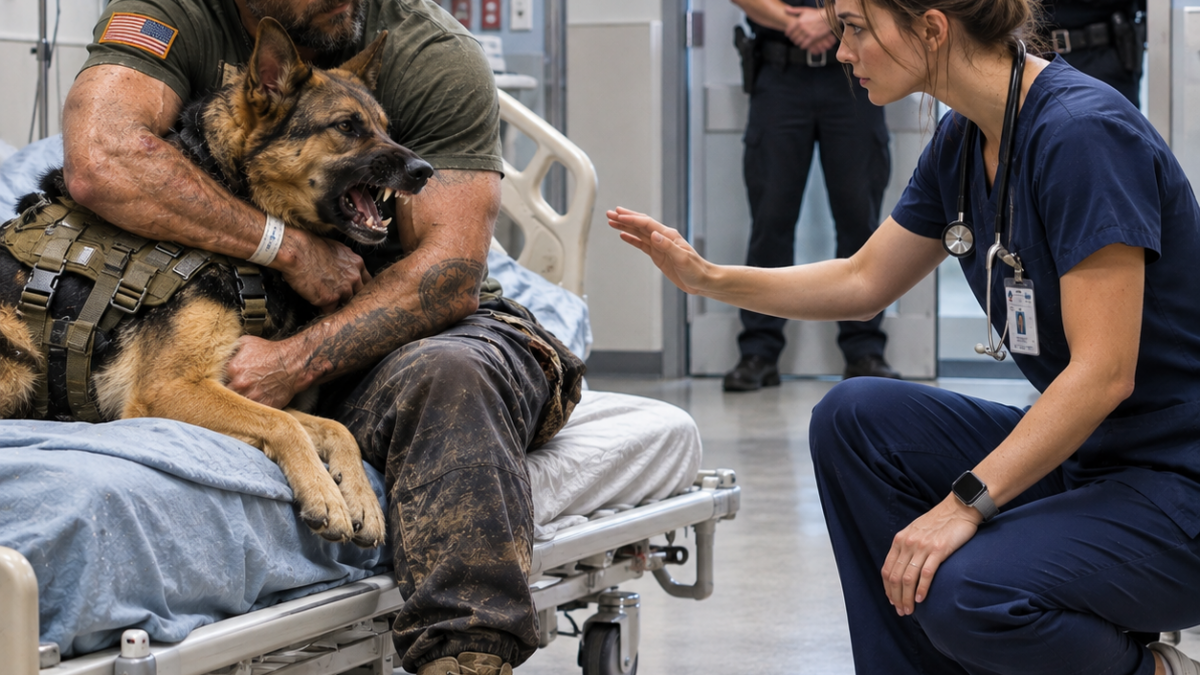
The man had repositioned himself.
His left side remained covered by Havoc.
The bed had been pushed diagonally into the far corner.
Chair near the door.
Wastebasket moved.
Table angled away from the window.
Clear sightline to both exits.
No clutter within grabbing distance.
Nothing behind him.
Rachel stared.
That wasn’t psychosis.
That was a fighting position.
“Who moved the furniture?”
“He did.”
“When?”
“First night.”
“Why?”
Denise shrugged.
“Because he’s crazy.”
Rachel didn’t respond.
A security officer approached.
Marcus Webb.
Young.
Broad shoulders.
Military haircut.
Not military, as far as Rachel knew, but he carried himself like someone who had spent enough time around uniforms to borrow the posture.
“You assigned to Cross?”
Rachel nodded.
“Starting today.”
Marcus looked at her like somebody had assigned a kindergarten teacher to defuse a bomb.
“Don’t.”
“Don’t what?”
“Go in there alone.”
Rachel looked toward Havoc.
The dog wasn’t lunging.
Wasn’t barking.
Wasn’t snapping at random targets.
He was watching hands.
Watching distance.
Watching the people closest to Ethan.
“Has Havoc actually bitten anyone?”
Marcus hesitated.
“Nearly.”
“That isn’t what I asked.”
“He got Dr. Silverman’s sleeve yesterday.”
“Skin broken?”
“No.”
“Any punctures?”
“No.”
“Then he didn’t bite him.”
“He could have.”
Rachel nodded.
“That matters.”
Marcus frowned.
“How?”
“A dog that wanted to bite him would have.”
Before Marcus could answer, another man approached from the far end of the hallway.
Jeff Hong.
Older security officer.
Tired eyes.
He lowered his voice.
“Cross has put two orderlies in the ER.”
Rachel looked at him.
“What happened?”
“First guy tried to restrain him during intake.”
“How many people approached?”
“Four.”
“Did they warn him?”
Jeff hesitated.
“I don’t know.”
“Second?”
“He woke up swinging when somebody grabbed him.”
Rachel’s eyes narrowed.
“From behind?”
“Yes.”
“And we’re calling those unprovoked attacks?”
Jeff looked at Marcus.
Marcus shrugged.
Rachel handed Denise the medication cup.
“Hold this.”
Denise stared.
“You’re not going in.”
Rachel removed the lanyard from around her neck so nothing could be grabbed easily.
Then she checked her pockets.
No scissors.
No loose equipment.
Nothing unnecessary.
She tied her auburn hair back tighter.
Marcus said:
“Rachel.”
She looked at him.
“If something goes wrong, we are not going to get through that dog before Cross hurts you.”
“I know.”
“Then don’t.”
Rachel studied Room 412.
She had been a combat medic before nursing school.
Three deployments attached to evacuation teams.
Kandahar.
Bagram.
Places where men woke from surgery believing they were still under fire.
Places where reaching for someone’s arm without warning could get your nose broken.
Places where the first job wasn’t always medicine.
Sometimes the first job was convincing a terrified person that you were not another threat.
Rachel approached the door.
Havoc saw her.
His head turned.
Growl.
Rachel stopped outside the threshold.
She didn’t reach for Ethan.
Didn’t speak to the dog.
Didn’t tell him to calm down.
She looked directly at Ethan Cross.
And said one word.
“Permission?”
The corridor went quiet.
Ethan’s eyes narrowed.
Rachel waited.
The dog kept growling.
Nobody moved.
Finally Ethan spoke.
His voice was rough from nine days of near silence.
“Permission for what?”
“To enter your room.”
Denise looked at Marcus as if Rachel had lost her mind.
Ethan stared at her.
Then his eyes moved over Rachel’s posture.
Hands visible.
Distance maintained.
Not blocking the door.
Not touching anything.
Not advancing.
Something in his face changed.
Barely.
“Who are you?”
“Rachel Donovan. Registered nurse.”
“Psych?”
“No.”
“What are you doing up here?”
“Apparently somebody thinks I need toughening up.”
A strange flicker passed through his eyes.
Almost amusement.
Almost.
Rachel nodded toward the door.
“May I come in?”
Long pause.
Then Ethan said:
“One step.”
Rachel entered exactly one step.
Stopped.
Havoc’s growl lowered.
“Again?” Rachel asked.
Ethan stared.
“You always ask permission to walk?”
“When I’m in somebody else’s room.”
“This isn’t my room.”
“You’ve been sleeping here sixteen days.”
“That doesn’t make it mine.”
“No. But you’re the one trapped in it.”
Silence.
Rachel waited.
Ethan finally nodded once.
Rachel took another step.
Havoc’s ears flicked.
She stopped again.
The dog wasn’t confused by her presence.
He was reading Ethan.
His tension rose and fell with Ethan’s.
Rachel said:
“Your dog’s a Belgian Malinois.”
Ethan’s eyes sharpened.
“At least one person in this building has eyes.”
“Working line?”
“Yes.”
“Military?”
Ethan didn’t answer.
Rachel looked at Havoc’s harness.
Old.
Repaired in three places.
One faded hook-and-loop panel had been removed.
The stitching near the top showed where something had once been attached.
“Multi-purpose canine?”
Ethan’s expression hardened.
“You military?”
“Was.”
“What?”
“Medic.”
“Where?”
“Afghanistan mostly.”
“How many?”
“Three deployments.”
Havoc stopped growling.
Rachel noticed.
So did Ethan.
She pointed gently toward the dog.
“May I crouch?”
Ethan glanced at Havoc.
Then nodded.
Rachel lowered herself slowly.
Not close.
About six feet away.
“Hey, Havoc.”
The dog’s ears came forward.
“I’ve worked with some dogs like you.”
Havoc watched.
“Smarter than half the men I knew.”
Ethan’s mouth almost moved.
Rachel continued:
“Definitely better listeners.”
The dog’s tail twitched once.
Marcus whispered through the small door window:
“I don’t believe this.”
Rachel kept her eyes on Havoc.
“I’m not touching you.”
The dog sniffed the air.
Rachel shifted her attention to Ethan.
“I came to check your vitals.”
“No.”
“Okay.”
That answer surprised him.
He stared.
Rachel said:
“We’ll try again later.”
“You’re leaving?”
“If you don’t want me checking you, yes.”
Ethan looked almost suspicious of the choice itself.
“What about the meds?”
“You’ve refused them.”
“And?”
“And I’m not forcing them into you.”
His eyes hardened.
“They will.”
“Maybe.”
“Mercer will.”
Rachel had already heard the name.
Sharon Mercer.
Director of psychiatric services.
Eight years on the fourth floor.
Known for strict protocols, excellent administrative metrics, and a belief that anything disruptive could be made manageable with medication, paperwork, or security.
Rachel said:
“We’ll talk about it.”
“There is nothing to talk about.”
“Then we won’t.”
She stood slowly.
Havoc remained still.
Rachel turned toward the door.
Ethan spoke.
“Wait.”
She looked back.
His hand rested on Havoc’s neck.
“They’re taking him.”
Rachel didn’t respond immediately.
“Who?”
“Administration.”
“Why?”
“They say he’s dangerous.”
Rachel looked at Havoc.
“He isn’t relaxed.”
“He doesn’t relax anymore.”
“Neither do you.”
Ethan’s face closed.
Rachel regretted it instantly.
Too fast.
She softened her voice.
“I’m sorry.”
That surprised him too.
“Nobody here says that.”
“They should.”
Ethan looked down at Havoc.
“They’re sending animal control.”
“When?”
“Tomorrow.”
“Did anyone explain the legal basis?”
“No.”
“Is he a certified service animal?”
“He was my working dog.”
Rachel’s breathing changed.
“Your working dog?”
Ethan looked up.
“Five years.”
“What kind of work?”
“Things I don’t discuss.”
That answered more than he realized.
Rachel stood still.
“What rank?”
His eyes narrowed.
“Why?”
“Because everybody out there keeps calling you Sergeant Cross.”
A pause.
“They don’t know much.”
“What should they call you?”
He looked away.
“Ethan is fine.”
Rachel nodded.
“Okay, Ethan.”
She walked to the door.
Behind her he said:
“You aren’t going to ask what I did?”
“No.”
“Why not?”
“Because if it matters medically, you’ll tell me.”
She opened the door.
“And if it doesn’t, it’s yours.”
She stepped into the hallway.
The door locked behind her.
Denise stared.
“Are you stupid?”
Rachel took back the medication cup.
“Probably.”
Marcus looked impressed despite himself.
“He talked.”
Rachel nodded.
“He has a voice.”
“He hasn’t said more than three words to staff in nine days.”
Rachel looked through the window.
Ethan had already returned to the bed.
Havoc lay beside him.
Not fully.
Chest down.
Head up.
Still working.
Rachel said:
“Maybe nobody gave him anything worth saying.”
That was when Sharon Mercer appeared.
She wore a cream-colored blazer over dark slacks, blond hair perfectly styled, hospital badge clipped precisely at her waist.
She looked less like someone who worked on a psychiatric floor than someone who owned the building.
Her gaze moved from Rachel to Room 412.
Then to the watching staff.
“Nurse Donovan.”
Rachel turned.
“My office.”
The office had inspirational quotes on the walls.
COMPASSION IS THE HEART OF CARE.
EVERY PATIENT DESERVES TO BE HEARD.
Rachel noticed those immediately.
Sharon closed the door.
“What exactly did you think you were doing?”
“Assessing my assigned patient.”
“Without security.”
“They were outside.”
“You entered alone.”
“Yes.”
“You sat down.”
“Yes.”
“Six feet from a patient who has assaulted multiple staff members.”
Rachel remained calm.
“He didn’t assault me.”
“That isn’t a defense.”
“No. It’s an observation.”
Sharon walked around her desk.
“Rachel, you’ve worked here eleven days.”
“Yes.”
“You’ve worked on this floor for four hours.”
“Yes.”
“And somehow you’ve already decided everyone who treated Ethan Cross before you was wrong.”
“I didn’t say that.”
“You implied it.”
Rachel took a breath.
“May I tell you what I saw?”
Sharon folded her arms.
Rachel continued.
“His room is set up tactically.”
Sharon’s expression didn’t change.
“He maintains visual control over the entrance and window. Havoc protects his weaker side. Cross reacts to sudden group approaches, physical grabbing, and people entering without warning.”
“He is paranoid.”
“He’s hypervigilant.”
“That’s a symptom.”
“It can be.”
Sharon’s voice sharpened.
“It is.”
Rachel looked directly at her.
“Sometimes a behavior that looks pathological in the wrong context is completely understandable in the right one.”
Sharon laughed.
“You think because you were a military medic, you’re a psychiatrist now?”
“No.”
“Good.”
“But I’ve treated people who just came out of combat.”
“So have our psychiatrists.”
“Have they been in combat?”
Sharon’s face chilled.
“That is irrelevant.”
“It isn’t to him.”
Sharon sat.
“Let’s discuss the dog.”
Rachel waited.
“Tomorrow at eight, animal control will transfer Havoc to a VA-approved behavioral facility in Cincinnati.”
“Against Cross’s wishes?”
“Yes.”
“What assessment determined removal was clinically necessary?”
“Mine.”
“You’re not a veterinary behaviorist.”
Sharon’s jaw tightened.
“The animal has displayed aggressive behavior.”
“He’s protecting his handler.”
“From my staff.”
“Because the staff keep approaching his handler as a threat.”
Sharon leaned forward.
“This hospital does not adapt its safety standards around one patient’s delusions.”
Rachel felt anger rise.
She controlled it.
“Is Havoc legally documented as a service animal?”
“That is being reviewed.”
“Was he previously a military working dog?”
“That is irrelevant.”
“It’s very relevant.”
“Nurse Donovan.”
Rachel stopped.
Sharon opened a folder.
“Tomorrow morning Nurse Kowalski will administer a sedative to Mr. Cross before the transfer.”
Rachel stared.
“Why?”
“To prevent escalation.”
“You’re going to sedate him so he can’t resist while you remove his dog.”
“We are going to provide medication to reduce anxiety.”
“He doesn’t consent.”
“His current hold allows clinically necessary treatment.”
“Taking his dog isn’t treatment.”
Sharon’s expression hardened.
“You’re getting dangerously close to insubordination.”
Rachel’s pulse accelerated.
She thought of Ethan.
Room 412.
Havoc awake even when Ethan slept.
Two living things rotating watch because neither trusted anybody else.
Rachel said quietly:
“I won’t administer it.”
Sharon blinked.
“What?”
“If I’m assigned, I won’t administer sedation for the purpose of making it easier to remove Havoc.”
“You will follow orders.”
“No.”
The room became very quiet.
Sharon stood.
“Do you understand what refusing a direct clinical order can do to your career?”
“Yes.”
“Your license?”
“Yes.”
“Your employment?”
“Yes.”
“And you’re still refusing.”
“Yes.”
Sharon smiled.
It wasn’t warm.
“Then perhaps Riverside isn’t the right place for you.”
Rachel stood.
“Maybe.”
Sharon pointed toward the door.
“Dismissed.”
Rachel reached it.
Sharon spoke again.
“You think you’re helping him.”
Rachel turned.
“I am listening to him.”
“Listening isn’t treatment.”
“No.”
Rachel looked at the poster behind Sharon.
EVERY PATIENT DESERVES TO BE HEARD.
“Sometimes it’s where treatment starts.”
She left.
At two that afternoon, Rachel returned to Room 412.
Havoc recognized her before Ethan did.
His head lifted.
No growl.
Rachel stopped at the threshold.
“Permission?”
Ethan looked up.
Something almost human returned to his exhausted expression.
“Come in.”
She entered.
Closed the door gently.
“They’re coming tomorrow.”
“I know.”
“You can’t stop it.”
“Maybe not.”
He stared.
“But I’m not helping them sedate you.”
Ethan’s eyes narrowed.
“Why?”
“Because it’s wrong.”
“That usually doesn’t stop people.”
“No.”
He looked down.
“They’ll fire you.”
“Possibly.”
“For someone you’ve known one day.”
Rachel pulled the chair forward.
Asked:
“Permission?”
He gave a tired exhale.
“Yes.”
She sat.
For a while neither spoke.
Havoc eventually lowered his chin to his paws.
The first time Rachel had seen him do it.
She asked:
“What unit?”
Ethan’s eyes sharpened.
“You said you weren’t going to ask.”
“I said I wouldn’t ask what you did unless it mattered medically.”
“And now it matters?”
“Yes.”
“Why?”
“Because your chart is full of redactions, your behavior is being misinterpreted, your dog has operational training, and somebody keeps describing normal tactical responses as psychotic symptoms.”
Ethan watched her.
“You know what JSOC means?”
Rachel’s stomach tightened.
“Yes.”
He said nothing.
Rachel waited.
Finally:
“Tier One.”
She didn’t react outwardly.
Inside, every piece shifted.
“How many deployments?”
“Twelve.”
“Countries?”
“Six.”
“SEAL?”
A long pause.
Then:
“Yes.”
There it was.
Not for drama.
Not a reveal.
A fact he had tried to bury because facts like that make strangers ask questions they have not earned the right to ask.
“Chief Petty Officer?”
He looked at her.
“You saw the old tattoo?”
“No.”
“Then how?”
“Your posture when somebody gives an order you don’t respect.”
For the first time, Ethan laughed.
One dry sound.
It disappeared quickly.
Rachel nodded toward Havoc.
“How long together?”
“Five years active.”
“Two tours?”
“Yes.”
“What did he do?”
“Explosives. Patrol. Tracking. Apprehension.”
Ethan’s hand moved to the dog’s shoulder.
“Saved my life four times that I know of.”
Rachel watched his fingers disappear into Havoc’s coat.
“And the last mission?”
Ethan’s expression closed.
“Classified.”
“Fine.”
“I got medicaled out.”
He touched the scar on his neck.
“Blast injury. Hearing loss left side. Nerve damage in the arm. Sleep went to hell. Havoc took shrapnel in the hip.”
“He retired with you?”
“I fought for him.”
His voice changed.
“They wanted to send him to a training facility.”
“What happened?”
“I called every person who still owed me something.”
His hand tightened gently around Havoc’s scruff.
“I got him.”
“And since then?”
Ethan looked toward the door.
“Everybody thinks he keeps me sick.”
Rachel waited.
“He’s the reason I’m alive.”
That sentence carried no theatrics.
It didn’t need them.
Rachel asked:
“What happened at the housing facility?”
Ethan’s face hardened.
“The chart says I became paranoid about an environmental threat.”
“That’s how they wrote it.”
“What happened?”
“Havoc alerted.”
“To what?”
“Basement.”
“What did you think?”
“Gas.”
Rachel sat straighter.
“Was there?”
Ethan looked at her.
“Yes.”
Her stomach dropped.
“Confirmed?”
“Fire department found a leak after they already had me restrained.”
Rachel felt anger crawl up her neck.
“Is that in your hospital chart?”
“You tell me.”
It wasn’t.
The intake report described Ethan insisting the building was unsafe despite staff reassurance.
Paranoid fixation.
Escalating aggression.
Potential delusion.
No gas leak.
Rachel whispered:
“Jesus.”
Ethan smiled bitterly.
“Exactly.”
“They restrained you for being right.”
“They restrained me because I wouldn’t stop telling them they were wrong.”
“And Havoc?”
“He kept trying to lead people downstairs.”
“So they called him aggressive.”
“He barked.”
Rachel looked toward the door.
“Does Sharon know?”
“She doesn’t care.”
Rachel wanted to say that wasn’t fair.
Then remembered the sedative.
Maybe it was.
Ethan asked:
“Why do you care?”
Rachel looked at him.
“Kandahar, 2016.”
His face changed slightly.
“A JSOC team came into our field hospital after a mission went bad.”
Ethan became completely still.
“Three operators critical.”
She swallowed.
“We worked eleven hours.”
“What date?”
Rachel told him.
Ethan looked down.
“That was Red Talon.”
Rachel didn’t know the mission name.
His reaction told her enough.
“You were there?”
“Different element.”
He looked at her again.
“I heard about the medic team.”
Rachel shrugged.
“We did our job.”
“One guy came in with almost no blood pressure.”
“Yes.”
“Survived?”
“Yes.”
“Another had a chest wound.”
“Yes.”
“He survived too.”
“Yes.”
Ethan stared at her.
“You were one of those medics?”
“Yes.”
He leaned back.
For the first time since Rachel entered, the tension left both shoulders.
Not all of it.
Enough.
“You people saved three of ours that night.”
Rachel shook her head.
“The surgeons did.”
“Don’t do that.”
“Do what?”
“Disappear from your own story.”
The words hit harder than he intended.
Rachel looked away.
Ethan noticed.
Didn’t push.
After a moment she stood.
“Tomorrow, they’ll come for Havoc.”
“I know.”
“I can’t promise I can stop them.”
He looked at her.
“But I can promise I won’t help them hurt you to do it.”
Ethan stared.
“Why?”
Rachel opened the door.
“Because somebody should have said that sixteen days ago.”
That night, Ethan slept for ninety-three consecutive minutes.
The longest since admission.
Havoc slept at the same time.
Nobody on staff noticed except Rachel.
She wrote it down.
At 6:56 the next morning, Rachel pulled into Riverside’s parking lot and saw three extra security vehicles.
At 7:03, she reached the fourth floor.
Animal control had arrived early.
Two officers.
Heavy gloves.
Catch poles.
Protective sleeves.
Sharon Mercer stood outside Room 412.
Denise held a loaded syringe.
Rachel stopped.
“What is that?”
Denise looked almost embarrassed.
Sharon wasn’t.
“You’ve been removed from the case.”
Rachel looked at the syringe.
“What dose?”
“Nurse Donovan.”
“What dose?”
“Not your concern.”
“What’s in it?”
Sharon stepped toward her.
“You were given a direct instruction yesterday. You refused. Nurse Kowalski will proceed.”
Rachel looked at Denise.
“Don’t.”
Denise’s face hardened defensively.
“Don’t make this harder.”
“I’m trying to stop it from becoming harder.”
Sharon turned toward the animal-control officers.
“Proceed.”
A master key unlocked Room 412.
The door opened.
Everything happened in less than three seconds.
Havoc exploded forward.
Not wild.
Precise.
One officer swung the catch pole.
Havoc moved around it.
Second officer raised a padded arm.
Havoc seized the sleeve.
Clamped.
Held.
No shaking.
No tearing.
Controlled grip.
The officer shouted.
Ethan’s voice cut through everything.
“HAVOC! OUT!”
Instant release.
The dog backed into the doorway.
Positioned.
Teeth visible.
Ethan stood behind him.
Barefoot.
Breathing hard.
Eyes far away.
Rachel knew that look.
She’d seen it in Kandahar.
Ethan wasn’t on the fourth floor anymore.
He was surrounded.
Unknown hands.
Weapons.
Dog threatened.
Door compromised.
No trusted route out.
Sharon shouted:
“Restrain that animal!”
Rachel stepped between them.
“Everybody back.”
Sharon snapped:
“No.”
“If you rush that doorway, somebody is getting hurt.”
“Move.”
“No.”
Sharon’s face went red.
“Nurse Donovan, I will have security remove you.”
Rachel didn’t turn.
“Then do it after I get him back.”
“Back from where?”
Rachel looked through the doorway.
Ethan’s eyes were scanning people who weren’t there.
“From somewhere none of you can see.”
Silence.
Rachel lifted both hands.
“Give me two minutes.”
Sharon shook her head.
“One.”
Rachel moved toward the doorway.
Havoc growled.
She stopped.
“Ethan.”
Nothing.
“Chief Cross.”
His gaze flickered.
She used the word that had opened the door the first time.
“Permission?”
Ethan’s eyes found hers.
Not fully.
But enough.
Rachel took one step.
“You’re at Riverside Veterans Hospital.”
Breathing hard.
“Columbus, Ohio.”
Havoc watched.
“Thursday morning.”
Another step.
“My name is Rachel Donovan.”
Ethan blinked.
“You know me.”
His breathing slowed fractionally.
Rachel pointed toward the dog.
“Havoc did his job.”
Ethan’s mouth moved.
No sound.
“He protected you.”
Another step.
“But he’s waiting for you now.”
Rachel stopped four feet away.
“You’re his handler.”
Ethan’s eyes finally focused.
“Call him down.”
His right hand trembled.
Slowly, two fingers moved.
Small signal.
Barely visible.
Havoc sat.
Every person in the hallway seemed to exhale together.
Rachel lowered her hands.
“Good.”
Ethan looked past her.
Catch poles.
Security.
Sedative.
His face hardened again.
Rachel said:
“Stay with me.”
Havoc remained seated.
Rachel turned.
“This is what I tried to tell you.”
Sharon stepped forward.
“You are interfering with an authorized safety procedure.”
“You just triggered a combat response.”
“He attacked an officer.”
“He stopped the instant his handler commanded him.”
“He is dangerous.”
“No.”
Rachel pointed toward Havoc.
“He is trained.”
Sharon laughed in disbelief.
“Those are not mutually exclusive.”
Before Rachel could answer, a male voice came from behind the crowd.
“Maybe you should listen to the nurse.”
Everyone turned.
Three uniformed military officers stood at the far end of the corridor.
Behind them was a civilian carrying Department of Defense credentials.
The man in front was in his fifties.
Gray at the temples.
Army dress uniform.
Decorations that made even the hospital security officers straighten without knowing why.
He walked forward.
Sharon stepped into his path.
“Who are you?”
He showed identification.
“Lieutenant Colonel Marcus Webb, United States Army Special Operations Command.”
The security officer Marcus Webb stared.
Same surname.
No relation.
He instinctively straightened anyway.
The colonel gestured.
“Major Sarah Rodriguez. Captain James Mitchell. Special Agent Daniel Torren, Department of Defense Inspector General.”
Sharon’s face changed.
“I wasn’t informed of a military visit.”
Colonel Webb looked toward Room 412.
“We aren’t visiting.”
Pause.
“We’re extracting.”
Nobody spoke.
Webb walked toward Ethan.
Stopped.
“Chief Petty Officer Cross.”
The use of the rank changed the hallway.
Ethan straightened.
Automatic.
Old reflex.
“Sir.”
“At ease.”
Ethan didn’t relax.
Webb looked at Havoc.
Then at the catch poles.
Then at the syringe in Denise’s hand.
His expression became almost frighteningly calm.
“Would someone like to explain why two animal-control officers are attempting to seize a retired military working dog from a decorated Naval Special Warfare veteran?”
Sharon recovered first.
“Chief Cross is under psychiatric hold because of violent behavior. The animal has demonstrated aggression toward staff.”
Webb looked at Havoc.
“Has anyone been bitten?”
Silence.
The animal-control officer rubbed his padded sleeve.
“No skin injury, sir.”
“Has anyone been seriously injured by the dog?”
“No.”
Sharon interrupted.
“He has cornered staff.”
Webb looked at her.
“While they were attempting physical intervention with his handler?”
No answer.
Webb turned to Agent Torren.
“Document that.”
Torren began typing.
Sharon’s face paled.
“What exactly is happening?”
Major Rodriguez answered.
“Three days ago, your facility requested access to Chief Cross’s full service record.”
“Yes.”
“That record is sealed.”
“We needed it for psychiatric evaluation.”
“The request triggered an automatic review.”
Sharon went still.
Rodriguez continued.
“We investigated why a civilian psychiatric unit was attempting to access highly restricted JSOC medical and operational records.”
Webb looked at Ethan.
“We found out he was here.”
Then at Sharon.
“And we found out why.”
Ethan spoke.
“You people haven’t contacted me in five years.”
Webb’s expression changed.
“We tried.”
“Not hard.”
“No.”
The admission surprised everyone.
Webb stepped closer.
“You’re right.”
Ethan looked at him.
“We attempted contact four times in the last eighteen months. Addresses were outdated. Phone disconnected. VA coordinators couldn’t locate you.”
“I didn’t want to be located.”
“I understand.”
“No, you don’t.”
Webb accepted that too.
“Maybe not.”
Ethan’s breathing slowed.
Webb continued:
“But when we pulled the intake record, we saw the housing incident.”
Rachel watched.
“We got the fire marshal’s report.”
Ethan’s face tightened.
Webb said:
“Havoc detected a natural-gas leak.”
Sharon looked at him.
“What?”
“A confirmed gas leak.”
Rachel saw Denise slowly lower the syringe.
Webb continued.
“Chief Cross was not experiencing a paranoid delusion. His military working dog alerted to a real environmental hazard.”
Sharon said:
“That information wasn’t provided to us.”
Agent Torren looked up.
“It existed.”
“Not in our chart.”
“That’s one problem we’re going to discuss.”
Webb looked down the corridor.
“Another is the apparent effort to forcibly sedate a veteran so staff could remove his protected service animal.”
Sharon’s lips parted.
“The medication was clinically indicated.”
Rachel said:
“No, it wasn’t.”
Sharon snapped toward her.
Webb looked between them.
“Who ordered it?”
Silence.
Then Sharon:
“I did.”
Torren typed.
Webb’s voice remained calm.
“Thank you.”
That somehow sounded worse than anger.
Sharon said:
“I have authority over this unit.”
“You have authority to deliver lawful medical care.”
Webb stepped closer.
“You do not have authority to invent your own rules for federal disability protections because a patient is inconvenient.”
Sharon’s hands trembled slightly.
“We were protecting staff.”
“Then where was the behavioral specialist?”
No answer.
“Where was the military liaison?”
Silence.
“Where was the service-dog specialist?”
Nothing.
“Where was the trauma-informed care plan?”
Sharon looked toward her office.
Webb nodded once.
“That’s what I thought.”
He turned toward Ethan.
“Pack your things.”
Ethan didn’t move.
“Sir?”
“You and Havoc are leaving.”
“Where?”
“Military medical facility in Virginia. Trauma team. People who know working dogs.”
Ethan stared.
“No restraints?”
“No.”
“No separation?”
“No.”
His hand dropped to Havoc’s head.
The dog leaned against him.
Something in Ethan’s face broke.
Not dramatically.
His eyes simply closed for two seconds too long.
Rachel looked away to give him privacy.
Webb turned toward Sharon.
“Agent Torren will remain.”
Sharon swallowed.
“For what?”
“Review.”
“Of this incident?”
Webb’s expression changed.
“All of them.”
That was the moment Sharon Mercer understood that Room 412 was no longer a personnel problem.
It was evidence.
Twenty-three minutes later, Ethan emerged dressed in jeans, black T-shirt, boots, carrying a worn deployment duffel.
Havoc wore his old tactical harness.
He walked at Ethan’s left knee.
No leash tension.
No growling.
No aggression.
Patients watched from doorways.
Staff pretended not to.
Ethan stopped in front of Rachel.
For several seconds, neither spoke.
Then he said:
“You asked.”
Rachel frowned.
“What?”
“First thing.”
His voice roughened.
“You asked permission.”
Rachel swallowed.
He looked down at Havoc.
“Everybody else came in telling me what they were going to do to me.”
Then back at her.
“You asked.”
Rachel nodded.
“It’s your body.”
A strange expression crossed Ethan’s face.
Pain, maybe.
Gratitude, maybe.
Something older.
“You were willing to lose your job.”
“Yes.”
“Why?”
Rachel gave the answer she believed.
“Because it was my job.”
He almost smiled.
“No.”
Rachel waited.
“That was something else.”
Then he held out his hand.
Rachel took it.
His grip was firm.
Not crushing.
“Thank you, Rachel.”
She squeezed once.
“Get better.”
Ethan looked at Havoc.
“We’ll try.”
They walked toward the elevator.
Havoc looked back once.
Rachel lifted her hand.
The dog turned forward.
The elevator doors closed.
Rachel stood there longer than she should have.
Then Colonel Webb approached.
“Nurse Donovan.”
“Yes, sir.”
“You were removed from his case this morning?”
Rachel looked toward Sharon.
“Yes.”
“Why?”
Sharon answered before she could.
“Staff reassignment based on appropriate experience.”
Webb pulled a folded report from his pocket.
“That’s interesting.”
Sharon’s face stiffened.
“Because the incident documentation I received says Nurse Donovan was reassigned after refusing to sedate Chief Cross for the forced animal transfer.”
Nobody spoke.
Webb looked at Rachel.
“Is that accurate?”
Rachel said:
“Yes.”
Webb nodded.
Then handed her a card.
“If anyone retaliates against you, call.”
Sharon said sharply:
“This is an internal employment matter.”
Webb turned.
“Not anymore.”
The elevator opened.
Before entering, he looked at Rachel.
“You stood up for one of ours.”
Rachel shook her head.
“He’s my patient.”
Webb nodded.
“Exactly.”
Then he left.
Ten minutes later, Sharon summoned Rachel to her office.
The motivational poster was still there.
EVERY PATIENT DESERVES TO BE HEARD.
Sharon sat.
Rachel remained standing.
“I am placing you on administrative review.”
Rachel almost laughed.
“For what?”
“Insubordination.”
“For refusing an inappropriate sedation order?”
“For disregarding supervisory authority.”
“Anything else?”
“Violation of chain of command.”
Rachel nodded.
“What happens now?”
“You’ll be reassigned to non-patient-facing duties.”
“How long?”
“Until review is complete.”
“Meaning?”
“Inventory. Sterilization. Records.”
Rachel stared.
“You’re benching me.”
“I am protecting patients while your conduct is evaluated.”
Rachel looked at the poster.
Then Sharon.
“You know federal investigators are in the building.”
“I know exactly who’s in my building.”
Rachel almost corrected her.
Didn’t.
Sharon continued:
“I strongly advise you not to communicate with those military personnel during an active employment investigation.”
“Are you ordering me?”
“I’m advising you.”
Rachel nodded.
“Then I decline your advice.”
Sharon’s eyes hardened.
“You’re making a serious mistake.”
Rachel walked toward the door.
“Maybe.”
She looked back.
“But at least it’ll be mine.”
By three that afternoon, she was sorting boxes in the basement.
Denise found her there.
For a while, Denise said nothing.
Then:
“You really screwed yourself.”
Rachel kept counting sterile gauze.
“Probably.”
“Sharon has friends on the board.”
“Okay.”
“She has connections.”
“Okay.”
“You think those military people are going to save your career?”
Rachel looked up.
“I didn’t do it for my career.”
Denise laughed bitterly.
“That’s what people say until rent is due.”
Rachel set down the clipboard.
“Why did you have the syringe?”
Denise’s face tightened.
“I was assigned.”
“That isn’t what I asked.”
“Don’t.”
“Did you think it was right?”
Denise stared at her.
Then away.
“I have two kids in college.”
Rachel waited.
“A mortgage.”
Still Rachel waited.
“A husband who got laid off last year.”
Rachel softened slightly.
Denise said:
“People like you think courage is free.”
“No.”
Rachel’s voice was quiet.
“I know exactly what it costs.”
Denise looked at her.
“Then why do it?”
Rachel thought about Ethan.
Because someone should have done it sixteen days ago.
Instead she said:
“Because eventually the bill for staying quiet gets sent to somebody else.”
Denise walked away.
At 7:18 that night, Rachel’s phone buzzed.
Unknown number.
This is Major Rodriguez. Colonel Webb asked me to pass along his thanks. Chief Cross and Havoc arrived safely. Document any retaliation.
Rachel read it twice.
She replied:
Already started.
The next morning brought the first reporter.
By noon, there were four.
By afternoon, Sharon was demanding to know whether Rachel had leaked patient information.
Rachel hadn’t.
The investigation had begun producing public-record requests.
Veteran advocacy groups had heard.
Former patients started talking.
Then Agent Torren sent Rachel formal notice.
She had been identified as a material witness in a Department of Defense Inspector General investigation into possible violations of veteran protections at Riverside.
Rachel sat in her car reading the message.
Material witness.
The phrase felt enormous.
Her phone rang.
Major Rodriguez.
“You received it?”
“Yes.”
“You okay?”
“No.”
“Good.”
Rachel almost laughed.
“Good?”
“Means you understand the stakes.”
Rachel leaned her head against the seat.
“What did you find?”
A pause.
“Chief Cross wasn’t the first.”
Something cold moved through Rachel.
“How many?”
“Six similar cases in eighteen months.”
Rachel closed her eyes.
Rodriguez continued.
“Three involved service animals.”
“What happened?”
“Removed.”
Rachel gripped the steering wheel.
“Veterans?”
“Two repeatedly restrained.”
Pause.
“One chemically sedated for nearly forty-eight hours.”
Rachel felt sick.
“Where are they?”
Another pause.
“Two died by suicide after discharge.”
Rachel stopped breathing for a moment.
Rodriguez’s voice softened.
“This is bigger than Cross.”
Rachel whispered:
“I know.”
“Do you?”
“No.”
“Neither do we yet.”
That night, Rachel received the first anonymous message.
STOP TALKING TO INVESTIGATORS.
Then:
YOU ARE MAKING THINGS WORSE FOR EVERYONE.
Then:
THIS IS YOUR ONLY WARNING.
Her hands shook.
For several seconds, she considered deleting it.
Then old training returned.
Document.
Preserve.
Duplicate.
She screenshot everything.
Forwarded the messages to Torren and Rodriguez.
Opened her laptop.
Started a timeline.
Dates.
Times.
Names.
Exact quotes.
Who stood where.
What Sharon said.
What Denise held.
What Havoc did.
What Ethan said.
Every detail.
She backed it up three times.
At 11:47 p.m., she received an email from Riverside legal.
Formal employment review.
Potential violations of confidentiality.
Chain of command.
Professional conduct.
Hearing scheduled.
Rachel stared at the screen.
Then laughed.
Not because it was funny.
Because sometimes cruelty becomes so predictable it starts looking lazy.
At 5:47 the next morning, Torren called.
“Don’t attend that hearing without counsel.”
Rachel sat up.
“Why?”
“They’re building a termination-for-cause record.”
“I can’t just ignore it.”
“You won’t. You’ll request time for counsel.”
Rachel rubbed her eyes.
“I have three thousand dollars.”
“DoD witness support can help.”
“This is insane.”
“Yes.”
“I’m a nurse.”
“I know.”
“I walked into one room.”
“I know.”
“I asked one patient if I could come inside.”
Torren was quiet.
Then he said:
“Sometimes that’s where these things start.”
Rachel hired Lydia Brennan.
Fifty-four.
Federal whistleblower attorney.
Sharp eyes.
Sharper voice.
She read Rachel’s three-inch folder in less than half an hour.
Then looked up.
“You document like military.”
“I was.”
“I know.”
Rachel blinked.
“Torren told you?”
“Only what’s relevant.”
Brennan tapped the folder.
“This habit may save your license.”
Rachel said:
“I thought the truth would do that.”
Brennan smiled without humor.
“You’re adorable.”
Rachel glared.
Brennan leaned back.
“Truth is evidence wearing no shoes.”
“What does that mean?”
“It means if you want truth to survive court, give it documents.”
Over the following days, Riverside’s attempt to isolate Rachel became obvious.
Basement assignments.
No clinical work.
Coworkers stopped texting.
Two nurses unfriended her online.
A manager she barely knew wrote a memo questioning her “interpersonal stability.”
Then the threats escalated.
Rachel’s address appeared online.
A photograph of her apartment building was posted beneath a message asking how quickly an old structure could burn.
Major Rodriguez called at eleven that night.
“Pack.”
Rachel sat up.
“What?”
“You’re moving.”
“Where?”
“Hotel near the federal building.”
“This is ridiculous.”
“This is credible.”
That word changed everything.
Rachel moved.
Two nights later, another anonymous message arrived.
YOU SHOULD HAVE TAKEN THE MONEY.
There had been no money offered yet.
Rachel called Brennan immediately.
The attorney went silent.
“Interesting.”
“Why?”
“Because whoever sent that knows what Riverside’s legal team is planning.”
The offer came Monday.
Seven hundred fifty thousand dollars.
Two years of benefits.
Neutral reference.
In exchange:
Drop the suit.
Sign a comprehensive nondisclosure agreement.
Stop talking.
Brennan put the call on speaker.
Hospital counsel finished.
Rachel looked at Brennan.
Shook her head.
Brennan smiled.
“My client declines.”
Silence.
The attorney on the phone said:
“Miss Donovan should understand this is an exceptionally generous offer.”
Rachel leaned toward the phone.
“I understand.”
“If you reject it, litigation could last years.”
“I understand.”
“You may find future employment difficult.”
Rachel’s jaw tightened.
“I understand.”
“Then perhaps you should reconsider.”
Rachel looked at the photograph on Brennan’s desk.
A courtroom.
A woman holding the hand of another woman outside federal court.
She thought about Ethan.
Havoc.
Two veterans who never made it far enough to testify.
“No.”
Brennan ended the call.
Then looked at Rachel.
“Congratulations.”
“For what?”
“You just became extremely expensive to intimidate.”
Rachel didn’t feel brave.
She felt nauseated.
The DoD preliminary report was released days later.
Forty-seven pages.
Systematic failures.
Inadequate trauma-informed care.
Questionable forced sedation.
Improper treatment of service animals.
Retaliation against staff.
Multiple veteran cases.
The news exploded.
Veterans gathered outside Riverside.
Former employees contacted investigators.
Sharon held a press conference describing allegations as “misunderstandings involving complex psychiatric cases.”
Rachel watched from the hotel.
When a reporter asked whether Riverside had attempted to remove a decorated veteran’s service dog, Sharon replied:
“Patient confidentiality prevents discussion of individual cases.”
Rachel shut off the television.
Brennan called.
“She’s good.”
Rachel stared at the dark screen.
“She’s lying.”
“No. She’s surviving.”
“What’s the difference?”
“In public relations? About six billable hours.”
Rachel almost smiled.
Then Brennan became serious.
“Do not underestimate her.”
“I don’t.”
“Good.”
Three days later, Ethan called.
His voice was different.
Not happy.
Steadier.
“Nurse Donovan.”
“Ethan.”
“Havoc is asleep.”
Rachel smiled.
“That’s news?”
“For him?”
Pause.
“Yeah.”
“Where?”
“Middle of the room.”
“Not covering the door?”
“No.”
Rachel closed her eyes.
“That is news.”
“They’ve got a program here with retired working dogs.”
“And you?”
“Therapy.”
“How’s that going?”
“Terrible.”
She laughed.
“Good.”
“You sound like Rodriguez.”
“Maybe therapy is working already.”
He was quiet.
Then:
“I saw the report.”
Rachel’s smile disappeared.
“Yeah.”
“You didn’t have to do this.”
“Yes, I did.”
“No.”
His voice hardened.
“You could’ve taken the money.”
Rachel frowned.
“How do you know about that?”
“Military grapevine.”
“Apparently classified information is safer than settlement negotiations.”
Ethan almost laughed.
Then:
“You’re in danger because of me.”
“No.”
“Rachel.”
“Because of Riverside.”
“You met Riverside because of me.”
“I worked there.”
Silence.
Then he said:
“If you need anything, call.”
“You don’t owe me.”
“Stop saying that.”
“Why?”
“Because you don’t get to decide what something meant to me.”
That silenced her.
Ethan continued.
“You walked into that room and asked permission.”
Rachel swallowed.
“You have no idea how long it had been since anybody asked me anything.”
She looked out the hotel window.
Traffic far below.
“You saved yourself.”
“Maybe.”
“Havoc saved you too.”
“Definitely.”
“Then give him the credit.”
Ethan laughed softly.
“I do.”
Pause.
“But I’m keeping some for you.”
Three nights later, at 2:47 a.m., Rachel’s landlord called.
Her apartment building was on fire.
She drove there with the security detail Rodriguez had assigned her.
Retired Marine Katherine Voss.
Six feet of quiet menace who seemed capable of threatening a parking meter into surrender.
Fire engines filled the street.
Smoke poured from Rachel’s third-floor windows.
Everything she owned was inside.
Photographs.
Deployment keepsakes.
Her mother’s old letters.
Books.
Uniform patches.
The mug her younger brother had given her when she graduated nursing school.
Gone.
A detective met her beyond the tape.
Morgan Price.
“We found accelerant.”
Rachel stared at him.
“What?”
“Three ignition points.”
Her knees felt weak.
“This wasn’t accidental.”
Katherine moved closer.
Rachel looked up at the window that had been her living room.
“Was anyone hurt?”
“Two smoke inhalation. No deaths.”
Relief hit first.
Then rage.
“Because of me.”
Detective Price said:
“Because of whoever lit the fire.”
Rachel turned.
“Same thing.”
“No.”
His voice was firm.
“Don’t carry their crime for them.”
The next afternoon, Sharon Mercer was arrested.
Rachel watched from Brennan’s office as police walked the hospital director through a crowd of reporters.
Handcuffs.
Hair uncombed.
Face gray.
Brennan lowered the television volume.
“They found messages between her and a private security contractor.”
Rachel couldn’t move.
“What messages?”
“References to removing obstacles.”
Rachel’s stomach turned.
“And?”
“Contractor hired a man to burn your apartment.”
Rachel sat.
Brennan continued.
“He was picked up this morning.”
“He talked?”
“Immediately.”
Rachel covered her face.
“Why?”
“Money. Fear. Pick one.”
“And Sharon?”
“Conspiracy. Witness intimidation. Arson. Potential attempted murder charges.”
Rachel looked up.
“Why would she go that far?”
Brennan’s expression became grim.
“Because this is bigger than her job.”
That sentence proved true.
Investigators followed the money.
Private contractors.
Shell companies.
Consulting firms.
Then Castellan Group.
The healthcare corporation that owned Riverside.
Forty-three hospitals.
Seventeen facilities with similar complaints involving veteran care.
Cost reductions.
Shortened stays.
Pressure to reduce expensive trauma treatment.
Employees terminated after raising concerns.
Internal memos about “high-cost patient populations.”
Rachel read one document twice because she couldn’t believe the language.
Non-compliant employees should be terminated for cause to limit whistleblower exposure.
She looked at Torren.
“They planned this.”
“Parts of it.”
“This wasn’t bad training.”
“No.”
“This was policy.”
“Some of it appears to have been.”
“How many veterans?”
“We don’t know.”
“How many died?”
Torren looked away.
“More than two.”
Rachel’s hands began shaking.
She closed the file.
For the first time since Room 412, she wanted to quit.
Not the lawsuit.
Everything.
Nursing.
Advocacy.
Fighting.
She wanted a small house somewhere nobody knew her name.
A job at a clinic where the biggest scandal involved expired gauze.
She told Brennan.
The attorney listened.
Then said:
“Okay.”
Rachel stared.
“Okay?”
“You can stop.”
“I thought you’d tell me I couldn’t.”
“You can.”
“What about the case?”
“We have evidence now.”
“The veterans?”
“Other people can fight.”
Rachel looked down.
Brennan continued:
“You are allowed to be tired.”
Something inside Rachel broke.
She cried.
Not quietly.
Not beautifully.
Months of fear came out all at once.
Apartment gone.
Career threatened.
Strangers calling her liar.
Dead veterans she’d never met sitting somewhere behind her eyes.
Brennan handed her tissues.
No speeches.
When Rachel finally stopped, Brennan said:
“Still want to quit?”
Rachel breathed.
“I don’t know.”
“Good.”
“Why is that good?”
“Because yesterday you thought you weren’t allowed to.”
Rachel looked at her.
Brennan smiled slightly.
“Permission matters.”
That word again.
Weeks later, federal court opened the civil case.
Ethan came to Columbus.
Havoc with him.
The first time Rachel saw them outside the courtroom, she almost didn’t recognize Ethan.
He had gained weight.
Hair trimmed.
Clean-shaven except for a short beard.
Still scarred.
Still watchful.
But his eyes were in the room.
Havoc wore a black working-dog harness.
No muzzle.
No need.
Rachel crouched.
“Hey, troublemaker.”
Havoc crossed the space between them.
Pressed his head into her chest.
Rachel laughed.
Ethan smiled.
“He remembers.”
“I smell like hospital disinfectant.”
“He hates hospital disinfectant.”
“Then definitely me.”
Ethan looked at her.
“You okay?”
Rachel glanced at the courthouse.
“No.”
“Good.”
She looked at him.
“Why does everybody keep saying that?”
“Because people who say they’re fine before federal court are either lying or lawyers.”
Brennan appeared behind them.
“I heard that.”
Ethan nodded.
“Counselor.”
“Chief.”
Rachel looked between them.
“I’m surrounded by deeply annoying people.”
Havoc leaned against her.
“Except you.”
Ethan said:
“He’s the worst one.”
The trial lasted weeks.
Security officers testified.
Marcus Webb—the hospital guard, not Colonel Webb—described how Rachel entered Room 412 alone after everyone else insisted force was necessary.
Jeff Hong described Ethan’s tactical room setup.
Denise Kowalski took the stand reluctantly.
Rachel expected her to protect Sharon.
Instead, Denise told the truth.
The sedative.
The order.
The warnings.
Brennan asked:
“Did Nurse Donovan ever instruct you to disobey administration?”
Denise swallowed.
“No.”
“Did she tell you to lie?”
“No.”
“Did she threaten anyone?”
“No.”
“Then why did staff describe her as disruptive?”
Denise looked toward Rachel.
Her eyes filled.
“Because she said out loud what the rest of us had trained ourselves not to say.”
The courtroom became silent.
Brennan waited.
Denise continued.
“We knew some things were wrong.”
“Why didn’t you speak up?”
Denise’s voice cracked.
“Because we needed our jobs.”
Brennan’s tone softened.
“And Nurse Donovan?”
“She needed hers too.”
Pause.
“But she spoke anyway.”
Rachel looked down.
Ethan testified the next morning.
No uniform.
Dark suit.
Havoc wasn’t allowed inside during testimony, so the dog waited with Major Rodriguez outside the courtroom.
Ethan sat.
Swore the oath.
Looked at the jury.
Brennan began gently.
“Chief Cross, why were you admitted to Riverside?”
Ethan explained the housing facility.
Havoc’s alert.
The gas leak.
The police.
Restraints.
His voice remained steady.
Then she asked:
“How were you treated after admission?”
Ethan looked toward the defense table.
“Like a threat.”
“What did that mean?”
“People entered without warning.”
“Medication?”
“I refused some.”
“Why?”
“Nobody explained what they wanted it to do.”
“What happened when you asked?”
“They called it noncompliance.”
“Your room arrangement?”
“I needed to see the door.”
“Why?”
Ethan paused.
“Because for twenty years, doors mattered.”
Some jurors looked down.
Brennan asked:
“What did Havoc mean to you?”
Ethan’s voice changed.
“He was my dog.”
“Just your dog?”
“No.”
Pause.
“He was my teammate.”
“Did he serve with you?”
“Yes.”
“Did he save your life?”
“Yes.”
“How many times?”
“Four confirmed.”
“And after retirement?”
Ethan looked toward Rachel.
“He kept doing it.”
Brennan waited.
Then:
“Tell us about Nurse Donovan.”
Ethan was quiet for several seconds.
“The first word she said to me was permission.”
Brennan glanced at the jury.
“Permission for what?”
“To enter.”
“And why did that matter?”
Ethan’s jaw worked.
“Because nobody had asked me anything.”
He looked down.
“Everybody came into that room with a plan for me.”
“Medication.”
“Restraints.”
“Evaluations.”
“Dog removal.”
He looked up.
“She asked.”
Brennan’s voice was gentle.
“Did that make you trust her?”
“No.”
A few people looked surprised.
Ethan almost smiled.
“It made me consider trusting her.”
A juror smiled.
Brennan continued.
“When Riverside tried to remove Havoc, what did Nurse Donovan do?”
“She stood between us.”
“Did she threaten staff?”
“No.”
“Did she encourage violence?”
“No.”
“Did she tell you to resist?”
“No.”
“What did she do?”
Ethan looked at Rachel.
“She reminded me where I was.”
He swallowed.
“And asked me to call Havoc down.”
“What happened?”
“I did.”
Brennan stepped closer.
“Chief Cross, where do you believe you would be today if Havoc had been forcibly removed and you had remained at Riverside?”
Defense counsel stood.
“Objection. Speculative.”
Judge Cortez looked at Ethan.
“Sustained.”
Brennan nodded.
Then changed the question.
“Did you believe you would survive that hospitalization?”
Ethan’s face went still.
“No.”
Rachel stopped breathing.
Brennan asked:
“Why not?”
“I’d already decided.”
The courtroom changed.
Ethan’s voice was quiet.
“If they took Havoc, I was done.”
A woman on the jury covered her mouth.
Rachel looked at Ethan.
He hadn’t told her that.
Brennan asked:
“Done meaning?”
Ethan’s attorney objected.
Withdrawn.
No need.
Everyone understood.
Ethan looked at Rachel anyway.
“She didn’t know.”
Brennan said:
“Nurse Donovan didn’t know?”
“No.”
“Then why do you believe her intervention mattered?”
Ethan held Rachel’s gaze.
“Because sometimes somebody saves your life without knowing how close you were to giving it up.”
Rachel cried silently.
The defense made the mistake of attacking him.
They questioned PTSD.
Memory.
Aggression.
Whether trauma could distort perception.
The more they pushed, the worse it looked.
Ethan didn’t become angry.
He became precise.
“Yes, I have PTSD.”
“Yes, I have hearing damage.”
“Yes, I have nightmares.”
“No, none of that changes the fire marshal’s gas-leak report.”
The defense attorney paused.
Nothing else landed after that.
The jury deliberated eleven hours.
When they returned, Rachel held Brennan’s hand beneath the table.
Liability.
Retaliation.
Violation of rights.
Wrongful employment action.
Systemic negligence.
The verdict went against Riverside and Castellan on every major claim submitted.
Rachel didn’t cheer.
She cried.
Ethan sat behind her.
Havoc beside him now.
The dog rested his chin on Ethan’s knee.
Three weeks later, the Department of Defense held a small ceremony.
Rachel hated ceremonies.
This one was worse because her name was on the program.
Secretary of Defense Medal for Valor.
She told Colonel Webb the word valor was ridiculous.
He replied:
“Good thing you don’t decide.”
Rachel stood at the front of a conference room in a dark blue dress.
Ethan attended.
Major Rodriguez.
Agent Torren.
Captain Mitchell.
Brennan.
Havoc.
Of course Havoc.
When the citation was read, Rachel barely heard it.
Exceptional courage.
Protection of veterans.
Integrity.
Service.
She kept thinking about one door.
Room 412.
Permission?
That was all.
After the medal was pinned, people applauded.
Rachel stepped away as quickly as etiquette allowed.
Ethan found her near the hallway.
“You look miserable.”
“I am.”
“Medal heavy?”
“Emotionally.”
He smiled.
Havoc sat between them.
Rachel touched his head.
“How’s retirement?”
Ethan looked down.
“We’re learning.”
“Learning what?”
“How to sleep at the same time.”
Rachel smiled.
“Progress.”
“Yesterday he snored.”
“Evidence?”
“Video.”
“I require it.”
“Classified.”
She laughed.
Then Ethan became serious.
“You have a job?”
“Not yet.”
“Want one?”
“Depends.”
“Walter Reed is starting a trauma program.”
Rachel stared.
“How do you know?”
“People talk.”
“Again, somehow the entire special-operations community knows my employment status.”
“You made an impression.”
Rachel shook her head.
“I don’t want to be famous for this.”
“You aren’t.”
“Feels like it.”
Ethan leaned against the wall.
“You know what people remember about you?”
She waited.
“That you asked.”
Rachel looked at him.
“Not the lawsuit.”
“Some people.”
“Not the medal.”
“Some.”
He nodded toward Havoc.
“He remembers one thing.”
“What?”
“You didn’t try to take him.”
Havoc looked up at the sound of his name.
Rachel crouched.
The dog’s muzzle had begun graying around the edges.
“What do you think, buddy?”
Havoc touched his nose to her hand.
Ethan said:
“That’s basically a job recommendation.”
She smiled.
Two months later, Rachel stood outside a new clinical building in Bethesda, Maryland.
Walter Reed.
New badge.
New apartment.
Almost none of her old possessions.
Fire doesn’t give much back.
But she had bought a small table.
A secondhand couch.
Three framed photographs.
One showed her family.
One showed her medic team in Afghanistan.
The third showed Ethan and Havoc after leaving Riverside.
Not because she believed she saved them.
Because she wanted to remember what listening looked like.
Her new role involved designing veteran trauma-care protocols.
Consent before contact when clinically possible.
Clear explanation before medications.
Service-animal integration.
Military-cultural competency.
De-escalation.
Staff training.
Procedures for differentiating hypervigilance from psychosis.
None of it revolutionary.
That was what made Rachel angry.
So much suffering had come from people failing to do simple things well.
Knock.
Explain.
Ask.
Wait.
Listen.
One word became part of the training.
Not because Rachel demanded it.
One of the physicians did.
A slide appeared during orientation.
PERMISSION.
Underneath:
Never confuse control with care.
Rachel stared at it.
The physician beside her said:
“Too dramatic?”
Rachel shook her head.
“No.”
“What would you change?”
She thought.
Then added a second line.
A patient can be frightened, difficult, traumatized, angry, and still deserve dignity.
The physician nodded.
“Better.”
Months passed.
The federal cases against Sharon Mercer and the contractors continued.
Sharon ultimately received a lengthy prison sentence after pleading guilty to multiple charges related to witness intimidation, conspiracy, and the arson attack.
Castellan Group was forced into restructuring.
Several executives were indicted.
Congressional hearings followed.
Veterans from facilities Rachel had never heard of came forward.
Families brought boxes of records.
Nurses submitted emails.
Former employees testified.
Policies changed.
Not everywhere.
Not perfectly.
Systems rarely transform in one dramatic scene.
They resist.
They negotiate.
They rename.
They promise.
Then somebody has to keep checking whether the promises became practice.
Rachel became one of those people.
She never loved the attention.
But she learned not to confuse visibility with vanity.
Sometimes being visible gave another person permission to speak.
A nurse from Missouri wrote:
I reported forced sedation after reading about your case.
A veteran in Kentucky wrote:
They tried to separate me from my service dog. I knew I could say no because of what happened to Chief Cross.
The mother of one veteran who had died wrote something Rachel never forgot.
I wish someone had listened to my son the way you listened to Ethan. Please keep teaching them.
Rachel printed that one.
Kept it in her desk.
Not because it made her feel heroic.
Because it prevented her from becoming comfortable.
A year after Room 412, Ethan visited Bethesda.
He looked healthier.
Not cured.
Rachel hated that word in relation to trauma.
He was living.
Working part-time with a veteran outdoor-recovery program.
Helping former operators transition into civilian life.
Havoc came too.
Older.
Slower.
Still alert.
Rachel walked them through the new unit.
Ethan noticed the doors first.
Of course he did.
“Windows.”
Rachel smiled.
“Observation without standing in someone’s face.”
“Furniture isn’t bolted down.”
“Only what has to be.”
He looked inside one room.
Bed not shoved into a corner.
Chair movable.
Dog bed beside it.
Ethan stopped.
“You have dog beds?”
“Yes.”
“Hospital-approved?”
“Don’t sound so shocked.”
He looked at her.
“You fought an entire corporation for this?”
Rachel laughed.
“No.”
Then considered.
“Maybe a little.”
Havoc walked into the room.
Sniffed the dog bed.
Circled.
Lay down.
Ethan froze.
Rachel whispered:
“He approves.”
Ethan sat in the chair.
For a moment, the room looked ordinary.
Man.
Dog.
Nurse.
No restraints.
No security.
No threat.
Rachel leaned against the doorway.
Ethan looked up.
“You remember the first day?”
“Yes.”
“I thought you were insane.”
Rachel smiled.
“Most people did.”
“No.”
“You walked into a room with Havoc guarding me.”
“Yes.”
“You were twenty-seven.”
“Yes.”
“Five feet nothing.”
“Five-four.”
“Same thing.”
“And?”
“You asked permission like I had some authority left.”
Rachel’s smile disappeared.
“You did.”
“Didn’t feel like it.”
“I know.”
He looked down at Havoc.
“I spent years thinking trust meant knowing somebody couldn’t hurt you.”
Rachel waited.
Ethan continued.
“That’s impossible.”
“Yes.”
“People can always hurt you.”
“Yes.”
“So maybe trust is something else.”
“What?”
He thought.
“Knowing they won’t take advantage of the fact that they can.”
Rachel looked at him.
“That sounds expensive.”
“It is.”
Havoc sighed.
Ethan touched the dog’s shoulder.
“But sometimes worth it.”
A few months later, Havoc’s health began declining.
Hip pain first.
Then neurological weakness.
Old shrapnel injuries.
Age.
Years of work written into a body that had once seemed indestructible.
Ethan called Rachel late one evening.
She knew from his silence.
“What happened?”
“Havoc fell.”
“Is he hurt?”
“He got up.”
Pause.
“But not like before.”
Rachel closed her eyes.
“Vet?”
“Tomorrow.”
“I’ll come.”
“You’re in Maryland.”
“So?”
“You have work.”
“So?”
A longer silence.
Then Ethan whispered:
“Okay.”
Rachel drove to Virginia the next day.
Havoc had degenerative disease.
Manageable for a while.
Not reversible.
Ethan listened without speaking.
The veterinarian explained medications.
Mobility support.
Pain monitoring.
Quality-of-life markers.
Rachel watched Ethan’s face.
Room 412 again.
Not exactly.
But close.
A man hearing somebody discuss taking away the one life he had built everything around.
Outside, Rachel sat beside him on a bench.
Havoc lay between their feet.
Ethan said:
“I can’t do this.”
Rachel knew better than to say yes, you can.
Instead:
“I know.”
“He got me out.”
“I know.”
“Four times overseas.”
Rachel waited.
“Then after.”
His voice broke.
“After everything.”
Rachel looked at Havoc.
The dog lifted his head.
Still watching Ethan.
Always Ethan.
Rachel said:
“You’ve spent years letting him protect you.”
Ethan wiped his face angrily.
“So?”
“So eventually he’ll need you to protect him from pain.”
Ethan closed his eyes.
“That isn’t fair.”
“No.”
“You’re supposed to say something helpful.”
“I don’t have anything helpful.”
He laughed once through tears.
“Terrible nurse.”
“Documented.”
They sat together.
Havoc eventually put one paw on Ethan’s boot.
Ethan looked down.
Rachel looked away.
Havoc lived another ten months.
Good months.
Slow walks.
Warm grass.
Car rides.
A ridiculous orthopedic bed Ethan claimed cost more than his first car.
Then came the morning when he couldn’t stand without falling.
Ethan called Rachel.
One sentence.
“It’s time.”
She drove down.
Colonel Webb came.
Major Rodriguez.
Two former operators Ethan rarely talked about.
Nobody wore dress uniforms.
Nobody needed ceremony.
Havoc lay on a blanket beneath an oak tree behind Ethan’s small house.
Sunlight through leaves.
Ethan sat on the ground.
Havoc’s head in his lap.
The veterinarian explained everything.
Then asked:
“Ready?”
Ethan couldn’t answer.
Rachel crouched beside him.
For a second she remembered the first day.
Doorway.
Growling dog.
Scarred man.
One word.
She looked at Ethan.
“Permission?”
He stared at her.
Then understood.
This time the word meant something different.
Not permission for her.
Permission for him.
To stop fighting.
To let love choose mercy.
Ethan looked down at Havoc.
His hands shook.
Then he whispered:
“Yes.”
The veterinarian administered the medication.
Ethan kept both hands on Havoc.
Rachel rested one hand against Ethan’s shoulder.
The dog relaxed.
Breathing slowed.
No fear.
No struggle.
Just Ethan’s voice.
“You did good.”
Again.
“You did good, brother.”
Havoc’s eyes remained on him until they closed.
The last breath was soft.
Ethan bent over the dog and cried in a way Rachel had never seen a grown man cry.
No restraint.
No pride.
Nothing held back.
Rachel stayed.
Nobody told him to calm down.
Nobody called it an episode.
Nobody reached for medication.
Nobody tried to move him.
They let grief be grief.
Later, Webb brought a small wooden box.
Inside was Havoc’s old military patch.
Retired years earlier.
Ethan had kept it.
He placed it beneath the oak.
Rachel stood beside him.
Ethan said:
“Everyone called him dangerous.”
Rachel looked at the grave.
“So did everyone call you.”
He nodded.
“They were wrong about both of us.”
“Sometimes.”
Ethan looked at her.
“Not always.”
She waited.
“I was dangerous.”
He said it without shame.
“In the right place.”
Pause.
“Then I came home and didn’t know where to put it.”
Rachel understood.
“And Havoc?”
“He gave it somewhere to go.”
Rachel nodded.
Ethan’s eyes filled again.
“Then you walked in.”
Rachel shook her head.
“Don’t.”
“You always do that.”
“What?”
“Disappear from your own story.”
She remembered Kandahar.
Remembered him saying it in Room 412.
Rachel smiled sadly.
“Fine.”
Ethan looked toward the oak.
“You didn’t fix me.”
“No.”
“You didn’t cure anything.”
“No.”
“You just treated me like I still belonged to myself.”
Rachel’s throat tightened.
“That matters.”
Ethan nodded.
“More than people know.”
Three years after Riverside, Rachel stood before a room of newly hired nurses, social workers, psychiatrists, and security personnel.
She still hated public speaking.
Her hands shook.
She let them.
Behind her was one slide.
No complicated diagram.
No policy code.
One word.
PERMISSION.
Rachel looked at the room.
“A patient may be frightened.”
Pause.
“Angry.”
“Traumatized.”
“Confused.”
“They may refuse you.”
“They may distrust you.”
“They may have done things you cannot imagine and survived things they cannot explain.”
She looked across the audience.
“Your authority does not erase their humanity.”
Silence.
Rachel continued.
“I once met a retired SEAL everyone described as violent, paranoid, and noncompliant.”
She did not say Ethan’s name.
“The first thing I noticed was that his room wasn’t chaotic.”
“It was organized.”
“The second thing I noticed was that his dog wasn’t attacking everyone.”
“He was protecting one person.”
“And the third thing I noticed was that nobody had asked the patient what he needed.”
Rachel pointed toward the word behind her.
“So I asked permission to enter.”
She smiled slightly.
“That didn’t cure him.”
A few people smiled.
“It didn’t magically make his dog safe.”
“It didn’t erase years of trauma.”
“But it told him one thing.”
She paused.
“You still have a choice here.”
Rachel looked toward the door at the back of the training room.
Ethan stood there.
Older now.
More gray.
No Havoc.
That absence would always be visible to Rachel.
But Ethan wasn’t alone.
Beside him stood a young veteran from his outdoor program, nervous and watchful.
Ethan was doing for someone else what Havoc and Rachel had once done for him.
Staying.
Rachel finished.
“People imagine dignity is something we give patients when they’re cooperative.”
She shook her head.
“That’s not dignity.”
“That’s a reward.”
“Dignity matters most when someone is difficult to understand.”
Her voice softened.
“Especially then.”
Afterward, Ethan waited near the doorway.
“You didn’t tell them I threw a lunch tray.”
Rachel gathered her notes.
“I was protecting your reputation.”
“Very generous.”
“You owe me.”
“I’ve been told I don’t.”
Rachel smiled.
They walked outside.
Autumn afternoon.
Veterans crossing the medical campus.
A service dog trotting beside one of them.
Ethan stopped to watch.
Rachel didn’t say anything.
After a moment, he asked:
“You ever think about what would’ve happened if you’d just followed orders?”
Rachel looked at him.
“Yes.”
“Me too.”
They stood quietly.
There was no need to describe the alternate ending.
Havoc gone.
Ethan sedated.
Rachel silent.
Two more names added someday to an investigation nobody opened.
Maybe.
Maybe not.
Some questions are too terrible to answer.
Ethan said:
“One word.”
Rachel looked at him.
“What?”
“You changed everything with one word.”
She shook her head.
“No.”
“Permission.”
“That didn’t change everything.”
“It changed the next minute.”
Rachel considered that.
Then smiled.
“Maybe.”
Ethan looked toward the medical center.
“And sometimes that’s enough.”
Rachel thought about all the lives that followed that minute.
The federal review.
The veterans who came forward.
The employees who stopped staying silent.
The service dogs hospitals learned to understand before calling animal control.
The families who received better care because policies changed.
The people she would never meet.
Maybe Ethan was right.
Sometimes changing everything doesn’t begin with something enormous.
Sometimes it begins with changing the next minute.
A door.
A frightened man.
A dog everybody calls dangerous.
A nurse everyone thinks is too inexperienced to understand.
And one word.
Not an order.
Not a diagnosis.
Not a threat.
A question.
Permission?
Because trust cannot be forced.
Respect cannot be sedated into existence.
And the people who appear most difficult to reach are sometimes not asking you to break through their defenses at all.
Sometimes they’re waiting to see whether, for once, someone will knock.


