The Little Girl Slid a Biker a Napkin That Said the Man Beside Her Was Not Her Dad
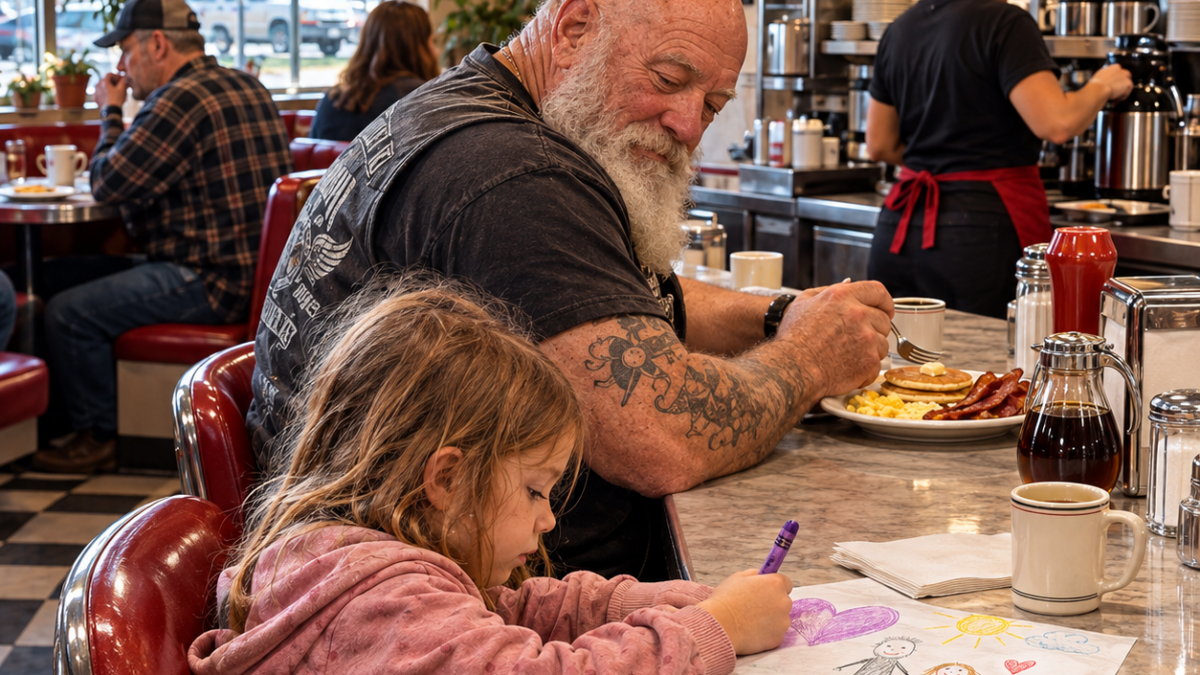
The Little Girl Slid a Biker a Napkin That Said the Man Beside Her Was Not Her Dad
I was sixty-four years old when a seven-year-old girl sitting beside me in a Texas truck stop quietly slid a folded napkin against my elbow and trusted me with her life.
The first line, written in shaking purple crayon, said, “The man next to me is not my dad.”
Then I turned the napkin over and saw a second sentence pressed so hard into the paper that the crayon had nearly torn through it—and suddenly saving the little girl beside me wasn’t the only thing that mattered.
My name is Dale Mercer.
Most people called me Preacher.
Not because I was a preacher.
I used to ride with a motorcycle club, and when one of our brothers died, I was usually the man who could stand beside the grave and find enough words to keep everyone else standing.
By then, I was retired.
Widowed.
Bad knees.
Old shoulder injury.
Gray beard.
A Road King that still ran better than I did.
That Tuesday morning, I stopped at a truck stop off I-40 about ninety miles outside Amarillo.
Strong coffee.
Bad pie.
Almost no cell signal.
I noticed a white panel van parked crooked near the edge of the lot.
No windows in the back.
Then I forgot about it.
Inside, I took a stool at the counter.
That decision would matter more than almost anything I had ever done.
I was halfway through my eggs when a man walked in with a little girl.
Something felt wrong immediately.
Most people enter a diner looking for a table.
He looked for exits.
Front door.
Bathroom hallway.
Kitchen.
Emergency exit.
Then people.
The girl was maybe seven.
Pink jacket zipped wrong.
No socks.
Dirty sneakers.
Dark tangled hair.
A faint bruise near her temple.
The man guided her toward the counter with one hand on the back of her neck.
I have three daughters.
I know what a father’s hand looks like.
That wasn’t it.
His hand said control.
They sat directly beside me.
The waitress, Brenda, asked the girl whether she wanted chocolate chips in her pancakes.
The child opened her mouth.
The man tightened his grip.
“Plain.”
The girl immediately went silent.
Brenda noticed.
So did I.
Then the man’s phone rang.
He turned slightly away.
“Yeah,” he said. “I got her.”
The girl’s purple crayon stopped moving.
I kept looking at my plate.
Then something touched my elbow.
Barely.
I looked down.
A folded napkin.
The girl had pushed it toward me without turning her head.
I opened it beneath the counter.
Big, shaky purple letters.
THE MAN NEXT TO ME IS NOT MY DAD.
My heart started pounding.
I had been in combat.
I had heard bullets pass close enough to remember the sound decades later.
None of that felt like this.
The man ended his call.
PART2:
I folded the napkin under my palm.
Then he suddenly threw money onto the counter.
“We’re leaving.”
The girl flinched.
He grabbed her arm.
“Come on, Emma.”
Her face changed.
That wasn’t her name.
I had maybe thirty seconds.
No cell signal.
One waitress.
One young cook.
One old trucker reading a newspaper.
And one terrified child who had chosen me out of an entire diner.
Then I noticed purple showing through the other side of the napkin.
More writing.
I flipped it open.
PLEASE HURRY.
HE ALREADY TOOK MY LITTLE BROTHER.
Everything inside me went quiet.
The man pulled the girl toward the door.
I knocked my coffee cup onto the floor.
It shattered.
Everyone turned.
Exactly what I needed.
While I apologized loudly, I slid the napkin to Brenda.
She read it.
Her face went pale.
I mouthed one word.
“Police.”
Then the man dragged the girl outside.
Toward the white van.
I followed.
He opened the rear doors.
And when I saw what was lying half-hidden beneath a dirty blue tarp inside, I finally understood what the second line on that napkin really meant…


