The Cat Who Mothered Three Different Species—Then Her Vet Discovered Something He Couldn’t Explain
PART3:
By that spring, it had become something quieter.
An empty chair.
Her boots still beside the utility-room door because neither Dad nor I could move them.
A mug with tiny painted daisies that nobody used.
The habit of turning toward a doorway when something funny happened, because some part of me still expected her to walk through it.
The farm had felt enormous without her.
Dad had become quieter.
I had become busier.
And the animals had become the place where we both put feelings we couldn’t say aloud.
I looked down at the squirrel.
“We can warm it.”
Dad nodded.
“We can call Peter.”
Peter meant Dr. Peter Hale, the village veterinarian.
He had treated everything on our farm from lambs to barn cats for as long as I could remember.
Dad filled a hot-water bottle.
I lined a shoebox with towels.
The squirrel was so cold I could barely feel warmth beneath my fingertips.
Then someone scratched at the kitchen door.
Maple.
Our four-year-old ginger-and-white cat.
She had given birth five days earlier in a wooden nesting box Dad had built from an old apple crate.
Two kittens.
One ginger.
One white with orange ears.
Maple had always been affectionate, but motherhood had transformed her.
She rarely left the utility room except to eat and use the litter tray.
She watched anyone who approached the nesting box with the focus of a security guard.
I opened the kitchen door just enough for her to slip inside.
She immediately noticed the shoebox.
Her head lifted.
She approached.
Dad said:
“Don’t let her near it.”
“Why?”
“She might hurt it.”
Maple sniffed the edge.
The squirrel moved.
Maple froze.
Then she placed both front paws on the side of the box.
Her nose hovered over the baby.
Dad reached forward.
I stopped him.
“Wait.”
Maple sniffed again.
Then, with astonishing gentleness, she climbed into the box.
She licked the squirrel once.
Twice.
The baby made a faint squeaking motion.
Maple’s entire expression changed.
I know that sounds ridiculous.
People say animals don’t have human facial expressions.
Maybe not.
But anybody who lives closely with them learns their bodies have sentences.
Maple’s ears softened.
Her shoulders dropped.
She licked the baby again.
Then she did something neither Dad nor I expected.
She took the squirrel by the loose skin at the back of its neck.
Dad moved.
“Lucy—”
“Wait.”
Maple jumped down from the chair.
She walked toward the utility room carrying the squirrel.
I followed.
She climbed into her nesting box.
Her two kittens were sleeping against her blanket.
Maple placed the squirrel between them.
Then she lay down.
The squirrel began searching immediately.
Tiny nose.
Tiny paws.
Instinct.
It moved against Maple’s belly.
Found a nipple.
Latched.
I knelt beside the box.
Dad stood behind me.
Neither of us spoke.
Within ten minutes, the orphaned squirrel was nursing beside two kittens.
Dad finally whispered:
“Well.”
I looked up.
“Can she feed it?”
“I have absolutely no idea.”
We called Peter.
He arrived thirty-five minutes later wearing muddy boots and carrying the expression of a man who had already dealt with one prolapsed ewe before breakfast.
“What have you two done now?”
I pointed toward the nesting box.
Peter looked.
His eyebrows rose.
“Is that a squirrel?”
“Yes.”
“Why is it attached to your cat?”
“Because Maple adopted it.”
Dad muttered:
“Apparently.”
Peter crouched.
He examined the baby without separating it from Maple.
“Very young.”
“Four days?” I asked.
“Maybe. Five at most.”
“Will cat milk hurt it?”
Peter hesitated.
That was unusual.
Peter always had an answer.
Even when the answer was “I don’t know,” he said it confidently.
This time, he rubbed his chin.
“Squirrel milk is quite rich. Cat milk isn’t identical, obviously. But at this stage, warmth and calories matter more than perfect nutritional matching.”
“So she can nurse it?”
“For now.”
I smiled.
Dad didn’t.
He had already started doing the calculations he always did after Mum died.
Vet visits.
Feed.
Equipment.
Money.
We weren’t poor.
Not exactly.
But farms can own a great deal of land and still have almost no cash.
Ours had been in the family for generations.
That made selling anything feel like betraying the dead.
It also meant every winter involved arithmetic.
Peter looked at Dad.
“I won’t charge you for this visit.”
Dad frowned.
“I didn’t ask.”
“I know.”
“You don’t need to—”
“Tom.”
Peter stood.
“Let your daughter save her squirrel.”
Dad looked at me.
I pretended not to hear the word her.
Peter pointed at the nesting box.
“Keep weighing it. Same time every day. Grams matter.”
I nodded.
“If it loses weight?”
“Call.”
“If Maple rejects it?”
“Call.”
“If anything changes?”
“Lucy.”
“Call.”
“Good.”
He started toward the door.
Then stopped.
He looked back at Maple.
“I’ve seen queens foster kittens before.”
“Queens?” I asked.
“Female cats.”
“I know what it means.”
“Then why did you ask?”
“I wanted to annoy you.”
He smiled.
“Mission accomplished.”
Then he looked at the squirrel again.
“But that’s new.”
We named him Pip.
Not because we knew he was male.
We didn’t.
I just thought something that tiny needed a tiny name.
Pip gained four grams the first day.
Seven the second.
By the fifth day, a faint gray fuzz appeared along his back.
Maple treated him exactly like her kittens.
She groomed him.
Moved him when he crawled too far.
Curled around him at night.
When he squeaked, she responded.
The kittens seemed completely unconcerned that their new sibling had a tail that was beginning to look increasingly un-catlike.
For ten days, our little family seemed strange enough.
Then I found Clover.
April 19.
The lower meadow had been cut early because a local farmer had needed emergency hay.
I was walking the edge of the field after school when I noticed something brown beside a flattened patch of grass.
Baby rabbit.
Eyes still closed.
Cold.
Alone.
I stopped.
Not again.
I searched for a nest.
Nothing obvious.
Wild rabbit mothers often leave kits alone for long periods.
I knew that.
So I didn’t immediately touch her.
I marked the spot.
Went home.
Returned two hours later.
Still alone.
Near sunset, temperature dropping.
I called Peter.
He told me to wait longer.
At 9 p.m., I checked again.
The baby was colder.
Weak.
A dead adult rabbit had been found near the road that afternoon.
Maybe unrelated.
Maybe not.
I carried the kit home.
Dad saw the box.
He closed his eyes.
“No.”
“I haven’t said anything.”
“You don’t need to.”
“She’s freezing.”
“Lucy.”
“You want me to put her back?”
He looked at the tiny body.
That was unfair.
I knew it.
Dad knew I knew it.
He sighed.
“Warm her first.”
I smiled.
“Then Peter.”
“Already texted.”
Dad stared at me.
“You are becoming your mother.”
That hit me harder than he intended.
Mum had brought home injured birds, abandoned hedgehogs, stray cats, and once a goat that technically belonged to someone three villages away.
I looked down so Dad wouldn’t see my face.
“Good.”
His expression changed.
He touched my shoulder.
“Yeah.”
Then, quieter:
“Good.”
We warmed the rabbit.
Peter came.
He checked her.
Then he stared toward the utility room.
“Don’t even think about it.”
I said:
“I didn’t say anything.”
“You have the face.”
“What face?”
“The same face you had before you introduced me to a squirrel drinking cat milk.”
Dad laughed.
It was the first real laugh I’d heard from him in weeks.
Peter shook his head.
“Rabbits are different.”
“How?”
“Milk composition. Feeding frequency. Gut development. Everything.”
“So Maple can’t nurse her?”
“I didn’t say that.”
“You implied it.”
“I said it’s not ideal.”
“Is formula ideal?”
Peter frowned.
“No.”
“Will Maple reject her?”
“I have no idea.”
“Can we try?”
Peter looked at Dad.
Dad raised both hands.
“Don’t look at me. I’ve lost control of the house.”
Peter finally said:
“Supervised.”
I carried the rabbit toward Maple.
Maple was nursing her three current babies.
Two kittens.
One increasingly furry squirrel.
I placed the rabbit on a towel near the edge of the nesting box.
Maple looked.
The rabbit moved.
Maple stood.
She stepped toward the baby.
Sniffed.
Then began licking.
One minute.
Two.
Five.
Eight.
I checked the clock because Peter told me later to write everything down.
Eight minutes of grooming.
The little rabbit warmed beneath Maple’s tongue and body.
Then Maple grasped her by the scruff.
Lifted.
Placed her between Pip and the ginger kitten.
The rabbit immediately began rooting.
Peter whispered:
“No.”
Not an order.
Disbelief.
The baby latched.
Peter crouched lower.
He watched.
Nobody spoke for nearly a minute.
Then Dad said:
“Apparently we have four.”
I corrected him.
“Maple has four.”
Peter looked at me.
“You’re keeping records.”
“I already am.”
“Weight. Feeding frequency. Which teat each animal uses if you can tell.”
I frowned.
“Why?”
He didn’t answer immediately.
Then:
“Because this is becoming interesting.”
Clover survived the first night.
Then the second.
Then the third.
She gained weight rapidly.
More rapidly than Peter expected.
He started visiting every few days.
At first, I assumed he was simply monitoring welfare.
Then he began carrying a notebook.
One afternoon, I found him sitting on the utility-room floor staring at Maple’s abdomen.
“What are you doing?”
“Watching.”
“You’ve been watching for twenty minutes.”
“Yes.”
“That’s creepy.”
“For science.”
“Still creepy.”
He pointed.
“See Pip?”
The squirrel had developed a definite preference for one rear teat on Maple’s left side.
“Yes.”
“He’s almost always there.”
“So?”
“And Clover favors the opposite rear gland.”
“Okay.”
“The kittens mostly use the front four.”
I shrugged.
“Maybe they have assigned seats.”
Peter didn’t smile.
He was thinking.
“Milk glands can respond locally to demand.”
“What does that mean?”
“Milk removal affects production. One gland can produce more than another depending on how much it’s used.”
“Like supply and demand.”
“Very roughly.”
I sat beside him.
“And?”
He shook his head.
“Nothing yet.”
That phrase would become important later.
Nothing yet.
Because Peter was seeing something he didn’t understand.
And Peter hated not understanding things.
The third orphan arrived ten days later.
April 29.
This time, Dad found it.
He walked into the kitchen at 7:15 carrying a damp yellow duckling in both hands.
I nearly dropped my cereal spoon.
Dad said:
“Don’t.”
I grinned.
“You found it.”
“I know.”
“You’re becoming Mum.”
“Absolutely not.”
“What’s its name?”
“It doesn’t have one.”
“Sunny.”
“No.”
“Sunny.”
“Lucy.”
“Too late.”
He put the duckling in a box.
“Found it beside the drainage ditch. No hen. No other ducklings.”
We had several ducks on the pond, mostly semi-wild birds that came and went.
Dad searched for almost an hour.
No mother appeared.
The duckling was newly hatched.
Still damp in places.
Peter was in surgery at the clinic.
He couldn’t come immediately.
Dad set up a brooder lamp.
We offered appropriate starter feed.
Sunny pecked twice.
Then started calling.
A sharp, repetitive peep.
Maple heard it from the utility room.
She stood up.
Every baby in the nesting box shifted as her body moved.
Maple walked into the kitchen.
She saw the duckling.
I looked at Dad.
Dad pointed at me.
“No.”
“I didn’t move.”
“Your face moved.”
Maple approached the box.
Sunny called again.
Maple jumped onto the chair.
Sniffed.
Sunny immediately pushed toward her.
Maple looked confused.
For perhaps three seconds.
Then she climbed into the box and curled around the duckling.
Dad stared.
“Of course.”
Sunny buried herself under Maple’s chest.
Maple groomed her head.
The duckling’s peeping stopped.
I whispered:
“She thinks everything is a kitten.”
Dad said:
“Or she thinks everything is hers.”
We moved Sunny near the nesting area.
Unlike Pip and Clover, she didn’t truly nurse.
She pecked at Maple’s fur.
Occasionally mouthed near her belly.
But ducks aren’t mammals.
There was no natural suckling behavior.
She received wet starter crumble and tiny amounts of appropriate food several times a day.
Still, she slept against Maple.
Followed Maple.
Climbed over the kittens.
And every night, Maple tucked her into the warm center of the family.
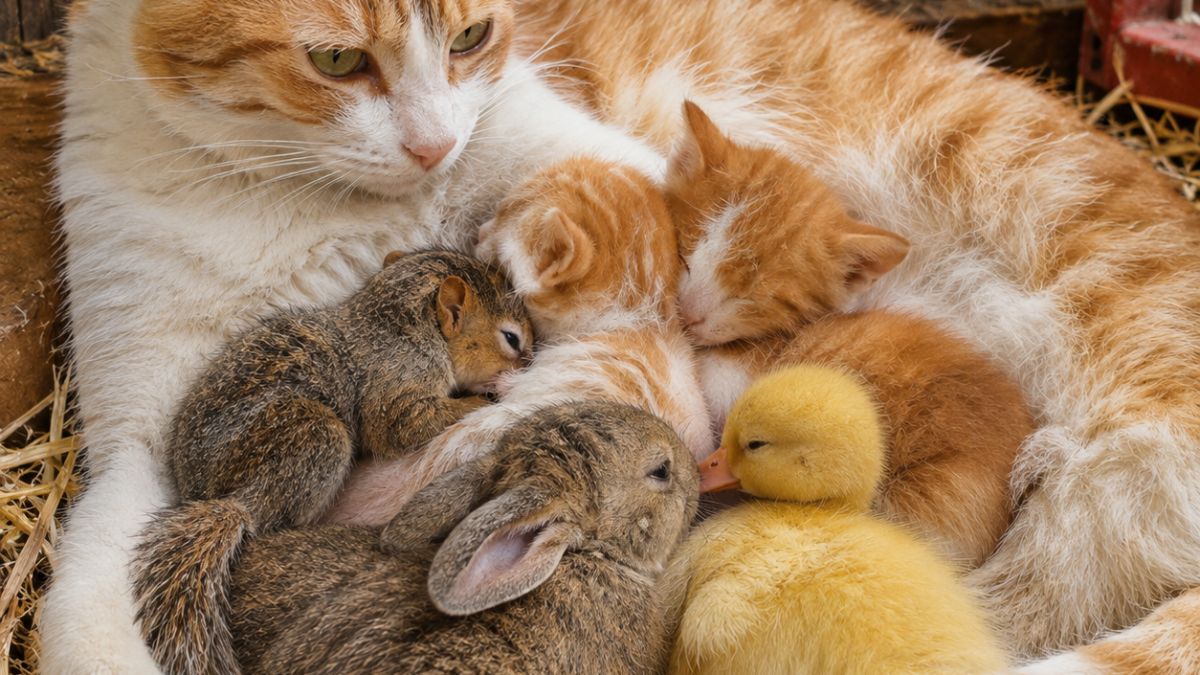
Five babies.
Three different adopted species.
One mother.
The first photograph happened accidentally.
Dad’s sister, my Aunt Sarah, came over with groceries.
She walked into the utility room.
Stopped.
Then backed out.
“Tom.”
Dad looked up from paperwork.
“What?”
“Your cat has a duck.”
He didn’t even glance up.
“I know.”
“And a rabbit.”
“I know.”
“And unless I’m losing my mind, that’s a squirrel.”
“I know.”
Sarah stared at him.
“Why are you saying that like it’s normal?”
Dad finally looked up.
“Because I’ve had three weeks to adjust.”
She took out her phone.
The photograph showed Maple lying in the nesting box.
Her two kittens near her chest.
Pip stretched across her belly.
Clover tucked against one hind leg.
Sunny sitting directly on Maple’s back.
Sarah posted it online.
She wrote:
My brother’s cat apparently doesn’t believe in species.
By dinner, the post had been shared more than a thousand times.
By the next morning, twenty thousand.
By the end of the week, local journalists were calling.
Dad hated it.
I secretly loved it.
At first.
The BBC regional desk emailed.
Two newspapers wanted interviews.
A morning program asked whether we could bring Maple and the babies into a television studio.
Dad refused immediately.
“Absolutely not.”
I said:
“Why?”
“Because they’re animals, not performers.”
“They’d just film them.”
“In a studio.”
“We could—”
“No.”
His voice was sharper than necessary.
I stopped.
Dad rubbed his face.
“Lucy, they are safe here. They are growing. Maple is calm. We’re not sticking them in a van because somebody wants a cute segment between weather and cooking.”
I knew he was right.
Still, I was seventeen.
Being right didn’t make him less annoying.
Peter supported him.
“No unnecessary transport.”
I crossed my arms.
“Everybody is boring.”
Peter looked at Maple.
“Maple disagrees.”
Then something changed.
Peter began taking milk samples.
The first time, he explained carefully.
“Very small amount.”
“Does it hurt her?”
“No.”
“Why?”
“I want to check composition.”
“Because of Pip and Clover?”
“Because of something I’ve noticed.”
I looked at him.
He hesitated.
“I think the milk may differ depending on gland.”
I laughed.
“Doesn’t all milk come from the same cat?”
“Yes.”
“So?”
“So each mammary gland is its own secretory structure.”
I stared blankly.
He sighed.
“Think of them as separate factories connected to the same company.”
“Better.”
“Local stimulation can affect output.”
“Which means?”
“Which means Pip uses the same gland most often. Clover uses another. The kittens favor others.”
“And Sunny?”
“Sunny mostly creates chaos.”
That was accurate.
Peter collected tiny samples from several glands.
He labeled them.
Sent them to a laboratory attached to an agricultural college where he knew a veterinary physiologist.
Three days later, he came to our house after dinner.
No appointment.
Dad looked suspicious.
“What’s wrong?”
“Nothing.”
Peter was carrying printed papers.
I recognized that face.
Thinking face.
He sat at our kitchen table.
Spread the results.
I asked:
“Am I supposed to understand these?”
“No.”
“Good.”
He pointed.
“Protein fairly similar.”
“Okay.”
“Fat isn’t.”
Dad leaned forward.
“Meaning?”
Peter tapped two columns.
“The samples from glands most frequently used by the kittens are where I’d roughly expect for feline milk.”
“Roughly?”
“Individual variation exists.”
He pointed again.
“This one is the gland Pip prefers.”
“And?”
“Higher fat.”
Then another.
“Clover’s preferred gland.”
“Higher again.”
I stared.
“Rabbit milk is fatty, right?”
“Very.”
“So Maple is making rabbit milk?”
Peter immediately shook his head.
“No. Absolutely not. Don’t say that.”
“But—”
“Not rabbit milk.”
“Squirrel milk?”
“No.”
“What are you saying?”
Peter sat back.
“I’m saying I don’t know.”
Dad raised an eyebrow.
“That’s uncomfortable for you.”
“Extremely.”
I looked at the numbers.
“So her milk changed?”
“Possibly.”
“Because different animals are nursing?”
“Possibly.”
“That’s incredible.”
“Or coincidence.”
I frowned.
“You’re ruining it.”
“I’m being a veterinarian.”
“Same thing.”
He ignored me.
“We need repeat samples.”
The second round came a week later.
Similar pattern.
Not identical.
But again, the glands used most heavily by Pip and Clover showed richer fat profiles.
Peter called the physiologist.
His name was Professor Malcolm Reeves.
He was in his late fifties.
Specialized in lactation physiology.
He agreed to visit.
That was when the story stopped being merely charming.
Professor Reeves arrived wearing clean boots that became muddy within three minutes.
He had the slightly distracted manner of someone whose brain had arrived before the rest of him.
He sat beside Maple’s nest for almost an hour.
Asked about feeding patterns.
Asked about birth date.
Weights.
Frequency.
Whether we had supplemented.
Whether Maple had previous litters.
Whether any medication had been used.
Then he examined the lab results.
He said almost nothing.
Finally:
“I’d like to collect controlled samples.”
Dad asked:
“Why?”
“Because if these numbers hold, this is unusual.”
I asked:
“How unusual?”
Reeves adjusted his glasses.
“Mammary glands are not completely uniform. Local regulation is known. Composition can vary through lactation, by time of day, fullness, diet, and many other factors.”
“That sounds like you’re about to tell me this isn’t special.”
“Quite the opposite.”
I sat straighter.
He continued.
“What interests me is the apparent association between nursing behavior of different offspring and localized composition.”
I blinked.
“Normal English.”
Peter smiled.
Reeves tried again.
“If the squirrel repeatedly feeds from one gland, and that gland repeatedly produces milk with somewhat different characteristics than glands used predominantly by kittens…”
I finished:
“Her body might be responding to Pip.”
“Possibly.”
“And Clover.”
“Possibly.”
I grinned.
Reeves raised one finger.
“Possibly is doing very heavy work in those sentences.”
Dad laughed.
I didn’t.
“So you don’t believe it.”
“I believe evidence.”
“That’s not what I asked.”
He looked at me.
Then toward Maple.
“I believe something interesting is happening.”
That was enough.
For two more weeks, we collected samples under veterinary supervision.
Not daily.
Not excessively.
Maple’s welfare came first.
Professor Reeves insisted on that more strongly than anyone.
During those weeks, the babies grew.
Pip’s eyes opened.
He developed the first beginnings of his magnificent tail.
Clover became rounder and stronger.
She started hopping out of the nesting box, which created problems because Sunny chased her.
Sunny developed feathers and discovered water.
That discovery nearly destroyed our kitchen.
I had placed a shallow tray down for her.
Five minutes later, Sunny was splashing.
The kittens joined.
Pip fell in.
Clover became wet and furious.
Maple sat outside the tray looking at all five as though regretting every life decision she’d ever made.
Dad walked in.
Water covered the floor.
He stared.
I said:
“Enrichment.”
He said:
“Mop.”
Maple’s kittens reached five weeks.
Normal weight.
Healthy.
Pip outpaced many bottle-raised squirrels in the rehabilitation references Peter found.
Clover doubled her weight in nine days.
Sunny began eating independently and following Dad to the pond.
Every baby thrived.
Then the first problem came from outside.
A local newspaper published an article titled:
MIRACLE CAT PRODUCES THREE KINDS OF MILK
Peter nearly choked when he saw it.
“I never said that!”
I read the article.
“You basically did.”
“No, I absolutely did not.”
“It says a source close to the family.”
Dad looked at me.
I raised both hands.
“Not me.”
It wasn’t.
A freelance reporter had spoken with someone at the laboratory.
Within hours, larger websites copied the claim.
CAT CHANGES MILK FOR DIFFERENT SPECIES.
MOTHER CAT’S BODY DEFIES SCIENCE.
VET SAYS CAT MAKES CUSTOM MILK.
Peter was furious.
Professor Reeves was worse.
He called us.
“Nobody talks to media.”
Dad said:
“We haven’t.”
“Good.”
“Is the science wrong?”
Reeves paused.
“The headline is wrong.”
“But the results?”
“Interesting.”
“Meaning?”
“Meaning we’re not saying more until we understand more.”
The internet didn’t wait.
People accused us of lying.
Others called Maple a miracle.
Animal-rights accounts claimed we were exploiting wildlife.
Some commenters insisted the squirrel and rabbit should have been euthanized rather than raised by a domestic cat.
Others said Maple’s kittens were being deprived.
One person wrote:
Take the wild animals away. That cat is being abused for clicks.
Dad read that one.
He slammed the phone onto the table.
“We’re done.”
“With what?”
“Photos. Posts. Everything.”
“But we haven’t posted anything in days.”
“Your aunt has.”
“I’ll tell her.”
“No more.”
I stared at him.
“People care about them.”
“People don’t know them.”
“That doesn’t mean—”
“Lucy.”
The way he said my name ended arguments.
Usually.
This time, I pushed.
“Mum would’ve shared them.”
He froze.
The sentence came out before I could stop it.
Dad’s face changed.
I immediately regretted it.
“Don’t.”
“I’m sorry.”
“Don’t use your mother to win.”
“I said I’m sorry.”
He stood.
“She loved animals. She also knew when people turned animals into entertainment.”
I felt heat behind my eyes.
“That’s not what I’m doing.”
“I know.”
“Then why are you treating me like I am?”
Dad’s expression softened.
But I was already crying.
“I found them.”
“I know.”
“I stayed up feeding Sunny.”
“I know.”
“I weighed Pip every morning.”
“I know, love.”
“And now everyone is acting like I’m hurting them.”
Dad stepped closer.
I moved back.
“I just wanted people to see something good.”
That was the real truth.
After Mum died, our house had been full of people talking about pain.
Cancer.
Funerals.
Money.
Farm problems.
Loss.
Then Maple created something ridiculous and beautiful.
Five babies who should never have belonged together.
I wanted the world to look at them because when I looked at them, I felt something besides grief.
Dad understood.
He opened his arms.
I resisted for exactly three seconds.
Then I fell into him.
He held me.
“I’m trying to protect that,” he whispered.
“What?”
“The good part.”
I cried against his shirt.
“So am I.”
“I know.”
A week later, officials came.
Not aggressively.
But officially.
A wildlife officer named Martin Shaw visited with a representative from an animal welfare charity.
Pip was native wildlife.
Clover was native wildlife.
Keeping them indefinitely without proper rehabilitation plans was not acceptable.
I knew that.
Still, hearing someone say they would have to leave felt like betrayal.
Martin examined the setup.
He was calm.
Professional.
He wasn’t the villain I wanted him to be.
That’s inconvenient when you’re seventeen and angry.
He said:
“The squirrel eventually needs species-specific rehabilitation.”
I crossed my arms.
“He has a family.”
“He has a cat family.”
“Exactly.”
“Lucy.”
Peter touched my shoulder.
Martin continued gently.
“If Pip remains too habituated to people and domestic animals, release becomes difficult.”
“He barely cares about us.”
“Good. Let’s keep it that way.”
“And Clover?”
“Same issue.”
“She lives in a field.”
“Eventually.”
I looked at Maple.
Pip was climbing over her tail.
Clover slept against her front legs.
My throat hurt.
“What about Sunny?”
“She can join domestic ducks here if appropriate.”
“So you’re taking Pip and Clover.”
“Not today.”
“When?”
“When they’re developmentally ready.”
I hated him.
Not personally.
Conceptually.
That night, I slept on the utility-room floor.
Maple lay in her box.
The kittens asleep.
Pip curled between them.
Clover near Maple’s stomach.
Sunny beneath Maple’s chin.
Five little bodies rising and falling.
I whispered:
“They’re going to take your babies.”
Maple licked Sunny’s head.
I cried quietly.
Maybe grief makes every goodbye feel like the first funeral.
Professor Reeves’ final round of results arrived two days later.
He asked Peter and Dad to meet at the farmhouse.
I joined.
Of course I did.
Reeves spread graphs across the dining-room table.
He looked different.
Not excited.
More careful than before.
He began:
“The pattern persisted.”
Peter leaned forward.
“How strong?”
“Enough that I don’t think simple analytical noise explains it.”
My heart started beating faster.
Dad asked:
“So what exactly are you saying?”
Reeves pointed to the graph.
“Samples from glands primarily used by Maple’s own kittens remained within expected ranges for feline lactation at this stage.”
Then another.
“Pip’s preferred glands had a higher lipid concentration.”
Then another.
“Clover’s showed higher energy density as well.”
I asked:
“Rabbit milk?”
“No.”
I sighed.
He almost smiled.
“Still no.”
“But different?”
“Measurably.”
“Because of them?”
Reeves looked at me.
“We cannot prove causation from this case.”
“So maybe.”
“Maybe.”
I grinned.
Peter asked:
“What mechanism?”
Reeves shook his head.
“Local mammary regulation is real. Frequency and intensity of suckling, degree of emptying, local hormonal signaling, possibly saliva-mediated interactions—there are several plausible pathways.”
Dad looked horrified.
“Saliva?”
Reeves said:
“Don’t worry. I’m not suggesting the cat is tasting species.”
I laughed.
Peter didn’t.
He was absorbed.
Reeves continued.
“What’s unusual is the apparent localized adaptation occurring simultaneously.”
I asked:
“Has anyone documented this before?”
He paused.
“Not in a case like this that I’ve found.”
That sentence changed everything.
Not because Maple became more extraordinary.
She had been extraordinary to me when she carried Pip into her box.
But adults react differently when someone with Professor before their name says they haven’t seen something.
The university requested permission to prepare a case report.
Dad agreed under strict welfare conditions.
No unnecessary procedures.
No transport for Maple or the babies.
No invasive testing.
No media access without consent.
Reeves agreed immediately.
Then came the humiliation.
A well-known veterinary nutritionist named Dr. Adrian Bell gave an interview to a national newspaper.
He had never visited our farm.
Never examined Maple.
Never seen the raw data.
But the article quoted him saying:
“This sounds much more like enthusiastic interpretation than evidence of species-specific milk production.”
That part was fair.
Peter agreed.
Then Bell added:
“The danger is turning an ordinary maternal cat into folklore because people prefer miracles to biology.”
That angered me.
Ordinary.
I showed Peter.
He shrugged.
“He’s technically criticizing the claim, not Maple.”
“He called her ordinary.”
“She is an ordinary cat.”
“No, she’s not.”
Peter smiled.
“I mean genetically.”
“Still rude.”
Then another article appeared.
The headline:
SCIENTIST DISMISSES ‘MIRACLE MILK CAT’ CLAIMS
Online comments became worse.
FAKE STORY.
FARM FAMILY WANTS ATTENTION.
THE VET SHOULD LOSE HIS LICENSE.
That last one hurt Peter.
I knew because he stopped joking.
He withdrew from local interviews entirely.
One afternoon, I found him in the barn examining a lamb.
I asked:
“Are you okay?”
“Fine.”
“You’re lying.”
“Occupational hazard.”
“They’re calling you dishonest.”
“I’ve been called worse.”
“Because of us.”
He looked at me sharply.
“No.”
“But—”
“No, Lucy.”
He took off his gloves.
“You didn’t fabricate lab work.”
“I shared the photo.”
“You shared a beautiful photograph of animals.”
“If Aunt Sarah hadn’t posted it—”
“Then we’d still have the same data.”
I swallowed.
“Do you think you’re wrong?”
Peter considered.
“I think the internet is arguing about a claim I never made.”
“What claim did you make?”
“That Maple’s milk composition appears to vary by gland in a pattern associated with which offspring predominantly nurse there.”
I stared at him.
“Nobody is going to put that in a headline.”
“Exactly.”
I laughed despite myself.
Then he became serious.
“Science doesn’t need Maple to be miraculous.”
“What does it need?”
“For us to be accurate.”
That stayed with me.
Because grief had made me hungry for miracles.
After Mum died, I wanted proof impossible things could still happen.
Maybe that was why I clung so hard to Maple’s story.
Peter wasn’t trying to take away the wonder.
He was protecting it from exaggeration.
If the truth was beautiful, it didn’t need us to lie for it.
Pip left first.
Six weeks after we found him.
The wildlife rehabilitator was named Helen Carter.
She ran a licensed facility twenty miles away.
I hated her before she arrived.
Again, not personally.
Conceptually.
She brought a transport box.
Pip was climbing the side of Maple’s nesting area.
His tail had begun fluffing.
He looked more squirrel every day.
Less like one of us.
Helen watched him.
“Good body condition.”
I didn’t answer.
She looked at me.
“You found him?”
“Yes.”
“Then you gave him an excellent start.”
“I’m not giving him away.”
“Lucy.”
Dad’s warning.
Helen didn’t take offense.
She crouched.
“We’ll minimize human contact.”
“I know.”
“He’ll be housed with another juvenile squirrel.”
“I know.”
“Then pre-release enclosure.”
“I know.”
“If everything goes well, he’ll come back here.”
I looked at her.
“What?”
“Your oak trees are good habitat.”
My anger vanished a little.
“You’ll release him here?”
“If appropriate.”
I swallowed.
“Promise?”
“I don’t promise things wildlife decides.”
I almost hated her again.
Then she smiled.
“But that’s the plan.”
We placed Pip near Maple one last time.
I expected some dramatic goodbye.
Maple licked his head.
Pip climbed across her back.
Then tried to bite her ear.
Maple smacked him gently.
I laughed through tears.
Helen picked him up.
He squeaked.
Maple stood.
She watched the carrier.
I knelt beside her.
“He’s okay.”
She looked toward the door after they left.
For the rest of the afternoon, she checked the nesting box more often than usual.
That broke me.
Two weeks later, Clover left.
Her transition was different.
Wild rabbits mature quickly.
Clover had become active.
Alert.
Increasingly uncomfortable indoors.
She spent more time in a protected grass enclosure.
One evening, she disappeared into the artificial warren we had prepared near the hedgerow.
She emerged at dawn.
Went back.
Three days later, we opened access to the protected field.
Clover sat at the entrance.
Maple was nowhere nearby.
I felt strangely angry.
“She should be here.”
Dad said:
“She’s a cat, Lucy.”
“I know.”
“She doesn’t know this is a ceremony.”
“I know.”
Clover hopped forward.
Stopped.
Her nose moved.
Another hop.
Then another.
She reached the tall grass.
Paused.
And vanished.
I cried.
Dad put his arm around me.
“You wanted her wild.”
“I know.”
“Then that’s the good ending.”
I nodded.
Good endings hurt too.
Sunny stayed longest.
By then, she had feathers.
A ridiculous little adolescent duck with oversized feet.
She followed Maple everywhere.
Maple tolerated this with an exhaustion that felt universal to mothers.
When Maple walked to the garden, Sunny followed.
When Maple sat on the step, Sunny sat beside her.
When Maple groomed herself, Sunny pecked at her own feathers.
Then one morning, Sunny saw the adult ducks on the pond.
Something changed.
She walked toward them.
Stopped.
Looked back at Maple.
Maple was sitting on the farmhouse step.
Sunny continued.
One duck approached.
Then another.
Sunny joined them.
She swam.
The first time, she looked surprised by her own body.
I laughed so hard I cried.
For the next week, she split her time.
Pond.
Farmhouse.
Pond.
Maple.
Then gradually, more pond.
Less nest.
Nature doesn’t ask whether you’re emotionally ready for children to grow.
It simply keeps moving.
Maple’s two kittens were adopted by local families.
That was easier.
Mostly.
One went to my teacher, Mrs. Allen.
The other to a retired couple three cottages down.
I could visit.
Maple remained with us.
For the first time in nearly two months, the nesting box was empty.
I thought she would enjoy the peace.
Instead, for several days, she wandered.
Checked the utility room.
Looked behind the sofa.
Entered the kitchen whenever she heard Sunny outside.
She had spent weeks organizing her life around five babies.
Suddenly none needed her.
I understood that kind of emptiness more than I wanted to.
One evening, Maple sat on Mum’s old chair.
I sat beside her.
“Everyone leaves.”
The words came out before I could stop them.
Dad was standing in the doorway.
He heard.
I didn’t notice until he said:
“Not everyone.”
I looked up.
He crossed the room.
Sat beside me.
For almost a year after Mum died, Dad and I had avoided talking about her directly.
We mentioned practical things.
Mum’s recipe.
Mum’s garden.
Mum’s coat.
Never the giant fact underneath everything.
She was gone.
That night, Dad finally said:
“I thought if I kept moving, I wouldn’t notice.”
“Notice what?”
“How much I miss her.”
I stared at him.
He looked older than he had a year earlier.
“Farm needs feeding. Bills need paying. Sheep don’t care if you’re grieving.”
His voice broke.
“So I kept going.”
I touched his hand.
“I thought you were okay.”
“I thought you were.”
We both laughed once.
Sad.
Stupid.
Dad looked toward Maple.
“Maybe we’ve both been doing what she did.”
“What?”
“Taking care of whatever was hungry because we didn’t know what else to do.”
That sentence stayed with me forever.
The case report took months.
Professor Reeves became even more cautious after the media mess.
The final draft never said Maple produced squirrel milk.
Never said rabbit milk.
Never said her body scientifically identified species.
Instead, it described localized variation in milk composition during simultaneous nursing of heterospecific young.
Boring words.
Extraordinary reality.
The report stated that the observed differences were compatible with local regulation of mammary production but did not establish mechanism or species-directed adaptation.
I read it three times.
Then called Peter.
“This is terrible.”
“What’s terrible?”
“The paper.”
He sounded offended.
“Why?”
“It makes Maple sound like plumbing.”
Peter laughed.
“Welcome to scientific writing.”
“Where’s the part about her carrying Pip into the box?”
“Not scientifically relevant.”
“It is emotionally relevant.”
“Different paper.”
“Where’s Sunny sleeping under her chin?”
“Lucy.”
“Where’s Clover?”
“Would you like me to add ‘rabbit extremely cute’ to the results section?”
“Yes.”
“I’ll tell Malcolm.”
He didn’t.
The controversy faded.
Other researchers commented.
Some skeptical.
Some intrigued.
One suggested that differential gland emptying alone could explain much of the variation.
Another proposed local signaling associated with suckling intensity.
Another said the sample size—one cat—made strong conclusions impossible.
All true.
Maple didn’t care.
She resumed normal life.
Morning on the step.
Afternoon in the sun.
Occasional mouse.
Nap in Dad’s paperwork.
She never became famous in the way the internet expected.
No television tour.
No sponsorship.
No dramatic scientific award.
And I’m glad.
Because something happened after the attention disappeared.
Something quieter.
Pip came back.
It was September.
Helen called first.
“Release day.”
I nearly screamed.
We met at the oak tree where I’d found him.
The leaves were beginning to turn.
Pip had become magnificent.
Gray coat.
Huge tail.
Bright eyes.
He didn’t look like the helpless pink thing from my hat.
He looked wild.
That was the victory.
Helen opened the carrier.
Pip didn’t move.
Then he shot out.
Up the oak.
Gone.
I looked upward.
“That’s it?”
Helen smiled.
“That’s the goal.”
I felt cheated.
Then a branch moved.
Pip appeared twenty feet above us.
He looked down.
Maybe at us.
Maybe not.
Then vanished again.
I cried anyway.
For several weeks, we saw a gray squirrel near the oak.
Could have been Pip.
Could have been another squirrel.
I chose not to pretend certainty.
Peter would’ve been proud.
But once, in late October, Maple followed me toward the garden.
A squirrel appeared on the stone wall.
Maple froze.
Normally, squirrels activated every hunting instinct she possessed.
This one sat.
Maple stared.
The squirrel stared.
I stopped breathing.
Maple’s tail moved once.
Slowly.
The squirrel came closer.
Not much.
Then ran along the wall and up the oak.
Maple watched.
She didn’t chase.
“Did you know him?”
No answer.
Of course.
But I like not knowing.
Clover became harder to identify.
Several rabbits lived around the hedgerow.
One had a small pale patch near the left ear.
Clover had too.
Maybe her.
Maybe not.
Sometimes love means accepting that successful rescue removes your right to know the ending.
Sunny was easier.
Sunny never left.
She grew into a healthy adult duck with white and yellow-brown plumage.
She joined the flock.
Found a mate.
Became aggressively opinionated about bread she was not allowed to eat.
But she remembered Maple.
I know what scientists would say.
Be careful.
Avoid anthropomorphism.
Association can be learned.
Early social attachment shapes behavior.
Fine.
Use whatever terminology you like.
Every morning when Sunny crossed the yard toward the pond, Maple watched her.
Always.
Maple could be washing herself.
Sleeping.
Eating.
If Sunny walked past, Maple’s head turned.
Her eyes followed the duck across the yard.
The same focused attention she had used when Sunny was small enough to disappear under her belly.
One morning, a fox appeared near the far hedge.
Sunny was crossing the grass.
Maple saw it first.
She stood.
Back arched.
She made a sound I’d never heard from her.
Sunny stopped.
The other ducks reacted.
Dad came outside.
The fox ran.
Was Maple warning Sunny?
Maybe.
Was she reacting to a predator?
Definitely.
Did it matter which explanation sounded more poetic?
Not really.
Sunny was safe.
Maple sat down.
That was enough.
The greatest change happened in Dad.
Before Maple’s strange family, he had been disappearing into himself.
After Mum’s death, he worked from dawn until exhaustion.
He stopped attending village dinners.
Stopped inviting friends.
Stopped playing the old guitar Mum used to tease him about.
Then people started visiting because of Maple.
Peter.
Professor Reeves.
Helen.
Wildlife officers.
Neighbors.
Children wanting to see Sunny.
At first, Dad complained.
Then he began making tea.
Then he started talking.
One evening, I came home and heard guitar music from the kitchen.
Dad was sitting in Mum’s chair.
Maple on his lap.
He stopped when he saw me.
I said:
“Keep playing.”
“I haven’t played properly in years.”
“I know.”
He looked embarrassed.
Then started again.
It was Mum’s favorite song.
I cried.
Dad kept playing.
Neither of us apologized.
By the following spring, I had decided what I wanted to study.
Veterinary medicine.
Peter claimed full credit.
I told him he had nothing to do with it.
He wrote my university recommendation anyway.
In the personal statement, I wrote about Maple.
Not the milk.
Not the publicity.
Not the scientific curiosity.
I wrote about the first morning.
A baby squirrel in a wool hat.
A mother cat approaching.
The moment before she picked him up.
I wrote:
The most important lesson Maple taught me was that care begins before certainty. She did not know whether the squirrel was hers. She did not know whether she could save him. She responded because something vulnerable was in front of her. Veterinary medicine, at its best, begins the same way. We often do not know the outcome when we choose to help.
Peter read it.
He sat silently for a moment.
Then said:
“Your grammar needs work.”
I hit him with a cushion.
I was accepted.
Dad cried.
Then denied crying.
Maple slept through the entire celebration.
Years passed.
The internet forgot.
That’s what the internet does.
People move to the next extraordinary thing.
But the farm remembered.
Sunny remained at the pond.
The oak remained at the field edge.
Wild rabbits continued appearing every spring.
Maple continued sitting on the front step.
Professor Reeves kept copies of the data.
Peter kept telling young veterinary students about the case, although he carefully corrected anyone who said “three kinds of milk.”
He would say:
“No. Different compositional characteristics across glands. Words matter.”
Then, according to one student, he always added:
“But yes, the cat was remarkable.”
I eventually asked him what he believed.
We were sitting outside the clinic after I finished my first year of university.
I said:
“Do you think Maple actually changed her milk because Pip and Clover were different species?”
Peter looked toward the road.
“I think her mammary glands responded locally.”
“That’s the safe answer.”
“It’s the evidence-based answer.”
“Peter.”
He smiled.
“You want the answer I don’t put in medical records?”
“Yes.”
He took a breath.
“I think biology is more responsive than we understand.”
I waited.
He continued.
“We like categories because they’re tidy. Cat. Squirrel. Rabbit. Mother. Offspring. Own. Other.”
He looked at me.
“Maple didn’t care about our categories.”
“That’s emotional, not scientific.”
“You’re allowed both.”
I smiled.
“So yes?”
“So maybe.”
I groaned.
He laughed.
Professor Reeves gave me a similar answer years later.
By then, I was training in veterinary medicine.
I attended a lecture he gave on lactation physiology.
At the end, I introduced myself.
He recognized my name immediately.
“Maple.”
“Yes.”
We had coffee.
I asked whether later research had explained what happened.
“Partly.”
“That’s disappointing.”
“Science often is.”
He explained that mammary glands can function with a significant degree of local independence.
Milk production responds to removal.
Frequency.
Local feedback factors.
Hormonal environment.
Potential biochemical signaling.
Variation within an individual is not surprising.
What remained unusual in Maple’s case was the apparent pattern of richer milk associated with the glands favored by the non-feline mammals.
“Could chance explain it?” I asked.
“Yes.”
“Could feeding intensity?”
“Yes.”
“Could their different suckling patterns create different local demand?”
“Yes.”
“Could Maple somehow be adapting to them?”
He smiled.
“Define somehow.”
I rolled my eyes.
He continued:
“We had one animal. No controls. An ethically limited sampling window. We observed an intriguing association.”
“That’s all?”
“Scientifically?”
“Yes.”
“That’s all.”
Then he leaned closer.
“But remember, ‘we do not know’ is not the same as ‘nothing happened.'”
I never forgot that.
Maple grew older.
At eleven, she developed arthritis.
At twelve, mild kidney disease.
At thirteen, she stopped jumping onto the kitchen windowsill.
Dad built her a ramp.
He pretended it was because he had spare wood.
At fourteen, her face became paler around the muzzle.
Her orange patches faded.
Her body grew thin.
Sunny was gone by then.
She had lived a good duck life.
The year Sunny died, Maple still turned her head for several mornings when ducks crossed the yard.
I noticed.
I didn’t tell Dad.
Or maybe he noticed too.
Some grief doesn’t require discussion.
When Maple was fifteen, I was home from my veterinary job for Christmas.
Not as a student.
Not a trainee.
A qualified veterinarian.
Peter had retired.
Dad had finally leased part of the farm to a younger couple so he could slow down.
The farmhouse looked smaller than I remembered.
Childhood places do that.
Maple was asleep in Mum’s old chair.
I sat beside her.
She opened one eye.
I touched her head.
“Hello, Mum.”
Dad overheard.
He smiled.
“You calling the cat your mother now?”
“No.”
“Sounded like it.”
“I was making a joke.”
“Very strange joke.”
Maple pushed her head into my hand.
I thought about everything she had carried.
Two kittens she had birthed.
A squirrel blown from a tree.
A rabbit left cold in grass.
A duckling beside a ditch.
Five young animals whose bodies were biologically unrelated except for one fact:
They needed something.
Maple had it.
So she gave it.
Maybe too much meaning had been placed on the milk.
For years, that was what fascinated everyone.
Did gland A become fattier because Pip nursed there?
Did gland B respond to Clover’s suckling?
What signaling pathway could explain localized composition?
Could mammalian lactation adapt at a gland-specific level to demand created by different species?
Important questions.
Interesting questions.
But sitting beside an old cat at fifteen years old, none of them felt like the biggest question anymore.
The biggest question was simpler.
Why did she accept them?
Scientists could explain maternal hormones.
Postpartum drive.
Neonatal vocalizations.
Warmth seeking.
Scent.
Behavioral generalization.
All real.
All useful.
But explanations do not make things ordinary.
People make that mistake.
They believe if something can be explained, wonder disappears.
I became a veterinarian partly because Maple taught me the opposite.
Understanding makes wonder larger.
A heart is a pump.
Knowing how it works doesn’t make heartbreak less real.
Milk is water, fat, protein, lactose, minerals, enzymes, immune factors, hormones, and living biological signals.
Knowing that doesn’t make a mother feeding a helpless animal less beautiful.
Maternal behavior is shaped by neurochemistry.
Oxytocin.
Prolactin.
Sensory feedback.
Knowing the names of the molecules doesn’t reduce love to chemicals.
It shows how deeply care is written into living bodies.
Maple never knew any of those words.
She never knew researchers discussed her.
She never knew graphs existed.
She never knew people argued online about whether she was extraordinary.
She certainly never knew that I built a career partly because of what I watched her do during five weeks one spring.
The following morning, Dad and I sat outside with tea.
Cold winter sun.
Maple in a blanket between us.
A squirrel ran along the stone wall.
Maple’s ears moved.
She raised her head.
The squirrel stopped.
For a moment, absurdly, my heart jumped.
“Pip?”
Dad asked.
I laughed.
“He’d be ancient.”
“Could be his grandson.”
“Or a completely unrelated squirrel.”
Dad sighed.
“Veterinarians ruin everything.”
“Accuracy matters.”
“Peter corrupted you.”
The squirrel disappeared.
Maple lowered her head again.
Dad stroked her.
“Your mother would’ve loved this.”
I knew he meant more than the squirrel.
More than Maple.
The whole strange life after loss.
I said:
“I think Maple saved us too.”
Dad looked at me.
“From what?”
I thought about it.
“Being empty.”
He didn’t answer immediately.
Then he nodded.
“Yeah.”
Maple died the following summer.
At home.
In Mum’s chair.
She stopped eating first.
Then drinking less.
Bloodwork confirmed what I already knew.
Kidneys failing.
Age.
No dramatic disease.
No enemy to fight.
Just a body reaching the far end of its work.
Dad called me.
I drove home.
Peter came too, though he’d been retired for years.
Maple lay on a blanket.
I examined her.
I was a veterinarian.
I knew.
I was also seventeen again, watching a cat carry a hairless squirrel toward a wooden box.
Dad asked:
“Can she recover?”
The worst question.
Because he knew.
I shook my head.
“No.”
Dad cried.
Peter looked away.
We made the decision every animal lover eventually fears.
Comfort.
No pain.
No crisis.
No frightening final night.
I prepared the medication myself.
My hands shook.
Peter offered.
I refused.
“She’s mine.”
Then corrected myself.
“Ours.”
Maple was very tired.
Dad sat on one side.
I sat on the other.
Peter near her feet.
Dad stroked her head.
I said:
“Do you remember Pip?”
Of course she didn’t answer.
“Clover?”
Her eyes stayed half closed.
“Sunny?”
At Sunny’s name, nothing happened.
I laughed at myself.
“Stupid.”
Dad said:
“No.”
Maple’s breathing slowed.
I told her everything I had wanted to tell Mum and never had time to.
“Thank you.”
My voice broke.
“For all of them.”
I stroked the white patch between her ears.
“For me too.”
The medicine worked gently.
Her last breath passed without struggle.
And just like that, the mother who had made room for everything was gone.
We buried Maple under the oak.
The same oak where I’d found Pip.
Dad built a small wooden marker.
Not elaborate.
Just her name.
MAPLE
Then the years.
2019–2034.
I almost added something underneath.
Mother of five.
Or:
She never asked what they were.
But Peter stopped me.
“Keep it simple.”
I looked at him.
“Why?”
“Because everyone who matters knows.”
So we left it.
Maple.
Nothing more.
That autumn, I visited the farm again.
The oak leaves had turned gold.
Dad was repairing fencing.
A rabbit crossed the lower meadow.
A squirrel moved overhead.
Ducks walked from the yard toward the pond.
Different generations.
Different animals.
None of them were the babies Maple raised.
Probably.
But for one second, the farm looked exactly like her family had simply spread outward into the landscape.
The thought made me smile.
I sat beneath the oak.
And I finally understood something Professor Reeves had said years earlier.
“We do not know” does not mean nothing happened.
Maybe Maple’s milk changed because each gland responded independently to how intensely it was emptied.
Maybe Pip’s nursing pattern created different local demand.
Maybe Clover fed less frequently but more aggressively.
Maybe ordinary biological mechanisms created extraordinary-looking results.
Maybe some interaction exists that science still hasn’t fully described.
I don’t know.
And I no longer need the mystery solved to believe the story matters.
What I know is this.
On April 8, a newborn squirrel fell from an oak tree.
Maple accepted him.
On April 19, a cold rabbit was found alone in a field.
Maple cleaned her for eight minutes and pulled her into the nest.
On April 29, a wet duckling arrived from a drainage ditch.
Maple moved her body so the bird could crawl beneath her.
She raised those three alongside two kittens of her own.
She fed the mammals.
Warmed the bird.
Groomed all of them.
Responded when they cried.
Slept around them.
Protected them.
Released them when their bodies told them to grow beyond her.
And then, when they were gone, she sat on the farmhouse step and watched the world continue.
Scientists saw a lactation puzzle.
The internet saw a miracle.
Reporters saw a headline.
I saw a mother.
That word makes some people uncomfortable when used across species.
Fine.
Call it maternal behavior.
Call it postpartum responsiveness.
Call it cross-species fostering.
Call it hormonally mediated nurturing.
Call it whatever makes the phenomenon respectable.
Maple never asked for a label.
Pip never asked whether his caregiver had the correct taxonomy.
Clover never checked whether the milk came from her species.
Sunny never cared that cats usually chase birds.
They were cold.
Hungry.
Helpless.
Maple was warm.
Maple had milk.
Maple stayed.
Sometimes that is the whole definition of family.
Not blood.
Not species.
Not genetics.
Not what anyone expected.
Who stayed when staying mattered.
Dad still lives on the farm.
He’s older now.
The younger couple manages most of the land.
Mum’s boots were finally moved from the utility room years ago.
Not thrown away.
Dad cleaned them and placed them in a wooden chest.
That mattered.
Grief changes.
People were right.
It doesn’t disappear.
It learns where to sit.
Mine sits in strange places.
A ginger patch of fur.
A duck crossing a yard.
A squirrel on an oak.
The smell of hay after rain.
A wooden nesting box in the utility room that Dad never threw away.
And sometimes, when I treat a frightened animal whose owner asks me whether it’s worth trying, I think about Maple.
I don’t promise miracles.
Peter taught me better.
I explain the facts.
The risks.
The odds.
The limitations.
But I also remember the smallest squirrel I had ever seen, wrapped inside my wool hat.
I remember believing he would die.
I remember Maple sniffing the box.
I remember the moment she picked him up.
There was no guarantee.
No research paper.
No certainty.
She simply responded.
That might be the part of medicine we sometimes forget.
Knowledge matters.
Evidence matters.
Accuracy matters.
But before any of those things can help, somebody has to care enough to notice the life in front of them.
Maple noticed.
Again.
Again.
Again.
Five young animals.
Three species.
One month.
One little cat who never knew she had become a scientific question.
Every morning, Dad says that when ducks cross the yard, he still expects Maple’s head to turn.
Sometimes mine does too.
And perhaps that’s the final thing she taught us.
Love doesn’t always need to understand what it’s caring for.
It doesn’t need matching blood.
Matching bodies.
Matching language.
Sometimes something small pushes against you in the dark.
It is cold.
It is hungry.
It needs warmth.
And somewhere inside a living body, a decision happens before thought.
Move closer.
Make room.
Feed it.
Protect it.
Stay.
Professor Reeves once told me that Maple’s body appeared to respond differently depending on which young animal fed from which gland.
He spent years refusing to say more than the evidence justified.
I used to find that frustrating.
Now I respect it.
Because the truth was already remarkable enough.
Different glands may have produced milk with different nutritional characteristics.
Maybe future research will explain every mechanism.
Maybe it already has by the time somebody reads this.
But no laboratory result can fully describe what I saw in that nesting box.
A kitten pressed beside a squirrel.
A rabbit tucked beneath a ginger leg.
A duckling asleep under a cat’s chin.
No one fighting for space.
No one asking who belonged.
Just five babies breathing against the same warm body.
And Maple in the center.
She never knew the squirrel required one nutritional profile.
She never knew rabbit milk is extraordinarily rich.
She never knew ducklings don’t nurse.
She never knew mammary glands could respond locally.
She never knew Professor Reeves wrote reports.
She never knew journalists exaggerated them.
She never knew strangers argued about her online.
She never knew I would become a veterinarian because of her.
She never knew any of it.
She knew Pip cried.
She pulled him closer.
She knew Clover was cold.
She cleaned her.
She knew Sunny needed warmth.
She opened her body and made room.
That was all.
Maybe that’s why, after all these years, the most important sentence in Maple’s story is still the simplest.
They were hungry.
And she fed them.


