A Blind Mother Cat Walked Three Miles Along a Highway With Four Kittens Following Behind—Then Rescuers Traced Her Path Back and Found What She’d Escaped
PART2:
PART3:
Not lids swollen shut by a current infection.
No eyes.
Where they should have been were two shallow depressions covered by smooth scar tissue.
Old scars.
Healed scars.
The kind that told Denise this animal had lived in darkness for a long time.
The cat tilted her head.
Her ears pointed directly toward Denise.
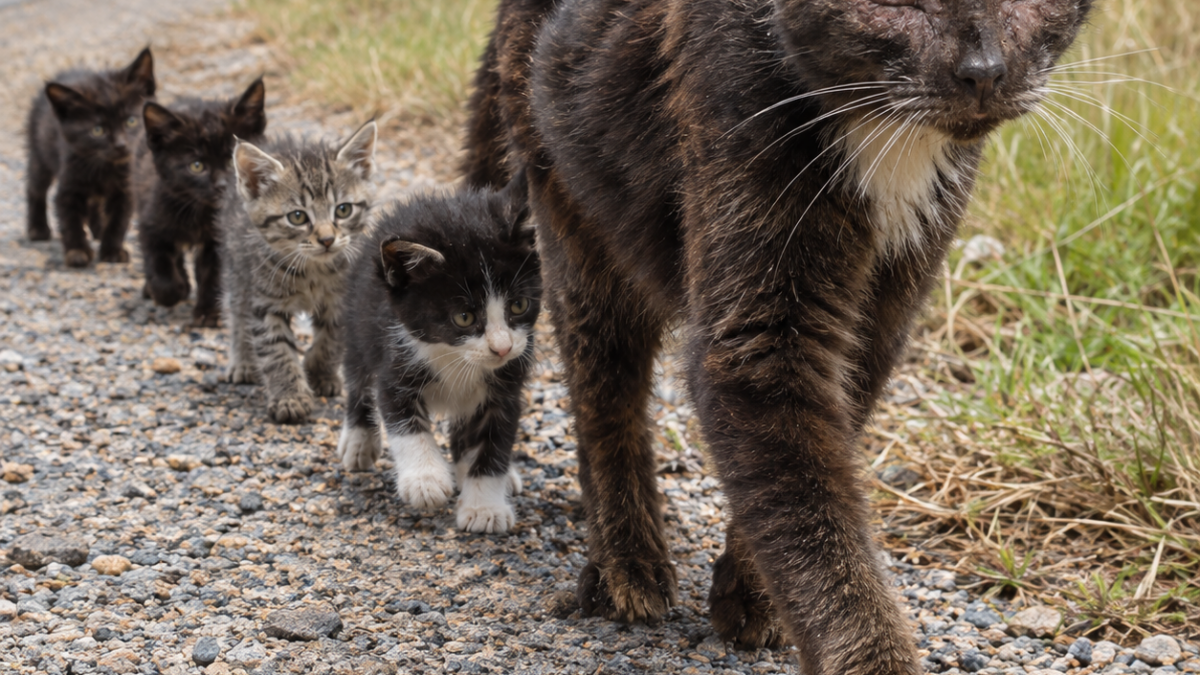
Behind her, four kittens remained still.
Denise had worked around animals most of her life.
She had grown up with barn cats.
She knew what frightened kittens did.
They cried.
They scattered.
They hid.
These kittens did none of those things.
They waited.
For their mother.
A mother who could not see them.
Denise reached slowly for her phone.
She called the Pitt-Wilson County Animal Rescue line.
A woman answered on the fourth ring.
“This is Carolina Safe Paws, Kelly speaking.”
“My name is Denise Harper. I’m a postal carrier out on County Road 118.”
“Okay.”
“I’ve got a mother cat and four kittens walking the roadside.”
“Are they in traffic?”
“Not yet.”
“Can you safely contain them?”
Denise looked at the mother.
“I don’t think so.”
“Are they feral?”
“I don’t know.”
There was a pause.
Then Denise said, “The mother doesn’t have eyes.”
The woman on the phone became quiet.
“What do you mean?”
“I mean both eyes are gone.”
“Injured?”
“No.”
Denise swallowed.
“Healed over.”
Another pause.
“And she’s walking with kittens?”
“Four of them.”
“Stay where you are.”
“I have a mail route.”
“I understand.”
Denise stared at the family.
The blind cat took one cautious step.
The kittens moved with her.
“I’m staying.”
The rescue volunteer arrived twenty-eight minutes later.
Her name was Marissa Cole.
Thirty-six years old.
Red hair pulled through a baseball cap.
Mud on her boots.
An animal carrier in one hand and a folded wire trap in the other.
By then, Denise had followed the cats in her truck at a distance.
The family had traveled nearly another quarter mile.
Slowly.
Steadily.
Still north.
Marissa parked and approached on foot.
Denise met her halfway.
“You see what I mean?”
Marissa nodded.
She had stopped smiling the moment she saw the mother’s face.
“How long have they been doing this?”
“I noticed them around eight fifteen.”
Marissa checked her phone.
“Almost an hour.”
“They haven’t left the shoulder.”
“Not once?”
“No.”
Marissa crouched twenty yards behind the last kitten.
“Look at her ears.”
Denise had noticed them.
Now she watched more carefully.
The mother’s right ear rotated toward an approaching pickup truck.
Her left turned toward the field.
When the vehicle passed, both flattened briefly.
She paused.
Waited for the noise to fade.
Then continued.
Her front paw touched loose gravel.
She adjusted two inches toward the grass.
The kittens copied her.
“She’s mapping with sound,” Marissa whispered.
“And her paws.”
“And probably whiskers.”
They watched as the blind cat moved forward.
“She knows where the road edge is,” Denise said.
“She can feel the change in surface.”
“Where is she going?”
Marissa shook her head.
“No idea.”
The nearest occupied house was more than a mile north.
Nothing stood nearby except fields, irrigation ditches, a few pine breaks, and an abandoned equipment shed farther east.
Marissa opened a can of sardines.
The smell caught the mother immediately.
She stopped.
Her nose lifted.
The kittens remained behind her.
Marissa set food in the grass.
Then backed away.
The mother took several minutes to approach.
Her whiskers swept forward.
She tapped the ground with one paw.
Found the plate.
Ate.
Only after she moved aside did the kittens eat.
Marissa watched the mother’s ribs expand beneath her thin coat.
“She’s starving.”
“She looks tiny.”
“She is.”
The cat’s spine was visible.
Her hips protruded.
Her belly hung slightly from nursing.
Yet the kittens looked significantly healthier.
Thin.
Dirty.
But full enough to have survived.
Marissa crouched closer.
“That tells you everything.”
“What?”
“She’s been feeding them before herself.”
The words hit Denise harder than she expected.
She looked at the blind mother.
“You poor little thing.”
Capturing the family took almost two hours.
Not because the mother fought.
Because she refused to enter the trap until all four kittens were near her.
Marissa managed to pick up the gray tabby first.
The kitten hissed but did not bite.
The mother immediately turned toward the sound.
Her body became rigid.
“Easy,” Marissa whispered.
She placed the kitten inside a large carrier.
The mother followed the crying.
But when she reached the carrier, she would not enter.
Instead, she pressed her face against the bars.
The other three kittens clustered against her hind legs.
Denise watched.
“She’s counting them.”
Marissa looked at her.
“What?”
“Listen.”
The gray kitten cried.
The blind mother touched the bars.
Then she turned.
Her nose moved toward the kittens beside her.
One.
Two.
Three.
She seemed to smell or touch each one.
Then returned to the carrier.
Marissa’s expression changed.
“My God.”
They placed all four kittens inside first.
Only then did the mother walk in.
The moment the door shut, she pressed her body around them.
No scratching.
No throwing herself against the carrier.
No attempt to escape.
Just four kittens beneath one thin black body.
As Marissa lifted the carrier, Denise asked the question neither woman could answer.
“How did she get them this far?”
Marissa looked down at the scarred face.
“I think she’s been getting them somewhere for five weeks.”
The veterinary clinic stayed open late.
Dr. Evan Rhodes had treated animals in eastern North Carolina for twenty-two years.
He had seen cruelty.
Neglect.
Accidents.
Birth defects.
He had removed eyes from cats whose infections had been allowed to progress beyond saving.
But when Marissa placed the blind mother on the examination table and explained where she had been found, he stopped writing.
“She was leading four kittens?”
“Single file.”
“How far?”
“We don’t know yet.”
“And she’s completely blind?”
“That’s what it looks like.”
Dr. Rhodes examined her.
His fingertips moved gently over the scar tissue.
The cat did not resist.
“Old injury.”
“How old?”
“At least a year.”
He examined both sides.
“Probably longer.”
“Was someone’s eyes surgically removed?”
“No.”
Marissa frowned.
“You can tell?”
“Almost certainly.”
He pointed carefully.
“If a veterinarian had performed bilateral enucleation, the closure would be cleaner. These sockets collapsed naturally after severe tissue destruction.”
“What causes that?”
“In cats this age? Severe untreated infection would be high on my list.”
He sighed.
“Feline herpesvirus. Secondary bacterial infection. Ulceration. Corneal rupture.”
Denise had stayed.
She sat in the corner still wearing her postal uniform.
“Would that hurt?”
Dr. Rhodes looked at her.
“Yes.”
“How much?”
He hesitated.
“A lot.”
Denise looked away.
Dr. Rhodes continued examining the cat.
“The fact that she survived without treatment is remarkable.”
He weighed her.
Five pounds, three ounces.
“She should be closer to eight.”
He examined her paws.
The pads were thickened.
Cracked in places.
Calloused.
“Look at these.”
Marissa leaned closer.
“What?”
“This cat travels.”
“How can you know?”
“Wear pattern.”
He touched one paw.
“She’s been moving over gravel, concrete, rough soil. A lot.”
Then he examined her whiskers.
Several were blunted.
Some bent.
“She uses these constantly.”
“For navigation?”
“Exactly.”
He gently moved his fingers near the cat’s ear.
The ear rotated immediately.
Then followed the movement.
Dr. Rhodes smiled sadly.
“She’s adapted.”
He examined the kittens.
All four were approximately five weeks old.
No fractures.
No serious wounds.
Normal neurological responses.
Sight intact.
Some fleas.
Mild worms.
Slight dehydration.
But remarkably healthy given their mother’s condition.
Dr. Rhodes returned the final kitten to the carrier.
The mother immediately touched its head with her nose.
He watched.
Then he said something that stayed with Marissa for years.
“She has never seen them.”
Denise swallowed.
Dr. Rhodes continued.
“She was blind long before pregnancy.”
The room became quiet.
“She gave birth without sight,” Marissa said.
“Yes.”
“Nursed them.”
“Yes.”
“Protected them.”
“Yes.”
“And moved them.”
Dr. Rhodes looked toward the carrier.
“Yes.”
Denise asked, “How does she know all four are there?”
“Sound. Smell. Touch. Routine.”
“But they weren’t making noise on the road.”
“That may be deliberate.”
Marissa looked at him.
“Can kittens learn that?”
“Absolutely.”
He sat back.
“Cats don’t normally walk in a perfectly spaced line for miles. Five-week-old kittens certainly don’t.”
“So she taught them.”
“In some fashion, yes.”
“How?”
Dr. Rhodes smiled faintly.
“We’re probably giving too much credit to language when we use the word taught. Animals create patterns. The kittens learn what keeps them safe.”
He looked toward the mother.
“She can’t scan visually to locate them. If they scatter, she has a serious problem. So over five weeks, she may have established movement routines through touch, vocal signals, body position, scent.”
Marissa watched the mother begin grooming one kitten.
Dr. Rhodes added, “A blind cat taught four sighted kittens to make themselves predictable.”
Denise whispered, “They became her eyes.”
The veterinarian nodded.
“In a way.”
Marissa named the mother that night.
Compass.
It started as a joke.
The blind cat who somehow knew where she was going.
But the name stayed.
Compass and her kittens were taken to Carolina Safe Paws’ foster facility.
The kittens received temporary names based on directions.
North.
South.
East.
West.
North was the gray tabby.
South was black with a white patch on his chest.
East was solid black and fearless.
West was black and white and the smallest.
Compass stayed in a quiet room with them.
The first night, Marissa slept on the floor nearby.
She wanted to observe.
At 2:14 a.m., West wandered away from the bedding.
Compass immediately raised her head.
The kitten made no sound.
Neither did the mother.
Compass stood.
Turned her ears.
Listened.
Then walked toward the sound of tiny paws against the vinyl floor.
She found West within seconds.
Touched his body with her nose.
Then gently took the loose skin at the back of his neck and carried him back.
Marissa stared from her sleeping bag.
“Okay.”
Compass settled again.
“You’re incredible.”
Over the next several days, everyone at the rescue became fascinated by the little family.
Not because Compass was helpless.
She wasn’t.
That misconception irritated Marissa almost immediately.
Visitors would see the scarred face and whisper, “Poor thing.”
Then Compass would walk across the room, avoid three chairs, locate her water, climb into the nesting box, groom four kittens, and jump onto a low platform.
Blind did not mean helpless.
It meant different information.
Compass memorized every room within hours.
Move a chair and she might touch it with her whiskers once.
Then never hit it again.
She learned voices.
Marissa.
Dr. Rhodes.
Kelly at reception.
A volunteer named Jamal.
She learned the sound of the refrigerator because wet food came from there.
She learned the click of Marissa’s key in the foster room.
And she learned exactly where each kitten slept.
What nobody knew was where she had come from.
Marissa could not stop thinking about the road.
The direction.
The deliberate pace.
Compass had not been wandering.
She had been traveling.
Somewhere.
Marissa pulled up maps.
The postal route stretched fourteen miles through mostly agricultural land.
Denise marked the exact location where she had first seen the cats.
Marissa drew a line south.
Then north.
Three miles south was a farm access bridge.
Three miles north was the closest cluster of occupied houses.
“What if she was going there?” Denise asked.
“For food?”
“Or people.”
Marissa stared at the map.
“Then where did she start?”
Two days later, she drove south.
She stopped every quarter mile.
Walked drainage ditches.
Checked barns.
Asked at two farms.
Nobody recognized Compass.
At the farm bridge three miles south of the sighting, she noticed broken concrete.
A drainage culvert beneath the access road had partially collapsed.
Recent storms had pushed branches and mud against one end.
Marissa climbed down.
The opening was narrow.
Inside, beneath the concrete, she found dry grass.
Pressed flat.
Cat fur.
Food wrappers.
A dead mouse.
And four small depressions in the nesting material.
She crouched.
“This was it.”
The smell was faint but unmistakable.
Compass.
Marissa took photographs.
The culvert was dangerous.
Part of the concrete ceiling had cracked.
Rainwater had carved fresh channels through the nest area.
A larger animal’s tracks marked the mud near one entrance.
Raccoon, probably.
Maybe a fox.
Something had changed.
Something had forced Compass to move four five-week-old kittens.
She had selected north.
Toward houses.
Toward people.
She had walked three miles before Denise found her.
But Marissa discovered something else.
A plastic food dish lay thirty yards beyond the bridge.
Blue.
Faded.
Someone had once fed cats there.
She carried it to the nearest farmhouse.
An older man answered.
“Sorry to bother you. I’m with Carolina Safe Paws.”
He looked suspicious.
“You selling something?”
“No, sir. I’m looking for information about a black cat.”
“Lots of black cats.”
“This one has no eyes.”
The man’s expression changed.
He glanced behind him.
“You mean June’s cat?”
Marissa felt a chill.
“June?”
The man opened the door farther.
“Woman who used to rent the old Baker place.”
“Where’s that?”
“Half mile west.”
“What was the cat’s name?”
“Don’t know.”
“Did it have eyes?”
“Not by the end.”
Marissa stood very still.
“What happened?”
The man sighed.
“You better talk to June.”
“Where is she?”
“Gone.”
“Gone where?”
“Assisted living, I think.”
He scratched his chin.
“Her son cleared the place out last summer.”
Marissa’s stomach tightened.
“Was the cat left behind?”
He looked uncomfortable.
“I reckon.”
“Did anybody try to catch her?”
“Not that I know.”
“Who was feeding her?”
“My wife sometimes.”
The man looked toward the road.
“She’d put bowls near the bridge.”
“What happened to your wife?”
“Died in November.”
“I’m sorry.”
He nodded.
“She worried about that cat.”
“Why?”
“Because it couldn’t see.”
Marissa stared.
The man continued.
“June used to say the cat got sick a couple years back. Eyes got bad.”
“Did she take her to a vet?”
“June barely had money for herself.”
“So nobody did anything.”
He stiffened.
“I didn’t say that.”
“I’m not blaming you.”
“Sounds like you are.”
Marissa took a breath.
“I’m trying to understand how a completely blind cat ended up raising kittens under a collapsing bridge.”
The man looked away.
After a moment, he said, “Talk to June’s boy.”
“Name?”
“Travis Mullen.”
That was the first thread.
Marissa did not yet realize pulling it would make half the county angry.
June Mullen was seventy-nine.
She lived in a small nursing facility in Greenville.
Marissa called first.
The activities director agreed to ask whether June wanted to speak.
June did.
Three days later, Marissa brought a photograph of Compass.
The elderly woman touched it with shaking fingers.
“Oh.”
Her eyes filled.
“Oh, Blackbird.”
Marissa sat beside her.
“That was her name?”
June nodded.
“She’s alive?”
“Yes.”
June covered her mouth.
Marissa waited.
“And the babies?”
“Four kittens.”
June stared at her.
“She had babies?”
“Yes.”
A tear ran down the woman’s cheek.
“I didn’t know.”
“Ms. Mullen, can you tell me what happened to her eyes?”
June closed her eyes.
“She got sick.”
“When?”
“Two winters ago.”
“Did you take her to a veterinarian?”
June’s face twisted.
“I tried.”
“What happened?”
“Travis said it would cost too much.”
Marissa felt anger rise but kept her voice calm.
“Your son?”
June nodded.
“Blackbird was an outdoor cat. She came to the house when she was little.”
“Was she yours?”
June smiled faintly.
“She decided that.”
“What happened when her eyes got infected?”
“They ran all the time. Then she stopped opening them.”
June rubbed her hands.
“I told Travis she needed a doctor.”
“What did he say?”
“That farm cats either make it or they don’t.”
Marissa looked down.
“Did you have transportation?”
“No.”
“Money?”
“Not much.”
“Did you call anyone?”
“I called a clinic once.”
“What happened?”
“They said examination fee was sixty-five dollars.”
June’s voice broke.
“I had twenty-three.”
Marissa swallowed.
“What happened after that?”
“I cleaned her eyes with warm cloths.”
“Did she lose them gradually?”
June nodded.
“One ruptured.”
She began crying.
“I heard her crying under the porch.”
Marissa wished she had not asked.
But she needed to know.
“And the second?”
“Later.”
June stared at her hands.
“I begged Travis.”
“What did he do?”
“He said it was disgusting.”
A cold sensation ran through Marissa.
“Did he hurt the cat?”
“No.”
June answered quickly.
“No. Not with his hands.”
Sometimes cruelty was exactly that.
Not what someone did.
What they refused to do while watching suffering unfold.
“When did you leave the property?”
“Last August.”
“Why?”
“I fell.”
“Your son moved you?”
“He said I couldn’t live alone anymore.”
“What happened to Blackbird?”
June’s face changed completely.
“I asked him to bring her.”
“To assisted living?”
“He said they wouldn’t allow cats.”
“Was that true?”
June looked confused.
“I don’t know.”
“What did he say he would do?”
“Find her somewhere.”
“Did he?”
June began shaking.
“I asked.”
“What did he tell you?”
“That somebody took her.”
Marissa felt her jaw clench.
“Do you know who?”
“No.”
June looked at the photograph.
“She wasn’t taken, was she?”
Marissa did not answer immediately.
June understood anyway.
“He left her.”
“Ms. Mullen—”
“He left her.”
June began sobbing.
“I knew it.”
Marissa moved closer.
“Listen to me.”
“I knew it.”
“Compass is alive.”
June looked up.
“Compass?”
“That’s what we call her now.”
“Blackbird.”
“You can call her Blackbird.”
June touched the photograph again.
“She had babies.”
“Yes.”
“All alive?”
“Yes.”
June began crying harder.
Marissa placed a hand over hers.
“All four.”
The story could have ended there.
A poor elderly woman.
A negligent son.
A blind cat surviving outdoors.
But Marissa wanted answers.
She contacted Travis Mullen.
He did not react well.
“Why are you calling me about a cat?”
“Your mother identified her.”
“That thing is still alive?”
Marissa’s grip tightened around the phone.
“Yes.”
“Huh.”
“She says you promised to find a home for her.”
“I probably did.”
“Did you?”
“I don’t remember.”
“It was eight months ago.”
“I had a whole house to clear out.”
“Did you leave the cat?”
“Look, lady, it was feral.”
“She had lived with your mother for years.”
“She lived outside.”
“She was blind.”
“So?”
Marissa became silent.
Travis seemed irritated by the silence.
“What do you want?”
“I want to know if you made any attempt to place her.”
“No.”
“Did you contact a shelter?”
“No.”
“Animal control?”
“No.”
“Rescue?”
“No.”
“Did you leave food?”
“Probably.”
“You probably left food?”
“I don’t remember.”
Marissa looked at her notes.
“Your mother says you knew the cat was blind.”
“Yes.”
“And that both eyes were destroyed by untreated disease while she was living on your mother’s property.”
“I’m not responsible for every stray cat in North Carolina.”
“Your mother considered her a pet.”
“My mother considered squirrels pets.”
Marissa heard someone talking in the background.
Travis lowered his voice.
“Are we done?”
“One more question.”
“What?”
“Did you tell your mother somebody adopted the cat?”
Silence.
Then:
“She was upset.”
“So you lied.”
“I told her what she needed to hear.”
Marissa wrote the sentence down.
“Thank you.”
“For what?”
“For answering.”
She hung up.
Carolina Safe Paws filed a report with county animal control.
Not because they believed Travis would necessarily face serious criminal charges.
Animal neglect cases involving outdoor cats were difficult.
Ownership was disputed.
Timeline was complicated.
Evidence was old.
But Marissa wanted documentation.
She wanted someone to write down that a blind animal had been knowingly left behind.
The county investigator was a woman named Carla Nguyen.
She interviewed June.
The neighbor.
Travis.
She inspected the old rental property.
She found old veterinary paperwork among boxes Travis had left in an exterior shed.
There was one invoice.
Two years earlier.
An examination appointment had been scheduled for Blackbird.
Never attended.
The paperwork included the reason:
“Cat unable to open both eyes. Discharge. Possible corneal injury.”
June had made the appointment.
Someone had cancelled it the same afternoon.
The contact number belonged to Travis.
When Carla confronted him, he said he could not remember cancelling anything.
Then he changed his story.
He said June had asked him to cancel because she could not afford care.
June denied that.
Then he said the cat was feral and impossible to transport.
June denied that too.
Then he became angry.
“You people are acting like I murdered somebody.”
Carla answered calmly.
“No, Mr. Mullen. We’re investigating whether a dependent animal was knowingly denied necessary care.”
“It was a farm cat.”
“Pain doesn’t become less painful because it happens on a farm.”
He stared at her.
Carla continued.
“Did you understand the cat’s eyes were severely infected?”
“Yes.”
“Did your mother ask you for help?”
“Probably.”
“Did you have the means to transport the cat?”
“Yes.”
“Did you?”
“No.”
“Did you leave the cat behind when your mother moved?”
“Yes.”
“Knowing she was blind?”
“Yes.”
Carla closed her notebook.
“Thank you.”
The eventual legal outcome disappointed people who wanted a dramatic punishment.
There was no courtroom sentence.
No handcuffs.
No television cameras.
The evidence around the original infection was too old to support a strong cruelty prosecution.
But the county cited Travis for abandonment under local animal welfare ordinances.
He paid fines.
The case became part of a formal record.
More importantly, the investigation changed local policy.
The county shelter and three volunteer rescue organizations created a referral program specifically for elderly or disabled owners who could no longer care for animals.
No cost to surrender.
No judgment.
Transportation available.
The program was named Safe Passage.
June cried when Marissa told her.
“Because of Blackbird?”
“Because of people like you.”
“I failed her.”
“No.”
June shook her head.
“I did.”
“You were poor, had no transportation, and asked for help.”
“I should have done more.”
Marissa looked at her.
“We can always imagine more when we know how a story turned out.”
June wiped her face.
“I loved her.”
“I know.”
“Does she hate me?”
Marissa smiled.
“Cats are usually more interested in who has tuna.”
June laughed through tears.
Then Marissa asked, “Would you like to see her?”
June froze.
“Can I?”
The nursing facility did not normally allow visiting animals outside specific therapy programs.
The administrator made an exception.
Compass arrived in a carrier on a Tuesday afternoon.
June sat in a wheelchair in the recreation room.
Her hands trembled in her lap.
Marissa opened the carrier.
Compass stepped out.
She paused.
Her ears rotated.
June whispered, “Blackbird?”
Compass stopped.
Marissa stopped breathing.
June said it again.
“Blackbird.”
The blind cat turned toward her.
Walked forward.
Slowly.
Carefully.
Until her nose touched June’s shoe.
June made a sound that was almost a cry.
“Oh, baby.”
Compass lifted her head.
June reached down.
Her fingers found the cat’s scarred face.
Compass pushed into the touch.
Then began purring.
June bent forward and sobbed.
“I’m sorry.”
Compass rubbed against her hand.
“I’m so sorry.”
Marissa looked away to give them privacy.
But there was nowhere far enough to stand.
June whispered into the cat’s fur.
“I thought somebody had taken you.”
Compass purred.
“I should have fought harder.”
The blind cat climbed halfway into her lap.
June laughed.
“You remember me.”
Marissa wiped her eyes.
Of course she remembered.
Not the face.
Never the face.
The voice.
The smell.
The hands.
The rhythm of a person.
The things sighted humans too often forget are enough.
Compass stayed nearly an hour.
When Marissa prepared to leave, June held her one last time.
“You saved her.”
“No.”
June looked confused.
Marissa smiled.
“She saved four kittens before we ever arrived.”
During Compass’s first three weeks in foster care, her kittens changed quickly.
North became adventurous.
East climbed everything.
South discovered human laps.
West remained attached to his mother.
He slept with his body pressed against her shoulder every night.
Potential adopters began asking about the kittens.
Everybody wanted the babies.
Few asked about Compass.
That angered Marissa more than it should have.
People would look at photographs online.
“Oh, poor mama.”
Then:
“Are the kittens available?”
Compass was four years old.
Blind.
Underweight.
Scarred.
Adult black cats already struggled to get adopted.
A blind adult black cat?
Marissa knew the statistics.
One Saturday, a family visited.
They wanted North.
Their eight-year-old daughter noticed Compass.
“What happened to her eyes?”
The mother quickly said, “Don’t stare.”
Compass could not know anyone was staring.
Marissa crouched.
“She got very sick when she was younger.”
“Does it hurt?”
“Not anymore.”
“Can she see black?”
“No.”
“Can she see dreams?”
Marissa paused.
“I don’t know.”
The girl thought about that.
Then asked, “How does she find her babies?”
Marissa smiled.
“She listens.”
The child sat on the floor.
Compass approached.
The mother said, “Careful.”
Compass sniffed the girl’s knee.
The girl whispered, “She doesn’t look sad.”
Marissa felt something tighten in her throat.
“No.”
“She just looks like a cat.”
“Exactly.”
The family adopted North.
Over the next month, South and East found homes too.
Then a couple adopted West.
Marissa almost stopped them.
Not because they were wrong.
Because she knew what separation meant.
West cried when placed in the carrier.
Compass turned immediately.
Her ears searched.
She walked toward him.
Marissa sat beside her.
“He’s okay.”
Compass pressed against the carrier.
West pushed one white paw through the bars.
Compass touched it with her nose.
For several seconds they stayed that way.
Then the carrier was lifted.
West left.
Compass stood in the middle of the room.
Listening.
The door closed.
Marissa watched her.
She expected crying.
Searching.
Panic.
Compass walked slowly around the room.
Checked the nesting bed.
Food bowl.
Corner.
Blanket.
Then sat.
Her ears moved.
The room was silent.
For the first time since Marissa met her, there were no kittens.
That night Compass did something she had not done before.
She climbed into Marissa’s lap.
Marissa froze.
Compass tucked herself against her stomach.
Then slept.
“You did it,” Marissa whispered.
Her hand moved over the thin black fur.
“You got every one of them there.”
Two months earlier, Compass had left a collapsing culvert with four kittens.
She could not see the road.
Could not see cars.
Could not see predators.
Could not see whether a safe place existed ahead.
She had only one certainty.
Where they were was no longer safe.
Sometimes that is enough reason to move.
But now the kittens were gone.
Healthy.
Safe.
Loved.
And Compass needed somewhere to go too.
The first adoption application came from a woman named Lorraine Bennett.
Seventy-one.
Widowed.
Retired school librarian.
No other pets.
Quiet home.
Fenced garden.
The application contained one unusual sentence.
“I am legally blind and would like to meet her if you believe that would not make me an unsuitable adopter.”
Marissa read it twice.
Then called.
Lorraine answered on the first ring.
“Hello?”
“Mrs. Bennett?”
“Lorraine, please.”
“This is Marissa from Carolina Safe Paws.”
“Oh.”
Her voice brightened.
“About Compass?”
“Yes.”
“I wondered if you’d call.”
“I wanted to talk about your application.”
“All right.”
“You mentioned you’re legally blind.”
“Yes.”
“Can you tell me a little about your situation?”
Lorraine laughed softly.
“You’re trying to determine whether the blind woman can safely adopt the blind cat.”
Marissa felt embarrassed.
“I’m trying to make sure every adoption is safe.”
“I know. I’m teasing.”
Lorraine had advanced macular degeneration.
Three years earlier, she had stopped driving.
She could still distinguish large shapes in bright contrast but had almost no central vision.
She navigated her home by memory.
Used voice technology.
Walked with a white cane outside.
Her daughter lived fifteen minutes away.
A neighbor checked in regularly.
Lorraine had owned cats most of her life.
Her last cat, Simon, died at sixteen.
“Why Compass?” Marissa asked.
Lorraine became quiet.
“My daughter showed me the article.”
A local newspaper had published a short piece about the blind mother cat found on the road.
“I could not see the photograph well,” Lorraine continued. “So my daughter described it.”
“What did she say?”
“That Compass was walking in front and the babies were lined up behind.”
Lorraine paused.
“I asked her whether the cat looked frightened.”
“What did she say?”
“That she looked determined.”
Marissa smiled.
“That’s accurate.”
Lorraine continued.
“Everybody has been very kind to me since my eyesight went.”
Something in her voice changed.
“Sometimes too kind.”
Marissa understood immediately.
“They help before you ask.”
“Yes.”
“They assume you can’t.”
“Yes.”
“They talk to whoever is standing beside you.”
Lorraine laughed.
“Exactly.”
She took a breath.
“When I read about Compass, everyone called her helpless.”
“She isn’t.”
“I know.”
“How?”
“Because helpless creatures do not lead four babies three miles down a road.”
Marissa said nothing.
Lorraine continued.
“I think people see blindness and imagine only what is missing.”
Her voice softened.
“I would like to live with an animal who already knows that there is still an entire world left.”
They arranged a meeting.
Lorraine’s house sat on a quiet half-acre outside Greenville.
Brick ranch.
Wide hallway.
Few stairs.
Furniture arranged with deliberate open spaces.
Wind chimes near the rear door.
A textured mat at each threshold.
Small bells hung from one kitchen cabinet.
Marissa noticed.
Lorraine smiled.
“Landmarks.”
“You planned those?”
“When my vision started going.”
She tapped the wall twice.
“You learn.”
Compass remained in the carrier for several minutes.
Lorraine sat on the floor.
Not easy for a seventy-one-year-old woman.
Marissa offered help.
“No.”
Lorraine lowered herself carefully.
“If I get down, I can get up.”
She smiled.
“Eventually.”
Marissa opened the carrier.
Compass stepped out.
She listened.
Lorraine did not reach for her.
“Hello, Compass.”
The cat’s ears rotated.
Lorraine smiled.
“I’m Lorraine.”
Compass approached.
One careful step at a time.
Her whiskers touched Lorraine’s jeans.
She sniffed.
Lorraine held out one hand.
Compass touched it with her nose.
Then walked past.
Lorraine laughed.
“Well. Rejected.”
“She’s mapping.”
Compass circled the room.
Wall.
Chair.
Coffee table.
Rug.
Doorway.
She walked into the hallway.
Lorraine listened.
“You can hear her paws.”
“Yes.”
“Rough pads?”
“Very.”
Compass returned.
She brushed against Lorraine’s knee.
Then sat beside her.
Lorraine’s hand hovered.
“May I?”
Marissa smiled.
“Ask her.”
Lorraine lowered her fingers.
Compass pushed her head into them.
The woman became still.
“Oh.”
Marissa heard the emotion in that single sound.
Lorraine traced the cat’s head.
The ears.
The cheeks.
Then reached the scarred sockets.
She did not recoil.
She simply felt them.
Compass purred.
Lorraine’s fingers stopped.
“So that’s you.”
She began crying quietly.
Marissa looked away.
After a while Lorraine laughed at herself.
“This is ridiculous.”
“No.”
“I promised my daughter I wouldn’t adopt the first cat who touched me.”
“Technically, she walked past you first.”
“That is an excellent legal distinction.”
Compass curled beside Lorraine’s leg.
The adoption was approved that afternoon.
Lorraine’s daughter, Rebecca, was not happy.
Not initially.
“You adopted a blind cat?”
Lorraine stood in her kitchen while Rebecca paced.
“Yes.”
“You are blind.”
“Thank you for the update.”
“Mom.”
“Rebecca.”
“What if she gets under your feet?”
“What if you get under mine?”
“I’m serious.”
“So am I.”
Rebecca lowered her voice.
“I worry about you.”
“I know.”
“This seems unnecessarily difficult.”
Lorraine’s expression hardened.
“Blindness is not contagious, Rebecca.”
“That isn’t what I meant.”
“No. You meant that because I cannot see well, I should choose only easy things.”
Rebecca sighed.
“Why this cat?”
Lorraine pointed toward the hallway.
Compass was walking from the bedroom toward the kitchen.
Straight line.
Measured pace.
No hesitation.
“Watch her.”
“I am.”
“That’s your advantage.”
Rebecca went quiet.
Compass reached the kitchen.
She turned before hitting the cabinet.
Walked to her water.
Drank.
Then crossed toward Lorraine.
“She learned this house in one day,” Lorraine said.
Rebecca stared.
“She knows more about where the furniture is than your father ever did.”
Despite herself, Rebecca laughed.
Lorraine smiled.
Then became serious.
“I do not need an animal to guide me.”
“I know.”
“I need company.”
Rebecca nodded.
“And she needs a home.”
“I know.”
“Then what exactly is the problem?”
Rebecca crouched.
Compass sniffed her hand.
“I guess there isn’t one.”
Lorraine smiled.
“There usually isn’t.”
The two adjusted to each other almost immediately.
Lorraine walked with a cane outside.
Compass used sound.
Lorraine kept furniture in fixed positions.
Compass memorized routes.
Lorraine identified doors by texture.
Compass used whiskers.
Lorraine found the kitchen by counting steps.
Compass followed the hum of the refrigerator.
They both disliked people moving chairs.
They both became irritated when Rebecca rearranged anything.
One afternoon, Rebecca shifted a small side table six inches.
Lorraine bumped it with her knee.
Compass bumped it with her whiskers.
Both stopped.
Lorraine called, “Rebecca.”
Her daughter appeared.
“Yes?”
“Did you move something?”
“A table.”
“Put it back.”
“It was six inches.”
Compass walked around it cautiously.
Lorraine pointed.
“See? You upset the cat.”
Rebecca stared at her mother.
“You ran into it too.”
“Exactly. Two votes.”
The table went back.
Lorraine’s favorite time was evening.
Around eight, she sat in a chair beside her bedroom window.
Compass climbed onto the neighboring chair.
The cat’s purr filled the quiet room.
Lorraine would read audiobooks.
Sometimes poetry.
Sometimes mysteries.
Sometimes history.
She had been a librarian for thirty-seven years and refused to surrender books simply because printed words had become inaccessible.
“Books were never paper,” she told Marissa once.
“They were voices.”
Compass seemed to agree.
She slept through most of them.
April became May.
Compass gained weight.
Five pounds became six.
Then seven.
Her coat became glossy.
Her ribs disappeared.
The cracks in her paw pads softened.
But the calluses remained.
Dr. Rhodes said they probably always would.
“She earned those,” Lorraine replied.
Compass occasionally walked the fenced garden.
At first Marissa worried.
Lorraine did not.
“She knows the path.”
“How?”
“The same way I do.”
The garden had brick edging.
Grass.
Mulch.
Wind chimes near the porch.
Rosemary by the back door.
Compass learned each cue.
She followed the garden path in straight lines.
Turned at the birdbath.
Paused beneath the oak tree.
Returned by following the smell of rosemary.
Lorraine sat on the porch listening.
One afternoon a neighbor named Carol stopped by.
She watched Compass cross the lawn.
“That poor cat.”
Lorraine turned her head.
“Why?”
Carol seemed surprised.
“Well…”
“She’s healthy.”
“Yes.”
“She’s fed.”
“Yes.”
“She has a home.”
“Yes.”
“What exactly is poor about her?”
Carol became embarrassed.
“I just meant because she can’t see.”
Lorraine smiled.
“Neither can I.”
“Oh, Lorraine, I didn’t—”
“I know.”
She laughed.
“I’m not offended.”
Compass reached the porch.
Lorraine bent down and touched her back.
“People think blindness is tragedy because sighted people are terrified of losing sight.”
Carol sat beside her.
“Isn’t it hard?”
“Of course.”
Lorraine scratched Compass beneath the chin.
“So are taxes.”
Carol laughed.
Lorraine continued.
“I miss seeing faces.”
Her voice softened.
“I miss sunsets.”
Then she smiled.
“But I still know when my daughter is smiling.”
“How?”
“Her voice changes.”
Compass’s ears moved toward Carol.
“I know when this one is annoyed.”
“How?”
“She flicks her tail against my ankle.”
“I know rain is coming because the air smells different.”
She leaned back.
“I know where my bed is. Where coffee is. Where music comes from. Where my friends sit.”
Lorraine touched Compass’s scarred face.
“A life is not an eye exam.”
That quote eventually appeared in another newspaper story.
Lorraine hated that.
“They made me sound wise.”
Marissa laughed.
“You are wise.”
“No. I’m old. People confuse the two.”
Compass’s kittens continued thriving.
The rescue maintained contact with their adopters.
North lived with a young couple and slept in a baby crib before their child was born.
South belonged to the family with the little girl who had asked whether Compass could see dreams.
East lived on a farm and apparently considered himself management.
West lived with a retired firefighter and another cat.
On the kittens’ first birthday, Marissa organized a reunion.
It was partly sentimental.
Partly curiosity.
Would Compass remember them?
Would they remember her?
The gathering took place at the rescue facility.
One at a time, the cats arrived.
Adult now.
Larger.
Confident.
Different smells.
Different lives.
Compass sat beside Lorraine.
North entered first.
He froze.
Compass’s ears lifted.
North approached.
Sniffed.
Compass sniffed back.
No dramatic recognition.
No movie moment.
Just two cats gathering information.
Then North rubbed his head against Compass’s shoulder.
Lorraine smiled.
“There.”
West reacted differently.
The black-and-white cat immediately began vocalizing.
A high chirping sound.
Compass turned.
West walked directly toward her.
Then pressed his entire body against hers.
Marissa covered her mouth.
Rebecca began crying.
Lorraine listened.
“What’s happening?”
“West is rubbing against her.”
“All of them?”
“Just West.”
Compass began grooming his head.
The same movement she had made when he was five weeks old.
Lorraine smiled.
“She knows him.”
Nobody could prove that scientifically.
Nobody cared.
All four kittens went home again.
Compass returned to Lorraine’s house.
Nothing about her changed afterward.
She did not spend days looking for them.
Motherhood in animals is not human motherhood.
The kittens had grown.
They had their own territories.
Their own people.
Compass had done what she needed to do.
She had moved them.
Fed them.
Protected them.
Delivered them to the world.
Then she had continued.
But the mystery of her three-mile journey still bothered Marissa.
Why north?
Why that road?
The occupied properties to the north were not visible from the culvert.
Compass could not have seen them anyway.
Had she smelled people?
Heard vehicles?
Remembered something?
The answer appeared unexpectedly nearly a year later.
Denise, the postal carrier, called Marissa.
“You remember where I found Compass?”
“Of course.”
“I think I know where she was going.”
Marissa sat upright.
“What?”
“Come out here.”
A small white farmhouse sat four miles north of the culvert.
Denise had delivered mail there for years but had not thought to ask the elderly resident because the woman had been hospitalized around the time Compass was found.
Her name was Evelyn Harper.
No relation to Denise despite sharing a last name.
Evelyn returned home months later.
One afternoon, Denise mentioned the blind cat.
Evelyn began crying.
“She came here.”
“What?”
“Before the babies.”
Evelyn had fed Compass occasionally for nearly a year.
Not daily.
Compass lived closer to June’s old property.
But once or twice a week, the blind cat appeared near Evelyn’s porch.
“How?” Denise asked.
Evelyn shrugged.
“Same way she did everything.”
By memory.
Sound.
Scent.
Evelyn left canned food near the steps.
Then she fell ill.
In February 2023, she spent six weeks hospitalized.
Compass must have returned and found no food.
But somewhere in her memory was a safe place to the north.
A porch.
A human voice.
Food.
Four miles from the culvert.
When the nest became unsafe, Compass had not been wandering randomly.
She had been taking her kittens somewhere she remembered.
A destination.
A person.
Safety.
She made it three miles.
One mile short.
Then Denise found her.
Marissa drove to Evelyn’s house with Lorraine and Compass.
The moment the carrier opened, Compass stood still.
Her nose lifted.
Evelyn sat on the porch.
“Black kitty?”
Compass’s ears turned.
The old woman began crying.
“She remembers.”
Compass walked across the porch.
Slowly.
Straight toward Evelyn.
Lorraine listened.
“Another old friend?”
Marissa laughed through tears.
“Apparently.”
Evelyn fed Compass tuna.
Lorraine protested.
“She already had breakfast.”
Evelyn said, “She walked four miles for this.”
“One year ago.”
“Interest.”
Lorraine laughed.
The story changed once again.
Compass had not simply led her kittens away from danger.
She had been leading them toward something.
Toward a place where kindness had once existed.
She could not see the farmhouse.
Could not see a mailbox.
Could not read a road.
But memory did not require sight.
Safety had a smell.
A sound.
A direction.
Compass knew.
That revelation mattered deeply to Lorraine.
That night she sat beside Compass.
“You knew where you were going.”
The cat purred.
Lorraine smiled.
“People used to say that to me after my diagnosis.”
What will you do if you lose the rest of your vision?
How will you live?
How will you find things?
How will you manage?
As though sight were the only map a human being possessed.
Lorraine leaned toward the sound of Compass breathing.
“You knew.”
She reached across.
Her fingertips found the scarred head.
“So did I.”
A few weeks later, Lorraine encountered her own fight.
Her health insurer denied coverage for a piece of adaptive equipment recommended by her low-vision specialist.
The device would help her identify medication labels and printed documents.
The denial said it was not medically necessary.
Lorraine stared at the letter she could not read.
Rebecca read it aloud.
Then said, “I’ll appeal.”
Lorraine shook her head.
“I’ll appeal.”
“Mom.”
“My equipment.”
“I know, but paperwork—”
“I was a librarian for thirty-seven years.”
“You can’t read the forms.”
“I can dictate.”
Rebecca hesitated.
Lorraine smiled.
“You’re doing the thing again.”
“What thing?”
“Helping before I ask.”
Rebecca sighed.
“You and that cat.”
Compass slept on the rug.
Lorraine dictated her appeal.
It was approved six weeks later.
When the device arrived, she tested it by scanning a printed article about Compass.
A synthetic voice read:
“Completely blind mother cat leads four kittens three miles along rural highway…”
Lorraine laughed.
Compass lifted her head.
“Listen to you. Famous.”
The machine continued.
“…rescued after being spotted by a postal carrier…”
Lorraine reached down.
Compass rubbed against her hand.
The article called Compass brave.
Lorraine disliked the word.
“Why?” Rebecca asked.
“Because people call disabled people brave for ordinary living.”
“But walking three miles with kittens isn’t ordinary.”
“No.”
Lorraine smiled.
“That part is brave.”
“Which part?”
“Leaving.”
Rebecca thought about it.
Lorraine continued.
“People think the brave part is walking without sight.”
She shook her head.
“The brave part was deciding the place she knew was no longer safe and moving toward a place she could only remember.”
Rebecca became quiet.
Sometimes Lorraine did sound wise.
She remained deeply offended whenever anyone mentioned it.
Two years passed.
Compass became a fixture in the neighborhood.
Children knew not to move suddenly near her.
Delivery drivers watched for the black cat on the garden path.
Carol kept tuna in her pantry despite Lorraine’s complaints.
Denise sometimes visited.
So did Marissa.
June remained in assisted living.
Once every few months, Compass visited her.
June always called her Blackbird.
Lorraine never corrected her.
One afternoon, June asked Lorraine, “Does she seem happy?”
Lorraine smiled.
“She snores.”
June laughed.
“She always did.”
“She steals my chair.”
“That too.”
“She bites my blanket.”
“Same cat.”
June’s eyes filled.
“Thank you.”
“For what?”
“For taking her.”
Lorraine reached across and found June’s hand.
“You loved her first.”
June shook her head.
“Not well enough.”
Lorraine squeezed her fingers.
“Love and ability are not the same thing.”
June began crying.
Lorraine continued.
“You did not have money. You did not have transportation. You relied on someone who failed you.”
“I should have found another way.”
“Perhaps.”
June flinched slightly.
Lorraine was never cruel enough to offer false absolution.
“Maybe there were other choices.”
She paused.
“But punishing yourself now does nothing for the cat.”
June wiped her eyes.
“What does?”
“Help the next one.”
June asked how.
That became another beginning.
June started donating five dollars a month from her small personal allowance to Safe Passage.
Five dollars.
Not much.
Except ten other residents joined.
Then twenty.
The nursing home organized a small fundraiser.
A local church matched it.
By the end of the year, more than seven thousand dollars had been raised for emergency veterinary transportation and care for pets belonging to low-income elderly residents.
The first animal helped was a twelve-year-old orange cat named Chester whose owner had no car and could not afford treatment for an infected tooth.
June kept Chester’s thank-you photograph on her bedside table.
“That’s Blackbird’s money,” she told everyone.
When Travis visited his mother months later, he saw it.
He had not been around much since the animal control investigation.
June pointed toward the picture.
“That cat kept his tooth infection from killing him.”
Travis looked uncomfortable.
“Okay.”
“Safe Passage paid.”
“That’s nice.”
“Blackbird helped start it.”
Travis became tense.
“Mom, are we still doing this?”
“Yes.”
“Jesus.”
“No.”
June’s voice became unexpectedly firm.
“You don’t get to be annoyed because remembering what happened is uncomfortable.”
Travis stared at her.
The woman who had once depended on him for rides and paperwork looked very different now.
“You told me you found her a home.”
“I know.”
“You lied.”
“Yes.”
“You left her blind outside.”
“Yes.”
“I need you to say it.”
Travis’s jaw tightened.
“Why?”
“Because I spent a year blaming myself for believing you.”
He looked away.
June waited.
Finally he said, “I left the cat.”
“Knowing she couldn’t see.”
“Yes.”
“Why?”
Travis rubbed both hands over his face.
“Because I was overwhelmed.”
June said nothing.
He continued.
“Your house was a disaster. The hospital wanted decisions. The assisted living place wanted paperwork. I was missing work.”
“And that made her disposable.”
“No.”
“It made her inconvenient.”
Travis looked at the floor.
“Yes.”
There it was.
Not some grand evil.
Not hatred.
Convenience.
One of the quietest forms of cruelty.
June nodded.
“Thank you.”
“For what?”
“For finally telling the truth.”
He looked up.
“Do you forgive me?”
June thought.
“I love you.”
“That isn’t what I asked.”
“I know.”
She turned her face toward the window.
“I’m working on the other part.”
Travis began volunteering for Safe Passage six months later.
Marissa distrusted him immediately.
“You don’t have to take me.”
“No.”
“I mean as a volunteer.”
“I heard you.”
He stood in the rescue lobby.
“I have a truck.”
“Congratulations.”
“I can transport animals.”
“We have drivers.”
“You need more.”
She stared at him.
“Yes.”
“I’m asking to help.”
“Why?”
He looked uncomfortable.
“My mother won’t stop sending me stories.”
“That sounds like June.”
“She sent me one about a man who surrendered his dog because he was going into hospice.”
Marissa waited.
Travis continued.
“I kept thinking about Blackbird.”
“Compass.”
“My mother calls her Blackbird.”
“She earned naming rights.”
Travis nodded.
“I know.”
Marissa did not make forgiveness easy for him.
That would have been another form of dishonesty.
“You understand that volunteering doesn’t erase what you did.”
“Yes.”
“You understand I may never like you.”
“Yes.”
“You understand if you treat one owner disrespectfully because they’re poor, elderly, disabled, or overwhelmed, you’re done.”
“Yes.”
Marissa handed him a form.
“Thursday. Seven a.m.”
His first transport was a blind dachshund.
Marissa suspected the universe had a sense of humor.
Years later, Travis would say that dog vomited all over his truck and probably saved him from becoming the same selfish man for another decade.
Compass knew none of this.
She lived.
That was enough.
She walked her garden path.
Slept beside Lorraine’s bed.
Listened to audiobooks.
Visited June.
Received far too much tuna from Carol.
Sat in morning sunlight she could not see but could feel.
Lorraine’s vision continued declining.
Eventually she lost nearly all functional sight.
One morning, she stood in her kitchen and realized she could no longer distinguish the bright window from the darker cabinets.
She gripped the counter.
Not because she was physically lost.
Because grief sometimes arrives late.
She had known this day was coming.
Knowing did not make it painless.
“Compass?”
Her voice shook.
The cat was somewhere in the house.
Lorraine listened.
Nothing.
“Compass?”
A faint sound.
Rough paw pads on tile.
Tap.
Tap.
Tap.
Then purring.
Compass touched Lorraine’s ankle.
Lorraine sank into a chair.
“I can’t see the window anymore.”
Compass rubbed against her leg.
“I knew it would happen.”
She started crying.
“I’m still angry.”
Compass jumped onto the chair beside her.
Lorraine touched her.
“You don’t care, do you?”
Purring.
“I hate inspirational animals.”
Compass pushed her head beneath Lorraine’s palm.
“You’re supposed to let me be miserable.”
The cat climbed into her lap.
Lorraine laughed through tears.
“Fine.”
She held her.
“I get it.”
Not that blindness was beautiful.
It wasn’t.
Not that loss did not matter.
It did.
But life had not disappeared with the last useful portion of Lorraine’s sight.
The kitchen still smelled like coffee.
Rebecca still called every evening.
Wind still moved through the oak leaves.
Music still came from the radio.
Compass’s fur was still warm.
The world had become darker.
It had not become empty.
That evening Lorraine called Marissa.
“My vision went.”
“I’m sorry.”
“So am I.”
“You okay?”
“No.”
“Fair.”
Lorraine smiled.
“Thank you.”
“For what?”
“For not telling me how strong I am.”
Marissa laughed.
“I learned.”
“Compass is sitting on me.”
“Of course.”
Lorraine stroked the cat.
“She spent years in darkness before anyone came to rescue her.”
“Yeah.”
“And still raised those kittens.”
“Yes.”
Lorraine became quiet.
“I suppose tomorrow I’ll make coffee.”
“That seems reasonable.”
“And Friday I have book club.”
“Also reasonable.”
“And Saturday Rebecca is taking me to that terrible seafood place she likes.”
“Sounds busy.”
Lorraine smiled.
“I guess blindness will have to fit around my schedule.”
Compass purred.
By 2026, Safe Passage had helped more than two hundred animals remain with vulnerable owners or transition safely into new homes.
The county began referring cases automatically.
Veterinary clinics donated services.
Postal carriers were trained on how to report animals in distress on rural routes.
Denise loved that part.
“You know this all happened because I was nosy.”
Marissa corrected her.
“Observant.”
“I pulled over on a federal mail route for a cat.”
“You saved five lives.”
Denise smiled.
“Fair.”
At the program’s third anniversary, the rescue organized a small gathering.
Nothing fancy.
Folding tables.
Cupcakes.
Coffee.
Photographs of animals helped.
Lorraine attended with Compass in a soft carrier.
June attended in a wheelchair.
Travis handled transportation for three residents from her facility.
Dr. Rhodes came after clinic hours.
Denise wore her postal jacket.
Marissa stood near a display board.
At the center was a photograph taken the morning Compass was found.
The image was blurry.
Shot from Denise’s phone.
A black cat walking beside the road.
Four kittens behind her.
Perfect line.
Lorraine could not see it.
June could.
She stared for a long time.
“She was so thin.”
“Yes,” Marissa said.
“And the babies.”
“All four.”
June touched the edge of the display.
“She couldn’t see where she was going.”
A voice beside her answered.
“Yes, she could.”
Lorraine.
June turned.
Lorraine smiled.
“She couldn’t see it.”
She reached toward the carrier.
Compass’s head pushed beneath her hand.
“But she knew where she was going.”
Dr. Rhodes overheard.
“That’s probably exactly right.”
The crowd eventually became quiet when Marissa stood to speak.
Compass hated microphones.
The first squeal from the speaker made both ears flatten.
Lorraine laughed.
“Finally, something we agree is awful.”
Marissa told the story.
Not the viral version.
Not miracle language.
The whole story.
A blind cat.
A poor elderly woman who tried and failed to get help.
A son who chose convenience over responsibility.
A culvert becoming unsafe.
Four kittens.
Three miles of road.
A remembered farmhouse.
A postal worker who stopped.
A veterinarian.
A rescue network.
A blind adopter.
A county program.
A mother cat who had no idea humans had built any of those things around her.
Then Marissa said, “When we first met Compass, everybody asked the same question.”
How could a blind cat lead four kittens three miles?
She shook her head.
“That was the wrong question.”
People listened.
“The more important question was: What made her believe there was somewhere worth walking toward?”
Lorraine lowered her head.
Marissa continued.
“She had known kindness before.”
She gestured toward June.
“Imperfect kindness.”
Then toward Evelyn’s empty chair—she had died the previous winter.
“Kindness from someone who once left food on a porch.”
Then Denise.
“And kindness from somebody willing to stop.”
Marissa looked around the room.
“Compass survived because she adapted.”
She paused.
“But adaptation should not become an excuse for neglect.”
Dr. Rhodes nodded.
“A blind animal surviving outside does not mean she belonged outside.”
She looked toward June.
“A poor owner struggling does not mean she doesn’t care.”
Toward Travis.
“A family member being overwhelmed does not make abandonment acceptable.”
Then Lorraine.
“And disability does not mean helplessness.”
Lorraine whispered, “Amen.”
People laughed.
Compass slept through the applause.
That night Lorraine sat beside her bedroom window.
Compass occupied the chair beside her.
The cat was seven now.
Maybe eight.
Nobody knew exactly.
A few strands of gray had appeared around her muzzle.
Lorraine had learned every contour of her body.
The scar tissue over her eyes.
The slight notch in one ear.
The roughness on two paw pads that never completely softened.
She ran her hand over Compass’s shoulder.
“Do you remember the road?”
The cat purred.
“Probably not.”
Lorraine leaned back.
“I remember roads.”
Before her sight failed, she had driven everywhere.
Library.
Grocery store.
Beach.
Mountains.
She once drove across six states with her husband.
For years after macular degeneration forced her to stop driving, roads represented everything she had lost.
Independence.
Distance.
Spontaneity.
Then Compass arrived.
A creature who had traveled farther without sight than Lorraine had believed possible.
Not because she was fearless.
Animals are not symbols.
They feel fear.
Pain.
Hunger.
Stress.
Compass had probably been terrified.
The courage was not absence of fear.
The courage was movement while afraid.
Lorraine touched the cat.
“You had four behind you.”
She smiled.
“That’s the difference.”
When someone depends on you, stopping becomes harder.
Compass had given birth in darkness.
She had never seen a kitten’s face.
Never watched them nurse.
Never seen them tumble over each other.
Never watched them sleep.
Yet she knew each one.
By smell.
By warmth.
By tiny differences in movement.
Maybe North stepped heavier.
Maybe West made a particular chirp.
Maybe East always slept against her stomach.
Maybe South smelled slightly different.
She knew them the way Lorraine knew Rebecca’s footsteps.
The way she knew Marissa’s quick knock.
The way she knew Compass’s rough paws from every other sound in the house.
Sighted people often confused seeing with knowing.
Compass had disproved that every day.
The following spring, Lorraine developed pneumonia.
She was hospitalized for six days.
Compass remained with Rebecca.
The cat hated it.
Rebecca called Lorraine from the house.
“She keeps going to your chair.”
Lorraine lay in a hospital bed.
“Of course.”
“She slept beside the front door last night.”
“Tell her I’m not dead.”
“I did.”
“What did she say?”
“Very rude things.”
Lorraine smiled.
“Good.”
When Lorraine returned home, Rebecca opened the carrier before her mother was fully through the door.
Compass came running.
Not walking.
Running.
She hit Lorraine’s ankle.
Lorraine almost fell.
“Traitor!”
Rebecca caught her.
Compass climbed onto Lorraine’s feet.
Purring so loudly Rebecca could hear it from across the room.
Lorraine knelt with help.
“There you are.”
She buried both hands in the cat’s fur.
“I came back.”
Rebecca cried.
Lorraine did not know.
Until her daughter sniffed.
“Are you crying?”
“No.”
“Liar.”
Rebecca laughed.
Then said, “She really thought you were gone.”
Lorraine held Compass.
“I know how that feels.”
The comment silenced both women.
Lorraine had lost her husband years earlier.
June had lost her home.
Compass had lost sight.
Then kittens.
Then places.
Loss never stopped arriving merely because someone had endured enough.
But neither did connection.
Lorraine recovered.
Compass grew older.
Their routines slowed.
Morning coffee.
Garden.
Audiobook.
Nap.
Dinner.
Chair.
Purring.
No drama.
No road.
No kittens.
No rescue.
That was the victory.
Ordinary life.
People often imagined rescue stories ended at adoption.
They did not.
The real ending was thousands of uneventful mornings afterward.
Food appearing.
Medicine given.
Doors opening.
Blankets washed.
Vet appointments kept.
A body sleeping without fear.
A person waking and knowing another living thing was nearby.
Years after the roadside rescue, Denise drove County Road 118 every weekday.
She always slowed near the place where she first saw Compass.
The culvert had been repaired.
The nest was gone.
Grass grew where the mother cat had once sheltered her kittens.
Three miles north stood the farmhouse Compass had been trying to reach.
Denise sometimes thought about the distance.
Three miles does not sound far in a car.
At fifty miles an hour it disappears in minutes.
For a starving five-pound blind cat carrying the responsibility of four kittens, it was another kind of distance entirely.
Every sound could be danger.
Every ditch a fall.
Every passing vehicle a wall of noise.
Every interruption risked scattering the kittens she could not visually recover.
Still, she walked.
One paw.
Then another.
Behind her:
one kitten.
Then another.
Then another.
Then another.
Nobody knew how many times she stopped to check.
Nobody knew whether she touched each kitten during the journey.
Nobody knew if she used small sounds humans could not hear.
Nobody knew whether the kittens understood their mother was blind.
Perhaps they did not need to understand.
They only needed to learn the rule.
Stay close.
Stay quiet.
Follow.
And Compass?
Her rule was even simpler.
Keep moving.
Years later, when people asked Lorraine why she had adopted a cat she could never see, she always found the question strange.
“I’ve never seen her,” she admitted.
“Not really.”
Then she would smile.
“But I know exactly what she looks like.”
People often laughed because they thought it was a joke.
It wasn’t.
Lorraine knew the shape of Compass’s ears beneath her fingers.
The smooth scars where eyes had once been.
The narrow shoulders that became stronger after months of proper food.
The paw pads hardened by miles no animal should have needed to walk.
The whiskers that swept forward whenever she entered a new room.
The little ridge of fur along her spine.
The warm weight against her leg each night.
That was a kind of seeing.
Perhaps the oldest kind.
One evening Rebecca asked her mother, “Do you ever wish you could see her once?”
Lorraine became quiet.
“Yes.”
The answer surprised Rebecca.
“I thought you’d say no.”
“I’m blind, not philosophical all the time.”
Rebecca laughed.
Lorraine continued.
“I would love to see her.”
She stroked Compass.
“I would love to see you too.”
Rebecca’s laughter disappeared.
Lorraine smiled.
“But wanting something doesn’t mean life is empty without it.”
She touched her daughter’s face.
“I know you.”
Then touched Compass.
“And I know her.”
Rebecca wiped her eyes.
Lorraine frowned.
“Stop crying.”
“I’m not.”
“You inherited lying from your father.”
Compass purred between them.
In late summer, June died peacefully in her sleep.
She was eighty-three.
At her memorial, her family displayed photographs from every period of her life.
Childhood.
Wedding.
Farm.
Children.
Grandchildren.
On one table was the photograph of Compass in June’s lap during their reunion.
Beneath it sat a card:
BLACKBIRD.
LOVED IMPERFECTLY.
REMEMBERED ALWAYS.
Travis had written it.
Marissa stood beside him.
He said, “You think that’s wrong?”
“No.”
“I almost wrote ‘forgiven.’”
“By who?”
He nodded.
“Exactly.”
Marissa looked at the photograph.
“Your mother forgave herself a little.”
“I hope so.”
“She helped a lot of animals.”
Travis swallowed.
“I wish I’d helped hers.”
“You can’t change that.”
“I know.”
“But you can keep driving Thursday mornings.”
He smiled.
“You still don’t like me, do you?”
“Not especially.”
He laughed.
“Fair.”
The Safe Passage fund received more than eighteen thousand dollars in memorial donations.
June’s five dollars had become something she never could have imagined.
Compass attended no funeral.
She was home with Lorraine.
That evening, Lorraine sat beside her.
“June’s gone.”
Compass rested her chin on Lorraine’s leg.
“She loved you.”
The cat purred.
“She failed you too.”
Lorraine traced the scar above one empty socket.
“Both can be true.”
That was another lesson humans resisted.
Love did not erase failure.
Failure did not always erase love.
Some stories contained both.
Compass’s did.
A woman loved her but lacked power.
A son had power but lacked compassion.
A stranger left food.
A postal worker stopped.
A rescue volunteer investigated.
A veterinarian treated.
A blind woman opened her home.
Nobody alone saved Compass.
Not even Compass.
Survival stories are rarely solitary when examined closely.
Somebody always leaves the porch light on.
Somebody puts food out.
Somebody notices.
Somebody stops.
But before all of them, Compass had done the first necessary thing herself.
She left the collapsing culvert.
She did not know Denise was coming.
Did not know rescue existed.
Did not know a veterinarian would examine her.
Did not know four families would adopt her kittens.
Did not know Lorraine Bennett was sitting somewhere in the same county listening to audiobooks and mourning the vision she had lost.
Compass knew only that the ground beneath her kittens was no longer safe.
So she stood.
Turned north.
And walked.
That decision changed more lives than anyone could count.
Four kittens reached homes.
A blind cat reached Lorraine.
June found a way to turn guilt into help.
Travis was forced to confront the difference between being overwhelmed and making someone else pay for it.
A county built a program.
Hundreds of animals received care.
Postal carriers learned to report strays.
And an elderly blind woman who had once feared her world was shrinking discovered a companion who understood darkness without treating it as emptiness.
One autumn morning years later, Lorraine woke before sunrise.
Compass was not in bed.
Lorraine listened.
No rough paws.
No purring.
“Compass?”
Nothing.
Her heart tightened.
She stood carefully.
Found her cane.
“Compass?”
Still nothing.
She moved through the hallway.
Counted steps.
Sixteen to the kitchen.
Turn.
Four to the back door.
She heard a faint sound outside.
The garden door had been left slightly open.
Rebecca had visited the evening before.
Lorraine’s breath caught.
“Compass?”
A bell on the garden gate moved in the wind.
Then:
tap.
tap.
tap.
Rough paw pads against brick.
Lorraine stood still.
The sound came closer.
Compass walked onto the porch.
Touched Lorraine’s cane with her whiskers.
Lorraine exhaled so hard she laughed.
“You little criminal.”
Compass rubbed against her.
Lorraine crouched carefully.
“Where were you going?”
No answer.
Of course.
But Lorraine thought about the road.
The four kittens.
The farmhouse.
Movement.
Compass had spent her life walking toward remembered safety.
Lorraine touched her scarred face.
“You don’t have to go anywhere anymore.”
Compass purred.
Lorraine smiled.
“You already made it.”
She carried the cat inside.
Compass protested because she preferred walking.
Lorraine ignored her.
They settled into the kitchen.
Coffee brewed.
Dawn arrived invisibly for both of them.
Lorraine could not see the light entering the room.
Compass had never seen it at all.
Still, both knew morning had come.
Birds changed their songs.
The house warmed slightly.
Traffic began in the distance.
The world announced itself in a hundred ways beyond sight.
Compass jumped into the chair beside Lorraine.
The woman rested one hand on her back.
For most of her life, people had asked Lorraine what blindness took.
Few asked what remained.
Compass never asked either question.
She simply lived inside what remained.
Sound.
Smell.
Memory.
Touch.
Routine.
Trust.
Love.
And perhaps that was why the two understood each other so easily.
One had once possessed sight and lost it.
The other had lost hers so young that nobody knew whether she remembered seeing at all.
Their histories were different.
Their darkness was different.
But both had learned the same truth.
A world does not cease to exist because you cannot see it.
A road can still have an edge.
A house can still have rooms.
A daughter can still be recognized by her footsteps.
A cat can still find the kitchen.
A mother can still know four kittens are behind her.
And a destination can still be real even when it cannot be seen.
Compass never saw the scarred culvert she left behind.
She never saw the road stretching north.
She never saw Denise pull over.
She never saw Marissa kneeling in the grass.
She never saw Dr. Rhodes examine her kittens.
She never saw June cry when they were reunited.
She never saw Lorraine waiting on the floor of a quiet brick house.
She never saw the four kittens grow into healthy adult cats.
She never saw the newspaper photographs.
She never saw the Safe Passage logo.
She never saw the faces of the hundreds of animals helped because people learned what had happened to her.
She never saw any of it.
But she moved through all of it.
And that may be the part of her story people remember longest.
Not that she was blind.
Not even that she walked three miles.
But that she had four vulnerable lives behind her and refused to leave one of them.
One could argue that she acted only on instinct.
Perhaps.
Instinct is not a small thing.
Humans often use that word to reduce what animals do.
As though instinct means meaningless.
As though the urge to protect, feed, return, follow, flee danger, or seek safety matters less because it is ancient.
Compass did not need to understand motherhood in human language.
She lived it.
She gave milk when her body had almost nothing left.
She groomed kittens she had never seen.
She found them when they wandered.
She taught them a pattern that kept them together.
And when the home she knew became unsafe, she took the only map available to her—sound, scent, memory, the feel of gravel beneath scarred paws—and started toward the last place where she remembered kindness.
Four kittens followed.
Not one was left behind.
Years later, Lorraine would sometimes tell visitors that people misunderstood why she and Compass worked so well together.
“It isn’t because we’re both blind,” she said.
“That’s the least interesting thing about us.”
Then someone would inevitably ask what the interesting thing was.
Lorraine would smile.
“She knows how to keep going.”
She would reach down.
Compass would find her hand.
“And so do I.”
The most famous photograph of Compass remains the roadside image Denise took that first morning.
It is not a beautiful picture.
The sky is gray.
The grass is brown.
A ditch cuts across the foreground.
Compass looks painfully thin.
Her scarred face is turned slightly toward the road.
Behind her, four kittens follow.
One.
Two.
Three.
Four.
None of them knows a postal carrier is watching.
None knows a rescue volunteer is already on the way.
None knows safety is less than an hour away.
They know only the cat in front.
And she cannot see them.
Yet she moves.
And they move.
The photograph captures the strange contradiction at the center of the entire story.
The one creature who cannot see the path is leading everyone else.
Maybe that is why people respond to it.
Because sooner or later, most of us reach a point where we cannot see what comes next.
A diagnosis.
A death.
A betrayal.
A lost job.
A darkened room.
A future different from the one we expected.
People tell us to have a plan.
Sometimes there is no plan.
Sometimes the road ahead is invisible.
Compass did not need certainty.
She needed direction.
North.
Toward a memory of food.
Toward the sound of a place where a human once spoke kindly.
Away from a shelter that could no longer protect her children.
One paw.
Then another.
That was enough.
Lorraine keeps a framed copy of that photograph even though she cannot see it.
It hangs near the front door.
When people ask why she keeps photographs, she says, “Other people have eyes.”
Then she laughs.
But beneath the frame is a small brass plaque Rebecca had made.
Lorraine knows the words by heart.
They read:
COMPASS
SHE NEVER SAW THE ROAD.
SHE ONLY KNEW HER CHILDREN NEEDED HER TO KEEP WALKING.
One evening, Lorraine asked Marissa whether she thought the inscription was too sentimental.
Marissa considered it.
“Yes.”
Lorraine laughed.
“I knew it.”
“Keep it anyway.”
“Why?”
“Because it’s true.”
Lorraine touched Compass, asleep beside her.
“Yes.”
It was.
Compass did not save the world.
She did not understand laws.
Did not expose neglect.
Did not create Safe Passage.
Did not know newspapers wrote about her.
She never knew she had become anyone’s symbol.
She was simply a mother cat whose shelter failed.
Her kittens depended on her.
She remembered that somewhere north, a person had once left food.
So she walked.
Three miles.
Completely blind.
Four tiny lives following behind.
And when strangers finally stopped her journey, every kitten was still there.
Years later, Compass no longer travels country roads.
Her route is smaller now.
Bedroom.
Hallway.
Kitchen.
Garden.
Lorraine’s chair.
Back again.
Her ears still sweep continuously.
Her whiskers still touch doorframes.
Her paws still choose straight lines whenever possible.
At night she sleeps beside a woman whose eyes can no longer guide her either.
Neither sees the morning.
Both recognize it.
Neither sees the other.
Both know exactly where the other is.
And sometimes, when Compass walks down the hallway and Lorraine hears those rough little paws approaching, she smiles before the cat even reaches her.
Because there are many ways to know you are not alone.
Sight is only one of them.
The world once looked at Compass and saw what she lacked.
Two eyes.
A home.
Food.
Protection.
Someone to help.
But her kittens experienced her differently.
To them, she was warmth.
Milk.
Safety.
Direction.
The body they slept against.
The scent they followed.
The mother who did not disappear.
They did not need her to see them.
They needed her to stay.
She did.
Through hunger.
Through darkness.
Through a collapsing shelter.
Through miles of roadside gravel.
She kept moving until someone finally noticed.
And perhaps that is the simplest way to understand Compass.
She could not see the destination.
She could not know rescue was coming.
She had no proof the road ended somewhere safe.
But four kittens were behind her.
So stopping was never really an option.
She listened.
She remembered.
She chose a direction.
And she kept walking.


