The Bank Sold Him 84 “Dead” Acres for $5,800 and Laughed—Three Years Later, a $9 Million Aquifer Was Discovered Beneath the Land.
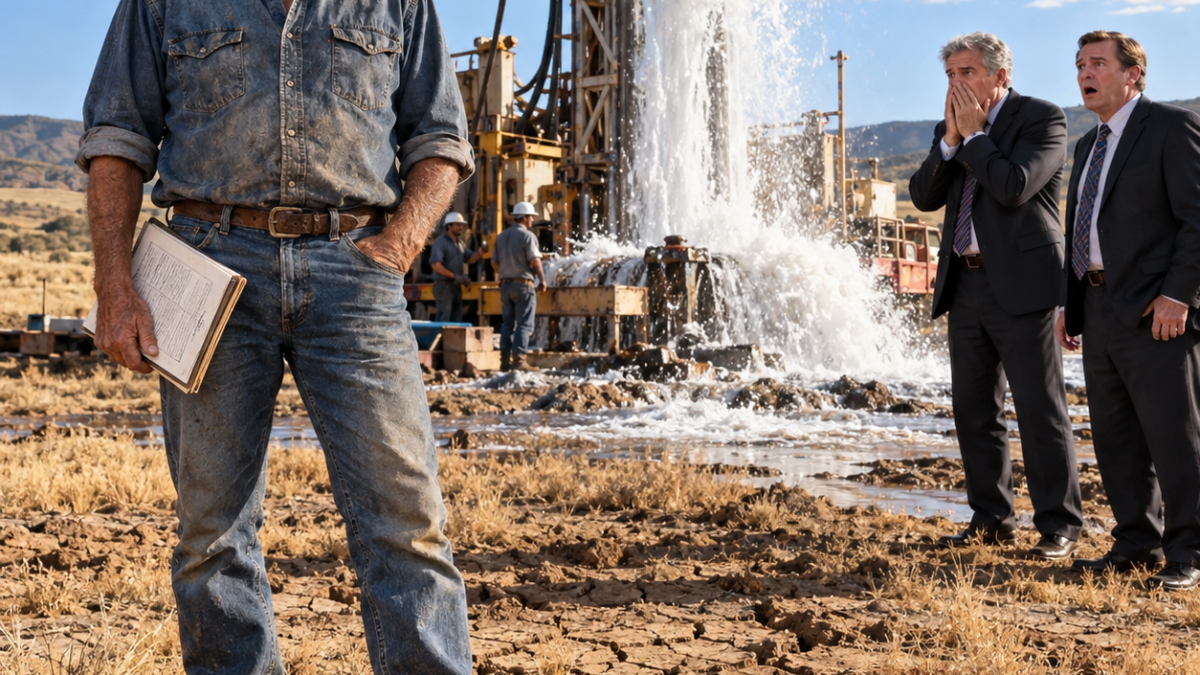
The Bank Sold Him 84 “Dead” Acres for $5,800 and Laughed—Three Years Later, a $9 Million Aquifer Was Discovered Beneath the Land.
The bank manager laughed when seventy-year-old Walter Grady paid $5,800 for eighty-four acres everyone in the valley called dead land, joking that if he sold the rocks one by one he might eventually earn his money back.
Three years later, after Walter had spent hundreds of quiet mornings studying soil nobody else wanted, a county drilling crew punched through 181 feet of clay and stone and hit an ancient buried river channel capable of producing more than 400 gallons of clean water every minute.
Then the same bank that had rushed to dump the worthless property offered him more than $9 million for the pumping rights—and discovered the old farmer had spent his entire life learning the difference between what land is worth today and what it is worth if you refuse to destroy tomorrow.
My name is Walter Grady.
I was sixty-nine years old the morning a bank manager laughed while I signed the papers for eighty-four acres nobody else wanted.
I remember the laugh more clearly than the price.
Five thousand eight hundred dollars.
That was all.
Less than some people spend on a used pickup.
Good ground in our valley was bringing more than fourteen hundred dollars an acre that year.
I paid about sixty-nine dollars an acre.
That should tell you what everyone thought of it.
Nothing.
Less than nothing, if you listened to the men drinking coffee at Roy’s Diner.
The property sat on the west side of Cottonwood Valley, about eleven miles from the nearest town and half a mile from my home place.
Eighty-four acres of yellow grass, shallow gullies, exposed stone, cracked soil, two abandoned well casings, and one leaning barn whose roof had survived mostly because even the wind had lost interest.
The land had been farmed hard for decades.
Wheat.
Milo.
Wheat again.
Then hay.
Then wheat.
Always shallow tillage.
Always more fertilizer.
Always another crop pulled out of soil that was giving less each season.
By the late nineties, yields collapsed.
The owner borrowed against the place.
Tried irrigation.
Both wells failed.
Then the farm failed.
Harvest Plains Bank foreclosed.
PART2:
They tried selling the eighty-four acres at three different auctions.
Nobody bid.
The first time, the minimum was thirty-two thousand.
Second time, nineteen.
Third time, ten.
Still nothing.
After that, the bank stopped pretending.
They listed it as distressed nonproductive agricultural acreage.
Bank language for:
Please take this problem away.
I had looked at the land my entire life.
My father used to drive past it and say:
“That ground isn’t dead.”
I would look out the truck window at dust blowing across it.
“Looks dead.”
He would shake his head.
“Land doesn’t die easy.”
“People just forget how to listen.”
I thought that was one of his old-man sayings.
He had many.
Never sharpen a knife when you’re angry.
Never buy cattle because somebody else got rich on cattle.
Never trust a man who says a fence line is “about here.”
And:
PART3:
Land is rarely dead.
Most of the time, people have just been asking the wrong thing from it for too long.
I did not understand that until after he was gone.
When Harvest Plains Bank finally put the eighty-four acres into a liquidation sale, I went mostly because I was curious.
There were eleven people in the room.
Two were bank employees.
One auctioneer.
A title clerk.
Several farmers.
A land investor from two counties over.
Nobody wanted the tract.
The auctioneer opened at ten thousand.
Silence.
Eight.
Silence.
Seven.
Nothing.
Then:
“Five thousand eight hundred.”
I raised my hand.
The banker in the back laughed.
Not cruelly enough that anybody would call it cruel.
Just enough.
The kind of laugh people use when they are grateful someone else is making the mistake.
The auctioneer looked around.
“No other bids?”
Nothing.
“Sold.”
Five thousand eight hundred dollars.
When I sat down to sign, the bank manager, Martin Keller, stood beside the closing clerk.
Martin was forty-eight then.
Good suit.
Expensive watch.
A man who enjoyed appearing sympathetic while saying things that were not.
He looked at one of his employees and said:
“Stamp it fast before Walter comes to his senses.”
The employee laughed.
I kept signing.
Martin looked at me.
“No offense.”
“None taken.”
“You got plans for it?”
“Yes.”
“What?”
“I bought it.”
He smiled.
“I gathered that.”
“That’s the plan for now.”
The closing clerk slid the deed toward me.
Martin leaned against table.
“Walter, you know both wells are dry.”
“I know.”
“Previous owner spent almost fifty grand trying to find irrigation water.”
“I read the listing.”
“Soil’s mostly blown out.”
“I’ve seen it.”
“Stone everywhere.”
“Yes.”
“You may have bought eighty-four acres of property taxes and rocks.”
One of the employees said:
“If he sells rocks along the highway, maybe he can make his money back.”
More laughter.
I folded the deed.
Placed it inside my coat.
Then asked:
“What happens to the old property records?”
Martin looked confused.
“What records?”
“The files from foreclosure.”
“We keep what’s required.”
“And the rest?”
“Most of it gets archived or destroyed.”
“I want it.”
“Why?”
“Because I bought what it describes.”
He shrugged.
“Take whatever title says we can release.”
That decision mattered more than the sale.
Three cardboard boxes came home in the bed of my pickup.
Most people would have called them trash.
Old farm receipts.
Faded aerial photos.
A soil report.
Two invoices from failed drilling attempts.
Tax notices.
Crop histories.
A 1948 topographic map.
And a manila folder from an irrigation engineer named Harold Voss, dated 1952.
I put everything on my kitchen table.
My wife, Margaret, had died six years earlier.
The house had been too quiet since.
So I had room.
I opened box one.
Then box two.
Then three.
Nothing jumped out.
No treasure map.
No handwritten note saying:
DIG HERE.
That is not how land works.
The useful things looked ordinary.
The first important thing I noticed was not underground.
It was what rain did.
I bought the place in late October.
Winter came dry.
Then March brought a storm.
Almost two inches overnight.
I drove over before breakfast.
Water ran brown off the eighty-four acres.
Not clear.
Brown.
Soil.
The gullies filled fast.
The ditch along the south line carried enough mud to stain the county culvert.
Then I walked six hundred yards to my own field.
Same rain.
Far less runoff.
That was my first clue.
The problem was not simply lack of water.
The property could not keep the water it received.
For the first month, I planted nothing.
People noticed.
They expected the crazy old man to immediately plow his cheap land.
Instead I walked.
Every morning.
Notebook.
Shovel.
Tape measure.
Flagging stakes.
I watched where frost stayed longest.
Where weeds grew differently.
Where soil darkened.
Where wind stripped the surface.
Where runoff cut.
I divided the eighty-four acres into thirty-six sections.
Not equal squares.
Zones.
Slope.
Aspect.
Soil condition.
Vegetation.
Then I dug.
One test hole.
Then another.
Then another.
People at Roy’s Diner began asking.
“What are you growing out there, Walter?”
“Holes.”
They laughed.
One man called it the dirt graveyard.
The name stuck.
“How’s the dirt graveyard?”
“Still dead?”
“You bury anything yet?”
I smiled.
Drank coffee.
Went back to digging.
Around sixteen inches down, my shovel began hitting something hard.
At first I thought rock.
Then I tried another test.
Same depth.
Different area.
Again.
A layer of soil so compacted the shovel bounced.
I brought a soil probe.
Same thing.
Years of plowing at nearly identical depth had created a hardpan layer beneath the topsoil.
Think of it as a sealed floor.
Rain hit the surface.
Could not move downward fast enough.
Roots hit the layer.
Turned sideways.
Then summer came.
The surface dried because roots remained shallow.
Farmers responded by plowing more.
Fertilizing more.
Trying to force production out of a soil profile that had been physically locked.
The land had not run out of life.
It had lost structure.
I told my neighbor, Dean Foster.
He laughed.
“Hardpan doesn’t explain the wells.”
“No.”
“So still dead.”
“Maybe.”
“You planning to deep rip all eighty-four?”
“No.”
“Why?”
“Because I could be wrong.”
That was another thing my father taught me.
Never be wrong at full scale.
I chose six acres near the barn.
Bought an old subsoiler from a retired farmer.
It looked like something pulled from a museum.
The third shank was bent.
The frame had been welded twice.
I rebuilt it with parts from an old tractor.
First day, I barely moved.
Second day, better.
Third day, the ground bent a steel shank nearly in half.
I hauled it back to shop.
Heated it.
Straightened it.
Reinforced the mount.
Went again.
By November, the six acres looked worse than before.
Deep cuts.
Clods.
Uneven ground.
Dean drove by and stopped.
“You farming or mining?”
“Neither.”
“Looks terrible.”
“Thank you.”
I planted rye.
Clover.
Daikon radish.
Not to harvest.
To work.
The radish roots pushed deep.
Rye held soil.
Clover added organic matter.
Winter killed some.
Roots decayed in place.
Small channels remained.
Spring came wet.
That was the first moment I knew I had not bought a mistake.
Heavy rain fell for twelve hours.
I drove out wearing rubber boots.
The untreated acreage ran brown.
Mud toward ditch.
The six-acre test?
Water stood briefly, then disappeared.
Not all.
Enough.
I dug.
Moisture had moved deeper.
Soil under cover crop felt different in my hand.
Not miracle.
Beginning.
I expanded by eight acres the next year.
Then ten.
Slow.
No giant loan.
No new equipment line.
People told me I was wasting time.
“You’re almost seventy.”
“Why not borrow and finish?”
Because I had bought the land from a bank that thought it was worthless.
I was not about to borrow money from the same bank just so I could hurry proving them wrong.
That amused me.
It also protected me.
By the end of year two, the change became visible from the road.
My first six acres stayed green longer during dry weeks.
Erosion channels softened.
Water disappeared into ground instead of racing off it.
The dirt graveyard was beginning to hold rain.
That was when Martin Keller came back.
Harvest Plains Bank SUV.
Same polished shoes.
He parked by the fence.
I was spreading old hay over a restored section.
“Walter.”
“Martin.”
He looked across the land.
“Looks better.”
“A little.”
“You put money into this.”
“Some.”
“Bank’s been reviewing nearby holdings.”
I leaned on fork.
“Congratulations.”
He smiled.
“We might be interested in reacquiring this parcel.”
“How much?”
“Twelve thousand.”
I laughed.
Martin looked slightly offended.
“That’s more than double what you paid.”
“Why?”
“What do you mean?”
“Two years ago, you called it rocks and property taxes.”
“I was joking.”
“You tried three auctions.”
“Market changes.”
“So does land.”
He looked toward green six-acre block.
“Twelve thousand is strong.”
“No.”
“Think about it.”
“I just did.”
His smile cooled.
“Walter, you’re not exactly young.”
“I’ve noticed.”
“This could be a clean profit.”
I looked across the field.
“This land isn’t done talking yet.”
He stared at me as though I had said something ridiculous.
Maybe I had.
He left.
That afternoon I became more curious about the northwest corner.
Less than one acre.
Willows.
Sedges.
Green longer than everything around them.
Even during dry spells.
The soil felt cooler underfoot.
Previous owners had dug a shallow ditch there to drain what they considered useless wet ground.
I brought out the 1948 topographic map.
Near that corner was a symbol I almost missed.
A seep.
Not a spring exactly.
A natural wet point.
By 1970s maps, it disappeared.
Likely drained.
I walked the old contour.
Then reread the Voss file.
Nothing dramatic.
Soil descriptions.
Irrigation sketches.
And on one page from 1952:
Rounded gravel beneath deep clay on western side. Possible ancient channel. Not confirmed by drilling.
I circled it.
Rounded gravel matters.
Water rounds stone.
River systems leave patterns.
The note did not prove anything.
But it matched the seep.
I dug a shallow contour trench uphill from the willows.
Not deep.
Just enough to intercept lateral movement.
Three days later, water appeared.
Cold.
Clear.
First a wet line.
Then drips.
Then steady.
I got greedy.
Dug deeper.
The bank collapsed slightly.
Fine clay smeared over the face.
Water vanished.
I stood in mud feeling stupid.
Dean came by.
“What happened?”
“I ruined it.”
He laughed.
“Thought you were the soil whisperer.”
“Apparently the soil stopped listening.”
I did not hide the mistake.
Measured it.
Filled part back.
Changed slope.
Tried again.
This time the seep returned.
About one gallon per minute.
Nothing close to irrigation.
But it stayed.
That was what mattered.
July.
Still flowing.
August.
Still.
The valley’s shallow wells rose and fell with rain.
This flow barely changed.
I began wondering whether it was connected to something deeper.
The old Voss note again:
Ancient channel.
Possible.
Not confirmed by drilling.
The two failed wells had records.
One stopped at 96 feet.
The other at 142.
Both reported dense clay and rock.
No meaningful water.
What if they had stopped too soon?
That question cost nothing.
Answering it would cost tens of thousands.
I did not have it.
So I waited.
Then drought arrived.
The first year was bad.
Second worse.
Ponds shrank.
Shallow wells dropped.
Farmers lowered pumps.
Some wells started pulling air.
Cattlemen hauled water.
Fields failed.
Water trucks became common.
Harvest Plains Bank suddenly had a problem bigger than my eighty-four acres.
Many borrowers depended on shallow groundwater.
When water disappeared, cattle had to be sold.
Crops failed.
Operating loans stretched.
Loan extensions piled up.
A drought is agricultural.
Then financial.
By third summer, Martin Keller came again.
This time he did not joke.
He drove up while I was checking the seep.
“Walter.”
“Martin.”
He looked at the willows.
Then restored fields.
“I have another offer.”
“Thought you might.”
“Sixty-five thousand.”
I turned.
“For eighty-four acres?”
“Yes.”
“Why?”
“Strategic acquisition.”
“What strategy?”
“Long-term land positioning.”
I laughed.
“No.”
“Walter.”
“Five-eight.”
“What?”
“You sold it for $5,800.”
“I know what you paid.”
“Then twelve.”
“Yes.”
“Now sixty-five.”
He shifted.
“You’ve improved it.”
“Not sixty thousand dollars’ worth.”
“You don’t know that.”
“Neither did you when you sold it.”
He held out a folder.
“Sixty-five thousand.”
“Cash transaction.”
“Fast closing.”
“You’re almost seventy.”
I stared.
That was the second time he had used age as pressure.
“Martin.”
“Yes?”
“If I’m too old to own it, why is your bank so desperate to buy it?”
His face hardened.
“We’re not desperate.”
“Then go home.”
He did.
That night I laid everything on the table.
1948 map.
1952 note.
Seep coordinates.
Restoration zones.
Failed well logs.
Bank offers.
Why was Harvest suddenly interested?
Maybe simply because land looked better.
Maybe because drought made acreage strategic.
Maybe they knew something.
I had no proof.
Then county commissioners announced a groundwater survey.
Emergency drought funding.
A hydrogeologist named Dr. Lena Morales had been hired to run electrical resistivity lines across several farms.
The method does not magically “see water.”
It measures differences in how subsurface materials conduct electrical current.
Certain saturated sediments can produce distinctive patterns.
Lena surveyed twelve farms before mine.
Everywhere the story was similar.
Shallow aquifer thin.
Recharge poor.
Water table down.
Then she reached the dirt graveyard.
I told her about the seep.
Showed Voss note.
She did not get excited.
Scientists disappoint storytellers.
She said:
“Interesting.”
That was all.
They laid the first line across northwest section.
Electrodes.
Cables.
Meters.
Near surface, nothing surprising.
Dry clay.
Rock.
Compacted layers.
Exactly the stuff everybody hated.
Then Lena expanded spacing to read deeper.
More than 170 feet.
She stopped talking.
Stared at screen.
One technician recalibrated.
“What?”
I asked.
“Nothing yet.”
They reran.
Then moved line.
Again.
Same anomaly.
Third location.
Same.
Fourth.
Same.
Lena finally showed me.
A broad conductive zone beneath nearly half the property.
Long.
Continuous.
Deep.
Not the patchy shallow signatures seen elsewhere.
“What is it?”
“I don’t know yet.”
“What could it be?”
“Saturated gravel.”
“Clay lens.”
“Saline water.”
“Geologic structure.”
“Something conductive.”
“So maybe water.”
“Maybe.”
That word kept me awake.
County authorized a test well.
At the intersection of the strongest survey lines.
Drilling began in October.
The first fifty feet:
Clay.
Seventy-five:
Clay and stone.
One hundred:
Dry.
A hundred forty:
Still mostly dry.
I remembered the old wells.
One had stopped here.
The drilling contractor looked at me.
“Want to keep going?”
County was paying the test.
Lena said yes.
One hundred sixty.
Hard formation.
One hundred seventy-five.
Nothing meaningful.
Then at roughly 181 feet, the sound changed.
If you have never stood near a drill rig, you may not understand.
Machines speak.
The crew heard before I did.
Cuttings changed.
Wet gravel came up.
Rounded.
Sand.
The driller picked up handful.
Looked at Lena.
“There.”
They kept drilling.
Water-bearing material continued.
Not six inches.
Feet.
Then more.
When casing was installed, the static water level rose.
No pump.
Just pressure.
Water climbed inside casing to around the hundred-foot mark.
Lena remained cautious.
“Finding water is not same as finding a useful aquifer.”
“What do we need?”
“Pump test.”
They ran twenty-four hours.
Flow increased.
Two hundred gallons per minute.
Three hundred.
Four hundred.
Over 420 gallons per minute.
The water level dropped only modestly.
Hours later, flow remained strong.
I stood beside discharge line watching clean water pour into a temporary basin.
More water than those eighty-four acres had seen in my lifetime.
Dean Foster drove up.
The same man who called it the dirt graveyard.
He stared.
“How long’s it been doing that?”
“Hours.”
“Going down?”
“Not much.”
Dean removed cap.
Scratched head.
“Well.”
That was all he could say.
Laboratory results came later.
Low nitrate.
Low agricultural chemical residue.
Clean compared with many shallower valley wells.
The thick clay everybody cursed had helped protect the deeper water from contamination above.
The hard geology that made the property difficult to farm had acted as a lid.
The two “dry” wells had not proven the land held no water.
They had simply stopped before reaching it.
That realization stayed with me.
How many things in life get called failures because somebody stopped ten feet before the answer?
The county meeting was full.
Standing room.
Farmers.
Bank representatives.
Press.
Water district.
Lena presented cross sections.
Pump test.
Water quality.
She used careful language.
Potential deep aquifer.
Likely buried paleochannel.
Substantial estimated storage.
Further testing required before any long-term sustainable yield could be established.
Not:
Infinite water.
Not:
Magic.
But stable enough to matter.
Very much.
Martin Keller sat in second row.
He did not laugh.
After meeting, he approached.
“Walter.”
“Martin.”
“Impressive.”
“Seems so.”
“We should talk.”
“About?”
“Management.”
That word made me smile.
“The bank has infrastructure-finance experience.”
“We could help develop distribution.”
“Permitting.”
“Commercial agreements.”
“Metering.”
“We could maximize value.”
There it was.
Not land now.
Water.
I said:
“I’ll think.”
That answer surprised him.
Truth is, I did think.
Managing water at that scale was not simple.
Pumps.
Power.
Pipelines.
Testing.
Permits.
Sustainability.
Contracts.
Liability.
I was an old farmer.
Not a water utility.
Then Harvest Plains Investment Partners sent a formal proposal.
More than nine million dollars.
Not for land.
For long-term extraction rights.
They would install wells.
Pump at commercial volumes.
Pipe water across the valley.
The projected withdrawal numbers were enormous.
The upfront money could have changed my family permanently.
Nine million.
I sat at kitchen table looking at it.
Margaret would have told me to sleep on it.
I slept three nights.
Then asked Lena a question.
“If they pump at this proposed rate, how long does the aquifer last?”
She refused to give exact number.
Good scientists do.
“We do not have enough long-term data.”
“What worries you?”
“That deep isolated systems can recharge very slowly.”
“How slowly?”
“Potentially decades.”
“Centuries in parts.”
“So water might look abundant and still be finite.”
“Yes.”
I read investment proposal again.
High extraction.
Long contract.
Escalation clauses.
Expansion options.
To them, aquifer was asset.
To me, it had survived underground because nobody had found a way to empty it yet.
I declined.
Martin called.
“You’re turning down nine million dollars?”
“Yes.”
“Walter, be serious.”
“I am.”
“You paid fifty-eight hundred.”
“I remember.”
“This is generational money.”
“So is water.”
Silence.
“You can’t personally use that much.”
“That isn’t point.”
“Then what is?”
“If I sell you right to pump as fast as your model allows, I don’t own a water source anymore.”
“I own a check.”
“That check will outlive you.”
“Maybe.”
“The aquifer should too.”
Martin became frustrated.
“Do you understand what nine million dollars means?”
“Yes.”
“Apparently not.”
I ended the call.
Then cattle started dying on farms with dry wells.
Not in dramatic numbers.
Enough.
People hauled water.
Dean came first.
Of course it was Dean.
His well dropped below pump.
He had forty-eight cows and calves relying on tanks.
He pulled up in an old Chevy.
Did not get out for almost a minute.
Finally walked to porch.
Hat in hands.
“Walter.”
“Dean.”
“I need water.”
No joke.
No dirt graveyard.
Just need.
“How much?”
“Enough to keep stock.”
“For how long?”
“Until we can drill or sell.”
He looked ashamed.
That bothered me.
“Dean, look at me.”
He did.
“You laughed when I bought the place.”
“I did.”
“So did everybody.”
“I know.”
“You owe me nothing but the normal price.”
His eyes filled.
“What’s normal price?”
“Cost plus enough to maintain pump.”
He stared.
“That’s it?”
“For now.”
“Why?”
“Because cows didn’t laugh.”
He laughed then.
A broken laugh.
We set conditions.
Not punishment.
Restoration.
If I was going to help keep farms alive, I did not want them going back to the same practices that worsened runoff and shallow recharge.
Deep ripping where appropriate.
Cover crops.
Reduced bare soil.
Recharge basins.
Contour practices.
Not identical prescriptions everywhere.
Technical help.
Water came with responsibility.
Dean agreed.
Then Howard Keene.
Maria Santos.
The Wilcox family.
Twelve farms eventually.
Water lines and tanker fills.
One-year contracts only.
No permanent surrender of rights.
Local agriculture first.
Commercial buyers later if sustainable yield allowed.
Harvest Plains offered again.
Higher management fee.
I declined.
An outside water company offered ten million for a longer-term contract.
Declined.
People called me crazy.
Maybe.
But my father’s sentence kept returning.
Land is rarely dead.
People treat it wrong too long.
Water can be treated wrong too.
If I turned an ancient aquifer into the next thing extracted until weak, what had I learned?
The eighty-four acres became more than source.
Recharge work expanded.
Ponds.
Swales.
Restored soil.
When spring floods came, we slowed water.
Let it soak.
Some recharge went to shallow systems.
Whether significant volumes reached deep paleochannel would take years to know.
But keeping rainfall on land helped regardless.
Dean’s fields improved.
Howard planted cover crops reluctantly.
Then became evangelist after one dry summer when his soil held moisture longer.
The same diner that called my place the dirt graveyard became unofficial meeting room for soil restoration.
Men who laughed at radishes asked seed rates.
That amused me.
Martin stopped coming personally.
Bank sent letters.
Professional now.
Harvest Plains had loans on many farms receiving my water.
Eventually we reached an arrangement.
Not control.
Not mineral-style rights.
Simple financing partnership for farmers who needed upgrades.
The bank funded tanks and soil improvements under normal loans.
I supplied water under short contracts.
Nobody owned aquifer but me, subject to state law and regulatory limits.
Nobody got ninety-nine-year pumping rights.
The first time Martin and I sat across a table after that, he said:
“You really don’t like banks.”
“I don’t like people confusing money with ownership.”
He looked embarrassed.
“I deserved that.”
“Probably.”
Then he surprised me.
“I was wrong at the auction.”
“Yes.”
“You enjoy saying that.”
“A little.”
He laughed.
“Did you know?”
“When you bought?”
“No.”
“Not aquifer.”
“You thought something was there.”
“I thought land was mistreated.”
“That’s all?”
“That was enough.”
He leaned back.
“If you hadn’t restored soil, would you have found water?”
“Maybe eventually.”
“If county hadn’t surveyed?”
“Maybe never.”
“So you got lucky.”
“Yes.”
That answer seemed to disappoint him.
People want genius.
I was observant.
Patient.
And lucky.
Those can coexist.
I did not discover an aquifer because I was wiser than geology.
I noticed a seep.
Found an old note.
Asked questions.
Then public drought survey found what was there.
The water existed whether I deserved it or not.
What mattered was what I did after finding it.
That distinction became more important as newspapers picked up story.
OLD FARMER TURNS $5,800 LAND INTO $9 MILLION WATER FORTUNE.
I hated headline.
The land was not worth nine million because I transformed it.
The offer was for extraction rights based on scarcity and estimated volume.
Different.
And I did not take the nine million.
Reporters skipped that sometimes because it ruined clean ending.
They wanted:
Bank mocks farmer.
Farmer gets rich.
Bank regrets.
Easy.
Truth was better.
Bank sold land.
I restored soil.
County found aquifer.
Bank saw opportunity.
I refused long-term extraction.
Neighbors survived drought.
Farms changed practice.
The story was not revenge.
It was restraint.
That is harder to sell.
Three years after test well, the aquifer still performed strongly under controlled pumping.
Monitoring wells recorded levels.
Withdrawal limits adjusted.
No assumption of infinity.
We established a local water stewardship cooperative.
Not because I wanted committees.
I hate committees.
Because one seventy-year-old man should not make every decision about something that could affect a valley after he dies.
Ownership remained mine.
Management had oversight.
Hydrogeologists.
Farmers.
County.
Environmental representatives.
Annual report.
Public numbers.
Boring.
Good.
My granddaughter Claire designed website.
She told me nobody under fifty reads printed reports.
I told her nobody over seventy trusts websites.
We compromised.
Both.
I put eighty-four acres into a conservation-oriented family trust.
Not to freeze it forever.
To make selling pumping rights difficult.
My son thought I was overdoing it.
Then read Harvest proposal.
Changed his mind.
The old barn came down eventually.
Not salvageable.
I saved beams.
Used them in pump house.
The two failed well casings remain.
I left one visible.
People ask why.
Because failure is part of map.
One stopped at ninety-six feet.
One at one-forty-two.
Water at one-eighty-one.
I had small metal plaques made:
WELL 1 — STOPPED HERE, 1967.
WELL 2 — STOPPED HERE, 1979.
TEST WELL — WATER-BEARING GRAVEL, 181 FT.
Not motivational.
Just facts.
Claire says it is motivational anyway.
She may be right.
Dean once stood beside them.
“If those guys had gone forty feet farther…”
“Maybe bank never owns it.”
“And you never buy for $5,800.”
“Probably.”
He shook head.
“Funny.”
“Expensive joke for bank.”
I smiled.
“Maybe.”
But I no longer thought of bank as loser.
Harvest sold an asset it had good reasons to consider poor.
The old wells were dry.
Soil degraded.
No buyer.
Banks are not geology departments.
They made decision based on available information.
Then mocked.
That was unnecessary.
The mistake was not selling.
It was assuming value had been permanently defined.
That is human mistake.
We all do it.
Person failed once.
Therefore failure.
Field produced poorly.
Therefore bad land.
Well was dry.
Therefore no water.
Old man bought cheap acreage.
Therefore fool.
Labels become shortcuts.
Reality keeps changing underneath.
After drought eased, some neighbors stopped buying my water.
Good.
That was goal.
Water should be emergency bridge, not dependency.
Their soils improved.
Recharge improved.
Several shallow wells recovered partially after wet seasons.
Not because my aquifer magically saved everything.
Because rainfall returned and farmers changed practices.
The deep source remained reserve.
Used carefully.
Harvest Plains Bank eventually financed a regional water study.
Martin retired before it finished.
On his last week, he drove out.
No suit.
Jeans.
Plaid shirt.
He brought old auction brochure.
“You kept this?”
“No.”
“Found it in office.”
The brochure described my property:
84 ACRES — NONIRRIGATED DISTRESSED AGRICULTURAL LAND.
Two failed wells.
Significant erosion.
Limited productive capacity.
Martin had written in margin:
TAKE ANY CLEAN OFFER ABOVE $5K.
He handed it to me.
“Thought you should have it.”
I laughed.
“Frame it?”
“That’s what I would do.”
I did not.
I placed it in old file box with 1948 map and Voss note.
Same box bank almost threw away.
Martin walked toward restored field.
“You ever regret not taking nine million?”
I answered honestly.
“Some mornings.”
He laughed.
“Thank God.”
“I was worried you were going to say never.”
“Nine million is nine million.”
“So why not?”
I looked toward pump house.
Because numbers tempt you to treat decisions as finished.
If I had sold, I could have told myself I secured my family forever.
Maybe true.
Then somebody else decides pumping rate.
Expansion.
Resale.
Future.
I wanted my grandchildren to inherit choice.
Not just money from a choice I made for them.
“That water might matter more in twenty years.”
Martin nodded.
“Or less.”
“Yes.”
“That’s risk.”
“Ownership is risk.”
He looked across valley.
“You know what bothered me?”
“What?”
“When you refused twelve thousand.”
“That?”
“Yeah.”
“I thought you were stubborn.”
“I was.”
“But you said land wasn’t done talking.”
“I remember.”
“I thought that was old-man nonsense.”
“It was.”
He laughed.
“Turned out right.”
“Even nonsense gets lucky.”
We shook hands.
No enemies.
No humiliation.
He retired.
The aquifer kept flowing.
Years later, Claire interviewed me for college project.
She set a phone on kitchen table.
“Grandpa, when did you know land was valuable?”
“Before I bought.”
She frowned.
“You knew about aquifer?”
“No.”
“Then what did you know?”
“That eighty-four acres for $5,800 beside my farm had some value.”
“That’s not what I mean.”
“I know.”
She tried again.
“When did you know it was special?”
I thought.
“When rain soaked into the six-acre test.”
“Not when water well hit?”
“No.”
“Why?”
“Because that was first time land answered something I asked correctly.”
Claire stared.
“That sounds annoyingly poetic.”
“I’m old.”
“Occupational hazard.”
She smiled.
Then:
“What would’ve happened if aquifer wasn’t there?”
“I would still own restored eighty-four acres.”
“So you wouldn’t call purchase failure.”
“No.”
“That’s important.”
It was.
Because people rewrite decisions after lucky outcomes.
If test well had been dry at 181 feet, my soil work would still have mattered.
The land had become productive again.
Not high-yield miracle.
Healthy enough.
Holding water.
Growing forage.
Reducing erosion.
Worth more than $5,800.
The aquifer changed scale, not truth.
That is why I never liked story told as:
He bought worthless land and found treasure.
It was never worthless.
The treasure did not make it valuable.
The work revealed value in layers.
Soil first.
Then water.
Then community.
Maybe that is sentimental.
At seventy-six, I am allowed some.
The valley changed after drought.
You can see cover crops in winter now.
More residue left.
Less bare ground.
Farmers argue about infiltration rates instead of just yields.
Not everyone.
We still have people who plow too much because their fathers did.
Change is slow.
Water cooperative requires annual soil-health plan for discounted emergency allocation.
That started arguments.
Good.
People take agreements seriously when water is attached.
We do not dictate one method.
We require measurable effort.
Infiltration tests.
Erosion control.
Recharge.
Ground cover.
The principle is simple:
If you take from water system, help land receive water too.
The $9 million offer remains in my safe.
I kept it.
Not as trophy.
Reminder.
Numbers can make bad ideas look respectable.
Nine million dollars printed on bank letterhead looks intelligent.
Professional.
Safe.
It does not show gallons per minute.
Decline curve.
Recharge uncertainty.
What happens after thirty years.
It just shows money.
I am not anti-money.
Money bought drill.
Pumps.
Pipelines.
Lab tests.
Water tanks.
Money keeps farms alive.
I am against pretending money answers questions it only prices.
What is aquifer worth?
Nine million?
Twenty?
Fifty?
Wrong question by itself.
How much can be removed without destroying it?
Who gets water during drought?
What obligations come with access?
What happens after I die?
Those matter.
The investment company did not like those questions because they complicated the deal.
Good.
Some deals should be complicated.
My father’s saying changed over years in my head.
Land is rarely dead.
People treat it wrong too long.
I would add:
Resources are rarely infinite.
People treat them like they are until they become expensive.
Drought taught valley that.
The aquifer taught me restraint.
The bank taught me humility in reverse.
They laughed because they knew what land was worth.
Then tried buying it back because they learned they did not.
I could laugh at them.
Sometimes I did.
But if I am honest, I did not know either.
That is point.
Nobody knew.
Not fully.
We knew clues.
History.
Maps.
Soil.
Seep.
Old note.
Then survey.
Then drill.
Certainty came late.
It usually does.
What separated outcomes was not that I possessed secret knowledge.
I kept looking.
The previous owners stopped.
Understandably.
They were broke.
The bank stopped.
Understandably.
It had to liquidate a bad asset.
I could continue because I had patience and low debt.
Luck again.
Never tell story of perseverance without mentioning who could afford to persevere.
That matters.
I was not heroic for refusing a loan.
I had enough savings to work slowly.
Other farmers did not.
That is one reason the water fund helps them.
You cannot tell a man whose cattle are thirsty to be patient for three years.
Sometimes systems must buy people time.
Water bought time.
Soil work reduced future need.
That is better cycle.
A few years ago, county put up sign near road.
COTTONWOOD DEEP PALEOCHANNEL MONITORING SITE.
Tour groups occasionally come.
College geology students.
Agronomy classes.
I hate giving speeches.
Claire makes me.
I walk them to test well.
Show old failed wells.
Then restored soil.
I ask:
“What made land look dead?”
Students say:
Drought.
Erosion.
Compaction.
Bad management.
Correct.
Then:
“What protected deep water?”
Clay.
Rock.
Low permeability.
Exactly.
The same thing can be problem at one depth and protection at another.
I like that lesson.
Hard layer near surface damaged crops.
Thick confining layers deeper protected aquifer.
Land is not simple.
Neither are people.
At the end, somebody always asks:
“Would you sell now?”
I answer:
“Everything has conditions.”
They want no.
Clean line.
I give truth.
If someday science shows aquifer can support more use sustainably, maybe contracts change.
If valley needs drinking water, maybe priorities change.
If my grandchildren choose differently under trust rules, that is their generation.
Stewardship is not freezing world.
It is making decisions slowly enough that future people still have decisions left.
That is what I wanted to preserve.
Choice.
The bank wanted extraction rights.
I wanted future choices.
Nine million dollars could not buy that back after signing it away.
Today the first six acres are almost unrecognizable.
Dark soil.
Roots deeper.
Earthworms where there used to be hard dust.
After heavy rain, little runoff.
The old erosion ditch has grass.
Willows remain in northwest corner.
The seep still runs.
Small.
Steady.
One gallon per minute give or take.
Funny.
Everyone obsesses over 420-gallon-per-minute well.
I like seep more.
That little thread of water started everything.
Easy to ignore.
Almost nothing.
Like old note.
Like one green patch in dry field.
Big discoveries often begin as small inconsistency.
Something does not match.
Why is that grass green?
Why does this water not stop?
Why did old engineer write “ancient channel”?
Why is bank offering sixty-five thousand now?
Questions are cheap.
Answers sometimes are not.
But questions keep you from accepting labels too early.
Dead land.
Dry ground.
Worthless.
Old fool.
Strategic acquisition.
Nine-million-dollar aquifer.
Every label captured one moment.
None captured whole.
At seventy-nine now, I still drive those eighty-four acres most mornings.
Slower.
Knees worse.
Claire does more management.
My son handles equipment.
I mostly interfere.
They tolerate me.
The bank’s original auction sign sits in shop.
84 ACRES — $5,800 MINIMUM.
Somebody stole it after sale and gave it to me years later.
I will not say who.
Underneath, Claire hung another sign:
NOT FOR SALE.
I told her remove it.
“Why?”
“Too dramatic.”
“True.”
“Still.”
She left it.
Grandchildren ignore old men selectively.
One morning, after wet spring, I stood near pump house.
The aquifer was not running.
We do not pump unless needed.
Silence.
Birds.
Green field.
The highest-value water is often water you do not extract.
That sounds backwards if you see water only as commodity.
Makes sense if you see reserve.
The bank once saw eighty-four acres as dead because it produced nothing.
Later it saw aquifer as valuable because it could produce enormous volume.
I eventually saw a third possibility.
Value can exist in what you choose not to produce yet.
That may be most expensive lesson I ever learned.
And I bought it for $5,800.
Not because bank made mistake selling.
Not because I outsmarted anybody.
Because I happened to own the ground when everybody finally learned what was beneath it.
The bank offered me nine million dollars to turn that discovery into a permanent extraction deal.
I said no.
Some people still think that was foolish.
Maybe.
But every drought year when local families can keep cattle watered without surrendering their farms, I sleep well.
Every heavy rain that sinks into restored soil instead of carrying it away, I sleep well.
Every monitoring report showing deep water level stable, I sleep well.
And when I pass the old bank office, I sometimes remember Martin Keller saying:
“Stamp it fast before he comes to his senses.”
I did come to my senses.
Just not the way he expected.
I learned that the cheapest land in the valley could hold the most important water.
I learned two failed wells can be evidence of stopping too soon, not proof that nothing exists.
I learned a $9 million offer can still be too expensive if the price is control.
And I learned my father was right about land.
It does not stop talking because people stop listening.
You just have to be patient enough to hear what it has been trying to say.




