The Bank Sold Him 1,140 “Worthless” Whiskey Barrels for $750—Eleven Years Later, They Came Back Begging for Them
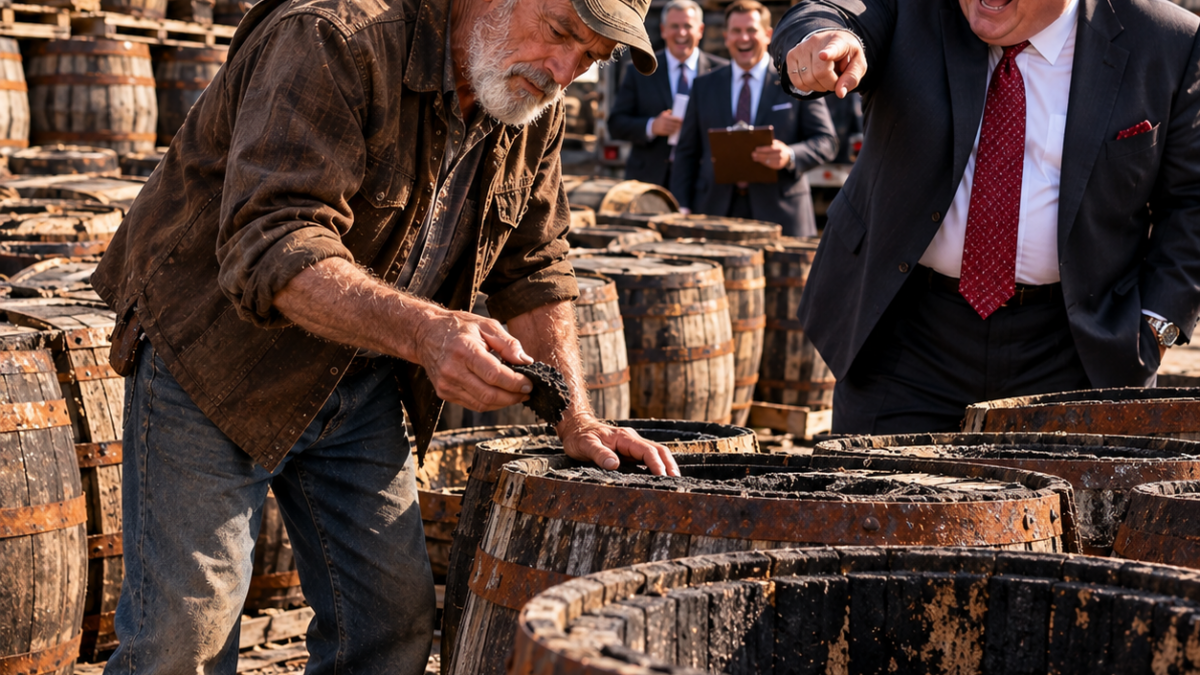
The Bank Sold Him 1,140 “Worthless” Whiskey Barrels for $750—Eleven Years Later, They Came Back Begging for Them.
The bank manager laughed when a sixty-seven-year-old farmer paid $750 for 1,140 weathered whiskey barrels the bank had planned to spend more than $5,000 hauling to a dump, and he made sure the receipt clearly transferred every last barrel because he never imagined the “trash” would ever matter again.
Eleven years later, properly prepared whiskey barrels were selling for hundreds of dollars each, the farmer had used that forgotten oak to save 148 acres from foreclosure, and the same banker who once mocked him drove back up the farm road carrying a contract instead of a late-payment warning.
But the real thing the bank had underestimated was not the value of old oak—it was the old man’s patience, because what looked like a lucky $750 purchase had actually taken years of failure, study, drying, craftsmanship, and promises kept before it became the business the bank suddenly wanted for itself.
The bank manager laughed before my father even finished asking the question.
Not a polite laugh.
Not the kind a man gives because something surprises him.
This was the full-bodied laugh of somebody who believes another person has just made a mistake large enough to become a story.
My father stood in the liquidation yard outside Chillicothe, Ohio, with his hands inside the pockets of an old brown work coat while eleven hundred and forty whiskey barrels sat in rows behind him.
Most looked terrible.
Gray oak.
Rust bleeding down from iron hoops.
Some leaning.
Some missing bands.
Some black inside from years of char and whiskey.
Others had spent months outside under Ohio rain.
The yard smelled like wet wood, iron, mud, and something sweet buried underneath.
Bourbon.
Even after all those years.
The manager’s name was Harold Pritchard.
He was fifty-three then.
Heavyset.
Black suit.
Red tie.
Hair combed carefully over the thinning place at the crown of his head.
Harold had managed Citizens Farm & Trust for thirteen years, and he liked to remind people that the bank had survived two recessions because men like him knew the difference between an asset and a liability.
He pointed at the barrels.
“All of them?”
My father nodded.
“All.”
“One thousand one hundred forty?”
“All.”
Harold looked toward two bank employees standing beside a forklift.
Then at my father.
“What are you going to do, Noah?”
“Catch rainwater?”
The employees smiled.
My father did not.
His name was Noah Mercer.
Sixty-seven years old.
Five foot nine.
One hundred forty-eight pounds if he’d eaten well that week.
Hands bent from arthritis.
PART2:
Shoulders rounded from fifty years of lifting things that should have been lifted by machines.
He had spent his entire life on 148 acres that had belonged to our family since 1911.
Corn.
Soybeans.
Hay.
Twenty-six head of cattle.
A farmhouse built in sections because each generation added what it could afford.
Nothing fancy.
Nothing easy.
And at the time, he still owed Citizens Farm & Trust $41,600 on the mortgage.
Harold knew that.
Everybody in a small county knew everybody’s trouble eventually.
The bank had recently foreclosed on a barrel cooperage and liquor-storage business forty miles away.
Most of the machinery had buyers.
Forklifts.
Compressors.
Saws.
Office equipment.
But the barrels were a problem.
They filled almost half the rear storage yard.
A hauling company wanted more than $5,000 to load, transport, and dispose of them.
Harold hated paying to remove something the bank technically owned.
So when Noah offered $750 for all of them and agreed to haul every barrel himself, Harold saw genius.
PART3:
His genius.
Not Noah’s.
“You’re serious.”
“Yes.”
“Cash?”
“Yes.”
“You understand we’re not delivering.”
“I understand.”
“You take the damaged ones too.”
“Yes.”
“No returns.”
“I wouldn’t expect any.”
Harold shook his head.
“Seven hundred fifty dollars.”
“Every last barrel.”
Noah nodded.
Then said:
“I want that written exactly.”
Harold laughed again.
“Gladly.”
He went inside.
The bill of sale was simple.
1,140 USED WHISKEY BARRELS.
TOTAL PURCHASE PRICE: $750.
BUYER ASSUMES ALL TRANSPORTATION, HANDLING, STORAGE, AND DISPOSAL RESPONSIBILITY.
FULL OWNERSHIP TRANSFERS TO BUYER UPON PAYMENT.
NO WARRANTY.
AS-IS, WHERE-IS.
Harold signed.
Noah signed.
The teller stamped receipt.
Noah folded it carefully.
Put it inside his coat.
Harold leaned back.
“You know what I think?”
Noah looked at him.
“I think you just paid us seven hundred fifty dollars to haul away our garbage.”
Noah nodded once.
“Could be.”
That answer bothered Harold more than an argument would have.
My father never liked explaining an idea before it had earned the right to be explained.
Three months later, everybody thought he’d lost his mind.
He made trip after trip with a faded green Ford pickup and a tandem-axle trailer borrowed from our neighbor, Calvin Reese.
The warehouse was forty miles each way.
He could carry twelve or fourteen barrels depending on how he stacked them.
Sometimes fewer.
Every trip cost fuel.
Rope.
Time.
One frozen January morning a trailer bearing seized twenty-two miles from home.
Noah spent four hours on shoulder with a jack, hammer, and vocabulary my mother would not have tolerated when she was alive.
The repair cost another $310.
By the time he brought the final barrel home, he had more than $1,000 invested.
And behind the barn stood a wall of oak so strange that cars slowed to look.
Calvin came over one afternoon.
Stood with hands on hips.
“Noah.”
“Yeah?”
“How many?”
“Eleven forty.”
“You planning to open distillery?”
“No.”
“Wine?”
“No.”
“Rainwater?”
“No.”
“Then what?”
Noah picked at loose piece of char inside one barrel.
“Wood.”
Calvin stared.
“You bought barrels for wood?”
“Yes.”
“You know lumberyard sells boards.”
“I’ve heard.”
Calvin laughed.
“Your father would be proud.”
“No, he’d call me idiot until I proved otherwise.”
That was probably true.
Noah’s father, Silas Mercer, had one rule he repeated constantly:
A thing only has value when you put it in the right place.
He meant tools.
Land.
Money.
People sometimes.
Silas hated waste.
A broken wagon wheel became fence hardware.
Barn siding became shelves.
Bent nails were straightened.
A cracked feed trough became planter.
As a boy, Noah once threw away a short length of copper wire.
Silas made him dig through trash.
Then said:
“You looked at the job it finished.”
“You didn’t look at the next one.”
That sentence lived in Noah’s head.
So when he walked through bank yard and saw gray barrels, he didn’t see liquor containers past usefulness.
He saw white oak.
Thick.
Seasoned.
Bent.
Fire-charred.
Soaked for years in whiskey.
Wood that had spent decades becoming something new lumber could not imitate quickly.
He had no proof anybody wanted it.
That was the problem.
Opportunity without proof is just an expensive hunch.
At first, he made a table.
It failed.
People usually leave that part out.
Success stories like to pretend the first idea worked.
It didn’t.
Noah selected eight staves.
Removed hoops.
Flattened them as much as he could.
Jointed edges with old hand plane.
Clamped.
Glued.
Sanded.
Finished.
For two weeks it looked beautiful.
Dark char lines through center.
Amber coloring.
Oak grain with reddish-brown streaks.
Then January furnace heat dried house.
One stave shrank faster than others.
Tabletop cupped.
Joint opened half an inch.
By February it looked like canoe paddle assembled by drunk carpenter.
I was there when Noah stared at it.
I was thirty-seven then and working maintenance at a paper mill.
“Dad.”
“Hmm.”
“You want me to say it?”
“No.”
“It warped.”
“I noticed.”
“Bad.”
“I noticed that too.”
“You spent four days.”
“Five.”
“What are you going to do?”
“Take it apart.”
“Why?”
“To see where I was stupid.”
That was Noah.
Failure wasn’t verdict.
It was evidence.
He dismantled table.
Numbered each piece.
Measured.
Compared.
Some staves had retained much more internal moisture.
The barrels had held liquid for years.
Wood had swelled, dried, soaked, frozen.
When he took curved staves from cold shed into heated house and glued them too soon, each piece moved differently.
So he went to library.
County library had books on furniture making, timber seasoning, hardwood movement.
No internet worth mentioning then.
No YouTube.
He sat under fluorescent lights with carpenter’s pencil.
Read about equilibrium moisture content.
Tangential shrinkage.
Radial shrinkage.
Quarter-sawn oak.
Sticker stacking.
Air drying.
Kiln schedules.
He wrote notes on yellow legal pad.
Then built his own test.
He dismantled twenty barrels.
Sorted staves by condition.
Stacked them inside old grain shed with thin wood stickers between layers.
Put iron hoops across top as weights.
Kept rain off.
Allowed airflow.
And waited.
That was hardest part.
Because the bank wasn’t waiting.
The farm economy was turning ugly.
Interest rates hurt.
Crop margins narrowed.
Fuel rose.
Equipment repairs ate cash.
A dry summer cut corn yield.
Citizens Farm & Trust sent increasingly careful letters.
Nothing illegal.
Nothing dramatic.
Just reminders.
Payment dates.
Loan balance.
Adjusted interest.
Collateral values.
The kind of language that tells a farmer:
We are watching.
Harold Pritchard called after one poor harvest.
“Noah.”
“Yes?”
“You know payment’s due October fifteenth.”
“I know.”
“I’m not saying you won’t make it.”
“Then don’t.”
Harold ignored that.
“I’m telling you land values are softening.”
“I know.”
“Bank can’t carry weak loans indefinitely.”
“Loan isn’t delinquent.”
“Not yet.”
Noah’s jaw tightened.
“Harold.”
“Yes?”
“I’ll make payment.”
He did.
Barely.
Corn and cattle weren’t enough.
He sold old cultivator.
Delayed roof repair.
Used savings.
Then went home and checked drying oak.
The same barrels bank had laughed about sat in dark shed quietly changing.
Almost a year after first failed table, Noah tried again.
This time he selected staves that had dried longest.
He checked weight.
Compared thickness.
Let pieces acclimate inside workshop.
Built stronger joints.
Preserved some char instead of sanding all evidence of barrel away.
Second table was better.
Beautiful, actually.
Dark stripe down center where char remained.
Warm amber.
Brown.
Blackened grain.
Slight curvature flattened into design rather than erased.
But he still didn’t trust it.
So he put it in kitchen.
Winter.
Spring.
Summer.
Humidity.
Heat.
Wood stayed flat.
Joints stayed closed.
Noah said nothing.
Then a cabinetmaker came to buy tractor.
His name was Samuel Baird.
Columbus.
Forty-four.
He walked inside kitchen, stopped before shaking Noah’s hand, and touched tabletop.
“Where’d you get this oak?”
That question changed everything.
Not:
Who made table?
Not:
How much?
Where’d you get this oak?
Noah said:
“Back.”
They walked behind barn.
Samuel stared.
Hundreds of barrels intact.
Stacks of staves drying.
Hoops.
Charred heads.
He picked up piece.
Smelled it.
Scraped underside.
“What’d these hold?”
“Whiskey.”
“How old?”
“Varies.”
“You selling?”
“Maybe.”
Samuel offered $95 per barrel for twelve.
Noah could have said yes instantly.
Twelve barrels would bring $1,140.
More than entire lot cost.
Instead:
“Six.”
Samuel frowned.
“You have over thousand.”
“Six.”
“Why?”
“I don’t know if you’re coming back.”
Samuel laughed.
“Fair.”
He took six.
Three months later returned.
Wanted thirty.
Offered $125 each.
“Sold furniture?”
“All of it.”
“Any movement?”
“Minimal.”
“Complaints?”
“No.”
“Then thirty.”
That’s how business started.
No sign.
No marketing agency.
No catalog.
Word.
Cabinetmaker tells another.
Furniture maker calls.
Restaurant designer wants reclaimed whiskey oak.
Craft shop.
Architect.
People liked story in wood.
Not fake distress.
Real.
Char from fire.
Color from spirit.
Curves from barrel.
Iron marks.
No two same.
By third year buyers drove from Indiana and Kentucky.
Then Pennsylvania.
Noah created grades.
Grade A:
sound staves.
Rich color.
Minimal rot.
Grade B:
good for smaller pieces.
Grade C:
char-heavy, cracked, decorative.
Hoops sold too.
Barrel heads.
Even bung staves.
He refused to sell wet material.
That cost him sales.
One buyer demanded forty immediately.
Noah said no.
“Why?”
“They aren’t ready.”
“I’ll dry myself.”
“No.”
“It’s my risk.”
“Becomes my reputation.”
Buyer left angry.
Returned next year.
That decision built trust.
The first table failure had become most valuable lesson Noah bought.
He paid for it with time.
Meanwhile farming got worse.
Auction signs started appearing.
You could drive ten miles and see three.
Whole families leaving.
Machinery lined along roads.
Bank clerks standing beside auctioneers.
Land that had stayed in one surname generations suddenly numbered as lots.
Noah drove past them quietly.
He knew how close we were.
Mortgage: $41,600.
On 148 acres.
Today that sounds small.
Then it wasn’t.
Especially when crops paid poorly.
Whenever corn fell short, whiskey oak filled gap.
Not millions.
Not overnight fortune.
$1,500.
$3,000.
$5,000.
Enough.
Enough is underrated.
People think wealth arrives as explosion.
Sometimes survival comes as dozens of modest invoices that keep one payment from becoming missed payment.
Harold noticed.
Every time he expected Noah to struggle, check arrived.
One November, Noah walked into bank.
Harold looked at amount.
“Good harvest?”
“No.”
“Cattle?”
“No.”
Harold frowned.
“Where’s money coming from?”
Noah said:
“From the $750 you sold me.”
Harold stared.
“What?”
Noah signed slip.
Walked out.
A bank employee eventually found newspaper article.
WHISKEY OAK FINDS SECOND LIFE IN CUSTOM FURNITURE.
The article mentioned demand for reclaimed barrel wood.
Prices.
Craft makers.
Unique color.
Harold read.
Then remembered 1,140.
He did math.
By then selected dry barrels were selling around $210.
1,140 × 210.
$239,400.
Not guaranteed.
Not all top grade.
Not pure profit.
Still enough to make the original $750 sale painful.
Harold drove to farm.
First time he arrived since sale.
No red tie.
Sport coat.
He looked around.
Rows were neat.
Barrels under cover.
Drying shed.
Small workshop.
Two finished tables.
Noah was sharpening plane iron.
Harold said:
“Looks like you’ve done something.”
Noah looked up.
“Something.”
“I want to discuss barrels.”
“Which?”
“The remaining original lot.”
“What about them?”
“Bank may be interested in reacquiring.”
Noah actually smiled.
Small.
“How many?”
“All.”
“Why?”
“We have buyers.”
“Who?”
“Industrial salvage.”
“Furniture.”
Noah nodded.
“How much?”
Harold named figure many times original price.
Still below market.
Noah said no.
Harold tried again.
Higher.
No.
“Why?”
“I’ve promised material.”
“To who?”
“Customers.”
“Contracts?”
“Some.”
“Some not?”
“Handshakes.”
Harold sighed.
“Those aren’t enforceable.”
Noah looked at him.
“They are here.”
That was end.
Harold left.
Noah didn’t refuse because revenge.
He refused because business was built on trust.
A bank offering more money today wasn’t worth breaking promises to people who had bought from him before anybody knew whiskey oak mattered.
Demand kept climbing.
$210.
$280.
$340.
Then more for premium barrels.
But Noah never dumped inventory into market.
He treated stock like land.
Finite.
Slow.
He paid mortgage principal aggressively.
Didn’t buy new truck.
Didn’t remodel house.
Roof finally got repaired.
Workshop improved.
He bought moisture meters.
Better saw.
Dust collection.
Then hired two men.
Both former farmers.
Calvin’s nephew Raymond had lost dairy operation.
Pete Dawson’s family farm auctioned previous spring.
Noah hired them because they already understood wood, weather, patience, and work nobody applauded.
He taught process.
“Don’t sand story off.”
Raymond asked:
“What?”
“The char.”
“Marks.”
“Stains.”
“That’s why buyer wants it.”
He taught them how to disassemble without splitting staves.
Where to strike hoops.
How to stack.
How long to wait.
How to reject rotten bottom.
How to grade.
How to smell wood for mold.
He wrote systems in same notebook.
Years passed.
Bank watched.
Then made its own mistake.
Another liquor-related business defaulted.
Citizens Farm & Trust found itself holding thousands of used barrels.
This time Harold knew they had value.
He was determined not to be fooled twice.
Bank kept them.
Set up yard.
Hired labor.
Tried to process.
On paper, simple.
Own barrels.
Break apart.
Dry.
Sell.
Except bank didn’t know how.
They stored too many directly on damp ground.
Rain collected.
Hoops loosened.
Barrels collapsed.
Workers dismantled wet staves immediately.
Oak twisted.
Cracked.
Warped.
Some stacked without stickers.
Mold developed.
Others overdried fast beside forced-air heaters.
Customers complained.
The bank discovered raw material and usable product are not same thing.
They also had no buyers.
No waiting list.
No reputation.
No craftsmen calling because previous load worked.
They had barrels.
No system.
Eleven years after selling Noah those 1,140 “worthless” barrels, Harold Pritchard drove back to Mercer farm.
This time he carried contract.
Not late notice.
Not buyback offer.
Contract.
Properly prepared barrels were now bringing around $460 each in specialty market.
Noah was seventy-eight.
Thinner.
More bent.
Hair almost white.
Same coat.
Harold sat at kitchen table—the second whiskey-oak table, still perfectly flat.
He placed papers between them.
“We need your help.”
Noah looked.
“Who’s we?”
“Bank.”
“With barrels.”
“Yes.”
“How many?”
“Several thousand.”
“Condition?”
“Mixed.”
“Outside?”
Harold hesitated.
“Yes.”
“Covered?”
“Some.”
“Some means no.”
Harold sighed.
“No.”
Noah opened contract.
The bank wanted Mercer Oak Works to:
receive barrels,
inspect,
process,
dry,
grade,
market,
distribute.
Noah read every page.
Then picked up carpenter’s pencil.
Harold watched.
Noah crossed three sections.
Wrote changes.
One:
BANK RESPONSIBLE FOR ALL TRANSPORTATION.
Two:
UNSALVAGEABLE OR DAMAGED BARRELS REMOVED BEFORE PROCESSING FEES APPLY.
Three:
CONTRACT TERM GUARANTEES MINIMUM WORK VOLUME SUFFICIENT TO MAINTAIN EXISTING EMPLOYMENT.
Harold stared.
“That’s it?”
“No.”
“What else?”
“Payment schedule needs thirty days, not sixty.”
Harold nodded.
“But I mean…”
“You’re not asking more?”
“Rate’s fair.”
Harold leaned back.
“Noah.”
“Yes?”
“Eleven years ago I laughed at you.”
“I remember.”
“I sold you barrels for seven hundred fifty dollars.”
“I remember.”
“I tried to buy them back when I realized what you had.”
“I remember.”
“And now I’m asking you to fix barrels we ruined.”
“Looks that way.”
“You could name almost anything.”
Noah set pencil down.
“My goal isn’t to make your bank lose.”
Harold said nothing.
“My goal was keeping this farm.”
“Then keeping men working.”
“If this contract does both and keeps good oak out of landfill, that’s enough.”
Harold looked down.
For first time Noah had known him, bank manager seemed ashamed.
“I thought you got lucky.”
Noah smiled.
“I did.”
Harold looked surprised.
“I was lucky to see barrels.”
“Lucky to have truck.”
“Lucky Samuel came to buy tractor.”
“Lucky market liked wood.”
“But luck didn’t dry one stave.”
“No.”
“It didn’t fix first table.”
“No.”
“It didn’t build customers.”
“No.”
“That’s the part you missed.”
Harold nodded.
Bank signed.
Truckloads started arriving.
This time process was right.
Bad barrels culled.
Good dismantled.
Slow dried.
Graded.
Sold.
Mercer Oak hired more people.
Priority went to families hit by farm crisis.
Men and women who knew work but had lost land.
Some sanded.
Some graded.
Some shipped.
One young woman named Carol learned furniture joinery and later opened her own shop.
Pete Dawson eventually supervised drying sheds.
Raymond handled customer orders.
Noah became less worker and more teacher.
He hated that.
“Too many meetings.”
“You own company,” I told him.
“That’s the problem.”
The business grew without borrowed expansion.
That was another rule.
Noah refused large loans.
When demand exceeded supply, he waited.
Buyers waited too.
“Dad, we could double output.”
“Can we double quality?”
“Maybe.”
“Then no.”
“Could build kiln.”
“Test first.”
“Could finance.”
“No.”
“You hate banks?”
“No.”
“I hate owing people for an idea not proven.”
That came from farm mortgage years.
By year twelve, mortgage balance dropped sharply.
Then one cold March morning Noah walked into Citizens Farm & Trust carrying final check.
$3,814.27.
Remaining principal plus interest.
Harold was still manager.
Older.
Diabetes had taken weight from him.
Red tie gone.
Blue now.
Noah wore same brown coat.
Harold processed payment personally.
Stamped:
PAID IN FULL.
Mortgage satisfied.
148 acres clear.
Noah looked at paper longer than I’d ever seen him look at money.
Three generations.
Still ours.
Harold stood.
Held hand.
Noah shook.
Harold said:
“I remember storage yard.”
“So do I.”
“I thought I was genius.”
“You saved hauling cost.”
“Don’t help me.”
Noah smiled.
“I thought you’d gone crazy.”
“Most people did.”
“I thought you were paying us to haul trash.”
“Technically I was.”
Harold looked at him.
Then said:
“I was wrong.”
Noah waited.
“About you.”
“About barrels.”
“About what I thought value looked like.”
He swallowed.
“And I was hard on you about farm.”
“You were bank manager.”
“I enjoyed it sometimes.”
That honesty surprised both of them.
Noah nodded.
“I know.”
“I’m sorry.”
Noah considered.
Then:
“Accepted.”
No speech.
No revenge.
No humiliating retort.
Harold asked:
“What did you see that I didn’t?”
Noah looked through bank window toward town.
Then said:
“You saw the job they already finished.”
“I saw the job they could still do.”
Harold wrote that down.
I know because years later he told me.
Noah kept working into eighties.
Slower.
Sat more.
Taught more.
Mercer Oak stopped being emergency side business and became stable regional supplier.
Not giant corporation.
Didn’t need to.
Enough.
Always enough.
Then one afternoon his grandson Ethan—my son—made Noah confront his own lesson.
Behind shop sat pile of scraps.
Short staves.
Broken pieces.
Char flakes.
Sawdust.
Noah had marked it disposal.
Ethan was twenty-one.
He said:
“Grandpa.”
“What?”
“Why are we throwing this away?”
“Too small.”
“For furniture.”
“Yes.”
“What about smoking wood?”
Noah looked.
“Restaurants.”
“What about coasters?”
“Maybe.”
“Serving boards.”
“Maybe.”
“Barrel-char fire starters.”
“Stupid.”
“Maybe not.”
Ethan smiled.
Noah stared at scrap pile.
Then laughed.
“What?”
Ethan asked.
“I’ve become Harold.”
“What?”
Noah pointed.
“I looked at job this wood couldn’t do.”
“Didn’t look at next one.”
He handed Ethan old notebook.
The same notebook started after failed table.
“Run numbers.”
Ethan opened.
“Seriously?”
“Don’t borrow money.”
“I wasn’t—”
“Test first.”
“Small batch.”
“See if people pay.”
“Then expand.”
“Real demand before equipment.”
Ethan nodded.
“That all?”
“No.”
“What else?”
“Don’t make ugly coasters.”
That became new product line.
Smoking chips sold first.
Then restaurant planks.
Coasters.
Small trays.
Bottle-openers mounted on charred stave.
Nothing revolutionary.
But scrap disposal dropped.
Margin improved.
Noah delighted in being corrected by grandson because it proved lesson was alive rather than merely repeated.
He died at eighty-six.
At home.
In bedroom facing fields.
Not dramatic.
Heart had been failing.
Family knew.
His last week he asked to be driven behind barn.
We sat near first drying shed.
Much repaired now.
The old second table remained in kitchen.
Still flat.
He looked at shop.
Workers moving.
Truck unloading barrels.
Then fields.
Corn just emerging.
He said:
“Looks busy.”
“It is.”
“You keeping mortgage off it?”
“Yes.”
“Good.”
“Ethan bothering you?”
“Yes.”
“Good.”
Pause.
Then:
“Receipt.”
“What receipt?”
He looked at me like I was stupid.
“Barrels.”
I knew.
Original 1980 bill of sale was in metal box.
He had kept it forty-six years.
“What about it?”
“Don’t throw it away.”
“I won’t.”
“Frame it.”
“You hate framed things.”
“That one earned it.”
So we did.
It hangs in office now.
Seven hundred fifty dollars.
1,140 barrels.
Bank manager’s signature.
My father’s.
AS-IS, WHERE-IS.
FULL OWNERSHIP TRANSFERS.
Most valuable thing about that paper wasn’t price.
It was clarity.
If Harold had tried to claim barrels later, receipt ended argument.
That mattered when market changed.
People have strange relationship with things after value rises.
They remember ownership differently.
The bank had sold without hesitation.
Later they wanted back.
Then tried copying.
Eventually needed Noah’s expertise.
Receipt made past indisputable.
There is lesson there too.
Put deals in writing when nobody thinks deal matters.
That’s when people are most careless.
After Noah died, Harold came funeral.
He was eighty-two.
Walked with cane.
Stood near casket longer than most.
Then came to me.
“He saved me some embarrassment.”
I laughed.
“By buying barrels?”
“No.”
“By not rubbing it in.”
Harold looked toward crowd.
“Most men would’ve.”
“Dad wasn’t interested.”
“I know.”
“He taught me something.”
“What?”
“That price and value aren’t the same.”
I nodded.
Harold added:
“And ownership isn’t expertise.”
That was better lesson.
Bank learned it hard way.
They could own thousands barrels and still ruin them.
Noah owned fewer and understood them.
Knowledge turned wood into product.
Process turned product into reputation.
Reputation turned inventory into income.
Income saved land.
People tell story as if old farmer bought $750 of junk and got rich.
That’s lazy version.
He did not get rich from bargain.
He spent nearly year learning why first table failed.
He waited when he needed money.
He rejected wet sales.
He kept promises when bank offered more.
He hired carefully.
He reinvested.
He refused debt-fueled expansion.
Eleven years passed before reversal was complete.
Eleven years.
That is not lucky flip.
That’s work.
The 1,140 barrels themselves would have been worth little if left rotting behind barn.
Potential isn’t value until somebody does something disciplined with it.
Noah understood.
That’s why final lesson wasn’t:
Buy junk.
It was:
Look twice.
Study before dismissing.
Test before betting farm.
Build skill before scaling.
And never assume something is worthless because its first purpose ended.
The farm still stands.
All 148 acres.
Soybeans this year.
Corn next.
Peach trees near south fence.
Workshop behind barn bigger now.
Mercer Oak buys barrels from distilleries directly.
We pay fair.
No more bank liquidation luck.
Customers include furniture makers, restaurants, architects, small craft shops.
We track moisture digitally now.
Noah would hate computers.
But his handwritten drying rules still work.
On office wall:
A THING ONLY HAS VALUE WHEN YOU PUT IT IN THE RIGHT PLACE.
Underneath:
the $750 receipt.
Visitors ask if story true.
I point outside.
“See that land?”
“Yes.”
“Barrels helped keep it.”
They usually expect me to say barrels were worth half million.
That’s not how I think.
Their value wasn’t market total.
Their value was mortgage payment during bad corn year.
Payroll for farmer who lost his own land.
Table still used by family.
Business that taught grandson.
148 acres not auctioned.
You can’t put one price on all of that.
Harold’s original calculation wasn’t stupid.
From bank’s position in 1980, barrels were disposal burden.
$750 plus avoiding $5,000 hauling looked rational.
His mistake wasn’t selling.
It was laughing.
He assumed because barrels had no value in bank’s system they had no value anywhere.
That is arrogance hidden as accounting.
Noah saw different system.
White oak.
Time.
Craft.
Demand.
Same object.
Different place.
Different knowledge.
Different value.
Eleven years later, when Harold returned asking Noah to process bank’s barrels, situation had reversed completely.
But Noah did not demand revenge price.
That bothered people when they hear story.
They want humiliation.
They want old farmer to say:
Now who’s laughing?
He didn’t.
Because winning for Noah was never making bank lose.
Winning was keeping farm.
That is why he changed only three contract terms.
Bank hauls.
Bad barrels removed.
Workers guaranteed.
He used leverage to reduce waste and create stability.
Not to punish.
That may be reason business survived after him.
Revenge doesn’t scale well.
Systems do.
Years later I found one of Noah’s notebook pages from first year.
His handwriting:
BARREL #17 — TOO WET.
BARREL #22 — SPLIT AT BUNG.
TABLE FAILURE = MOVED TOO FAST.
Then underneath:
DON’T CONFUSE WANTING MONEY WITH WOOD BEING READY.
I framed that too.
Because it explains everything.
He needed money desperately.
Mortgage pressure.
Bad crops.
Still waited.
That’s discipline.
Most bad business decisions are reasonable decisions made too early.
Noah’s first table taught him that.
If he had sold undried staves immediately because he needed cash, customers would’ve received warped wood.
Word would spread.
Market die.
Barrels return to junk.
Instead he waited until product worked.
Then market came.
Eleven years later, bank had money, labor, barrels, but skipped learning.
It moved fast.
Ruined inventory.
Then returned to man it mocked.
There are many kinds of capital.
Money is one.
Inventory another.
Land.
Tools.
But knowledge is capital too.
Reputation.
Patience.
A waiting list built from promises honored.
The bank had balance sheet.
Noah had system.
System won.
Sometimes I walk behind barn in evening.
Oldest drying shed still standing.
Iron hoops stacked along wall.
You can smell oak when humidity rises.
Sweet.
Char.
Whiskey.
Dust.
I think about that November morning in 1980.
Harold laughing.
My father thin and tired.
Mortgage hanging over farm.
1,140 ugly barrels nobody wanted.
If you’d asked me then whether those barrels would save land, employ neighbors, create business, and bring bank manager back eleven years later with contract in hand, I’d have laughed too.
That’s uncomfortable truth.
I didn’t see it either.
Noah did.
Not future clearly.
He wasn’t prophet.
He saw possibility worth testing.
That’s enough.
You don’t need certainty.
You need observation, small risk, willingness to learn, and patience to let evidence decide.
He spent $750.
Not farm.
He hauled himself.
Built one table.
Failed.
Studied.
Built another.
Sold six barrels.
Waited.
Then thirty.
Expanded as demand proved.
That is why when grandson proposed smoking wood, Noah warned:
Don’t borrow to chase unproven idea.
He had not gambled recklessly.
He had tested cheaply.
People romanticize contrarian thinking.
Sometimes contrarian is just wrong.
The difference is testing.
Noah’s genius wasn’t disagreeing with bank.
It was building a process that allowed reality to tell him whether he was right.
First table said:
Wrong process.
Second said:
Better.
Cabinetmaker said:
Market interest.
Repeat order said:
Real demand.
Waiting list said:
Scale cautiously.
Cash flow said:
Pay mortgage.
Bank contract said:
Expertise has become valuable.
Data, one step after another.
Farmer’s version of science.
He never called it that.
He called it paying attention.
Today, properly used whiskey barrels are common decorative material.
Bars build walls from them.
Restaurants use staves.
Craft makers sell furniture online.
But in 1980, Noah wasn’t following trend.
He was looking at material nobody wanted and asking:
What else can this do?
That question built everything.
So when people say the bank sold him 1,140 worthless whiskey barrels for $750 and wanted them back eleven years later, they’re right.
But “worthless” is wrong word.
The barrels were never worthless.
They were misplaced.
The bank had them in a liquidation yard where they cost money.
Noah moved them to a farm where time, knowledge, and craftsmanship could reveal another use.
His father had said it before any of us understood:
A thing only has value when you put it in the right place.
Noah proved it with oak.
Then his grandson proved it with scraps.
Maybe someday somebody will prove it with something we’re throwing away now.
That’s the part I like.
The lesson never ends.
Every generation becomes bank manager eventually if it stops looking.
Every generation needs somebody to point at the pile and ask:
Are we sure this is waste?
My father did that with 1,140 barrels.
The bank laughed.
Eleven years later, they came back.
And this time they didn’t bring a foreclosure warning.
They brought a contract.
Not because Noah had been lucky.
Because while everyone else was deciding what the barrels were worth, he had spent eleven years learning what they could become.




