The Bank Built a $48M Marina on My Family’s Lake—Then I Opened the 60-Year-Old Spillway They Never Owned
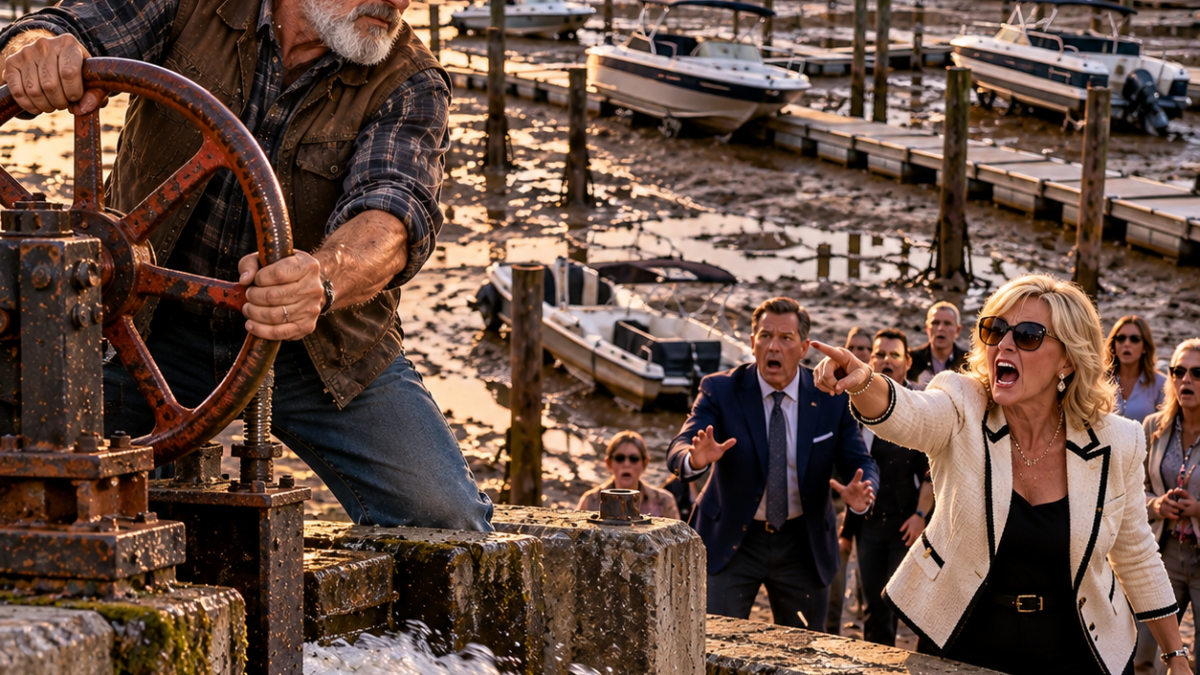
The Bank Built a $48M Marina on My Family’s Lake—Then I Opened the 60-Year-Old Spillway They Never Owned.
The bank sold hundreds of families a $48 million “private lake community,” built a luxury marina across water my grandfather created to save our farm from drought, and publicly promised buyers permanent lake access even though not one recorded document gave them control of the dam or the outlet gate.
When I interrupted their grand opening with sixty-year-old survey maps proving the lake’s control system still belonged to my family, the bank president ordered security to remove me and told everyone I was just a bitter old farmer trying to sabotage progress.
Three days later, after the county confirmed the truth and an independent engineer certified the old spillway safe, I turned the steel wheel exactly one revolution—and before sunset, the water began pulling away from their multimillion-dollar marina while the bank’s own attorneys discovered the documents that could destroy them.
The applause started before Charles Voss finished speaking.
That told me almost everything I needed to know.
People had not come to hear facts.
They had come to celebrate something they already believed they owned.
Nearly four hundred people stood along the southern shore of Mercer Lake that Saturday afternoon.
White folding chairs.
Champagne.
Blue-and-gold banners snapping in the wind.
A string quartet under a tent.
Children wearing little cardboard captain hats with the Stonewater Reserve logo printed across the front.
Behind them rose forty-seven newly completed lakefront villas, each one built in pale stone and cedar with oversized windows angled toward the water.
Another thirty-six houses were under construction farther up the hill.
The clubhouse had opened that morning.
So had the restaurant.
The marina was the centerpiece.
Four long floating docks stretched across the cove.
Fresh pressure-treated pilings.
Black aluminum gangways.
Shore-power pedestals.
Fuel station.
Boat lifts.
Security gate.
A polished brass sign at the entrance read:
STONEWATER PRIVATE MARINA
RESIDENTS AND GUESTS ONLY
I stood behind the last row of chairs wearing work boots that still had red clay around the soles.
Nobody noticed me at first.
That was useful.
At sixty-seven, I’ve learned invisibility can be an advantage.
Especially when everyone else is looking toward a stage.
Charles Voss stood at the podium.
Fifty-eight years old.
Silver hair.
Navy suit.
President of First Dominion Bank’s regional development division.
He was the kind of man who always looked as if somebody had adjusted the room temperature specifically for him.
Beside him stood Grant Halpern, chief executive of Halpern Ridge Development.
Grant had put the Stonewater deal together.
The bank had financed it.
First Dominion had underwritten construction.
First Dominion had issued mortgages to more than half the buyers.
First Dominion held the construction loan on the marina.
First Dominion’s logo was on the banners, the brochures, the mortgage packets, and the little cocktail napkins beside the champagne.
The lake had become a financial product.
My family’s lake.
Voss lifted his glass.
“Ladies and gentlemen, what began four years ago as a vision has become one of the premier private waterfront communities in the region.”
Applause.
I stayed still.
He continued.
PART2:
“Today, with the opening of the Stonewater Marina, every resident gains not merely a home, but a lifestyle.”
More applause.
“Private boating.”
“Fishing.”
“Waterfront recreation.”
“And permanent access to this beautiful seventy-acre lake for generations to come.”
That’s when I started walking.
Not fast.
Didn’t need to.
My attorney, Melissa Kane, had told me that morning:
“Eli, whatever happens, do not yell.”
I said:
“I don’t yell.”
She stared at me.
“You yelled at a tractor salesman for forty minutes last year.”
“He lied about hydraulic hours.”
“That is not a legal exception.”
So I promised.
No yelling.
I moved down the outside aisle carrying an old leather document case under my arm.
Some people turned.
A woman whispered.
Security noticed me before Charles did.
Two men in black polo shirts began moving from side of stage.
I stopped ten feet from ribbon table.
Charles finally saw me.
His smile did not disappear.
People like Charles Voss don’t lose expressions.
They change them.
“Mr. Mercer.”
He said my name into microphone.
That got everyone’s attention.
I nodded.
“Mr. Voss.”
PART3:
“This is a private event.”
I looked behind me.
“Half county appears to be here.”
A few people laughed.
Charles didn’t.
Grant Halpern stepped forward.
“Eli, we’ve been through this.”
“No.”
I put leather case on ribbon table.
“You’ve talked.”
“I’ve sent documents.”
“That’s not the same as going through something.”
Charles lowered microphone.
“Security.”
I opened case.
Removed first map.
County survey.
My grandfather’s name across bottom.
WALTER E. MERCER.
Then original excavation permit.
Then dam construction plan.
Then easement records.
Then water-control diagram.
The audience had gone quiet.
Charles looked at documents without touching them.
I asked:
“In every purchase contract your buyers signed, is there anything saying who owns the outlet gate?”
His face changed.
Tiny.
But I saw it.
Grant’s attorney, standing behind him, stepped closer.
I continued.
“Anything saying who owns the concrete dam?”
No answer.
“Anything saying who controls irrigation release?”
Charles picked up microphone.
“Ladies and gentlemen, Mr. Mercer owns agricultural land adjoining Stonewater Reserve and has been involved in a long-running disagreement regarding historical lake access.”
That was smooth.
Prepared.
They had expected me eventually.
Just not here.
“He has repeatedly challenged rights confirmed by our legal team.”
I turned toward buyers.
“Then ask him for the deed.”
Charles stopped.
I looked at him.
“Not brochure.”
“Not marketing packet.”
“Not developer rendering.”
“Deed.”
A murmur moved through chairs.
Grant’s attorney leaned toward Charles.
Whispered.
Charles’s jaw tightened.
He raised voice slightly.
“Mr. Mercer, this isn’t appropriate forum.”
“You’re selling homes beside my water.”
“You made it forum.”
“Your water?”
Grant Halpern laughed.
Too loud.
That was mistake.
I looked at him.
“Exactly.”
The crowd shifted.
Somebody near front said:
“What does he mean?”
Another:
“Who owns lake?”
Charles raised both hands.
“The reservoir is subject to historical shared-use agreements.”
I nodded.
“Correct.”
“And ownership questions are more complicated than Mr. Mercer is suggesting.”
“No.”
“They’re simpler.”
I placed another paper down.
“Lake bed lies within parcels 1187-A and 1187-B.”
“Both owned by Mercer Agricultural Trust.”
“Dam parcel is 1187-C.”
“Same owner.”
“The south-shore access easement gives neighboring landowners right to reach water for recreation.”
“It does not convey ownership.”
“It does not guarantee elevation.”
“And it does not transfer control of irrigation gate.”
A man in front row stood.
Probably early forties.
Polo shirt with Stonewater logo.
“Wait.”
He looked at Charles.
“My closing documents say lake access.”
“Yes, sir.”
I answered before Charles.
“They probably do.”
He turned toward me.
“Then what’s problem?”
“Access isn’t control.”
I pointed toward water.
“That lake exists because my grandfather excavated it.”
“The dam exists because my family paid for it.”
“The outlet exists because it sends irrigation water through channels feeding our farm.”
“If Stonewater promised you that water will remain at this exact elevation forever, ask them to show you where my family signed that promise.”
Charles’s voice hardened.
“Enough.”
That was first crack.
He signaled.
Security approached.
I closed document case.
Didn’t resist.
Melissa had said:
“If they remove you, go.”
So I went.
One guard touched my elbow.
I looked at his hand.
He removed it.
Good decision.
Before turning, I looked at Charles.
“You should check county maps older than sixty years before you sell any more lake.”
Then I left.
The applause did not restart.
That was enough for one afternoon.
My name is Elijah Mercer.
Most people call me Eli.
My family has farmed the same ground for four generations.
One hundred twenty-six acres now.
Used to be more.
Corn.
Soybeans.
Hay.
A small peach orchard my daughter keeps trying to convince me is profitable.
It isn’t.
But my late wife loved it, so the trees stay.
The lake sits north of house.
Seventy acres at normal pool.
Sixty-eight in late summer.
A little over seventy-two after wet spring.
Everybody calls it Mercer Lake now.
My grandfather never did.
He called it Reservoir Number One.
He was romantic that way.
There had never been natural lake there.
Before 1962 it was a low basin cut by two seasonal creeks.
Wet in spring.
Hard as brick by August.
The Mercer farm had survived droughts by hauling water from wells.
Then 1959 almost broke family.
Corn died.
Cattle sold.
My grandfather Walter mortgaged equipment just to buy seed for following year.
He promised himself he would never again watch crops die while rainwater ran uselessly downstream every spring.
So he planned reservoir.
Not for fishing.
Not boating.
Not views.
Water.
He hired a young engineer from county soil office.
They surveyed basin.
Designed earthen embankment.
Concrete outlet.
Steel slide gate.
Three irrigation channels.
My grandfather paid excavation himself.
There are photographs.
Old Caterpillar.
Two bulldozers.
Men smoking beside scraper.
Granddad wearing white undershirt and felt hat.
The project took two summers.
When gate closed in October 1963, winter rain began collecting.
By 1965, enough water existed to irrigate most of farm.
By 1967, Granddad had expanded channels.
He kept every receipt.
Every engineering drawing.
Every permit.
Every property map.
That obsession saved me sixty years later.
The lake also changed land around us.
Wildlife came.
Fish were stocked.
Families picnicked.
People fished with permission.
Eventually neighboring owners used shore.
Granddad didn’t mind.
He believed if children wanted to catch bluegill they should.
But permission is not ownership.
That distinction stayed clear for decades.
Until First Dominion Bank discovered waterfront real estate.
My trouble with bank began small.
Fifty-four thousand dollars.
That’s almost funny now.
A project worth forty-eight million dollars nearly went to war with me over a $54,000 farm equipment loan.
Five years before Stonewater, I needed a new center-pivot pump and used tractor.
I could have sold investments.
Didn’t want to.
Interest rates were reasonable.
First Dominion had branch in town.
My family banked there decades.
I borrowed $54,000 using part of farm as collateral.
Nothing unusual.
Payments automatic.
Never late.
Not once.
Two years later, First Dominion foreclosed on property across lake.
The Thompson farm.
Nearly ninety acres.
Old man Thompson had died.
His sons couldn’t agree.
Debt grew.
Bank took it.
Then sold to Halpern Ridge Development.
Grant Halpern saw lake immediately.
He understood something my grandfather never cared about.
Water makes dirt expensive.
Farmland worth perhaps $12,000 an acre became “exclusive lakefront property.”
Plans appeared.
Stonewater Reserve.
Phase One.
Phase Two.
Villas.
Clubhouse.
Walking trails.
Private marina.
I attended first county zoning meeting.
Not because I opposed development.
Because map colored entire lake blue as if it belonged to project.
I raised hand.
“Why is my reservoir inside your site plan?”
Grant smiled.
“Lake is visual context.”
“That’s not answer.”
“The project enjoys existing lake access.”
“Correct.”
“So rendering shows lake.”
“Rendering makes it look owned by development.”
“Marketing issue.”
That was first warning.
Second came when First Dominion called.
Charles Voss himself.
“Mr. Mercer.”
“Yes?”
“We’d like to discuss cooperative lake management.”
“What is that?”
“Stonewater will increase local values.”
“Probably.”
“We believe formalizing water levels would benefit everybody.”
“Formalizing how?”
“Maintaining stable recreational pool.”
I laughed.
Not to be rude.
Because concept was absurd.
“This is irrigation reservoir.”
“Water level moves.”
“How much?”
“Depends on rain.”
“Crop needs.”
“Maintenance.”
“Drought.”
Silence.
Then:
“Would you consider operating agreement?”
“If terms protect farm.”
“Excellent.”
I wasn’t unreasonable.
If residential community wanted predictable recreational use and could coexist with agriculture, fine.
Water can be shared.
But their proposed agreement arrived six days later.
Twenty-seven pages.
It required me to maintain lake within eighteen inches of full pool year-round.
No substantial drawdown without thirty-day notice and developer consent.
No changes to dam.
No irrigation releases exceeding specified daily amount.
And First Dominion wanted agreement recorded as permanent burden against farm.
I called Charles.
“You realize this would make my irrigation system subordinate to boat docks.”
“I wouldn’t phrase it that way.”
“I would.”
“We can negotiate.”
“No.”
That was beginning of pressure.
The lake-side homes sold faster than expected.
Prices rose.
Advertisements everywhere.
PRIVATE LAKE LIVING.
YEAR-ROUND BOATING.
EXCLUSIVE WATERFRONT.
First Dominion financed buyers.
Their mortgage brochures used aerial photographs centered on my reservoir.
I wrote bank.
Please correct marketing.
No response.
Attorney sent letter.
First Dominion replied that materials did not explicitly claim ownership.
Technically clever.
Practically misleading.
Then marina started.
Floating docks can adapt somewhat to water level.
But designers still assumed stable pool.
They poured shore abutments.
Gangway elevations.
Clubhouse steps.
Boat lifts.
Fuel infrastructure.
All based on a narrow range.
Nobody asked me.
Millions spent.
One afternoon I drove around south road and saw pile-driving barge.
I called Grant.
“What are you doing?”
“Building marina.”
“On whose lake?”
“Within our access area.”
“Access doesn’t permit construction into lake bed.”
“Our counsel disagrees.”
“Then your counsel should read parcel description.”
That started formal dispute.
My attorney Melissa Kane specialized in agricultural land and water agreements.
She was forty-four and had no tolerance for old men wanting to solve legal problems with tractors.
Her first instruction:
“Do nothing.”
Second:
“Collect everything.”
Third:
“Stop calling Grant directly.”
I did two out of three.
Then the bank used loan.
Letter came by certified mail.
FIRST DOMINION BANK
COLLATERAL CONDITION REVIEW.
It said bank had concerns regarding “obsolescent hydraulic structures” on mortgaged property.
Suggested removal or modification of “aging concrete control features” near development boundary might improve collateral profile.
I read twice.
Then laughed.
They wanted my dam altered because it blocked views.
More importantly, removing or disabling gate would make lake level harder for me to change.
They were using $54,000 loan to pressure control of system worth their development millions.
I called Melissa.
She read letter.
Didn’t laugh.
“This is bad.”
“For them?”
“Potentially.”
“For you if they manufacture default.”
“My payments are current.”
“I know.”
“But lenders can create administrative friction.”
“Appraisals.”
“Insurance requirements.”
“Inspections.”
“Document requests.”
“Don’t underestimate them.”
Three days later developer’s attorney sent demand.
Remove “deteriorated concrete barrier” within thirty days due alleged safety and aesthetic impacts.
The barrier was dam outlet structure.
Independently inspected previous year.
Sound.
Now I was angry.
Not loud.
Cold.
I went to storage room.
My father and grandfather had kept records in cedar boxes.
I spent six hours going through them.
Tax receipts from 1940s.
Seed invoices.
Old marriage license.
Photos.
Survey plats.
Then I found blue tube.
Inside:
1962 irrigation project engineering set.
Every sheet.
Dam section.
Outlet elevation.
Gate details.
Property markers.
Water conveyance.
Sheet seven showed steel control gate beneath concrete structure near southern shoreline.
Handwritten note:
OWNER RETAINS FULL OPERATIONAL CONTROL FOR AGRICULTURAL IRRIGATION.
Signed engineer.
Countersigned Granddad.
Recorded permit number.
I called Melissa.
“Found something.”
“How good?”
“Come over.”
She arrived twenty minutes later.
Read.
Then smiled.
Not happy smile.
Lawyer smile.
“Eli.”
“Yes?”
“They built a forty-eight-million-dollar development around a valve they don’t own.”
“Looks that way.”
“Don’t touch it.”
I sighed.
“I knew you’d say that.”
We hired independent engineer.
Dr. Nathaniel Price.
Former state water-resources engineer.
No connection to family.
He inspected dam.
Gate.
Channels.
Property boundaries.
He took ultrasonic thickness readings on exposed gate components.
Checked concrete.
Reviewed original drawings.
Surveyed elevations.
His report:
Dam structurally serviceable.
Outlet gate operable following routine maintenance.
Irrigation channels functional.
Gate and control structure located entirely on Mercer parcel.
Historic water-control rights remained appurtenant to farm.
County reviewed.
Surveyor confirmed.
Recorder confirmed.
No instrument transferring ownership or operational authority to First Dominion, Halpern Ridge, or Stonewater HOA.
Then something better happened.
County found First Dominion’s own appraisal from my 54,000-dollar loan.
Page fourteen:
COLLATERAL IMPROVEMENTS INCLUDE PRIVATE AGRICULTURAL RESERVOIR, EARTHEN DAM, IRRIGATION OUTLET GATE, AND ASSOCIATED CHANNEL NETWORK OWNED AND MAINTAINED BY BORROWER.
Their own appraiser had already documented truth.
Melissa sat in my kitchen.
Read sentence three times.
Then said:
“Please frame this.”
I almost did.
Instead we sent certified notice to bank.
Their response was silence.
Then grand opening invitations went out.
“Stonewater Marina—A New Era of Private Lake Living.”
That is why I went.
Not to ruin party.
To stop bank from making another public statement buyers might rely on.
Security escorted me out.
I got in truck.
Melissa was waiting passenger seat.
“You behaved.”
“Barely.”
“What happened?”
I told her.
She rubbed forehead.
“He actually promised permanent lake access?”
“Yes.”
“Not stable level?”
“He implied lifestyle.”
“Exact language matters.”
“Of course it does.”
“Did you record?”
“No.”
“Public event?”
“Yes.”
“Others did.”
Before we left lot, three videos were already online.
In one, Charles’s statement was clear.
So was mine.
That evening phones started.
Residents.
Reporters.
Bank counsel.
County commissioner.
Nobody called me directly except one homeowner.
His name was David Lin.
Bought villa six months earlier.
“Mr. Mercer?”
“Yes.”
“I was at opening.”
“Okay.”
“Are you saying bank doesn’t control water level?”
“Correct.”
“Can you drain lake?”
“That is dramatic way to phrase irrigation release.”
“How far can level drop?”
“Historically?”
“Yes.”
“Six feet during severe irrigation years.”
Silence.
“Our dock…”
“I don’t know your dock design.”
“They told us lake was managed.”
“It is.”
“By who?”
“Me.”
Longer silence.
Then:
“Nobody told us that.”
“I know.”
That call made me less angry at homeowners.
They were not conspirators.
They had been sold certainty.
Next morning First Dominion’s lawyers appeared at county office.
They wanted emergency order preventing me from operating gate.
County engineer asked:
“Show me your control right.”
They couldn’t.
They argued economic harm.
County attorney said:
“Economic investment doesn’t create water-control ownership.”
Then produced First Dominion appraisal.
Meeting ended quickly.
I did not open gate immediately.
That matters.
I waited.
Engineer performed maintenance.
Lubricated stem.
Replaced packing.
Cleared debris.
Tested mechanism incrementally.
County observed.
I filed irrigation schedule.
My soybean fields genuinely needed water.
August had been dry.
Not emergency.
But dry enough irrigation justified.
State agricultural extension data supported release.
Melissa insisted every reason be real.
“If you’re going to make a point,” she said, “make it while doing exactly what system was built to do.”
So we did.
Tuesday morning.
7:12.
Nathaniel beside me.
County engineer present.
Melissa on bank.
My son Jacob recording.
I put hand on steel wheel.
It was older than me.
Paint flaked.
Grandfather had touched it.
Father had touched it.
Now me.
One full turn.
Nothing dramatic at first.
Then deep vibration.
Water pushed into outlet pipe.
A few moments later irrigation channel filled.
Slowly.
Brown water first from settled sediment.
Then clear.
The lake surface near intake began moving.
By noon level had dropped three inches.
By three:
Seven.
By evening:
Nearly a foot.
No boats stranded.
No docks damaged.
Floating sections adjusted.
But fixed shore stairs didn’t.
A visible gap appeared.
Brand-new stone walkway terminated above wet mud.
Some boat lifts sat lower than designers expected.
Residents noticed.
And phones exploded.
First Dominion called me at 4:18.
Charles Voss.
“Eli.”
“Charles.”
“Close the gate.”
“No.”
“This is creating panic.”
“I’m irrigating soybeans.”
“You’re doing it to make a point.”
“Both can be true.”
“You’re damaging development.”
“No structures damaged.”
“You’re undermining property values.”
“I don’t control your appraisal.”
“You know what you’re doing.”
“Yes.”
“I’ve operated irrigation system since I was seventeen.”
He went quiet.
Then:
“What do you want?”
That was first time he asked.
Not:
What will you accept?
Not:
How do we stop you?
What do you want?
“Truth in writing.”
He exhaled.
“What does that mean?”
“Recognize ownership.”
“Lake bed.”
“Dam.”
“Gate.”
“Operational rights.”
“Correct advertising.”
“Stop using my loan as leverage.”
“And?”
“Shared water agreement protecting farm first.”
“That’s all?”
I laughed.
“You thought I wanted marina?”
He didn’t find funny.
By next morning level was fourteen inches lower.
Still safe.
Still usable.
But Stonewater’s fantasy of fixed mirror-flat water had broken.
Residents reread contracts.
Most said “lake access.”
None guaranteed elevation.
Marketing had done heavier lifting than legal language.
That became serious.
Because advertisements showed promises that sales contracts carefully avoided.
A homeowner group hired attorney.
Then discovery started.
Mine first.
Melissa demanded every document related to bank’s collateral pressure.
At first bank resisted.
Then regulators got involved.
State banking regulator opened examination after we submitted appraisal, letters, and communications.
Internal emails emerged.
First bad email was from Grant Halpern to Charles.
MERCER STILL WON’T SIGN STABILIZATION AGREEMENT. NEED LEVERAGE BEFORE PHASE TWO CLOSES.
Charles replied:
HOW MUCH DEBT DOES HE CARRY?
Grant:
ONLY 54K WITH US.
Charles:
SMALL ENOUGH TO MAKE REFI INCONVENIENT IF COLLATERAL REVIEW TIGHTENS.
That sentence changed case.
Another email:
DAM IS VISUAL OBSTACLE AND OPERATIONAL RISK. IF HE REMOVES OR DECOMMISSIONS CONTROL, DEVELOPMENT ASSUMPTION BECOMES MUCH CLEANER.
Then worse.
Six months before grand opening, bank counsel had circulated memo:
CURRENT RECORDS DO NOT ESTABLISH STONEWATER OWNERSHIP OR CONTROL OF MERCER RESERVOIR. PROJECT MARKETING SHOULD AVOID EXPRESS REPRESENTATION OF WATER LEVEL GUARANTEE OR OWNERSHIP.
Charles forwarded to Grant.
Comment:
KEEP LANGUAGE LIFESTYLE-FOCUSED.
There it was.
They knew.
Not hidden deed discovered after construction.
Known risk.
Managed through wording.
Say private lake living.
Don’t say we own lake.
Say permanent access.
Don’t say water remains high.
Show boats.
Show full pool.
Let buyers infer rest.
Legally clever.
Ethically ugly.
Regulator suspended Charles pending investigation.
First Dominion publicly said internal review underway.
Grant blamed bank.
Bank blamed developer.
Developer blamed outside counsel.
Outside counsel produced emails proving warnings.
Everybody suddenly discovered memory.
Meanwhile I kept irrigation release moderate.
After sixteen inches, I reduced flow.
Crops had enough.
Docks still floated.
No property destroyed.
That was deliberate.
I could have drawn down farther.
Historical rights allowed larger irrigation draw in drought.
Engineer told me system could safely lower several feet.
Melissa asked:
“Are you tempted?”
“Yes.”
“Don’t.”
“I know.”
“Good.”
“Homeowners didn’t cause this.”
“Exactly.”
That distinction became important publicly.
Reporter asked:
“Why not drain lake farther and cripple marina?”
I answered:
“Because innocent families bought houses.”
“I’m not fighting them.”
“I’m fighting false claims.”
That quote spread.
The tone changed.
At first media framed:
OLD FARMER VS $48M DEVELOPMENT.
Then:
BANK KNEW IT DID NOT CONTROL LAKE.
Then:
HOMEOWNERS DEMAND ANSWERS.
David Lin organized meeting.
Invited me.
I went.
Stonewater clubhouse.
First time inside.
Beautiful.
Floor-to-ceiling windows.
Lake beyond.
About 130 residents.
Some angry at bank.
Some angry at me.
One woman stood.
“My husband and I put our retirement here because of water.”
“I understand.”
“Do you?”
Her voice shook.
“We paid $940,000.”
“I don’t control sale price.”
“You control lake.”
“Yes.”
“Then we’re at your mercy.”
That hurt because technically she wasn’t wrong.
I answered carefully.
“No.”
“You shouldn’t be.”
“If only arrangement is you trusting one old farmer, then arrangement is bad.”
Room quieted.
“What do you suggest?”
“Written management agreement.”
“Agricultural priority.”
“Minimum recreational targets when hydrology permits.”
“Notice before maintenance drawdown.”
“Emergency exceptions.”
“Transparent lake-level data.”
“Shared drought plan.”
“Who pays?”
“People using system.”
Murmurs.
I continued.
“Farm has paid every dam repair for sixty years.”
“If community wants predictable recreational benefit, community should contribute to infrastructure.”
That was fair.
A man shouted:
“So you want fees.”
“Yes.”
That surprised him.
“I want fair fees.”
“Not ransom.”
“Engineering costs money.”
“Inspections cost money.”
“Concrete costs money.”
“Gate repairs cost money.”
“You want benefit, share upkeep.”
David Lin nodded.
Someone else asked:
“Will you promise not to drain it out of spite?”
I looked directly.
“Yes.”
“I promise any operation will serve agricultural, maintenance, safety, or agreed management purpose.”
“And I’ll put it in writing.”
That was turning point.
Homeowners realized I wasn’t trying to destroy them.
I wanted boundaries.
Bank eventually offered $600,000 for permanent water-control rights.
Melissa slid offer across kitchen.
I stared.
“That’s a lot.”
“Yes.”
“Should I take?”
“That’s not legal question.”
“Pretend friend.”
She thought.
“No.”
“Why?”
“Because they aren’t paying six hundred thousand for wheel.”
“They’re paying for future ability to prioritize development over farm.”
Exactly.
I rejected.
Counterproposal:
Farm retains ownership and priority agricultural use.
Stonewater receives contractual recreational use subject to hydrologic conditions.
Annual infrastructure contribution.
Joint technical committee.
Real-time gauge installed.
Maintenance schedule published.
Minimum pool targets only when rainfall and farm needs permit.
No fixed-level guarantee.
No bank control.
No permanent construction outside defined marina footprint without Mercer approval.
No expansion.
No dredging.
No shoreline alteration.
Advertisements must disclose reservoir privately owned and levels may fluctuate.
First Dominion laughed.
Then regulators kept investigating.
Homeowners threatened litigation.
Developer construction slowed.
Another phase needed financing.
Suddenly our proposal seemed reasonable.
Negotiations lasted eleven weeks.
Charles no longer attended.
New bank representative, Elena Brooks, handled.
She was direct.
“Mr. Mercer, the bank needs certainty.”
“So do farmers.”
“What level variation can Stonewater tolerate?”
“Ask marina engineer.”
“We did.”
“They want plus-or-minus eighteen inches.”
“Impossible in drought.”
“Thirty?”
“Maybe seasonally.”
“What can you commit?”
We built table.
Monthly target ranges.
Rainfall thresholds.
Drought stages.
Irrigation priority.
Safety override.
No vague promises.
Numbers.
Engineers like numbers because they cannot flatter anyone.
Agreement was signed March 12.
First Dominion reaffirmed original $54,000 loan terms.
Canceled disputed review fees.
Acknowledged no ownership of lake, dam, or gate.
Developer acknowledged same.
Stonewater HOA received access rights under management schedule.
Farm received annual payment toward dam maintenance.
Not outrageous.
Enough to cover inspections and reserve.
Marketing disclosures mandatory.
Marina remained.
Homes remained.
Farm remained.
Nobody lost everything.
That disappointed people online.
They wanted bank destroyed.
Marina mud.
Executives jailed.
Explosions.
Reality can be more useful than revenge.
First Dominion paid regulatory penalties later.
Charles left bank.
Official statement said resignation.
I do not know if fired.
Didn’t care.
Grant Halpern’s company settled homeowner advertising claims.
Terms partly confidential.
Development survived.
Prices stabilized.
Families kept homes.
I kept lake.
More importantly, control was no longer ambiguous.
A brass plaque now sits beside marina entrance.
Not mine.
HOA installed.
STONEWATER MARINA OPERATES BY AGREEMENT ON PRIVATELY OWNED MERCER RESERVOIR. WATER LEVELS VARY SEASONALLY DUE TO AGRICULTURAL, SAFETY, AND MAINTENANCE REQUIREMENTS.
First time I saw it, I stood five minutes.
David Lin came over.
“Too much?”
“No.”
“Too honest?”
“Impossible.”
He laughed.
We became friends.
Not close.
Fishing friends.
That’s close enough.
He owns pontoon.
Calls before taking grandchildren out when lake is low.
I tell him where stumps are.
He brings peaches from orchard.
Mine are better.
His wife disagrees.
The old dam stayed.
Developer wanted it removed because view.
Now residents like it.
Funny.
People photograph it.
Historic irrigation structure.
County historical society put marker.
My grandfather would have hated marker.
“Waste of metal,” he’d say.
But I attended ceremony.
They used picture of him standing beside D7.
I cried.
Quietly.
My daughter Rachel noticed.
“You okay?”
“No.”
She squeezed arm.
My wife, June, had been gone six years by then.
She died two years before Stonewater fight began.
I thought about her constantly during dispute.
Especially when people called me stubborn.
She used to say:
“Eli doesn’t hold grudges.”
“He builds storage barns for them.”
Accurate.
If she’d been alive, she would’ve stopped me from appearing at grand opening alone.
She would’ve worn nice dress.
Sat front row.
Asked Charles question in sweetest voice imaginable.
Then destroyed him with follow-up.
She was better at conflict.
I was better at valves.
Maybe that’s why lake became place I worked through grief.
For years after June died, I avoided south shore because we used to walk there.
Stonewater construction forced me back.
Forced me to study maps.
Walk dam.
Meet people.
Fight for something.
That can be dangerous admission.
I don’t believe bank’s misconduct “happened for reason.”
That’s nonsense.
But defending farm reminded me I was still responsible for future.
Not just caretaker of past.
After settlement, I started a reservoir stewardship fund.
Part of Stonewater’s annual fees went into dam reserve.
Part of my farm revenue.
County extension used lake as demonstration site for shared agricultural-recreational water management.
College students came.
They asked too many questions.
I liked them.
One asked:
“Mr. Mercer, did you really drain luxury marina out of revenge?”
I said:
“No.”
He looked disappointed.
“I opened irrigation gate.”
“How much did lake fall?”
“Sixteen inches.”
“That’s all?”
“Yes.”
“Internet says four feet.”
“Internet was not holding gauge rod.”
His class laughed.
Then I told them important part.
“Never design around resource you do not control without contract.”
Professor wrote it on board.
That’s engineering lesson.
Also life lesson.
Stonewater eventually expanded walking trail.
They asked permission where trail approached my parcel.
A simple request.
I said yes in one section, no in another because cattle.
Nobody sued.
Nobody forged.
Amazing what asking can accomplish.
Bank refinanced some homes under corrected disclosures.
My loan paid off two years later.
I drove to branch with final check.
New manager looked at account.
“Congratulations.”
“Thank you.”
“Would you like line of credit?”
I stared.
He laughed nervously.
“No.”
“Good answer.”
I left.
The original mortgage satisfaction document hangs framed in barn office.
Not because debt bothered me.
Because it reminds me how absurd leverage was.
A $54,000 loan against family farm became weapon in forty-eight-million-dollar development.
They assumed scale made them stronger.
It did.
Until their own paperwork mattered.
Large institutions make same mistakes people do.
They just create larger emails.
One afternoon Charles Voss called me.
Three years after leaving bank.
Unknown number.
I almost hung up.
“Eli?”
I recognized voice.
“Charles.”
“I’d like to talk.”
“We are.”
He laughed weakly.
“I suppose I deserved that.”
“What do you want?”
“To apologize.”
I was quiet.
He continued.
“I told myself Stonewater was good for county.”
“Jobs.”
“Tax base.”
“Housing.”
“All true.”
“Yes.”
“And somewhere I started treating anything that slowed project as obstruction.”
“Also true.”
“I knew your water rights were unresolved.”
“Not unresolved.”
He paused.
“You’re right.”
“I knew they were yours.”
That mattered.
Not because I needed confession.
Because words became accurate.
“I thought we’d eventually buy them.”
“You tried.”
“I thought pressure was negotiation.”
“It wasn’t.”
“I know now.”
We were silent.
Then he said:
“I was wrong.”
People imagine apologies create peace.
Sometimes they create space.
That’s enough.
I said:
“Thank you.”
“Do you forgive me?”
I stared across lake from porch.
I could see marina in distance.
Boats.
Children.
No crisis.
“I don’t know.”
He exhaled.
“Fair.”
I didn’t ask how he was.
He didn’t ask me to.
We hung up.
That was last time we spoke.
Grant Halpern never apologized.
Also fine.
You don’t need everyone to become better for you to move forward.
Stonewater is part of landscape now.
I no longer see it as invasion.
Mostly.
On summer weekends, boat engines carry across water.
Kids scream off swim platform.
Sometimes music too loud.
HOA adopted quiet hours.
I helped write them.
Ironic.
My farm still gets first water.
That’s agreement.
During severe drought two summers ago, we entered Stage Three.
Lake dropped three feet.
Marina adjusted.
Some deep-draft boats had to leave temporarily.
Nobody panicked.
Because now everybody knew rules before buying.
HOA emailed:
AGRICULTURAL DRAW SCHEDULE ATTACHED.
Residents complained a little.
People always complain.
But no one felt deceived.
Truth is easier to tolerate than surprise.
David Lin called.
“My grandson thinks mud is disgusting.”
“Your grandson is correct.”
“When does water come back?”
“When rain does.”
“You control rain too?”
“Only Tuesdays.”
He laughed.
We waited.
October storms came.
Reservoir recovered.
Boats returned.
Crops survived.
That is what Granddad built it for.
The marina isn’t enemy.
It’s a secondary use.
That language matters.
Primary purpose:
farm water.
Secondary:
recreation.
Bank tried to reverse those without owning system.
Everything else grew from that arrogance.
The old spillway wheel is maintained annually now.
We replaced bearings.
Repainted housing.
Kept original wheel.
Too sentimental to swap.
Every time I turn it, I think of Granddad.
His hands were enormous.
Fingers scarred.
I was six first time he let me touch wheel.
“Don’t turn it.”
“I won’t.”
“Water don’t care who’s sorry.”
That was one of his sayings.
At six I thought it meant drowning.
At sixty-seven I understood more.
Systems don’t care about intentions.
Property records don’t care about marketing.
Dams don’t care about bank financing.
If your plan depends on someone else’s asset, you either secure rights or accept risk.
Stonewater had built $48 million on assumption.
Assumptions are expensive when poured into concrete.
The grand-opening ribbon stayed in my barn for a while.
David Lin brought it.
“Why?”
“Thought you’d want trophy.”
“No.”
He handed anyway.
I eventually threw it away.
I kept documents.
Granddad’s engineering plans.
County confirmation.
Bank appraisal.
Management agreement.
Those matter.
Not red ribbon.
People online remember ribbon-cutting because dramatic.
Old farmer interrupts.
Bank ejects him.
Then old spillway opens.
Water recedes.
Justice.
Real story is less tidy.
Nobody lost mansion overnight.
No yachts left hanging from ropes.
No bank collapsed.
No dramatic sheriff arrest on dock.
Instead, something more difficult happened.
Everyone had to read contracts.
That is nightmare for dishonest marketing.
When residents compared glossy brochures with legal language, gap became visible.
When regulator compared collateral letter with internal emails, intent looked different.
When county compared modern claims with sixty-year-old plans, ownership became clear.
When bank lawyers compared $48 million exposure with $600,000 offer, negotiation became rational.
And when I compared what I could legally do with what I should do, I decided not to punish homeowners for decisions they had no part in.
That is part people leave out.
I could have lowered lake much farther.
Not without legitimate agricultural demand and safety considerations, but drought cycles would have supported larger releases in some years.
I could have refused recreational agreement entirely.
Access easements would still exist, but predictable management would not.
Stonewater values would suffer.
Bank would bleed.
Grant would blame me.
I didn’t.
Because woman in villa 17 who spent retirement on lake house wasn’t person who wrote emails.
The young family in villa 23 didn’t threaten my loan.
David Lin didn’t misrepresent gate.
Punishing them would make me same kind of man I was fighting.
Power doesn’t become moral just because deed says yours.
That took me longer to understand than I’d like.
Granddad knew.
He let neighboring children fish before any easements existed.
But if somebody demanded his land, he became granite.
Generosity and boundaries are not opposites.
You can share something without surrendering ownership.
You can say yes because you are free to say no.
That’s what First Dominion never understood.
They wanted permanent yes.
Guaranteed.
Bankable.
Appraisable.
Transferable.
Control.
The lake refused to become that simple.
So did I.
Last summer Stonewater held twentieth? No, less. Its fifth anniversary picnic.
They invited me.
I considered declining.
Rachel said:
“Go.”
“Why?”
“Free barbecue.”
Good point.
I went.
No suit.
Work shirt.
David met me.
Marina busy.
Kids jumping.
Water two inches below target.
Nobody cared.
HOA president, a woman named Karen Ellis, gave short speech.
She said:
“Five years ago this community learned lake access and lake ownership are not same thing.”
People laughed.
Then:
“We also learned being neighbors works better when agreements are honest.”
She nodded toward me.
I hated attention.
“Mr. Mercer has been patient with us.”
I called:
“Eventually.”
More laughter.
Then Karen unveiled sign.
Not plaque about ownership.
A weatherproof digital gauge display at marina entrance showing current elevation, irrigation stage, rainfall, and next scheduled maintenance release.
Transparency.
Best monument.
A little boy asked:
“Mr. Mercer, can you make lake go down?”
His mother looked horrified.
I crouched.
“Yes.”
“Can you make it go up?”
“No.”
“Why?”
“Rain does that.”
He thought.
“So rain is boss?”
“Pretty much.”
Granddad would’ve approved.
That evening I walked dam alone.
Sunset turning Stonewater windows gold.
Marina lights on.
Farm sprinklers running south field.
Same water serving houses and soybeans.
Not perfectly.
Nothing shared is perfect.
But honestly.
At outlet tower I put hand on wheel.
Didn’t turn.
Just rested.
Sixty years before my grandfather built system because drought nearly took farm.
He could never have imagined luxury marina.
Or digital gauge.
Or $48 million development.
Or bank executives trying to pressure grandson.
But he’d understand basic dispute.
Who built it?
Who owns it?
Who uses it?
Who pays?
Who asks?
He taught me land isn’t valuable because you can keep people off.
It’s valuable because it gives you something worth protecting.
And sometimes protecting means sharing on terms that survive you.
My management agreement lasts twenty years, renewable.
My daughter will decide after.
Not bank.
Not developer.
Family trust and future board will negotiate.
That’s how it should be.
Recorded.
Clear.
No assumptions.
No glossy promises doing legal work.
I still have first letter First Dominion sent about collateral review.
The one suggesting “removal of obsolete lake structures” could improve my loan profile.
I keep it clipped to bank’s appraisal calling that same structure a private agricultural asset owned by me.
One above other.
Contradiction.
Whenever someone asks how large institutions get themselves in trouble, I show both.
“They knew.”
That’s whole case.
They knew enough to write truth when protecting their loan.
Then pretended not to know when marketing development.
Facts didn’t change.
Their incentive did.
That is why records matter.
Memory bends.
Marketing bends.
Pressure bends people.
Paper written before dispute is hard to bend afterward.
The old documents saved my family.
Not because old is sacred.
Because they were accurate.
Survey markers.
Permits.
Engineering drawings.
Appraisal.
Signatures.
I tell younger farmers now:
Scan everything.
Back it up.
Know your easements.
Know your water.
Never assume bank remembers its own file.
Never assume developer understands difference between access and ownership.
And never threaten when documentation will do more damage quietly.
They laugh at last part.
I am serious.
I never had to shout at Charles Voss.
Never had to block bulldozers.
Never chained myself to marina.
Never touched their boats.
I turned one wheel one revolution after engineer and county confirmed I could.
Water did rest.
Not violently.
Not destructively.
Just enough.
The shoreline stepped backward.
Wet mud appeared.
Gangway angle changed.
And hundreds of homeowners suddenly saw something brochures had hidden:
Their perfect lake was part of working system owned by somebody else.
Sometimes truth does not need speech.
Sometimes it needs gravity.
Years from now, Stonewater may still be there.
Marina may be rebuilt.
Houses may double value.
My farm may change crops.
Maybe Rachel will sell some acres.
Maybe grandson will hate farming.
That’s his right.
But nobody will again sell lake as something they own without opening county record first.
That is victory.
Not bank paying.
Not Charles resigning.
Not getting apology.
Clarity.
Granddad built reservoir to survive drought.
Turns out it survived something else too.
Money.
A lot of money.
Forty-eight million dollars can build villas.
Clubhouse.
Roads.
Docks.
Advertising.
Confidence.
It can hire lawyers who write beautiful sentences.
It can convince hundreds of buyers that what they’re looking at must belong to people selling it.
But forty-eight million dollars could not buy a right nobody had agreed to sell.
That right sat beneath an old concrete tower beside my field, connected to a steel wheel older than half the people at grand opening.
The bank saw ugly infrastructure.
My grandfather saw survival.
I saw inheritance.
And county records saw ownership.
In the end, records won.
The morning after first release, I walked down irrigation channel.
Water moved through it exactly as it had when I was boy.
Past sycamores.
Under county road culvert.
Into lower field.
Sunlight flashing across current.
Behind me, across lake, new homeowners stood at marina studying exposed shoreline.
Ahead of me, soybeans lifted in morning heat.
Two worlds using same water.
One had been there sixty years.
One had just arrived.
Neither had to destroy other.
They only needed to stop pretending arrival created ownership.
That was all I’d wanted from beginning.
Respect the land.
Respect documents.
Respect people who came before you.
Ask before building.
Ask before promising.
And if your forty-eight-million-dollar development depends on an old farmer never turning the valve on a system his family built—
you might want to talk to the old farmer before you cut the ribbon.




