She Adopted a Deaf Cat Nobody Wanted—Four Years Later, They Had Created 11 Secret Signals No One Else Could Understand
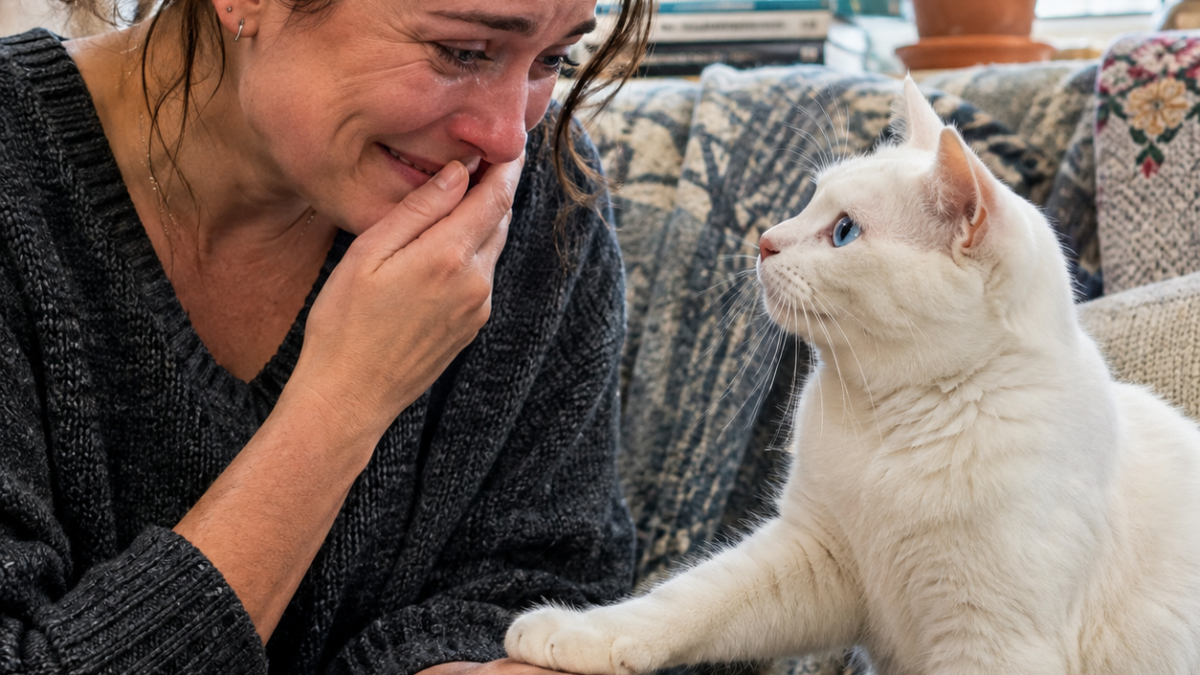
She Adopted a Deaf Cat Nobody Wanted—Four Years Later, They Had Created 11 Secret Signals No One Else Could Understand.
The shelter had hidden the deaf white cat in its quietest back room for fourteen months after her first family called her “defective,” but when a deaf woman walked through the door and asked for the animal nobody wanted, no one realized they were witnessing the beginning of a language the world had never heard.
Four years later, people who had mocked them, doubted them, and treated them like two broken creatures would sit in stunned silence as a researcher revealed eleven signals the woman and her cat had invented together—signals built from footsteps, fingertips, vibrations, and trust.
But the gesture that mattered most was the one the cat performed every morning with a single paw pressed over her owner’s heart, because when that heartbeat nearly disappeared, everyone finally understood what Whisper had been trying to say all along.
The first thing I noticed about the cat was that she never looked toward the door.
Every other animal in the rescue center knew someone had entered.
Dogs threw themselves against kennel gates.
Cats lifted their heads from blankets.
A black-and-white kitten reached one paw between the bars and clawed hopefully at the air.
But the white cat in the final enclosure didn’t move.
She sat with her back to us on a faded blue blanket, staring through a small window at a gray northern-English afternoon.
I stopped walking.
The shelter employee beside me kept talking for several seconds before she realized I wasn’t following.
Her name badge said HELEN.
She touched my arm gently.
I turned.
Her lips were moving.
I raised a finger and pointed toward her face.
She froze.
Then embarrassment spread across her expression.
“I’m sorry,” she said slowly, making sure I could see her mouth.
I smiled.
People had been apologizing to me for forgetting I was deaf for thirty-six years.
I pulled my phone from my coat pocket and typed.
You said she’s been here the longest?
Helen read the screen.
“Fourteen months.”
I looked back at the cat.
Fourteen months.
More than four hundred mornings in the same enclosure.
Four hundred nights under fluorescent lights.
Hundreds of families walking past while choosing younger cats, louder cats, playful cats, animals that turned when people called their names.
This one had probably spent most of those days watching mouths move and doors open without understanding the invisible thing everyone else seemed to respond to.
I knew something about that.
I typed again.
Why has nobody adopted her?
PART2:
Helen hesitated.
That hesitation told me almost everything.
I had seen it on teachers.
Doctors.
Job interviewers.
Boyfriends.
Strangers.
It was the pause people made when they wanted to describe something they believed was wrong with you without sounding cruel.
Helen lifted the clipboard she was carrying.
“She’s deaf.”
I nodded.
So am I.
Her face flushed again.
I typed another sentence.
That’s not what I asked.
For a moment, Helen simply looked at me.
Then she lowered her eyes.
She opened the intake folder.
PART3:
Inside was a photograph of the same white cat sitting stiffly on a kitchen counter.
Below the photo were notes from the family who had surrendered her.
OWNER REPORTS CAT DOES NOT RESPOND TO NAME.
UNABLE TO TRAIN.
UNRESPONSIVE TO VERBAL CORRECTION.
POSSIBLE BEHAVIORAL PROBLEMS.
And beneath that, handwritten in darker ink:
FAMILY DESCRIBES CAT AS “DEFECTIVE.”
I read that word twice.
Then a third time.
Something cold moved through me.
Defective.
When I was seven, a teacher told my mother I was a “defective listener.”
When I was eleven, another child asked whether my brain was broken too.
At seventeen, a boy I liked said dating me would be “too complicated.”
At twenty-four, a manager told me I was talented but worried that “communication limitations” might make clients uncomfortable.
At thirty-one, the man I had lived with for almost three years told me he loved me but wanted “a normal life.”
Different words.
Same message.
The world was built one way.
I had been built another.
Therefore, according to some people, the problem had to be me.
I handed the folder back to Helen.
Then I crouched beside the enclosure.
The cat still hadn’t noticed me.
I didn’t call her.
I didn’t clap.
I didn’t tap the glass.
Instead, I placed my palm flat against the wooden base of the enclosure.
Then I pressed firmly.
Once.
The vibration traveled through the wood.
The cat’s head moved.
Slowly.
She turned.
Bright blue eyes found mine.
I pressed again.
The cat stood.
She approached cautiously.
Not frightened.
Not friendly either.
Suspicious.
She came close to the front of the enclosure and stared at my hand.
I spread my fingers.
She lifted one white paw.
Then she placed it against the clear panel opposite my palm.
My chest tightened.
Helen stopped moving behind me.
For several seconds, the cat and I simply stayed there.
Palm.
Paw.
Transparent wall between us.
Neither of us heard anything.
Neither of us needed to.
I looked at Helen.
Then I typed:
I’ll take her.
Helen’s eyes widened.
“Wouldn’t you like to spend some time with her first?”
I looked at the cat again.
She was still watching me.
I typed:
I think we’ve spent enough time being misunderstood.
Helen read it.
Then she covered her mouth with one hand.
That was the day Whisper came home with me.
My name is Eleanor Hayes.
Most people call me Ellie.
I was born profoundly deaf.
I’ve never heard my mother’s voice.
I’ve never heard rain against a window.
I’ve never heard music.
I’ve never heard traffic, birds, laughter, thunder, a kettle boiling, a baby crying, or someone whisper my name.
People often ask me what silence sounds like.
That question has never made sense to me.
Silence doesn’t sound like anything.
It simply is.
Hearing people imagine deafness as though someone switched off a radio.
But if the radio was never on, you don’t spend your life mourning the song.
You build your life around other things.
Movement.
Light.
Faces.
Touch.
Rhythm.
Patterns.
Vibration.
You learn that a door has closed because air changes in the room.
You know someone has entered because shadows shift.
You feel a truck before you see it.
You recognize anger by shoulders and eyebrows long before a hearing person notices someone has raised their voice.
You become an expert in things other people ignore.
My mother understood that early.
My father didn’t.
Not because he didn’t love me.
He did.
But my deafness frightened him.
My father, David, repaired industrial machinery at a textile mill outside town. He understood broken belts, worn bearings, cracked gears, faulty motors.
If a machine stopped working, there was a reason.
You found it.
You repaired it.
You made the machine work the way it was designed to work.
Then I was born.
And I couldn’t hear.
Doctors explained it.
My father searched for solutions.
Specialists.
Devices.
Procedures.
Research papers.
Medical trials.
Every new possibility became another folder on the kitchen table.
My mother, Margaret, learned British Sign Language.
My father learned vocabulary.
There is a difference.
My mother learned how to speak to me.
My father learned how to give me instructions.
Eat.
Sleep.
School.
Wait.
Car.
Home.
Love.
Sorry.
He knew those.
But anything complicated usually went through my mother.
At fifteen, I finally exploded.
We were sitting at the kitchen table.
My father had been telling my mother something about me while I sat three feet away.
I slapped my palm against the table hard enough to make the mugs jump.
Both of them looked at me.
Then I signed to him.
Why are you talking about me instead of to me?
He looked at my mother.
That made me angrier.
Don’t look at her. Look at me.
His face changed.
He tried signing.
Slowly.
Awkwardly.
Hard. I don’t want wrong.
I answered so fast my hands hurt.
You are already getting it wrong by not trying.
My father stared at me.
I saw something break in his expression.
We never properly finished that conversation.
Years later, I would wish we had.
He died when I was twenty-eight.
Heart attack.
Tuesday morning.
No warning.
My mother texted me three words.
COME TO HOSPITAL.
I knew from the capital letters.
People think deaf people are protected from terrible sounds.
We aren’t protected from terrible sentences.
By the time I reached the hospital, my father was gone.
I stood beside his bed.
My mother cried against my shoulder.
My brother, Thomas, paced the corridor.
I held Dad’s hand.
Then I signed.
I love you.
Again.
I love you.
Again.
I love you.
There was no answer.
For nearly a year after that, I dreamed about him.
In those dreams, Dad signed perfectly.
Not just words.
Whole conversations.
He told me about childhood.
Regrets.
Fear.
How proud he had been.
How sorry he was.
Then I would wake up in my quiet bedroom and understand that my brain had created the father I needed because the real one had run out of time.
That experience changed something in me.
I stopped waiting for people to meet me halfway if they had already decided halfway was too far.
I built a life that worked for me.
I became a freelance graphic designer.
I bought a narrow terraced house in a former mill town tucked between green hills.
It had crooked stairs, uneven floors, a tiny kitchen, and a back garden barely large enough for three chairs.
I loved it.
My front door had a flashing-light alert system.
My phone connected to my smoke alarms.
Video calls gave me clear visual communication.
Clients used email.
Friends signed.
Life wasn’t broken.
It was adapted.
Still, by the spring of 2021, the house felt empty.
The pandemic had made isolation heavier.
I worked alone.
A relationship had ended two years earlier.
My mother had moved closer to Thomas and his children.
Some days passed without another person touching me.
There is a difference between being alone and being lonely.
I was becoming both.
So I went to the rescue center.
I didn’t want a kitten.
I didn’t want the cutest cat.
I didn’t want the easiest animal.
I told the staff I wanted the cat who had been waiting longest.
They took me to Whisper.
The rescue had called her Pearl.
I changed the name the first evening.
Whisper.
My friend Nadia laughed when I texted her.
You named a deaf cat Whisper?
I replied:
Yes.
She sent back:
That’s either beautiful or terrible.
I thought about it.
Then wrote:
It’s the name of something neither of us will ever experience. So now it belongs to us.
The first night was awful.
Whisper hid beneath my dining table for seven hours.
She didn’t eat.
She didn’t drink.
If I approached from behind, she startled violently.
Once, I reached toward her while she was sleeping.
She woke in panic, scratched my wrist, jumped backward, and crashed into a chair.
Then she disappeared beneath the sofa.
I sat on the floor bleeding.
I wasn’t angry.
I understood immediately.
In a shelter, people had probably approached her while she slept all the time.
They could call her name.
She couldn’t hear.
They could speak gently.
She couldn’t hear.
They could explain they weren’t dangerous.
She couldn’t hear.
So, from her perspective, hands simply appeared.
Bodies simply entered her world.
Things happened without warning.
I knew exactly what that felt like.
I lay flat on my stomach beside the sofa and slid my phone under the edge.
The screen displayed a message.
I won’t touch you while you’re sleeping again.
Ridiculous, obviously.
Whisper couldn’t read.
But the message wasn’t really for her.
It was a promise to myself.
The next morning, I began learning her world.
Not training her.
Learning her.
That distinction mattered.
I watched what she noticed.
Light.
Movement.
Floor vibrations.
Air movement.
Shadows.
Whisper could be asleep upstairs and somehow know when I opened the refrigerator downstairs.
Not because she heard it.
Because apparently I shifted my weight differently.
She noticed when buses passed the house because the windows trembled.
She knew when the washing machine entered its spin cycle.
She reacted when I dropped something heavy.
And one morning, completely by accident, I discovered the floor.
I had just prepared her breakfast.
Whisper was sitting in the hallway with her back to me.
I wanted her attention.
I stamped once.
Her ears didn’t twitch.
But her head turned.
I froze.
Whisper stared at me.
I stamped again.
She looked toward my foot.
I felt electricity move through me.
I crouched.
Whisper approached.
I stamped twice.
Then I placed her food down.
The next morning, I repeated it.
Two stamps.
Food.
Day three.
Two stamps.
Food.
By day six, Whisper turned after the first vibration.
By day nine, she ran toward the kitchen before I reached her bowl.
I laughed.
I don’t know what my laugh sounds like.
I’ve been told it’s loud.
I don’t care.
Whisper certainly didn’t.
Two stamps became our first word.
Food.
Then came one stamp.
That meant:
I’m here.
It started because I hated frightening her while she slept.
Whenever I entered a room and saw Whisper resting, I pressed one foot firmly against the floor.
She would feel the vibration.
Her eyes would open.
She’d see me.
Then, instead of panicking, she would usually lower her head again.
One stamp.
I’m here.
You don’t need to be afraid.
Three quick stamps became:
Come.
That took longer.
At first, Whisper ignored me.
Then she learned that three quick vibrations often meant something interesting.
A toy.
An open window.
A sunny spot.
Eventually, three stamps alone were enough.
She would appear in the doorway.
Those signals were mine.
Then Whisper started creating her own.
The first time happened while I was working.
She jumped onto my desk.
I pointed toward the floor.
Whisper ignored me.
I pointed again.
She walked across my keyboard.
My screen filled with nonsense.
I sighed dramatically.
Then Whisper placed one paw on the back of my hand.
She left it there.
I looked at her.
She leaned against my arm.
I stroked her.
A minute later, she left.
The next day, she did it again.
Paw on hand.
Then lean.
A week later, again.
I began keeping notes.
Not because I thought we were creating a language.
I simply wanted to understand her.
PAW ON HAND = POSSIBLY WANTS PETTING.
Then it became obvious.
Paw.
Hand.
Lean.
Closeness.
Whisper had created her own request.
I hadn’t trained it.
I hadn’t rewarded it deliberately.
She had discovered that touching my hand communicated something to me.
So she repeated it.
Then came the double tap.
Tap.
Tap.
My forearm.
Then Whisper walked toward the kitchen.
The first time, I assumed coincidence.
Second time, same thing.
Third time, same thing.
Tap.
Tap.
Kitchen.
Food bowl.
I stared at her.
She stared back.
I actually signed:
Are you serious?
Whisper blinked.
I gave her a small portion of food.
Two taps.
Food.
She had taken my two-stamp signal and created her own tactile version.
That realization kept me awake that night.
People love to describe animals as intelligent when they do tricks.
Sit.
Fetch.
Open a door.
Press a button.
But Whisper wasn’t performing.
She was negotiating.
I had told her something in vibrations.
She had answered in touch.
For the first time in my life, I was sharing a home with another living being who didn’t expect sound to be the default.
It felt almost impossible to explain.
My mother visited in summer.
She adored Whisper immediately.
Whisper did not return the enthusiasm.
Mum forgot the rules.
She approached from behind.
Whisper jumped.
Mum reached down quickly.
Whisper fled.
My mother looked wounded.
“She doesn’t like me?”
I lip-read the question.
I signed:
You keep entering her world without permission.
Mum frowned.
I’m just petting her.
You’re surprising her.
My mother stared at Whisper hiding beneath the table.
Then something shifted in her face.
Maybe she remembered my childhood.
Maybe she remembered all the times relatives grabbed me from behind, turned my face toward them, expected me to lip-read from across rooms, or discussed me while I sat nearby.
She crouched.
Then she placed her palm flat on the floor.
I had recently started using that signal as an invitation.
Open hand.
Come if you want.
Don’t come if you don’t.
Whisper stared.
Mum waited.
Nearly two minutes passed.
Then Whisper approached.
She sniffed Mum’s fingers.
My mother’s eyes filled with tears.
That night, while washing dishes, Mum signed something I never expected.
Was it like this for you?
I knew exactly what she meant.
I dried my hands.
Then answered.
Sometimes.
Her face crumpled.
She signed:
I’m sorry.
I shook my head.
You learned.
She nodded.
Not fast enough.
I touched her shoulder.
You learned.
That was enough.
Not everything needs punishment.
Sometimes understanding arrives late.
Late is still better than never.
Not everyone around us was as willing to learn.
My next-door neighbor, Peter Collingwood, hated Whisper.
Peter was sixty-two, retired, and believed the world worked best when everybody followed his rules.
He disliked my recycling bins.
My garden.
Delivery drivers.
Children.
Foxes.
Bicycles.
And apparently deaf cats.
Whisper was an indoor cat, but I sometimes allowed her into my enclosed back garden while I supervised.
One afternoon, Peter saw her sitting beside the fence.
He leaned over.
His mouth moved.
I couldn’t follow him because of the angle.
I pointed toward my ear and shook my head.
Peter rolled his eyes.
Then exaggerated his mouth.
“YOUR. CAT. IS. IGNORING. ME.”
I almost laughed.
I typed on my phone.
She’s deaf.
Peter read it.
His mouth twisted.
“Then how do you control it?”
I typed:
Her.
“What?”
She’s a her.
He waved that away.
“How do you call her?”
I stamped three times.
Whisper, who had been examining a flowerpot, immediately turned.
Then she walked toward me.
Peter stared.
I smiled.
He frowned.
“Animals need commands.”
I typed:
Apparently not all of them.
Peter didn’t find that funny.
A few weeks later, he filed a complaint with the local housing association claiming Whisper was “uncontrolled.”
I received an email requesting clarification.
Uncontrolled how?
The complaint alleged she might escape.
She had never escaped.
Might cause traffic hazards.
She had never entered the street.
Might attack wildlife.
She had never left my enclosed garden.
It was absurd.
I responded with photographs of the fencing and veterinary records.
The complaint was dismissed.
Peter wasn’t finished.
He began photographing Whisper through the fence.
Once, I caught him waving his arms to startle her.
I stormed outside.
I signed furiously.
He couldn’t understand.
So I shoved my phone in front of him.
STOP FRIGHTENING MY CAT.
He read it.
Then smiled.
“See? That’s the problem. That animal doesn’t belong outside. It can’t hear danger.”
Something inside me went very still.
I typed carefully.
Neither can I.
Peter’s expression changed.
For half a second, embarrassment appeared.
Then pride erased it.
“That’s different.”
I stared at him.
Why?
He had no answer.
He went inside.
That night, I sat on the couch feeling twelve years old again.
Whisper climbed beside me.
She placed her paw against my forearm.
But this time she didn’t tap.
She simply pressed.
A warm, steady weight against my skin.
I looked at her.
She held the contact.
Thirty seconds.
Maybe more.
She wasn’t asking for food.
She wasn’t asking me to pet her.
She wasn’t trying to move my hand.
She was simply there.
I stroked the top of her head.
Her eyes closed.
I began calling that signal:
Here.
Not “I’m here” like my foot stamp.
Something more.
Maybe:
I’m with you.
Maybe:
Stay.
Maybe:
This is enough.
Human language loves precision.
We imagine every feeling needs a word.
Whisper taught me some feelings are bigger when you don’t force them into one.
Over the next year, our vocabulary grew.
Two floor stamps: food.
One stamp: I’m here.
Three quick stamps: come.
Open palm on the floor: invitation.
Two slow taps on the couch cushion: sit with me.
A gentle palm resting on her back: safe.
Whisper’s signals became just as consistent.
Paw on hand: closeness.
Two paw taps: food.
Head bump against my shin: greeting.
Long paw press against my forearm: presence.
Then came the fifth signal.
The one I didn’t understand.
Every morning, Whisper slept near my feet.
At some point shortly before I got out of bed, she would walk up my body.
Then she’d place one paw directly against the center of my chest.
She would hold it there.
Ten seconds.
Sometimes twenty.
Then she’d jump down and go toward the kitchen.
At first, I thought she wanted breakfast.
But if I got up before she did it, she’d follow me around restlessly.
Once, I left the bedroom quickly because I was late for a video meeting.
Whisper chased me downstairs.
She jumped onto the kitchen counter.
Then onto a chair.
Then onto my lap.
Finally, she placed her paw against my chest.
Held it there.
Then left.
I stared after her.
That evening, I mentioned it to Nadia.
She signed:
Maybe she likes your heartbeat.
I laughed.
Nadia shrugged.
She can’t hear you breathing.
I stopped laughing.
Nadia touched her own chest.
Maybe that’s how she checks you’re there.
The idea stayed with me.
The next morning, Whisper climbed up.
Paw.
Chest.
I watched her face.
She wasn’t looking at me.
Her eyes were half closed.
Her paw pad rested directly over my heart.
She was feeling.
Not listening.
Feeling.
My vision blurred.
I covered my mouth.
Whisper kept her paw there.
Then she left.
I sat in bed crying.
I thought of my father.
The hospital.
His hand.
The last conversation we never had.
And suddenly this tiny animal was checking the one thing neither of us needed sound to understand.
A heartbeat.
Alive.
Still here.
I wrote in my notebook:
PAW ON CHEST = GOOD MORNING?
Then underneath:
OR: ARE YOU ALIVE?
I didn’t know.
Maybe both.
In autumn 2022, the rescue center contacted me.
Helen wanted permission to share Whisper’s story.
Apparently, shelter staff had been using some of my videos during training sessions about disabled animals.
I agreed.
They posted a short clip.
It showed me entering the kitchen.
One stamp.
Whisper looked up.
Three stamps.
She approached.
I placed my hand on the floor.
She stepped onto it.
Then Whisper tapped my wrist twice and walked toward her bowl.
The clip spread.
At first, the comments were lovely.
“Beautiful.”
“She’s brilliant.”
“They understand each other.”
Then came the others.
“It’s just conditioning.”
“Cat wants food. That’s not language.”
“Owner is anthropomorphizing.”
“This is fake.”
“Deaf cats shouldn’t be allowed to breed.”
“People project emotions onto animals.”
One comment bothered me more than the rest.
“Two disabilities don’t make a miracle.”
I stared at that sentence for a long time.
Two disabilities.
As though Whisper and I were an equation.
As though our value depended on transforming ourselves into inspiration for strangers.
I closed the app.
Whisper climbed onto my lap.
Paw on hand.
Closeness.
I smiled.
The internet could debate what our communication meant.
Whisper knew.
I knew.
Sometimes that has to be enough.
Then Peter found the video.
I knew because, three days later, he confronted me outside.
He was carrying his phone.
He held the screen toward me.
My face was frozen in the video thumbnail.
He mouthed slowly.
“YOU’RE MAKING MONEY FROM THIS?”
I shook my head.
The shelter hadn’t paid me anything.
He kept talking.
I typed:
Write it.
Peter sighed dramatically.
Then typed on his own phone.
You’re exploiting that animal for attention.
I read it twice.
Then looked at him.
I typed:
You filed a complaint because my deaf cat sat in my garden.
He responded:
Because it’s unsafe.
I typed:
For whom?
He didn’t answer.
Instead, he wrote:
Everyone thinks you’re special because you’re both deaf. It’s ridiculous.
There it was.
Not concern.
Resentment.
Some people can tolerate difference as long as it remains invisible.
What Peter hated wasn’t Whisper.
It was the possibility that the thing he considered a weakness had become the reason people were paying attention.
I typed:
You don’t need to understand us.
Then:
You just need to leave us alone.
I walked inside.
My hands shook for twenty minutes.
Whisper found me in the hall.
Head bump.
Greeting.
Then paw against my hand.
Closeness.
It helped.
For another year, life settled.
Whisper turned six.
She gained half a kilogram.
She developed an obsession with cardboard boxes and an unreasonable hatred of cucumbers.
She learned to open my bathroom door.
I learned to lock it.
We discovered sunlight reached the landing at exactly 3:20 p.m. during certain weeks in April, and Whisper treated those twenty minutes as a sacred appointment.
My mother began visiting more often.
She learned every signal.
She even created one accidentally.
A gentle finger circle on the blanket meant “move over,” because Whisper had a habit of occupying the entire guest bed.
Nadia claimed that should count as signal twelve.
I disagreed.
The official vocabulary remained eleven.
In early 2024, I received an email from someone named Dr. Rebecca Shaw.
She was a researcher specializing in animal cognition and cross-species communication at a university in northern England.
She had seen the shelter’s videos.
She asked whether she could observe Whisper and me.
My first reaction was no.
Not because I distrusted researchers.
Because I had spent my entire life being observed.
Audiologists observed me.
Teachers observed me.
Speech therapists observed me.
Doctors observed me.
At university, hearing students once asked whether they could interview me for a disability project.
I had become very protective of the difference between being understood and being studied.
I ignored the email for three days.
Then Dr. Shaw sent a second message.
This one was shorter.
I want to be clear that I’m not interested in proving anything about deafness. I’m interested in whether you and Whisper have developed reciprocal communication. If you say no, I won’t contact you again.
I respected that.
So I replied.
One visit.
She came the following Tuesday.
Rebecca was forty-two, with curly dark hair and the habit of observing everything before speaking.
She brought a certified BSL interpreter named Sam.
Before entering my house, Rebecca asked whether she should remove her shoes.
I liked her immediately.
Most people simply walked in.
She sat on the floor.
Whisper ignored her.
Rebecca didn’t attempt to touch her.
That made me like her more.
We talked for nearly an hour.
She asked how the signals developed.
Which were trained?
Which emerged naturally?
What happened when signals conflicted?
Did Whisper use them with other humans?
Did context matter?
Did intensity change meaning?
Excellent questions.
Then Rebecca asked if we could demonstrate.
I stood in the hallway.
Whisper was upstairs.
Three stamps.
Pause.
Nothing.
Rebecca looked toward the staircase.
Three stamps again.
A white face appeared between the railing posts.
Then Whisper descended.
Rebecca’s eyebrows rose.
I went to the couch.
Two slow taps.
Whisper jumped up beside me.
I rested my palm gently against her back.
Her muscles relaxed.
Then I stopped.
Whisper placed one paw on my hand.
Rebecca leaned forward.
She didn’t speak.
Whisper tapped twice.
I smiled.
Rebecca signed clumsily:
Food?
I nodded.
We went to the kitchen.
I fed Whisper.
Rebecca wrote notes.
For the next three months, she visited six times.
She recorded video.
She mapped signals.
She deliberately varied contexts.
She asked my mother and Nadia to use some signals.
That produced one of the most interesting discoveries.
Whisper understood some signals from them.
But not all.
Two stamps from Mum still meant food.
Three stamps meant come.
Yet when Nadia placed an open hand on the floor, Whisper often ignored her.
When I did it, Whisper approached.
Rebecca explained through Sam:
“That suggests part of the meaning may be relational rather than purely mechanical.”
I signed:
Meaning?
She continued.
“The same gesture can mean something different depending on who gives it. Human language does that constantly.”
I stared at Whisper.
She was cleaning her paw.
Completely unconcerned about advancing science.
Rebecca became especially fascinated by the chest signal.
I described it.
She asked to observe a morning.
I nearly said no.
My bedroom felt private.
But we compromised.
Rebecca set up a camera the night before and left.
The next morning, the recording captured everything.
6:42 a.m.
Whisper woke.
She walked from the foot of the bed toward me.
She paused.
Then placed her paw against my chest.
Seventeen seconds.
She withdrew.
Jumped down.
Waited beside the bedroom door.
Rebecca watched the footage three times.
Then she asked:
“Does she ever skip it?”
I thought.
Rarely.
“Have you ever noticed her doing it when you’re already awake?”
Yes.
“Does she do it to anyone else?”
No.
Rebecca asked permission to test something harmless.
For several mornings, I would sleep wearing a thick folded blanket over my chest.
Whisper reacted immediately.
She pawed at the blanket.
Moved.
Tried again.
Eventually she found the side of my neck.
The next morning, same thing.
Rebecca stopped the test.
Her theory strengthened.
Whisper was looking for my pulse.
Not my smell.
Not simply contact.
A rhythmic physical signal.
My heartbeat.
Rebecca refused to publish that conclusion as certainty.
She was careful.
Science, she told me, required resisting beautiful explanations when ordinary ones might exist.
I respected that too.
But privately, she admitted:
“If I had to guess, I’d say she’s checking for a biological rhythm.”
I signed:
Alive.
Rebecca smiled.
“Maybe.”
In June, she invited me to a small university seminar.
I hated public events.
Not because I was shy.
Because access was exhausting.
Poor lighting.
People talking over one another.
Interpreters missing context.
Questions asked from the back of rooms.
Faces turned away.
But Rebecca insisted the event would be fully accessible.
She wanted me to speak—not be spoken about.
That sentence mattered.
So I agreed.
I almost canceled when I learned Peter had somehow heard about it.
He cornered me outside my house two days before the seminar.
He typed on his phone.
They’re going to laugh at you.
I stared at him.
He continued.
Academics aren’t going to pretend tapping on floors is a language.
My stomach tightened.
Peter smiled.
Animals don’t talk.
I typed:
Neither do I.
His smile disappeared.
I continued.
Yet somehow I’m communicating with you.
Peter’s jaw clenched.
I walked away before he could answer.
The seminar room held about sixty people.
Students.
Researchers.
Veterinary staff.
Animal behaviorists.
A few journalists.
Helen from the shelter sat near the front.
My mother came.
So did Nadia.
Rebecca introduced the project.
Then she played footage.
Two stamps.
Whisper to kitchen.
One stamp.
Whisper waking calmly.
Three stamps.
Whisper approaching.
Paw on hand.
Closeness.
Two taps.
Food.
Head bump.
Greeting.
Long forearm press.
Presence.
Then the chest signal.
The room became completely still.
Of course, all rooms were completely still to me.
But hearing people have physical signs of silence.
Mouths stop.
Shoulders settle.
Heads tilt.
Nobody whispers to their neighbor.
I could see it.
Rebecca displayed her analysis.
She did not call it language in the same way human language works.
She was precise.
But she described it as an emerging, reciprocal signaling system with stable meanings shared by two participants.
Not simply commands.
Not simple conditioning.
Reciprocal communication.
Both participants created signals.
Both modified behavior based on the other’s signals.
Meaning depended on context.
Some gestures were initiated spontaneously.
And the system had evolved over years.
Then Rebecca invited me to speak.
I stood.
Sam positioned himself where I could see him.
I looked around the room.
For a moment, I thought about every time somebody had talked about me while I was present.
Every doctor who addressed my mother.
Every teacher who confused silence with ignorance.
Every interviewer who assumed access meant inconvenience.
Then I signed.
Sam voiced my words.
“When I adopted Whisper, I wasn’t trying to prove deaf animals were special.”
Pause.
“I wasn’t trying to prove deaf people were special either.”
Another pause.
“I just wanted a cat.”
A few people smiled.
I continued.
“Whisper had spent fourteen months surrounded by people who communicated in ways she couldn’t access. That sounded familiar to me.”
Helen lowered her head.
I signed:
“The first thing I did was stop expecting her to enter my world.”
Then:
“I entered hers.”
Rebecca watched me closely.
I continued.
“We discovered the floor carried information.”
“Touch carried information.”
“Movement carried information.”
“Routine carried information.”
“And eventually, trust carried information.”
My mother was crying.
I signed:
“People sometimes say Whisper and I live in silence.”
I shook my head.
“We don’t.”
“We live without sound.”
“Those are not the same thing.”
A woman near the front wiped her eyes.
I continued.
“Our house is full of conversation.”
“Two stamps.”
“One stamp.”
“Three.”
“A paw.”
“A hand.”
“A vibration.”
“A heartbeat.”
Then Rebecca played the final morning clip.
Whisper’s paw over my chest.
I signed:
“I don’t know exactly what that means.”
“Maybe she is checking that I’m alive.”
“Maybe she is saying good morning.”
“Maybe she feels the rhythm because she can’t hear breathing.”
“Maybe I’m giving a cat too much credit.”
A few people smiled.
I didn’t.
“But I know she does it every morning.”
“And I know that if I get out of bed before she has done it, she follows me until she can touch my chest.”
I swallowed.
Then signed:
“My father died before we learned how to communicate as well as I wish we had.”
My mother’s face changed.
She hadn’t known I planned to say that.
I continued.
“He loved me.”
“But sometimes he spent so much time worrying about what I couldn’t hear that he forgot to learn how I could listen.”
I stopped.
The room remained focused.
“Whisper never made that mistake.”
“She doesn’t care that I can’t hear.”
“I don’t care that she can’t hear.”
“We started from the question people should have asked both of us from the beginning.”
I raised my hands.
“How do you communicate?”
Not:
“What’s wrong with you?”
The room rose.
I didn’t hear the applause.
But I saw it.
Hands moving.
Faces changing.
Some people clapped traditionally.
Several Deaf attendees raised their hands in visual applause, twisting their wrists in the air.
Rebecca joined them.
So did Helen.
So did my mother.
I stood there watching sixty people make a kind of applause I could see.
I cried.
The video from that seminar spread online.
Much farther than the shelter clip.
Millions of views.
Messages arrived from parents of deaf children.
Owners of deaf dogs.
Adults who had grown up disabled.
Teachers.
Veterinarians.
One message came from a woman in Scotland.
My son is nine and deaf. He watched your video six times. He said, “The cat isn’t broken.” Then he said, “Neither am I.” Thank you.
I saved that one.
There were cruel comments too.
There always are.
But for once, they felt smaller.
Then came the message I never expected.
It was from Whisper’s former family.
The people who had surrendered her.
The message came through the rescue center.
A woman named Claire wrote:
I think that was our cat.
My stomach hardened.
She continued:
We called her Pearl.
I stared at the screen.
Claire wrote that Whisper had belonged to her family for eighteen months.
They had bought her from a breeder because their daughter wanted a white cat with blue eyes.
Whisper didn’t respond to her name.
She ignored shouting.
She slept through vacuuming.
They believed she was stubborn.
Then disobedient.
Then unintelligent.
They tried spray bottles.
Clapping.
Shouting.
Loud objects dropped nearby.
Nothing worked.
Eventually a veterinarian told them Whisper was deaf.
Claire admitted something painful.
We didn’t want a special-needs pet.
I stopped reading.
I put my phone down.
Whisper was sleeping on the windowsill.
I wanted to be furious.
Part of me was.
But I kept reading.
Claire wrote:
My husband used the word defective on the surrender form. I didn’t stop him.
Then:
Our daughter has never forgiven us.
I stared.
Claire continued.
She was eight then. She’s twelve now. She saw your video. She wants to know if she can meet Whisper.
My first answer was no.
Immediate.
Absolutely not.
They had abandoned her.
They had frightened her.
They had labeled her.
Now that she was famous, they wanted to return?
No.
I typed a refusal.
Then deleted it.
That evening, I spoke with my mother.
Mum signed:
What does the girl want?
I shrugged angrily.
To see her.
Did the girl surrender her?
I knew where this was going.
She was eight.
My mother nodded.
Exactly.
I stood and paced.
Whisper was terrified when she came here.
I know.
They treated her like she was stupid.
I know.
They gave up on her.
Mum waited.
Then signed:
Maybe the daughter didn’t.
I hated when my mother was right.
Two weeks later, Claire and her daughter came to my house.
Claire looked nervous.
Her daughter, Sophie, looked terrified.
She carried something under one arm.
A faded blue blanket.
The blanket.
The one from Whisper’s shelter enclosure.
Helen had apparently returned it to the family after adoption because the shelter had enough bedding.
Sophie had kept it.
Four years.
She had kept Whisper’s blanket.
Whisper entered the room.
Sophie froze.
Her eyes immediately filled.
She didn’t call the cat.
Didn’t move toward her.
Didn’t reach.
Good.
I had sent instructions.
Sophie crouched.
Then she placed her palm flat on the floor.
Open hand.
Invitation.
Whisper stared at her.
Seconds passed.
Claire began crying silently.
Sophie waited.
Whisper approached.
She sniffed the girl’s fingers.
Then she stopped.
Something changed.
Her nose moved toward the blanket.
She sniffed it.
Again.
Then Whisper rubbed her head against Sophie’s hand.
The girl collapsed into tears.
She didn’t grab Whisper.
She didn’t hug her.
She simply kept her hand where it was while tears fell onto the carpet.
Claire covered her face.
I watched.
Whisper head-bumped Sophie’s shin.
Greeting.
My chest tightened.
Did she remember?
I don’t know.
I will never know.
But Sophie did.
Afterward, Claire asked if she could speak privately.
We sat in the kitchen.
Sophie remained in the living room with Whisper.
Claire typed on her phone.
I was cruel.
I looked at her.
She continued.
Not intentionally. But that doesn’t matter much, does it?
I waited.
We thought a pet should fit our life. We never asked how to fit hers.
I read that twice.
Then typed:
Why did you call her defective?
Claire stared at the screen for a long time.
Finally:
My husband said it.
I waited.
She added:
I agreed.
Another pause.
Because admitting we didn’t understand her would have meant admitting the failure was ours.
There it was.
The truth behind so much cruelty.
Sometimes people call someone else broken because the alternative is admitting they refused to learn.
I typed:
She spent months terrified.
Claire nodded.
Tears ran down her face.
I know.
You can’t undo that.
I know.
I looked toward the living room.
Sophie sat cross-legged on the carpet.
Whisper had climbed beside her.
I typed:
But you can teach your daughter not to repeat it.
Claire nodded.
Before leaving, Sophie handed me the blue blanket.
I shook my head.
I pointed toward Whisper.
Then toward Sophie.
Keep it.
Sophie hugged the blanket.
Whisper watched her go.
That could have been the end.
It wasn’t.
Three months later, I woke at 4:17 in the morning with pressure crushing the center of my chest.
At first, I thought I had slept strangely.
I rolled over.
The pressure worsened.
I sat up.
The room tilted.
My vision blurred.
I tried to stand.
My knees failed.
I fell beside the bed.
I remember seeing the carpet close to my face.
Then nothing.
Whisper was there.
I know because of what happened next.
My home had a safety system designed for a deaf person living alone.
A button near the floor beside my bed could send an emergency alert to my mother and a monitoring service.
But I was unconscious.
I couldn’t press it.
Whisper couldn’t call anyone.
She couldn’t bark.
She couldn’t meow loudly enough for neighbors to know something was wrong—not that she could have understood that concept anyway.
But Whisper knew something had changed.
The camera Rebecca had once installed was long gone, so no recording exists.
We reconstructed what happened from physical evidence and the smart-home logs.
At approximately 4:21 a.m., my bedside lamp activated.
That lamp was connected to a pressure-sensitive pad I’d placed near the bed because Whisper sometimes stepped on it at night.
At 4:23, the hallway motion sensor activated repeatedly.
At 4:24, the emergency floor button registered pressure.
Once.
Then again.
Then six times in less than a minute.
The button was approximately five inches above the floor.
Whisper had somehow struck it.
Maybe accidentally.
Maybe because she’d seen me use it during monthly tests.
Nobody knows.
The alert reached my mother.
She called emergency services.
Paramedics entered my house eleven minutes later.
They found me unconscious beside the bed.
And they found Whisper sitting on my chest.
One paw pressed directly over my heart.
That detail came from the paramedic.
His name was Aaron.
He later wrote it in his report.
“White cat positioned on patient’s torso with front paw over sternum.”
When Aaron tried moving Whisper, she resisted.
Not violently.
She kept returning.
Paw.
Chest.
Paw.
Chest.
Eventually, they placed me on a stretcher.
Whisper followed until the front door.
My mother arrived as the ambulance left.
I had suffered a cardiac arrhythmia caused by a previously undiagnosed electrical abnormality.
My heart had not stopped completely.
But my blood pressure had fallen dangerously low.
Doctors later told me another twenty or thirty minutes without treatment could have changed everything.
When I woke in the hospital, my mother was sitting beside me.
Her eyes were swollen.
I signed:
Whisper?
Mum laughed and cried simultaneously.
Of course that’s your first question.
I signed again.
Whisper?
With Nadia.
I relaxed.
Then Mum took my hand.
She told me what had happened.
The button.
The paramedics.
Whisper on my chest.
I stared at her.
My mother signed:
Ellie… she was doing the morning thing.
I closed my eyes.
Paw.
Heart.
Alive.
Still here.
My mother leaned forward.
Maybe she knew something was wrong.
I shook my head.
Science mattered to me.
I wasn’t going to turn Whisper into magic because I loved her.
But then Mum signed:
Maybe she didn’t know what was wrong.
Pause.
Maybe she only knew your heartbeat wasn’t right.
That possibility broke me.
I cried so hard the heart monitor leads pulled against my skin.
My mother held me.
Three days later, Rebecca visited.
She listened to the story.
She asked for the smart-home logs.
She spoke with Aaron.
She spoke with the monitoring service.
Then she sat beside my hospital bed.
I signed:
Don’t say she saved my life unless you know.
Rebecca nodded.
“I won’t.”
I waited.
She continued through the interpreter.
“But I can say her behavior contributed directly to the emergency alert.”
I swallowed.
“Whether she intentionally pressed that button to summon help is impossible to prove.”
I nodded.
Rebecca continued.
“But her repeated attempts to make contact with your chest are consistent with the behavior we’ve already documented.”
I looked away.
Rebecca paused.
Then added:
“Whatever she believed she was doing, she noticed something.”
I cried again.
When I returned home, Whisper was furious.
That is the only scientifically irresponsible statement I will defend forever.
She sat at the top of the stairs staring at me.
I opened my arms.
Nothing.
I placed my palm on the floor.
Nothing.
Two couch taps.
Nothing.
I smiled.
I stamped once.
I’m here.
Whisper’s body changed.
Her eyes widened.
Then she ran.
She hit my legs hard enough to make me stumble.
Head bump.
Head bump.
Head bump.
Greeting.
I knelt.
Whisper climbed onto me.
Paw on hand.
Closeness.
Then she pushed against my chest.
Not gently.
She pressed.
Moved.
Pressed again.
Searching.
Finally, her paw settled over my heart.
I put my hand over hers.
She held it there.
I don’t know how long.
Long enough for my mother to start crying behind me.
Long enough for Nadia to turn away.
Long enough for me to understand something that language couldn’t improve.
My heartbeat was there.
Whisper could feel it.
That was enough.
The story became public after the paramedic mentioned it to Rebecca with my permission.
Reporters called.
Television programs wanted interviews.
A production company offered money.
I refused most of them.
I agreed to one university event.
The same seminar room.
This time, more than two hundred people attended.
Helen sat in front.
Claire and Sophie came too.
My mother sat beside Nadia.
Even Peter was there.
I didn’t invite him.
I learned later that he’d seen a public announcement.
When I walked onto the stage, I noticed him immediately.
Back row.
Arms crossed.
Rebecca presented the evidence carefully.
No miracles.
No exaggerated claims.
No pretending we knew what couldn’t be known.
Then she said:
“What we can document is this: a cat previously described as defective developed a stable set of reciprocal signals with her deaf guardian, one of those signals involved repeated tactile contact over the guardian’s chest, and during a medical emergency, the cat repeatedly returned to that same location while an emergency alert was activated from the bedroom.”
A reporter asked:
“So did the cat save her life?”
Rebecca answered:
“Emergency medicine saved her life.”
Then she looked at me.
“But emergency medicine arrived because an alert was triggered.”
The reporter tried again.
“By the cat?”
Rebecca said:
“The available evidence strongly suggests the cat physically activated the device. Intent cannot be established.”
I loved her for that answer.
Truth doesn’t become less beautiful because we refuse to decorate it.
Then I spoke.
I told the audience about the first surrender record.
Defective.
I told them about the shelter.
The blue blanket.
The first vibration.
The first paw.
Then I said:
“People keep asking whether Whisper understands eleven words.”
I shook my head.
“That’s the wrong question.”
The room watched.
“The better question is whether I understand hers.”
Pause.
“For most of human history, we’ve assumed communication means other beings learning our system.”
“We train animals.”
“We teach disabled children to adapt.”
“We reward behavior that resembles ours.”
“We call intelligence successful imitation.”
I looked toward Sophie.
She was holding the old blue blanket in her lap.
“But Whisper taught me another possibility.”
“Sometimes intelligence is adaptation in both directions.”
“Sometimes communication begins when you stop demanding that the other person—or animal—meet you where you are.”
“And sometimes the cruelest word in the world is ‘defective,’ because it allows the speaker to stop being curious.”
Peter shifted in the back row.
I saw him.
I continued.
“Whisper was never defective.”
“She was inaccessible to people who refused to change their method.”
“And I was never broken either.”
My mother covered her mouth.
I signed:
“I wish my father had understood that sooner.”
Then I smiled.
“But eventually, I think he did.”
I paused.
“My father once told me he was afraid to sign because he didn’t want to get it wrong.”
“I was angry with him for years.”
“I still wish he’d tried more.”
“But Whisper has taught me something about that too.”
I looked down at my hands.
“Communication doesn’t require perfection.”
“It requires willingness.”
I turned toward Claire.
She looked terrified.
I had warned her beforehand.
I told the audience Whisper’s original family was present.
Several heads turned.
Claire stood.
You could feel tension move through the room.
She walked to the front.
Sophie followed.
Claire took a microphone.
Then she stopped.
She looked at me.
Slowly, carefully, she raised her hands.
She had learned some BSL.
Not much.
But enough.
She signed:
I am sorry.
The room became still.
Claire continued awkwardly.
We failed her.
She pointed toward a photograph of Whisper.
Not deafness.
Then toward herself.
Us.
Her hands shook.
She switched to speech so the interpreter could relay everything accurately.
“We wanted a cat who fit our expectations.”
She looked toward Sophie.
“When she didn’t, we blamed her.”
Her voice broke.
“We called her defective because that was easier than admitting we were impatient and ignorant.”
Nobody moved.
Claire wiped her face.
“My daughter begged us not to surrender her.”
Sophie began crying.
“I told her she’d understand when she was older.”
Claire swallowed.
“She got older.”
Then she looked at me.
“And she understood something I didn’t.”
She faced the audience.
“Whisper wasn’t the problem.”
A long pause.
“We were.”
No one humiliated Claire.
No one needed to.
Truth had already done what cruelty never could.
It exposed the mistake without turning another human being into an object of hatred.
Afterward, Peter approached me in the lobby.
For the first time since I’d known him, he looked uncertain.
He held out his phone.
The message read:
I owe you an apology.
I looked at him.
He typed again.
I was cruel.
I waited.
Another message.
I think I disliked being corrected.
I almost laughed.
That sounded like Peter.
He continued.
And maybe I thought if your way worked, then mine wasn’t automatically better.
That was surprisingly honest.
I typed:
Your way isn’t automatically better.
Peter nodded.
Then wrote:
I know.
He glanced toward Whisper’s photo displayed nearby.
Is the cat all right?
I typed:
She’s spoiled.
For the first time in four years, Peter smiled at me without arrogance.
Then he did something awkward.
He raised one foot.
Stamped once.
I stared.
He pointed toward the photo.
I’m here.
I laughed so loudly several people turned.
Peter couldn’t hear my laughter as I heard it.
Maybe neither of us needed to.
Life didn’t become perfect afterward.
Whisper didn’t become a saint.
She still stole chicken.
Still knocked pens off my desk.
Still woke me earlier than necessary.
She once activated the emergency button again chasing a spider.
My mother nearly killed both of us.
Rebecca published a formal case report discussing reciprocal tactile-vibrational signaling in a deaf human–cat pair.
She was cautious.
Scientific.
Nobody announced the discovery of a new universal language.
That wasn’t the point.
The point was smaller.
And bigger.
Communication had happened.
Not because one of us became less deaf.
Because both of us adapted.
The rescue center changed its intake procedures.
Animals with sensory disabilities were assessed differently.
Staff received training.
The word “defective” was removed from internal descriptions except when quoting prior records.
Helen created a program pairing deaf animals with experienced foster homes.
Sophie began volunteering there when she turned thirteen.
The first cat she helped socialize was a deaf orange kitten.
She named him Echo.
Claire became one of the shelter’s most reliable donors.
Not because money erased what happened.
It didn’t.
But guilt can either rot inside a person or become fuel for change.
She chose change.
Peter replaced part of our shared fence himself when a storm damaged it.
He installed a low transparent panel near the bottom.
When I asked why, he typed:
So Whisper can see what’s happening before anyone reaches over.
I stared at him.
He shrugged.
People change strangely.
Sometimes slowly.
Sometimes after years of being unbearable.
But they change.
My mother learned every one of Whisper’s signals.
Nadia still insists her “move over” gesture should count as number twelve.
Rebecca refuses to take sides.
And me?
I had a small cardiac procedure.
I’m doing well.
I have regular checkups.
A medical alert watch.
Additional safety systems.
And every morning, without exception, Whisper checks me herself.
She is seven now.
Still white.
Still blue-eyed.
Still deaf.
Still stubborn.
Still mine.
Usually, she wakes before I do.
She walks from the foot of the bed.
I feel the mattress shift.
Then one paw touches my chest.
Right over my heart.
Sometimes I open my eyes.
Sometimes I pretend to sleep.
Her paw remains there.
Ten seconds.
Fifteen.
Twenty.
My heartbeat presses against the pad beneath her paw.
Lub-dub.
Lub-dub.
I’ve never heard that sound.
I never will.
But Whisper has never heard it either.
We feel it.
Together.
Then she removes her paw.
Most mornings she immediately heads toward the kitchen because profound emotional connection has never prevented Whisper from demanding breakfast.
I stamp twice.
Food.
She looks back.
Sometimes I think about the day I first saw her.
Back turned.
Blue blanket.
Watching sunlight move across a shelter wall while the rest of the building called names she couldn’t hear.
I think about someone writing the word defective on her file.
I think about how easily her life could have remained inside that definition.
Unresponsive.
Untrainable.
Difficult.
Broken.
Then I think about eleven signals.
Two stamps.
One stamp.
Three.
Open palm.
Couch taps.
Hand on back.
Paw on hand.
Two paw taps.
Head against shin.
Paw against forearm.
Paw over heart.
Eleven words that don’t exist in English.
Or British Sign Language.
Or any feline vocabulary researchers can translate perfectly.
They belong to us.
People still sometimes ask whether I wish I could hear.
It’s usually meant kindly.
Years ago, the question irritated me.
Now I answer differently.
I tell them there are things hearing might give me.
Music.
Voices.
Certain conveniences.
Things I cannot fully imagine.
But I also know what deafness taught me.
It taught me that listening is bigger than ears.
It taught me attention.
It taught me patience.
It taught me how much information lives inside a face, a floorboard, a fingertip, a shift in weight, a pause, a hand.
It taught me that communication isn’t something you demand.
It’s something you build.
My father spent years believing love should sound a certain way.
Whisper never made that mistake.
She found my language before either of us knew we were inventing one.
And maybe that’s why I no longer feel sad when people describe our house as silent.
They walk inside and hear nothing.
No radio.
No television audio.
No conversations drifting from room to room.
No footsteps called out from upstairs.
To them, it feels empty.
To me, it is full.
One vibration through the floor says:
I’m here.
Three say:
Come to me.
Two say:
Dinner.
A paw against my hand says:
Stay close.
A head against my leg says:
I missed you.
A warm paw against my forearm says something I still can’t translate completely.
And every morning, one small paw settles over my chest.
For years, I wondered what that signal meant.
Good morning?
Are you alive?
I’m here?
You’re here?
Maybe all of them.
Maybe none.
Human beings have a habit of assuming that if something cannot be translated into words, it hasn’t been communicated clearly enough.
I don’t believe that anymore.
Because the most important sentence anyone has ever said to me contained no sound, no letters, no sign language, and no voice.
It lasted seventeen seconds.
It came from a white cat who had once been thrown away because nobody knew how to speak to her.
Her paw rested over my heart.
My heart answered beneath it.
And the sentence was perfectly clear.
I can’t hear you.
You can’t hear me.
But I can feel you.
You’re still here.
And that’s all I needed to know.


