Seven years after I gave up searching for my missing cat, a Stranger Called About His Microchip—Then He Put the Same White-Toed Paw Back on My Shoulder.
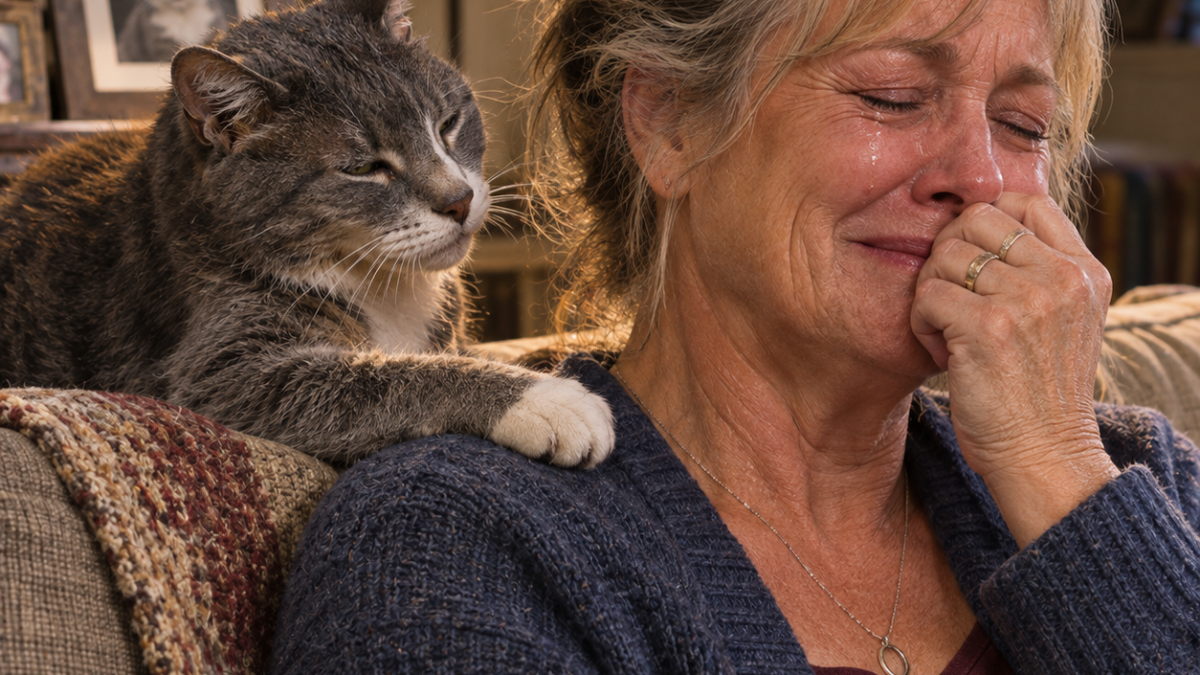
Seven years after I gave up searching for my missing cat, a Stranger Called About His Microchip—Then He Put the Same White-Toed Paw Back on My Shoulder.
Seven years after I stopped putting up flyers for my missing gray cat, a woman I had never met called and asked, “Did you ever have a cat named Orson?”
She told me his microchip still carried my name, but what nearly broke me was learning that the old, starving cat had been found less than two miles from the house where I had spent years waiting for him to come home.
When I finally knelt in front of him, Orson stared at me like I was a stranger—until I whispered the sentence I used to say every night, and one white-toed paw slowly lifted toward my shoulder.
My name is Darlene Jones.
For seven years, I kept a small ceramic cat bowl in the back of my kitchen cabinet.
I never used it.
I never threw it away either.
It was pale blue, chipped along one edge, with the word ORSON painted crookedly across the front in white letters.
I had painted the name myself one rainy Saturday afternoon when he was still young enough to attack the paintbrush every time it moved.
By the time the phone call came, dust had gathered around that bowl so thickly that I could draw a line through it with my finger.
I hadn’t looked at it in months.
Maybe longer.
That was the strange thing about grief after enough time passes.
You don’t necessarily stop loving what you lost.
You just learn not to touch the places where the pain lives.
Orson was one of those places.
I found him behind my detached garage in Kansas City in the spring of 2012.
At least, I thought I found him.
Anyone who has ever been chosen by a stray cat knows that’s not exactly how it works.
It was around six-thirty in the evening.
I’d just come home from work and was carrying groceries up the back steps when I heard something beneath the old wooden shelving beside the garage.
A scream.
Not a meow.
A scream.
I put the bags down.
“Hello?”
Another scream.
I crouched.
Two bright eyes stared back from behind a stack of old flowerpots.
Tiny kitten.
Gray and white.
Filthy.
His ribs showed through his fur.
His ears looked almost too large for his head.
I reached toward him.
He hissed.
Then screamed again.
“You’re terrifying.”
He hissed harder.
“Okay.”
I backed away.
Went inside.
Opened a can of tuna.
Put it on a saucer.
Left it near the garage.
Then watched through the kitchen window.
For five minutes, nothing happened.
Then one gray paw appeared.
Then a nose.
PART2:
Then the entire kitten shot out, attacked the tuna as if it had personally offended him, and ate so fast I thought he might choke.
The next morning, he was still there.
So I fed him again.
That evening, he followed me halfway to the porch.
The day after that, all the way.
By the end of the week, he walked inside my house without invitation, jumped onto my couch, curled into a ball, and fell asleep.
I remember standing in the living room holding a laundry basket and saying:
“Well, apparently we’ve reached an agreement.”
He opened one eye.
That was it.
I belonged to him.
I named him Orson because his personality seemed far too large for his body.
He grew into a handsome gray-and-white cat.
Mostly gray along his back and head.
White chest.
White chin.
And one front paw with three white toes that looked like a badly pulled-on sock.
That paw became the thing I remembered most after he disappeared.
Not because it was unusual.
Because of what he did with it.
Every evening after dinner, I watched television from the same old brown couch.
Orson would jump onto the back cushion.
Walk behind my head.
Circle twice.
Then settle down directly behind my right shoulder.
After a minute or two, I would feel it.
One paw.
PART3:
Softly against my shoulder.
At first, I thought he was balancing himself.
Then I noticed he did it every night.
Even when he was already comfortable.
Paw down.
Gentle pressure.
Sometimes claws barely touching my shirt.
I started saying:
“You checking on me again?”
Every time, Orson would press the paw down just a little harder.
It became our thing.
I lived alone then.
My husband, Michael, had died four years before I found Orson.
Cancer.
Fifty-eight years old.
Too young.
Everyone tells widows that the house will eventually feel normal again.
They mean well.
What actually happens is that you get used to hearing the silence.
There is a difference.
I went to work.
Bought groceries.
Saw friends.
Attended church.
Talked to my sister every Sunday.
I wasn’t isolated.
But every evening, I came home to a house where nobody was waiting.
Then Orson appeared.
Suddenly somebody met me at the back door.
Somebody complained if dinner was late.
Somebody slept on Michael’s side of the bed without understanding why that side mattered.
Somebody sat outside the bathroom and yelled because apparently closed doors were unacceptable.
Orson didn’t replace my husband.
Nothing could.
But he gave the silence another sound.
For almost five years, that was our life.
Then one Saturday afternoon, somebody visiting a house behind mine brought a dog.
I never learned whose dog it was.
Large.
Loud.
Excited.
It got loose in the adjoining yard.
Orson had been sitting near the back steps in a patch of sunlight.
The dog barked.
Once.
Then again.
Orson exploded.
He hit the fence so fast I barely understood what was happening.
There was a damaged board near the bottom where soil had washed away.
He squeezed through it.
The dog barked again.
Orson disappeared down the alley.
“Orson!”
I ran after him.
By the time I reached the alley, he was gone.
I wasn’t frightened at first.
Cats run.
Cats hide.
He knew the neighborhood.
I left the back door cracked.
Put food outside.
Walked the block.
Called his name.
“Orson!”
Nothing.
That evening, I searched again.
Flashlight.
Treat bag.
The little clicking sound he knew meant dinner.
I checked beneath porches.
Behind garages.
Under cars.
Inside bushes.
Every dark place where a frightened cat might hide.
At midnight, I told myself he’d return when the neighborhood got quiet.
I slept on the couch so I’d hear him scratch at the back door.
At 3:17 a.m., something knocked over the food dish.
I jumped up.
Raccoon.
I hated that raccoon for about thirty seconds.
Then immediately felt ridiculous.
Morning came.
No Orson.
I printed flyers.
MISSING GRAY AND WHITE CAT
NAME: ORSON
MICROCHIPPED
WHITE TOES ON FRONT PAW
I taped them to telephone poles.
Mailbox clusters.
Grocery-store bulletin boards.
Veterinary offices.
Pet-supply stores.
I posted online.
Called shelters.
Animal control.
Rescue groups.
I walked farther every day.
One mile.
Two miles.
Three.
At every gray cat, my heart jumped.
Every time someone called saying they had spotted one, I drove there.
Parking lot behind a pharmacy.
Not him.
Abandoned garage.
Not him.
Gray cat eating on somebody’s porch.
Not him.
One woman called at eleven-thirty at night.
“I think your cat is outside my apartment.”
I drove twenty minutes wearing pajama pants and slippers.
The cat was female.
Orange beneath the gray dirt.
Not Orson.
I thanked her anyway.
For months, I kept his bowl beside the back door.
Fresh water.
Food.
Sometimes the food disappeared.
I started leaving a camera.
Raccoons.
Possums.
Neighborhood cats.
Once a gray shape appeared at 4:06 a.m.
I watched the footage frame by frame.
My hands shaking.
Wrong face.
No white toes.
Winter came.
That was when hope became painful.
Kansas City winters can turn cruel quickly.
Freezing rain.
Wind.
Nights below zero.
I imagined Orson under a porch.
Inside a shed.
Anywhere dry.
I walked the neighborhood after snowstorms looking for paw prints.
That probably sounds unreasonable.
Maybe it was.
Grief makes detectives out of people who have no evidence.
Spring came.
Still no Orson.
A year passed.
Then two.
People stopped asking.
At first, I hated that.
Every conversation used to include:
“Any news about Orson?”
Then eventually it didn’t.
My sister stopped mentioning him because she thought it hurt me.
My neighbors stopped calling about gray cats.
The flyers faded.
Rain tore some down.
City crews removed others.
The one on the grocery-store board disappeared beneath garage-sale notices and babysitting ads.
I printed replacements for a while.
Then I stopped.
But I didn’t stop looking.
Not completely.
Whenever I drove past an alley, I looked.
Whenever I saw a gray cat, I slowed down.
Whenever somebody posted a found cat online, I opened the photograph.
Four years after Orson vanished, I found myself crawling beneath a stranger’s porch because somebody swore the cat underneath looked exactly like mine.
He didn’t.
He was ten months old.
Orson would have been nearly nine by then.
The woman who owned the porch looked at me with sympathy.
“How long has yours been missing?”
“Four years.”
She hesitated.
Then said softly:
“That’s a long time.”
I knew what she meant.
You should stop.
She didn’t say it.
She didn’t need to.
That night, I finally put Orson’s bowl away.
I had kept it beside the back door for four years.
Sometimes empty.
Sometimes filled.
Mostly because removing it felt like admitting something I wasn’t ready to admit.
I picked it up.
Walked to the sink.
Washed it.
Dried it.
Then stood in the kitchen holding it.
And cried.
Not dramatic sobbing.
Just tears I couldn’t stop.
Over a ceramic dish.
I remember thinking:
This is ridiculous.
Then thinking:
No, it isn’t.
I opened the cabinet above the refrigerator.
Put the bowl in the back.
Closed the door.
I never threw it away.
That was the compromise I made with myself.
I would stop waiting.
But I wouldn’t erase him.
Life continued.
It always does.
My sister became a grandmother.
The Andersons next door moved to Arizona.
A young couple with two children bought their house.
Kids who had once ridden bicycles down my street grew up, learned to drive, left for college.
The maple tree beside my driveway got sick and had to be removed.
I painted the kitchen.
Replaced the refrigerator.
Retired from my bookkeeping job.
The neighborhood changed.
I changed too.
My world got smaller after retirement.
Not immediately.
At first, I enjoyed having no alarm clock.
Then entire mornings passed without speaking to anyone.
I started doing bookkeeping from home for a few local businesses because I missed structure.
Some days, I’d realize at four in the afternoon that the cashier at the grocery store was the first person I’d spoken to face-to-face.
The house seemed larger.
Quieter.
Orson’s absence had become part of the architecture.
The empty windowsill.
The unused corner of the couch.
Sometimes I still sat down in the evening and instinctively glanced over my shoulder.
Not because I expected him.
Because bodies remember routines longer than minds admit.
Seven years after he disappeared, my phone rang on a Thursday afternoon.
Unknown number.
I almost let it go to voicemail.
Something made me answer.
“Hello?”
A woman said:
“Is this Darlene Jones?”
“Yes.”
“My name is Megan. I’m calling from a rescue group here in Kansas City.”
I assumed she was asking for a donation.
Then she said:
“I have a strange question.”
“Okay.”
“Did you ever have a gray-and-white cat named Orson?”
Everything inside me stopped.
I sat down.
Actually, I missed the chair the first time and caught the edge of the kitchen counter.
“What did you say?”
“Orson.”
I couldn’t breathe properly.
“My cat disappeared seven years ago.”
“I know.”
“No.”
My voice sounded almost angry.
“You must have the wrong person.”
“We scanned his microchip.”
Silence.
“Your name came up.”
My knees weakened.
She continued carefully.
“Darlene Jones.”
I sat.
For several seconds, I couldn’t speak.
I could hear Megan breathing on the other end.
Finally:
“Where?”
“Excuse me?”
“Where did you find him?”
She gave me the address.
I knew the area.
Industrial buildings mixed with older apartments and small warehouses.
I pictured the route.
Then realized.
“That’s not even two miles from me.”
“No.”
“Two miles?”
“About 1.8 according to the map.”
Seven years.
Less than two miles.
I put one hand over my mouth.
Megan continued.
“A woman feeds a small group of outdoor cats behind one of the buildings.”
“She noticed an older cat coming around.”
“He was extremely thin.”
“No collar.”
“She managed to trap him.”
“They brought him in.”
“We scanned him.”
I barely heard the rest.
My mind had already filled with questions.
Had he lived there the entire time?
Had somebody kept him indoors for years and then let him out?
Had he moved from colony to colony?
Had someone fed him?
Had he ever crossed my street without me seeing him?
Had he been looking for home?
The question that hurt most came last.
“Does he remember people?”
Megan paused.
“He’s cautious.”
My heart sank.
“He’s older.”
“Underweight.”
“We’re having him examined.”
“But he’s gentle.”
I swallowed.
“Is it really him?”
“The microchip number matches your registration.”
“I mean—”
I closed my eyes.
“Does he have white toes?”
Megan went quiet.
Then laughed softly.
“Front paw?”
“Yes.”
“Three white toes?”
My eyes filled.
“Yes.”
“Yes, Darlene.”
“He does.”
I cried before I ever saw him.
On the drive there, I nearly turned around twice.
That sounds insane.
For seven years, I had wanted nothing more than confirmation Orson was alive.
Now I had it.
And I was terrified.
Because hope had returned so quickly it felt dangerous.
What if he didn’t know me?
What if seven years had erased everything?
What if I looked at him and realized the cat I remembered no longer existed?
The kitten behind the garage was gone.
The young cat on the couch was gone.
Time didn’t stop simply because I never knew what happened to him.
Orson would be around twelve years old now.
A senior cat.
I had missed most of his life.
That thought hurt in a way I hadn’t prepared for.
Megan met me outside.
She was maybe thirty.
Dark ponytail.
Blue rescue sweatshirt.
Kind face.
“You’re Darlene?”
I nodded.
She seemed unsure whether to hug me.
So was I.
She didn’t.
Good decision.
“He saw the vet this morning.”
“How is he?”
“Thin.”
“How thin?”
“About seven pounds.”
My Orson had once weighed eleven.
“Kidneys?”
“Not terrible for his age.”
“Teeth?”
“Some dental disease.”
“Anything else?”
“Arthritis.”
She hesitated.
“He’s been outside for a while.”
I heard the meaning.
He’d had a hard life.
“How long?”
“We don’t know.”
“Did anyone recognize him?”
“No.”
“Has the feeder seen him before?”
“She thinks maybe six or eight months.”
Only months.
So where had he spent the other six years?
No answer.
Megan touched the door handle.
“You ready?”
“No.”
She smiled sadly.
“That’s okay.”
Then opened it anyway.
The rescue room smelled like detergent, litter, and canned cat food.
Kennels lined one wall.
I heard meowing.
A dog barking somewhere farther away.
Megan led me to the last kennel.
I saw gray fur.
Then a face.
My heart sank.
Not because it wasn’t him.
Because it was.
Orson looked old.
His cheeks were thinner.
The gray fur around his face had faded.
His ears carried tiny scars.
His coat looked rough.
One eye watered slightly.
There was a notch in his left ear I didn’t remember.
He was standing instead of lying down.
Watching.
I walked closer.
My hands were trembling.
“Orson?”
His ears moved.
That was all.
He didn’t cry.
Didn’t rush to the door.
Didn’t throw himself against the kennel.
He simply looked at me.
I had imagined that moment hundreds of times during the first years.
In every imaginary reunion, he knew me instantly.
He ran.
I cried.
He climbed into my arms.
Life turned into a movie.
Reality was quieter.
Orson stared.
And I felt something inside me crack.
Seven years.
Of course he didn’t remember.
Why would he?
Megan stood beside me.
“Give him time.”
I nodded, pretending that was what I expected.
She opened the kennel.
Orson stepped out slowly.
His back legs looked stiff.
He sniffed the floor.
Then my shoes.
I held completely still.
He sniffed my pant leg.
Walked around me once.
No recognition.
At least none I could see.
I lowered myself to the floor.
My knees complained.
I didn’t care.
“Hey.”
Orson looked at me.
My vision blurred.
I laughed nervously.
“It’s me.”
Nothing.
I reached out.
Stopped.
Let him decide.
He came close enough to smell my fingers.
Then stepped away.
That almost hurt more than if he’d hissed.
I wiped my face.
Megan pretended not to notice.
Then something came to me.
Not consciously.
The words simply left my mouth.
Words I had said hundreds of evenings on that old couch.
“You checking on me again?”
Orson stopped.
Completely.
His ears turned toward me.
I stopped breathing.
He looked directly into my face.
Not past me.
At me.
Then he took one slow step.
Another.
His right front paw lifted.
The white one.
He placed it against my shoulder.
Softly.
Exactly where it used to go.
I broke.
There is no graceful description for it.
I covered my mouth.
Then cried so hard I couldn’t breathe.
“Orson.”
His paw stayed there.
I put both arms around him carefully.
He didn’t pull away.
Instead, he leaned into my chest.
I felt bones beneath his coat.
Too many.
I kept repeating:
“Oh my God.”
“Oh my God.”
“You remember.”
“You remember me.”
Megan was crying too.
She turned away and pretended to organize paperwork.
I pressed my face into Orson’s fur.
He smelled unfamiliar.
Rescue shampoo.
Outside.
Dust.
But underneath it, somehow, he was still Orson.
Then I heard something I had not heard in seven years.
A quiet rumble.
Purring.
Weak at first.
Then stronger.
That one little paw told me more than the microchip ever could.
Technology had remembered my name.
Orson remembered me.
The veterinarian wanted him monitored another day.
I hated leaving.
But I understood.
They ran bloodwork.
Checked his heart.
Treated fleas.
Started medication for arthritis.
The vet said:
“For a cat who’s apparently been missing seven years, he’s surprisingly stable.”
I asked:
“Could he really have survived outdoors that long?”
The vet gave me the answer I already knew.
“Maybe.”
“Cats can survive with colonies.”
“People feed strays.”
“He could’ve lived with somebody for part of that time.”
“There’s no way to know.”
“Could someone have kept him?”
“Yes.”
“Could he have been nearby?”
“Yes.”
Every answer created another question.
I eventually stopped asking.
The mystery belonged to Orson.
He couldn’t tell me.
Maybe that was okay.
The next afternoon, I brought him home.
Same street.
Different cars.
Different neighbors.
Different trees.
I set the carrier in the living room.
Opened it.
Orson stayed inside for almost five minutes.
Then emerged.
Slowly.
He sniffed the rug.
Coffee table.
Wall.
He froze near the hallway.
Looked toward the kitchen.
Then walked.
Not confidently.
But deliberately.
I followed.
He stopped at the back door.
The door he’d disappeared through seven years earlier.
I opened it only a crack, holding the screen firmly closed.
Orson looked outside.
For a very long time.
I wondered what he was seeing.
The fence had been repaired years ago.
No gap.
The garage repainted.
The maple tree gone.
Children yelling somewhere down the block.
Orson’s nose moved.
Then he turned away.
Walked back toward the living room.
I closed the door.
“Good choice.”
That evening, I sat on the couch.
I didn’t expect anything.
Orson had spent most of the afternoon sleeping in a heated bed the rescue gave me.
Around eight, I felt movement beside the couch.
He looked up.
Then attempted to jump.
His back legs failed the first time.
My heart clenched.
“Easy.”
He tried again.
Made the seat cushion.
Rested.
Then slowly climbed onto the back.
I didn’t move.
Every part of me wanted to help.
I was afraid helping would break whatever memory was guiding him.
Orson reached the old spot behind my shoulder.
Circled once.
Not twice.
Age had reduced unnecessary ceremony.
Then settled.
For several seconds, nothing happened.
I stared at the television without seeing it.
Then:
Touch.
One paw.
My shoulder.
White toes.
I closed my eyes.
“You checking on me again?”
Pressure.
A little harder.
I cried without making a sound.
We stayed like that for nearly an hour.
The next morning, I remembered the bowl.
I stood in the kitchen.
Opened the cabinet.
Reached behind baking dishes I hadn’t used in years.
There it was.
Pale blue.
ORSON.
Dust around it.
Chip still on the rim.
I took it down.
Washed it.
Dried it.
Set it on the floor.
Orson was sleeping nearby.
The sound of ceramic touching tile woke him.
He raised his head.
Walked over.
Sniffed the bowl.
Then looked at me.
I laughed.
“No way.”
He lowered his head.
Drank.
I had to sit down again.
That bowl had waited seven years.
So had I, in a way.
Orson’s recovery took months.
He gained weight slowly.
Seven pounds became eight.
Then almost nine.
His coat improved.
The watery eye cleared after treatment.
Dental work removed two bad teeth.
Arthritis medication helped him climb.
I bought little pet steps for the couch.
He refused them for three weeks because apparently surviving seven missing years did not make him reasonable.
Then one evening I caught him using them when he thought I wasn’t watching.
I said:
“Smart.”
He glared at me.
Some things hadn’t changed.
The hardest adjustment was nighttime.
Orson sometimes woke crying.
Not loudly.
A strange, searching yowl.
I’d find him standing in the hallway.
Looking around.
I don’t know whether he was confused from age or remembering someplace else.
I would kneel.
“Hey.”
He’d look at me.
“Home.”
Eventually he’d come closer.
One paw against my leg.
Then we’d go back to bed.
I never learned where Orson had spent those seven years.
I tried.
For a while.
I posted his photographs in neighborhood groups.
Talked to the woman who had fed the colony.
Visited nearby apartment buildings.
Asked older residents.
A man remembered a gray cat living around a mechanic’s shop years earlier.
Could have been Orson.
A woman said an elderly tenant two streets away had once fed a gray-and-white cat she called Smokey.
Could have been him.
That woman had died three years before.
Her family didn’t remember the cat.
Another person thought they’d seen him near a church.
Maybe.
Maybe not.
I created possible histories.
Perhaps somebody found him after he disappeared.
Maybe they fed him.
Maybe he became their cat without ever getting scanned.
Maybe they moved.
Maybe he escaped again.
Maybe he spent winters in garages and summers beneath porches.
Maybe five different people thought he was theirs.
Maybe nobody did.
The questions started hurting more than helping.
Then my sister said:
“Darlene.”
“What?”
“You have him.”
“I know.”
“So stop searching for the seven missing years.”
I went quiet.
She continued:
“You spent seven years searching for Orson.”
“Don’t spend the years you have now searching for what you can’t get back.”
That landed.
So I stopped.
Not because the missing years didn’t matter.
Because the remaining ones did.
Orson changed my life again.
The first time, he arrived when I was learning how to live alone after Michael died.
The second time, he arrived when I had slowly become alone without noticing.
Those are different kinds of loneliness.
The first is loud.
People call.
Bring casseroles.
Sit beside you.
Say they’re sorry.
The second kind grows quietly.
A friend moves.
Another gets sick.
You retire.
Days lose structure.
You decline invitations because staying home is easier.
Then one afternoon you realize you haven’t heard your own voice in hours.
Orson didn’t solve that.
But caring for him changed my routines.
Veterinary appointments.
Trips to the pet store.
Neighbors stopping to ask if the famous missing cat was really back.
The young family next door brought their daughter, Sophie, to meet him.
She was eight.
She sat cross-legged on my living-room floor for twenty minutes waiting for Orson to approach.
He finally did.
One sniff.
Then sat beside her.
Sophie whispered:
“Did he walk home?”
“No.”
“How did he find you?”
“Microchip.”
She thought.
“Like a GPS?”
“No.”
“It doesn’t tell anyone where he is.”
“It just tells them who he belongs to if somebody finds him.”
Sophie looked at Orson.
“So it remembered when everybody else forgot?”
That sentence hit me.
“I didn’t forget.”
She looked embarrassed.
“I didn’t mean you.”
“I know.”
I smiled.
“But yes.”
“In a way, it remembered.”
After that, I started volunteering twice a month with the rescue that found Orson.
Nothing heroic.
Laundry.
Cleaning carriers.
Entering microchip numbers.
Sometimes calling owners.
The first time I made one of those calls, my hands shook.
A black cat had been found thirty miles from home.
Missing eleven months.
The owner answered.
I said:
“Did you ever have a cat named Pepper?”
Silence.
Then crying.
I understood exactly what was happening on the other end.
I sat down.
Waited.
That became the part of Orson’s story I hadn’t expected.
One animal coming home helped others do the same.
I began talking about microchips whenever anyone would listen.
Not because they track animals.
They don’t.
Because identity survives distance.
Phone numbers change.
People move.
Shelters change staff.
Collars fall off.
But a tiny chip beneath the skin can still connect one life to another years later.
I updated Orson’s registration immediately.
Then checked it twice.
New phone.
Backup contact.
My sister.
Veterinarian.
I became slightly obsessive.
Nobody complained.
Orson aged quickly after coming home.
Or maybe I simply noticed age because I had missed the years when it happened.
At thirteen, his kidneys began showing early decline.
At fourteen, he needed more medication.
He stopped climbing onto the couch back without steps.
Eventually I added a wider set.
He used those.
Pride has limits.
His evening ritual remained.
Up the steps.
Across the cushion.
Behind me.
Paw.
Some nights the pressure was so light I almost couldn’t feel it.
But it was there.
“You checking on me?”
Press.
Always.
One evening, Megan—the woman who had called me—came over for dinner.
She hadn’t seen Orson since the rescue.
He was sleeping beside me.
She crouched.
“Look at you.”
Orson opened one eye.
Megan laughed.
“Still judgmental.”
“Very.”
She looked at me.
“You know, we almost didn’t trap him.”
My stomach tightened.
“What?”
“The colony feeder had tried for weeks.”
“He wouldn’t go near the trap.”
“What changed?”
Megan smiled.
“Rain.”
She explained.
A cold storm came through.
Orson finally entered the humane trap for food and shelter.
If that night had been warm?
Maybe he wouldn’t have.
If the feeder hadn’t checked?
If they hadn’t scanned an old cat because somebody assumed he was feral?
If I had failed to update the phone number attached to the microchip?
Small things.
Seven years separated by tiny decisions.
I looked at Orson.
“Do you ever think about how close people come to never knowing something?”
Megan nodded.
“All the time.”
After she left, I sat on the couch.
Orson climbed behind me.
Paw.
I thought about that storm.
A feeder.
A scanner.
A number stored in a database.
A phone call I almost didn’t answer.
Life sometimes turns on very unimpressive hinges.
Orson lived four years after coming home.
Four years I had stopped believing I’d ever have.
By sixteen, he was almost completely deaf.
He slept most of the day.
His kidneys required fluids twice a week.
I learned to administer them.
He hated the needle.
Loved the treats afterward.
He moved slowly.
But every evening, he still wanted the couch.
One winter night, he stood at the bottom of the pet steps.
Looked up.
Tried the first.
Stopped.
I knelt.
“Need help?”
He stared.
I took that as yes.
I lifted him gently.
Placed him behind my shoulder.
He settled.
Then the paw.
Always the paw.
My sister said once:
“Maybe he’s checking whether you’re still there.”
I said:
“Maybe I’m checking whether he is.”
The final spring was difficult.
He ate less.
Lost weight.
Spent more time beside the sunny living-room window.
The veterinarian talked about quality of life.
I understood every word.
I hated every word.
One afternoon, I sat beside him on the floor.
His head rested in my lap.
I thought about those seven lost years again.
Not where he’d been.
How angry I’d once felt about them.
Why didn’t he come home?
Why didn’t someone scan him earlier?
Why couldn’t I find him when he was less than two miles away?
Then I looked down at the old cat sleeping against me.
And realized those questions no longer had power.
Because whatever had happened during those seven years, Orson had eventually returned.
And I had been given four more.
That was enough to feel impossible.
The night before his final veterinary appointment, I sat on the couch with him.
He could no longer climb behind me.
So I held him against my chest.
I whispered:
“You checking on me again?”
His eyes opened.
One paw moved.
Slowly.
White toes touched my shoulder.
I cried.
Of course I did.
I had cried when he disappeared.
Cried over the bowl.
Cried when Megan called.
Cried when he remembered.
And now I cried because love had given me the same gesture for the last time.
The next afternoon, Orson died peacefully in my arms.
I almost don’t include that part when people ask about him.
They want the reunion.
The miracle.
Seven years missing.
Microchip.
White paw.
Happy ending.
But happy endings don’t mean nothing painful happens afterward.
They mean the pain was worth what came before it.
I brought his ashes home.
The rescue made a clay impression of his paw.
Three white toes weren’t visible in clay, obviously.
But I knew which paw it was.
I placed the impression beside his photograph.
And his bowl?
Back in the cabinet?
No.
It sits on a small shelf near the kitchen window now.
Clean.
Empty.
Not hidden.
I spent too many years hiding it because looking hurt.
I don’t need to hide it anymore.
Sometimes Sophie from next door comes over.
She’s older now.
She still remembers Orson.
Once she asked:
“Are you sad when you look at his bowl?”
“Yes.”
“Then why keep it out?”
I thought about that.
“Because sad isn’t the only thing I feel.”
She nodded like that made perfect sense.
Children are often better at accepting mixed emotions than adults.
Orson taught me that home can survive distance.
Memory can survive time.
Love can survive not knowing.
But he also taught me something else.
Coming home doesn’t always mean returning to the same place you left.
The neighborhood had changed.
I had changed.
Orson had changed.
The kitten was gone.
So was the woman who used to wait at the back door every night listening for him.
We met again as two older creatures who had both lived seven years without the other.
And somehow we still recognized the language.
Not my voice alone.
Not his name.
Not even the house.
A question.
A paw.
“You checking on me again?”
Yes.
That was home.
Sometimes people ask me whether I believe Orson had been trying to get back to me all those years.
I don’t know.
I refuse to invent an answer just because it makes the story prettier.
Maybe he tried.
Maybe he didn’t know how.
Maybe someone cared for him.
Maybe he lived two streets away and never understood how close he was.
Maybe cats experience home differently from us.
I’ll never know.
What I do know is this.
Seven years after I stopped believing Orson would return, a stranger scanned a tiny microchip beneath the skin of an old gray cat.
A computer displayed a name.
Darlene Jones.
A phone rang.
I answered.
And less than two miles from the house where I had once left food outside night after night, the cat I thought I’d lost forever was waiting in a kennel.
He didn’t run to me.
Didn’t cry.
Didn’t perform the reunion I’d imagined.
He simply smelled my shoes.
Walked around me.
Listened to a sentence from another lifetime.
Then slowly lifted one tired front paw.
And placed it on my shoulder.
That was enough.
Seven years of questions disappeared beneath the weight of one small paw.
He remembered.
So did I.
And when I brought him home that night, Orson didn’t need a map.
He didn’t need the microchip anymore.
He walked into the living room.
Found the old couch.
Found his place behind me.
And reminded me that sometimes home isn’t the address you return to.
Sometimes home is the person who still knows exactly what your touch means.