Salute. I Won’t Ask Twice.” The Lieutenant Humiliated Me in Front of 12 Mechanics—Then a Two-Star General Dropped His Coffee, Recognized Me, and Said, “Lieutenant… Turn Around. Slowly.”
PART3:
Nobody said anything.
Pierce knew he had an audience.
That seemed to improve his mood.
“Sir,” I said, “I’m happy to follow a lawful instruction. But I don’t believe this situation requires me to walk inside, put on my patrol cap, and return solely so you can require a hand salute.”
His eyebrows rose.
“What this situation requires, Staff Sergeant, is for you to stop explaining military customs to a commissioned officer.”
Bear’s face changed.
Not much.
Enough.
I knew that face.
It meant he was approximately six seconds away from saying something that would create paperwork.
I gave him one quick look.
Don’t.
He stayed quiet.
Pierce tucked the portfolio tighter beneath his arm.
I said:
“Understood, sir.”
“Good.”
“Would you like me to retrieve my cover now?”
“That is what I have been telling you.”
“Then I’ll be right back.”
I turned.
“Don’t walk away while I’m addressing you.”
I stopped.
Behind me, the motor pool became completely silent.
Somewhere outside the perimeter, a diesel engine coughed twice and failed to start.
Pierce stepped closer.
His voice dropped slightly.
Not enough that the soldiers couldn’t hear.
Enough to make it personal.
“I’ve seen your name on a report, Moreno.”
I looked at the portfolio.
“Apparently, you have a pattern of challenging officers who give you instructions.”
I met his eyes.
“Would that report happen to concern B-17, sir?”
Something flickered across his face.
Gone almost instantly.
I had spent too many years watching frightened, injured, dishonest, and overconfident people to miss it.
“That is not your concern right now.”
“It became my concern when someone listed the vehicle mission capable without repairing the brake fault.”
“Your concern is showing appropriate respect.”
I nearly answered.
Then I saw somebody walking around Bay Three.
Camouflage uniform.
Patrol cap.
Paper coffee cup.
Gray hair.
Two black stars on his chest.
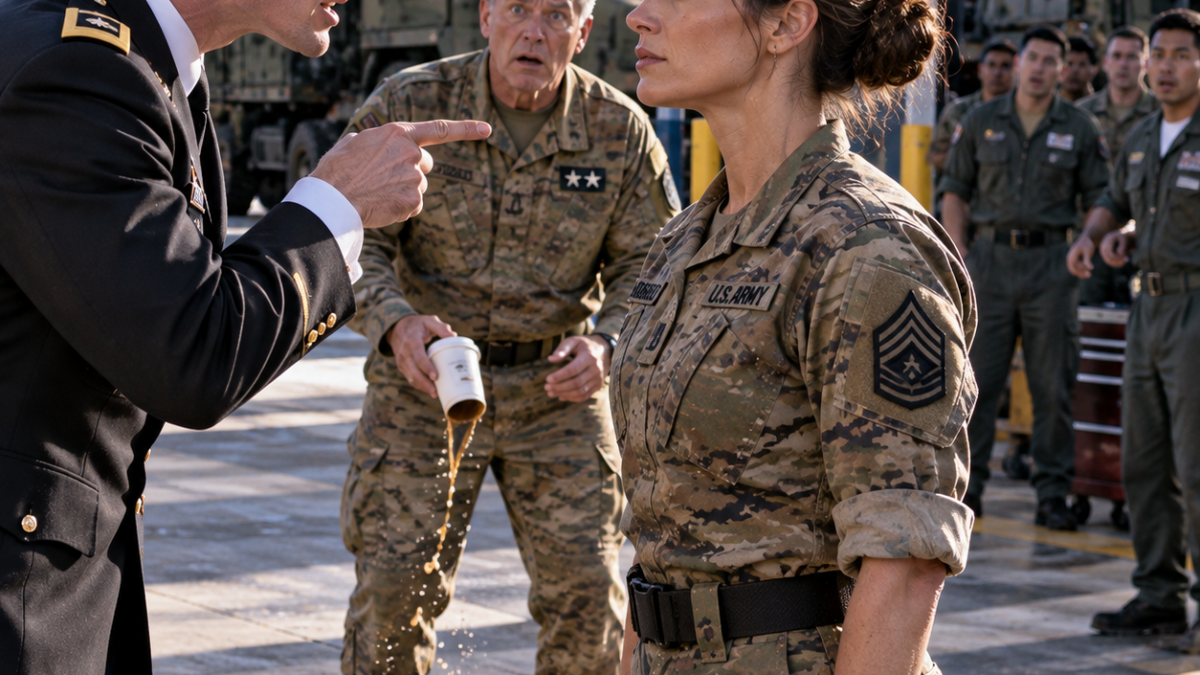
Major General Thomas Avery.
He was looking toward the vehicle line.
Not us.
His free hand rested casually behind his back while he walked with the unhurried posture senior officers develop after enough years of everybody else hurrying for them.
I had not seen him in almost eight years.
For one strange second, I wondered whether he would recognize me.
Different last name.
Older face.
Hair shorter.
No dress uniform.
No pale blue ribbon.
Just Rachel Moreno in greasy coveralls holding a rag.
Then his gaze passed across Pierce.
Reached me.
Stopped.
Avery froze so abruptly I thought he had tripped.
His fingers opened.
The coffee cup fell.
Hit the concrete.
Bounced.
Split at the seam.
Coffee spread around his boots in a dark steaming puddle.
The cup rolled under the tire of a parked Humvee.
Pierce never noticed.
He was still looking at me.
“Staff Sergeant.”
“Yes, sir.”
“I’m waiting.”
I could barely hear him.
My mind had gone somewhere else.
Afghanistan.
A truck.
Smoke.
A man climbing onto a running board while I shook so badly I could not release the steering wheel.
Thomas Avery had looked at me then exactly the way he was looking at me now.
Not at rank.
Not at uniform.
At me.
I said quietly:
“Lieutenant.”
Pierce’s eyes narrowed.
“You should turn around.”
“Do not tell me what to—”
“Sir.”
Something in my voice finally reached him.
“Please.”
Pierce turned.
Saw Avery.
His entire body changed.
He snapped to attention so fast the black portfolio slipped from beneath his arm.
It landed in the gravel.
“General Avery, sir. Good morning. I was just correcting a—”
“Lieutenant Pierce.”
Avery’s voice was almost gentle.
That was never a good sign.
“Yes, sir.”
“Step aside.”
Pierce moved.
Avery approached me.
He stopped where the concrete changed from sunlight to shade.
For several seconds, neither of us spoke.
I became aware of everything at once.
The cold against my uncovered head.
Grease drying on my sleeve.
Twelve mechanics watching.
Pierce standing three feet away.
My heart hitting my ribs harder than it had any right to.
Then Avery said:
“Rachel.”
Nobody at Fort Carson called me Rachel during duty hours.
Not anymore.
“Good morning, General.”
He swallowed.
“I didn’t know you were here.”
“Since February, sir.”
His expression tightened.
“Seven months?”
“Yes, sir.”
He looked at the clipboard in my hand.
Then my coveralls.
Then the motor pool.
“Still keeping trucks moving?”
“Trying to.”
A small smile almost reached his face.
Almost.
Then he looked toward the gate shack.
“Do you have your patrol cap nearby, Staff Sergeant?”
I knew immediately what he intended.
Every part of me wanted to say no.
Not because I wanted to embarrass Pierce.
Because I did not want what came next.
I had spent years arranging my life so what came next would not happen.
But refusing Avery would make it larger.
So I said:
“Inside, sir.”
“Would you mind putting it on?”
I looked toward Jonah.
“Reed.”
He nearly jumped.
“Staff Sergeant?”
“My cap is on the hook beside dispatch.”
“Yes, Staff Sergeant.”
He disappeared.
Pierce stood rigid beside his portfolio.
Bear lowered the torque wrench.
Avery waited.
Jonah came back carrying my patrol cap with both hands like it was evidence.
I took it.
Put it on.
Adjusted the brim.
Then stepped from beneath the overhang into the open air.
“Sir.”
I came to attention.
“I’m covered.”
Major General Thomas Avery straightened.
Then a two-star general raised his right hand and saluted me.
Behind my shoulder, Lieutenant Pierce whispered:
“Oh, my God.”
There are military traditions people outside the service often misunderstand.
Rank governs formal saluting customs.
But the Medal of Honor occupies a different symbolic place in American military tradition.
Its recipients are often accorded honors by service members of every rank, including officers senior to them, not because the medal changes the recipient’s rank but because the salute recognizes the act represented by it.
I had spent years avoiding moments when that tradition might become relevant.
For a while, avoiding them had been difficult.
There had been news stories.
Photographs.
Ceremonies.
Television.
Schools.
Veterans organizations.
People who wanted to shake my hand while telling me what kind of person they believed I must be.
Eventually, attention faded.
I helped it.
Changed assignments.
Changed my surname after marrying.
Kept the surname after the divorce because Moreno attracted fewer questions than Ellis.
Asked commanders not to publicize me unless duty required it.
Requested ordinary jobs.
Maintenance.
Transportation.
Training.
Anywhere I could be Staff Sergeant Moreno instead of the woman whose worst day had become public property.
For seven years, it mostly worked.
Until Major General Avery dropped his coffee.
I returned his salute.
My arm stayed steady.
My breathing did not.
Avery lowered his hand.
Three seconds passed.
Nobody moved.
Then Bear’s voice detonated across the motor pool.
“Motor pool! Attention!”
Twelve mechanics came upright in a ragged wave.
Jonah nearly dropped his flashlight.
Torres slapped her hands against the seams of her coveralls.
Someone inside Bay Three kicked a rolling stool and barely caught it.
Pierce looked from Avery to me.
His face had gone pale.
Avery turned.
“Lieutenant.”
“Yes, sir.”
“Do you recognize Staff Sergeant Moreno?”
Pierce swallowed.
“No, sir.”
“You may recognize her previous name.”
Avery looked at me first.
I gave the smallest possible nod.
“Sergeant Rachel Ellis.”
Pierce stopped breathing.
At least it looked that way.
“The Medal of Honor recipient?”
Avery said:
“Yes.”
I wanted the concrete to swallow me.
Avery turned toward the mechanics.
“At ease.”
Nobody moved.
Bear had enough sense to break the spell.
“You heard the general. Get back to work.”
Jonah stared at me.
Bear pointed sharply toward Bay One.
“Reed.”
“Yes, Sergeant First Class.”
“Truck.”
“Yes, Sergeant First Class.”
He vanished.
Pierce remained at attention.
“Staff Sergeant Moreno.”
I waited.
“I apologize.”
The arrogance was gone.
Embarrassment had replaced it.
Maybe regret too.
I had learned something about public humiliation over the years.
It can make people kinder.
It can also merely teach them to check whether the person they plan to mistreat has powerful friends.
I did not yet know which lesson Pierce had learned.
“Sir, I appreciate the apology.”
He looked at me.
“But nothing about that medal changed whether I deserved professional respect five minutes before you knew about it.”
His eyes lowered.
“Understood.”
I wasn’t sure he did.
Avery retrieved his ruined coffee cup.
Bear sent Jonah for towels.
Then the general asked:
“Staff Sergeant, can we use your maintenance office?”
“Yes, sir.”
“Lieutenant, with us.”
We went inside.
The office was small.
Burnt-coffee smell.
Printer toner.
Rubber floor mats.
A wall calendar still showing September because none of us had remembered to change it.
Avery sat behind the battered desk.
Placed the crushed cup beside a stack of work orders.
Pierce remained standing until Avery pointed at a chair.
“Sit.”
We sat.
Avery looked at me.
“Why didn’t you tell me you were assigned here?”
I almost laughed.
“Because I thought you might arrange something similar to what just happened.”
He nodded.
“Fair.”
“I requested an ordinary assignment.”
“I know you’ve done that before.”
“No ceremonies.”
“No speaking engagements.”
“No special duties unless required.”
“I wanted mechanics.”
“Trucks.”
“Safety inspections.”
Avery looked through the office window.
“And you got them?”
“Mostly.”
He glanced at Pierce.
“Apparently this morning became complicated.”
Pierce looked at the floor.
Avery leaned back.
“Lieutenant Pierce is supporting headquarters readiness review for the next field exercise.”
I looked at Pierce’s portfolio.
“Colonel Kessler’s office?”
Pierce’s eyes came up.
Avery noticed.
“Yes.”
Lieutenant Colonel Victor Kessler.
Brigade operations.
Late forties.
Always immaculate.
Loved green percentages.
He rarely came to the motor pool.
He came to briefings.
Two weeks earlier, he had announced that ninety-five percent fleet readiness was required before a major exercise.
That was a goal.
Machinery doesn’t recognize goals.
It recognizes fluid pressure, torque specifications, worn seals, cracked lines, heat, friction, and whether somebody repaired what was broken.
Avery said:
“Colonel Kessler reported concerns about inconsistencies in maintenance documentation.”
I felt my stomach tighten.
“This is about B-17.”
Pierce shifted.
Avery said:
“Explain.”
“Communications support LMTV.”
“Last Thursday Specialist Torres identified inconsistent brake pressure during inspection.”
“We found evidence of a hydraulic leak.”
“I placed the vehicle non-mission-capable.”
“Was it repaired?”
“No, sir.”
“Then why does headquarters show mission capable?”
“That’s what I’ve been asking.”
Pierce looked increasingly uncomfortable.
I continued.
“Thursday afternoon our system showed the vehicle correctly deadline.”
“Friday morning, revised documentation removed the fault.”
“I checked the truck.”
“Same leak.”
“No repair.”
“I declined to sign the corrected status.”
Avery looked toward Pierce.
“Lieutenant.”
“Sir?”
“Why were you sent here?”
Pierce hesitated.
“To obtain an explanation for Staff Sergeant Moreno’s refusal to acknowledge the readiness correction.”
“Were you directed to inspect B-17?”
“No, sir.”
“To speak with the mechanic who identified the defect?”
“No, sir.”
“To determine whether the revised status was accurate?”
“No, sir.”
Avery folded his hands.
“So you were sent to resolve a disagreement with the NCO.”
Pierce swallowed.
“Yes, sir.”
“Not the truck.”
Silence.
“No, sir.”
Avery looked back at me.
“I want the original inspection.”
“The revised report.”
“Every work order.”
“Every electronic entry.”
“Preserve them.”
“Yes, sir.”
Then he turned to Pierce.
“You will assist.”
“Yes, sir.”
“You are not here to make her acknowledge anything.”
“You are here to determine what occurred.”
“Yes, sir.”
Avery paused.
“And Graham?”
Pierce stiffened at the use of his first name.
“Yes, sir?”
“The next time an enlisted mechanic tells you a military vehicle is unsafe, inspect the vehicle before you inspect the mechanic’s attitude.”
I almost smiled.
Almost.
Avery stood.
Then stopped beside me.
His expression softened.
“How are you doing, Rachel?”
It was not about the truck.
I hated that he could still do that.
“I’m doing my job, sir.”
“That isn’t what I asked.”
“I know.”
He waited.
I said nothing.
Eventually he nodded.
He never pushed when I went quiet.
That was one reason I had remembered him kindly.
After he left, I called Torres in.
Elena Torres was twenty-six.
Excellent mechanic.
The kind who wiped down every tool before returning it and became personally offended by stripped threads.
She carried her original inspection worksheet.
Her hands trembled slightly.
“Tell Lieutenant Pierce what you found.”
She did.
Soft brake response.
Pressure variance.
Visible fluid.
Reported twice.
“Who told you the readings might be inaccurate?”
Torres hesitated.
“Operations said the vehicle had already been reviewed.”
“Names?”
“I have them written.”
She produced a notebook.
Pierce stared.
Torres looked at me.
“You told us to keep our own copies whenever something didn’t match.”
“Yes.”
A knock came at the open door.
Jonah.
He was holding a sheet of paper.
“Staff Sergeant J?”
Bear shouted from the bay:
“Reed, stop calling her that while officers are in the office.”
Jonah looked alarmed.
“Staff Sergeant Moreno.”
“What?”
“I found this on dispatch printer.”
He handed it over.
Final maintenance authorization.
Vehicle B-17.
Time stamped Sunday evening.
Our motor pool had been closed.
The report declared:
BRAKE DEFECT CORRECTED.
HYDRAULIC SYSTEM INSPECTED.
VEHICLE FULLY MISSION CAPABLE.
At the bottom:
SSG RACHEL MORENO.
Electronic signature attached.
I stared.
Read it twice.
Then a third time.
Pierce said:
“You signed this Sunday?”
“No.”
His face changed.
I looked through the office window at B-17 sitting outside Bay One.
A vehicle capable of carrying soldiers and equipment down mountain roads.
Paperwork said I had inspected it.
Approved it.
Released it.
I had done none of those things.
Somebody had forged my name onto a safety report.
And they had done it eighteen hours before Lieutenant Pierce arrived at the motor pool ready to teach me obedience.
“Do not edit anything,” I said.
Pierce looked at me.
“Staff Sergeant?”
“Print the audit information.”
“Preserve an authorized copy.”
“Document where this came from.”
“We report the discrepancy.”
“We do not try to fix it ourselves.”
Pierce nodded.
“Yes, Staff Sergeant.”
That was the moment the morning stopped being about a salute.
There are mistakes soldiers forgive.
A forgotten wrench.
A missed deadline.
A form routed incorrectly.
A repair that has to be redone.
Approving an unsafe vehicle is different.
A twelve-ton truck descending a Colorado grade does not care whether a colonel needs ninety-five percent readiness.
Hydraulic pressure does not respect rank.
Gravity does not read PowerPoint.
The next hour moved quickly.
Maintenance control notified.
Safety office contacted.
Electronic record preserved.
Original inspection secured.
Avery’s staff informed.
By lunchtime, everybody at Fort Carson seemed to know two stories.
The first was wrong in all the easy ways.
A young lieutenant had tried to humiliate a Medal of Honor recipient.
A general had put him in his place.
The end.
The second story was harder.
Someone had signed my name to an unsafe truck.
That was the one I cared about.
The salute story spread faster.
Of course it did.
It had a photograph.
Somebody had taken one at exactly the moment Avery saluted.
By Tuesday night it was online.
A military social-media page posted it with a caption about a lieutenant getting “the shock of his career.”
Jonah found it.
He walked toward me with his phone held out.
“Staff Sergeant J.”
I looked at him.
He stopped.
“Staff Sergeant Moreno.”
“Better.”
“Thirty thousand people have commented.”
“Thirty thousand people need hobbies.”
He scrolled.
“One guy says you’re the most decorated mechanic in Colorado.”
Bear shouted from under a truck:
“That fool clearly hasn’t seen my socket collection.”
I called back:
“Stolen socket collection.”
“Allegedly.”
Jonah laughed.
Then stopped.
He looked at me differently now.
They all did.
That was the part I feared.
Soldiers stood a little straighter.
People who had argued with me casually now reconsidered every sentence.
Somebody offered to carry a box I had carried myself for months.
I hated it.
“Reed.”
“Yes?”
“What are the torque specs on those rear wheel fasteners?”
He answered.
“And what happens if I tell you to ignore the technical manual?”
He hesitated.
“You’re wrong.”
“Good.”
His eyes widened.
“Even now?”
“Especially now.”
I pointed at his truck.
“Go work.”
That afternoon, installation safety investigators arrived.
Captain Lena Cho led the review.
Dark hair.
Wire-frame reading glasses.
No interest whatsoever in my medal.
I liked her immediately.
She asked for documents.
Dates.
Work orders.
User logs.
Witnesses.
Nothing else.
Pierce was removed temporarily from his aide-related duties while his role was reviewed.
Not punished for the forged signature.
There was no evidence he had created it.
His conduct Monday was separate.
Cho treated it separately.
That impressed me.
I had seen investigations fail because everybody wanted one villain.
Reality is usually messier.
During the first audit, Torres found another inconsistency.
Then another.
B-17 wasn’t alone.
Over eighteen months, several vehicles had been shown operational despite unresolved complaints.
One equipment number caught my attention.
I had seen it during my initial maintenance-history review after arriving at Fort Carson.
A truck involved in a serious training accident two years earlier.
Driver:
Specialist Hannah Webb.
Twenty-two at the time.
Official finding:
Driver failed to properly inspect vehicle before movement and lost control descending a range road.
She had shattered one leg.
Two other soldiers injured.
Eventually medically separated.
But the maintenance system contained an older entry.
Three days before the crash:
BRAKE RESPONSE INCONSISTENT.
DRIVER REPORTS SOFT PEDAL.
INSPECTION REQUESTED.
That warning disappeared from the final accident packet.
I stared at the screen.
Cho saw my face.
“You know this case?”
“Only from archive.”
She leaned closer.
The truck’s inspection had been approved through the same operations chain now connected to B-17.
A name appeared repeatedly.
Master Sergeant Alan Dugan.
Senior maintenance coordinator under Colonel Kessler’s section.
Dugan had a reputation.
Everybody knew one.
The man who “got things done.”
Needed a part that supply said would take a week?
Dugan.
Need a bus?
Dugan.
Inspection conflict?
Dugan.
Fifty-one.
Close to retirement.
Relaxed.
Friendly.
The sort of NCO officers loved because difficult processes seemed to become easy around him.
I had met him twice.
Both times he joked that our maintenance section “wrote up too many things that could wait.”
When Cho found his account linked to the Sunday upload, I felt disappointment more than surprise.
“Could he have uploaded it without knowing it was false?”
“Yes.”
Cho answered immediately.
“That’s why we investigate.”
Good answer.
She enlarged the signature.
Something looked strange.
My electronic signature was not an authentication generated by the current maintenance system.
It was an image.
Copied from an older scanned inspection.
Cho placed both documents side by side.
Same thin black flaw in lower corner.
Same scanner line.
Someone had taken an earlier signature I genuinely made and pasted it onto the new report.
Cho leaned back.
“That changes things.”
“Can you trace who handled it?”
“We can trace the originating workstation and upload account.”
She did.
Dugan’s office.
That did not prove motive.
It proved access.
We kept going.
Two days later Colonel Kessler asked to see me.
His office looked exactly like I expected.
Polished desk.
Framed commissioning photograph.
Green briefing charts.
Kessler was tall.
Thinning blond hair.
Pale eyes.
Friendly voice.
The kind of senior officer who never seemed to ask a question unless he had already decided what answer would help him.
“Staff Sergeant Moreno.”
“Sir.”
“You’ve attracted a considerable amount of attention.”
“Not intentionally.”
“I believe you.”
He smiled.
“General Avery speaks highly of you.”
There it was already.
My medal entering a conversation where brakes should have been enough.
Kessler gestured to a chair.
I sat.
“Unfortunately, all this attention has complicated a routine administrative matter.”
“The forged signature?”
His smile thinned.
“The alleged signature discrepancy.”
“The truck is still unsafe, sir.”
“Equipment classifications change as updated information becomes available.”
“Then there should be a repair record.”
Silence.
“You are an experienced NCO.”
“Yes, sir.”
“You understand readiness pressure.”
“Yes, sir.”
“You understand that headquarters must balance maintenance requirements against operational needs.”
“Yes, sir.”
“Then perhaps you understand why people are concerned that a routine disagreement is now being interpreted as misconduct.”
I placed my maintenance notebook on his desk.
“The safety office already has my original records.”
Kessler’s expression cooled.
“That may not have been necessary.”
“I believe it was.”
He looked at me for several seconds.
Then stood.
“Very well.”
“Dismissed.”
I walked back toward the motor pool with an old feeling tightening my shoulders.
The same feeling Afghanistan gave me when a road looked too empty.
Not fear exactly.
Pattern recognition.
Something was wrong.
I just did not yet know how large it was.
Bear was in Bay Three that evening rebuilding a hydraulic pump.
I sat on an overturned bucket.
He glanced over.
“You look like you just had lunch with a rattlesnake.”
“Kessler wanted to discuss teamwork.”
Bear grunted.
“That means somebody wants you to do their work and accept their blame.”
“How long has he controlled readiness reporting?”
“Since 2023.”
“What about Hannah Webb’s crash?”
Bear stopped turning his wrench.
“Where’d you hear about Hannah?”
“Records.”
He put the wrench down.
“She was careful.”
“Good driver.”
“Reported that brake pedal more than once.”
“You know that?”
“I knew the warrant officer who examined the truck afterward.”
“What did he say?”
“Braking issue predated the accident.”
“What happened to his finding?”
Bear looked toward the open bay door.
“He transferred.”
“When?”
“Six months later.”
Then Bear said something I never forgot.
“Rachel, people learn what not to say when the same people who control the paperwork also control whether you’re considered a team player.”
I thought about Pierce arriving Monday.
Not to inspect B-17.
To inspect me.
The next morning, Cho told me she had found Hannah Webb.
She lived outside Pueblo.
Twenty-four now.
Business degree.
Part-time medical supply job.
Permanent limp.
Multiple surgeries.
The Army had medically separated her.
But her record still contained the finding that she had failed to identify and report an obvious mechanical defect.
For nearly two years she had tried to challenge it.
Nobody believed her.
She agreed to meet.
Hannah came to Cho’s office wearing jeans and a dark green sweater.
Auburn hair.
Flat shoes.
A scar near one eyebrow.
She rose carefully when I entered.
“Staff Sergeant Moreno.”
“Rachel is fine.”
She smiled.
“I saw your picture online.”
“I’m sorry.”
That made her laugh.
Good.
She carried a thick folder.
Medical records.
Emails.
Appeals.
And one yellowed maintenance worksheet inside a plastic sleeve.
“I reported the brakes.”
Her hands tightened around the folder.
“Three times.”
“To whom?”
“My team leader.”
“Maintenance.”
“Then again on the dispatch inspection sheet.”
“What did they tell you?”
“That the truck had been cleared.”
“That we were short vehicles.”
“That I needed to stop looking for reasons not to drive.”
Cho placed an archived report on the table.
It claimed Hannah had inspected the truck and found no defects.
“Is this yours?”
Hannah shook her head.
“I never signed that.”
Then she pulled out her copy.
Handwritten at the top:
BRAKE PEDAL SOFT. DELAYED RESPONSE. REQUEST RECHECK BEFORE CONVOY.
I looked at her.
“Why did you keep it?”
“My team leader told me to throw it away after the accident.”
She started crying.
Not dramatically.
Quiet tears.
“Everybody kept telling me I made a mistake.”
“Eventually I thought maybe I remembered it wrong.”
I knew that kind of doubt.
Trauma loves an empty space.
Guilt fills it.
“You reported it.”
She looked at me.
“You did your job.”
“That doesn’t change what happened.”
“No.”
I did not lie.
“It doesn’t.”
Cho showed her the maintenance authorization issued before the convoy.
Brake concern listed resolved.
Initials beside it.
A.D.
Hannah stared.
“I remember Dugan.”
Then:
“But I remember Kessler too.”
Cho leaned forward.
“Kessler?”
“He was a major then.”
“He came to the motor pool before the exercise.”
“He said we couldn’t afford another truck going deadline.”
Hannah looked down.
“After the accident, he came to the hospital.”
“What did he say?”
She swallowed.
“He said accepting responsibility would help me move forward.”
I felt something cold settle in my stomach.
The paperwork had not merely covered a mistake.
It had redirected blame into an injured twenty-two-year-old.
And she had carried it.
The safety investigation expanded.
Eleven questionable authorizations over three years.
Six involved documented safety defects.
Others listed repairs before parts arrived.
Several turned out to be clerical errors.
Not everything suspicious was malicious.
That mattered.
Five documents contained signatures or inspection confirmations that the named soldiers denied providing.
One belonged to Hannah.
Another belonged to Specialist Daniel Foster.
Foster had transferred to Georgia after receiving an evaluation calling him “difficult to supervise.”
His problem?
He kept asking for written authorization before altering maintenance status.
He had saved emails.
One from Dugan:
STOP CREATING UNNECESSARY DOCUMENTATION.
Another warned his attitude would be reflected in performance reviews.
When I read them, my anger stopped feeling hot.
Hot anger is exhausting.
Cold anger organizes.
People who objected became problems.
People who kept the numbers green became reliable.
Officers demanded readiness.
Dugan made paperwork cooperate.
Eventually Hannah Webb took a truck down a mountain road.
The brakes did not cooperate.
That was the system.
During all this, Pierce returned to the motor pool one afternoon.
No gold aide cord.
Dark circles under his eyes.
Less shine.
“Staff Sergeant.”
“Lieutenant.”
“I was told I could speak with you.”
“About?”
“Monday.”
I was checking replacement filters.
I set the packing slip down.
“Go ahead.”
Pierce inhaled.
“Kessler’s office contacted me Friday.”
“They told me you were refusing to cooperate with headquarters.”
“That you had a history of challenging supervisors.”
“Did they tell you the vehicle had a brake fault?”
“No.”
“Did you ask?”
He looked down.
“No.”
“What did you think your job was Monday?”
“To get you to acknowledge the corrected status.”
“And?”
He hesitated.
“To establish that headquarters instructions would be followed.”
“By criticizing my coveralls?”
Pierce winced.
“I know how that sounds.”
“How did it sound Monday?”
He was quiet a long time.
Then:
“Like leadership.”
That answer made me like him slightly more.
Not because it was good.
Because it was honest.
Pierce was twenty-six.
Maybe twenty-seven.
College.
Commission.
Officer training.
Aideship.
He had spent years being told confidence mattered.
It does.
But confidence is not certainty.
Authority is not accuracy.
My first platoon sergeant used to say the worst officer wasn’t the one who didn’t know.
It was the one who could not admit he didn’t know.
I told Pierce that.
He nodded.
“I’m receiving formal counseling.”
“Avery reassigned me pending review.”
“That sounds reasonable.”
“I agree.”
That surprised me again.
Then he said:
“Can I ask why you didn’t tell me who you were?”
I looked across the bay.
Jonah was fighting a stubborn bolt.
Bear stood three feet away offering absolutely useless commentary.
“Because you shouldn’t need to know somebody’s achievements before treating them decently.”
Pierce took that quietly.
Then:
“When this is over, would you teach me a proper vehicle inspection?”
I raised an eyebrow.
He continued.
“I realize how stupid that sounds.”
“No.”
“It sounds useful.”
“Request it through chain.”
“And bring clothes you don’t care about.”
For the first time, he smiled.
“Yes, Staff Sergeant.”
My history made everything harder in other ways.
The viral photograph brought calls.
Veterans groups.
Local media.
A national military magazine.
Nobody cared about the hydraulic leak.
Everybody wanted:
What did you feel when the lieutenant ordered you to salute?
Did you recognize the general?
Were you angry?
What was the look on his face?
People love reversals.
Humiliated enlisted soldier revealed as secret hero.
The story writes itself.
Except my Medal of Honor had never felt like a reveal.
It felt like Wes.
Specialist Wesley Bell.
My gunner.
My friend.
Twenty years old.
Oversized ears.
Terrible jokes.
He wanted to open a barbecue restaurant in Odessa.
Bell’s Smokehouse.
He had decided the sign should be red because, according to him, red made hungry people hungrier.
June 14, 2010.
Arghandab.
I was Specialist Rachel Ellis then.
Transportation.
Armored cargo truck.
Wes above me in the turret stealing my Skittles.
“How much money do I need to open a restaurant?”
“More than you have.”
“That’s negative leadership.”
“I’m realistic.”
“You can drive delivery truck.”
“I already drive trucks.”
“Then you’re overqualified.”
I remember laughing.
I do not remember breakfast.
I do not remember every name in the convoy.
But I remember Wes tearing open the candy bag.
Tapping his fingers against the turret ring.
Explaining that a proper smoker could not be rushed.
The first explosion hit the lead vehicle shortly after seven.
No warning.
Road.
Dust.
Sun.
Then earth rising.
Concussion slammed through my chest.
The lead truck disappeared.
Training moved before fear.
I pulled our vehicle into position between the disabled truck and incoming fire.
Wes rotated turret.
I grabbed my medical bag.
Ran.
The lead truck had rolled into a drainage ditch.
Rear access jammed.
Flames around engine compartment.
I climbed onto the exposed side.
Burned my gloves forcing access.
Pulled the first soldier out.
Then second.
Then third.
The fourth was trapped.
Not breathing.
I knew the odds.
Knowing and accepting are different.
I stayed.
Another explosion hit nearby.
Someone yelled that fuel was burning.
Wes kept firing from our turret.
Short controlled bursts.
Warnings.
Then suddenly there was silence where his voice should have been.
I turned.
He was slumped.
Still.
The rest comes in fragments.
Hands pulling me.
Blood in my mouth.
Smoke.
Someone shouting my name.
Eventually I sat in the driver’s seat of our truck.
My hands locked around the wheel.
I could not let go.
I shook so hard my teeth hit.
I kept staring at the turret opening.
Empty now.
That was when Lieutenant Colonel Thomas Avery climbed onto the running board.
He leaned through the open driver’s window.
“Specialist Ellis.”
I could barely see him.
“Rachel.”
“Look at me.”
I tried.
“You’re safe for this minute.”
“I need you to release the steering wheel.”
“I left him.”
“You did not leave him.”
“I couldn’t get him.”
“I know.”
His hands covered mine.
He did not tell me to stop crying.
Did not say be strong.
Did not say soldiers die.
He just stayed until my fingers unlocked.
Three years later, the President put the Medal of Honor around my neck.
The citation described the soldiers I pulled from the burning truck.
The fire.
Incoming fire.
Burns.
Repeated exposure.
Everything in it was true.
But when people applauded, I thought about Wes.
Hero was what people called the survivor.
Wes’s mother called me Rachel.
Evelyn Bell attended the White House ceremony.
I could barely look at her.
She hugged me anyway.
For years afterward, she called.
Christmas.
My birthday.
Wes’s birthday.
Sometimes she mailed pictures.
I began avoiding her.
Not because I disliked her.
Because I loved her and did not understand how to survive that love without feeling guilty.
By 2019, I had stopped most public appearances.
I asked to be ordinary.
Then Graham Pierce demanded I salute him in a motor pool and dragged all of it back into daylight.
Avery called me to division headquarters one evening while the maintenance investigation continued.
He had coffee again.
I pointed at it.
“Hold onto that one, sir.”
He smiled.
“I have endured two weeks of jokes.”
“You earned them.”
“Probably.”
We discussed the case.
Dugan removed from administrative responsibilities pending inquiry.
Kessler removed from readiness oversight while investigators worked.
Access restricted.
Nobody declared guilty in advance.
Avery emphasized that.
“The evidence has to survive scrutiny.”
“Yes, sir.”
Then his tone changed.
“There’s another matter.”
I knew immediately.
“Public affairs?”
“Among others.”
“No.”
He smiled faintly.
“I haven’t asked.”
“The answer is still no.”
“Veterans Day gala committee wants you there.”
“No.”
“No speech required.”
“No.”
“Evelyn Bell will be attending.”
That stopped me.
I looked up.
“She called me.”
“How is she?”
“Stubborn.”
I smiled despite myself.
“That sounds like Evelyn.”
“She wants to see you.”
My hands came together in my lap.
“She watched me get that medal while her son was buried in Texas.”
“Yes.”
“I don’t understand how she can stand looking at me.”
Avery’s eyes narrowed.
“Have you ever asked her?”
No.
Of course not.
That would have required answering her phone.
When I reached my apartment that night, a forwarded package sat outside the door.
Evelyn’s handwriting.
Inside:
A photograph of Wes in his parents’ backyard wearing an oversized apron and holding a spatula like a rifle.
A rusted barbecue grill behind him.
He looked nineteen.
Maybe twenty.
On the back:
He was absolutely convinced you were going to be his first employee.
Love, Evelyn.
I sat at the kitchen table.
Then opened my dresser.
The Medal of Honor presentation case rested beneath folded shirts.
I carried it out.
Opened it.
The pale blue ribbon caught the overhead light.
My phone rang.
EVELYN BELL.
I stared until the third ring.
Then answered.
“Hello?”
Pause.
Then her Texas voice.
“Well, honey.”
“I was beginning to think you forgot how telephones work.”
I laughed.
The laugh became tears before I could stop it.
“I’m sorry.”
“Oh, sweetheart.”
I heard her settle into a chair.
“I’ve missed you.”
“I’ve missed you too.”
We talked about nothing important first.
Her garden.
A neighbor’s dog stealing mail.
Weather.
Then Wes.
Finally I said what I had never said.
“I still think about what I could’ve done.”
She became quiet.
“I know.”
“If I had moved the truck farther.”
“If I stayed in the cab.”
“If I had gotten back to him sooner.”
“Rachel.”
Her voice stopped me.
“My son died in a war.”
“You did not take him from me.”
“He was protecting me.”
“He was protecting everybody.”
“That is who I raised.”
I covered my mouth.
Evelyn waited.
Then:
“Now I’m going to ask you something.”
“What?”
“Come to that dinner with me.”
I looked at the open medal case.
For seven years, I had believed hiding the medal honored Wes.
Maybe hiding had become another way of leaving him in that turret.
“Okay.”
The Veterans Day gala was November 11.
I wore Army dress uniform.
The medal around my neck felt heavier than I remembered.
Evelyn tapped on my passenger window after I sat outside the hotel long enough to consider driving away.
She wore dark blue.
Cream coat.
Silver necklace with Wes’s initials.
I unlocked the door.
She climbed in.
“Well.”
She looked me up and down.
“Aren’t you a sight.”
“I’m thinking of leaving.”
“I know.”
“How?”
“You’ve been sitting here long enough for me to finish a tea.”
She took my hand.
“We can leave.”
“After you flew here?”
“I didn’t fly here for chandeliers.”
“I came to see you.”
That changed something.
I had spent years imagining Evelyn wanted the woman from the citation.
She wanted Rachel.
The woman who had argued with her son about Skittles and trucks.
“Would Wes hate this?”
She considered.
“He’d steal three dinner rolls.”
“Complain the food needed smoke.”
“Try to find the kitchen.”
I laughed.
“And he’d tell everyone you were the best truck driver in the Army.”
We went inside.
Pierce stood beneath the hotel portico in service uniform.
When he saw me, he approached.
Then noticed Evelyn.
“Mrs. Bell.”
I looked at him.
He smiled awkwardly.
“General Avery introduced us earlier.”
Pierce came to attention.
And saluted.
No smirk.
No command.
No audience summoned.
Just a lieutenant rendering respect.
I returned it.
“Good evening, sir.”
He lowered his hand.
“I’ve been doing inspections with Sergeant First Class Salazar.”
“Survived?”
“Barely.”
“What have you learned?”
“That I know considerably less about military vehicles than I believed.”
“That’s an excellent beginning.”
Evelyn squeezed my arm.
“Young man.”
“Yes, ma’am?”
“Wes used to say never take directions from someone who refuses to look at a map.”
Pierce laughed.
“I may write that down.”
Inside, the ballroom was worse.
Hundreds of people.
Uniforms.
Evening dresses.
The medal attracted eyes before I said a word.
People approached.
Handshakes.
Thank you for your service.
It’s an honor.
Evelyn saw my shoulders rising.
She moved me toward a side table.
“Sit.”
I sat.
“You’re a grown woman.”
“Yes.”
“You’re allowed to tell people you don’t feel like talking.”
“Yes.”
“Then do it.”
I looked at her.
“You sound like Wes.”
“Somebody has to.”
Avery joined us later with his wife.
He and Evelyn began swapping Wes stories.
Stories I had never heard.
Wes lecturing Avery about brisket rest time.
Wes telling an officer red restaurant signs increased appetite.
Wes mailing his father a six-page business plan with no actual financial numbers.
We laughed.
That was new.
For years, remembering Wes meant the moment his voice stopped.
That night he became twenty again.
Funny.
Hungry.
Annoying.
Alive.
During the formal recognition, Avery asked if I would stand.
I almost refused.
Evelyn nodded.
So I stood beside her.
The ballroom rose.
Applause.
I wanted to run.
Then Avery held out a microphone.
I surprised myself by taking it.
“I wasn’t planning to speak.”
A few people smiled.
“There’s someone I want you to know about.”
I looked at Evelyn.
“Specialist Wesley Bell was twenty when he died in Afghanistan.”
“He wanted to open a barbecue restaurant in Texas.”
“He believed he made the best brisket in America despite the fact that I never once saw him cook brisket.”
Laughter.
“He talked too much.”
“Stole my candy.”
“And took care of people without expecting thanks.”
I touched the medal.
“When I received this, I wished he was standing beside me.”
My voice nearly failed.
“Tonight his mother is.”
“That means more to me than I can explain.”
I returned the microphone.
The applause began slowly.
Evelyn held my hand.
I cried.
I did not turn away.
Afterward she straightened my ribbon.
“There.”
“That’s how he would’ve wanted to see you.”
“I’m not sure.”
She gave me the look mothers reserve for stupid children.
“I knew him longer than you.”
After the gala we went to a twenty-four-hour diner.
Hamburgers.
Fries.
Chocolate pie.
Evelyn handed me an envelope.
“Been carrying this for years.”
Inside was one of Wes’s letters home.
Near the bottom:
If I ever get in trouble out here, Mom, I hope Rachel’s driving. She’s the one person I trust to get us home.
My hands shook.
I read it again.
Then cried into cheap diner tissues until the waitress quietly brought us a second box.
For sixteen years, I believed the most important thing Wes left me was responsibility for remembering how he died.
That night, I realized he had left something else.
Trust.
While all of that was happening, Cho kept working.
Investigations are boring when done correctly.
Interviews.
Logs.
Authentication.
Metadata.
Parts receipts.
Maintenance schedules.
Email traffic.
No dramatic confession under a spotlight.
By December, the picture was clear enough.
Dugan admitted altering maintenance records.
He said senior leaders demanded numbers he could not honestly meet with the available vehicles, parts, personnel, and repair time.
So he changed paperwork.
He reused signatures.
Reclassified faults.
Recorded repairs early.
Sometimes to keep vehicles moving.
Sometimes to keep percentages green.
He insisted he had never intended anyone to get hurt.
I believed that was probably true.
Intent does not repair Hannah Webb’s leg.
Investigators also found correspondence showing Kessler had repeatedly pressured maintenance personnel to “reconsider” classifications before major exercises.
Hannah’s case was reopened.
The claim that she had failed to report the brake problem no longer survived the evidence.
Kessler was removed from operational responsibility pending further administrative and legal review.
Dugan faced separate proceedings.
Other supervisors received actions according to evidence.
Nobody marched across a stage in handcuffs.
No installation-wide announcement.
Just corrected records.
Removed responsibilities.
Investigations.
Slow consequences.
That felt more real than revenge.
Hannah called after receiving notice her accident findings were being amended.
“I thought I’d feel happy.”
I was drinking coffee while snow gathered outside my apartment.
“What do you feel?”
“Tired.”
“I understand.”
“They sent an apology.”
“How do you feel about it?”
“I appreciate it.”
Pause.
“But I don’t know if I can forgive people who knew I was telling the truth and let me think I was crazy.”
“Then don’t.”
Silence.
“Is that terrible?”
“No.”
“You can build your life without calling what they did acceptable.”
She exhaled.
Before hanging up, she told me she had been accepted into a business-management program.
She wanted to build a company supplying adaptive equipment.
Her Army career had ended differently than she planned.
That did not mean her usefulness had ended.
I knew something about confusing those things.
In January, I found Pierce beside B-17 wearing dark blue mechanic coveralls.
Sleeves rolled.
Checklist against the fender.
The truck had finally been repaired properly.
Full inspection before return to service.
“Good afternoon, Staff Sergeant.”
“Lieutenant.”
“I found something.”
“That sentence always makes my day worse.”
He pointed toward a fitting.
“It looks dry.”
“Previous entry says serviced.”
I handed him a grease gun.
“Then let’s verify.”
Pierce worked.
Kneeling on cold concrete.
Hands dirty.
No gold cord.
No portfolio.
I watched a minute.
Then asked:
“Would you have questioned that report if Avery had not shown up?”
Pierce stopped.
He could have lied.
“No.”
That answer mattered.
“I probably would’ve accepted what headquarters told me.”
“And moved on.”
“What changed?”
He looked at the truck.
“Seeing the general salute you embarrassed me.”
“But learning why you refused the report scared me.”
I waited.
“I realized I had spent the morning demanding compliance without knowing whether the underlying instruction was right.”
He wiped grease from his glove.
“I was more worried about whether you respected rank than whether twelve soldiers might end up in an unsafe truck.”
I nodded.
“Remember that.”
He looked at me.
“Do you think I’ll become a decent officer?”
“That depends.”
“On what?”
“What you do when nobody important is watching.”
He gave a small smile.
“Fair.”
A week later, Dugan sent a written apology through official channels.
He acknowledged using my signature without authorization.
Explained pressure.
Said he regretted putting my reputation at risk.
I read it once.
Filed it.
Did not answer.
My reputation was not the part that mattered.
Hannah’s leg mattered.
The next soldier in B-17 mattered.
People whose names were copied onto paperwork mattered.
I did not need Dugan to feel forgiven.
By February, I made a decision.
I requested assignment to the Army transportation school at Fort Leonard Wood.
Teaching.
Young drivers.
Maintenance discipline.
Vehicle safety.
Avery called me in when the recommendation hit his desk.
“You’re leaving Colorado?”
“If approved.”
“Why?”
I thought about the motor pool.
Bear.
Jonah.
Torres.
Pierce.
Hannah.
The photograph.
The coffee.
“I think I’ve done what I came here to do.”
Avery leaned back.
“When I saw you that morning, I thought you had disappeared because you couldn’t bear to remember Afghanistan.”
“That was part of it.”
“And the rest?”
“I needed to know if I could be useful without being treated like a medal with legs.”
Avery smiled sadly.
“Did you find out?”
“Yes.”
He signed.
Then offered his hand.
“Rachel, I worried about you after the White House ceremony.”
“You didn’t need to.”
“I know that now.”
I shook his hand.
“Thank you for coming back for me that morning.”
He knew which morning.
Afghanistan.
Truck.
Steering wheel.
He held my hand another second.
“I couldn’t leave you there.”
“I know.”
Then he said:
“Neither could Wesley.”
My final morning at Fort Carson arrived in March.
Snow overnight.
Thin white layer over the parked vehicles.
Yellow light from maintenance bays.
I came in at six with coffee and my battered clipboard.
Jonah was already under an LMTV.
“You’re blocking my light, Staff Sergeant J.”
I stepped aside.
“You’re really leaving?”
“Afraid so.”
“Who’s going to stop Bear from stealing tools?”
From Bay Two:
“I hear everything, Reed.”
Jonah grinned.
Torres arrived with a card from the section.
Everybody had signed.
Someone had drawn a terrible truck on front.
Someone else drew two stars beside a spilled coffee cup.
I stared at it.
“Who did that?”
Nobody answered.
Bear appeared behind them.
“You’re late for your own farewell.”
“I didn’t authorize one.”
“That’s why we kept it short.”
No speeches.
Thank God.
They gave me a new shop rag.
Clean.
My name embroidered badly in one corner.
Jonah had done it.
Letters crooked.
MORINO.
“You spelled my name wrong.”
“I panicked.”
“You had seven months.”
“I panicked for seven months.”
I hugged him.
Then Torres.
Bear pretended we weren’t going to hug.
I hugged him anyway.
He stood stiff for half a second.
Then wrapped both arms around me.
“Teach those kids right.”
“I’ll try.”
“Don’t try.”
He pulled back.
“Do.”
I nodded.
“Thank you, Bear.”
He pointed toward my truck.
“Leave before somebody finds one more inspection.”
I drove out after seven.
The motor pool disappeared in my mirror.
I expected relief.
Instead I felt grief mixed with gratitude.
I had gone to Fort Carson because I wanted invisibility.
What I learned was that being known did not require surrendering the ordinary person I wanted to be.
That summer, I visited Evelyn in Odessa.
We cooked brisket.
Or attempted to.
Wes’s old notes demanded more patience than either of us possessed.
Her neighbors came.
Grandchildren ran beneath pecan trees.
Somebody brought chocolate cake that collapsed in the middle.
Above the patio door hung a red metal sign.
BELL’S SMOKEHOUSE.
I stared.
“When did you put that up?”
“Last month.”
“Why now?”
She looked toward Wes’s photograph in the kitchen.
“Figured he’d complain if I kept putting it off.”
I laughed.
Then helped serve dinner.
At Fort Leonard Wood, I settled into teaching.
Vehicle inspections.
Convoy preparation.
Mechanical warning signs.
Documentation.
The responsibility carried by a signature.
Sometimes students recognized me.
Sometimes they asked about the medal.
If there was time, I answered.
If there wasn’t, I said:
“That story takes longer than this training block.”
Most accepted that.
The rest got distracted quickly when I handed them a complicated inspection sheet.
The Medal of Honor no longer lived under folded shirts.
I put the case on a shelf in my living room.
Beside it:
A photograph of Wes in the turret.
Eyes half closed against the sun.
Ears sticking out beneath his helmet.
Expression suggesting he had just said something stupid.
Next to the picture:
A bag of Skittles.
Sometimes I sit across from that shelf.
The grief is still there.
I stopped expecting grief to disappear.
But other memories came back.
Wes laughing.
Wes stealing candy.
Wes designing restaurant signs.
Wes trusting me.
For years I believed I had to choose between the soldier who climbed onto a burning truck and the woman who wanted an ordinary life.
Hero or mechanic.
Medal or shop rag.
Public memory or private life.
I finally understood those were false choices.
The medal represented something I did on the worst day of my life.
It did not own every day afterward.
And Lieutenant Pierce taught me something I now repeat to every class.
Rank can establish authority.
Awards can recognize courage.
Neither automatically earns another person’s trust.
Trust is built in quieter decisions.
Usually when nobody is taking photographs.
One morning, a nineteen-year-old private raised his hand while the rest of the class prepared to inspect training vehicles.
“Staff Sergeant Moreno?”
“Yes?”
“What if an officer says the truck is safe, but I find something wrong?”
The room became quiet.
I thought about B-17.
Hannah Webb.
Pierce.
Dugan.
Kessler.
Coffee spreading around Avery’s boots.
Then Wes’s letter.
The one person I trust to get us home.
“You report what you found.”
“You document it accurately.”
“You make sure it is addressed before the vehicle moves.”
The private frowned.
“What if the officer gets angry?”
I handed him the checklist.
“Then stay professional.”
He waited.
I added:
“Being responsible for somebody else’s life occasionally requires an uncomfortable conversation.”
He nodded.
“Roger, Staff Sergeant.”
The class started.
Nobody saluted me.
Nobody asked about Afghanistan.
Nobody mentioned the medal.
Half an hour later, that same private called me over.
“Staff Sergeant.”
“What?”
“I think this fitting is loose.”
I crouched beside him.
Checked it.
He was right.
I handed him the proper tool.
“Good catch.”
He smiled.
Then tightened the fitting.
Engines rumbled across the training field.
Sunlight moved over the concrete.
Another group of young soldiers learned that a green box on a readiness chart does not make a truck safe.
A senior officer’s confidence does not make a fact true.
And a person does not become worthy of respect only after someone important recognizes them.
That Monday at Fort Carson, Lieutenant Graham Pierce thought the lesson was going to be about a salute.
For a few minutes, I thought so too.
Then a general dropped his coffee.
A forged signature surfaced.
An old accident reopened.
A young lieutenant learned to inspect the truck before judging the mechanic.
A wounded former soldier finally heard that she had told the truth.
And I stopped hiding a medal because I finally understood that remembering the life I could not save did not require erasing the one I was still living.
Pierce had ordered me to find my cover.
In a strange way, that morning forced me to stop living under one.
And years later, when students ask what I learned from the whole thing, I never tell them the general’s salute was the important part.
It wasn’t.
The important part happened long after the photograph.
When a nineteen-year-old soldier found a loose fitting, trusted what he saw, and spoke up before somebody got hurt.
That was the kind of respect I wanted.
Not for my rank.
Not for my medal.
For the truth.
And when he called me over to check his work, I knelt beside him on the concrete, got grease on my sleeve, and helped him fix the problem.
Exactly where I wanted to be.





