Our Cat Came Home After 367 Days—But the Note Around His Neck Made My Wife Beg Me Not to Take Him Back
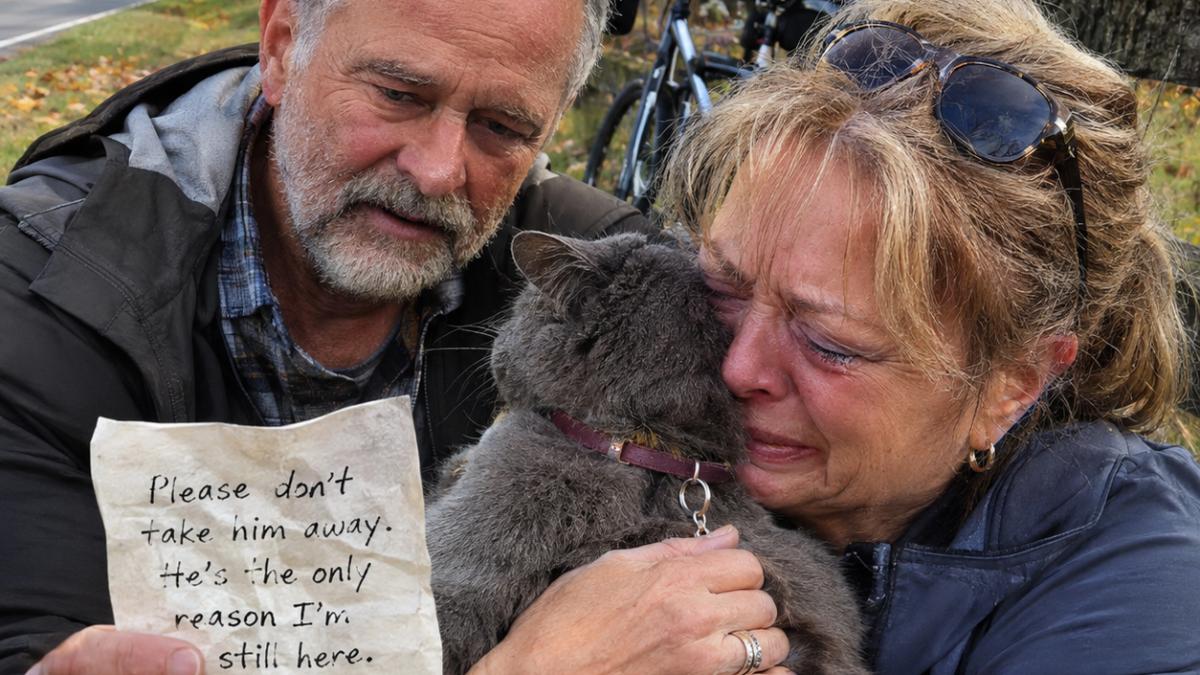
Our Cat Came Home After 367 Days—But the Note Around His Neck Made My Wife Beg Me Not to Take Him Back.
For 367 days, my wife searched every roadside, shelter, and neighborhood for the gray cat our daughter had given her before cancer took her life.
When Oliver finally came running back into our arms, I found a handwritten note tied to his collar that said, “Please don’t take him away. He’s the only reason I’m still here.”
We thought we were bringing home the last living piece of our daughter, but the frightened 74-year-old widow waiting at the address on that note was about to show us that grief can make strangers into family—and that love sometimes asks you to share what you thought belonged only to you.
The first sound I heard was a bell.
A tiny silver jingle beneath the rustle of maple leaves and the low hum of tires somewhere beyond the hill.
I had already passed the old wooden fence when Susan grabbed the back of my cycling jersey.
“Daniel.”
There was something in her voice that made me hit the brakes.
I turned my bike sideways across the narrow shoulder.
“What?”
She didn’t answer.
She was staring across the road.
A gray cat sat beneath the fence, half hidden by tall grass.
For one second, I felt nothing.
That may sound strange.
After spending nearly a year looking for the same animal, you would think hope would come immediately.
It didn’t.
Hope had tricked us too many times.
For 367 days, every gray cat had become Oliver for approximately three seconds.
A cat behind the grocery store.
Oliver.
A cat crossing the church parking lot.
Oliver.
A cat under a neighbor’s porch.
Oliver.
A photograph posted by an animal shelter forty miles away.
Oliver.
Every time, Susan’s face would brighten.
Every time, I would drive, knock on doors, call numbers, crawl beneath decks, or stand in shelter corridors with my heart pounding.
And every time, I would watch that light disappear from her face.
So when I saw the cat near the fence that Sunday afternoon, my first instinct was to protect her.
“Susan,” I said quietly, “we’ve done this before.”
“I know.”
She put one foot on the pavement.
“Wait.”
The cat turned his head.
There was a small white patch beneath his chin.
My hands went cold.
Susan stopped breathing.
I saw his left ear.
A tiny notch near the tip.
PART2:
Years earlier, when Oliver was still a kitten, he had tried to attack one of Susan’s rosebushes and lost.
I knew that notch.
I knew that face.
I knew those eyes.
I dropped my bicycle.
“Oliver?”
The cat froze.
His ears lifted.
Susan whispered, “Oh my God.”
I took one step toward him.
“Oliver.”
His entire body changed.
He stood.
Then he ran.
Not cautiously.
Not hesitantly.
He came charging across the grass like he had been waiting a year to hear his name spoken in that exact voice.
“Oliver!”
I barely had time to kneel.
He leaped into my chest.
His claws caught my shirt.
His head struck my chin.
PART3:
And then he made a sound I will remember until the day I die.
It was somewhere between a meow and a cry.
Loud.
Broken.
Demanding.
Almost angry.
As though he had 367 days of questions and expected me to answer every one of them immediately.
I wrapped both arms around him.
“Oh, buddy.”
My voice cracked.
“Where the hell have you been?”
He shoved his forehead against my jaw.
I laughed.
Then I started crying.
I am sixty-two years old.
I worked thirty-eight years as an electrical contractor.
I raised a daughter.
I buried my parents.
I buried my daughter.
I had spent most of my life believing that a man ought to keep himself together when other people were falling apart.
Grief cured me of that foolishness.
So did joy.
I cried right there beside a Pennsylvania road with my helmet still on and my bicycle lying in the gravel.
Susan was worse.
She stumbled off her bike and nearly fell.
“Oliver?”
The cat turned at the sound of her voice.
His purr started before she reached him.
I felt it against my chest.
Deep and rough.
Susan dropped to her knees.
She touched his face with both hands.
Then she pressed her forehead against his.
“My baby.”
Oliver licked the end of her nose.
She made a sound that was half laughter and half sob.
“Oh, my sweet baby. Where were you? Where have you been?”
I watched my wife hold him.
For the first time in almost a year, something in her face relaxed.
I had forgotten what she looked like without that permanent tension behind her eyes.
Then she whispered the name that lived inside every room of our house.
“Emily would be so happy.”
I looked away.
Even after three years, our daughter’s name could still knock the air out of me.
Emily had been twenty-nine when she died.
Twenty-nine years old.
There are ages that should never be written on gravestones.
Twenty-nine is one of them.
She had inherited Susan’s dark hair, my stubbornness, and a sense of humor that could turn a funeral home silent if she felt people were becoming too serious.
She was a pediatric physical therapist.
She loved terrible coffee.
She hated folding laundry.
She once drove two hours during a snowstorm because a shelter had posted about an elderly dog that had not been adopted.
And on Susan’s fifty-sixth birthday, she arrived at our house carrying a cardboard pet carrier with a blue ribbon tied around it.
Susan took one look at the carrier and said, “Emily.”
“What?”
“We agreed. No surprise animals.”
“We agreed you wouldn’t buy yourself an animal.”
“That is not the same thing.”
“It’s legally distinct.”
I had been standing at the kitchen counter.
“I’m allergic to cats.”
Emily looked at me.
“You sneezed once at Aunt Carol’s house in 1998.”
“I remember.”
“You were standing beside a dusty curtain.”
“It was the cat.”
“The cat was outside.”
“Could’ve been an aggressive allergy.”
Emily rolled her eyes and opened the carrier.
A tiny gray kitten marched out as though he owned the mortgage.
He walked directly to me.
Climbed onto my shoe.
Looked up.
And sneezed.
Emily laughed so hard she had to hold the counter.
“He’s allergic to you.”
I lasted two days.
By the end of the week, I had purchased a heated cat bed.
By Christmas, Oliver slept on my stomach every afternoon.
Emily took a picture of it.
She framed it and wrote underneath:
THE MAN WHO DIDN’T WANT A CAT.
That frame still sat on our mantel.
After Emily was diagnosed, Oliver seemed to understand before we did that something was wrong.
Whenever she visited, he stayed near her.
During the final months, when she was too weak to play with him, he would curl beside her on the couch and rest one paw against her leg.
After she died, he became Susan’s shadow.
My wife stopped sleeping properly.
Stopped gardening.
Stopped going to lunch with friends.
For several weeks, there were days she did not change out of her pajamas.
People brought casseroles.
People mailed sympathy cards.
People said things like, “She’s in a better place,” and “Time will heal.”
Oliver never said anything stupid.
He simply stayed.
He followed Susan into every room.
If she cried, he sat beside her.
If she woke at three in the morning, he was there.
If she stood in Emily’s old bedroom holding a sweater against her face, Oliver would rub himself around her ankles until she moved again.
Then, one rainy Tuesday morning, I came home from the grocery store carrying too many bags at once.
I left the front door partly open for perhaps twenty seconds.
That was all it took.
Oliver disappeared.
We searched that afternoon.
Then that night.
Then the next morning.
We printed posters.
We contacted shelters.
We posted photographs online.
We knocked on doors.
I walked miles through woods and drainage ditches calling his name.
Susan left his blanket on the porch.
She placed a bowl of food near the back steps.
Every night for months, she turned on the porch light.
“Just in case.”
At first, neighbors called frequently.
Then less often.
Then not at all.
The posters faded.
Some blew down.
Winter came.
One evening in February, I quietly picked up Oliver’s empty food bowls.
Susan saw me.
“What are you doing?”
I stopped.
“They’ve been sitting here for months.”
“Put them back.”
“Susan.”
“Put them back.”
Her voice wasn’t angry.
That made it worse.
I set them down.
Eventually we moved them into a cupboard, but she never let me throw them away.
Losing Oliver was not like losing Emily.
Nothing could ever be like that.
But somehow, it felt connected to her.
As though the universe had taken another small piece of our daughter and carried it away.
And now, 367 days later, Oliver was purring in Susan’s arms.
I reached under his chin.
That was when my fingers touched leather.
I frowned.
“He’s wearing a collar.”
Susan looked down.
Oliver had disappeared without one.
This collar was brown, worn around the edges.
A small brass bell hung from it.
Attached to the buckle was a clear plastic sleeve containing a folded piece of paper.
“What’s that?” Susan asked.
“I don’t know.”
I slid the paper out carefully.
The handwriting was shaky.
I unfolded it.
There were only two sentences on the front.
Please don’t take him away.
He’s the only reason I’m still here.
I read them twice.
Susan noticed my expression.
“What does it say?”
I hesitated.
Then handed her the note.
Her eyes moved across the words.
Her smile vanished.
She looked at Oliver.
Then at me.
“Oh.”
She turned the paper over.
There was an address.
Below it was a name.
Margaret Ellis.
Underneath, in smaller handwriting:
Please tell me he’s safe.
Susan held the note against her chest.
“We have to go there.”
I looked at Oliver.
“He just came back.”
“I know.”
“What if whoever this is tries to keep him?”
Susan’s face tightened.
“Daniel.”
“I’m serious.”
“I know what you’re saying.”
“We spent a year looking for him.”
“And apparently someone spent a year loving him.”
That sentence irritated me more than it should have.
“He’s our cat.”
Susan stared at me.
“I know.”
There was a long silence.
Then she said quietly, “That doesn’t mean we get to ignore this.”
She touched the note.
“Someone wrote that he’s the only reason she’s still here.”
I exhaled.
Susan was right.
She usually was when my fear dressed itself up as logic.
“We’ll take him home first.”
She nodded.
“We’ll take him home.”
The ride back was slow.
Susan tucked Oliver inside the front of her cycling jacket.
His gray head poked out beneath her chin.
Every few minutes she looked down at him.
“You’re real.”
Oliver blinked.
She laughed.
When we reached our house, I opened the front door.
Oliver paused on the threshold.
He sniffed.
Then walked inside.
For perhaps five seconds, he stood perfectly still.
Then he went straight to the kitchen.
Straight to the cupboard.
Straight to the exact spot where his food bowls used to be.
Susan covered her mouth.
“He remembers.”
I opened the cupboard.
The blue bowl was still there.
Emily had bought it.
Across the side, in white letters, it said:
OLIVER’S DINER.
I set it on the floor.
He meowed.
“Bossy already,” I said.
Susan laughed for the first time in weeks.
I filled the bowl.
Oliver ate as though he had never left.
Afterward, he inspected every room.
The couch.
The bedroom.
My office.
Emily’s room.
When he reached her doorway, he stopped.
Susan stood behind me.
Neither of us spoke.
Oliver walked inside.
He jumped onto the bed.
He sniffed the quilt.
Then curled himself in the same place he used to sleep whenever Emily stayed overnight.
Susan sank onto the edge of the mattress.
Her face crumpled.
“Oh, Emily.”
I sat beside her.
Oliver climbed into her lap.
She looked at me through tears.
“We found him.”
I put my arm around her.
“Yeah.”
Then her eyes fell toward the note in her hand.
“But somebody else is losing him.”
That evening we found the address on a map.
It was only five miles from where we had seen Oliver.
A small road outside town.
We agreed to go the next morning.
Neither of us slept much.
Oliver slept between us.
At three in the morning, I woke and found Susan watching him.
“You okay?” I whispered.
She nodded.
Then after a moment, she said, “I’m scared.”
“Of what?”
“What if she loves him like I do?”
I did not know how to answer.
The next morning, we drove to Margaret Ellis’s house.
It stood near the end of a narrow road surrounded by trees.
The house had probably been beautiful once.
White siding.
Green shutters.
A deep front porch.
But now the paint was peeling.
The lawn was high.
Weeds had taken over the flower beds.
One shutter hung slightly crooked.
A pair of gardening gloves sat beside the front steps as if someone had removed them months earlier and never returned.
Susan held Oliver in her arms.
“You ready?”
“No.”
“Me neither.”
We walked up the porch.
I knocked.
Nothing.
I knocked again.
A moment later, we heard slow footsteps.
The door opened.
An elderly woman stood there.
She was small.
Thin.
Her white hair was pulled loosely behind her head.
She wore a blue cardigan over a faded blouse.
Her face looked tired in the particular way grief makes people tired.
Not sleepy.
Worn through.
She looked at me first.
Then at Susan.
Then at Oliver.
Her hand flew to her mouth.
“Angel?”
Oliver twisted in Susan’s arms.
He meowed.
The woman’s eyes filled instantly.
“Oh.”
She opened the door wider.
“Oh, there you are.”
Oliver struggled free.
Susan barely had time to lower him before he ran toward the woman.
She bent slowly, gripping the doorframe.
Oliver rubbed against both her legs.
She touched his back.
“Where have you been, sweetheart?”
Her voice shook.
She knelt as far as her knees allowed.
Oliver pressed his head into her hand.
The woman closed her eyes.
Then she looked up at us.
Her expression changed.
Fear entered it.
“You found my note.”
Susan nodded.
The woman rose slowly.
“You’re his family.”
It wasn’t a question.
“Yes,” I said.
She looked at Oliver again.
“I knew this day would come.”
Susan stepped forward.
“You’re Margaret?”
“Yes.”
“I’m Susan. This is my husband, Daniel.”
Margaret nodded.
She looked embarrassed.
“I’m sorry.”
“For what?” Susan asked.
“For keeping him.”
The sentence came out so softly I almost missed it.
“I should have found you.”
“We lost him a year ago,” I said.
Margaret lowered her eyes.
“I tried.”
Something in me tightened.
“How?”
Susan glanced at me.
I knew that look.
Careful.
Margaret gestured inside.
“Would you come in?”
We followed her.
The house smelled faintly of coffee and old wood.
There were photographs everywhere.
A younger Margaret standing beside a tall man in a military uniform.
The same man holding a fishing pole.
The two of them at Niagara Falls.
Wedding pictures.
Christmas pictures.
Anniversary pictures.
But no children.
Oliver walked through the living room like he knew every inch of it.
He jumped into an old brown recliner.
Margaret smiled sadly.
“That was Henry’s chair.”
“Your husband?” Susan asked.
Margaret nodded.
“He died two years ago.”
“I’m sorry.”
“Thank you.”
She led us into the kitchen.
Three mugs sat upside down beside the sink.
Margaret put on coffee.
Her hands shook slightly.
“Angel showed up last spring.”
Susan smiled faintly.
“You named him Angel?”
Margaret looked toward Oliver.
“I did.”
“Why?”
Margaret swallowed.
“Because he arrived on a night I’m not very proud of.”
The room changed.
I could feel it.
Susan pulled out a chair.
“What happened?”
Margaret stood with her back to us for a moment.
Then she turned.
“Henry and I were married forty-eight years.”
She sat across from us.
“He was the kind of man who fixed things before you even knew they were broken.”
Her eyes moved to the window.
“When he died, people came around for a while. Our church ladies brought food. Neighbors checked on me. My nephew called every Sunday.”
She gave a tired smile.
“Then everybody went back to living.”
Susan said nothing.
She understood that sentence.
Margaret rubbed her thumb across the edge of her mug.
“The house became very quiet.”
She glanced toward the living room.
“I started leaving the television on even when I wasn’t watching it.”
Oliver jumped down and came into the kitchen.
Margaret smiled.
“There he is.”
He rubbed against her ankle.
She reached down.
“The night he came, there was a thunderstorm.”
I remembered it.
One of the worst storms of that spring.
“I was sitting upstairs,” she continued. “I had been looking through Henry’s things.”
Her voice grew quieter.
“I found a box of cards he had written me over the years.”
She stopped.
Susan touched the table.
Margaret took a breath.
“I decided I was tired.”
I felt Susan stiffen.
Margaret looked ashamed.
“Not sleepy.”
“You don’t have to explain,” Susan said gently.
“Yes, I do.”
Margaret stared at her hands.
“Because that note probably frightened you.”
It had.
She continued.
“I had some medication upstairs. Pain pills from a surgery. I remember putting the bottle on the nightstand.”
Susan’s eyes filled.
“And then?”
“I heard scratching.”
Margaret laughed once, weakly.
“Of all things.”
She pointed toward the back of the house.
“Scratch, scratch, scratch beneath the porch.”
She went outside.
There, soaked by rain and mud, was Oliver.
“He looked terrible.”
“He hates thunderstorms,” I said.
“I learned that.”
For the first time, Margaret smiled warmly.
“He bit me when I tried to pick him up.”
“That sounds like him.”
“I wrapped him in Henry’s old fishing jacket.”
She looked at Susan.
“He stopped shaking.”
Margaret fed him.
Dried him.
Tried to put him outside the next morning.
Oliver refused to leave.
“He followed me around the kitchen. Then he slept on Henry’s chair.”
She looked down.
“And the pills stayed upstairs.”
Nobody spoke.
I heard the refrigerator humming.
A clock ticked over the sink.
Susan whispered, “He did that for me too.”
Margaret looked up.
“What?”
“When our daughter died.”
Margaret’s expression changed.
Susan took a photograph from her wallet.
Emily.
Smiling beneath a red umbrella.
“Our daughter gave us Oliver.”
Margaret took the photograph with both hands.
“She’s beautiful.”
“She was twenty-nine.”
Margaret’s face softened.
“Oh, Susan.”
“She had cancer.”
“I’m so sorry.”
Susan nodded.
“For months after she died, Oliver followed me everywhere.”
Her voice trembled.
“I didn’t want to get out of bed sometimes.”
Margaret reached across the table.
She didn’t touch Susan.
Not yet.
She simply left her hand there.
Near enough.
Susan looked at it.
Then placed her hand over Margaret’s.
Two women.
Two kinds of grief.
One gray cat circling their chairs.
Margaret told us she had tried to find Oliver’s owners.
She called the county animal shelter.
She posted something on a neighborhood bulletin board.
She asked three neighbors.
She even took him to a small veterinary clinic several miles away.
“They scanned him,” she said.
I sat forward.
“For a microchip?”
“Yes.”
“He has one.”
Margaret looked surprised.
“They said they didn’t find anything.”
I frowned.
Oliver had been chipped as a kitten.
I still had the paperwork.
Susan looked at me.
“Maybe it migrated?”
“Maybe.”
Something bothered me.
But there was no reason yet to suspect anything more.
Margaret continued.
“After a few weeks, I told myself maybe someone had abandoned him.”
Her eyes filled.
“I know that was selfish.”
Susan shook her head.
“No.”
“It was.”
“You tried.”
“Not enough.”
Margaret looked toward Oliver.
“I should have put posters up farther away. I should have done more.”
She wiped her cheek.
“But every day that passed, I wanted less and less to find whoever had lost him.”
There it was.
Not cruelty.
Not theft.
Just loneliness.
The ugly honesty of wanting to keep the thing that had saved you.
Margaret looked at us.
“That’s why I wrote the note.”
“Why put it on him now?” I asked.
She hesitated.
“I have to move.”
“Where?”
“There’s a senior apartment building in town.”
She gestured around the kitchen.
“This place is too much for me.”
I looked at the neglected yard.
The peeling paint.
The loose cabinet handle near the sink.
“I fell last winter,” she said. “Nothing terrible. But my doctor thinks I shouldn’t be alone in a house this size.”
Susan asked, “Does the apartment allow pets?”
“I didn’t know.”
Margaret looked embarrassed again.
“My nephew arranged most of it.”
“Your nephew?”
“Robert.”
Something about the way she said his name made me notice it.
She glanced toward the hallway.
“He’s been helping me.”
“Does he live nearby?”
“About an hour away.”
She rubbed her hands together.
“He wants me to sell the house.”
“That makes sense if you’re moving,” I said.
Margaret didn’t answer immediately.
Then she looked at Oliver.
“Robert doesn’t like Angel.”
Oliver’s ears twitched at his name.
Susan frowned.
“Why not?”
“He says animals are a complication.”
That phrase did not sound like Margaret.
It sounded repeated.
I filed it away.
She continued.
“When Robert told me the apartment might not allow animals, I panicked.”
“So you put the note on his collar.”
“Yes.”
“I thought if he wandered off, or if something happened during the move, whoever found him would know he mattered to someone.”
Susan squeezed her hand.
“He matters to us too.”
Margaret closed her eyes.
“I know.”
Then she surprised us.
She stood.
Walked into the living room.
Lifted Oliver from Henry’s recliner.
And brought him back.
She placed him in Susan’s arms.
“He belongs with you.”
Susan began crying.
Margaret did too.
Oliver looked annoyed by everyone.
Susan held him.
“Margaret—”
“No.”
“You love him.”
“Yes.”
“So do we.”
“I know.”
Margaret touched Oliver’s head.
“But your daughter gave him to you.”
She looked at Emily’s photograph.
“I had him when I needed him.”
Her lower lip trembled.
“Maybe that’s enough.”
Susan looked at me.
I knew that expression.
It was the same look she had given me thirty-five years earlier when we found a stray dog freezing outside a gas station.
I sighed internally.
My wife had already made a decision.
“Margaret,” Susan said, “what if it doesn’t have to be enough?”
Margaret blinked.
“What do you mean?”
“What if you don’t have to lose him?”
I turned toward Susan.
She continued.
“We live fifteen minutes away.”
Margaret stared.
“What if we bring him to see you?”
“You would do that?”
“Of course.”
“Why?”
Susan smiled through her tears.
“Because I know what it feels like to have him keep you alive.”
Margaret covered her mouth.
Susan continued.
“Maybe Sundays.”
“Every Sunday?”
“As often as we can.”
Margaret looked at me.
I smiled.
“I’ve learned not to argue with her when she has that face.”
Susan elbowed me.
Margaret laughed.
It was a small laugh.
Rusty from lack of use.
But real.
We spent another hour there.
Before leaving, Susan hugged Margaret.
Not politely.
Not like strangers.
She held her.
Margaret stiffened for perhaps half a second.
Then hugged her back.
As we walked to our car, Susan wiped her eyes.
“She needs someone.”
“We barely know her.”
“That’s how knowing someone starts.”
I opened the passenger door.
Oliver jumped inside.
“He definitely learned that philosophy from you.”
The following Sunday, we returned.
Susan brought apple pie.
Margaret had made coffee.
Oliver acted as though he owned both houses.
He spent twenty minutes in Margaret’s lap, then wandered toward me and demanded to be scratched.
The week after that, Margaret called.
Not because of Oliver.
Because a pipe beneath her kitchen sink was leaking.
I fixed it.
Then her porch railing came loose.
I repaired that too.
Susan helped her sort clothes for the move.
Within a month, Sunday visits became Wednesday phone calls and occasional weekday dinners.
Something changed in our house too.
Susan started baking again.
She pulled weeds in the garden.
She told stories about Emily without always crying at the end.
Margaret told us about Henry.
He had served in Vietnam.
Worked thirty-two years for the postal service.
Could repair almost anything except plumbing.
Loved baseball.
Hated broccoli.
Could not dance.
Apparently, after four glasses of champagne at their twenty-fifth anniversary party, he had attempted to prove otherwise.
Margaret kept photographs.
Hundreds of them.
One afternoon, while Susan helped her pack, I found a small wooden box in the closet.
“Daniel?”
Margaret appeared behind me.
“Should I put this with the things you’re keeping?”
She saw the box.
Her face changed.
“I haven’t opened that in years.”
She sat on the bed.
Inside were letters from Henry.
Birthday cards.
Anniversary notes.
A dried flower.
At the bottom was a small silver key.
“What’s that?” I asked.
She took it.
Then smiled faintly.
“Henry’s desk.”
There was an old rolltop desk downstairs.
“He kept paperwork in there.”
“Important paperwork?”
“I suppose.”
She frowned.
“Robert has been asking about deeds and insurance documents.”
“Your nephew?”
“Yes.”
“He says the house needs to be listed quickly.”
I did not like the uneasiness in her voice.
“Do you want to sell?”
Margaret looked around the bedroom.
“I need to.”
“That isn’t what I asked.”
She studied me.
“No.”
“Then don’t yet.”
“Daniel.”
“I’m not saying stay here forever. I’m saying moving because you want something easier and being rushed because somebody else wants your house sold are two different things.”
She looked down at the key.
“Robert says prices might fall.”
“Robert sell real estate?”
“No.”
“What does he do?”
“Investment consulting.”
Of course he did.
That evening, Robert arrived.
It was the first time we met him.
He drove a black Mercedes.
He wore a navy jacket, polished shoes, and the impatient expression of a man arriving at a meeting he believed should already be over.
He walked into the living room and stopped when he saw Susan.
Then me.
Then Oliver.
His expression hardened.
“Aunt Margaret.”
“Hello, Robert.”
“I didn’t know you had company.”
Margaret smiled.
“These are Susan and Daniel.”
“I gathered.”
He looked at Oliver.
“And that cat is back.”
Susan’s face cooled.
“His name is Oliver.”
Robert glanced at her.
“My aunt calls him Angel.”
“Both are true.”
Robert gave a thin smile.
“I see.”
I disliked him immediately.
That is not evidence of wrongdoing.
But sometimes a man’s handshake tells you plenty.
Robert’s said he had already decided how much respect you deserved before touching your hand.
Very little, in my case.
He turned to Margaret.
“Did you sign the listing agreement?”
“No.”
His jaw tightened.
“Aunt Margaret.”
“I told you I wanted more time.”
“We’ve discussed this.”
“I know.”
“The apartment is ready.”
“I know.”
“You can’t maintain this property.”
“I know.”
“You fell.”
Margaret shrank slightly.
I saw it.
Susan did too.
Robert took a folder from his briefcase.
“The market is strong right now. Delaying is financially irresponsible.”
Margaret looked at the folder.
“I’m tired tonight.”
“This takes five minutes.”
“Robert.”
He exhaled through his nose.
Then noticed the wooden box on the table.
“What’s that?”
“Henry’s papers.”
Robert walked toward it.
Margaret’s hand moved over the lid.
“I haven’t sorted them yet.”
“I can do it.”
“No.”
Robert stopped.
Margaret looked surprised by her own answer.
So did he.
“I’ll do it myself.”
A long pause.
Then Robert smiled.
“Of course.”
But the smile never reached his eyes.
That was the first time I became suspicious.
The second came a week later.
Margaret called me on Thursday morning.
Her voice shook.
“Daniel?”
“What’s wrong?”
“Robert was here.”
I stood from my desk.
“Are you okay?”
“I think so.”
“What happened?”
“He was angry.”
“About what?”
“The house.”
I grabbed my keys.
“I’m coming over.”
When I arrived, Susan was already there.
Margaret sat at the kitchen table holding a cup she wasn’t drinking from.
Oliver was beneath her chair.
Susan looked furious.
“What happened?”
Margaret swallowed.
“Robert brought a man from a real estate company.”
“Without asking you?”
“He said they needed photographs.”
“Did you let them in?”
“I told them no.”
I sat down.
“What did Robert do?”
“He shouted.”
Susan’s lips tightened.
Margaret continued.
“He said I was becoming confused.”
The sentence made her voice crack.
“He said maybe I wasn’t capable of managing my affairs anymore.”
I felt something ugly rise in my chest.
“He threatened you with incompetency?”
“I don’t know.”
“He said if I refused to make reasonable decisions, the family might need to intervene.”
“What family?” Susan snapped.
Margaret looked at her.
“Robert is the only relative I speak to regularly.”
I asked, “Do you have other relatives?”
“A younger sister in Arizona. We haven’t been close for years. A few cousins.”
“Any children?”
“No.”
Susan took Margaret’s hand.
“You’re not confused.”
Margaret gave a humorless laugh.
“Some days I forget why I walked into a room.”
“So does Daniel.”
“Constantly,” I said.
That got a small smile.
I leaned forward.
“Margaret, did you ever sign Robert as power of attorney?”
She became still.
“I think so.”
“When?”
“After Henry died.”
“Do you have a copy?”
“He does.”
My stomach tightened.
“What exactly did you sign?”
“I don’t remember.”
Susan looked at me.
That was the problem.
Not dementia.
Not incapacity.
Trust.
Grieving people sign things.
Lonely people trust family.
Margaret whispered, “He said it would help with bills.”
I asked, “Has he handled your finances?”
“Yes.”
“For how long?”
“Almost two years.”
“Do you see your bank statements?”
She hesitated.
“Sometimes.”
“Margaret.”
“I don’t like dealing with money.”
That sentence explained more than she realized.
The next day, we took her to her bank.
Not to accuse Robert.
Not yet.
Just to understand.
Margaret requested recent statements.
The manager printed them.
We sat in a small office.
I started reading.
At first, everything looked normal.
Utilities.
Groceries.
Insurance.
Then I found a transfer.
$4,800.
Then another.
$7,200.
Then $3,500.
All within eight months.
“Margaret, what are these?”
She leaned closer.
“I don’t know.”
The manager looked uncomfortable.
“Those were authorized electronic transfers.”
“To whom?”
She clicked something.
“I’m not permitted to disclose certain account-holder information to third parties, but Mrs. Ellis can request the documentation.”
Margaret did.
The destination account belonged to a company.
RME Consulting LLC.
I stared at the initials.
Robert Michael Ellis.
Susan whispered, “Oh my God.”
Margaret’s face went white.
“No.”
“Margaret.”
“No, Robert wouldn’t.”
There were more.
By the time we finished reviewing eighteen months of statements, the transfers totaled nearly $46,000.
Margaret started shaking.
“He told me investments had gone down.”
Susan put both arms around her.
I asked the manager, “Can these transfers be disputed?”
“Some may be outside normal dispute windows. But if financial exploitation is suspected, we can flag the account and begin a review.”
Margaret looked at me.
“He took my money?”
“I don’t know yet.”
She closed her eyes.
“He’s Henry’s sister’s boy.”
As if blood made betrayal impossible.
Unfortunately, blood sometimes makes betrayal easier.
Because it gets the door opened.
We contacted an attorney.
Her name was Rachel Morgan.
She specialized in elder law.
She listened without interrupting.
Then she asked Margaret to describe everything.
The power of attorney.
The transfers.
The pressure to sell.
The threat that Margaret might be declared incapable.
When Margaret finished, Rachel folded her hands.
“Mrs. Ellis, I want to be very clear about something.”
Margaret looked terrified.
“You have rights.”
“I know.”
“I don’t think you do.”
Rachel’s voice was kind but firm.
“No relative gets to sell your home because it’s convenient for them. No power of attorney gives someone permission to steal from you. And nobody gets to use your grief or age as evidence that you are incapable.”
Margaret began crying silently.
Rachel handed her a tissue.
“We’ll start by revoking any existing power of attorney.”
“Can we?”
“It belongs to you. Of course we can.”
The relief on Margaret’s face was almost painful to watch.
We filed the revocation.
Rachel notified the bank.
She requested records.
Then we waited.
Robert did not.
Two days later, he showed up at Margaret’s house.
I happened to be replacing a broken porch light.
His Mercedes stopped hard in the driveway.
He got out carrying papers.
“Where is she?”
I stepped off the ladder.
“Hello to you too.”
“This doesn’t concern you.”
“Then why are you talking to me?”
He walked toward the house.
I moved in front of the steps.
Robert stopped.
“Move.”
“No.”
His face reddened.
“I’m her family.”
“Then act like it.”
His eyes narrowed.
“You have no idea what’s happening here.”
“I know someone moved forty-six thousand dollars out of Margaret’s accounts.”
That stopped him.
Only for half a second.
But I saw it.
Then he recovered.
“Those were legitimate expenses.”
“For what?”
“That’s none of your business.”
“Margaret seems to think it is.”
The front door opened.
Susan stood beside Margaret.
Robert looked at his aunt.
“You revoked the power of attorney?”
Margaret’s hands shook.
“Yes.”
“You have no idea what you’ve done.”
“I think I do.”
“These people are manipulating you.”
Margaret flinched.
Susan said, “Robert, don’t.”
He pointed at her.
“You stay out of this.”
I stepped forward.
“Do not point at my wife.”
Robert laughed.
“What is this? You two find an elderly widow with property and suddenly become her best friends?”
Susan went pale.
That accusation hit exactly where he meant it to.
Robert saw it.
So he pushed harder.
“You think I don’t understand?”
Margaret whispered, “Stop.”
“A cat wanders between two houses, and suddenly you’re involved in her banking, her property, her estate?”
“Robert.”
“You think I’m the problem?”
Margaret stood straighter.
“Stop.”
He looked at her.
She was trembling badly now.
But her voice was stronger.
“These people sat with me when I was lonely.”
Robert opened his mouth.
She continued.
“They repaired my house.”
“They want something.”
“They never asked for anything.”
“Not yet.”
“You did.”
Silence.
Robert’s face changed.
Margaret looked directly at him.
“You asked me to sell.”
“For your own good.”
“You took money.”
“It was reimbursement.”
“For what?”
“I managed everything after Uncle Henry died.”
“You told me you were helping me.”
“I was.”
“Then why didn’t you tell me I owed you forty-six thousand dollars?”
Robert stared at her.
He had no answer.
Margaret’s eyes filled.
“You thought I was too old to notice.”
“That’s ridiculous.”
“Too sad.”
“Stop dramatizing.”
That was the wrong thing to say.
I watched Margaret’s grief become anger.
“You used Henry’s death to get control of my money.”
Robert scoffed.
“Listen to yourself.”
“I am.”
Margaret stepped onto the porch.
“For the first time in two years, I am listening to myself.”
Robert pointed toward Oliver.
“This is because of that stupid cat.”
Oliver was sitting beside Susan.
Margaret looked down at him.
Then back at Robert.
“No.”
Her voice softened.
“That cat just reminded me that I was still alive.”
Robert left.
Not quietly.
He threatened attorneys.
He threatened to prove Margaret incompetent.
He threatened to sue Susan and me for interference.
Three weeks later, the bank investigation found something worse.
The $46,000 was only what had come directly from Margaret’s checking and savings accounts.
Robert had also taken out a $72,000 home equity line of credit using the power of attorney.
Margaret knew nothing about it.
When Rachel showed us the paperwork, Margaret stared at the signature page.
“That isn’t my signature.”
Rachel nodded.
“It was executed under power of attorney.”
“Where did the money go?”
“Most of it was transferred into an investment account connected to Robert.”
Margaret stopped breathing normally.
Susan moved beside her.
“Margaret?”
She pushed the documents away.
“My house.”
Her voice was barely audible.
“Henry paid for this house.”
Rachel remained calm.
“The house is still yours.”
“He stole against my house.”
“We’re going to challenge it.”
Margaret stood suddenly.
“I need air.”
She walked outside.
Susan followed.
I stayed with Rachel.
“How bad is this?”
“If the evidence holds up, very.”
“Criminal?”
“Potentially.”
I looked through the window.
Margaret was standing on the porch.
Susan beside her.
Oliver sitting between their feet.
Rachel said, “Financial exploitation of older adults is more common than people realize.”
“I know.”
“No.”
She looked at me.
“Most people know it happens. They don’t understand what it looks like.”
I thought of Robert’s polished shoes.
His folder.
His confidence.
His insistence that everything was for Margaret’s own good.
Rachel continued.
“It usually doesn’t look like a stranger breaking into someone’s house.”
She closed the folder.
“It looks like trust.”
The police became involved.
Then the county’s adult protective services office.
Robert hired an attorney.
He claimed every transfer was authorized.
He claimed Margaret had agreed to compensate him for financial management.
He claimed the home equity loan was meant to fund repairs and future care.
He also claimed Susan and I had manipulated Margaret because we wanted access to her estate.
That accusation spread farther than I expected.
Margaret’s sister in Arizona called.
The conversation was ugly.
I heard only Margaret’s side.
“No, Claire.”
Pause.
“No.”
Longer pause.
“Because you haven’t been here.”
Then Margaret’s face tightened.
“I am not confused.”
She hung up.
Susan asked what happened.
Margaret stared at the phone.
“Robert told her you’re after my house.”
Susan looked crushed.
Margaret touched her hand.
“I know you’re not.”
But rumors have weight even when you know they are false.
I saw Susan pull back.
She stopped handling any of Margaret’s documents.
She stopped going with her to the bank.
One Sunday, she said, “Maybe we should visit less often.”
Margaret looked shocked.
“Why?”
“I don’t want to make this harder.”
“You’re making it easier.”
“But Robert—”
“Robert doesn’t get to choose my family.”
The word hung there.
Family.
Susan began crying.
Margaret did too.
Oliver sat on the floor and stared at both of them as though humans were ridiculous.
Margaret laughed through her tears.
Then she said something I have never forgotten.
“Blood tells you who you’re related to.”
She squeezed Susan’s hand.
“Love tells you who stays.”
Months passed.
The legal case grew.
Investigators found that Robert’s consulting company had serious debt.
He had made several bad investments.
He owed taxes.
He had been using Margaret’s money to keep his business alive.
The planned sale of her house was not about helping her move.
He needed the equity.
That was why he had been rushing her.
That was why he wanted signatures.
That was why he had threatened to challenge her competence.
He was running out of time.
Then Rachel found something else.
Something that brought Oliver’s disappearance back into the story.
I was sitting in her office when she placed a veterinary receipt on the desk.
“Recognize this clinic?”
I looked.
Hillside Veterinary Center.
“That’s where Margaret said she took Oliver.”
“Correct.”
“And they didn’t find his chip.”
Rachel nodded.
“But they did.”
I stared at her.
“What?”
She slid over a copy of the clinic record.
Animal: male gray domestic shorthair.
Microchip detected.
Registration information requested.
Owner contact attempted.
My name was printed beneath it.
Daniel Foster.
My phone number.
My address.
I stood.
“No.”
Rachel pointed to the next line.
A handwritten notation.
Owner’s relative declined transfer, claimed animal abandoned.
I read it again.
“Owner’s relative?”
Rachel opened another sheet.
“The clinic receptionist remembers the visit.”
My pulse accelerated.
“Margaret took Oliver there.”
“Yes.”
“Was Robert with her?”
Rachel nodded.
I felt sick.
According to the receptionist, Margaret had brought Oliver to the clinic about two weeks after finding him.
Robert happened to be visiting.
He drove her.
The clinic found the chip.
They attempted to call the number on file.
My old cell number.
The one I had changed after Emily died because I kept receiving automated hospital billing calls on it.
But the chip registration also had our home address.
The clinic offered to contact us by mail.
Robert intervened.
“He told them Oliver had been abandoned?” I asked.
“He told them you were relatives who had moved and surrendered the animal informally.”
“Why?”
Rachel looked at me.
“We don’t know.”
I did.
Not completely.
But enough.
Oliver had given Margaret a reason to live.
A living Margaret was useful to Robert.
At least until she signed what he needed.
And a lonely Margaret was easier to control than one surrounded by people.
If returning Oliver meant losing the one thing that stabilized her, Robert had apparently decided not to return him.
But there was more.
Rachel continued.
“Margaret also told investigators that after the clinic visit, Robert discouraged her from putting up posters.”
My hands clenched.
“He knew.”
“It appears so.”
“He knew we were looking for him.”
“He had enough information to find you.”
I sat.
For almost a year, Susan had searched.
Cried.
Blamed herself.
Every night she left that porch light on.
Every time we drove past shelters.
Every time she asked me, “Do you think he’s alive?”
And Robert could have answered that question.
He knew.
I wanted to drive straight to his house.
Rachel must have seen it in my face.
“Don’t.”
“I didn’t say anything.”
“You didn’t have to.”
I stood by the window.
“That son of a—”
“Daniel.”
“He watched Margaret love our cat knowing exactly who we were.”
“Yes.”
“He let Susan suffer.”
“Yes.”
“Why?”
“Because people who exploit others eventually begin treating everyone as pieces on a board.”
I turned.
Rachel continued.
“Oliver made Margaret calmer. Less isolated physically, but emotionally dependent on the home. Robert may have thought that benefited his access to her.”
I felt my stomach twist.
“A cat.”
“Control doesn’t need to be logical.”
Susan took the news worse than I did.
She sat in our kitchen with the veterinary record in her hands.
“He knew?”
“Yes.”
“All that time?”
“Yes.”
She stared at Oliver.
“He knew where we lived?”
“Yes.”
Susan put the papers down.
Then she walked outside.
I followed.
She stood in the garden.
The same garden she had abandoned after Emily died.
For a while, she said nothing.
Then she turned toward me.
“I hated myself.”
“What?”
“When Oliver disappeared.”
“Susan.”
“I left the bedroom window open that week. I kept thinking maybe he had tried to come home and I didn’t hear him.”
“That isn’t—”
“I thought Emily would be angry at me.”
My heart broke.
“She wouldn’t.”
“I know that logically.”
She pressed both hands against her chest.
“But grief isn’t logical.”
I walked toward her.
She began crying.
“For a year, I thought I lost the last thing she gave me.”
I held her.
Susan whispered, “And he knew.”
“Yes.”
Then something changed in her face.
She pulled away.
“Margaret cannot know yet.”
“She’ll find out.”
“I know.”
“She may hear it from investigators.”
“I want to tell her.”
So we did.
That evening, we sat with Margaret.
Oliver was asleep in Henry’s recliner.
Susan explained everything.
Margaret listened.
At first, she looked confused.
Then horrified.
“No.”
Susan touched her arm.
“Margaret.”
“No.”
“He knew the chip information.”
Margaret’s face collapsed.
“I asked him.”
“What?”
“I asked Robert if we should keep looking.”
She covered her mouth.
“He said if someone loved the cat, they would have chipped him.”
Susan looked at me.
Margaret began sobbing.
“I believed him.”
“This isn’t your fault,” Susan said.
“I kept your daughter’s cat.”
“You didn’t know.”
“I should have known.”
“You did exactly what I would have done.”
Margaret looked at her.
“How can you say that?”
“Because you loved him.”
Susan’s own tears began.
“And because while we were grieving, he was taking care of you.”
She reached for Margaret.
“I don’t hate you for that.”
Margaret leaned into her.
“I’m sorry.”
“I know.”
“I’m so sorry.”
Oliver woke.
He jumped down from the chair.
Walked toward them.
Then climbed onto the couch between the two women.
Margaret laughed through tears.
“Look at him.”
Susan scratched beneath his chin.
“He thinks this is about him.”
“It is about him.”
“No.”
Susan looked at Margaret.
“It’s about what people do when they think nobody is watching.”
The criminal case moved forward.
Robert was charged with financial exploitation, theft, forgery-related offenses, and other counts connected to misuse of the power of attorney.
His lawyer tried to paint Margaret as confused.
That strategy failed badly.
At a preliminary hearing, Margaret took the stand.
Robert sat across the courtroom.
For the first few questions, she looked nervous.
Then his attorney asked, “Mrs. Ellis, isn’t it true that during the year in question you were experiencing significant grief?”
“Yes.”
“And depression?”
“Yes.”
“And memory problems?”
“I forgot appointments sometimes.”
“So your memory was unreliable.”
Margaret paused.
Then she looked toward Robert.
“My memory was good enough to remember trusting him.”
The courtroom went quiet.
The lawyer shifted.
“Mrs. Ellis, you agreed your nephew would help manage your finances, correct?”
“Yes.”
“And you benefited from his assistance?”
“Yes.”
“So when he transferred funds—”
“I asked him to help pay my bills.”
Margaret’s voice grew stronger.
“I did not ask him to pay his.”
I almost smiled.
The prosecutor definitely did.
Robert eventually accepted a plea agreement after forensic accounting records showed exactly where Margaret’s money had gone.
He was ordered to pay restitution.
His consulting business collapsed.
The court entered protections around Margaret’s remaining assets.
He received a sentence that included incarceration followed by probation.
I won’t pretend the sentence erased what happened.
Justice is not a time machine.
It doesn’t return trust.
It doesn’t erase humiliation.
It doesn’t give Margaret back the nights she spent wondering whether she was foolish.
But consequences matter.
And so does being believed.
The day Robert was sentenced, Margaret wore a blue dress Susan helped her choose.
As we left the courthouse, reporters waited outside because the case had attracted local attention.
One called, “Mrs. Ellis, do you have anything to say to your nephew?”
Margaret stopped.
I expected Rachel to move her along.
Instead, Margaret turned.
She looked at the cameras.
Then said, “Yes.”
Everyone quieted.
“I hope he learns that helping someone does not mean owning them.”
She took Susan’s arm.
“And being old does not make you stupid.”
Then she walked away.
We drove directly to her apartment.
Yes, apartment.
She eventually sold the old house.
But on her terms.
Not Robert’s.
The buyer was a young couple expecting their first child.
They loved the porch.
They promised to restore the garden.
Margaret cried when she handed them the keys.
But this time, she wasn’t being pushed out.
She was choosing to leave.
Her new apartment was smaller.
Bright.
Second floor.
Elevator.
A little balcony overlooking maple trees.
And most importantly, it allowed pets.
That created a problem.
A beautiful one.
By then, Oliver had become used to living between two homes.
He slept at our house most nights.
But whenever we took him to Margaret’s apartment, he behaved as though we had brought him to his second kingdom.
He knew which cabinet held treats.
He slept in Henry’s old recliner, which we had moved there.
He sat in the window every afternoon.
Margaret joked that she had joint custody.
One Sunday, after everything with Robert was finished, we brought Oliver over.
Susan had made apple pie.
I carried coffee.
Margaret was waiting at the door.
“Angel!”
“Oliver,” I corrected automatically.
She smiled.
“Angel.”
“Oliver.”
Susan walked past us.
“You two have been doing this for six months.”
Margaret pointed at me.
“He started it.”
“I did not.”
Oliver walked between us without choosing a side.
Traitor.
We sat in the living room.
Susan cut pie.
Margaret told us she had joined a book club.
That was new.
She had also started helping organize lunches for residents who lived alone.
Even newer.
“You?” I teased. “Socializing?”
She glared at me.
“I can revoke your pie privileges.”
“Understood.”
Susan laughed.
I looked around the apartment.
Photographs of Henry filled one shelf.
On another was the picture Susan had given her.
Emily holding Oliver as a kitten.
Margaret had framed it.
Beside it was a newer photograph.
The three of us.
Susan.
Margaret.
Me.
Oliver in the middle.
It had been taken the previous Christmas.
For the first time since Emily died, Susan had insisted we decorate the entire house.
Not just a tree.
Lights.
Wreath.
Garland.
Everything.
Margaret spent Christmas Eve with us.
At dinner, she brought Henry’s old tradition into our family.
Everyone had to say one thing they were grateful for.
When it came to her, she looked at Oliver.
Then at us.
She said, “Second chances.”
Susan cried.
Naturally.
I pretended something was in my eye.
Naturally.
That Sunday in Margaret’s apartment, after the pie was gone, Susan and Margaret sat together on the couch.
Oliver was stretched between them.
His head rested against Susan.
His back paws touched Margaret.
Perfectly placed.
As if even in sleep he refused to choose.
Margaret stroked his fur.
“I used to think losing Henry was the end of my family.”
Susan looked at her.
Margaret continued.
“I thought family was something you were given once.”
Her hand found Susan’s.
“And when they were gone, that was it.”
Susan squeezed her fingers.
“I know.”
Margaret smiled.
“Then this little thief showed up under my porch.”
Oliver’s ear twitched.
“And he stole Henry’s chair.”
Susan laughed.
“He steals everything.”
“He stole my chicken once.”
“That sounds right.”
Margaret’s eyes filled.
“But then he brought you.”
Susan stopped smiling.
Margaret looked at her.
“I never imagined the worst year of someone else’s life would become the year I found another family.”
Susan leaned her head against Margaret’s shoulder.
Neither woman spoke for a while.
I sat across from them.
And suddenly I thought about Emily.
Not the hospital.
Not chemotherapy.
Not the final morning.
I thought about the first day she brought Oliver home.
Her standing in our kitchen.
Blue ribbon around the carrier.
That grin.
Dad’s allergic to admitting he’s wrong.
I could almost hear her.
For years after her death, I believed honoring Emily meant preserving everything she left behind.
Her room.
Her coffee mug.
Her photographs.
Her cat.
I thought love meant protecting what remained.
Keeping it safe.
Keeping it ours.
But Oliver taught me something I should have learned much earlier.
Love doesn’t survive by being locked inside a room.
It survives by moving.
From one person to another.
From one house to another.
From a grieving mother to a lonely widow.
From a daughter who died too young to strangers who never would have met without her.
Later that afternoon, I walked onto Margaret’s balcony.
Susan joined me.
Below us, children were playing near the parking lot.
“You okay?” she asked.
“Yeah.”
“You’re quiet.”
“I was thinking about Emily.”
She leaned against the railing.
“Me too.”
“Do you ever wonder if she somehow planned all this?”
Susan smiled.
“She was organized, but not that organized.”
I laughed.
Then she looked through the window at Margaret and Oliver.
“But she would like this.”
“Yeah.”
“She’d love Margaret.”
“Definitely.”
Susan rested her head against my shoulder.
“You know what the strange part is?”
“What?”
“The day Oliver disappeared, I thought we were being punished.”
I looked at her.
“For what?”
“For surviving.”
That hurt to hear.
Susan continued.
“I know that sounds terrible.”
“No.”
“I kept thinking we had already lost Emily. How much more were we supposed to lose?”
She wiped beneath one eye.
“But if Oliver had never disappeared…”
“We never would have met Margaret.”
She nodded.
“I wish there had been another way.”
“So do I.”
“I wish we hadn’t spent a year wondering.”
“So do I.”
She looked through the glass.
“But I don’t wish he hadn’t found her.”
Neither did I.
There are stories where every painful thing turns out to have happened for some perfect reason.
I don’t believe that.
I will never say Emily died for a reason.
She didn’t.
Cancer took my daughter, and nothing beautiful that came afterward makes that fair.
Robert’s betrayal was not necessary.
Susan’s suffering while Oliver was missing was not necessary.
Margaret’s loneliness was not necessary.
Pain does not become good simply because something good eventually grows beside it.
But I do believe we get choices after pain.
We can close the door.
Or open it.
We can let grief convince us the world has nothing left to give.
Or we can notice the scratching beneath the porch.
Sometimes what saves us arrives looking nothing like salvation.
Sometimes it


