My Cousin Mocked the Scar on My Neck at His Military Banquet—Then His Two-Star General Shoved Past Him, Saluted Me, and Said, “Captain… We Thought You Died in Fallujah.
PART3:
He sighed dramatically.
“Evan’s promotion recognition dinner.”
“I heard about it.”
“Fort Bellamy officers’ club.”
“There’ll be senior officers there.”
He emphasized senior officers as if I had never encountered one.
“Might be good for you.”
“For me?”
“You know.”
“See what real military achievement looks like.”
I stared at the cracked inspection seal on my desk.
“I’m happy Evan is being recognized.”
“He worked for it.”
“I’m sure he did.”
“You should wear something nice.”
“I usually manage clothes.”
He chuckled.
“I mean not one of those work jackets.”
“My company logo embarrasses you?”
“No.”
“No.”
“Just saying this is an Army event.”
I looked down at my notes.
One shipment number repeated where another should have been.
“Holloway Vehicle Solutions still supplying Fort Bellamy?”
There was a brief pause.
“Yes.”
“Some.”
“We’re helping sponsor reception.”
His voice brightened immediately.
“Business has really grown.”
“I heard.”
“You people finish that transportation review yet?”
I looked at the document in front of me.
“Which review?”
“Whatever Ridgeway’s doing with maintenance purchases.”
“We have several.”
“Well.”
“Anything involving our sector.”
“Active reviews aren’t family conversation.”
He laughed.
“Still serious about paperwork.”
“Yes.”
“Somebody has to be.”
He ended the call a minute later.
At the time, I thought his question was ordinary curiosity.
Later I would replay it repeatedly.
The invitation arrived two days later.
Cream envelope.
Embossed seal.
A handwritten note from Aunt Paula tucked inside.
Please come. Dean really wants the family together. And please don’t bring up anything unpleasant from your deployment. Tonight should be about Evan.
I read that sentence twice.
Then placed it on my kitchen counter.
Across the room, a photograph of Hannah Ruiz hung on my refrigerator.
Hannah had been my platoon sergeant during the deployment that changed everything.
She was laughing in the picture.
Mud on both legs.
Standing beside a field ambulance.
Hannah survived the war.
Then died four years later from an illness nobody could fight with armor or training.
Some evenings I still reached for my phone when something happened that she would have found funny.
That night I looked at Aunt Paula’s note and heard Hannah’s voice in my head.
Wear the dress.
The navy one.
Make them uncomfortable.
I did.
Simple navy dress.
Low black heels.
Silver earrings my father had given me before he died.
The neckline exposed most of the scar.
I considered changing.
Then didn’t.
Fort Bellamy’s officers’ club sat beneath enormous Georgia pines.
White columns.
Warm lights.
Round tables.
Fresh flowers.
Approximately forty officers and senior NCOs, plus spouses, civilians, family members, and local sponsors.
Near the entrance stood a sponsor board.
HOLLOWAY VEHICLE SOLUTIONS.
Blue-and-silver logo.
My uncle’s company.
My mother appeared before I reached the registration table.
Elaine Bell.
Seventy now.
Pale green jacket.
Pearls.
She kissed my cheek.
Then looked at the scar.
Then immediately away.
“You could’ve worn that blouse I bought you.”
“Hello to you too, Mom.”
“I’m only saying it was beautiful.”
“I like this.”
She smoothed invisible wrinkle near my sleeve.
“You look nice.”
Uncle Dean came up holding two drinks.
“Mara.”
He kissed my cheek too.
Smelled faintly of bourbon.
“Glad you made it.”
“I said I would.”
“Evan’s been making great impression.”
“Good.”
“He’s already talking with Colonel Keene’s people.”
“Good.”
Dean looked at my folder.
Ridgeway logo.
“You working tonight?”
“No.”
“Then why bring that?”
“Came straight from office.”
He nodded, but his eyes stayed on logo a second too long.
That was another detail that meant nothing until it meant everything.
Evan stood near center of room.
Dress uniform.
Broad shoulders.
Thirty-six years old.
Three younger soldiers laughing around him.
I approached.
“Congratulations.”
He turned.
His grin widened.
“Look who escaped the filing cabinet.”
The soldiers laughed uncertainly.
I smiled.
“Good to see you too.”
He looked at my folder.
Then the scar.
Then back to soldiers.
“You guys know Mara?”
They shook heads.
“My cousin.”
“She works with military paperwork.”
One soldier said:
“Oh, procurement?”
“Something like that.”
Evan put a hand on his chest theatrically.
“While we’re out actually training, she sits somewhere comfortable deciding if we checked the right boxes.”
Another laugh.
Not everyone joined this time.
I said:
“How’s your new assignment looking?”
“Busy.”
“Actual Army stuff.”
“Not spreadsheets.”
“Sounds terrifying.”
One soldier coughed to hide a smile.
Evan did not appreciate it.
I turned to leave.
He stepped sideways.
Blocked space between tables.
“You leaving already?”
“Going to sit down.”
“Can’t handle hearing about real deployments?”
I looked at him.
“Evan.”
“This evening is about you.”
“I’m trying to keep it that way.”
He glanced toward my collarbone.
Then lifted two fingers.
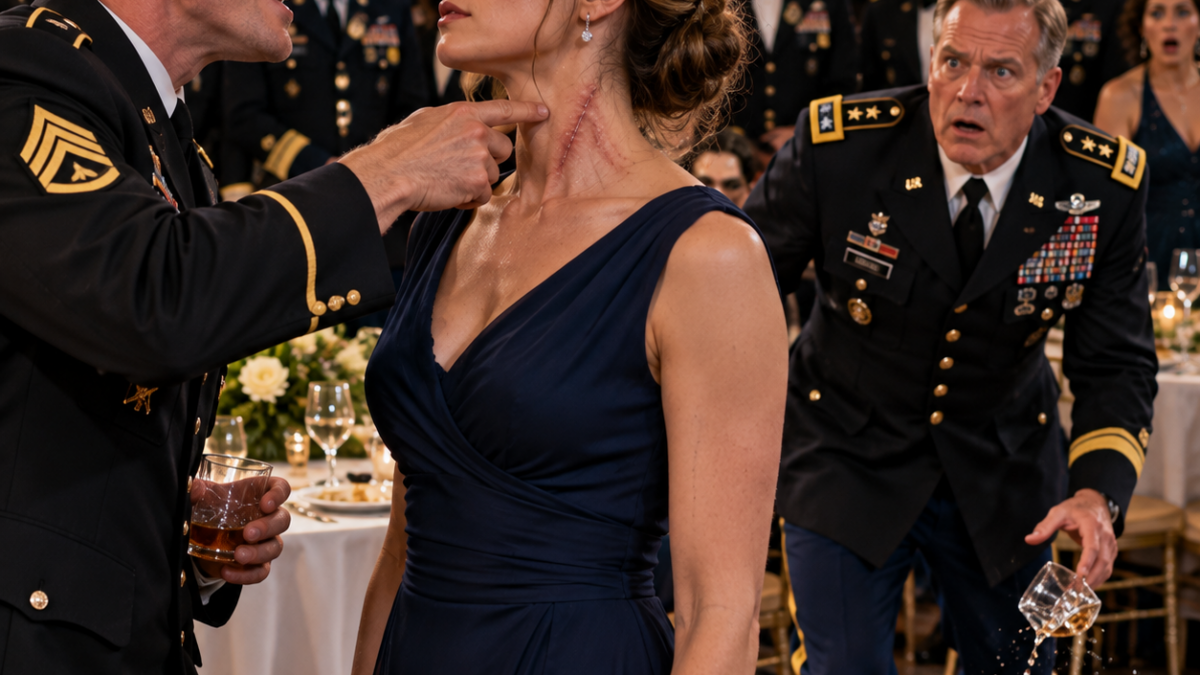
Before I realized what he intended, he touched the raised edge of the scar.
“What’s story behind this?”
His smile widened.
“Filing cabinet attack you?”
The soldiers went quiet.
“Or somebody drop a box of printer paper?”
His fingers were still near my skin.
I caught his wrist.
Not hard.
Enough.
Moved his hand away.
“Don’t touch me again.”
My voice was low.
Calm.
He stared.
Then pulled back dramatically.
“Relax.”
“It’s a joke.”
Uncle Dean appeared.
“What’s going on?”
“Nothing.”
Evan said.
“Mara’s being sensitive.”
Dean looked at me.
“You always did take things too seriously.”
My mother sat at nearest table.
Hands wrapped around untouched water glass.
Eyes fixed on centerpiece.
I could have left.
Probably should have.
Then a voice behind Evan said:
“Sergeant Holloway.”
Everything stopped.
“What exactly did you find amusing?”
Colonel Nathan Keene stood six feet away.
Silver hair.
Tall.
Late fifties.
Beside him was Command Sergeant Major Alicia Warren and another officer.
Evan snapped to attention.
“Sir.”
“We were only—”
“Family joke.”
Keene was not looking at him anymore.
He was looking at me.
First my face.
Then scar.
Then face again.
I saw recognition happen.
Not instantly.
Like a photograph developing.
He took one step.
“Mara Bell?”
My stomach dropped.
I had last seen Nathan Keene six years earlier.
Not at ceremony.
Not in command setting.
Hospital.
He had been a lieutenant colonel then.
His younger brother Owen lay in bed after surgery.
Nathan had stood beside him holding a paper coffee cup in both hands.
He never drank it.
We had spoken less than ten minutes.
Apparently that had been enough.
“It’s good to see you, sir.”
Keene shook his head.
His voice softened.
“Captain Bell.”
Evan’s face changed.
Uncle Dean stared.
My mother finally looked up.
Keene continued quietly.
“My brother is alive because you brought him out of that convoy.”
Nobody laughed.
For several seconds, the room seemed to shrink around us.
Evan repeated:
“Captain?”
Like the word itself was wrong.
Keene turned toward him.
“You were speaking to Captain Mara Bell.”
“Sir, I didn’t—”
I interrupted.
“Colonel.”
Keene looked at me.
“I didn’t come here for that.”
He understood immediately.
Stopped.
No speech.
No public citation.
No dramatic announcement.
I appreciated that more than he knew.
“I apologize.”
he said.
“I recognized you.”
“You don’t need to apologize.”
He looked at Evan.
Then Command Sergeant Major Warren.
That was enough.
Professional machinery began quietly.
Warren asked Evan to remain.
Then spoke to younger soldiers who witnessed exchange.
One looked deeply uncomfortable when asked whether Evan had touched me.
Another confirmed he had.
Evan’s promotion selection still existed.
But the atmosphere around him changed.
Not because I wanted revenge.
Because what he thought was family performance had taken place in front of his chain of command.
My mother came toward me.
Tears in her eyes.
“Why didn’t you tell him?”
“Tell who?”
“Evan.”
“That you were an officer.”
I stared.
“You knew I was an officer.”
“I knew you had responsibilities.”
“Mara, you never talked about rank.”
“You were at hospital.”
“That was different.”
“How?”
She dabbed her eyes.
“I thought all those complicated things were behind you.”
That sentence hurt in way Evan’s joke did not.
Because it revealed something deeper.
My mother had not forgotten my service.
She had simplified it.
Edited frightening parts until they became manageable.
Then let edited version become family truth.
Uncle Dean approached.
His voice quieter.
“You were a captain?”
“Yes.”
“You never said.”
“You never asked.”
“What happened over there?”
“Not tonight.”
Evan pushed closer.
“So you just let everybody think—”
“I never told anybody to think anything.”
“You deliberately hid this.”
“Why would I do that?”
“To make me look stupid.”
I almost laughed.
“You touched my scar and mocked me.”
“I didn’t make you say those things.”
Command Sergeant Major Warren returned.
Small notebook.
“Sergeant Holloway.”
“Come with me.”
Evan looked at me.
For first time in years, uncertainty overpowered arrogance.
I collected my clutch.
Colonel Keene waited nearby.
“I’m sorry for public recognition.”
he said.
“Really.”
“It’s all right.”
“Owen has wanted to contact you.”
My throat tightened.
“He’s doing well?”
“Mostly.”
“Walking long distances is difficult.”
“He started veteran transportation program in Tennessee.”
“That sounds like him.”
Keene handed card.
“If you ever want.”
I took it.
“Thank you.”
Then he noticed Ridgeway folder.
“You’re with Ridgeway Logistics?”
“Yes.”
“They’re doing independent review of Fort Bellamy’s vehicle-maintenance supply chain.”
It was phrased like statement but felt like careful question.
“I can’t discuss active work socially.”
“Of course.”
His expression sharpened.
“There have been questions about equipment acceptance records.”
He lowered voice.
“One supplier is connected to unit.”
I waited.
He did not name.
Did not need to.
“Whatever your assignment involves,” Keene said, “keep it entirely separate from what happened tonight.”
“I intend to.”
I left.
Rain had started.
Light.
Warm.
I was unlocking car when footsteps splashed behind me.
Evan.
Tie loosened.
Face flushed.
“Mara.”
I kept hand on door.
“What?”
“You need to tell Keene it was a joke.”
“No.”
“You know how this looks.”
“I do.”
“You can explain we’ve always joked.”
“We haven’t.”
“Come on.”
“You think I’m stupid?”
“I think you’re panicking.”
His face tightened.
“You don’t understand.”
“Dad’s business depends on things staying normal here.”
I stopped.
“What does your father’s business have to do with you touching my scar?”
Evan realized mistake instantly.
“Nothing.”
“That’s not what you said.”
“I meant sponsorship.”
“Relationships.”
“Contracts.”
He grabbed edge of my car door.
“You could ruin everything over one stupid joke.”
I looked at his hand.
Waited.
He noticed.
Released door.
“Sorry.”
I got inside.
“Mara—”
“I won’t lie for you.”
Then drove away.
His final sentence followed me all the way home.
Dad’s business depends on things staying normal here.
The next morning, I opened work laptop.
Holloway Vehicle Solutions appeared on several subcontractor schedules.
That was not surprising.
Dean had regional supply contracts.
What stood out was acceptance documentation.
Too many recent deliveries had cleared without supporting inspection photographs.
Several forms referenced physical verification that I could not confirm had occurred.
I marked discrepancies.
Then called my supervisor.
Denise Walker.
“Denise.”
“I need to flag conflict.”
“What kind?”
“My uncle owns one of suppliers appearing in review.”
Pause.
“How close relationship?”
“Family.”
“Not professional.”
“I issued deficiency notice involving one of his shipments about eighteen months ago.”
“Anything else?”
“No.”
“Stop reviewing Holloway transactions.”
“Send me identifiers you already found.”
“Do not access more until legal reviews conflict.”
“Understood.”
That afternoon my mother called three times.
Dean left voicemail asking me to come Sunday.
Evan texted.
I’m sorry. I’ll never joke about your injury again. Please tell the colonel we handled it privately.
I answered none.
Second day after banquet, Denise called.
Her voice different.
“Mara.”
“Yes?”
“Government investigators requested Ridgeway records.”
“Okay.”
“They want interview with you.”
“As analyst?”
“As potential witness.”
My stomach tightened.
“About what?”
“They didn’t say enough for me to speculate.”
“Bring current signature authorization.”
That phrase bothered me.
“Why?”
“Bring it.”
Three days after dinner, I sat across from Special Agent Celia Park.
Army Criminal Investigation Division.
Plain conference room.
No dramatic insignia.
No handcuffs.
A legal pad.
Two folders.
One bottle of water.
She began professionally.
Confirmed identity.
Employment.
Prior service.
Relationship to Dean and Evan.
Then placed document in front of me.
Government receiving certificate.
Twenty-four replacement brake assemblies.
Supporting inspection summary.
My printed name.
My Ridgeway credentials.
My signature.
Almost perfect.
I stared.
Date.
One week in February.
I knew immediately.
“No.”
Park looked at me.
“You’re certain?”
“Yes.”
“Why?”
“I was in North Carolina.”
“What for?”
“Hannah Ruiz’s memorial service.”
“Who was she?”
“My former platoon sergeant.”
Park made note.
I looked at signature again.
It was mine.
Not drawn approximation.
Mine.
Copied.
She turned page.
Under endorsement:
MARA BELL
SENIOR COMPLIANCE ANALYST
MEDICALLY RETIRED U.S. ARMY CAPTAIN
SILVER STAR RECIPIENT
My skin went cold.
Park said nothing.
Did not need to.
Somebody knew exactly who I was.
Not just Ridgeway analyst.
Not office cousin.
Not logistics joke.
Captain.
Silver Star.
Everything Evan had pretended not to know.
Park asked:
“Did you inspect this shipment?”
“No.”
“Approve?”
“No.”
“Authorize use of your military background?”
“No.”
“Ever serve Holloway Vehicle Solutions as consultant?”
“No.”
She added three documents.
Same shipment.
Army receiving representative:
STAFF SERGEANT EVAN HOLLOWAY.
I looked up.
Park’s expression stayed neutral.
“Tell me about his duties.”
“He works maintenance coordination.”
“Does he discuss specifics with you?”
“No.”
“Why?”
“Mostly because he enjoys pretending my work is beneath his.”
Park wrote that without reaction.
She then showed older document.
Eighteen months earlier.
My legitimate Ridgeway deficiency notice.
Broken inspection seals on shipment connected to Dean’s company.
I remembered everything.
Dean calling furious.
Telling me harmless paperwork issue threatened customer relationship.
Me refusing withdrawal.
Correction eventually completed.
Case closed.
Or I thought.
Park placed forged certificate beside old notice.
Tiny gray scanning blemish near final letter of my signature.
Same mark.
They had copied the signature image.
Resized.
Pasted.
Repeated.
“Did you ever give Dean permission to use this signature?”
“No.”
“Anyone at Holloway Vehicle Solutions?”
“No.”
“Did you give Evan access?”
“No.”
For first time, humiliation from banquet transformed into something sharper.
Dean had spent years mocking my work while storing my signature in his files.
Evan laughed at compliance while accepting shipments backed by it.
My silence had been convenient for them.
I asked:
“Were parts delivered?”
“We’re establishing inventory.”
“Any quality issues?”
“We’ve identified discrepancies.”
“What kind?”
“Some parts represented as new appear to show prior use.”
Park was careful.
No premature accusation.
I respected her immediately.
She asked me to sign formal denial.
I did.
Outside, I sat in car under sycamore tree and called Denise.
When I explained copied signature, she became very quiet.
“Mara.”
“Yes?”
“If they used your credentials to validate false inspections, they’re positioning you inside the transaction.”
“I know.”
“Legal is preserving everything.”
“Your original notice.”
“Email chain.”
“Document history.”
“Do not delete any family communication.”
“I won’t.”
That afternoon Ridgeway counsel recovered original deficiency record.
Distribution list.
Receiving agency.
Carrier.
Holloway Vehicle Solutions.
Dean had received my signed notice directly.
No mystery.
That evening a warehouse quality technician named Lena Ortiz called.
She had Park’s permission to contact Ridgeway about inspection standards.
“I need to know if you are Mara Bell.”
“Yes.”
“Whose name is on outside certificates.”
“Yes.”
She exhaled.
“I told them those parts were wrong.”
“What do you mean?”
“Manufacturer markings didn’t match purchase specification.”
“Did you report?”
“Twice.”
“What happened?”
“I was told outside expert already approved.”
“Your name.”
My stomach dropped.
“They showed me your certificate.”
“I never signed it.”
Silence.
Then Lena whispered:
“I knew something was wrong.”
She had kept copies.
Photographs.
Discrepancy reports.
Emails telling her to verify quantity against paperwork rather than opening sealed containers.
“Why’d you keep them?”
“My father said a signed warning is worth more than ten conversations nobody remembers.”
I almost smiled.
“Smart man.”
We arranged all further exchange through investigators.
No private document sharing.
No amateur case-building.
That mattered.
That night Mom left voicemail.
“Mara.”
“Please come talk before this becomes impossible.”
“Dean has helped us so much.”
“He deserves chance to explain.”
I listened twice.
Preserved it.
Next morning Park called again.
New records obtained from Holloway Vehicle Solutions.
There was folder with my surname.
Inside:
Old Ridgeway notice.
My former rank.
Abbreviated service history.
Silver Star citation.
Medical retirement information.
Some could have been public.
Some not.
On cover was handwritten note.
Blue ink.
My mother’s handwriting.
FOR DEAN — EVERYTHING MARA RECEIVED AFTER COMING HOME.
I stared until letters blurred.
That afternoon I drove to my mother’s house.
She opened door before I knocked.
Cream cardigan Dad used to call Sunday sweater.
Coffee.
Cinnamon toast.
Family photographs everywhere.
Mostly Evan.
One old college graduation picture of me partly hidden behind fern.
I sat at kitchen table.
“Why did you give Dean my military records?”
She rubbed hands.
“He said he needed information about family veterans for contract.”
“What contract?”
“Veteran employment.”
“Transportation support.”
“He said it might help his company qualify.”
“Did you ask me?”
“No.”
“You knew I didn’t want those records shared.”
Tears appeared.
“Yes.”
That yes hurt more than explanation.
“Why?”
“He’s family.”
That word.
Family.
The universal solvent for consent.
I asked:
“Did he pay you?”
Her face changed.
“No.”
Then eyes shifted toward repaired roof.
I remembered storm two years earlier.
Fourteen thousand dollars insurance gap.
She said savings covered it.
“Dean paid for roof.”
She looked down.
“Yes.”
“All of it?”
“Most.”
“Did he ask for paperwork after?”
“Months later.”
“And you felt you owed him.”
“He helped me.”
“So you gave him my records.”
“I thought it was harmless.”
“Did you know he was using my name on inspections?”
“No.”
I believed that.
Then asked:
“When did you learn?”
She hesitated.
“Recently.”
“How recently?”
“Last month.”
My chest tightened.
“What did he tell you?”
“That your name appeared on some paperwork.”
“You didn’t call me?”
“He said it was authorized.”
“You believed him?”
“I wanted to.”
“Why?”
She cried.
“Because I need family, Mara.”
“You have me.”
That stopped her.
She looked up.
I continued.
“You had my phone number.”
“You had every opportunity to ask.”
“You chose not to.”
She whispered:
“I was afraid.”
“Of what?”
“Losing Dean’s help.”
I understood fear.
I understood aging.
I understood financial dependence.
Understanding did not erase choice.
“You could have asked me.”
I stood.
“You didn’t have to choose between him and me until you decided I wasn’t entitled to know.”
Investigation widened.
Then something happened that removed remaining abstraction.
A military training vehicle lost braking pressure during maintenance movement.
Driver stopped it against gravel embankment.
Another soldier broke his wrist.
Vehicle damaged.
No immediate conclusion about cause.
But several suspect assemblies had to be checked.
Vehicles removed from service.
Training disrupted.
Maintenance crews forced into emergency inspections.
Suddenly paperwork had weight.
Metal.
Pain.
Risk.
Lena’s photographs showed mixed manufacturer markings.
Some assemblies appeared refurbished.
Procurement called for new approved parts.
Price difference substantial.
Ridgeway formally removed me from Holloway-related review because family conflict.
Necessary.
Still humiliating.
Denise told me:
“We found no evidence you approved anything.”
“But investigation will take time.”
“You keep your job.”
I thanked her.
Then went into restroom and let cold water run over my hands.
I was not afraid of title.
I was afraid somebody had trusted my name.
Installed something.
Driven something.
Gotten hurt because a document told them I had checked what I never saw.
That fear took me back to canal crossing.
The deployment my family had reduced to a transportation accident.
Our convoy had been moving beside canal.
Explosive blast disabled lead vehicle.
Gunfire followed.
Vehicles scattered.
Hannah Ruiz coordinating defense.
Owen Keene trapped.
A metal fragment tore through my collarbone while I pulled him from damaged vehicle.
For several seconds I lost feeling in my left hand.
I remember blood.
Broken glass.
Mud.
Owen saying:
“Don’t leave me.”
“I’m not.”
I dragged him anyway.
Another wounded specialist.
Another movement.
Then fragments.
Helicopter.
Hospital.
Months of rehabilitation.
Silver Star came later.
I hated ceremony.
Seven people survived.
That was what mattered.
Colonel Keene’s brother among them.
The scar Evan touched was not symbol of heroism to me.
It was memory of being terrified and moving anyway.
Then Park called with information that changed everything again.
Investigators recovered messages between Evan and Dean from before banquet.
They had discussed Ridgeway review.
They knew I might recognize shipment numbers.
Evan knew my military history.
Before dinner.
Not after Colonel reveal.
Park could not show full thread.
But enough.
My hands went cold.
“So he knew.”
“Yes.”
“About my rank?”
“Yes.”
“Silver Star?”
“Yes.”
“And still did that.”
“Yes.”
“Do you think confrontation was deliberate?”
“We are examining whether conduct was intended to undermine your credibility.”
She refused stronger statement without proof.
But later Aunt Paula supplied missing piece.
She appeared at my townhouse with casserole.
Of course.
Family disasters always arrive with food.
She stood on porch.
“I need to tell you something.”
I let her in.
Paula looked exhausted.
Dean’s wife for decades.
Quiet.
Organized.
The person who remembered birthdays and made sure Dean never forgot appointments.
She said Dean’s finances had grown secretive.
Unusual transfers.
Consulting fees.
She had questioned them.
Dean told her stop.
“Why tell me now?”
She stared at foil casserole.
“Because I heard them before banquet.”
“Dean and Evan.”
“In garage.”
“What did they say?”
“They were worried you’d recognize shipment numbers.”
My fingers tightened on counter.
Paula continued.
“Evan said deliveries weren’t normally in your review lane.”
“Dean said safest thing was making sure people at installation didn’t consider you reliable source.”
I went still.
Paula swallowed.
“Evan said…”
“What?”
“If she gets upset enough in front of colonel, nobody will take her accusations seriously.”
For several seconds I could not connect sentence to cousin I had known since childhood.
Not because he had always been kind.
Because deliberate cruelty feels different from habitual cruelty.
One is casual.
One is tactical.
The joke about my scar may have been performance.
Push me.
Humiliate me.
Make me react.
Create story:
unstable cousin.
Jealous civilian.
Emotionally difficult.
Then if I questioned invoices?
“She has personal grudge.”
I told Paula:
“You need to tell investigators.”
“I will.”
“Not me.”
“All of it.”
She nodded.
Before leaving, she said:
“I told myself you didn’t care when they mocked you.”
I looked at her.
“I stopped arguing.”
“That isn’t same as not caring.”
She began crying.
“I know now.”
Evan sent apology letter.
Handwritten.
He blamed alcohol.
Excitement.
Family humor.
Claimed he had not understood severity of my injury or service.
Then asked me to tell command our disagreement was privately resolved.
I gave original to Park.
It was not apology.
It was document for future audience.
My mother called when Evan was removed from maintenance receiving duties.
She cried.
Dean’s customers asking questions.
Bank asking records.
Paula moved into guest room.
Then she said:
“Mara.”
“Yes?”
“Could it be possible you signed some of those papers and forgot?”
Silence.
I thought I misheard.
“What?”
“Not saying you did.”
“Just with everything…”
“You had memorial.”
“Stress.”
“Memory can—”
“You are asking me to lie about government document.”
“No.”
“I’m asking you not to be so absolute.”
“I was hundreds of miles away.”
“I can prove it.”
“Everyone has difficult memories.”
That was moment.
Not military reveal.
Not forged signature.
Not Paula’s disclosure.
That moment broke relationship.
My mother knew I had been set up.
And still searched for a way to make my certainty less inconvenient.
I ended call.
Sent factual account to Park.
Next day Denise told me investigators found even earlier internal warning.
Six months before banquet.
Quality supervisor reported questionable labels and serial inconsistencies.
Sent to maintenance office where Evan worked.
Response claimed issue already resolved by independent compliance specialist.
Me.
Except forged certificate supposedly proving that resolution did not yet exist when warning was written.
They had built paper trail backward.
My name was not merely used to collect money.
It was positioned to absorb blame.
If defective equipment failed, records pointed to me.
Independent expert approved.
Silver Star veteran.
Former Army captain.
Ridgeway analyst.
Credible enough to silence warehouse technician.
Far enough from transaction to be expendable.
My family had mocked me publicly while borrowing my credibility privately.
That realization was almost physically nauseating.
Dean arranged lunch through my mother.
Did not tell me he would be there.
His truck was in driveway.
I nearly left.
Went in anyway.
Dean sat at kitchen table with papers.
Mother making soup.
Three place settings.
Trap disguised as lunch.
Dean began softly.
“Mara.”
“I appreciate your service.”
That alone nearly made me laugh.
He continued.
“Company relied on vendors.”
“Some may have misrepresented refurbished products.”
“Junior employee possibly attached wrong signature to template.”
“Evan processed paperwork based on what he received.”
I listened.
Then asked:
“Why was my copied signature on documents dated while I was not working?”
“Clerical.”
“Why did company have my military records?”
“Contract background.”
“Why did messages discuss whether I would recognize shipment numbers?”
His face changed.
Mother turned from stove.
Dean leaned forward.
“We can resolve.”
He slid document.
“Sign clarification.”
I read.
It claimed I had provided informal technical consulting to Holloway Vehicle Solutions.
False.
I put it down.
“This is false.”
“Lawyers can adjust language.”
“It says I consulted.”
“You helped family before.”
“I issued deficiency notice against you.”
“That proves technical involvement.”
“No.”
“It proves opposite.”
He hardened.
“Do you realize how many employees could lose jobs?”
“Yes.”
“And you’re willing to let that happen?”
“No.”
“Your decisions might.”
“My decisions?”
“You could clear this up.”
I stared.
“You think colonel remembering my name changed me?”
Dean’s eyes narrowed.
“You think you’re better than everyone because of medal?”
I almost felt pity.
He genuinely did not understand.
This was not about honor.
It was about brake assemblies.
A soldier already had broken wrist.
Somebody could have died.
I stood.
Mother put soup in front of me.
“Mara, please.”
I looked at her.
“Do you understand someone could have been killed?”
“No one proved Dean’s parts caused—”
“Yet.”
She seized word.
“Exactly.”
That told me where she stood.
Absence of final ruling had become permission to minimize danger.
Dean showed payroll sheet.
Names.
Employees.
Mortgages.
Families.
Real people.
That hurt.
Those workers mattered.
But they were being used as shield by people who put company at risk.
“I’m not signing.”
Dean warned company might collapse.
Mother cried.
I left soup untouched.
Outside Colonel Keene called.
He said Owen visiting Georgia.
Would I meet?
I almost declined.
Then he explained Owen’s veteran transportation program.
Training veterans with disabilities for fleet maintenance, warehouse operations, scheduling.
I agreed.
Lunch with Owen was first good thing in months.
He arrived with cane.
Blue shirt.
Unit baseball cap.
Same gray eyes.
He hugged carefully.
“Still terrifying?”
I asked.
“Only to airport security.”
We talked work.
Veterans.
Training.
Paperwork.
Only near end did he mention canal.
“Thank you for getting me out.”
I looked down.
“You don’t owe me.”
“I know.”
“That’s why I’m saying it.”
Then:
“I hope you haven’t spent six years believing you were responsible for everyone who didn’t come home.”
That cracked something.
I told him about Hannah.
How she survived convoy then died years later.
How sometimes survival felt arbitrary.
Owen listened.
No hero language.
No noble suffering.
Then told me he had felt ashamed needing help.
A rehabilitation counselor eventually said:
“Being helped and helping others are both ordinary human states.”
Owen slid brochure.
Veterans transportation program.
“Teach?”
“Me?”
“Inspection documentation.”
“Safety reporting.”
“How not to trust a form because famous name is on bottom.”
I almost laughed.
“I’m dealing with active conflict.”
“We keep you away from related contracts.”
“I’ll think.”
He looked at me.
“Hannah would say stop overthinking.”
That evening I volunteered.
Meanwhile investigation kept moving.
Payments from Holloway Vehicle Solutions to Evan.
Labeled consulting.
No legitimate services.
Started before latest shipments.
Paula gave investigators financial records.
Dean had instructed her to call transfers family loans if accountants asked.
She told me:
“I can’t undo what I ignored.”
“But I can stop helping him hide it.”
That sentence became one of few things about family that gave me hope.
Government warned relatives not to pressure me about testimony or statements.
Seeing official words for family behavior changed something.
Witness pressure.
Attempt to alter testimony.
Improper contact.
Things I had been trained to call:
Mom being Mom.
Dean being stubborn.
Evan trying to protect future.
Four months after banquet, Army completed technical examination.
Refurbished braking component falsely represented as new and compliant contributed to loss of braking pressure.
Specialist Daniel Price’s wrist still required therapy.
More shipments contained parts inconsistent with invoices.
Some used.
Some refurbished at unauthorized facilities.
Some manufacturer origins unclear.
Government paid for new approved equipment.
Received cheaper substitutes.
Questionable billings exceeded four hundred thousand dollars at that stage.
Final amount uncertain.
Ridgeway confirmed no forged inspections originated through its system.
My name cleared professionally.
I sat at desk reading conclusion.
Did not cheer.
Just breathed.
Evan’s role was broader than paperwork.
He approved questionable receipts.
Dismissed discrepancies.
Received money.
Participated in discussions about using my credentials to discourage questions.
His promotion withheld.
Removed from sensitive duties.
Military proceedings followed.
Not colonel rage.
Not dramatic public stripping of rank.
Evidence.
Months.
Records.
Process.
Dean’s civilian case moved separately.
False invoices.
Altered supplier records.
Payments.
Eventually guilty plea.
Company lost government eligibility under affected contracts.
Restitution.
Employees lost jobs.
That part hurt.
People who had not falsified anything paid economic cost because leadership poisoned business.
Consequences rarely stay neatly attached to guilty.
The next time I saw Evan was during military proceeding.
Nine months after dinner.
He looked thinner.
Uniform no longer made him look larger.
His lawyer advised him to accept responsibility for certain false statements.
He acknowledged certifying inaccurate receiving information.
I watched.
No satisfaction.
No pity strong enough to erase memory.
Eventually:
Reduction in rank.
Financial penalties.
Separation from Army.
Promotion never became official.
His career ended.
Not because Colonel Keene called me Captain.
Not because I exposed secret rank.
Because Evan had made choices before banquet.
The dinner only illuminated character already operating elsewhere.
Dean’s sentencing came later.
Small federal courtroom.
Wood benches.
Fluorescent lighting.
Prosecutor described false quality assurances.
Attorney described Dean’s community work.
Both true.
Neither erased parts.
Judge emphasized risk beyond money.
Prison.
Financial penalties.
Restitution.
Mother sat two rows ahead.
Paula separately.
Dean turned before being led away.
Our eyes met.
For a second I saw man who taught me change tire at sixteen.
Then man who slid false statement across kitchen table.
Both.
That is hardest thing about betrayal.
People who harm you are rarely villains from beginning.
They also teach you to drive.
Bring groceries after funeral.
Repair roof.
Make jokes at Thanksgiving.
Then one day ask you to carry lie.
After sentencing, Mom approached.
“I hope you’re satisfied.”
Old me would have rushed to explain.
“I didn’t want this.”
“I’m sorry.”
“I wish it had been different.”
Instead:
“I’m relieved bad parts were found.”
“And people responsible can’t hide behind signatures that weren’t theirs.”
She stared.
“Dean’s sentence destroyed family.”
“No.”
“Family started destroying itself when dishonesty became easier than embarrassment.”
She followed me down hallway.
“You know how lonely I am?”
“Yes.”
“You think I don’t understand?”
“I do.”
“Then help me.”
“I can help you with practical things.”
“Appointments.”
“Resources.”
“Transportation.”
“But I am not pretending nothing happened.”
Her face broke.
I still walked away.
Boundaries hurt even when necessary.
Outside courthouse I met Specialist Price and wife.
His wrist brace gone.
Still therapy.
He thanked me.
I redirected credit.
“Lena Ortiz noticed first.”
His wife asked:
“Are you related to man sentenced?”
“My uncle.”
She looked horrified.
“I’m sorry.”
Not for him.
“For having to discover that inside family.”
It was first sympathy in months that asked nothing from me.
I went home.
Opened drawer.
Banquet program.
Evan’s name.
SELECTED FOR PROMOTION.
Sponsor logo:
HOLLOWAY VEHICLE SOLUTIONS.
A whole public identity printed in ink.
I placed it in case folder.
Not trophy.
Reminder.
Public admiration can coexist with private dishonesty.
The next morning Owen called.
Second training group funded.
“Need instructor.”
“What topic?”
“Inspection documentation.”
“Safety reporting.”
“And difference between verifying equipment and trusting a familiar name.”
I looked at Hannah’s photo.
“I’ll do it.”
A year after banquet, I stood in warehouse outside Savannah with fourteen veterans.
Shelves of demonstration parts.
Old vehicle components.
Whiteboard full serial numbers.
Two trainees arguing about manufacturer label.
One examining fitting under bright lamp.
I loved it.
Not glamorous.
Useful.
Owen’s program taught fleet administration, supply operations, compliance, scheduling.
Veterans with physical limitations.
People convinced injuries made them obsolete.
I knew that lie.
We talked accommodations without pity.
Technical skills without mythology.
How to ask questions.
How to document.
How to say:
Stop.
This doesn’t match.
Lena Ortiz came guest-teach.
She described pressure to approve incomplete paperwork.
Trainees listened more closely than any auditorium ever listened to medal citation.
I introduced her:
“This woman kept copies.”
“Because everyone else wanted her to stop looking.”
Lena blushed.
Then corrected technical term I used.
Room loved her.
My mother sent cards.
Sadness.
Missing me.
Rarely direct acknowledgment.
I answered one.
Boundaries:
No financial matters.
No professional intervention.
No family gathering involving pressure around Dean or Evan.
No pretending investigation was misunderstanding.
She did not like it.
Accepted partially.
On birthday, flowers.
Phone call.
Garden.
Health.
Neighborhood.
No Thanksgiving.
I spent Thanksgiving with Owen, Lena, several trainees, Julia Price and husband, and Paula, who brought casserole because apparently that part of her identity survived federal investigation.
Paula had divorced Dean.
Found work managing records for repair company.
Volunteered at food pantry.
We had coffee occasionally.
I appreciated truth without pretending late truth restored everything.
Evan wrote twice.
First:
Dad influenced me.
Second:
More honest.
He admitted money.
Approval.
Jealousy.
Said he mocked me because I never competed for family attention.
My achievements threatened him precisely because I did not perform them.
I wrote once.
I hope you continue accepting responsibility.
I do not want personal contact.
Do not involve me in reputation repair.
That was all.
Loving memory of cousin who brought groceries after Dad died did not require trusting man he became.
My mother remained hardest.
Because she had loved me.
Really.
Sat bedside after surgery.
Fed me when left arm barely worked.
Stayed awake during pain nights.
Those memories were true.
So were years she let Dean and Evan diminish me.
So was giving records.
So was asking me to soften denial of forged signature.
People are rarely one thing.
Healing sometimes means refusing to choose comforting half.
I still helped with essentials when necessary.
I stopped unlimited financial support.
Stopped family gatherings staged as proof everything healed.
She asked:
“You’re punishing me?”
“No.”
“I’m changing access.”
“Same thing.”
“No.”
“Punishment tries to make you suffer.”
“Boundary decides what I will participate in.”
She cried.
I cried after hanging up.
Necessary does not mean painless.
Ridgeway promoted me to lead supplier-document reliability team.
Denise said:
“Congratulations.”
I immediately asked:
“How many inspectors?”
She laughed.
“You haven’t accepted.”
“I’m deciding based on staffing.”
“Of course you are.”
I accepted only when resources included actual inspection capacity.
Forms matter.
Physical verification matters too.
That lesson cost too much.
Following autumn, veterans’ program held graduation.
Folding chairs.
Paper decorations.
Volunteer buffet.
No flags big enough to cover wall.
No dramatic hero speeches.
Owen gave certificates.
Colonel Keene—near retirement—sat second row.
One trainee named Brooke Ellis approached after.
Former Army mechanic.
Burn scar along forearm.
She hid it under sleeves during first weeks despite Georgia heat.
Final exercise, she found concealed defect others missed.
She thanked me.
“For not treating me like damaged person.”
“You weren’t.”
She glanced at my collarbone.
“Were you always comfortable showing yours?”
I smiled.
“No.”
“And some days I’m still not.”
She nodded.
Relieved.
I resisted turning answer into lesson.
Sometimes people need honesty, not lecture.
Later Colonel Keene handed coffee.
No ceremony.
We talked Owen’s expansion plans.
His retirement.
Ordinary.
Before leaving, he gave envelope.
“Something Owen found.”
Inside photograph.
Hospital.
After convoy.
Hannah in borrowed scrubs.
Owen in wheelchair.
Arm sling.
Me behind them.
Shoulder heavily bandaged.
All laughing.
I had forgotten picture.
Thumb over edge.
Keene said:
“Owen thought you should have it.”
Then left.
I stood alone.
That photograph mattered more than Silver Star portrait.
Because convoy had become worst afternoon in my memory.
Photo showed what came after.
Pain.
Survival.
Laughter.
All together.
That night I placed it beside older team photo.
Before.
After.
Neither complete alone.
The navy dress stayed in closet for a year.
I could not look at it without feeling Evan’s fingers near scar.
One evening veterans program invited me to awards dinner.
I pulled it out.
Put on.
Looked mirror.
Scar visible.
I almost changed.
Then asked myself:
Do I actually dislike dress?
No.
Then why let him own it?
I wore it.
At dinner sat with Lena, Owen, graduates.
Talked supervisors.
Jobs.
Vehicle inspections.
Restaurants.
Nobody asked for war story.
Nobody treated scar like public property.
On drive home under Georgia pines, I realized something quietly miraculous.
My life had become mine again.
Not because family apologized enough.
They didn’t.
Not because justice repaired everything.
It didn’t.
Not because colonel revealed rank.
That moment had been satisfying in way I was almost embarrassed to admit.
But it was not healing.
Healing was smaller.
Teaching class.
Coffee with Owen.
Arguing staffing with Denise.
Watching Lena challenge trainee’s assumptions.
Wearing dress because I liked it.
Going home without explaining myself.
My family spent years believing loudest person deserved most respect.
Evan had uniform and swagger.
Dean had money.
My mother had silence and emotional gravity.
Each used different form of control.
Evan thought rank excused cruelty.
Dean thought success excused dishonesty.
My mother thought peace excused avoidance.
All three eventually faced consequences.
Not because I revealed secret identity.
Because records told truth.
That is irony I still appreciate.
They laughed at paperwork.
Paperwork ended them.
Inspection logs.
Bank transfers.
Email timestamps.
Forged signatures.
Warehouse reports.
Contract requirements.
The unglamorous things everyone wanted to ignore.
During my military service, people liked dramatic parts.
Convoy.
Explosion.
Rescue.
Medal.
But survival also depended on somebody checking restraint strap before departure.
Counting medical supplies.
Verifying fuel.
Maintaining brake systems.
Reading map revisions.
Doing boring things correctly.
Heroism gets remembered.
Competence keeps people alive.
That became center of every class I taught.
One trainee once asked:
“Ma’am, what’s most important thing in compliance?”
I said:
“Don’t sign what you didn’t verify.”
He laughed.
I did not.
Then added:
“And don’t let somebody else’s confidence substitute for evidence.”
That rule applies outside warehouses too.
Families.
Relationships.
Reputation.
For years my family confidently said I had failed.
I knew otherwise.
Did not need prove.
Then they confidently said paperwork was harmless.
Evidence said otherwise.
They confidently said one little lie could protect jobs.
Evidence said otherwise.
They confidently said I owed forgiveness because family.
I finally asked:
Where is evidence that love requires unlimited access?
There isn’t any.
There is care.
History.
Duty sometimes.
But not surrender.
I never returned to Dean’s Sunday lunches.
I never asked Evan why he touched scar.
His motives became clear enough.
Some apologies came.
Some did not.
Some relationships ended.
Some became smaller.
My mother and I spoke monthly.
Sometimes warm.
Sometimes strained.
She learned not to mention Dean.
Not to ask about Evan.
Once, years later, she said:
“I should have believed you before things became public.”
I waited.
She continued.
“I kept thinking if I didn’t choose a side, nobody could blame me.”
“That was a choice.”
“I know.”
It was first time she said it without defending.
I cried after call.
Not because everything fixed.
Because accountability is rare and precious even when late.
We did not go back.
There is no back.
We built narrower relationship.
More honest.
One Christmas she asked about my class.
I told her.
She said:
“Your father would have been proud.”
I almost corrected.
Then let it sit.
Maybe true.
Maybe enough.
Colonel Keene retired.
Owen expanded program into two neighboring states.
Lena became quality-assurance manager.
Brooke became fleet inspector.
Paula eventually laughed again without checking phone first.
Specialist Price recovered enough for new assignment, though wrist never entirely same.
Denise kept reminding me vacations existed.
I kept ignoring until she scheduled one on calendar herself.
Life became ordinary in ways I had stopped expecting.
Years after banquet, one of program graduates invited me to speak at employer conference.
I refused keynote framing.
Agreed panel.
Someone asked audience:
“What’s greatest lesson from your military service?”
People expected Silver Star story.
I said:
“Check the brakes.”
The room laughed.
I smiled.
Then explained.
A system fails long before dramatic moment.
Warning ignored.
Inspection skipped.
Report altered.
Person silenced.
Convenient assumption repeated.
By time vehicle cannot stop, failure feels sudden.
It wasn’t.
Families work similarly.
My family did not break at promotion dinner.
That dinner merely revealed cracks.
Evan mocking me was not beginning.
Dean forging documents was not one isolated temptation.
Mother sharing private records was not one misunderstood favor.
Each rested on years of habits:
Ignore boundaries.
Reward confidence.
Avoid discomfort.
Call silence peace.
The banquet was moment load exceeded structure.
After panel, a young woman approached.
She had scar near jaw.
Asked:
“Do people ever stop asking?”
“About scar?”
“Yes.”
“No.”
Her face fell.
I added:
“But you get better at deciding who deserves answer.”
She smiled.
“That’s worse and better.”
“Exactly.”
I drove home thinking of younger me.
Twenty-nine.
Garage.
Evan’s first joke.
Captain insignia in car.
What if I had corrected him then?
Would anything change?
Maybe family narrative.
Probably not business scheme.
Maybe Dean would have been more careful using credentials.
Maybe he’d choose different name.
Maybe Evan wouldn’t underestimate me.
But I refuse to turn silence into blame.
I was entitled not to perform my service for family approval.
Their dishonesty was theirs.
My privacy did not cause it.
That distinction took therapy to accept.
Another difficult truth:
Part of me enjoyed Colonel Keene saying Captain Bell.
I wish I were noble enough not to.
After years of being diminished, watching Evan’s face collapse was satisfying.
That does not invalidate everything I learned about quiet dignity.
Human beings can value restraint and still enjoy a reversal.
I did not engineer it.
Did not announce medal.
Did not humiliate him.
Truth arrived by accident.
The consequences came later from evidence.
That is difference.
Public reveal showed family wrong about me.
Investigation showed something far more important.
They were wrong in ways that endangered others.
If story ended at banquet, it would be shallow.
Mocking cousin learns quiet cousin is decorated officer.
Applause.
Revenge.
But life kept going.
Three days later, forged signature.
Then warehouse reports.
My mother’s handwriting.
Financial transfers.
Failed brake.
The real story was not secret hero getting respect.
It was credibility being stolen.
My name used as shield by people who privately mocked it.
That betrayal changed me more than any insult.
And yet it also returned me to work I loved.
Teaching veterans.
Building stronger inspection systems.
Helping people whose injuries had made them believe useful life was behind them.
I stopped hiding scar.
Not completely.
Some days I wore high collar because I wanted to.
That is different.
Choice matters.
At final training session before I moved into advisory role, I stood before twenty veterans.
On table were ten brake assemblies.
Nine correct.
One deliberately wrong.
Paperwork said all ten passed.
Their job:
Find discrepancy.
They opened boxes.
Checked manufacturer stamps.
Dimensions.
Serials.
Certification labels.
A former infantryman named Caleb raised hand.
“This one.”
“Why?”
“Casting number doesn’t match drawing.”
“Paper says it does.”
“Paper’s wrong.”
“Good.”
Another trainee asked:
“So who signed?”
I smiled.
“Doesn’t matter.”
“It matters after you verify.”
“Never before.”
We talked an hour about authority.
Not rank.
Not medals.
Evidence.
Process.
Responsibility.
At end, I told them:
“A familiar name at bottom of form can make you stop thinking.”
“Don’t.”
“If it says I approved something you know is wrong, question me too.”
One trainee laughed.
“You’d hate that.”
“I’d love it.”
Maybe that was final distance between who I had been and who I became.
Younger Mara wanted to be trusted because she had earned trust.
Older Mara wanted systems strong enough that nobody’s reputation could replace verification.
Not mine.
Not colonel’s.
Not family.
Nobody.
After class, I packed markers.
Turned off lights.
My reflection appeared faintly in warehouse window.
Scar visible above collar.
For once I did not think of Evan.
I thought of canal.
Owen alive.
Hannah shouting orders.
Mud.
Helicopters.
Pain.
Then hospital photo.
Three people laughing.
Scars do not belong to people who touch them without permission.
Neither do stories.
For years my family wrote mine for me.
Failed soldier.
Quiet cousin.
Office worker.
Sensitive daughter.
Ungrateful niece.
Then later, when truth surfaced:
Decorated captain.
Witness.
Victim.
Whistleblower-adjacent hero.
Those labels were better in some ways.
Still incomplete.
I was Mara.
I worked.
I taught.
I missed Hannah.
I loved my mother carefully.
I did not trust Evan.
I had complicated feelings about Dean even after prison.
I liked navy dresses.
I hated speeches.
I overchecked paperwork.
I still woke sometimes from convoy dreams.
I laughed more.
That was enough.
The promotion dinner did not give me identity back.
Neither did the Silver Star.
Neither did investigation.
What gave it back was deciding other people no longer got to define me through what was convenient for them.
Not my cousin.
Not my uncle.
Not even my mother.
The banquet program still sits in a folder at home.
Sometimes when I clean desk, I see Evan’s printed name.
Selected for Promotion.
Holloway Vehicle Solutions below as sponsor.
I do not feel satisfaction anymore.
Mostly sadness.
So much damage created by people trying to preserve appearances.
Evan wanted promotion.
Dean wanted contracts.
Mother wanted peace.
All three wanted the surface to stay smooth.
Nobody wanted to open the box and inspect what was actually inside.
That was the lesson.
Not about Army.
Not about families.
About truth.
You can polish paperwork.
You can rehearse speeches.
You can frame photographs.
You can wear dress uniform.
You can tell relatives whatever version keeps dinner pleasant.
But eventually, somebody opens container.
Somebody checks serial number.
Somebody compares date.
Somebody notices signature belongs to person who was three hundred miles away.
And then what you were trying to keep buried stops being a family story and becomes evidence.
The morning after my final class that year, I put on work jacket.
Picked up keys.
Paused beside shelf near door.
Hannah’s laughing face.
The hospital picture Keene gave me.
Before and after.
I could see my scar reflected faintly in glass.
I did not adjust collar.
Did not cover it.
Did not think about what strangers might ask.
I had somewhere to go.
Another class.
Another group learning how to inspect what people preferred them not to question.
Another chance to teach that paperwork does not become true because important person signed it.
And for the first time in years, nobody in my life expected me to make myself smaller so somebody else could feel larger.





