My Cat Could Never Have Kittens—Then at 2:14 A.M. She Heard a Cry on the Porch and Became a Mother Anyway
PART2:
Neighbors I waved to but rarely visited.
PART3:
Every neighboring window dark.
I stepped onto the porch.
Willow cried behind me.
“I know.”
I crouched.
My back complained immediately.
I pulled the towel back.
Something tiny stared up at me through crusted eyes.
A kitten.
So small she hardly looked real.
Copper-colored fur.
White toes.
Matted around her face.
Her body shook so hard the cardboard underneath trembled.
“Oh, baby.”
Her mouth opened.
Nothing came out at first.
Then a thin squeak.
That sound did something to Willow.
She struck the screen once with her paw.
Not hard.
Just:
Let me through.
“No.”
I said again.
I was scared.
Not of Willow.
Willow was the gentlest animal I had ever known.
I was scared because sick kittens can carry disease.
Because I did not know where this one had come from.
Because Willow was old.
Because loving anything after loss had become an equation I always finished with subtraction.
Three years earlier, my husband, Robert, had died.
He was seventy-two.
Heart attack while trimming the lilac bush beside our driveway.
No warning.
No long illness.
No chance to prepare.
One moment he was outside muttering about how the bush “had declared war on civilized landscaping.”
Ten minutes later, a neighbor was doing CPR while I stood barefoot on the porch dialing 911 with hands that did not seem attached to my body.
He never came home.
The silence after forty-four years of marriage is difficult to describe.
People imagine loneliness means nobody is speaking.
It is more specific than that.
It is one particular person not speaking.
Robert whistled when he cooked.
He dropped his keys in the same ceramic bowl every night.
He watched baseball too loud.
He made coffee stronger than paint remover.
He had a habit of touching my shoulder whenever he passed behind my chair.
After he died, the house kept waiting for those things.
So did I.
My daughter Maddie wanted me to stay with her for a while.
I refused.
My granddaughter Lila came by three nights a week.
I appreciated it.
Still refused.
Six months later, she drove me to the county shelter.
“For company.”
She said.
“I don’t want a dog.”
“I know.”
“I don’t want anything energetic.”
“I know.”
“I don’t want anything that lives twenty years.”
Lila looked at me.
“Grandma, you’re shopping for a pet like you’re choosing a refrigerator.”
“I’m being practical.”
“You’re terrified.”
I ignored that.
Then I saw Willow.
Adult gray female.
Maybe seven then.
Soft coat.
Crooked tail from an old injury.
Torn ear.
Big green eyes.
She was not young.
Not playful.
Not reaching through cage bars.
She simply sat.
Watching.
The volunteer told me she had been found outside an apartment complex after living there for at least two years.
Already spayed.
Or so they had thought at first.
Later veterinary records suggested a congenital reproductive abnormality and prior surgery.
“She can’t have kittens.”
The worker said casually.
Just a medical fact.
Willow came home with me three days later.
And then I started noticing things.
She carried socks.
Not loose socks.
Rolled pairs.
She would steal them from the laundry basket, carry them carefully in her mouth, and place them under the kitchen table.
Then curl around them.
If I moved them, she found another pair.
Dish towels too.
Small ones.
Once, Lila left a stuffed bear after staying overnight.
I found Willow washing its face.
Slow, careful strokes.
She slept beside it for hours.
I laughed.
“You are a strange girl.”
Willow blinked.
That night on the porch, watching the dying kitten tremble, I stopped thinking the behavior was funny.
I brought the box inside.
Bathroom.
Small room.
Easy to clean.
Warmest floor in the house.
I set a heating pad beneath half a folded towel so the kitten could move away if too warm.
That was something I remembered from an online rescue article.
I called the emergency veterinary line.
They told me to warm her before feeding.
Not give cow’s milk.
Check gums.
Keep her separate from Willow.
Bring her in when clinic opened unless she worsened.
I sat on tile.
The kitten fit in both hands.
She felt wrong.
Too light.
A living thing should have some weight.
This one felt like holding a question.
“Come on.”
I whispered.
She shivered.
I warmed a little kitten formula from an old emergency packet the church pantry kept for foster families.
I had no idea how long it had been in my cupboard.
Still sealed.
I offered one drop at a time.
She swallowed two.
Turned away.
I tried again later.
Three.
Willow sat outside the bathroom door.
Not scratching.
Not pacing.
Just lying there.
One paw pushed beneath the crack.
Every time the kitten squeaked, Willow answered.
Soft chirp.
Tiny trill.
I stayed up the whole night.
At some point, I named the kitten Penny.
Why?
Copper-colored.
Tiny.
Looked like something somebody dropped without thinking.
By six in the morning I was exhausted enough to cry.
Penny was still alive.
Barely.
She would swallow a little formula.
Then stop.
Her body felt as though there was not enough of her to hold life inside.
I sat on the bathroom floor with my back against the tub.
And cried harder than I had since Robert’s funeral.
Not only for Penny.
For Willow outside the door.
For myself.
For everything old, damaged, inconvenient, unwanted.
People talk about being “useful” as though usefulness is rent we pay to stay in the world.
Older people feel it.
Animals feel consequences of it.
People who cannot work.
People who need help.
Pets with cloudy eyes.
Pets that need medication.
Widows whose children speak slowly because they assume grief has turned them fragile.
Everywhere you look, someone has quietly been moved to the edge because they require more than they provide.
Willow cried from the other side.
I wiped my face.
“Fine.”
I opened the door.
Willow stood slowly.
She did not rush in.
She smelled.
Looked at Penny.
Looked at me.
Walked one step.
Another.
Like a mother entering a hospital room.
She approached towel.
Penny lifted her head.
Weak little nose moved.
Then that kitten—who had barely responded to food, heat, my hands—started crawling.
Toward Willow.
I stopped breathing.
Willow froze.
Penny dragged herself across towel.
One inch.
Another.
Reached Willow’s front paw.
Willow looked at me.
Then lowered her head.
One lick.
Across Penny’s forehead.
Then another.
Penny stopped shaking.
Just like that.
Not completely.
Not medically.
But the frantic trembling eased.
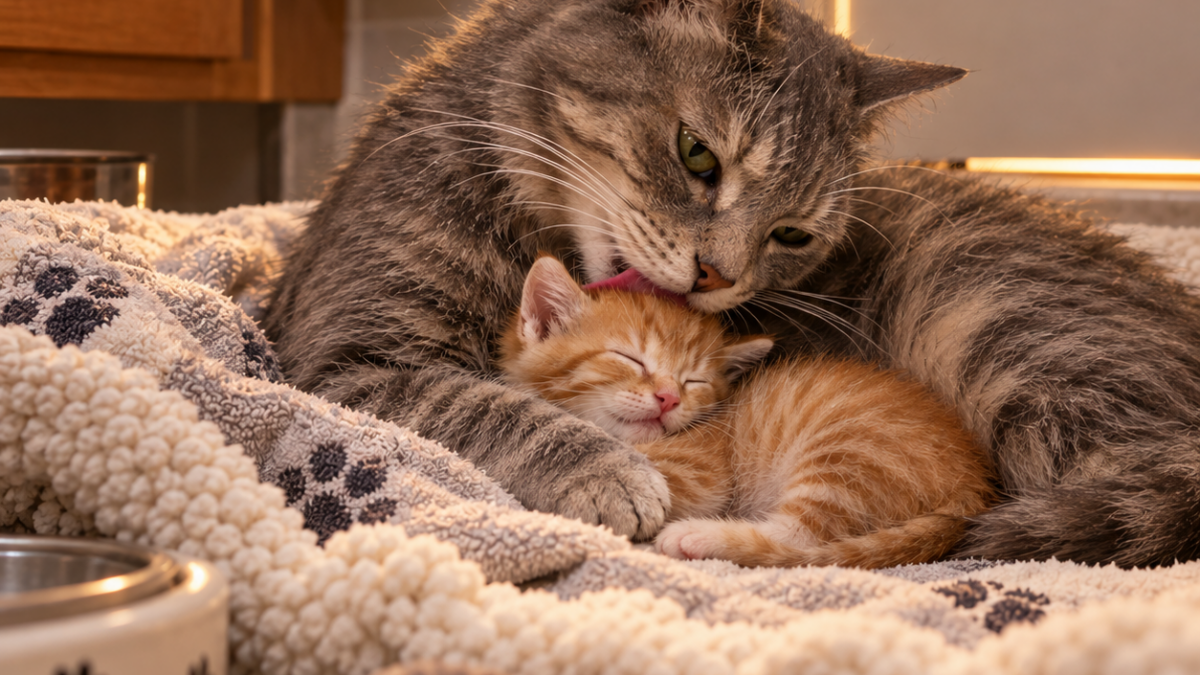
Willow circled once.
Then curled around her.
Careful.
Slow.
Penny pushed her face against Willow’s belly.
Searching.
There was no milk.
Never would be.
But there was warmth.
Heartbeat.
Fur.
Breathing.
Something to belong against.
I sat there with my mouth covered.
The whole house changed in that moment.
I know how foolish that sounds.
Two cats in a bathroom.
Nothing supernatural.
No miracle cure.
But before Willow entered, Penny was a sick abandoned kitten I was trying to keep alive.
After Willow entered, she was somebody’s baby.
The distinction mattered.
Penny still needed veterinary care.
Antibiotic ointment for her eyes.
Treatment for parasites.
High-calorie kitten food.
Formula.
Weigh-ins.
She had an upper respiratory infection.
Severe dehydration.
The vet guessed four weeks old but significantly underweight.
“Do you know where she came from?”
“No.”
“Any mother?”
“No.”
“Other littermates?”
“No.”
He looked at Willow in carrier.
“This your cat?”
“Yes.”
“She nursing?”
“She can’t.”
“Good.”
I frowned.
He clarified.
“Not good that she can’t.”
“Good because I was going to tell you not to let kitten stimulate milk production if there’s reproductive history we don’t understand.”
He examined Willow too.
Healthy for age.
A little arthritis.
Nothing alarming.
He watched Penny cry from exam table.
Willow answered from carrier.
The veterinarian smiled.
“Well.”
“What?”
“She has opinions.”
“That is not new.”
He let Willow out briefly.
She walked straight to Penny.
Licked her face.
The vet watched.
“Bonding response.”
“Mothering?”
He hesitated like scientists do around emotional vocabulary.
“Maternal behavior.”
“Same thing.”
“Close enough.”
From that day forward, Willow became somebody I had not met yet.
She ate beside Penny.
Slept beside Penny.
If Penny cried, Willow arrived before me.
If I held Penny too long, Willow sat directly in front of my feet and stared.
No sound.
Just judgment.
“What?”
I would say.
“She needs socialization.”
Willow stared.
“She also needs human handling.”
Stare.
“Fine.”
I put Penny down.
Willow immediately checked her.
Weeks passed.
Penny’s eyes cleared.
Her coat softened.
Her little belly rounded.
She discovered food.
Then chaos.
She attacked shoelaces.
Curtains.
Dust.
My robe belt.
A shadow on the wall.
Her own back foot.
She chased Willow’s tail exactly once.
Willow turned and gave her such a look Penny sat down.
Lesson learned.
For about six minutes.
Penny grew.
Willow changed.
The socks stopped disappearing.
I noticed one morning when I opened laundry drawer and realized every pair was there.
Dish towels stayed on hooks.
Stuffed bear remained untouched.
Penny slept tucked beneath Willow’s chin.
One paw across her back.
Not tight.
Just enough.
I sat across the room.
Something inside me loosened.
For years, I had thought family was a shrinking thing.
Robert gone.
Children grown.
Friends moved.
Holiday chairs empty.
I thought age was mostly subtraction.
Then Willow found Penny.
Or Penny found Willow.
And my house gained something it had not had in years.
Need.
Noise.
Movement.
A reason to laugh alone without feeling foolish.
Family did not only disappear.
Sometimes it arrived late.
Sometimes in a box.
I would have been content if the story ended there.
It did not.
My granddaughter Lila caused that.
She came over one Saturday.
Seventeen years old.
Phone permanently attached to hand.
She stopped in hallway.
Willow and Penny were sleeping in the front window.
Penny beneath Willow’s chin.
Willow’s paw resting across her.
Lila whispered:
“Oh, Grandma.”
Then took a photograph.
“Don’t make a thing out of it.”
She looked at me.
“Define thing.”
“Lila.”
She posted.
One sentence:
“My grandma’s cat couldn’t have babies, so she became a mother to the kitten someone threw away.”
By evening, my phone sounded like a slot machine.
Comments.
Messages.
Shares.
People from town.
People I did not know.
A woman wrote:
“I lost three pregnancies and this made me cry.”
Another:
“I was adopted. Blood doesn’t decide who your mother is.”
A man wrote:
“My stepdad was the first father I ever had.”
I read those quietly.
The photo seemed to give people permission.
Then next morning, the internet remembered what it does best.
Argue.
“She’s just a cat.”
“Stop anthropomorphizing animals.”
“People care more about pets than children.”
“Calling that motherhood is offensive.”
“Maybe the kitten belonged to someone.”
“Old women always turn pets into babies.”
That one bothered me.
More than it should.
Old women always turn pets into babies.
I looked around kitchen.
Robert’s coffee mug still on top shelf.
His chair across from mine still unused.
Willow on rug.
Penny batting at her tail.
Yes.
I talked to Willow.
Yes.
I told her good morning.
Yes.
I thanked her for keeping me company.
If somebody wanted to call that pathetic, let them.
There are worse things than loving something that needs you.
A week later, someone knocked on my door.
Late afternoon.
Willow and Penny watching birds.
I opened.
A woman stood there.
Maybe forty.
Tired face.
Hair pulled tight.
A boy around twelve behind her.
He stared at ground.
“Are you the lady with the orange kitten?”
“Copper.”
“What?”
“She’s copper-colored.”
The woman looked past me.
“We think that might be ours.”
My stomach tightened.
Behind me, Penny jumped down.
Willow made a low sound.
Not growl.
Not hiss.
Warning.
The woman folded her arms.
“My son saw the picture.”
“He said it looks like one of the kittens from a litter behind our garage.”
The boy still would not look.
“The kitten on my porch was nearly dead.”
I said.
The woman’s face changed.
“Yes.”
I waited.
“That was why…”
She stopped.
“Why what?”
“We couldn’t keep all of them.”
There it was.
The sentence people use when they want a hard act to sound soft.
Couldn’t keep all of them.
Not:
We called for help.
Not:
We stayed until she was safe.
Not:
We surrendered her properly.
I said:
“I found her in a cardboard box at 2:14 in the morning.”
The woman looked away.
“You left her?”
No answer.
The boy whispered:
“Mom.”
She snapped:
“I was trying to save it.”
It.
Not her.
Willow entered hallway.
Penny behind.
The boy finally looked.
His face broke.
“That’s her.”
Penny froze.
Willow moved in front.
Just a small gray body.
No drama.
One step between Penny and door.
The woman saw.
“I know how it looks.”
I said nothing.
“My husband said kitten wasn’t going to survive.”
“The shelter said full.”
“I had work.”
“My son was crying.”
“I knew you had a cat.”
“Everybody says you like animals.”
I felt anger rise.
“So you left a dying kitten on an old woman’s porch in middle of night.”
“You make it sound cruel.”
“It was cruel.”
The boy flinched.
I regretted saying it in front of him.
Not because false.
Because children often stand inside adult mistakes and assume blame belongs to them.
The woman lifted her chin.
“We want her back.”
“No.”
She blinked.
“No?”
“No.”
“You can’t keep someone else’s cat.”
“I did not take her.”
“She was left on my porch.”
“We were overwhelmed.”
“I believe you.”
That surprised both of us.
But I did.
I believed she had bills.
I believed shelter was full.
I believed she was tired.
I believed her son cried.
People can be struggling and still make harmful choices.
Two truths can share a room.
“My son misses her.”
I looked at boy.
He was crying silently.
“What’s your name?”
“Evan.”
“Did you put the box there?”
He shook head fast.
“No, ma’am.”
“Did you know?”
“Not till morning.”
The woman looked embarrassed.
Maybe truth feels like embarrassment when we have avoided it.
I opened door a little wider but kept screen closed.
“She almost died, Evan.”
He nodded.
“Willow stayed beside her.”
Penny pressed against Willow.
“She is safe here.”
He whispered:
“I’m sorry.”
The woman said:
“We can pay food.”
That nearly made me laugh.
I live on careful budget.
I understand money.
But some debts are not food bills.
“No.”
“You think you’re better than us.”
I shook my head.
“No.”
“I think Penny got lucky despite all of us.”
Silence.
The woman pulled Evan away.
At sidewalk he looked back.
I lifted hand.
He did not.
He looked sad.
That night I wrote one comment under Lila’s post.
No names.
No address.
“Please do not leave animals on anyone’s porch and call it rescue. Ask for help while there is still time. A cardboard box in the dark is not a plan. It is a burden placed on another living heart.”
By morning:
war.
Some said I was right.
Some said cruel.
Some said poor people deserve compassion.
They do.
Some said abandoned animals deserve protection.
They do.
Some said:
“At least she left kitten somewhere safe.”
But she could not know that.
What if I had been away?
What if I had not heard Willow?
What if porch froze?
Intent does not cancel risk.
Then two nights later, at 1:39 a.m., Willow woke me again.
Same broken cry.
Penny beside her.
Tail puffed.
My stomach went cold.
“No.”
I already knew.
Another box.
Two kittens.
One black.
One gray.
Five or six weeks.
Thin.
Crying.
Note:
YOU HELPED THE LAST ONE. PLEASE.
I sat on floor.
Angry.
Then guilty for being angry.
Then angrier because guilt came automatically.
Kind people are trained to feel guilty for having limits.
I brought kittens inside.
Of course.
But I refused to call it beautiful.
It was not beautiful.
It was an old woman in a robe at almost two in morning cleaning diarrhea off two frightened kittens because somebody decided her porch was easier than asking.
I called clinic.
Rescue.
Maddie.
“I hate when you’re right.”
“What happened?”
“Two kittens.”
“Oh, Mom.”
No lecture.
That is love growing up.
Rescue volunteer Marla came.
Older woman.
Tired voice.
Looked at kittens.
Looked at me.
“You cannot become drop box.”
“I know.”
“I mean it.”
“I know.”
She gave me sign:
PLEASE DO NOT ABANDON ANIMALS HERE. CALL A SHELTER, CLINIC, OR RESCUE FOR GUIDANCE.
I taped it inside window.
Then cried from guilt because kittens would leave after three days.
Absurd.
Necessary.
People who care need boundaries more than people who do not.
Otherwise care burns them alive.
I wrote online:
“Compassion is not a dumping ground. Older people, rescue workers, neighbors, and animal lovers are not magic. Asking for help is brave. Leaving a box in the dark is not the same thing.”
That post spread.
Arguments.
Then something shifted.
People posted rescue numbers.
Clinic hours.
Offers.
Carriers.
Food.
Drivers.
Feed store put up bulletin board.
Found kittens?
Need temporary foster?
Can drive?
Have towels?
An informal network formed.
Not perfect.
But better.
Willow did not adopt the two new kittens.
That surprised people.
She sniffed.
Walked away.
Willow was not Saint Mother Cat.
She was a cat.
She had chosen Penny.
That made her love more real, not less.
Penny, however, sat outside laundry room exactly the way Willow had sat outside bathroom.
One paw under crack.
Every squeak:
Penny answered.
Willow watched from hallway.
Maybe pride.
Maybe sleepiness.
I chose pride.
When Marla took kittens, Penny cried.
Ran window to window.
Willow climbed onto couch.
Waited.
Eventually Penny came.
Willow pulled her close.
One paw.
That image mattered.
Love is not infinite performance.
It can have limits and still be love.
A month later, envelope appeared.
Notebook paper.
Three dollars seventeen cents.
Dear Mrs. Harris,
I am sorry about Penny.
I did not leave her but I knew she was sick and I did not stop it.
I thought if she went to your house she would be okay.
That was dumb.
My mom cried after we left.
She said she was ashamed.
I am saving money to help cats someday.
Please tell Penny I am sorry.
From Evan.
I read three times.
Then wrote back.
Dear Evan,
Penny is safe.
She is healthy.
She is loud.
She has stolen two socks and one piece of toast.
I told her you were sorry.
I think she forgives you.
I do too.
But forgiveness does not mean pretending something did not matter.
It means letting the truth teach us instead of poison us.
Keep caring.
And next time, speak up sooner.
Mrs. Harris.
Two weeks later:
doorbell.
Evan.
Alone.
Paper grocery bag.
“I brought towels.”
Old towels.
Lemon dishcloth.
Newspaper.
“For rescue lady.”
Then:
“Can I see Penny?”
I almost refused.
Willow looked at him.
Then at me.
I opened inside door.
Screen stayed shut.
Penny trotted up.
Stopped when she saw Evan.
Willow behind.
Evan crouched.
Did not reach.
Did not make noises.
Just sat.
Penny sniffed through screen.
Sneezed.
Evan laughed.
First time I heard him sound twelve.
“She got big.”
“Yes.”
“She looks happy.”
“She is.”
He swallowed.
“Good.”
He stood.
Then looked at Willow.
“Thank you for being her mom.”
I had to turn away.
Adults had argued online about whether Willow could be called mother.
A twelve-year-old understood in one sentence.
Willow blinked slowly.
Evan began coming once a month.
Towels.
Food.
Coins.
Never asked to take Penny.
Never asked to touch.
Always:
“Is she still loud?”
“Worse.”
His mother eventually met me at grocery store.
Both froze.
She said:
“He talks about that cat all the time.”
“Penny is well.”
Her eyes filled.
“I did wrong.”
It would have been easy to hammer truth.
Instead:
“You raised a boy who can apologize.”
She looked down.
Then:
“I called clinic about mother cat.”
“What?”
“They helped get her fixed.”
“So no more kittens.”
Relief.
That was accountability doing something useful.
No movie hug.
Just two women near canned beans.
Less broken than before.
Summer came.
Penny grew.
Willow aged.
At first I denied.
Heat.
Naps.
Old cats sleep.
Then her tail did not rise as high.
She paused after jumping.
Her body felt lighter.
Penny noticed before me.
Stopped ambushing.
Stopped chasing Willow’s tail.
Started bringing things.
Felt mouse.
Twist tie.
My socks.
She would drop beside Willow.
Chirp.
Willow looked like queen receiving taxes.
Then Penny curled beside.
One night, a low cry woke me.
Broken.
Almost human.
This time:
Penny.
She stood outside bedroom.
Ran down hall.
I followed.
Willow was in laundry basket.
Had climbed in.
Could not climb out.
Did not cry.
Of course not.
Willow would have sat there until morning rather than admit weakness.
Penny frantic.
I lifted Willow.
She felt too light.
I sat floor holding.
Penny climbed into lap.
All three of us in dark hallway.
Old woman.
Old cat.
Young cat who had once been unwanted and now refused to let anyone be alone.
Vet next morning.
I will not make this about lab values.
Willow was aging.
Nothing dramatic yet.
Manageable pain.
Arthritis.
Beginning kidney disease.
More rest.
Food adjustments.
I paid bill.
Sat in car afterward and cried.
Love is expensive in ways no receipt explains.
When we got home, Penny ran to carrier.
Sniffed Willow.
Pressed forehead to cheek.
Willow leaned in.
Circle closed.
Once Willow cared for creature with no strength.
Now that creature was strong enough to care back.
Family is not always line.
Sometimes circle.
One day you hold.
One day you are held.
One day you answer cry.
One day someone answers yours.
Lila posted another photo with permission.
Willow asleep in sun.
Penny curled around her.
Paw over Willow’s shoulder.
“The kitten Willow saved is now watching over her.”
That one spread quietly.
People shared:
“My stepmom raised me.”
“My aunt was my real mother.”
“My foster dad stayed.”
“My neighbor fed me every Friday.”
“My dog kept me alive after divorce.”
A woman wrote:
“I never had children. This made me feel like my love still counted.”
I read aloud.
“It does count.”
Willow opened one eye.
Penny yawned.
I meant it for all of us.
People are made to feel unfinished if lives do not follow expected shape.
No children.
No spouse.
No blood family.
No perfect home.
But real families are often built after picture breaks.
Widow and shelter cat.
Cat and kitten in box.
Boy bringing towels because he cannot undo past.
Woman learning shame does not fix.
Rescue worker answering phone.
Granddaughter turning one photo into conversation.
Messy.
Still family.
Thanksgiving:
Maddie said bring cats.
I laughed.
She did not.
So we did.
Children built Willow bed.
Penny tried stealing dinner roll.
Son-in-law:
“That one has crimes in her eyes.”
Correct.
Ben, nine, sat floor.
“Grandma?”
“Yes?”
“Is Willow Penny’s real mom?”
Adults went quiet.
I said:
“Willow is not the cat who gave Penny life.”
He nodded.
“But she is the one who helped Penny keep it.”
He thought.
“So she’s real mom in different way?”
“Yes.”
Children understand belonging before adults complicate it.
Later Maddie asked:
“How much longer?”
I could not answer.
“I don’t know.”
She held my hand.
For once I was not mother.
I was held.
Family again.
Winter.
Good days.
Quiet days.
Steps near couch.
Warm food.
Penny sleeping beside Willow every night.
Evan arrived with box.
Towels.
Food.
Handmade sign:
ASK FOR HELP BEFORE IT BECOMES AN EMERGENCY.
He had made for Marla.
Penny came to screen.
Evan crouched.
Penny pressed paw to mesh.
Evan put fingers other side.
No touching.
Screen.
Past.
Still peace.
“I’m glad she stayed.”
“So am I.”
He looked at Willow.
“She looks old.”
“She is.”
“Is she okay?”
“For today.”
He nodded.
For today.
Sometimes most honest.
“My mom helps phone list now.”
“What list?”
“For people who find animals.”
“She says being ashamed didn’t fix anything.”
No.
It does not.
That night I told Willow she had started movement by accident.
“You never even had babies.”
She blinked.
Satisfied.
A week before Christmas, old stuffed bear appeared beside Willow’s bed.
The one Willow used to groom before Penny.
Then Penny walked in with rolled sock.
Dropped beside bear.
Curled next Willow.
I stood doorway.
Willow had stopped carrying socks because Penny filled empty place.
Now Penny brought socks back to Willow.
Not because she understood grief in words.
Because love repeats what it learns.
Presence teaches presence.
Christmas Eve:
Maddie and children came.
Ben made card.
Gray cat with crown.
Inside:
TO WILLOW, PENNY’S REAL MOM IN A DIFFERENT WAY.
I put in recipe box beside Evan’s letter.
That box used to hold my mother’s recipes.
Pie crust.
Pot roast.
Lemon bars.
Now proof people can learn.
Maybe that is recipe too.
After everyone left, house settled.
Not empty.
Settled.
Penny chased ribbon.
Willow watched.
Porch light outside.
I thought of first night.
2:14.
Box.
Cry.
What if I ignored?
What if Willow had not heard?
Sometimes whole life turns on small sound.
A cry.
Knock.
Phone call.
Child saying:
I’m sorry.
Woman saying:
I did wrong.
Neighbor saying:
I can drive.
An old cat saying:
Open the door.
People kept asking lesson.
I do not know whole lesson.
I know mine.
Do not call abandonment compassion.
Do not shame people for needing help.
But do not praise them for dropping burden in dark either.
Ask sooner.
Stay longer.
Tell truth.
And when living thing lands in your path, do not waste too much time deciding whether it fits your definition of family.
Love rarely arrives in expected form.
Sometimes in box.
Crusted eyes.
Matted fur.
Crooked tail.
Torn ear.
Old woman crying on bathroom floor while cat who could never have kittens knows exactly what to do.
Willow never gave birth.
That did not change.
Her body never carried a kitten.
But Penny never cared.
One night near end of year, I woke again at 2:14.
Exact minute.
I saw clock.
Heart stopped.
No cry.
No box.
No porch mystery.
Just quiet.
Too quiet.
I walked hall slowly.
Willow asleep on blanket.
Penny curled around her.
One paw over Willow’s back.
Exactly as Willow had once held her.
I stood there.
Nothing wrong.
Not that night.
For once, 2:14 did not mean fear.
It meant memory.
We had made it from then to now.
Penny was not in box.
Willow was not alone.
Neither was I.
I sat floor.
Penny opened one eye.
Willow stayed asleep.
“You did good, old girl.”
Willow’s ear twitched.
Enough.
Morning:
Penny and Willow sat front window.
Porch light still on.
Porch empty.
No box.
No note.
No shaking body.
For first time, empty porch felt like mercy.
Penny leaned into Willow.
Willow leaned back.
I stood behind with coffee.
Street woke.
Delivery truck.
Neighbor with dog.
Child dragging backpack.
Normal life.
Ordinary life.
The kind people ignore until gone.
I once believed family disappeared piece by piece.
Husband gone.
Children grown.
Friends moved.
Empty chairs.
Quiet rooms.
I was wrong.
Family can arrive late.
Damaged.
Inconvenient.
When you think too old to begin.
Willow taught me.
Penny proved it.
The rest of us—with opinions, arguments, excuses—are still catching up to what those two cats understood immediately.
A mother is not always the one who gives you life.
Sometimes she is the one who hears you crying in the dark.
Sometimes she is the one who stays outside the door all night.
Sometimes she is the one who puts her aging body between you and the world.
And sometimes, years later, you become strong enough to do the same for her.
That is not “just a cat story.”
It never was.
It is about what happens when the unwanted are finally wanted.
It is about how love does not require perfect beginnings.
Only open doors.
And whenever Penny curls around Willow now, I remember the cardboard box.
The moving towel.
The cry that woke me.
The old gray cat looking at me as if to say:
What are you waiting for?
So I opened the door.
In saving Penny, Willow saved more than kitten.
She saved my quiet house.
She saved a boy from becoming numb to a mistake.
She helped one woman step out of shame.
She forced a town to admit that animals do not appear on porches by magic.
And maybe, in her strange little way, she saved me too.
Because before Penny came, I had started believing my best years of loving were behind me.
Willow knew better.
Love was not behind me.
It was on the porch.
Shaking.
Waiting.
Needing a towel.
Needing a chance.
Needing someone to say:
“You belong here now.”
And that is exactly what we did.
We opened the door.


