My Brother Handed Me $50 for “Gas Money” in Front of His Squadron—Then the Admiral Stood Up and Said, “She Kept Every One of You Alive.”
My Brother Handed Me $50 for “Gas Money” in Front of His Squadron—Then the Admiral Stood Up and Said, “She Kept Every One of You Alive.”
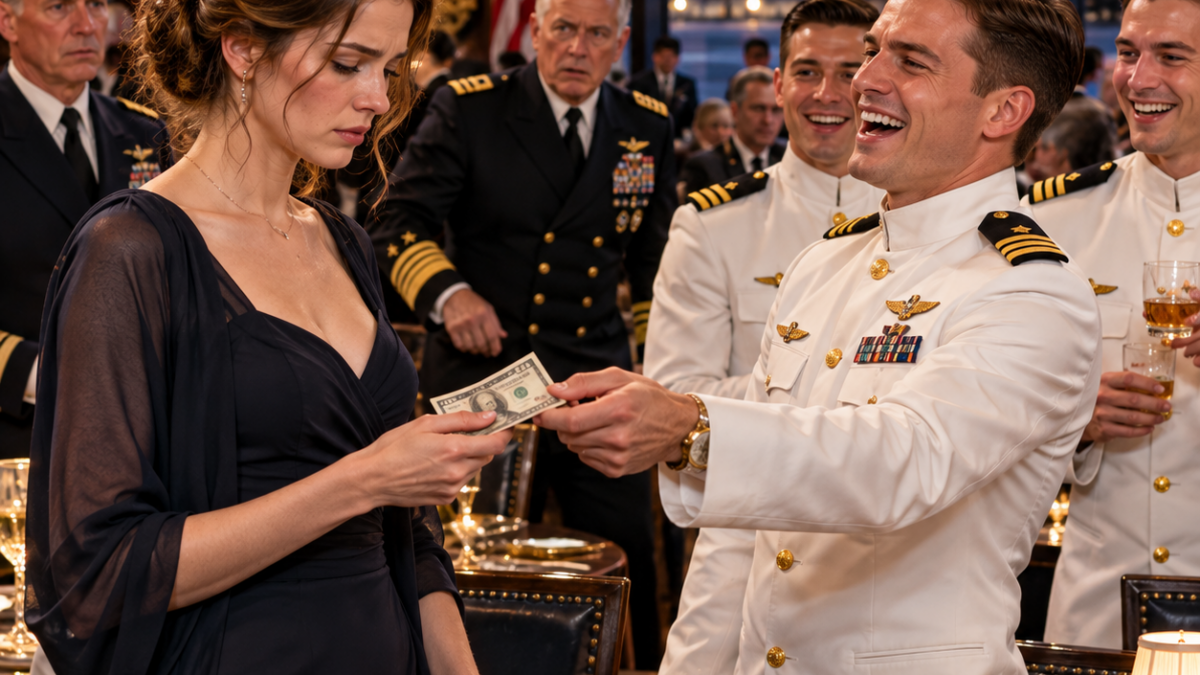
My younger brother pressed a crumpled fifty-dollar bill into my hand in front of half his Navy squadron because he thought his quiet older sister probably needed gas money, and when several officers laughed, my retired-captain father caught my eye and silently warned me not to embarrass him by making a scene.
I smiled, thanked Logan, and slipped the bill into my purse without mentioning that less than twenty-four hours earlier I had been underground outside Washington making decisions inside a classified operation built to keep American aircraft alive in the Pacific—including aircraft connected to the very carrier group my brother was about to join.
Then the lights dimmed, Vice Admiral Owen Mercer walked toward the microphone carrying a dark folder nobody had expected him to open, and for the first time in my life, my entire family stopped talking long enough to hear someone say my name.
The fifty-dollar bill was still warm from Logan’s wallet.
“For the drive home, Mara.”
He said it loudly.
Of course he did.
My younger brother had never understood how to do anything quietly when there was an audience available.
We were standing beneath polished brass lights inside the naval officers’ club, surrounded by pilots, commanders, spouses, and enough white dress uniforms to make the room look brighter than it actually was.
Logan pressed the bill into my palm.
“I know the government doesn’t exactly pay computer people overtime.”
Three officers around him laughed.
Not viciously.
That almost made it worse.
There is a kind of cruelty you can confront.
And then there is affectionate humiliation.
The joke everybody expects you to laugh at because nobody technically meant harm.
Logan grinned and squeezed my shoulder.
“There. Now you can get home.”
I looked down at the money.
Fifty dollars.
Same hand.
Same fingers.
PART2:
Eighteen hours earlier, those fingers had rested against a secure communications console three levels beneath a federal operations facility outside Washington while I authorized the final intelligence package for Operation Meridian.
Twenty-two months of work.
Seventy-two hours of near-continuous operations.
A hostile missile network across the Pacific.
American surveillance and command aircraft entering an increasingly dangerous corridor.
Forty-seven Americans aboard the first airborne platform most likely to encounter the threat.
Other aircraft behind them.
Naval aviation assets too.
Including, potentially, people who flew with Logan.
The classified confirmation had arrived less than an hour before dinner.
MERIDIAN COMPLETE.
ALL PERSONNEL CLEAR.
ZERO U.S. CASUALTIES.
I had read those last three words twice.
Zero U.S. casualties.
Then I had closed my secure phone, walked back toward my family, and been handed gas money.
I folded the bill once.
“Thanks, Logan.”
He laughed.
“See? Little brothers are useful.”
“I’m older than you.”
PART3:
“Only technically.”
More laughter.
Logan moved on.
His white uniform was immaculate.
Ribbons perfectly aligned.
Hair regulation-short.
The easy posture of a man who had spent most of his life learning that confidence looked good on him.
And to be fair, it did.
My brother was charming.
Brave.
An exceptional naval aviator.
His squadron trusted him.
Junior officers respected him.
That was what made everything so complicated.
I had never wanted Logan to become smaller so I could finally feel larger.
I had only wanted there to be room for both of us.
There never seemed to be.
My name is Mara Caldwell.
I was thirty-two years old that night.
For almost ten years, I had worked in intelligence for the United States government.
My family knew those words.
Intelligence analyst.
But in the Caldwell family, words had always been adjusted until they fit the story everyone preferred.
Mom called it my “serious government desk job.”
Logan said I “worked with computers.”
Dad, retired Navy Captain Daniel Caldwell, usually described it as “the administrative side of national service.”
None of them had ever asked what any of those descriptions meant.
Dad stood ten feet away.
He had seen Logan give me the fifty.
I knew because our eyes met immediately afterward.
For one stupid second, I was twelve again.
Waiting.
Hoping.
Thinking maybe this time he would say:
Logan, knock it off.
Or:
Your sister doesn’t need your charity.
Or even:
Mara, you all right?
Instead Dad gave me the smallest shake of his head.
Don’t.
Don’t make this awkward.
Don’t spoil your brother’s evening.
Don’t make trouble.
Then he turned back toward the two senior officers beside him.
That hurt more than the money.
I slipped the bill into my purse.
And smiled.
Because I had spent most of my life becoming exceptionally good at disappearing without leaving the room.
The Caldwell family had always been a Navy family.
That was the first thing people learned about us.
Dad had spent twenty-seven years in uniform.
Sea duty.
Staff assignments.
Command.
He had retired with the kind of reputation that made younger officers straighten unconsciously when he entered a room even after the uniform was gone.
Our house in Chesapeake was filled with the evidence.
Ship photographs.
Command coins.
Framed citations.
An old ceremonial sword.
A photograph of Dad as a young officer standing on a flight deck with the ocean behind him.
Then Logan came along.
And the story continued perfectly.
He loved airplanes before he could properly pronounce the word.
At nine, Dad bought him a professional-grade flight simulator setup for Christmas.
It took up half the garage.
Logan screamed when he saw it.
Dad laughed until tears ran down his face.
I remember standing near the door holding my own present.
A forty-dollar craft-store gift card.
Three weeks earlier, I had become the youngest student in our district to win the statewide mathematics competition.
My mother had written inside the card:
Something fun for a change!
Nobody intended to hurt me.
I need to be clear about that.
My childhood was not abusive.
My parents were not monsters.
Logan was not some evil golden child deliberately stealing attention.
That would have been easier.
Cruelty has edges.
You can point to it.
Name it.
Reject it.
Being overlooked is softer.
It happens in increments.
A photograph that goes above the fireplace while your certificate goes into a drawer.
A question about his training while nobody asks about your research.
A neighborhood party for his wings.
A handshake for your federal appointment.
No individual moment seems serious enough to complain about.
Together, they teach you a language.
His achievements are interesting.
Yours are reassuring.
His ambition is identity.
Yours is intensity.
His career is service.
Yours is a stable job.
By the time I was twenty-two, I had learned to translate myself before entering my parents’ house.
Graduate research became “school.”
Intelligence work became “analysis.”
Overseas travel became “a work trip.”
Promotions became “new responsibilities.”
It made everybody comfortable.
Especially Dad.
Dad understood visible service.
Ships.
Squadrons.
Uniforms.
Risk you could photograph.
What I did existed behind sealed doors.
No cameras.
No applause.
Often no disclosure.
So in his mind, what he could not see became something smaller.
A month before the officers’ club dinner, that assumption had finally collided with money.
My parents’ Chesapeake house needed a new slate roof.
Not patching.
Major work.
Nearly one hundred thousand dollars.
Dad announced the estimate over Sunday dinner as though presenting a casualty report.
Mom looked sick.
The house had belonged to Dad’s family for more than four decades.
Every Christmas I remembered happened there.
Every deployment homecoming.
Graduation photographs on the front steps.
Birthday cakes in the kitchen.
Logan immediately began giving financial advice.
Refinance.
Investments.
Borrow against equity.
Some property arrangement he had apparently learned about from a podcast.
Dad listened seriously.
When Logan finished, I said:
“I can cover it.”
Silence.
Dad looked at me.
“Cover what?”
“The roof.”
“All of it?”
“Yes.”
Mom stopped moving.
Logan laughed.
“Okay, Mara.”
I looked at him.
“I mean it.”
Dad’s expression changed.
Not gratitude.
Suspicion.
“Where would you get that kind of money?”
I felt heat rise into my face.
“My salary.”
Pause.
“Savings.”
Pause.
“Investments.”
Dad put down his napkin.
“This family doesn’t accept money we can’t account for.”
I stared.
“You can account for it.”
“How?”
“It’s mine.”
“Your government salary is public information.”
“Not everything about federal compensation is whatever number you found online.”
His expression hardened.
“Then I don’t want it.”
He never said illegal.
Never said dirty.
Never accused me directly of anything.
He did not have to.
My father trusted my brother’s half-understood financial advice more readily than he trusted the possibility that I had built a successful life he knew nothing about.
I withdrew the offer.
Nobody mentioned it again.
Until Logan put fifty dollars in my hand.
Now I stood near the officers’ club windows watching aircraft silhouettes beyond the glass while my secure phone vibrated inside my purse.
I stepped away from the crowd.
Shielded the screen naturally.
MERIDIAN COMPLETE.
ALL PERSONNEL CLEAR.
ZERO U.S. CASUALTIES.
My shoulders finally loosened.
Operation Meridian had consumed almost two years of my life.
The threat had begun as fragments.
Intercepts.
Procurement irregularities.
Satellite imagery.
Movement patterns.
Communications bursts that looked meaningless until enough analysts placed them beside each other.
Eventually a picture emerged.
A hostile missile capability moving toward operational status.
Not theoretical.
Not political theater.
Real.
Capable of putting American airborne surveillance and support platforms in danger.
We spent months trying to understand the system without causing it to disappear underground.
Linguists.
Technical specialists.
Military planners.
Signals teams.
Allied partners.
Analysts who slept on couches.
People whose names would never appear in newspapers.
I directed the intelligence component.
That did not mean I personally “saved” anyone.
I hated language like that.
Complex operations are never one person.
But leadership does eventually narrow.
At some point, incomplete information reaches a desk.
Nobody has certainty.
Somebody must decide whether there is enough.
That decision had reached mine.
I made it.
The operation moved.
The threat network did not.
And now:
Zero U.S. casualties.
I closed the secure message.
Across the room, Logan laughed with two pilots.
Completely unaware that part of my week had been dedicated to making sure people like them reached the next one.
A voice came beside me.
“Ms. Caldwell.”
I turned.
Vice Admiral Owen Mercer approached.
Three stars.
Dress whites.
The kind of officer whose presence changes how everyone within twenty feet stands.
“Admiral.”
He extended his hand.
Then covered mine with his second.
“I read the final Meridian report on the flight down.”
My stomach tightened.
“What your team accomplished was extraordinary.”
“Thank you, sir.”
“We’re going to acknowledge part of it tonight.”
I stared.
“What?”
Before he could answer, Logan appeared.
His hand landed on my shoulder.
“There you are.”
Then he stepped slightly between us.
“Dinner’s starting.”
He flashed Mercer a quick smile.
“Sorry, sir. Borrowing my sister.”
The admiral said nothing.
Logan began guiding me away.
I looked back.
Mercer watched him.
His expression had become perfectly still.
“Logan.”
“What?”
“You might want to look at who you just interrupted.”
“Mara, half the room has stars tonight.”
“Not that many.”
He glanced back.
Two junior officers intercepted him.
Recognition never quite arrived.
He deposited me beside Mom.
Mom leaned toward me.
“Was that man bothering you?”
I looked at her.
“The vice admiral?”
Her eyes widened.
“Oh.”
“No, Mom. The vice admiral was not bothering me.”
Dad heard.
Looked toward Mercer.
Something moved across his face.
Then the lights dimmed.
The master of ceremonies welcomed everyone.
Several officers were recognized.
Families thanked.
Stories told.
Then Logan went to the podium.
My brother was magnificent.
That mattered.
If he had been arrogant and incompetent, none of this would have hurt so much.
But Logan had earned his wings.
Earned respect.
Earned trust.
His speech was excellent.
He thanked mechanics.
Flight-deck crews.
Logistics personnel.
Families who handled broken appliances, frightened children, and delayed homecomings while pilots were away.
Then he thanked Dad.
“My father taught me service isn’t something you talk about. It’s something you prove.”
Dad’s face transformed.
Pride.
Pure.
Visible.
Logan thanked Mom.
Then moved on.
He did not mention me.
I knew he would not.
Still, knowing a wound is coming does not stop it hurting.
Everyone stood to applaud.
For half a second, I remained seated.
Not in protest.
Because something inside me had finally become clear.
I had spent fifteen years waiting for the moment my family would understand me.
One achievement.
One promotion.
One medal.
One piece of classified work finally released.
Something impressive enough.
Then Dad would see me.
Logan would understand me.
Mom would stop introducing me as someone who “works for the government.”
Sitting there while they applauded Logan, I understood what was wrong with that fantasy.
I was trying to earn curiosity from people who should have been curious before I became extraordinary.
That was not love.
That was an audition.
And I was tired.
Not tired of them.
Not finished loving them.
Not cutting anyone out.
Just tired of auditioning.
I stood.
Applauded Logan because he deserved it.
And quietly decided I would never again make myself smaller to make my family comfortable.
The applause faded.
The master of ceremonies returned.
“Ladies and gentlemen, please remain standing.”
People straightened again.
“We have an unscheduled addition to tonight’s program.”
Dad looked up.
Logan turned near the stage.
The room shifted.
“It is my privilege to introduce Vice Admiral Owen Mercer.”
My heartbeat started pounding.
Mercer approached the podium carrying a dark folder.
He placed it down.
Looked across the room.
“We have spent this evening recognizing courage in its most visible form.”
The room quieted.
“Pilots. Officers. Sailors. Men and women who serve where danger can be seen, measured, and remembered.”
His hand rested on the folder.
“But national defense also depends upon people whose successes are designed to remain invisible.”
My fingertips went cold.
Dad slowly turned toward me.
Mercer continued.
“There are Americans whose names will never appear in news reports. People whose missions cannot be discussed at family tables. They identify dangers before those dangers have names. They build pictures from fragments most people would discard as meaningless.”
Nobody moved.
“Last night, one such operation concluded.”
Logan’s expression changed.
“By authorization of the Department of Defense, limited information concerning Operation Meridian may now be acknowledged.”
The room became absolutely still.
“Meridian was a twenty-two-month intelligence effort directed against an emerging missile threat in the Pacific theater.”
Dad inhaled.
“An American airborne command-and-control aircraft scheduled to enter the affected corridor was assessed as one of the earliest potential targets.”
Every aviator in the room understood the implication.
Mercer continued.
“Subsequent operations would have exposed additional naval aviation assets to the same threat environment.”
Logan stopped smiling.
His eyes went toward me.
“The operation concluded successfully early this morning.”
Pause.
“The network is no longer capable of performing its intended mission.”
Another pause.
“All American personnel associated with the operation are safe.”
A murmur passed through the room.
“Meridian required linguists, analysts, operators, technical specialists, military personnel, and allied partners.”
Then Mercer looked directly at me.
“But every operation also requires someone willing to make decisions when incomplete information provides no perfect choice.”
Mom whispered:
“Mara?”
The admiral opened the folder.
“The official responsible for directing Meridian’s intelligence component has spent years working within some of our most sensitive Pacific programs.”
Logan had gone pale.
“Her work has contributed to the protection of American service members across multiple deployments.”
Mercer paused.
“Most of those service members never knew her name.”
I stopped breathing.
“For extraordinary leadership and distinguished service to the national defense, I have been authorized tonight to recognize Ms. Mara Caldwell.”
Nothing happened.
Not immediately.
The room seemed unable to process it.
I stood.
My chair scraped across the floor.
Mom covered her mouth.
Dad stared at me as if I had suddenly become a stranger.
I walked toward the stage.
Same black heels.
Same charcoal dress Mom had called “a little plain” when I arrived.
Left foot.
Right foot.
Admiral Mercer shook my hand.
“About time,” he whispered.
An aide brought the recognition forward.
Mercer pinned it to my dress.
Then stepped back and saluted.
The first applause came from somewhere behind Logan.
Then more.
Then everyone.
People rose.
I looked at my brother.
For once, the confident commander disappeared.
He looked like the little boy who used to knock on my bedroom door when thunderstorms frightened him.
Mercer gestured toward the microphone.
I stepped forward.
“This recognition belongs to a team.”
My voice stayed steady.
“To the people who found patterns in noise. Who challenged assumptions. Who continued working when exhaustion made mistakes easier.”
Faces watched me.
“They did their jobs knowing that success might mean nobody ever learned what they had done.”
I looked across the uniforms.
“They did that work so other Americans could do theirs safely.”
I stepped back.
That should have ended it.
Mercer leaned toward the microphone again.
“One additional point.”
Silence returned.
“The carrier aviation units preparing for operations in the affected region were among the forces Meridian was intended to protect.”
His eyes moved toward Logan.
“Commander Caldwell.”
My brother looked up.
“Your sister’s team helped make sure your people came home.”
Logan’s face changed.
And inside my purse, that fifty-dollar bill suddenly felt heavier than the medal pinned to my dress.
Afterward, an aide moved me into a smaller reception room.
There were photographs.
Signatures.
Senior leaders wanting three minutes.
Eventually I found myself alone beside a long mahogany table.
My purse sat on a chair.
The fifty dollars inside.
The door opened.
Logan entered.
Mom followed.
Dad came last.
He closed the door.
Nobody spoke.
Logan finally said:
“Why didn’t you tell us?”
Of course.
Of all the questions available, that was his first.
I almost smiled.
“I couldn’t.”
“You couldn’t tell me anything?”
“I told you I worked in intelligence.”
“You said you were an analyst.”
“I am.”
“Mara, analysts don’t—”
He stopped.
I waited.
“You know what I mean.”
“Yes.”
I did.
Mom stepped closer.
“We thought you did reports.”
“I do reports.”
Logan snapped:
“That’s not what she means.”
I looked at him.
“Don’t talk to Mom like that.”
He stared.
The sheer normality of the sentence seemed to shock him.
Dad spoke.
“You were responsible for Meridian?”
“For part of it.”
“How much?”
“More than I can discuss.”
His frustration appeared automatically.
Logan paced.
“That operating corridor.”
I looked at him.
“What about it?”
“It’s ours.”
I said nothing.
“And the command aircraft Mercer mentioned?”
“Logan.”
“Was it ours?”
“I can’t answer that.”
His eyes stayed on mine.
Sometimes silence gives away more than speech.
He turned toward the window.
I had imagined this conversation for years.
In my fantasies, it always felt wonderful.
Dad finally knew.
Mom understood.
Logan apologized.
Instead I felt exhausted.
Dad asked:
“Why didn’t you tell me when you offered the money for the roof?”
I stared.
“What should I have said?”
He said nothing.
“Should I have told you, ‘Trust my bank account because the government allows me to authorize operations I can’t discuss’?”
“I didn’t say your money was illegal.”
“You implied it.”
“I said I couldn’t account for it.”
“No.”
I shook my head.
“You didn’t ask me to account for it.”
His face tightened.
“You decided.”
“Mara—”
“No.”
My voice remained quiet.
That made everyone stop.
“I have spent my entire life helping this family remain comfortable with the version of me you preferred.”
Mom’s eyes filled.
“When I won mathematics competitions, we talked about Logan’s baseball.”
Dad flinched.
“When I entered a competitive academic program, Dad called it practical.”
I looked at him.
“When I entered federal service, everybody was relieved I had a stable government job.”
“Mara…”
“When Logan earned his wings, forty people came to the house.”
I swallowed.
“When I received my first major promotion, I took myself to dinner.”
Mom whispered my name.
“I am not listing debts.”
I looked at all three of them.
“I’m explaining a pattern.”
Logan sat.
“You giving me fifty dollars wasn’t the problem.”
He looked down.
“It was only the clearest example.”
“I thought you were struggling.”
“Why?”
His mouth opened.
Nothing.
“Have I ever asked you for money?”
“No.”
“Have I ever told you I couldn’t pay rent?”
“I don’t know.”
“Exactly.”
The word struck harder than I intended.
“You don’t know whether I rent or own.”
Logan looked up.
“You don’t know where I’ve traveled.”
Mom wiped her face.
“You don’t know what degree I completed after graduate school.”
Dad looked away.
“You don’t know my actual job title.”
I took a breath.
“You don’t know because nobody asked.”
“That isn’t fair,” Logan said.
“It is accurate.”
He looked hurt.
A year earlier I would have repaired that hurt immediately.
Not anymore.
Dad said:
“Your brother loves you.”
“I know.”
“Then don’t make this bigger than tonight.”
There.
That reflex.
Reduce.
Control.
Restore comfort.
Something inside me became perfectly calm.
“It was bigger before tonight.”
Dad frowned.
“What do you want? An apology because we didn’t know classified information?”
“No.”
“Then what?”
“I want you to stop pretending classified information is the issue.”
Silence.
“Two hours ago, before Admiral Mercer said my name, Logan assumed I couldn’t afford gas.”
Logan closed his eyes.
“You heard him, Dad.”
My father said nothing.
“You looked at me and told me not to react.”
“I didn’t want a scene.”
“Exactly.”
I picked up my purse.
“I don’t need apologies tonight.”
Mom reached toward me.
I stepped back gently.
“I’m not cutting anyone off.”
Her hand stopped.
“But I am changing the terms.”
“What does that mean?”
“It means I won’t come to family events where I’m treated like an afterthought and then help everyone pretend nothing happened.”
Logan looked at me.
“Mara, I really am sorry.”
“I believe you.”
Relief appeared too quickly.
“But your apology does not erase the years that made tonight possible.”
The relief disappeared.
I opened my purse.
Pulled out the fifty-dollar bill.
Placed it on the table.
“You keep it.”
Logan stared.
“I don’t need it.”
“I know.”
I walked toward the door.
Dad called my name.
I stopped.
Did not turn.
Then he asked:
“Did you save his life?”
I looked back.
“No one person gets to claim something like that.”
He waited.
“My team helped remove a threat that could have killed people he serves beside.”
Dad’s face aged in front of me.
I opened the door.
Behind me, Logan whispered:
“I didn’t even know.”
I paused.
“That was never the problem, Logan.”
Then I left.
The problem was that until somebody important told him I was important, he had never wanted to know.
For the next six weeks, I learned something uncomfortable.
Boundaries often feel like punishment to people who were comfortable when you had none.
Mom called first.
“I need you to know I’ve always been proud of you.”
I was walking home through cold rain.
Headlights smeared across wet streets.
“Proud of what?”
She went silent.
“Mom?”
“You were always brilliant.”
“That’s not what I asked.”
Another silence.
“I told people that.”
“Who?”
“People.”
“What did you tell them I did?”
Pause.
“Government work.”
I stopped beneath an awning.
There it was.
Not malice.
Absence.
“Mom, I love you.”
“I love you too.”
“I need space.”
She cried.
Old Mara would have rushed to fix it.
Old Mara believed somebody else’s pain meant I had done something wrong.
I closed my eyes.
“I’ll call Sunday.”
Then ended the call.
Logan texted more.
I’m sorry.
Twenty minutes later:
I mean actually sorry. Not because of the ceremony.
Then:
I found the $50.
I didn’t answer.
Two days later:
I keep replaying it.
Then:
I sound like an asshole when I replay it.
That one almost got a response.
Almost.
Instead I went to work.
Meridian was over operationally.
Administratively, nothing ends that cleanly.
Reviews.
Lessons.
Reports.
Threat reassessments.
Briefings for officials who wanted twenty-two months of complexity reduced to three slides.
For the first time in almost two years, I slept normal hours.
I bought groceries.
Cooked.
Replaced a lamp that had flickered for eight months.
Bought a plant.
Small ordinary things.
They felt luxurious.
One Friday, Admiral Mercer stopped beside my desk.
“You look less haunted.”
“Thank you, sir. I think.”
He smiled.
“Your brother requested a meeting.”
I looked up.
“With you?”
“Official channels.”
“Why?”
“He wants guidance on intelligence support for deployed aviation units.”
That surprised me.
“He specifically requested no classified information.”
I leaned back.
“Responsible.”
“Very.”
Mercer almost smiled.
“He also apologized for interrupting me at the club.”
I covered my face.
“Oh, God.”
“I enjoyed that.”
“I’m sure.”
“He looked like he wanted the floor to open.”
I laughed.
Then Mercer’s expression changed.
“You don’t owe reconciliation because your résumé finally impressed your family.”
My smile disappeared.
“I know.”
“Do you?”
I looked through the secure glass behind him.
“I’m learning.”
“Good.”
He turned to leave.
Then paused.
“One thing, Caldwell.”
“Sir?”
“Being unseen for operational reasons is honorable.”
He looked at me.
“Being unseen at home is something else.”
I sat with that sentence long after he left.
Dad did not call.
Two weeks.
Three.
Thanksgiving approached.
Mom sent a group message.
Coming home?
I wrote:
I have plans.
She called immediately.
“You’re missing Thanksgiving?”
“I’m going to a friend’s.”
“But we’re your family.”
I looked around my apartment.
“Yes.”
“You are.”
Something in my voice stopped her.
My friend Priya had invited several colleagues.
I went.
For once, I did not rearrange everything because Caldwell tradition required my attendance.
Priya’s house was loud.
Children running.
Too much food.
People interrupting one another without anybody taking offense.
Her father asked:
“What do you do, Mara?”
“Federal intelligence work.”
He nodded.
“Sounds stressful.”
Then:
“Do you enjoy it?”
That was all.
No comparison.
No interrogation.
No reason I needed to prove the job deserved respect.
I nearly cried into the mashed potatoes.
After dinner, I checked my phone.
One voicemail.
Dad.
I went onto the porch.
Played it.
“Mara.”
Pause.
“It’s Dad.”
As if I couldn’t recognize his voice.
“I’ve been trying to figure out what to say.”
Another pause.
“Apparently six weeks isn’t enough time to become good at words.”
I held the railing.
“I found a box in the attic yesterday.”
I stopped breathing.
“Your things.”
His voice changed.
“Certificates. School papers.”
Then:
“That mathematics trophy from when you were twelve.”
I looked into Priya’s dark backyard.
“I don’t remember putting it there.”
Silence.
“But I know exactly where Logan’s first flight helmet is.”
My eyes filled.
“I think I’m beginning to understand what you were trying to tell me.”
Beginning.
Not fixed.
Not magically enlightened.
Beginning.
“I don’t expect you to call me today.”
Then something I almost never heard from my father.
“I’m sorry.”
The voicemail ended.
I listened again.
Then put the phone away.
I did not call.
Not because I wanted him punished.
Because for once, I wanted an apology to exist without immediately turning myself into the person comforting the one giving it.
A week later, Logan appeared outside my building.
No uniform.
No squadron.
No audience.
He held an envelope.
“I found something.”
I let him upstairs.
Inside was an old photograph.
Christmas.
Twenty years earlier.
Logan sat inside the flight simulator.
Dad behind him.
Mom near the garage door.
Everyone smiling.
And in the corner, nearly outside the frame, twelve-year-old me sat on a folding chair.
A mathematics trophy rested in my lap.
I stared at it.
“Where did you find this?”
“Attic.”
Logan stood in my kitchen with both hands in his jacket pockets.
Without a uniform he looked younger.
More familiar.
“Dad found your stuff.”
“I know.”
“He called?”
“Voicemail.”
Logan nodded.
I placed the photograph on the counter.
“What do you want?”
He flinched.
I felt the familiar urge to soften the question.
I resisted.
“I want to apologize.”
“You did.”
“No.”
He looked at the photograph.
“I said the words before.”
He pulled out a chair.
“I don’t think I understood them.”
That got my attention.
“I always believed Dad pushed us both.”
“He didn’t.”
“I know.”
“You know because an admiral publicly said I mattered.”
Logan looked down.
“That is the part I can’t stop thinking about.”
He rubbed his hands together.
“When Mercer described Meridian, I was impressed.”
Pause.
“When he mentioned our operating area, I was grateful.”
Another pause.
“When he said your name…”
He looked at me.
“I became proud of you.”
The honesty hurt.
“And then I realized how awful that was.”
I said nothing.
“I should’ve been proud before.”
Outside, traffic moved.
My refrigerator hummed.
“I tried remembering ordinary things about your life.”
He laughed bitterly.
“I couldn’t remember your graduate program.”
I waited.
“I don’t know your official position.”
Another silence.
“I didn’t know you bought this apartment.”
“I didn’t.”
He looked up.
“I own the building.”
His mouth opened.
I almost smiled.
“Six units, Logan. Calm down.”
“When?”
“Four years ago.”
He leaned back.
“Jesus Christ.”
“Exactly.”
Then understanding crossed his face.
“That’s why Dad thought the roof money was impossible.”
“Partly.”
“You could’ve made us look stupid whenever you wanted.”
“I wasn’t trying to make anybody look stupid.”
“I know.”
He said it quickly.
“That is actually what bothers me.”
I waited.
“You weren’t hiding things because you wanted to feel superior.”
He looked around my kitchen.
“You were hiding them because telling us had become pointless.”
I sat opposite him.
“I didn’t hide buying the building.”
He frowned.
“What?”
“I told everyone.”
“When?”
“Dinner. Four years ago.”
He stared.
“You had just been selected for a new training slot.”
His face changed.
“Dad spent the rest of dinner asking you about flying.”
Logan covered his mouth.
“Oh, God.”
“I said I’d closed on a small residential investment.”
“I remember something about apartments.”
“Exactly.”
Then Dad asked about your flight hours.
Logan closed his eyes.
“Mara…”
“No.”
I stopped him.
“Don’t turn yourself into a villain.”
He looked up.
“That would actually make this easier.”
“For who?”
“Both of us.”
I shook my head.
“You didn’t create the entire family dynamic.”
He waited.
“But you benefited from it.”
“Yes.”
“And you rarely questioned it.”
“Yes.”
“That matters.”
“I know.”
This time I believed him.
Before leaving, he took the photograph.
“I thought you might want it.”
“I don’t.”
“You sure?”
“Very.”
He returned it to the envelope.
Then reached into his jacket.
Pulled out another fifty-dollar bill.
I stared.
He held up both hands.
“Not what you think.”
“What exactly could I think?”
“I want you to autograph it.”
I laughed.
Actually laughed.
“No.”
“Come on.”
“Absolutely not.”
“The guys won’t let me forget what happened.”
My smile weakened.
“They know?”
“Mara, they were standing there.”
He winced.
“My callsign situation is moving in a direction I strongly dislike.”
“What direction?”
“Not telling you.”
“Then I’m definitely not signing it.”
He laughed.
For a moment we were teenagers again.
Two kids downstairs after midnight eating cereal while Dad was deployed.
There had been good things between us.
That mattered too.
At the door, Logan stopped.
“Dad wants you home for Christmas.”
“I know.”
“You going?”
“I don’t know.”
He nodded.
“No pressure.”
Then:
“One more thing.”
“What?”
“The roof.”
I stiffened.
“Dad took a loan.”
“His decision.”
“I know.”
Logan hesitated.
“The contractor found more structural damage.”
My stomach tightened.
“How much?”
“I’m not asking you.”
“How much?”
“Mara.”
“How much?”
“About one-sixty total now.”
One hundred sixty thousand.
The house.
Every childhood Christmas.
Mom’s kitchen.
Dad’s history.
My old reflex rose instantly.
Fix it.
Transfer the money.
Make sure nobody loses anything.
Prove you can.
I let the instinct pass.
Money could repair slate.
It could not repair why Dad rejected mine.
“Tell him I’m not buying my way back into this family.”
Logan nodded.
“I think he knows.”
Three weeks later, on Christmas morning, I boarded an airplane.
Not home.
Santa Fe.
There was no conference.
No assignment.
No person waiting.
I had simply looked at a map and chosen somewhere I had never been.
For three days I walked beneath cold blue skies.
Drank coffee near adobe walls.
Ate alone.
Didn’t feel lonely.
For the first time in my life, I heard what my days sounded like when nobody in my family was narrating them.
Mom sent photographs Christmas morning.
Tree.
Dining room.
Fireplace.
Logan stealing pie.
Dad at the grill wearing an old Navy sweatshirt.
The final image stopped me.
The mantel.
Dad’s command photograph on one side.
Logan’s aviation portrait on the other.
Between them:
An empty walnut frame.
Inside the frame was a piece of paper.
Your place when you’re ready.
I stared.
For years, I had wanted exactly that.
A visible place.
Evidence.
Equality.
Now it existed.
And I did not need it badly enough to get on a plane home.
That hurt.
It was also freedom.
January brought a promotion.
New directorate.
Small interagency group.
Emerging threats.
Higher responsibility.
More pressure.
A corner office only technically large enough to deserve the description.
This time I celebrated.
I invited Priya and three colleagues.
Bought champagne.
Ordered too much food.
Nobody outside our table knew exactly why the promotion mattered.
The people beside me did.
Enough.
Logan called later.
“I heard you got promoted.”
“Who told you?”
“Dad.”
“How does Dad know?”
“He has sources.”
“You mean Mom searches my agency biography.”
“Probably.”
I laughed.
“Congratulations,” Logan said.
“Thank you.”
That was all.
No joke.
No story about himself.
No comparison.
We talked twenty minutes.
It wasn’t reconciliation.
It was construction.
Slow.
Awkward.
Real.
Dad started writing letters.
Handwritten.
The first came in February.
Mara,
I have rewritten this three times because every version sounds like an explanation, and explanations are probably the last thing you need from me.
I treated visible service as though it were the only service I understood.
Then I treated what I understood as though it were the only thing worthy of respect.
That was my failure.
Not yours.
I folded it.
Put it in a drawer.
Did not answer.
Another arrived in March.
This one described my mathematics competition.
He remembered my dress.
The freezing rain on the drive.
The final problem.
Then he wrote something he had forgotten for twenty years.
You asked if we could stop for ice cream afterward.
I told you we had to get home because Logan had an early game.
Then:
I don’t remember your expression.
That sentence broke me.
Not because he forgot the expression.
Because he finally understood that not remembering was part of the wound.
I cried.
Then went to work the next morning.
Healing turned out to be disappointingly uncinematic.
Answer this call.
Do not answer that one.
Attend dinner.
Skip holiday.
Say yes.
Say no.
Stop explaining no.
In April, Mom came to my apartment.
For the first time.
Thirty-two years old.
My mother had never been inside the place where I lived.
She walked slowly through the rooms.
Looked at books.
Travel photographs.
Things I had collected.
“You’ve made a beautiful home.”
“Thank you.”
She stopped beside a picture of me with Priya and coworkers.
“I feel like I missed your whole life.”
Old Mara would have said:
No, Mom.
Of course you didn’t.
I didn’t.
Mom looked at me.
Then nodded.
“I suppose that’s true.”
“Some of it.”
She sat.
“I don’t want to make you comfort me.”
New.
“So I’m going to say this plainly.”
I waited.
“I thought I was protecting you when I told you to be less intense.”
My stomach tightened.
“The craft-store gift card.”
She closed her eyes.
“You remember that?”
“Of course.”
“I thought you needed something besides achievement.”
“Hobbies.”
“Friends.”
“Yes.”
I looked at her.
“Did you ever tell Logan he needed something besides flying?”
Her eyes opened.
“No.”
“Why?”
“I don’t know.”
“Think.”
She did.
Silence stretched.
Finally:
“Because his ambition looked normal to us.”
There it was.
Not malice.
A pattern so old nobody had named it.
Mom cried.
“I worried you would be lonely.”
“I was lonely.”
She looked up.
“But not because I cared too much about my work.”
Her face changed.
“No.”
We sat together.
When she left, she hugged me.
I hugged back.
Nothing was erased.
That was not what forgiveness became for me.
Forgiveness meant I did not require her to deny what happened before allowing myself to love her now.
Two weeks later, Dad called.
Not voicemail.
Phone ringing.
His name on the screen.
I watched three rings.
Answered.
“Hi, Dad.”
A breath.
“Hi, kiddo.”
Eight minutes.
Weather.
Work.
The house.
The roof.
He had repaired the emergency sections.
Full restoration postponed.
Before hanging up he said:
“I’m proud of you.”
I closed my eyes.
Once, those words would have meant everything.
Now they meant something.
That was healthier.
“Thanks, Dad.”
I stood at my window afterward.
Not healed.
Not vindicated.
Grown.
Then my secure phone vibrated.
Mercer.
Can you be at Oceana Friday?
Caldwell squadron returning early.
There has been an incident.
The word incident means many things in our world.
Some are nothing.
Some begin terrible weeks.
I called immediately.
“What happened?”
“Nothing requiring you operationally.”
I exhaled.
“Then why do you need me?”
“I don’t.”
Pause.
“Your brother asked for you.”
That scared me more.
“Is Logan hurt?”
“No.”
“His people?”
“Everyone is alive.”
Alive.
Not necessarily fine.
“What happened?”
“He should tell you.”
Two days later, I drove toward the naval station beneath a low gray sky.
The last time I had been there, Logan had given me fifty dollars.
This time my credentials produced an escort.
Families gathered near the squadron building.
Mom saw me first.
Dad hugged me.
Not the old one-arm pat.
He held on.
My stomach dropped.
“Where is Logan?”
“Inside.”
“Is he okay?”
Dad nodded.
“Physically.”
The door opened.
Logan walked out.
Bruise along his jaw.
Bandage near his hairline.
Exhausted.
I crossed to him.
“What happened?”
He hugged me.
Hard.
“We had a systems failure during recovery.”
I waited.
“We lost an aircraft.”
My heart stopped.
“Crew?”
“Ejected.”
I exhaled.
“Injuries?”
“Yes.”
“Alive?”
“Yes.”
“Thank God.”
Logan nodded.
“We came close to losing more.”
His voice lowered.
“Weather deteriorated.”
“People were tired.”
“One thing stacked onto another.”
He did not tell me operational details.
I did not ask.
Then:
“Someone in the command center caught a pattern in data we’d nearly dismissed.”
I understood immediately.
“Analyst?”
He nodded.
“Twenty-six years old.”
A tired smile.
“She stopped us from making the situation worse.”
I waited.
“I don’t know her name.”
Silence.
“Six months ago…”
Logan looked toward the flight line.
“That would not have bothered me.”
Now I understood why he wanted me there.
Not comfort.
Witness.
“I want to know their names now.”
He looked at me.
“The analysts.”
“The maintenance crews.”
“The weather people we make jokes about.”
“Everybody.”
I smiled.
“Careful.”
“What?”
“You’re becoming emotionally mature.”
He almost laughed.
“Don’t ruin it.”
Dad smiled behind us.
Then Logan became serious.
“I thought flying was the center of aviation because I was the one in the cockpit.”
“Most people see the world from wherever they’re standing.”
“Yeah.”
His eyes met mine.
“You spent your whole life standing somewhere I never bothered to look.”
That was the closest either of us came to discussing the fifty dollars for a while.
Later, in a waiting room, Dad handed me coffee.
Black.
No sugar.
He remembered.
“I sold the boat.”
I looked over.
The boat had belonged to him fourteen years.
“For the roof?”
“Yes.”
“You didn’t have to.”
“I know.”
He stared into his cup.
“I’ve been thinking about why I refused your money.”
I waited.
“I told myself it was principle.”
“It wasn’t.”
“No.”
He looked at me.
“It was pride.”
That confession probably hurt him more than selling the boat.
“I understood Logan’s money because I understood Logan.”
His voice roughened.
“When you said you could pay a hundred thousand dollars, I suddenly realized there was an entire adult life belonging to my daughter that I knew nothing about.”
I said nothing.
“Instead of admitting that made me feel like I had failed you…”
He swallowed.
“I turned your success into something suspicious.”
I watched ground crews through the window.
“I am ashamed of that.”
Silence.
“I don’t expect you to forgive me.”
That surprised me.
Maybe he finally understood.
“I don’t know if I can give you the version of forgiveness you probably imagined.”
He nodded.
“I know.”
“I don’t want to pretend the past wasn’t real.”
“I don’t want you to.”
“I don’t want our relationship rebuilt only because you finally understand my résumé.”
“I know.”
Then Dad asked a question nobody in my family had ever asked without already having the answer.
“What do you want?”
I took time.
“I want a relationship based on what happens next.”
He nodded.
“Then that is what I’ll try to earn.”
Earn.
Not deserve automatically.
Not receive because family.
Earn.
A nurse eventually came with an update.
Both injured aviators expected to recover.
Logan lowered his head.
Mom cried against Dad.
Investigations would follow.
Reviews.
Questions.
None of them belonged to me.
When I left, Logan walked me to the parking lot.
“Do you still have the fifty?”
“No.”
He looked surprised.
“What did you do with it?”
“Donated it.”
“To what?”
“A scholarship fund.”
He waited.
“For girls going into mathematics and computer science.”
Logan stared.
Then laughed.
“You are unbelievable.”
“I thought it was appropriate.”
“Put my name on it?”
“Anonymous.”
“Missed opportunity.”
I opened the car door.
Then he said:
“Mara.”
I looked back.
“I don’t expect us to go back to normal.”
“We shouldn’t.”
His face fell.
Then I added:
“Normal wasn’t very good for me.”
He nodded.
“No.”
“We can build something different.”
A small smile.
“I’d like that.”
I drove away realizing I had finally offered both of us something our family had always struggled with.
A future that did not require pretending the past was fine.
One year after the officers’ club dinner, I returned to Chesapeake.
Saturday.
November.
I went because I wanted to.
That distinction mattered.
The maple tree out front had turned amber.
The roof looked almost new.
Dad’s boat was gone.
A pale rectangle remained where years of shade had protected the driveway.
I opened the front door.
Rosemary.
Grilled meat.
Mom’s cinnamon candle.
Home.
But different.
Nobody rushed toward me.
Also intentional.
Mom called from outside.
“We’re in the yard!”
I set down my bag.
Then looked toward the fireplace.
Three photographs.
Dad’s command portrait.
Left.
Logan in flight gear.
Right.
And in the middle—
Me.
Not the medal ceremony.
Not an official portrait.
Not anything from Meridian.
A photograph from my promotion dinner.
Green sweater.
Champagne glass.
Head tilted back.
Laughing so hard my eyes were nearly closed.
I stared.
Dad came in through the back door.
Stopped.
“Hi.”
“Hi.”
I pointed.
“Where did that come from?”
“Priya.”
My eyebrows rose.
“You contacted Priya?”
“Your mother did.”
“Traitor.”
Dad smiled.
I looked back at the mantel.
“You didn’t use the award picture.”
“No.”
“Why?”
He came beside me.
For a moment we looked at all three photographs.
“Because I spent too many years being proud only of things I could understand as achievements.”
He nodded toward the center frame.
“In that one, you look happy.”
My throat tightened.
“That is what I wanted up there.”
I did not hug him immediately.
Did not say everything was forgiven.
It wasn’t.
I only said:
“Good choice.”
He nodded.
“Medium?”
“What?”
“Steak.”
I laughed.
“Medium.”
“Thought so.”
He walked outside.
Before opening the door, he stopped.
“Mara?”
“Yeah?”
“I’m glad you’re here.”
“I know.”
And I did know.
That was new.
Outside, Logan stood over the grill arguing with Dad.
“Dad does not respect science.”
Dad snapped:
“You fly airplanes. You know nothing about steak.”
“I understand heat transfer.”
“You understand burning things.”
Mom sat under a patio heater wrapped in a blanket despite the mild cold.
I sat beside her.
She handed me iced tea.
Nobody asked if I was dating.
Nobody asked about classified operations.
Nobody made a joke about my career.
Nobody introduced me as Logan’s sister.
For almost twenty minutes, nobody discussed work at all.
That may have been the strongest evidence of growth.
Later, Logan and I carried plates into the kitchen.
He bumped my shoulder.
“Remember the fifty?”
“Unfortunately.”
“My squadron still remembers.”
“Good.”
He hesitated.
“They raised money.”
I stopped.
“For what?”
“The scholarship.”
I turned.
“Logan.”
“Somebody found out where you donated it.”
“How?”
“I may have investigated.”
“Of course you did.”
“We matched the donation.”
I stared.
“You didn’t need to.”
“I know.”
No one was watching.
No squadron.
No father.
No admiral.
No applause.
Just my brother carrying dirty plates.
“Thank you.”
He nodded.
“We called it the Fifty Forward Fund.”
I stared.
“You absolutely did not.”
His grin returned.
“Maybe.”
“Is my name attached?”
“No.”
“Yours?”
“No.”
“Whose?”
“Anonymous donors.”
He escaped toward the dining room before I could interrogate him.
That evening, Dad brought an old storage box from upstairs.
Certificates.
Ribbons.
School papers.
Photographs.
Then the mathematics trophy.
Twelve years old.
Tarnished brass plate.
Small.
I picked it up.
For decades, that object had represented everything nobody saw.
Now it looked tiny.
Not meaningless.
Simply small.
Dad stood nearby.
“I thought about putting it on the mantel.”
I shook my head.
“No.”
His expression fell.
“Okay.”
“I’m taking it.”
He looked surprised.
“Home?”
“Yes.”
I brushed dust from the base.
“It belongs with me.”
Dad nodded.
No argument.
On the drive back, the trophy sat on my passenger seat.
Red taillights stretched across the interstate.
I thought about everything that had changed.
I had not forgiven my family in the way people sometimes demand forgiveness.
I had not declared the record clean.
Dad’s remorse did not turn childhood into something it had not been.
Logan’s growth did not make the old jokes harmless.
Mom’s understanding did not erase all the times she tried to make my ambition smaller because she believed that would make my life easier.
Some injuries should remain part of the record.
Not because bitterness is admirable.
Because truth matters.
What changed was this:
I stopped carrying those injuries as instructions.
Being overlooked no longer instructed me to become smaller.
Being dismissed no longer instructed me to achieve more.
Being doubted no longer instructed me to prove myself.
And love—especially love that finally learned how to see me—no longer automatically earned unlimited access to my life.
My family learned that.
Logan learned it.
Dad learned it.
Mom learned it.
Most importantly, I learned it.
At home, I placed the mathematics trophy on a bookshelf.
Beside a photograph from Santa Fe.
Beside another from my promotion dinner.
My phone buzzed.
Logan.
Forgot to give you gas money.
Attached:
A photograph of a fifty-dollar bill.
I laughed.
Then another message.
Seriously though. Glad you came.
I typed:
Me too.
Sent.
Enough.
Across the room, my secure phone charged beside the window.
Tomorrow I would return to work.
There would always be places I could not tell my family I had gone.
Names I could not repeat.
Decisions I could not describe.
Operations that might succeed without medals.
Threats that might disappear without anyone ever knowing they had existed.
That no longer bothered me.
The officers’ club had taught me something I should have understood years before.
Recognition is wonderful.
Respect matters.
Family approval can feel like oxygen when you grow up waiting for it.
But none of those things create worth.
Mine existed when Dad doubted me.
It existed when Logan laughed.
It existed when Mom bought craft supplies instead of asking why mathematics made me happy.
It existed at three in the morning inside secure rooms where nobody outside those walls knew my name.
It existed before Vice Admiral Mercer opened his folder.
Before the medal.
Before the applause.
And it existed now.
Alone.
Quiet apartment.
No uniforms.
No audience.
No one standing.
I never forgot the fifty-dollar bill.
I didn’t want to.
Some people keep photographs of turning points.
Some keep medals.
I kept the memory of that crumpled bill pressed into my hand by a brother who thought he understood my entire life.
Not because his mistake defined me.
Because it was the last moment I let someone else’s limited view of me decide how much space I was allowed to occupy.
My family and I did build something after that night.
Not our old relationship repaired until the cracks disappeared.
Something new.
Slower.
More careful.
More equal.
Real.
Dad learned to ask about my work without demanding answers I could not give.
Mom learned that concern and control were not the same thing.
Logan learned that respect should not begin only when somebody becomes impressive enough to embarrass you.
And I learned the hardest truth.
People can love you and still fail you.
They can regret it.
They can change.
You can let them back into your life.
But you do not owe them the version of yourself that existed before you finally learned how to protect your own dignity.
That Mara was gone.
The woman who smiled at every insult.
Minimized every success.
Fixed every crisis.
Comforted everyone who hurt her.
Waited patiently to be noticed.
I did not hate my family for helping create her.
I simply refused to become her again.
Outside my window, the city lights stretched beneath a clear November sky.
I turned off my phone.
Placed the mathematics trophy exactly where I wanted it.
Then walked away smiling.
Because after thirty-two years of waiting for someone else to understand what it meant—
I finally did.



