“Let the Boy Eat,” She Whispered… The Cowboy Realized She Had Nothing Left but Love
PART2:
He had trusted land more easily than he had trusted people.
Land did not flatter.
Land did not promise beyond itself.
Land did not take a woman’s life and quietly grind it down at a kitchen table while calling that marriage.
He had seen enough of that in his own house growing up.
His father had not been a cruel man in the loud way people recognized quickly. No, Thomas Maddox had been harder to explain. A silent man. A disappointed man. A man who could fill a room with what he refused to say until Caleb’s mother began moving around his moods as if they were weather.
Caleb had watched her disappear slowly into the work of loving a man who never asked what that love cost.
She served first.
Ate last.
Softened every hard edge in the household until there was nothing left of her own shape but usefulness.
No one called it suffering.
That was how such things lasted.
By the time Caleb understood what he had been seeing, his mother was already buried, his father was dying, and the land his father had nearly owned was being sold to pay debts Thomas had kept hidden until the end.
At twenty, Caleb inherited no ranch.
Only knowledge.
How to work cattle.
How to read weather.
How to build fence.
PART3:
How to survive disappointment without letting it make him mean.
For fourteen years he rebuilt what his father had lost.
Slowly.
Without wife.
Without children.
Without anyone whose hunger might be pushed aside at his table while he failed to notice.
He told himself the ranch left no room for family.
That was partly true.
The fuller truth sat deeper.
Caleb feared becoming the kind of man who took a woman’s care as naturally as air and never thought to ask whether she was breathing.
So he lived alone.
Honestly, he told himself.
Quietly.
That evening in late spring, he had just finished repairing a broken hinge on the south corral gate when he saw them on the road.
A woman and a child.
At first, they were only two moving shapes near the cottonwoods beyond the creek road, small against the distance, walking slowly through the last of the light.
That alone was enough to make him set down the hammer.
People did not walk that road for pleasure.
Not at that hour.
Not without a horse.
Not in country where the nearest proper stop was half a day behind them and the next one too far ahead to reach before dark.
He stood at the fence and watched.
The woman carried a single bag in one hand and held the boy’s hand with the other. The boy was small, maybe five, his steps short and careful. His hat hung crooked, and he kept glancing up at the woman as if checking whether she needed him to keep going.
That was the first thing Caleb noticed.
A child that young should not already know to measure his mother’s strength.
The woman saw the ranch before she saw Caleb.
Her body changed in a way most people would have missed. Not relief. Relief would have softened her. This was calculation. Her grip adjusted on the boy’s hand. Her shoulders squared. Her gaze moved across the house, the barn, the fences, the distance between buildings, the visible doors.
A woman looking for danger before she looked for help.
Caleb knew then that whatever had brought her here was not simple.
He walked toward the road slowly, making sure she could see him coming.
He stopped well before he reached them.
Evening wind moved across the grass. A hawk circled somewhere high over the eastern ridge. The boy stood half behind the woman’s skirt without being told.
“Evening,” Caleb said.
The woman’s chin lifted slightly.
“Evening.”
Her voice was tired but steady.
She wore a plain brown dress gone dusty at the hem, a faded shawl, and boots that had seen too many miles since their last repair. Her face might have been pretty once in the easy way young women are pretty before weather and worry sharpen them into something more exact. Now she looked thin, watchful, and held together by will more than strength.
The boy’s eyes were large and dark.
He stared at Caleb without speaking.
Caleb looked at the road behind them, then the lowering sun, then the bag in her hand.
“You heading north?”
“Yes.”
“There’s no town close enough to make before dark.”
“I know.”
Her answer held no complaint.
Only fact.
Caleb respected facts.
He nodded toward the house.
“I’ve supper on the stove. You and the boy are welcome to it.”
The woman’s fingers tightened around the bag.
“We don’t have money for—”
“Didn’t mention money.”
“I can work for it.”
“Didn’t mention work either.”
That seemed to trouble her more than if he had named a price.
She looked at him carefully, searching his face for the hidden clause, the delayed cost, the place where kindness would turn and show its teeth.
Caleb stood still under her inspection.
At last, the boy leaned closer to her and whispered something too quiet for Caleb to catch.
The woman looked down at him.
The boy did not plead.
That was the second thing Caleb noticed.
He only waited.
As if he had already learned that wanting a thing too openly could make it dangerous.
The woman looked back at Caleb.
“My name is Norah Tate,” she said. “This is Jesse.”
“Caleb Maddox.”
He stepped aside enough to make the way open but did not reach for the bag.
She noticed that too.
They all noticed too much, these two.
Norah accepted the invitation with the careful, measured gratitude of someone who had learned not to trust kindness quickly. She did not enter ahead of Caleb. She did not let Jesse get more than a step away from her. Inside the house, she took in the room the same way she had taken in the yard.
Windows.
Doors.
Stove.
Table.
Rifle above the mantel.
Caleb saw her see it.
He crossed to the mantel, took the rifle down, checked that it was unloaded, and leaned it in the corner by the back door, away from the table.
He said nothing about why.
Norah said nothing either.
But something small changed in her breathing.
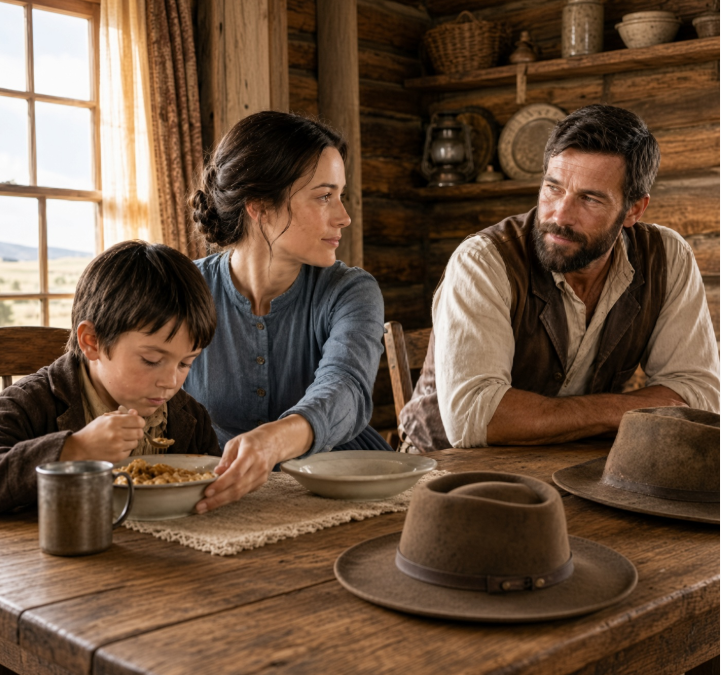
The stew had been simmering since late afternoon. Beans, potatoes, onion, salt pork, and the last of yesterday’s beef cut small enough to stretch. Caleb added more water, more potatoes, and a second handful of beans without comment.
Jesse stood beside the table, both hands at his sides.
“You can sit,” Caleb said gently.
The boy looked to Norah.
She nodded.
He climbed into the chair across from Caleb with the solemn care of a much older child.
Caleb set bowls on the table.
Bread.
Butter.
Tin cups.
Norah sat only after Jesse had been served.
When Caleb placed a bowl in front of her, she thanked him but did not lift the spoon.
Jesse waited until his mother nodded again.
Then he began to eat.
Not greedily.
That would have been easier to watch.
He ate steadily and carefully, the way children eat when they have learned that meals are not guaranteed and haste might make someone take the bowl away.
Caleb had seen half-starved ranch dogs eat like that after being beaten off scraps.
Jesse scraped the bottom of his bowl clean.
Norah’s plate remained untouched.
Without a word, she pushed it toward him.
A movement so practiced it barely looked like decision.
More like arithmetic.
One empty child.
One full plate.
A mother’s hunger removed from the equation.
Caleb reached for the pot.
Norah’s hand lifted sharply.
“Let the boy eat,” she whispered.
Her voice was low enough that Jesse might not hear, though Caleb did.
“Please. He hasn’t had enough in three days. I can wait.”
Caleb looked at the untouched plate.
He looked at Norah’s hands, thin and roughened, the knuckles reddened from weather, the nails worn short by work that had not fed her properly in return.
He looked at Jesse, still eating carefully, eyes lowered to the plate as if shame and hunger had become tangled together somewhere on the road.
Caleb said nothing.
Not because there was nothing to say.
Because saying the wrong thing would turn her sacrifice into something she had to defend.
He stood, crossed to the stove, filled a second bowl, and set it in front of Norah.
Then he sat down again.
Norah looked at the bowl.
Then at him.
Something in her composure cracked very quietly.
She mastered it almost at once.
“You don’t have to do that.”
“Wasn’t a question.”
She stared at him.
He picked up his own spoon and ate, giving her the mercy of not watching too closely.
After a moment, Norah lifted her spoon.
Her hand shook once.
Only once.
She ate slowly at first, as if her body did not quite trust the food would remain. Then with more steadiness.
Jesse glanced at her bowl, then at Caleb.
For the first time since arriving, some of the tightness in the boy’s shoulders loosened.
That was when something shifted in Caleb’s chest.
Not pity.
He distrusted pity. Pity stood too far above the person it claimed to feel for.
What he felt was recognition.
Quiet.
Immediate.
This woman had been taking care of everyone around her for so long that no one had thought to take care of her in return.
And she had stopped expecting it.
That struck Caleb harder than tears would have.
Norah told him pieces that first evening.
Not the whole story.
The whole story came later, over weeks, parceled out the way careful people portion trust—small, deliberate measures, never more than they can afford to lose if the person receiving it proves unworthy.
She told him she was traveling north.
She said she had family near Helena.
She said her husband was dead to them.
That phrase told Caleb enough not to ask more in front of the boy.
Jesse fell asleep sitting up by the time the last light left the windows. His head drooped forward, then jerked up again with startled determination, as if sleep itself were another thing he needed permission to trust.
Norah reached for him.
“I should get him outside. We can sleep in the barn if—”
“No.”
The word came out too sharp.
Caleb softened his voice.
“There’s a spare room. Clean bed. Door closes. You and the boy can have it.”
Norah’s eyes flicked toward the hallway.
“We can’t impose.”
“You’re not.”
“We can leave at first light.”
“You can decide that after first light.”
She looked at him, searching again for the cost.
Caleb met her gaze evenly.
“The road to Helena is weeks by foot from here. More if weather turns. Neither of you is fit for that yet.”
“I’ve managed worse.”
“I believe you.”
That stopped her.
He continued, “Doesn’t mean you should have to manage this tonight.”
For a long moment, she did not move.
Then Jesse made a small sound in sleep and leaned fully against her side.
Norah closed her eyes.
Only briefly.
“Yes,” she said. “Thank you.”
Caleb showed them the spare room.
He brought an extra blanket, then set it on the chair instead of coming too far inside. He pointed out the latch on the inside of the door.
Norah noticed.
Of course she did.
“There’s water in the pitcher,” he said. “If you need anything, my room’s across the hall.”
Then, after a moment, “I won’t come in unless you ask.”
Norah’s hand rested on Jesse’s shoulder.
“Thank you.”
Caleb nodded and left.
In his own room, he lay awake longer than usual, listening to the unfamiliar presence of other people in his house.
Once, near midnight, he heard a floorboard creak.
Then another.
A soft sound near the kitchen.
He rose quietly, opened his door enough to see.
Norah stood by the stove in the dark, one hand pressed against the table edge.
Not stealing.
Not searching.
Just standing in a room where food had been given without a price, trying, perhaps, to believe it.
Caleb stepped back without speaking and closed his door.
Some things a person should not be seen learning.
By morning, Norah had made the bed, folded the blankets, washed the bowls, swept the kitchen floor, and started splitting kindling from the pile near the stove before Caleb finished feeding the horses.
When he came inside, she was kneeling near the hearth with Jesse still asleep in the spare room.
He leaned against the doorway.
“You don’t have to earn breakfast.”
She stiffened.
“I wasn’t—”
“I know.”
She looked down at the kindling.
“It’s difficult not to.”
Caleb took off his hat and hung it by the door.
“Then don’t stop all at once.”
She looked up.
He moved toward the stove.
“But eat first.”
Norah opened her mouth, likely to protest.
Caleb held up one hand.
“Wasn’t a question.”
For the first time, something almost like humor touched her eyes.
Not a smile.
The possibility of one.
Jesse woke after breakfast had started cooking.
He came out barefoot, hair rumpled, wearing the cautious expression of a child who did not yet know whether yesterday’s safety had survived the night.
When he saw Norah at the table with a plate of her own, he stopped.
Looked at Caleb.
Looked back at his mother.
Then climbed into his chair.
“Morning,” Caleb said.
Jesse nodded gravely.
“Morning.”
That was the first word Caleb heard him speak.
By the second day, Jesse had begun following Caleb at a distance.
Not close enough to be invited into work.
Not far enough to pretend he was uninterested.
He watched Caleb carry feed, check fence, repair a gate latch, and curry a mare named Blue who tolerated everyone and liked almost no one.
On the third morning, Jesse stopped beside a fence post near the corral and frowned.
“That one’s leaning.”
Caleb glanced over.
“It’s sound.”
“It’s leaning.”
“It’s been there six years.”
Jesse looked at him with the steady disapproval of a foreman assessing substandard work.
“It’s leaning,” he repeated.
Caleb stared at the post.
It was, in fact, leaning no more than an inch.
Maybe less.
He looked toward the porch.
Norah stood with a tin cup in both hands, watching.
There was something on her face Caleb had not seen before.
The beginning of a smile she was not yet ready to fully commit to.
Caleb sighed, picked up the post maul, and fixed the fence post.
Jesse watched the entire repair with solemn satisfaction.
When Caleb finished, the boy nodded once.
“Better.”
Caleb looked at Norah.
She looked down at her cup quickly.
That evening, after Jesse fell asleep in the chair with the barn cat under his dangling hand, Norah said, “He used to be loud.”
Caleb looked up from mending a strap.
“Jesse?”
She nodded.
“He was loud when he was very small. Loud and careless and entirely unafraid of anything.”
Her voice remained even, but Caleb heard the grief under it.
“I miss that version of him more than I like admitting.”
Caleb kept his eyes on the leather.
“He may find some of it again.”
Norah looked toward Jesse.
“Do children do that?”
“Sometimes.”
“How would you know?”
He pulled the needle through.
“Animals do.”
She looked back at him.
“That’s not the same.”
“No.”
He tied off the thread.
“But it isn’t entirely different either.”
He thought of horses that had come to him half-wild from bad handling. How they watched every movement, flinched at the sound of a rope, trembled when a hand approached too fast. No amount of telling them they were safe made them believe it.
Safety had to become the weather.
Every day.
Same voice.
Same pace.
No sudden hands.
No punishment for fear.
Eventually, if the animal chose, the world changed shape.
Caleb suspected people worked much the same way, though they resented being understood in such plain terms.
He did not say all that.
Instead, he said, “I’ve seen frightened things remember they were not born frightened.”
Norah looked at him a long while.
Then down at her sleeping son.
“I would like that,” she said.
Over the next week, Caleb made the ranch predictable.
Not dramatically.
Drama would have defeated the purpose.
He announced himself before entering rooms.
He kept his voice even.
He never came up behind Jesse without making sound first.
He let the boy approach the horses only when the horses were calm.
He did not press Norah for the whole story.
He left extra food on the stove after supper, enough to make second helpings ordinary rather than charity.
He noticed she ate last every time.
Not occasionally.
Every time.
She served Jesse first. Then Caleb if he let her. Then herself from whatever remained.
It was so automatic he doubted she recognized it as deprivation anymore.
The habit lived in her body.
His mother had done the same thing for thirty years.
Quietly.
Efficiently.
So consistently that no one remarked upon it until she was gone and the empty chair made the pattern visible.
Caleb refused to make Norah defend the habit before she was ready.
Instead, he cooked more.
He placed the pot where she could reach it.
He left bread sliced.
He stepped away from the stove before she could turn serving into proof she had earned her place.
Small things.
Repeated.
Unremarkable.
That was how trust began.
Norah noticed.
He saw it in the gradual lowering of her shoulders.
In how she began lingering on the porch after supper instead of retreating to the spare room as soon as dishes were done.
In the questions she started asking.
Did the creek freeze solid or only slow in winter?
How many cattle could the valley carry without cutting hay too far down?
Did mountain storms come from the west every time?
How far was the nearest school?
That question came three evenings into the second week.
Caleb looked over.
“School’s a full day’s ride.”
Norah’s mouth tightened slightly.
She had not meant to reveal interest in a future.
Not yet.
“Jesse knows some letters,” she said.
“I can see that.”
“You can?”
“He stares at the labels on my feed sacks like he’s fighting them.”
For the first time, Norah laughed.
It startled both of them.
It was small, not fully released, but real.
Jesse looked up from the barn cat.
Norah covered her mouth as if she had done something improper.
Caleb pretended not to notice because he wanted it to happen again someday.
“You’re very quiet about your own life,” she told him one evening.
They were sitting on the porch, watching the mountains fade from purple to black while the first stars opened above the ridge.
“For a man who’s given us his spare room and food without asking much in return.”
“Not much to tell that the ranch doesn’t already say.”
“A ranch can say a great deal and still leave out the parts a man chooses not to mention.”
Caleb leaned back in his chair.
“Man builds a place alone, runs it alone, keeps it going through winters that test whether the building was worth doing. Most of what I am is in the work itself, not in any story I tell about it.”
Norah watched him.
“That’s a lonely way to live.”
Caleb looked out at the valley.
“Was.”
He left the past tense between them.
Deliberate.
Unhurried.
Norah heard it.
He knew because she did not ask him to explain.
The letter from Helena arrived three weeks after they came to the ranch.
A rider brought it from the post road along with a parts order Caleb had nearly forgotten. Norah recognized the handwriting before opening it. Her face changed so quickly Caleb looked away, giving her privacy inside the same room.
She read it at the kitchen table after Jesse fell asleep.
Caleb sat by the fire mending tack, lamplight warm against the log walls.
The letter was from her aunt Ruth in Helena.
A distant relation Norah had never met, known only through an old letter her mother once kept in a sewing box. Ruth had room. Not much, but enough. Work was available. Not fine work, but honest. A woman and small boy could come if they did not mind close quarters.
It was exactly the lifeline Norah had been walking toward since the night she left Tulsa.
The fixed point on the horizon.
The destination that had made each mile bearable.
She should have felt relief.
Instead, she sat holding the paper while Caleb worked quietly across the room and felt something she had not prepared for.
Reluctance.
Not fear of the road ahead.
Attachment to the weeks behind her.
The spare room she had started tidying according to her own sense of order.
Jesse’s laugh that morning when the barn cat stole a scrap of bacon.
The way Caleb left food on the stove without comment.
The way he moved through the house like a man who understood that safety was built from not making people flinch.
“Good news?” Caleb asked, not looking up.
Giving her room to answer or not.
“My aunt has room for us.”
His hands paused only a fraction before resuming the stitch.
“That is good news.”
“It’s what I was waiting for.”
He nodded.
His voice, when he spoke, had gone careful.
“When would you need to leave?”
Norah looked down at the letter.
There was no need.
That was the startling part.
No one chasing them that she knew of.
No pressing deadline.
No reason except the reason that had carried her here.
“Soon,” she said.
Caleb nodded again.
The silence that followed held more weight than either of them was willing to name.
Jesse said it aloud three days later.
He was helping Caleb feed the horses, which mostly meant holding small measures of grain with the solemn concentration of a boy performing surgery. His little brows drew together whenever a horse pushed too eagerly, and Caleb had to keep from smiling.
Norah watched from the porch, coffee cooling in her hands.
Jesse looked up suddenly.
“Are we staying here?”
Caleb looked at Norah.
Said nothing.
The question belonged to her.
“We’re going to Helena,” Norah said carefully. “To Aunt Ruth’s house. I told you about it, remember? She has room for us. There’s work for me there.”
Jesse considered this with the grave attention he brought to all serious matters.
He looked at the horse.
Then at Caleb.
Then back at his mother.
“But Caleb’s horses need feeding.”
Norah’s composure did not crack.
Not visibly.
Something behind it shifted.
“Caleb managed before we came,” she said gently. “He’ll manage after.”
Jesse looked unconvinced.
Caleb poured grain into the trough.
Quietly enough that Jesse would not hear, but Norah would, he said, “Managed, yes.”
Norah’s eyes moved to him.
He did not look up.
“Managing and wanting to are different things.”
She packed their bag that evening.
The same single bag she had carried from Tulsa.
The same bag that had held the coin-hidden coat lining, Jesse’s spare shirt, a small comb, a needle case, and the last scraps of a life she had escaped.
It should have felt lighter now.
They had eaten.
Rested.
Washed.
Jesse had new socks Caleb had insisted were extras from a winter order, though Norah suspected there had been no extras before he rode to the supply store.
But as she folded Jesse’s clothes into the bag, it felt heavier.
Leaving a place her son had begun to trust weighed more than leaving one they had needed to survive.
She sat on the edge of the spare bed.
Half-packed bag beside her.
Mountains visible through the window.
She thought about the first night.
The second bowl.
The way Caleb had not asked permission to feed her because he somehow understood she would have refused.
She thought about how he announced himself before entering rooms.
How Jesse had started talking in full, breathless streams about horses and fence posts and whether the barn cat had opinions.
She thought about Lyall too.
That was necessary.
Because fear, ignored, often dressed itself as wisdom.
Lyall had seemed kind at first.
In the early months, he made her laugh over supper. Brought ribbons from town. Spoke softly around her family. Presented himself as a cattle buyer with steady work and modest prospects. The credentials held long enough for the wedding.
Then came the truth underneath.
Drinking that reorganized a household around itself.
Which evenings were safe.
Which version of him would come through the door.
The weight of boots on porch boards.
The angle of his hat brim.
The tightness in his voice.
Norah had learned that arithmetic so quickly and so completely she had stopped calling it fear.
She called it paying attention.
She saved coins in the lining of a winter coat Lyall never wore.
A coin here.
A coin there.
Never enough missing at once to notice.
Nearly two years of patience.
The same vigilance once spent surviving, slowly turned toward escape.
She told no one.
Not her mother.
Not the priest.
Not the one friend who knew fragments of the truth.
Telling left trails.
Trails were how men found what they believed belonged to them.
Three weeks ago, she had taken Jesse and the bag and gone north.
Now she sat in a safe room and asked herself whether safety was real or only waiting to close.
The next morning before dawn, she found Caleb at the corral.
The mountains were just beginning to catch pale light. Frost silvered the grass. Caleb stood with one boot on the lower rail, checking a leather lead by touch.
He looked over when he heard her.
She had not tried to be silent.
That itself was new.
“How do you know?” she asked.
He lowered the lead.
“How does a person tell the difference between a place that’s safe and a place that only feels safe long enough to trap you in it?”
Caleb was quiet.
The kind of quiet that did not avoid the question.
The kind that gave it room.
“I don’t think you can know for certain in advance,” he said finally. “Not with places. Not with people.”
Norah wrapped her shawl tighter.
“That isn’t comforting.”
“No.”
He rested one hand on the fence rail.
“I think you watch what a person does when nothing requires them to be decent. When there’s no audience. No obligation. No advantage. No reason to perform kindness except that kindness is what they do when nobody’s keeping score.”
She looked at him.
He continued carefully.
“I’ve been this way with you and Jesse because it’s how I’m built, not because I want something in return. Whether that’s enough to trust is something only you can decide. I won’t pretend I have any right to rush that decision.”
Norah looked past him toward the valley.
“What if I decide wrong?”
“Then you leave.”
“And if leaving hurts Jesse?”
“Staying where your heart already left would hurt him too.”
She looked back at him.
Caleb’s face was calm, but not empty.
She had learned enough of him now to recognize that the more he felt, the stiller he often became.
“You would let us go?”
His jaw shifted once.
“Yes.”
“Even if you didn’t want us to?”
His eyes stayed on hers.
“Especially then.”
Norah looked down.
The frost had begun melting in the first light.
She hated that answer.
She trusted it more than any promise he might have made.
Two days later, she found him mending fence on the north section.
The valley stretched gold and open around him. Mountains blue behind. Wind moving through the grass.
“I wrote back to my aunt,” Norah said.
Caleb set down the wire cutters and gave her his full attention.
“Told her we’d be delayed.”
He nodded slowly.
“Didn’t tell her how long.”
“All right.”
“I’m not staying because I have nowhere else to go.”
“I know.”
“I need that plain between us.”
“It is.”
“I spent four years making decisions out of necessity instead of choice. I don’t intend to start a new life by repeating the same pattern in a gentler setting.”
Caleb waited.
Norah drew a breath.
“I’m staying because my son laughed yesterday for the first time since we left Tulsa. Feeding grain to a horse with a man who hasn’t raised his voice once in three weeks of sharing a house with a stranger and her child.”
Her voice trembled, but she did not stop.
“That isn’t nothing, Caleb. It isn’t gratitude. It isn’t convenience. I don’t have a word for what it is yet, but I know it’s worth staying long enough to find one.”
Caleb looked at her for a long time.
Morning light caught something in his expression he had carefully kept hidden.
“I’ve been watching you give away your own plate for three weeks,” he said.
Norah went still.
“Watching you feed Jesse first and yourself last like your hunger doesn’t count in whatever arithmetic you’ve been running since long before you got here.”
She swallowed.
“I didn’t want you to feel watched,” Caleb said. “Not in a house where you’d only just started feeling safe. So I said nothing. But I see it, Norah. Every evening. Every plate you push toward Jesse instead of eating from it yourself. I see the size of what that costs you.”
Her eyes filled despite her effort.
“And I’d like,” he said, voice low, “if you’ll let me, to be the kind of man who makes sure you never have to run that arithmetic again.”
Wind moved between them.
The mountains stood vast and patient.
Norah pressed one hand against her mouth.
“That is the kindest thing anyone has said to me in four years.”
Caleb’s face tightened.
“And you said it,” she continued, “by describing a thing I didn’t even realize I was doing until you told me you’d noticed.”
He stepped no closer.
That mattered.
Norah crossed the distance herself.
Not into his arms.
Not yet.
Only to stand beside him at the fence, close enough that their sleeves nearly touched.
For both of them, it was enough.
Norah stayed through summer.
Then autumn.
By the time the first real snow settled on the mountains above Brier Creek, she had stopped thinking of the spare room as temporary and begun thinking of it as hers.
She realized it one morning while rearranging the small shelf above the bed without asking permission. The realization startled her with equal parts alarm and warmth.
Jesse changed too.
The quiet boy who had arrived with watchful eyes and careful hands began talking constantly.
Questions about horses.
The creek.
Why mountains changed color depending on the hour.
Whether the barn cat had a name or simply did not care enough about names to answer one.
“Does she have a name?” Jesse asked Caleb one morning, crouched near the cat with the focus of a diplomat conducting treaty negotiations.
“Called her Cat.”
Jesse frowned.
“That’s a terrible name.”
“She never complained.”
“I’m calling her Raina.”
The cat purred, either agreeable or indifferent.
Caleb looked at Norah.
“Seems settled.”
Jesse became unafraid in increments.
He ran across the yard one October morning and tripped hard enough to scrape both palms. Norah’s body moved before thought, old fear surging, but Caleb was closer.
He crouched, not reaching too fast.
“You’re hurt?”
Jesse looked at his palms.
His lip trembled.
Caleb waited.
The boy began to cry.
Not silently.
Not neatly.
A full child’s cry.
Norah stood frozen halfway across the yard, tears in her own eyes.
It was strange, the things that proved healing.
Not courage.
Crying.
Jesse had trusted the world enough to be loud in it.
Caleb washed the scrapes.
Norah held him.
Raina, deeply unimpressed, sat on the fence post.
That evening, Norah stood on the porch beside Caleb and said, “I missed that sound.”
He glanced at her.
“Him crying?”
“Him believing someone would come.”
Caleb looked toward the barn, where Jesse was telling Raina she needed better manners.
“He’s finding it.”
“So am I,” Norah said.
The words surprised her.
Caleb turned fully toward her.
She looked at the mountains.
Not because she did not want to look at him, but because looking at him made the words larger.
“I still wake some nights thinking I hear boots on porch boards.”
Caleb said nothing.
“I still count coins in my head sometimes. How much is hidden. How far it could carry us. Whether Jesse could walk another day if we had to leave quickly.”
Her voice thinned.
“I hate that I do that.”
“I don’t.”
She looked at him sharply.
“I hate that you had reason to learn it,” Caleb said. “But I don’t hate the part of you that kept you alive.”
Norah’s eyes burned.
“That part is tired.”
“I know.”
She laughed once, softly, through tears.
“You say that a great deal.”
“Usually because I do.”
Snow came hard in November.
The valley closed in.
The road became unreliable. The creek slowed under ice. Caleb taught Jesse how to break water for the horses safely, how to carry kindling without dropping half of it, how to listen for weather in wind hitting the north wall.
Norah taught Jesse letters at the kitchen table.
She had not expected to love teaching.
At first, she did it because the nearest school was a full day’s ride, and winter made travel foolish.
Then she discovered the satisfaction of watching Jesse’s mind open.
He learned quickly, especially when the words involved ranch life.
Horse.
Creek.
Barn.
Snow.
Cat.
He insisted Raina should be practiced daily.
Norah wrote it.
Raina walked across the paper with muddy paws.
Jesse declared this a signature.
By December, evenings had taken on a rhythm that felt dangerously like happiness.
Supper.
Dishes.
A small lesson.
Caleb mending tack or carving replacement pegs by the fire.
Jesse asleep on the rug with Raina nearby.
Norah at the table, sewing or reading a borrowed book from Caleb’s small shelf.
Sometimes she and Caleb spoke.
Sometimes not.
The silences had changed.
Silence with Lyall had been a room holding its breath.
Silence with Caleb was the fire settling, snow at the window, a man nearby who did not require anything of her fear.
On a clear December morning, fresh snow made the whole valley look newly created.
The mountains stood white and bright under a pale sky. Smoke rose straight from the chimney. The world seemed to be holding still long enough for a decision.
Norah found Caleb in the kitchen before Jesse woke.
He had come in from the fence line, coat dusted with snow, hands red from cold.
“I’d like to stay,” she said.
He stopped.
She held herself steady.
“Not temporarily. Not as a guest. Not because I have nowhere else to go. I have somewhere else. Ruth’s letter is still good. The work in Helena is still available.”
Caleb said nothing.
“I am choosing this,” she continued. “You. This ranch. The life Jesse is becoming in it.”
Her breath shook.
“I want that clear because I spent four years having choices made for me. I don’t ever intend to let anyone, including myself, mistake what I’m doing here for anything less than a free, clear decision made with both eyes open.”
Caleb crossed the kitchen slowly.
He moved as he always moved around something he cared about too much to risk startling.
He took her hands in both of his.
His hands were rough from morning work, cold from the fence line.
She held them anyway.
There was honesty in that cold.
He had not warmed himself before coming to her.
“I fell for you the night you pushed your plate toward your son without a word,” he said.
Norah’s eyes filled instantly.
“I didn’t say it then because you needed safety more than you needed a man’s feelings to manage on top of everything else. I didn’t say it after because you needed time to know safety wasn’t a performance.”
His thumbs rested lightly over her knuckles.
“I’m saying it now because you’ve told me plainly this is your choice. And I’d like to tell you plainly it’s mine too. It has been since that first bowl I set down in front of you without asking.”
Norah let out a breath she seemed to have held for years.
“Then let’s build something here.”
“Together?”
“Together. The three of us.”
He looked toward the hallway where Jesse slept.
“Yes,” he said.
They married that spring on the ranch porch.
No church.
No crowd large enough to make Norah feel cornered.
Only a few neighbors from Brier Creek, Caleb’s nearest ranching friends, the circuit preacher, and Jesse standing between them holding both their hands.
Caleb insisted on that.
“Any marriage worth having,” he told Norah the night before, “is one a boy can stand inside without feeling like a guest at his own family’s beginning.”
Jesse took his duty seriously.
He held both hands, looked sternly at the preacher, and interrupted once to ask whether Raina was allowed to attend.
Raina, who had already invited herself onto the porch rail, blinked with complete innocence.
“She can witness from there,” Caleb said.
Jesse nodded, satisfied.
The mountains behind them were full green, the valley wild with lupine and Indian paintbrush. Norah wore a simple dress she had altered herself. Caleb wore his best coat, which Jesse had brushed with great enthusiasm and uneven results.
When the preacher asked if Caleb took Norah, Caleb looked at her as if the question was too small for the answer.
“I do.”
When he asked Norah, she did not look down.
“I do.”
Jesse squeezed both their hands.
That evening, after the neighbors left and the dishes were done, Norah stood at the table and realized she had eaten a full supper without once counting portions.
The awareness struck her so suddenly she had to sit.
Caleb noticed.
Of course he did.
“You all right?”
She looked at her plate.
Then at him.
“I didn’t think about it.”
“What?”
“Whether there would be enough.”
Caleb’s expression softened.
Jesse, half-asleep in his chair, mumbled, “There’s pie.”
Norah laughed.
A full laugh this time.
Loud enough that Jesse smiled without opening his eyes.
The years that followed did not erase the past.
Nothing honest does.
Norah still had dreams sometimes.
Rain against windows could make her pulse jump if it came with the wrong wind. A man shouting at a horse in town could turn her cold before reason caught up. Once, months after the wedding, a rider arrived unexpectedly near dusk and Jesse, now six, moved behind her without thinking.
Both of them noticed.
Both of them grieved it.
Then Caleb stepped onto the porch, called out his own name loudly before the stranger reached the yard, and stood angled just enough that Norah and Jesse were behind him without being hidden.
Small things.
Repeated.
The body learned slowly.
The ranch grew around their griefs until the griefs no longer filled every room.
Jesse became a valley boy.
Curious.
Direct.
Unusually observant.
Prone to correcting fence posts, renaming animals, and asking adults questions they were not prepared to answer.
Caleb encouraged this rather than correcting it.
A boy who had once learned silence needed active permission to discover his voice belonged in every room of his own house.
Norah taught him lessons through winter. Reading, numbers, Bible passages, letters to Aunt Ruth, and accounts for ranch supplies. She found she loved teaching not because she was patient—though she was—but because learning changed Jesse’s face.
It gave him hunger that had nothing to do with food.
Aunt Ruth visited the following summer.
She arrived in a hired wagon, stepped down stiffly, looked at the mountains, and declared them entirely too tall for sensible living.
Then she hugged Norah for a long time.
She approved of Caleb in her own dry manner by criticizing his coffee and asking for a second cup. She taught Jesse card games Norah suspected were not entirely appropriate for a six-year-old. She fed Raina from the table and denied it with crumbs still visible.
Before leaving, Ruth stood beside Norah at the creek.
“You could have come to Helena,” she said.
“I know.”
“I would have made room.”
“I know.”
Ruth looked toward the house, where Caleb was showing Jesse how to mend a broken strap.
“You chose well.”
Norah watched Caleb laugh at something Jesse said.
“I chose,” she said softly.
Ruth looked at her then and understood why that mattered.
Norah kept one thing from the old life.
In the bottom of the same bag she had carried from Tulsa, wrapped in cloth, lay a single coin.
The first coin she had hidden in the lining of Lyall’s winter coat.
The beginning.
Before enough money for a wagon.
Before the rail ticket.
Before Brier Creek.
Before Caleb’s table.
Only one coin and a decision no one else could see.
She showed it to Jesse when he was old enough to understand.
He was ten then, nearly the age Toby from another story might have been, though Norah did not know that story and did not need to.
Jesse held the coin carefully.
“This bought our freedom?”
“No,” Norah said. “It started it.”
He turned it over.
“It’s small.”
“Yes.”
She closed his fingers around it.
“Courage often is at first.”
He looked up.
“I thought courage was big.”
“Sometimes. But sometimes courage is a single coin hidden where nobody thinks to look. Sometimes it is leaving before dawn. Sometimes it is walking when your feet hurt. Sometimes it is eating the bowl someone sets in front of you because your child needs to see that his mother is allowed to live too.”
Jesse looked toward the porch where Caleb was repairing a saddle strap.
“Did Caleb save us?”
Norah considered the question carefully.
“He opened a door,” she said. “He fed us. He gave us a safe place. That matters.”
“But?”
“But a person is not a lost calf to be rescued and owned.”
Jesse frowned thoughtfully.
“We chose to stay.”
“Yes.”
“Because he’s good?”
“Because he is good when nobody is keeping score.”
Jesse accepted that.
He kept the coin for the afternoon, then returned it to her before supper.
“I think you should keep it,” he said. “In case you need remembering.”
Norah kissed his head.
“I remember.”
And she did.
Every time she filled three plates.
Every time she sat before serving seconds.
Every time Caleb wordlessly placed the bread nearer to her hand.
Every time Jesse laughed too loudly in the yard.
Every time the house stayed peaceful through a storm.
Years later, when the Maddox table was scarred by use and Jesse’s boots grew nearly as large as Caleb’s, Norah still thought of that first supper.
Not the wedding.
Not the porch ceremony.
Not even the morning she chose to stay.
The second bowl.
That was where the story lived.
A man saw a woman give her food away and did not praise her sacrifice.
Did not shame her for it.
Did not demand the history that had taught her to disappear from her own hunger.
He simply stood, filled another bowl, and set it down.
No speech.
No bargain.
No expectation.
A quiet correction of an injustice so small most people would have looked straight past it.
That was the whole thing, really.
Not rescue.
Not charity.
A refusal to let someone go hungry at his table.
Offered without performance.
Received by a woman who had spent four years learning that every kindness eventually revealed a price she could not afford.
A bowl of food freely given.
No invoice hidden beneath it.
Some love stories begin with grand declarations.
This one began with a woman whispering, “Let the boy eat.”
And a cowboy understanding that love should not require a mother to starve.
So he gave her a bowl.
And then, slowly, patiently, without ever asking her to trust faster than she could, he gave her a life where she never had to choose between feeding her child and being allowed to hunger herself.
In the mountains above Brier Creek, that was how love took root.
Not as a promise shouted into the sky.
As supper on the table.
A door left open.
A voice kept gentle.
A man who noticed.
A woman who chose.
A boy who learned to laugh again.
And one small second bowl, set down without a word, that became the beginning of home.


