K9 REX NEVER MISSED A COMMAND IN NINE YEARS—BUT HIS FINAL RADIO CALL LEFT HIS HANDLER UNABLE TO ANSWER
PART3″
Police officers are rarely that quiet unless something is very wrong.
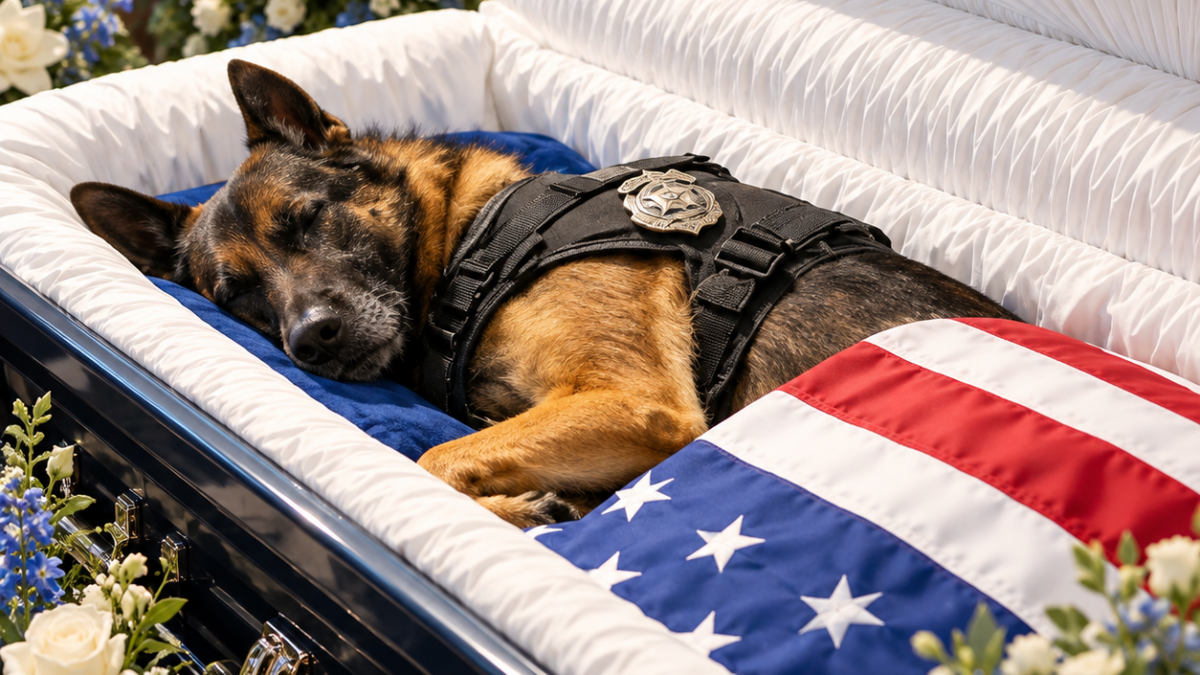
Inside the ceremonial hall stood Rex’s casket.
Black polished wood.
White interior.
Flowers arranged around it.
Blue.
White.
Green.
And across part of his body rested the American flag.
His police harness had been placed over his chest.
The same black harness I had clipped onto him thousands of times.
The same one he used to hear before I ever said a word.
That click had always meant work.
The instant he heard it, his ears came up.
Body changed.
Eyes sharpened.
He knew.
Harness on.
Time to go.
That morning the harness was perfectly clean.
Badge polished.
Straps straight.
And Rex was not moving beneath it.
His eyes were closed.
His head rested against the white lining.
Someone had brushed his coat until the black and tan fur shone.
He looked almost asleep.
Almost.
That word can destroy you.
Almost sleeping.
Almost breathing.
Almost waiting for the command to rise.
I stood twenty feet away and could not walk closer.
Captain Herrera came beside me.
He did not touch me.
I appreciated that.
“You ready?”
“No.”
He nodded.
“Neither are we.”
I stared at Rex.
Officers had already begun filing past him.
Some saluted.
Some placed a hand briefly against the side of the casket.
One old officer whispered something I could not hear.
A young K9 handler brought his Belgian Malinois close.
The dog smelled the air.
Then lowered his head.
That nearly broke me before the ceremony even started.
I whispered:
“He hated Malinois.”
Captain Herrera almost smiled.
“Rex hated everybody faster than him.”
“That’s true.”
For half a second, Rex was alive again.
Running a training field.
Barking at another dog because he believed the entire world existed twenty seconds too slowly.
Then I looked back at the casket.
Gone.
The room filled.
Families.
Officers.
Veterinarians.
Dispatchers.
Retired handlers.
Children Rex had visited during demonstrations.
People I had not seen in years.
And sitting in the second row was my son, Mateo.
He was seventeen by then.
The first time Rex met him, Mateo was eight years old.
He had grown up with that dog.
Rex had been there for baseball games.
Middle-school heartbreak.
The day Mateo got braces.
The night he broke his wrist.
The first time I let him drive my truck around an empty parking lot.
Rex had also been the reason Mateo learned not to leave food unattended.
My son looked at the casket and kept wiping his face with the sleeve of his black suit.
Beside him sat my wife, Elena.
She held Rex’s old leather collar in both hands.
Not his working collar.
His home collar.
Brown leather.
Cracked near the buckle.
Metal nameplate worn nearly smooth.
REX.
REYES FAMILY.
PHONE NUMBER.
As though anybody who found him would ever have been able to keep him long enough to make the call.
I finally forced myself forward.
One step.
Then another.
I stopped beside the casket.
My hand hovered over Rex’s head.
I had touched that dog every day for nine years.
Thousands of times.
Between the ears after a good search.
Under the jaw while checking him for injuries.
Across the ribs after long shifts.
Both arms around him during storms because he was fearless around gunfire and inexplicably offended by thunder.
Now I was afraid to touch him.
Because warmth had always been part of Rex.
Heat beneath the fur.
Breath.
Muscle.
Movement.
Touching him now would make the truth physical.
Elena appeared beside me.
“You don’t have to.”
“Yes, I do.”
I placed my hand between his ears.
Cold.
That was the moment the ceremony became real.
Not the casket.
Not the uniforms.
Not the flag.
Cold.
My dog was cold.
I closed my eyes.
And suddenly I was standing nine years earlier on a training field, watching an eighteen-month-old German Shepherd ignore me completely.
**FULL STORY CONTINUATION 👇👇**
The first thing Rex ever did to me was embarrass me.
Our K9 trainer, Sergeant Bill Morgan, led me toward a row of kennels and said:
“Pick carefully.”
I had waited almost three years to become a K9 handler.
Interviews.
Physical testing.
Extra certifications.
Weekend training.
And months of irritating every supervisor above me until they finally gave me a chance.
I expected some dramatic moment.
Handler meets dog.
Dog looks into man’s eyes.
Instant bond.
Hollywood nonsense.
Rex was sitting inside the third kennel licking his front paw.
Morgan stopped.
“This one.”
I looked at the dog.
The dog did not look at me.
“That’s Rex?”
“That’s Rex.”
“He know I’m here?”
“Oh, he knows.”
I crouched.
“Hey, buddy.”
Nothing.
“Rex.”
He kept licking.
Morgan smiled.
“You wanted a confident dog.”
“I wanted a police dog.”
“You got one.”
I reached toward the kennel.
Rex finally looked up.
Walked over.
Smelled my hand.
For one beautiful second, I thought the connection had happened.
Then he turned and urinated against the kennel wall.
Morgan laughed hard enough to cough.
“That mean something?”
“Yeah.”
“What?”
“He had to pee.”
That was Rex.
No symbolism.
No ceremony.
No concern for my dignity.
When Morgan opened the kennel, Rex came out like somebody had fired him from a cannon.
Eighty pounds of German Shepherd.
Black saddle.
Deep tan legs.
Dark face.
Ears upright.
He circled me twice.
Smelled my boots.
Checked my pockets.
Found the training ball hidden behind my back.
Then sat.
Perfectly.
Eyes locked on it.
I looked at Morgan.
“He likes me.”
“He likes the ball.”
“I’ll take it.”
The first months were difficult.
Rex knew more than I did.
That was the humiliating truth.
He understood tracking.
Odor work.
Building searches.
Controlled aggression.
Recall.
Basic obedience.
I understood police procedure.
But working a K9 was a language I had not yet learned.
Timing.
Body position.
Leash pressure.
Tone.
Trust.
Too much control made Rex stubborn.
Too little made him creative.
And Rex’s creativity usually ended with me apologizing to somebody.
During one early training exercise, I gave a search command.
Rex ignored the doorway I indicated.
Went left.
I corrected him.
He went left again.
“Rex.”
Left.
“Rex!”
Morgan shouted from behind me:
“Stop fighting your dog!”
“He’s wrong!”
“Are you sure?”
I was.
Until Rex scratched at a closed storage cabinet.
Morgan opened it.
The hidden training aid was inside.
I stared.
Morgan said:
“Your nose good enough to argue?”
“No.”
“Then shut up and trust his.”
Lesson one.
Rex did not need me to be the smartest creature in the room.
He needed me to listen when he knew something I didn’t.
That lesson saved my life years later.
But first, we had to learn each other.
Rex hated rain.
Not working in rain.
He would work in a hurricane if somebody held his ball.
He hated stepping into puddles unnecessarily.
He would leap over them whenever possible.
Watching an eighty-pound police dog designed to chase armed men carefully avoid getting his paws wet destroyed some of the department’s respect for him.
He loved tennis balls.
Not new ones.
Used ones.
Preferably disgusting.
He could find a ball buried beneath twenty others and somehow choose the one that looked least safe to touch.
He hated bananas.
Nobody knows why.
Mateo discovered it accidentally.
Held out a piece.
Rex smelled it.
Backed away.
Mateo laughed.
Tried again.
Rex left the room.
After that, my son occasionally placed a banana beside anything he did not want Rex stealing.
Effective security system.
Rex’s first night at our house, I made a rule.
“He does not sleep on furniture.”
Elena looked at me.
“Okay.”
“I’m serious.”
“I know.”
“He’s a working dog.”
“Daniel.”
“What?”
“I said okay.”
At 2:00 a.m., I woke because something heavy landed on my chest.
Rex.
He turned twice.
Lay down.
Eighty pounds directly across my ribs.
I pushed.
“Off.”
Nothing.
“Rex. Off.”
He sighed.
Elena opened one eye.
“Working dog?”
“Shut up.”
Within a week, Rex slept on the floor beside our bed.
Within a month, on a rug.
Within six months, somehow the rug had migrated against the side of the mattress and Rex’s head rested on the bed every night.
I blamed Elena.
Elena blamed Mateo.
Mateo blamed Rex.
Rex accepted no responsibility.
At work, he became something else.
The first real search I ever trusted him with involved a missing seven-year-old boy.
January.
Cold.
Late afternoon.
The child had wandered from his grandmother’s property near a wooded drainage area.
Autism.
Limited speech.
No coat.
By the time we arrived, he had been gone nearly two hours.
Neighbors were searching.
Officers spread out.
Everybody shouting his name.
Rex immediately became excited.
Search mode.
I collected scent from the boy’s blanket.
Let Rex work it.
Then:
“Track.”
He pulled.
Hard.
Across grass.
Down an embankment.
Through brush.
I followed.
Radio crackled.
Search teams calling negatives.
Light fading.
Temperature dropping.
Rex moved faster.
At one point, he left the obvious path and went toward thick reeds near a creek.
I almost corrected him.
Almost.
Then remembered the storage cabinet.
Trust his nose.
We pushed through.
Rex stopped.
Head lifted.
Then barked once.
I heard something.
Tiny.
Crying.
The boy was wedged between exposed tree roots above the creek bank.
Mud on his pajamas.
One sock missing.
Shivering.
Alive.
Rex reached him first.
The boy screamed when he saw the dog.
Rex stopped immediately.
No command.
Just stopped.
Then he lowered himself.
Belly on ground.
Head down.
The child stared.
Rex crawled forward slowly.
One foot.
Another.
Until his nose reached the boy’s hand.
The boy touched one ear.
Stopped crying.
I carried the child out.
Rex walked beside me.
At the ambulance, the boy refused to let go of Rex’s harness.
His grandmother kept saying:
“Thank you.”
I said:
“Thank him.”
She knelt.
Put both hands around Rex’s face.
Kissed his head.
Rex looked deeply uncomfortable.
I laughed.
That was the first time I understood something about police dogs civilians rarely see.
People imagine teeth.
Speed.
Violence.
They see videos of dogs taking suspects down.
But most of Rex’s greatest work was not dramatic.
It was finding.
A child.
An elderly man with dementia.
A woman who wandered from a crash in shock.
Evidence beneath leaves.
A weapon thrown into a field.
A frightened teenager hiding because he thought being arrested meant his life was over.
Rex found things people had lost.
Sometimes that included hope.
Three years into our partnership, we responded to the call that changed how I trusted him forever.
Domestic disturbance.
Shots reported.
Small house at the end of a narrow street.
A man inside had threatened his girlfriend.
She escaped through a bathroom window.
He remained.
Possibly armed.
We established a perimeter.
Negotiators called.
No answer.
Hours passed.
Then information came that the suspect might have slipped out through the back.
Rex and I were sent to check a detached garage.
I remember the smell.
Wet wood.
Motor oil.
Grass.
Rex’s breathing.
I approached the side door.
Nothing.
I reached for the handle.
Rex stopped.
Not hesitated.
Stopped.
Then pulled backward.
I whispered:
“What?”
His ears locked forward.
He stared toward the dark gap beneath a raised pickup truck beside the garage.
I saw nothing.
Rex growled.
Very low.
I had learned.
Trust the dog.
I moved behind cover.
Called it in.
Another officer brought light.
Under the truck, behind the rear wheel, lay the suspect.
Handgun pointed toward where my legs had been seconds earlier.
He surrendered after officers surrounded him.
Later, investigators found the pistol loaded.
Safety off.
Fingerprints.
Everything.
I sat beside my cruiser afterward.
Rex drank water.
I stared at him.
He finished.
Looked up.
“What?”
Rex panted.
“You know you saved my life?”
Nothing.
I took his face in both hands.
“You know that?”
He licked my chin.
I hated when he did that.
That night, I got home after midnight.
Mateo was asleep.
Elena sat at the kitchen table.
She could always read me.
“What happened?”
“Nothing.”
“That means something happened.”
I told her.
Not everything.
Enough.
She walked outside to Rex.
He had just finished drinking from his bowl.
Elena knelt.
Wrapped both arms around him.
Rex looked at me over her shoulder like he was being unfairly detained.
She whispered:
“Thank you for bringing him home.”
I turned away.
Because I could not handle the sentence.
After that, Elena stopped calling Rex “your dog.”
He became “our Rex.”
Mateo already believed that anyway.
Years passed.
Rex collected scars.
A small one above his nose from broken glass.
Another beneath his chest from crawling under fencing.
A bite mark from another dog.
One torn nail.
Two cracked teeth repaired.
I collected scars too.
Mostly emotional.
Police work does that.
You go home carrying pieces of strangers.
A mother screaming after a crash.
A child’s bedroom after a homicide.
The smell of burned buildings.
A partner sitting alone after making a decision nobody should ever have to make.
You learn how to compartmentalize.
That word sounds healthy.
Sometimes it means locking pain in a box and pretending you forgot the combination.
Rex always knew when I brought something home.
I don’t know how.
Maybe smell.
Posture.
Breathing.
Maybe dogs simply notice what humans are too polite to mention.
One night, after a call involving a baby we could not save, I came home and sat on the garage floor.
Did not turn on lights.
Did not go inside.
Could not.
Rex had ridden beside me during the entire silent drive.
I opened his door.
He jumped out.
Instead of going toward the house, he walked to me.
Sat.
I put my hand on his neck.
Then I cried.
Not a few tears.
Not controlled.
I folded.
Rex stayed.
He did not lick me.
Did not move.
Just pressed his shoulder against mine.
For twenty minutes.
Maybe thirty.
Elena eventually opened the kitchen door.
Saw us.
Closed it again.
No questions.
That was our marriage at its best.
Some nights, the person you love knows that comfort means leaving the door open and walking away.
Rex never walked away.
When I finished, I whispered:
“Good boy.”
His tail hit the floor once.
That phrase had been said millions of times to dogs.
With Rex, sometimes it was the only prayer I had.
Good boy.
You found him.
Good boy.
You stopped.
Good boy.
You came back.
Good boy.
You brought me home.
At six years old, Rex started slowing slightly.
Not enough for most people to notice.
I noticed.
Handlers notice half-seconds.
A little longer getting out of the cruiser.
More stretching after long rides.
Hesitation before jumping.
Our veterinarian checked him.
Arthritis beginning.
Normal.
We adjusted.
Supplements.
Anti-inflammatory medication when needed.
Ramp for the vehicle.
I hated the ramp.
Not because it was inconvenient.
Because it represented time.
Rex hated it more.
First morning I installed it, he looked at the ramp.
Looked at me.
Then jumped beside it.
“Seriously?”
Tail wag.
I led him back.
“Ramp.”
He jumped beside it again.
By attempt four, half the shift was watching.
Somebody laughed.
Rex stared at me.
I swear he knew.
Eventually he used the ramp.
Once.
Then acted humiliated for three days.
Mateo, thirteen then, began spending more time training with us.
Not police work.
Basic obedience.
Games.
Hide-and-seek scent drills.
Rex adored him.
Mateo adored Rex.
My son once asked:
“Does he know he’s a police dog?”
I said:
“He knows he has a job.”
“What does he think your job is?”
I looked at Rex.
“Probably carrying his ball.”
Mateo laughed.
Then asked:
“When he retires, does he stay here?”
The question came too early.
Still hurt.
“Yes.”
“Forever?”
I looked at my son.
Children use forever differently.
“Yes.”
At the time, I believed it.
Rex retired officially at eight and a half.
His hips were worsening.
He was still capable.
Still motivated.
That made the decision harder.
One of the cruel truths of working dogs is that their mind can remain ready after their body begins saying no.
His final training day is still on video.
Somebody filmed it.
I have watched it twice.
Never a third time.
Rex stands on the field.
Older.
Gray around his muzzle.
Still alert.
I give commands.
“Stay.”
He holds.
“Position.”
Perfect.
Then a short search.
Finds the target.
Reward.
Ball.
I say:
“Good boy.”
Rex carries the ball proudly.
Everybody claps.
He believes he has simply completed another exercise.
He does not know it is the last time he will work wearing a police harness.
Maybe that is mercy.
We held a small retirement gathering.
No speeches.
Rex hated speeches because speeches delayed food.
They gave him a steak.
He ate too fast.
Vomited.
Then tried to eat it again.
Police hero.
After retirement, Rex became a full-time family dog.
For about two weeks he loved it.
Then he became unbearable.
At 5:30 every morning, he stood beside the bed.
Ready.
I got dressed.
He ran to the door.
I left.
He stood watching through the window.
Elena sent me photographs.
Rex beside the door.
Rex staring down the driveway.
Rex asleep with his nose on my work boot.
The first few times destroyed me.
So I changed routine.
Before shift, I walked him.
Twenty minutes.
Then removed my patrol gear somewhere he could see.
Touched his collar.
“Stay home.”
He eventually understood.
Not happily.
But understood.
Retirement gave him and Mateo something I never expected.
They became inseparable.
Homework on couch.
Rex underneath.
Video games.
Rex sleeping.
Backyard.
Rex following slowly.
When Mateo started dating his first girlfriend, Rex sat directly between them.
My son texted me:
COME GET YOUR DOG.
I replied:
OUR REX.
No help.
Elena thought it was hilarious.
Then came the morning everything changed.
Rex had been retired seven months.
It was a Tuesday.
Nothing dramatic.
No emergency.
No storm.
No chase.
I woke at 4:50.
Rex was not beside the bed.
That was wrong.
I found him in the kitchen.
Standing.
Head low.
Breathing differently.
“Elena.”
She came immediately.
“What?”
I touched Rex’s gums.
Pale.
My stomach dropped.
“Get my keys.”
Rex tried walking toward me.
His back legs folded.
I caught him.
Eighty pounds.
Suddenly too light and too heavy at once.
“No.”
I lowered him carefully.
“Hey.”
His eyes found mine.
“Stay with me.”
That command.
Stay.
I had given it thousands of times.
That morning it meant something else.
Mateo appeared in the hallway.
“What happened?”
“Get shoes.”
“Dad—”
“Shoes, Mateo.”
He did.
We lifted Rex into my truck.
I wrapped him in my patrol jacket because he was shivering.
Elena drove.
I sat in back.
Rex’s head in my lap.
Mateo beside me.
“What’s wrong with him?”
“I don’t know.”
I did.
Not specifically.
But I knew enough to recognize something terrible.
At the emergency veterinary hospital, staff took him immediately.
Doors closed.
No Rex.
That had never happened.
Even during treatment, I usually stayed close.
This time they needed room.
Blood tests.
Ultrasound.
X-rays.
We waited.
Mateo paced.
Elena prayed quietly.
I stared at double doors.
Eventually, Dr. Patel came out.
She had cared for Rex for years.
She sat across from us.
Veterinarians do not sit when news is simple.
“What?”
She looked at me.
“Daniel, the ultrasound shows internal bleeding.”
“From where?”
“There’s a mass on his spleen.”
My hands went cold.
“What kind?”
“We can’t confirm without pathology.”
“But?”
Her eyes softened.
“There’s a strong possibility it’s hemangiosarcoma.”
Cancer.
Aggressive.
Often silent.
Sometimes the first sign is bleeding.
“He was fine yesterday.”
“I know.”
“He ate.”
“I know.”
“He walked.”
“I know.”
The human mind does stupid things when it hears death.
It lists evidence against reality.
He ate.
He walked.
He barked.
Therefore he cannot be dying.
Dr. Patel continued.
“We can stabilize him.”
“Then do it.”
“We are.”
“Surgery?”
“Possible.”
“Then surgery.”
She paused.
I hated that pause.
“With his age, heart findings, and the amount of blood loss…”
“What?”
“Surgery carries significant risk.”
“Fine.”
“Daniel.”
“What?”
“If this is hemangiosarcoma, removing the spleen may give time.”
“How much?”
Silence.
“How much?”
“Sometimes weeks.”
I stared.
“Months?”
“Sometimes.”
“Years?”
Her eyes gave the answer.
Mateo stopped pacing.
“No.”
He said it quietly.
Dr. Patel looked at him.
“No.”
He shook his head.
“You said surgery.”
I put one hand on his shoulder.
He pulled away.
“No.”
He was seventeen.
Almost a man.
But grief had made him eight again.
“You fix him.”
Dr. Patel’s face broke slightly.
“I wish I could.”
That was the moment Mateo cried.
Elena took him.
I stood.
Walked to the window.
Outside, cars moved through the parking lot.
People carrying pets.
Ordinary day.
How dare the world be ordinary?
I asked:
“Can I see him?”
Rex lay inside an oxygen enclosure.
IV.
Blanket.
His eyes opened when I entered.
Tail moved once.
Once.
That tail had nearly broken lamps.
Knocked drinks.
Hit walls.
Now one small movement.
I opened the enclosure enough to touch his head.
“Hey, partner.”
He breathed.
I pressed my forehead against his.
“We’re in trouble.”
His ear moved.
I laughed once.
“You always knew before me.”
Dr. Patel stood behind me.
“What would you do?”
I hated asking.
“If he were yours?”
She took time.
“I would stabilize him enough to bring him home if possible.”
Not surgery.
I understood.
“For how long?”
“Maybe a day.”
“Maybe less?”
“Yes.”
“Could he die at home?”
“Yes.”
“Pain?”
“We can control it.”
I looked at Rex.
Police dogs spend their lives going where humans ask.
Cars.
Buildings.
Gunfire.
Crowds.
Hospitals.
Training fields.
Rex had obeyed me long enough.
I did not want his last hours under fluorescent lights because I could not let go.
“Bring him home.”
We arrived just before noon.
Rex walked inside himself.
Slow.
I had offered to carry him.
He refused by standing.
Stubborn to the end.
He went first to his water bowl.
Drank.
Then living room.
His bed.
Lay down.
Mateo sat beside him.
For the rest of that day, nobody left.
I turned off my phone.
Captain covered my shift.
Officers offered to visit.
I said no.
Family first.
Later, some came anyway.
Quietly.
Tommy from K9 unit.
Sergeant Morgan, retired now.
He had introduced us.
Morgan knelt painfully beside Rex.
Old knees.
Older hands.
Rex opened his eyes.
Morgan whispered:
“You gave him hell?”
Rex breathed.
“He needed it.”
I laughed.
Morgan stroked his head.
Then looked at me.
“You did good together.”
Past tense.
I could not answer.
Around sunset, Rex became restless.
I took him outside.
He walked to the corner of the yard where he had spent years watching the street.
Sat.
I sat beside him.
Orange light through trees.
Cars passing.
Somewhere, a lawn mower.
Mateo joined us.
Then Elena.
Nobody spoke.
Rex lay down between us.
That was our last sunset.
At 10:30, his breathing changed.
Dr. Patel had warned me.
I knew.
We loaded him into the truck again.
This time Mateo sat with him.
At the hospital, the room was dim.
Blanket on floor.
No metal table.
Dr. Patel explained the medication.
I already understood.
Still needed her to explain.
Maybe because if she kept talking, time kept moving before the final moment.
Elena kissed Rex’s forehead.
“Thank you for bringing him home every night.”
Mateo buried his face against Rex’s neck.
“I’m not ready.”
Neither was I.
Nobody is.
Mateo whispered:
“You were supposed to stay forever.”
I closed my eyes.
There it was.
The promise children think adults control.
Forever.
Rex licked Mateo’s cheek.
One weak movement.
My son laughed through tears.
“Gross.”
Perfect.
Exactly Rex.
Then Mateo stepped back.
Elena held his hand.
I stayed on the floor.
Rex’s head in my lap.
Dr. Patel administered the first medication.
His body relaxed.
Breathing eased.
I removed his police collar.
Not because I wanted to.
Because he did not need it anymore.
I put my hand over his chest.
Heart.
Still there.
I whispered every command we had known.
Not as orders.
Memories.
“Sit.”
Training yard.
“Down.”
Rain.
“Track.”
Missing boy.
“Hold.”
Dark garage.
“Come.”
Every time he ran toward me.
Then:
“Good boy.”
His eyes were almost closed.
“Good boy, Rex.”
Dr. Patel looked at me.
I nodded.
Final medication.
His heart slowed beneath my hand.
Then stopped.
I kept my hand there.
Waiting for something impossible.
One more beat.
Nothing.
I whispered:
“Stay.”
No response.
Of course.
For the first time in nine years, Rex did not obey.
Dr. Patel knelt beside me.
I do not know how long I stayed.
When I finally stood, my knees barely worked.
We left without him.
That was the worst part.
Not death.
Leaving.
I had entered thousands of buildings with Rex.
Gotten into thousands of vehicles with Rex.
Gone home thousands of nights with Rex.
That night, I walked through a veterinary hospital door carrying only his collar.
The truck felt enormous.
Mateo sat in back where Rex had been.
No one spoke.
At home, his water bowl was still half full.
A few hairs floated on the surface.
His bed had an indentation.
His tennis ball lay beneath the table.
I stood in the kitchen holding the collar.
Then collapsed.
I mean that literally.
Back against cabinet.
Floor.
Elena sat beside me.
No words.
Mateo brought Rex’s ball.
Placed it in my hand.
The disgusting yellow one.
Chewed nearly flat.
I laughed.
Then cried harder.
Police departments understand ceremony.
Maybe because ceremony gives grief something to do with its hands.
Within a day, plans began.
Honor guard.
Flag.
Flowers.
Radio call.
Department procession.
Photographs.
People asked what I wanted Rex to wear.
His working harness.
Definitely.
Which collar?
Police collar.
What flowers?
I did not care.
Music?
I did not care.
Casket?
I hated the word.
Elena chose.
Black.
White lining.
Simple.
Then the funeral home called.
“Would you like to place personal items with him?”
I looked at the tennis ball.
“Yes.”
The morning before the ceremony, I went alone.
Rex was already in the casket.
Harness in place.
Flag folded across him.
I carried the ball.
Stood there.
“This is stupid.”
No answer.
Obviously.
“You destroyed this thing.”
I held it up.
“You know how many times I told Mateo to throw it away?”
Silence.
I placed it beside Rex’s front paw.
Then stopped.
Something felt wrong.
A police dog buried with his favorite reward.
Perfect.
But Rex was not only police.
I removed the ball again.
Took it home.
Mateo looked confused.
“I thought you were putting it with him.”
“I was.”
“Why didn’t you?”
I held it out.
“Because he gave us everything else.”
Mateo stared.
“This stays.”
His mouth trembled.
He took the ball.
Still has it.
The next morning, the ceremony began.
I wore dress uniform.
I hated every inch of it.
Rex had never cared what I wore unless a ball was hidden inside it.
The honor guard entered.
People stood.
Someone spoke about courage.
Service.
Sacrifice.
Words police funerals know well.
Someone said Rex served with distinction.
True.
Someone said his memory would inspire us.
Probably.
Someone talked about the bond between handler and K9.
No speech could explain it.
Then they showed video.
Young Rex.
Training field.
Running.
Barking.
Leaping.
My voice:
“Stay.”
Rex holding position.
“Good boy.”
Another clip.
Rex panting.
Rolling in grass.
People laughing.
Then older footage.
Demonstrations.
Children petting him.
Rex looking bored.
Every version of my dog alive on a screen while his body lay ten feet away.
Mateo left the room for a minute.
I wanted to follow.
Elena shook her head gently.
Let him.
The video ended.
Silence.
Then came the final radio call.
Every officer knew it was coming.
Knowing did not help.
The dispatcher’s voice filled the room.
“Attention all units.”
Static.
Pause.
“This is the final call for K9 Rex.”
I stopped breathing.
“K9 Rex.”
Silence.
A radio call expects response.
Unit acknowledges.
Partner answers.
That is how it works.
“K9 Rex.”
Nothing.
Of course nothing.
But every cell in my body expected him somehow.
A bark.
Movement.
Something.
The dispatcher continued.
“You are clear of duty.”
My vision blurred.
“Your service is complete.”
Someone behind me began crying.
“Rest in peace, Rex.”
Mateo covered his face.
“We have the watch now.”
That line broke me.
We have the watch now.
For nine years, Rex had watched.
Doors.
Streets.
Children.
Suspects.
Me.
He watched the house while we slept.
Watched Mateo play.
Watched my back during searches.
Watched me come apart on a garage floor and never told anybody.
Now somebody was telling him he could stop.
The dispatcher repeated his call sign.
Then:
“End of Watch.”
I reached for the edge of the casket because my legs stopped trusting me.
Captain Herrera stepped close.
I shook my head.
Don’t.
I needed to stand myself.
I looked down at Rex.
“You hear that?”
My voice barely existed.
“You’re done.”
Cold fur beneath my hand.
“You don’t have to watch anymore.”
That was the goodbye I had not been able to say.
Not goodbye.
Permission.
Rest.
When the ceremony ended, officers filed past.
Salutes.
Hands.
Tears.
One little boy came with his mother.
I recognized him only after she spoke.
The missing child from Rex’s first real search.
Older now.
Teenager.
Tall.
He stood beside the casket.
“Is this him?”
“Yes.”
His mother cried.
The boy touched Rex’s harness.
“I don’t remember much.”
“That’s okay.”
“My mom tells me.”
I nodded.
“She said he found me.”
“He did.”
The boy swallowed.
“Can I say thank you?”
I almost lost it again.
“He’d like that.”
The boy leaned close.
“Thank you, Rex.”
Then he walked away.
Nine years reduced to moments like that.
People Rex found.
People Rex protected.
People who went home because his nose, ears, training, courage, or simple presence changed what happened next.
After everyone left, I remained.
The hall emptied slowly.
Flowers stayed.
Casket stayed.
Me.
Elena waited near the door.
Mateo beside her.
I touched Rex one final time.
Then saluted.
I had saluted graves before.
Flags.
Officers.
Military funerals.
Never my dog.
My hand shook.
“Good boy.”
Last time.
We buried him that afternoon.
The department placed a memorial marker near the K9 training field later.
K9 REX
END OF WATCH
FAITHFUL PARTNER
LOYAL SERVANT
GOOD BOY
The last two words were mine.
Somebody thought they were too informal.
I said they stayed.
They stayed.
For weeks after Rex died, I heard him.
Not ghosts.
Habit.
Nails against tile.
Collar moving.
Body jumping from the cruiser.
I would unlock the back door and pause, waiting for him.
At work, I opened the rear K9 compartment once before remembering.
Empty.
Closed it.
Sat in front seat.
Could not start the car for ten minutes.
People suggested another dog.
Too soon.
I became angry every time.
Rex was not equipment.
He was not a position to refill.
Eventually I understood they did not mean replacement.
There is no replacement.
A new dog is another relationship.
Another language.
Another story.
But I was not ready.
Mateo was.
Not for another police dog.
For something else.
Three months after Rex died, he asked me to drive him to the animal shelter.
“Why?”
“Just come.”
There was an old German Shepherd mix.
Eleven years old.
Gray face.
Hip problems.
Owner died.
Nobody wanted him.
His name was Duke.
I looked at Mateo.
“No.”
“We’re just meeting him.”
“That is never how shelters work.”
He smiled.
Duke walked toward us.
Slow.
Looked at me.
No spark.
No Rex.
Good.
I did not want Rex.
I wanted Duke to be Duke.
He leaned against my leg.
Mateo said:
“He needs somewhere to retire.”
Cruel child.
We took him home.
Duke slept on Rex’s old rug the first night.
I almost moved him.
Then stopped.
Rex would not care.
Dogs are better at making room than people.
Duke lived with us two more years.
Quiet years.
No police work.
No commands beyond dinner and come inside.
He helped teach me that loving again does not betray what came before.
When Duke died, it hurt differently.
Still hurt.
I was better at understanding that grief is proof of ownership only in one sense.
You do not own the life.
You own the memories after it leaves.
I retired from police work eventually.
My knees started making decisions before my pride did.
Captain Herrera gave a speech.
Mateo, grown by then, attended.
Elena cried.
I received a shadow box.
Badge.
Photographs.
Commendations.
Inside was a picture of Rex and me.
Young Rex.
Young enough Daniel.
Training field.
He is looking up.
I am looking down.
Both of us waiting for the next command.
That photograph hangs above my desk now.
Rex’s leather collar hangs beneath it.
Mateo still has the tennis ball.
He keeps it in a small glass display case.
I told him that is ridiculous.
He says I have a dog collar hanging on a wall and therefore no authority to judge.
Fair.
Sometimes people still send me the ceremony video.
They say:
“I cried watching Rex’s last call.”
I rarely watch.
Not because I want to forget.
Because I remember too well.
The radio.
The silence after his name.
The words:
Clear of duty.
Rest in peace.
We have the watch now.
People often tell me that line is beautiful.
It is.
But there is another line I remember more.
Nobody said it through a microphone.
Nobody printed it in a program.
It was something I whispered into Rex’s fur at the hospital while his heart was still beating.
“Stay.”
For his entire life, Rex had obeyed that command.
Stay beside the cruiser.
Stay at the doorway.
Stay with the suspect.
Stay beside me.
Stay.
That night, he could not.
For years afterward, I wondered whether my final command should have been different.
Now I know.
I should have said:
“You can go.”
Because loyalty is not supposed to become a prison.
Rex had already stayed.
Through nine years of shifts.
Rain.
Heat.
Training.
Danger.
Long nights.
Family dinners.
My worst calls.
Mateo growing up.
Elena waiting.
Every door.
Every road.
Every dark building.
Every silent drive home.
He stayed.
Long enough.
More than long enough.
So when I think about Rex now, I do not picture the casket first.
I do not picture the flag.
I do not picture the hospital.
I picture the field.
Sun out.
Rex younger.
Black-and-tan coat bright.
Ball in his mouth.
Running toward me.
I can hear Sergeant Morgan laughing.
I can hear Mateo shouting from somewhere beyond the fence.
I can hear my own voice.
“Come!”
And Rex comes.
Fast.
Straight.
Certain.
Like there has never been anywhere else in the world he would rather go.
He reaches me.
Drops the ball.
Looks up.
Waiting.
I bend down.
Scratch between his ears.
And tell him the two words that somehow held everything we were to each other.
“Good boy.”
That is where I leave him.
Not cold.
Not silent.
Not beneath a flag.
Running.
Because a dog’s final day should never be allowed to become bigger than all the days that came before it.
Rex served.
Rex protected.
Rex found people.
Rex brought me home.
And when his watch finally ended, hundreds of people stood together to honor him.
But I was the one who knew the smallest things.
The banana hatred.
The puddles.
The terrible tennis balls.
The way he snored.
The place behind his left ear that made one back leg kick.
The way his eyes changed before a search.
The sound of his breathing beside my bed.
The weight of his shoulder against mine on a garage floor when I could not stop crying.
Those were not police memories.
They were ours.
And that is what I wish people understood when they see a photograph of a K9 lying beneath a flag.
The flag honors the service.
The badge honors the duty.
The ceremony honors the sacrifice.
But somewhere in that room is usually one person looking at the dog and remembering something nobody else knows.
A scratched door.
A muddy paw print.
A chewed toy.
A quiet night.
A head resting on a knee.
One last ride home.
Because before the dog became a symbol, he was somebody’s partner.
Before the final call, there were thousands of ordinary calls.
Before End of Watch, there was a life.
Rex had a good one.
Hard sometimes.
Dangerous sometimes.
But good.
He was loved every day of it.
And if there is one thing I would change about his ceremony, it is this:
When dispatch said, “We have the watch now,” I wish I had been strong enough to answer.
Not with a call sign.
Not with police language.
Just:
“Copy.”
Because that was what Rex needed me to understand.
His shift was over.
Mine was not.
He had carried me as far as he could.
The rest of the road belonged to me.
So I kept going.
For Elena.
For Mateo.
For every young K9 handler I later trained.
For every dog whose handler needed reminding that the animal at the end of the leash was not a tool.
For Rex.
And every time a rookie asks me what the most important command is, they expect something tactical.
Recall.
Stay.
Track.
Release.
I tell them they are wrong.
The most important thing you will ever say to that dog is not a command.
It is two words.
Say them often.
Say them when he finds nothing but still works.
Say them after bad days.
Say them when you are angry.
Say them before it is too late.
Because someday, no matter how much you pretend otherwise, there will be a last time.
Good boy.
I was lucky.
I got nine years to say it.
And if Rex could have understood one thing while that radio called his name and every officer in the room stood silent, I hope he understood this:
He was never only K9 Rex.
Never only a badge.
Never only a police dog.
He was my partner.
My son’s best friend.
My wife’s shadow in the kitchen.
The reason a missing child went home.
The reason I came home.
And long after the radio declared his watch complete, part of me still listened for his footsteps behind mine.
Maybe I always will.
That is all right.
Some partners stop walking beside you.
They do not stop going with you.


