I Went to the Shelter for a Kitten—Then an Old Cat Pushed a Baby Sock Through the Bars to Beg for a Home
I Went to the Shelter for a Kitten—Then an Old Cat Pushed a Baby Sock Through the Bars to Beg for a Home
I went to the shelter looking for a kitten because at sixty-two years old, with my daughter living three states away and a marriage finally dead on paper after years of dying quietly at home, I thought I deserved something young enough to come without history.
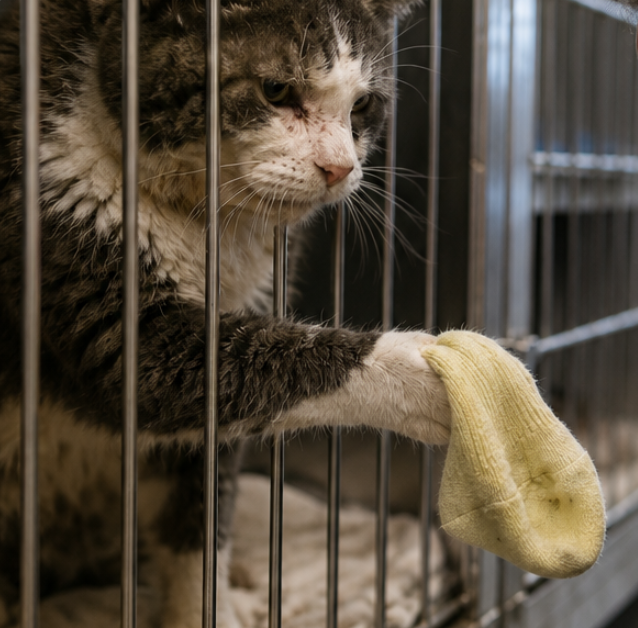
Then an old gray-and-white tomcat in Cage 23 dragged a worn yellow baby sock to the bars, pushed it toward me with one enormous paw, and the volunteer beside me whispered, “He’s not giving it to you… he’s trying to buy a home.”
Two years later, after Otis finally stopped offering that sock every time I fed him or came through the front door, the family who had abandoned him came back—and a four-year-old boy showed every adult in the room what love was supposed to do when the past returned asking to be seen.
I had walked into the shelter that Saturday morning with one plan.
A kitten.
Tiny.
Soft.
Ridiculous.
Something that would attack shoelaces, fall asleep in laundry baskets, misjudge the distance between a chair and a windowsill, and grow into my house without bringing a whole other life through the door first.
I wanted something easy.
At sixty-two, I had become very skilled at calling avoidance practicality.
My daughter Lily had moved three states away the previous year.
Not because she didn’t love me.
Because she had been offered a job she wanted, in a city she liked, with a life opening in front of her.
I had raised her to walk through open doors.
Then I spent the first six months after she left pretending the silence in my house was proof I had raised her well.
My divorce became final six weeks after that.
By then, the marriage had been over so long the paperwork felt almost administrative.
No screaming.
No affair discovered in a hotel.
No plates thrown.
Nothing cinematic.
Just years of slowly becoming two people who shared bills, furniture, history, and fewer words every month.
My ex-husband, Richard, had started sleeping in the guest room before either of us acknowledged why.
We had eaten dinner at the same table while looking at different screens.
Asked each other whether the electric bill had been paid.
Whether the oil needed changing.
Whether Lily had called.
We had become polite.
PART2:
People underestimate how lonely politeness can be.
When the judge signed the papers, friends told me I had a clean slate.
They meant it kindly.
A fresh start.
Freedom.
A chance to rebuild.
I smiled.
Thanked them.
Went home.
Unlocked my front door.
And stood in a house so quiet it felt like something had forgotten to happen.
I was not falling apart.
That was important to me.
I still went to work.
Still answered emails.
Still remembered birthdays.
Still watered the porch plants.
Still bought groceries.
Still waved at neighbors.
Still changed the furnace filter and scheduled dental cleanings and did all the things functioning adults do when they want no one asking whether they are lonely.
But every evening, my key turned.
The floorboards creaked.
PART3:
And no one answered.
So yes.
I wanted a kitten.
A fresh start in fur.
The shelter volunteer introduced herself as Maria.
Late forties, maybe.
Dark hair tucked behind one ear.
Paw-print T-shirt.
Clipboard.
She had the particular calm of someone who had spent enough time around abandoned animals to understand that enthusiasm could frighten as easily as anger.
“What are you looking for?”
“Small.”
She smiled.
“Helpful.”
“Young.”
“Okay.”
“Friendly.”
“Kitten room.”
“Perfect.”
She led me down a hallway smelling of disinfectant, old blankets, litter, canned food, wet fur, and something I could never properly describe.
Shelters always smell a little like hope after rain.
Hope mixed with bleach.
Hope that has had a difficult week.
The kitten room sat behind glass at the end of the hall.
I saw them immediately.
An orange kitten climbing a scratching post with more confidence than ability.
A black kitten chasing his own tail like it had insulted him.
A tiny tabby batting at a feather toy and looking betrayed each time it swung back.
I laughed.
Actually laughed.
For the first time that morning, I felt light.
Almost there, I thought.
Then something scraped behind me.
Not a meow.
Not a hiss.
A scrape.
Soft.
Deliberate.
I turned.
Adult cat row.
Last cage.
Number 23.
Inside sat the largest gray-and-white cat I had ever seen outside a farm.
Big square face.
Wide chest.
White socks on his front paws.
Gray saddle over his back.
One ear nicked.
Whiskers bent in different directions.
Fur thicker around his shoulders, thinner over one hip.
One corner of his mouth lifted slightly, giving him the permanent expression of a retired school principal who had caught someone chewing gum.
His name card read:
OTIS
ADULT MALE
NEUTERED
QUIET
BEST AS ONLY CAT
Quiet.
Shelter language can mean many things.
Calm.
Reserved.
Depressed.
Shut down.
Waiting so long that asking has stopped feeling useful.
I looked at him one second too long.
That was enough.
Otis stood.
Slowly.
His joints seemed to hold a committee meeting first.
Then he turned toward the back of the cage.
Lowered his head.
Dragged something forward.
A sock.
A baby sock.
Pale yellow.
Stretched.
Frayed.
Worn almost transparent in places.
He carried it to the bars.
Pushed it through as far as it would go.
Then rested one paw on it.
And looked directly at me.
I laughed because I did not know what else to do.
“Is he playing?”
Maria didn’t laugh.
Her face changed.
“No.”
“What is he doing?”
She folded both hands around her clipboard.
“He’s making an offer.”
I looked back at the cat.
Otis did not move.
His paw stayed on the sock.
“An offer?”
Maria nodded.
“He came in with that tucked under his belly.”
“His family moved.”
“They left him in the apartment with some food, paperwork, and that sock.”
“Animal control brought him in.”
“How long ago?”
“Four months.”
I stared.
Maria continued.
“Every time someone stops at his cage, he brings the sock forward.”
“Everyone?”
“Kids.”
“Couples.”
“Older people.”
“Single people.”
“Anyone who pauses.”
Otis blinked once.
Not cute.
Not pleading.
Just waiting.
“He’s trying to trade it?”
Maria’s voice softened.
“I think he believes it’s all he has.”
Behind me, kittens threw themselves around their room in easy, uncomplicated chaos.
A kitten would be simple.
A kitten would arrive without a baby sock.
Without four months of rejection.
Without a family who had left.
Without a story heavy enough to walk into the room ahead of it.
A kitten would not look at me like it understood what it meant to live in a room that used to belong to more people.
I stepped back.
Otis did not cry.
Did not reach.
Did not push harder.
He just left that ruined little sock against the bars and waited.
“How old is he?”
“About eleven.”
I closed my eyes.
Of course.
Senior.
Adult.
Arthritis.
Medical bills.
History.
Exactly everything I had told myself I did not want.
I opened my eyes again.
Otis nudged the sock forward.
That broke me.
Not dramatically.
No cinematic music.
No instant certainty.
Just enough.
I knelt.
Put my fingers near the bars.
Otis sniffed once.
Then pushed the sock closer.
As if the first offer had not been sufficient.
As if maybe I needed more.
“Buddy.”
My voice cracked.
“You don’t have to pay me.”
One ear moved.
Maria stayed quiet behind me.
I should have walked into the kitten room.
I should have followed the plan.
Instead I heard myself say:
“I’ll take him.”
Maria waited.
“You’re sure?”
I looked at Otis.
At the sock.
At his giant paws.
At the face of a cat who looked exhausted by human decision-making.
“Yes.”
Maria smiled.
“Okay.”
When she opened Cage 23, Otis did not rush toward freedom.
He picked up the sock first.
Then stepped into the carrier.
Like a gentleman carrying his own suitcase.
All the way home, one paw rested over it.
My house was ready for a kitten.
Ridiculous little bed.
Tiny scratching post.
Bright plastic balls.
Feather wand.
Stuffed mice.
A plush banana I regretted the second I bought it.
Otis emerged from the carrier.
Sniffed my kitchen.
Looked toward hallway.
Evaluated the living room.
Apparently concluded the entire property was deeply suspicious.
Then crawled beneath the dining room table and stayed there for six hours.
I left him alone.
That surprised me.
Old me would have tried.
Treats.
Talking.
Coaxing.
Making myself useful.
But my marriage had taught me something, even if the lesson arrived too late.
Sometimes trying to force closeness only teaches someone how badly they need a better hiding place.
So I put water nearby.
Food.
A litter box down the hall.
And placed the yellow sock outside the table.
Not under it.
Not taking it.
Just close.
Then I went to the living room and watched television with the volume low.
Around three in the morning, I woke on the couch because something bumped my hand.
The sock.
I opened my eyes.
Otis stood several feet away.
Watching.
The sock sat beside my fingers.
My heart hurt.
He still thought this was a transaction.
Food.
Warmth.
Home.
In exchange for the only thing he owned.
I picked up the sock.
Otis stiffened.
I placed it gently beside him.
“No trade.”
He stared.
“You live here now.”
He didn’t believe me.
Not that night.
Not the first week.
For a while, every kindness had to be paid for.
I filled his bowl.
Sock.
I came home from work.
Sock.
I sat on the couch and said his name.
Sock.
I brushed him.
Sock.
He would drag it across the floor, drop it near my feet, then watch me with the seriousness of a tenant presenting rent.
Every time I returned it.
“You don’t have to earn dinner.”
“You don’t have to pay rent.”
“You don’t have to earn the couch.”
“You don’t have to buy me.”
He either did not understand or did not trust the answer.
There is a difference.
Trust came slowly.
The first time he ate while I stayed in the kitchen, I nearly applauded.
I did not.
I knew better.
The first time he slept on the back of the couch, I sat frozen for forty minutes because I didn’t want to ruin it.
The first time he jumped on my bed, he looked deeply offended that I had already occupied it.
That became our relationship.
I paid the mortgage.
Otis owned the house.
Little by little, the sock moved.
At first he left it halfway across a room.
Then beside his bed.
Then under a chair.
Then one morning, I woke and found him sleeping beside me with the sock tucked under his chin.
Not offered.
Not payment.
His.
I lay there staring at him.
Gray fur rising with each breath.
Crooked whiskers.
One giant white paw.
And that battered yellow scrap beneath his face.
Maybe, I thought.
Maybe someday he would believe me.
Otis became less sad.
Never less judgmental.
He snored.
Loudly.
He ignored every expensive toy I bought him and developed a passionate relationship with bottle caps, receipts, and one ugly guest-room pillow.
He sat in clean laundry.
He opened his mouth at birds without making sound.
He glared if dinner was late.
He followed me from room to room while pretending it was coincidence.
When Lily visited, he tolerated her.
Mostly.
“He likes me.”
“He hates your hand lotion.”
“It’s unscented.”
“Not to him.”
“He’s just like you.”
I would tell her to leave.
She would laugh.
Otis would steal her chair.
The house stopped listening back.
That is the best way I can explain it.
There were sounds again.
Paws on hardwood.
The thump of a cat jumping down from furniture.
Water bowl scraping.
A mysterious crash followed by me shouting:
“Otis?”
Then silence so suspicious it was almost an answer.
My daughter still lived three states away.
My marriage was still over.
The empty spaces in my life did not magically refill.
But the house had another heartbeat.
Sometimes that is enough.
The sock remained.
I washed it by hand.
No machine.
No harsh detergent.
Pressed it between towels.
Laid it in sunlight.
Otis supervised every wash like a union inspector who expected corruption.
I never replaced it.
Never threw it out.
Some objects do not need to disappear for their pain to change.
Sometimes they just need somewhere safe to rest.
Two years passed.
Then Maria called.
Thursday evening.
Otis was asleep at the bottom of my bed.
One paw over the yellow sock.
Maria’s name appeared on my phone.
Something in my chest tightened before I answered.
“Everything okay?”
Silence.
Too long.
“I need to tell you something before you hear it another way.”
I sat down.
Otis opened one eye.
“What?”
“Someone came to the shelter today asking about him.”
“Otis?”
“Yes.”
My first thought was ugly.
No.
No.
Absolutely not.
Not after two years.
Not after the nights.
Not after the sock stopped appearing beside every meal.
Not after he learned the couch.
The bed.
The kitchen window.
My voice.
My house.
Maria said:
“It was his old family.”
The room went completely still.
“They want him back?”
Another pause.
That pause mattered.
“They asked if he was alive.”
“Then if he was adopted.”
“The woman started crying.”
I hated the crying immediately.
Crying made her human.
For two years, I had built Otis’s former family into easy villains.
People who packed boxes.
Left a cat.
Drove away.
Shadows.
Easier that way.
Easy anger requires simple people.
“What did you tell them?”
“That he has a good home.”
“And?”
“They asked me to pass along a message.”
I laughed once.
Sharp.
“A message?”
Otis sat up.
He knew my tone.
Maria said:
“They said they never stopped wondering what happened to him.”
“That is a strange thing to wonder after leaving him.”
“I know.”
“No, Maria.”
“I really mean that.”
“I know.”
She wasn’t defending them.
She was walking carefully around something broken.
Then she said:
“There’s a little boy.”
I closed my eyes.
Of course.
Life never leaves anger clean.
“He was a baby when Otis came in.”
“The sock was his.”
I looked toward the bedroom.
Otis was watching me now.
“The sock?”
“Hospital sock.”
“From the baby bag.”
“The mother thought it was gone.”
Gone.
That word angered me.
It had not been gone.
Otis had carried it.
Slept on it.
Offered it to strangers.
Kept it alive in the only way an animal can keep anything alive.
“What do they want?”
“A visit.”
“No.”
The word left before I decided.
Maria did not argue.
“I understand.”
“He is old.”
“I know.”
“He finally feels safe.”
“I know.”
“They don’t get to come back because guilt became inconvenient.”
Maria was quiet.
Then:
“Maybe.”
“Or maybe they loved him badly and too late.”
That sentence hurt more than if she had defended them.
Because I knew exactly what bad love looked like.
My marriage had contained bad love.
Not cruelty.
Not violence.
Two people who cared about each other and still failed each other in slow, quiet ways.
I had been loved badly.
I had also loved badly.
That did not mean none of it was real.
That is the terrible thing.
Bad love can still be real.
It just may not be safe.
I told Maria I needed time.
After the call, I stayed in the kitchen.
Otis walked in.
He had the sock in his mouth.
My breath stopped.
Two years.
Two years since he had used it that way.
He came toward me.
Dropped it beside my knee.
I slid onto the floor.
“No trade.”
Otis pushed his head against my shin.
I started crying.
Not because I thought a cat understood family disputes.
Because some part of him still connected tension with bargaining.
Trouble with payment.
Uncertainty with giving something away.
I picked up the sock.
Put it back between his paws.
“You keep this.”
He looked at me.
“You keep everything.”
Then climbed into my lap.
He did not fit.
Too heavy.
Too large.
Too warm.
Exactly enough.
That night I called Lily.
I told her everything.
Maria.
Old family.
The boy.
The sock.
She stayed quiet.
Then said exactly what I did not want to hear.
“Maybe you should let them see him.”
“Lily.”
“I’m not saying give him back.”
“You better not be.”
“I’m saying there’s a four-year-old child who didn’t do any of this.”
“There is always ‘a child involved’ when someone wants to make everybody else’s feelings smaller.”
“That isn’t what I’m doing.”
“He is not a library book.”
“I know.”
“He is not something I borrowed until someone with a better claim shows up.”
“I know, Mom.”
“Do you?”
She sighed.
Not annoyed.
Careful.
“I’m not asking you to give up your peace.”
“Good.”
“I’m asking what kind of peace you want.”
I stood at the sink.
Otis sat in the laundry basket.
Clean towels beneath him.
“I want the kind where no one asks me to give back what I love.”
Lily went silent.
Something changed.
We were not just talking about Otis anymore.
She said softly:
“I never meant to make you feel left.”
I closed my eyes.
“Oh, Lily.”
“I know me moving isn’t the same.”
“No.”
“But maybe it rhymes a little.”
That broke me open.
Because it did.
She had not abandoned me.
She had grown.
That was different.
But grief does not always respect categories.
Loss can rhyme even when the stories do not.
“I’m proud of you,” I said.
“I know.”
“And I want you there.”
“I know.”
“But sometimes I hate how quiet the house is.”
She started crying.
So did I.
Then Otis dragged his sock into the kitchen.
Dropped it under the table.
Sat on my foot.
Lily heard me laugh.
“What?”
“Your brother has terrible timing.”
“Did he bring the sock?”
“Yes.”
“Maybe he has a point.”
I looked down.
Maybe he did.
The next morning, I called Maria.
“What exactly happened when they left him?”
She told me the story she had gotten from Hannah.
That was the mother’s name.
Hannah.
Her husband had lost his job.
They lost their rental.
The new place did not allow pets.
They called relatives.
Asked a neighbor.
Waited too long.
Then moving day came.
They left Otis behind with food, papers, water, and Noah’s yellow sock.
They told themselves someone would come.
Someone did.
Animal control.
Three days later.
Three days.
I had never known.
Otis had waited three days in an empty apartment.
Doors closed.
Furniture gone.
Voices gone.
Baby gone.
Food running low.
No one explaining why.
Maria said Hannah regretted it almost immediately.
She returned the next week.
Otis was gone.
Her husband told her he had found him a home.
Years later, after their divorce, she discovered that had been a lie.
I wanted to hate her.
Part of me did.
But now I could see shape of another person.
A frightened young mother.
Money problems.
Marriage trouble.
Bad decisions.
Shame.
None of that made leaving Otis okay.
It did make it human.
“Does she want him back?”
Maria paused.
“She said she doesn’t know what she has the right to want.”
That was first thing Hannah said that I respected.
“She asked if she could write you.”
I almost refused.
Then remembered all the apologies I had never gotten from my own marriage.
Not because Richard was evil.
Because some people never learn how to say:
I was afraid.
I handled it badly.
You deserved better.
Sometimes the absence of an apology becomes its own room inside you.
“Tell her to write.”
Three days later, Maria emailed the letter.
I printed it.
Maybe pain feels more manageable on paper.
Otis slept across the table while I read.
Dear Elaine,
My name is Hannah.
I was Otis’s owner before you.
I know that sentence probably makes you angry.
It makes me angry too because I do not think I earned the right to call myself that anymore.
I stopped.
Looked at him.
He slept on.
Hannah did not make herself heroic.
No excuses.
She was young.
Exhausted.
Ashamed.
Afraid.
None made it right.
She wrote that Otis slept beside Noah’s crib.
That when Noah cried, Otis sat in doorway and meowed until she came.
That the yellow sock fell out of a laundry basket and Otis began carrying it everywhere.
On moving day, Noah cried in his car seat.
Hannah put the sock beside Otis.
“He’ll have something familiar,” she had said.
Something familiar.
My eyes blurred.
Hannah wrote:
Regret can be loud and still not make you brave.
I put the letter down.
I understood that sentence too well.
At the end:
I am not asking for him back.
I know he is yours now.
I know he should be yours.
Noah saw an old photo at my mother’s house and asked about the cat with his sock.
I finally told him Otis did not come with us.
He asked if Otis found a home.
I told him yes.
Then he asked me if the home was kind.
I told him I hoped so.
If you are willing, I would like Noah to know the truth.
Not all of it.
Just enough.
That Otis is safe.
That he is loved.
That he did not disappear into nowhere.
I folded the letter.
Unfolded it.
Folded again.
“What am I supposed to do with that?”
Otis sneezed.
Helpful.
For two days, I did nothing.
Then Lily came home.
She brought pastries.
A suitcase.
The cautious expression of someone entering a room where an emotional explosive might be armed.
She read Hannah’s letter.
“Oh, Mom.”
“Don’t.”
“She left him.”
“Yes.”
“For three days.”
“I know.”
“He thought he had to buy a home.”
“I know.”
“She doesn’t get to feel better because she wrote a good letter.”
“No.”
That stopped me.
I had expected argument.
Lily touched the paper.
“But Noah didn’t leave him.”
“I know.”
“And Otis is not responsible for Noah.”
“No.”
“And you aren’t responsible for Hannah.”
“No.”
I crossed my arms.
“Then what exactly are you saying?”
Lily looked at me.
“Maybe you decide what is safe instead of what is fair.”
That sat between us.
Safe.
Not fair.
Not deserved.
Not owed.
Safe.
For Otis first.
Always.
I called Maria.
“I’ll meet them.”
“Are you sure?”
“No.”
Maria laughed softly.
“Most honest answer all week.”
“I have conditions.”
“Go.”
“Neutral place.”
“The shelter.”
“One short visit.”
“No touching unless Otis approaches.”
“No asking to take him.”
“No surprises.”
“No pressure.”
“If he gets distressed, we leave.”
“Done.”
“And Maria?”
“Yes?”
“If they ask for the sock…”
“They won’t.”
“How do you know?”
“Because Hannah already asked me whether it still belongs to him.”
I swallowed.
“What did you say?”
“Yes.”
Maria paused.
“She said, ‘Good.’”
The visit was scheduled Tuesday evening after closing.
I regretted it all day.
At work I read the same email six times.
Typed a cancellation text.
Deleted it.
Typed again.
Deleted again.
When I came home, Otis sat by the door.
No sock.
Just Otis.
I knelt.
“You don’t have to do anything tonight.”
He bumped his head under my chin.
Then bit my sleeve.
Feelings over.
I packed a towel into carrier.
Then placed the yellow sock inside.
My hand stopped.
Maybe seeing it would hurt Hannah.
Maybe Noah would want it.
Maybe they would think it belonged to them.
Then Otis walked into the carrier.
Picked up the sock.
Tucked it under his body.
Decision made.
It was not evidence.
Not family property.
Not something for adults to argue over.
It was his.
The shelter was different after hours.
Quiet.
Beige walls.
Old-cleaner smell.
The same visiting room where I signed adoption papers two years earlier.
Maria set water on floor.
I put carrier beside chair.
Otis remained inside.
Sock under his chin.
“They’re here,” Maria said.
My throat tightened.
“Okay.”
Door opened.
Hannah entered first.
She looked nothing like villain I built.
That annoyed me more than it should have.
Villains should look cooperative enough to hate.
Hannah was about Lily’s age.
Hair in messy knot.
Plain coat.
Pale.
Terrified.
Behind her stood a small boy.
Four.
Serious brown eyes.
Both hands around stuffed cat.
Noah.
He did not smile.
He looked like a child who had been told repeatedly that tonight was about being gentle.
Hannah saw carrier.
Covered her mouth.
Did not step closer.
Did not call his name.
That mattered.
Maria said:
“Elaine, this is Hannah.”
“And Noah.”
Hannah looked at me.
“I’m sorry.”
No hello.
No speech.
No explanation.
“I’m sorry.”
I nodded.
I did not say it was okay.
It wasn’t.
Noah whispered:
“Is that him?”
I looked at carrier.
“Yes.”
“That’s Otis.”
The boy took one small step.
Stopped.
Looked at his mother.
Hannah touched his shoulder.
“Remember?”
“He gets to choose,” Noah said.
Five words.
He gets to choose.
My eyes burned instantly.
I wished more adults understood that.
I opened carrier.
Otis did not move.
Nobody spoke.
Then one paw came out.
Then other.
He emerged.
Slow.
Heavy.
Unimpressed.
Noah made a tiny sound.
“He’s big.”
“He knows.”
Otis walked to Maria.
Sniffed her shoe.
Rejected it.
Then sat in corner.
The yellow sock remained in carrier.
Hannah saw it.
Her face collapsed slightly.
Noah saw too.
“That’s my sock.”
Hannah crouched beside him.
“It was yours when you were a baby.”
Then:
“But it belongs to Otis now.”
I looked at her.
She was looking only at her son.
“He kept it safe,” Noah whispered.
No one answered.
Children sometimes say things too cleanly.
Noah sat cross-legged.
Placed his stuffed cat on floor.
Not toward Otis.
Just near himself.
An offering without pressure.
Otis looked at stuffed cat.
Then Noah.
Then fake cat again.
His face said counterfeit animals were beneath him.
Hannah laughed through tears.
“I remember that look.”
I stiffened.
She noticed.
“I’m sorry.”
“For what?”
“For acting like I still know him.”
Something shifted inside me.
Not forgiveness.
Not yet.
But room for it.
“He still makes that look.”
Hannah covered her mouth.
Noah looked at her.
“Mom?”
“I’m okay.”
Otis stood.
Walked toward Noah.
Every muscle in my body tightened.
He stopped two feet away.
Noah stayed perfectly still.
“Hi.”
Otis sniffed.
Then turned around.
Sat with his back to Noah.
Maria’s shoulders began shaking because she was trying not to laugh.
Noah looked confused.
“That means he likes you,” I said.
“It does?”
“For Otis, yes.”
Noah smiled.
Small.
Careful.
For ten minutes, no one touched him.
Otis walked.
Noah sat.
Hannah watched.
Then she asked:
“Can I know what he’s like now?”
I breathed.
“He snores.”
Noah giggled.
“He eats like nobody has ever fed him, despite being fed twice a day for two years.”
“He sleeps on my bed.”
“Not beside me.”
“On me.”
“Like a sandbag with opinions.”
Noah laughed harder.
“He hates every toy I buy.”
“Bottle caps are acceptable.”
“Receipts.”
“One ugly pillow.”
Hannah smiled.
Then her eyes went toward carrier.
“And the sock?”
The room changed.
“He sleeps with it.”
She closed her eyes.
Noah looked at Otis.
“So he wasn’t lonely?”
My chest tightened.
He had been.
I wasn’t going to lie.
But four-year-old didn’t need adult weight.
“He was lonely for a while.”
“But not anymore.”
Noah whispered:
“I’m sorry.”
Otis walked to carrier.
Reached inside.
My entire body went cold.
No.
Not again.
He took the sock.
Carried it toward Noah.
Dropped it halfway between them.
Sat.
The old bargain.
The old payment.
My fingers clenched.
I almost moved.
Noah looked at sock.
Then at me.
Then his mother.
He did not pick it up.
Instead:
“He thinks he has to give it to me.”
“Yes.”
My voice barely came.
The little boy’s face changed.
He looked sad in a way only children can look when they understand something painful for first time.
He turned to Otis.
“You don’t have to.”
Otis blinked.
Noah reached one finger toward sock.
Not grabbing.
He pushed it gently back toward the cat.
“You keep it.”
Hannah broke.
She turned away.
Maria handed tissue.
I could not move.
Otis sniffed the sock.
Then Noah’s fingertip.
And bumped his head once against the boy’s knee.
Noah froze.
Pure joy.
“He touched me.”
I laughed.
Then cried.
Because healing is rarely dramatic enough for stories.
Sometimes healing is an old cat headbutting a four-year-old because the child had enough kindness not to take the thing that once belonged to him.
The visit lasted twenty-two minutes.
I know because I watched clock.
Not because I wanted them gone.
Because I needed to know I could end it.
Otis never hid.
Never trembled.
Stayed near me.
Twice he approached Noah.
Once he sniffed Hannah’s shoe.
Then sneezed and walked away.
Honestly?
Fair.
When it was time, Hannah stood.
Hands clasped.
“I won’t ask for him.”
My throat tightened.
“Okay.”
“I thought I might.”
That honesty hurt.
“I thought if I saw him, maybe I would feel like he was still mine.”
She looked at Otis.
He was sitting on my shoe.
Sock beneath one paw.
“But he isn’t.”
She smiled sadly.
“He knows where home is.”
Noah hugged his stuffed cat.
“Can I say bye?”
I nodded.
He crouched.
“Bye, Otis.”
Then:
“I’m glad you got a mom.”
A mom.
Not owner.
Not adopter.
Mom.
Something inside me folded.
For years, motherhood had meant Lily.
Responsibility.
Lunches.
Homework.
Fevers.
College forms.
Learning how to let go.
Otis needed me differently.
Not in a way that asked me to disappear inside the need.
In a way that made room for me too.
At the door, Hannah turned.
“I don’t deserve this.”
I believed her.
But deserving wasn’t really the question anymore.
“No.”
Her face flushed.
Maria looked at me.
Then I continued.
“But Noah deserved to know he was safe.”
Hannah cried.
“Thank you.”
Otis kept one paw on the sock all the way home.
That night, he climbed onto bed.
Turned three circles.
Sock under chin.
Asleep within minutes.
I sat beside him almost an hour.
Peace did not arrive immediately.
Doing the kindest thing you can manage does not always feel good right away.
Sometimes it feels like running barefoot.
The next morning Lily called.
I told her everything.
Noah.
The sock.
“You keep it.”
Hannah refusing to ask for Otis.
Lily stayed quiet.
Then:
“I’m proud of you.”
“I am the mother.”
“I say that to you.”
“Today I get to say it.”
I looked toward window.
Otis was silently yelling at bird.
“She didn’t ask for him.”
“If she had?”
“No.”
“You would have said no?”
“Yes.”
Immediately.
That surprised even me.
“Would it have hurt?”
“Yes.”
Lily said:
“That doesn’t make the no wrong.”
It didn’t.
That may have been biggest thing I learned.
Boundaries are not cruelty simply because somebody cries outside them.
A week later, an envelope arrived.
Inside was a drawing.
A huge gray-and-white cat with whiskers like electrical wires.
Beside him was yellow shape that could have been sock.
Or banana.
At bottom, uneven letters:
THANK YOU FOR LOVING OTIS.
On back, Hannah wrote:
Noah asked me to send this.
He tells people Otis lives with his real mom now.
I hope that’s okay.
I put it on refrigerator.
Cried every morning for four days.
Then moved it to drawer where I keep important things.
Lily’s kindergarten handprint.
My grandmother’s recipe card.
One beach photo from marriage when smile had still been real.
Noah’s drawing.
Not erased.
Just given somewhere safe.
After that, life changed in small ways.
Maria asked me to write a short shelter newsletter note about senior cats.
I refused.
Then thought of Cage 23.
Quiet adults while kittens bounced behind glass.
How easy it was to want something untouched.
A clean slate.
A love without old fears.
So I wrote.
I wrote about Otis.
Not Hannah.
That part wasn’t mine to distribute.
I wrote:
Older animals are not broken because they remember.
People aren’t broken because they remember either.
Sometimes memory just needs patience.
Sometimes love isn’t beginning of story.
Sometimes love is place where story finally stops hurting so loudly.
Maria called next day.
“You made three people ask about senior cats.”
Otis lay upside down with one fang showing.
“Tell them senior cats come with management.”
Maria laughed.
“And socks?”
“Only executive models.”
A month later, I returned to shelter with towels.
Only towels.
I told myself.
Adult row.
Cage 23 held a black female cat with one cloudy eye.
Name:
MABEL.
She stared.
I stared.
“No.”
Blink.
“No.”
Maria stood nearby smiling.
“Don’t.”
“I didn’t say anything.”
“You said it with your face.”
I left without Mabel.
I deserve credit.
When I got home, Otis smelled shelter on my jeans.
He gave me a look capable of ending civilizations.
Then dragged his sock into hallway.
Dropped it at my feet.
Not offering.
Accusing.
“I did not bring home another cat.”
Stare.
“I considered nothing.”
Stare.
“Fine.”
“I considered it.”
He picked up sock.
Walked away.
Forgiveness apparently had limits.
Months later, I saw Hannah and Noah again at a shelter adoption afternoon.
Small event.
Folding tables.
Cookies.
Donation jars.
I brought Otis because Maria asked.
Never again.
He glared from carrier for twenty minutes until an elderly man sat nearby and said:
“That cat looks like he’s done with nonsense.”
Otis came out immediately.
Found his demographic.
Hannah arrived later.
Noah was taller.
Still carried same stuffed cat.
He asked before approaching.
I said yes.
Otis sniffed him.
Then sat on his foot.
Noah looked like he’d won lottery.
Hannah stood beside me.
For a while, we watched.
Then she said:
“I adopted a senior cat.”
I turned.
“What?”
“Twelve.”
“Her name is Clover.”
“Missing half her tail.”
“Very bossy.”
I felt something loosen.
“Sounds right.”
“Noah chose her.”
“Why?”
Hannah smiled.
“He said older cats already know how to love you.”
“They just need more time to believe you.”
I looked at Noah.
He was whispering into Otis’s ear.
Probably secrets.
Probably nonsense.
Maybe both.
Hannah said:
“I learned that from you.”
“No.”
I shook my head.
“You learned it from him.”
We looked at Otis.
He was licking his shoulder with no dignity.
“Yes,” she said.
“Probably.”
Then she reached into bag.
My body tightened.
Old fear is unfair like that.
She noticed immediately.
“I’m not giving Otis anything.”
I relaxed.
She pulled out an envelope.
“For you.”
Inside was photograph.
A much younger Otis lying beside a baby crib.
Noah asleep inside.
Otis on floor at doorway.
Watching.
Guarding.
Same serious face.
My throat closed.
I had never seen Otis before shelter.
Before Cage 23.
Before the sock became payment.
There he was.
Loved.
Needed.
Before everything went wrong.
“That was at my mother’s house,” Hannah said.
“I thought you should have it.”
I stared at picture.
For two years, some part of me had wanted to believe Otis’s real life began with me.
It hadn’t.
He had an entire chapter before.
Some warm.
Some terrible.
All his.
“Thank you.”
I meant it.
That night I framed photograph.
Put it near his favorite window.
I worried I would feel jealous.
Ridiculous.
Jealous of proof another person loved my cat before me.
Instead, the picture made him more whole.
He was not mine because I erased everything before me.
He was mine because he came carrying everything before me.
And stayed.
That is stronger love.
The yellow sock is still here.
Thinner every year.
I still wash it by hand.
Press it between towels.
Lay it flat in sunlight.
Otis supervises.
When dry, I return it.
He takes it carefully.
Not desperately.
Not payment.
A possession.
A memory.
His.
Last winter, he got sick for several days.
Nothing catastrophic.
He recovered.
But he ate less.
Slept more.
I camped on couch because he had chosen blanket there and arguing with senior cat over medical furniture is pointless.
At two in morning I woke with Otis standing on my chest.
Heavy.
Warm.
Rude.
The sock was in his mouth.
For one terrible second, I thought we had gone backward.
He was scared.
He was trying to pay.
Trying to stay.
He dropped it beside my face.
Then turned around.
Curled against my shoulder.
Fell asleep.
I stared at sock.
He wasn’t buying anything.
He was sharing.
That was when I understood.
For a long time, the sock meant:
Please take me.
Then:
Please keep me.
Now it meant:
This is mine.
You are mine too.
We can rest.
I wish humans learned that cleanly.
I wish we knew when to stop offering pieces of ourselves to prove we deserve a place.
A returned call.
A seat at table.
A second chance.
A marriage.
A home.
I wish I had learned before sixty-two, crying on kitchen floor because an old cat believed love had a price.
Maybe we learn when we’re ready.
Or when someone finally refuses to take the sock.
People sometimes ask whether I regret meeting Hannah.
No.
I regret what happened to Otis.
I regret those three days.
I regret the fear he carried into Cage 23.
I regret that Noah needed a softened version of a hard truth.
I regret that love can be real and still fail someone.
But I don’t regret the visit.
Because Noah pushed sock back.
Because Hannah did not ask for what was no longer hers.
Because Otis left with the same thing he entered carrying.
And because I learned boundaries and compassion do not cancel each other.
Forgiveness doesn’t require access.
Understanding doesn’t require surrender.
Kindness doesn’t require giving back what makes you safe.
And being chosen later does not make you less loved than being chosen first.
Otis was not my kitten.
He was not untouched.
He was not simple.
He came with a baby sock.
Old fear.
Bad memories.
One hip that bothered him in cold weather.
A habit of offering the only thing he loved because once, love disappeared.
I came with my own version.
A quiet house.
A daughter far away.
A marriage that had ended long before paperwork.
A heart that still smiled politely at grocery store and came home to silence.
Maybe that’s why we understood each other.
When Otis pushed that sock through bars of Cage 23, he was saying:
This is all I have.
And some hidden part of me answered:
Me too.
Now when I come home, the house no longer holds its breath.
It complains.
It creaks.
It smells faintly of cat food no matter how often I clean.
There is fur on furniture.
A scratching post in living room.
One expensive cat bed no cat has ever used.
And a yellow baby sock on my comforter that looks like trash to anyone who doesn’t know better.
I know better.
Otis knows better.
Noah does too.
Last week, another envelope arrived.
Noah’s handwriting was neater.
Inside was drawing.
Two cats.
One gray and white.
One black with a short tail.
At bottom:
SOME CATS NEED TWO HOMES IN THEIR STORY
BUT ONLY ONE HOME AT A TIME.
I put it on refrigerator.
This time I left it there.
It still makes me cry.
That’s okay.
Not everything that hurts needs hiding.
Some things become proof.
Proof an old cat can stop bargaining.
Proof a woman can say no without becoming cruel.
Proof regret can tell truth without demanding reward.
Proof a child can understand gentleness better than adults.
Proof that the past does not have to be erased before it can become quiet.
Tonight, Otis is sleeping beside me.
Snoring.
Loud.
One paw twitching in a dream.
The yellow sock is beneath his chin.
Not offered.
Not guarded.
Just held.
Every time I see it, I remember what Maria told me the first day.
“He’s not giving it to you.”
“He’s trying to buy a home.”
She was right then.
She would not be right now.
Otis is not trying to buy anything anymore.
He paid too much before he ever met me.
Now he just lives here.


