I Was a Millionaire Rancher Who Found a Woman Sleeping in a Run-Down Homestead—Then I Offered Her Something No Rich Man Before Me Had.
PART2:
I trusted my foreman, Aldous Mercer, with almost everything.
Men.
Herd movements.
Winter feed.
Buying.
Selling.
Repairs.
I did not delegate water.
My father had taught me that before I was old enough to saddle properly.
“Cattle can lose weight and recover.”
He told me.
“Lose water and you’re counting carcasses.”
My father had started with less than four hundred acres.
One mule.
Eight cattle.
A house so small my mother said you could fry breakfast from the bed without getting up.
By the time he died, we had seventeen thousand acres.
I expanded from there.
People later said I inherited an empire.
No.
I inherited a beginning.
Everything after that came from winters when I slept three hours, summers when every cloud mattered, and a stubborn conviction that the easiest thing to lose in cattle country was something you assumed would still be there tomorrow.
That October morning, the thing I was inspecting was East Creek.
The weather had turned gray.
Cold without being cruel.
My stallion, Ransom, moved beneath me with the steady confidence of an animal who had traveled the same ridge more times than either of us could count.
I had ridden back from Cedar Falls alone.
Aldous wanted a hand with me.
I told him no.
Sometimes I needed to ride without a man asking questions every quarter mile.
The trail curved along low country.
Cottonwoods gone pale.
Grass brittle.
Creek reduced but moving.
That was when I saw the ranch house.
I nearly missed it.
The place sat below the trail behind dead cottonwoods.
Bleached siding.
Porch rail collapsed inward.
South fence gone in three places.
Barn wall missing boards.
Everything about it said abandonment.
Everything except the yard.
The yard was swept.
Not days ago.
That morning.
A thin haze of disturbed dust still hung above the hard-packed ground.
I stopped Ransom.
Looked again.
Then saw the garden.
East side of the house.
Small.
Maybe thirty feet by twenty.
Rows cut carefully into hard October soil.
Garlic.
Late greens.
A strip prepared for spring planting.
Whoever lived there was not merely surviving today.
She was planning for April.
That interested me.
Planning for spring is an act of faith in dry country.
I dismounted.
Told myself I was checking the well boundary.
East Creek passed close enough that any water use might concern my downstream rights.
The explanation sounded sensible.
I knew it was a lie before I reached the porch.
The front door stood open.
I knocked anyway.
Nothing.
Again.
Still nothing.
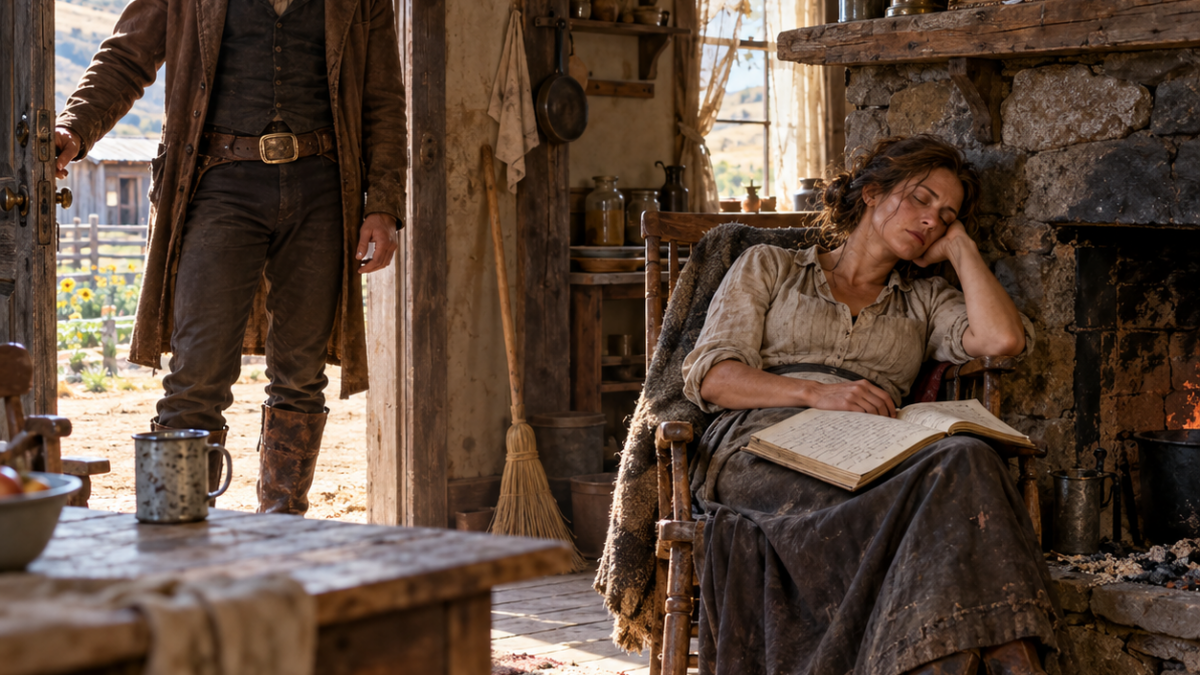
I stepped just far enough inside to see the main room.
A woman slept in a wooden chair beside a cold fireplace.
Boots still on.
Sleeves rolled to the elbows.
A ledger book open across her knees.
Her head had fallen slightly against the chair back.
Not comfortable sleep.
Collapse.
The kind that happens when the body overrules the person living inside it.
I stayed at the threshold.
I have entered a great many houses in my life.
Some welcomed me.
Some wanted my money.
Some feared my name.
That room did none of those things.
It simply existed.
Bare table.
Two chairs.
A cast-iron stove.
One shelf of dishes.
Patched curtains.
A rifle above the door.
And above the fireplace, inside a cracked wooden frame, a deed.
VANCE HOMESTEAD.
REGISTERED 1869.
CIMARRON COUNTY, KANSAS.
I was still reading when the woman woke.
Her eyes opened.
Found me instantly.
No scream.
No confusion.
No frightened scramble.
She closed the ledger in one movement.
“You’re on private property.”
Her voice was low.
Direct.
Not accusing.
Fact.
I remained exactly where I was.
“I am.”
“Door being open isn’t an invitation.”
“No.”
“Then?”
“Door was open.”
She stared.
“That is an explanation. Not a reason.”
I liked her immediately.
That was inconvenient.
“Reeve Callaway.”
Something changed in her eyes.
Recognition of name.
Not admiration.
Possibly annoyance.
“Nora Vance.”
“Fair exchange.”
She stood.
Perhaps thirty-five.
Dark hair tied carelessly.
Brown work skirt.
Men’s wool shirt beneath an old vest.
No jewelry.
No attempt to look like anything except a person who had work waiting.
She had the posture of somebody who had spent years carrying weight that should have been shared.
Not broken.
Recalibrated.
I looked toward the deed.
“Your place.”
“Yes.”
“You running cattle?”
“Sold them.”
“All?”
“Last thirty-seven in August.”
“Why?”
“To keep the deed.”
No shame.
No request for sympathy.
Just arithmetic.
I understood immediately.
The drought years had ruined small operators across the county.
Feed cost money.
Water infrastructure cost more.
Keep cattle too long and a rancher burned the last cash trying to save animals that might die anyway.
Sell too early and rebuilding could take years.
Nora had chosen land.
“How long alone?”
Her expression sharpened.
“Maintaining it.”
I waited.
“That was going to be your question.”
“Yes.”
“I’m maintaining it alone.”
She looked through the open door toward the pasture.
“Running a cattle place requires cattle.”
“Fair.”
“Maintaining ownership requires different resources.”
“What resources?”
“Work.”
She looked back at me.
“Mostly.”
I stepped outside.
The south fence was worse than it looked from trail.
Three complete sections down.
Two more leaning.
Old posts rotted.
Wire loose.
Original work good.
Time had beaten it.
“South line’s gone.”
“I know.”
“I’m looking at it.”
“I assumed.”
“You mind?”
“It’s still my fence.”
“Then walk with me.”
She did.
No hesitation.
No concern about being alone beside a man richer than half the county.
That may sound reckless.
It did not feel reckless.
It felt like Nora had spent too long defending the place to waste fear where caution would do.
We walked the line.
One hundred yards.
Then another.
Her boots were cracked.
Gloves worse.
Hands beneath them raw at knuckles.
She noticed me noticing.
“Don’t.”
“What?”
“Whatever charitable calculation you’re doing.”
“I haven’t done one.”
“You’re a Callaway.”
“What does that mean?”
“It means men with your acreage calculate everything.”
“True.”
She looked ahead.
“Then calculate quietly.”
I smiled.
She saw.
Did not.
At the third broken post, I crouched.
Soil dry.
Bad.
“If you bring stock in spring, they’ll be on Cooper’s pasture inside a week.”
“Yes.”
“Cooper will claim boundary confusion.”
“Yes.”
“He’ll bring a surveyor.”
“Yes.”
“And a lawyer.”
She looked down.
“You always repeat things people already know?”
“Sometimes.”
“Why?”
“To hear whether they disagree.”
“I don’t.”
I stood.
“What would it cost you?”
Nora did not answer.
“Fence.”
“I know what you mean.”
“How much?”
“I priced wire.”
“Then?”
“Forty-two dollars if I set every post myself.”
“And if you hire?”
“Too much.”
“How long?”
“Eight days alone.”
“Six with two men.”
“I don’t have two men.”
I nodded.
She walked back toward garden.
Conversation apparently finished.
I followed.
“I’m not offering to buy your fence.”
She turned.
“I didn’t ask.”
“I know.”
“Good.”
“I’m offering a trade.”
Now she listened.
“East Creek.”
“What about it?”
“I need winter movement.”
Her eyes narrowed slightly.
My cattle crossed my larger creek farther north.
But winter ice could make it difficult.
East Creek through her land offered safer movement.
Eight weeks in heavy season would reduce losses.
“You want water access.”
“Yes.”
“For how long?”
“Three years.”
“That is not a fence repair.”
“No.”
“Then what else?”
“Fair market lease.”
She stared.
“Cash?”
“Yes.”
“Plus fence?”
“Yes.”
“What else?”
“Barn roof.”
Her eyes flickered.
That interested her.
“Why?”
“Because half the west pitch is failing.”
“You inspected my barn?”
“I have eyes.”
“Dangerous quality.”
“So I’ve been told.”
She set down hoe.
“Sit.”
We sat on porch.
Not in house.
Important.
Nora wanted ground between home and negotiation.
I understood.
I explained terms.
Winter rights for East Creek.
Defined cattle movement.
Maximum frequency.
Three-year term.
Cash payment comparable to county rates.
Fence labor and materials included as consideration.
Barn roof before hard freeze.
She asked:
“Damage?”
“My cattle damage your bank, I repair it.”
“Define damage.”
“Reasonable degradation from crossing.”
“No.”
“No?”
“Too vague.”
I looked at her.
“Continue.”
“Bank rutting deeper than six inches outside marked channel. Any loss of seeded edge. Any widening beyond eight feet.”
I wrote it down.
She watched.
“Water level?”
“You still control domestic and garden priority.”
“In writing.”
“In writing.”
“Termination?”
“For cause.”
“Define cause.”
“Repeated bank damage.”
“That’s your cause.”
I smiled.
“Yours?”
“Failure to repair within ten days of notice.”
I wrote.
“Winter storm?”
“Fifteen days if ground cannot be worked.”
I wrote that too.
She said nothing for a while.
Then:
“You expected me to say yes because forty dollars is money I don’t have.”
“No.”
“That is why most men would expect it.”
“I’m not most men.”
“Rich men say that frequently.”
“Poor men too.”
That almost earned smile.
“Why don’t you just buy the parcel?”
There.
The obvious question.
“Because it isn’t for sale.”
“How do you know?”
I pointed through open doorway.
“Your deed is hanging where you can see it every morning.”
That silenced her.
Not softened.
Read.
There is a difference.
Her eyes stayed on mine.
Finally:
“In writing.”
“Of course.”
“Termination clause exactly as stated.”
“Yes.”
“I review every page.”
“I would be disappointed if you didn’t.”
“Do not try flattery.”
“That wasn’t.”
She considered.
Then extended her hand.
Not agreement yet.
A beginning.
I took it.
Firm grip.
Working hand.
“Bring paper.”
“I will.”
“Then we’ll see.”
I rode home thinking about Nora Vance the entire way.
Not romantically.
At least that was the lie I used first.
What interested me was structure.
She had no cattle.
Little cash.
Failing fence.
Bad roof.
Yet her thinking was not desperate.
She did not ask:
What can you give me?
She asked:
What do you need and what does that need cost?
That was a rancher.
Not a widow waiting to be rescued.
At breakfast next morning, Aldous asked why I was late.
“I wasn’t.”
“You’re late in your head.”
I stared.
“What does that mean?”
“You haven’t heard anything I’ve said.”
“Try saying something useful.”
He sipped coffee.
“Woman?”
I looked at him.
He laughed.
“Thought so.”
“It’s a water lease.”
“Of course.”
“A legitimate one.”
“Most dangerous kind.”
I threw bread at him.
Two days later, I returned with notarized papers.
Two copies.
Nora was working south fence already.
Post-hole digger in hand.
Our crew had arrived at first light.
Four men.
Enough material for whole line.
Aldous led them.
Before leaving my ranch, I told him one thing.
“She knows that place better than you do.”
He looked offended.
“I’ve built fences twenty years.”
“So?”
“So I know fencing.”
“Yes.”
“She knows her soil.”
He waited.
“Listen when she speaks.”
He nodded.
That was all.
When I reached Vance place, Nora had one boot on new post while reading lease.
She noticed added drainage clause.
“You added this.”
“Yes.”
She read aloud:
“Leaseholder responsible for maintaining drainage at all designated crossing approaches.”
“That wasn’t in our conversation.”
“No.”
“Why add it?”
“Cattle traffic compresses soil. Two winters without drainage, you lose bank.”
“You benefit too.”
“Yes.”
“Then why list as your obligation?”
“Because cattle are mine.”
She read again.
Something shifted.
“Reasonable.”
High praise from Nora Vance.
She signed.
So did I.
Aldous witnessed.
She kept one copy.
I kept one.
No gift.
No debt.
Contract.
The fence crew stayed six days.
Nora worked beside them.
Not supervising from porch.
Not performing pride.
Working.
She dug.
Set wire.
Carried posts.
At noon first day, Aldous told her:
“Ground shifted here. Need seventh post.”
Nora looked at section.
“You’re right.”
Then carried the extra post herself.
No excuse for miscalculation.
No embarrassment.
She simply adjusted.
That impressed Aldous.
Men who actually work respect correction more than perfection.
By end of week, south line stood straight.
Barn roof repaired.
Missing boards replaced.
Nora checked every rafter by lantern after crew left.
Aldous told me later:
“She’ll outlast half the men in this county.”
“I know.”
“You’ve known her a week.”
“Long enough.”
Then he added:
“You told us to listen to her.”
“Yes.”
“She noticed drainage angle none of us did.”
“Good.”
“You knew?”
“No.”
He stared.
“Then why tell us?”
“Because it’s her land.”
Aldous thought.
Then nodded.
Simple things often need explaining only because people are used to opposite.
November arrived hard.
First freeze overnight.
That was when Gerald Pell rode in.
I knew Pell.
Everybody did.
Land acquisition.
Wichita.
He dressed well enough to look respectable.
Not so well he appeared useless.
That was deliberate.
Men like Pell studied appearances as carefully as deeds.
He bought distressed land.
Not illegally.
Usually.
That made him more dangerous.
He read weakness.
Drought.
Debt.
Death.
Widows.
Men too proud to admit their ranch was failing.
He found pressure.
Then made an offer that looked clean enough to sign and dirty enough to regret.
Eleven parcels in two years.
Most resold within twelve months.
Railroad speculation.
Water consolidation.
He understood the future coming west.
So did I.
Difference was I preferred agreements people could still respect after ink dried.
Pell arrived at Nora’s yard on a roan wearing silver tack.
She was banking garlic rows with straw.
He dismounted without invitation.
“Miss Vance.”
“You’re Pell.”
He smiled.
“Good news travels.”
“The news I heard wasn’t good.”
I would have paid money to see his face.
I did not witness that conversation.
Nora recorded it.
That tells you everything about her.
Pell offered twelve hundred dollars.
Clean sale.
Quick close.
A large sum for a woman with no herd.
He expected hesitation.
Nora told him property was under lease.
Water rights.
Pasture access.
Notarized.
My name.
Pell’s smile changed.
“Leases are paper.”
Nora said nothing.
He continued:
“Paper’s fragile in a dry winter.”
Then:
“This county is a long ride from nearest law office.”
That was not negotiation.
Threat.
Polite enough to deny later.
Clear enough to understand now.
“I’ll be back Friday.”
He rode away.
Nora went inside.
Opened ledger.
Wrote:
Pell. November 4. Threat made explicit.
Then sent a rider to me.
The boy reached our ranch near dark.
I read note once.
Aldous saw my face.
“What?”
“Pell.”
He swore.
I saddled immediately.
Three men came.
Not because I planned violence.
Because Gerald Pell understood witnesses better than morality.
We arrived Thursday evening.
Nora sat at kitchen table cleaning a Colt Navy revolver.
I stopped in doorway.
“You know how to use that.”
Not question.
“My husband taught me.”
First mention of husband.
I had suspected widowhood from circumstances.
Never asked.
“Before he died.”
She set revolver down.
“I’m not hiding in house while Pell burns my fence.”
“Nobody asked you to.”
She looked at me.
Maybe expecting different.
“Good.”
We reviewed everything.
Pell’s words.
Time.
Description.
Direction.
I asked:
“Why not sheriff?”
“I sent word.”
“Then?”
“He’s two days north.”
“Of course.”
Nora looked at my three men outside.
“I asked you because your name is on lease.”
“That was correct.”
“You don’t need to stay.”
“I know.”
Her eyes narrowed.
“You use that answer often.”
“Works.”
Friday morning came cold and bright.
Pell arrived with two riders.
Hired muscle.
Not local.
Coats too clean.
Eyes too calm.
Men who expected trouble but did not expect consequences.
We waited at south fence.
Me.
Aldous.
Two hands.
Nora six feet to my left.
Revolver on hip.
Not behind me.
Beside.
That position mattered.
Pell stopped.
Looked.
“Callaway.”
“Pell.”
“Didn’t expect you personally.”
“I inspect water rights personally.”
He looked at Nora.
Then me.
“This creek runs through property under my lease.”
I kept voice even.
“What happens here is my business.”
Pell smiled.
“Miss Vance has until Sunday.”
Nora answered before I could.
“No.”
He turned.
“Excuse me?”
“The offer was declined Monday.”
Her voice carried across the field.
“It was declined when you threatened me.”
Pell’s men shifted.
“It is declined now.”
She placed one hand near revolver.
Not drawing.
Not dramatic.
Just clear.
“This land is not for sale.”
Pell looked at me.
As if I might correct her.
I didn’t.
“The next time you ride onto it uninvited,” Nora continued, “county sheriff will meet you.”
Silence.
Long enough to hear leather creak.
Pell measured.
That is what men like him do.
He looked at armed woman.
Three ranch hands.
Me.
Not because violence was likely.
Because consequences were.
He touched hat.
Turned horse.
Left.
Nobody spoke until hooves faded.
Then Aldous said:
“First time I’ve seen Pell leave without paperwork.”
I looked at Nora.
She was already walking toward house.
No celebration.
Fence still needed checking.
That was her.
News traveled.
Three ranchers visited within week.
Not to congratulate.
To ask details.
How lease worked.
How she documented threat.
What Pell offered.
Why Callaway became involved.
Nora answered factually.
No embellishment.
By month’s end, Pell’s favorite advantage had weakened.
People were comparing notes.
Predators prefer isolated prey.
Information changes terrain.
Samuel Darrington, county land recorder, stopped me in Cedar Falls.
Old man.
Thirty years deeds.
He adjusted spectacles.
“Heard Pell left Vance place empty-handed.”
“He did.”
“You know what you’ve done?”
“Leased water.”
He smiled.
“Don’t play stupid.”
“I rarely do.”
“Every speculator in county sees Callaway name on paper attached to broke widow’s land.”
“Nora isn’t broke.”
“She sold herd.”
“Cash-poor is not broke.”
Samuel studied me.
“Most men in your position would buy parcel.”
“She doesn’t want to sell.”
He leaned back.
“In thirty years recording deeds, I don’t think I’ve seen this once.”
“What?”
“A rich man who takes no for answer from woman with nothing.”
I disliked sentence.
“She doesn’t have nothing.”
“That isn’t what I meant.”
“I know.”
He looked at me.
“You’re serious.”
“Yes.”
Samuel lowered eyes to ledger.
“Good.”
I rode to Nora that afternoon.
Told her.
She sat with her ledger.
“He’s right.”
“About what?”
“That it’s unbelievable.”
No irony.
Pure observation.
I laughed.
“That’s insulting.”
“It’s accurate.”
Then:
“Thank you, Reeve.”
First time she used my given name.
I noticed.
Did not make anything of it.
Outwardly.
December settled hard.
Creek froze from edges inward.
Our cattle crossed twice a week.
Nora monitored every crossing.
Water depth.
Ice.
Bank compression.
Traffic.
Sent written reports.
I responded.
At first:
Received.
No issue.
Then:
North approach soft after thaw. Shift crossing six yards east.
Then:
Your estimate on bank loss correct. Add rock before next push.
Facts.
Only facts.
Still, I began waiting for those reports.
Her handwriting became familiar.
Straight.
Compact.
No flourishes.
Once she wrote:
Three steers ignored marked path because apparently cattle are as intelligent as their owners.
I wrote beneath it:
That comparison unfair to cattle.
Aldous saw.
“You flirting through drainage reports?”
“No.”
He stared.
“You wrote a joke.”
“So?”
“You do not write jokes.”
“I speak them.”
“Rarely.”
“Go work.”
Third Thursday in December, I rode there myself.
Official reason: inspect creek before heaviest movement.
Real reason: I wanted to see her.
I admitted it by then.
Not to anybody else.
Nora crouched near bank when I arrived.
“Needs deflector.”
“Where?”
“Here.”
She pointed.
“And three yards upstream.”
“Rock?”
“Rock and brush.”
“Why?”
“Slows approach. Spreads weight.”
She was right.
Experienced solution.
Not in manuals.
Learned from land.
We crouched beside each other.
Close enough our shoulders nearly touched.
Neither moved.
I said:
“These reports.”
“What?”
“In ten years, whoever works this land will know this crossing because you wrote it down.”
She looked.
“Most ranch knowledge dies with rancher.”
“I know.”
“You’re making yours survive.”
Something softened in her face.
Not flattery.
Legacy.
That mattered to Nora.
I knew enough by then.
“You’ve been thinking about who works this land in ten years.”
“I have.”
Wind came through cottonwoods.
Cold clean.
I stood.
So did she.
“Miss Vance.”
She looked.
I used negotiation voice.
Then slowed.
“I’d like to discuss whether our arrangement might take another form.”
Her eyes stayed on mine.
“Permanent?”
“Yes.”
“You mean lease?”
“No.”
Silence.
“You mean more than business.”
“I do.”
She did not answer.
Of course.
Nora did not answer meaningful questions quickly.
That was one of things I admired most.
“I need to think.”
“I expect you to.”
“How long?”
“As long as you need.”
She nodded.
I rode away.
Aldous took one look when I returned.
“She say no?”
“She didn’t say anything.”
“Worse.”
“No.”
I smiled.
“Better.”
Three days later, Tuesday morning, Nora came to my ranch.
I was repairing north-pasture water tank.
Saw her horse.
Then her.
She tied at gate.
Walked toward me carrying folded papers.
I wiped hands.
“Morning.”
“I have conditions.”
Something warm moved in my chest.
“Of course you do.”
“Do not sound pleased.”
“I’m not.”
“You are.”
“Continue.”
She opened paper.
“Vance deed stays separate.”
“Yes.”
“Three hundred twenty acres remain mine.”
“Yes.”
“My title.”
“Yes.”
“No transfer through marriage or partnership or debt.”
The source did not define what permanent arrangement would ultimately be called, and neither did we in that moment.
What mattered was ownership.
“Agreed.”
“I manage East Range records.”
“I’d expect it.”
“Ledger system stays.”
“Yes.”
“If we expand cattle onto my parcel, stocking levels require both signatures.”
“Agreed.”
“Water monitoring remains under my management.”
“Yes.”
“I am not ornamental.”
That one stopped me.
“What?”
“I will not become something rich men place inside a fine house while other people run land I know.”
I looked at her.
“Nora.”
“No.”
“Let me finish.”
She did.
“I told my fence crew before they came that you knew more about that ranch than they did.”
Her expression changed.
“Aldous told me.”
“Good.”
“I’ve known what I was looking at since October.”
“What were you looking at?”
“A rancher.”
Her eyes filled slightly.
She looked away.
Then back.
“Then we are agreed.”
Not proposal.
Not rescue.
Terms.
She extended hand.
I took it.
Same as first time.
Firm.
Clean.
Decision made.
Spring came slowly.
Garlic rose through straw.
Fence held.
Roof held.
Creek bank remained intact.
Cattle moved without tearing the ground.
Nora rebuilt pasture in stages.
Not with charity.
With income from lease.
Then careful purchases.
A few cows first.
Then more.
The first page of spring ledger carried new heading.
CALLAWAY–VANCE RANCH.
CIMARRON COUNTY.
SPRING 1878.
The first time I saw it, I stared too long.
Nora noticed.
“Problem?”
“No.”
“Then?”
“Nothing.”
“That answer usually means something.”
“I like it.”
She looked at heading.
Then me.
“So do I.”
That was enough.
We never became what people expected.
People expected merger to mean disappearance.
Her name swallowed by mine.
Her ranch absorbed.
Her records replaced by my system.
Her decisions becoming recommendations.
None happened.
Vance property remained separately titled.
Exactly as agreed.
Callaway operation expanded through contract.
East Creek management stayed hers.
She maintained her own ledger.
Then eventually integrated data with mine where useful.
Aldous once complained she used too much detail.
Two months later, her records showed a pattern in water decline none of us had noticed.
Aldous never complained again.
Gerald Pell did not return.
Not personally.
He tried through letters.
Offers rose.
Fifteen hundred.
Two thousand.
Then an absurd amount after railroad rumors intensified.
Nora wrote one answer each time.
Not for sale.
Pell eventually bought elsewhere.
Years later, one of parcels he acquired collapsed under debt after water failed.
Nora clipped newspaper notice.
Put it in ledger.
No comment.
That was comment.
We built slowly.
That mattered.
I could have poured money into Vance ranch.
New house.
New barn.
Hundreds of cattle.
Wells.
Windmill.
Everything in one season.
Nora refused.
“Why?”
“Because then I won’t know what this place supports.”
“You know the land.”
“I know land without twelve thousand of your cattle.”
Fair.
We expanded according to water.
Not wealth.
Twenty cows.
Then forty.
Then sixty.
One new well after two years.
Not before.
Garden grew.
Barn improved.
House repaired.
Nora insisted porch rail stay original wood where sound.
“Why?”
“Because new is not always better.”
“Rot is not history.”
“That board is sound.”
“It looks terrible.”
“So do you before breakfast.”
Board stayed.
So did I.
People in county began calling her rich.
She hated it.
“I’m not rich.”
“You own appreciating land, cattle, water rights, and half interest in several operations.”
“That’s assets.”
“Yes.”
“Cash is different.”
I laughed.
“Spoken like rancher.”
“Exactly.”
The thing between us developed through work.
Not romance as people imagine it.
I learned how she took coffee.
Too strong.
She learned I reread contracts at night.
I learned she kept husband’s Colt cleaned every month.
Never asked her to stop.
She learned I rode alone when making difficult decisions.
Sometimes joined.
Sometimes did not.
She told me about her husband eventually.
Caleb Vance.
Homestead claim originally his and hers.
He died from pneumonia after hauling supplies during ice storm.
Four years before I found her.
“Good man?”
“Yes.”
“Do you miss him?”
“Yes.”
No jealousy.
No discomfort.
Dead man did not threaten me.
He helped build place I admired.
I asked:
“What was he best at?”
“Patience.”
“Worst?”
“Thinking patience could fix weather.”
I smiled.
“He sounds optimistic.”
“He was.”
“Did you like that?”
“Sometimes.”
She looked at garden.
“Sometimes I hated it.”
Truth.
Always.
Nora never edited dead husband into saint.
That made memory healthier.
I told her about my father.
How he built Callaway beginning.
How he believed land should outlive pride.
She said:
“He’d approve of separate deeds.”
I laughed.
“Probably not.”
“No?”
“He was traditional.”
“Then he could argue with mine.”
I liked imagining two dead ranchers fighting over paperwork.
Years moved.
Cattle numbers increased.
Rain returned.
Then disappeared.
Good seasons.
Bad.
Railroad came farther west.
Land values changed.
Barbed wire transformed range.
Open country narrowed.
We adapted.
That became our real wealth.
Not acreage.
Adaptation.
One year, neighboring rancher offered me land cheap.
I almost bought automatically.
Nora asked one question.
“Water?”
I showed maps.
She shook head.
“Not enough.”
“It borders ours.”
“Still dry.”
“Could drill.”
“Maybe.”
“Price is good.”
“Bad land at good price remains bad land.”
I did not buy.
Two years later, buyer abandoned it.
Nora never said I told you so.
That was almost worse.
“You can say it.”
“What?”
“You were right.”
“I know.”
There.
Our arguments were legendary among hands.
Not shouting.
Numbers.
Maps.
Rainfall.
Stocking.
One man told another:
“Never bet on Callaway winning when Nora has ledger open.”
Accurate.
But she lost too.
Once insisted on delaying cattle sale because grass looked good.
Weather shifted.
Prices dropped.
We lost money.
She came to office.
Set ledger down.
“I was wrong.”
“That’s it?”
“Yes.”
“No excuse?”
“Do you want one?”
“No.”
“Then.”
Next decision.
That was why partnership worked.
Neither needed perfection.
Only honesty.
County changed its opinion of her too.
At first:
Poor widow.
Then:
Stubborn widow.
Then:
Callaway’s woman.
She hated that one.
I hated it more.
Finally:
Nora Vance.
Rancher.
That was enough.
Samuel Darrington once said:
“Funny.”
“What?”
“People act like you made her important.”
I looked at him.
“She was important before I met her.”
He nodded.
“Exactly.”
That may have been first time I realized others understood.
Years later, young woman came to Nora asking advice.
Her husband had died.
Small place.
Debt.
Should she sell?
Nora did not answer.
Instead asked:
“What do you want?”
Woman cried.
“I don’t know.”
“Then don’t sign anything until you do.”
That became Nora’s rule.
Never decide permanent things while somebody else is using desperation as clock.
She helped read offers.
Not choose.
One ranch sold.
One stayed.
One widow remarried.
Another moved east.
No single correct answer.
Respect meant letting people choose.
That was lesson I learned from Nora.
Wealth creates a temptation.
Efficiency.
See problem.
Solve.
Poor fence?
Pay.
Bad roof?
Replace.
Debt?
Buy it.
But people are not infrastructure.
A solution that removes their agency may fix problem while breaking something else.
Nora understood before I did.
I had known how to negotiate with bankers.
Railroads.
Cattle buyers.
County officials.
She taught me how to negotiate with someone whose dignity mattered more than speed.
One winter, our house burned partially.
Chimney fire.
No one hurt.
East room destroyed.
I said:
“We rebuild larger.”
Nora:
“Why?”
“We can.”
“Not a reason.”
“We need room.”
“We use three.”
“We may need five.”
“For what?”
I had no answer.
She looked at me.
“You still think money wants to be used simply because it exists.”
I laughed.
“Sometimes.”
We rebuilt same footprint.
Better insulation.
One extra window.
That was all.
It became finest room in house because morning sun came through that window.
Nora sat there doing records.
I often thought about first morning.
Her asleep beside cold hearth.
Ledger open.
Body surrendering.
Years later, I once found her sleeping exactly same way.
Chair.
Ledger.
Fire warm now.
I stood in doorway.
She opened eyes.
“You’re staring.”
“I’ve done this before.”
“What?”
“Found you asleep with ledger.”
She smiled faintly.
“I was more tired then.”
“You were nearly broken.”
“No.”
I waited.
“Nearly out of options.”
Difference.
Always precise.
“Would you have sold?”
“Eventually?”
“Yes.”
She thought.
“If keeping it meant dying, yes.”
That surprised me.
“I thought you’d never sell.”
“I wanted land, Reeve.”
She closed ledger.
“Not grave.”
I admired her more.
People sometimes romanticize stubbornness.
Nora never did.
Will mattered.
So did reality.
“What if I hadn’t stopped?”
She looked toward window.
“Pell might have come.”
“Would you sign?”
“No.”
“Then?”
“Maybe another buyer.”
“You’d sell eventually.”
“Maybe.”
“And where go?”
“I didn’t know.”
No tragedy required.
Another life.
Possible.
I said:
“I’m glad I stopped.”
She looked at me.
“So am I.”
Then:
“Your horse needed water?”
I smiled.
“No.”
“I knew.”
“You knew?”
“Your stallion wasn’t thirsty.”
I laughed.
“You noticed?”
“I notice livestock.”
“So why let me pretend?”
“You were negotiating with yourself.”
She returned to ledger.
“I didn’t see need to interfere.”
Nora Vance.
The only woman I knew who could turn meeting into cattle observation.
By tenth year, Callaway-Vance operation became one of most stable in county.
Not largest.
My original operation held that.
Nora did not want larger simply to be large.
“Scale is useful until it becomes vanity.”
She said.
I argued.
“Scale reduces cost.”
“Until distance increases management errors.”
Both true.
We compromised.
That was marriage in everything but perhaps the word people wanted.
The source records from that period did not say how we named the personal arrangement.
They recorded deeds.
Leases.
Accounts.
Joint ownership.
That suited Nora.
Public ceremony mattered less to her than enforceable terms.
Once, a newspaper man asked:
“Mrs. Callaway?”
She answered:
“Nora Vance.”
He looked at me.
I said:
“You heard her.”
Article printed:
NORA VANCE, PARTNER OF CATTLEMAN REEVE CALLAWAY.
She clipped it.
Not because press.
Because they got name right.
Age changed us.
My empire did not remain exactly mine.
Nothing does.
New generation of foremen.
Bankers.
Railroads.
Cattle markets.
Some years twelve thousand became nine.
Then thirteen.
Land increased.
Then portions sold.
Water remained center.
Always.
Nora’s East Creek reports became standard reference.
Years of observations.
Freeze dates.
Bank wear.
Drought levels.
Flooding.
A young surveyor once asked where she learned recordkeeping.
“Necessity.”
He asked if she attended school for it.
“No.”
“Then who taught you?”
“Land.”
He wrote that down.
She later complained.
“Why?”
“Because it sounds poetic.”
“It is.”
“I was being literal.”
Of course.
Gerald Pell aged badly.
I saw him once in Wichita years later.
He recognized me.
“Callaway.”
“Pell.”
“Heard Vance place did well.”
“Yes.”
He smiled.
“You should have bought it.”
I looked at him.
“Why?”
“Would’ve owned whole thing.”
“I own enough.”
He laughed.
“Men like you never believe that.”
He was wrong.
Nora had taught me.
Enough is a skill.
Pell died with multiple properties in dispute.
Nora read notice.
Said nothing.
Then turned page.
In our later years, she walked slower.
Hands stiff in winter.
Still checked garden.
Still corrected foremen.
One young hand ignored her instruction about creek crossing.
Lost wagon wheel in mud.
Aldous, old by then, said:
“Boy learned.”
Nora said:
“Expensive lesson.”
“Best kind.”
“No.”
She looked at him.
“Best lesson is one somebody else paid for and bothered to write down.”
Aldous laughed.
That was why ledgers mattered.
Experience should not have to bleed every generation.
When Nora became ill, it was gradual.
Heart.
Doctor said age.
I hated diagnosis.
Age explains nothing.
It simply means body has been working long.
She kept records until final spring.
One morning, I found her in garden.
Not working.
Chair.
Watching garlic.
“You should be inside.”
“You sound old.”
“I am old.”
“So am I.”
“Then we agree.”
I sat beside her.
Fence south line still held.
Not original posts.
Replaced many times.
Same boundary.
Barn roof replaced twice.
House expanded only modestly despite my arguments.
East Creek ran low but clear.
Nora looked across.
“Remember first fence?”
“Yes.”
“You thought I couldn’t afford forty dollars.”
“You couldn’t.”
“I could have.”
“How?”
“Sold father’s revolver.”
I looked.
“You wouldn’t.”
“No.”
“Then.”
She smiled.
“You were very certain.”
“You were very tired.”
“I was.”
Silence.
Then:
“Did you stop because you felt sorry for me?”
“No.”
Immediate.
“Never?”
“No.”
“Why?”
I thought.
Because this question deserved precision.
“I saw yard.”
She waited.
“House failing.”
“Yes.”
“Fence down.”
“Yes.”
“Barn open.”
“Yes.”
“And yard swept.”
Her eyes shifted toward house.
“Garden planted.”
“Yes.”
“Deed on wall.”
“Yes.”
“You were asleep with ledger.”
She smiled.
“That was embarrassing.”
“No.”
“I was sitting up.”
“You were unconscious in chair.”
“Still.”
“I saw someone losing resources, not will.”
Nora looked at me.
“That interested me.”
“Because?”
“Will is rarer.”
Her eyes filled.
Mine too.
“And then?”
“Then you argued every clause.”
“Somebody had to.”
“Then you threatened Pell.”
“He was annoying.”
“Then you rewrote my water management.”
“It was inefficient.”
“Then you made my life difficult for decades.”
She smiled.
“Regret?”
“No.”
Not one second.
Nora died in late spring.
Garden beginning.
Beans.
Squash.
Garlic.
She had approved rotation weeks earlier.
I sat with her.
No speech.
Nora disliked speeches.
Her hand in mine.
Weak.
Still familiar.
Near end, she whispered:
“Ledger.”
“What?”
“Spring ledger.”
“It’s done.”
“No.”
“What’s missing?”
Her eyes opened.
“Next year.”
I understood.
Always spring.
Always after.
Planning as refusal to believe one life is final container for land.
“I’ll do it.”
She studied me.
“You?”
Insulting even at death.
“I can keep a ledger.”
“Not like mine.”
“That is unnecessarily cruel.”
Her mouth moved.
Almost smile.
“Have Aldous check.”
“Aldous can barely see.”
“Then find someone competent.”
Last practical instruction.
Perfect.
She died that evening.
I buried her on Vance land.
Not Callaway family cemetery.
Her choice.
Near cottonwoods above East Creek.
The title remained hers after death according to arrangements we had made.
Nobody had to wonder.
No inheritance fight.
No banker.
No man arriving with paper.
She had made sure.
I stood at grave with her ledger.
Did not put it in ground.
That would have made her angry.
Records were for living.
I opened first page.
Her handwriting.
VANCE HOMESTEAD.
Then later:
CALLAWAY–VANCE RANCH.
SPRING 1878.
I remembered first time.
Garlic through straw.
Fence holding.
Horse in yard.
Nora looking up and knowing sound was welcome.
That was wealth.
I had spent lifetime with numbers.
Acres.
Cattle.
Dollars.
Water.
Miles of fence.
Freight rates.
Interest.
Loss.
Profit.
You can measure almost anything if you try hard enough.
Except the moment a place becomes home.
Except respect.
Except a woman trusting that your offer contains no hidden ownership.
Except the difference between helping someone and making them smaller so your help looks larger.
After Nora died, people told stories.
Millionaire cattleman saved poor widow.
I corrected them until I got tired.
Then corrected again.
“No.”
Some listened.
Some preferred story.
Heroic rich man.
Broken woman.
Rescue.
Simple.
Wrong.
Nora was never waiting for a savior.
She was waiting for rain.
For money.
For fence.
For spring.
Practical things.
I happened to need something she owned.
Water access.
That allowed us to make an agreement.
What happened after grew from respect.
Not charity.
If I had paid for fence with nothing in return, Nora would have refused.
If I had bought land, I would have ended thing I came to admire.
If I had told her what to do, she would have told me where to ride.
Probably accurately.
The unexpected thing I did was not spend money.
Rich men spend money constantly.
It was easy.
The unexpected thing was stopping before money became answer.
Listening.
Asking.
Writing terms.
Accepting conditions.
Taking no seriously.
The first fence cost forty dollars in materials.
The lesson cost me nothing.
Worth more than everything I owned.
Years later, a young rancher asked:
“How did you know Vance parcel would become valuable?”
I said:
“I didn’t.”
“But railroad—”
“No.”
“Water?”
“I knew water mattered.”
“Then?”
“I wasn’t investing in speculation.”
“What were you investing in?”
I almost said Nora.
Would have sounded sentimental.
Instead:
“Competence.”
He frowned.
I explained.
“A person who keeps yard swept while house falls down, plants spring garden in October, sells herd to protect deed, and records threats in ledger is telling you exactly who she is.”
Young man nodded slowly.
“That’s what you saw?”
“Yes.”
“What did she see in you?”
I laughed.
“You’d have to ask her.”
He couldn’t.
So I did, in memory.
Maybe she saw man who respected contract.
Maybe name useful against Pell.
Maybe water lease.
Maybe later something else.
I never needed certainty.
Love does not require both people to narrate it the same way.
Land records survive.
Feelings rarely do.
That is fine.
The deed from those years remained.
CALLAWAY–VANCE RANCH.
Three hundred twenty acres on original parcel.
Joint registration where appropriate.
Separate title protections.
Permanent.
It never hung over fireplace.
Nora said:
“We know where it is.”
That mattered.
Her original Vance deed stayed on wall.
Cracked frame.
Proof of what she kept before I arrived.
I never asked her to remove it.
Why would I?
My name did not need erase hers to exist beside it.
That might be the truest thing our partnership accomplished.
When I was very old, long after Nora, I rode less.
Walked with cane.
Still checked water when able.
Aldous gone.
New foreman.
Young people used different systems.
Better maps.
More accurate surveys.
Still needed eyes.
I visited Vance place one October morning.
Gray sky.
Dead cottonwoods mostly replaced by younger growth.
House repaired.
Porch solid.
Garden bigger.
Yard swept.
A young woman worked there.
Granddaughter of one of our foremen.
Managed records.
She found me looking at fireplace deed.
“Mr. Callaway?”
“Yes.”
“You all right?”
“Yes.”
She looked at frame.
“Mrs. Vance’s?”
“Nora.”
“I know.”
Everybody did by then.
Stories.
Some accurate.
Some not.
Young woman said:
“They say you found her sleeping in that chair.”
She pointed.
Chair not original.
Story remained.
“Yes.”
“And then you bought ranch for her?”
“No.”
She looked confused.
“That’s how I heard it.”
“I didn’t buy anything for her.”
“Then what happened?”
I smiled.
“She negotiated.”
Young woman waited.
I told her shorter version.
Water.
Fence.
Lease.
Pell.
Conditions.
Joint work.
At end she said:
“That’s less romantic.”
“No.”
I looked out toward garden.
“It’s more.”
She thought.
“Why?”
“Because she had choice.”
That is what I would want remembered.
Nora Vance was not loved because she was helpless.
She was loved because she was formidable.
And I was not worthy of her because I had money.
Money was easiest thing about me.
I became worthy only when I learned not to use it as leverage against someone I wanted beside me.
There is strength that announces itself.
Men on stallions.
Thousands of cattle.
Bankers.
Judges.
Acres.
Names.
Then there is the other kind.
A swept yard before sunrise.
A garden planted in October.
Raw knuckles.
A ledger.
A woman asleep in a chair because she worked past body’s limit.
A deed on wall.
That was Nora’s strength.
I had three hundred thousand acres.
She had three hundred twenty.
I had twelve thousand cattle.
She had none.
People assumed that meant I had more power.
On paper, maybe.
But the morning I stood at her door, Nora Vance had something my wealth had never required me to practice.
The ability to hear an offer and say no even when yes would make life easier.
That kind of freedom cannot be bought for somebody.
It has to remain theirs.
So I did not buy her ranch.
I did not hand her money.
I did not tell her she should be grateful.
I offered a fair trade.
She rewrote the terms.
I agreed.
Then Gerald Pell came.
She refused him herself.
I merely stood where he could see that her refusal had witnesses.
Afterward we built.
Condition by condition.
Fence by fence.
Winter by winter.
Not because she needed saving.
Not because I needed another property.
Because some things genuinely work better together than apart.
That was our unexpected thing.
Not rescue.
Recognition.
And if I could ride that October trail again, knowing everything ahead, I would do exactly what I did the first time.
I would stop.
Dismount.
Notice the swept yard.
Notice the garden.
Stand at the open door.
Wait until she woke.
Then when she said:
“You’re on private property.”
I would answer:
“I am.”
And I would remain in the doorway until she decided whether I was invited any farther.
Because every good thing that came afterward began there.
Not when a rich man entered a poor woman’s house.
When he understood that the house was hers.


