I Stopped at a Widow’s Farm Just to Water My Horse on the Way to Oregon—Then One Broken Fence Made Me Question the Life I’d Spent Two Years Chasing.
PART2:
Enough room for the cattle operation I had been planning since I was nineteen years old and watching my father repair somebody else’s fences on somebody else’s ranch.
My father had worked land his whole life.
He never owned an acre.
He used to tell me ownership was overrated.
I never believed him.
Maybe because men are often most certain about lessons they have not yet lived long enough to understand.
So I worked.
Kansas.
Arkansas.
Tennessee.
Missouri.
Wherever somebody needed horses started, corrected, trained, or sold, I went.
I slept in bunkhouses.
Barns.
Cheap hotels.
Once in a church basement because the preacher’s daughter owned a mare nobody else could get near.
I saved money.
Didn’t gamble.
Rarely drank enough to cost me more than I intended.
Never bought a fancy saddle.
Never married.
Never stayed anywhere long enough to mistake comfort for permanence.
Two years of that.
And now Oregon was waiting.
Which made stopping because of tomatoes particularly stupid.
But those tomatoes were extraordinary.
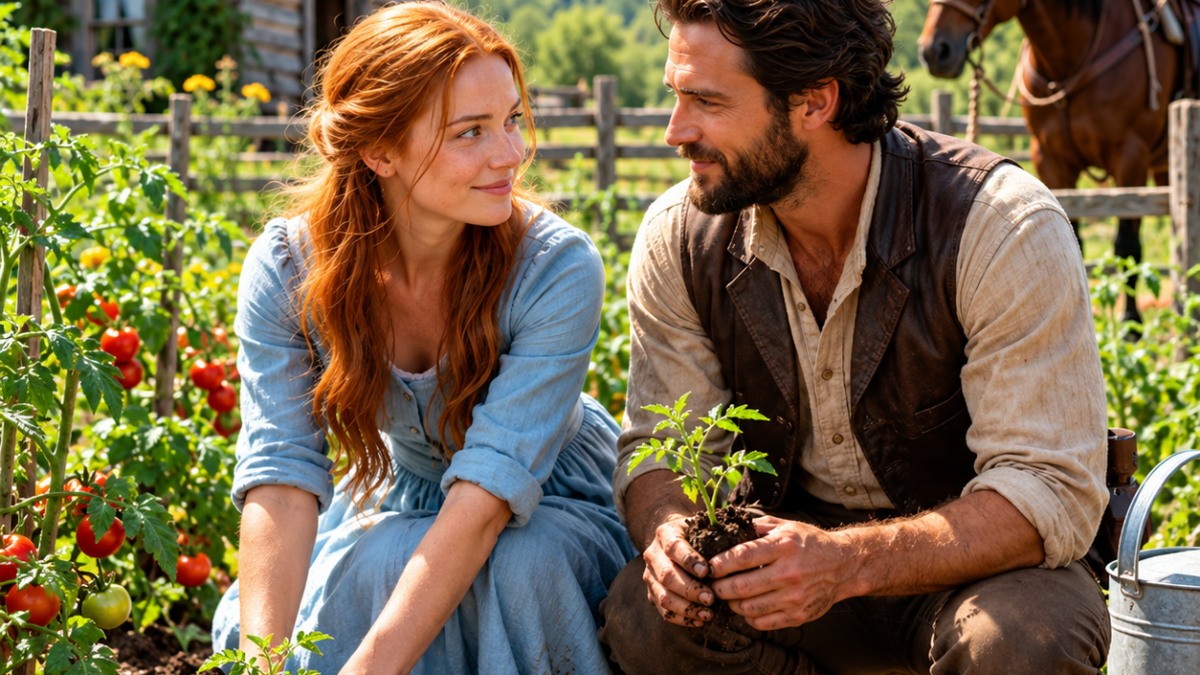
Three long rows.
Every vine properly staked.
Branches tied with strips of faded cloth.
Soil weeded clean.
Fruit everywhere.
Green.
Yellow.
Deep red.
Some so ripe the July sun seemed to shine through them.
Around the garden stood a low fence woven from branches by hand.
No deer tracks.
No damage.
Whoever had built it knew what she was doing.
Then I heard a woman’s voice from somewhere between the second and third rows.
“You’re not going to make it if you keep leaning like that.”
I stopped Cobb.
Silence.
Then:
“I told you last week. The stake goes here.”
Pause.
“This is not a negotiation.”
I looked around.
Nobody.
Then a woman stood between two tomato vines.
Copper-red hair pinned badly enough that several strands had escaped around her face.
Plain blue work dress.
Apron.
Gloves covered in dirt.
She held one plant upright with a hand on each side of the stalk.
And apparently she had been threatening it.
She finally noticed me.
Her expression changed immediately.
Not fear.
Not welcome either.
Something carefully balanced between the two.
The expression of a woman who had met enough unsolicited male advice to recognize it coming from a distance.
“Can I help you with something?”
“No.”
She waited.
I looked toward the tomato vine nearest the end.
“That one’s going to fall.”
Her eyes narrowed.
She looked at it.
The vine was leaning.
She looked back at me.
“I know.”
I should have ridden on.
Instead, I smiled.
That was mistake number two.
The woman straightened.
“Something funny?”
“No.”
“Good.”
She bent toward the vine again.
I almost left.
Then Cobb shifted beneath me.
He needed water.
That was legitimate.
“Is there a well nearby?”
She pointed toward the barn.
“Pump beside the west wall.”
“Thank you.”
“Don’t let your horse into the garden.”
“I was going to put him at the dinner table.”
She looked up.
That might have been mistake number three.
Then, unexpectedly, the corner of her mouth moved.
Barely.
Not a smile.
Potential for one.
I rode toward the well.
Her name, I would learn later, was Clover Finch.
Twenty-eight years old.
Widowed for two years.
Owner of forty acres because her late husband’s father had possessed the uncommon wisdom to put the deed in both their names.
Twelve acres tobacco.
Eight apples.
The rest pasture, garden, barn lot, creek, and the kind of work that made one person’s hands look older than the rest of them.
Her husband’s name had been Thomas.
He died from fever in February.
Four days sick.
Dead on the fifth.
They had been married three years.
Clover was twenty-six.
There were no children.
People sometimes said that made widowhood easier.
People who said things like that should be forced to listen to themselves.
Thomas had left her the farm.
Not intentionally.
Death does not create thoughtful estates.
He simply died before either of them expected him to.
The land stayed.
The work stayed.
The chickens still required feeding the morning after the funeral.
The pigs still pushed against their pen.
Fences still failed.
Fruit trees still needed pruning.
Spring still came.
That may have been what kept Clover moving.
Grief expects the world to stop.
Farms refuse.
By the time I arrived two years later, Cedar Hollow knew two things about Clover Finch.
She was not selling.
And she was not remarrying simply because half the county thought a farm needed a man.
Neighbors had helped after Thomas died.
Food.
Labor.
A repaired wagon wheel.
Harvest help.
Then help gradually became advice.
Advice became proposals.
Not always romantic proposals.
Sometimes practical arrangements disguised as romance.
A widower with children who needed a mother.
A farmer whose north pasture touched hers and thought consolidation made sense.
A merchant who had never held a hoe in his life but believed owning land and owning a wife were adjacent ambitions.
Clover turned all of them down.
Eventually people stopped offering.
Mostly.
She did the work.
Her tomatoes were proof.
So was the orchard.
And five minutes after I watered Cobb, I saw another piece of evidence.
A section of fence along the north pasture gave up.
One old post leaned.
Then cracked.
Wire sagged with it.
Clover heard.
I heard.
She came around the house.
Saw the damage.
Closed her eyes.
Then said something under her breath that was probably not intended for church.
“I can fix that.”
She looked at me.
“I didn’t ask.”
“No.”
“Then why are you volunteering?”
“Because your fence is on the ground.”
“I noticed.”
“You have livestock?”
“Two pigs.”
“They roam?”
“They have ambitions.”
I smiled.
She did not.
“The tools are in the barn?”
She folded her arms.
“You’re passing through.”
“Yes.”
“You have somewhere to be.”
“Oregon.”
“Then go to Oregon.”
“I will.”
“When?”
“After I fix your fence.”
She stared at me long enough that Cobb began drinking again.
Finally:
“West wall.”
“What?”
“Tools.”
I nodded.
“Thank you.”
“I did not thank you.”
“I know.”
That was how it started.
Not love.
Not fate.
A broken fence post.
Missouri clay was not designed for men who wanted to finish anything quickly.
The old post had rotted below ground.
I dug.
Sweated.
Dug more.
Clover returned twice.
The first time, she carried a shovel.
“I thought you didn’t want help.”
“It’s my fence.”
Fair.
We worked.
She did not waste movement.
That was the first thing I noticed about her after the tomatoes.
Every motion had purpose.
Lift.
Turn.
Clear soil.
No conversation unless needed.
At one point I said:
“You always this friendly?”
“Yes.”
“Good to know.”
She almost smiled again.
By noon, the old post was out.
A replacement came from a stack in the barn.
I set it.
Packed clay.
Restrung wire properly.
Then noticed the next post.
Also bad.
Clover followed my eyes.
“No.”
“It’s going.”
“It’ll last.”
“Not winter.”
“Daniel.”
That was the first time she used my name.
I had told her sometime during the digging.
I liked hearing it more than I should have.
“I’ll do the section.”
“You said one post.”
“I was optimistic.”
“You’re headed to Oregon.”
“It’ll still be there this afternoon.”
“How do you know?”
“Geography.”
This time she laughed.
One short sound.
Surprised out of her.
She looked almost irritated afterward.
As though I had tricked her into enjoying something.
I fixed the rest of the section.
Two hours.
When I finished, sweat had soaked through my shirt.
Mud covered both arms.
Clover appeared carrying a tin cup of water.
“You didn’t have to do all of it.”
“The whole thing needed doing.”
“I was going to get to it.”
“I know.”
She looked at me.
There are answers people say to be polite.
That was not one.
I meant it.
I had already seen enough of the farm to know Clover would have fixed it.
Maybe not that morning.
Maybe not before something else demanded attention.
But eventually.
That distinction mattered to her.
I took the cup.
Drank.
The water was cold enough to hurt my teeth.
For a while neither of us spoke.
Cedar Hollow filled the silence.
Birds.
Creek water moving over limestone below the pasture.
Cicadas.
Leaves shifting in the orchard.
The smell of warm grass and green apples.
Clover looked toward the house.
“There’s food.”
I lowered the cup.
“What?”
“If you want it.”
She immediately added:
“Before you go.”
Of course.
Before I went.
I looked west.
Road shimmering beneath July heat.
Oregon still there.
“I’ll help with the afternoon work.”
Clover frowned.
“Why?”
“Because I already ruined my shirt.”
“That’s your reason?”
“Partly.”
“You always this logical?”
“Yes.”
“No, you aren’t.”
She walked toward the house.
I followed.
Dinner was bread, ham, tomatoes, beans, and coffee.
The tomatoes were as good as they looked.
I told her.
She said:
“I know.”
That woman had no use for false modesty.
I liked that too.
By three that afternoon, I had repaired a barn latch.
Not because she asked.
Because it annoyed me.
By four, I helped move hay.
By five, Clover informed me for the third time that I could leave whenever I liked.
By six, thunder rolled in the hills.
By seven, rain started hard enough to make the road miserable.
Clover looked toward the window.
“Your timing’s unfortunate.”
I smiled.
“Terrible.”
“There’s a spare room.”
“I can sleep in the barn.”
“The roof leaks.”
“I noticed.”
Her eyes narrowed.
“You planning to fix that too?”
“Depends how long it rains.”
She should have thrown me out.
Instead, she showed me the room.
I told myself I would leave at first light.
I did not.
FULL STORY CONTINUATION 👇👇
The rain ended before dawn.
I woke to a house so quiet I heard the kitchen stove being opened downstairs.
For a moment I did not know where I was.
Then I smelled coffee.
Cedar Hollow.
Clover.
Oregon.
In that order.
I dressed.
Went downstairs.
Clover stood with her back to me, hair braided now, pouring coffee into two cups.
“You’re awake.”
“So are you.”
“I live here.”
“Strong argument.”
She handed me a cup.
No question about how I took it.
Black.
That was how I drank it.
I looked at her.
“How’d you know?”
“You drank it black yesterday.”
“You remember everything?”
“Useful things.”
That answer stayed with me much longer than it should have.
We went outside.
Morning fog sat low between the hills.
The orchard looked unreal.
Eight acres of apple trees emerging through pale mist.
Drops of rain still clung to leaves.
Lavender along the paths leaned under water.
Bees had not yet started moving.
I stopped.
Clover noticed.
“What?”
“Nothing.”
“You’re staring.”
“It’s beautiful.”
She looked toward the orchard.
“It’s work.”
“So you said about the garden.”
“Still true.”
“Can be both.”
She gave me that sideways look.
I learned it quickly.
It meant she had heard something she might agree with but did not intend to reward me immediately.
Cobb was dry.
Road was passable.
I could leave.
Instead, I saw the barn roof.
One patch sagged.
Tin nailed badly over old shingles.
I pointed.
“That leaks.”
“I know.”
“How long?”
“November.”
I stared.
“You’ve had a leaking barn roof since November?”
“It doesn’t leak over the hay.”
“That is not the standard.”
“It has been the standard.”
“I can fix it.”
She sighed.
“Daniel.”
“One hour.”
“It won’t be one hour.”
“Two.”
“You’re going to Oregon.”
“I am beginning to think Oregon has representatives in Missouri reminding me.”
“You’re reminding you.”
That was true.
I looked at the roof again.
“Two hours.”
Four hours later, I was still there.
The rotten section beneath the tin was worse than expected.
Clover worked below, cutting replacement boards.
We argued about measurements.
She was right twice.
I was right once.
I counted.
By noon, the roof held.
Clover brought lunch to the barn.
We sat in the doorway.
Cobb ate nearby.
She handed me bread.
“You do understand you don’t owe me labor.”
“I know.”
“Then why?”
I considered.
“Things bother me when they’re almost fixed.”
“That sounds exhausting.”
“It is.”
She smiled into her cup.
I looked toward the orchard.
“Thomas build the barn?”
Her smile disappeared.
Not angry.
Just gone.
“No.”
I immediately regretted the question.
“Sorry.”
“You don’t have to apologize for saying his name.”
I waited.
“His grandfather built it.”
She looked toward the structure.
“Thomas repaired everything badly.”
I laughed before I could stop myself.
Clover looked at me.
Then she laughed too.
“He did.”
She shook her head.
“Terrible carpenter.”
“I thought he owned a farm.”
“That did not improve him.”
“What was he good at?”
Clover’s face changed.
Soft.
“He understood trees.”
I looked toward the orchard.
“Apples?”
“All of them.”
“People?”
She considered.
“Sometimes.”
Then:
“He was patient.”
I said nothing.
“He could sit beside a sick animal for hours.”
She looked down at her hands.
“He was not much good at sitting beside me when I was angry.”
“Why?”
“He tried fixing it.”
I smiled.
“Sounds familiar.”
Clover looked at me.
“That was intentional.”
“Cruel.”
“Accurate.”
I liked Thomas from that conversation.
That surprised me.
Dead husbands are difficult company for men who may eventually love their widows.
Not because the dead compete.
The living invent competition where none exists.
I did not know yet that I would love Clover.
But I knew even then that Thomas had mattered.
Deeply.
And I knew I did not want to become one of those men who entered a widow’s life expecting grief to clear out before he moved in.
So I asked:
“Which trees did he plant?”
Clover pointed.
“Eight along the eastern row.”
“Those younger ones?”
“Yes.”
“Why eight?”
“No reason.”
She smiled faintly.
“He said planting something that took years to mature was an argument against leaving.”
I looked at her.
“That sounds like something a man says before dying young to make everybody furious.”
Clover stared.
Then laughed so suddenly she nearly spilled coffee.
I was afraid I had crossed a line.
Instead she covered her mouth.
“Oh, Thomas would have liked that.”
Her eyes filled while she laughed.
Then the laughter turned.
Not entirely to crying.
But close.
I looked away.
Gave her privacy without leaving.
After a minute she said:
“I was angry at him.”
“Thomas?”
“Yes.”
“For dying?”
She stared at the orchard.
“Yes.”
The honesty of it felt fragile.
I did not touch it.
Did not tell her grief was irrational.
Did not say Thomas had not chosen it.
She already knew.
Instead:
“Seems fair.”
She looked at me.
“Fair?”
“Not logical.”
“No.”
“But fair.”
Her eyes went wet.
“Most people tell me I shouldn’t feel that.”
“Most people say stupid things around grief because silence scares them.”
She stared at me long enough that I wondered whether I had offended her.
Then:
“You have experience?”
“My father.”
“When?”
“Six years ago.”
“I’m sorry.”
“So am I.”
“How?”
“Horse.”
She winced.
“Bad fall?”
“Broken neck.”
Silence.
“He was working?”
“Yes.”
“Someone else’s ranch?”
“Yes.”
She remembered.
I had told her my reason for Oregon.
Ownership.
My father.
She connected it immediately.
“That’s why the land matters.”
I looked toward Cobb.
“Partly.”
Clover nodded.
No advice.
No moral.
That was one of the first times I realized how much I liked speaking with her.
She let statements remain statements.
Not every confession required fixing.
I left the next morning.
Or rather, I attempted to.
I saddled Cobb.
Tied the bedroll.
Walked him to the road.
Clover stood beside the garden fence.
No request to stay.
No emotional goodbye.
“Thank you for the fence.”
“Roof too.”
“I was including the roof.”
“You shouldn’t.”
“Goodbye, Daniel.”
“Goodbye, Clover.”
I rode west.
Made nearly five miles.
Then Cobb threw a shoe.
I stared at the hoof.
Cursed.
There was a blacksmith in Cedar Hollow.
Behind me.
Naturally.
I returned.
Clover saw me ride into the yard.
Looked at Cobb.
Then at me.
“You forgot Oregon?”
“Horse forgot a shoe.”
“Convenient.”
“You think I removed it?”
“I don’t know what people from Kansas do for entertainment.”
“I’m from Nebraska.”
“That explains even less.”
The blacksmith reset Cobb’s shoe.
Late afternoon by then.
Clover needed help moving feed sacks before rain.
I helped.
Stayed another night.
The next morning, one of her pigs escaped.
I had never respected pigs.
That morning reinforced the decision.
The larger one was named Principal.
The smaller one, Sentiment.
I asked why.
Clover said:
“Because Principal behaves as if everyone works for him, and Sentiment makes decisions based entirely on feelings.”
I decided not to ask what that said about her.
Principal pushed through a weak corner of the pen.
Sentiment followed because apparently emotional loyalty overcame judgment.
It took three hours to recover them.
Clover laughed harder during that chase than I had yet seen.
Really laughed.
Bent over.
Hands on knees.
Hair falling loose.
At one point I slipped in mud and Principal ran over my boot.
Clover nearly collapsed against the fence.
“You enjoying yourself?”
“I haven’t been this happy in months.”
“At my expense.”
“Mostly.”
We repaired the pig pen.
Another day gone.
The next morning I did not saddle Cobb.
I told myself one rest day after a thrown shoe was sensible.
That afternoon, we weeded tobacco.
Next day, orchard pruning.
Next, wagon wheel.
I stopped pretending every task was the reason.
By the seventh evening, we sat on the porch watching fireflies over the south pasture.
Clover occupied one chair.
I sat on the steps.
Between us:
Quiet.
Not uncomfortable.
That was new for me.
I had lived much of my adult life among people who treated silence like empty space requiring conversation.
Clover did not.
She could sit beside a person for an hour and say three useful sentences.
I respected efficiency.
She looked at the road.
“You’re not going to Oregon.”
“I am.”
“When?”
“Soon.”
“Mhm.”
“What does that mean?”
“Nothing.”
“It sounds like something.”
She sipped coffee.
“You’ve been here a week.”
“Road is still there.”
“So is your deadline.”
“I know.”
“September.”
“I know what month comes after August.”
She looked at me.
“Do you?”
I laughed.
She looked away.
But later that night, lying in the spare room, I stared at the ceiling.
September.
Prescott.
Money.
Land.
Two years.
Everything in me understood the cost.
That was what made staying dangerous.
If Oregon had been fantasy, Cedar Hollow would have been easy.
But Oregon was real.
Good land.
Good price.
A future worth wanting.
Leaving Clover did not mean choosing wrong.
That was the problem.
Sometimes life does not place good and bad in opposite hands.
Sometimes it gives you two good things and makes you decide which loss you can carry.
On the eighth morning, Clover went to the orchard before breakfast.
I did not follow.
I repaired a harness strap in the barn.
Later, I learned what she said among the trees.
Not then.
Years later.
She had stood beneath an apple tree nearly her age and told it:
“He’s going to leave.”
She told the tree I had a life.
A plan.
Oregon.
She told Thomas’s tree she wished I had never stopped.
Then admitted something she hated.
She had forgotten what it felt like to notice another person’s absence before that person was actually gone.
That line stayed with her.
She told me much later.
“I liked it better when I didn’t notice the difference between alone and together.”
I understood.
Competence can become armor.
If you prove you can do everything alone long enough, needing nobody begins to feel safer than wanting anybody.
Clover did not need me.
That was one of the things I loved most about her.
Though again, I had not yet admitted love.
On the tenth morning, I saddled Cobb.
For real.
Brushed him.
Checked shoes.
Rolled bedroll.
Packed supplies.
Everything.
The sun came low across the valley.
Mist over creek.
Orchard glowing.
I stood beside Cobb.
Ready.
I thought about Oregon.
High grassland.
Cattle.
The house I might build.
A name on a deed.
My father never had that.
I could.
If I left now.
I took Cobb’s reins.
Walked toward the road.
Then heard Clover in the garden.
Bucket.
Shears.
Her voice, low.
Talking to something green.
I stopped.
There are moments people later describe as decisions.
They rarely feel dramatic while happening.
No music.
No certainty.
Just a man holding reins.
One road west.
One farmhouse behind him.
I thought:
If I leave, I will think about this place.
That was not enough.
Men think about many places.
Then:
If I stay, I lose Oregon.
Also true.
Then:
If I ride away because I am afraid staying means changing my plan, then the plan owns me instead of the other way around.
That was the thought.
Simple.
I led Cobb back to the barn.
Unsaddled him.
He looked pleased.
Traitor.
I stood in the dim barn with both hands on the stall rail.
“You better not make me regret this.”
Cobb ate hay.
Useful.
I walked around the house.
Clover knelt beside the herb row.
She heard me.
Did not look up.
“I thought you were leaving.”
“I was.”
She cut something with small shears.
“And?”
“I unsaddled Cobb.”
She stopped cutting.
“Why?”
I had spent most of my life being good with practical answers.
This one was not practical.
“Because I’d like to see the orchard at harvest.”
Clover set the shears down.
Slowly.
She looked up.
“Harvest is September.”
“I know.”
“You have a deadline in Oregon.”
“Yes.”
“You’d miss it.”
“Yes.”
She stood.
“That land took you two years.”
“Yes.”
“Daniel.”
“I know.”
Her expression sharpened.
“No. I don’t think you do.”
“I do.”
“What exactly are you doing?”
“Staying.”
“Until harvest?”
“Yes.”
“Why?”
I wanted to say because of you.
Too easy.
Too much.
And not entirely accurate.
Because I liked the farm.
The work.
The creek.
The orchard.
The porch.
Clover.
All of it had become something together.
So I said:
“I want to.”
She stared.
“That is not an explanation.”
“It’s the only one I have.”
She crossed her arms.
“I haven’t needed anybody here in two years.”
“I know.”
“I need you to understand that.”
“I do.”
“I repaired fences before you.”
“Yes.”
“Roof would have gotten fixed.”
“Eventually.”
Her eyes narrowed.
“Careful.”
I smiled.
“I’ve watched you work.”
I stepped closer.
“You are the most capable person I’ve met in years.”
That stopped her.
“I’m not staying because you need saving.”
Her shoulders lowered slightly.
“Good.”
“I think you’d shoot me.”
“I don’t own a gun.”
“You’d find one.”
That almost-smile.
Then Clover said:
“The farm is quieter than it should be.”
I waited.
Her face changed as the words came.
Not weakness.
Cost.
“I did not notice before.”
She looked toward the orchard.
“I noticed this week.”
I did not move.
“That’s all.”
It was not all.
But it was enough.
I said:
“Orchard will need two people at harvest.”
“I’ve done it alone.”
“I know.”
“Every year.”
“I believe you.”
“Then why keep saying two?”
“Because two can be better without one being incapable.”
Clover looked at me.
Bees moved through lavender.
Somewhere a chicken complained about existence.
Finally:
“Stay through harvest.”
I nodded.
“We’ll see what happens after.”
“Fair.”
She picked up the shears.
I began walking away.
“Daniel.”
I turned.
She was looking at the herbs.
Not me.
“I’m glad you unsaddled the horse.”
That was the first time Clover asked me to stay without pretending it was about work.
I slept badly that night.
Not from regret.
From understanding how much had changed.
Summer deepened.
We worked.
That sounds plain.
It was not.
Work is one of the most intimate ways two people learn each other when neither is inclined toward confession.
I learned Clover’s pace.
Fast early.
Slower in afternoon heat.
She hated stopping halfway through a task.
Forgot lunch if nobody reminded her.
Counted things under her breath.
Apples.
Eggs.
Fence staples.
Anything.
She learned I became quiet when angry.
That I checked horses twice before sleep.
That I repaired tools before being asked.
That I hated boiled carrots.
She served them once.
I ate around them.
She noticed.
Next week there were none.
No announcement.
Just memory.
I learned she left one cup of coffee on the porch rail every morning.
At first for Thomas, years earlier.
Then only for herself after he died.
Eventually there were two.
Mine appeared without discussion.
That mattered more than any declaration could have.
We harvested tobacco in late August.
Hard work.
Hot.
Sticky.
By evening both of us were too exhausted for romance even if we had understood romance was happening.
That may have helped.
Nothing was performed.
No courting games.
No flowers I did not know what to do with.
No jealous neighbor.
No dramatic misunderstanding.
We simply learned how to be tired beside each other.
That is underrated.
One afternoon, Clover cut her palm badly on a broken tobacco knife.
She hissed.
Dropped it.
Blood.
I grabbed her wrist.
“Sit.”
“I’m fine.”
“You’re bleeding.”
“I can see.”
“Sit.”
“I still have—”
“Clover.”
She sat.
I cleaned it.
Wrapped it.
Her eyes stayed on my face.
“What?”
“Nothing.”
“That’s not true.”
She looked at my hands.
“You’re gentle.”
I paused.
“Should I be offended?”
“No.”
“You sound surprised.”
“Most men your size assume gentleness and weakness are the same thing.”
“My father cured me of that.”
“How?”
“He could lift a calf by himself and cried every time a dog died.”
Clover smiled.
“Thomas cried over chickens.”
“Chickens?”
“One died his first winter here.”
“That is excessive.”
“I told him.”
“What happened?”
“He buried it beneath the pear tree.”
I laughed.
“He was ridiculous.”
“He was.”
She smiled.
“I loved him.”
There it was.
I kept wrapping her hand.
“I know.”
No discomfort.
No jealousy.
Just fact.
After a moment:
“Do you mind?”
“What?”
“That I talk about him?”
I tied the bandage.
“No.”
“Most men—”
“I’m not most men.”
“That sentence usually comes from men who are exactly like most men.”
Fair.
I looked at her.
“Thomas was here.”
“Yes.”
“He loved you.”
“Yes.”
“You loved him.”
“Yes.”
“That does not become untrue because he died.”
Her eyes filled.
“If I need him erased for there to be room for me, there isn’t room for me.”
Clover stopped breathing for half a second.
I stood.
“Try not to bleed on the tobacco.”
She laughed through tears.
“Daniel.”
“What?”
“Thank you.”
I nodded.
Walked away before I ruined it by speaking.
September arrived.
Apple harvest.
Thomas’s orchard became another world.
Fruit bending branches.
Red.
Green.
Gold.
Arkansas Black going nearly purple in shade.
Morning fog.
Warm afternoons.
Sweet smell everywhere.
We borrowed ladders.
Baskets.
Started before sunrise.
I took upper branches.
Clover lower.
We worked through rows.
One morning, beneath the eastern section, she said:
“Thomas planted these.”
I looked down from ladder.
“Which?”
“Last eight.”
She touched one trunk.
“This one especially.”
Dark apples.
“He said we needed things that took years.”
I climbed down.
“Why?”
“To give us reasons to stay somewhere long enough to see them.”
I looked at the tree.
“He was right about staying.”
Clover’s face changed.
Soft.
“He was right about a lot.”
Then she admitted:
“I’ve been angry at him longer than I should.”
“For dying.”
“Yes.”
“That isn’t measurable.”
“What?”
“How long you should be angry.”
“It’s irrational.”
“So?”
“You say that as though irrational feelings deserve authority.”
“No.”
I lifted a basket.
“I say they deserve acknowledgment before they start running things from hiding.”
She stared.
“Where did you learn that?”
“Nowhere.”
“You sound suspiciously wise.”
“I’m mostly tired.”
She smiled.
Then said quietly:
“He would’ve liked you.”
I stopped.
“Thomas?”
“Yes.”
“Why?”
“He liked people who knew how to work.”
“That is a low standard.”
“For Thomas, very high.”
I laughed.
Something settled in her face.
I did not ask whether that meant permission.
Dead husbands do not give permission.
Widows do not need it.
But I understood the gift.
That evening, I sat alone at Clover’s kitchen table.
Lamp lit.
Farm quiet.
The letter paper looked too clean.
Dear Mr. Prescott,
I began.
Stopped.
Started again.
Dear Prescott,
I’m writing to let you know I will not meet the September deadline for the Eugene parcel.
There.
Once written, reality changed.
I continued.
I understand this forfeits my claim, and I apologize for the inconvenience.
The reason is simple, though I doubt it will look sensible on paper.
I stopped in Cedar Hollow, Missouri, several weeks ago to water my horse.
There was a woman arguing with tomatoes.
I smiled writing it.
Somewhere between a broken fence post, a leaking barn roof, two unreasonable pigs, and an apple harvest I was never supposed to see, I stopped thinking of myself as a man on his way somewhere else.
I looked around the kitchen.
Thomas’s kitchen once.
Clover’s now.
Maybe something more later.
I wrote:
There will be other land.
There is always land if a man keeps looking.
What I have found here feels less replaceable.
I am not inclined to ride past it simply because it was not part of the original plan.
I wish you well with the sale.
Daniel Voss.
I sealed it.
Set it on the table.
Went to bed.
Clover found it in the morning.
She did not open it.
Read the address.
Understood.
When I came downstairs, coffee sat on the porch rail.
Two cups.
She said nothing.
Neither did I.
Some choices are large enough that ordinary mornings become the best way to honor them.
October came.
Harvest nearly finished.
Cold entered evenings.
I had stayed beyond the agreement.
Neither of us mentioned that.
One afternoon, I found Clover in the orchard beneath Thomas’s Arkansas Black tree.
Last apples.
Light gold.
I had carried a small ring in my pocket for nine days.
Not Thomas’s.
I would never have used his.
I bought it in town.
Plain.
Silver.
Nothing dramatic.
Clover saw me approaching.
“You look strange.”
“Encouraging.”
“Did something break?”
“Possibly.”
She looked toward barn.
“No.”
“Not barn.”
“Fence?”
“No.”
“Pig?”
“No.”
“Then?”
I stopped beneath the tree.
“I’d like to stay.”
She folded her arms.
“You are staying.”
“Permanently.”
That removed some humor from her face.
“Daniel.”
“I’d like to work this farm with you.”
I swallowed.
“And see what it becomes.”
Silence.
“And I would like to do that as your husband.”
Clover looked at me.
No gasp.
No hands to mouth.
No theatrical shock.
Thank God.
I continued:
“I know you don’t need me.”
Her eyes changed.
“That matters.”
“I know you could keep this place without me.”
I looked around.
“You did.”
She waited.
“I’m not asking because I think a widow needs a man.”
“Good.”
“I’m asking because I think my life is better when you’re in it.”
Her mouth trembled slightly.
“And because I think two people who can each stand alone can still decide standing together is better.”
Clover looked upward.
Thomas’s apples.
Branches.
Then back.
“You gave up Oregon.”
“Yes.”
“Two years.”
“Yes.”
“Money.”
“Yes.”
“You’re either very romantic or very stupid.”
“I have been called worse.”
“Thomas would call you a fool.”
I smiled.
“Would he mean it kindly?”
“Probably.”
“I’ll take it.”
Clover looked at me for a long time.
Then:
“Yes.”
I almost answered too quickly.
She lifted one finger.
“To be clear.”
“Please.”
“Yes.”
“Good.”
“You assumed?”
“A little.”
“That is dangerous.”
“I know.”
She held out her hand.
I put the ring on.
It fit.
Mostly because I had bribed June Miller at the general store into estimating the size based on Clover’s glove.
Clover noticed.
“How did you know?”
“Trade secret.”
“You asked June.”
I stared.
“How?”
“She cannot keep a secret.”
That was true.
Then Clover laughed.
And kissed me.
First time.
No orchestra.
Bees probably gone for the season anyway.
Cold air.
Apples.
A dead man’s tree above us.
A new promise beneath it.
Perfect.
We married the following May.
In the orchard.
Clover’s idea.
Thomas’s trees in full bloom.
White and pink blossoms.
Neighbors between rows.
Wildflowers.
Ribbon.
Cobb tied near barn looking unimpressed.
Principal and Sentiment excluded from ceremony because experience had taught us limits.
Clover wore a simple cream dress.
No veil.
Her hair loose enough that the wind moved it.
Before walking into the orchard, she stopped.
I saw her look toward the farmhouse.
Then one tree.
Thomas’s Arkansas Black.
She touched the trunk.
Just once.
No one interrupted.
Then she came toward me.
That moment taught me something I had not understood before.
Beginning again does not require pretending there was no beginning before it.
Clover did not leave Thomas at the edge of our marriage.
She carried what he gave her.
The farm.
The orchard.
Memory.
Grief softened by time.
I married all of it.
Gladly.
Our first year was not perfect.
This is where stories often lie.
They say marriage begins and loneliness ends.
Work becomes lighter.
Love solves practical things.
Nonsense.
We argued.
About fences.
Money.
Tobacco acreage.
Whether Cobb was allowed near the garden.
He wasn’t.
Whether Clover should climb barn roofs while pregnant.
She wasn’t pregnant then; she simply considered my argument insulting in principle.
Whether I repaired things too quickly without asking.
She said yes.
I said things need fixing.
She said ownership did not transfer through marriage.
I shut up.
Mostly.
The first serious argument came over orchard pruning.
I cut a branch.
Clover stared at the tree.
“What did you do?”
“Pruned it.”
“You butchered it.”
“It was crossing inward.”
“It produced well last year.”
“It will produce better.”
“You don’t know apples.”
“I know trees.”
“You know horses.”
“I know branches.”
“You know nothing.”
We barely spoke through supper.
That night I sat on porch.
Clover came out.
Placed coffee beside me even though it was late.
She sat.
After five minutes:
“You were right about the branch.”
I looked at her.
“Could you repeat that?”
“No.”
“I want documentation.”
“Daniel.”
I smiled.
“Sorry.”
She stared toward orchard.
“I hate being wrong about things Thomas taught me.”
That changed everything.
The argument had not been about a branch.
Of course.
I said:
“Then I’m sorry too.”
“For what?”
“Acting like it was only about a tree.”
Clover leaned back.
“Marriage is irritating.”
“Very.”
“We should warn people.”
“Too late.”
We laughed.
The orchard produced better that year.
I never mentioned it.
Growth.
We had a daughter two years later.
Grace.
Named after no one.
Clover wanted a name that belonged only to the child.
Grace arrived in March during rain.
Red hair.
Loud lungs.
I had handled foals.
Calves.
Injured horses.
Nothing prepared me for how terrified I was holding an eight-pound human.
Clover laughed from bed.
“You look afraid.”
“I am.”
“She’s not breakable.”
“She absolutely looks breakable.”
Grace wrapped one hand around my finger.
That was it.
Finished.
I became ridiculous.
Thomas remained part of the household.
A photograph in bedroom.
His father’s tools in barn.
Stories.
When Grace was old enough to ask:
“Who’s that?”
Clover said:
“Thomas.”
“Was he Mama’s friend?”
Clover looked at me.
Then:
“He was my first husband.”
Grace thought.
“Before Papa?”
“Yes.”
“Did he live here?”
“Yes.”
“Where is he?”
“He died.”
Grace became quiet.
Then asked:
“Did you love him?”
Clover said:
“Yes.”
Our daughter looked at me.
“Papa knows?”
I laughed so hard Clover threw a dish towel at me.
“Yes, sweetheart.”
Grace frowned.
“Is Papa mad?”
“No.”
“Why?”
I answered.
“Because loving somebody before me doesn’t take anything away from what we have now.”
Grace considered.
Then:
“Okay.”
Children can accept truths adults spend years complicating.
Years passed.
Tobacco changed.
Prices rose.
Fell.
We reduced acreage.
Added cattle eventually.
Not Oregon.
Missouri.
Irony.
I got the cattle operation I wanted.
Just not where I had planned it.
Clover reminded me of that whenever I became philosophical.
“You still got cows.”
“Yes.”
“You complained for two years about giving up Oregon.”
“I did not.”
“You wrote three letters to Prescott asking about land prices.”
“Research.”
“Regret.”
“Research.”
She smiled.
The truth?
I wondered.
Of course.
People who choose one life do not become incapable of imagining another.
Sometimes in spring, seeing cattle grazing Missouri hills, I wondered what Oregon looked like.
Did Prescott sell?
Who bought?
Was the grass as good as promised?
Would I have built a fine house?
Married someone else?
Stayed alone?
There is no insult in wondering.
Clover wondered too.
Not about Oregon.
Thomas.
What if fever had passed?
What if he lived?
Would they have children?
Would I have ridden by without stopping?
Probably.
One night, years into our marriage, Clover asked:
“Do you ever think you chose wrong?”
I was honest.
“Sometimes I think about the other life.”
She nodded.
“So do I.”
Thomas.
Neither of us pretended.
Then I said:
“I don’t wish for it.”
Clover looked at me.
“Neither do I.”
There.
That was enough.
Contentment is not amnesia about roads untraveled.
It is knowing them and staying anyway.
That became our marriage.
Choosing again.
Morning after morning.
Not because one vow solved it.
Because things worth keeping require tending.
Like tomatoes.
Like orchards.
Like people.
Clover always said that last part was my invention.
I say she thought it first.
The farm prospered.
Not every year.
One terrible drought nearly ruined us.
A winter storm killed three calves.
Fire took half the tobacco barn when Grace was nine.
I ran into smoke trying to save equipment.
Clover dragged me backward by my coat.
“You are not dying for a tobacco knife.”
“It was the good one.”
She hit me.
Hard.
Fair.
We rebuilt.
Neighbors came.
The same community that had once wondered how long a widow could keep forty acres now took orders from Clover about where every board belonged.
She had earned that.
I never wanted credit for it.
Another lesson.
When a strong woman lets you work beside her, do not retell the story as though you created her strength.
Clover was Clover before I arrived.
I added labor.
Love.
Irritation.
Better fence posts.
She would have survived without me.
That did not make me unnecessary.
It made being wanted different from being needed.
Better, maybe.
One autumn, when Grace was fourteen, she asked:
“Mama, why did you marry Papa?”
I waited for something sentimental.
Clover was sorting apples.
She did not even look up.
“He was difficult to get rid of.”
Grace laughed.
“I’m serious.”
“So am I.”
Then Clover looked at me.
Her eyes still had that same arithmetic in them.
Finally:
“He never acted like I owed him helplessness.”
Grace frowned.
“What does that mean?”
Clover thought.
“After Thomas died, people wanted to help me.”
“That’s good.”
“Yes.”
“Then?”
“Some of them needed me to remain someone who required helping.”
Grace considered.
“Papa didn’t?”
“No.”
Clover smiled.
“Your father saw I could carry something and offered to carry the other end.”
I stood very still.
Grace said:
“That’s why?”
“One reason.”
“What’s the other?”
Clover returned to apples.
“He made me laugh while chasing a pig.”
I objected.
“The pig attacked me.”
“Principal stepped on your boot.”
“Hostile.”
Grace laughed.
That evening, I wrote Clover’s words down.
Not because she knew.
Because I wanted to remember.
Carry the other end.
Years later, that became more literal.
Age changes marriages.
At fifty-five, I could still work sunup to sunset.
At sixty-five, my left knee disagreed.
At seventy, Clover’s hands began aching during cold weather.
Tasks shifted.
I cooked more.
Badly.
She supervised.
I stopped climbing roofs.
Mostly because Grace threatened to tell my grandchildren every time.
The farm passed gradually to our son-in-law and daughter.
Yes, Grace married.
Yes, I disliked him initially.
His name was Samuel Reed.
Good man.
I disliked him on principle.
Clover loved that.
“You look exactly like my father when you asked for my hand.”
“I did not ask your father.”
“He still looked like that.”
Samuel understood orchards.
That helped.
He also listened to Grace.
That helped more.
Our grandchildren grew among the same trees.
Thomas’s eight remained for decades.
Not all.
Storm took one.
Disease another.
The Arkansas Black survived longest.
Clover became fiercely protective of it.
One spring, lightning split a major branch.
Samuel suggested removal.
Clover stared at him.
He reconsidered instantly.
We saved half the tree.
It fruited again.
Not much.
Enough.
On our fortieth anniversary, Clover and I sat beneath it.
She was sixty-eight.
I was seventy-two.
Hair white now.
Same eyes.
Same refusal to accept nonsense.
We watched our grandchildren chase each other between rows.
Clover leaned against me.
“Do you remember the tomato?”
“Which?”
“The one you said would fall.”
“It would have.”
“I had it handled.”
“Clearly.”
“You were very irritating.”
“You married me.”
“I was grieving.”
“Forty years is a long grief response.”
She laughed.
Then became quiet.
“Thomas has been gone forty-two years.”
I waited.
“Longer than he lived.”
“Yes.”
“That feels impossible.”
I understood.
Dead people remain one age while we keep traveling.
Thomas still twenty-something in her mind.
Clover had become old enough to be his grandmother.
Grief makes time strange.
She said:
“I barely remember his voice.”
No shame.
Only sadness.
I took her hand.
“You remember what he gave you.”
“The farm.”
“More.”
She looked toward trees.
“Yes.”
Then:
“I used to be afraid loving you meant losing him again.”
I turned.
She had never said that.
“Did it?”
“No.”
She smiled faintly.
“It made him safer somehow.”
“What does that mean?”
“When it was only me and grief, remembering him hurt.”
She looked at our family.
“When life became full again, memory could stop doing all the work.”
I understood enough.
Not everything.
Love after loss is like that.
The person beside the grief never fully understands.
They do not need to.
They need to make room.
Clover squeezed my hand.
“Thank you for never making me choose.”
I kissed her temple.
“Thank you for choosing me anyway.”
She rolled her eyes.
“You ruined it.”
“What?”
“That was too sentimental.”
“Forty years buys me one.”
“No.”
Same Clover.
She died at seventy-four.
I hate writing that sentence.
Even now.
Not dramatically.
Not fever in five days like Thomas.
Her heart weakened over several years.
She knew.
We all did.
That did not make it easier.
Her last summer, she could no longer work the garden.
That nearly killed her before her heart did.
So we put a chair between the tomato rows.
Grace carried her out each morning.
I sat beside her.
Clover inspected everything.
“That one needs tying.”
“I know.”
“You said that yesterday.”
“I’ll do it.”
“When?”
“Eventually.”
She looked at me.
“That’s my line.”
“I’ve waited fifty years.”
One morning, she reached toward a vine.
Could not quite reach.
I moved the chair closer.
She touched a red tomato.
Smiled.
“Good year.”
“Yes.”
“You finally learned.”
“I’ve always known.”
“No.”
She closed her eyes.
“Daniel?”
“What?”
“Do you regret Oregon?”
I had answered versions of that question many times.
That day deserved simplicity.
“No.”
Not because Oregon would have been bad.
Because regret was not the right word.
Clover opened her eyes.
“Never?”
“I wonder.”
“Different.”
“Yes.”
She nodded.
“Good.”
I asked:
“Do you regret letting me stay?”
She smiled weakly.
“Frequently.”
I laughed.
Then she reached for my hand.
“No.”
That was the last long conversation we had.
Three weeks later, she died in our bedroom.
Morning.
Window open.
Orchard visible.
Grace beside her.
Me holding one hand.
Clover looked toward the window.
Then at me.
“You stayed.”
I could barely speak.
“Yes.”
“Good.”
Those were her last words to me.
Good.
I buried Clover in the small family cemetery beyond the orchard.
Beside Thomas.
People questioned that quietly.
Not me.
Thomas had been part of the story before I arrived.
I did not need death to become possessive.
My stone would eventually go on her other side.
That was Grace’s idea.
Thomas.
Clover.
Daniel.
Not a contest.
A life.
Two marriages.
Two loves.
One woman who had lived enough for both.
After the funeral, everyone left.
Grace tried staying.
I made her go home.
I walked alone to the garden.
Tomatoes.
Of course.
Late summer.
Heavy.
One vine leaned.
I stood there.
Looked at it.
Then said:
“You’re not going to make it if you keep leaning like that.”
My voice broke before I finished.
I tied the vine.
Exactly where Clover would have.
Probably.
She would have corrected me.
I sat in the dirt and cried.
Not dignified.
Not quiet.
Seventy-eight-year-old man on his knees beside tomatoes.
I had cried for my father.
Friends.
Horses.
But losing Clover was different.
She had been the person beside whom most of my adult life happened.
That is what long marriage becomes.
Not one grand love story.
A witness.
Someone who knows what you meant before you finish.
Someone who remembers which knee hurts.
How you take coffee.
What you looked like before gray hair.
Which stories you exaggerate.
Which regrets you carry.
Which roads you almost took.
Then suddenly that witness is gone.
And you are the only person left holding half the memories.
For the first winter without her, I considered selling.
Grace refused to pressure me.
Samuel said property decisions could wait.
I walked the farm.
Barn.
Pasture.
Creek.
Orchard.
Thomas’s last Arkansas Black tree had finally become unsafe.
Large split.
Rot.
It needed to come down.
I stood beneath it.
Forty-plus years after Clover told me Thomas planted it.
Samuel waited.
“What do you want?”
I touched the trunk.
“Take it.”
“You sure?”
“No.”
We removed the tree.
I kept one piece of wood.
A straight section.
Had it milled.
A year later, I built a bench.
My carpentry had improved.
Clover would have complained about something anyway.
I placed the bench where the tree stood.
On the back I carved:
STAY LONG ENOUGH TO SEE WHAT GROWS.
People think Thomas said it.
He almost did.
Clover lived it.
I learned it.
I remained on the farm until eighty-one.
Then moved into a smaller house near Grace.
The farm stayed in the family.
I visited every week.
Every July, I went to the tomato rows.
Grace changed some things.
Metal stakes.
I objected.
Cloth ties still.
Good.
One summer, my granddaughter asked:
“Grandpa, is this where you met Grandma?”
“Yes.”
“What was she doing?”
“Arguing.”
“With who?”
“A tomato.”
She laughed.
“No.”
“Yes.”
“Why?”
“It was leaning.”
“Did it listen?”
“No.”
“Then what happened?”
“I stopped.”
She waited.
“That’s it?”
“That’s the important part.”
I looked toward the road.
The same route, though wider now.
Cars where horses once passed.
“You stopped because of a tomato?”
“No.”
I thought.
“I stopped because something caught my attention.”
“What?”
“Your grandmother.”
She smiled.
“But I didn’t know that yet.”
Children like clear stories.
Adults learn life rarely provides them.
The tomatoes were not destiny.
Fence was not fate.
Cobb losing a shoe was probably just bad luck.
I did not stay because the universe ordered me.
I stayed because, eventually, I chose to.
That matters more.
There is a version of my life where I did not.
I think about that sometimes.
Daniel Voss reaches Cedar Hollow.
Sees tomatoes.
Waters horse.
Maybe helps with fence.
Then rides west.
He reaches Oregon before September.
Prescott sells him the land.
He buys cattle.
Builds a house.
Maybe prospers.
Maybe marries.
Maybe has children.
Maybe not.
It could have been a good life.
That truth does not threaten the one I had.
People want choices to become obvious after we make them.
Otherwise we must admit how much rests on uncertainty.
Oregon was a good road.
Cedar Hollow was another.
I could not walk both.
So I chose one.
The value did not come from destiny.
It came from staying long enough to build something after the choice.
That is what people misunderstand about love.
They think meeting is the story.
It isn’t.
Meeting is weather.
Accident.
Luck.
The story is what you do the next morning.
And the morning after that.
I met Clover because I stopped.
I loved Clover because I stayed.
Different things.
Clover did not need a husband.
That was true from the first day to the last.
She had kept forty acres alive without one.
Buried a man she loved.
Survived winters.
Harvested tobacco.
Pruned an orchard.
Repaired fences.
Raised animals.
Paid taxes.
Turned down men who mistook her competence for a problem requiring rescue.
She did not need me.
And I did not need a home.
I had spent years perfectly capable of sleeping wherever I worked.
A horse.
A bedroll.
Money.
A plan.
Enough.
Then we met.
And discovered that need was never the question.
Want was.
Choice was.
She could stand alone.
So could I.
That made standing together mean more.
Years after Clover died, I found the original letter to Prescott in an old box.
Not the letter itself.
I had mailed that.
A draft.
One line crossed out.
I had forgotten it.
There is other land.
There always is.
What there is not always is a place where leaving begins to feel more costly than staying.
I sat holding that paper for a long time.
That had been the entire truth.
I was not trapped in Cedar Hollow.
Clover never asked me to abandon myself.
She never said:
Choose me or Oregon.
She barely asked me to stay through harvest.
I chose.
And because I chose, I could keep choosing without resentment.
Maybe that is why we lasted.
Neither of us became the other person’s prison.
Clover kept the farm because she wanted it.
I stayed because I wanted her.
When either of us forgot that, marriage became harder.
When we remembered, it became home again.
There is a photograph of us taken the spring after our wedding.
Orchard blossoms behind.
Clover looking directly at camera.
Me looking at her.
Grace always teased me about that.
“You knew a photographer was there.”
“Yes.”
“Then why weren’t you looking?”
“Your mother was prettier.”
“Grandpa.”
“What?”
“That is disgustingly sweet.”
“She would agree.”
In the photograph, Clover looks strong.
Not rescued.
Not softened by marriage.
Still the woman who threatened vegetables.
I am glad.
That is how I want her remembered.
Not as a lonely widow waiting for a man to save her.
She was living before me.
Fully.
Painfully.
Capably.
I simply arrived during the middle of it.
And I was lucky enough that when I finally stopped pretending I was only passing through, she made room.
Not because the room had been empty.
Thomas had occupied part.
Grief occupied part.
Work occupied plenty.
But hearts, unlike farms, do not always require acreage to make room.
They expand strangely.
Clover taught me that too.
If I could go back to that July morning, I would not tell younger Daniel what happened.
I would not say:
Stop. That woman becomes your wife.
Too much knowledge ruins choice.
I would let him see the tomatoes.
Hear her talking.
Let Cobb slow.
Let him wonder.
Then when she asks:
“Can I help you with something?”
I would say nothing.
Because I already know his answer.
“No.”
Then he will look at the end of the row.
See the leaning vine.
Say something unnecessary.
Annoy her.
Water his horse.
Notice the fence.
And make the first decision that seems too small to matter.
“I can fix that.”
Clover will say:
“I didn’t ask you to.”
He will answer:
“I know.”
And somewhere between those two sentences, an entire life will quietly begin.
Not because she needs him.
Not because he needs her.
Because eventually two people who have proven they can walk alone will look at the road ahead and decide they would rather walk it together.
That was us.
Clover Finch did not need a husband.
Daniel Voss did not need a home.
Until Cedar Hollow.
Until three rows of tomatoes.
Until a broken fence.
Until one ordinary morning when I had somewhere important to be and stopped anyway.
I never reached Oregon.
I found something else.
And all these years later, after the cattle, the children, the harvests, the grief, the laughter, Thomas’s trees, Clover’s coffee, and the thousands of ordinary mornings that made a marriage out of one unexpected stop, I know exactly what I would do if the whole road were offered to me again.
I would pull the horse to a stop.
I would listen to the woman arguing with the tomato.
And this time, I would already know.
I was home.


