I Spent 11 Years Saving to Buy an Abandoned Montana Ranch—Then a Millionaire Rancher’s Daughter Rode Through My Gate With $700 and an Offer I Refused.
PART2:
Fields returned to the stubborn wildness of land that had stopped being asked to produce anything.
A property everyone else had already judged.
Cole looked at it and felt something he had not felt in thirty-two years of life.
Certainty.
Not happiness.
Not excitement.
Certainty.
It rose in him quietly, like water finding a path under stone.
He had been a hired hand since he was old enough to swing into a saddle without help. Wyoming. Idaho. Montana Territory. Any ranch that paid wages and provided a bunk. He had slept in rooms that smelled of sweat, smoke, wet socks, and men who were always leaving. He had eaten whatever was set out, worked whatever was assigned, and spent almost nothing he did not have to spend.
Eleven years of wages.
Eleven years of saying no to whiskey he wanted, shirts he needed, women he admired from a distance because courting cost money and a man with a moving life had no business making promises. Eleven years of sleeping light with his savings wrapped in oilcloth beneath his bedroll.
Four hundred twenty dollars.
Every cent of it.
That was what the bank took.
Four hundred twenty dollars for 240 acres nobody else wanted.
When Cole signed the papers, the banker looked at him the way men look at a fool while hoping the fool does not notice.
“You understand the condition of the property?”
“Yes.”
“House needs work.”
“I saw.”
“Barn needs more.”
“I saw that too.”
“Fences are down.”
“I know.”
The banker paused, pen still in hand.
“Mr. Harding, a man could spend every remaining dollar he owns just getting that place to the starting line.”
Cole took the deed.
“That’s what starting lines are for.”
He rode out that afternoon with ten dollars left in his pocket, a horse, tools, callused hands, and the stubbornness of a man who had been working toward one thing so long he no longer remembered who he was without the work.
He went first to the house.
His house.
The words required imagination.
The porch sagged at one end. One shutter hung loose. The front door stuck when he opened it. Dust lay thick over the floorboards. Mice had made use of the corners. A raccoon had made use of the pantry. Wind moved somewhere it should not have been able to move.
Cole stepped inside anyway.
He stood in the main room and listened.
Empty houses speak if a man is willing to hear them.
This one did not say welcome.
Not yet.
It said prove it.
He walked back out and sat on the porch step in the late afternoon light, looking over the land.
The fence first.
Nothing else mattered until the fence was right.
A ranch without a fence was only hope scattered across grass.
He was still planning the order of work when he heard hoofbeats on the road.
Cole lifted his head.
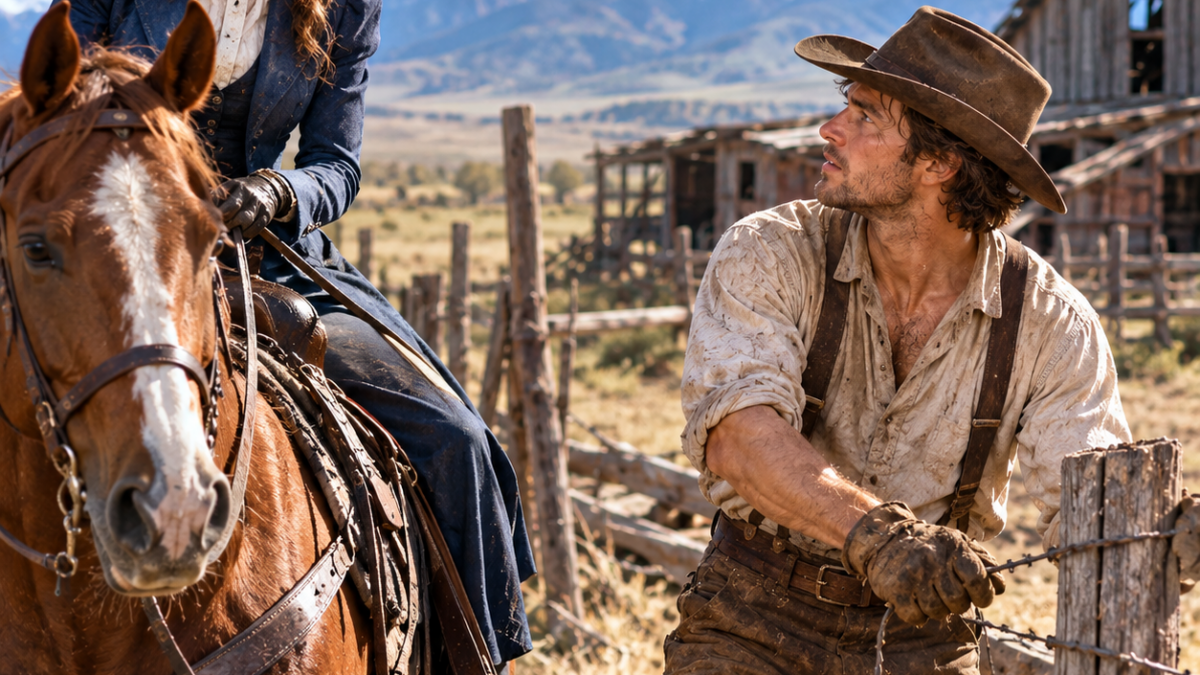
A young woman on a very fine horse was coming through his gate.
She rode with the easy balance of someone who had been in a saddle since before she could read. Her riding clothes were well cut, practical but expensive, the kind of clothing that did not announce money loudly because it had never doubted money was present. The horse beneath her was bay, strong-necked, glossy, and worth more than most men’s full outfits.
The woman looked over the property as she came in, not with idle curiosity, but with the expression of someone arriving to deliver news she was not certain would be well received.
Cole stood.
He put on his hat.
Then he waited.
She pulled up at the edge of the yard and looked at him directly.
She was perhaps twenty-two, with blue eyes that assessed a situation before committing to a response. They moved over his worn coat, his work gloves, the sagging house behind him, the broken barn, the fence line beyond.
“Mr. Harding,” she said.
“Miss.”
He had not told anyone nearby his name except the banker.
Which meant she had come knowing it.
“Abigail Whitmore,” she said. “My father is Edward Whitmore. The Whitmore ranch borders you to the north and east.”
She did not wait for acknowledgment.
“My father does not like loose ends on his border, Mr. Harding. He sent me here with seven hundred dollars to make sure you climb back on your horse and keep riding.”
Cole looked at her.
Then at the horse.
Then at the land.
Seven hundred dollars.
He had spent eleven years saving four hundred twenty.
Seven hundred dollars would put money back into his hands. More than he had ever held at once. Enough to leave this broken place, buy good equipment, maybe find a cleaner start somewhere people did not look at him and see a hired hand trying to become an owner.
The offer was practical.
Generous, even, by the arithmetic of poor men.
Cole reached down, picked up the fence post he had been examining, and went back to setting it.
Abigail’s horse shifted under her.
“Mr. Harding?”
Cole spat in the dust at the foot of her horse.
“Tell your father to keep his seven hundred.”
Her eyes narrowed, but she did not flinch.
“This land cost me eleven years of calluses,” he said. “Three days and a check do not buy that.”
Abigail held his gaze.
“You have seen what the big die-up left here.”
“Clearly.”
“The fence is down in three sections. The barn roof is open to the sky. The fields have not produced in six years.”
“I know what I bought.”
“Then you know what it will take.”
Cole drove the post into place with the slow force of a man who did not intend to repeat himself.
“Yes,” he said. “I know exactly what it will take.”
He lifted the post driver again.
“And it is not your father’s seven hundred dollars.”
For a moment, neither spoke.
Abigail looked at the property again.
Not dismissively.
Accurately.
Her eyes touched the broken roof, the south fence, the house, the field gone wild, the man standing in the middle of all of it with ten dollars and a refusal.
“I’ll tell him,” she said.
She turned her horse.
Cole watched her ride back through his gate.
Then he drove the next post.
And as the sound cracked across the empty land, he thought, That is not the last time I will see her.
He was right.
She came back three days later.
Not with another offer.
Not with papers.
Not with her father’s authority sitting on her shoulder like a hawk.
She came alone, on the same fine horse, but with less formal posture, as if she had left the Whitmore ranch before she could talk herself out of it.
Cole was working the south fence when she appeared.
He heard the horse before he saw her. He did not turn immediately. Pride, like thirst, is something a man should learn to manage before it manages him.
She stopped near the fence line and watched him work.
“My father’s offer stands,” she said.
“I know.”
He kept working.
She was quiet.
Cole set the post, checked it by eye, and reached for the driver.
“You’re doing that wrong,” she said.
He stopped.
Slowly, he looked at her.
“The angle,” she said.
“The angle?”
“Glidden wire pulls differently than smooth wire. The post needs to lean two degrees into the tension direction or it will walk over by spring.”
Cole looked at the post.
Then at her.
She continued before he could decide whether to be offended.
“The big die-up changed the soil in this valley. Freeze, thaw, compression, moisture loss. Posts that worked before 1886 do not hold the same way now.”
“You know fencing.”
“I grew up on a ranch.”
“Your father’s ranch.”
“Still a ranch.”
She dismounted, tied her horse to a nearby tree, and came through the gap in the fence.
“May I?”
Cole stepped back.
He did not like stepping back.
But he did.
Abigail adjusted the post angle precisely, tamped the earth, tested the lean, then handed him the driver.
He drove it.
The post seated correctly.
Solid.
Better than the others.
He hated that she was right.
He respected that she was right more.
“Thank you,” he said.
He meant it.
No decoration.
No resentment tucked under it.
Just the words.
Abigail looked at him a little differently after that.
Not softer.
More interested.
“How long will this take you?” she asked.
“Alone?”
“Yes.”
“Two weeks. Maybe three. South section first. Everything else waits.”
“Everything else?”
“The barn roof is open too.”
“I know.”
“I sleep under that roof.”
He said it without complaint.
Only information.
She looked toward the barn.
A man sleeping under a caved roof rather than repairing it first because he knew the fence mattered more. Not because comfort did not matter. Because order did.
That told her something.
Not everything.
Enough.
“My father does not know I am here,” she said.
Cole looked at her.
“Does that happen often?”
“No.”
She picked up the post driver.
“Show me where the next one goes.”
She came back the next day.
And the day after that.
Not every day.
She had her own life, her own duties, and a father who would eventually have opinions about where she was spending her afternoons. But she came often enough that Cole began, without intending to, to notice when she was not there.
Abigail Whitmore was a good fencer.
That surprised him.
It should not have, perhaps, but it did.
She did not treat labor as novelty. She did not laugh at blisters. She did not perform toughness by pretending work was easier than it was. She drove posts, checked tension, stretched wire, handed tools, corrected mistakes, accepted correction when he gave it, and drank water from a tin cup without looking around to see if anyone admired her for it.
Cole respected that immediately.
He was proud.
This was his flaw, and he knew it.
Not vanity.
Not exactly.
It was the pride of a man who had had so little that whatever he did possess—skill, endurance, patience, the strength of his back—he guarded fiercely.
On the fourth day, near sunset, Abigail said, “Let me drive the posts on this section.”
“I’m fine.”
“You’re losing angle when you’re tired.”
“I said I’m fine.”
“You are driving them straight.”
“Straight is generally considered acceptable for posts.”
“Not here. Two degrees.”
She held out her hand for the driver.
Cole did not give it to her immediately.
She waited.
No argument.
No pleading.
Only her hand, open, steady, certain.
He gave it to her.
She drove four posts at the correct angle without comment.
He checked them.
They were right.
He said nothing.
The next day, he asked her to check his angle before each post.
It was the closest he could come to admitting she had been right.
She understood.
She did not make him say more.
That was the day they began talking.
Not courtship talk.
Not polished talk.
Work talk first.
Which sections flooded in spring.
Where the soil was deep enough for oats.
Which draw held water longest in a dry year.
What the big die-up had done to ranchers who had ignored shelter, hay, and winter planning.
Abigail knew the valley the way some women knew piano pieces. She knew its rises, moods, drainage, grasses, and risks because she had ridden every acre she was allowed to ride since childhood and several she was not allowed to ride at all.
Cole told her about eleven years in pieces.
Not because he meant to confess anything.
Because side-by-side work loosens a man’s tongue in ways chairs and parlors never can.
He told her about Wyoming bunkhouses.
About a foreman in Idaho who cheated every hand on wages until someone burned his account book.
About saving money in a tobacco tin.
About eating beans for months because meat cost too much and wanting land so badly he sometimes could not sleep.
One afternoon in April, they sat on the fence rail at the end of a long day.
The repaired line stretched behind them, straight and solid where before it had sagged in surrender.
Abigail looked at the land they had been building back into usefulness.
“Why this one?” she asked.
Cole wiped dust from his hands.
“There were other properties,” she said. “Properties that did not need this much work.”
He looked across the field.
“Because nobody else wanted it.”
She turned toward him.
“That is the reason?”
“It needed someone.”
“That sounds like something from a sermon.”
“I do not go to church often enough to steal from one.”
She almost smiled.
He looked at the broken barn, the patched corner of the house, the field waking slowly.
“Land nobody wants still needs someone to believe in it.”
Abigail grew quiet.
The wind moved through dry grass.
A hawk circled above the ridge.
“My father’s land has never needed anyone,” she said. “It has always been wanted.”
She said it like something true she had not heard until she spoke it.
“That is a different thing than being cared for.”
Cole said nothing.
But something that had been building since a blue-eyed woman corrected his fence-post angle moved one step closer to being said.
Neither of them noticed the Whitmore ranch hand sitting still on a gray horse along the northern ridge.
He had been there twenty minutes.
He was not paid to keep secrets.
Edward Whitmore came on a Thursday morning.
Cole saw him long before he reached the yard.
Everyone in Clearwater County knew Edward Whitmore’s shape on a horse. Broad shoulders. Straight back. Hat low. The posture of a man who had been the most powerful presence in every room for thirty years and had stopped noticing because no room had ever taught him otherwise.
He rode a horse that cost more than Cole’s entire property.
He dismounted near the south fence and looked at it.
That was the first thing he did.
Not at Cole.
Not at the house.
The fence.
His eyes moved over the Glidden wire, the bracing, the tension, the angles.
He had expected poor work.
Cole saw the moment he did not find it.
Then Whitmore looked at him.
“You’ve done work here.”
“Yes, sir.”
“My daughter has been helping you.”
Cole could have denied it.
Could have softened it.
Could have made it sound accidental.
He did not.
“She corrected my post angle on the second day. She was right. I have been asking her to check each one since.”
Something flickered through Whitmore’s expression before hardening.
“My daughter was educated in St. Louis. She speaks French. She plays piano. She is going to marry a man who can give her a life appropriate to who she is.”
His gaze moved toward the house, the broken barn, the patched fence, the evidence of a man building carefully with almost no money.
“Not a man sleeping under a caved barn roof because he ran out of funds before he ran out of list.”
Cole looked at him directly.
“Mr. Whitmore, I have not asked your daughter anything. I have been fixing a fence.”
“I know what I saw.”
“Then you saw two people fixing a fence.”
“I know what it leads to.”
The older man stepped closer.
“I am going to say this once. My daughter is not for you. Not because of your character. I have nothing against your character. Because of what you do not have.”
Cole felt the words land.
Not character.
What you do not have.
Money.
Land that produced.
A roof that held.
Cattle worth counting.
A name that opened doors.
“This place will take years to become anything,” Whitmore said. “Abigail deserves more than years.”
Cole looked at him.
At the certainty.
The absolute conviction of a father who had mistaken provision for permission.
“With respect, Mr. Whitmore, I think that is her decision.”
Whitmore’s eyes went hard in the specific way of a man who had not been spoken to that way in a long time.
“Not while she is my daughter.”
He mounted his horse and rode away without looking back.
Cole stood in the yard and watched him go.
Then he turned back to the fence.
His pride told him he did not need Edward Whitmore’s approval to drive a post correctly.
So he drove the next post correctly.
Her father told her that evening.
Not gently.
Edward Whitmore was not gentle once he had decided he was right.
Abigail sat across from him at the long dining table while silverware shone between them and a portrait of her late mother watched from the wall.
He told her he had been to the Harlan place.
He told her he had spoken to Cole.
He told her the visits were finished.
Abigail listened.
She had grown up with her father.
She knew confronting him directly in the moment was like driving a post straight into rock. You broke the post, not the rock. Over twenty-two years, she had learned her father’s positions could sometimes be moved, but not by declaration.
Evidence moved him.
Patience moved him.
Truth, if it arrived with enough weight, eventually moved him.
Anger only hardened him.
So she did not argue at dinner.
She excused herself, went to her room, and sat by the window looking out at the Montana night.
She thought about Cole sleeping under a caved roof because the fence came first.
She thought about land being cared for rather than merely owned.
She thought about her father saying, “Not because of your character. I have nothing against your character.”
Which meant he had seen Cole.
Not fully.
But enough.
Her father knew who Cole was.
He had simply not decided whether who Cole was could be enough.
Abigail rose from the chair.
She went downstairs to her father’s study.
Whitmore was bent over account books, pen in hand, lamplight sharpening the lines of his face.
“Papa.”
He looked up.
“I am not going to stop seeing him.”
He set down the pen.
“Abigail.”
“I am twenty-two years old. I have done everything you ever asked. St. Louis. French. Piano. Proper dinners with men I did not like. Smiling when ranchers spoke over me about land I knew better than they did.”
His face stiffened.
She did not stop.
“I have never once asked you for anything you did not want to give.”
He was very still.
“I am asking now. Not for your approval. For your trust that I know my own mind.”
Whitmore looked at her a long moment.
This daughter with her mother’s eyes, his stubbornness, and something entirely her own.
“He has nothing.”
“He has everything that matters.”
She left before he could answer.
Edward Whitmore sat in his study long after she was gone.
He had built five thousand acres and a name in three counties. He owned cattle by the hundreds, horses bred from bloodlines men envied, barns filled with winter stores, equipment, accounts, employees, influence.
His daughter had looked at him the way her mother used to when he was wrong.
He picked up his pen.
Put it down.
For the first time in years, he could not work.
June arrived.
Cole kept working.
The south fence stood.
He moved to the main field.
Clearing first.
Then turning soil compacted by six years of neglect.
Land needed persuasion as much as labor. A man who forced too much too fast only made dust. Cole worked with a horse, a plow, patience, and the humility to learn what the place would allow.
He planted oats in the north section.
He had four cattle by then.
Four.
The beginning of a herd, not a herd.
But he managed them like they mattered because they did. Four could become six. Six could become twelve. Twelve could become a future if a man stayed careful.
Abigail came Tuesdays and Thursdays.
She told her father she was going.
He did not stop her.
That was not approval.
It was an exhausted acknowledgment that she was going anyway.
She brought knowledge, competence, and a refusal to make his pride easier than truth.
When Cole drove a post wrong, she said so.
When he planned oats for the north section, she said the drainage was too fast for standard variety.
“You’ll lose it to frost,” she told him.
“You are sure?”
“I have watched that field drain since I was eight years old.”
He replanted with a shorter-season variety.
When she saw his barn-roof patch, she stood with hands on hips, staring up.
“That patch will not last the winter.”
“I know.”
“It may not last heavy rain.”
“I know that too.”
“Then why leave it?”
“It will last until I can afford to do it right.”
She looked at the salvaged wood, the careful placement, the temporary honesty of it.
Then at him.
He was doing things in the correct order rather than the comfortable one.
His pride was not the kind that refused correction.
It was the kind that needed a moment to accept correction and then moved forward.
That was different.
Much different.
The fire started on a Wednesday night in July.
Not on Cole’s land.
At Whitmore’s.
Nobody knew precisely how.
A lantern knocked over in the dark, someone said later. A careless hand. A faulty hook. A gust through the east doors. Fire needs very little explanation once it has begun. By the time men understand the cause, they are already fighting the consequence.
Cole smelled smoke before he saw flame.
He woke in the dark with his lungs already tightening.
For one moment, he lay still, listening.
Then the northern horizon glowed red.
He was out of his bunk and saddled in four minutes.
He did not consciously decide to ride north.
He simply did what ranch work had trained into him.
Fire did not respect property lines.
By the time he reached the Whitmore ranch, the east barn was well involved.
Flames poured from the roof. Sparks rode the wind. Men formed a bucket line from the main well, working to keep the fire from the house and equipment barn. Women carried water. Someone shouted for more blankets. Someone else screamed that the wind had shifted.
The east barn was gone.
Everyone knew it.
The fight had moved to saving everything near it.
Then Cole heard the horses.
Not frightened whinnies from a pasture.
Screams.
Deep, panicked, trapped.
The breeding barn stood twenty feet from the burning structure. Inside were Whitmore’s Morgan stallions and best quarter-horse mares, animals representing twenty years of careful bloodline selection. The doors were latched. Smoke seeped under the eaves. The wind was wrong.
Cole rode to the foreman.
“The horses.”
The foreman’s face was blackened with smoke.
“Roof’s going.”
“There are horses inside.”
“I know.”
“You going in?”
The foreman’s jaw tightened.
“I am not sending men under that.”
It was a practical answer.
A cold answer.
Maybe even a responsible answer.
Cole looked at the breeding barn.
At the smoke pushing through boards.
At the pattern of flame licking along the far roofline.
At the panicked impact of hooves against stall walls.
He swung down.
Pulled his bandana free.
Soaked it at the trough.
Tied it over his nose and mouth.
The foreman grabbed his arm.
“You will die in there.”
Cole looked at him.
“How many horses?”
“Eleven.”
Cole pulled free.
And went in.
Inside, the smoke was alive.
Not clean outdoor smoke moving with wind, but thick, directional, choking smoke of enclosed heat building toward collapse.
Cole could barely see.
He moved by sound.
The horses were beyond reason, slamming against stall boards, eyes rolling, hooves striking wood, the whole barn shaking with animal terror.
He found the first stall by touch.
A Morgan stallion tried to kill everything within reach.
Cole got the halter on anyway.
He spoke low, steady, not with words that mattered, but with tone.
The frequency that tells an animal, I am not the danger.
The stallion fought him until the door opened.
Then it bolted for air, dragging Cole halfway through the aisle before he gained control and pushed it toward the opening.
Outside, men shouted.
Cole went back.
Second horse.
Third.
Fourth.
Smoke burned his eyes. Heat pressed against his face. His lungs rejected every breath.
On the fourth trip, a beam above him groaned.
Not cracked.
Groaned.
That long, terrible sound of structure deciding how much longer it intends to remain loyal.
Cole got the horse out.
Then went back.
On the eighth horse, his legs stopped working correctly.
He went down on one knee in the straw.
The mare he was leading pulled backward in panic and nearly tore the rope from his hand. Cole held on, and her own terror hauled him upright. He let her momentum drag him toward the door.
Outside, air hit him like a slap.
He sat hard in the dirt because sitting was what his body had decided.
Someone shouted, “Stay down!”
Cole looked at the barn.
Three horses still inside.
He got up.
The foreman stepped in front of him.
“The roof is going.”
“Three more.”
“You can’t.”
Cole walked around him.
He went back in.
Ninth.
Tenth.
Eleventh.
By the last trip, he was no longer counting anything except the space between breaths.
He cleared the door with the final horse.
Twelve seconds later, the breeding barn roof came down.
The sound was like the world ending in one place.
Cole sat in the dirt with his eyes watering so badly he could not see.
The yard had gone quiet in that stunned way men become quiet after nearly witnessing a death.
Then he heard Edward Whitmore’s voice.
Not directed at him at first.
Present.
Commanding.
Taking inventory.
“Count them.”
A pause.
“One. Two. Three…”
Cole coughed into his hands.
His palms were burned.
His shirt was singed.
Smoke had scraped his throat raw.
Whitmore counted aloud to eleven.
Then stopped.
Footsteps came through dirt.
A hand gripped Cole’s arm.
Edward Whitmore pulled him to his feet and held him there until he was steady.
Neither man said a word.
Some moments cannot survive speech too soon.
Smoke damaged Cole’s lungs.
Not permanently, the ranch hand with some medical knowledge said. But enough.
For several weeks, heavy work in Montana summer heat would be dangerous. Cole understood the meaning before anyone explained it kindly.
His oats were in the ground.
His fence stood.
His four cattle grazed the south pasture.
But late summer did not wait for injured men.
Haying.
Harvesting.
Winter preparation.
All of it required breath, strength, and time.
He rode home the morning after the fire and sat on his porch, looking at the property while doing arithmetic.
The numbers were merciless.
Two days later, two Whitmore ranch hands appeared at his gate.
No message.
No explanation.
They tied their horses and went to the north field, where they began cutting oats with the efficient motions of men told to do a job and determined to do it well.
Cole came out of the house.
“Mr. Whitmore sent you.”
The older hand looked at him.
“He said the oats won’t wait and you can’t cut them.”
Cole looked at his field.
At his bandaged hands.
At the men working his land.
Pride rose in him like a reflex.
He almost said he did not need help.
Almost.
Eleven years of managing alone stood up inside him. Eleven years of not asking. Eleven years of proving that a man could build something with his own hands and nobody else’s.
Then he thought of Abigail correcting his post angle.
He thought of driving posts wrong until she came.
He thought of the fence standing straight because he had given her the post driver.
“Thank you,” he said.
Then he went inside.
He sat at the kitchen table with his burned hands in front of him while, outside, Whitmore men cut his oats.
It was the hardest thing about the whole summer.
And it changed him.
Whitmore came ten days after the fire.
Unannounced.
He appeared at the south fence line on horseback, dismounted, came through the gate, and walked the property like he had walked land his whole life.
Looking.
Reading.
Arriving at conclusions without asking permission.
Cole walked beside him.
They did not speak much.
Whitmore inspected the fence, the Glidden wire, the posts leaning two degrees into tension, the oat field cut and stacked, the barn roof patch that would not last winter, the four cattle in the south pasture.
At the south fence, he stopped and placed one hand on a post.
Tested it.
Solid.
“The big die-up,” Whitmore said, “broke better men than fools understand.”
Cole said nothing.
Whitmore looked across the pasture.
“Harlan lost everything in February of ’87. I bought some of his cattle for ten cents on the dollar when he walked off.”
He said it without pride.
Only fact.
“I’ve been watching this land six years. I know what it was and what it needs.”
“So do I,” Cole said.
Whitmore looked at him.
“The north field east third. You replanted with shorter variety.”
“Abigail told me about the drainage.”
“She was right.”
Cole nodded.
Whitmore’s face shifted with something complicated.
“I taught her that.”
There are moments when a father realizes his daughter has become what he taught her to be, and that the result is no longer his to command.
“I built my ranch in ten years,” Whitmore said. “Started with a horse, a bedroll, and thirty dollars saved working other men’s cattle in Ohio.”
Cole had heard the story.
Everyone had.
But Whitmore said it differently now.
Not as legend.
As memory.
“My daughter told me you knew that.”
“Martha at the general store told me.”
Whitmore almost smiled.
“I told myself I did not want Abigail to go through what I went through. Starting from nothing. Building year by year.”
He was quiet.
“I think I have been confusing protecting her with deciding for her.”
Cole did not answer.
Whitmore looked at him.
“You went back into a burning barn three times after the roof beam cracked. For animals belonging to a man who told you to stay away from his daughter.”
He let that sit.
“I cannot argue with that. Not because you saved my horses. Because you went back when no one was watching, nothing was owed, and the only reason was that three horses were still inside.”
He put his hat back on.
“I am not giving you my blessing today.”
Cole looked at him.
“I am telling you I am no longer your enemy. There is a difference.”
He mounted his horse.
At the gate, he stopped.
“The barn roof. Before winter. I’ll send materials.”
“I’ll pay for the materials.”
Whitmore looked at him a long moment.
“Yes,” he said. “You will.”
Then he rode north.
Cole stood by the south fence watching him go and thought Edward Whitmore had just done the hardest thing he had done in years.
He went back to work.
Cole asked Abigail in August.
No audience.
No grand arrangement.
No ring bought from town because he did not yet have money for one worthy of her hand and refused to pretend otherwise.
They sat on his porch in the Montana evening while the repaired land settled around them. The south pasture held grass. The field showed promise. The barn patch still warned him daily of work ahead. The house had begun to feel less like a test and more like a place.
Abigail was telling him about a creek rise she had seen near the north draw when he interrupted.
“Abigail.”
She stopped.
The way he said her name told her enough.
“Yes?”
“I would like to marry you.”
She inhaled once.
He kept going because he had planned the words, and a man should finish what he starts.
“I have little to offer that your father can measure. This house needs work. The herd is small. The barn roof will be replaced before winter, but only because I will pay for materials over time and accept help installing them. It will take years to make this place what it can be.”
She was smiling now.
He saw it and nearly lost his place.
“I am not asking you because I think you need saving. You do not. I am asking because I have watched you work, think, argue, correct, and care. And I do not want to build anything without asking whether you want to be part of it.”
“Cole.”
“Yes?”
“Yes.”
He blinked.
“I had more to say.”
“I know.”
“You said yes before I finished.”
“I have been ready to say yes since approximately the Tuesday in April when you said land nobody wants still needs someone to believe in it.”
He stared at her.
Then laughed.
A rare, surprised sound.
She took his burned hand carefully in hers.
“I know what you have, Cole Harding. I know exactly what you have.”
They married in September.
At Cedar Creek Church.
Abigail dressed in the small room off the vestibule with Martha Greer fussing over details and two friends from Clearwater pretending not to watch the doorway.
She wore her mother’s necklace.
The same necklace given to her after the funeral.
The one she had worn on every important occasion since.
The church filled with townspeople, ranchers, curious neighbors, Whitmore hands, and people who had already retold the burning barn story enough times that Cole had become taller in every version.
Abigail’s father was not there.
She had known he might not come.
He had said, “I am no longer your enemy.”
He had never said, “I give you my blessing.”
She had told herself she was prepared for the distinction.
She had been telling herself that with decreasing conviction for three weeks.
Martha fixed the last detail of Abigail’s sleeve, then stepped back.
“Ready?”
Abigail picked up her flowers.
She put her hand on the door.
“Abigail.”
Martha’s voice was soft.
Pointing.
Abigail turned.
The back door of the church stood open.
In the doorway, wearing his good coat, hat in his hands, stood Edward Whitmore.
He looked at his daughter the way a man looks at something he has been reconsidering for weeks and has finally arrived at the right answer about.
He walked up the aisle slowly.
Deliberately.
With the weight of a man doing something that cost him pride and gave him back love.
He stopped before her.
For a moment, he did not speak.
Then his eyes moved over her face.
“You look like your mother.”
His voice was not steady.
Abigail said nothing.
She was not going to make it easy.
It should not be easy.
But she was not going to make it hard either.
Whitmore looked toward the open church doors, where Cole waited beyond.
“I have been watching that man build something since March. The fence. The field. The way he went back into the barn when my own foreman would not.”
He swallowed.
“A man who returns to a burning barn for animals belonging to his enemy does not do it for recognition. He does it because it is who he is.”
He offered his arm.
“My daughter is not walking to that altar alone.”
Abigail looked at his arm.
The same arm she had held at her mother’s funeral.
Then at his face.
Sixty years of stubbornness, pride, fear, love, and late understanding.
She took his arm.
They walked down the aisle together.
Cole stood at the altar.
He watched the woman he loved come toward him beside the man who had told him to stay away from her. The church seemed to hold its breath.
Whitmore stopped beside Cole.
For one second, the two men looked at each other.
It was not warm.
Not exactly.
It was not a smile.
It was the look of a man who had made a decision he intended to keep.
From Edward Whitmore, that was everything.
They stayed on Cole’s 240 acres.
Clearwater County had expected otherwise.
Most assumed Abigail Whitmore marrying Cole Harding would mean Cole moving north to 5,000 acres, Whitmore money, Whitmore barns, Whitmore name. It was logical.
It was wrong.
They stayed because the land was Cole’s.
Because Abigail had spent enough afternoons on it to understand what it was becoming.
Because both of them knew the easy path and the right one were not always the same road.
Whitmore sent twenty Morgan cattle in October.
Good stock.
His best breeding cows.
Delivered without ceremony and with a note.
For the south pasture.
The grass is good there.
The Morgan bloodline will suit the terrain.
E.W.
Cole read the note twice.
Then put it in the kitchen table drawer where he kept things that mattered.
The herd grew carefully.
Not quickly.
Twenty became thirty-two by the second year.
Thirty-two became forty-eight by the third.
The Morgan cattle bred true in the south pasture. The bloodline Whitmore had sent produced animals worth far more than Cole’s first four.
The barn roof was replaced properly in October with materials Cole paid for himself and Whitmore’s men helped install. That arrangement—Whitmore helping, Cole paying—would have been impossible in March.
By October, it was simply correct.
Edward Whitmore came for Sunday supper beginning in November of the first year.
Not every Sunday.
Some Sundays.
With the irregularity of a man moving toward something but refusing to be hurried.
He sat at Cole’s kitchen table and talked about cattle, weather, feed prices, Billings shipments, horses, drainage, and fences with the focus of a man for whom such things were never merely conversation.
On a Sunday evening in the second year, as he walked to his horse after supper, Whitmore stopped at the south fence.
The first fence.
The line Cole had been working when Abigail returned to correct his angle.
Whitmore placed one hand on a post.
Two degrees into tension.
Solid.
He tested it.
Said nothing.
Then nodded once.
A verdict.
He mounted and rode north.
Cole stood at the gate watching him.
Abigail came beside him.
“He’ll never say it,” she said.
“I know.”
“He does not have to.”
“No.”
Cole put his arm around her.
The Montana evening held them beside the south fence of a ranch once broken by winter and abandoned by everyone who had looked only at damage.
Now it was the most cared-for land in Clearwater County.
The mountains did what they always did.
The cattle grazed where they were supposed to.
The fence stood right.
The woman beside him leaned into his shoulder.
The old man riding north would likely return next Sunday.
Everything, not perfect but true, was exactly right.
Cole Harding spent eleven years saving four hundred twenty dollars.
He spent it on a place the big die-up had broken.
A place nobody else wanted.
Fence down.
Barn caved.
Fields gone wild.
A house that challenged any man foolish enough to call it home.
He got off his horse, stood in the main field, and felt certain about something nobody else could see.
That certainty is the whole story.
A man who saw neglected land and believed care could bring it back.
A woman who rode in to make him leave and stayed because, somewhere between fence angles and April afternoons, she saw that what he was building was something worth being part of.
And a father who had built 5,000 acres from thirty dollars and a bedroll, then forgot somewhere along the way that what he had really been building was not acreage.
It was a life.
And a life is measured by character, not property lines.
Edward Whitmore remembered that on a Wednesday night in July when a man he had insulted went back into a burning barn after the roof beam cracked.
Not for money.
Not for approval.
Not because anyone was watching.
Because three horses were still inside.
That is the honest measure of a person.
Not what they claim.
Not what they own.
Not what their name can purchase.
What they go back for when the beam cracks.
Cole went back.
Whitmore saw it.
Abigail already knew.
And the ranch nobody wanted became the place where all three of them learned what was worth keeping.


