I Met a Woman With No Family Left in a Colorado Town—Then I Looked at My Two Children and Said, “Funny… They Need a Mother.”
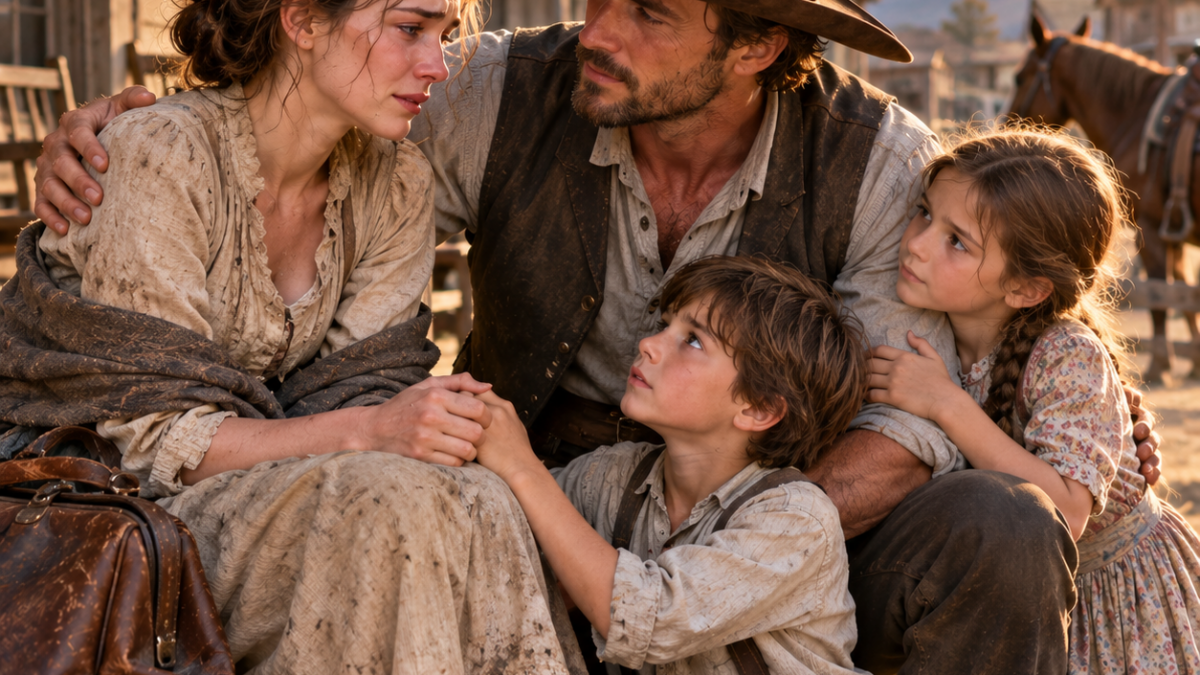
PART3:
Eliza looked past us toward the mountains, though I do not think she saw them.
“He died two weeks before I arrived. Pneumonia. Quick at the end, they said.”
Owen stopped fidgeting.
For once, he had no immediate question.
“I’m sorry,” I said.
I meant it.
I did not say it the way people said sorry over spilled coffee, a late package, bad weather, or a dead horse they had not known. I said it as a man who understood what it meant to arrive somewhere expecting a person and find only the shape they had left behind.
Eliza heard the difference.
I saw that too.
“Is there somewhere you’re staying?” I asked.
She glanced at the hotel behind her.
“I’m working on that.”
That answer told me more than she intended.
The Clearfield Hotel charged two dollars a night for a room with clean sheets and not much else. A woman with a leather bag and no family did not sit on the steps in the middle of the afternoon if she had a secure plan. She sat there because she was calculating. How much money. How much time. How much pride she could afford to spend before asking a stranger for help.
I looked at Owen.
He looked at me.
Children are dangerous because they still expect adults to do the right thing once it has been identified.
I cleared my throat.
“There is work in town if you are willing.”
“I’m willing.”
She said it quickly.
Too quickly.
Like a person afraid the offer would disappear if she did not catch it fast enough.
“The laundry sometimes needs hands,” I said. “Mrs. Pierce is particular, but fair. Restaurant is full most weeks. School already has a teacher.”
“I’ll ask.”
I nodded.
That should have been the end.
A decent man could have walked away then and told himself he had done enough. I had given information. I had expressed sympathy. I had not embarrassed her by offering money on the hotel steps.
I turned with my children and began down the street.
Owen walked beside me for about ten steps before saying, “Papa.”
“No.”
“I didn’t ask yet.”
“You were going to.”
“She doesn’t have anyone.”
“That does not mean she has us.”
“Why not?”
I stopped.
That was the trouble with Owen. His questions were rarely polite, but they were often difficult to defeat honestly.
Lucy looked back over her shoulder.
Eliza still sat on the steps, one hand resting on her leather bag.
I told myself to keep walking.
My house was already full of unfinished grief. My children needed more than I had to give most days. The ranch needed constant attention. The kitchen garden had gone to seed because cattle had to come first. Lucy’s hair was proof that I was failing at several domestic skills. Owen asked questions his mother would have known how to answer better.
A lonely woman with no money and no family was not our business.
I kept walking.
At the end of the street, I stopped.
I hated Owen a little in that moment for being right before I was ready to be.
I turned around.
Eliza was still there.
Owen smiled like he had personally moved a mountain.
“Don’t look pleased,” I muttered.
“I’m not.”
“You are.”
“A little.”
That evening, I made stew.
I did not plan to make too much. I simply did.
At least, that was the lie I told myself while cutting more potatoes than three people needed and adding extra beef I had meant to save for Saturday. Owen watched from the table with his chin in his hands.
“Are we taking that to the hotel?”
“I am not taking anything anywhere.”
“Then why are you making so much?”
“People can eat stew twice.”
Lucy sat beside him, threading the new blue ribbon through her fingers.
“She looked hungry,” she said quietly.
That was different from Owen saying it.
Owen charged at the world with questions. Lucy handed you truths wrapped in silence.
I set the knife down.
“She may not want help.”
Owen frowned.
“Food isn’t help. Food is food.”
I closed my eyes briefly.
Their mother, Anna, would have laughed.
She would have said, He has you there, Daniel.
Instead, there was only me, a pot of stew, and two children waiting to see what kind of man their father was going to be.
An hour later, Owen stood in the hotel hallway holding a covered dish.
I stood several paces behind him, looking at the wall because there are moments when a man understands his presence may make a kindness feel like pressure. Owen had no such burden. He knocked like he had a right to be there.
Eliza opened the door.
Her hair was pinned more neatly, but her face was tired.
Owen lifted the dish.
“Papa made stew.”
She looked down at him.
Then past him at me.
“He said you probably hadn’t eaten,” Owen added.
“Owen,” I said.
“What? You did.”
Eliza’s mouth moved like she almost smiled and had forgotten how.
“He didn’t have to do that.”
“I know,” Owen said. “He does things he doesn’t have to do. Lucy says it’s because Mama isn’t here anymore and he doesn’t know what to do with the extra.”
I closed my eyes.
If the hallway had opened beneath me, I would not have objected.
Eliza took the dish carefully.
Something changed in her expression at the word Mama.
Not pity.
Not exactly.
Recognition.
“Thank you,” she said.
“It’s good,” Owen said. “Papa burns biscuits sometimes, but stew is safe.”
“Owen.”
“I’m just warning her.”
Eliza’s almost smile became real, though very small.
“I appreciate the warning.”
I looked at her then.
“You don’t owe us anything for it.”
Her chin lifted slightly.
“I know.”
Of course she did.
I had insulted her without meaning to.
I knew that look. A person with little left will defend the line between gratitude and dependence with a courage wealthier people never have to understand.
“I only meant—”
“I know what you meant,” she said, softer.
Then, after a pause, “Thank you, Mr. Holt.”
“Daniel.”
“Eliza,” she said, though I had already known.
We left her with the stew.
On the walk home, Owen said, “She’s going to stay.”
“You do not know that.”
“I think she should.”
“That is not the same thing.”
“It could be.”
Lucy walked silently for a while.
Then she said, “Her bag is too small.”
I looked down at her.
“What?”
“If she had a home somewhere, her bag would be bigger.”
I had no answer for that.
The next morning, I paid for three more nights at the hotel.
I did it through the clerk and told him not to make a performance of it. Mr. Bell, the hotel clerk, was a narrow man with watery eyes and the moral courage of a teaspoon, but he understood payment and discretion when handed together.
“She’ll ask who paid,” he said.
“Then you will say it was handled.”
“That sounds like lying.”
“It sounds like keeping your hotel from being short two dollars a night when she leaves.”
He took the money.
Eliza found me at the feed store before noon.
I was loading sacks into the wagon when I heard my name.
“Mr. Holt.”
I turned.
She stood near the doorway in the same beige dress, sleeves rolled, face calm in a way that warned me calm had taken effort.
“You paid my hotel bill.”
I lifted another sack.
“Did I?”
“Daniel.”
It was the first time she used my name.
I stopped.
“I’ll pay you back,” she said.
“You don’t have to.”
“I will anyway.”
I looked at her then.
Not measuring this time.
Just looking.
There is a difference between offering help and taking someone’s dignity by refusing to let them define what help means.
“All right,” I said. “You will.”
Her shoulders eased.
Not much.
Enough.
“Mrs. Pierce may have work Thursday,” she said.
“She is particular.”
“So am I.”
I almost smiled.
“I believe that.”
She worked at the laundry Thursday through Saturday.
I passed by on Saturday afternoon with Owen and Lucy.
The laundry was not on the way to anywhere I had mentioned going. Eliza noticed this. So did Mrs. Pierce, who had the kind of eyes that made closed curtains feel ineffective.
Eliza stood over steaming sheets, sleeves rolled high, hair damp at her temples, moving with the tired efficiency of someone who had known work long before Clearfield.
Mrs. Pierce said she was good.
Mrs. Pierce did not give praise loosely. She handled praise like flour in hard times: carefully, in small measures, only when warranted.
Owen informed Eliza while I spoke with Mrs. Pierce that Lucy had asked at breakfast whether “the lady from Tennessee” was going to stay.
Eliza looked at Lucy.
Lucy looked back without apology.
“What did your father say?” Eliza asked.
Owen considered.
“He said he didn’t know. But he said it like he was hoping you would.”
“Owen,” I said, turning.
He looked at me with complete innocence.
“What?”
“You know what.”
Eliza bent over a basket of linens, but I saw the edge of her smile.
Lucy spoke to Eliza for the first time the following Sunday.
I had brought the children to church because Anna had believed church attendance was less about being good and more about not letting grief turn a person into an island. After she died, I kept taking the children even when I no longer knew what I believed about prayer, because sometimes habit carries a family when faith cannot.
Eliza sat alone near the back.
Not so far back as to appear unwilling.
Not so far forward as to invite notice.
After the service, I introduced her to Reverend Cole, then to Mrs. Warren, then to two neighbors who immediately began doing the mental arithmetic of who Eliza was, where she belonged, and whether she might become permanent enough to discuss.
She handled them better than I expected.
Better than I did, most Sundays.
We walked back along Main Street together.
No one planned it.
It simply happened.
Owen walked ahead of us, explaining to a patient Eliza the difference between our mare Juniper and the bay gelding Coffee, whose name had been a mistake made by a tired child and accepted by the family before common sense could intervene.
Lucy walked beside Eliza for nearly two blocks without speaking.
Then she said, “Do you know how to braid hair?”
Eliza glanced down.
“Yes.”
“Papa tries.”
I pretended not to hear.
“He practices on the horses’ tails,” Lucy said. “But it’s not the same.”
“It is not,” Eliza agreed.
“I could show you, if you like.”
Lucy nodded once.
“Yes.”
With Lucy, yes was not acceptance.
It was a decision.
That afternoon, Eliza sat on the hotel porch with Lucy between her knees, gently combing out the uneven braid I had tied that morning. Owen stood nearby delivering a complete history of every horse on the Holt ranch, including several that were dead before Lucy was born.
I sat in the third chair and said almost nothing.
Eliza would later tell me she had learned by then that my silence was not absence.
It was attention.
She was right.
I watched her hands as she braided Lucy’s hair.
Not because they were delicate.
They were not.
Laundry had reddened them. Travel had roughened them. Work had shaped them.
I watched because Lucy sat still under them.
My daughter, who had resisted every effort I made at her hair with the rigid patience of a child enduring necessary disappointment, relaxed under Eliza’s touch.
By the time Eliza tied the blue ribbon at the end, Lucy looked as if she had been restored to herself.
I felt something in my chest loosen and hurt at the same time.
Anna had done Lucy’s hair every morning.
For two years, that had been one of the small daily griefs I could not repair. I could feed my children. Clothe them. Keep the ranch running. Teach Owen to ride. Teach Lucy numbers. But every crooked braid in Lucy’s hair had seemed to announce that her mother was gone and her father was trying badly.
Lucy touched the braid.
Then she took Eliza’s hand briefly before letting go.
I looked at Eliza.
I said nothing.
What was there to say?
Thank you for making my daughter look less motherless?
No decent sentence existed for it.
When we stood to leave, Owen said at full volume, “Papa, can she come to supper?”
“Owen.”
It was the voice fathers use when a child has said the true thing at the wrong moment.
Eliza looked toward the mountains.
She said nothing.
But something moved across her face.
Not fear exactly.
Possibility.
The invitation came from Owen.
Not officially.
I had told him after the Sunday walk that he was not to invite Eliza to supper without asking me first. He followed this rule in the narrow legal manner children use when they have no interest in obeying the spirit of instruction.
Monday morning, he asked, “Can Miss Eliza come to supper?”
I said, “We’ll see.”
He interpreted this as yes.
By Wednesday evening, Lucy had set the table for four and arranged wildflowers in a jar with the solemn concentration of someone carrying out a long-planned domestic campaign.
When Eliza arrived, I was both embarrassed and relieved.
“Owen said I was expected,” she said.
“Owen exaggerates.”
“Owen is accurate,” Lucy corrected from the table.
I sighed.
“I am sorry.”
“Don’t be,” Eliza said.
She meant it.
That first supper was plain.
Roast chicken, potatoes, carrots, bread I had not burned, and coffee. The house had been built solidly by my father before he died and improved by Anna after we married. It was well made. Functional. Clean.
But it had become cheerless in small ways.
Not neglected.
Never that.
Only managed.
There is a difference between a house kept from falling apart and a home cared for by someone whose heart is present in the curtains, the garden, the table, the little useless things a man alone stops noticing first.
Eliza noticed.
She did not criticize.
That mattered.
Owen talked enough for all of us. Lucy watched Eliza with the steady attention she had apparently decided to give her. I asked measured questions and tried not to look like a man aware he had invited a woman to supper without knowing what the invitation meant.
Afterward, I sent the children to bed with firmness because I had something to ask and because Owen would have asked it for me if allowed another ten minutes.
Eliza and I sat at the kitchen table with coffee.
The lamplight softened her tired face.
I turned my cup in my hands.
“I want to ask you something directly because I don’t know another way.”
She waited.
“How long are you planning to stay in Clearfield?”
She looked down at her cup.
“I don’t know. I don’t have anywhere else to be.”
I nodded slowly.
“That is not a bad answer.”
Her brows drew together.
“Why?”
“Because I have a question I am not ready to ask yet, and I need you to still be here when I am.”
She did not answer.
A wiser man might have said less.
I had been silent too long in my life and had learned that silence, when overused, becomes its own kind of dishonesty.
“Would you come out to the ranch Saturday?” I asked. “Not for supper. I want to show you something.”
She studied me.
Then nodded.
“I can come.”
On Saturday, I showed her the ranch.
Not as men show land when they want admiration.
I had nothing grand to display.
I showed her what was true.
The north pasture, where the grass came in strongest if spring rains were kind.
The west fence line, which needed repairs before winter.
The barn, orderly because disorder around livestock costs money and sometimes lives.
The kitchen garden, gone half to seed because for two years I had never managed to be father, rancher, cook, mender, gardener, bookkeeper, and grieving husband all at once without letting something fail.
I showed her the apple tree on the east side of the house.
Anna had planted it our first year there.
“It has not borne well since she died,” I said, then wished I had not.
Eliza looked at the tree.
“Some things stop when the person tending them is gone.”
“Yes.”
We sat on the porch after.
Owen and Lucy were in the yard with a rope, apparently building either a trap, a swing, or a legal problem. The mountains stood blue beyond the fields. Autumn light lay long over the ranch.
I turned the coffee cup in my hands.
“I’m going to say something, and I want you to know you can say no. If you say no, nothing between us changes. I mean that.”
She was very still.
“I need help with this ranch,” I said. “Not just practical things, though those too. I need someone who knows how to make a house feel like a home again. Someone Owen will listen to when his questions outrun sense. Someone Lucy can learn from. Someone who can be here. Properly here.”
Her face did not change, but her hand tightened once around the cup.
“Permanently?” she asked.
“I’m not talking about hired help.”
The words felt larger than the porch could hold.
“I’m talking about something real. Something permanent.”
I looked at her directly.
“I’m talking about being a family.”
The Colorado afternoon held us both.
The rope contraption in the yard collapsed, and Owen shouted, “That was supposed to happen!”
Lucy disagreed.
Eliza did not look away from me.
“I know you do not know me well enough to answer that today,” I said. “I’m not asking for the answer today. I’m telling you what I’m thinking because you have been honest with me since the first day, and it seemed right to be honest with you.”
For a long moment, she said nothing.
Then she whispered, almost too softly to hear, “I have no family left.”
Something in me broke for her then.
Not pity.
Never pity.
Pity looks down.
This was grief recognizing grief across a porch.
I thought of Owen sleeping with Anna’s old shawl under his pillow the first winter.
I thought of Lucy asking whether mothers could see crooked braids from heaven.
I thought of the empty chair at the table and the dead garden and the apple tree that had stopped bearing right.
I looked at Eliza Marsh, who had crossed half a country to find the last person belonging to her and arrived too late.
And before I could make the sentence polished, I said the truth.
“Funny,” I said quietly. “My children need a mother.”
Her eyes filled.
I regretted it instantly.
Not because it was false.
Because it was too much, too plain, too close to asking a woman with nowhere to go to become the answer to my grief.
“I did not mean—”
“I know what you meant.”
Her voice trembled, but she held my gaze.
“I’ll think about it.”
“That is all I’m asking.”
And I meant every word.
The complication arrived Monday morning.
His name was Ned Hargrove.
Forty years old. Recently widowed. Owner of the feed supply operation on the south end of Clearfield. Pleasant, prosperous, well regarded, and not shy about any of it.
He came to the laundry while Eliza was working, hat in hand, coat brushed, boots polished enough to show intention. Mrs. Pierce later told me half the laundry stopped working just to listen.
Ned invited Eliza to the Henderson social on Friday.
Not crudely.
Not unkindly.
With practiced charm.
The sort of charm that expected the world to be reasonable.
Eliza thanked him and said she would think about it.
After he left, Mrs. Pierce spoke with the blunt efficiency that made her feared and useful across town.
“Ned Hargrove. Good man. Solid. Well regarded. Late wife was a friend of mine.”
Eliza kept pressing shirts.
“He’d take care of you,” Mrs. Pierce said.
Eliza said nothing.
“The whole town thinks Daniel Holt is too settled in his ways to take another wife. They think he’ll run that ranch alone until the children are grown.”
Mrs. Pierce paused.
“I’m not saying they are right. I’m saying that is what people think.”
Eliza thought about it all afternoon.
She thought about Ned Hargrove, who was safe and pleasant and would take care of her.
She thought about me, which I did not deserve, and my dead kitchen garden shown like a confession.
She thought about Owen bringing stew.
Lucy asking for braids.
A coffee cup turned in careful hands.
A man who had asked not for an answer, but for honesty.
At the laundry press with the Tuesday light coming through the window, she understood something that would later become one of the truest things she ever told Lucy.
Safe and right are not always the same word.
Ned Hargrove was safe.
He represented a version of life that would be acceptable to everyone. A widower and a displaced woman. A tidy solution. A household. A respectable name. No children grieving loudly. No apple tree planted by another woman. No dead garden that asked to be restored. No risk of loving a family that still belonged partly to someone gone.
Safe.
But not right.
She did not answer me for a week.
I did not ask.
That may have been the hardest good thing I did in those days.
Owen asked, of course.
Many times.
“Has Miss Eliza said yes?”
“To what?”
“You know.”
“No, she has not.”
“Did she say no?”
“No.”
“Then she might say yes.”
“She might.”
“When?”
“Owen.”
“What?”
“Go feed the chickens.”
“They already ate.”
“Then ask them if they need anything else.”
Lucy said nothing, but watched me with quiet sympathy no father wants from his six-year-old daughter.
On Thursday, Eliza came to the ranch to return a book Lucy had insisted she borrow. Lucy was on the porch attempting to mend a torn cloth with more concentration than skill.
“Are you going to stay?” Lucy asked.
Eliza stopped at the foot of the porch.
“I’m thinking about it.”
“Owen thinks you will.”
“Does he?”
“Yes.”
“What do you think?”
Lucy pulled the thread carefully through the cloth.
“I think Papa looks different when you are here.”
Eliza sat on the porch step.
“Different how?”
Lucy considered this seriously.
“Less like he is holding everything by himself.”
Then she returned to her mending as if she had not just opened a door inside Eliza’s heart.
Eliza told me later that was when the question changed.
She had been asking whether she was saying yes to me or yes to not being alone.
But Lucy’s words made her understand the better question.
Did she want to hold things together with someone instead of alone?
The answer had been yes for a long time.
She had simply been afraid to say it out loud because real things can be lost.
She found me at the north fence Friday morning.
She had planned to go to the laundry, walked three blocks, stopped, turned around, and come to the ranch because once she had the answer, holding it another day felt like cowardice.
I saw her crossing the field and stopped working.
I waited.
I had promised myself I would not assume anything.
She stopped a few feet from the fence.
“I’ve been thinking about what you said.”
“I know.”
“I want to say yes.”
The world stopped.
Then started again.
I held the fence rail because my hands needed something to do.
“But I need to say something first,” she said.
“All right.”
“I am not doing this because I have nowhere else to go. I have the laundry. I had another offer this week from a man the whole town considers a reasonable choice.”
I knew who before she said it.
“Ned Hargrove.”
“Yes.”
I hated how my chest tightened.
Not because Ned was a bad man.
Because he was not.
Because a decent alternative is harder to resent than an unworthy one.
Eliza stepped closer.
“I am saying yes because of Owen explaining horses for forty minutes. Because Lucy asked me to braid her hair. Because you showed me a dead kitchen garden like it was the most important thing on the property. Because you paid my hotel bill and let me pay it back. Because you asked me for something permanent but gave me room to think.”
Her voice grew steadier.
“I am saying yes because of you. Not because of the alternative.”
I looked at her a long moment.
Then I told her the truth I had been carrying since the first day.
“When I saw you on those hotel steps, Owen asked why you were sad, and I told him it was not our business.”
“I remember.”
“I walked away believing it. I got to the end of the street and stopped because I kept thinking about the day I met my wife and how I almost did not say anything. How different everything would have been if I had not turned around.”
Eliza’s eyes softened.
“I turned around,” I said. “And Owen had already started talking to you.”
The almost smile came.
“He has been trying to give me a second chance ever since.”
She looked at me standing by the fence, gray at my temples, dust on my sleeves, one hand on a post and the other trembling like a younger man’s.
“Yes,” she said.
Then, clearer, “Yes.”
We married in December in the Clearfield Church.
Owen was the happiest person in attendance and made no effort to conceal it. He informed three separate guests that he had “helped arrange the matter,” which was not entirely false and therefore difficult to correct.
Lucy wore the blue ribbon Eliza had placed in her braid and stood very straight beside Mrs. Pierce, carrying the gravity of a child participating in something she had prayed for without telling anyone.
Ned Hargrove attended.
I respected him for that.
He shook my hand after and told Eliza he wished her well. There was sadness in his face, but no bitterness. Safe men are not always small men. Sometimes they are simply not the right ones.
Eliza walked toward me in a simple dress the color of winter cream, her hair pinned neatly though one curl had already escaped near her ear. She carried no grand bouquet. Only a small bundle of evergreen, dried lavender, and ribbon Lucy had chosen.
As she came down the aisle, I thought about a Tuesday afternoon, a woman on hotel steps, my son asking the wrong question at exactly the right moment, and the fact that the life you are meant to live may depend on whether you turn around at the end of the street.
The practical work began in January.
Marriage, people like to pretend, is made of vows and feeling. Those things matter. But marriage is also made of mornings, laundry, fences, tired children, burned bread, sore backs, shared accounts, and the daily decision not to leave one person holding what belongs to both.
Eliza learned the ranch.
Not as a guest.
Not as a woman placed gently into a chair while others worked around her.
She learned fence lines, cattle patterns, which pasture held through dry summer, where the spring mud swallowed wagon wheels, which mare kicked if approached too quickly, which accounts I had neglected because grief makes even numbers feel heavy.
Owen taught her about the horses with professional seriousness.
Lucy taught her, without saying so, exactly where Anna had stood in the kitchen and what that place meant.
Eliza listened to both.
She never tried to erase Anna.
That was one of the reasons I loved her most.
Some women, entering a widower’s house, might have tried to remove every trace of the first wife in order to make room for themselves. Others might have lived timidly among those traces, afraid to touch anything, becoming guests in their own homes.
Eliza did neither.
She took Anna’s apron from the hook, washed it, folded it, and placed it in the cedar chest.
She kept Anna’s Bible on the shelf.
She asked the children for stories.
She asked me too, though at first I could barely answer.
One evening, as we stood near the dead kitchen garden, she pointed toward the apple tree.
“Your wife planted that.”
“Yes.”
“You told me.”
“She should be known about,” I said, surprising myself with the sudden force of it. “By the children. By you.”
“Then we will make sure she is,” Eliza said.
“How?”
“We tell the stories. We keep the tree.”
Something settled in me then that had not settled in two years.
Not because grief ended.
It did not.
Because grief no longer had to guard the door alone.
The kitchen garden became Eliza’s first project.
By February, she had ordered the beds properly.
By March, she had planned spring growth.
By April, green returned.
Not all at once.
Healing is rarely dramatic if watched closely.
It comes in shoots.
Small leaves.
A child laughing over dirt on her nose.
A man coming home from the far pasture and finding lamplight warm in the kitchen.
A woman who arrived with one leather bag now standing with flour on her sleeve, telling Owen he could not bring a frog to supper unless the frog had washed its hands.
In May, the apple tree bloomed.
Lucy stood beneath it, staring upward.
“Mama planted that,” Owen said.
“I know,” Lucy replied.
“Eliza told me.”
I stood on the porch and heard the sentence as if someone had rung a bell inside my ribs.
Eliza told me.
Not Papa told me.
Not I forgot.
Eliza.
The woman who came after had carried forward the woman who came before.
That is a rare kind of love.
That evening, all four of us sat on the porch.
Owen carved a piece of soft wood with more confidence than skill. Lucy leaned against Eliza’s skirt, half asleep. Eliza read a book in the chair beside mine, her hair coming loose from its pins the way it always did by evening.
The Colorado mountains did what they always did.
Stood there.
Held the light.
Made small human lives look both fragile and worth protecting.
I looked at my children.
Then at Eliza.
She looked up, met my eyes, and went back to her book.
She did not need me to say it.
That was the beauty of being known.
Two years earlier, I had believed I was holding everything together alone because that was what a father did.
I know better now.
Sometimes holding alone is courage.
Sometimes it is pride.
Sometimes it is simply the result of no one having asked the right question yet.
Owen asked.
Why are you sad?
The question was too direct, impolite, inconvenient, and holy in the way only a child’s question can be.
Adults learn to walk past people on steps.
We learn to make it not our business.
We learn the hundred small phrases that excuse us from being interrupted by another person’s suffering.
I had learned them too.
I said them to my son.
It’s not our business.
But I turned around.
That is the part I return to most.
Not the wedding.
Not the yes.
Not even the sentence that became family legend because Owen later repeated it to half of Clearfield with unforgivable accuracy.
She said she had no family left, and Papa said, “Funny, my children need a mother.”
The sentence matters, I suppose.
But turning around mattered first.
Eliza Marsh arrived in Clearfield, Colorado, with a leather bag, four dollars and thirty cents, and no one left in the world who belonged to her.
She sat on hotel steps doing the arithmetic of a life that had run out of numbers.
A boy stopped.
A father almost kept walking.
A little girl watched the truth unfold.
And because we did not walk past her, she became not an answer to our grief, but a person we chose and who chose us back.
That distinction matters.
Eliza did not save us by being available.
She saved us by being Eliza.
Practical.
Careful.
Stubborn.
Tender when tenderness was needed and honest when honesty cost something.
She taught Lucy to braid her own hair and Owen to ask fewer questions before breakfast, though success on that point was limited. She brought the garden back. She kept Anna’s apple tree alive. She made me laugh in rooms where I had only endured silence. She let herself be loved without pretending she had not been afraid of wanting it.
And me?
I learned that love after loss is not replacement.
It is not betrayal.
It is not the erasing of one name so another can be written.
It is a house growing large enough to hold memory and morning, grief and bread, a dead woman’s apple tree and a living woman’s hands in the soil beneath it.
On the first anniversary of the day we met, Owen insisted we go into town.
“Why?” I asked.
“Because that’s where it happened.”
“What happened?”
“You being slow.”
Eliza laughed so hard she had to sit down.
We went to Clearfield anyway.
The hotel steps were still there.
New paint on the rail.
Same boards beneath.
Eliza stood at the bottom, looking at the place where she had once sat with everything she owned beside her.
I stood next to her.
Owen and Lucy argued softly behind us about whether destiny needed a child to point it in the right direction.
After a while, Eliza slipped her hand into mine.
“I was so afraid,” she said.
“I know.”
“I thought if I admitted I had nowhere to go, I would disappear.”
“You didn’t.”
“No.”
She looked at Owen, then Lucy, then back at me.
“I was found.”
The wind moved down Main Street.
A wagon rolled past.
Somewhere, a bell rang.
And I thought, not for the first time, that the world had changed because a child refused to be polite and a man reached the end of the street and turned around.
So if you ask me now where family begins, I will not tell you blood.
I will not tell you a name, a house, a church record, or a shared past.
Sometimes family begins on hotel steps with a question nobody else is brave enough to ask.
Sometimes it arrives carrying stew.
Sometimes it is a braid tied with blue ribbon.
Sometimes it is a dead garden shown like a confession.
Sometimes it is a woman whispering, “I have no family left.”
And a man, broken enough to understand but hopeful enough to answer, saying, “Funny. My children need a mother.”
Not because need is love.
Need alone is not enough.
But sometimes need opens the door.
Choice walks through it.
And if you are very fortunate, one day you look around at the porch, the children, the mountains, the apple blossoms, the woman beside you reading in the evening light, entirely at home, and you understand that nothing was missing anymore.
Not because the lost returned.
But because love did.


