I Helped an Old Stranger Load His Wagon—Then He Looked Me in the Eye and Said, “My Daughter Needs a Man Like You.”
PART2:
For three years, I took work wherever I found it.
Fence lines in Tennessee.
Barn roofs in Arkansas.
Wells in Indian Territory.
A month driving cattle.
Two weeks repairing wagon wheels.
A winter hauling lumber until my hands split.
I told myself I was looking for the right place to settle.
The truth was uglier.
I left every place the moment it began to feel as if it might ask something of me.
A man can disguise fear as independence for a long time.
I was still doing exactly that on the morning I met Earl Callaway.
The day was bright, dry, and mean with heat, even though autumn was supposed to have softened Texas by then. Harlow Creek’s main street ran between wooden storefronts with faded awnings and hitching rails polished by years of reins. Wagons creaked past. Dust rose under boots and hooves. Somewhere near the blacksmith shop, a hammer rang against iron in slow, steady strikes.
I had just left the boarding house after asking, again, if anyone had mentioned needing labor.
The woman behind the desk had said no with the careful kindness people use when they have no help to offer and do not want you to hate them for it.
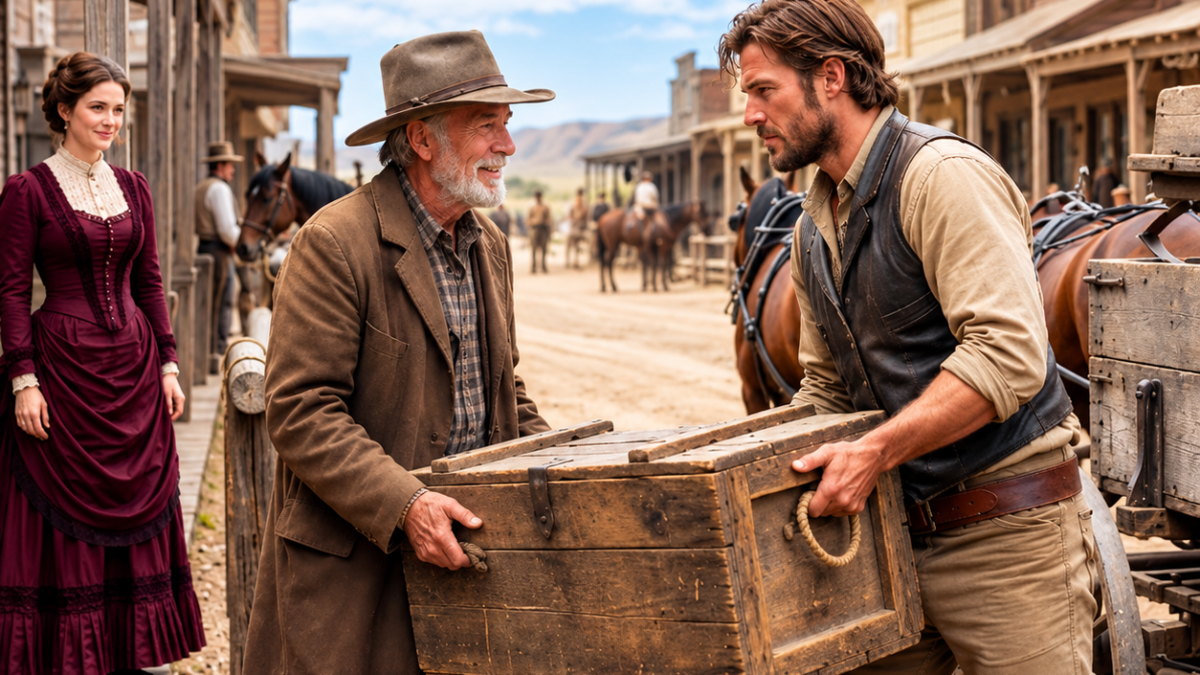
I walked toward the dry goods store, calculating how many meals I could stretch from the coins in my pocket, when I saw the old man with the crate.
He stood beside a wagon in front of Hale’s Mercantile.
The crate was too heavy for one person.
Anyone could see that.
He had it lifted halfway to the wagon bed, his arms locked, his back stiff, his whole body paused in that dangerous position men get into when pride has already moved farther than strength can safely follow.
Two people were near enough to notice.
One man looked away.
Another pretended to adjust his saddle strap.
The old man shifted his grip, and the crate dipped.
I crossed the street.
“Let me get that.”
He turned his head.
Sharp blue eyes met mine.
Not faded blue.
Not watery with age.
Sharp.
Clear.
Eyes that looked like they had spent sixty years learning what people did when they thought nobody important was watching.
He did not say yes.
He did not say no.
So I took the other end of the crate.
Together, we lifted it into the wagon bed.
It landed with a thud that made the wagon springs groan.
I looked at the rest of the load.
Two more crates.
A rolled length of fencing wire.
A sack of staples.
A coil of rope.
Without asking, I picked up the second crate.
“Don’t need to do that,” the old man said.
“I know.”
I loaded it anyway.
He watched me for half a second, then took the other side of the third crate without another word.
We loaded the wagon in ten minutes.
No speech.
No ceremony.
Just work.
When the last coil was tied down, I stepped back and wiped dust from my hands.
The old man looked at the wagon.
Then at me.
Then he smiled.
Not the polite smile of a man saying thank you.
The smile of a man who had just made a decision before telling you there had been a question.
“My name is Earl Callaway,” he said. “I’ve got a ranch south of town. Good fencing work available if you want it.”
I shook his hand.
His grip was dry and stronger than I expected.
“Samuel Grant. I’ll take it.”
He nodded as if that settled something larger than employment.
Then he climbed onto the wagon box and picked up the reins.
I thought the moment was over.
It was not.
He paused, like a man who had nearly forgotten to mention the weather.
“One more thing,” he said.
I looked up.
“My daughter needs a man like you.”
For a moment, the whole street seemed to stop.
It did not, of course.
A woman came out of the mercantile carrying flour.
A horse snorted.
Somewhere, somebody laughed.
But inside me, all sound dropped away.
I stood in the middle of Harlow Creek’s main street, dusty, unemployed five minutes earlier, now apparently hired and introduced to a daughter I had never seen.
“Pardon?” I said.
Earl looked down with those blue eyes doing something that was not quite a smile but contained everything that came before one.
“Just thought you should know.”
Then he clicked his tongue at the horse.
The wagon rolled forward.
I stood there holding that sentence like a tool I did not yet understand the use of.
My daughter needs a man like you.
I had helped a stranger load three crates because they were heavy and nobody else had moved.
That was all.
I did not know Earl Callaway.
I did not know his daughter.
I did not know whether he was wise, foolish, lonely, manipulative, amused, or merely the kind of old man who said whatever passed through his mind and left other people to handle the wreckage.
What I knew was simpler.
The work paid fair wages.
The ranch had a bunkhouse.
Supper was at six.
I needed the job.
So I went to the boarding house, packed my tools, and tried not to think about the daughter all the way there.
I failed.
Earl Callaway, as I would learn soon enough, had been trying to find his daughter a husband for three years.
He did not describe it that way.
Not at first.
He preferred softer language.
He would say he was “introducing possibilities.”
He would say Nora could make up her own mind, which was true.
He would say loneliness was a thing a father was allowed to notice, which was also true.
But Harlow Creek knew what Earl was doing.
The whole town knew.
Nora Callaway was twenty-six years old, taught the older children at Harlow Creek School, and, according to later testimony from nearly everyone within ten miles, had more opinions per square foot than any three other people in the county combined.
She was educated, direct, competent, and entirely unwilling to pretend stupidity in order to make men comfortable.
That last quality had complicated Earl’s project considerably.
The first man he had invited to Sunday dinner made the mistake of saying teaching school was fine work for a woman until she married.
Nora thanked him for coming and suggested he see himself out before dessert.
The second told her she was “very smart for a woman.”
Nora looked at him for a long moment and said, “What an interesting thing to say.”
Earl later told me that tone had frightened him more than any gun ever pointed in his direction.
The third man was respectable, kind, and intelligent enough to understand within one conversation that he was not made for Nora Callaway and Nora Callaway was not made for him. He told Earl so honestly. Earl respected him for it.
But still, he kept watching.
Not for money.
Not for status.
Not for polish.
Earl did not care if a man owned land, though he respected one who knew what to do with it.
He did not care if a man could make a room admire him, though he distrusted men who tried.
He was looking for something quieter.
A man who saw a heavy crate and crossed the street before checking whether anyone would praise him for it.
That was Earl’s measure.
Whether it was enough to build a marriage on was another matter entirely.
Earl knew that.
He simply decided there was no harm in placing the material near his daughter and letting life test it.
That was where Earl was wrong.
Not entirely wrong.
But wrong enough to matter.
Because people are not fence posts.
You cannot set them close and assume weather, time, and pressure will settle them correctly.
You cannot love your daughter so much that you forget she has the right to resent the shape of your concern.
But Earl would need time to learn that.
So would I.
I arrived at Callaway Ranch the following Monday at 6:20 in the morning.
The ranch lay south of town where the land opened wide beneath an enormous Texas sky. The house was whitewashed, broad-porched, and old enough to look settled rather than built. A barn stood to the west, needing work along the roofline. Beyond it, pastures stretched toward low ridges of mesquite and scrub oak. The east fence ran in a long, uneven line that even from a distance looked tired.
Earl had told me coffee would be ready at 6:30.
He had not told me who would be pouring it.
I knocked lightly on the kitchen door and stepped inside when a voice called, “Come in.”
The woman at the stove was not Earl.
She stood with her dark hair pinned up, sleeves rolled, a coffee pot in one hand and the expression of someone thinking about something else who had been interrupted by the practical world.
She turned.
“You must be the fencing man.”
There are moments in life when a person appears in a doorway and the world does not change dramatically.
No music.
No thunder.
No grand recognition.
Only a slight adjustment in the air, as if everything has leaned closer to listen.
That was Nora Callaway.
She was not delicate in the way poems favored.
She was not trying to be pretty, which somehow made noticing her feel like discovering something honest rather than being invited to admire.
Her eyes were brown and direct.
Not warm immediately.
Not cold.
Clear.
The kind of eyes that did not flutter away just because a man looked back.
“Samuel Grant,” I said. “I was told there would be coffee.”
“There is coffee.”
She poured a cup and handed it across the counter.
“My father mentioned he hired someone.”
“He mentioned he had a daughter.”
She stopped.
Only for half a second.
Then she looked at me fully.
“What exactly did he say?”
I had a choice then.
A coward would have pretended not to understand the question.
A smoother man might have made a joke.
A foolish one might have leaned into Earl’s presumption and treated it as invitation.
I was tired of lies, and I had learned enough from hard living to know that pretending makes poor ground for anything decent.
So I said, “He said his daughter needed a man like me.”
Nora stared.
I held the coffee cup and held her gaze.
The kitchen smelled of coffee, bread, woodsmoke, and something clean I could not name.
Finally she set the pot down.
“My father has been trying to find me a husband for three years.”
“I gathered that.”
“He is transparent about it.”
“It’s one of his better qualities.”
That surprised her.
Not enough to smile.
Enough that her eyes shifted.
“Mr. Grant, I want to say something directly.”
“I’d prefer that.”
“My father means well. He thinks he is being helpful. He is not, in fact, being helpful, because I am not a problem that requires solving, and I am not property that requires a new owner.”
She held my gaze.
“I am a schoolteacher who lives in this house, makes her own coffee, and manages her own life. I would appreciate being treated accordingly.”
I stood there with my cup in my hand and felt something inside me settle.
Not attraction first.
Respect.
There is a difference, though one can become the other if given room.
“Understood,” I said.
She watched me as if testing whether I meant it.
I finished the coffee, set the cup on the counter, and nodded.
“Thank you, Miss Callaway. I’ll be at the east fence.”
Then I left.
Behind me, in the kitchen, Nora stood still for a long moment.
I did not know that then.
I did not know she was thinking about how the previous men Earl had brought into her path had all tried to explain, charm, correct, flatter, or win.
I had simply listened, said understood, and gone to work.
It was a small thing.
Small things matter more than people admit.
The east fence needed more than two weeks.
I saw that within the first hour.
Fence work reveals truth the way illness does. The section everyone can see is rarely the only problem. One loose post leads to three rotted ones. One sagging stretch reveals bad tension for twenty yards in either direction. A line that looks serviceable from the road may, upon actual inspection, be held together by weather, prayer, and the optimism of a man too busy to look closely.
Earl’s east fence was in terrible shape.
The first section needed posts reset, wire restrung, braces replaced, and two corners rebuilt entirely. The creek section had rotted at the base. A low stretch near the draw showed signs of cattle testing it. Adjacent sections were not yet failures, but they were practicing.
I made a list.
At the end of the first day, I brought it to Earl.
He stood beside me at the fence line, reading my pencil marks.
“You didn’t have to do this.”
“I could fix the section you described and move on,” I said. “But it would need doing again in a year.”
He folded the list slowly and put it in his coat pocket.
“How long for all of it?”
“Six weeks if the weather holds.”
Earl nodded with the satisfaction of a man whose plan had improved without his having to touch it.
“I’ll pay you for six weeks.”
“Earl.”
“Yes?”
“I’m doing the fence work because the fence needs doing and the pay is fair. Not for any other reason.”
He looked out over the pasture.
Then at me.
“Understood.”
He said it almost exactly the way I had said it to Nora.
Then he went back toward the house.
He was whistling.
Inside, Nora was at the kitchen table with lesson plans spread before her.
Earl entered like a man trying not to look pleased and failing.
“He’s staying six weeks.”
Nora did not look up.
“The fence must be in bad shape.”
“Terrible shape.”
He went upstairs still whistling.
Nora dipped her pen, stared at the page, and did not write another word for several minutes.
On the second day, she brought lunch to the east fence.
She later insisted she had made extra and saw no reason to waste it.
I did not argue, then or later.
I was near the creek section, sleeves rolled, shirt damp with sweat, digging out a post that had rotted below the soil line. The sun stood high. Grasshoppers snapped from weed to weed. The creek moved shallow and brown under cottonwoods.
Nora came carrying a covered pail.
“There’s enough if you haven’t eaten.”
“I haven’t.”
“I assumed.”
She set the pail on a fence post.
I opened it and found bread, cold chicken, sliced apples, and a piece of molasses cake wrapped in cloth.
It was the best lunch I had eaten in months.
“You found the creek section,” she said.
“Yesterday morning.”
“You didn’t tell Earl?”
“I put it on the list.”
“He’ll be pleased.”
“He’ll be pleased because it means I’m here longer.”
I said it without bitterness.
Just fact.
She looked at me.
“You know what he’s doing.”
“Yes.”
“Does it bother you?”
“It would bother me if I were here for the reason he wants me here,” I said. “I’m here for the fence.”
She looked toward the creek.
Then at the work already done.
Clean.
Straight.
Properly braced.
“It’s good work.”
“Thank you.”
She sat on the fence rail.
Not because she had planned to.
Because sometimes a person sits before deciding what sitting means.
We ate in companionable silence at first.
Then she asked where I had learned fencing.
“My father.”
“That sounds like an unhappy answer.”
“It is.”
She accepted that without prying.
I learned later that Nora’s curiosity was strong, but her manners were stronger. She did not open a closed door simply because she noticed it existed.
“My father taught me many useful things badly,” I said after a while. “Fencing was one of them.”
“Useful things badly,” she repeated.
“Yes.”
“That is an efficient description of half the education in Texas.”
I laughed.
It surprised us both.
Her mouth almost curved.
Almost.
That was the beginning of lunch becoming not an accident.
Harlow Creek began talking by Wednesday.
Earl had mentioned the new fencing man to approximately nine people by Tuesday afternoon.
By Wednesday, the reverend’s wife knew.
By Thursday, Martha Hale at the mercantile had formed a complete theory.
The theory was that Earl Callaway had hired me specifically, which was partially true.
That I knew about it, which was also partially true.
And that Nora Callaway would have something to say about all of it, which was entirely true.
Martha asked Earl directly.
“Is this what I think it is, Earl?”
“I hired a fencing man,” Earl said. “The east fence is in terrible shape.”
“Earl Callaway.”
“The wire was sagging something awful.”
He bought nails, coffee, and lamp oil, then left.
Martha watched him go and said to the woman behind her, “He’s doing it again.”
By Saturday, Nora had heard enough.
A student’s mother mentioned the matter after school in the tone of someone conveying necessary information while pretending to discuss spelling lessons.
Nora thanked her, went home, and found Earl on the porch.
“Martha Hale told half the town you hired the fencing man specifically.”
Earl looked out at the yard.
“The east fence—”
“Earl.”
He looked at her.
She stood at the foot of the porch steps, schoolbooks pressed against her chest, brown eyes steady in the way that made lesser men confess.
“You put me in a position.”
His face changed.
Just slightly.
“The whole town is watching now,” she said.
“The whole town was watching anyway. They watch everything.”
“This is different.”
He said nothing.
“If nothing comes of it, which is the most likely outcome, I look like a woman whose father is so concerned about her loneliness that he hires men to meet her.”
Earl was quiet.
“Is that so different from the truth?”
“That is not a fair thing to say.”
“No,” he said. “It is a true one.”
That hurt her.
He saw it.
And because Earl Callaway was many things but not careless with his daughter’s pain once he recognized it, his face softened immediately.
“Nora.”
She looked away.
The evening had begun turning gold over the south field.
Cattle moved slowly in the distance.
For a moment, neither spoke.
Then Earl said, “I have watched you come home from school and sit at that kitchen table with a book open and your mind a hundred miles from the page.”
“I am allowed to be tired.”
“Yes.”
“I am allowed to be alone.”
“Yes.”
“I am allowed to decide whether those things are problems.”
Earl leaned forward, forearms on his knees.
“I know.”
“Do you?”
He sighed.
“I am trying.”
She stood there, still angry but no longer only angry.
He looked older in that moment than I had seen him look on the street.
“I loved your mother for thirty years,” he said. “And then one winter I woke up and she was gone, and the house became too large before noon. I know you are not me. I know loneliness does not look the same on everyone. But I know what it is to come home to rooms that do not answer.”
Nora’s face shifted.
“Papa.”
“I am not saying that gives me authority. I am saying it made me foolish.”
She came up the steps and sat beside him.
The porch boards creaked.
“He knows what you’re doing,” she said after a while.
“I know.”
“You respect that?”
“I do.”
“He told you he is here for the fence?”
“He did.”
“And you believed him?”
“I believed he meant it.”
She looked toward the east pasture.
“He listens.”
Earl smiled faintly.
“I noticed.”
“That does not mean anything.”
“No.”
“It might mean something.”
“Yes.”
She looked at him sharply.
He raised both hands.
“I said nothing.”
“You said yes.”
“I am guilty of accuracy.”
She almost smiled despite herself, then stood and went inside.
She did not slam the door.
Earl considered that encouraging.
I found Nora reading on the porch Wednesday evening of the second week.
Or rather, she found me.
I had finished supper and carried my coffee outside because the evening had cooled and the porch caught the last amber light across the south pasture. My body ached in the clean way that comes after good work. My hands were nicked from wire. My shoulders were tired. I had taken off my boots and set them beside the chair.
I was reading my mother’s copy of Middlemarch.
The spine was worn nearly white. Several pages had been repaired. My mother’s notes filled the margins in small, slanted writing. She had loved George Eliot as if the woman were an old friend who told uncomfortable truths with excellent grammar.
Nora stepped onto the porch with lesson papers.
She paused.
“What are you reading?”
I held up the book.
She crossed the porch.
“Middlemarch?”
“Third time.”
She looked at the cover.
“At the end of a fence day?”
“It’s better each time.”
She sat in the other chair.
Not far.
Not close.
“Where did you come across George Eliot in Tennessee?”
“My mother. She had the complete works.”
“And your father approved?”
“My father believed reading was acceptable if it did not interfere with work.”
“Did it?”
“Often.”
That earned the smallest curve of her mouth.
“When she died,” I said, “I kept the books. My father kept the land. When he died, I sold the land and kept more books.”
She looked at me then.
Not with pity.
With attention.
“What do you think of Dorothea?”
I lowered the book.
There are questions people ask to fill air.
This was not one.
“I think she spends a long time being wrong about what she needs,” I said. “And then she figures it out. But the figuring out costs her considerably.”
Nora leaned back.
“Some would say she ends up with less than she deserves.”
“Some would say she ends up with exactly what she chose.”
“You think those are both true?”
“Yes.”
She looked toward the evening light.
“So do I.”
We sat in silence after that, she with lesson plans and I with my book, the porch quiet in a way that was not empty.
That was new to me.
I had known silence as punishment.
Silence as grief.
Silence as avoidance.
Silence as two people in a room with nothing left to say.
This was different.
This was the silence of two people who did not need to fill a space in order to share it.
“What did you mean to do before you came here?” she asked finally.
“I meant to find a place that felt right to settle.”
“And Harlow Creek?”
“I don’t know yet.”
She nodded.
“What about you?” I asked. “What did you mean to do?”
“I know exactly what I mean to do.”
I looked at her.
“The school,” she said. “My students. The particular way October light comes through the east window of my classroom in the afternoon. The older children pretending not to care and then caring very much. The moment a girl realizes she has solved a problem no one expected her to solve.”
She held my gaze.
“I know what mine looks like.”
“Yes,” I said. “I can see that.”
And I could.
That was part of what unsettled me.
Nora Callaway did not drift through her own life waiting for someone else to name it. She knew its shape. She knew its rooms, its mornings, its duties, its light.
I had spent three years refusing to belong anywhere.
She belonged to her life with both hands.
It frightened me more than I wanted to admit.
Earl invited every neighboring family within four miles to a Saturday supper.
He announced this at breakfast Thursday with the serenity of a man dropping a match into dry grass and calling it weather.
“How many people?” Nora asked.
“Just neighbors.”
“Earl.”
“The Garfields. The Prestons. Widow Mercer and her son. The Hendersons.”
“That is fourteen people.”
“Neighbors.”
I stood in the kitchen doorway, coffee in hand, reading the room.
“What’s happening Saturday?”
“Neighbors for supper,” Earl said.
Nora looked at me.
I looked at Nora.
We both looked at Earl.
“Earl,” I said, “you are a very transparent man.”
“I know.”
He buttered his toast.
The supper was exactly what Earl claimed and exactly what everyone knew it was.
Fourteen neighbors came carrying pies, beans, biscuits, opinions, and the bright-eyed interest of people who had arrived to observe a developing matter while pretending to discuss cattle prices.
They observed me helping Earl carry the extra table from the barn.
They observed me talking to Tom Garfield about wire tension.
They observed Nora correcting the reverend’s wife on the difference between encouraging students and flattering them.
They observed, with intense satisfaction, that I was seated beside Nora at supper.
Nora had chosen that seat.
She did not examine why until later.
The supper itself was loud and warm. Earl told a story about a horse that had once untied three separate knots to escape a storm. Martha Hale asked me about Tennessee and somehow made it sound like a cross-examination. Widow Mercer said my mother had excellent taste if she gave me George Eliot, which startled me enough that I nearly dropped my fork.
Nora noticed.
Of course she noticed.
After everyone left, Earl retreated upstairs with suspicious speed.
Nora stood at the sink washing dishes.
I took a towel and began drying them.
This had not been arranged.
It simply happened.
“The whole county will know about this by Monday,” she said.
“The whole county already knows. Martha Hale has been briefed.”
She handed me a plate.
I dried it.
“Samuel.”
“Yes?”
“If my father had not said what he said on the street—if you had just come to the ranch for the fence work and nothing else—would you have noticed me?”
I held the plate longer than necessary.
The easy answer would have been flattering.
The honest one mattered more.
“Yes,” I said. “The coffee was very good, and you said what you meant, and you did not apologize for it. I noticed that.”
She handed me another plate.
“When did you start noticing me?” I asked.
Not the same question back.
A more dangerous one.
She looked into the dishwater.
“The morning you said understood and meant it. Before I decided whether I wanted to notice you.”
“Is that inconvenient?”
This time she almost laughed.
Not quite.
But close.
“Considerably.”
She handed me the last plate.
I dried it and set it on the stack.
For a moment, the kitchen held both of us and nothing else.
Outside, Harlow Creek night pressed against the windows.
Inside, the lamp burned warm.
The dishes were done.
Neither of us had any reason to keep standing there.
Neither of us moved.
“Same time tomorrow?” I said.
“For the fence?”
“For the coffee.”
She turned back to the basin.
“Yes.”
The problem, when it came, came from me.
Nora had expected trouble from herself. She told me that later.
She had built caution over three years of being told she was complicated by people who meant it as criticism and interesting by men who meant it as possession. She knew how to defend the borders of her own life.
What she had not expected was for me to be the one afraid.
But I was.
By the third week, the east fence was beginning to straighten behind me like a line drawn through confusion. I woke before dawn thinking about wire and posts, then found my thoughts drifting to coffee, Nora’s voice, Nora’s hands ink-stained from lesson plans, Nora in evening light asking what I thought of Dorothea Brooke.
I had stayed places before because the work continued.
This felt different.
And difference frightened me.
One Tuesday morning before coffee, I knocked on the kitchen door and stood there with my hat in my hands, feeling like a man about to step onto a frozen pond without knowing whether it would hold.
Nora opened the door.
She looked at my face.
“What is it?”
“I need to tell you something.”
She set the coffee on.
“Tell me.”
“I stayed because the fence needed it. That is true. But I could have done two weeks, given Earl the list, and gone on.”
She sat across from me.
I held her gaze.
“I did not go on. And I think you deserve to know that I know the difference between those two things.”
Her face did not change quickly.
Nora was too honest for performance.
“What are you saying?”
“I’m saying I’ve been here three weeks, and I am going to stay three more. At the end of six weeks, I’ll have to decide where to go next. And the reason that decision is harder than it should be is not the fence.”
She looked at the table.
Then at me.
“Samuel.”
“Yes.”
“I know.”
I stopped breathing a little.
“I’ve known for a week.”
“Then why haven’t you said anything?”
She looked toward the window, toward the east field where morning lay pale over the grass.
“Because you are leaving in three weeks. And because what happens after that is not something I know how to plan around.”
There it was.
Plain.
Painful.
True.
“I don’t know what happens after that,” I said. “Honestly.”
“I know.”
“That’s the problem?”
“That’s the problem.”
The coffee was ready.
She rose, poured two cups, and placed one in front of me.
We drank in silence while morning opened outside, and neither of us pretended certainty we did not have.
That may have been the most honest thing that had passed between us.
Earl found me at the east fence two days later.
He leaned on the rail while I worked.
For once, he did not begin with a joke.
“I owe you an apology.”
I looked up.
He watched the fence line rather than me.
“I put you in a position. I put Nora in a position. I did it because I could see something in thirty seconds on a Tuesday morning that three years of looking had not found. But seeing something in a man does not give me the right to decide for my daughter.”
I set the wire down.
Earl’s face was turned toward the pasture, but his eyes were troubled.
“I was wrong about my authority,” he said. “Not about the man.”
“What did you see?” I asked.
“On the street?”
“Yes. Thirty seconds.”
He thought about it.
“A young man who did not look around first. Who did not wait to see if anyone else would move. Who just took the other end of the crate because the crate was heavy and there was nobody else.”
I looked at the fence.
“What did you mean to do with that after you saw it?”
“Put a good man close enough for Nora to notice. The rest was above my authority. I knew that. I told myself there was no harm in the introduction.”
He paused.
“There was not harm exactly. But there was presumption.”
I respected him more for saying it.
“I like her,” I said.
“I know.”
“She is the most interesting person I have met in three years of moving. She says what she means. She reads George Eliot and understands it. She knows exactly what her life looks like and does not apologize for knowing it.”
My voice caught in spite of myself.
“I do not know what comes next. I have no land here. No history. Nothing except a good fence and three weeks of supper.”
Earl looked toward the south pasture.
“The south fence is in similar shape to where the east was when you started.”
“I noticed when I came in.”
“Once you finish the east line, you could take a look at it.”
I looked at him.
“What exactly are you offering?”
“Ranch work that needs doing. Permanent if it suits. I am sixty-two years old, and the land deserves more than I can give it alone.”
He held my gaze.
“What you do with the other part is entirely your business.”
I looked at the east fence, clean and tight from one end to the other.
I looked at the south pasture beyond.
Then back at Earl.
“I would want to talk to her before anything.”
“Obviously.”
He pushed away from the fence.
Then started back toward the house.
He was whistling.
I watched him go and thought the man was absolutely impossible.
And possibly right.
I found Nora at the school on Friday afternoon.
Class was over.
The desks stood in neat rows. Chalk dust floated in the light from the east windows. The room smelled of slate, old wood, paper, and children recently gone. Nora stood at the blackboard erasing arithmetic problems with her sleeves rolled to her elbows.
She heard my boots and turned.
“Class is over.”
“I know.”
“Did you come for Earl?”
“No.”
I stepped inside.
“I came for you.”
She set the eraser down slowly.
“My father talked to you.”
“Yes.”
“What did he say?”
“He offered me work. Permanent ranch work, if it suits. He also said what I do with the other part is entirely my business.”
She folded her hands.
“And what is the other part?”
I crossed the room and stood before her in that October light she had once described as hers.
“I am going to ask you something, and I want you to know the answer has no bearing on whether I take the work. The fence is done regardless.”
“Ask.”
“Would you be willing to let me court you properly?”
Her eyes did not leave mine.
“Not because your father wants it,” I said. “Not because the town is watching. Because I have been here three weeks and I do not want to leave at the end of six and spend the next three years thinking about Middlemarch, excellent coffee, and a woman who says exactly what she means.”
The room was quiet.
Outside, a child laughed somewhere down the road.
Nora looked at the desks.
The blackboard.
The east windows.
Then back at me.
I could see the thoughts moving through her.
Three years of being told she was difficult.
Three years of men who liked the idea of her until they met the reality.
Three weeks of coffee.
Fence work.
Evening reading.
A kitchen after supper.
A man who had said understood and meant it.
“Yes,” she said simply.
The way she said everything that mattered.
My breath left me.
I nodded because I did not trust myself to speak.
She studied my face.
Then her own softened.
“There it is.”
“What?”
“The real smile. The one under the careful one.”
I looked down, embarrassed.
She almost laughed.
“I should warn you. My father is going to be insufferable about this.”
“I know.”
“He will say ‘I told you’ approximately four hundred times.”
“I expect so.”
She picked up the eraser and placed it on the desk.
“Same time Monday?”
“For the fence?”
“For all of it.”
Earl was on the porch when we returned.
He sat in the chair that caught the evening light with coffee in one hand and an expression of complete indifference performed with very limited success.
We came up the steps and sat in the other chairs.
Earl looked at the south field.
Nora looked at him.
“Say it.”
He glanced at her.
Then at me.
Then at his coffee.
“I told you.”
“There it is,” I said.
“That is one,” Nora added. “Three hundred ninety-nine to go.”
Earl smiled then.
The real one.
The one that went all the way to his sharp blue eyes.
He drank his coffee and said nothing else.
For once.
The courtship did not look the way Harlow Creek had imagined.
Harlow Creek had expected flowers, Sunday calls, long formal rides, and all the performances that allowed people to observe romance without admitting they were observing.
Instead, I finished the east fence on Wednesday, began the south fence on Thursday, and appeared at the Callaway supper table every evening in the specific manner of a man who had, somehow, always been expected there.
Nora and I took walks on Saturday afternoons.
Not to be seen.
To talk.
Some conversations require movement.
We talked about Tennessee and Texas. About belonging to a place. About books. About students. About how a person knows the difference between duty and fear when both can keep you in motion.
In November, I repaired the schoolhouse window frame after noticing cold air slipping through the east window.
Nora was marking papers at her desk when I worked.
After a while, she put down her pencil.
“You did not have to do that.”
“I noticed it last week. It will be a cold winter.”
She watched me fit the frame.
“You notice many things.”
“Useful habit.”
“Dangerous one too.”
I looked back.
“Yes.”
She tapped the pencil against the desk.
“Why did you stop in Harlow Creek specifically? You said you had been moving three years. There is work in other towns.”
I looked at the window frame, at the clean line of it.
“I had been moving because moving was easier than the alternative.”
“What alternative?”
“Staying long enough to care whether something held.”
She did not speak.
“Every time a place began to feel like it might become something, I left. Not because I was unhappy. Because I was afraid of what it would mean if I stayed and then lost it.”
“Like Tennessee.”
“Yes.”
She sat very still.
“My father saw something in you in thirty seconds,” she said.
I turned.
“What do you see?”
She looked at her papers.
Then at the east window.
Her window.
Her light.
“I see a man who goes back to check his work,” she said. “Every time.”
I came away from the window and stood before her desk.
“Nora.”
“Yes?”
“I am not going to leave.”
It was not a vow decorated with poetry.
Not a proposal.
Not an attempt to force certainty on the future.
Just the fact of it, stated as clearly as I knew how.
She held my gaze a long moment.
Then said, “I know.”
I went back to the window.
The seal was perfect.
I checked it twice.
December came cold.
The south pasture fence was finished by the last week of November, clean and tight enough to make Earl stand with his hands on his hips and pretend he was only inspecting, not admiring.
I moved to barn repairs.
Then gates.
Then winter preparations.
There was always work.
Real work.
Needed work.
And with each task completed, the ranch changed shape around me.
Not because I owned any part of it.
Because my hands had begun leaving evidence of my staying.
Nora kept teaching.
There was never a discussion about whether marriage, if it came, would change that.
It would not.
The school was hers.
Anyone who could not see that did not belong close enough to ask.
She went each morning and came home each evening with chalk on her cuff, stories about students, and papers to mark at the kitchen table. Earl made coffee at six. We ate supper together. Some nights we talked until the lamp burned low. Some nights we sat quiet.
The table had a quality Earl had not felt in eight years.
He told me that much later.
A house can be occupied and still not full.
By winter, the Callaway house was full.
On a January evening, after Earl had gone upstairs, Nora and I stood on the porch in coats watching stars appear over the south pasture.
The air was cold enough to sharpen every breath.
Inside, the kitchen lamp glowed.
Coffee stayed warm on the stove.
“You came here looking for something that belonged to you,” she said.
“I remember.”
“Have you found it?”
I looked at the pasture.
The south fence, my work.
The barn roof, partly my work.
The gate I had reset the week before.
The house where light waited.
The woman beside me.
“I have found where I belong,” I said. “That is not quite the same thing.”
She looked up at the stars.
“No. I think it is better.”
I turned toward her.
“Nora.”
“Yes?”
“I would like to ask your father if he would be all right with us marrying.”
Her eyes shifted.
“Not because he needs to give permission,” I said. “Because he is your father, and I think he deserves to be asked.”
She was quiet for a long time.
Then she smiled.
Small.
Real.
“I think my father has been waiting for that question for three years.”
“I know.”
“He is going to say ‘I told you.’”
“Yes.”
“Approximately three hundred ninety-eight more times.”
“Likely.”
She leaned her head against my shoulder.
I put my arm around her.
The January night was cold and clear and enormous around us, and below it, the Callaway Ranch rested with the specific quality of a place being used correctly.
I asked Earl the next morning.
He was in the barn checking a harness.
I stood in the doorway like I had walked into church.
“Earl.”
He glanced up.
Then saw my face and set the harness down.
“Well,” he said.
“I would like to marry Nora, if she will have me.”
“That second part seems more important.”
“It is.”
“And has she indicated anything?”
“Yes.”
He nodded slowly, eyes bright.
I continued before he could speak.
“I am not asking because I believe she needs permission. I am asking because you are her father. Because I respect you. Because you gave me work when I needed it. Because you apologized when you saw you had overstepped. And because I intend to stay.”
Earl looked away toward the open barn doors.
For a moment, he did not look like a meddling old rancher.
He looked like a widower whose only daughter had carried too much of his hope for too long.
“My wife would have liked you,” he said.
My throat tightened.
“I would have been honored.”
He nodded.
Then looked back.
“I told you.”
I laughed despite myself.
“That is two.”
“Many more coming.”
“I have been warned.”
He came forward and gripped my shoulder.
“Marry her because she is Nora. Not because she is my daughter. Not because this ranch needs hands. Not because Harlow Creek has been waiting for a wedding.”
“I know.”
“She will argue with you.”
“I know.”
“She will be right often.”
“I know.”
“More often than you expect.”
“I expect often.”
He smiled.
“Then yes, Samuel Grant. If Nora chooses you, I will be proud to call you family.”
We married in April.
In Harlow Creek Church, on a Saturday, with Texas spring outside and wildflowers brightening the south pasture.
The whole town came.
Martha Hale sat in the second row with the satisfied posture of a woman who considered the outcome a personal vindication. The reverend’s wife sat in the third row and had opinions about the flowers, several of which had already been delivered indirectly to Nora and ignored.
Earl sat in front.
He tried to look solemn.
He failed.
I stood at the altar in my good coat.
My second good coat, actually.
Nora had pointed out when I bought it in November that it was a significant investment for a man who owned more books than furniture.
I said it was reasonable given the circumstances.
She asked what circumstances.
I said possible future solemn occasions.
She told me I was transparent.
I said I had learned from Earl.
She laughed then, and I decided the coat had already earned its cost.
Nora came down the aisle in a dress the color of Texas after rain.
Not white.
Not fragile.
Blue-green, like new grass.
Practical enough to be worn again because Nora saw no virtue in clothing that could not be used after being admired.
She walked past Earl.
He wiped his eyes with the speed of a man hoping nobody had seen.
Everybody had.
She reached me.
I looked at her.
She looked at me.
And every road I had taken for three years seemed suddenly less like running and more like a long, crooked path to that exact place.
After the ceremony, we walked back to the Callaway ranch for the reception Earl insisted on hosting.
On the road, Earl fell into step beside me.
He looked at the south fence, clean and tight.
At the barn.
At the gate I had replaced in March, which now closed with the solid sound of a gate that would hold.
“Samuel.”
“Yes?”
“Thank you for helping me with that crate.”
He said it simply.
Not as a joke.
Not as a clever circle closing.
As a man who understood the weight of small beginnings.
I looked at him.
He held my gaze with those blue eyes that had been paying attention for sixty years.
“Thank you,” he said, “for being the kind of man who does that.”
Then he walked ahead to open the gate for the guests.
I stood on the road a moment and looked at the Callaway ranch.
The fence.
The barn.
The gate.
The house where lights would be on by evening.
I thought about a Tuesday morning, a crate too heavy for one man, and thirty seconds that had become six weeks, then winter, then vows, then home.
Nora waited on the other side of the gate.
“How many?” she asked.
“Two,” I said. “He said ‘I told you’ twice on the walk from the church.”
“Three hundred ninety-seven to go.”
She took my hand.
We went inside.
The ranch was better with three people.
Earl never argued this.
He did not need to.
By summer, it became visible.
The barn roof was done by July.
The cattle were in better condition by August than they had been in years.
The fences held.
The school remained Nora’s.
She taught every morning, came home every evening, marked papers at the kitchen table, and planned lessons on the porch when the light was right.
I worked the ranch.
Earl worked beside me when his knees allowed and supervised with great authority when they did not.
At supper, the table sounded like life.
Not grand life.
Not the kind written in newspapers.
The better kind.
Coffee pouring.
Pages turning.
Chairs scraping.
Earl pretending not to listen when Nora and I discussed books.
Nora correcting his arithmetic when he counted calves wrong.
Me burning my hand on a skillet and being mocked mercilessly by both Callaways.
Winter came again.
One January evening, I finished Middlemarch for the fourth time.
Nora sat beside me and did not speak until I closed the book.
“Better the fourth time?”
“Different.”
“How?”
“The fourth time, you know how it ends. You read for the parts in between.”
She held her coffee.
Looked toward the south pasture in cold light.
Then looked at me.
“Samuel.”
“Yes?”
“My father is going to say ‘I told you’ about forty more times before the year is out.”
“Probably.”
“I want you to know he is right.”
I looked at her.
She held my gaze with those clear brown eyes that had read situations correctly long before I arrived.
“He saw something in thirty seconds that three years of careful men missed,” she said. “He was not wrong about the material.”
She paused.
“He was right about that and wrong about his authority. Both things are true.”
I looked down at the book in my hands.
“Nora.”
“Yes?”
“He was also right about the fence.”
She almost laughed.
“The real one?”
“Terrible shape.”
“Terrible.”
She leaned her head against my shoulder.
I put my arm around her.
Outside, January lay cold over Harlow Creek. The south pasture was brown and waiting, and the fence ran tight from one end to the other.
In front of the house, Earl sat on the porch with coffee, listening to the sound of his home full of the right people.
It was not a dramatic sound.
Nothing anyone would write a song about.
Just two people in a kitchen on a winter evening.
A book closing.
A cup placed on a table.
A chair shifting closer.
The sound of everything exactly where it was supposed to be.
Earl Callaway had seen something in thirty seconds.
A young man who did not look around first to see who was watching.
A young man who picked up the other end of a crate because the crate was heavy and there was nobody else.
He knew what that meant.
He also learned that knowing what a man is made of and deciding who belongs in his daughter’s life are two different things, and the second was above his authority.
So he did the only thing he had the right to do.
He gave us a fence, a kitchen table, six weeks of supper, and enough room to decide for ourselves.
The rest was ours.
I did not fall in love with Nora Callaway because her father told me to.
I loved her because she said what she meant and did not apologize for it.
Because she read George Eliot seriously.
Because she knew exactly what her life looked like.
Because she made excellent coffee.
Because she taught me that staying was not something a man did after running out of road.
It was something he chose when the place was right, the people were right, and he had finally stopped being afraid that what mattered could be lost.
Nora did not love me because Earl arranged anything.
She loved me because I heard what she said and meant it.
Because I stayed longer than the fence required.
Because I replaced a window frame in November after noticing it let in cold.
Because I did not ask her to become smaller so I could feel larger.
Earl said, “I told you.”
He will continue saying it.
He was right.
He was also wrong to think love could be guided like a wagon onto a road simply because a father saw the road before anyone else.
Both things were true.
And sometimes that is what love looks like.
One person noticing what another is made of.
Stepping close enough to help.
Then stepping back far enough to let the rest become choice.
I helped an old stranger load his wagon one hot morning in Harlow Creek.
I thought I was earning a day’s good opinion and maybe a week’s work.
Instead, I found a fence that needed mending.
A woman who needed no man but chose one anyway.
A father wise enough to be foolish, and foolish enough to apologize.
And at the end of all my running, I found a gate that closed solid behind me and a house with a light on in the kitchen.
I had come west looking for something that belonged to me.
What I found was better.
I found where I belonged.


