I Helped an 8-Year-Old Girl Cross a Busy Street—Then I Found My Name Hidden Inside Her Leg Brace and a Photo of My Dead Brother in Her Backpack.
PART3:
“Okay, Lily Bennett. We’ll cross first, then figure out where your mom is.”
She nodded as though I had passed some private test.
The pedestrian light changed.
I stepped into the crosswalk beside her.
That was when I understood how difficult walking was.
Every movement required concentration.
Click.
Step.
Click.
Step.
The metal joints in the braces made a faint mechanical sound.
She did not complain.
Did not ask me to slow down.
Did not accept my arm when I offered it.
Halfway across, a horn blasted from somewhere to our left.
Lily startled.
Her right foot caught.
Her knee buckled.
I caught her beneath both arms before she hit pavement.
“Easy.”
“I’m okay.”
“You sure?”
“Yes.”
Then her pant leg shifted.
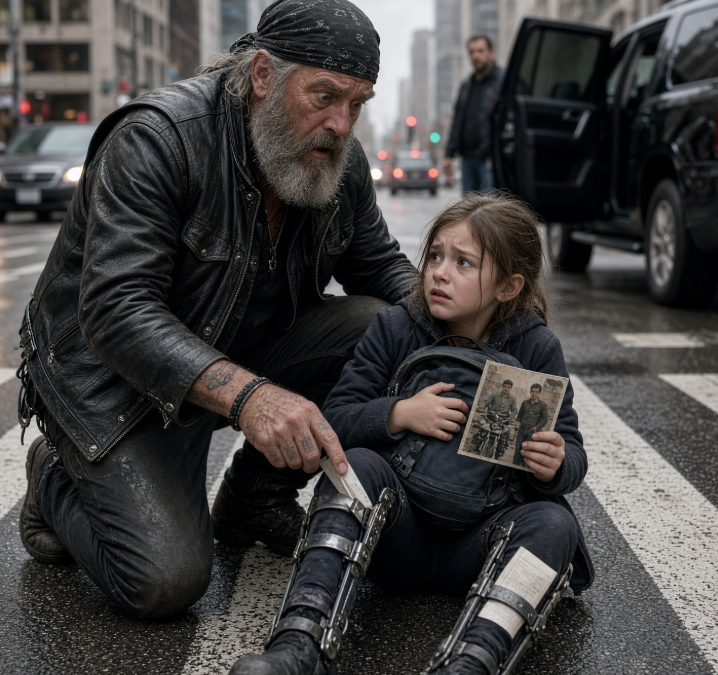
I saw white paper taped inside the brace.
Three words written in black marker.
GRANT “BEAR” CALLAHAN.
For one second, traffic disappeared.
Noise disappeared.
The entire city went silent.
I stared at my own name.
Not Grant Callahan.
Bear.
That mattered.
Plenty of people knew Grant.
Far fewer knew the nickname well enough to write it between quotation marks.
“Lily.”
She looked up.
“Where did you get this?”
“My mom put it there.”
I looked toward the countdown signal.
Seven seconds.
Not the place.
I carried her the final few yards despite her protesting that she could walk.
Once we were safely on the opposite sidewalk, I crouched again.
“Can I take the paper out?”
She nodded.
The tape peeled away.
Inside was one sentence.
Find Grant Callahan. He’s the only man who can bring your father home.
My fingers went numb.
I read it twice.
Then a third time.
“Lily.”
“Yes?”
“Who is your father?”
She opened her backpack.
Reached past a juice box, a folded sweater, and what looked like three library books.
Then she pulled out an old photograph.
The edges were soft from handling.
Two young men stood beside a motorcycle.
One was me.
Thirty-two.
Black beard.
No gray.
Arrogant enough to believe age was something that happened to other people.
The second man stood beside me with one arm around my shoulders.
Michael.
My little brother.
Michael Callahan.
Six years dead.
I had chosen his coffin.
I had stood beside his grave.
I had watched our mother place both hands against a closed casket and whisper goodbye to a son who, according to police, had died when his truck went through a guardrail on a mountain road.
The vehicle burned.
Weather delayed recovery.
The body was damaged badly enough that they advised against viewing.
Curtis Hale identified what could be identified.
Wallet.
Watch.
Truck.
Personal belongings.
Michael.
Dead.
That had been the story.
For six years.
I looked from the photograph to Lily.
Michael’s eyes.
God.
I should have seen them immediately.
Same hazel-brown color.
Same slight downward angle at the outside corners.
My hands began shaking.
“Where did you get this picture?”
“My mom.”
“Lily…”
I had trouble forcing out the next question.
“Is Michael Callahan your father?”
She nodded.
“Yes.”
The world shifted beneath me.
“He’s alive?”
Another nod.
I forgot how to breathe.
“Where?”
“I don’t know.”
“What do you mean?”
“Some men came three nights ago.”
Her voice became smaller.
“Dad told Mom to hide me.”
“Why?”
“I don’t know.”
“Where’s your mom?”
“I don’t know that either.”
I closed my eyes.
Opened them.
“Okay.”
Nothing was okay.
But children need adults to use that word sometimes.
“Did your dad give you anything else?”
Lily looked around.
Then lifted the padding inside her other brace.
Her fingers pulled out a tiny brass key.
She held it toward me.
“Dad said you’d remember what this opens.”
I knew instantly.
Michael and I had bought matching steel lockboxes years before on a motorcycle trip through Tennessee.
Stupid purchase.
Twenty dollars each at a roadside hardware store.
Mine still sat in the back of my garage beneath old riding gear.
I had not opened it in years.
Michael’s key was gone.
His box supposedly disappeared with everything else after his death.
I took the brass key.
It felt too small to carry six years of impossible questions.
Then tires screamed behind us.
A black SUV jumped toward the curb.
Lily went white.
“That’s them.”
The rear door opened.
A man stepped out.
And I recognized him immediately.
Curtis Hale.
Michael’s business partner.
Michael’s friend.
The last man supposedly traveling with him before the accident.
The man who had put one hand on my shoulder beside Michael’s coffin and said:
“I’m sorry, Bear. I wish I could’ve brought him home.”
Now he stood ten feet away staring at Michael’s eight-year-old daughter.
And for one second, none of us moved.
FULL STORY CONTINUATION 👇👇
Lily grabbed the back of my vest.
“That’s him.”
My body moved before my mind did.
I stepped in front of her.
Curtis immediately lifted both hands.
“Bear.”
“Don’t.”
“I’m not here to hurt her.”
“You’ve got about five seconds to explain why an eight-year-old says you came for her father.”
Curtis looked past me toward Lily.
His expression changed.
Not anger.
Not threat.
Guilt.
That was worse.
“Where’s Rachel?”
I looked over my shoulder.
“Your mom?”
Lily nodded.
Curtis exhaled hard.
“Good.”
“What’s good?”
“She got Lily out.”
“Out of what?”
Curtis glanced at traffic.
Pedestrians.
Storefront glass.
People looking.
“Not here.”
“Bad answer.”
“Bear, please.”
“You told me Michael was dead.”
His jaw tightened.
“Yes.”
“You stood at his funeral.”
“Yes.”
“You identified the body.”
Curtis closed his eyes for half a second.
“No.”
I stared.
“What?”
“I identified personal effects.”
“That is not what you told me.”
“No.”
The word was quiet.
No defense.
I stepped closer.
“Then say something useful before I decide you are the last person on earth this kid should go anywhere near.”
Curtis looked directly at me.
“The remains recovered from the truck couldn’t be visually identified.”
“I know.”
“Police relied on vehicle registration, Michael’s wallet, his watch, and what I told them.”
My mouth went dry.
“What did you tell them?”
“That Michael had been driving.”
“Was he?”
Curtis hesitated.
“No.”
Behind me, Lily whispered:
“Dad said Uncle Curt made a mistake.”
Uncle Curt.
I turned.
“You know him?”
She nodded.
“He used to bring groceries.”
Curtis looked miserable.
“I haven’t seen Lily in almost a year.”
My brain felt too slow for the amount of information being thrown at it.
“Who was driving the truck?”
“A man named Evan Doyle.”
The name reached backward through memory.
Mechanic.
Worked around Michael’s shop.
Dark hair.
Skinny.
Always smoked near gasoline despite everybody telling him he was an idiot.
“Why was Michael’s wallet in the truck?”
“His jacket.”
“Where?”
Curtis looked around again.
“Bear.”
“If you say ‘not here’ one more time—”
“It isn’t safe to do this on a sidewalk.”
He was right.
I hated that.
The street was not the place to unravel six years of death, lies, and missing family in front of an eight-year-old whose knees were already beginning to tremble from standing too long.
I crouched beside Lily.
“Do you trust Curtis?”
She took the question seriously.
Michael did that too.
He never gave easy answers just because someone wanted one.
“Dad does.”
“That isn’t what I asked.”
She looked around my shoulder at Curtis.
“A little.”
Smart kid.
“Do you know where your mom is?”
“No.”
“Did she tell you where to go?”
“She said if we got separated, find you.”
My chest tightened.
“Anything else?”
“She said don’t go home.”
I looked at Curtis.
“Is Rachel in danger?”
“No.”
“You sure?”
“As sure as I can be.”
“What the hell does that mean?”
“It means Rachel is frightened about something that may be mostly old paperwork and consequences catching up to Michael.”
“Mostly paperwork?”
“Yes.”
“Then explain the black SUV.”
For the first time, Curtis looked embarrassed.
“It’s a rental.”
I stared at the polished black monstrosity.
“That somehow makes this stupider.”
“Probably.”
“Who’s driving?”
“My wife.”
The passenger door opened.
Dana Hale stepped out.
I recognized her from the funeral.
She was in her early fifties now.
Blond-gray hair.
Simple coat.
The same calm expression I remembered from six years earlier when she brought coffee nobody drank.
She walked slowly.
No rush.
No attempt to grab Lily.
“Hi, Lily.”
Lily peeked around me.
“Hi, Mrs. Dana.”
Dana looked at me.
“You’re Grant.”
“Bear.”
“I know.”
She glanced down at Lily’s braces.
“She’s been walking?”
“Too far.”
Concern tightened Dana’s face.
“Sweetheart, your mom must be losing her mind.”
“I didn’t know where she was.”
“I know.”
Dana crouched several feet away.
She did not touch Lily.
That mattered.
“Can I call her?”
Lily looked at me.
Again.
I had known this child maybe fifteen minutes.
Somehow she had already assigned me a job.
I nodded.
“Let her call.”
Dana took out her phone.
Rachel answered on the first ring.
I heard only Dana’s half.
“We have her.”
Pause.
“She’s safe.”
Another pause.
“Yes.”
Dana looked at me.
“He’s here too.”
Rachel said something loudly enough that Dana moved the phone from her ear.
Then she held it toward me.
“Brace yourself.”
I took it.
“Rachel?”
A woman’s voice broke through.
“Is Lily okay?”
“Yes.”
“Is she hurt?”
“No.”
“Where are you?”
“Downtown.”
“With Curtis?”
I looked at him.
“Yes.”
Silence.
Then:
“Do not let him take her.”
Curtis lowered his eyes.
I turned away.
“Why?”
Another silence.
“Rachel.”
“Because I don’t know what Michael told him.”
My hand tightened around the phone.
“What does that mean?”
“I can’t explain this over the phone.”
I rubbed my forehead.
“Everybody today seems very committed to that sentence.”
“I’m sorry.”
“Where are you?”
“St. Anne’s.”
Hospital.
My stomach dropped.
“Are you hurt?”
“No.”
“Michael?”
Nothing.
That pause told me before she did.
“Rachel.”
“He’s alive.”
I closed my eyes.
Hearing it from Lily had been impossible.
Hearing it from Rachel made six years collapse differently.
“Is he at the hospital?”
“Yes.”
My knees nearly gave.
“Why?”
“He collapsed this morning.”
Lily was watching me.
I turned slightly so she could not read too much.
“Serious?”
“They think exhaustion and dehydration. Maybe an arrhythmia. He’s stable.”
Stable.
Alive.
Hospital.
My brother.
“Why didn’t anybody call me?”
Rachel’s voice softened.
“He told me not to.”
That hurt exactly as badly as it should have.
Then she added:
“Until today.”
I looked at the note still in my hand.
Find Grant Callahan.
“He changed his mind.”
“Yes.”
“Why?”
“Because Curtis came to the house three nights ago.”
I turned toward Curtis.
He watched me.
Rachel continued.
“He said someone had reopened the old accident records.”
“Who?”
“I don’t know.”
“Police?”
“Insurance investigator. Maybe state records. Something connected to the old business.”
“And Michael panicked.”
“Yes.”
“Why?”
“Because everything he hid could come apart at once.”
I laughed once.
No humor.
“What did he hide, Rachel?”
Her voice dropped.
“His life.”
“That part I figured out.”
“Bear—”
“Six years.”
“I know.”
“No.”
I stared across the street.
“You don’t.”
Her voice cracked.
“I do.”
I stopped.
“Because I spent six years helping him justify it.”
That shut me up.
Rachel continued quietly.
“Please bring Lily here.”
“Does Michael want me there?”
“He told me to call you if she found you.”
“That isn’t what I asked.”
“No.”
Honest.
I respected it despite everything.
“Does he want to see me?”
A long pause.
“Yes.”
My throat tightened.
I handed the phone back to Dana.
Then crouched beside Lily.
“Your dad’s at the hospital.”
Her whole face changed.
“Is he okay?”
“He’s awake. Your mom is there.”
“Can we go?”
“Yes.”
She looked at Curtis.
“Is he coming?”
Curtis shook his head.
“Only if you want me to.”
Lily thought.
Then:
“Maybe later.”
No offense crossed his face.
“Okay.”
He accepted the decision.
That mattered too.
I rode with Dana and Lily.
Curtis followed in another vehicle.
Lily sat in the back seat with her legs extended carefully.
The braces looked heavy.
I kept glancing at her in the mirror.
Finally:
“What happened to your legs?”
She looked down.
“I was born like this.”
“With braces since birth?”
“Since I was three.”
“They help?”
“Yes.”
“Do they hurt?”
“Sometimes.”
Dana glanced at me.
“That is an extremely Bear way to interview a child.”
“What does that mean?”
“Blunt.”
Lily smiled.
“I like blunt.”
“Good.”
Definitely a Callahan.
At St. Anne’s, Rachel met us near the elevators.
Mid-thirties.
Dark hair twisted into a knot.
No makeup.
Sweater.
Hospital visitor sticker stuck crooked near her shoulder.
The moment she saw Lily, she dropped to her knees.
Lily moved as quickly as the braces allowed.
“Mom!”
Rachel wrapped her arms around her.
No dramatic sobbing.
Just holding.
Long.
Then she pulled back.
“You never leave Mrs. Patel without telling her again.”
“I’m sorry.”
“You scared me.”
“I know.”
Rachel closed her eyes.
Then corrected herself.
“No.”
She kissed Lily’s forehead.
“I’m sorry. I’m glad you’re safe.”
Only then did she look at me.
“You’re Bear.”
“So I’m told.”
Her eyes filled.
“He looks like you.”
“Who?”
She almost laughed.
“Michael.”
That hit harder than it should have.
Of course Michael looked like me.
He was my brother.
But in my mind, he had stopped aging at thirty-four.
Dead people do that.
They freeze inside memory.
Michael should have been forty now.
Gray maybe.
Different lines.
A man who had kept getting older while I visited a grave.
“Where is he?”
Rachel glanced at Lily.
“Room 412.”
Lily grabbed my hand.
“You coming?”
I froze.
Rachel noticed.
“You don’t have to.”
That was not the problem.
For six years, I had imagined impossible versions of this moment.
Dreams where Michael walked through my garage door.
Dreams where the police called and said they had made a mistake.
Dreams where he laughed and asked why I looked so shocked.
Reality waited upstairs in a hospital bed.
“Yeah.”
I swallowed.
“I’m coming.”
We went up.
Room 412.
Door partly open.
Rachel entered first.
“Michael?”
A man turned his head.
My brother.
Alive.
Older.
Thinner.
Gray at his temples.
Hospital gown.
IV.
Monitor clipped to one finger.
Same crooked nose from when he was seventeen and thought a dirt bike could jump a drainage ditch.
For several seconds, neither of us spoke.
Then Lily said:
“Dad!”
Everything in Michael’s face softened.
“Hey, bug.”
She went to him.
He hugged her carefully.
Eyes closed.
Then he opened them and looked at me over her shoulder.
“Bear.”
I had imagined hitting him.
I had imagined hugging him.
I did neither.
I stood by the door like a man who had forgotten how rooms worked.
“You’re alive.”
His mouth trembled.
“Yeah.”
I laughed once.
“Sharp observation.”
“I deserve that.”
“You deserve significantly worse.”
Rachel touched Lily’s shoulder.
“Let’s get juice.”
Lily looked between us.
“No fighting.”
Michael said immediately:
“No fighting.”
I looked at him.
“Define fighting.”
“Bear.”
“Fine.”
I raised my hands.
“No fighting.”
Lily let Rachel take her.
Door closed.
My brother and I were alone.
I stayed standing.
He looked exhausted.
A petty part of me appreciated that.
“Six years.”
“Yes.”
“Where?”
“Colorado first.”
He swallowed.
“Indiana after that.”
“And?”
“Back here two years ago.”
I stared.
“Ohio.”
“Yes.”
“How close?”
Michael looked ashamed.
“An hour.”
I laughed.
“You lived sixty minutes away for two years.”
“Yes.”
“And never called.”
“No.”
“Why?”
He stared at the hospital blanket.
“Because the first year made the second harder.”
I waited.
“Then the second made the third harder.”
“That is not a reason.”
“No.”
“Give me one.”
He lifted his eyes.
“Shame.”
One word.
Simple.
I hated it.
“What happened on the mountain?”
Michael took a slow breath.
“Evan was driving.”
“Curtis told me.”
He nodded.
“We drove up to look at a repair contract at a lodge.”
“Why were your belongings in the truck?”
“My jacket was in the cab.”
“Why weren’t you?”
“Curtis drove me down.”
“Why?”
“Evan had been drinking.”
I stared.
“He was driving drunk?”
“Not when I left.”
Michael rubbed his face.
“He said he’d sleep it off in the cab and come down in the morning.”
“He didn’t.”
“No.”
The truck went over the road sometime overnight.
Bad weather.
Fire.
Recovery delayed.
Body impossible to identify by sight.
Police found Michael’s wallet.
Watch.
Truck registration.
Curtis believed Michael was still there because Michael never told him he had left his jacket behind.
“Why didn’t you walk into a police station the next morning?”
Michael closed his eyes.
“That is where everything broke.”
“I’m listening.”
“I was already in trouble.”
“What kind?”
“Debt.”
“Gambling?”
“No.”
“Drugs?”
“No.”
“Then what?”
“The shop.”
Michael had owned a small fabrication business.
Custom metalwork.
Machinery repair.
Parts.
I remembered the early years.
Always close to success.
Always one contract from breathing room.
“It was failing.”
“How bad?”
“I owed suppliers.”
He looked away.
“Payroll. Taxes. Equipment loans.”
“How much?”
“Enough.”
“And you didn’t tell me.”
“You would’ve paid it.”
“Probably.”
“That was part of the problem.”
I stepped closer.
“You let people think you were dead because I would have helped you?”
“No.”
He looked frustrated with himself.
“When Curtis called and said police believed I was in the truck…”
He stopped.
“What?”
“I had this thought.”
His face twisted with shame.
“For the first time in years, nobody needed anything from me.”
I stared.
“Creditors stopped calling.”
He continued.
“Suppliers would deal with insurance. Probate. The shop would close.”
“You saw an escape.”
“Yes.”
Ugly.
Weak.
Human.
Not the criminal conspiracy my mind wanted.
Just a man crushed under his own failures suddenly handed a door with no guard.
“I told myself twenty-four hours.”
“Six years.”
He nodded.
“I know.”
I said nothing.
He corrected himself.
“Right.”
Better.
“Rachel knew?”
“Second day.”
My anger shifted.
“She helped you.”
“Yes.”
“Why?”
Michael’s expression softened.
“Lily.”
I sat finally.
“What about Lily?”
“She needed us.”
“Explain.”
Michael rubbed both palms over his face.
Then told me something I had not expected.
Lily’s biological mother was not Rachel.
A woman named Claire Bennett.
Michael’s former girlfriend.
They had separated before Lily was born but remained in contact.
Claire raised Lily initially.
Michael stayed involved.
Rachel came into his life later.
When Claire became seriously ill, Michael and Rachel began helping more.
Claire died when Lily was eighteen months old.
I looked toward the door.
“That’s why Bennett.”
“Yes.”
“Rachel adopted her?”
“Eventually.”
“Why eventually?”
“Claire’s parents.”
Michael’s face tightened.
“They wanted custody.”
“Did they have a reason?”
“They thought I was unstable.”
“Were you?”
“At the time?”
He gave a bitter laugh.
“Yeah.”
At least he was finally honest.
“Business failing.”
“Yes.”
“Debt.”
“Yes.”
“Rachel was stable.”
“Yes.”
“And when everyone thought you died?”
Michael nodded.
“Rachel petitioned for temporary guardianship as Lily’s primary caregiver.”
I stared.
“You thought your death helped her case.”
“At first.”
“That sounds insane.”
“It was.”
“How long was temporary guardianship?”
“Six months.”
“Then why not come back after six months?”
He looked down.
“Because by then correcting the death record meant reopening everything.”
“Debt.”
“Yes.”
“Taxes.”
“Yes.”
“Insurance.”
“Yes.”
“You chose hiding over bankruptcy.”
“Yes.”
“Why?”
“Pride.”
There it was.
Shame.
Pride.
Fear.
The most ordinary words had stolen six years.
I stood.
“You let me bury you.”
Michael’s face collapsed.
“I know.”
“Stop saying that.”
He nodded.
I paced toward the window.
“You let Mom bury you.”
“No.”
I turned.
“What?”
His eyes filled.
“She knew.”
The room became still.
“When?”
“Two years before she died.”
I stared.
“Our mother knew you were alive?”
“Yes.”
“And never told me.”
“No.”
My hands closed into fists.
“Why?”
“She wanted to.”
“That’s not what I asked.”
“She asked me to tell you.”
“But you didn’t.”
“No.”
“So she protected you.”
“She said she wouldn’t betray my confidence.”
“That was not hers to keep.”
“I know.”
I gave him a look.
“Sorry.”
“Better.”
I looked out the hospital window.
Our mother had cried beside that empty grave.
Then apparently learned the grave was empty in every meaningful sense.
And carried that truth alone.
Protecting one son.
Hurting another.
Our family seemed talented at that.
Michael said quietly:
“There’s a letter.”
I turned.
“Everybody dead or pretending to be dead in this family writes letters now?”
He almost smiled.
“Mom left one.”
“For me?”
“Yes.”
“Where?”
“In the lockbox.”
The brass key in Lily’s brace suddenly felt heavier in my pocket.
I pulled it out.
Michael stared.
“She got it to you.”
“She crossed downtown by herself.”
His face tightened.
“She was supposed to stay with Mrs. Patel.”
“Children are famously bad at respecting adult plans based on six years of secrecy.”
Fair enough.
“Where’s your box?”
Michael looked at me.
“Your garage.”
I stared.
“My garage.”
“Do you still have yours?”
“Yes.”
“Our boxes were paired.”
“I remember.”
“There’s a false bottom in yours.”
My pulse shifted.
“No.”
“Yes.”
“You put something inside my lockbox?”
“Six years ago.”
“How?”
Michael said nothing.
I stepped closer.
“Before or after the crash?”
“Before.”
Everything changed again.
“You already planned this.”
“Not exactly.”
“You just said you hid something in my garage before the accident.”
“I had been thinking about leaving.”
The mistaken death did not invent the idea.
It gave him permission.
That hurt differently.
“What did you put in the box?”
“A letter.”
“For me?”
“Yes.”
“And?”
“Documents.”
“What documents?”
Michael looked toward the door.
“Business records.”
I frowned.
“You just told me the shop was failing.”
“It was.”
“Then?”
“Not only because of me.”
I waited.
Michael’s expression hardened for the first time since I entered.
“Money was disappearing.”
“What do you mean disappearing?”
“Payments recorded that suppliers never received.”
My jaw tightened.
“Payroll taxes marked transferred but never posted.”
“Who handled books?”
He did not answer immediately.
I asked again.
“Michael.”
“I didn’t know then.”
“And now?”
“Yes.”
“Who?”
He looked at me.
That look scared me more than anything so far.
“Who?”
“The documents in the lockbox show where some of the transfers went.”
I thought about Curtis.
Michael saw it.
“It isn’t that simple.”
“He stood at your funeral.”
“Yes.”
“He told police you were driving.”
“Yes.”
“He handled parts of your business.”
“Yes.”
I felt rage rise.
“Curtis.”
Michael looked away.
That was answer enough.
I walked toward the door.
“Bear.”
I stopped.
“Do not do what you always do.”
I turned slowly.
“What exactly do I always do?”
“Decide the shape of the fight before you have every fact.”
I stared.
“You hid for six years.”
“Yes.”
“You are not currently in a strong position to critique my judgment.”
“I know.”
There it was again.
I pointed.
“Stop.”
“Fine.”
He swallowed.
“Please.”
“Why?”
“Open the box.”
“Why?”
“Because I was wrong about part of it.”
I went still.
“What part?”
“I thought Curtis was stealing from the company.”
“You thought.”
“Yes.”
“And?”
“Then I learned some of the accounts were connected to your company too.”
I stared.
My business.
Callahan Custom Cycle.
The motorcycle shop I had built over twenty years.
My livelihood.
My employees.
“Say that again.”
“Some payments tied to my missing funds moved through accounts associated with your suppliers.”
“That doesn’t mean anything.”
“I know.”
“Who did your books?”
Michael stared at me.
I already knew.
Because there was one person who had worked for both of us.
One man I trusted.
One man our mother invited to Sunday dinner.
One man who sat beside me after Michael’s funeral and helped sort probate paperwork.
Curtis Hale.
I left the hospital without hitting my brother.
That counted as personal growth.
Rachel and Lily were near the elevator.
Lily held a small apple juice.
She looked at my face.
“Did you fight?”
“No.”
Michael shouted from inside the room:
“He wanted to.”
Lily frowned at me.
“I said no fighting.”
“I listened.”
Mostly.
Rachel stood.
“What happened?”
“We need to go to my garage.”
Her face changed.
“The box.”
“You know about it.”
“Some.”
“Does everyone know things except me?”
Rachel looked tired.
“Pretty much how Michael built this mess.”
Fair.
Lily raised one hand.
“I didn’t know.”
“Thank you, Lily.”
She smiled.
Rachel looked toward the hospital room.
“Michael can’t leave.”
“I noticed.”
“Curtis is downstairs.”
“Also noticed.”
“Bear…”
“What?”
“Do not attack Curtis.”
“People keep making this day less enjoyable.”
Rachel stepped closer.
“There’s more.”
“Apparently there is always more.”
“Michael and Curtis…”
She paused.
“What?”
“They’ve been speaking again.”
That surprised me.
“When?”
“Recently.”
“Michael told you Curtis hadn’t seen Lily for a year.”
“He hadn’t.”
“Then why are they talking?”
“Because Curtis found something.”
“What?”
“That’s why he came three nights ago.”
I stared.
“The reopened accident file?”
“Partly.”
Rachel looked toward Lily.
“Not here.”
I almost laughed.
“Of course not.”
We left the hospital.
I drove separately on my Harley.
Needed air.
Needed the engine.
Needed something mechanical that behaved predictably when properly maintained.
Unlike my family.
At a red light, I caught my reflection in a storefront window.
Old biker.
Gray beard.
Jaw locked.
My mind kept returning to Michael’s face.
Alive.
He had aged.
That bothered me more than I expected.
I had spent six years growing older beside a younger brother frozen in memory.
Now the memory had become a lie.
I thought about our mother.
She died two years ago.
Cancer.
Slow.
I sat beside her.
Held her hand.
Michael’s photograph remained on her nightstand.
I once asked whether she thought he knew we loved him.
She said:
“He knew.”
At the time, I thought she meant before death.
Now I knew she meant something else.
She had known.
God.
She had known.
I wanted to be angry at her.
I was.
But grief complicated anger.
She had spent her final years carrying a secret for one son and grief for another.
Not fair.
Not right.
But human.
Apparently humanity was ruining my day repeatedly.
At my house, Dana brought Lily inside.
Rachel came with them.
Curtis stayed by his SUV.
I pointed at him.
“You stay there.”
He nodded.
“Fine.”
No argument.
That annoyed me too.
My garage sat detached behind the house.
Motorcycle parts.
Tools.
Old helmets.
Storage shelves.
The lockbox was beneath a cabinet where it had sat untouched for years.
Red steel.
Dented corner.
I pulled it out.
Dust.
The original key remained taped beneath a shelf.
But Michael’s brass key was for something else.
I unlocked the main lid first.
Inside:
old road maps.
A photograph.
Some receipts.
A military-style knife.
Nothing meaningful.
Rachel stood in the doorway.
Lily sat on a shop stool.
I looked at the key Michael had sent.
Then searched the box.
False bottom.
Where?
I pressed along the interior.
Nothing.
Lily said:
“Dad said remember Tennessee.”
I turned.
“What?”
“He said if you forgot, remember Tennessee.”
Memory came immediately.
Michael and I bought the boxes outside Knoxville.
The salesman had demonstrated a hidden compartment by sliding the metal badge on the bottom sideways.
I flipped the box.
A faded manufacturer’s plate.
I pushed.
It moved.
A tiny keyhole appeared.
The brass key fit.
Rachel inhaled.
I turned it.
Click.
The bottom lifted.
Inside:
A brown envelope.
A smaller sealed packet.
An old flash drive.
And a letter addressed:
BEAR.
Michael’s handwriting.
Six years old.
I sat.
For some reason, my knees stopped cooperating.
Lily watched.
“Is that Grandma’s letter?”
“No.”
I picked up the brown envelope.
“This one is your dad’s.”
The date at the top was three days before the mountain accident.
Three days.
Before everyone thought he died.
Before Evan drove the truck off the mountain.
Before Michael was handed an escape.
Which meant he had been planning something already.
I unfolded it.
Bear,
If you find this, I either got brave enough to tell you the truth or cowardly enough to leave it behind.
I stopped reading.
Rachel closed her eyes.
“Sounds like him.”
I continued.
The shop is bleeding money and I don’t know exactly how.
I know what you’ll do if I tell you.
You’ll write a check.
You’ll call it a loan.
I’ll call it humiliation.
We’ll fight.
You’ll win because you’re bigger and older and annoyingly decent.
So I’m trying to fix this before you know.
That sounded exactly like Michael.
Even in a confession, he had to insult me.
I kept reading.
I think someone with access to both sets of books is moving payments between accounts.
Some of the supplier confirmations don’t match what our ledger says.
Curtis says it’s software.
I don’t think it is.
I found three transfers routed through a clearing account connected to Callahan Cycle vendor payments.
I do NOT think you know.
If I’m right, somebody is using the fact that we share suppliers and an accountant to hide money between businesses.
My stomach tightened.
Accountant.
Not Curtis.
I looked at Rachel.
She looked confused too.
I continued.
I copied what I found.
If nothing comes of it, burn this and tell me I’m paranoid.
If something happens to me before I can explain, do not trust the first version of anything.
Especially if Curtis is the one explaining it.
I stopped.
There.
Curtis.
Michael had suspected him before the crash.
Or at least suspected his explanations.
The next page:
One more thing.
I’m thinking of leaving for a while.
Not forever.
A month maybe.
I need air.
I need to figure out whether I can save the shop without Bear saving me first.
If I leave, I’ll tell Rachel where I am.
I’m sorry.
I know this is childish.
I just need one problem in my life to be mine long enough to either solve or ruin it myself.
Michael.
I lowered the letter.
Rachel whispered:
“He never told me he’d written that.”
Lily asked:
“Was Dad sad?”
I looked at her.
“Yeah.”
“Is he still?”
I thought about the man in the hospital.
“Sometimes.”
She nodded as though that answer made sense.
The smaller envelope carried our mother’s handwriting.
Grant.
My hands shook more opening that one than Michael’s.
Dear Grant,
If Michael has finally allowed this to reach you, then either he has found more courage than I ever managed to force into him, or circumstances have done the forcing for us.
I need you to know something before anger chooses the whole story.
I knew Michael was alive.
There it was.
Direct.
No excuse.
I learned two years before my diagnosis.
He begged me not to tell you.
I agreed.
I believed I was protecting him from consequences he was not yet strong enough to face.
I see now that in protecting one son from consequences, I forced the other to continue grieving someone who was still alive.
That was wrong.
I am sorry.
I had to stop.
My mother was not a woman who apologized easily.
She once backed her car into my motorcycle, bent the exhaust, and claimed both vehicles were equally responsible.
I read the words again.
That was wrong.
I am sorry.
Rachel quietly took Lily into the kitchen.
Left me alone.
Good choice.
I continued.
Michael asked me for more time every time I insisted he tell you.
I gave it.
Then more.
Then more.
Eventually, I realized time itself had become the excuse.
I do not know whether you will forgive him.
I do not know whether you should.
I only ask that when you learn the truth, you remember that shame can make good people selfish and fear can make loving people cruel.
Neither excuses what was done to you.
Do not let anyone tell you it does.
Including me.
There is another matter.
Michael believed Curtis was responsible for the missing money.
I believed him at first.
I no longer do.
My pulse changed.
I read faster.
Curtis came to me after Michael disappeared.
He showed me records Michael had not seen.
Curtis had been trying to trace the same losses.
Someone manipulated entries under his login.
Someone with access to both companies.
You and Michael trusted the same bookkeeper.
Find the original bank authorizations.
Not the ledger copies.
I stopped.
Bookkeeper.
A name formed.
No.
I kept reading.
I will not write the name because I do not know enough to accuse someone from a grave.
But Curtis knows where to look.
That is why Michael was wrong about him.
And why you may be wrong too.
Love,
Mom.
I sat in the garage for a long time.
Then I unfolded the records.
Bank transfers.
Vendor invoices.
Copies.
Highlighted account numbers.
Curtis’s name appeared.
So did mine.
Michael’s.
Several vendor codes.
And one signature authorization I recognized immediately.
Not because it was forged badly.
Because I had seen that signature every month for fourteen years.
My accountant.
Thomas Avery.
Tom.
Sunday dinner Tom.
Birthday-card Tom.
Man-who-brought-my-mother-groceries Tom.
He had handled my company books since the year after I opened.
Michael hired him on my recommendation.
I stood.
Curtis waited outside.
I walked toward him carrying the papers.
He saw my face.
“So you opened it.”
“Yes.”
“Then Michael told you.”
“Some.”
I held up one document.
“My mother says you were investigating this.”
Curtis nodded.
“For years.”
“Why didn’t you tell me?”
“Because at first I thought Michael stole the money.”
I stopped.
“What?”
Curtis rubbed his jaw.
“When he disappeared and the books were a disaster, I assumed he’d been moving money.”
“Then?”
“Then I found transfers under my user credentials I never authorized.”
“So you thought someone framed you.”
“Yes.”
“And you never came to me.”
“I did.”
“No, you didn’t.”
“I came to your shop.”
“When?”
“About four months after the funeral.”
Memory surfaced.
Curtis in the parking lot.
I had refused to see him.
I blamed him for the accident.
For letting Michael drive.
For identifying the remains.
I told an employee to make him leave.
Curtis said:
“You threatened to break my jaw if I came back.”
“That sounds like me.”
“It did.”
I looked at the records.
“Tom Avery?”
Curtis’s expression hardened.
“Yes.”
My stomach turned.
“You’re sure?”
“No.”
“You just said yes.”
“I’m sure enough to reopen everything.”
That was why he came three nights ago.
Not to take Michael.
To warn him.
Curtis continued:
“An insurance audit flagged old vendor payments connected to Michael’s closed business.”
“Six years later?”
“Companies keep records.”
“Apparently better than my family.”
Curtis ignored that.
“One vendor number matched a current account connected to your shop.”
I stared.
“Current.”
“Yes.”
Meaning if someone had been stealing from Michael, it might still be happening to me.
“How much?”
“We don’t know.”
“Try.”
“Across Michael’s company before it closed? At least two hundred thousand.”
I swore.
“From me?”
“Unknown.”
“Tom still does my books.”
“I know.”
The words felt diseased.
Fourteen years.
Tax returns.
Payroll.
Passwords.
Bank access.
My mother’s estate paperwork.
Michael’s probate.
Tom had been involved in all of it.
I looked toward the house.
“Does Michael know Tom is being investigated?”
“Yes.”
“That’s why he panicked.”
“Partly.”
“What’s the other part?”
Curtis looked uncomfortable.
“What?”
“When the old death record gets reopened, Michael’s legal status becomes a problem.”
“No kidding.”
“Insurance.”
“Life insurance?”
Curtis nodded.
My mother had received Michael’s life insurance payout.
Most of it went toward business debts and Lily’s care.
If Michael was alive, the policy had been paid under false information.
Michael had known eventually.
Rachel had known.
Maybe not immediately.
Still.
“Fraud.”
“Potentially.”
“Tax evasion.”
“Potentially.”
“False records.”
“Yes.”
“Custody documents.”
“Yes.”
I rubbed my face.
“You called this mostly paperwork.”
Curtis shrugged.
“Complicated paperwork.”
I nearly hit him just for that.
Instead:
“Who reopened the accident?”
“State insurance investigator working with the bank.”
“And they know Michael’s alive?”
“Not officially.”
“How?”
“They know the identification was weak and payments continued under accounts tied to him after death.”
“Payments?”
Curtis nodded.
“Small ones.”
“From where?”
“That’s the problem.”
He handed me another document.
Several transactions after Michael’s supposed death.
Not Michael withdrawing.
Someone moving money through accounts carrying his old business identifier.
“Tom.”
Curtis said nothing.
We did not need to.
Lily appeared at the back door.
“Bear?”
I turned.
She stood holding Michael’s photograph.
“Yeah, kid?”
“Mom says Dad wants to talk to you again.”
“Of course he does.”
She looked at Curtis.
Then at me.
“Are you still mad?”
“Yes.”
She considered.
“At Dad?”
“Yes.”
“Curtis?”
“Yes.”
Curtis sighed.
“Fair.”
“Mom?”
I paused.
“Less.”
“Grandma?”
That one hurt.
“Complicated.”
Lily nodded.
Then:
“Are you mad at me?”
I stared.
“No.”
“Okay.”
She turned.
“Why would you ask that?”
She looked back.
“Everybody’s mad.”
I walked to her.
Crouched.
“You did nothing wrong.”
“Dad said he did.”
“Yes.”
“Mom says she did too.”
“Yes.”
“Curtis?”
I looked over.
Curtis said:
“Definitely.”
Lily frowned.
“That’s a lot.”
“Yeah.”
She thought.
“Maybe adults should stop doing secrets.”
I looked at Curtis.
He looked at me.
“Kid might be a genius.”
“She gets it from Michael.”
“Let’s not insult her.”
Lily smiled.
Then handed me the photograph.
“Dad said this was your last ride.”
I looked.
The motorcycle in the picture.
Michael’s arm around me.
“That was the last long one.”
“Where?”
“Tennessee.”
“Where you bought the boxes.”
“Yeah.”
She pointed at Michael.
“He looks happy.”
“He was.”
“Were you?”
I stared at younger me.
Black beard.
No funeral behind him yet.
No six-year lie.
“Yeah.”
I was.
Lily touched the photograph carefully.
“Can you be happy he’s alive and still mad?”
I looked at her.
Eight years old.
Metal braces.
Crossed a downtown street alone to find a stranger because every adult around her had built their lives on secrets.
“Yes.”
I said it more for myself.
“You can.”
She nodded.
“Good.”
Then she went inside.
I stood holding the photograph.
Curtis said:
“She’s something.”
“Yes.”
“Michael loves her.”
“I know.”
Curtis winced.
I looked at him.
“Sorry.”
“Good.”
Maybe I was learning.
We returned to St. Anne’s before evening.
Michael looked better.
Annoyingly.
Rachel sat beside him.
Lily climbed into the chair.
Curtis stayed outside until Michael asked for him.
Then the four of us stood around the bed like the world’s worst reunion.
Michael looked at me.
“You opened Mom’s letter.”
“Yes.”
“I’m sorry.”
“Which part?”
“All of it.”
“That is going to take more than one hospital afternoon.”
“I know.”
I raised a finger.
He stopped himself.
“Right.”
Curtis almost smiled.
I glared.
He stopped.
Michael looked at the papers.
“You saw Tom’s name?”
“Yes.”
“I was wrong about Curtis.”
“So it seems.”
Curtis said:
“You had reason.”
I looked at him.
“Do not make this emotionally mature. I’m not ready.”
Rachel laughed unexpectedly.
First laugh all day.
Lily smiled.
For one strange second, the room felt like family.
Then Michael said:
“Tom knows you have the box.”
Silence.
“What?”
Michael’s face changed.
“I think.”
“How?”
“Because the night before Curtis came, someone broke into our house.”
Rachel closed her eyes.
That had not been mentioned.
I looked at her.
“Seriously?”
“We didn’t want to scare Lily.”
“Successful.”
Michael continued:
“They didn’t take electronics.”
“What did they take?”
“Nothing obvious.”
“Then?”
“They searched my desk.”
“For the key.”
“Yes.”
I looked toward Lily’s braces.
Rachel nodded.
“I taped the key inside that morning.”
“Before you lost her?”
“Yes.”
Lily said:
“I wasn’t lost.”
Every adult looked at her.
She added:
“I knew where Bear was supposed to be.”
I almost laughed.
“Technically true.”
Michael looked at me.
“If Tom realizes those original records survived…”
“Then he has a problem.”
“Yes.”
I looked at Curtis.
“You said your SUV is a rental.”
“Yes.”
“Why?”
“My truck was followed twice this week.”
There it was.
Finally something worthy of the black SUV.
“Who?”
“Don’t know.”
I thought of Tom Avery.
Soft-spoken.
Glasses.
Never raised his voice.
Brought pecan pie to Christmas.
I had trusted him with everything.
Maybe too much.
Michael said:
“Bear.”
“What?”
“Do not go after him.”
“Why does everyone say that like it works?”
“Because he may not be alone.”
That changed the temperature in the room.
“What do you mean?”
Curtis answered.
“The transfers do not make sense for one bookkeeper stealing personally.”
“Why?”
“Too many accounts.”
“How many?”
“Eleven businesses we know of.”
I stared.
“Eleven.”
“Possibly more.”
Michael’s failing shop had not necessarily been the target.
Just one piece.
A network.
Old vendor payments.
Clearing accounts.
Small diversions.
Money hidden across businesses that shared suppliers, accountants, payroll services.
“Tom was laundering money?”
“We don’t know.”
“Embezzling?”
“Maybe.”
“Then what do we know?”
Curtis looked at me.
“We know someone used his access credentials.”
Just like someone used Curtis’s.
I sat.
“Could Tom be framed too?”
“Yes.”
That was the problem.
Every time I found a villain, somebody removed the floor beneath it.
Michael had lied.
But Michael was not the financial thief.
Curtis had misidentified the accident.
But Curtis had not necessarily engineered it.
Tom appeared guilty.
But the records were not proof enough.
The only clean truth in the entire story was sitting in the corner drinking apple juice.
Lily.
I looked at Michael.
“What exactly do you want from me?”
His face tightened.
“I want you to take Lily somewhere safe.”
Rachel stared.
“No.”
Michael looked at her.
“If this expands—”
“She stays with me.”
“I know.”
“Then why Bear?”
“Because if something happens to both of us—”
Rachel stood.
“No.”
Lily went still.
I hated where the conversation was going.
“Stop.”
Everyone did.
I looked at Michael.
“You sent your daughter across town with my name hidden inside her brace.”
His eyes filled.
“Yes.”
“Why me?”
He gave the answer immediately.
“Because you stay.”
That hit.
Hard.
Michael continued:
“You get angry.”
“True.”
“You judge.”
“Also true.”
“You scare people.”
“Useful.”
“But you stay.”
My throat tightened.
“You stayed when Dad died.”
He swallowed.
“When Mom got sick.”
Another breath.
“When I screwed up the business.”
“You didn’t let me help.”
“That didn’t stop you from trying.”
He looked at Lily.
“If everything falls apart, I know you won’t disappear on her.”
I stared at my brother.
Six years gone.
Alive.
Coward.
Father.
Same man.
Different man.
I wanted to hate him cleanly.
He would not make it easy.
“Nothing is happening to you.”
He gave a tired smile.
“You don’t know that.”
“No.”
I looked toward Lily.
“But she won’t be alone.”
Michael closed his eyes.
Relief.
That made me furious again.
“You do not get forgiven because I said that.”
“I know.”
I pointed.
He corrected:
“Understood.”
Better.
We spent the next two days doing something my family had apparently avoided for years.
Telling the truth.
Not all at once.
Truth rarely arrives neatly.
Michael gave a formal statement through an attorney.
Curtis contacted the investigator.
Rachel disclosed the guardianship history.
I turned over the lockbox records.
Nobody was arrested immediately.
That surprised me.
I had expected flashing lights.
Handcuffs.
Instead:
Phone calls.
Interviews.
Bank subpoenas.
Forensic accountants.
Documents.
Boring work.
Real investigations often look less dramatic than guilt.
Tom Avery came to my shop Monday morning.
That was the worst moment.
He walked through the door carrying coffee.
Like every Monday.
“Morning, Bear.”
I stared.
“Morning.”
He held up a cup.
“Black. No sugar.”
He remembered.
Of course.
Tom had handled my books fourteen years.
He knew everything I bought.
Probably knew my coffee too.
“You okay?”
“Why?”
“You look like hell.”
“Family situation.”
His face softened.
“Anything I can do?”
I almost laughed.
Instead:
“No.”
“Michael’s anniversary coming up?”
There.
My dead brother.
Tom referenced him casually.
I watched his eyes.
Nothing.
Or nothing I could read.
“Something like that.”
Tom nodded.
“If you need anything…”
“I know.”
He went into the office.
My skin crawled.
Was he guilty?
Maybe.
Maybe not.
An investigator had told me directly:
Do not change routine.
Do not confront.
Do not signal knowledge.
I hated all three instructions.
I spent the morning fixing a carburetor I had already fixed.
At noon, Tom left.
I watched him through the window.
He got into his sedan.
Drove away.
No sinister music.
No black SUV.
Just a man I had eaten Christmas dinner with.
That night, I visited Michael.
He was discharged.
Rachel took him home.
Lily opened the door.
“You came.”
“Apparently.”
She smiled.
Michael sat on the couch.
No monitor now.
Looked less dead.
I hated how grateful I was.
We sat outside after Lily went to bed.
Rachel inside.
Quiet street.
Michael handed me a beer.
I took it.
For a long time, neither spoke.
Finally:
“I went to your grave.”
He looked down.
“I know.”
“No.”
I stared at him.
“You don’t know this part.”
He waited.
“Every Sunday for the first year.”
His face broke.
“I sat there.”
I continued because if I stopped, I never would.
“I told you about the shop.”
“Bear—”
“Shut up.”
He did.
“I told you Mom was getting worse.”
My voice cracked.
“I told you when she died.”
Michael covered his face.
“I told an empty box things I should have been telling my brother.”
He was crying now.
Good.
I was too.
“You stole that from me.”
“I know.”
I almost corrected him.
Didn’t.
This time the phrase belonged.
“I cannot give you those six years back.”
“No.”
“I cannot make you understand what that grave felt like.”
“No.”
“And I don’t forgive you yet.”
Michael nodded.
“I understand.”
“But.”
The word surprised both of us.
“But you are alive.”
He looked at me.
“And I don’t know what to do with how glad I am about that.”
Michael cried harder.
I looked away.
Brothers should not watch each other cry too closely.
It violates some rule.
After a while, he said:
“I missed you.”
“Badly enough to call?”
He deserved that.
He nodded.
“No.”
Honest.
“Why now?”
“Lily.”
“What about her?”
“She started asking about family.”
He looked through the window.
“She wanted to know why I didn’t have parents.”
“Because you told her everyone was dead.”
“Yes.”
“And me?”
Michael smiled sadly.
“I told her I had a brother.”
“That was generous.”
“She asked where you were.”
“What did you say?”
“That I had done something terrible and didn’t know how to go back.”
My throat tightened.
“What did she say?”
Michael laughed.
“She said ‘use GPS.’”
I laughed.
Actually laughed.
First time with him in six years.
That was the beginning.
Not forgiveness.
Beginning.
The financial investigation lasted months.
Tom Avery was eventually questioned formally.
He denied wrongdoing.
And for a while, evidence supported him.
His credentials had been used.
But so had Curtis’s.
Then forensic accountants found something Michael never noticed.
The transfers were initiated through remote sessions from an IP address registered to a bookkeeping subcontractor Tom used during tax season.
A man named Stephen Vale.
I barely knew him.
Michael had met him twice.
Curtis once.
Vale handled overflow data entry.
Bank reconciliations.
Supplier records.
Small access.
Enough.
He had spent years exploiting businesses Tom serviced.
Moved small amounts at first.
Then larger ones.
Used overlapping vendor accounts to disguise gaps.
When Michael’s company began collapsing, Vale increased transfers, assuming the failure would bury discrepancies.
The mountain accident and Michael’s disappearance became accidental cover.
Then Vale apparently realized Michael had copied records.
Years later, when the insurance audit reopened old transactions, Vale panicked.
The break-in at Michael’s house was eventually linked to a man who had done contract work for him.
Not enough for instant conviction.
Enough for warrants.
The investigation widened.
Tom was not innocent of everything.
He had been careless.
Shared credentials.
Weak controls.
Ignored warnings.
But he was not the thief.
Curtis had been wrong.
Michael had been wrong.
I had been wrong.
Again.
Human beings apparently spend a remarkable amount of life being wrong loudly.
Vale was arrested seven months after Lily crossed that street.
Multiple counts.
Fraud.
Identity theft.
Bank fraud.
Conspiracy.
Financial crimes I never learned properly because by then I had stopped caring about technical names.
Money was recovered.
Not all.
Some.
My shop had lost far less than Michael’s.
Enough to hurt.
Not enough to destroy me.
Michael’s business was long gone.
Nothing returned that.
The death-record mess was worse.
Michael had to legally resurrect himself.
That was the phrase his attorney used once.
I told him never to say it again.
Insurance settlement issues.
Tax filings.
Penalties.
Civil liability.
Probate corrections.
Guardianship documents.
He cooperated.
That mattered.
He was not imprisoned.
But he paid.
Financially.
Legally.
Personally.
He had to stand in front of people who mourned him.
Former employees.
Friends.
Our mother’s church.
Me.
Some forgave him.
Some did not.
One former employee punched him in a parking lot.
Michael called me afterward.
“Did you hit him back?”
“No.”
“Growth.”
“Thanks.”
“Did you deserve it?”
“Probably.”
“More growth.”
Rachel stayed.
That surprised people.
Not me eventually.
She had known the worst early.
She did not romanticize Michael.
One evening, I asked her:
“Why?”
She knew the real question.
“Why did you stay?”
“Yes.”
Rachel considered.
“Because leaving and holding him accountable are not the same thing.”
I looked at her.
“He was a coward.”
“Yes.”
“He lied.”
“Yes.”
“He let you carry it.”
“Yes.”
“You still love him.”
“Yes.”
No defense.
Just truth.
I liked Rachel.
Lily started calling me Uncle Bear.
I pretended to hate it.
She knew better.
I began attending physical therapy appointments sometimes when Michael couldn’t.
Her leg braces were upgraded the following year.
She chose blue.
Asked if I wanted to sign the inside.
“Why?”
“Because your name was in the old ones.”
Fair.
I wrote:
BEAR WAS HERE.
She rolled her eyes.
Michael wrote:
DAD TOO.
Rachel:
MOM ALWAYS.
Curtis:
UNCLE CURT, WITH PERMISSION.
That one made us laugh.
Curtis and I repaired something too.
Slowly.
He had lied at the funeral.
That remained.
He had told police Michael had been driving because he believed it.
He had allowed certainty where there was only assumption.
That mistake helped seal the false death.
One night, he came to my garage.
No rental SUV.
Just his old truck.
He handed me a beer.
“Still want to hit me?”
“Sometimes.”
“Fair.”
We sat.
“I should’ve been more careful.”
“Yes.”
“I should’ve questioned the identification.”
“Yes.”
“I thought grief needed certainty.”
I looked at him.
“That was not yours to give.”
“I know.”
He stopped.
“Understood.”
Good.
Then:
“I really did wish I could’ve brought him home.”
I stared at him.
He looked down.
“That part wasn’t a lie.”
I believed him.
Michael and I rode again one year after Lily found me.
Same route out toward the country.
Not Tennessee.
Too ambitious.
Fifty miles.
Then coffee.
Michael was rusty.
I mocked him.
He told me I had become slow.
We nearly fought over which was worse.
At a gas station, he took a picture of both bikes.
I said:
“Do not post that.”
“Why?”
“People think you’re dead.”
“Not anymore.”
“Some probably missed the update.”
He laughed.
I looked at him.
Gray at the temples.
Older.
Real.
“You know what’s strange?”
“What?”
“I buried you at thirty-four.”
Michael went quiet.
“You came back forty.”
“I know.”
I did not correct him.
Different kind.
“I missed six years of your face.”
He swallowed.
“I’m sorry.”
“Still working on that.”
“I know.”
I looked at him.
He raised both hands.
“Understood.”
We laughed.
Then rode home.
Our mother’s letter stayed in my lockbox.
So did Michael’s.
I never burned either.
The original photograph Lily carried now sits framed in my garage.
Two brothers beside a motorcycle.
A life before lies.
Beside it is another photograph.
Taken two years later.
Me.
Michael.
Rachel.
Lily between us.
Curtis and Dana at the edge.
Not perfect.
That is important.
Stories like this tempt people to believe truth fixes everything.
It does not.
Truth exposes what needs fixing.
Different thing.
Michael and I never returned to who we were.
We could not.
I still sometimes looked at him and felt anger with no warning.
He accepted that.
He sometimes disappeared emotionally when ashamed.
I called him on it.
Rachel stopped carrying secrets to protect him.
Curtis stopped making assumptions.
I stopped thinking anger and loyalty were opposites.
Lily grew.
That may have been the most important part.
Life continued.
At ten, she learned to ride a modified bicycle.
At eleven, she started swimming competitively in an adaptive youth program.
At twelve, she announced she wanted to become an engineer because braces were “designed by people who clearly never wore them.”
Good argument.
One day she asked:
“Do you remember when we met?”
“Yes.”
“You looked scary.”
“So I’ve been told.”
“I wasn’t scared.”
“I know.”
“Why do you think?”
“Poor judgment.”
She laughed.
Then became serious.
“I think Dad told me about you so much that I already knew you.”
That hit.
“What did he say?”
“That you were mean.”
“Accurate.”
“Loud.”
“Also.”
“You fixed everything.”
I looked away.
That one hurt.
Michael had believed that.
Maybe that was part of why he disappeared.
He thought coming to me meant surrendering the right to fail on his own.
I said:
“I don’t fix everything.”
Lily nodded.
“I know now.”
“Thanks.”
“But you show up.”
There it was again.
Stay.
Show up.
Maybe that was the only reputation worth keeping.
Years later, people still asked how I found out Michael was alive.
I never knew where to begin.
The brace?
The photograph?
The key?
The SUV?
The false funeral?
The business fraud?
There were too many beginnings.
So I tell them the simplest version.
An eight-year-old girl asked me to cross the street.
Halfway across, she stumbled.
I caught her.
And inside the metal brace holding up her leg was my name.
Not because fate put it there.
Because frightened adults had finally run out of places to hide the truth.
Her father had spent six years being dead on paper.
Her mother had spent six years helping him survive the lie.
Curtis had spent six years carrying guilt for an identification he never should have made with certainty.
My mother died holding a secret she regretted protecting.
And I had spent six years talking to an empty grave.
Lily walked into all of that wearing braces heavier than most children should ever need.
Then did what none of us had managed.
She crossed the street.
Found me.
Handed me the truth.
Children often do that.
Adults spend years constructing complicated reasons not to speak.
Children ask:
Why?
Where?
Who?
Can we go now?
Lily never understood why everybody had made the situation so difficult.
Maybe she was right not to.
The brass key still hangs in my garage.
I put it above the lockbox.
People sometimes ask why I keep it.
Because it reminds me that locked things are not necessarily gone.
Sometimes truth sits six inches beneath what you already know.
Waiting.
Sometimes people bury their mistakes so deeply they start calling them protection.
Sometimes shame lasts longer than danger.
Sometimes grief keeps loving a person after the facts change.
And sometimes the person who brings someone home is not the investigator.
Not the brother.
Not the mother.
Not the old friend.
Sometimes it is an eight-year-old girl who does not understand why adults keep lying.
She finds the name hidden inside her brace.
She walks into traffic.
She asks a frightening-looking stranger to walk beside her.
And without knowing it, she becomes the bravest person in the entire family.
The day Lily found me, I thought I was helping her cross a street.
I was wrong.
She was helping me cross six years.
From death to truth.
From anger to something harder.
From the brother I had buried to the brother I still had.
And when I finally stood beside Michael again—not at a grave, not in a dream, not in an old photograph, but alive and older and ashamed—I understood something I had spent most of my life getting wrong.
Bringing someone home does not always mean returning them to the place they left.
Sometimes there is no road back to that place.
Sometimes home has to be rebuilt around the damage.
With consequences.
With anger.
With apologies that do not erase anything.
With truth spoken later than it should have been.
With people deciding, one difficult day at a time, that being hurt is not the same as being finished.
Michael never got his six lost years back.
Neither did I.
Our mother never heard us reconcile.
Claire never saw Lily grow.
Curtis never got to undo what he told police.
Rachel never got to live those years without fear.
None of us received a clean ending.
But Lily received a family that stopped hiding.
Maybe that was enough.
And every time I look at the old photograph she carried that afternoon, I remember the first question she asked me.
“Sir, could you walk beside me?”
I thought she needed help because the braces made every step difficult.
Maybe she did.
But I know now that she was the one leading.
All I had to do was stay beside her long enough to find out where she was taking me.


