I Heard a Woman Crying From a Ranch I Was Passing—Then I Learned She’d Been Beaten for Saying No, and I Refused to Ride Away.
PART3:
Main house straight ahead.
Good adobe, well maintained.
Money here.
Order here.
Power here.
On the porch stood a man around fifty, heavy-set, red-faced, dressed in ranch clothes of good quality. Not a hand. The owner. He had the stance of someone who had just done something and was not finished doing it.
At his feet, sitting on the porch boards with one hand pressed against the wall to steady herself, was a young woman.
Jesse’s jaw tightened.
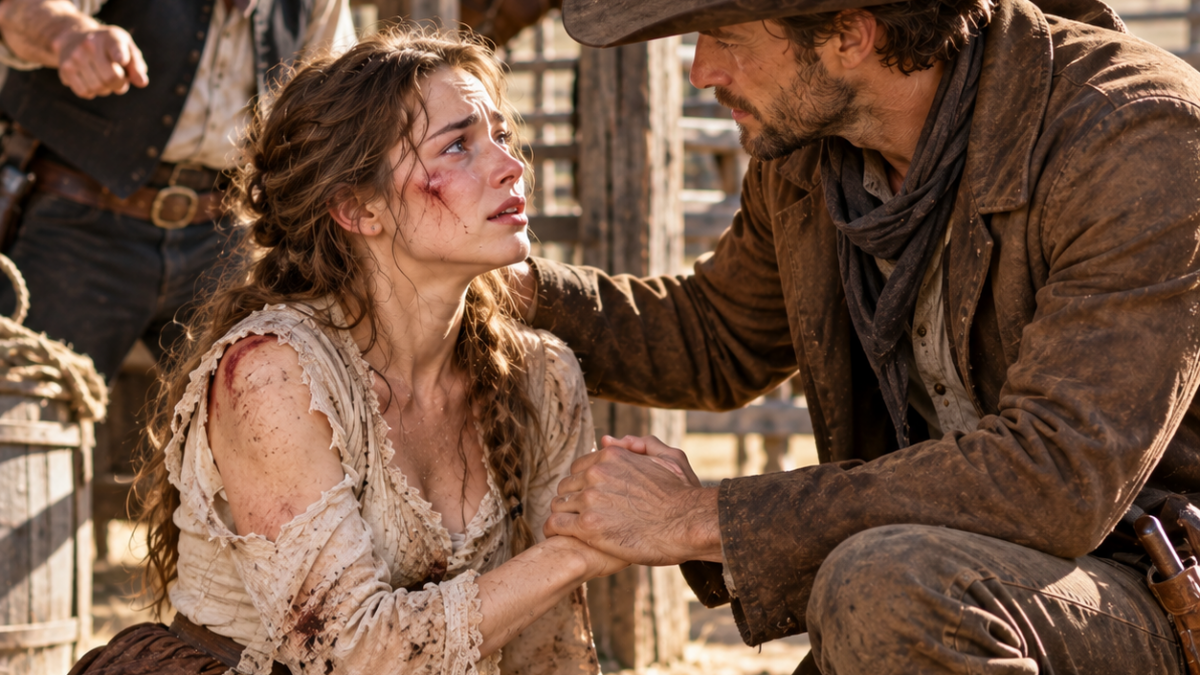
She was perhaps twenty-two or twenty-three. Dark hair had come loose from its pins. Her blue dress was torn at the collar. One hand pressed against her cheek, where the red mark of a man’s hand stood visible from twenty feet away.
She looked up when Jesse rode into the yard.
Their eyes met.
Hers were dark, direct, bright with pain she was refusing to fully show.
She did not plead.
That was the first thing Jesse understood about Clara Reeves before he knew her name.
She was not the kind of woman who begged strangers to save her.
But the look she gave him said something all the same.
This is what is happening here.
The man on the porch turned.
“This is private property,” he said.
His voice carried the flat authority of someone used to being obeyed.
“State your business or ride on.”
Jesse stopped his horse in the middle of the yard.
“My name is Jesse Holt,” he said. “I was passing on the road. I stopped because I heard something that concerned me.”
“Nothing here concerns you.”
Jesse looked at the woman.
She was standing now, one hand still on the porch post, jaw set with the fierce pride of someone who had decided she would not be seen on the ground.
“The lady’s well-being concerns me,” Jesse said.
The man’s face darkened.
“That woman is my daughter.”
“What is your name, ma’am?” Jesse asked.
The man started to speak.
Jesse’s eyes did not leave the woman.
“I asked the lady.”
The words were quiet.
No heat.
No raised voice.
Only a tone that told everyone in the yard how the conversation was going to go.
The man stopped.
The young woman lifted her chin.
“My name is Clara Reeves,” she said. Her voice was steady because she made it steady. “And no, I am not all right.”
The owner’s name was Douglas Reeves.
Jesse learned that within the hour, though he could have guessed much about him from the yard alone.
Douglas Reeves had built that ranch over twenty years with the particular hunger of a man who measured himself by what he owned. The ranch was real enough. Good cattle numbers. Reliable water. Strong walls. Productive land. Hands who moved quickly when they heard his voice.
What Douglas Reeves had built was real.
What he had done with the power that building gave him was something else.
Clara was his only daughter.
Her mother had died when Clara was twelve, and from that day forward, childhood had ended as cleanly as a door slamming shut. Clara had become the woman of the house before she understood what it cost. Cooking. Cleaning. Accounts. Mending. Managing supplies. Watching servants leave when her father’s temper grew too sharp. Learning when to speak and when not to. Learning that peace in the house depended on her reading Douglas Reeves before he entered a room.
She did it because there was no one else.
She did it because children do what the world requires before they know they have the right to refuse.
She grew up capable.
Quiet.
Composed.
With the internal life of someone who has learned to keep what matters most buried deep enough that no one cruel can reach it.
For two years, Douglas had been trying to marry her to a neighboring rancher named Harlan Cole.
Harlan was forty-four, twice widowed, prosperous, and confident in the way of men who believed money made their preferences reasonable. He wanted a young wife to manage his household, bear children if possible, and stand beside him like proof that time had not passed him by as much as the mirror suggested.
Douglas considered him a good match.
Clara considered him a cage.
The first time her father raised the subject, she said no quietly.
The second time, she said no clearly.
The third and fourth times, when Harlan began appearing at the ranch with the smug comfort of a man who had been told the matter was nearly settled, she said no with urgency.
That morning, she had said no again.
Douglas Reeves, a man with little patience and less humility, had struck her for it.
Jesse heard the details from Clara later, not in the yard with Douglas watching, but in the kitchen where she went to wash her face and where Jesse followed because he was not leaving.
Douglas had retreated to the barn with the frustrated fury of a man whose authority had been witnessed by an outsider.
Jesse sat at the kitchen table.
Clara stood at the basin, holding a damp cloth to her cheek.
Neither spoke for a time.
The room was clean. Too clean, maybe. The kind of kitchen managed by a woman who had learned that order kept criticism away. Copper pans shone along one wall. Bread cooled under a cloth. A ledger lay closed near the window. A vase of wildflowers sat on the sill, small and brave.
Clara lowered the cloth.
Her cheek was swelling.
Jesse’s hands curled beneath the table.
“How long?” he asked.
She knew what he meant.
“This is the third time.”
“Since when?”
“Since I started saying no about Harlan Cole.”
“And before that?”
She looked at him.
Before that lived in the pause between them.
“Before that, he used other methods,” she said. “Taking things. Restricting things. Making days difficult in ways that do not leave marks.”
Jesse sat with that.
He had worked ranches for fifteen years. He had seen all kinds of men. The loud ones. The violent ones. The charming ones whose cruelty showed only when doors closed. The respected ones whose houses were run by fear and whose reputations were polished by everyone too dependent to speak honestly.
He knew what this was.
More than that, he knew where it went if nobody stopped it.
“Do you have anywhere to go?” he asked.
“No.”
She said it simply.
Not dramatically.
“My mother’s family is in Ohio. I have not seen them since I was twelve. I have no money of my own. My father controls everything. I have nowhere to go and no way to get there.”
Jesse looked down at the table.
He was a man passing through.
That had been his life for five years. Passing through. Taking work. Moving on. Never staying long enough for anyone to expect him at supper.
But he had heard a cry and turned his horse.
Now he was discovering that some roads cannot be unchosen.
“What would you do,” he asked, “if you could do anything?”
Clara looked at him for a long moment.
“Leave,” she said. “And never come back.”
Jesse stood.
He unbuckled the gun belt from his waist and placed the Colt on the kitchen table.
Clara’s eyes moved to it.
“I’m not going to shoot your father,” he said.
“I did not ask you to.”
“I know.”
He left the gun there deliberately. Not because he was afraid to carry it, but because what he was going to say did not require a weapon, and he wanted Clara to understand what kind of man he meant to be in this matter.
Then he went to find Douglas Reeves.
He found him in the barn.
Douglas turned when Jesse entered, his red face hard with the expression of a man waiting for confrontation and determined to win it.
“I told you to ride on,” Douglas said.
“You did.”
“This is my ranch.”
“I know.”
“My daughter. My business.”
Jesse stopped a few feet inside the barn door.
Dust floated in shafts of light from the loft. A horse shifted in a stall. Somewhere outside, a ranch hand laughed briefly, then fell quiet.
“Your daughter,” Jesse said, “is a grown woman who has told you no repeatedly and clearly.”
Douglas’s jaw tightened.
“What you did this morning is not a father’s right,” Jesse continued. “It is not a man’s right. It is not any kind of right that exists.”
Douglas stepped forward.
“You have no idea what—”
“I have a complete idea.”
Jesse’s voice did not rise.
“I have been working ranches fifteen years. I have slept in bunkhouses, eaten at tables, worked under men good and bad. I know what this is. I know how it goes if nobody stops it.”
He held Douglas’s gaze.
“I’m stopping it.”
Douglas laughed once.
It was ugly and short.
“You are one man on my property with my hands within shouting distance.”
“Then shout.”
Douglas blinked.
Jesse took one slow step closer.
“And while you are doing that, understand that I will ride to the county sheriff in Las Cruces and tell him exactly what I saw this morning and exactly what your daughter told me. Then I will go to every ranch in this territory and tell them the same.”
Douglas’s expression shifted.
There it was.
Not remorse.
Calculation.
Jesse pressed on because men like Douglas Reeves did not always understand mercy, but they understood cost.
“A man’s reputation is worth something in this country. It is credit, labor, trade, trust, marriage prospects, cattle deals, winter help, water agreements. I would think carefully before you shout.”
Douglas stared at him.
“What do you want?”
“Your daughter’s freedom.”
The barn went very still.
“Her share of whatever her mother left her, if there is any. A horse. Her belongings. And your word that you will not come after her.”
Douglas’s face went dark.
“And if I say no?”
“Then I stay.”
“As long as it takes?”
“Yes.”
Jesse meant it.
The sentence surprised even him, because he had been heading to a real job in Las Cruces and now stood in another man’s barn prepared to throw away certainty for a woman he had known less than an hour.
But once said, he knew it was true.
“I have nowhere particular to be,” Jesse added.
It was the truest thing he had said in years.
Douglas Reeves did not give in quickly.
Men like him rarely do.
They circle defeat, name it something else, test the fences around it, look for weak places. He threatened. He cursed. He spoke of law and property and family. He sent for his foreman, then thought better of it when Jesse asked if he wanted witnesses to what had happened on the porch. He demanded Jesse leave, then demanded to speak to Clara alone, which Jesse refused.
By evening, Douglas had made his calculation.
Not because he was sorry.
Jesse never saw remorse in him.
But Douglas understood the arithmetic of reputation in a territory where neighbors were not merely people nearby. They were credit. Labor. Witnesses. Lifelines in drought, flood, and winter. A man known to beat his grown daughter for refusing a marriage became a particular kind of pariah.
And Douglas Reeves valued his name more than he loved his control.
That, in the end, saved Clara.
Her mother had left her two hundred dollars.
Douglas had managed it for years at a bank in Las Cruces. Clara was legally entitled to it at twenty-one. She was twenty-two and had not known it existed.
That told Jesse everything about how the managing had been done.
Douglas wrote the letter releasing the funds.
He provided a horse.
Not the best one.
A gray mare named Fern, sound and familiar to Clara, which was better than pride. Clara had ridden Fern for three years.
Douglas did not say goodbye to his daughter.
Clara did not seem to expect him to.
At dusk, she came out of the house with a bag larger than Jesse expected but still too small for a life.
She stopped in the yard.
Jesse waited beside his horse, Fern saddled near him.
“You stayed,” Clara said.
“I said I would.”
She looked back at the house.
The ranch she had run since she was twelve.
The porch where she had been struck.
The kitchen she had kept orderly.
The windows she had washed.
The life she had survived.
Her face did several things at once.
Then it settled into the expression of someone who has made a decision and intends to live with it.
“Where are we going?”
“Las Cruces first. The bank.”
“And then?”
Jesse paused.
“I have a job offer there. Foreman position on a cattle operation south of town. It is a good position.”
He looked at her directly.
“I would like you to come. Not because you have nowhere else to go. Because I would like you to.”
Clara’s eyes searched his face.
“You do not know me.”
“I know enough.”
“Do you?”
“I know you said no when it cost you everything to say it. I know you stood up on that porch when you had every reason to stay down. I know you told me the truth when you did not have to.”
He paused.
“That is more than I know about most people I have ridden with for years.”
The New Mexico evening lowered around them, orange turning purple, purple deepening toward blue. Stars appeared one by one above the ranch that had been Clara’s prison and, until that morning, the only world she knew how to survive.
“I’ll come,” she said.
“To Las Cruces.”
“That is enough,” Jesse said. “We will figure out the rest from there.”
They rode through the night.
Not fast.
There was no need to run unless Douglas changed his mind, and Jesse did not want the ride to feel like an escape more than it had to. Still, he kept his ears open and his hand near the rifle whenever the road narrowed.
Clara rode Fern beside him.
At first, she looked back often.
Then less.
Then not at all.
The desert at night was wide and cold and honest. No walls. No porch. No father’s voice measuring every movement. Only hoofbeats, wind, and sky.
Near midnight, Jesse stopped near a shallow wash to water the horses.
Clara dismounted stiffly.
He saw her wince when her feet hit the ground.
“Your cheek?” he asked.
“It hurts.”
“I am sorry.”
“You did not strike me.”
“No.”
They stood in silence for a moment.
Then she said, “Thank you.”
Jesse shook his head.
“Do not thank me yet. We have not reached anything.”
“We have left.”
“That is not the same as arriving.”
“No,” she said. “But it is more than I had this morning.”
They reached Las Cruces at first light.
The town woke around them with the indifferent cheerfulness of mornings that do not know what sort of night has preceded them. Storekeepers lifted shutters. A wagon rolled past carrying crates. Somewhere, coffee was being brewed, and the smell hit Clara with such force she nearly cried.
At the bank, she presented her mother’s letter.
The clerk looked at it, then at Clara, then at Jesse.
Jesse said nothing.
This was hers.
He would not make himself central in a room where Clara was finally being recognized by law as a person with rights.
The process took two hours.
When Clara stepped out of the bank, she held a leather pouch with two hundred dollars inside.
Her money.
Her mother’s money.
The first money in her life no one else controlled.
She stood on the boardwalk, looking at the pouch in her hands as if it might vanish.
“I have never had my own money,” she said.
“It was always yours.”
“I know.”
Her fingers tightened around the pouch.
“It did not feel real until now.”
Jesse took her to the best restaurant in Las Cruces.
It was not grand. Whitewashed walls. Clean tables. Good coffee. Bacon thick enough to matter. Biscuits warm from the oven.
Clara sat across from him and ate slowly.
Too slowly at first, as if expecting someone to comment on every choice. Then more normally. Then with quiet concentration.
It was the first meal she had eaten in someone else’s care in ten years.
Jesse did not crowd her with talk.
He asked for more coffee.
He told her the name of the cattle operation.
Aldridge Ranch.
He told her the owner, Thomas Aldridge, had a reputation as a fair man who paid on time and expected competence. He had never worked for Aldridge, but men whose judgment Jesse respected spoke well of him.
Clara listened.
“What happens if the job is not real?” she asked.
“Then I find another.”
“And me?”
“You decide what you want to do next.”
The answer surprised her.
She looked up.
“I decide?”
“Yes.”
That one word sat between them longer than any speech might have.
Jesse met with Aldridge by noon.
The job was real.
Better than real.
Foreman position, steady pay, authority over hands, and a small house separate from the bunkhouse with a kitchen and two rooms. The house had been empty since the previous foreman moved west after inheriting land from a brother. It needed cleaning, but it had a roof, a stove, a bedframe, and a porch.
Jesse accepted.
Then he went back to Clara, who stood near the livery with Fern’s reins in hand.
“The position is real,” he said. “The quarters are real.”
She looked at him, waiting.
He took off his hat.
“I know this is fast. I know we have known each other less than two days. I know you have just gotten free of one situation, and the last thing you need is to walk into another one.”
He paused.
“But I am asking you to stay. Not as an obligation. Not because you have nowhere else to go. Because I would like you to.”
Clara’s eyes softened slightly.
“You said that before. On the road.”
“I mean it more now.”
She looked at the Las Cruces street beyond him.
People moving.
Wagons passing.
Morning life continuing.
“You turned off the road,” she said.
“For a woman I did not know.”
“I heard you.”
“Most people do not stop.”
“I know.”
She looked down at the pouch in her hand.
At the mare’s reins.
At the dust on her boots.
At her own future, suddenly frightening because it was no longer entirely controlled by someone else.
“I’ll stay,” she said. “For now. And we will see.”
For now.
Jesse smiled slightly.
For now was honest.
For now was more than he had expected when he turned his horse off the road.
“For now,” he said.
The foreman’s house was small.
That was the first mercy of it.
After the Reeves ranch, with its big rooms and heavy expectations, the little house felt almost like it had no room for fear to hide.
Two rooms and a kitchen.
A narrow porch facing east.
A stove that smoked until Jesse fixed the pipe.
A window above the sink with a view of scrub, sky, and the distant line of the corral fence.
Clara stood in the doorway the first evening and looked around.
Dust lay over everything.
A mouse had found employment in one corner.
The bedframe needed rope.
The shelves were bare.
“It is not much,” Jesse said.
“No,” Clara replied.
Then she looked at him.
“But nobody has shouted in it.”
Jesse did not know how to answer that.
So he carried in a bucket of water and began cleaning.
For the first weeks, Clara stayed because she had chosen for now.
Jesse honored the words.
He did not crowd her.
Did not call the house theirs.
Did not behave as if rescue had earned him possession.
He gave her the bigger room and slept on a pallet near the kitchen until Aldridge’s wife, Margaret, learned of this arrangement and declared both of them fools. Within two days, Margaret found Clara temporary lodging in her own house while the foreman’s quarters were put properly in order.
Margaret Aldridge was a practical woman with silver threading her hair and eyes that missed nothing.
She did not ask Clara questions she was not ready to answer.
She did, however, put her to work.
Not as charity.
As usefulness.
That was the second mercy.
“Can you keep accounts?” Margaret asked on the third morning.
“Yes.”
“Household or ranch?”
“Household. Supplies. Wages when my father’s bookkeeper was away. I can learn ranch accounts.”
Margaret handed her a ledger.
“Good. The feed numbers are wrong, and I am tired of pretending my husband knows it.”
Clara looked at the ledger.
Numbers had always made sense to her.
Numbers did not shout.
They did not strike.
They did not change meaning depending on a man’s mood.
They stood where they were placed and revealed patterns if treated honestly.
By evening, she found the error.
By the end of the week, she had corrected three months of sloppy feed entries, identified overpayment to a freight hauler, and reorganized a supply list so clearly that Margaret Aldridge stood over the ledger and said, “Well. Douglas Reeves was a fool.”
Clara froze.
Margaret looked up.
“For not paying you.”
It was the first time anyone had said aloud that Clara’s competence had value beyond duty.
The words stayed with her for days.
Jesse became the foreman Aldridge hoped he had hired.
Firm. Fair. Capable. Not a man given to speeches, which the hands appreciated because speeches usually meant a foreman had nothing better to offer. Jesse expected work done right but did not humiliate men for mistakes honestly made. He corrected what needed correction, praised rarely enough that praise mattered, and handled horses with a patience that told Clara more about him than any declaration could.
She watched him from the porch sometimes.
He never used force when clarity would do.
That mattered to her.
More than she knew how to explain.
A man’s character shows not only in how he treats those he loves, but in how he treats what cannot resist him.
Jesse did not know she was watching.
Or if he did, he did not perform for it.
That mattered too.
The first time Clara laughed in the foreman’s house, it startled them both.
It happened because Jesse tried to repair the stove pipe and emerged with soot across one cheek, black hair dusted gray, and an expression of offended dignity.
“It is fixed,” he announced.
“You look like the pipe fought back.”
“It did not win.”
“No?”
“No.”
Then the pipe coughed smoke directly into the room.
Clara laughed.
Not politely.
Not cautiously.
Truly.
The sound seemed to surprise her so much she covered her mouth.
Jesse stood very still.
Not because he was offended.
Because he knew he had just heard something returning to life.
He smiled then.
A small smile.
Careful, because joy in a healing house should not be grabbed too hard.
“I’ll fix it again,” he said.
“That may be best.”
For four months, they built something neither named too soon.
Mornings began at the south corral.
It happened by accident at first.
Jesse left early to check stock, and Clara walked out for air before starting ledgers. They ended up standing at the fence together while the desert went gold and the horses shifted in morning light.
At first, they spoke of practical things.
Aldridge’s cattle.
Supply orders.
Weather.
Fern’s appetite.
A broken gate.
Then, little by little, other things.
Sarah.
Clara asked first.
Not directly enough to wound.
But gently enough to open the door.
“What was your wife like?”
Jesse looked across the corral for a long time.
“Kind,” he said. “Not soft. People confuse those. Sarah was kind in a way that required strength. She could tell a man the truth and make him grateful for it three days later.”
Clara smiled faintly.
“You loved her.”
“Yes.”
“Do you still?”
Jesse did not look away.
“Yes.”
Clara nodded.
“Good.”
That answer reached him strangely.
“Good?”
“If you had stopped loving her because she died, I would trust you less.”
He turned toward her then.
She was looking at the horses, face calm, voice steady.
“You do not talk like most people,” he said.
“No.”
“Have you noticed?”
“Yes.”
He almost laughed.
She almost did too.
Another morning, he asked about her mother.
Clara did not answer at first.
Then she said, “She smelled like lavender soap and flour. She hummed when she was tired. She once told my father no in front of a ranch hand, and I remember thinking I had seen something brave.”
“What happened?”
“He did not strike her.”
Jesse heard what she did not say.
“He punished the courage another way.”
“Yes.”
Clara’s hands rested on the fence.
“I think she knew she was leaving me too soon. I used to see it in her face. She taught me recipes and accounts and how to judge cloth and how to stretch coffee when money was low. Practical things. She never taught me how to leave.”
Jesse said quietly, “Maybe she left you the money for that.”
Clara’s eyes filled.
She turned her face away.
He did not touch her.
Not then.
He only stood beside her until the moment passed.
That became his way.
He did not rescue her from feelings.
He stood near enough that she did not have to face them alone.
That, Clara came to understand, was different.
Harlan Cole came to Las Cruces in August.
Jesse was at the far pasture when it happened.
Clara had gone into town with Margaret Aldridge to purchase fabric and lamp oil. She stood outside the mercantile holding a brown paper package when she heard her name spoken in a voice that made her body remember fear before her mind caught up.
“Clara Reeves.”
She turned.
Harlan Cole stood near the hitching rail.
He wore a dark coat despite the heat, a hat too fine for the dust, and the confident expression of a man accustomed to unwanted attention being mistaken for importance.
For one second, Clara was back on her father’s porch.
Blue dress torn.
Cheek burning.
No money.
No place to go.
Then she felt the leather pouch at her waist.
Her money.
Her choice.
Her life.
“My name is Clara Reeves,” she said. “But you may address me as Miss Reeves.”
Harlan’s face tightened.
“Your father is concerned.”
“No, he is angry.”
“He says you were led astray.”
“I rode willingly.”
“With a hired man.”
“With a man who respected my answer.”
The words came clean and hard.
Harlan glanced around the street, where several people had begun pretending not to listen.
“Be careful,” he said softly. “A woman without family should not make enemies.”
Clara looked at him for a long moment.
Then she stepped closer.
Not too close.
Close enough that he heard every word.
“I said no to you in my father’s house. I say no to you here. I will say no in front of the sheriff, the preacher, the bank clerk, or the entire town if needed. My answer has not changed because the place changed.”
Harlan’s jaw worked.
“You will regret embarrassing me.”
“No,” Clara said. “I regret being afraid of you. That was wasted time.”
Margaret Aldridge emerged from the mercantile then, took one look at the scene, and placed herself beside Clara with the calm ferocity of a woman who had raised three sons and buried one.
“Mr. Cole,” she said. “Are you bothering Miss Reeves?”
The street became very interested.
Harlan looked from Clara to Margaret to the gathering eyes.
Reputation.
Always reputation.
He tipped his hat stiffly.
“Not at all.”
Then he left.
Clara’s knees nearly gave out afterward.
Margaret guided her into the mercantile storeroom and waited while she shook.
“You did well,” Margaret said.
“I was terrified.”
“Bravery often is.”
When Jesse returned and heard what happened, he went very quiet.
That kind of quiet from Jesse Holt was not empty. It had weight.
“I should have been there.”
Clara looked up from the table.
“No.”
He stopped.
“I was there,” she said. “Margaret was there. The town was there. I said no. He left.”
Jesse’s expression shifted.
Slowly, he understood.
This had not been a failure of his protection.
It had been Clara’s proof to herself.
He sat across from her.
“You did.”
Her hands trembled slightly around the cup.
“I did.”
He reached across the table, palm up.
Not taking.
Offering.
She placed her hand in his.
It was the first time she did so without fear moving somewhere beneath the gesture.
Four months after Jesse turned his horse off the road, autumn came gold across the desert.
The mornings cooled.
The sky sharpened.
The foreman’s house smelled of coffee, leather, clean linens, and the rosemary Clara had planted near the door because she said the house needed a scent of its own.
One morning, as they stood beside the south corral, Jesse watched the sunrise touch the dust, the rail, Clara’s blue sleeve, and Fern grazing beyond the fence.
He had not planned a speech.
Jesse Holt did not trust speeches. Too often, men used them to decorate intentions they did not mean to keep.
So he said it simply.
“I love you.”
Clara turned.
He held her gaze.
“I would like to marry you. If you want that.”
The world became strangely still.
Clara looked out at the desert.
At the horses.
At the house behind them.
At the man beside her who had heard a sound most people would have ridden past.
Jesse waited.
He had promised himself that if she said no, he would accept it.
Not politely while resenting it.
Truly.
Because the freedom to say yes meant nothing if the no was not equally safe.
Clara looked back at him.
“I want that.”
His breath left him.
She smiled then, small and real.
“I want you,” she said. “Not because you saved me. Because after, you still let me belong to myself.”
Jesse had no answer ready for that.
So he took her hand.
And she let him.
Their wedding was small and exactly right.
The Las Cruces preacher performed it on a clear fall morning. Aldridge and his wife stood with them. Several ranch hands attended because Jesse was respected and Clara had become a favorite among them in the way competent people often do before anyone notices it happening.
Clara wore a dress she had made herself from fabric she had chosen herself with her own money.
It was blue.
Not the blue dress with the torn collar from her father’s porch.
Not the blue chosen by necessity, control, or habit.
This blue was the color of the New Mexico sky at noon. Clear. Open. Entirely her own.
When Jesse saw her, he thought about the distance between the two dresses.
Everything.
It represented everything.
After the ceremony, Aldridge clapped Jesse on the shoulder hard enough to nearly unbalance him and told Clara she had married the only foreman stubborn enough to argue with a bull and somehow win.
Margaret cried.
Then denied crying.
The hands offered various forms of advice, most of it useless and some of it inappropriate enough that Margaret threatened them with a serving spoon.
Clara laughed through half the breakfast.
Jesse watched her across the table.
Not like a man admiring something he had acquired.
Like a man grateful to be present for something becoming fully itself.
Douglas Reeves did not come.
Clara had not expected him to.
He did not send a letter.
Did not send money.
Did not send blessing or threat.
He stayed absent.
That was enough.
She had asked only one thing of him in the end.
Do not come after me.
Whether he kept that promise from fear, pride, calculation, or some buried grain of decency, Clara did not spend much time wondering.
His absence gave her room.
She used it.
The years that followed did not become a fairy tale.
Good lives rarely do.
They became something better.
Real.
Clara expanded the Aldridge ranch accounts into a system so efficient that nearby operations began asking if she would help with theirs. At first, Aldridge paid her extra quietly, as if afraid she might refuse. She did not refuse. She did negotiate.
Jesse sat at the kitchen table one evening listening to her calmly explain to Aldridge that if the work was valuable enough to request, it was valuable enough to price properly.
Aldridge blinked.
Margaret laughed from the stove.
Jesse looked down at his coffee to hide his smile.
Clara Reeves Holt became a paid bookkeeper.
Properly paid.
Known for accuracy, calm, and a pleasant directness that discouraged nonsense.
She planted a garden behind the foreman’s house. By the second year, people in Las Cruces mentioned it when talking about the Aldridge operation. Not because it was grand, but because it grew beautifully in soil everyone had claimed was too stubborn for such things.
“Stubborn soil respects stubborn women,” Margaret said.
Clara accepted this as scientific fact.
She learned slowly what it felt like to live in a house where the atmosphere did not depend on managing someone else’s moods.
That took longer than she expected.
For months, if Jesse entered too quietly, she startled.
If he was tired and silent, she worried.
If a cup broke, her body braced for anger that did not come.
Jesse noticed.
He hated that he noticed because noticing meant understanding how deeply fear had been trained into her.
But he did not make her ashamed of it.
Once, after she flinched when he dropped a bucket outside the kitchen door, he set the bucket down and stood still.
“I am not angry,” he said.
“I know.”
“Your body does not know yet.”
Tears filled her eyes.
“No.”
“That is all right,” he said. “We will tell it as many times as it needs.”
And they did.
Again and again.
In small ways.
In patient ways.
Until slowly, the house became quiet in the good sense.
The safe sense.
The sense where evenings could hold lamps, ledgers, supper, Jesse’s boots by the door, Clara’s sewing in the basket, and no fear hiding beneath the boards.
Jesse came in every evening from the day’s work and found her.
Every time, the finding struck him.
There she was.
At the table with accounts.
In the garden.
At the stove.
Reading by lamplight.
Talking with Margaret.
Mending his shirt while criticizing his habit of catching sleeves on nails.
Alive.
Free.
His wife.
He was grateful for it in the specific way a man is grateful for things he almost missed by continuing down the road.
Sometimes, in the evenings, he thought about that road.
About the sound that had crossed the distance.
About how easy it would have been to keep riding.
A man could tell himself one person cannot stop for every cry.
A man could say he had a job waiting, wages needed, his own grief to carry.
A man could make the world’s suffering none of his business and be praised for practicality.
Jesse had stopped for this one.
What it cost him was a morning.
What it returned was everything.
He did not say this often.
Jesse was not a man who spoke poetically unless cornered by deep feeling, and even then he preferred short sentences.
But one spring evening in their second year, with the desert blooming and the house warm and lit, Clara looked up from the accounts and asked, “What are you thinking about?”
“The road,” he said.
She knew exactly which road.
“I am glad you turned off it.”
“So am I.”
She returned to her ledger.
He went back to repairing a bridle strap.
The window was open. Desert birds called outside. The air smelled of sage, warmed earth, and Clara’s rosemary by the door.
The territory made that kind of evening often.
Beautiful without asking permission.
For five years, Jesse had been passing through evenings like that without truly seeing them.
He saw them now.
All of them.
Years later, Clara would sometimes be asked how she had met her husband.
She never told it the way town gossips wanted.
There was no grand shootout.
No dramatic duel.
No cowboy sweeping her into his arms and declaring ownership over her future.
That was not the truth.
The truth was quieter and better.
“I said no,” she would say. “And a man I did not know believed that my no mattered.”
That was the beginning.
Not rescue.
Not romance.
Not gratitude.
Respect.
The first real foundation.
Jesse did not become her home because he took her from her father’s house.
He became her home because every day afterward, he made room for her choice to remain her own.
And Clara did not love him because he saved her.
She loved him because he did not make salvation into a debt.
Because he left his gun on the kitchen table before confronting her father.
Because he asked what she would do if she could do anything.
Because he gave her room to answer.
Because he took her to the bank and stood aside while she claimed what was hers.
Because he asked her to stay, then accepted for now like it was a sacred promise instead of an incomplete answer.
Because when he finally asked her to marry him, he made the question safe enough for no.
And that made yes mean everything.
Douglas Reeves spent the rest of his life on the ranch he had built.
Men still traded with him.
Hands still worked for wages.
Cattle still moved through his corrals.
The world does not always punish men as much as stories wish it would.
But he lost the one thing he had believed he owned most completely.
He lost Clara.
Not because Jesse stole her.
Because Clara chose herself.
And once she understood that her life could belong to her, there was no power on earth that could make her small again.
Harlan Cole remarried eventually.
A widow from farther east, near Abilene, who reportedly told him within a month that she would not tolerate being spoken over at supper. Clara heard this from Margaret and smiled into her coffee.
“Good,” she said.
That was all.
The past, slowly, became a place she no longer lived.
Not forgotten.
Never that.
Forgetfulness is not healing.
But it stopped being the room she woke in every morning.
It became a road behind her.
A porch far away.
A blue dress she no longer wore.
A handprint that faded from her cheek but remained in memory only long enough to remind her that she had survived the person who put it there.
The dress she wore at her wedding stayed folded in a cedar chest.
Sky blue.
Her choice.
Sometimes, on difficult days, she would open the chest and touch the fabric.
Not because she needed proof that she was free.
Because proof is allowed to be beautiful.
On their fifth anniversary, Jesse gave her a small silver comb.
He had purchased it in Las Cruces after saving quietly for months.
Clara held it in her palm and laughed softly.
“It is too fine.”
“No.”
“You are very certain.”
“Yes.”
“Why?”
“Because it belongs to you now. That makes it the correct fineness.”
She looked at him.
“You sound like Owen Aldridge.”
Owen Aldridge was Thomas and Margaret’s youngest grandson, a child who had recently declared a stick “perfect” because it had become his.
Jesse considered.
“Owen is a wise man.”
“He is six.”
“Wisdom appears where it likes.”
Clara kissed him then.
Not because of the comb.
Because he had spent years teaching her that receiving kindness did not create a debt she could never repay.
That love was not a bargain.
That tenderness could come without a trap hidden beneath it.
One evening much later, when they had been married long enough for gray to appear at Jesse’s temples and laugh lines to settle around Clara’s eyes, a young ranch hand came to their door.
He was nineteen, shaking with anger, and asking Jesse whether he knew of work elsewhere.
His stepfather had struck his sister.
The boy had hit him back.
Now he needed a place for both of them to go.
Clara listened from the doorway.
Jesse looked at the boy and saw himself at another gate, another yard, another life-changing interruption.
“What does your sister want?” Jesse asked.
The boy blinked.
“What?”
“What does she want?”
“She wants to leave.”
“Then we start there.”
Clara went to pack food.
Jesse saddled horses.
The road, once turned from, has a way of teaching a man which direction to go the next time he hears a cry.
That was what their life became.
Not a public crusade.
Not speeches.
Not heroics.
Just a household where no did not get punished, where people in trouble could find a meal, where Clara’s accounts grew into a small business of their own, where Jesse’s reputation became that of a foreman who was fair, steady, and not inclined to ride past cruelty when it crossed his path.
Some called him honorable.
He never liked that word.
Honor sounded too polished.
Too easy to claim.
What he had done, in his mind, was simpler.
He had heard someone hurt.
He had stopped.
Everything else followed.
But Clara knew better.
Stopping is not small.
In a world full of men who keep riding, stopping can be the difference between a life ending quietly in fear and a life beginning again under an open sky.
She told him that once.
He shrugged because Jesse Holt was not comfortable being praised.
So she took his hand.
The hand that had held Fern’s reins at dusk.
The hand that had stayed open on the kitchen table when she first chose to place hers in it.
The hand that had never struck, never grabbed, never claimed what it had not been given.
“My father wanted to choose my forever,” she said. “Harlan Cole wanted to own it. You were the first man who asked whether I wanted one.”
Jesse looked at her.
“And did you?”
She smiled.
“With you.”
He leaned forward and kissed her forehead.
Outside, the desert evening gathered itself into gold.
Inside, the house held steady.
The kind of steady a person can spend years searching for.
The kind Clara had once believed existed only in other people’s lives.
A blue dress folded in cedar.
A ledger open on the table.
A silver comb by the mirror.
A garden behind the house.
A man beside her who had turned his horse off the road.
And a life in which her no meant no, her yes meant yes, and both belonged entirely to her.
That was freedom.
That was love.
That was forever.


