I Found a Woman Collapsing Outside My Desert Ranch—Then She Said, “You Don’t Have to Save Me…
PART2:
Nobody called it illness.
Nobody called it grief.
People simply said the war changed him.
As though naming the thing as change made it easier to live around.
I watched my mother slowly become quieter because loving a silent man required so much speaking into emptiness.
By eighteen, I understood one thing clearly.
I could become my father without ever going to war.
All I had to do was stay in that house long enough to learn his habits.
So I left.
Not dramatically.
No fight.
No slammed door.
I packed a bag.
My mother cried.
My father said:
“Travel safe.”
Three words.
I remember every one.
Years later, my uncle’s letter found me while I was working horses outside Santa Fe.
He was sick.
Ranch needed someone.
Family had no interest.
Would I come?
I did.
He died less than a year later.
Then everything became mine.
The house.
The cattle.
The silence.
At first, silence felt like freedom.
Nobody asking where I had been.
Nobody needing conversation over supper.
No grief sitting at the table.
No woman exhausting herself trying to reach a man who had nothing left to give.
I woke before dawn.
Fed stock.
Checked water.
Rode fences.
Fixed whatever the desert broke.
Ate.
Slept.
Repeated.
The ranch improved.
My fences stayed up.
The cattle stopped losing weight through winter.
I deepened one well.
Built a better shade structure near the south pasture.
Added a small kitchen garden that failed so completely the first year that I decided vegetables were an eastern conspiracy.
From the outside, I was doing well.
That was the dangerous part.
Nothing looked wrong.
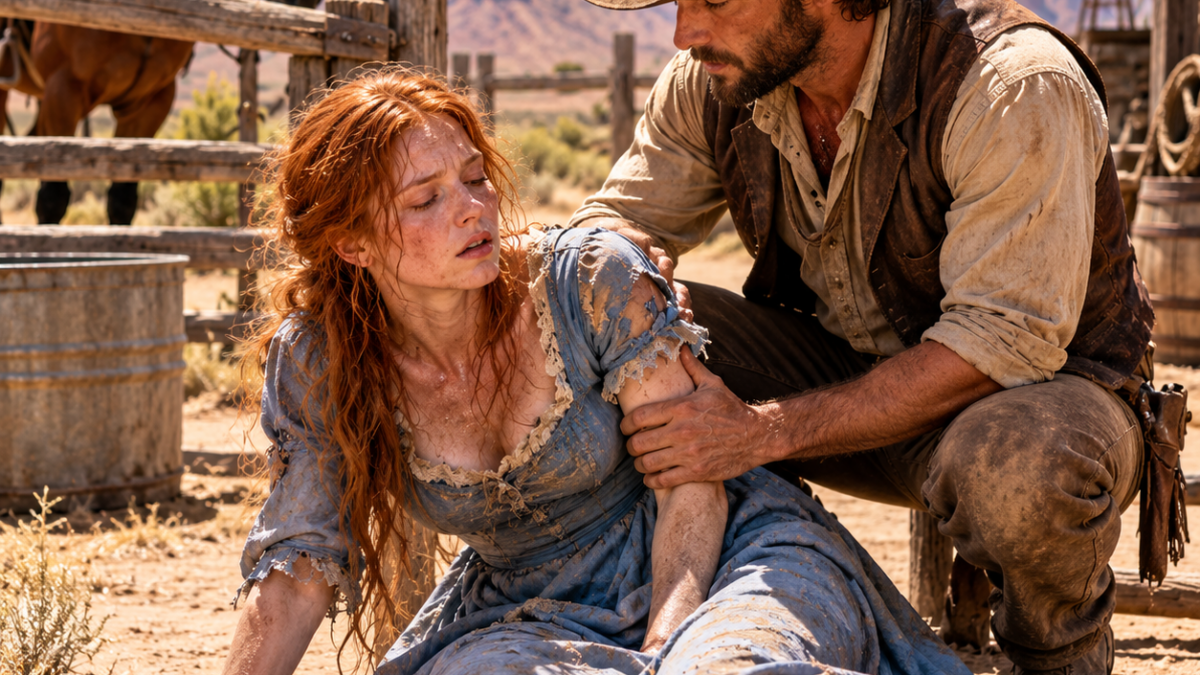
Then one July morning, I found a woman standing beside my fence.
And for the first time in four years, something entered my life that I had not planned, built, repaired, fed, purchased, or inherited.
She looked as though the desert had tried to kill her and become annoyed when she refused.
Dark hair.
Dust through every strand.
Blue dress bleached almost gray at the shoulders.
Lace at the collar torn and repaired.
Boots so worn I could see where one sole had been tied near the toe.
She held a bundle of clothing against her chest.
Not a suitcase.
Just fabric wrapped around what little she still owned.
She swayed slightly.
I dismounted immediately.
“You all right?”
She looked at me.
People sometimes imagine desperate people look frightened.
She did not.
She looked tired beyond fear.
“I saw smoke from your chimney.”
Her voice was rough.
“I’ve been walking since yesterday.”
I glanced behind her.
Desert shimmered already though the sun had only recently risen.
“How much water do you have?”
“None.”
That frightened me more than she seemed to understand.
“How long?”
“Since sometime yesterday afternoon.”
“Jesus.”
“I don’t need much.”
She spoke quickly, as though expecting refusal.
“Water. Shade for an hour. Maybe something small to eat if you have it.”
Then:
“I’ll move on.”
I looked at the road behind her.
No horse.
No wagon.
No town for miles.
“Move on where?”
“West.”
“That narrows the continent.”
“California.”
I stared.
She lifted her chin.
“I know how that sounds.”
“It sounds hot.”
“I noticed.”
Despite everything, I almost smiled.
“Come inside.”
“I don’t want trouble.”
“You’re standing in the Arizona desert in July without water.”
I opened the gate.
“You already found trouble. Might as well come inside.”
She hesitated.
I added:
“Water’s on the table.”
Then, because something about her pride was obvious even through exhaustion:
“Shade lasts longer than an hour. No good reason either of us should stand out here pretending otherwise.”
She followed.
That was how Marguerite Colvin entered my house.
“Etta,” she told me ten minutes later.
“Most people call me Etta.”
She sat at my kitchen table holding a tin cup in both hands.
Not drinking fast.
That impressed me.
People dangerously thirsty often drink too quickly.
I had told her small sips.
She listened.
Her hands shook.
Not fear.
Exhaustion.
I refilled the cup before she asked.
“You heading to California alone?”
“Yes.”
“Why?”
She looked at me.
“That usually considered appropriate conversation where you come from?”
“No.”
“Good.”
She drank again.
Then after a moment:
“My cousin is in Sacramento.”
“Work?”
“Boarding house.”
“Family?”
“A room too.”
“That’s a long road for kitchen work.”
“It’s a longer road to stay somewhere there’s nothing left.”
Something in the sentence stopped me.
I sat across from her.
“Missouri?”
She frowned.
“How’d you know?”
“Accent.”
“Is it that obvious?”
“To someone from Virginia.”
She nodded.
“Missouri.”
“Family?”
“Mother in St. Louis.”
“Father?”
“Dead.”
I immediately regretted asking.
Etta did not seem offended.
“He left debts.”
“How bad?”
“Worse than the farm.”
That answer carried a whole history.
She stared into the water.
“After we sold everything, my mother moved into my aunt’s house.”
Her voice changed.
Not weaker.
Harder.
“One bedroom that wasn’t hers. One chair that wasn’t hers. One table where she started asking permission before taking bread.”
Etta looked at me.
“I watched her become grateful for things she used to provide for herself.”
I understood why that frightened her.
“So you left.”
“I worked.”
Kansas first.
Railroad crew.
Forty men.
Three meals a day.
Then Albuquerque.
Hotel kitchen.
Then a cattle outfit near Tucson.
“Why leave Tucson?”
“Outfit folded.”
“And California?”
“My cousin wrote six months ago.”
Etta touched the bundle near her chair.
“She said if I could get there, she had honest work and a room I could close a door on.”
A room.
Not riches.
Not romance.
A door.
Sometimes people who have lost enough stop asking life for grand things.
“I misjudged the distance yesterday.”
She looked toward the window.
“Everything looks closer out here.”
“That’s the desert’s favorite trick.”
She glanced at me.
“Only one?”
“Main one.”
“What are the others?”
“Rattlesnakes.”
“That isn’t a trick.”
“They wait until you step close.”
“That’s honesty.”
I almost laughed.
She did first.
Quietly.
Then her face tightened with exhaustion.
I stood.
“Spare room.”
“I said an hour.”
“You said that before I saw you try to stand.”
“I can stand.”
“Prove it tomorrow.”
Her eyes narrowed.
“You always order strangers around?”
“Only dehydrated ones.”
“I don’t accept charity.”
“Good.”
“This isn’t charity?”
“No.”
“What is it?”
I thought.
“Water.”
She stared.
Then smiled faintly.
“Convenient answer.”
“Accurate one.”
She slept fourteen hours.
I know because I checked.
Not inside the room.
I’m not entirely stupid.
But I listened.
Once around midnight I stood outside the door long enough to hear breathing.
Steady.
Then went back to bed.
The next morning, she slept until nearly ten.
Ten hours the second night.
Her body had been surviving on stubbornness.
Once it found a safe bed, it collected the debt.
I never mentioned it.
She did not need to know I watched the water she drank.
Did not need to know I checked whether her hands still shook.
Did not need anybody turning her weakness into a spectacle.
By the third morning, she was already trying to work.
I walked into the kitchen.
Stopped.
Everything had moved.
Flour.
Beans.
Coffee.
Pans.
Three things I had not seen in months because apparently I had hidden them from myself.
Etta stood on a stool wiping the top shelf.
“What are you doing?”
“Saving this kitchen.”
“I thought we established nobody needs saving.”
She looked over her shoulder.
“Your kitchen does.”
“I know where everything is.”
“No, you know approximately where things disappeared.”
She climbed down.
Held up a dusty can.
“What is this?”
“Beans.”
“This can may have crossed the territory with Coronado.”
“Beans last.”
“Not historically.”
I took it.
Looked.
Could barely read label.
She folded her arms.
“You’ve been living like this?”
“Four years.”
“That is not the defense you think it is.”
I laughed.
Really laughed.
The sound surprised me.
I could not remember the last time somebody had said something in my kitchen that made me laugh.
Etta noticed.
Said nothing.
That was another thing about her.
She noticed more than she commented on.
For the first week, I assumed she was recovering.
Second week, I told myself the heat was still bad and she would travel easier if she waited.
Third week, I stopped making excuses in my own head because I was beginning to understand that neither of us was in any hurry to name what was happening.
Etta worked because stillness made her uncomfortable.
Not because I asked.
I tried stopping her at first.
“You’re a guest.”
“I know.”
“Guests don’t repair windows.”
“This window has not been washed since President Grant.”
“That’s an exaggeration.”
“Barely.”
She scrubbed years of dust from the kitchen glass.
When she finished, morning sunlight poured into the room.
I stood in the doorway holding coffee.
Stared.
I had eaten there every morning for four years.
Same walls.
Same table.
Same stove.
But I had not known the room could look like that.
Warm.
Golden.
Alive.
Etta watched me.
“You’ve been alone too long.”
That was the first time she said it.
I pretended not to hear.
She repeated herself later.
On the porch.
Evening.
Mesas red in the final light.
She sat in the chair beside mine.
I had not put that chair there for her.
At least not consciously.
“It’s not a criticism.”
“What?”
“You’ve been alone too long.”
“I heard you earlier.”
“You ignored me.”
“I was hoping you’d take the hint.”
“No.”
Clearly.
I looked toward the mesas.
“What exactly does ‘too long’ look like?”
Etta considered.
“Like a fence post.”
I stared.
“A fence post.”
“One still standing.”
She pointed toward the pasture.
“Looks fine from a distance.”
“Comforting.”
“But inside, the wood has gone soft.”
“Less comforting.”
“Nobody notices because the fence is still upright.”
I sipped coffee.
“And I’m the fence post.”
“Yes.”
“That is the worst thing anyone has said to me this month.”
“Month isn’t over.”
I laughed.
She smiled.
Then became serious.
“You function.”
“I would hope so.”
“Cattle alive.”
“Yes.”
“Fence stays up.”
“Mostly.”
“House stays standing.”
“So far.”
“But I don’t think you notice any of it.”
I looked at her.
“That’s a bold conclusion after three weeks.”
“I’ve spent two years in other people’s houses.”
Her voice stayed calm.
“You learn when somebody is living in a room and when somebody is just moving through it.”
That sentence stayed.
I thought of my father.
My mother.
A house where everything functioned.
Meals cooked.
Beds made.
Firewood stacked.
Nothing alive inside it.
I had left Virginia because silence was becoming hereditary.
Then built a house full of it myself.
Different landscape.
Same architecture.
That scared me more than I admitted.
Then the California letter arrived.
FULL STORY CONTINUATION 👇👇
The envelope waited at the Red Bluff post office.
Forwarded through general-delivery stops Etta had arranged before Tucson.
I brought it back with supplies.
Her name across the front.
Sacramento return address.
The second she saw it, I understood.
“This is from your cousin.”
“Yes.”
She did not open it immediately.
Sat at the kitchen table.
Turned envelope over.
Then opened.
I pretended to work near stove.
She read slowly.
Once.
Then again.
I said:
“Good news?”
Her eyes stayed on page.
“The room is still there.”
Something inside my chest tightened.
I kept my voice neutral.
“Good.”
“And the job.”
“Good.”
“She says they’re busy. She could use me immediately.”
“That’s what you came for.”
“Yes.”
I wanted to say:
Stay.
Instead:
“Then you should go.”
The sentence tasted like metal.
Etta looked up.
Not surprised.
That almost made it worse.
“You think so?”
“Yes.”
My voice came out too fast.
“You crossed half the country for it.”
She folded the letter.
I stood.
“California isn’t getting closer.”
“Apparently not.”
“I’ll check the south trough.”
The south trough did not need checking.
I left anyway.
The screen door slammed harder than intended.
I stood at the corral.
One hand on fence rail.
The mesas turned red as evening came.
For weeks, Etta had sat beside me for that part of the day.
Now I imagined the porch empty again.
Kitchen dim again.
One cup.
One plate.
One chair.
Nothing materially different from the life I had before she arrived.
So why did the thought feel like something being taken?
She found me an hour later.
I heard her steps in dust.
Did not turn.
“You’re angry.”
“No.”
“Emmett.”
“I’m not angry.”
“Then what?”
“I don’t know.”
“That one I believe.”
She stopped beside the fence.
We watched the pasture.
Finally she said:
“You don’t have to save me.”
I looked at her.
She faced forward.
“I want that clear.”
“I know.”
“No.”
Now she turned.
“I have a place to go.”
“Yes.”
“A job.”
“Yes.”
“A room.”
“Yes.”
“I am not trapped here.”
“I never said—”
“I know you didn’t.”
She took one breath.
“But whatever is happening between us…”
My chest tightened.
“Something is happening.”
Her honesty made looking away impossible.
“And I need you to know I am not staying because I have nowhere else.”
I said nothing.
Etta continued:
“I have spent two years making certain nobody gets to decide my future because I’m desperate.”
She looked toward house.
“If I stay here, it cannot be because you found me half-dead at your fence and decided I became your responsibility.”
“You aren’t.”
“Good.”
“I know you can leave.”
“Good.”
“I know you don’t need me.”
“Then why did you look like I shot you when I read that letter?”
I laughed once.
No humor.
Because she had earned truth.
Because avoiding it suddenly felt more cowardly than saying it.
“I think maybe I need saving too.”
Etta went still.
The words barely made it over fence.
I nearly wished I could pull them back.
She did not laugh.
“What do you mean?”
“I don’t know.”
“Try.”
I stared at my hands.
“My ranch works.”
“Yes.”
“Cattle survive.”
“Yes.”
“Fences stay up.”
“Mostly.”
I gave her a look.
She almost smiled.
“I spent four years building this.”
I looked toward house.
“And somehow I stopped seeing it.”
Etta listened.
“I eat because people have to eat.”
“I work because work is there.”
“I go to bed because it becomes night.”
“I wake because it stops being night.”
Her expression softened.
“My father lived that way after the war.”
I had told her some.
Not this.
“My mother spent years trying to reach him.”
I swallowed.
“I left because I thought silence was killing both of them.”
Etta said nothing.
“And then I came out here and built another silent house.”
That was the first time I said it aloud.
It hurt because it was true.
“You cleaned that window.”
I pointed toward kitchen.
“Sun came in.”
She smiled faintly.
“That’s what windows do.”
“I didn’t know.”
She studied me.
“You knew technically.”
“Technically.”
I looked at her.
“You’ve been here three weeks and I notice mornings now.”
Her eyes filled slightly.
“I notice supper.”
“I notice the mesas are different when somebody is standing beside me.”
My voice dropped.
“I don’t know whether that means I need saving.”
I gave a bitter smile.
“But if it does, I’m beginning to suspect you aren’t the only person at this ranch who was on his way somewhere without noticing how tired he was.”
Etta looked toward the darkening hills.
“That’s not rescue.”
“No?”
“No.”
She smiled.
“That’s someone finally opening curtains.”
I laughed softly.
“You’re the one who opened them.”
“Then don’t close them again.”
Simple.
That was Etta.
Never offering more drama than truth required.
We stood there until the mesas went dark.
Stars came.
More than Virginia ever had.
More than Missouri, according to Etta.
She looked upward.
“Feels closer here.”
“What?”
“The sky.”
I nodded.
“Desert has that.”
“Another trick?”
“Maybe.”
For a while neither spoke.
Then Etta said:
“I’m packing tonight.”
My stomach dropped.
I nodded.
“That makes sense.”
She looked at me.
“I didn’t say I was leaving.”
I turned.
“What does packing mean where you’re from?”
“It means I need to know I can.”
That distinction confused me then.
I understood later.
Etta needed the bag ready.
Because staying only meant something if leaving remained possible.
She packed.
Every piece.
The same bundle that carried her through Kansas, New Mexico, Tucson.
Set it beside bed.
Then slept.
She later told me she barely did.
I barely did either.
I woke before dawn.
Cooked breakfast.
I was bad at breakfast.
Eggs mostly.
Coffee.
Biscuits I nearly burned.
Etta entered kitchen.
Looked at stove.
“You cooked.”
“Seemed appropriate.”
“Why?”
I kept eyes on pan.
“Man shouldn’t send a woman walking on empty stomach.”
“Send?”
I set pan down.
She stared.
“Is this goodbye breakfast?”
I looked at her.
This was the moment.
Not fence.
Not sunset.
Not stars.
Kitchen.
Eggs.
Morning light through a clean window.
Life changes in undramatic rooms.
“I’d prefer it to be stay-for-breakfast breakfast.”
She did not move.
“And lunch.”
I continued because stopping would kill me.
“And supper.”
Etta’s eyes filled.
“And tomorrow’s breakfast.”
I swallowed.
“As many as you feel like giving a man who took four years to realize his ranch was missing something he couldn’t build with his hands.”
She sat slowly.
“What?”
“Someone to eat with.”
Her mouth trembled.
“That’s all?”
“No.”
“Good.”
I almost smiled.
“Someone who sees the things I stopped seeing.”
She looked toward window.
“Someone who finds ancient beans behind my stove and acts like she uncovered murder evidence.”
“Those beans were criminal.”
“Someone who can leave.”
I said that deliberately.
Etta looked back.
“And chooses not to.”
Silence.
Then she picked up coffee.
“Breakfast.”
I nodded.
“Breakfast.”
“I’m staying for breakfast.”
“That’s a start.”
“And after?”
“We’ll see.”
Her answer should have frustrated me.
Instead, relief nearly knocked the air from my lungs.
Because it was choice.
Not rescue.
Not gratitude.
Breakfast.
That afternoon Etta wrote to Catherine.
I gave her privacy.
Later she showed me the letter before sealing it.
Not because I asked.
Dear Catherine,
The room and work you offered me are the kindest promise I have carried in years.
I hope you will forgive me for not coming immediately.
I found a reason to stop.
Not because I became unable to continue.
Because something I was not looking for has become worth examining carefully before I do.
She paused there.
Then:
I don’t yet know what it will become.
But for the first time in a long while, I am staying somewhere because I choose the place, not because hardship chose it for me.
Love,
Etta.
I read it twice.
“That’s about me?”
“Partly.”
“What’s the other part?”
She looked around the kitchen.
“The flour is finally where it belongs.”
I laughed.
We walked to Red Bluff together.
Hot.
Dust.
Etta mailed the letter.
Outside the mercantile, Harlan Cook saw us.
Closest neighbor.
Fifty.
Thin.
Curiosity professionally developed.
“Still here?”
Etta nodded.
“Still here.”
Harlan looked at me.
“Your cooking improved.”
I frowned.
“How do you know?”
“Plate you brought during fence repair.”
“That was stew.”
“That was identifiable.”
Etta said:
“I take no credit.”
Harlan nodded thoughtfully.
“No?”
“Only moved his flour to a shelf human beings can reach.”
“That would do it.”
He tipped hat.
Left.
I stared at Etta.
“You told him about flour.”
“I told nobody.”
“He sees things.”
“Like you?”
“Worse.”
Catherine replied within a month.
Etta read the letter aloud.
The room remains yours if you change your mind.
But something tells me you won’t.
Etta folded it.
“You think she’s right?”
“I hope.”
“That wasn’t an answer.”
“I know.”
She smiled.
“Learning.”
Months developed a rhythm.
Etta stopped being guest.
Not through declaration.
Through accumulation.
Her apron hanging beside the stove.
Her boots near back door.
Hairpins on washstand.
A second cup always out.
A blue shawl over porch chair.
My house changed.
Not because she decorated.
Because another person had preferences.
The bowl belonged here.
Chair worked better there.
Window should remain open evenings until bugs got bad.
Coffee should not be boiled until dead.
I had opinions too.
Sometimes wrong.
Etta learned cattle.
At first, I told her not to stand inside crowded pen.
She ignored me.
“Etta.”
“I heard.”
“That heifer will turn.”
“I know.”
“She weighs nine hundred pounds.”
“She is also predictable.”
“Based on?”
“She hates you.”
“That is not a handling system.”
The heifer moved exactly where Etta expected.
Etta looked at me.
“She hates you.”
I had no answer.
She learned fast.
More importantly, she did not pretend competence before earning it.
When she did not know, she asked.
Then remembered.
One afternoon I caught myself watching her mend fence.
“You’re staring.”
“Admiring.”
“Difference?”
“Staring is when a man has nothing useful to do with his hands.”
“And admiring?”
“When the work is done but his eyes aren’t.”
She stared.
“That may be the worst compliment I’ve heard.”
“Give me time.”
“For what?”
“I’ve been alone four years.”
I smiled.
“Compliments require practice.”
She laughed.
Around fourth month, something in Etta loosened.
I did not realize how guarded she had been until it changed.
She laughed louder.
Sang sometimes while cooking.
Badly.
She knew.
Did not care.
She stopped keeping her bundle packed.
That mattered.
One evening I noticed it gone from spare room floor.
Clothes in dresser.
I said nothing.
Some commitments frighten if pointed at too quickly.
We worked side by side.
Sometimes all day with little conversation.
But silence with Etta felt different from silence with my father.
My father’s silence closed doors.
Ours left them open.
That distinction saved me.
I could sit with Etta on porch and say nothing because I knew if one of us spoke, the other would answer.
Silence becomes peaceful only when speech remains possible.
I learned that from her.
She learned desert.
At first, she called everything empty.
Then rain came.
Monsoon storm.
The sky turned green-gray.
Wind lifted dust.
Then water.
Violent.
Washes filled.
Ranch changed in hours.
Days later, flowers.
Blue.
Yellow.
Purple.
Ground that looked dead suddenly became extravagant.
Etta stood outside at dawn staring.
“I didn’t know.”
“That desert could do this?”
“Yes.”
“It waits.”
She smiled.
“I understand that.”
I looked at her.
She caught me.
“Don’t make it meaningful.”
“Wouldn’t dream of it.”
“You were.”
“Maybe.”
She walked away.
Smiling.
By winter, Sacramento barely came up.
Not because she forgot.
Because choice had settled.
She could still leave.
That freedom remained.
I never asked for forever.
Not yet.
I had seen people use love like ownership.
I did not want that.
Then spring came.
One year approached.
On the anniversary of Etta arriving at my fence, I woke before dawn.
Couldn’t eat.
Couldn’t work properly.
Dropped a wrench.
Forgot a gate.
Harlan noticed.
“You sick?”
“No.”
“Then woman.”
“What?”
“Men your age either sick or thinking about woman.”
“I’m going to shoot you.”
“Then definitely woman.”
I had bought a ring in Red Bluff.
Plain gold.
Nothing ornamental.
Etta would have hated elaborate.
I waited until evening.
Same fence.
Same place she had first stood.
She came carrying two cups.
“What are you doing?”
“Standing.”
“You’re bad at it today.”
“Apparently.”
We watched mesas.
Then I said:
“One year.”
Etta nodded.
“I remember.”
“Do you?”
“I nearly died here.”
“That’s not the romantic version.”
“It’s accurate.”
“Fine.”
She handed coffee.
I didn’t take it.
She noticed.
“Emmett.”
“I figure a year is long enough.”
“For what?”
“To decide whether a man is worth staying for.”
Her expression changed.
“Or whether desert limited options.”
She laughed.
“The desert had nothing to do with it.”
“Good.”
“I had Sacramento.”
“Yes.”
“Room.”
“Yes.”
“Job.”
“Yes.”
“I chose this place.”
I nodded.
“And its deeply impractical owner.”
I frowned.
“Impractical?”
“You stored flour on the floor.”
“Again with flour.”
“And beans behind stove.”
“Those beans have become mythology.”
“Your future children will know.”
Future children.
She realized.
So did I.
Silence.
I reached into pocket.
Etta stopped breathing.
“I don’t need you to marry me because you owe me anything.”
Her eyes filled.
“I don’t need you to stay because you were thirsty one July morning.”
I held ring.
“I’m asking because every version of this ranch I imagine now has you inside it.”
Her mouth trembled.
“I’m asking because you can leave.”
I swallowed.
“And because I want you to keep choosing not to.”
Etta stared at the ring.
Then at me.
“You practiced that.”
“All day.”
“I can tell.”
“Good or bad?”
“Painful.”
“Etta.”
She laughed through tears.
“Yes.”
My chest almost stopped.
“Yes?”
“Yes.”
“Just confirming.”
“You are ruining it.”
“I’ve been nervous.”
“I know.”
“How?”
“You left south gate open.”
I closed eyes.
“That’s bad.”
“Very.”
She stepped closer.
“Still yes.”
I put ring on her finger.
Then she kissed me before I could say something stupid.
We married in October.
Catherine traveled from Sacramento.
She arrived complaining about heat.
“It is October.”
“This land is aggressive.”
She hugged Etta.
Then me.
Whispered:
“If you hurt her, I know where you live.”
I respected Catherine immediately.
Harlan served as witness.
Said:
“Never seen bride look more at home than groom.”
Etta nodded.
“He needed supervision.”
Everybody laughed.
We married with red mesas behind us.
Sun gold.
Wind light.
No church.
No fancy clothes beyond what we owned cleaned properly.
Etta looked at me and promised freely.
That mattered.
I promised same.
Not ownership.
Partnership.
Marriage did not save us.
That is important.
People like saying love saved two lonely people.
Too simple.
Marriage gave us new ways to annoy each other.
Etta hated where I left boots.
I hated that she rearranged tools.
She said kitchen became shared space.
I said barn did not.
She reorganized barn anyway.
I moved everything back.
She moved it again.
Two days of silence.
Then I found labels on shelves.
I laughed so hard peace returned.
We argued about cattle sales.
Water.
Money.
Whether Etta worked too hard.
Whether I worked too hard.
We both accused the other correctly.
But conflict with her felt different from my childhood.
Nobody disappeared.
Nobody stopped speaking forever.
If we fought, eventually one of us said:
“We should finish this.”
Then we did.
Sometimes poorly.
Still.
Speech remained possible.
That became sacred to me.
Our first child was born two years later.
A girl.
Rose.
Etta chose name because after rare desert rain, wild roses appeared near one wash.
I said roses were not practical ranch plants.
Etta said neither were children.
Fair.
Rose had Etta’s dark hair.
My mother’s eyes.
And lungs strong enough to warn neighboring territories she had arrived.
Holding my daughter frightened me more than any wild horse.
Etta watched.
“You look terrified.”
“I am.”
“She’s small.”
“Exactly.”
“She’s sturdy.”
“She weighs seven pounds.”
“She’ll grow.”
I stared at tiny face.
“Can we slow that?”
Etta softened.
“No.”
I hated that answer more with every year.
We had a son four years later.
Thomas.
Not named for anyone in our family.
Etta simply liked it.
But the name reminded me of Clover’s story I hadn’t yet heard—no, irrelevant. Need keep current source only.
Let’s continue.
Thomas was quieter.
Rose attempted leadership immediately.
The ranch grew.
Not large.
Never rich.
Enough.
Etta turned one room into something I had never expected.
Home.
Not because of curtains.
Though there were curtains.
Not because the kitchen was organized.
Though God help me, it was organized.
Home became the certainty somebody would notice your absence.
That was what I had been missing.
Not noise.
Not marriage.
Witness.
If I returned late from checking cattle, Etta listened for gate.
If she went into town, I noticed the house change.
When children slept, we sat outside.
Same mesas.
Same stars.
Sometimes no words.
Comfortable silence.
One evening, years after wedding, Etta asked:
“Do you still think I saved you?”
I thought.
“No.”
She looked offended.
“Good.”
“You changed question.”
“What does that mean?”
“I thought saving meant pulling somebody out of disaster.”
“Usually.”
“You didn’t.”
I looked toward house.
“You showed me I was calling emptiness peace.”
Etta said nothing.
“And I chose differently.”
She smiled.
“So did I.”
“What did I save you from?”
“You didn’t.”
“Excellent marriage.”
She laughed.
Then:
“You gave me somewhere I could stop without surrendering.”
That sentence mattered.
Etta’s greatest fear had been becoming her mother.
Grateful for shelter.
Dependent on kindness.
Shrinking in someone else’s house.
So I made sure ranch belonged to her legally.
That caused an argument.
I brought deed paperwork.
Her name added.
She stared.
“No.”
“Yes.”
“I did not marry you for land.”
“I know.”
“Then why?”
“Because if I die tomorrow, I refuse to leave you asking permission to stay in your own kitchen.”
She went quiet.
My father’s silence taught me many wrong lessons.
My uncle’s will taught me one useful one.
Ownership matters when grief arrives.
Etta touched paper.
“You thought about this.”
“Yes.”
“For how long?”
“Since before wedding.”
“You should have told me.”
“Probably.”
She signed.
Not gratitude.
Equality.
Years passed.
Our children learned chores.
Rose complained about chickens.
Thomas liked horses.
Etta taught both cooking whether interested or not.
“People who can feed themselves cannot be trapped easily.”
That was her lesson.
I understood where it came from.
Rose once asked why Mama left Missouri.
Etta told truth.
“Because staying no longer meant living.”
Then Rose asked:
“Why did you stop here?”
Etta looked at me.
“Because your father had water.”
I objected.
“That’s all?”
“Initially.”
“What later?”
“He needed kitchen supervision.”
Children laughed.
Later, privately, I asked again.
“What really made you stay?”
Etta leaned against my shoulder.
“Choice.”
“That abstract.”
“No.”
She looked around.
“My whole life before this felt like reacting.”
“Debts.”
“Death.”
“Work ending.”
“Other people deciding.”
“Yes.”
“Here?”
“I had Sacramento.”
She smiled.
“I could go.”
“And didn’t.”
“I woke one morning and understood staying was mine.”
That was enough.
My mother visited once.
Virginia to Arizona.
She was older.
Smaller.
Father had died years earlier.
I had not gone back for funeral.
That still carried guilt.
Mother stood in our kitchen.
Saw sunlight.
Children.
Etta.
She looked at me oddly.
“What?”
“You talk.”
I laughed.
“What did you expect?”
“You were always quiet.”
“Not like him.”
“No.”
She touched my face.
“You were becoming like him when you left.”
That stunned me.
“You knew?”
“Of course.”
“Why didn’t you stop me?”
Mother smiled sadly.
“Because I loved you.”
There are sentences that rearrange old memories.
That was one.
She looked at Etta later.
Told her:
“Thank you.”
Etta immediately said:
“For what?”
“For making him happy.”
Etta shook her head.
“I didn’t make him.”
Mother looked confused.
“He decided to be.”
I loved her fiercely for that.
After Mother left, I asked:
“Couldn’t you accept one compliment?”
“It wasn’t a compliment.”
“No?”
“It gave me responsibility for your happiness.”
“You hate responsibility?”
“Not one that belongs to you.”
She was right.
Again.
I hated frequency.
The ranch survived drought.
Disease.
One brutal winter.
A wildfire that passed three miles east and turned noon sky black.
We packed wagon ready to flee.
Etta stood in kitchen looking around.
“What do we take?”
Documents.
Children.
Water.
Food.
Her Sacramento letter.
I noticed.
“You still keep it.”
“Yes.”
“Why?”
“Proof.”
“Of what?”
“That I had somewhere else.”
She folded it carefully.
“And stayed anyway.”
Fire turned.
Ranch survived.
Letter went back beside cleaned kitchen window.
Eventually Catherine’s second letter too:
The room will be here if you change your mind, but something tells me you won’t.
Etta framed it.
Years later she explained:
“Window and letter mean same thing.”
I frowned.
“How?”
“Both remind me something can already exist while you fail to see it.”
She touched clean glass.
“Sometimes all that changes is what blocks the light.”
At fifty, I still rose before dawn.
At fifty-five, slower.
At sixty, knees began negotiating.
Etta found this entertaining.
“Fence post.”
“What?”
“Soft inside.”
“I hate you.”
“No.”
“Sometimes.”
She kissed my cheek.
Children left.
Rose married and moved to New Mexico.
Thomas took over much ranch work eventually.
House quieted again.
I feared it.
Not because quiet itself was bad.
Because memory.
My father.
But silence with Etta remained alive.
We sat.
Read letters.
Shared coffee.
Sometimes she cooked.
Sometimes I did.
Badly.
She claimed thirty years of practice had improved me from dangerous to merely disappointing.
I accepted.
Catherine died before us.
Etta cried for weeks.
She kept first letter.
Still.
Our marriage reached thirty years.
Then thirty-five.
By then mesas looked same.
We did not.
Hair gray.
Hands marked.
Skin shaped by sun.
One anniversary, I asked:
“Would you still choose Arizona?”
Etta considered far too long.
“Depends.”
“On?”
“Is your kitchen still terrible?”
“Hypothetical past.”
“Then yes.”
“Why?”
She looked at me.
“Because Sacramento was a destination.”
She touched my hand.
“This became a life.”
Different.
I understood.
When Etta was sixty-seven, her heart began failing.
Slowly.
No dramatic collapse.
Breath shorter.
Stairs harder.
Work reduced.
She hated it.
Doctors in town offered what they could.
Limited.
We knew direction.
That last year, she sat on porch more.
Mesas.
Always mesas.
One evening, sky red enough to hurt.
She said:
“Remember fence?”
“Yes.”
“You looked suspicious.”
“You looked dead.”
“Romantic.”
“You nearly were.”
She laughed.
Then coughed.
I waited.
She said:
“You asked if I regret not reaching California.”
“Do you?”
“No.”
Then:
“But I’m glad I could have.”
I looked at her.
“That still matters?”
“Always.”
She leaned head on my shoulder.
“If there had been nowhere else, I would always wonder whether I loved you or simply needed you.”
That hurt slightly.
She noticed.
“Emmett.”
“What?”
“I know answer.”
I looked.
She smiled.
“I loved you.”
Simple.
Certain.
Choice preserved even at end.
Weeks later, she could no longer walk far.
I carried chair closer to fence where I had found her decades earlier.
We sat at dawn.
She looked across desert.
“Still makes everything look closer.”
“Desert trick.”
“You were right.”
“First time.”
“Don’t get excited.”
I held her hand.
She said:
“Maybe I did save you a little.”
I laughed.
“Finally taking credit?”
“Small amount.”
“Fair.”
“What did you save me from?”
I asked.
Etta thought.
“Becoming a man who thought functioning was same as living.”
That was accurate.
“And you?”
“What?”
“What did I save you from?”
She shook her head.
“You didn’t.”
“Still cruel.”
“You gave me water.”
“Yes.”
“Time.”
“Yes.”
“A choice.”
She squeezed hand.
“That was enough.”
Etta died in our bed early September morning.
Window open.
Desert air.
I sat beside her.
Thomas on one side.
Rose had arrived night before.
At end, Etta opened eyes.
Looked at me.
“Breakfast?”
I laughed through tears.
“What?”
“Our first promise.”
I understood.
Breakfast.
Then lunch.
Then supper.
Then as many mornings as she wanted.
I bent closer.
“You stayed for a lot of breakfasts.”
“Coffee improved.”
“Liar.”
Weak smile.
Then:
“Don’t close curtains.”
Those were last words she spoke clearly.
Do not close curtains.
I did not.
After funeral, everybody worried I would disappear into silence.
So did I.
House felt enormous.
One cup.
One chair.
Exactly what I had feared.
For several weeks, I moved through motions.
Fed cattle.
Checked fences.
Ate without tasting.
Slept.
My father’s life waiting.
Then one morning sunlight came through kitchen window.
The same one Etta scrubbed decades earlier.
Dust had gathered again.
Not terrible.
Enough.
I stood.
Got rag.
Cleaned it.
Cried the whole time.
Not because window mattered.
Because she had taught me how easily a man could stop noticing light.
I refused.
I cooked breakfast.
For one.
Sat at table.
Tasted it.
Burned eggs.
Still.
I ate.
Later I went to fence.
Place she appeared.
No marker.
I did not want one.
She was buried near a mesquite tree behind house.
But I liked fence better.
That was where she was alive.
Dusty.
Stubborn.
Walking toward California.
She thought she needed water.
I thought I needed nothing.
We were both wrong.
Not in the simple way.
She did need water.
I did survive alone.
But survival is a narrow measurement.
People can function for years inside lives that have gone dim.
Bills paid.
Animals fed.
Work completed.
Beds made.
Nobody looking closely enough to ask:
Does any of this mean something to you anymore?
Etta asked.
That saved me.
Not marriage.
Not dependence.
Being seen.
And I gave her something too.
Not rescue.
A place where stopping did not mean failure.
A house she could enter without becoming indebted.
A future she chose instead of accepted from desperation.
We saved nothing in each other that could not have survived alone.
That is what made it beautiful.
We were capable apart.
Better together.
Years later, Rose asked me for story.
“Mama always told funny version.”
“What version?”
“That she found you incapable of storing flour.”
“True.”
“She said you proposed because you needed kitchen management.”
“Also possible.”
“What happened really?”
I told her.
Fence.
Water.
Three weeks.
California letter.
Corral.
Those words.
“You don’t have to save me.”
“Maybe I need saving too.”
Rose cried.
I said:
“Your mother would hate this.”
“What?”
“Sentimentality.”
“She was sentimental.”
“Secretly.”
“Not secretly.”
Children always know parents better than parents realize.
Rose asked:
“Did she save you?”
I thought long.
Then answered:
“She reminded me there was something to save.”
“What?”
“My attention.”
Rose frowned.
I explained.
“Your life can remain intact while you stop paying attention to it.”
“The ranch?”
“Everything.”
“The light.”
“Food.”
“People.”
“You wake one day and years passed.”
I looked toward window.
“Your mother made me notice.”
Rose smiled.
“What did you do for her?”
I stared at Etta’s old Sacramento letter.
“Let her stay without needing to.”
That was the answer.
Not romantic.
True.
Before I died, I gave ranch to Thomas and Rose jointly.
Same principle.
Nobody should have to ask permission to remain in a life they helped build.
I kept small room.
Still there.
Still watched mesas.
When grandchildren visited, I told story.
They preferred bean can.
Apparently family legend now.
One grandson asked:
“Grandpa, if Grandma went to California, would you have been okay?”
“Yes.”
He looked disappointed.
“You wouldn’t die?”
“No.”
“Would she?”
“No.”
He frowned.
“Then why is it special?”
Best question.
Because children expose lazy storytelling.
“Because love isn’t special only when people cannot survive without it.”
He waited.
“It is special when they can.”
I pointed toward road.
“Your grandmother had a road.”
I pointed toward ranch.
“So did I.”
“We chose same direction.”
He thought.
“That’s it?”
“That’s enough.”
And it is.
There is another version.
Etta drinks water.
Rests one night.
Leaves.
Reaches Sacramento.
Catherine greets her.
She works boarding house.
Maybe marries.
Maybe owns something herself.
I continue ranch.
Maybe eventually marry neighbor’s daughter.
Maybe not.
Could have been decent lives.
I do not need to make those alternatives miserable to justify ours.
That is another thing age taught me.
A choice does not become meaningful because every other choice was disaster.
It becomes meaningful because it was yours.
Etta could leave.
I could let her.
She stayed.
I asked.
Again next day.
Again next year.
Again every morning in small ways.
That is marriage.
Not one rescue.
Repeated consent to share work.
Breakfast.
Coffee.
Fence.
Silence that remains open.
If I could go back to dawn in 1888, I would change almost nothing.
Maybe bring water outside faster.
Maybe stop staring because she noticed.
Maybe clean kitchen before she found ancient beans.
But I would not tell myself who she becomes.
Because the uncertainty mattered.
I had to invite a stranger inside without knowing she would love me.
She had to accept water without promising anything.
I had to watch her read California letter knowing she could leave.
She had to pack.
She needed that packed bag.
I understand now.
Then breakfast.
One meal.
Not forever.
Forever is too large when trust is new.
Stay for breakfast.
Then see.
That is how everything began.
People imagine great loves begin with thunder.
Ours began with dehydration.
A tin cup.
Dust.
A dirty window.
A terrible kitchen.
A letter from California.
And two people who had become very good at surviving alone.
She did not need husband.
I did not need wife.
She did not need saving.
Neither did I in the dramatic sense.
But we both needed something quieter.
Someone willing to look directly at the life we had built and ask whether surviving it was enough.
Etta asked me.
I asked her.
The answer changed us.
On my last morning at the ranch before age forced me to move closer to Rose, I stood at fence where Etta appeared.
Sun rose.
Mesas red.
Heat beginning.
For a moment, if I closed my eyes, I could see her.
Blue dress.
Dust.
Bundle against chest.
Too tired to pretend.
“I saw smoke from your chimney.”
That first sentence.
Not love.
Need.
Then mine:
“Come inside.”
Simple.
Not ownership.
Door.
Years later, after everything, I think that is the best thing one person can offer another.
Not:
I’ll save you.
Not:
You need me.
Not:
Stay because there is nowhere else.
Just:
There is water here.
There is shade.
There is breakfast.
There is room.
You can rest.
And if morning comes and you still want the road, I will open the gate.
But if you look around and decide this is somewhere you would like to remain—
then I will be grateful every day that you chose it.
Etta chose.
So did I.
And that lonely ranch beneath the red Arizona mesas became home not because either of us had nowhere else to go.
It became home because both of us did.
And we stayed anyway.


