I Drained My Own Backyard Pool After My Entitled Neighbor Kept Treating It Like Hers—Then She Showed Up With Two Police Officers, Accusing Me of Destroying Her Property. She Never Expected My Evidence.
PART2:
I wanted the specific luxury of not having to pack a bag, drive to a community facility, sign in at a desk, and share chlorinated chaos with thirty strangers and someone else’s abandoned goggles.
So three years after I moved in, I hired Aqua Design Solutions to install an in-ground concrete pool.
Twenty-two feet by forty-four feet.
Tile border at the waterline.
Concrete coping around the edge.
A wide shallow end.
A deep end.
Steps built into the corner.
And enough surrounding deck space for two lounge chairs, a small table, and the sort of umbrella that always tries to become airborne during storms.
The installation was permitted through the county.
The final inspection certificate had my name on it.
The property improvement paperwork had my address on it.
The insurance declaration listed the pool.
The maintenance invoices came monthly, then seasonally, then predictably enough that I built them into my budget the same way I budgeted property taxes and furnace filters.
The pool was mine in every boring, legal, documented, unromantic way.
And also in the emotional way.
That part matters too.
For twelve years, that pool gave me summer evenings, weekend afternoons, and a place to float quietly under a sky that belonged to nobody.
I was not wealthy.
I was careful.
I paid for it.
Maintained it.
Opened it.
Closed it.
Cleaned it.
Repaired it.
Insured it.
And worried about it during storms.
It was not the most valuable thing I owned.
But it was one of the most meaningful.
Sandra Fielding moved into 16 Cloverfield Road six years after the pool was installed.
Her house sat directly east of mine.
We shared a wooden privacy fence, six feet tall, weathered but solid.
Sandra arrived with two children, a moving truck, and a personality that announced itself before the boxes were unpacked.
She was not subtle.
Some people have preferences and express them.
Sandra had preferences and treated reality’s failure to comply as a personal insult.
Within two weeks, she had opinions about garbage pickup times, the neighbor across the street parking too close to the curb, the color of someone’s shutters, the sound of a lawn service before nine in the morning, and whether the mail carrier was “careless with presentation.”
Still, I didn’t dislike her at first.
She was energetic.
Talkative.
Divorced.
Her children, Tyler and Madison, were eleven and nine.
She worked in pharmaceutical sales and traveled often.
She seemed tired underneath all the confidence.
I understood tired.
So when she knocked on my gate one June afternoon during her first summer next door and asked whether the kids could swim, I said yes.
That was the beginning.
“Just for an hour,” Sandra said.
“Of course.”
“I’ll stay with them.”
“Please do.”
“They’re strong swimmers.”
“Still stay.”
She smiled.
“Absolutely.”
I unlocked the gate.
The kids came over.
They were polite.
Tyler cannonballed into the deep end.
Madison spent forty-five minutes practicing underwater handstands.
Sandra sat beneath the umbrella and drank sparkling water.
At six, they left.
She thanked me.
No problem.
Two days later, she texted.
Would it be okay if the kids swam again tomorrow?
I said yes.
Then again Sunday.
Then Tuesday.
By mid-July, it had become common.
But at first, she always asked.
That distinction would become important later.
Very important.
I didn’t mind.
The children were good kids.
And honestly, it was nice hearing laughter outside.
I lived alone.
My parents were gone.
My sister lived two states away.
My closest friend, Claire, had moved to Boston for work.
Some evenings the house felt too quiet.
So Tyler and Madison splashing in the backyard did not bother me.
I had one rule.
No swimming unless Sandra or I was physically present.
Not “somewhere next door.”
Not watching through a window.
Present.
The pool was seven feet deep at one end.
Children and water deserved more respect than convenience.
Sandra agreed.
At least verbally.
That first summer passed easily.
The trouble started the second.
The first change was small.
Sandra stopped asking every time.
I came home from work one Wednesday and found her sitting beside the pool while the kids swam.
I stood near the patio door for a moment, confused.
She saw me.
“Oh, hey!”
“How’d you get in?”
“The gate.”
“It was locked.”
“I know.”
She smiled.
“Madison knew where you keep the spare key.”
I stared.
The spare key was inside a magnetic lockbox beneath a patio storage cabinet.
I had shown Sandra once because she was feeding my cat during a weekend trip.
“It was just easier,” she said.
I walked over.
“Sandra, you need to ask first.”
Her smile faded.
“We’ve been using the pool all summer.”
“I know.”
“But I still need to know when someone is on my property.”
“The kids wanted to swim.”
“That’s fine.”
“Then what’s the problem?”
“The problem is you came into my locked backyard without telling me.”
She looked genuinely offended.
“Rachel, we’re neighbors.”
“Yes.”
“And friends.”
“Sure.”
“Then why make this weird?”
There it was.
The first little rewrite.
My boundary became the awkward behavior.
Her crossing it became normal.
I kept my voice calm.
“I’m not making anything weird.”
“Just text me first.”
She shrugged.
“Fine.”
I moved the spare key that evening.
A week later she texted:
Can we swim?
I was at work.
I wrote:
Not today. Pool service treated the water this morning. Please wait until tomorrow.
She replied with a thumbs-up.
When I got home, wet footprints crossed the patio.
Two towels hung over my chairs.
The pool cover reel had been moved.
I knocked on her door.
Sandra opened.
“What?”
“Did the kids swim today?”
Her expression gave me the answer.
“Only for a little while.”
“I told you not to.”
“They didn’t put their heads under.”
“That isn’t the point.”
“Rachel, chlorine isn’t radioactive.”
I stared.
“The pool company told me not to use it.”
“You’re being dramatic.”
“My pool.”
“Your rules.”
“Yes.”
She laughed.
It was a dismissive little sound.
“Okay.”
I left.
The next morning, I installed a coded gate lock.
Not because I thought Sandra was dangerous.
Because she had shown me that verbal boundaries became optional when they inconvenienced her.
She noticed that evening.
“New lock?”
“Yes.”
“What’s the code?”
I looked at her.
She smiled as if it were obvious.
“For emergencies.”
“If there’s an emergency, call 911.”
Her face tightened.
“So I’m not allowed to use the pool anymore?”
“I didn’t say that.”
“Then what’s the code?”
“You ask me when you want to swim.”
“I’ve been using that pool for almost two years.”
“With permission.”
“That sounds ridiculously formal.”
“Then don’t make it formal.”
She walked away angry.
After that, everything became formal.
Sandra began referring to the pool as “the shared pool.”
Not directly to me at first.
To other neighbors.
At a block barbecue, Mrs. Winters from three houses down said:
“Sandra tells me you two share the pool.”
I smiled.
“She uses mine sometimes.”
“Oh.”
Mrs. Winters looked embarrassed.
That word.
Share.
Small.
Harmless.
Dangerous.
Sandra used it again in a neighborhood Facebook group.
Someone asked whether Cloverfield had a community pool.
Sandra replied:
No official community pool, but Rachel and I have one between us that our families use.
I corrected gently:
Just to clarify, the pool is located entirely on my property. Sandra and her children have been guests.
She deleted her comment.
Then texted me privately.
Was that really necessary?
I answered:
Yes.
No response.
The following week, she asked whether she could host Madison’s birthday party around my pool.
Fifteen children.
Parents.
Food.
Decorations.
I said no.
Not because I hated birthdays.
Because my homeowners insurance agent would have had a stroke.
She called me immediately.
“Why?”
“Fifteen kids.”
“So?”
“Too much liability.”
“I’d sign something.”
“That doesn’t fix it.”
“What if every parent signs?”
“No.”
“You host people.”
“Four adults.”
“That’s different?”
“Yes.”
“It feels like you’re punishing the kids because you’re mad at me.”
That accusation worked on me for about three seconds.
Then accountant brain returned.
“No.”
“Rachel—”
“The answer is no.”
She hung up.
Madison had her party at a trampoline center.
Nobody died.
But afterward, Sandra’s behavior changed.
She stopped asking.
Stopped speaking to me over the fence.
Started complaining about my pool pump.
The pump had operated on the same schedule for twelve years.
Suddenly it was “mechanical noise.”
Then my patio lights were “intrusive.”
Then swimmers were “disruptive.”
The swimmers were me and my sister during a three-day visit.
Then came the fence complaint.
Sandra claimed the shared fence leaned six inches onto her property.
That one I took seriously.
I hired a surveyor.
He found the fence sat four inches inside my property for most of its length.
At one point it sat almost eleven inches inside.
In other words, if anybody was giving up land, it was me.
I saved the survey.
Folder:
CLOVERFIELD — EAST BOUNDARY.
That folder would become very useful.
Sandra did not like the result.
“You paid for that survey.”
“Yes.”
“Of course it favors you.”
“That isn’t how surveying works.”
“You accountants think paperwork is reality.”
I remember that sentence.
Paperwork is reality.
Not always.
But when people begin making claims about title, permits, property lines, insurance, access, and ownership, paperwork becomes awfully close.
Things quieted after that.
Until the summer everything broke.
It began in May.
I had been noticing hairline cracks in the pool shell.
Nothing dramatic.
Concrete pools crack.
But one crack near the deep end widened faster than I liked.
My pool company inspected.
Then brought a structural specialist.
Bad news.
A section of the shell had shifted.
Ground movement.
Possibly drainage.
Repairable.
Expensive.
The specialist recommended draining the pool, cutting out part of the shell, reinforcing it, repairing plumbing, resurfacing, and correcting drainage behind the east side.
Estimated cost:
$38,000.
I nearly fainted.
Then my insurance adjuster confirmed part of the work might be covered depending on cause.
More inspections followed.
Everyone agreed on one thing.
Do not continue using the pool.
I posted a sign.
POOL CLOSED — STRUCTURAL REPAIR.
Locked the gate.
Texted Sandra.
Pool is closed indefinitely due to structural damage. Please make sure Tyler and Madison do not enter the yard.
She replied:
What happened?
I explained.
Then:
How long?
Probably months.
Three dots appeared.
Disappeared.
Returned.
All summer?
Possibly.
Her next reply:
That’s really inconvenient.
I laughed out loud in my kitchen.
Not:
Are you okay?
Not:
That’s expensive.
Not:
Sorry.
Inconvenient.
For her.
I wrote:
Yes.
That should have been the end.
It wasn’t.
Two days later, Sandra knocked.
“What exactly is wrong with the pool?”
“Cracked shell.”
“Can it still hold water?”
“Yes.”
“Then why drain it?”
“Because workers need access.”
“Can’t they work around the water?”
“No.”
“Are you sure?”
I stared.
“Yes.”
“You’ve gotten multiple opinions?”
“Yes.”
“How many?”
“Why?”
“Because draining an in-ground pool can damage it.”
“I know.”
“Groundwater pressure.”
“I know.”
“Popping.”
“I know.”
She folded her arms.
“I just think you should think very carefully before destroying something other people depend on.”
There.
The first explicit claim.
“Other people don’t depend on my pool.”
“My children use it every summer.”
“That’s recreation.”
“You let us use it.”
“Yes.”
“For years.”
“Yes.”
“So you can’t suddenly act like that never happened.”
“I didn’t.”
“But you made it part of our lives.”
I took a slow breath.
“Sandra.”
“What?”
“You were guests.”
Her face changed.
“That’s insulting.”
“It isn’t.”
“You asked.”
“I said yes.”
“Sometimes.”
“That didn’t create ownership.”
“I didn’t say ownership.”
Not yet.
Then she said:
“You created an expectation.”
I almost smiled.
“An expectation is not a property right.”
She laughed.
“Here comes the accountant.”
“Here comes the homeowner.”
She left.
The next morning, I started the documentation file.
Not because I knew what was coming.
Because something about that conversation bothered me.
I created a binder.
Black.
Three inches.
Tabs.
TAB 1 — DEED.
TAB 2 — POOL PERMIT.
TAB 3 — FINAL INSPECTION.
TAB 4 — CONSTRUCTION CONTRACT.
TAB 5 — INSURANCE DECLARATIONS.
TAB 6 — MAINTENANCE.
TAB 7 — REPAIR INSPECTIONS.
TAB 8 — SURVEY.
TAB 9 — ACCESS COMMUNICATIONS.
TAB 10 — PHOTOGRAPHS.
My sister called it my “pool war binder.”
I said:
“There is no pool war.”
She said:
“You labeled a section ACCESS COMMUNICATIONS.”
Fair.
The pool company arrived June 2nd.
They pumped the water into a permitted stormwater discharge system after dechlorination.
By evening, the pool was empty.
It looked enormous without water.
Concrete shell.
Stains.
Cracks.
A place meant for floating suddenly looked like a drained reservoir.
Sandra stood at her upstairs window watching.
I saw her.
She did not wave.
Work began.
Part of the eastern deck was cut.
Excavation exposed failed drainage.
Then we found the real problem.
Roots.
Large roots.
From a silver maple growing on Sandra’s side of the fence.
The tree was beautiful.
Probably forty years old.
Its roots had crossed beneath the fence and spread behind the pool shell.
Not unusual by itself.
But combined with poor original drainage, they contributed to soil movement.
The structural engineer documented it carefully.
He did not blame the tree alone.
Important.
Multiple causes.
Drainage.
Soil.
Root pressure.
Age.
I was not looking for a fight.
I paid for the work.
Insurance covered part.
I did not ask Sandra for a dollar.
Still, when crews began trimming exposed roots that had crossed into my property, Sandra lost her mind.
She came through the side gate while workers were present.
“Stop!”
The crew stopped.
She pointed.
“You’re killing my tree.”
The foreman said:
“Ma’am, you need to speak with the homeowner.”
She found me in the kitchen.
“You cannot cut my roots.”
“They’re under my pool.”
“It’s my tree.”
“On your property.”
“Exactly.”
“The roots are on mine.”
“You’ll destabilize it.”
“We have an arborist.”
“You hired the arborist.”
“Yes.”
“Of course he agrees with you.”
I had heard that logic before.
Surveyor.
Engineer.
Arborist.
Apparently professionals became corrupt when invoices contained my name.
I showed her the arborist’s report.
Selective root pruning.
Canopy reduction recommendation.
Monitoring.
No immediate instability.
Sandra barely looked.
“You are doing this because I complained about the pool.”
“I am spending thirty-eight thousand dollars because my pool cracked.”
“You could have left it.”
“No.”
“The kids would’ve been careful.”
“Sandra, there is literally a cut-open concrete shell in my yard.”
“You always exaggerate risk.”
That sentence ended my patience.
“You need to leave.”
Her eyes widened.
“Excuse me?”
“You entered my property without permission.”
“The gate was open for workers.”
“Not for you.”
“Rachel—”
“Leave.”
She did.
But not before taking photographs.
That evening she posted online:
Some people would rather destroy beautiful mature trees and neighborhood amenities than compromise.
Neighborhood amenities.
I screenshotted it.
TAB 9.
She deleted it the next morning.
Too late.
Three weeks later, the arborist discovered intentional cuts on two major roots that had not been part of his work.
Clean cuts.
Outside the marked pruning zone.
Near the fence line.
He asked if another contractor had been present.
No.
I checked camera footage.
There was Sandra.
2:14 a.m.
Flashlight.
Gloves.
Small pruning saw.
She entered through a temporary gap in the construction fence.
Spent nine minutes near the root trench.
Then left.
I watched twice.
My hands shook.
Not from fear.
Anger.
She had entered an active construction area at night and cut her own tree roots.
Why?
The answer arrived two days later.
Certified letter.
Sandra accused my contractors of “reckless destruction of tree root systems causing severe destabilization and likely future loss.”
She demanded:
$22,000 for anticipated removal and replacement.
$8,500 in landscape restoration.
$5,000 for loss of shade and privacy.
Total:
$35,500.
I stared at the letter.
Then opened TAB 10.
Created subfolder:
JUNE 24 — VIDEO.
I sent the footage to my attorney, Ellen Moore.
Ellen called ten minutes later.
“Rachel.”
“Yes?”
“Your neighbor is an idiot.”
“Professional opinion?”
“Deeply.”
“What do we do?”
“Nothing dramatic.”
“Please define dramatic.”
“Do not confront her with the video yet.”
“Why?”
“Because she has made a written claim.”
“And?”
“Let her own it.”
Accountants and lawyers become dangerous friends when someone lies in writing.
Ellen replied formally.
Denied liability.
Requested supporting arborist report.
Requested photographs.
Requested invoices.
Requested basis for damages.
Sandra did not produce them.
Instead she changed direction.
She began telling neighbors that we had a “shared-use agreement.”
I heard that from Mr. Bell across the street.
“Is that true?”
“No.”
“She says when she bought her house, previous owner told her the pool was shared.”
That stopped me.
“What?”
Apparently Sandra had created a new story.
The woman who sold her 16 Cloverfield Road, Patricia Hale, had allegedly told Sandra that the two properties “shared recreational use of Rachel’s pool.”
I called Patricia.
She lived in Florida now.
She answered after I reminded her who I was.
“Shared pool?”
She laughed so hard she coughed.
“No.”
“Did you ever tell Sandra that?”
“I told her you sometimes invited me over for wine.”
“That’s different.”
“Very.”
“Did you tell her the kids could use it?”
“She didn’t have kids living there when she bought from me, did she?”
“She did.”
“Then maybe I said you were nice.”
Patricia paused.
“Rachel, that pool was built after you bought your house.”
“I know.”
“I never paid for it.”
“I know.”
“Never maintained it.”
“I know.”
“Never had a key.”
“Thank you.”
“What’s going on?”
“Long story.”
“Is this why she emailed me asking if I remembered a neighborhood pool agreement?”
My stomach tightened.
“When?”
“Last week.”
“What did you answer?”
“That there wasn’t one.”
“Would you forward me the email?”
“Absolutely.”
TAB 9 became very full.
By July, the pool shell had been repaired.
Drainage corrected.
New reinforcement installed.
The tree survived.
Sandra hired her own arborist eventually.
His report agreed the tree remained viable with monitoring.
She never paid the $35,500 demand.
She never withdrew it either.
Work continued.
Then I made a decision.
I did not want the pool anymore.
That surprised even me.
After months of repairs, conflict, construction dust, insurance adjusters, and Sandra standing at windows, the thing I had loved no longer felt peaceful.
I sat beside the empty shell one evening.
Thought about refilling it.
Maintaining it another decade.
Continuing arguments.
Insurance.
Liability.
Then I realized something.
I was keeping the pool because I had loved what it had been.
Not because I still wanted what it had become.
So I asked the contractor for a second estimate.
Not to refill.
To permanently decommission it.
Properly.
Permitted.
Drill drainage holes.
Remove upper shell sections.
Fill with engineered gravel and clean soil.
Compact in lifts.
Create a sunken garden and patio.
The contractor thought I was joking.
“You just repaired it.”
“I know.”
“You spent thirty-eight grand.”
“I know.”
“You want to fill it?”
“Yes.”
He scratched his head.
“I don’t understand accountants.”
“That’s mutual.”
The county allowed decommissioning with permit.
My insurer approved removal.
I documented everything.
Of course.
Sandra learned when the fill trucks arrived.
She came running.
Actually running.
“What are you doing?”
I was standing beside a loader.
“Removing the pool.”
“No.”
I looked around.
“Yes.”
“You cannot.”
“Permit says I can.”
She looked into the empty shell.
Fresh holes had already been drilled.
Part of the coping removed.
“This is insane.”
“Possible.”
“The kids use this.”
“Not anymore.”
“You are doing this because of me.”
“I am doing this because I don’t want a pool anymore.”
“You spent all that money fixing it.”
“Yes.”
“So why destroy it?”
“Because I changed my mind.”
“You don’t get to make that decision alone.”
I stared at her.
“Read that back to yourself.”
Her face flushed.
“We have used this pool for six years.”
“With permission.”
“It has become part of our property enjoyment.”
“Your property is next door.”
“You granted ongoing access.”
“No.”
“You created an easement by use.”
I almost laughed.
“You think you own an easement to my swimming pool?”
“Don’t twist my words.”
“I’m repeating them.”
“You cannot just eliminate an amenity after allowing us continuous use.”
I reached into the folding table where I kept project papers.
Pulled out a copy of the decommissioning permit.
“My property.”
“My permit.”
“My pool.”
“My decision.”
Sandra looked at the workers.
“Don’t continue.”
Nobody moved.
The foreman looked at me.
I said:
“Continue.”
The loader dumped gravel.
Sandra screamed.
Not words at first.
Just a sound of pure outrage.
Then:
“I WILL SUE YOU.”
I nodded.
“Please put it in writing.”
Accountant reflex.
She left.
By the end of the week, the pool was gone.
Not erased exactly.
Buried.
The outline remained in the landscape.
I turned part into a garden.
Lavender.
Hydrangeas.
Stone path.
A small circular patio where the deep end used to be.
And the strangest thing happened.
I loved it.
No pump.
No chemicals.
No skimming leaves.
No anxiety about children climbing the fence.
Just plants.
Chairs.
Quiet.
The first night I sat there with tea, I realized the peace I had originally wanted from the pool had returned after the pool disappeared.
Sandra did not share that feeling.
Three days after final grading, at 9:12 Saturday morning, someone knocked hard on my front door.
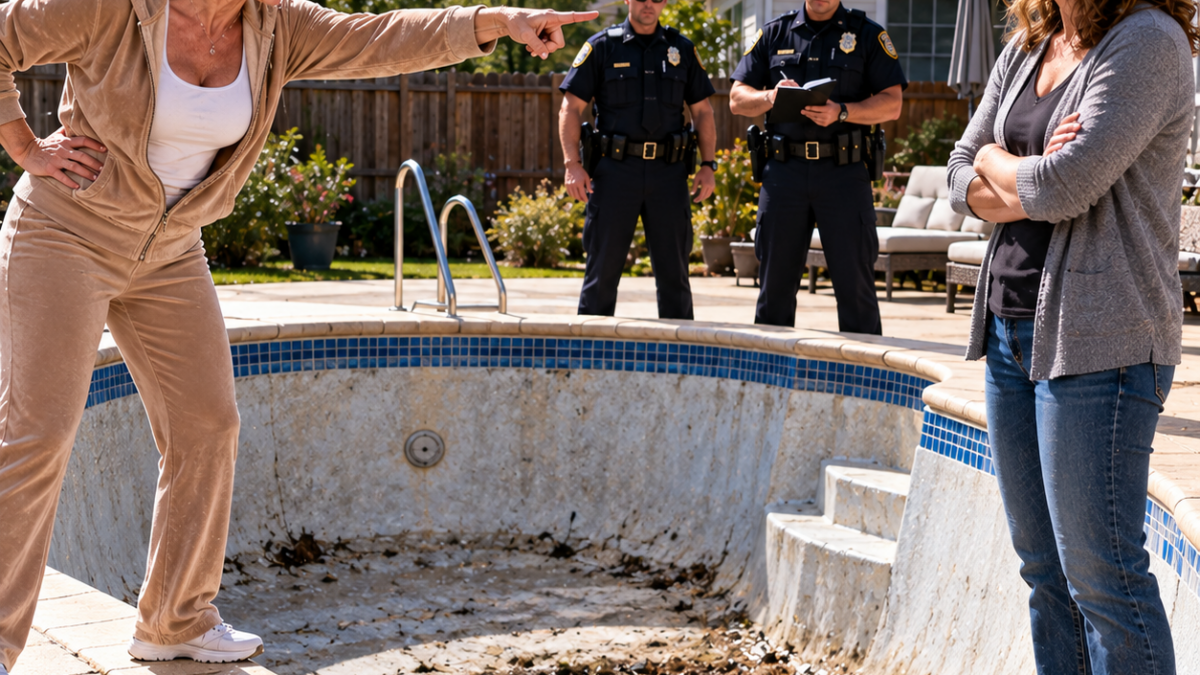
Two police officers stood outside.
Behind them, on the sidewalk, was Sandra.
She had a folder.
Of course she had a folder now.
Imitation is the sincerest form of escalation.
The older officer introduced himself as Sergeant Daniel Ortiz.
The younger was Officer Megan Shaw.
“Ms. Pemberton?”
“Yes.”
“We received a complaint regarding destruction of property.”
I looked past them at Sandra.
She crossed her arms.
“Whose property?”
Ortiz seemed uncomfortable.
“Your neighbor is alleging you removed or destroyed a swimming pool subject to shared ownership or shared use.”
There it was.
Not just use.
Ownership.
I stepped back.
“Would you like to come in?”
They did.
Sandra tried to follow.
Ortiz held up a hand.
“Ma’am, wait outside for a moment.”
Her face fell.
We went into my kitchen.
I had expected something eventually.
Not police.
But when you have spent your career preparing audit files, surprise does not prevent organization.
“Can I get you water?”
“No, thank you.”
Ortiz pulled out a notebook.
“Ms. Fielding says the pool was jointly maintained and used by both households for approximately six years.”
“False.”
“She says she has an established property interest.”
“False.”
“She says you drained and filled it specifically to deprive her family of access after a dispute.”
“The first half is partly true.”
Shaw looked up.
“You did remove it?”
“Yes.”
“Was it permitted?”
“Yes.”
I pointed toward the dining-room sideboard.
“My documentation is there.”
Ortiz looked.
Three-inch black binder.
Then another.
And a file box.
His eyebrows rose.
“You have records?”
I almost smiled.
“I’m an accountant.”
For the next twenty minutes, Sandra’s complaint died page by page.
Deed.
14 Cloverfield Road.
My name.
Survey.
Pool entirely within my boundary.
Original pool contract.
My signature.
Canceled checks.
My bank.
County building permit.
My name.
Final inspection.
My address.
Insurance declarations.
Pool listed as improvement to my property.
Twelve years of maintenance invoices.
Paid by me.
Chemical purchases.
Paid by me.
Repairs.
Paid by me.
Electric bills for pump.
Mine.
Property-tax assessment.
Mine.
Ortiz flipped carefully.
Then came access communications.
Texts where Sandra asked:
Can we swim?
My replies:
Sure.
Not today.
Tomorrow is fine.
Please wait until I am home.
Guest permission.
Not ownership.
Then the message after she entered without asking.
Then my text about structural repairs.
Then her:
That’s really inconvenient.
Officer Shaw’s mouth moved slightly.
She was trying not to smile.
Then Sandra’s $35,500 tree demand.
Then photographs.
Then video stills.
Ortiz stopped.
“What is this?”
“My neighbor entering my construction area at 2:14 a.m. and cutting tree roots she later claimed my contractor damaged.”
Silence.
“Do you have the full video?”
“Yes.”
“Has this been reported?”
“To my attorney.”
“Police?”
“No.”
“Why not?”
“I wanted to resolve it civilly.”
Ortiz leaned back.
Then came Patricia Hale’s email.
I never told Sandra there was any shared pool agreement. Rachel owned and maintained the pool. I occasionally swam there as her invited guest.
Then decommission permit.
Inspection.
Contractor invoice.
County signoff.
Final photographs.
New garden.
Ortiz closed the binder.
He looked at Shaw.
She looked at him.
Then he asked:
“Does Ms. Fielding have any deed, contract, easement, written agreement, maintenance payment, insurance document, or court order showing ownership?”
“Not that she has ever given me.”
“Did she ever pay toward installation?”
“No.”
“Repairs?”
“No.”
“Taxes?”
“No.”
“Maintenance?”
“No.”
“Utilities?”
“No.”
“Insurance?”
“No.”
“Did you ever tell her she owned part of the pool?”
“No.”
“Did you ever give her permanent access?”
“No.”
“Did you ever give her a key after changing the lock?”
“No.”
He nodded.
“Okay.”
Officer Shaw looked toward the backyard through the glass doors.
“Can we see where it was?”
“Of course.”
We stepped outside.
The pool was gone.
Fresh landscaping.
Circular patio.
Compacted lawn beginning to recover.
Sandra saw us from the front and marched around toward the side.
“See?”
She pointed into my yard.
“She destroyed it.”
Ortiz turned.
“Ms. Fielding, we need to talk.”
Sandra looked triumphant.
“Yes.”
He continued:
“Do you have documentation showing you owned the pool?”
Her expression changed.
“I’ve already explained the arrangement.”
“I’m asking about ownership documentation.”
“It was shared.”
“Based on what?”
“Six years of continuous family use.”
“Permission?”
“Mutual understanding.”
“Written?”
“It didn’t need to be written.”
“Financial contribution?”
“I contributed in other ways.”
“What ways?”
“I brought food.”
Silence.
Even Sandra heard it.
“I supervised the children.”
Officer Shaw said carefully:
“They were your children?”
Sandra flushed.
“That’s not the point.”
Ortiz remained calm.
“Did you ever pay for maintenance?”
“No.”
“Repairs?”
“No.”
“Insurance?”
“No.”
“Utilities?”
“No.”
“Property tax?”
“Obviously not.”
“Then on what basis are you reporting criminal destruction of property?”
Sandra’s voice rose.
“Because she knew my family used it.”
“That doesn’t establish ownership.”
“She gave us access for years.”
“Permission to use property does not automatically transfer ownership.”
“She couldn’t revoke it out of spite.”
“Generally, property owners can stop allowing guests to use private recreational property.”
“She created reliance.”
“This is not a police matter.”
Sandra went silent.
Then pointed at me.
“She did this to hurt my children.”
I answered before Ortiz could.
“No.”
“You hated that we used it.”
“I let you use it for years.”
“Until you got controlling.”
My mouth actually opened.
Then closed.
Officer Shaw looked away.
Sandra continued.
“You became obsessed with rules.”
I looked toward the binder still visible through my kitchen window.
That one was almost funny.
Ortiz raised a hand.
“Ms. Fielding.”
She stopped.
“There is no evidence before us of theft, vandalism, or criminal destruction of your property.”
“It was my property.”
“Nothing you’ve provided supports that.”
“You’re taking her side.”
“We’re reviewing evidence.”
“She buried evidence.”
“Of what?”
“The pool.”
“It was permitted.”
That stopped her.
“What?”
Ortiz nodded toward me.
“She provided a county decommissioning permit and final approval.”
Sandra stared.
I think that was when she realized what she had walked into.
Not an emotional argument.
Not neighborhood gossip.
A file.
Dates.
Signatures.
Government records.
Canceled checks.
A timeline.
She looked at me.
“You planned this.”
“The decommissioning?”
“No.”
“This.”
She pointed toward the house.
“The binder.”
“I started documenting when you said you had an expectation of access.”
“That is insane.”
“Today says otherwise.”
Ortiz interrupted before things could spiral.
“Ms. Fielding, this complaint is going to be documented as civil/property dispute with no criminal offense established.”
“You aren’t going to make her restore it?”
“No.”
“Arrest her?”
“No.”
“For destroying property?”
“Her property.”
Sandra looked physically stunned.
Then she made the worst possible decision.
She lied again.
“She forged those permits.”
Ortiz’s expression changed.
“Do you have evidence of that?”
“No, but—”
“Then do not make criminal allegations without a factual basis.”
“I know what she’s capable of.”
I almost laughed.
Sandra pointed toward my binder.
“Look at that.”
“She plans everything.”
Officer Shaw said:
“Planning is not illegal.”
Sandra left.
Not dramatically.
No final scream.
She simply turned and walked through my side yard back toward her house.
Ortiz watched.
Then looked at me.
“You should consider securing that gate.”
“Already scheduled.”
“Cameras?”
“Four.”
“Good.”
He hesitated.
“And I would report the root-cutting incident.”
“I don’t want to escalate.”
He looked at the filled pool site.
“Ms. Pemberton.”
“Yes?”
“I think escalation has already happened.”
Fair.
I filed the report that afternoon.
Provided footage.
Sandra was interviewed.
Her explanation was that she had entered because she believed my contractor was damaging her tree and wanted to “inspect.”
The video showed her using a saw.
That complicated the story.
She eventually received a citation for trespass and property-related misconduct associated with the construction zone.
Nothing dramatic.
Fine.
No jail.
But the false tree-damage demand became important in the civil case.
Because yes.
She sued me.
Of course she did.
Sandra Fielding v. Rachel Pemberton.
Her complaint alleged:
Promissory estoppel.
Implied easement.
Detrimental reliance.
Nuisance.
Intentional interference with property enjoyment.
Emotional distress.
Damage to her tree.
And, somehow, “unjust enrichment.”
Ellen read the complaint in silence.
Then removed her glasses.
“I need to ask.”
“Yes?”
“How did you enrich yourself by spending forty thousand dollars fixing a pool and then paying another twenty-three thousand to bury it?”
“I gained lavender.”
She laughed.
“Good lavender?”
“Excellent.”
“Maybe she’s onto something.”
The lawsuit was not entirely frivolous in the technical sense.
People can make creative claims.
Courts exist to decide them.
But creative does not mean strong.
Sandra’s core argument was that six years of regular access had created a durable right she reasonably relied on when buying and improving her neighboring property.
There was one problem.
She bought her house before ever meeting me.
Another problem.
The pool was not mentioned in her purchase contract.
Another.
No easement.
No license agreement.
No recorded recreational right.
No contribution.
No maintenance.
No written promise of permanent access.
And then there were the texts.
Hundreds of them.
Can we swim?
Sure.
Maybe tomorrow?
Yes.
Not today.
Okay.
Repeated requests are awkward evidence for someone claiming no permission was needed.
Ellen loved that.
“Every time she asks, she admits you controlled access.”
Sandra’s attorney tried another angle.
She claimed she had invested in her own backyard based on continued pool access.
New gate.
Patio furniture.
Outdoor shower.
I had never seen the outdoor shower used.
The gate led to her yard.
Her improvements benefited her house regardless.
Then discovery found something more interesting.
Sandra’s insurance application.
Completed two years earlier.
Question:
Does the property contain a swimming pool, spa, or other water feature?
Answer:
No.
Question:
Does insured household have ownership interest in any adjacent recreational facility?
Answer:
No.
Ellen placed the form on the conference table.
I stared.
“She told her insurer she didn’t own it.”
“Yes.”
“And now tells the court she did.”
“Yes.”
“I love forms.”
“I know you do.”
Then came her refinancing documents.
Property appraisal.
No pool included.
Neighborhood description:
Adjacent property at 14 Cloverfield contains private in-ground swimming pool.
Private.
Her lender’s appraiser had written it.
Sandra had signed the refinance package.
Then came a text between Sandra and her sister.
Obtained because Sandra herself produced a broad phone export without reviewing it carefully.
The sister wrote:
Why are you fighting Rachel over HER pool?
Sandra answered:
Because she can’t let us use something for years and then just take it away because she’s mad.
HER pool.
Capitalization preserved.
Ellen looked at me.
“Do you want to frame this?”
“Yes.”
“No.”
“Why?”
“Judges prefer exhibits without decorative borders.”
The tree claim collapsed too.
Her own midnight cutting.
Her own arborist saying the tree remained healthy.
Her original $35,500 demand unsupported by invoices.
Then the arborist testified that some of the cuts he initially thought unusual were consistent with Sandra’s saw marks visible on video.
That part was ugly.
Not because of money.
Because the tree had survived forty years.
Sandra had damaged her own maple trying to create evidence against me.
That told me the fight had stopped being about the pool long before she admitted it.
It had become about winning.
People do strange things when winning becomes more important than the original problem.
Mediation happened eight months after the police visit.
Sandra sat across from me.
Different lawyer by then.
Her first attorney had withdrawn.
No explanation officially.
I had theories.
The mediator was a retired judge named Evelyn Crane.
Late sixties.
Silver hair.
Voice so calm that angry people automatically sounded ridiculous beside her.
Sandra demanded I pay $75,000.
Ellen nearly choked.
For what?
Loss of recreational access.
Reduction in enjoyment.
Tree damage.
Legal fees.
Emotional distress.
Ellen offered:
Zero.
Mediator carried messages between rooms.
After three hours, Sandra’s demand dropped to $40,000.
Then $15,000.
Then:
Mutual walkaway.
Ellen looked at me.
“That is probably the rational resolution.”
I looked out the conference-room window.
“Does it include no access?”
“Yes.”
“No claims to my property?”
“Yes.”
“Dismissal with prejudice?”
“Yes.”
“Tree claim gone?”
“Yes.”
“Each side pays own remaining fees?”
“Yes.”
I thought.
“Add no-contact except boundary emergencies and necessary property issues.”
“Reasonable.”
“And she acknowledges no ownership or easement in writing.”
Ellen smiled.
“That may be harder.”
“Then no deal.”
“Rachel.”
“I spent a year being told my property wasn’t mine.”
“This is not just about money.”
“I know.”
“Good.”
Sandra refused.
So we went to court.
Not a dramatic jury trial.
Civil bench proceeding on preliminary claims.
Lawyers.
Documents.
Testimony.
The judge asked very practical questions.
Who owned 14 Cloverfield?
Me.
Who paid for the pool?
Me.
Who insured it?
Me.
Was any easement recorded?
No.
Any written agreement?
No.
Any oral promise of perpetual access?
Sandra said yes.
I said no.
Judge asked:
“When?”
Sandra could not identify a date.
“What exact words?”
She said:
“Rachel said we could use it whenever.”
I had texts afterward where she continued asking permission.
Judge noticed.
Then Patricia Hale testified remotely.
“No shared agreement.”
The insurance form came in.
No ownership interest.
The appraisal came in.
Private pool.
The sister text came in.
HER pool.
The judge took notes.
Then Sandra testified about reliance.
“Ms. Fielding,” he asked, “did you purchase your property because of access to Ms. Pemberton’s pool?”
“Yes.”
Ellen stood.
“Objection based on prior sworn discovery response.”
The judge looked.
In deposition, Sandra had answered:
No, the pool was not a factor in my original purchase decision because I did not know Rachel at the time.
Silence.
Her lawyer whispered frantically.
Judge looked at Sandra.
“Which answer is accurate?”
Sandra’s face reddened.
“The deposition.”
That was the moment the case ended, even before the order.
Weeks later, the ruling arrived.
No easement.
No ownership interest.
No enforceable promise of permanent pool access.
No basis to require restoration.
Tree-damage claim denied.
Sandra’s remaining claims dismissed.
Some attorney fees awarded to me under a state provision tied to unsupported property claims.
Not all.
Litigation never restores every dollar.
But enough.
Ellen emailed me the order.
Subject line:
BORING WINS.
I printed it.
Of course.
TAB 11.
COURT ORDER.
The neighborhood changed after that.
Not dramatically.
People still waved.
Lawns still got mowed.
Amazon trucks still blocked driveways.
But Sandra’s social position changed.
Not because I campaigned against her.
I said almost nothing publicly.
People learned anyway.
Court filings are public.
Police cars had appeared.
Contractors came and went.
Rumors circulated.
Some exaggerated.
One version had Sandra trying to take my entire backyard.
Another claimed I filled the pool with cement while her children were swimming.
Neighborhood storytelling is unregulated.
I corrected people when necessary.
“She claimed a right to use the pool.”
“Not ownership of my house.”
“No, nobody was in the pool.”
“No, police did not arrest her in my kitchen.”
Truth was strange enough.
Sandra’s children stopped coming over.
That part hurt.
Not because I regretted ending access.
Because Tyler and Madison had done nothing wrong.
One afternoon, months after the court order, Madison saw me collecting mail.
She was fourteen by then.
“Ms. Rachel?”
“Hi, Madison.”
She looked toward her house.
Then whispered:
“I’m sorry.”
My heart sank.
“For what?”
“Everything.”
“You don’t owe me an apology.”
“My mom says you hate us.”
“I don’t hate you.”
“She says you filled the pool so we couldn’t use it.”
“I filled the pool because I didn’t want one anymore.”
Madison looked down.
“Was it because of us?”
“No.”
Not entirely.
Important distinction.
“I liked when you guys swam.”
She looked surprised.
“Really?”
“Yes.”
“Then why?”
How do you explain boundaries to a fourteen-year-old without making her responsible for her mother’s choices?
I chose the simplest version.
“Sometimes something can be good for a while and still need to end.”
She nodded slowly.
“Mom doesn’t think things should end.”
That sentence told me more about Sandra than anything in the lawsuit.
I did not ask more.
“Your mom loves you.”
“I know.”
“And none of this was your fault.”
She looked at me.
“Okay.”
Then:
“The garden looks nice.”
“Thank you.”
She went home.
I stood at the mailbox longer than necessary.
Sandra sold her house the following spring.
I learned because a real-estate sign appeared.
For the first time in years, 16 Cloverfield looked quiet.
Before listing, Sandra had the maple professionally evaluated.
Still healthy.
The property brochure mentioned:
“Mature shade tree.”
No mention of shared pool.
Good.
The buyers were a couple named Daniel and Priya Ellis.
Two dogs.
No children.
Before closing, their inspector noticed the gate between our yards.
They asked about it.
Their agent called me.
“Does this gate reflect any shared-use agreement?”
I nearly laughed.
“No.”
“Any easement?”
“No.”
“Any continuing access rights?”
“No.”
“Would you put that in writing?”
“Yes.”
Gladly.
I wrote:
The gate is a physical feature only and conveys no access right, easement, license, or shared-use arrangement between 14 and 16 Cloverfield Road. Entry requires express permission of the property owner.
Signed.
Dated.
Priya later thanked me.
“I hope that didn’t seem paranoid.”
“No.”
“You’re asking the wrong woman if documentation seems paranoid.”
We became good neighbors.
Not pool-sharing neighbors.
Normal neighbors.
The gate stayed locked.
We occasionally had wine.
She gave me tomatoes.
I did her taxes once and regretted the precedent immediately.
The garden grew.
Lavender took over more space than intended.
Hydrangeas struggled at first.
I added a small fountain.
Nothing large.
Just enough moving water to hear from the patio.
That mattered.
I had removed the pool but not my desire for water.
On summer evenings, I sat where the deep end used to be and listened to the fountain.
No pump schedule.
No chlorine.
No permission disputes.
Just quiet.
My sister visited.
She walked around the patio.
“I like this better.”
“You’re legally required to say that.”
“No.”
She pointed toward the lavender.
“This feels like you.”
“What did the pool feel like?”
“You trying to create a resort.”
“I liked the pool.”
“I know.”
She sat.
Then looked at the house next door.
“Any regret?”
I thought.
“About letting Sandra use it originally?”
“Yes.”
“No.”
That surprised her.
“Really?”
“Why would I regret being kind before I had a reason not to be?”
She smiled.
“That’s healthier than I expected.”
“I’m in therapy.”
“Ah.”
The lesson was not:
Never share.
Never trust neighbors.
Never let children swim.
That would be a terrible lesson.
The lesson was simpler.
Permission stays permission until both people agree it becomes something else.
Kindness does not create ownership.
Hospitality does not surrender property.
Repeated generosity does not mean permanent entitlement.
A yes today does not erase your ability to say no tomorrow.
That applies to pools.
Cars.
Tools.
Money.
Time.
Rooms.
Relationships.
Attention.
People sometimes become angry when a boundary appears where they were benefiting from none.
That does not automatically mean the boundary is wrong.
Sandra’s mistake was not enjoying my pool.
I wanted her family to enjoy it.
Her mistake was deciding that because access had become familiar, access had become hers.
Familiarity can feel like ownership.
It isn’t.
Documentation matters because memory changes shape under pressure.
Sandra remembered:
Rachel let us use the pool every summer.
True.
Then:
We always used the pool.
Mostly true.
Then:
The pool was basically shared.
False.
Then:
We had a shared understanding.
Unsupported.
Then:
I had a property interest.
No.
Each step felt small enough to her.
By the time police arrived, she had walked from guest to co-owner without ever noticing the distance.
My binder forced every step backward.
Who paid?
Who permitted?
Who insured?
Who maintained?
Who controlled access?
Who asked whom?
Dates.
Texts.
Records.
Facts.
Boring became beautiful.
Years later, Sergeant Ortiz came into my accounting office.
Not because of the pool.
Taxes.
He recognized me immediately.
“Cloverfield.”
I laughed.
“Pool complaint.”
“That’s me.”
He sat.
“How’s the pool?”
“Still a garden.”
“Neighbor?”
“Moved.”
He nodded.
“Good.”
I opened his tax folder.
“You know what I remember?”
“What?”
“That binder.”
“Professionally intimidating?”
“Terrifying.”
I smiled.
“You officers should carry binders.”
“We have body cameras.”
“Binders are quieter.”
He laughed.
Then became serious.
“That case gets used sometimes.”
“What case?”
“Not officially.”
“When we get civil property calls.”
“People say, ‘But they let me use it.’”
“I tell newer officers to ask the boring questions.”
“Who owns it?”
“Who pays?”
“What’s in writing?”
“Who has permission?”
I liked that.
“So my pool became training material.”
“Your ex-pool.”
“Thank you.”
We finished his return.
He owed the state $614.
Justice is complicated.
The strangest closure came twelve years after Sandra moved away.
I was fifty-nine.
Closer to retirement.
The garden had changed.
Trees taller.
Patio weathered.
Fountain replaced once.
One July afternoon, a young woman knocked.
I opened the door.
It took a second.
Then I recognized the eyes.
“Madison?”
She smiled.
“Hi, Ms. Rachel.”
She was twenty-six.
Older than Sandra had seemed in my first memories, which made no mathematical sense but emotional memory rarely does.
She held a small plant.
“I hope it’s okay I came.”
“Of course.”
She stepped inside.
We sat in the backyard.
She looked toward the garden.
“So weird.”
“What?”
“I remember where the steps were.”
She pointed.
“Right there.”
“Exactly.”
“And the diving board?”
“Never had one.”
She laughed.
“I invented that.”
“Apparently.”
She looked at the fountain.
“Mom told the story differently for years.”
I didn’t answer.
“After I went to college, I found the court documents.”
That surprised me.
“Why?”
“I wanted to know.”
She looked down.
“She said you stole something from us.”
“I knew that didn’t sound right.”
“Tyler barely remembers.”
“I remember everything.”
I nodded.
“You were older.”
“She was going through a bad time.”
Madison’s voice softened.
“Dad had stopped paying what he promised.”
“She was scared about money.”
“Work was awful.”
“She thought everyone was abandoning her.”
I listened.
Again, explanation.
Not excuse.
Madison continued.
“She held onto things.”
“People too.”
“If she felt something slipping away, she’d grip harder.”
“The pool became one of those things.”
I looked at the garden.
“I figured it was bigger than swimming.”
“She talks about you sometimes.”
“That sounds dangerous.”
Madison smiled.
“She says you were the most stubborn person she ever met.”
“She’s wrong.”
“My sister would confirm.”
Madison turned serious.
“She also says you were right.”
I didn’t expect that.
“She does?”
“Now.”
I looked at the plant.
“What did you bring?”
“Lavender.”
I laughed.
“Of course.”
“I remembered you planted it.”
“We put it in near the old pool edge.”
She stayed an hour.
Before leaving, she stood at the side gate.
The same gate Sandra had crossed without asking.
Madison touched the latch.
“Can I ask something?”
“Sure.”
“Why did you keep letting us swim after Mom started being difficult?”
I thought.
“Because you and Tyler weren’t difficult.”
She looked down.
“That means a lot.”
Then she left.
I planted the lavender.
It grew badly the first year.
Perfect the second.
My documentation file still exists.
The original black binder became two binders before the case ended.
I keep them in a cabinet.
Not because I expect Sandra to come back.
Because throwing them away feels like tempting the universe.
My sister says I need help.
She’s probably right.
The original pool permit is there.
Construction contract.
Inspection.
Maintenance receipts.
Surveys.
Insurance.
Texts.
Police report.
Court order.
And one photograph I added much later.
Madison standing beside the new lavender.
No legal value.
Wrong tab entirely.
I filed it under:
FINAL.
Accountants are allowed one sentimental category.
If people ask what happened, the quick version sounds ridiculous.
Neighbor asked to use my pool.
I said yes.
Repeatedly.
Years passed.
Neighbor became accustomed to access.
I locked the gate after boundaries were ignored.
Pool developed structural problems.
I drained it.
Repaired it.
Changed my mind.
Removed it permanently.
Neighbor called police and claimed a shared ownership right.
I opened a binder.
Claim collapsed.
She sued.
Paperwork collapsed it again.
She moved.
I planted lavender.
That’s the headline.
But the story I prefer is less dramatic.
A woman bought a house because she wanted quiet.
She built a pool.
Shared it because sharing something nice felt good.
Another family came to love it.
Then familiarity turned into expectation.
Expectation turned into resentment.
Resentment turned into a claim.
And the person who had spent her entire career saving receipts discovered that sometimes a peaceful life depends on being willing to prove, page by page, where generosity ends and ownership begins.
The pool is gone.
The garden remains.
And every summer, when the lavender blooms where the deep end used to be, I sit beside the little fountain and remember something I wish I had understood earlier.
You do not have to stop being generous just because somebody once mistook generosity for surrender.
You simply learn to keep the gate locked.
And, if you’re anything like me, keep the paperwork.



