I Bought a Lake Cabin Outside the HOA—Then They Learned Their Only Road Was on My Property
PART2:
Eight months after her funeral, the cabin came up in an estate sale.
I made an offer before I finished reading the listing.
That was unlike me.
For thirty-one years, I had supervised survey crews for highway contractors.
I read legal descriptions.
Easements.
Right-of-way plans.
Boundary notes.
Utility corridors.
Construction plats.
I had spent most of my adult life telling people that the smallest line on the ugliest page could cost millions if nobody bothered to understand it.
Then grief came along and made me the kind of man who bought a cabin because his wife had once put her feet in the water nearby.
The estate lawyer slid one final page toward me at closing.
“There’s also Lot R.”
“What is Lot R?”
“Unbuildable strip.”
“How large?”
PART3:
“Just under an acre.”
“What’s on it?”
“Gravel access.”
He said it the way a person might say drainage ditch.
The assessed value was eighteen hundred dollars.
I looked at the parcel sketch.
Long.
Narrow.
Running from the county road down past the cabin property.
Something about it caught my attention.
Not because I had a plan.
Because thirty-one years of survey work had trained me to notice when a line continued farther than a realtor’s description did.
“I’ll take it.”
The attorney shrugged.
“It’s already part of the estate package.”
I signed.
That was it.
Nine-tenths of an acre.
Eighteen hundred dollars.
Three paragraphs near the back of the closing documents.
Nobody at Pine Ridge Estates asked me about it.
For the first six months, I did not ask them either.
Pine Ridge sat uphill from my cabin.
Two hundred twelve houses.
Stone entrances.
Landscaped common areas.
A clubhouse.
Swimming pool.
Architectural committee.
Monthly newsletter.
The usual machinery people create when they want their neighbors to agree about paint colors.
I was not inside the HOA.
My cabin predated it.
So did Lot R.
But the only paved-gravel road connecting Pine Ridge to the county highway crossed Lot R.
Everybody used it.
Residents.
School buses.
Mail.
Deliveries.
Contractors.
Medical transport.
The former cabin owner had apparently allowed it for more than twenty years.
Handshake arrangement.
No toll.
No gate most of that time.
No drama.
When I moved in, I installed a gate.
Not to close Pine Ridge.
To control what had gradually started happening on my property.
The HOA had erected road signs.
Added posts.
Spread gravel.
Scheduled landscaping crews.
Put up directional markers.
Then, six weeks after I arrived, I received an invoice.
ROAD RESERVE SHARE — $4,800.
I called the number.
Victoria Ashford answered.
She was president of the Pine Ridge Estates Owners Association.
Platinum-blond hair.
Light-blue blazers.
Perfect posture.
The kind of voice that made declarations sound like things you had already agreed to.
“This must be a mistake,” I said.
“No.”
“I’m outside your HOA.”
“You use Pine Ridge Road.”
“I own the land beneath part of Pine Ridge Road.”
A pause.
Then:
“The association has maintained that roadway for decades.”
“That doesn’t answer what I said.”
“You’ll receive the access agreement.”
“What access agreement?”
“The one that keeps this simple.”
That was our first conversation.
It did not stay simple.
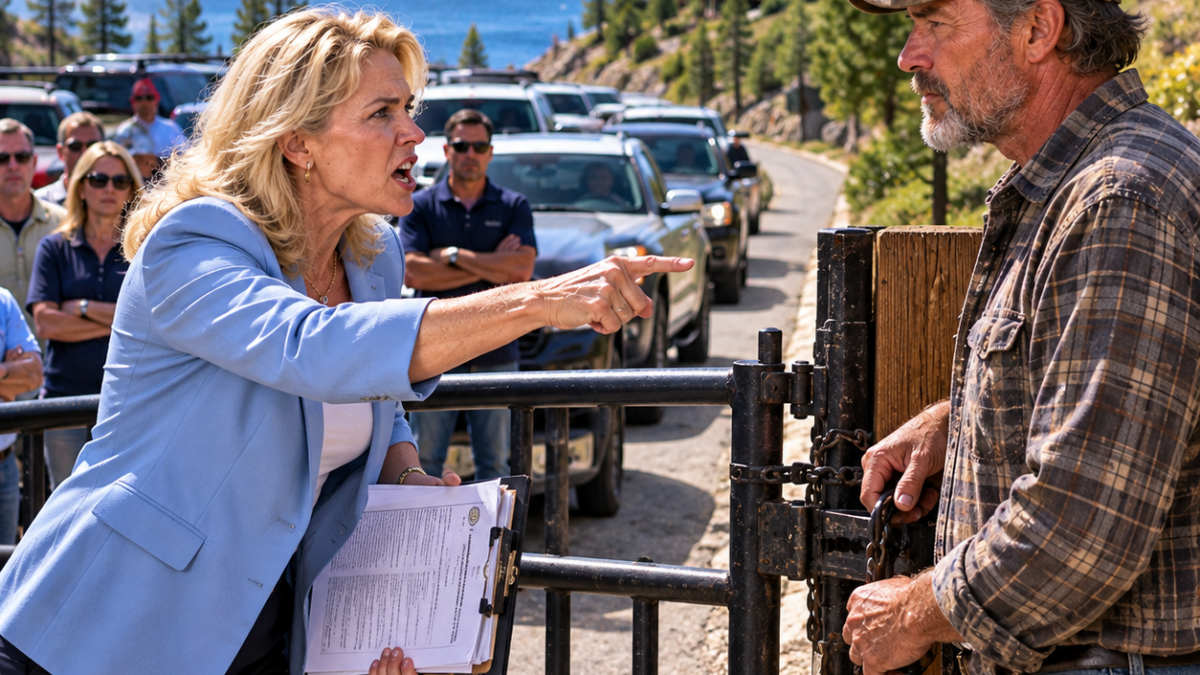
The morning everything became public, I stood beside my gate with forty-one vehicles idling behind Victoria.
SUVs.
Delivery trucks.
Landscaping vans.
A school maintenance vehicle.
Her light-blue blazer looked almost polished beside all that exhaust.
She was shouting.
“You cannot close this gate, Mr. Cole.”
I pocketed the key.
“Why?”
“This is our road.”
“Then show me where you bought it.”
She stopped.
Not long.
But long enough.
Behind her, an HOA sign hung from the sixth fence post.
There were twenty-two posts along the lane.
Each top painted red.
Surveyors do not paint post tops for decoration.
I had noticed them the first week.
Nobody else seemed curious.
Victoria pointed toward my lock.
“You have seven days to remember who runs this valley.”
Then she turned toward the contractor foreman standing nearby.
“Cut it.”
He did not move.
His eyes went past her.
Six vehicles back sat a white van with a wheelchair lift.
Dialysis clinic logo on the door.
I knew the van.
Three mornings a week at 6:10, it passed my porch.
Same time.
Same driver.
I had gotten used to pausing with my coffee and watching it go.
I walked to the side gate.
Punched the code.
Opened it.
The van came through.
The driver raised two fingers.
I returned the gesture.
A tan pickup followed.
I let it pass.
Victoria’s face tightened.
“Do not hide behind sick people.”
“I’m not.”
“You either open the road or you don’t.”
“Medical transport stays open.”
“Ambulances stay open.”
“Mail stays open.”
“Everything else can wait until someone shows me what legal right Pine Ridge claims.”
She stared.
I shut the side gate behind the pickup.
“That lane is open around the clock,” she said.
“No.”
“It was.”
“Past tense.”
She turned toward the foreman.
“Tomorrow morning, bring the paperwork.”
She said it loudly enough for me to hear.
Probably intended to.
The tan pickup came back around noon.
It stopped beside my truck.
A man in his late sixties rolled down the window.
Worn face.
Gray hair.
The expression of somebody who had spent years being reasonable in rooms where reason was not highly rewarded.
“Walt Brennan.”
He pointed uphill.
“I keep Pine Ridge’s books.”
I nodded.
“That was my wife in the dialysis van.”
I looked toward the road.
“Four hours in the chair.”
“Three days a week.”
“You didn’t have to let us through.”
“Yes.”
“I did.”
He studied me.
“Why’d you buy this place?”
“Most people don’t buy a cabin at the end of somebody else’s neighborhood road.”
So I told him about Claire.
The boat.
The dock.
The porch.
He listened without interrupting.
Then I told him about my job.
Thirty-one years of survey crews.
The closing.
Lot R.
Nine-tenths of an acre.
Eighteen hundred dollars.
Walt looked toward the sixth post.
“The old owner let us use this road for twenty-some years.”
“Handshake.”
“Never charged a dime.”
Then he lowered his voice.
“Victoria has been waiting for him to die since the day she became president.”
That got my attention.
“Why?”
“Phase Two.”
He nodded toward the east ridge.
“Thirty-eight new lots.”
“She’s the listing agent.”
“There’s a billboard on the highway advertising lake access.”
“Deposits already taken.”
I looked toward the posts.
Twenty-two.
Red tops.
Walt followed my eyes.
“You noticed.”
“I notice survey markers.”
“She’s never lost a board vote.”
He shifted into gear.
“Whatever you’ve got in that closing folder, don’t show it to her until you understand it.”
Then he drove away.
That evening, I opened my notebook.
I keep notes.
Always have.
Dates.
Weather.
Measurements.
Who came through.
Which contractor widened what shoulder.
When new gravel appeared.
When the HOA installed signs.
How many vehicles passed during morning peaks.
It is not glamorous.
But memory gets arrogant.
Paper usually wins.
I had been at the cabin 183 mornings.
I had walked that lane almost every one.
The next day at 8:50, Victoria appeared on my porch.
She did not knock.
She stood at the rail holding a laminated document.
“Temporary Community Access Agreement.”
She slid it toward me.
“Sign this and we stay civilized.”
I read.
The first paragraph said Pine Ridge Estates Owners Association granted me permission to use the access road.
I read it again.
Then looked at her.
“You’re giving me permission to use my own property?”
“You’re being granted access to the community roadway.”
“Lot R is mine.”
“The association has used and maintained that road for decades.”
“Practice isn’t a deed.”
Her smile became thin.
“It is what this valley runs on.”
Behind the agreement was another invoice.
BACK ROAD ASSESSMENT — $4,800.
Due in seven days.
I photographed everything.
Signature line:
V. ASHFORD, PRESIDENT.
Date.
Pages.
Exhibits.
Victoria watched.
Something passed through her face.
Quick.
Then gone.
She left without another word.
The agreement cited the association’s recorded subdivision plat.
That was useful.
After thirty-one years in surveying, I have a rule.
If someone cites a map confidently enough to demand money from you, go read the map.
The county records office smelled like dust, old paper, and a broken coffee machine.
The clerk brought out the Pine Ridge plat.
Large sheet.
Nearly table-sized.
I spread it flat.
The association boundary stopped thirty feet short of the lane.
I checked twice.
Then a third time.
The road was not inside Pine Ridge.
Lot R was shown separately.
Small note:
SEE SEPARATE INSTRUMENT RECORDED 1994.
The plat Victoria had cited to claim the road did not even give the HOA ownership of it.
I requested certified copies.
The plat.
1994 instrument.
Every filing connected to Lot R.
Five business days.
Too slow for Victoria’s seven-day clock.
So I documented everything I could.
Rain began around four that afternoon.
I walked the road with:
Tape.
Camera.
Notebook.
I photographed every sign bolted onto my posts.
Every gravel repair.
Every drainage modification.
Every red-painted cap.
Especially the sixth post.
At dusk, I came back toward the lake.
Victoria was standing on my dock stairs with a measuring wheel.
That was the first time I came close to losing my temper.
“What are you doing?”
“Updating association records.”
“Those are my steps.”
“Everything affecting Pine Ridge belongs in the association’s records.”
I looked down.
Claire had sat on those steps.
Feet in the water.
Said she wanted a porch.
Victoria stood on them like they were another item on a checklist.
“My wife sat there.”
For once, she had no answer.
She stepped off.
Slowly.
At the top of the bank she said:
“Two days, Nathan.”
“Counsel will be waiting at your road.”
The rain erased her measuring-wheel tracks before dark.
Two mornings later, a lawyer in a gray raincoat stood beside the sixth post.
Victoria beside him.
Two crewmen near a truck.
He read a demand.
Restore unrestricted access within forty-eight hours or Pine Ridge would seek judicial relief.
His argument:
Open use.
Continuous use.
Roughly thirty years.
Potential prescriptive rights.
“Courts don’t strand two hundred twelve homes, Mr. Cole.”
Victoria added:
“Thirty years.”
“Ask anyone.”
I looked at her.
“I’m asking you.”
She did not answer.
The attorney held out an envelope.
“We would prefer to settle this like neighbors.”
“Neighbors usually knock before sending lawyers.”
“Put your position in writing.”
“It is in writing.”
He checked his watch.
“Five p.m. deadline.”
I took the letter.
Then I called Ruth Callaway.
Ruth practiced real-estate law above a hardware store.
Her office smelled like hot radiators and old books.
She read the demand twice.
Then:
“You own Lot R.”
“That part is straightforward.”
I relaxed too early.
“However.”
There it was.
“Thirty years of open use creates a real legal question.”
“Do they own it or not?”
“No.”
“That is not the only issue.”
She took off her glasses.
“Ownership is one thing.”
“Access rights are another.”
“If the prior owner merely permitted use, that helps you.”
“If Pine Ridge used it openly under a claim of right for long enough, they may argue that use hardened into something legally enforceable.”
“Can they?”
“I won’t know until we see the history.”
“What do we need?”
“Evidence that Pine Ridge itself understood the road was used by permission.”
“One acknowledgment.”
“Letter.”
“Form.”
“Meeting minute.”
“Anything.”
I remembered Walt.
Every January.
Not yet.
He had not told me enough.
Ruth continued:
“And keep the medical side lane open.”
“I was planning to.”
“Good.”
“A judge will notice.”
Then:
“Get a neutral inspection.”
“County.”
“Someone who writes what exists, not who they like.”
I called.
At dawn, Dan Harlow arrived in a white county truck.
Lean man.
Clipboard.
Tape measure.
The exhausted patience of somebody who spends his life standing between angry property owners.
“I’ll tell you this first.”
“I don’t decide who wins.”
“I write what I see.”
“That’s all I want.”
We walked.
Signs.
Posts.
Shoulder.
Widths.
Gate.
Side access.
Lot R boundaries.
Victoria arrived twenty minutes later.
“This is unnecessary.”
Dan did not look up.
“Who authorized these improvements?”
He pointed at the HOA road signs.
Then the fresh gravel.
“The association manages this area.”
He wrote it.
Then looked at me.
“Mr. Cole?”
“I own the parcel the road crosses.”
Dan checked his map.
“County shows Lot R as private.”
Victoria turned toward me.
“Nathan, you’re turning a simple access issue into something much bigger.”
“I didn’t install the signs.”
That stopped her.
Dan wrote that too.
Victoria spent the next hour on her phone.
After she left, Dan tapped my notebook.
“You said you measured the lane fifteen times.”
“Maybe sixteen.”
“Your notes say sixteen.”
“Then sixteen.”
He smiled.
“Paper wins.”
Then he said:
“One more thing.”
“If this lane closes, the county will eventually have to look at Pine Ridge’s other emergency route.”
“What other route?”
“Old fire road.”
“East side.”
“I’ve never seen it.”
“Most people haven’t.”
“Can vehicles use it?”
“Some.”
“Medical van?”
He shook his head.
“Not in current condition.”
That complicated everything.
I sat on the porch after he left.
Coffee.
Lake.
Mist burning away.
Owning the road was one thing.
Using that ownership without hurting people was another.
Walt came down to the dock at dusk.
No truck.
Thermos.
He sat where Claire used to sit without knowing it.
“Let’s be clear,” he said.
“I’m not your friend in this.”
“I’m the HOA treasurer.”
“Understood.”
“There is another way out.”
“Fire road.”
“Yes.”
“Overgrown.”
“Too steep in places.”
“Victoria keeps saying why spend money improving it when we have your lane.”
He looked at the water.
“My wife needs a ramp at our house.”
I waited.
“Request has been sitting on Victoria’s committee since spring.”
“She chairs architectural review.”
“Last week she told me it would be easier to approve after this road problem goes away.”
I looked at him.
“She said that?”
“Not exactly.”
“Close enough that I understood.”
He turned his thermos.
Then:
“Every January, a lawyer’s letter came about Lot R.”
“One-page form.”
“Victoria signs whatever the secretary puts in front of her.”
“Nobody reads the boring page.”
My pulse changed.
“What does it say?”
He looked at me.
Then away.
“I said too much.”
So I did not ask again.
I would not make him choose between his board, his neighbors, and his wife in front of me.
Instead, I tore a page from my notebook.
Wrote the side-gate code.
Gave it to him.
“For your wife’s driver.”
“For you.”
“Nobody else.”
He folded it carefully.
“Day after tomorrow, your seven days are up.”
“She’s bringing the neighborhood.”
“You didn’t hear it from me.”
The morning the deadline expired, I heard engines before I saw people.
Vehicle after vehicle.
Then residents walked onto my grass.
Forty.
Maybe more.
Work jackets.
Church sweaters.
Concerned faces.
Victoria led them.
Light-blue blazer.
Folder.
Walt stayed behind her with his eyes down.
“We’re here to resolve this,” she said.
“By standing on my lawn?”
“By showing you that this affects an entire community.”
She handed me a proposal.
The HOA would maintain the lane.
Remove its signs.
Handle surface repairs.
In exchange, I would surrender control of the gate and acknowledge Pine Ridge’s perpetual right of access.
There it was.
Last paragraph.
The entire fight.
“One man’s deed does not outweigh two hundred twelve families and thirty years.”
Victoria said it loudly enough for everyone.
“No judge is going to strand nurses and school buses because you like a gate.”
Then:
“If you had paper that mattered, you would have shown it by now.”
That part bothered me.
Because she was not entirely wrong.
The certified copies had not arrived.
I had an old photocopy.
My deed.
My notes.
But the long-use question remained.
People held printed flyers.
COLE HOLDS PINE RIDGE HOSTAGE.
A gray-haired woman stepped forward.
“My husband is on oxygen.”
Her voice shook.
“You cannot just block—”
“The medical gate stays open.”
She stopped.
“What?”
“Medical transport has never been blocked.”
“Ambulances.”
“Dialysis.”
“Emergency vehicles.”
“Mail.”
“Nobody told us that.”
Heads turned toward Victoria.
“He’s confusing the issue.”
“No.”
I said it quietly.
“I’m separating it.”
“The people who need this road for medical care are not bargaining chips.”
Walt looked at the ground.
The woman stepped back.
I handed Victoria her proposal.
Unsigned.
By noon, I was back with Ruth.
She underlined:
PERPETUAL RIGHT.
“Do not sign anything containing those words.”
“I wasn’t planning to.”
“Good.”
Then she pulled out my old photocopy.
Coffee stain on one corner.
A line from the 1994 instrument:
Association use of Lot R shall be by permission only.
Ruth looked at me.
“That is very good.”
“But?”
“But a court may want evidence both sides behaved that way after 1994.”
“Permission on paper can be forgotten.”
“Show me one time Pine Ridge later acknowledged it was still permission.”
“One.”
I thought again of Walt.
Nobody reads the boring page.
I said nothing.
Ruth did not press.
My phone buzzed.
Dan Harlow.
Association filed request with county this morning. Call me.
He wanted to meet at the gate at 6:15 the next morning.
Before sunrise, headlights came up the lane.
Tow truck.
Dump truck.
Then residents on foot.
Dozens.
The dialysis van came through the side gate at 6:10.
Same as always.
Driver raised two fingers.
I raised mine.
Dan arrived.
Victoria stood with her attorney.
Dan opened a manila envelope.
“Pine Ridge has requested interim access protection.”
The association’s filing claimed the road had been used:
OPENLY AND AS OF RIGHT SINCE 1994.
Signed:
Victoria Ashford.
County policy required a road serving more than two hundred homes to remain open temporarily until an on-site review.
Friday.
Ten a.m.
I looked at Dan.
“She’s wrong.”
“Maybe.”
“That’s what review is for.”
“I need you to open the gate until then.”
I hated it.
But I opened it.
The hinges groaned.
“Open.”
Victoria’s attorney stepped forward.
“Not quite.”
He said the gate itself was an obstruction.
The HOA had hired a contractor to remove it and the roadside posts so emergency vehicles could pass.
Dan looked at the trucks.
“The county notice does not authorize removal.”
“Then stop them.”
He shook his head.
“My authority here is limited.”
“If their action is wrongful, that becomes a civil issue.”
The tow chain went around my gate.
Forty seconds.
Maybe less.
Steel screamed.
Concrete cracked.
The gate ripped free with ten feet of fence attached.
Then crews pulled my posts.
One after another.
Red-painted tops thrown into the dump truck.
The sixth post snapped at ground level.
Only a stump remained.
A deputy arrived.
I told him:
“They’re tearing out my fence.”
He reviewed the paperwork.
Then gave the sentence landowners hear too often.
“Civil matter.”
Victoria crossed the lane holding a paper.
RECEIPT FOR RETURN OF COMMUNITY ACCESS.
She offered me a pen.
“Sign for the key you won’t need anymore.”
Then she said:
“A deed is paper, Nathan.”
“This is a community.”
Someone behind her cheered.
I photographed the paper.
Every line.
Then gave it back.
Unsigned.
After the trucks left, I found part of the sixth red cap in the gravel.
Split circle of painted wood.
I put it in my pocket.
No reason.
Not yet.
That night, I sat on the porch staring at the hole where my gate had been.
Ruth answered my call.
“Get me every document Pine Ridge filed.”
“And Friday’s review in writing.”
“What are you going to do?”
“Wait.”
She waited for more.
I gave her none.
On Sunday, Victoria was installing new signs.
PINE RIDGE ROAD — PRIVATE.
On my parcel.
I walked down.
She watched the crew.
Then casually said:
“I noticed Walt has been spending time near your property.”
I said nothing.
“His ramp request remains under architectural review.”
“Reviews can take a very long time.”
There it was.
The threat.
Not even hidden.
“His wife cannot climb stairs.”
“Then I would think he wants this road problem settled quickly.”
Something in me went hot.
My hand closed around her clipboard.
Plastic creaked.
The crew stopped.
Victoria looked down at my hand.
Then at me.
For one second, I came close to becoming exactly the man she needed everyone to believe I was.
I let go.
She smiled slightly.
“Careful.”
That night I came closer to doing something worse.
I loaded six large shoreline boulders onto my flatbed.
Each one intended for Claire’s porch footings.
I drove to the road entrance.
Parked.
Engine running.
One chain release.
Six boulders would fall.
The lane would close until heavy equipment arrived.
For hours, I sat there.
Midnight.
One.
Three.
Wind rattling chains.
My hand touching the release.
Every time I pictured Victoria.
The gate.
The posts.
The crowd cheering.
Then I pictured Walt’s wife.
Dialysis.
Four hours.
Three mornings a week.
I would be doing to her exactly what Victoria was willing to do.
At four, I drove away.
At 6:10, the van came.
It slowed beside me because the boulders were still on the truck.
A woman rolled the window down.
Cardigan.
Blanket over her knees.
“Mr. Cole?”
“Yes.”
“Walt told me about the gate code.”
“You’re welcome.”
She looked at the boulders.
“That’s a lot of rock this early.”
“Yes, ma’am.”
“You’re not going to do what she would do, are you?”
I looked at her.
“No.”
“Good.”
The window went up.
The van left.
Then Walt’s tan pickup stopped.
He climbed out holding a folder.
“She called me last night.”
“Victoria?”
“Yes.”
“Said none of it was personal.”
“Just process.”
He laughed without humor.
“Twelve years I’ve kept her books.”
Then held out the folder.
“The association copy.”
I opened it.
One page.
Folded.
Old.
At the top:
LOT R ACCESS ACKNOWLEDGMENT.
Then:
The Pine Ridge Estates Owners Association acknowledges that its use of Lot R is by permission of the owner, revocable at any time, and claims no right of ownership.
My heart started beating harder.
At the bottom:
V. ASHFORD, PRESIDENT
Dated January 2.
Two years earlier.
I looked at Walt.
“She signed this?”
“Every January.”
“You said twelve years.”
“I filed twelve of them.”
“The wording changed a little over time.”
“But not that part.”
“Why?”
“Original owner’s attorney required annual acknowledgments.”
“So nobody could ever claim the use was hostile or as of right.”
Walt looked ashamed.
“I never read it either.”
“She signed them between the budget and pool schedule.”
I stared at the signature.
Victoria had filed a county request eight days earlier claiming thirty years of use as of right.
Two years earlier, she personally signed a document saying the opposite.
Walt said:
“Don’t thank me.”
“I haven’t decided what else I’m doing.”
“I’m not asking you to.”
“That’s why I brought it.”
Ruth read the page twice.
Then placed it beside the certified copies that had finally arrived.
1994 instrument.
Subdivision plat.
Recorded seals.
Her pencil moved down both pages.
“It tracks almost word for word.”
“Good?”
“Very.”
“But this annual form is unrecorded.”
“So?”
“Their attorney will call it internal paperwork.”
“Administrative formality.”
“He will say it was never intended to create rights.”
I looked at Victoria’s signature.
“She signed it.”
“Yes.”
“Repeatedly.”
“Yes.”
“What do we need?”
“The person who maintained the file.”
“Walt.”
“If he is willing to say what it is and how it was kept.”
“I’m not asking him.”
Ruth studied me.
“Good.”
Before I left, she made three copies.
Original went into her safe.
Then I told her three things I wanted done before Friday.
She took off her glasses.
“I don’t love the third.”
“Is it illegal?”
“No.”
“Dishonest?”
“No.”
“Dangerous?”
“Only to somebody’s confidence.”
“Then do it.”
Thursday night, Walt came to the dock.
No thermos this time.
He stood at the end where Claire had once sat.
“If I testify Friday, I’m done there.”
“Nineteen years.”
“My neighbors.”
“My wife’s friends.”
“Christmas potluck.”
“I know.”
“I’m not asking.”
He looked at me.
“That’s why I’m doing it.”
Then we sat without speaking.
Friday morning, I took the broken red cap from my pocket.
Placed it on top of the stump where the sixth post had been.
At 9:30, people arrived.
Sixty or more.
Victoria in blue.
Attorney in gray.
Dan’s county truck.
Ruth beside me.
Walt standing several feet away from Victoria.
At ten, Dan spoke.
“I’m here to document the access claim and the materials supporting it.”
The HOA attorney went first.
Thirty years.
Continuous use.
Public reliance.
Two hundred twelve homes.
Openly.
As of right.
Victoria stepped forward.
“Thirty years, Dan.”
“Ask anyone.”
I waited.
Then:
“Can I see the association’s county request?”
Dan handed it over.
I placed it on his hood.
Eight days old.
Victoria’s signature.
Beside it, I placed Walt’s form.
Two Januarys old.
Same signature.
Mist dotted the pages.
I had prepared a speech.
Ten minutes.
Dates.
History.
Claire.
Gate.
Survey.
Lot R.
I threw it away.
“This one is eight days old.”
I pointed.
“This one is two years old.”
Dan bent over.
He read the first:
“Road used openly and as of right since 1994.”
Then the second:
“Use of Lot R is by permission of owner, revocable at any time, and association claims no right of ownership.”
He straightened.
“Same signature.”
Nobody spoke.
The attorney recovered first.
“Unrecorded internal form.”
“Administrative housekeeping.”
“Not binding.”
I looked at Walt.
He did not look at me.
Then he stepped forward.
One step.
Second.
Until there was visible space between him and Victoria.
His hands shook.
“I filed it.”
Victoria turned.
“Walt.”
“Twelve Januaries.”
“I put that page in the association’s file.”
“It’s genuine.”
“And I’ll sign an affidavit saying how it was maintained.”
Victoria’s face changed.
“You had no authority to provide that.”
Walt finally looked at her.
“I’m the treasurer.”
“Keeping the file is the job.”
That was the moment the crowd changed.
People who had been standing behind Victoria began looking at one another.
Dan looked between the documents.
“I now have two statements from the same association officer.”
“One says access is claimed as a right.”
“The association’s own historical file says the opposite.”
He turned toward me.
“Anything else?”
I pointed toward the signatures.
“Read the dates.”
Victoria stepped closer.
Her hand hovered above the pages.
Then stopped.
She looked at the red cap sitting on the broken stump.
Then at her own name.
Her mouth opened.
“The association’s longstanding…”
She stopped.
Nothing followed.
A woman in the gray cardigan—the one whose husband used oxygen—stepped sideways.
Away from Victoria.
A gap opened.
Nobody filled it.
Walt stared at the gravel.
Wind moved through cattails.
The attorney took one step back.
Victoria placed her clipboard on Dan’s hood.
She never picked it up again.
Dan photographed both documents.
Front.
Back.
Then returned Walt’s original to Ruth.
He placed the HOA’s county request in his own file.
“Until a court rules otherwise, Lot R remains private property.”
“Pine Ridge’s use is documented as permissive.”
“The interim county hold ends now.”
The attorney cleared his throat.
“The association withdraws its request.”
Dan looked at me.
“Your field notes match the county map within a foot.”
I smiled.
“Thirty-one years.”
“That helps.”
Victoria walked to her SUV.
Alone.
Nobody followed.
Three days later, she came to my porch.
No blazer.
No clipboard.
No folder.
An envelope.
“A check.”
I opened it.
$11,200.
Personal account.
“What is this?”
“The gate.”
“The fence.”
“The posts.”
“The association will not pay for what I personally ordered removed.”
That surprised me.
She unfolded another document.
My $4,800 assessment.
Across it:
WITHDRAWN.
Then:
“The developer terminated my Phase Two listing agreement yesterday.”
“All thirty-eight pending contracts are being reviewed.”
“I resigned as HOA president this morning.”
I said nothing.
She looked toward the lake.
“You should have come to me first.”
That almost made me laugh.
Instead:
“You stood on my land and told me a deed was only paper.”
She nodded once.
No excuse.
Ruth had drafted a new access agreement.
One year at a time.
Renewable.
Not perpetual.
Pine Ridge would pay a fair share of actual road maintenance.
$240 per home annually into a dedicated road fund.
The HOA would restore the eastern fire road so no medical patient, school bus, or emergency vehicle depended on one private lane.
The side gate remained available to medical and emergency traffic at all times.
No HOA signs on my property without written approval.
No landscaping crews.
No unilateral construction.
And in bold:
USE OF LOT R REMAINS BY PERMISSION OF OWNER.
Victoria read every page.
Actually read it.
Her lips moved slightly over the last paragraph.
Then she signed.
Took her copy.
Walked down my porch stairs.
Did not look toward the dock.
The next Saturday, Walt arrived with eight neighbors.
Post-hole diggers.
Concrete.
Lumber.
A new steel gate.
Twenty-two posts went in.
Walt opened a can of red paint.
I raised an eyebrow.
He smiled.
“Tradition?”
“Whose?”
“Yours now.”
He painted the first cap.
Then said:
“Turns out somebody reads the boring page.”
“How’s the board?”
“Met Tuesday.”
“And your wife’s ramp?”
“Approved in eleven minutes.”
“Fire road?”
“Grader starts Monday.”
I took another brush.
Painted the sixth post myself.
The same one Victoria’s sign had hung from.
At dusk, I closed the new gate.
The lock clicked.
One clean metallic sound across the lake.
Nobody shouted.
No vehicles trapped.
The side gate remained open under the rules we had written.
The next morning, I unlocked the main gate at six.
Not because Pine Ridge owned it.
Because I chose to.
At 6:10, the dialysis van passed.
Walt’s wife waved.
Two fingers.
I raised mine.
Behind the van, twenty-two red caps caught the first sunlight.
That afternoon, I finished Claire’s porch.
Last cedar board.
North side.
I ran my palm along the grain.
Fresh wood smelled sweet.
Sharp.
Exactly the smell the cabin had the day I first walked through it carrying the realtor’s keys.
I sat down with coffee.
Hot this time.
The broken red cap rested on the railing.
Claire never got to sit on that porch.
That remains one of those facts grief does not improve with time.
I sat there anyway.
Put my feet where hers might have been.
Watched the lake move from silver to gold.
Then slate.
A heron lifted from the reeds.
Later, a car came slowly down the lane.
The driver raised one hand.
I raised mine.
People still ask whether I regret allowing Pine Ridge to keep using Lot R.
No.
Ownership was never the reason I bought a lock.
Control was.
There is a difference.
For years, the old owner had shared the road because he wanted to.
Pine Ridge eventually forgot the second half of that sentence.
They remembered the use.
Forgot the permission.
Then Victoria tried to turn habit into ownership because permanent lake access made thirty-eight new lots easier to sell.
That was the mistake.
Not using the road.
Assuming continued kindness meant entitlement.
A lot of people confuse the two.
Use something long enough and you begin believing it has always been yours.
A driveway.
A favor.
Someone’s money.
Someone’s time.
Someone’s patience.
Sometimes the only thing separating a gift from an obligation is whether the person giving it is still allowed to say no.
Lot R stayed mine.
Pine Ridge kept access.
Medical vehicles kept moving.
The fire road was restored.
The neighborhood paid its share.
Nobody’s dialysis depended on Victoria’s politics again.
That outcome mattered more to me than winning.
Because shutting two hundred twelve homes behind six boulders would have been power.
It would not have been right.
Claire would have known the difference.
She usually did before I did.
So the gate still opens.
Every morning.
Because I choose to open it.
That is what makes it permission.
And permission freely given is worth more than access taken.
Used is not owned.
Shared is a gift.



