I Bought 2,400 Acres Outside the HOA—Then Their President Blocked My Bridge and Trapped 212 Families Inside.
PART2:
She looked past my truck toward the open fields.
“You bought the Cutler tract.”
“Yes.”
“All of it?”
“Most of it.”
“Two thousand four hundred acres?”
“Approximately.”
Her expression changed.
Only slightly.
Then the smile returned.
“Well, Mr. Cutler, now that we’ve met, you should understand that Willow Bend’s roads, gates, and bridge are private community infrastructure.”
I said nothing.
“You will need written permission if you intend to move agricultural equipment through our entrance.”
“I’ll look into that.”
She tapped her clipboard.
“I would appreciate it if you turned around.”
I looked at the pasture.
“My land is on the other side.”
“Then access it another way.”
“Is there another way?”
“That’s not my problem.”
I almost laughed.
Instead, I got back into the truck.
Helena smiled as though she had won something.
I crossed the bridge.
Went home.
And opened the folder Nora Cutler had told me not to ignore.
My name is Ian Cutler.
I was fifty-two years old then.
For thirty years, I built structural steel.
Bridges.
Warehouses.
Industrial frames.
Agricultural buildings.
Anything that required heavy beams, large crews, and people who understood that a quarter-inch mistake on paper can become a twelve-ton problem in real life.
I started with four men and a rented fabrication shop when I was twenty-two.
By the time I sold Cutler Steel Works, we had nearly three hundred employees and contracts across five states.
I made enough money to retire.
The problem was I didn’t know how.
For three decades, my phone had never stopped ringing.
Delivery problems.
Labor problems.
Engineers.
Inspectors.
Owners.
Lawyers.
One missing bolt could create twelve emails.
A bad weld could ruin a week.
When I sold the company, everybody told me to buy a beach house.
I lasted six days in Florida.
Too many people.
Too much traffic.
Too much pretending sitting still was relaxing.
Then Nora Cutler called.
No relation that I knew of, though people in rural Tennessee had been confusing our families for generations.
Nora was eighty-three.
Her family owned the old Harlan Creek tract outside Ridgeway County.
Pasture.
Timber.
Creek bottom.
Rolling ground.
And one strange piece of infrastructure nobody mentioned until closing.
A bridge.
Not a little farm bridge.
A real steel truss.
Built originally in 1922.
Repaired several times.
Concrete deck added later.
Two lanes.
It crossed Harlan Creek and connected the county highway to what had become Willow Bend Estates.
Willow Bend had been developed twenty-six years earlier on land carved out of the old Cutler holdings.
Two hundred twelve houses now sat behind its stone entrance.
At closing, Nora slid a dusty accordion folder across the attorney’s table.
“Read the bridge papers.”
I smiled.
“I will.”
“No.”
She tapped the folder.
“Before you cross that bridge.”
Something about her tone made me stop.
“What am I looking for?”
“You’ll know.”
The closing attorney glanced at her.
“Nora.”
She ignored him.
“Read the last page last.”
I had intended to go through everything that night.
Instead, I spent the day inspecting fences, meeting a farm manager, and trying to determine why one barn roof looked as though it had been repaired by someone angry at geometry.
Then I met Helena.
So that evening I sat at my kitchen table.
Opened Nora’s folder.
The first document was a deed map.
Parcel K-9.
Bridge parcel.
Approach road.
Both included in the larger tract I had purchased.
The second was an agreement dated 1998.
REVOCABLE ACCESS LICENSE.
I read it twice.
When Willow Bend’s original developer bought land for the subdivision, the Cutler family had not sold the bridge.
Instead, Harold Cutler—Nora’s father—granted residents, contractors, emergency vehicles, and guests a nonexclusive license to cross it.
The language was simple.
Access permitted.
Ownership retained.
License revocable under certain conditions and automatically subject to review if the underlying property changed hands.
No dedication to the county.
No conveyance to the HOA.
No permanent easement.
That was surprising.
Then I found a certified letter from 2021.
ENGINEERING SAFETY NOTICE.
It warned that Harlan Creek Bridge showed significant deterioration.
Corrosion.
Bearing movement.
Gusset wear.
Recommended weight restrictions pending rehabilitation.
Attached to the back was the green certified-mail card.
Signed:
H. STRAND.
Helena.
Three years earlier.
She knew.
I leaned back.
That changed the entire conversation we had that afternoon.
She had not simply been wrong about ownership.
She had received written notice that the bridge required work.
Then I reached the last page.
Nora had told me to read it last.
It was handwritten.
No legal language.
Just a note from Harold Cutler dated 2019.
To whoever owns this bridge next:
People depend on it.
Don’t use that against them.
If it needs fixing, fix it.
If they need crossing, let them cross.
Ownership gives you responsibility before it gives you power.
I read it twice.
Then folded it carefully.
The next morning, I called an attorney.
Marcus Bell.
Marcus had handled industrial property for me for fifteen years.
He answered:
“You’re retired.”
“So?”
“You promised not to buy anything complicated.”
“I bought a bridge.”
Silence.
“What?”
“Apparently.”
He sighed.
“Send documents.”
An hour later he called back.
“That bridge is yours.”
“I know.”
“No, Ian. I mean legally yours.”
“I understood the sentence.”
“The subdivision has no recorded permanent easement.”
“What about county road status?”
“Need to check.”
“HOA claims they own it.”
“They don’t based on what you sent me.”
“Can the access license end because I bought the property?”
“Possibly, depending on the exact notice provisions.”
“I’m not trying to lock them in.”
“Good.”
He paused.
“What are you trying to do?”
“Figure out why their president knew the bridge was deteriorating and never told anyone.”
That Monday, Marcus and I drove to the county recorder.
Joan Pratt sat behind the counter.
Late fifties.
Glasses on a chain.
She had the temperament of someone who considered sloppy filings a personal insult.
We gave her the parcel number.
She searched.
Then turned her screen.
Parcel K-9.
Owner:
IAN CUTLER.
Bridge structure.
Approach road.
Creek strip.
All included.
No dedication.
No county acceptance.
No recorded HOA ownership.
Marcus asked, “Any permanent easement?”
Joan shook her head.
“Only the old license reference.”
Then she hesitated.
“What?”
I asked.
“Somebody requested this file recently.”
“How recently?”
“Two weeks.”
“Who?”
She looked uncomfortable.
Public records are public.
But librarians, clerks, and recorders still dislike becoming part of disputes.
“Helena Strand.”
Marcus and I looked at each other.
I asked:
“What did she request?”
“Original county acceptance pages.”
“There aren’t any.”
“I know.”
“What did you tell her?”
“That.”
Joan lowered her voice.
“She asked whether old records ever disappear from the public index.”
Marcus went still.
“What did you say?”
“I told her no.”
“She ask anything else?”
“How corrections are filed.”
I felt the beginning of a headache.
On the drive home, Marcus said:
“She knows the bridge is yours.”
“Yes.”
“She may also know the neighborhood doesn’t have a permanent right.”
“Yes.”
“And she’s telling everybody the opposite.”
“Yes.”
“Ian.”
“What?”
“Do not get creative.”
“I built steel for thirty years.”
“That is why I am saying it.”
I ignored him.
Not completely.
I did something better.
I inspected the bridge.
I had spent most of my adult life looking at steel that people trusted with their lives.
You develop instincts.
Rust is not automatically dangerous.
Surface corrosion can look terrible and still leave plenty of section.
A clean structure can hide serious fatigue.
I crawled beneath the Harlan Creek bridge with a flashlight, inspection hammer, camera, and old work clothes.
The closer I looked, the less I liked.
Corrosion at several gusset plates.
One lower chord with visible section loss.
Hairline cracking near a connection.
And the southwest bearing had shifted.
Almost two inches.
I climbed back out.
Sat on the creek bank.
Looked up at traffic.
SUV.
Sedan.
Pickup.
Then a loaded heating-oil truck.
My stomach dropped.
The bridge could carry ordinary passenger vehicles.
Probably.
But those loaded trucks were another question entirely.
I called Carol Whitlow, county engineer.
She came the next morning with one of her bridge inspectors.
They agreed.
Immediate temporary weight restriction.
Detailed inspection required.
We posted:
10 TON LIMIT.
NO HEAVY COMMERCIAL VEHICLES.
Emergency vehicles exempted as operationally necessary pending evaluation.
Then I wrote Willow Bend’s board.
Not Helena personally.
Board.
Dear Willow Bend Estates Board,
I recently acquired the property containing Harlan Creek Bridge.
County records confirm ownership of the bridge and its approaches remain with my parcel.
The bridge remains available for normal residential access under the existing arrangement while we address safety concerns.
A preliminary inspection has identified deterioration requiring professional evaluation and likely repair.
I would like to meet immediately to discuss:
- continued resident access,
- emergency access,
- cost-sharing,
- permanent easement options,
- bridge rehabilitation.
My goal is simple: keep people safe and preserve reliable access.
Sincerely,
Ian Cutler
I sent it certified.
Then emailed a copy.
That afternoon, Edna Marsh called me.
I didn’t know her.
“Mr. Cutler?”
“Yes.”
“My name is Edna Marsh.”
“Okay.”
“I live in Willow Bend.”
I waited.
“She read your letter tonight.”
“Who?”
“Helena.”
“At the board meeting?”
“Yes.”
“What did the board say?”
Silence.
“She tore it.”
I closed my eyes.
“What?”
“She read part of it.”
Then said:
“We are not negotiating with a stranger who bought farmland.”
I stood at my kitchen window looking toward the distant bridge.
“What happened next?”
“Treasurer asked if we should contact an attorney.”
“Name?”
“Walter Gaines.”
“And?”
“Helena told him to stay in his lane.”
Edna’s voice dropped.
“Mr. Cutler, she hired a crew.”
“For?”
“Saturday morning.”
My stomach tightened.
“What are they doing?”
“Closing your bridge.”
I almost laughed from disbelief.
“She’s closing the bridge she claims belongs to her?”
“She says you’re using ownership claims to harass residents, so she is taking control.”
“Taking control how?”
“Barriers.”
“What kind?”
“Big orange water barriers.”
I knew exactly what she meant.
Plastic roadway barricades.
Filled with water.
Heavy.
Difficult to move quickly.
“Anything else?”
“She called the sheriff.”
“For what?”
“To have you removed if you interfere.”
I picked up a pen.
Wrote one sentence on the napkin beside my coffee.
Stay calm.
“Edna.”
“Yes?”
“Does Willow Bend have another exit?”
A pause.
“Sort of.”
“What does sort of mean?”
“Service gate behind the clubhouse.”
“Usable?”
“It’s chained.”
“Why?”
“Helena said security.”
“Who has the key?”
“Walter.”
“Where is Walter?”
“Out of town until Saturday afternoon.”
I put the pen down.
“How many homes?”
“Two hundred twelve.”
“And she plans to block the only open bridge.”
“Yes.”
“Emergency access?”
“She says crews can move barriers if necessary.”
I looked at the napkin.
Stay calm.
Marcus called later.
I told him.
He said:
“No.”
“What?”
“You are thinking something.”
“I’m always thinking.”
“That sentence is never reassuring.”
“I’m going there Saturday.”
“Fine.”
“Coffee.”
“Fine.”
“I’m not stopping them.”
Silence.
Then:
“I hate you.”
“Come at eight.”
Saturday dawned clear.
Cool.
Mist above Harlan Creek.
At 6:40, two pickups arrived.
Then a flatbed carrying six orange water-filled barricades.
Foreman Rudy Salazar climbed out.
I knew Rudy by reputation.
Road contractor.
Good operator.
Serious man.
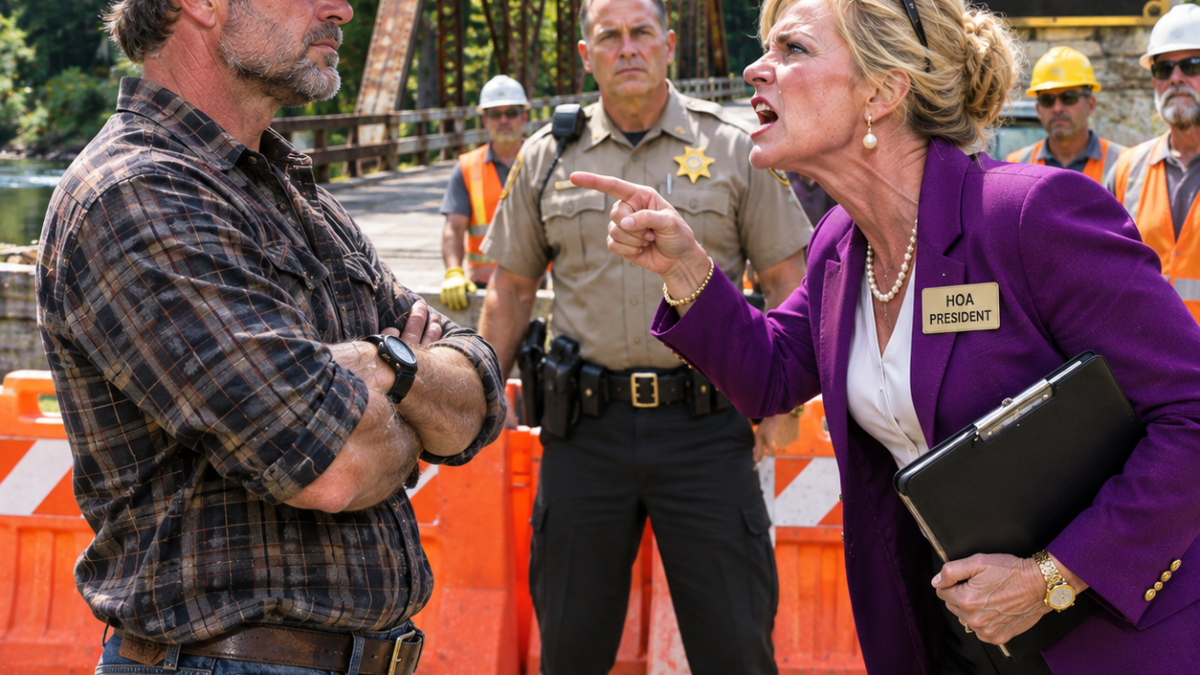
Helena arrived twelve minutes later.
Purple blazer.
Clipboard.
She was dressed for television.
I parked my F-150 on my side of the approach.
Poured coffee.
Leaned against the fender.
Rudy’s crew started unloading.
The first barrier went across the bridge.
Then the second.
Helena pointed.
“All the way.”
Rudy looked toward me.
I raised my coffee.
He came over.
“You Ian?”
“Yes.”
“You okay with this?”
“No.”
He frowned.
“Mrs. Strand said HOA owns the deck.”
“She’s wrong.”
“Permit?”
“Ask her.”
Rudy turned.
“Ms. Strand.”
She walked over.
“What?”
“Can I see county closure authorization?”
“You have my work order.”
“I need traffic-control authorization if this is a public road.”
“It’s private.”
“Then owner authorization.”
“You have it.”
“From you?”
“I represent the owner.”
Rudy looked at me.
I said:
“She doesn’t.”
Helena’s face tightened.
Then a sheriff’s cruiser turned onto the approach.
Lights flashing.
Deputy Kevin Astor stepped out.
Helena smiled instantly.
“Deputy.”
Kevin looked at the bridge.
Then me.
Then orange barriers.
“What’s happening?”
Helena pointed at me.
“That man is trespassing on HOA property and interfering with a lawful closure.”
Kevin looked at me.
“You Ian Cutler?”
“Yes.”
“Any weapons?”
“No.”
“Threats?”
“No.”
Helena said:
“He’s intimidating contractors.”
Rudy immediately said:
“No, he isn’t.”
She glared.
Kevin looked toward me.
“You got anything showing ownership?”
I smiled.
“Actually, yes.”
From the truck I took a certified deed copy.
Handed it over.
Kevin leaned against the hood.
Read.
Page one.
Page two.
Legal description.
Parcel map.
The longer he read, the quieter Helena became.
Then Marcus Bell arrived.
Of course he had brought a briefcase.
Lawyers cannot travel without one.
He walked up.
“Morning.”
Helena looked irritated.
“Who are you?”
“Marcus Bell.”
“I didn’t ask your name.”
“My mother did.”
I almost choked on coffee.
Marcus laid certified documents on the truck hood.
County record.
Parcel map.
License.
No dedication.
Kevin read.
Then looked toward Helena.
“Ma’am.”
“What?”
“This says the bridge belongs to Mr. Cutler.”
“That’s an old clerical issue.”
Marcus replied:
“No.”
“The county owns it.”
“No.”
“Our developer dedicated it.”
“No.”
Helena stared.
Marcus slid over the 1998 agreement.
“Willow Bend residents have been crossing under a revocable access license.”
Her voice became sharp.
“Everyone knows the county owns this bridge.”
Marcus said:
“Everyone knowing something doesn’t make it true.”
Rudy raised one hand.
“I need clarity.”
Kevin nodded.
“Fair.”
Rudy showed Helena her own paper.
“This is HOA letterhead.”
“Yes.”
“This isn’t a closure permit.”
“It doesn’t need one.”
“If he owns the bridge, I need his permission.”
“You have mine.”
Rudy slowly removed his hard hat.
“Ma’am, you are not him.”
That was when Helena lost control.
“Put the barriers in place.”
Rudy didn’t move.
“I’m serious.”
“I know.”
“Finish the job.”
Kevin stepped forward.
“No.”
She turned.
“What?”
“Remove what you already placed.”
Her eyes widened.
“You are taking his side?”
“I’m reading documents.”
“You work for Ridgeway County.”
“Yes.”
“Then enforce county property.”
Kevin held up the deed.
“It isn’t county property.”
She crossed both arms.
“Not one barrier moves.”
I took a sip of coffee.
Then asked:
“What about your second gate?”
She looked at me.
“What?”
“The service gate.”
Her expression changed.
Edna had been right.
“You chained it shut.”
“That is irrelevant.”
“So right now, if you close this bridge, Willow Bend has no accessible vehicle exit.”
“The service road can be opened.”
“Who has the key?”
She said nothing.
Marcus looked at me.
“You planned that question.”
“Maybe.”
Then Kevin’s radio crackled.
Dispatch.
“Unit Twelve.”
Kevin raised it.
“Go.”
“Medical emergency. Willow Bend Estates. Eighty-one-year-old male. Chest pain, diaphoresis, difficulty breathing.”
Everything stopped.
Kevin looked at the bridge.
Dispatch continued:
“Medic Four responding from Highway Nine. ETA approximately six minutes.”
Helena’s face went white.
Kevin asked:
“Secondary access?”
I already knew.
Dispatch:
“Caller advises only normal entrance is Harlan Creek Bridge.”
Nobody moved.
Then Kevin’s radio:
“Patient becoming less responsive.”
I dropped my coffee.
“Rudy!”
He looked at me.
“Drain plugs.”
He understood instantly.
Water-filled barriers weigh hundreds of pounds when full.
Much less empty.
His crew ran.
Helena shouted:
“Do not touch those!”
Nobody listened.
Rudy’s men dropped to their knees.
Opened valves.
Water rushed across the bridge deck.
I grabbed the winch cable from my truck.
Kevin backed his cruiser.
We hooked the first barrier.
“Pull!”
Plastic scraped against concrete.
One moved.
Then another.
Far down Highway Nine, we heard sirens.
Growing louder.
Someone shouted:
“Four minutes!”
Edna Marsh had come down from the neighborhood.
Barefoot except for slippers.
She stood behind the stone gate.
“That’s Roy.”
I looked at her.
“My husband!”
Her voice broke.
The eighty-one-year-old patient was Roy Marsh.
Kevin shouted:
“Second barrier!”
We pulled.
Rudy’s crew shoved.
Water ran over boots.
Helena stood near the shoulder.
Frozen.
For the first time since I met her, she was not issuing orders.
Three minutes.
Ambulance siren closer.
Two barriers remained.
The third shifted.
Then stuck.
Rudy yelled:
“Angle it!”
I backed my truck.
Pulled.
It slid sideways.
“Last one!”
The ambulance appeared beyond the curve.
Red lights.
Siren.
Fast.
We got the final barricade clear with maybe thirty seconds to spare.
Rudy waved the ambulance through.
It crossed Harlan Creek.
Into Willow Bend.
Nobody cheered.
Not yet.
Too scared.
Edna ran after it.
Kevin drove behind.
I stood on the bridge.
Wet boots.
Coffee cup lying upside down.
Helena ten feet away.
I looked at her.
She looked at me.
Neither spoke.
Dozens of Willow Bend residents had gathered near the entrance.
Phones out.
They had filmed everything.
The deed.
The argument.
The closure.
The radio call.
The ambulance.
More importantly, they had heard Helena tell everyone not to move the barriers after learning the road was privately owned.
That mattered.
Roy survived.
I visited the hospital that evening.
Edna hugged me in the hallway.
“He had a heart attack.”
“I’m sorry.”
“They got the artery open.”
“Good.”
She started crying.
“The doctor said another ten minutes…”
She couldn’t finish.
I put both hands around hers.
“You don’t owe me anything.”
She shook her head.
“You opened what she closed.”
That sentence stayed with me.
When I left the hospital, Walter Gaines was standing beside my truck.
Willow Bend treasurer.
Thin.
Navy blazer.
Shaking.
He held a sealed envelope.
“Mr. Cutler.”
“Yes?”
“I need to give you something.”
“What?”
“Something Helena told me to destroy.”
I looked at him.
“When?”
“Three years ago.”
I did not take the envelope immediately.
“What is it?”
“Proof.”
“Of?”
He looked toward the hospital.
“Everything.”
We sat inside my truck.
Walter opened the envelope himself.
First document.
Offer from Harold Cutler.
He had offered to sell Willow Bend the bridge parcel for $150,000.
Fair price.
The board never acted.
Second document.
2021 engineering report.
Same warning Nora had preserved.
Bridge deterioration.
Urgent rehabilitation recommended.
Third.
Financial statements.
Six years.
BRIDGE AND ROAD RESERVE contributions from homeowners.
Total collected:
$410,000.
Current balance:
$38,412.
I looked at Walter.
“Where is the rest?”
His eyes filled.
“I signed checks.”
“To who?”
“Contractors.”
“Which contractors?”
He shook his head.
“I thought.”
“What?”
“I thought they were doing studies.”
“Did you see studies?”
“No.”
“Repairs?”
“No.”
“Inspections?”
“Helena said reports were confidential.”
I stared at him.
Then he handed me the fourth document.
County Resolution 04-117.
Officially accepting Harlan Creek Bridge into county road inventory.
At least that was what the copy said.
County seal.
Signatures.
That explained everything.
Twenty years of residents believing the bridge belonged to the county.
I looked at Walter.
“Where did this come from?”
“Helena’s files.”
“Original?”
“Copy.”
“Board relied on it?”
“Yes.”
I drove straight to County Engineer Carol Whitlow the next morning.
She pulled the official 2004 resolution book.
Page 117.
Then stared.
“What?”
I asked.
Carol looked at me.
“Resolution 04-117 is not bridge acceptance.”
“What is it?”
She turned the book.
AN ORDINANCE REGULATING STRAY ANIMAL IMPOUNDMENT.
I laughed once.
Not because it was funny.
Because sometimes fraud is so stupid it becomes surreal.
Carol compared seals.
Signatures.
Formatting.
The supposed bridge acceptance was fake.
Someone had copied a legitimate county resolution format and changed the body.
“Can you tell when?”
“No.”
“Who?”
“No.”
“Can you certify this is not county-issued?”
“Yes.”
That Monday, Helena filed an emergency court petition.
She accused me of unlawfully obstructing a public road.
Requested injunction.
Damages.
Legal fees.
Judge Ronald Pike heard it.
Packed courtroom.
Willow Bend residents filled the gallery.
Edna sat front row.
Roy beside her wearing a hospital bracelet.
Walter sat on our side.
That mattered.
Helena noticed immediately.
Her attorney was Preston Lowe.
Good reputation.
Expensive suit.
Brown leather folder.
He began confidently.
“Your Honor, this dispute concerns a public bridge historically maintained for the benefit of Willow Bend Estates—”
Marcus stood.
“Historically used, yes.”
Judge Pike looked up.
“Counsel.”
Marcus sat.
Preston continued.
Then Marcus presented our records.
Certified deed.
Parcel map.
1998 license.
No county dedication.
2021 engineering warning.
Actual county resolution.
Then the forged resolution.
He handed Preston the copy.
“Mr. Lowe.”
Preston read it.
His expression changed.
Marcus asked:
“Is this the county acceptance document your client provided you?”
Preston looked at Helena.
She whispered:
“Just argue.”
That microphone did not need to catch it.
Half the courtroom did.
Preston stood.
“Your Honor.”
Judge Pike waited.
“I request a brief recess to confer with my client.”
Granted.
They returned fourteen minutes later.
Preston looked worse.
“Your Honor, I respectfully request leave to withdraw from further representation after today’s emergency proceeding.”
Helena’s face was furious.
Judge Pike denied her requested injunction.
Found no evidence the county owned the bridge.
Recognized my recorded ownership.
Ordered the HOA and its agents not to obstruct access.
Then he said:
“The record presented raises substantial questions concerning what appears to be a false county instrument.”
He looked toward the clerk.
“I am referring the matter to the state attorney general and district attorney.”
Helena marched out.
Heels striking the courthouse tile like gunshots.
A man in a dark windbreaker waited in the hallway.
“Ms. Strand?”
She stopped.
“Thomas Brewer. Attorney General’s Office.”
She turned pale.
“I’d like to speak with you regarding Resolution 04-117.”
She walked away.
He followed.
The criminal investigation moved faster after that.
Not because of courtroom drama.
Because money leaves tracks.
The $410,000 bridge reserve had not vanished.
It had been transferred through twenty-three checks to:
STRAND PROPERTY SERVICES LLC.
Owner:
Helena Strand.
Walter sat beside Investigator Brewer when they showed him.
He put his face in both hands.
“I signed those.”
Brewer asked:
“Why?”
“She brought invoices.”
“For?”
“Bridge engineering.”
“Did you verify?”
“No.”
“Road studies?”
“No.”
“Maintenance?”
“No.”
Walter started crying.
“She said I was slowing everything down.”
I understood.
Not excuse.
Mechanism.
People like Helena rarely do every fraudulent act themselves.
They make other people participate incrementally.
Sign this.
Approve that.
Trust me.
You’re being difficult.
Everyone else already agreed.
By the time somebody realizes what is happening, their own signature is on the paper.
Walter cooperated completely.
Then investigators found the name Garrett Voss.
Original Willow Bend developer.
He had sold most of his interest years earlier.
But emails showed he had worked with Helena to preserve the illusion that the bridge was public.
Why?
Because permanent legal access mattered enormously to property values.
If buyers learned the neighborhood depended on revocable permission across privately owned land, lenders and insurers might ask questions.
So the fake county resolution solved the problem.
Paper created certainty.
Or seemed to.
Helena had also hidden the 2021 safety report because acknowledging deterioration might force the HOA to spend reserve money that no longer existed.
That was the ugliest part.
Not the forgery.
Not even the theft.
The bridge warning.
For three years, loaded fuel trucks crossed steel she knew had been flagged.
School buses.
Delivery trucks.
Ambulances.
Families.
She did not merely steal money.
She gambled with everyone who trusted that bridge.
Friday afternoon, Helena made the mistake that ended any chance of explaining the first forgery away.
She went to the recorder’s office.
Carrying a new document.
CORRECTIVE COUNTY ACCEPTANCE.
Joan Pratt received it.
Read.
Stamped the intake copy.
Then said:
“Ms. Strand, would you wait here a moment?”
Helena waited.
Tapped her heel.
Checked her phone.
The glass door opened.
Tom Brewer entered with two deputies.
Joan looked at Helena.
“Ms. Strand, this document purports to correct a county action that never occurred.”
Helena said nothing.
Brewer held out his hand.
“Please step away from the counter.”
She tried:
“My attorney prepared this.”
Brewer asked:
“Which attorney?”
Silence.
Joan pointed toward the ceiling camera.
“You also just submitted it for recording on video.”
That was forgery number two.
Garrett Voss was detained the same afternoon.
The next night, Willow Bend held an emergency meeting.
All 212 homes had been notified.
The clubhouse was packed.
People stood along the walls.
Some angry.
Some frightened.
Some embarrassed.
The board resigned one member at a time.
President’s chair empty.
Vice president gone.
Secretary gone.
Two directors gone.
Walter remained.
He stood in front.
Placed the gavel on the table.
“I failed you.”
Nobody moved.
“I did not steal your money.”
His voice shook.
“But I signed checks I did not verify.”
He looked toward Edna.
“I believed Helena when I should have asked for proof.”
Then at everyone.
“I will cooperate with every investigation.”
He handed the gavel to Edna.
“I’m sorry.”
Someone shouted:
“What about the bridge?”
Everyone turned toward me.
I was standing in the back.
That was the moment I could have become exactly what Helena had accused me of being.
The outsider controlling their road.
Legally, I had options.
Terminate the license.
Charge significant tolls.
Force the HOA to negotiate from weakness.
Maybe extract a large payment.
Two hundred twelve homes depended on one structure I owned.
That is leverage.
Real leverage.
I walked to the front.
Edna asked:
“Mr. Cutler, what happens now?”
Silence.
I looked around.
Families.
Older residents.
Children sitting on the floor.
Roy Marsh beside his wife.
A man who had nearly died because their president turned access into a power game.
Then I remembered Harold Cutler’s note.
Ownership gives responsibility before it gives power.
I said:
“The bridge stays open.”
Several people exhaled.
“I’m not using it as a weapon.”
Silence.
“We need repairs.”
Heads nodded.
“We need permanent legal access.”
More nods.
“We need money.”
Less enthusiasm.
A few nervous laughs.
I continued:
“My proposal is simple.”
“Willow Bend gets a permanent recorded easement.”
“The cost comes from recovered reserve funds and insurance where available.”
“I contribute the engineering management at no fee.”
“County oversees rehabilitation.”
“And when the bridge meets county standards, I will offer the bridge parcel to the county for dedication.”
Nobody spoke.
Then Roy Marsh started clapping.
Hospital bracelet still on.
Edna joined.
Then Walter.
Then the whole room.
I hated every second of the applause.
But I understood it.
Repair took eleven weeks.
More steel than expected.
Bearing replacement.
Gusset reinforcement.
Deck work.
Drainage.
Load testing.
The engineer in me came alive again.
I spent mornings on site.
Not because contractors needed me.
Because after selling my company, I had missed steel more than I admitted.
Willow Bend residents brought food.
At first awkwardly.
Then routinely.
Coffee.
Sandwiches.
Pie.
Children made a banner.
BRIDGE CREW = BEST CREW.
Rudy Salazar’s men hung it on the fence.
Edna brought peach cobbler every Friday.
Roy came in a folding chair.
He had lost weight after the heart attack.
But he watched.
“Never thought I’d be grateful to a man who owns the road out of my neighborhood.”
I said:
“I’m trying not to take that personally.”
He smiled.
“You saved my life.”
“No.”
“Ambulance did.”
“You opened the bridge.”
“We all opened it.”
He looked toward the workers.
Then nodded.
On opening morning, sunlight hit new steel.
Fresh deck.
Repaired bearings.
New load-rating signs.
The county engineer signed off.
We held no fancy gala.
Just residents.
Crew.
County officials.
Coffee.
Roy and Edna cut a ribbon.
A brass plaque was mounted near the approach.
HARLAN CREEK BRIDGE
REBUILT BY NEIGHBORS
SAFE PASSAGE IS A SHARED RESPONSIBILITY
Nobody put my name on it.
That was my condition.
Helena’s case took longer.
Forgery.
Theft by deception.
False instruments.
Misappropriation of reserve funds.
Other related charges.
She eventually pleaded guilty.
Restitution ordered.
Prison sentence.
Permanent prohibition on holding fiduciary positions connected to community associations under the terms of her judgment.
Garrett Voss faced separate charges and penalties for his part in the fraudulent county records and development representations.
Homeowners recovered part of the stolen reserve through restitution, insurance, asset seizure, and settlement.
Not every dollar appeared instantly.
Real recovery never works like that.
But the bridge got fixed.
The records got corrected.
The neighborhood gained permanent legal access.
And everyone learned what they actually owned.
The last time I saw Helena was sentencing day.
Deputies were preparing to lead her out.
She turned toward me.
“You could have taken everything.”
I knew what she meant.
I could have exploited their dependence.
Charged.
Closed access.
Forced sales.
Used the same leverage she had tried to use against me.
I answered:
“Helena, I only took what the deed gave me.”
She looked at me.
“You lost the rest yourself.”
She looked away first.
That night, I went home.
Opened Nora’s old folder again.
I had read Harold’s note many times by then.
But something about that day made it different.
To whoever owns this bridge next:
Never lock it against the people who need it.
Lend it.
Fix it.
Sleep well.
I sat at the kitchen table.
Read it three times.
Then called Nora.
She answered slowly.
“Ian?”
“Yes.”
“Bridge fall down?”
“No.”
“Then why are you calling?”
I laughed.
“You knew.”
“Knew what?”
“That Willow Bend thought they owned it.”
Silence.
“Nora.”
“My father worried.”
“About what?”
“He saw what subdivisions do.”
“That sounds ominous.”
“He didn’t hate them.”
She coughed.
“He just knew once two hundred families used something every day, people would eventually forget it belonged to somebody.”
“That’s exactly what happened.”
“I know.”
“Why didn’t you correct it?”
“We tried.”
“Who?”
“Dad.”
“Helena?”
“Before her.”
Nora sighed.
“People liked believing the county owned it.”
“Why?”
“Because public roads feel permanent.”
I understood.
“Dad offered to sell the bridge.”
“I saw.”
“Board ignored him.”
“Yes.”
“He thought eventually somebody would use ownership to hurt the residents.”
I looked at the handwritten note.
“Instead, their president did.”
Nora was quiet.
Then:
“What did you do?”
“I gave them permanent access.”
Pause.
Then she said:
“Good.”
Nothing more.
That was enough.
I thought buying 2,400 acres would give me silence.
It did eventually.
But first, it taught me something about power.
Property ownership is power.
So is being HOA president.
So is controlling a budget.
So is holding a county seal.
So is knowing which gate opens.
None of those things tell you what you should do.
Only what you can do.
Helena confused the two.
She believed authority justified itself.
She was president, therefore she was right.
The board obeyed, therefore her instructions were valid.
Residents paid reserve assessments, therefore she could decide where the money went.
People crossed the bridge for decades, therefore the HOA must own it.
Everyone knows became evidence.
That phrase should frighten you.
Everyone knows.
The county owns it.
Everyone knows.
The reserve is being used correctly.
Everyone knows.
The bridge is safe.
Everyone knows.
Helena has the authority.
Nobody checked.
Joan Pratt checked.
Marcus checked.
Carol checked.
Walter finally checked.
Residents finally checked.
That is how the truth came apart from the story they had been told.
One page at a time.
After repairs, the county began the process to accept the bridge formally.
Properly.
Engineering review.
Public meeting.
Legal description.
Survey.
Recorded easement.
Actual signatures.
Real resolution.
Real seal.
I attended the county commission meeting.
When the chairman asked for public comment, I stood.
“My name is Ian Cutler.”
One commissioner smiled.
“We know.”
People laughed.
I continued:
“I support county acceptance.”
Then held up a copy of the proposed resolution.
“And for everybody’s peace of mind, I checked the number.”
More laughter.
Carol Whitlow shook her head.
The resolution passed unanimously.
This time it really was about a bridge.
No stray animals.
I donated the bridge parcel after final acceptance.
People told me I gave away valuable property.
Maybe.
But what value?
A strip of roadway.
Steel.
Concrete.
Liability.
Power over 212 families.
I did not need that kind of power.
I had enough land.
Enough money.
Enough quiet.
I kept the surrounding acreage.
The bridge became public.
Exactly what people had believed for decades.
Only now it was true.
Willow Bend changed too.
Not magically.
HOAs remain HOAs.
People still argued about paint colors.
Mailbox styles.
Fence heights.
One meeting apparently lasted ninety minutes over inflatable holiday decorations.
That comforted me.
Ordinary nonsense meant nobody was forging county documents.
Edna eventually became board president.
She hated the title.
“That woman ruined the word president for me.”
I said:
“Call yourself bridge queen.”
“No.”
“Supreme commander?”
“No.”
“Neighborhood dictator?”
She pointed toward the door.
“Leave.”
She was good at the job.
First rule she proposed:
Every major HOA expenditure posted online.
Second:
Two signatures on checks.
Third:
Any reserve expenditure over $10,000 required independent documentation.
Fourth:
Annual bridge and road reports.
Fifth:
Any resident could inspect financial records with reasonable notice.
Boring safeguards.
That is what honest systems mostly look like.
Boring.
Walter stayed long enough to testify.
Then resigned.
Some residents never forgave him.
Others did.
He moved away two years later.
Before leaving, he stopped at my farm.
“I’m selling.”
“I heard.”
“My daughter wants me closer.”
“Probably good.”
He looked toward the bridge.
“I still see those checks.”
I knew what he meant.
“You cooperated.”
“After.”
“Yes.”
“Should’ve been before.”
“Yes.”
He looked at me.
“You don’t make people feel better.”
“I built steel.”
“Not therapy.”
He laughed.
Then became serious.
“I signed because saying no to Helena made every meeting miserable.”
I waited.
“She’d call.”
“Email.”
“Threaten removal.”
“Tell everybody I was obstructing progress.”
He looked down.
“Eventually signing felt easier.”
That is how a lot of damage happens.
Not because everyone is corrupt.
Because one person is exhausting.
And everyone else starts paying for peace.
I said:
“Next board?”
“What?”
“If someone tells you signing is easier than checking?”
He smiled sadly.
“I’ll check.”
“Good.”
Nora died at eighty-six.
Her family invited me to the funeral.
Afterward, her daughter gave me another envelope.
Inside was an old photograph.
Harlan Creek Bridge.
Probably 1960s.
Harold Cutler standing beside it.
Young.
Work boots.
One hand on the railing.
Back of the photo:
A bridge is only useful if somebody can cross it.
I framed that.
It hangs above my desk.
Years after Helena, I still walk the bridge sometimes at sunrise.
Old habit.
Coffee.
Harlan Creek underneath.
Cars passing.
School bus.
Delivery vans.
Residents.
Nobody knows who owns the steel anymore because the county does.
Perfect.
Sometimes Edna stops.
She still brings pie.
Roy lived another six years after his heart attack.
Every time he saw me, he pointed at his chest and said:
“Borrowed time.”
I always answered:
“County property now.”
He laughed.
When Roy died, Edna left a note at my gate.
Thank you for six extra years.
I kept that too.
Not because I believe I saved him.
I didn’t.
Paramedics did.
Doctors did.
Rudy did.
Kevin did.
Everyone who moved a barrier did.
But the note reminds me why access matters.
Helena saw the bridge as authority.
I eventually saw it as obligation.
Those are opposite ways to look at the same thing.
A locked gate says:
I can stop you.
A bridge says:
You can get through.
That sounds sentimental.
Maybe it is.
I spent thirty years building steel.
You learn that structures reveal purpose.
Walls resist.
Roofs shelter.
Columns carry.
Bridges connect.
The moment you use a bridge mainly to control who cannot cross, you are fighting what the structure was built to do.
Helena never understood that.
She tried to turn Harlan Creek Bridge into a weapon against me.
Then almost turned it into a trap around 212 families.
All because she could not tolerate the idea that something she had controlled for years did not legally belong to her.
Her mistake was not merely arrogance.
It was confusing use with ownership.
Willow Bend used the bridge.
That did not mean they owned it.
Residents paid into a bridge fund.
That did not mean Helena could spend it.
The HOA maintained an entrance sign.
That did not make the road theirs.
Everybody believed a county resolution existed.
That did not make the forged paper real.
Use is not title.
Confidence is not proof.
History is not automatically law.
And permission is not ownership.
I learned those distinctions from lawyers.
But Harold’s handwritten note explained the bigger one.
Ownership is not the same as entitlement.
Legally, I could have made life extremely difficult for Willow Bend.
I chose not to.
People sometimes congratulate me for that.
I’m not sure they should.
Not abusing power should be normal.
But power is strange.
Once people discover they have leverage, they start inventing reasons why using it would be justified.
Helena embarrassed me.
They threatened arrest.
They blocked my bridge.
They cost me legal fees.
Residents believed her.
I could have charged them.
Punished them.
Made them pay.
Maybe some people would have called that fair.
But the people who needed the bridge were not Helena.
They were Edna.
Roy.
Children.
Families.
Delivery drivers.
Paramedics.
Nurses.
Workers.
Two hundred twelve households who bought homes believing the road was secure because somebody had shown them fake county paperwork twenty years earlier.
Punishing them would not have been justice.
It would have been a new abuse built on top of the old one.
That is why I donated the bridge.
Not generosity.
Closure.
I did not want to wake every morning owning a road that could decide whether somebody reached a hospital.
I already knew what that felt like once.
Enough.
The 2,400 acres remain mine.
Mostly pasture.
Some timber management.
One restored barn.
Two ponds.
I lease grazing ground.
Grow hay.
Walk more than I ever did running a steel company.
My phone is quiet now.
Usually.
Occasionally Edna calls.
“You coming to the meeting?”
“No.”
“We need somebody who understands roads.”
“You have county engineers.”
“You understand people.”
“Definitely not.”
She hangs up on me.
I like her.
One autumn afternoon, a new Willow Bend resident drove onto my farm by mistake.
Young father.
Two kids.
GPS sent him down an old service lane.
He apologized.
“I thought this connected to the subdivision.”
“It used to.”
“Am I trespassing?”
“Technically.”
His face tightened.
I smiled.
“You’re fine.”
Then his daughter pointed toward the creek.
“Is that the famous bridge?”
I looked at him.
He groaned.
“They teach the story now.”
“What story?”
“HOA orientation.”
I laughed.
Apparently Willow Bend’s new resident packet included a one-page history of the bridge.
Not Helena’s crimes.
Just legal access.
County ownership.
Maintenance responsibility.
Emergency routes.
And a final line:
NEVER BLOCK HARLAN CREEK BRIDGE WITHOUT COUNTY AUTHORIZATION.
Good policy.
The girl asked:
“Did you really own it?”
“For a while.”
“Why did you give it away?”
Her father looked embarrassed.
“Sweetheart.”
“No.”
I thought about it.
“Because everybody needed it more than I needed to own it.”
She nodded like that made perfect sense.
Children often understand things adults spend decades turning into litigation.
Before they left, the boy asked:
“Did the bad lady go to jail?”
His father closed his eyes.
I said:
“She got in trouble because she lied and took money that wasn’t hers.”
“Was she mean?”
“Sometimes.”
“Were you mean back?”
I almost laughed.
“I tried not to be.”
He considered.
“That’s hard.”
“Yep.”
That may have been the most accurate summary of the entire case.
Restraint is hard.
Owning something gives you options.
Anger gives you reasons.
Fear gives you urgency.
But having a reason to hurt somebody back does not always make hurting them useful.
The morning Helena blocked the bridge, I had written stay calm on a napkin.
I kept that napkin too.
Coffee stain.
Blue ink.
Two words.
It sits in the same folder as Harold’s note.
People ask why.
Because paper saved us more than once.
The deed.
The access license.
The inspection report.
The real county resolution.
The fake one.
Walter’s financial statements.
The court order.
The new easement.
The final county acceptance.
People love saying actions speak louder than words.
Sometimes.
But in land disputes, words recorded correctly can stop bulldozers.
Or expose fraud.
Or prove ownership.
Or save a neighborhood from depending on somebody’s memory of what “everyone knows.”
I built steel.
Marcus built arguments.
Joan maintained records.
Carol maintained infrastructure.
Kevin maintained order.
Everybody had a role.
The bridge survived because eventually enough people did theirs.
That is how systems should work.
Not because one heroic person appears.
Because the survey is accurate.
The deed is real.
The clerk checks.
The deputy reads.
The engineer inspects.
The contractor asks for authorization.
The treasurer finally tells the truth.
The judge compares documents.
The investigator follows the money.
Boring competence defeats a surprising amount of corruption.
Helena thrived because people stopped checking.
She ended when they started.
That is the second lesson I kept.
The first came from Harold.
Never lock it against people who need it.
The second came from Joan Pratt.
Ask to see the record.
Years later, the county replaced the small brass plaque with a larger one during a bridge-history project.
It now reads:
HARLAN CREEK BRIDGE
ORIGINAL STRUCTURE 1922
REHABILITATED THROUGH COMMUNITY AND COUNTY PARTNERSHIP
PUBLIC ACCESS DEDICATED 2025
Below that, in smaller letters:
A BRIDGE BELONGS TO EVERY JOURNEY IT SAFELY CARRIES.
I did not write that line.
Wish I had.
Sometimes at sunrise, I park the truck nearby.
Not the original F-150 anymore.
That one finally died.
I still use the same coffee cup.
Cars cross.
Nobody slows.
Nobody thinks about deeds.
Good.
That means the legal structure underneath everyday life is working.
Most people should not need to know who owns the bridge they cross on the way to work.
They should only need to know it is safe and open.
The fact that Willow Bend once almost lost that certainty because one woman wanted control still bothers me.
But it also taught the neighborhood something valuable.
Ask where the reserve money is.
Ask who owns the infrastructure.
Ask whether the emergency exit actually opens.
Ask whether the paper somebody waves at you is real.
And if somebody answers, “Everyone knows,” ask again.
The morning Helena Strand told a sheriff’s deputy to arrest me, she believed certainty could substitute for ownership.
Twelve minutes later, an ambulance siren proved something else.
The bridge was never really about who could keep somebody off it.
It was about who could get across when seconds mattered.
I bought 2,400 acres looking for silence.
Instead, I inherited a bridge, a forged county record, a missing reserve fund, 212 frightened families, and a lesson I didn’t know I needed.
Power is not measured by how effectively you can close a gate.
Sometimes the strongest thing you can do with power is make sure the gate stays open.


