I Asked a Feared Biker for the Food He Wasn’t Eating—Then the Wheelchair-Bound Club President Gave Me One Chance to Change His Life.
PART3:
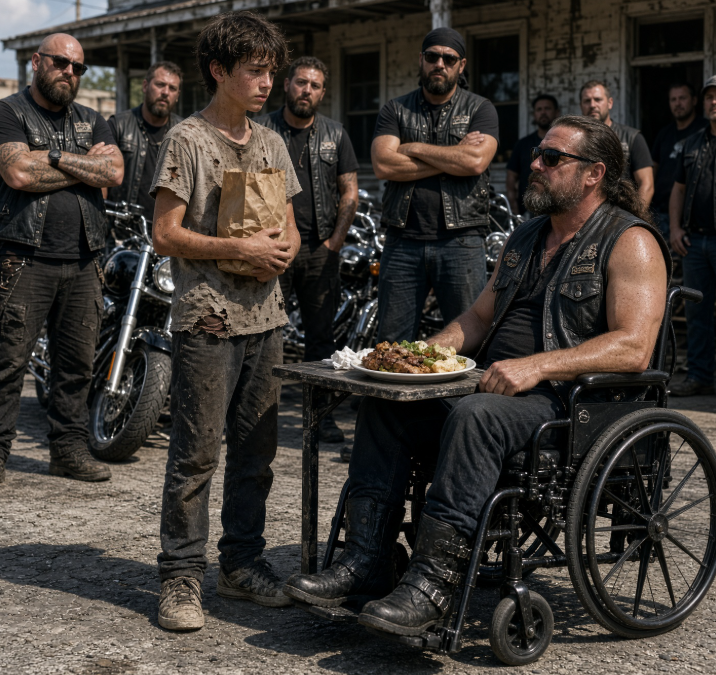
He sat with his wheelchair angled beside a black Harley that looked like it had been built for a king who never planned to kneel. His leather vest hung open over a dark shirt. Silver streaked his beard. Sunglasses hid his eyes, but I felt his attention before I saw his face turn.
Two large bikers stood near him.
One had a beard down to his chest.
The other had arms as thick as fence posts.
Between them, on the table beside Jack, sat a plate of food.
Pulled pork.
Cornbread.
Fries.
Untouched.
My stomach cramped so sharply I almost stopped walking.
I wanted to ask for it.
I couldn’t.
Begging does something to you after a while. Not because asking for help is shameful. I knew that now. But because of the way people look at you when they decide whether your hunger deserves their inconvenience.
I had seen women pull children closer when I approached.
I had seen cashiers follow me down aisles.
I had seen church volunteers smile while asking too many questions about where I slept and why my clothes were dirty, then offer to pray instead of offering food.
So I did not beg.
I offered a trade.
“Sir,” I said, forcing my voice steady, “I think I can help you get stronger.”
One biker laughed immediately.
The big one with the beard.
The laugh rolled out of him like thunder, loud enough that two men near the door turned to look.
Jack did not laugh.
His head tilted slightly.
His sunglasses moved over me, from my torn shirt to my worn sneakers, from the paper bag clutched under my arm to my face.
“And what exactly do you want?” he asked.
His voice was lower than I expected.
Not loud.
Not friendly.
Controlled.
I looked at the plate before I could stop myself.
“The food you’re not eating.”
For several seconds, no one spoke.
Inside the bar, someone laughed at something unrelated. A glass clinked. A motorcycle rolled past on the road beyond the lot. Sweat ran down the side of my face, and I was suddenly aware of how ridiculous I looked standing there pretending this was a business negotiation.
Then Jack Mercer laughed.
Not cruelly.
Not kindly either.
It was the laugh of a man who had heard every promise in the world and buried most of them.
“Kid,” he said, “I’ve paid specialists more money than you’ve probably seen in your entire life.”
“I know.”
“And you think you can do better?”
“No, sir.”
That surprised him.
I saw it in the way his chin lifted.
The bearded biker stopped smiling.
“No?” Jack repeated.
“No, sir. I can’t undo your accident. I’m not promising you’ll walk. I’m not promising miracles.”
“Then what are you promising?”
I shifted the paper bag higher under my arm.
“I’ve spent months studying rehabilitation exercises, stretching techniques, mobility work, nerve stimulation, muscle strengthening, adaptive training, and post-spinal-injury conditioning.”
The biker with fence-post arms snorted.
“From where? TikTok?”
“The public library,” I said.
That earned another laugh from someone behind me.
My ears burned, but I kept going.
“There are medical books. Physical therapy textbooks. Manuals. Videos on the library computers. Some of them are old, but the principles are still useful. I know how to check for residual muscle activation. I know basic range-of-motion work. I know how to build strength around what still responds.”
Jack watched me.
I knew how I sounded.
A homeless fourteen-year-old boy standing in ruined sneakers outside a biker bar telling a millionaire motorcycle club president that library books might help where expensive doctors had failed.
But hunger had burned away my fear until only desperation and truth remained.
“I can’t fix you,” I said. “But maybe I can help you get stronger.”
Then my stomach betrayed me.
It growled so loudly the bearded biker glanced away as if embarrassed for me.
Jack did not look away.
Something in his expression changed.
Not pity.
I hated pity.
This was sharper.
His gaze dropped to the wrinkled paper bag pressed against my chest.
“Why does a fourteen-year-old spend his summer studying rehabilitation instead of hanging out with friends?”
I could have lied.
I had gotten good at lying in small ways.
I’m fine.
I already ate.
My aunt is picking me up.
I live nearby.
My mom is coming.
But some lies taste worse when you are hungry.
I looked past him at the motorcycles.
“The library is free.”
Jack became completely still.
That answer landed somewhere I had not aimed.
For one strange moment, everything I had left in the world seemed balanced on what this man decided to do next.
I expected him to hand me the plate.
Maybe twenty dollars.
Maybe nothing.
Instead, Jack gripped the wheels of his chair.
He rolled toward me until we were only a few feet apart, and the bikers around him stopped talking.
His sunglasses came off.
His eyes were gray.
Not soft.
Not cruel.
Tired in a way that looked older than his face.
“Forget the food for a second, kid.”
My heart started pounding.
Jack leaned forward.
“If I actually gave you one chance, what would you do first?”
That was when I understood.
He wasn’t offering charity.
He was testing me.
And whatever came out of my mouth next could change both our lives.
I swallowed hard and pointed toward his right leg.
“First, I’d check what still works.”
One of the bikers snorted.
Jack raised a hand, and the laughter stopped instantly.
It was the first time I saw what power looked like when it did not need to shout.
“How?” Jack asked.
“I’d start low. Voluntary activation. Nothing fancy.”
“Speak English.”
“I’d ask you to push your foot against my palm.”
The bearded biker stepped forward.
“You’re not touching him.”
Jack did not look at him.
“Back up, Boone.”
Boone’s jaw tightened, but he stepped back.
I crouched in front of Jack’s chair. My knees cracked because I had slept under a loading dock the night before and my body still felt stiff from concrete. Up close, Jack’s boots were expensive, worn but cared for. His right foot sat angled slightly outward.
I placed my palm against the sole.
“Push down like you’re pressing a gas pedal.”
He stared at me.
Nothing happened.
“Again,” I said.
“Kid—”
“Again.”
The word came out stronger than I intended.
Boone shifted.
Jack’s eyes narrowed.
Then he tried again.
Nothing.
I moved my hand to the side of his foot.
“Turn inward.”
Nothing.
“Outward.”
A flicker.
Maybe imagination.
Maybe my own hunger making me see things.
I sat back on my heels.
“Again.”
Jack’s face changed.
He had felt it too.
He tried again.
This time the muscle fired faintly beneath my hand.
Not enough to move much.
Not enough for drama.
But enough for information.
I moved higher.
“Knee.”
I placed my fingers lightly above his kneecap and asked him to tighten his thigh.
For three seconds, nothing.
Then a tremor.
Small.
So small the bikers standing above us missed it.
Jack did not.
His jaw tightened.
“Again.”
This time the quadriceps responded more clearly.
The muscle twitched under my fingers like something waking up angry after a long sleep.
I forgot hunger for the first time all day.
I leaned closer, checking position, watching his face, watching the muscle.
“Your body hasn’t quit,” I said. “Some of it is still answering.”
The words slipped out before I could soften them.
Jack stared at me for a long moment.
Then he reached back, grabbed the untouched plate, and shoved it into my hands.
“Eat.”
I did not argue.
I ate like an animal trying not to look like one.
The pulled pork was cold, the cornbread too sweet, the fries soggy from sitting out, and it was the best meal I had ever tasted. I tried to slow down twice and failed. Sauce got on my fingers. I wiped it on the napkin, then licked the napkin when no one was watching, except Jack was watching everything.
When the plate was empty, shame rose in me faster than fullness.
“Thank you,” I said.
Jack rolled backward and jerked his head toward the open door.
“Inside.”
I froze.
Boone looked at him.
“Jack.”
“Inside,” Jack repeated.
Nobody argued the second time.
The clubhouse went quiet when I entered.
It smelled like beer, leather, cigarette smoke that had soaked into the walls years earlier, fried food, engine oil, and old wood. Men at the bar turned on their stools. A woman with tattoos down one arm paused while wiping glasses. Two younger bikers playing pool lowered their cues.
I tightened my grip on the paper bag.
Jack rolled across the room like a king moving through a court that did not fully understand his decision.
“Room in back,” he said.
We followed him through a hallway lined with framed club photos: motorcycles outside diners, charity rides, men shaking hands with mayors, funeral processions, newspaper clippings. At the end was a room that looked like a small gym.
Dust coated most of it.
Resistance bands hung from hooks.
A therapy table sat against one wall.
Parallel bars ran down the center.
There were free weights, medicine balls, a stationary hand bike, a set of pulleys, balance pads, mirrors, and equipment I recognized from books but had never touched in real life.
Jack stopped in the doorway.
“This was built after the accident,” he said. “I stopped using it three years ago.”
I looked at the dust.
“Why?”
His expression hardened.
“Because everyone kept lying to me.”
I understood that feeling better than I wanted to admit.
Lies told with kindness are still lies.
You’re improving.
You look better.
There’s hope.
She’s stable.
We’re doing everything we can.
Your mother would want you to be strong.
Strong, I had learned, was what adults called children when they wanted them to suffer quietly.
I set my paper bag carefully against the wall.
For the next hour, I showed Jack Mercer what I knew.
Not miracles.
Not magic.
Basics.
I asked him questions first.
Where did he have sensation?
What kind?
Sharp?
Pressure?
Temperature?
Pins and needles?
Could he activate glutes?
Hamstrings?
Quads?
Hip flexors?
Did spasms happen?
When?
What medications?
What pain?
What fatigue?
He answered at first like a man tolerating nonsense.
Then, little by little, he began answering like a man listening.
Boone stayed by the door with his arms crossed. The other biker, whose name I learned was Tuck, watched more quietly. A few club members gathered outside the room, pretending not to stare.
I showed Jack simple resistance work.
Press into my hand.
Hold three seconds.
Release.
Again.
Again.
Rest.
Quad set.
Heel slide attempt.
Assisted range of motion.
Seated core activation.
Breathing.
Posture.
Scapular engagement.
I corrected his form once without thinking.
“Don’t cheat with your shoulder.”
The room went silent.
Boone looked like he expected me to die.
Jack slowly turned his head toward me.
“What did you say?”
My mouth went dry.
“You’re shifting through your shoulder instead of activating your trunk.”
Tuck made a coughing sound that might have been a laugh.
Jack stared at me another second.
Then he looked forward.
“Fine. Again.”
By sunset, sweat darkened Jack’s shirt.
His face looked drawn with exhaustion, but his eyes were different.
Not hopeful exactly.
Hope is dangerous when it comes back too fast.
But awake.
Twice, his right quadriceps responded clearly.
Once, his left hip flexor gave the faintest contraction when I asked him to try lifting his knee.
Nothing miraculous happened.
He did not stand.
He did not walk.
No music swelled.
No men cried.
But Jack Mercer looked alive in a way he had not when I found him under the awning.
Then he noticed my paper bag beside the wall.
“What’s in there?”
My body went cold.
“Clothes.”
“That all?”
I nodded.
His voice changed.
“Where are your parents?”
I looked away.
Before I could answer, the clubhouse door opened somewhere down the hall.
Voices shifted.
A woman spoke sharply.
“I know where his office is, Boone. Move.”
Boone muttered, “Doc—”
“I said move.”
Footsteps approached.
A woman stepped into the gym wearing navy hospital scrubs, a white coat folded over one arm, and a leather bag slung across her body. She was maybe late thirties, with dark auburn hair pulled into a low ponytail and tired green eyes that looked like they had spent too many nights reading bad news from scans.
The moment she saw me, she froze.
“Eli?”
My stomach dropped.
I knew her.
Dr. Mara Bennett.
The neurologist who had treated my mother before she died.
For a second, I was no longer in a biker clubhouse. I was twelve years old again, sitting in a hospital corridor with vending-machine crackers in my hand while Dr. Bennett knelt in front of me and said my mother needed rest but still knew I was there.
Jack looked between us.
“You two know each other?”
Dr. Bennett’s face went pale.
Then she looked at Jack.
“This boy didn’t learn rehabilitation from library books alone.”
I stopped breathing.
She reached slowly into her bag and pulled out an old medical file.
My mother’s name was written across the front.
Claire Hart.
Then she said the words I had spent two years trying to forget.
“Jack, his mother was researching your exact spinal injury before she died.”
No one moved.
The gym seemed to shrink around us.
Jack’s eyes shifted from the file to me.
“My injury?”
Dr. Bennett nodded.
“And not generally. Specifically. Your trauma pattern. Your surgical history. Your failed rehabilitation protocols. Your nerve response records. She had access to information she should never have had.”
I stood so fast the room tilted.
“That’s not true.”
Dr. Bennett looked at me with something like pain.
“Eli.”
“My mother was a nurse.”
“She was more than that.”
“No.”
The word came out small and sharp.
Because I knew what happened when adults started rewriting the dead.
They turned people into symbols, secrets, warnings, saints, burdens. My mother had already lost enough. I did not want them taking the simple truth of who she was.
She made oatmeal too watery.
She sang off-key while cleaning.
She smelled like peppermint lotion and hospital soap.
She fell asleep with medical journals open on her chest.
She forgot to eat when she was thinking too hard.
She kissed the top of my head every time she passed behind me, even when she was exhausted.
She was my mother.
Not Jack Mercer’s secret.
Not anyone’s file.
Dr. Bennett opened the folder.
“She was a rehabilitation researcher before she left the program. A brilliant one. She worked under a grant connected to Mercer Medical Technologies.”
Jack’s face hardened.
“Mercer Medical was my foundation.”
“It was supposed to fund adaptive equipment,” Dr. Bennett said. “But one department was studying spinal recovery methods, nerve stimulation, and muscle reactivation in chronic paralysis cases. Your case became the model after your accident.”
“I never approved that.”
“I know.”
The words hit the room like a door slamming.
Jack rolled closer.
“What do you mean, you know?”
Dr. Bennett looked at me.
Then at the bikers.
“This is not a conversation for a hallway full of armed men.”
Jack’s voice turned quiet.
“That means it absolutely is.”
Dr. Bennett held his stare.
“Your accident created an opportunity. Your medical data was valuable. Someone inside your foundation allowed private researchers to access it without proper consent. Claire Hart found out. She objected. Then she left. Two years later, she was dead.”
My hands went numb.
“She had cancer,” I said.
Dr. Bennett turned to me.
“Yes.”
“But?”
Her silence was enough.
“No,” I whispered.
“Eli—”
“No.”
I grabbed my paper bag.
Boone blocked the door without thinking.
I flinched so hard he stepped back.
Jack saw it.
His head turned slowly toward Boone.
“Move.”
Boone moved.
But I did not make it out.
My legs folded before I reached the hall. Hunger, heat, fear, the full plate eaten too fast, the hour of work, the shock of my mother’s name in that room—all of it caught up at once. The floor tilted sideways.
I heard Dr. Bennett say my name.
Then everything went dark.
When I woke, I was on a leather couch in Jack Mercer’s office.
A fan turned slowly overhead. The room smelled of old books, tobacco, and rain even though the sky outside was still bright. Someone had put a cold cloth on my forehead and a blanket over me.
My paper bag sat on the floor beside the couch.
Untouched.
I checked before I let myself breathe.
Jack sat behind a massive wooden desk, not in his wheelchair now but transferred into a high-backed chair. Dr. Bennett stood near the window. Boone and Tuck were outside the glass door, pretending they were not guarding it.
On the desk was my mother’s file.
I sat up too fast.
“Easy,” Dr. Bennett said.
“Don’t.”
She stopped.
Jack watched me carefully.
“You fainted.”
“I’m fine.”
“You’re fourteen years old, carrying your life in a paper bag, and you inhaled barbecue like a prisoner. You are not fine.”
Anger warmed my face.
“I didn’t ask for your opinion.”
“No,” Jack said. “You asked for my leftovers.”
That should have humiliated me.
It did.
But there was no cruelty in his voice. Only fact.
I looked away.
“I paid for them.”
His brow lifted.
“With what?”
“Work.”
He leaned back.
“That you did.”
Dr. Bennett sat in the chair across from me.
“Eli, I need to explain.”
“I don’t want you to.”
“I know.”
“My mother died because of cancer.”
“She did.”
“Then don’t make it something else.”
Dr. Bennett folded her hands.
“I’m not trying to take that truth away from you. Your mother had cancer. It was aggressive. It spread quickly. But before she died, she believed something had happened inside the research program. She believed data was being hidden, patients were being misled, and your work—”
She stopped and corrected herself.
“Her work had been stolen.”
Jack’s eyes narrowed.
“What work?”
Dr. Bennett opened the file and removed a copy of a notebook page.
My mother’s handwriting filled it.
I recognized it instantly.
Small, slanted, precise.
Subject J.M. retained residual lower-limb activation beyond projected injury profile. Existing therapy terminated prematurely after discouragement response. Recommend combined progressive resistance, peripheral stimulation, assisted load-bearing, and neuroplastic repetition under long-duration protocol. Outcome uncertain. Not impossible.
Jack stared at the page.
Subject J.M.
Jack Mercer.
My mother had written about him.
He looked at me.
“Did you know?”
I shook my head.
Not completely.
That was the truth.
I had known my mother studied spinal injuries. I had known she watched old videos of gait training and nerve response testing. I had known she read about paralysis long after leaving the hospital job. I had known she sometimes whispered “they gave up too soon” when she thought I was asleep.
But I had not known the subject had a name.
I had not known the man in the wheelchair outside a biker bar was the ghost inside my mother’s final research.
“I found her notebooks after she died,” I said. “Some of them. Not all. I read what I could.”
Dr. Bennett’s voice softened.
“You were twelve.”
“I know how old I was.”
“What happened after she died?”
The room became very quiet.
I looked at the floor.
A person’s life can collapse slowly enough that each piece seems survivable until one day there is no floor left.
After my mother died, I went to live with my uncle Ron and his wife, Lacey, outside Macon. Ron was my mother’s half brother. He had not visited her once in the hospital, but he showed up quickly when social services called. He told everyone family took care of family.
Family took my mother’s savings.
Family sold her car.
Family packed her books in boxes and left them in a damp shed.
Family used the survivor benefits meant for me to buy a boat Ron named Second Chance, which would have been funny if it had not been so disgusting.
At first, they mostly ignored me.
Then Ron found the notebooks.
He asked what they were worth.
I said nothing.
He hit me for the first time that night.
Not hard enough to leave marks where teachers would see. Hard enough to teach me what questions cost.
After that, I hid the notebook that mattered most and pretended the others had been lost.
Lacey called me ungrateful.
Ron called me a burden.
When the checks slowed because of paperwork problems, he told me I could either start bringing money into the house or get out.
I got out.
That was two months ago.
But I did not tell Jack all of that at first.
I only said, “Things got complicated.”
Jack’s face hardened.
Dr. Bennett looked like she already suspected more.
“Where have you been staying?” she asked.
“Around.”
“Eli.”
“Around.”
Jack’s fingers tapped once on the desk.
“You got someone looking for you?”
I thought of Ron.
His red face.
His thick fingers gripping my arm.
The way he smiled when visitors came to the house.
“No one who should find me.”
That answer changed the room.
Jack looked at Dr. Bennett.
She nodded once.
Some adult decision passed between them, and I hated it immediately.
“I’m not going into the system,” I said.
“No one said that,” Dr. Bennett replied.
“That’s what adults mean when they look at each other like that.”
Jack almost smiled.
Almost.
“You always this sharp?”
“When I’m not unconscious.”
He did smile then.
Just a little.
“Fair.”
Dr. Bennett leaned forward.
“Eli, your mother came to me three weeks before she died. She gave me copies of some files. She believed if anything happened, you might be in danger.”
“Why didn’t you help us then?”
The question struck hard.
I wanted it to.
Dr. Bennett flinched.
“I tried.”
“No, you didn’t.”
“You’re right,” she said quietly.
That stopped me.
She did not defend herself.
She did not explain too fast.
She accepted the blade.
“I did not do enough,” she said. “I was scared. Claire was scared. The people involved had money, lawyers, medical boards, private security, political donors. I told myself I needed more proof before making accusations. Then she declined faster than expected. After she died, I tried to locate you, but your guardians moved you, and I was warned to stop.”
“Warned by who?”
She glanced at Jack.
“Someone tied to Mercer Medical.”
Jack’s face went dark.
“My foundation closed two years ago.”
“The research branch did not,” she said. “It changed names.”
“What name?”
“Crownbridge NeuroRecovery.”
Jack went perfectly still.
I noticed because everyone did.
Boone, outside the door, turned his head.
Tuck muttered something under his breath.
“What?” I asked.
Jack’s voice was low.
“Crownbridge tried to buy Mercer Custom Parts after my accident. I refused. They bought debt from one of my suppliers instead. Made my life hell for eight months.”
Dr. Bennett nodded.
“They are not just a medical research company. They acquire patents, patient data, therapy protocols, anything that can be monetized. Claire believed they stole her long-duration recovery protocol and buried the parts that did not fit their profitable model.”
I looked at my mother’s handwriting on the desk.
“She said they gave up too soon,” I whispered.
Jack heard me.
“What?”
“When she was sick. Sometimes she’d say that in her sleep. ‘They gave up too soon.’ I thought she meant doctors gave up on her.”
Dr. Bennett’s eyes filled.
“Maybe she meant both.”
I hated that.
I hated how grief kept finding new rooms inside me.
Jack wheeled back slightly from the desk.
“Why bring this file today?”
Dr. Bennett looked at him.
“Because I heard a boy matching Eli’s description was seen near the Iron Kings lot from a nurse who volunteers at the shelter downtown. I came hoping I was wrong.”
“Why here?”
“Because if Eli had his mother’s notebook, eventually he would find you.”
I pulled the paper bag closer with my foot.
Jack saw.
“You have it.”
I said nothing.
His voice softened.
“The notebook.”
I looked at the bag.
Then at the door.
Then at Dr. Bennett.
Trust is not a switch.
Adults love acting like children should hand it over because someone uses a gentle voice. But trust is built from patterns, and most patterns in my life had taught me to hide what mattered.
Jack did not push.
He only said, “You don’t have to show us tonight.”
That made me more likely to.
I reached into the paper bag and pulled out the notebook wrapped inside two shirts.
It was blue once, but the cover had faded and warped. The corners were soft. A coffee stain marked the back. My mother had written C.H. PRIVATE across the inside cover.
I held it against my chest.
“This is mine.”
Jack nodded.
“Yes.”
“Not yours.”
“Yes.”
“Not hers.”
Dr. Bennett’s face tightened with pain, but she nodded too.
“Yours.”
Only then did I place it on the desk.
No one touched it.
For the first time all day, an adult waited for my permission.
I opened to the page I had read more than any other.
The one with the diagram of lower-limb activation pathways.
The one with Jack’s initials.
The one with a sentence circled three times.
Do not measure recovery only by what returns quickly. Measure what remains reachable.
Jack stared at the sentence.
He looked like a man standing at the edge of a grave and realizing someone inside it had been alive when they buried him.
“They told me there was no meaningful activation,” he said.
Dr. Bennett’s voice was careful.
“Some early tests showed more than that.”
“My doctors said—”
“Some of them may have believed what they said. Some may have been working from incomplete reports. Some may have been pressured.”
Jack’s hand curled into a fist.
“By Crownbridge.”
“Yes.”
“Why?”
“Because long-duration, labor-intensive recovery protocols are expensive and uncertain. Crownbridge was developing implant-based stimulation devices. Your case helped justify their approach. A high-profile patient who ‘failed’ conventional rehab made their technology look more necessary.”
The room seemed to tilt around him.
“You’re telling me they needed me hopeless.”
Dr. Bennett did not answer.
She did not need to.
Jack turned his chair toward the window.
For a long time, he said nothing.
The most feared biker in Savannah looked suddenly like something had been stolen from him twice.
First his legs.
Then the truth.
Finally, he said, “Kid.”
I looked up.
“You still think you can help me get stronger?”
My throat tightened.
“Yes.”
He nodded once.
“Then we start tomorrow.”
Dr. Bennett stood.
“Jack, this is bigger than therapy.”
“I know.”
“We need legal counsel, records, protection for Eli, medical review—”
“I know.”
“He needs a safe place tonight.”
Jack looked at me.
“You hungry?”
The question almost broke me.
Because it was not are you safe, or where are your parents, or what trouble are you in.
It was the first truth.
The oldest need.
The one my pride could not outargue anymore.
“Yes,” I said.
Jack nodded toward the door.
“Boone.”
The big biker opened it immediately.
“Yeah?”
“Kitchen. Real food. Not leftovers.”
Boone looked at me.
For the first time, his face softened.
“You like burgers?”
I did not trust my voice, so I nodded.
“Tuck,” Jack said.
Tuck straightened.
“Find clean clothes. Shoes. He’s about a men’s seven?”
I blinked.
“Eight,” I said.
Tuck grinned.
“Bigfoot here says eight.”
“And call Rosa,” Jack added. “Tell her we need the upstairs room made up.”
I stiffened.
“I’m not staying.”
Jack looked at me.
“Fine. Eat, shower, sleep somewhere else if you want.”
That was unfair because he said it like he would let me choose.
I hated him a little for making kindness harder to refuse.
“Why?” I asked.
“Why what?”
“Why help me?”
He glanced at the notebook.
“Because your mother tried to help me when people around me were making money off my hopelessness. Because you walked up to men twice your size and offered work instead of begging. Because somebody hurt you. Because I can.”
He paused.
“And because I want to know who stole five years from me.”
That answer I trusted more than charity.
Revenge, at least, made sense.
The burger Boone brought me was too big to finish.
I finished it anyway.
Then another.
Then fries.
Then a milkshake Rosa apparently ordered from somewhere because she arrived forty minutes later carrying bags, blankets, and the emotional authority of a woman no biker dared cross.
Rosa was in her sixties, short, round-faced, with silver hair and sharp brown eyes. She ran the clubhouse kitchen three nights a week and, from what I could tell, the men the rest of the time.
She took one look at me and said, “This child needs a shower, electrolytes, and somebody arrested.”
“I like her,” I said before I could stop myself.
Rosa pointed at me.
“Don’t get charming. Charming boys are always trouble.”
“I’m not charming.”
“You’re fourteen. That means you lie even when you’re honest.”
Jack laughed from behind his desk.
I showered in the upstairs bathroom with the door locked.
Then I unlocked it and wedged a chair under the handle anyway.
The hot water hurt.
Not emotionally.
Physically.
It found every scrape, bruise, and sore place I had been ignoring. Dirt ran off me in gray-brown streams. I washed my hair three times. I used the soap Rosa gave me because it smelled like cedar and not like hospitals.
When I looked in the mirror afterward, I barely recognized myself.
Still too thin.
Still hollow-eyed.
But human.
Tuck had left clothes outside the door. Sweatpants, a plain black T-shirt, socks, and sneakers almost my size. A note sat on top.
Don’t steal my socks. They’re lucky. —Tuck
I put them on and folded my old clothes into the paper bag.
When I came downstairs, Jack was alone in the main room.
The clubhouse was quieter now. Most of the bikers had left or moved outside. The bar lights were dim. A storm had rolled in, rain tapping against the windows.
Jack sat near the back table, the blue notebook in front of him, unopened.
He had not touched it without me.
That mattered more than I wanted it to.
“You should sleep,” he said.
“So should you.”
“I’m old. I don’t sleep. I brood.”
“That sounds unhealthy.”
“It’s part of the biker code.”
I sat across from him.
The chair felt too comfortable.
Comfort was dangerous when you had gone without it long enough. It made you sleepy. It made you careless. It made you want to believe it would still be there in the morning.
Jack looked at my clean clothes.
“Tuck’s shoes fit?”
“Mostly.”
“He’ll tell you they make you faster.”
“Do they?”
“No.”
For a while, the rain spoke for both of us.
Then Jack said, “Tell me about your mother.”
The request came quietly.
Not like a demand.
Like he understood he was asking for something valuable.
I looked down at my hands.
“Her name was Claire Hart. She was thirty-nine when she died. She worked nights at Saint Mark’s for a while. Before that, she did research, but she didn’t talk about it much. She made terrible pancakes. She read medical journals like other people read novels. She said coffee was a food group. She used to dance in the kitchen when she thought nobody was watching.”
My throat tightened.
“She was sick for seven months. Really sick for four. She kept saying there was one more thing she had to finish. I thought she meant a letter to me. Or paperwork. Maybe insurance.”
I looked at the notebook.
“I think she meant that.”
Jack’s face was still.
“I’m sorry.”
I shrugged.
People say I’m sorry when there is nothing else to say.
Sometimes it helps.
Sometimes it just reminds you the thing happened.
“She believed you could improve,” I said.
“She didn’t know me.”
“She knew your data.”
“That’s not the same.”
“No,” I said. “But she cared anyway.”
Jack looked away.
The next morning, I woke in the upstairs room to sunlight through blinds and panic in my chest.
For three seconds, I did not know where I was.
That was all it took.
I grabbed for the paper bag.
It was beside the bed.
Still there.
The chair was still under the doorknob.
No one had come in.
My heart slowly backed away from my throat.
Downstairs, the clubhouse smelled like coffee, bacon, and motor oil. Men turned when I entered. A few nodded. Boone lifted his chin from near the bar. Tuck pointed at my feet.
“Lucky socks?”
“They’re socks.”
“Ungrateful.”
Rosa set a plate in front of me before I could ask.
Eggs, toast, bacon, fruit.
Fruit.
I stared at it.
She pointed a fork at me.
“Eat like a person today.”
“I don’t know what that means.”
“Slower than yesterday.”
Jack rolled in halfway through breakfast with Dr. Bennett beside him and a man in a navy suit I did not know. The man introduced himself as Daniel Price, attorney for Jack’s companies and, apparently, the club when things became complicated.
He looked too polished for the clubhouse, but he did not look scared.
That earned him some respect.
“We need to discuss guardianship,” he said.
I stopped eating.
“No.”
Jack looked at Daniel.
“Not like that.”
Daniel adjusted immediately.
“Temporary protective placement. Eli, no one here is trying to take control of you. But you are a minor without a safe legal guardian present. If your uncle has legal custody and has mistreated you, we need to move carefully.”
My appetite vanished.
“You’re calling him?”
“Not without a plan,” Daniel said.
“He’ll say I ran away.”
“You did.”
“He’ll say I stole from him.”
“Did you?”
I looked down.
“I took my mother’s notebook.”
“That is not theft if it belonged to her and passed to you. Anything else?”
I shook my head.
Daniel nodded.
“Good. Then we document abuse, financial exploitation if applicable, neglect, and unsafe placement. Dr. Bennett can file a mandated reporter statement. Mr. Mercer can provide emergency housing only if approved through proper channels, or we find a licensed foster option connected to someone you trust.”
“I don’t trust anyone.”
Daniel did not smile.
“That is inconvenient but understandable.”
I liked him a little.
Jack rolled toward the gym.
“Legal later. Therapy now.”
Dr. Bennett stepped in front of him.
“No.”
The word shocked everyone.
Jack looked up slowly.
“No?”
“You are exhausted. Yesterday you overworked muscles that haven’t been properly conditioned in years. You need a medical exam before starting anything.”
“I’ve had enough exams.”
“Good. Then one more won’t kill you.”
Boone made a small sound.
Jack glared at him.
I said, “She’s right.”
Jack turned that glare on me.
I swallowed.
“You need baseline measurements. Strength, range, spasticity, sensation map, pain scale, fatigue. If we push too hard, you can lose progress or injure something.”
He stared.
“You enjoy taking her side?”
“No. I enjoy being correct.”
Tuck laughed so hard he choked on coffee.
That was how the routine began.
Not dramatic.
Not smooth.
Jack got a medical evaluation from a specialist Dr. Bennett trusted, a cautious man named Dr. Samuel Reeves who treated Jack like neither a legend nor a lost cause. He reviewed old records, ordered new imaging, nerve conduction tests, muscle response evaluations, and then sat in Jack’s office with all of us and said the first honest sentence Jack had heard from a doctor in years.
“I cannot promise walking. Anyone who does is selling something. But I can say your previous prognosis appears to have been unnecessarily final. There is residual activation. There may be functional gains possible with disciplined work.”
Jack looked at me.
I tried not to look too proud.
Dr. Reeves added, “However, no fourteen-year-old should be directing your rehabilitation alone.”
“Obviously,” Jack said.
I felt heat rise in my face.
Then he added, “He’s consulting.”
Dr. Reeves blinked.
Dr. Bennett covered a smile.
That became my role.
Unofficial.
Strange.
Closely supervised by actual medical professionals.
But real.
Every morning, after breakfast and schoolwork Rosa insisted I do because “rescued does not mean uneducated,” I met Jack in the gym. Dr. Bennett came when she could. A licensed physical therapist named Aaron joined three days a week. Dr. Reeves monitored progress.
I recorded repetitions.
Activation.
Pain levels.
Fatigue.
Mood, though Jack told me to stop writing “irritable” because it was redundant.
Nothing about recovery was fast.
That surprised the club.
Men like them understood broken bones, stitches, bruises, gunshot scars, things that healed visibly or did not. Neurological recovery was quieter and meaner. It demanded repetition without applause.
Ten quad contractions.
Rest.
Eight assisted knee extensions.
Rest.
Core work.
Rest.
Seated balance.
Rest.
Electrical stimulation.
Rest.
Stretching.
Breathing.
Failure.
Again.
Some days, Jack improved.
Some days, his legs refused everything.
Some days, pain made him cruel.
Not physically.
Never that.
But words can draw blood too.
On one of those days, three weeks in, he snapped at me after I corrected his form.
“Maybe if your mother’s notes were so brilliant, she’d still be here to explain them.”
The room went silent.
Aaron froze.
Boone muttered, “Jack.”
Jack’s face changed instantly.
But apology does not erase impact before it lands.
I closed the notebook slowly.
Then I stood.
“Session’s over.”
“Eli—”
“Session’s over.”
I walked out.
No one stopped me.
I made it to the back alley before the tears came, which felt like victory until I realized victory did not make them hurt less.
I crouched behind the dumpster where no one could see me and pressed both hands over my mouth.
I had been called many things since my mother died.
Burden.
Thief.
Charity case.
Problem.
But Jack had found the one place I was unarmored.
The door opened behind me.
I wiped my face fast.
“Go away.”
The wheels stopped at the top of the ramp.
Jack said nothing for a while.
Then, “I was wrong.”
I stared at the brick wall.
“Yes.”
“I was angry.”
“Yes.”
“That’s not an excuse.”
“No.”
Rainwater dripped from a gutter somewhere overhead.
“My father used to say things when he was in pain,” Jack said. “Ugly things. Then later he’d buy something. A jacket. A bike part. A watch. Never apologized. Just paid over the wound and expected it to close.”
I looked at him then.
Jack’s face was pale with pain and something worse than pain.
“I’m sorry,” he said. “Not because I want you back in that room. Not because I need your notebook. Because I hurt you with the one thing you trusted me enough to show.”
I wanted to stay angry.
I deserved to.
But the apology sat between us, unhidden and unpaid for.
“My mother died scared,” I said.
Jack closed his eyes.
“I know.”
“She knew people had taken her work. She knew nobody believed her enough. She knew she was leaving me with nothing but notes I couldn’t understand yet.”
“You understand more than most grown men I know.”
“That doesn’t make it fair.”
“No,” he said. “It doesn’t.”
I wiped my face with my sleeve.
“You ever say something like that again, I leave.”
Jack nodded.
“Fair.”
“I mean it.”
“I know.”
I stood.
He looked up at me.
“You coming back inside?”
“Not for you.”
A flicker of humor crossed his face.
“No?”
“For the data.”
He smiled faintly.
“Your mother would’ve liked that answer.”
The investigation into Crownbridge moved slower than therapy and hurt almost as much.
Daniel Price filed record requests and legal challenges. Dr. Bennett contacted former colleagues. Dr. Reeves reviewed Jack’s old medical reports and found missing test results, altered summaries, and unexplained gaps.
My mother’s notebook became central, but not enough by itself.
We needed proof.
Hard proof.
The kind that could stand in court against men who wore thousand-dollar suits and used words like proprietary, experimental, consent framework, and unfortunate outcome variance when they meant theft.
The first break came from a storage unit.
My mother had rented it under the name C. Hart six months before she died. I did not know it existed. Dr. Bennett found a reference in an old email Claire had sent her but never followed up on. The rent had been prepaid for three years in cash. After that, the unit went into lien status but had not yet been auctioned because of a clerical backlog.
Daniel got it opened legally.
Inside were twelve boxes.
Medical journals.
Printed emails.
Patient data with names redacted except initials.
Copies of internal Crownbridge memos.
A hard drive.
And a letter addressed to me.
I did not open it there.
Everyone pretended not to notice.
That night, in the upstairs room at the clubhouse, I sat on the bed with the letter in my lap for almost an hour.
Then I opened it.
My dearest Eli,
If you are reading this, then I ran out of time before I found a safe way to explain everything. I am sorry. That sentence is too small, but it is the only one I have.
You are twelve now, and I keep thinking I should protect you by telling you less. But secrets have teeth. I know that better than most. One day you may need the truth not because it is gentle, but because it is useful.
I worked on a recovery protocol for chronic spinal injury patients. I believed progress could still happen long after traditional programs stopped trying. Not miracles. Not fantasy. Work. Time. Repetition. Dignity.
A man named Jack Mercer became part of the research without proper consent. That was wrong. I objected. When I realized my work was being reshaped into something profitable and incomplete, I tried to expose it.
I failed.
No, that is not true. I have not failed yet if you are reading this.
You are not responsible for finishing my fight. You are my son, not my weapon. But if the world ever tells you that you have nothing valuable because you are young, poor, frightened, grieving, or alone, I want you to remember this: what you know matters. What you notice matters. What you refuse to forget matters.
I love you more than any work I ever did.
I am sorry I cannot stay.
Mom
I read it once.
Then again.
Then I folded it carefully and screamed into the pillow until my throat hurt.
Rosa found me later.
She did not ask to read the letter.
She sat on the floor beside the bed and leaned against the wall.
“Grief comes back mean sometimes,” she said.
I wiped my face.
“It never left.”
“No. But some days it changes clothes.”
I hated how much sense that made.
The hard drive changed everything.
Crownbridge had stolen my mother’s protocol, altered trial data, suppressed low-cost rehabilitation findings, and used Jack’s incomplete recovery narrative to push investors toward expensive implant technology. Worse, several patients had been steered away from therapies that might have helped them because those therapies did not support the company’s market strategy.
Jack was not the only one.
He was only the most famous.
When Daniel and Dr. Bennett built the case, Jack wanted to go public immediately.
Daniel said no.
Jack threatened him.
Daniel still said no.
“We do this correctly, or they bury us,” Daniel said. “You want justice or noise?”
“Both,” Jack snapped.
“In that order?”
That shut him up.
The public humiliation came anyway.
But not first for Crownbridge.
First for me.
Ron found me because someone leaked that I was staying with the Iron Kings.
He showed up at the clubhouse on a Friday afternoon wearing his good church shirt and the expression he used when pretending to be a reasonable man. Lacey came with him, dabbing at her eyes with a tissue for an audience that did not exist yet.
Two police officers stood behind them.
My stomach dropped when I saw them through the window.
Jack noticed immediately.
“What?”
“My uncle.”
His face changed.
Ron entered like he owned the floor.
“There he is,” he said loudly. “Eli, we’ve been worried sick.”
The lie sounded so smooth I almost admired it.
Lacey pressed the tissue to her mouth.
“Oh, honey, why did you run?”
Every biker in the main room went silent.
Ron looked around, performing concern for witnesses.
“This boy has been through so much. His mother’s death affected him deeply. He gets confused. Tells stories. We just want to bring him home.”
My hands went cold.
One officer looked uncomfortable.
The other said, “Eli Hart?”
I did not answer.
Jack rolled forward.
“Who are you?”
Ron’s eyes flicked over him.
“Ronald Pritchard. His legal guardian.”
Jack smiled without warmth.
“Funny. He didn’t mention you fondly.”
Ron gave a sad little sigh.
“That’s what I mean. He’s troubled. We’ve tried everything. Therapy. Structure. But he steals, lies, runs off—”
“He stole from us,” Lacey added softly.
My face burned.
There it was.
The public humiliation.
Not shouting.
Not violence.
A respectable man in a clean shirt telling strangers I was broken.
“He took private documents,” Ron said. “Medical papers that belonged to his mother’s estate. We believe these people may be manipulating him because of their value.”
Jack became very still.
Boone shifted near the bar.
Tuck whispered, “Oh, bad choice.”
The officer looked at me.
“Eli, is that true? Did you take documents from your guardian’s home?”
My mouth would not work.
Because technically, yes.
Because fear does not care about context.
Because Ron knew exactly how to make the truth sound like guilt.
Dr. Bennett arrived from the hallway before I had to answer.
“No,” she said.
Ron’s face tightened.
“And you are?”
“Dr. Mara Bennett. Mandated reporter. I filed documentation this morning regarding suspected abuse, neglect, and financial exploitation in the Pritchard home.”
Lacey stopped crying.
Ron’s mask slipped for half a second.
Then Daniel Price stepped from Jack’s office carrying a folder.
“And I represent Eli’s interests in pending emergency custody review. Officers, I believe your department received notice from Judge Harlan’s clerk less than twenty minutes ago.”
The uncomfortable officer checked his radio.
Ron looked at me then.
Really looked.
The fake worry fell away.
“You little liar,” he said.
The room changed temperature.
Jack rolled closer.
“Say one more word to him.”
Ron looked down at Jack, and maybe he saw only a man in a wheelchair.
That was his mistake.
“You people think you can take a child from his family?”
Jack’s voice was calm.
“No. I think a judge can. I think bank records can. I think bruises can. I think the neighbor who saw you lock him outside in February can. I think the survivor checks you spent on a boat can. I think the medical files you tried to sell can.”
Ron went pale.
Daniel opened the folder.
“We have copies.”
Lacey stepped backward.
The officer’s radio crackled. He listened, then looked at Ron.
“Mr. Pritchard, we need you to step outside with us.”
Ron pointed at me.
“This isn’t over.”
For the first time, I spoke.
“Yes,” I said. “It is.”
My voice shook.
But it was mine.
After they left, I realized half the clubhouse had witnessed everything.
My shame rose fast.
Jack saw it.
“Look at me,” he said.
I did not want to.
“Eli.”
I looked.
“You survived him. That’s not shame. That’s evidence.”
I held that sentence for a long time.
The custody hearing happened four days later.
It was not dramatic in the way television makes courtrooms dramatic. No shouting. No surprise witness bursting through doors. Just a tired judge, stacks of documents, testimony from Dr. Bennett, Daniel, a social worker, financial records, photographs, and me answering questions while my hands shook under the table.
Ron and Lacey tried to look wounded.
It did not work.
Emergency custody was removed.
I was placed temporarily with a licensed foster family connected to Rosa’s church, a couple named Sam and Elise Turner who lived fifteen minutes from the clubhouse and had fostered teenagers before. I did not want to go. I also knew Daniel was right. If we wanted this done legally, we had to do it properly.
Jack hated it more than I did.
“You’ll still come here every day,” he said.
“That’s not your decision.”
He scowled.
“It’s a request.”
“You’re bad at those.”
“I’m learning.”
The Turners gave me a room with blue walls, a desk, and a bed that did not smell like anybody else. Elise asked before entering. Sam showed me where snacks were and said I did not have to ask permission to eat food in the kitchen.
That made me distrust him for a week.
Then it made me cry.
Therapy continued.
The case against Crownbridge grew.
My life became a strange collection of things I never thought I would have.
School enrollment.
Medical checkups.
A toothbrush that was not kept in a paper bag.
Regular meals.
A phone Daniel insisted I carry.
A schedule.
People who noticed when I went quiet.
Jack improved slowly.
At first, only muscle activation.
Then assisted standing in parallel bars.
Then weight shifts.
Then one step with braces and two therapists supporting him.
Then three steps.
Then six.
The first time he made it across the parallel bars, the Iron Kings exploded so loudly Dr. Reeves threatened to ban all bikers from rehab sessions.
Jack pretended not to like the cheering.
He did.
I recorded the data with hands that shook.
“Don’t write emotional nonsense,” he said.
I wrote: Subject completed full bar length. Irritable but compliant.
He read it and laughed for almost thirty seconds.
The lawsuit went public in November.
Crownbridge denied everything.
They called my mother a disgruntled former employee.
They called her notes incomplete and speculative.
They called me an unstable minor influenced by outlaw bikers and opportunistic attorneys.
That hurt.
More than I expected.
Not the part about me.
The part about my mother.
Jack saw me reading the article on my phone outside the gym.
He took it from my hand, read it, and said, “Good.”
“Good?”
“They’re scared.”
“They’re lying about her.”
“That’s how we know they can’t disprove her.”
The public hearing before the state medical research oversight committee changed the story.
Daniel presented documents.
Dr. Bennett testified.
Dr. Reeves testified.
Former Crownbridge staff, encouraged by subpoena protection and Jack’s very public legal pressure, began coming forward.
Then Jack testified.
He rolled to the microphone in a dark suit instead of leather. Cameras flashed. Reporters whispered. Crownbridge attorneys looked relieved to see him in the wheelchair.
Then Jack stood.
Not easily.
Not without braces.
Not without gripping the table.
But he stood.
The room went silent.
“This,” he said, voice steady, “is not a miracle. It is work. Work that was delayed because a company decided my hopelessness was more profitable than my progress.”
Cameras clicked rapidly.
He looked toward the committee.
“Claire Hart believed patients deserved time, honesty, and access to every reasonable path toward improvement. Crownbridge buried that because it threatened their business model. They stole from me. They stole from other patients. They stole from her son by trying to erase what she gave him.”
He looked back at me.
I sat between Rosa and Dr. Bennett, hands clenched.
Then Jack said, “A starving fourteen-year-old boy with his mother’s notebook gave me more honesty outside a biker bar than I got from years of paid specialists.”
The room blurred.
Jack turned back to the microphone.
“Do not let them call this research misconduct. Call it what it is. They sold despair.”
That clip went everywhere.
By the end of the week, Crownbridge stock collapsed.
Investigations expanded.
Licenses were suspended.
Executives resigned.
Civil suits multiplied.
The medical world, which had ignored Claire Hart when she was alive, began saying her name with respect only after shame made silence expensive.
I was angry about that for a long time.
Part of me still is.
But Dr. Bennett told me something I try to remember.
“Late justice is not enough,” she said. “But it is still better than permanent erasure.”
The settlement came almost a year later.
Large enough to fund independent rehabilitation access for patients whose records had been affected.
Large enough to create the Claire Hart Long-Duration Recovery Fellowship.
Large enough to secure my future, though Daniel placed most of my portion in trust because, as he said, “Fourteen-year-olds with sudden money attract wolves.”
Jack objected to the metaphor on behalf of wolves.
Ron and Lacey faced charges for fraud and child benefit misuse. Ron took a plea. Lacey testified against him. I did not attend sentencing. I thought I would feel stronger if I went. Then I realized I had nothing to prove to him.
The boat was sold.
I took petty satisfaction in that.
Jack kept working.
Two years after I walked into the Iron Kings lot, he could stand independently for short periods and walk with braces and forearm crutches across a room. He still used the chair often. He still had pain. Recovery did not turn into a fairy tale.
But his life expanded.
He returned to public business.
He funded clinics.
He apologized privately to people he had pushed away during the worst years after the accident.
He rode again in a modified trike with hand controls, which Tuck called “old man thunder” until Jack threatened to assign him paperwork.
The first time Jack rode, the entire club stood outside.
He looked at me before starting the engine.
“You ready?”
“For what?”
“To see if your data works at highway speed.”
“That is medically meaningless.”
“Get in the chase truck, professor.”
I rode with Boone in the truck behind him, watching Jack Mercer roll out of the lot with the Iron Kings around him.
He did not look healed.
He looked alive.
There is a difference.
I turned sixteen that year.
The Turners became my permanent guardians after asking me first.
That mattered.
Jack offered too, in his awkward way.
He said, “If you want, we can talk about legal arrangements.”
I said, “You mean adoption?”
He looked deeply uncomfortable.
“Or something less Hallmark.”
I told him I wanted the Turners.
He nodded once.
Then said, “Good. They’re better at vegetables.”
I thought he was fine with it.
Later Rosa told me he sat alone in the garage for an hour.
So I found him there.
“You’re still my emergency biker,” I said.
He looked up.
“My what?”
“Everyone needs one.”
“That sounds legally vague.”
“Daniel can draft paperwork.”
Jack laughed.
Then his eyes shone, and he looked away.
I did not need Jack to become my father.
I had lost too much to pretend people could be replaced.
But he became something.
A mentor.
A patient.
A protector.
A problem.
Family, maybe, though neither of us used the word lightly.
Dr. Bennett became Aunt Mara only after insisting she did not deserve that title, which made Rosa tell her deserving had nothing to do with being loved by stubborn children.
I finished high school early.
Not because I was a genius, though Jack told everyone I was until it became annoying. I finished because I had spent enough time in libraries teaching myself how to survive that school finally felt like a place with better lighting.
I chose biomedical engineering.
Then rehabilitation science.
Then research.
People acted surprised.
I wasn’t.
At my scholarship interview, a professor asked when I became interested in the field.
I thought of my mother’s notebook.
Jack’s trembling quadriceps.
The plate of pulled pork.
The paper bag.
The way hunger sharpened pride until I nearly walked away from the only door that opened.
“I think I was born into unfinished work,” I said.
Years later, the Iron Kings held a fundraiser outside Savannah for the Claire Hart Rehabilitation Access Center.
It stood where an abandoned warehouse used to be, renovated into a clinic for patients who needed long-term therapy insurance often refused to cover. Jack funded half. The Crownbridge settlement funded the rest. My mother’s photograph hung in the lobby.
Not saintly.
Not polished.
A candid picture of her laughing in our old kitchen, hair messy, coffee mug in hand.
Under it were her words:
Do not measure recovery only by what returns quickly. Measure what remains reachable.
Jack gave a speech at the opening.
Short, because he hated speeches unless he was angry.
He stood with braces, one hand resting lightly on the podium.
“I used to think strength meant never needing help,” he said. “Then a starving kid walked up to me and offered me help in exchange for food. I thought I was the one doing him a favor when I let him eat.”
He looked at me.
“I was wrong. He brought me the truth. He brought me work. He brought me back to a life I had been told was finished.”
My throat tightened.
Jack looked at the crowd.
“This center is for everyone who was told too soon that they were done. It is for every patient denied time because time was expensive. It is for every caregiver who kept notes when nobody listened. It is for Claire Hart, who deserved to be believed while she was alive. And it is for her son, Eli, who proved that knowledge carried in a paper bag can still bring powerful men to their knees.”
People stood.
Applause filled the room.
I looked at my mother’s photograph and wished grief had a body so I could hold it still for one second and make it understand: Look. We made something from what they tried to bury.
After the ceremony, I found Jack outside near the parking lot.
The Iron Kings had parked their motorcycles in a long shining row. The Georgia heat shimmered above the pavement just like it had that first day. For a second, I could almost see my fourteen-year-old self crossing the lot, paper bag under one arm, fear in every step.
Jack followed my gaze.
“You thinking about it?”
“Yeah.”
“You looked terrible.”
“You looked mean.”
“I was mean.”
“You still are.”
“Less.”
“That’s debatable.”
He smiled.
“You hungry?”
I laughed.
“No.”
“Good,” he said. “I was going to make you pay this time.”
We stood together in the heat.
He leaned on his crutches.
I held the blue notebook, carefully restored and copied, the original now protected in a climate-controlled archive at the center. I still carried a digital copy everywhere. Old habits. Important things deserved backups.
Jack nodded toward the building.
“She’d be proud.”
I looked at my mother’s photo through the glass doors.
“I hope so.”
“She would.”
“You didn’t know her.”
“No,” he said. “But I know what she left behind.”
For once, I did not argue.
The boy I had been thought value meant having something to trade.
Food for knowledge.
Work for shelter.
Usefulness for safety.
It took years to unlearn that.
I know now that I had value before I helped Jack Mercer move his leg. Before I opened my mother’s notebook. Before Crownbridge fell. Before reporters learned my name. Before scholarships, settlements, speeches, and centers with glass doors.
I had value when I was hungry.
When I was dirty.
When my only luggage was a wrinkled paper bag.
When I stood in front of dangerous men and tried not to shake.
That is the truth I wish someone had told me sooner.
But maybe some truths arrive late and still save what they can.
Jack once told me I gave him back his strength.
He was wrong.
I did not give it back.
I only checked what still worked.
That was where everything began.
A palm against a boot.
A faint tremor.
A man who had been lied to realizing his body had not quit.
A boy who had been discarded realizing his knowledge mattered.
A dead mother’s research refusing to die quietly.
And an untouched plate of food sitting beside the most feared biker in Savannah, waiting for someone hungry enough, desperate enough, and brave enough to ask for more than charity.
I asked for a trade.
What I got was a life.


