I Adopted a Quiet Shelter Cat, but for 11 Days He Barely Ate and Never Stopped Staring at My Front Door—Then I Found One Paw Reaching Beneath It and Finally Understood Who He Was Waiting For.
PART3:
Give him space.
Let him adjust.
Do not rush him.
He has been through a lot.
So I gave him time.
I placed food near the kitchen entrance, not too close to the door. I filled his water bowl. I laid a warm blanket on the couch. I bought a toy mouse with a bell inside and rolled it gently across the floor.
Cloudy watched it pass.
Then turned back to the front door.
On the third day, I thought maybe he missed the shelter smells.
On the fifth, I thought maybe he simply preferred the entryway.
Cats are mysterious. People say that when they do not want to feel responsible for what they do not understand.
By the seventh day, I started to worry.
He barely touched his food.
He did not climb into the window bed.
He did not curl beside me on the couch.
He did not explore closets or knock things off tables or do any of the rude, charming things I had been told cats did.
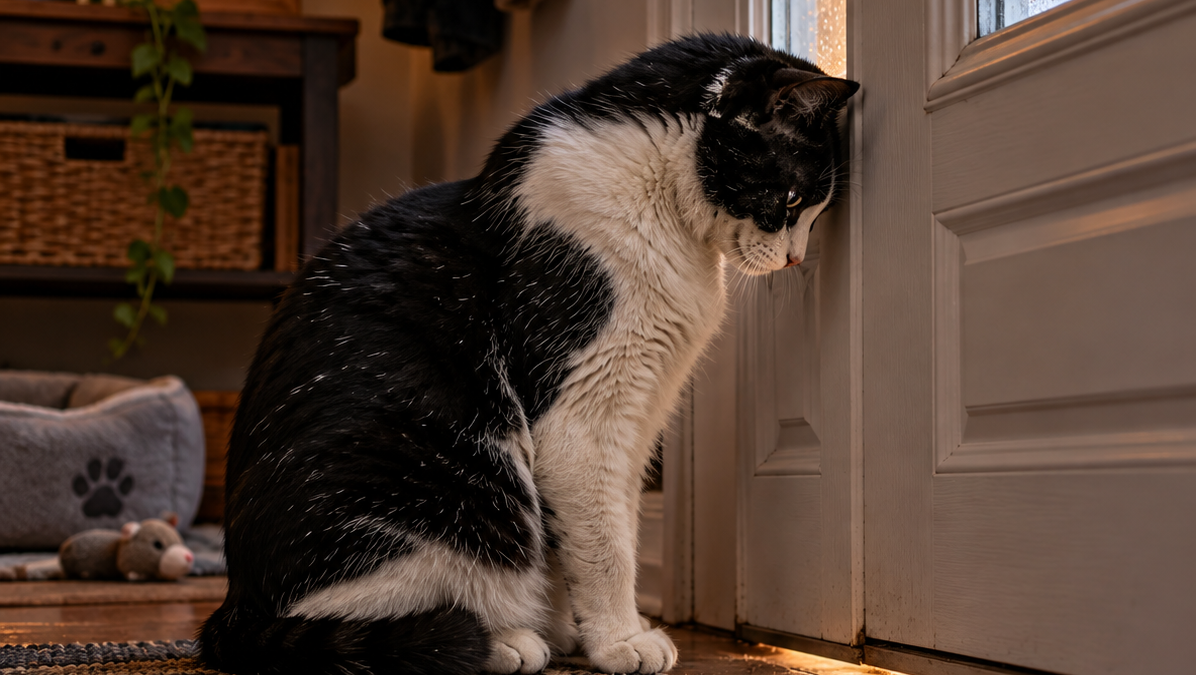
Every morning, he sat by the front door.
Every night, he was still there.
On the tenth night, I woke at 2:00 a.m. for water and found him in the dark hallway, a small black-and-white shape facing the door like a guard waiting for orders that never came.
The house felt colder than before I had brought him home.
Because now the silence had a witness.
On the eleventh morning, I found him with one paw pushed under the crack at the bottom of the door.
As if he were trying to reach someone on the other side.
My heart sank.
I sat down beside him on the floor.
“Oh, Cloudy,” I whispered. “I’m so sorry.”
He looked at me with those quiet eyes.
Then turned back to the door.
That hurt more than if he had scratched me.
I called the shelter with my hand shaking around the phone.
“Is Sunny still there?”
There was a small pause.
Then the woman said, “Yes.”
Twenty minutes later, Cloudy walked into the carrier by himself.
He did not fight me.
He did not hide.
He stepped inside like maybe he had been waiting for me to finally understand.
The whole ride, he was silent.
But when I turned onto the road near the shelter, his head lifted.
Before I even parked, he began to cry.
It was the first real sound he had made in my house.
Inside, the cat room looked the same.
But Sunny did not.
He was curled in the back of the cage, smaller than I remembered. His blanket was bunched under him. His food bowl was still half full.
When Cloudy cried again, Sunny’s head snapped up.
He stood so quickly his paws slipped.
Cloudy pushed against the carrier door.
I opened it with shaking hands.
He ran straight to cage number nine.
Sunny rushed to the bars.
They pressed their faces together through the metal.
No big scene.
No loud crying.
No wild jumping.
Just two cats standing perfectly still, forehead to forehead, eyes closed, like they had been holding their breath for eleven days.
I covered my mouth and started crying.
I had thought I was saving Cloudy.
Instead, I had taken him away from the only home he still understood.
That is the thing about animals.
They do not care about what looks good on paper.
They do not care that the bed is new, the food is better, the house is quiet, or the windows are sunny.
Sometimes safe is not a place.
Sometimes safe is another heartbeat beside you.
“I want to adopt Sunny too,” I said.
The shelter worker’s eyes softened.
“Are you sure?”
Cloudy and Sunny stood pressed together through the cage.
“Yes,” I said. “I’m sure.”
I bought another bowl.
Another bag of litter.
Another little bed.
They have never once used the second bed.
Of course they sleep together.
The first night back at my house, Cloudy ate a full meal.
Sunny ate beside him.
Then they climbed onto my old brown couch and curled into one soft pile of fur. Sunny rested his head on Cloudy’s back. Cloudy’s tail lay across Sunny’s paws.
Every so often, one of them opened an eye and touched the other.
Are you still here?
And for the first time since I had met them, the answer was yes.
My house was still quiet.
But it was not empty anymore.
There is a difference.
For eleven days, I thought I had adopted a scared cat.
What I had really adopted was half of a heart and expected it to beat alone.
I would like to say that was the end of the story.
Two cats reunited.
Old woman forgiven.
House made warmer.
A clean little ending, tied with ribbon.
But life rarely stops at the clean ending.
Eleven days after Sunny came home, just when I had begun to believe we were done with heartbreak, the shelter called and asked me to bring him back.
I was standing in my kitchen with a mug of coffee in one hand and a grocery list in the other.
Cloudy and Sunny were in the living room, curled together in the same patch of morning sun. Cloudy’s white paw rested over Sunny’s back. Sunny’s face was tucked beneath Cloudy’s chin.
My phone rang.
The shelter’s number appeared on the screen.
“Mrs. Parker,” the woman said gently, “I need to talk to you about Sunny.”
My hand tightened around the mug.
I do not know why, but sometimes the body understands bad news before the mind does.
“What happened?”
“There was a misunderstanding.”
Those four words can ruin an entire morning.
Her name was Lena, the shelter manager. I had met her once in passing, a young woman with tired eyes and a ponytail that looked like it had been done quickly between emergencies.
She explained slowly.
A woman named Mrs. Marjorie Harlan had visited the shelter the same week I adopted Cloudy. She was seventy-six, recently widowed, and she had fallen in love with Sunny.
She had not been able to take him home that day because her apartment manager required approval paperwork for pets.
So the shelter marked Sunny as pending.
Not adopted.
Not exactly reserved.
Just pending.
Then the note got missed.
A volunteer placed the cage card back incorrectly.
Staff changed shifts.
I called asking if Sunny was still available.
Nobody saw the pending note.
They let me adopt him.
“I’m so sorry,” Lena said. “This should not have happened.”
I looked into the living room.
Sunny stretched in his sleep.
Cloudy immediately opened one eye, as if even in dreams he was checking to make sure Sunny was still there.
“What are you asking me?” I said.
Silence came through the phone.
Then Lena said it.
“Mrs. Harlan came in yesterday with the approval paperwork. She believed Sunny was still waiting for her. She asked whether you might consider returning him.”
Returning him.
As if he were a sweater in the wrong size.
As if he were a lamp that did not match my curtains.
As if he were not in the next room finally eating, finally sleeping, finally living again.
I sat at the kitchen table because my legs suddenly felt weak.
Lena kept talking, not because she wanted to hurt me, but because truth sometimes has to finish the job.
“Mrs. Harlan only wanted one cat. She says she cannot manage two. She connected with Sunny. She has his photo printed out. She already bought a bed.”
I closed my eyes.
I did not want to know that.
It would have been easier if Mrs. Harlan had been careless.
It would have been easier if she were the kind of woman I could point to and say, no, absolutely not, she does not deserve him.
But she was not.
She was lonely.
She was old.
She had waited.
She had done the paperwork.
She had made a promise in her heart to a little orange cat who had already been left behind once.
And now I was standing in the middle of it.
“You are not required to do anything,” Lena said.
That almost made it worse.
Because the hardest choices are the ones nobody can force you to make.
“I need to think,” I said.
Then I hung up and sat there until my coffee went cold.
Cloudy came first.
He padded into the kitchen, silent as a shadow, and looked up at me.
A few seconds later, Sunny followed.
That was how they did everything now.
One moved.
The other came.
Cloudy rubbed against my ankle.
Sunny sat beside him, blinking slowly.
I had not known them long, but the look on Cloudy’s face already felt familiar.
Waiting.
Watching.
Trusting me to understand something he could not say.
“What am I supposed to do?” I whispered.
Of course neither cat answered.
Cats never answer when you ask the big questions.
They just sit there and make you hear yourself.
That afternoon, I called Rachel.
My daughter has always been more practical than me. Even as a child, she organized her crayons by color and reminded me when bills were due.
She loves me.
She worries about me.
Those two things often come out sounding exactly the same.
I told her the whole story.
She was quiet for a long time.
Then she said, “Mom, you cannot give Sunny back.”
My throat tightened.
“I know.”
But then she added, “At the same time, that poor woman.”
“I know that too.”
Rachel sighed.
“This is why shelters need better systems.”
I almost laughed, but there was no humor in it.
“Systems don’t fix a cat staring at a door for eleven days.”
“No,” she said softly. “They don’t.”
I told her about Mrs. Harlan’s paperwork.
The printed photo.
The little bed already waiting in an apartment somewhere.
Rachel went quiet again.
Then she asked the question I knew she had been holding back.
“Mom, can you afford both cats long term?”
I looked toward the living room.
Cloudy was licking Sunny’s ear.
Sunny had his eyes closed like he had waited his whole life to feel safe enough to be annoying.
“I’ll figure it out,” I said.
“That is not an answer.”
“I know.”
Rachel was not trying to be cruel.
She was asking what everyone asks when compassion gets expensive.
Food costs more.
Litter costs more.
Vet visits cost more.
Emergency care costs more.
And when you live alone, every decision feels larger because no one is sitting across the table saying, we will handle it together.
I wanted to tell her love was enough.
But I am old enough to know love is not a budget.
Still, I knew what I had seen.
Cloudy had nearly shut down without Sunny.
Sunny had shrunk inside that cage without Cloudy.
Those were not feelings I invented.
They were facts I had watched with my own eyes.
“I can’t separate them,” I said.
Rachel’s voice softened.
“I don’t think you should. I just don’t want you getting hurt because you’re trying to save everybody.”
There it was.
The sentence my children had been saying in different ways for years.
After the divorce, I had tried to save the marriage long after it had stopped wanting to be saved.
After my mother got sick, I tried to save her from every hard day.
After my children moved out, I tried to save them from needing me too much.
Now here I was in a quiet house with two cats, still trying to save something.
Maybe Rachel was right.
Maybe there is a line between kindness and taking on too much.
But I had learned something in those eleven days too.
Sometimes the line between too much and exactly right is not where people think it is.
That evening, I drove to the shelter without the cats.
I needed to see Mrs. Harlan’s face before I made a decision.
Lena met me at the desk.
“I’m glad you came,” she said.
I wanted to be generous.
I really did.
But I was angry.
Not loud angry.
Not throwing-things angry.
The cold kind that settles behind your ribs.
“You should have told me Sunny was pending,” I said.
“I know.”
“You should have made it clear what bonded meant before I took Cloudy.”
“We try.”
“You had one note taped to a cage.”
Lena lowered her eyes.
That was when I realized she was not going to defend herself.
Some arguments lose their shape when the other person already knows they failed.
“We’re understaffed,” she said. “That is not an excuse. It’s just true.”
A dog barked once from the back.
A volunteer carried a laundry basket full of towels.
A gray cat watched us from a tower in the lobby, looking like he had heard every human excuse and remained unimpressed.
Lena said, “Mrs. Harlan is in the visiting room.”
My heart started beating harder.
“You didn’t tell her I was coming, did you?”
“I told her the adopter wanted to talk.”
The adopter.
That was me.
I had become a title in someone else’s disappointment.
Mrs. Harlan sat by the window in a small visiting room with two plastic chairs, a scratched table, and a faded rug covered in cat hair.
She was smaller than I expected.
White hair.
Soft blue sweater.
Brown shoes with thick soles.
Her purse rested in her lap with both hands folded over it.
On the table in front of her was a photo.
Sunny.
Same pale orange face.
Same tired, sweet eyes.
Seeing his picture there made my chest ache.
Mrs. Harlan stood when I entered.
“You’re the lady who has him,” she said.
Her voice was not mean.
That made it worse.
“Yes,” I said. “I’m Helen.”
“Marjorie Harlan.”
We shook hands.
Her hand was thin and warm.
For a few seconds, neither of us spoke.
There is no polite way to begin a conversation about who gets to keep a heart.
Finally she said, “I’m sorry they put you in this position.”
That surprised me.
I had expected her to plead.
Maybe accuse.
Maybe cry.
Instead, she apologized.
I sat across from her.
“I’m sorry too.”
She looked down at Sunny’s photo.
“My husband loved orange cats,” she said. “We had one for eighteen years. After Frank passed, I said I would never get another. Then I saw Sunny.”
Her mouth trembled slightly.
“He looked like something that had survived but had not quite decided why.”
I swallowed.
That was exactly what he looked like.
“I sat with him in this room for nearly half an hour,” she said. “He was shy at first. Then he put one paw on my knee.”
I could see it.
Sunny did that now when I ate toast.
One little paw, light as a question.
“I thought,” she said, “maybe he and I understood each other.”
I looked away.
Through the glass, I could see the cat room.
Some cats slept.
Some stared.
Some waited without knowing what they were waiting for.
Mrs. Harlan said, “They told me he had a friend.”
I turned back.
“They told you?”
“Yes.”
“And you still wanted only Sunny?”
Her face changed.
Not with anger.
With embarrassment.
“I live in a one-bedroom apartment. I’m not as steady as I used to be. My son helps, but he has his own family. Two cats felt like too much.”
I understood that.
I hated that I understood that.
She looked at me carefully.
“Can I ask how he is?”
I could have said fine.
That would have been easier.
But the truth was sitting between us already.
So I told her.
I told her about Cloudy at the front door.
About the eleventh morning.
About his paw under the crack.
About the drive back to the shelter.
About Sunny jumping up when he heard Cloudy cry.
About the two of them standing forehead to forehead through the cage bars.
Mrs. Harlan listened without interrupting.
By the time I finished, she was crying quietly.
She took a tissue from her purse and pressed it beneath one eye.
“Well,” she whispered. “That answers that.”
I stared at her.
“What do you mean?”
She looked at Sunny’s photo for a long moment.
Then she pushed it gently across the table toward me.
“I cannot ask for him after hearing that.”
My eyes filled so fast I could barely see.
“I don’t want to hurt you.”
She gave me a sad little smile.
“Oh, honey,” she said. “I was already hurt before I met Sunny.”
That sentence stayed with me.
It still does.
Sometimes a pet does not create the ache.
Sometimes a pet just shows you where the ache already was.
I slid the photo back.
“You should keep this.”
She touched it with two fingers.
“I don’t know if that will help or make it worse.”
“Both, probably.”
We sat there like that.
Two women in a shelter visiting room, both trying to do the right thing, both losing something.
Then Mrs. Harlan said, “Can I see them?”
I froze.
“At my house?”
“No,” she said quickly. “Not if it would upset them. I don’t want to confuse them.”
That was the moment I understood something important about her.
She did not just want a cat.
She wanted to be kind.
Even when kindness cost her.
“I have pictures,” I said.
I showed her Cloudy and Sunny asleep on my couch.
Sharing one bowl even though they had two.
Cloudy watching the window while Sunny sat tucked against his side.
Sunny using Cloudy’s tail as a pillow.
Mrs. Harlan laughed through her tears.
“That one looks like an old married couple.”
“They do.”
“Which one snores?”
“Sunny.”
“I knew it.”
For a minute, the room felt less impossible.
Then she handed back the phone.
“You keep them together.”
“I will.”
“And I will find someone else.”
The clean ending was right there.
I should have taken it.
But life rarely stops at the clean ending.
As I stood, I looked through the glass into the far corner of the cat room.
Two older cats were curled together in a bottom cage.
One was gray with a white muzzle.
The other was brown and black, round as a loaf of bread.
A card hung on their cage.
MABEL & JUNE.
SENIOR PAIR.
MUST GO TOGETHER.
Mrs. Harlan followed my gaze.
“Oh no,” she said.
I almost smiled.
“They’re older.”
“I saw them.”
“Have you met them?”
“No.”
“Do you want to?”
She shook her head immediately.
“I told you. Two cats are too much.”
I should have respected that.
Maybe some people would say I should have.
Maybe they are right.
But something in me had changed since Cloudy sat by my door. Not in a reckless way. In a clear way.
Sometimes people say no because the thing is wrong for them.
And sometimes they say no because nobody has helped make yes possible.
“Just meet them,” I said.
Mrs. Harlan narrowed her eyes.
“You’re trouble.”
“That’s what my daughter says.”
Lena came back in, and I asked about Mabel and June.
Her face softened with the tired shelter sadness I had already learned to recognize.
“They’ve been here seven months.”
“Seven months?”
“Their owner went into assisted living. They’re twelve and thirteen. Sweet girls. No issues. They just get overlooked.”
Mrs. Harlan stared through the glass.
The gray cat had woken up and was watching us.
The round brown-and-black one remained asleep, pressed against her side.
“People see senior pair and keep walking,” Lena said.
Mrs. Harlan looked at me.
“No,” she said.
But her voice was not as firm as before.
We went into the cat room anyway.
I know.
That was pushy.
I have thought about it many times.
There is a fine line between encouraging someone and dragging them toward your idea of a happy ending.
At the time, I told myself I was only opening a door.
But sometimes opening a door is not a small thing.
Lena unlocked the cage.
The gray cat, Mabel, stepped out first.
She did not rush.
She did not hide.
She walked straight to Mrs. Harlan and looked up like she had been expecting her.
June stayed inside, blinking sleepily.
Mrs. Harlan held both hands close to her chest.
“Oh,” she said.
Just that.
Oh.
Mabel rubbed against her ankle.
Then June finally stood, stretched, and gave one rusty little meow that sounded like a screen door.
Mrs. Harlan laughed.
That laugh changed the room.
It was not big.
It was not young.
But it was real.
June waddled over and sat on Mrs. Harlan’s shoe.
Nobody moved.
Then Mrs. Harlan whispered, “Well, that’s rude.”
Mabel jumped onto the bench beside her.
June remained on her shoe.
Cloudy and Sunny had been a love story.
Mabel and June were something else entirely.
They were two elderly ladies who had decided the meeting was over and Mrs. Harlan belonged to them now.
Mrs. Harlan stayed with them for forty minutes.
She did not adopt them that day.
I was glad.
Real decisions should have time to breathe.
Before she left, she asked for their medical notes.
What food they ate.
Whether they used a covered litter box.
Whether they climbed curtains.
Lena smiled.
“At their age? They mostly judge curtains.”
Mrs. Harlan smiled back.
But in the parking lot, she turned serious.
“I cannot be pressured into this.”
“I know.”
“I mean it.”
“I know.”
She looked at me for a long moment.
“You have a rescuer’s face.”
I did not know what to say.
She opened her car door.
“That is not always a compliment.”
Then she drove away.
I sat in my own car for a long time.
A rescuer’s face.
Maybe she meant I looked soft.
Maybe she meant meddlesome.
Maybe both.
When I got home, Cloudy and Sunny were waiting in the front window.
Not at the door.
The window.
That difference nearly broke me open.
For the first time, the front door did not feel like a wound.
It felt like an entrance.
Two days later, Lena called.
“I promise I’m not asking for Sunny,” she said immediately.
“Good.”
“Mrs. Harlan came back.”
My heart jumped.
“And?”
“She sat with Mabel and June again.”
“And?”
“She filled out an application.”
I covered my mouth.
“She hasn’t finalized yet,” Lena said. “She wants her son to come meet them. She also asked if there was a way to talk with someone who adopted a pair.”
I knew where this was going.
“She wants to talk to me?”
“If you’re willing.”
That evening, Mrs. Harlan called.
She did not waste words.
“Tell me the truth. Is two cats twice as much work?”
“Yes.”
She sighed.
“I knew it.”
“But not in every way.”
“What does that mean?”
“It means two bowls, more litter, more food, more vet appointments. But emotionally? With bonded cats, they help each other. They are not looking to you for every bit of comfort.”
She was quiet.
I kept going.
“Cloudy and Sunny play together. Sleep together. Groom each other. When one gets nervous, the other settles him. I’m important to them, but I’m not their whole world.”
Mrs. Harlan said, “That sounds healthier.”
“It is.”
“For people too, maybe.”
I looked down at my hands.
“Yes,” I said. “For people too.”
She asked about money.
I told her honestly.
Not dramatically.
Not pretending it was nothing.
I told her I had changed small things.
Fewer takeout meals.
No more random decorations for a house that already had enough things.
I put a little aside each month for vet care because surprises are less frightening when you admit they can happen.
She listened.
Then said, “My son thinks I should get a young cat.”
“Why?”
“He says it will last longer.”
I winced.
“I hate that sentence.”
“So did I.”
She cleared her throat.
“He means well.”
“I’m sure he does.”
But meaning well does not always mean seeing clearly.
People talk about pets like purchases.
How many years can I get?
How much trouble will this be?
Will it fit my schedule?
Will it be worth the cost?
Those questions matter.
Of course they matter.
But they are not the only questions.
Sometimes the better question is: who needs the home I actually have?
Mrs. Harlan said, “I’m old.”
I did not argue.
“I’m not ancient,” she added.
“I wasn’t going to say anything.”
“But I am old enough to know I may not have thirteen years.”
“None of us knows that.”
“No,” she said. “But some of us can see the exit sign better.”
She had a way of saying hard things plainly.
“Mabel and June are old too,” I said.
“Yes.”
“Maybe that’s not a bad match.”
She was quiet.
Then she said, “That is what I was thinking.”
The next Saturday, Mrs. Harlan’s son came to the shelter.
His name was Daniel.
Late forties, maybe early fifties, tall and neat, wearing the kind of jacket people wear when they are trying to look casual but still responsible.
He shook my hand.
“My mother has told me about you.”
I could not tell whether that was good or bad.
“Only good things, I hope.”
“Mostly.”
Mrs. Harlan swatted his arm with her purse.
“Behave.”
He looked toward Cloudy and Sunny, who were sitting in a large playpen near the lobby for a bonded-pair awareness event.
“So these are the famous boys.”
Cloudy stared at him.
Sunny blinked.
Daniel crouched.
“They look happy.”
“They are.”
He stood again.
“My mother is very taken with Mabel and June.”
Mrs. Harlan lifted her chin.
“I am standing right here.”
“I know, Mom.”
Daniel turned back to me.
“I’m not against it. I just want to make sure she understands the work.”
I respected that.
I also recognized the tone.
Adult children use it when they are trying to protect a parent without making them feel managed.
It is a hard line to walk.
Mrs. Harlan looked annoyed.
“Everyone keeps discussing me like I’m a porch that needs repair.”
Daniel’s face softened.
“That’s not what I’m doing.”
“It is a little what you’re doing.”
He rubbed his forehead.
“I just don’t want you overwhelmed.”
“I have been overwhelmed before,” she said. “I survived your teenage years.”
I coughed to hide a laugh.
Daniel pointed at her.
“That was unnecessary.”
“But accurate.”
Then June meowed from across the room.
Everyone turned.
She and Mabel had been brought into the visiting area.
June stood in the open cage with one paw lifted like she had an announcement.
Mabel sat behind her, calm and queenly.
Mrs. Harlan’s whole face changed.
That was what Daniel needed to see.
Not a brochure.
Not my opinion.
Not a speech from Lena.
That face.
His mother, who had walked into the shelter grieving Sunny, had found herself smiling at two old cats who looked like they had no interest in being anyone’s second choice.
Daniel watched her walk toward them.
He followed slowly.
I stayed back.
This was not my moment.
Through the glass, I watched Mrs. Harlan sit on the bench.
Mabel climbed beside her.
June inspected Daniel’s shoe, then sneezed on it.
Daniel looked down.
Mrs. Harlan laughed.
Then Daniel laughed too.
It started small.
That is how most changes start.
Not with thunder.
With a laugh you did not plan.
The following Thursday, Mrs. Harlan adopted both of them.
Mabel went into the carrier first.
June refused.
Then Mabel came back out, turned around, and stared at June like she had embarrassed the family.
June walked in after that.
The staff applauded quietly.
Not the loud kind that scares animals.
Just fingertips against palms.
Soft.
Respectful.
Mrs. Harlan cried anyway.
So did Lena.
So did I.
Daniel pretended not to, which fooled no one.
That night, Mrs. Harlan sent me a photo.
Mabel was on the couch beside her.
June was asleep on top of a folded newspaper.
The message said:
They have rejected both beds and accepted the couch. I suppose I have roommates now.
I laughed so hard Cloudy woke up.
Sunny did not.
Sunny could sleep through a thunderstorm, a vacuum, and possibly a marching band.
But that photo loosened a knot I had been carrying since the phone call.
Mrs. Harlan had not lost Sunny and gone home empty.
Sunny had not lost Cloudy.
Mabel and June had not stayed in that bottom cage.
Nobody got exactly what they first wanted.
Somehow, everybody got what they needed.
That sounds simple when I say it now.
It did not feel simple then.
For a while, the story spread around town.
Not in a huge way.
Nobody became famous.
No cameras showed up in my driveway.
But people talked.
The shelter posted a little update about bonded pairs without using my full name.
They shared a photo of Cloudy and Sunny curled together.
Then a photo of Mabel and June in Mrs. Harlan’s apartment.
Most comments were kind.
Some were not.
That is how people are when a story asks them to feel something and think at the same time.
One person wrote that bonded animals should never be separated.
Another said that was unrealistic because shelters were full and adopters were already hard to find.
Someone said two pets were a privilege many people could not afford.
Someone else said animals should not suffer because humans wanted convenience.
Then one person wrote that older people should not adopt pets unless a younger relative signs something.
That one made Mrs. Harlan furious.
She called me at nine o’clock that night.
“Apparently I am too old to own a cat,” she said.
“Good evening to you too.”
“Do you know what one woman wrote? She said seniors should stick to plants.”
I looked at Cloudy trying to fit his whole body into a box half his size.
“Plants can be pretty demanding.”
“I have killed six ferns.”
“Then cats are safer.”
She snorted.
But underneath the humor, I heard the hurt.
People talk about older adults like they are problems to manage.
People talk about shelter animals like they are items to place.
People talk about money like it is the only measure of responsibility.
And online, people talk like the person reading is not a real human sitting in a quiet room with two old cats and a sore heart.
“Maybe they’re right,” Mrs. Harlan said.
“They’re not.”
“You don’t know that.”
“I know enough.”
She went silent.
So I said the truest thing I had.
“You made a plan. Daniel is involved. The shelter knows. Your girls are older. You are not being careless.”
She breathed out.
“My girls.”
“Yes.”
“I do like saying that.”
“Then say it again.”
“My girls are asleep on my clean laundry.”
“That sounds right.”
“And I am not moving them.”
“That also sounds right.”
Within a month, Mrs. Harlan was no longer just the woman who almost took Sunny.
She was my friend.
A strange thing happens when you get older.
Making friends feels harder, but the need does not go away.
People assume loneliness is quiet.
It is not always.
Sometimes it is loud in your chest.
Sometimes it follows you from room to room.
Sometimes it sits across from you at dinner and makes one plate look foolish.
Cloudy and Sunny helped my house.
Mabel and June helped Mrs. Harlan’s apartment.
But the cats did something else too.
They gave two lonely women a reason to call each other without feeling needy.
We talked about food brands.
Vet appointments.
Litter mats.
Then slowly, we talked about our marriages.
Her husband had been Frank.
Mine had been David.
Frank had died after fifty-one years of marriage.
David had left after twenty-eight.
Different griefs.
Same empty chair.
Mrs. Harlan told me the hardest part after Frank died was waking up and not hearing him clear his throat in the bathroom.
I told her the hardest part after my divorce was pretending I felt relieved when people said, “At least now you can do whatever you want.”
Because yes, I could.
I could eat cereal for dinner.
I could paint the hallway yellow.
I could leave dishes in the sink.
Freedom is real.
But so is the ache of having no one notice what you did with it.
One afternoon, Rachel came over and found Mrs. Harlan at my kitchen table.
Cloudy and Sunny were under the chairs, hoping someone would drop something.
Rachel looked surprised.
I realized then that my daughter had not seen me with a new friend in years.
Not a neighbor.
Not an old work acquaintance.
A friend.
Mrs. Harlan stood.
“You must be Rachel. Your mother tells me you are bossy.”
Rachel looked at me.
I looked at the ceiling.
“I said organized.”
Mrs. Harlan smiled.
“She meant bossy.”
Rachel laughed, and the room relaxed.
We had tea.
Mrs. Harlan told the story of June stealing toast with the seriousness of a courtroom witness.
Rachel laughed again.
I watched my daughter’s face.
She looked relieved.
Adult children carry quiet fears about their parents.
They worry we are lonely.
They worry we are stubborn.
They worry we are one bad winter, one missed bill, one sad phone call away from becoming someone they need to rescue.
That day, Rachel saw I had a life inside my quiet house.
Not a huge life.
Not a busy one.
But a real one.
After Mrs. Harlan left, Rachel helped me wash the mugs.
At first, she said nothing.
Then she looked toward the living room.
“They really are different together.”
“Cloudy and Sunny?”
“Yes.”
“They are.”
“I didn’t fully get it before.”
That meant more than I expected.
A lot of people say they understand bonded animals.
I thought I did too.
But until you see one cat waiting at a door like his whole soul has been left outside, you do not really understand.
Until you see the first full meal after a reunion, you do not understand.
Until you watch two old cats choose an old woman and give her back a little daily nonsense, you do not understand.
Love is not always loud.
Sometimes it is a paw under a door.
Sometimes it is a head pressed through cage bars.
Sometimes it is toast stolen from a saucer.
A few weeks later, Lena asked if I would speak at a small adoption night.
I said no immediately.
Then she asked again, because shelter people are persistent in the way tired people become when something matters.
“It’s not a speech,” she said. “Just tell Cloudy and Sunny’s story.”
“I’m not a public speaker.”
“It’s twelve people in a room with folding chairs.”
“That sounds worse.”
She laughed.
“You don’t have to be perfect. Just honest.”
That was the problem.
Honest is harder than perfect.
Perfect lets you polish everything until it shines.
Honest makes you stand there with your mistakes showing.
And my mistake was the center of the story.
I had separated them.
Not because I was cruel.
Not because I did not care.
Because I had been practical.
Because I wanted one cat.
Because I read the word bonded and treated it like a cute detail instead of a warning label.
That is the part people argue about.
Some say I did nothing wrong.
Some say I should have known better.
I think both are true.
I did not mean harm.
I still caused it.
Good intentions do not erase impact.
But guilt by itself does not repair anything either.
So I said yes.
The adoption night was held in the shelter’s back room.
There were fifteen people, not twelve.
I noticed immediately and gave Lena a look.
She mouthed, sorry.
Cloudy and Sunny stayed home. I did not want to stress them for human education.
Instead, I brought photos.
One of Cloudy by the front door.
One of their reunion at the shelter, taken by a volunteer.
One of them asleep on my couch.
I held up the first photo with shaking hands.
“This is Cloudy,” I said. “Eleven days after I adopted him without Sunny.”
The room went quiet.
I told the whole story.
Not the pretty version.
The real one.
I told them I thought I was being sensible.
I told them I thought someone else would adopt Sunny.
I told them I gave Cloudy a soft bed, good food, toys, warmth, and safety.
Then I said, “He still sat by the door.”
A woman in the front row wiped her eyes.
A man in the back crossed his arms and stared at the floor.
I kept going.
I told them about the paw under the door.
The call to the shelter.
The reunion.
Mrs. Harlan.
Mabel and June.
Then I said the thing I had come to believe.
“Not everyone can adopt a bonded pair. That is real. Money is real. Space is real. Age is real. Life is real. But we need to stop pretending love is only real when it is convenient.”
No one spoke.
“If you can only take one animal, that does not make you bad. But please ask questions. Please listen when shelter workers say two animals are bonded. Please do not assume they will get over it just because we want them to.”
My voice cracked.
“Some do adjust. Some don’t. And the ones who don’t can break your heart without making a sound.”
Afterward, people came up to me.
A young couple said they had never considered adopting two cats but would meet a pair.
A man said he appreciated that I did not shame people who could only afford one.
A woman told me she disagreed and thought shelters should refuse to separate bonded animals under any condition.
Another woman said that policy could leave more animals in cages.
They started debating right there by the coffee table.
Lena looked nervous.
I did not.
Because for once, the argument did not feel useless.
They were not arguing about gossip.
They were arguing about responsibility.
Compassion.
What we owe the vulnerable when resources are limited and hearts are tired.
That is a conversation worth having.
Even if nobody wins it cleanly.
That night, when I got home, Cloudy met me at the door.
Sunny stood behind him with a toy mouse in his mouth.
He dropped it at my feet.
It was the first time he had ever brought me anything.
I bent down.
“For me?”
Sunny looked away, embarrassed by his own generosity.
Cloudy nudged the toy closer.
I sat on the floor in my coat and cried.
Not hard.
Just enough.
There are tears that come from pain.
There are tears that come from relief.
These were both.
I thought about the first day I brought Cloudy home.
How quiet he had been.
How I mistook grief for fear.
Humans do that all the time.
We see someone withdrawn and say they need space.
Sometimes they do.
But sometimes they need the one person, or animal, or familiar heartbeat that tells them the world has not completely ended.
We are so quick to praise independence.
Be strong.
Stand alone.
Move on.
Start over.
And yes, there is strength in surviving by yourself.
I know that.
I lived that.
But there is also strength in admitting you are bonded to someone.
There is courage in needing.
There is dignity in attachment.
Cloudy was not weak because he needed Sunny.
Sunny was not less adoptable because he came with Cloudy.
Mrs. Harlan was not foolish because she needed company.
I was not broken because my quiet house hurt.
We were all just living creatures trying not to be alone in ways that made us disappear.
Winter came early that year.
Not dramatic winter.
Just gray afternoons, cold windows, and darkness arriving before you are ready.
Cloudy loved the radiator.
Sunny loved sleeping directly on top of Cloudy while Cloudy loved the radiator.
This seemed unfair, but Cloudy allowed it.
Mrs. Harlan sent weekly updates.
Mabel had claimed the armchair.
June had claimed Mrs. Harlan’s lap.
Daniel installed a low window shelf so both cats could watch birds.
Mrs. Harlan said it looked ridiculous.
Then she sent seven photos of them using it.
Rachel started coming over every other Sunday.
She said it was to check on me.
Then she started bringing treats for Cloudy and Sunny.
Then she started staying for dinner.
One evening, she sat on the couch with Sunny asleep against her leg and said, “It feels different here now.”
I looked around.
Same couch.
Same scratched coffee table.
Same family photos.
Same little crack in the hallway wall I kept meaning to fix.
But she was right.
The house felt different.
Not busier.
Not louder.
Softer.
Like it had unclenched.
“What do you mean?” I asked.
Rachel rubbed Sunny’s head with one finger.
“It feels like you stopped waiting.”
I knew exactly what she meant.
For years, I had been waiting without calling it that.
Waiting for my kids to need me the way they used to.
Waiting to stop feeling strange at restaurants alone.
Waiting for life after divorce to feel like a life and not a waiting room.
Waiting for the house to stop sounding like absence.
Then Cloudy came and waited at my door.
His waiting was so visible it exposed mine.
And when I brought Sunny home, I did not just fix something for him.
I fixed something in myself.
Not all of it.
Do not believe anyone who says one good deed heals a whole life.
That is not how healing works.
Healing is smaller.
It is feeding cats at seven.
It is calling Mrs. Harlan at noon.
It is laughing with your daughter in the kitchen.
It is realizing you went three hours without feeling lonely and not wanting to jinx it by saying so.
One morning, a letter arrived from the shelter.
Inside was a photo.
Two black cats, side by side, in a sunny window.
The shy pair from the adoption event.
They had gone home together.
The adopter had written on the back:
I came for one. I listened. Thank you for telling the truth.
I stood in my hallway with that card in my hand and looked down at Cloudy.
He was sitting near the front door.
For one sharp second, my heart jumped.
Then Sunny came around the corner.
Cloudy turned, touched his nose to Sunny’s, and walked away from the door.
Just like that.
No drama.
No old wound reopening.
Just a cat near a door, no longer waiting for what was missing.
I pinned the photo to my fridge.
Then a photo of Mabel and June.
Then one of Cloudy and Sunny.
Soon my fridge looked like a wall of tiny second chances.
Not perfect stories.
Not easy ones.
Second chances rarely are.
They come with misunderstandings.
Phone calls you do not want.
Guilt.
Paperwork.
Money worries.
People telling you what they would have done even though they were not the one sitting on a kitchen floor beside a grieving cat.
But they also come with moments you never forget.
A forehead pressed through cage bars.
An old woman laughing because a cat sat on her shoe.
A daughter seeing her mother’s house as warm again.
A toy mouse dropped at your feet like an offering.
People like clean morals.
Do this.
Do not do that.
Always keep bonded pairs together.
Never take on more than you can handle.
Think with your heart.
Think with your head.
The truth is, most of life happens in the uncomfortable place between those sentences.
Yes, bonded animals should be protected.
Yes, adopters have limits.
Yes, shelters are overwhelmed.
Yes, older people deserve companionship.
Yes, adult children are allowed to worry.
Yes, love costs money.
Yes, loneliness costs something too.
I cannot give you one rule that solves all of it.
I can only tell you what two cats taught me.
When you see a bond, do not dismiss it because it complicates your plan.
When someone tells you a heart comes attached to another heart, believe them.
And when doing the right thing feels too big, ask whether there is a way to make it possible before deciding it is impossible.
That is what changed everything.
Not me being heroic.
I was not.
I made the first mistake.
Not Mrs. Harlan being saintly.
She was lonely and disappointed, and she still chose kindness.
Not the shelter being perfect.
They were not.
What changed everything was that nobody stopped at the first painful answer.
I could have kept Sunny and ignored Mrs. Harlan.
Mrs. Harlan could have demanded Sunny and ignored Cloudy.
The shelter could have hidden the mistake.
Daniel could have treated his mother like a child.
Rachel could have rolled her eyes and stayed away.
Any of us could have made the story smaller.
Instead, in our imperfect ways, we made room.
That is all a home really is.
Room.
Room for another bowl.
Room for another opinion.
Room for an apology.
Room for an old grief.
Room for a new friendship.
Room for two cats who refuse to use the beds you paid good money for.
Cloudy and Sunny are asleep beside me as I write this.
Cloudy is on the left.
Sunny is on the right.
Their backs are pressed together.
Every now and then, Cloudy’s ear twitches, and Sunny lifts his head just enough to check on him.
Are you still here?
Yes.
Still here.
Mrs. Harlan called earlier today.
June knocked over a cup of water.
Mabel looked offended by the mess even though she had done nothing to prevent it.
Mrs. Harlan said her apartment is never clean anymore.
Then she said it is also never lonely.
I told her I understood.
My house is not as neat as it used to be either.
There is litter tracked near the laundry room.
There are paw prints on the window.
There are two untouched cat beds in the corner like expensive little monuments to my optimism.
There is fur on my sweater almost every day.
And there is life.
Real life.
Small life.
The kind that pads down the hallway in the morning and reminds you to open your heart before you open your phone.
I still think about the day I almost left Sunny behind forever.
That thought hurts.
Maybe it always will.
But I no longer let guilt be the end of the story.
Guilt can be useful if it teaches you.
It becomes useless when it only punishes you.
Cloudy taught me to notice.
Sunny taught me to return.
Mrs. Harlan taught me that giving up what you wanted can sometimes lead you to what was meant for you.
Mabel and June taught me that second choices can walk into your life like they own the place.
And Rachel taught me that the people who question your kindness are not always against you.
Sometimes they are trying to make sure your kindness has a floor under it.
So no, I do not believe everyone should run out and adopt two cats tomorrow.
I do not believe love magically pays bills.
I do not believe every situation is simple.
But I do believe this.
Before you separate two animals who have already lost everything else, pause.
Before you call someone foolish for choosing companionship late in life, pause.
Before you tell a lonely person to be practical, pause.
Before you decide one heart is easier than two, look closely.
Because sometimes two is not extra.
Sometimes two is the minimum.
Sometimes the second bowl is not a burden.
Sometimes it is the reason the first bowl finally gets emptied.
Sometimes the cat you did not plan for is the one who saves the cat you chose.
And sometimes, if you are very lucky, they save you too.


