HOA Tore Down My Rescue Tower for a Better View—Then They Regretted Using My Signature
PART3:
The concrete pad near the shore was cracked in six places.
A rusted metal box sat half buried beside it.
Stamped survey numbers were barely visible beneath corrosion.
I was standing there kicking leaves off the pad when an older man named Walter Dunor approached from the neighboring community.
He kept a pontoon boat at Brierstone Shores.
“Bought this?”
“Yes.”
He whistled.
“Why?”
“Still deciding.”
He laughed.
Then pointed toward the pad.
“There used to be a rescue station there.”
“What kind?”
“Tower.”
“Life rings.”
“Emergency radio.”
“First aid.”
“Back when the lake wasn’t lined with million-dollar roofs.”
I looked at the concrete.
“What happened?”
“Rotted.”
“Storm took part.”
“Association stopped maintaining it.”
He became quieter.
“Then a kid drowned off the point.”
I looked toward the water.
Walter said:
“College boy.”
“Good swimmer too.”
“Nobody saw him go under until too late.”
That stayed with me.
My original idea for 47B had been simple.
Weekend cabin.
Small dock if permitted.
Somewhere quiet.
But the cabin could wait.
I rebuilt the tower first.
Twelve feet high.
Galvanized steel.
Life rings.
Emergency radio.
First-aid box.
Throw line.
Solar beacon.
Nothing elaborate.
I used the existing pad after having it inspected.
Filed the required county structure registration.
Signed it April 3.
That date later became very important.
The tower was finished in May.
Marjorie Vickers watched some of the construction from the Brierstone Shores side.
She was HOA president.
Late fifties.
Platinum hair.
Expensive casual clothing.
Always carried herself as though five people were waiting to hear her decision.
The first time we spoke, she stood behind a split-rail fence and said:
“Whatever is left on that parcel is what nobody else wanted.”
I answered:
“That’s usually why things are cheap.”
She did not laugh.
She pointed toward the lake.
“This is community shoreline.”
“My deed disagrees.”
“Our maps show continuous waterfront common area.”
“Then your maps should speak with my deed.”
That was the beginning.
Within weeks I received letters.
Unapproved shoreline improvements.
Unauthorized structure.
Visual obstruction.
Nonconforming signage.
I replied once.
47B was not subject to the Brierstone Shores declaration.
Please provide recorded documents showing otherwise.
They sent a color map.
Not a deed.
Not a plat.
A map.
Blue shoreline band labeled:
COMMUNITY WATERFRONT.
I filed it.
Forgot about it.
Then North Point Marine called.
That changed everything.
The county had announced a dredging and channel-improvement project in South Bay.
Engineering reports identified the deep natural channel adjacent to 47B as one of the few shoreline locations suitable for larger logistics access without enormous dredging cost.
North Point Marine had been looking for exactly that.
They approached me.
Not the other way around.
Negotiations took months.
Environmental review.
Title review.
Engineering.
Access.
County approvals.
They proposed purchasing 47B for $6.5 million, subject to several conditions.
The most important:
Clean title.
Clear lawful access.
No unresolved claims materially affecting the parcel.
The contract entered escrow.
I stared at the deposit confirmation on my phone the same morning Marjorie destroyed the rescue tower.
I had driven down because Walter called.
“You better get here.”
“What happened?”
“Machine on your bank.”
“What machine?”
“Excavator.”
I reached the waterline in twelve minutes.
Too late.
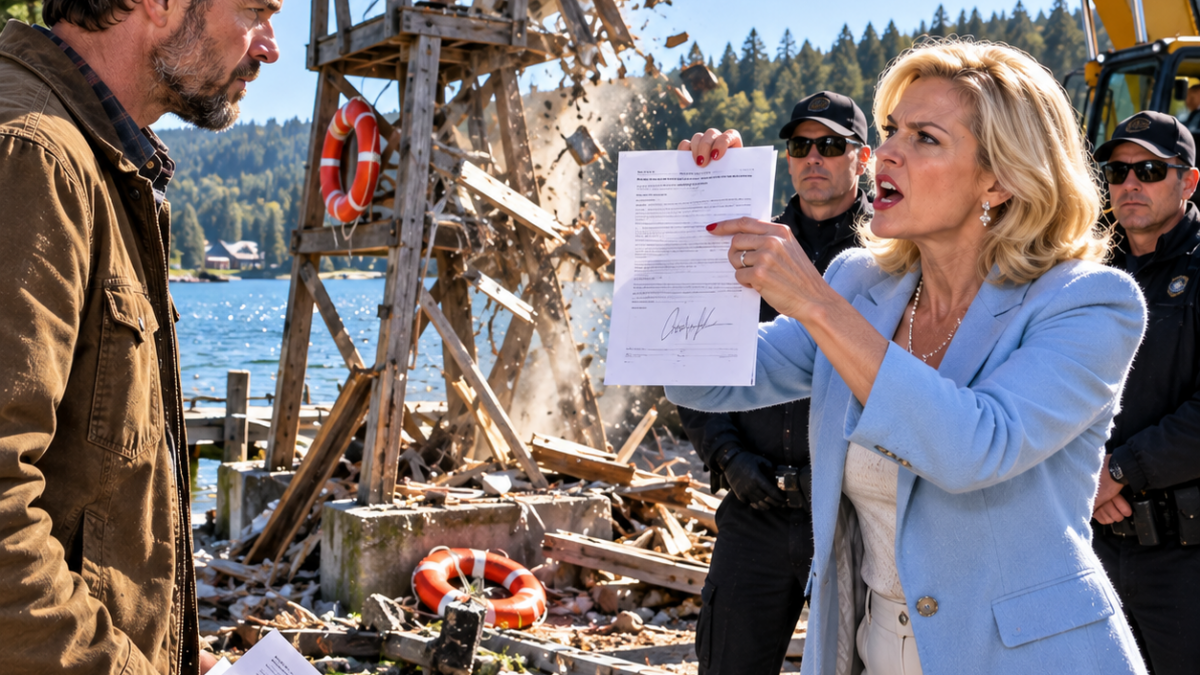
The excavator had its bucket under the tower frame.
Steel shrieked.
The upper section leaned.
Then collapsed.
Life ring bounced once across the mud.
The radio box tore free.
One support twisted until it snapped.
I jumped out of my truck.
“Shut it off!”
The operator stopped.
Six private security guards stood nearby.
Marjorie was beside a black SUV.
Pale blue blazer.
White pants.
Perfect hair.
The contrast between her outfit and the mud was almost absurd.
“What are you doing?”
She held up a single sheet.
“You approved removal.”
“No.”
She walked toward me.
“Owner authorization.”
She handed me the page.
My name was at the bottom.
My signature.
Not similar.
Mine.
I stared.
Above it:
OWNER AUTHORIZATION FOR REMOVAL OF WATERLINE STRUCTURE.
Then:
Owner acknowledges the structure stood on Brierstone Shores community waterfront and authorizes removal.
I read it twice.
“I never signed this.”
Marjorie smiled.
“That’s your signature.”
“It is.”
“Then perhaps you should keep better records.”
I almost answered.
Then noticed something else.
Near the heading in smaller type:
Site: Waterline Structure, Parcel 47B.
Requested by: M. Vickers.
I read that too.
Interesting.
The page said:
HOA waterfront.
But also:
Parcel 47B.
My parcel.
Marjorie handed me another paper.
Purchase offer.
$17,000.
“For what?”
“The nonwaterfront portion of your lot.”
I looked at her.
“You’re offering seventeen thousand for land under contract for millions?”
She shrugged.
“You paid a hundred.”
Behind her, one of the guards pulled an orange survey stake from the ground.
My survey stake.
He threw it down.
Then hammered a white sign into the concrete.
PRIVATE HOA PROPERTY.
Every strike echoed across the lake.
I wanted to stop him.
Instead I raised my phone.
Photographed everything.
The torn tower.
Excavator.
White sign.
My survey marker in the gravel.
Authorization.
Marjorie.
She saw me.
“Photograph all you like.”
I looked at the page again.
Then asked:
“If the shoreline already belongs to your association…”
She waited.
“…why did you need the owner of Parcel 47B to approve removing the tower?”
She opened her mouth.
Nothing.
Three seconds.
Maybe four.
Enough.
I watched the guards hear the silence.
The tallest one started toward my truck.
“I want copies of your property documents.”
“No.”
He kept walking.
Marjorie caught his sleeve.
“Back in the vehicles.”
He stopped.
“Now.”
The SUVs left.
No one returned by sunset.
I stood beside the ruined tower until the light disappeared.
Three questions.
Where had she gotten my signature?
Why did she need it?
And why did something near the lower right corner look wrong?
That night, I sat at my kitchen table.
Legal pad.
Three signatures.
I had signed my name only three times that year in connection with 47B.
First:
Receiver purchase acceptance.
Private.
Second:
North Point contract.
Escrow.
Private.
Third:
County structure registration.
April 3.
Public.
I underlined that one.
That was the only signature anybody could easily obtain from a public record.
But suspicion is not evidence.
I knew better than to run into the sheriff’s office shouting forgery based on a feeling.
Especially with $6.5 million at risk.
Two days later a courier delivered nineteen pages from the HOA.
Three demands.
Terminate the North Point agreement.
Remove private-property signs.
Pay $18,500 in “violation processing fees.”
Then an invoice.
Tower removal.
Billed to me.
Authority:
Exhibit F.
There it was.
Same signature page.
Again.
I took everything to Natalie Ashford.
Real-estate litigator.
Small woman.
Quiet voice.
Ability to make opposing counsel regret adjectives.
She read the packet.
Put the HOA map aside.
“Internal map.”
“What does that mean?”
“Means it can be useful.”
“Doesn’t mean it transfers title.”
She tapped it.
“A board can color a map purple and call it Atlantis.”
“That doesn’t make Aquaman the owner.”
I laughed.
Then she held up Exhibit F.
“This is dangerous.”
“Because of the signature?”
“Yes.”
“A signature that looks genuine can make a title insurer nervous.”
“A nervous title insurer makes a buyer nervous.”
“A nervous buyer walks.”
North Point received a letter from Marjorie three days later.
She accused me of trying to sell “community waterfront belonging to 112 Brierstone Shores families.”
Then new signs appeared.
HOA MEMBERS ONLY.
Survey crew met me at the lake.
Two guards blocked the access path.
“You step past this truck, you’re trespassing.”
I did not touch anything.
Dashboard camera was running.
I asked:
“Who instructed you?”
“Association.”
“Do you have a deed?”
“Sir, leave.”
I called the sheriff’s office.
Filed incident report.
Then left.
Natalie said:
“Good.”
“Didn’t feel good.”
“Evidence rarely does.”
She sent a demand to the HOA.
Produce the deed.
Recorded instrument.
Court order.
Anything establishing ownership of the shoreline.
They answered a week later.
Same color map.
Board resolution.
Signed by Marjorie.
Brierstone Shores board hereby recognizes the entire South Bay shoreline as community property.
Natalie placed it down.
“If they had the deed, we would have it.”
“That simple?”
“That simple.”
That night I went through the receiver’s old document box.
Water stains.
Rusty staples.
Old corporate papers.
Then I found a faded plat from 1984.
Dotted path ran from the public road toward the lake.
At the shoreline:
RESCUE STATION.
Exactly where my tower stood.
Interesting.
I called Tucker Blevens.
Licensed surveyor.
Thirty years untangling boundaries.
He asked for everything.
Then I went to the county archive.
Curtis Renshaw had worked there longer than anyone I knew.
I asked for the April 3 structure registration.
He retrieved the original image.
Certified a copy.
County received stamp near the bottom.
My signature beside it.
Natalie’s office had a conference room with huge windows.
She printed Exhibit F.
Printed the county registration.
Same scale.
Then copied each onto clear acetate.
Laid one over the other.
Held them to the glass.
We both stopped.
Every line matched.
Not close.
Exact.
The first capital letter.
Middle loops.
Long trailing stroke.
Even a tiny hitch where my pen had skipped.
Natalie whispered:
“Nobody signs exactly the same way twice.”
She shifted the sheets.
“Not this exactly.”
I said:
“She copied it.”
“Looks like it.”
Then she pointed.
“Look at the tail.”
Past the end of my signature on Exhibit F was a faint gray curve.
I had assumed scanner artifact.
Natalie held the certified county copy beside it.
The gray curve matched the edge of the county received stamp.
Not all of the stamp had been removed.
Someone had lifted my signature from the April 3 registration.
Erased most of the county stamp.
Placed the signature onto a different page dated June 11.
I stood there.
Angrier than I had been when the excavator destroyed the tower.
“Let’s file.”
Natalie put one hand on the table.
“Not yet.”
“What?”
“If you accuse them now, they know exactly what flaw we found.”
“So?”
“They replace Exhibit F with a cleaner version.”
“They say this was an administrative error.”
“They stop using it.”
She tapped the page.
“Right now, she believes this protects her.”
“So we let her keep using it?”
“For a little while.”
“My buyer sees this.”
“I know.”
“It could cost me six and a half million dollars.”
“I know.”
I hated that answer.
Then:
“What do we gain?”
“We find out how far she used it.”
That turned out to matter enormously.
Three nights later Tucker called near midnight.
“I found something.”
“What?”
“Their shoreline map isn’t shifted.”
“What does that mean?”
“They erased a parcel.”
At eight the next morning we met at the archive.
Curtis brought out a large cardboard tube.
Inside:
Original lake survey.
Pre-Brierstone.
Lot 47B ran along approximately 810 feet of shoreline.
Permanent monuments.
Fixed coordinates.
And the boundary crossed directly through areas Brierstone Shores claimed as common waterfront.
We drove to the lake.
Tucker used a metal detector.
Then a hand trowel.
Found one brass cap.
Then another.
Coordinates matched.
One was six feet from my tower pad.
He stood.
“This monument predates the HOA.”
“So?”
“So your lot line didn’t move because they colored over it.”
Then I looked at the docks.
Thirty-eight slips.
Floating docks.
Gangways.
Anchor points.
Some of the land-side structures appeared to sit inside 47B.
Tucker immediately raised a hand.
“Careful.”
“What?”
“Owning the bank does not automatically mean you own lakebed.”
“I know.”
“Dock rights can involve separate permits, submerged-land rights, riparian law.”
“But?”
“Building ramps and anchor infrastructure on somebody else’s dry land is a different issue.”
Archive records confirmed something even bigger.
Brierstone Shores founding documents listed every parcel conveyed into common ownership.
Lots 1 through 46.
No 47B.
Never transferred.
The development company that retained 47B later failed.
Receiver acquired authority through bankruptcy proceedings.
Receiver sold it.
To me.
For one hundred dollars.
The price did not change the chain of title.
That afternoon a silver SUV sat outside the archive.
Marjorie.
She never came inside.
Ten minutes later she left.
Then Curtis received a phone call.
Somebody representing the HOA asked him to restrict access to “old lake surveys” because they were confusing.
Curtis told them:
“Public records are public.”
And hung up.
Still, I did not fully understand why Marjorie was fighting so aggressively over that shoreline.
Then Walter Dunor called.
“I’ve got something.”
He came to my house carrying a lease.
Boat slip.
Brierstone Shores.
Location:
Dock Facility – Parcel 47B.
I stared.
“What year?”
“2017.”
Behind it, Walter had annual HOA summaries.
Slip charges.
Maintenance fees.
Rent increases.
Thirty-eight slips.
Operating for years.
Natalie did the math.
More than two million dollars collected.
I looked at Exhibit F again.
Site: Waterline Structure, Parcel 47B.
The page was somehow getting worse for Marjorie every time we read it.
Natalie said:
“It contradicts itself.”
“Paragraph says community waterfront.”
“Identification line says your parcel.”
“And Marjorie’s name appears as requester.”
She looked at me.
“She put the truth on the page she altered.”
Two days later Marjorie invited me to the clubhouse.
Not privately.
Six guards outside.
Two board members.
Camera recording.
She presented a final offer.
$17,000 for 47B.
I cancel North Point.
Drop all dock claims.
Release the HOA from past use.
Then one more clause:
Owner reaffirms the acknowledgment executed June 11.
Exhibit F.
I looked up.
“If this parcel is worthless, why do you need this many releases?”
She did not answer.
“You paid one hundred dollars.”
“Doesn’t answer the question.”
“You’re trying to profit from a clerical mistake.”
“Which clerical mistake?”
Her palm hit the table.
“Do you understand how long we can litigate this?”
There it was.
“If you refuse, we can tie your buyer up for years.”
The camera caught everything.
I later learned a board member preserved that recording.
At the time, I simply stood.
Marjorie said:
“Security will escort you out.”
“Fine.”
I walked toward the door.
Then she called after me.
“I mailed North Point a page you’ll recognize.”
My phone rang before I reached the parking lot.
Helena Fitzpatrick.
North Point.
“I have a document with your signature.”
“Is it yours?”
“My signature.”
Pause.
“Not my document.”
Silence.
“I believe you.”
Then:
“But our board doesn’t work on belief.”
“I understand.”
“We need a court ruling establishing clean title.”
“How long?”
“End of the month.”
After that, North Point could walk.
Deadline.
Real one.
Then Tucker called.
“Get to the lake.”
“What?”
“Excavator.”
Again.
I arrived to find the machine on my access track.
Fresh grading.
Survey monuments uprooted.
I told the foreman to shut down.
Asked for paperwork.
Work order.
Signed by Marjorie.
Stapled behind it:
Exhibit F.
Per owner authorization on file.
I called sheriff.
Recorded everything.
Deputy arrived.
Read Exhibit F.
Looked at me.
“If the owner approved the tower removal, that’s probably civil.”
I wanted to scream.
I wanted to hand him the overlays.
Instead I waited.
Because Natalie was right.
Then the deputy reread the page.
“This says structure.”
He looked toward the torn hillside.
“Nothing about grading.”
“Nothing about survey monuments.”
He asked the foreman:
“You have county authorization for this work?”
Foreman hesitated.
“No, sir.”
“Any grading permit?”
“No.”
Deputy ordered the machinery off until ownership and permits were clarified.
He photographed the damage.
Work order.
Uprooted monuments.
Marjorie’s signature.
Exhibit F had now been used four times.
Then five.
Natalie called that night.
“HOA treasurer wants to talk.”
“Where?”
“Not Brierstone.”
We met two towns away.
Gloria Nickerson arrived carrying four binders and a laptop.
She had served as treasurer four years.
She looked sick.
“I thought dock fees went into maintenance.”
Natalie said nothing.
A forensic accountant named Raymond Hollis reviewed the records.
Slip income:
More than two million dollars since 2017.
Some legitimate maintenance.
Some insurance.
Some repairs.
Then payments to:
Vickers Waterfront Services.
I looked at Gloria.
“Related?”
She nodded.
“Marjorie’s company.”
Hundreds of thousands.
Vague invoices.
Shoreline management.
View corridor maintenance.
Dock reinforcement.
One invoice apparently paid three times under slightly different descriptions.
Some slips not included in reports sent to residents.
Then Gloria handed us an invoice.
Vickers Waterfront Services.
VIEW CORRIDOR CLEARING – RESCUE STRUCTURE – PARCEL 47B.
Date:
June 2.
Natalie put Exhibit F beside it.
Supposed authorization date:
June 11.
Nine days later.
I stared.
“They hired demolition before I supposedly approved demolition.”
Natalie nodded.
“That chronology matters.”
Then Gloria produced the financing file.
$3.1 million.
Marina expansion.
Bank financing.
Investor materials.
Same color map showing HOA ownership along the shoreline.
Appendix C:
ADJACENT OWNER’S SIGNED ACKNOWLEDGMENT.
Exhibit F.
My signature again.
Natalie leaned back.
“Your stolen signature isn’t supporting a tower demolition.”
“It’s supporting financing.”
That changed everything.
We filed.
Quiet-title action.
Temporary restraining request.
Preservation demands.
Records.
Leases.
Payments.
Vickers Waterfront Services.
Communications.
Loan file.
We did not accuse everyone of everything.
Evidence first.
Natalie asked:
“We can demand damages immediately.”
“From who?”
“Association.”
I looked at Gloria.
112 families.
Most had no idea.
Walter paid slip fees believing the HOA owned what it rented.
People laughed at me from behind the fence sometimes.
That irritated me.
It did not make them responsible for financial manipulation they did not know about.
“Not yet.”
Natalie nodded.
“Title first.”
“Evidence.”
“Then money.”
Two days later Brierstone put up banners.
PREMIUM WATERFRONT GRAND LAUNCH.
Marina expansion.
Investors.
Bank representatives.
Real-estate brokers.
Vacation homeowners.
Architectural model painted the entire shoreline HOA blue.
Emergency hearing landed the exact morning of the launch.
Coincidence.
Useful coincidence.
The judge signed a temporary order preventing alterations in the disputed area pending further hearing.
Natalie arranged service.
We went to the lake.
Not to disrupt the event.
We stood outside the rope.
Marjorie was onstage.
Light blue blazer.
Of course.
Flags.
Flowers.
Model.
Rows of white chairs.
HOA lawyer Douglas Pewitt walked onto the stage while she was speaking.
Handed her the order.
She glanced.
Waved him away.
Then saw the court seal.
Her face changed.
Pewitt whispered to the organizers.
Presentation paused.
An investor raised his hand.
“Does the association own all the waterfront shown on that model?”
Marjorie took the microphone.
She said I was trying to steal community land.
Then lifted Exhibit F.
High.
“The owner signed this himself.”
“The owner acknowledged the shoreline belongs to the community.”
Fifth public use.
Then a bank representative stood.
Diane Kessler.
“Ms. Vickers.”
“My file contains a county-certified document signed by Mr. Rowley on April 3.”
“I would like to compare the signatures.”
Marjorie froze.
Could not refuse without looking terrified.
Natalie walked through the rope.
I stayed outside.
Hands at my sides.
She placed the acetate sheets beside the model.
The investor stacked them.
Held them toward the sun.
“Every stroke matches.”
Then:
“What’s this gray curve?”
Diane looked.
Natalie did not answer immediately.
She let Diane see it.
Diane’s eyes moved to the certified county copy.
“The received stamp.”
Silence.
Then she asked Marjorie:
“Please read the site identification line from your document.”
Marjorie stared.
Her microphone was live.
“Waterline structure…”
Pause.
“…Parcel 47B.”
Her voice broke.
I heard her whisper:
“Where did they get that?”
Natalie answered:
“The county.”
Pewitt stepped away from the podium.
“I did not prepare Exhibit F.”
That mattered.
Tucker brought the archive plat forward.
Showed the bank.
Showed the boundary.
Explained the brass monuments.
Then Gloria stood.
Hands shaking.
She told the membership that financial statements had not fully disclosed payments to Vickers Waterfront Services.
Board member Philip Grady immediately called for the launch to be suspended.
Investors began leaving.
Banners came down.
Staff folded them.
The giant model remained on the stage with 47B painted the wrong color.
Marjorie stared at me.
I did not smile.
This was not finished.
She had one more card.
Access.
North Point needed trucks.
Equipment.
Legal road access.
And Brierstone’s security gate stood between the public road and 47B.
A week later Marjorie sent North Point a letter.
Parcel 47B allegedly had no independent lawful vehicular access.
Therefore commercial use was impossible without HOA permission.
For the first time since the tower fell, I was truly scared.
Ownership without access can destroy value.
Natalie and Tucker returned to the archive.
Curtis spent hours searching.
Then found it.
Recorded easement.
Sixteen-foot corridor.
Public road to lake.
Purpose:
Access to rescue station and shoreline parcel.
Appurtenant to 47B.
Runs with the land.
Binds successor owners.
The dotted line on the old plat.
Not decorative.
Not maintenance.
An easement.
Brierstone had constructed its gate directly across it years later.
Nobody complained because 47B sat abandoned.
But disuse is not automatically abandonment.
Pewitt argued otherwise.
Could not produce a release.
Termination.
Merger.
Court order.
Anything extinguishing the easement.
Two weeks later the court confirmed the right of way remained valid and ordered Brierstone to stop obstructing lawful access.
That broke the second part of Marjorie’s strategy.
Then the board turned inward.
I did not attend the resident meeting.
Walter did.
He called from the parking lot.
“She blamed the old board.”
“For what?”
“The gate.”
“Said it was there before she became president.”
“Was it?”
“Yes.”
“But Gloria has minutes showing Marjorie approved the upgraded lock system.”
I closed my eyes.
Of course.
Then:
“They voted.”
“What happened?”
“She’s out.”
Marjorie Vickers lost the presidency.
No guards followed her when she left.
Independent forensic audit passed unanimously.
Audit found additional payments to Vickers Waterfront Services lacking documentation.
Duplicate invoicing.
Unreported revenue.
Questionable entries.
Records were referred to the appropriate authorities.
I did not celebrate.
Criminal investigations are not entertainment.
They are slow.
Specific.
Evidence-driven.
Eventually prosecutors brought charges supported by the records, including false statements connected to financing and altered documentation.
Not every rumor became a charge.
Good.
That is how it should work.
The civil case continued.
The court confirmed 47B’s boundaries.
Confirmed my ownership.
Ordered Brierstone to cease unauthorized occupation of the parcel.
But the thirty-eight slips could not simply be ripped out overnight.
Environmental rules.
Engineering.
Permits.
Lake management.
Safety.
So the court required a remediation plan.
That was more sensible than revenge with excavators.
The irony did not escape me.
My tower had been destroyed with almost no process.
Their docks had to be handled carefully because lawful property rights do not excuse reckless conduct.
I requested something unusual in the damages phase.
Natalie asked:
“Are you sure?”
“Yes.”
I wanted recovery directed first toward Vickers Waterfront Services and Marjorie’s assets where legally appropriate before draining association accounts funded by homeowners who had also been misled.
That did not eliminate Brierstone’s responsibility.
The association had obligations.
But I did not want 112 families punished simply because their former president had signed documents in their name.
The court and lawyers determined what was legally possible.
A reserve approaching a million dollars was eventually established for remediation and related obligations.
Other claims continued.
The $17,000 offer became a family joke between Walter and me.
“Still thinking about selling?”
“For seventeen?”
“I’ll give you eighteen.”
“Too late.”
North Point was the final question.
Title cleared.
Access confirmed.
But months had passed.
Deals die during litigation.
People move capital elsewhere.
I tried not to think about it.
Late winter.
Gray afternoon.
Phone rang.
Helena Fitzpatrick.
“Mr. Rowley.”
“Yes.”
“One question.”
“Okay.”
“Do you still want to sell 47B for $6.5 million?”
I sat down.
“Yes.”
“Then let’s close.”
The transaction closed on a Thursday.
Quiet title office.
No cameras.
No HOA.
No victory speech.
Just documents.
At the final signature, I paused.
Looked at my hand.
Natalie noticed.
“What?”
“Nothing.”
Then I laughed.
“Just making sure this one doesn’t end up authorizing a demolition.”
She smiled.
“I’m keeping the original.”
North Point announced revised plans.
A logistics dock.
Public waterfront-access component coordinated with local authorities.
And a new rescue tower.
Same concrete pad.
Updated design.
Better equipment.
The county maps were corrected.
47B appeared clearly.
No blue HOA band over it.
New Brierstone board cooperated with the financial review.
Gloria joined the committee.
Walter remained Walter.
Complaining about everything.
Paying attention to everything.
Months later I returned to the lake.
Last time as former owner.
The security gate remained.
But the HOA-only sign was gone.
New marker:
RECORDED RIGHT OF WAY – PARCEL 47B.
Simple.
Accurate.
Tucker leaned against my truck.
We walked the sixteen-foot corridor.
At the shoreline, construction crew had placed the first steel post for the new rescue tower.
Same cracked pad.
Reinforced now.
Better anchors.
New radio system planned.
I stood where the old tower had fallen.
Walter joined us.
“Looks taller.”
“It is.”
“Needlessly.”
“Probably.”
“You selling people a view blocker now?”
I laughed.
“Safety equipment.”
“Same thing if you’re Marjorie.”
We looked across the lake.
The thirty-eight slips were being addressed under the remediation plan.
Some would move.
Some infrastructure redesigned.
Nothing dramatic.
No bulldozers tearing everything out while people screamed.
Lawful process.
Imagine that.
Walter said:
“You ever think about the hundred dollars?”
“All the time.”
“Best investment you ever made?”
I thought.
“No.”
He looked surprised.
“Six and a half million?”
“Still no.”
“What was?”
I pointed toward the tower.
“That.”
He stared at me.
“You’re getting sentimental.”
“Don’t spread it around.”
He laughed.
I meant it, though.
The money changed my life.
Obviously.
Anyone claiming otherwise is lying.
But the tower changed something else.
It exposed the whole structure.
Without the tower, Marjorie might have kept collecting slip fees.
Might have kept using the shoreline map.
Might have obtained marina financing.
Might have kept treating 47B as community property because nobody had enough reason to check.
Destroying the tower forced her to explain why she had authority.
That required Exhibit F.
Exhibit F required my signature.
Using my signature required copying it from somewhere.
And copying it from the county page left the faintest piece of a public stamp.
The mistake was tiny.
Gray curve.
Most people would have ignored it.
I almost did.
That is what people misunderstand about fraud.
They imagine enormous clues.
Secret accounts.
Confessions.
Hidden cameras.
Sometimes.
More often it is something boring.
A date.
A duplicate invoice.
A font.
A parcel number.
A line on a plat.
The edge of a stamp somebody failed to erase.
Marjorie did not fall because I outshouted her.
I never could have.
She had guards.
Board authority.
Money.
Lawyers.
Community newsletters.
Signs.
She fell because she kept using the same bad document.
Once.
Twice.
Three times.
Four.
Five.
Each time, she made it more important.
At the demolition.
In the demand packet.
To North Point.
For grading.
In the loan file.
Then publicly in front of the bank.
She turned a questionable page into the spine of her entire story.
Natalie understood that before I did.
“Let her keep using it.”
I hated her for saying that.
She was right.
Waiting cost me.
The tower came down.
Buyer paused.
Guards treated me like a trespasser.
A sheriff’s deputy initially looked at my own signature and assumed I had approved what happened.
That hurt.
There were moments I wanted to throw every piece of evidence onto social media.
Expose her.
Embarrass her.
Get the neighborhood angry.
Natalie refused.
“Court first.”
“Authenticated evidence.”
“Then conclusions.”
That discipline saved us.
Because when the truth came out, it did not look like a feud.
It looked like records.
Certified copy.
Recorded deed.
Archive survey.
Survey monuments.
Lease.
Accounting ledgers.
Loan file.
Invoice date.
Video.
Easement.
Documents independent people could inspect and reach their own conclusions about.
That is stronger than anger.
Years later, somebody asked me whether I hated Marjorie.
No.
I hated what she did.
Different thing.
Hate requires too much maintenance.
She lost the presidency.
Lost control of her waterfront company.
Faced legal consequences.
Restitution obligations followed the judgments entered against her.
I did not need more.
The law is not supposed to satisfy emotion perfectly.
It is supposed to establish responsibility as fairly as evidence allows.
I was satisfied with that.
Mostly.
The one thing I never got back was the original tower.
Not really.
New tower was better.
Stronger.
Safer.
But I had built the first one myself.
Walter helped with one support post.
I had scratched my knuckle installing the radio bracket.
There was something personal about it.
Watching the excavator fold it into mud felt like watching somebody destroy a promise.
I did not know the drowned young man.
Never met his family.
Still, I had built that structure because a place where somebody died without help should probably have help afterward.
Simple.
Marjorie saw it as a view obstruction.
That difference said more about both of us than any courtroom testimony.
The new tower opened the following summer.
Small ceremony.
County rescue team.
North Point.
A few Brierstone residents.
Walter insisted on cutting the ribbon.
Nobody had asked him.
He brought scissors anyway.
A woman approached me afterward.
Maybe forty.
She introduced herself as the older sister of the swimmer who had died years earlier.
Walter had found her somehow.
Of course he had.
She looked at the tower.
“You built the first one?”
“Yes.”
“Why?”
I gave the obvious answer.
“Because there wasn’t one.”
She cried.
Not dramatically.
Quietly.
Then she said:
“My mother always hated that nothing changed after Michael died.”
I looked at the new tower.
“Something did eventually.”
She nodded.
That moment mattered more than the closing check.
Not more financially.
More humanly.
The property story became local legend.
Usually told badly.
Man buys $100 lakefront property and makes $6.5 million after fighting HOA.
Technically true.
But incomplete.
The more interesting part is that everybody had accepted a map that contradicted the title records because the map was familiar.
Brierstone residents saw the blue waterfront band every year.
The HOA budget referenced docks.
Leases referenced Parcel 47B but nobody asked why.
The gate had blocked the easement for years but nobody using 47B existed to object.
People inherit assumptions the same way they inherit roads.
Then one day somebody buys the forgotten parcel.
And the old assumptions finally meet a deed.
I kept copies of everything.
Yes.
Everything.
Exhibit F most of all.
Framed.
Not in my living room.
I’m not that strange.
Office.
The forged acknowledgment sits beside the certified April 3 registration.
Visitors sometimes ask why.
I show them the signatures.
They say:
“They look identical.”
Exactly.
Then I point to the gray curve.
County stamp.
The tiny mistake.
Below the frames is another document.
North Point closing statement.
$6.5 million.
Not because I like bragging.
Because the three pages together tell the whole lesson.
One real signature.
One altered use.
One consequence.
I also kept the $17,000 offer.
Walter said I should frame that too.
I told him office wall had limits.
He said:
“Unlike Marjorie’s maps.”
Walter died four years later.
Heart failure.
Eighty-two.
His daughter asked me to speak at the funeral.
I told the story about the lease.
How he kept a useless-looking paper in a filing cabinet for years.
How that paper became one of the first independent records showing the HOA had been charging people for facilities tied to Parcel 47B.
Afterward his daughter laughed.
“Dad kept everything.”
“I know.”
“He had receipts from 1998.”
“That tracks.”
Then she handed me an envelope.
Inside:
His original dock lease.
“He wanted you to have it.”
I still do.
People ask what document mattered most.
No single one.
That is the point.
The deed proved ownership.
Archive plat showed boundaries.
Brass caps confirmed the line physically.
Lease showed the association itself had used the parcel number.
Accounting records showed revenue.
Invoice date contradicted alleged authorization.
Certified registration exposed the copied signature.
Loan file showed how broadly Exhibit F had been used.
Recorded easement solved access.
Video preserved Marjorie’s own threat.
Each piece answered one question.
Together they told the truth.
That’s how strong cases usually work.
Not one magical paper.
Sequence.
The rescue tower became the first domino only because Marjorie needed my signature to justify touching it.
That was her worst decision.
If she had sued me openly, she might have delayed things.
If she had challenged title honestly, we would have litigated boundaries.
If she had negotiated for 47B, maybe North Point or I would have considered terms.
Instead she wanted the appearance of consent.
My consent.
Because consent solved too many problems for her.
Demolition.
Ownership narrative.
Loan underwriting.
Investor confidence.
Buyer pressure.
One signature could make all of those questions look settled.
So somebody took mine.
That is what made me angriest.
Not the money.
Not even the land.
My name.
A signature is a strange thing.
Ten seconds of ink.
Yet banks trust it.
Courts trust it.
People move property because of it.
You spend a lifetime teaching people that your name means you agreed.
Then someone pastes it beneath words you never said.
For a few weeks, every institution that saw Exhibit F treated Marjorie’s paper as more believable than my voice.
That is frightening.
“I didn’t sign that.”
“But it looks like your signature.”
Exactly.
That is why documentation mattered.
I could not defeat a copied signature by sounding sincere.
I needed the source.
Certified copy.
Stamp fragment.
Dates.
That was the answer.
The experience changed how I handle documents forever.
I never send a bare signature page anymore.
Never.
I initial page numbers.
Use complete PDFs.
Retain executed copies.
Digital audit trail where possible.
If something important is filed publicly, I keep certified copies.
Paranoid?
Maybe.
But I paid enough tuition for the lesson.
North Point eventually built much more than the dock.
Public rescue equipment.
Emergency-access coordination.
Shoreline improvements.
The project created jobs.
Brierstone homeowners discovered their property values did not collapse because they no longer pretended 47B belonged to them.
Funny how often catastrophe survives only in the person predicting it.
The new board negotiated legitimate dock arrangements where needed.
Some residents chose different slips.
Some stayed.
Life adjusted.
Nobody lost a house.
Nobody lost access to the lake entirely.
The world continued.
That mattered because during the fight, Marjorie framed every challenge as an attack on 112 families.
It was effective.
Makes you hesitate.
If I sue the HOA, am I suing neighbors?
If damages come from dues, who pays?
Those are real questions.
But they cannot mean the board gets unlimited immunity.
Associations are supposed to serve members.
Members are also entitled to know when their money is being used based on false assumptions or conflicted transactions.
Gloria understood that.
She took enormous personal risk by bringing the financial records out.
Some neighbors initially called her disloyal.
She told them:
“My loyalty is why I’m showing you.”
Best answer I heard in the entire dispute.
A few years later, she became board president.
I teased her.
“Learn nothing?”
She laughed.
“Somebody has to read the invoices.”
Fair.
She implemented rules requiring independent review for related-party vendors.
Competitive bids.
Clear disclosures.
Document retention.
Nothing revolutionary.
Just boring governance.
Boring is underrated.
Boring might have saved everybody hundreds of thousands of dollars.
I visited the lake occasionally after selling.
North Point never minded.
Technically I had no ownership anymore.
That was fine.
A good sale means accepting the property belongs to somebody else afterward.
I would stand beside the new tower.
Look at the water.
Sometimes families used it.
Kids climbed the steps.
Life rings stayed untouched most days.
Good.
Rescue equipment is best when boring too.
One afternoon I watched a teenager grab the throw line when a younger boy slipped from a floating platform.
Nothing dramatic.
Boy could swim.
But the line reached him.
He held on.
Parents pulled him closer.
Thirty seconds.
Finished.
Nobody called the news.
Nobody knew why the tower existed.
I did.
I thought of Michael.
The swimmer Walter told me about years before.
Then I thought of the first tower collapsing under an excavator.
Strange path.
A structure destroyed for a view eventually exposed enough paperwork to protect the shoreline more carefully than anybody had before.
I suppose consequences rarely arrive in the form people expect.
Marjorie wanted the tower gone because it blocked sightlines for premium waterfront marketing.
She got the view.
For a few weeks.
Then the missing tower became Exhibit A in every question that followed.
Who authorized demolition?
Where did the signature come from?
Who owns Parcel 47B?
Why are dock leases using that parcel number?
Where did the slip money go?
Why was Vickers Waterfront Services paid?
Why does the demolition invoice predate owner authorization?
Why is Exhibit F inside a $3.1 million loan application?
Why does the HOA map omit 47B?
Why is there a recorded easement under the security gate?
One view.
A lot of questions.
That is why the title of this story is not really about a tower.
It is about signatures.
More precisely:
What happens when somebody believes your signature is easier to control than you are.
Marjorie believed a copied name would turn her version of reality into the official one.
For a while, it worked.
Contractors believed it.
Security believed it.
A deputy almost believed it.
North Point’s board had to take it seriously.
The bank had it in a file.
That is the frightening part.
False documents do not arrive wearing a sign saying false.
They arrive formatted.
Stapled.
Signed.
Attached to letters written by people with titles.
The way you beat that is not louder outrage.
It is better records.
People sometimes ask what I would have done differently.
One thing.
I would have researched every historical document before rebuilding the tower.
Not after the fight started.
I had the deed.
I knew I owned 47B.
But I did not know the full importance of the old plat.
The easement.
The dock history.
The underlying development transfers.
I learned because conflict forced me to learn.
Had I known earlier, Marjorie’s first shoreline letter might have ended much faster.
Maybe.
Then again, she had a strong reason not to want the answer.
Money does that.
The $6.5 million was obvious money.
Everyone noticed.
Less obvious was what Brierstone had been collecting from the slips.
What the marina project promised.
What financing depended on.
What Vickers Waterfront Services received.
My hundred-dollar purchase had become inconvenient to a system already treating the parcel as though it did not exist.
That was why she could not simply say:
Oops.
Wrong map.
Because correcting the map opened every question behind it.
Sometimes people defend small lies fiercely because larger structures are sitting on top of them.
Exhibit F was exactly that.
A page holding too much weight.
Eventually it broke.
The last time I saw Marjorie was not dramatic.
Years after the case.
Grocery store.
She was in another aisle.
Older.
Shorter hair.
No blue blazer.
We recognized each other.
Neither walked away immediately.
She said:
“Gideon.”
“Marjorie.”
Silence.
Then:
“I heard the tower is still there.”
“Yes.”
She nodded.
“I never wanted anyone hurt.”
I believed her.
That may surprise people.
I think Marjorie genuinely believed she was protecting Brierstone.
The view.
Marina.
Property values.
Financial plans.
Maybe even the residents.
But believing your goal is good does not give you permission to manufacture consent.
I said:
“The tower wasn’t the problem.”
She looked down.
“I know.”
That was enough.
We walked away.
No forgiveness scene.
No confession.
No handshake.
Life is not required to provide emotional closure just because a dispute had legal closure.
I was fine with that.
Today, the original Exhibit F is still in my office.
At the bottom:
My signature.
Above it:
Words I never agreed to.
Near the edge:
That faint gray curve.
If you do not know what it is, you might miss it completely.
That is why I keep it.
Not as a trophy.
As a warning.
When somebody puts your name beneath their version of the truth, do not waste all your energy telling them they’re lying.
Find the original.
Find the date.
Find the stamp.
Find the deed.
Find the parcel number.
Find the money.
Then let the records talk.
Marjorie had guards.
A board.
A marina plan.
A security gate.
A waterfront map.
A demolition crew.
A loan package.
My signature.
For a while, it looked overwhelming.
I had a hundred-dollar deed.
A ruined tower.
A skeptical buyer.
And questions.
Turns out questions are enough if you keep asking the right ones.
Why did you need my permission if the property was already yours?
Why does your own document call the site Parcel 47B?
Why is my signature identical to the one filed April 3?
Why is part of the county stamp still attached?
Why did demolition get ordered nine days before I supposedly authorized it?
Why have residents paid for thirty-eight dock slips located on a parcel your founding documents never received?
Why is the same signature inside your financing file?
Why did your gate get built across an easement recorded before your HOA existed?
There was no single dramatic answer.
There did not need to be.
Eventually the questions became heavier than her story.
And the story collapsed.
Just like the tower.
Except the tower got rebuilt.
Her version of the shoreline did not.
I once believed the best part of this story was buying a forgotten parcel for one hundred dollars and later selling it for $6.5 million.
It makes a good headline.
But money was not the part I remembered when I stood beside the new rescue tower for the last time.
I remembered that first question on the muddy bank.
If this shoreline already belongs to your association, why did you need my signature?
That was where everything began.
Because power that is legitimate can usually show you where it comes from.
A deed.
A statute.
A contract.
An easement.
Consent.
When someone cannot show you the source of their power but suddenly produces your signature instead, look very closely at the page.
Especially the corner.
Sometimes the piece they forgot to erase is the piece that tells the truth.



