HOA Started Building 40 Boat Slips on My Private Lake With a Forged Permit—So I Opened My Dam’s Spillway and Left Their Marina in the Mud by Sunrise.
HOA Started Building 40 Boat Slips on My Private Lake With a Forged Permit—So I Opened My Dam’s Spillway and Left Their Marina in the Mud by Sunrise.
The HOA president spent ninety days driving pilings into a lake my grandfather built in 1947, collected $112,000 from her neighbors for forty unauthorized boat slips, and expected me to surrender because she had a laminated “permit” with an official-looking stamp.
What she didn’t know was that I had spent thirty-one years as a dam-safety engineer, the lake bed belonged to my family by deed, and the notary whose seal appeared on her paperwork had been dead for years.
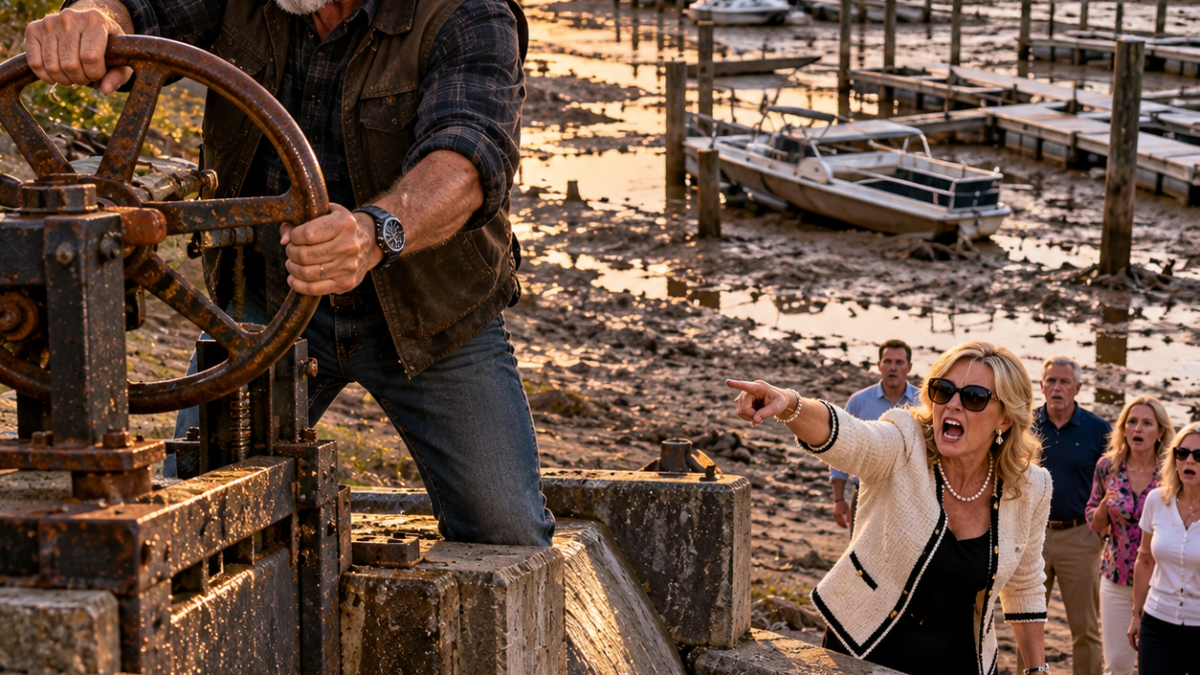
So at 7:14 on a Saturday night, with a state engineer, the sheriff, my attorney, my son, and half a dozen witnesses standing on the dam, I put both hands on the old spillway wheel—and by sunrise her brand-new marina was standing in black mud while investigators waited for her on shore.
The wheel groaned on the first turn.
Not loudly.
Just a low metallic complaint that traveled through the steel stem into my palms.
I stopped.
For half a second, nobody on the dam said anything.
Then Joe Varin, eighty-one years old and stubborn enough to have outlived most of the people who ever told him what to do, called from behind me.
“Don’t you dare get sentimental now, Wade.”
I looked over my shoulder.
Joe stood on the crest of the dam in a pressed plaid shirt and an old felt hat he’d worn to my grandfather’s funeral thirty-two years earlier.
My son Luke stood beside him holding a clipboard.
Marisol Cabrera from the Georgia Safe Dams Program had a state tablet tucked against her chest.
Sheriff Ben Hightower stood twenty yards farther down the embankment.
My attorney Sam Bagley had both hands in his pockets, which meant he was trying very hard not to look pleased with himself.
A reporter from Atlanta had her camera raised.
And my old blue heeler, Dozer, was asleep beside a folding chair as though legally lowering a forty-seven-acre lake was something we did every Saturday.
I looked back at the wheel.
“I’m not sentimental.”
Joe snorted.
“You’ve been staring at that thing for thirty seconds.”
“I was checking the stem.”
“Your grandfather used to lie better.”
That made Luke laugh.
It was the first time I’d heard him laugh in four months.
I put both hands back on the wheel.
Turned again.
The brass stem moved.
The second turn came easier.
Then the third.
Somewhere thirty-seven feet below us, inside concrete and earth and steel, a gate that had not moved in years began lifting from the mouth of a forty-eight-inch outlet pipe.
On the fourth turn, the lake made a sound.
Deep.
Distant.
Almost alive.
A low mechanical exhale rose through the tower.
Then another.
PART2:
By the sixth turn it sounded like a freight train waking underground.
Forty-seven acres of water had begun moving.
Not because I was angry.
Not legally.
Not officially.
Officially, this was a routine dam-safety drawdown required to inspect sediment accumulation at the low-level intake.
That statement was true.
Every word.
The unauthorized construction upstream had disturbed enough shoreline and lake-bottom material to create a measurable sediment plume.
My intake trash rack had partially clogged.
The outlet needed inspection.
The state had reviewed my engineering packet.
Downstream owners had been notified.
The drawdown was authorized.
Everything about what I was doing was legal, documented, witnessed, and boring enough to make a judge comfortable.
The fact that Mountain Mirror Estates had just spent three months building a forty-slip marina on water it didn’t own was somebody else’s problem.
So was the fact that nine feet of drawdown would place every one of those slips high above the new waterline by sunrise.
I turned the wheel again.
And I thought about my grandfather.
Earl Harrison.
Born in 1908.
Raised poor enough that shoes were seasonal equipment.
He bought the original eighty acres of our farm in 1928 for forty-six dollars, two years of promised labor, and the temporary use of a mule that apparently hated him.
By the time I was born, the farm had grown to more than four hundred acres.
Pasture.
Timber.
Three cold springs.
High Tower Creek.
And the lake everybody now wanted to pretend had always belonged to the subdivision next door.
It hadn’t.
Granddaddy built it.
Not metaphorically.
He built the dam himself.
In 1947, after years of watching spring floods tear soil off the lower fields, he talked a local Soil Conservation Service supervisor into helping him design an earthfill structure.
He borrowed a Caterpillar D7.
He moved dirt for four days.
Then another contractor finished the core trench.
They shaped the embankment.
Installed the original outlet.
Armored the downstream channel.
Closed the gap.
And waited for rain.
It took two and a half years for the basin to fill.
My grandmother called it Earl’s Pond the morning he started.
The name stuck.
It was no pond.
Forty-seven acres at normal pool.
Nearly fifty during spring runoff.
Seventy-two-foot dam.
Three springs feeding it year-round.
Cold water.
Bass.
Bluegill.
Catfish.
Herons.
Kingfishers.
And in the winter, when the leaves dropped and the mountains reflected perfectly across the surface, it looked like somebody had cut a hole in the earth and filled it with sky.
Granddaddy spent the rest of his life watching that water from the front porch.
I grew up there.
Left for college.
Became a civil engineer.
Then a hydrologic engineer.
Then spent thirty-one years with the Tennessee Valley Authority.
The last fourteen were mostly dam safety.
Outlet capacity.
Spillway calculations.
Emergency-action plans.
Flood routing.
Slope stability.
The kind of work nobody notices when it’s done correctly.
That’s the point.
If you live below a well-maintained dam, success looks like nothing happening.
I liked that.
My wife Margaret used to say I had chosen the only career where being invisible counted as excellence.
She died in January of 2022.
Cancer.
Forty-seven days from diagnosis to funeral.
People talk about grief like it arrives in waves.
Mine didn’t.
Mine moved into the house.
Sat in her chair.
Left her reading glasses on the kitchen counter.
Stayed in every room.
For more than two years, I lived around it.
Then one morning I realized I had spent twenty-seven months doing nothing except continuing.
Eating.
Sleeping.
Working enough to finish retirement paperwork.
Driving past places Margaret loved because stopping hurt too much.
My son Luke finally said:
“Dad, you need to go somewhere Mom isn’t standing in every doorway.”
He meant it gently.
I hated him for saying it.
Then I knew he was right.
So I went home.
To Granddaddy’s farm.
I arrived in spring 2024 with a U-Haul full of books, a fourteen-year-old blue heeler named Dozer, and no plan except:
Don’t die yet.
That was enough.
My daughter Meredith lived near Atlanta with her husband and their new baby.
Luke was twenty-four and finishing a master’s in environmental engineering at Georgia Tech.
He had inherited Margaret’s ability to point out when I was being ridiculous without sounding cruel.
Three weekends a month I stayed at the farm.
One weekend I drove south to see my granddaughter.
The rest of the time, I repaired fences, walked the dam, started writing a technical book nobody had asked for, and tried to remember what life felt like before every happy thought ended with Margaret’s absence.
The subdivision next door had existed for years by then.
Mountain Mirror Estates.
Forty-eight houses on former Harrison land.
The eighty acres had been sold by my uncle Bobby in 2004 after a family dispute I have no interest in reopening.
The developer promised buyers “deeded lake access.”
That phrase caused nineteen years of confusion.
Residents had always used the lake with our permission.
Canoes.
Kayaks.
A small community dock no bigger than a backyard deck.
Fishing from one narrow section of shore.
Granddaddy allowed it because he believed water looked better with children around it.
My father continued.
So did I.
Nobody abused the arrangement.
Nobody claimed ownership.
Then Marlene Witford moved in.
Fifty-two.
Long blond hair.
White Lexus.
Expensive clothes.
A laugh you could hear across water.
She became HOA president fourteen months later.
Her husband Greg had worked for Camden Hollow Development, the same company that originally built Mountain Mirror.
That detail mattered later.
The first time I met Marlene, she came up my gravel road in the Lexus.
No appointment.
I was sitting on the porch with Dozer.
She stepped out wearing white slacks and shoes that cost more than my first truck.
“Mr. Harrison?”
“Yes.”
“Marlene Witford.”
She smiled.
“President of Mountain Mirror Estates.”
“Congratulations.”
She laughed.
At the time I didn’t realize she thought I was joking.
“I wanted to discuss the community lake.”
“The what?”
She pointed.
“The lake.”
I looked at it.
“Earl’s Pond?”
“Yes.”
“Our community refers to it as Mountain Mirror Lake.”
“That’s fine.”
Her smile returned.
“Wonderful.”
“They can call it whatever they want.”
I stood.
“Still mine.”
Smile changed.
Only slightly.
“What do you mean?”
“Lake.”
“Dam.”
“Bottom.”
“Shoreline on this side.”
“Mine.”
She tilted her head.
“The HOA has deeded lake access.”
“Access isn’t ownership.”
“Our attorneys have interpreted it broadly.”
“Then get narrower attorneys.”
She laughed again.
That was meeting one.
Meeting two happened six weeks later.
Same question.
“How long exactly has your family owned the lake?”
“Since before your subdivision existed.”
“Do you have documentation?”
“Marlene.”
“Yes?”
“I spent three decades designing and regulating hydraulic infrastructure.”
“I know where my property lines are.”
She smiled as if I had made a small mistake she was polite enough not to correct.
“You’d be surprised how old deeds can be interpreted.”
That sentence should have warned me.
Instead, I went back to mowing.
At the end of August, I drove to Atlanta for my granddaughter’s six-month photographs.
Meredith had booked some photographer who wrapped babies in fabric and put them inside decorative baskets.
I complained the entire time.
Then bought fourteen prints.
I got home Sunday evening.
Dozer was asleep in the back.
The sun was dropping behind the ridge.
I rounded the gravel bend.
And saw six fresh pilings standing in the lake.
I stopped the truck.
Didn’t get out.
Six treated-pine poles.
Sixteen inches thick.
Driven approximately forty feet off my shoreline.
Fresh yellow tops.
Sediment around each.
I knew instantly what equipment had been used.
Vibratory driver.
Maybe barge-mounted.
The disturbed silt spread from the pilings toward my spring inlets.
I sat there.
Maybe a minute.
Maybe five.
Then I drove home.
Fed Dozer.
Made coffee.
Sat on porch.
Looked at those pilings for half an hour.
Anger is dangerous when you’re technically knowledgeable.
You can think of very efficient responses.
Most are bad ideas.
So I called my son.
“Luke.”
“Hey, Dad.”
“I need you home Friday.”
Pause.
“What happened?”
“Bring the survey-grade GPS from the lab if you’re allowed.”
Longer pause.
“And the laser rangefinder.”
“Dad.”
“Yes?”
“What happened?”
“I have a situation.”
He sighed.
“I’ll be there by six.”
Then I called Sam Bagley.
Sam and I met at the University of Georgia in 1990.
He became an attorney.
I became an engineer.
We’ve spent thirty-four years insisting the other’s profession exists primarily to make simple things expensive.
He answered.
“Wade.”
“Sam.”
“You sound unhappy.”
“Somebody’s building a marina in my lake.”
Silence.
Then:
“Say that again.”
I did.
“How many structures?”
“Six pilings visible.”
“Contractor?”
“Don’t know yet.”
“HOA?”
“Who else?”
He exhaled.
“Listen carefully.”
“Do not remove anything.”
“I know.”
“Do not threaten anyone.”
“I know.”
“Do not touch their equipment.”
“Samuel.”
“I know you know.”
“I’m saying it because I’m your lawyer and I know your grandfather.”
“My grandfather is dead.”
“His spirit has committed several potential misdemeanors in my imagination already.”
I almost laughed.
“Photograph everything tomorrow.”
“Permit.”
“Equipment.”
“Workers.”
“License plates.”
“Shoreline.”
“Water clarity.”
“Existing high-water marks.”
“Then come to my office.”
“I’ll clear noon.”
I slept four hours.
At first light I walked to shoreline with Nikon, tape, field notebook, and Dozer moving at the pace of a retired tractor.
What I found was worse.
Construction trailer twenty feet inside my recorded property.
Backhoe.
Lumber.
Aluminum gangways.
Prefabricated finger piers.
Piling equipment.
Twenty-four holes or layout positions marked along a stretch of shoreline.
And a laminated permit posted on the trailer.
FORTY-SLIP COMMUNITY MARINA IMPROVEMENT PROJECT.
Issued by:
Mountain Mirror Estates Homeowners Association.
Approved by:
Marlene Witford, President.
Notarized.
The seal made my stomach go cold.
Not because I recognized the name.
Because it looked wrong.
I photographed everything.
Then drove into town.
Fannin County clerk’s office occupied the second floor of the courthouse.
Donna McRae had worked there forever.
She had known me since I was nine and still called me Wade Junior even though my father had been dead nineteen years.
I placed photograph of notary seal on her desk.
“Can you check commission?”
She adjusted glasses.
Typed.
Then stopped.
Typed again.
Looked at me.
“That’s strange.”
“What?”
“This woman died in 2019.”
I stared.
“Commission?”
“Expired before that.”
“You sure?”
Donna turned screen.
Record.
Death notation.
Old commission information.
“Very.”
“Certified copies.”
“How many?”
“Three.”
She looked again at photograph.
“What are you doing?”
“Trying not to commit a crime.”
“That sounds unlike Harrison men.”
“Personal growth.”
She printed documents.
I drove to Sam’s office.
He spread everything out.
Permit.
Deeds.
Photographs.
Dead notary record.
He sat back.
“Wade.”
“Yes?”
“This is no longer an HOA argument.”
“I know.”
“This permit appears fraudulent.”
“Yes.”
“Construction is unauthorized.”
“Yes.”
“Potential environmental violations.”
“Yes.”
“And if somebody knowingly used a dead notary’s credentials…”
“Forgery.”
He looked at me.
“You’ve gotten annoying in retirement.”
“I had good teachers.”
Sam removed glasses.
“I’m going to need a week.”
“You have four days.”
“Why?”
I looked at him.
He knew.
His eyes narrowed.
“Wade.”
“What?”
“You are not opening that low-level outlet.”
“I didn’t say I was.”
“You have face.”
“What face?”
“Hydrologist revenge face.”
I drank cold coffee.
He pointed at me.
“Do nothing hydraulic until I finish legal review.”
“Define hydraulic.”
“Anything involving gates, valves, spillways, pipes, pumps, siphons, excavators, explosives, or rain dances.”
“Specific.”
“I know you.”
I left.
The following Tuesday, Marlene called the sheriff on me.
I came home and found a patrol cruiser by porch.
Marlene beside it.
Arms folded.
White blazer.
Phone in hand.
Deputy Castro approached.
Young.
Late twenties.
Polite.
“Mr. Harrison?”
“Yes.”
“Could I get few minutes?”
Marlene spoke before he finished.
“He threatened our contractor.”
“I did?”
“They’re afraid to return.”
“I wasn’t there today.”
She ignored me.
“He’s been photographing workers and harassing a legally permitted improvement project on common property.”
Deputy Castro lifted one hand.
“Ma’am.”
She kept going.
“Our HOA is losing money every hour.”
“Ma’am.”
He turned to me.
“Mr. Harrison, Mrs. Witford is asserting this shoreline is HOA common property.”
“She says marina is permitted.”
“Do you have documentation showing ownership?”
“Yes.”
“How much?”
“Kitchen table’s covered.”
He glanced at house.
“May I see?”
“Absolutely.”
Marlene stepped forward.
Castro stopped her.
“Ma’am, please remain here.”
Her expression could have curdled milk.
Inside, he removed hat before sitting.
Granddaddy always said a man who takes off his hat in your kitchen probably intends to listen.
I poured coffee.
Then laid out everything.
1928 deed.
1947 construction records.
1971 dam modification documentation.
Later boundary surveys.
Tax plats.
Safe Dams registration.
2009 outlet redesign permit.
Current tax assessment including lake bed.
Recent high-water survey.
Easements.
Maps.
Castro read carefully.
Then photograph of HOA permit.
Then certified proof notary was dead.
He sat back.
“Mr. Harrison.”
“Yes?”
“I owe you apology.”
“No.”
“I came here thinking I might cite you.”
“That’s not apology-worthy.”
“Marlene was persuasive.”
“I imagine.”
“She’s telling different story than these records.”
“Yes.”
He tapped dead-notary page.
“This part…”
“Is why attorney is involved.”
Castro took photographs.
Called supervisor.
Wrote incident report:
CIVIL TRESPASS / UNAUTHORIZED CONSTRUCTION / SUSPECTED FRAUDULENT NOTARIAL ACT.
Before leaving he paused.
“Off record?”
“Sure.”
“We’ve got a file on Mrs. Witford.”
“How thick?”
He held fingers apart.
“Couple inches.”
“For?”
“Repeated complaints.”
“Neighbor disputes.”
“One situation with elderly couple.”
“Nothing I should discuss.”
“Then don’t.”
He appreciated that.
I asked:
“Would department be willing to provide prior public incident reports to counsel?”
“Through proper request.”
“Yes.”
“Absolutely.”
He returned outside.
Spoke with Marlene.
Thirty-one seconds, maybe.
Her face changed.
Confusion.
Anger.
Then flat.
The look of someone who has just decided the problem isn’t her behavior.
It’s the person who exposed it.
She drove away.
That night Sam called.
“Deputy report helps.”
“Good.”
“But there’s more.”
“What?”
“I pulled original lake-access language.”
We went down rabbit hole.
Mountain Mirror’s buyers did possess legal permission for limited recreational access.
That was real.
The recorded language allowed ingress to designated shoreline and nonmotorized recreational use.
It did not grant ownership.
It did not grant construction rights.
It did not grant marina rights.
Yet Marlene’s board minutes referenced something else:
A “1973 Lake Use Easement.”
One that supposedly conveyed sixty feet of shoreline construction rights.
I had never seen it.
Neither had Sam.
We went back to courthouse.
Donna pulled record.
There it was.
At first glance legitimate.
Dated 1973.
Purportedly signed by Earl Harrison.
Recorded.
But signature looked wrong.
I had Granddaddy’s handwriting in dozens of places.
Checks.
Letters.
Old plats.
He made capital E with tall backward hook.
The easement’s E was rounded.
His lowercase r barely rose.
The easement’s r looped.
Sam looked.
“Could still be natural variation.”
“Maybe.”
Then Donna noticed notary seal.
Same woman from marina permit.
I stared.
“What’s her birth year?”
Donna checked.
Then her mouth opened slightly.
“1982.”
Sam leaned closer.
“What?”
The instrument was dated 1973.
Its current recorded version carried acknowledgment from a notary who would not be born for another nine years.
That did not automatically tell us how alteration occurred.
But it told us this version was not what it claimed.
Further archival review showed a 1973 book entry associated with timber harvesting, not lake construction.
At some later point, a copy had been altered and reintroduced into county records.
Donna located scanning metadata from 2009.
The same year Camden Hollow Development was preparing later phases of Mountain Mirror.
The developer where Greg Witford had worked.
Now Sam stopped smiling.
“Wade.”
“Yes.”
“We need prosecutors.”
“Agreed.”
Then Donna said:
“I remember her.”
“Who?”
“Marlene.”
“She brought some documents in over years.”
“How many?”
We checked.
Forty-seven filings connected to Marlene or entities she represented.
We did not assume all were fraudulent.
That would be foolish.
We compared seals.
Commission records.
Dates.
Eleven contained serious irregularities.
Dead notaries.
Expired commissions.
One nonexistent registration number.
Sam started making calls.
State investigators.
Secretary of State.
Sheriff’s fraud investigator.
Then financial records.
Mountain Mirror HOA had collected lake-maintenance assessments for years.
Members had paid for “shoreline restoration” and “lake stewardship.”
Contractor:
Mountain Mirror Lake Stewardship LLC.
Registered to Greg Witford.
Marlene held controlling interest.
Four years of payments:
$218,000.
Some work had actually been done.
Brush clearing.
Trash pickup.
Minor dock repairs on HOA-access point.
But nothing remotely approaching $218,000.
And now forty families had each paid $2,800 toward new slips.
$112,000.
The marina contractor had been shown forged or invalid permitting documents and had accepted HOA’s claimed ownership without independently verifying lake-bed title.
That was reckless.
Maybe worse.
But the crewmen themselves?
Laborers.
Equipment operators.
Men paid to drive pilings where supervisor told them.
Luke asked me about them Friday night when he arrived.
We had documents covering entire kitchen table.
He read silently.
Forty minutes.
Then looked out window.
“Dad.”
“Yes?”
“You’re draining lake.”
“Lowering.”
“You’re draining it.”
“Nine feet.”
He pointed.
“That’s draining.”
“Terminology matters.”
He laughed.
Then stopped.
“What happens to workers?”
“I don’t want workers crushed.”
“Legally or literally.”
He smiled.
“Both.”
“I notified contractor through counsel.”
“Formal cease-and-desist?”
“Served.”
“They know permit disputed.”
“Yes.”
“Saturday crew?”
“Canceled.”
“Good.”
He studied me.
“You’re enjoying this.”
“No.”
“Dad.”
I looked down.
“Maybe five percent.”
“Mom would be making popcorn.”
That got me.
Margaret loved property disputes because she believed engineers became funniest when angry about boundaries.
I could hear her.
Wade, nothing says grief recovery like destroying yacht parking.
I looked away.
Luke noticed.
He always did.
“You okay?”
“No.”
“Me either.”
We stood quietly.
Then he asked:
“Why exactly nine feet?”
Now we were engineers again.
That helped.
“Need intake exposure.”
“Gate setting?”
“Eighty-three percent.”
“Discharge?”
“Approximately thirty-one thousand gallons minute initially, tapering with head.”
“Downstream capacity?”
“Confirmed.”
“Notice?”
“Seventy-two hours.”
“State authorization?”
“Tomorrow morning.”
“Fish impacts?”
“Minimal at rate.”
“Spring protection?”
“That is why nine, not full drawdown.”
Luke nodded.
“So marina sits dry.”
“Marina was installed at normal pool without legal right to assume normal pool.”
“Dad.”
“Yes?”
“You’ve practiced that sentence.”
“Several times.”
Saturday morning Marisol Cabrera arrived.
State engineer.
Forty-one.
Sharp.
No patience for theatrics.
I respected her immediately.
She reviewed dam.
Sediment plume.
Outlet intake readings.
Construction disturbance.
My calculations.
Downstream channel.
Weather forecast.
Drawdown rate.
She finished around eleven.
“This is justified.”
“Thank you.”
“Do not thank me.”
“You wrote half the standards I’m applying.”
“Not half.”
She rolled eyes.
“Retirement has made you worse.”
“Common observation.”
Then she looked toward pilings.
“Those are ridiculous.”
“Off record?”
“Deeply off record.”
She approved maintenance drawdown.
Everything moved fast after that.
Not because I was powerful.
Because documents aligned.
Property records.
Suspected forged instruments.
Environmental concerns.
Financial records.
Sheriff report.
State review.
Attorney filings.
I had spent career telling younger engineers:
Paper trails are boring until somebody needs one.
Then they’re everything.
Marlene spent Saturday calling everyone she knew.
County commissioner.
Developer contacts.
HOA counsel.
Contractor.
State offices.
At 5:53 p.m., she called me.
“Mr. Harrison.”
“Marlene.”
“We need to talk.”
“We are.”
“In person.”
“I’m occupied.”
“This is becoming unnecessarily hostile.”
I looked at the state vehicle parked by dam.
Sheriff’s cruiser.
Sam’s car.
Luke setting floodlights.
Joe eating peanuts.
“Unnecessarily?”
“Forty families invested in this project.”
“Based on your representation.”
“They relied on HOA counsel.”
“Then give them counsel’s name.”
“Wade.”
First time she used it.
“We can resolve this.”
“Remove pilings.”
“Refund money.”
“Restore shore.”
“Then we can discuss legal access.”
“You know we can’t simply—”
“You can.”
“Financial losses would be enormous.”
“Whose?”
“The HOA.”
“No.”
“The forty families.”
“They paid you.”
Her voice sharpened.
“They paid for improvements to an amenity they were promised when they purchased.”
“Access was promised.”
“Ownership was not.”
“Our easement says—”
“Your easement was allegedly notarized nine years before notary was born.”
Silence.
I continued.
“Try another argument.”
She lowered voice.
“If you damage marina, I will personally make sure you spend rest of retirement defending lawsuits.”
“Marlene.”
“What?”
“I am not damaging anything.”
“I am conducting state-authorized dam-safety drawdown.”
“The water level of private reservoir is operational variable controlled by dam owner subject to regulation.”
“If someone built unauthorized fixed structures assuming permanent elevation, that’s their engineering problem.”
“You’re doing this on purpose.”
“I’m doing it because your construction silted intake.”
“That’s convenient.”
“Truth often is.”
She hung up.
At 6:07, she came anyway.
Black Escalade.
Greg driving.
Marlene passenger.
No makeup.
White dress.
Sheriff Hightower met them before porch.
“Mrs. Witford.”
“Mr. Witford.”
“This is private property.”
“We’re conducting authorized operation.”
“You need to remain outside marked perimeter.”
Marlene looked beyond him at me.
“Wade.”
Sam stepped forward.
He was holding manila envelope.
Greg noticed.
His face changed before Sam spoke.
“Mr. Witford.”
“You are being served with complaint filed today in Fannin County Superior Court.”
He handed envelope.
Greg stared.
Sam continued calmly.
“Named defendants include you, Mrs. Witford, Mountain Mirror Estates HOA, Mountain Mirror Lake Stewardship LLC, and Blue Ridge Marine Works as appropriate to specific counts.”
Marlene interrupted.
“This is intimidation.”
Sam looked at her.
“No.”
“This is service.”
The sheriff almost smiled.
Sam listed allegations.
Trespass.
Unauthorized construction.
Fraudulent instrument issues.
Financial self-dealing.
Damage to private property.
Environmental remediation costs.
Declaratory relief on easement scope.
Greg turned toward wife.
“Marlene.”
She didn’t look.
“What?”
“What’s he talking about?”
“We’ve discussed this.”
“Not this.”
His voice dropped.
“What notary?”
She stared at me.
Not husband.
Me.
That told me plenty.
Then:
“Please don’t open valve.”
The words came quietly.
No performance.
For first time since I met her, she sounded frightened.
“There are families who put money into those slips.”
“I know.”
“They trusted me.”
“I know.”
“If you do this…”
“Do what?”
“Humiliate them.”
I shook head.
“This isn’t about them.”
“It is now.”
“No.”
I stepped closer but stayed behind survey marker.
“You made them part of it.”
“You collected money.”
“You told them lake was yours to improve.”
“You showed contractor documents.”
“You installed structures.”
“I gave you opportunities to stop.”
“You didn’t.”
She whispered:
“You’re enjoying this.”
That bothered me because part of me had asked same question.
I answered honestly.
“Less than you think.”
Then:
“More than I should.”
Sam glanced at me.
Luke too.
Marlene seemed surprised by truth.
I continued.
“But whether I enjoy it doesn’t change whether it’s authorized.”
“That is difference between us.”
She stared.
I went on.
“You treated authority like something you could create by saying it confidently.”
“I spent thirty-one years working around structures where confidence without engineering kills people.”
“I don’t confuse the two.”
Sheriff escorted them back.
Escalade left.
At 7:11 sun disappeared behind ridge.
We walked dam.
Joe.
Luke.
Marisol.
Me.
No cheering.
No dramatic music.
Only insects.
Water.
Wind.
I climbed steel walkway.
At 7:14, opened valve.
Thirty-six turns.
Not forty-three.
Joe called:
“Why stop?”
“Because I need nine feet.”
“Full opening would overshoot.”
He nodded.
“Earl would’ve stopped there.”
“I know.”
Water thundered through outlet.
Downstream creek whitened over riprap.
Lake began falling.
Slowly at first.
That is thing about enormous systems.
They can be moving violently without looking fast.
At shoreline, wet band appeared.
Then an inch.
Two.
By nine, top of first piling collar was clearly above water.
Luke watched Mountain Mirror Facebook.
“They think dam’s failing.”
“Post state notice.”
“Already public.”
“Good.”
Someone on HOA side called 911.
Sheriff’s dispatch explained authorized drawdown.
Then someone called local news.
By ten-thirty, residents had gathered.
Some furious.
Some confused.
Several had written checks for slips.
One man shouted across water:
“You can’t drain our lake!”
I didn’t respond.
Luke wanted to.
I stopped him.
“Why?”
“Because nobody becomes smarter during shouting match across half mile of water.”
At midnight, construction was exposed enough that geometry looked absurd.
Gangway angle too steep.
Pontoon frames hanging.
Pilings taller.
Mud flats widening.
A boat someone had tied prematurely at incomplete slip began settling sideways.
I asked sheriff to notify owner.
He did.
Owner couldn’t safely retrieve.
Marisol documented.
Nobody touched.
Dozer slept.
Joe drank coffee like man at baseball game.
At one-thirty he said:
“Your granddaddy would’ve charged admission.”
“Probably.”
“He would’ve parked tractor on road.”
“Definitely.”
At three, lake bottom showed.
Black silt.
Old stumps.
Stone wall from pasture flooded in 1949.
Luke walked shoreline with instruments.
Stayed within safe ground.
He came back muddy.
“Dad.”
“What?”
“I found old fence line.”
Granddaddy’s original field fence.
Underwater seventy-five years.
Posts nearly gone.
Wire still there.
I stared into darkness.
The past had literally surfaced.
That did something to me.
I sat.
For first time that night, revenge disappeared.
I thought about Margaret.
Granddaddy.
Years.
Ownership is temporary.
That realization comes late for stubborn men.
We say “my land.”
“My lake.”
“My farm.”
But really we’re custodians with paperwork.
Granddaddy built it.
I inherited.
Somebody else someday would decide what happened next.
The question wasn’t:
How do I win?
It was:
What do I leave?
At 5:45, reporter returned from nap.
By six-thirty, cameras appeared across subdivision shore.
At 7:18 sun came up.
Lake had dropped just over nine feet.
Marina wasn’t a marina anymore.
Twenty-eight installed pilings stood in black mud.
Gangway ended nowhere.
Finger slips hung above exposed lakebed.
One expensive pontoon boat leaned helplessly in eighteen inches of muck.
A great blue heron stood on aluminum walkway.
Joe pointed.
“Margaret.”
“What?”
“Heron.”
“My grandfather named every blue heron Margaret.”
Luke looked at me.
“Mom?”
“No.”
“Long before.”
“That’s weird.”
“Granddaddy.”
“Fair.”
Across water, more than sixty Mountain Mirror residents gathered.
Nobody looked triumphant.
They looked betrayed.
That mattered to me.
These people were not all Patricia.
Many were victims too.
They had paid.
Trusted board.
Believed paperwork.
Some had bought homes specifically because of supposed lake privileges.
Their anger was legitimate.
Just aimed wrong.
At 8:42, white Lexus came over ridge.
Marlene got out alone.
She looked toward lake.
Stopped.
Saw pilings.
Mud.
Boat.
Cameras.
Then me on dam.
Sheriff walked toward her.
Two investigators stood nearby.
He had warrant.
Not because lake was low.
Because overnight a judge had reviewed evidence related to suspected forged instruments, financial records, and false statements investigators had already been developing.
Sheriff said her name.
She looked at him.
Then at me.
The arrest was not cinematic to witness.
No screaming.
No running.
No handcuffs raised for cameras.
Just a woman realizing confidence could not talk documents out of existing.
The sheriff informed her of allegations.
She said:
“This is all Wade Harrison.”
“No, ma’am.”
Hightower answered.
“This is evidence.”
That sentence stayed with me.
She looked across lake toward neighbors.
Some stared.
Some looked away.
One woman cried.
Marlene asked:
“Can I speak to Greg?”
The sheriff said she could through counsel.
She looked at me once more.
I expected hatred.
What I saw was fear.
And underneath it, something worse.
Confusion.
As though some part of her still could not understand how “no” had become real.
Sam approached after she left.
“You’re very quiet.”
“Nothing to say.”
“You drained their marina.”
“Lowered reservoir.”
“Still doing that?”
“Yes.”
He smiled.
“What now?”
I looked across mud.
“Refill.”
Luke laughed.
And that was exactly what happened.
We inspected intake.
Removed sediment.
Documented construction impacts.
Marisol signed off.
Gate gradually closed.
Rains came.
Lake began rising.
Nature is much less interested in human drama than humans are.
High Tower Creek kept coming.
Springs kept feeding.
Within eighteen days water returned near normal pool.
The pilings did not stay.
The HOA held emergency meeting.
This time Patricia wasn’t presiding.
Her longtime board critic, retired schoolteacher Patricia Andrews—everyone called her Pat so no one confused them—stood at microphone.
She laid out facts.
Property boundaries.
Access easement.
Construction rights.
Financial records.
Attorney advice.
Then invited Sam to explain difference between access and ownership.
He enjoyed this far too much.
One resident asked:
“So we never had right to build slips?”
Sam said:
“Not based on any valid instrument I’ve reviewed.”
Another:
“Then why did board say we did?”
Nobody answered.
A third man stood.
“I paid $2,800.”
Pat Andrews nodded.
“So did thirty-nine other families.”
“Do we get it back?”
“We are voting tonight.”
They did.
Unanimous.
Refund all contributions from reserves, then pursue recovery from responsible parties.
Terminate marina project.
Remove pilings.
Restore shoreline.
Commission independent audit.
Review every contract involving Witford entities.
Create conflict-of-interest policy.
Sixty-three to zero.
No cheering.
Just tired people trying to clean up what trust had cost them.
Contractor returned under supervision.
Pulled each piling.
Regraded disturbed bank.
Installed erosion matting.
DNR biologist inspected.
Sediment stabilized.
The lake healed.
The legal cases took longer.
They always do.
The criminal allegations around forged documents were untangled one by one.
Not every suspicious filing became a conviction.
Evidence standards matter.
Nine of the eleven strongest forgery-related counts held.
The financial records supported theft-by-deception and related misconduct.
Marlene’s defense argued she believed HOA had broad rights.
That argument became difficult after prosecutors presented emails where she questioned whether “old Harrison deed could be worked around.”
A particularly bad email said:
Once pilings are in water, removal becomes politically impossible.
That sentence ended a lot of sympathy.
Greg cooperated after federal investigators followed wire transfers through Mountain Mirror Lake Stewardship LLC.
He admitted invoices were inflated and some “maintenance” work had never occurred.
He pleaded to federal financial charges.
Marlene went to trial.
I testified for ninety-three minutes.
Her attorney tried to paint me as vindictive retired government engineer who manipulated water levels to destroy community investment.
I expected that.
He asked:
“Mr. Harrison, isn’t it true you deliberately lowered the lake knowing it would strand my client’s marina?”
“Yes.”
Courtroom stirred.
Sam glanced at me.
Defense attorney smiled.
“And you expect jury to believe that wasn’t retaliation?”
“I expect them to believe I knew physical consequence.”
“Same thing.”
“No.”
“Explain distinction.”
I looked at jury.
“The outlet inspection was necessary.”
“The drawdown was approved.”
“The level was selected to expose intake safely without draining basin.”
“The marina was unauthorized.”
“Had marina not existed, same drawdown would have occurred.”
Attorney walked closer.
“But you enjoyed seeing it stranded.”
Sam objected.
Judge allowed.
I answered:
“Yes.”
Another stir.
Attorney’s smile widened.
“So this was revenge.”
“No.”
“How can you say that after admitting pleasure?”
“Feelings don’t change permits.”
Silence.
I continued.
“I can dislike person and still follow regulation.”
“I can enjoy consequence and still have lawful engineering reason.”
“The question isn’t whether I smiled.”
“The question is whether I had authority to operate my dam within approved conditions.”
That ended line.
Jury eventually convicted Marlene on multiple counts.
Sentence included incarceration, suspended portion, restitution, probation afterward.
Greg received federal time.
Their LLC dissolved.
Marlene’s house sold.
Her white Lexus disappeared too.
I never asked where.
I didn’t need trophies.
What surprised me was what happened next.
November first, Pat Andrews drove up my road.
Not Lexus.
Old Toyota pickup.
Foil-covered pan in passenger seat.
She parked where visitors park.
Walked to porch.
“Mr. Harrison?”
“Wade.”
“Pat.”
She held cobbler.
“Peace offering.”
“Pecan?”
“Yes.”
“You may enter.”
She laughed.
We sat.
Dozer sniffed cobbler until she moved it.
Pat didn’t start with apology.
I liked that.
She started with facts.
“The community wants to repair relationship.”
“Okay.”
“We understand lake is yours.”
“Good beginning.”
“We understand existing recreational easement allows limited access.”
“Yes.”
“We’re asking whether you’d consider written supplemental agreement.”
“What kind?”
“Five years.”
“Renewable only by mutual consent.”
“Canoes.”
“Kayaks.”
“No motors.”
“No docks.”
“No permanent structures.”
“Eight people maximum at one time.”
“Reservation list.”
“Liability coverage paid by HOA.”
“Children fish free.”
I stared.
She waited.
“No pressure.”
“That’s new.”
She smiled.
“We’re learning.”
I looked at lake.
The shoreline was almost restored.
No aluminum.
No pilings.
Just water.
“What do residents think?”
“Mixed.”
“Some don’t want any access.”
“Some think we lost rights we never had.”
“Most just want what families used to have before Marlene turned it into a development amenity.”
That mattered.
For nineteen years, people had used lake politely.
The problem wasn’t canoes.
It was entitlement.
I said:
“I’ll think.”
Pat stood.
“Take all time.”
She left cobbler.
Smart woman.
I thought through winter.
Luke and Meredith both had opinions.
Meredith:
“Dad, don’t punish kids because adults were stupid.”
Luke:
“Make them carry insurance.”
Engineer.
I looked at Granddaddy’s old notebooks.
Found entry from May 1950.
Three sentences:
Bobby caught four bass. Let Miller boys fish east cove. Water ought to be used.
That settled more than lawyers.
I called Pat.
“Yes.”
She exhaled.
“Thank you.”
“One condition.”
“Name it.”
I did more than restore limited HOA access.
I created something separate.
Five-acre eastern cove placed under permanent youth-fishing easement through county land trust.
Not HOA-controlled.
Not resident-only.
Every kid in county.
Free.
No dues.
No neighborhood gatekeeping.
We built one simple wooden pier.
Accessible path.
Life-jacket station.
No marina.
No motors.
Earl’s Cove.
First fishing day came in May.
Sixty-three kids.
Joe taught knots.
Luke ran registration.
Pat served lunch.
Dozer, fifteen and barely interested in existence unless cheese involved, slept under picnic table.
I sat on dam.
A nine-year-old girl from Mountain Mirror caught a largemouth bass.
Maybe two pounds.
To her, world record.
She held it up.
“Mr. Harrison!”
“What?”
“It’s huge!”
I yelled back:
“They all are!”
Everybody laughed.
That afternoon, I thought about September night.
Wheel turning.
Water dropping.
Marlene begging.
Cameras.
Police.
All of it.
People later told story as revenge.
HOA built marina on engineer’s private lake.
Engineer drained lake overnight.
Perfect headline.
Clean.
Satisfying.
But that isn’t really what happened.
I didn’t empty lake.
I lowered it nine feet.
I didn’t destroy marina.
I exposed how badly it had been built—legally and literally.
I didn’t bankrupt neighbors.
Their own leadership had taken their money under false pretenses.
I didn’t forge easement.
I found it.
I didn’t invent criminal evidence.
I documented it.
The most important thing I did wasn’t turn a wheel.
It was wait until every piece of paper was in order before I did.
Granddaddy would’ve preferred simpler method.
He once settled boundary disagreement by moving neighbor’s fence onto neighbor’s porch at two in morning.
Different era.
Sam said that would now create liability.
Law has ruined many excellent stories.
But patience gave me something rage wouldn’t have.
Credibility.
When Marlene called sheriff, I had deeds.
When contractor showed permit, I had notary record.
When HOA claimed easement, I had signatures.
When state reviewed drawdown, I had engineering.
When court asked why water moved, I had safety justification.
Every time she escalated, she ran into paper.
That is what arrogance hates most.
Not anger.
Documentation.
Years later, people still ask if I planned from beginning to expose marina.
No.
First night I saw pilings, I wanted them gone.
That was it.
Then sediment reached intake.
Then records surfaced.
Then financial trail.
The lake became smallest part of larger case.
Water showed problem.
Paper proved it.
There was also something I had to admit about myself.
I came home after Margaret died because I wanted nobody to need me.
That was truth.
I told Luke I wanted quiet.
What I meant was I wanted exemption.
From grief.
People.
Obligation.
I had spent decades being responsible for structures other people depended on.
I wanted porch.
Dog.
Water.
No emergencies.
Then Marlene drove pilings into lake and forced me back into exactly what I knew how to do.
Measure.
Document.
Calculate.
Protect.
Fight, but correctly.
Luke said once:
“Mom would’ve loved that lake made you mad enough to live again.”
I told him that was stupid.
Then thought about it for months.
Maybe anger isn’t always opposite healing.
Sometimes it reminds you that you still care about outcome.
I started writing again after case.
Finished book.
Not bestseller.
Hydraulic structures rarely are.
Luke helped technical review.
Meredith complained there were no characters.
I told her spillways were characters.
She stopped asking.
Dozer died following winter.
Fifteen years old.
I buried him under white oak near porch.
That hurt in clean familiar way.
Joe came.
Pat came.
Luke drove up.
Nobody said much.
Good people know when words are nuisance.
A month later Mountain Mirror kids left hand-painted stone by grave.
DOZER — LAKE BOSS.
I cried where nobody saw.
The lake remained.
It always does.
Not literally forever.
Nothing does.
But longer than our arguments.
Longer than Marlene’s presidency.
Longer than Greg’s company.
Longer eventually than me.
That changed way I thought about ownership.
Deed says mine.
Law says mine.
Tax bill definitely says mine.
But Granddaddy built something he knew he’d eventually leave.
I was custodian.
Luke may be next.
Maybe Meredith.
Maybe land trust someday.
The job isn’t to clutch.
It’s to decide what deserves protection and what deserves sharing.
Marlene’s mistake wasn’t wanting access.
Access can be good.
Her mistake was deciding permission was beneath her.
She believed if she constructed fast enough, spent enough money, involved enough families, physical reality would become legal right.
Sometimes people call that “fait accompli.”
Granddaddy would’ve called it stealing with extra steps.
The marina taught entire neighborhood difference.
Pat Andrews remained HOA president three years.
Then stepped down willingly.
That alone made her historically exceptional.
The next president emailed before any lake event.
Subject line:
ASKING BEFORE DOING ANYTHING STUPID.
I liked him immediately.
Every spring, Mountain Mirror renews insurance certificate.
Sends reservation rules.
No motors.
No structures.
No changes without written permission.
Children fish.
Adults paddle.
Nobody calls it community lake anymore.
Some call it Earl’s Pond.
That might be greatest victory.
One afternoon, a new resident walked up public cove.
Young man.
Nice clothes.
Asked:
“Are you Mr. Harrison?”
“Yes.”
“I bought on Ridgeview Court.”
“Congratulations.”
“Realtor said HOA has access.”
“It does.”
“Can I build little floating dock near our side?”
“No.”
He blinked.
“Why not?”
“Agreement prohibits.”
“What if removable?”
“No.”
“Even seasonal?”
“No.”
He looked disappointed.
Then:
“Okay.”
That was it.
No campaign.
No lawyer.
No forged notary.
He asked.
I answered.
Civilization survived.
I almost wanted to hug him.
Instead gave fishing map.
Sam retired eventually.
Sort of.
Lawyers never fully retire because arguments seek them like mosquitoes.
He still comes for cobbler.
He still claims my case added five years to his life.
I say it removed seven.
Donna retired from clerk’s office.
At party I gave her framed copy of dead-notary search.
She laughed.
“Most romantic gift I’ve ever received.”
Joe reached eighty-five.
Still taught knot tying.
His hands shook more.
Kids didn’t care.
Luke finished master’s.
Took work in watershed restoration.
I told him TVA paid better.
He told me money wasn’t everything.
This from boy who complained about student loans for six years.
Meredith’s daughter got old enough to fish.
First time she came to Earl’s Cove, she threw entire rod into lake.
Luke went after it.
I laughed until ribs hurt.
Margaret would’ve too.
There are moments grief becomes gratitude without asking permission.
That was one.
My granddaughter caught no fish.
She caught a frog.
Declared success.
We framed photograph.
These are the things that matter after lawsuits fade.
Not arrest.
Not headline.
Not marina stranded in mud.
Normal life returning to place somebody tried to turn into battleground.
I still open low-level gate for maintenance.
Every few years.
Same wheel.
Same groan.
First time after lawsuit, Pat happened to be nearby.
She heard water roar.
“Should I panic?”
“No.”
“Is somebody building marina?”
“Not yet.”
She laughed.
I opened twelve percent.
Routine flush.
No cameras.
No sheriff.
No FBI.
No angry HOA.
That was better.
Quiet infrastructure doing quiet work.
The way I like it.
Sometimes visitors ask to see “spot.”
They mean where slips stood.
There is no spot now.
Shoreline restored.
Grass returned.
Water covers lake bed.
Bass don’t care.
Herons don’t remember.
Nature is bad at preserving human humiliation.
Good.
I don’t want monument to Marlene.
I’d rather have fish.
But I kept one thing.
Not piling.
Not sign.
The laminated marina permit.
Sam told me destroy copy after litigation.
I didn’t.
It’s in drawer beside Granddaddy’s 1947 permit.
One fraudulent.
One real.
One printed on modern HOA letterhead with official seal that meant nothing.
One yellowed, handwritten, signed by people who actually built and regulated the dam.
Every once in while I take both out.
Difference isn’t paper quality.
The fake one looks better.
That’s lesson.
Authority often doesn’t look authentic.
Sometimes fraud is laminated.
Sometimes truth is coffee-stained.
You have to read.
Look up.
Verify.
That is what saved me.
Not engineering alone.
Not money.
Not inherited land.
Not being stubborn Harrison.
Verification.
Who owns lake?
Check deed.
Who signed easement?
Compare signature.
Who notarized?
Check commission.
Who got paid?
Pull LLC.
Who authorized drawdown?
Read state approval.
Who says community owns water?
Show me instrument.
Marlene relied on everyone being too impressed, too busy, or too embarrassed to ask those questions.
For a while, it worked.
Forty families wrote checks.
Contractor brought pile driver.
Board approved.
Nobody stopped.
Then one old engineer came home from visiting his granddaughter and saw six poles where water was supposed to be.
That’s how these stories begin.
Not with revenge.
With something that shouldn’t be there.
At 7:14 p.m. on that September Saturday, I turned spillway wheel thirty-six times.
By sunrise, the waterline was nine feet lower.
The marina stood useless in mud.
That image traveled farther than any deed or financial audit.
People liked symbolism.
I understand why.
An HOA tried to take a lake.
The lake disappeared out from under them.
Clean justice.
But my favorite moment came months later.
Not arrest.
Not trial.
Not headlines.
It was that little girl at Earl’s Cove holding her first bass.
She didn’t know Marlene Witford.
Didn’t know forged easements.
Didn’t care about property law.
She knew water was free that morning.
She knew Joe showed her how to tie knot.
She knew lake had fish.
She yelled:
“Mr. Harrison, it’s a big one!”
And for first time since Margaret died, I looked across something my family had protected for almost a century and didn’t feel like I was guarding it from world.
I felt like I was sharing it with the right people.
That’s difference ownership is supposed to make.
Not:
Nobody else gets this.
But:
Nobody else gets to take it.
There is a world of distance between those two sentences.
Marlene never understood it.
Granddaddy did.
I finally did too.
So yes.
The HOA built forty boat slips on my private lake.
And yes.
I opened the spillway.
By sunrise, their marina was standing in mud.
But the real victory wasn’t watching their docks go dry.
It was making sure that when the water came back, it returned to a lake with honest boundaries, clean records, restored shoreline, and children fishing where greed had tried to build something permanent.
The water came back.
The fraud didn’t.
And every morning when the mist rises over Earl’s Pond, the shoreline looks exactly the way my grandfather meant it to.
No marina.
No fake permits.
No argument.
Just water.
And the quiet certainty that some boundaries only need to be explained once—provided you have the deed, the engineering, and a spillway wheel waiting on top of the dam.


