HOA Put a $180,000 Lien on My Farm—Then Their Lawyers Saw What I Was Wearing at the Courthouse
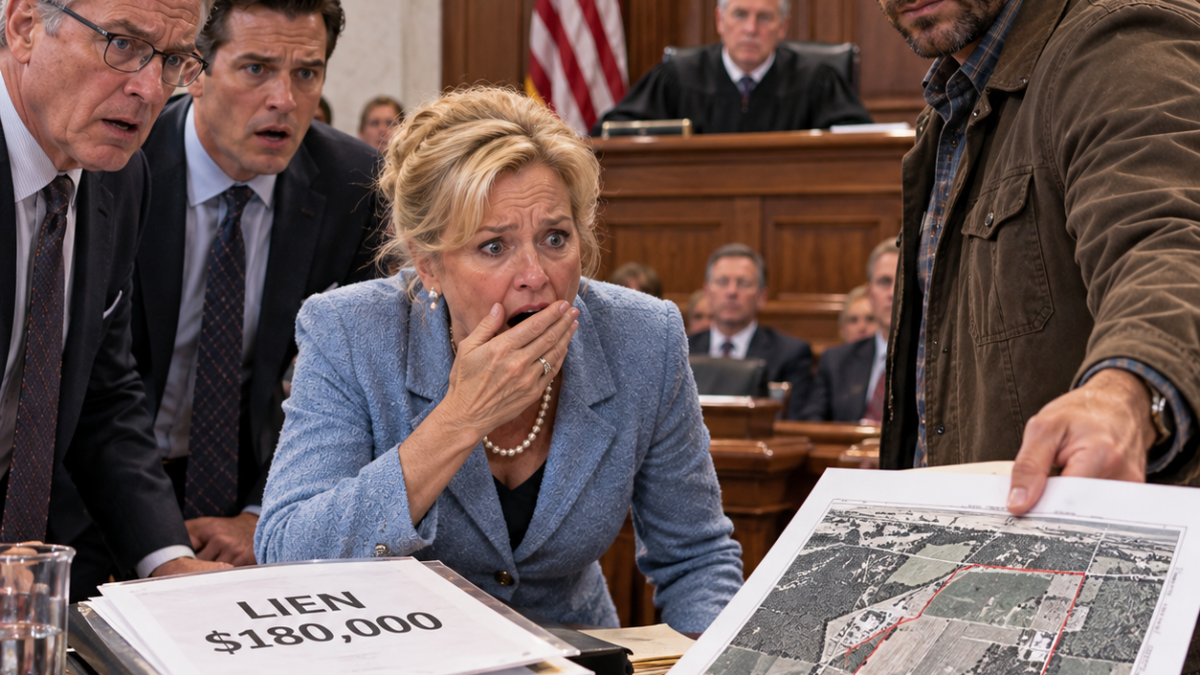
PART2:
Always dressed as though a television crew might appear without warning.
She liked pale blue jackets.
I remember that because on the morning she first threatened my farm, her jacket was the brightest thing for a hundred yards in every direction.
She arrived at 8:10.
Black SUV.
Three attorneys.
One binder.
One map.
I was replacing a hydraulic hose on the tractor.
Shop towel in my back pocket.
Grease on my forearms.
Dad was repairing fence farther east.
Linda parked beside the equipment barn.
The attorneys climbed out.
The oldest was Charles Whitmore.
Silver hair.
Expensive suit.
Real-estate and association lawyer.
I recognized the name.
PART3:
He had represented developers throughout the county for years.
Next came a title attorney named Franklin Shaw.
Then a younger associate who looked about thirty and smiled the entire time.
Whitmore approached me.
“Mr. Mercer?”
“Yes.”
He handed me a document.
“Notice of delinquent assessment and enforcement.”
I read the first page.
Then the second.
Then returned to the first because the number looked absurd.
$180,000.
“Is this a joke?”
Linda stepped closer.
“No.”
I looked at her.
“What exactly do you believe I owe you a hundred eighty thousand dollars for?”
She opened her binder.
“Accumulated penalties, assessments, compliance costs, attorney fees, architectural violations, commercial-use violations and enforcement expenses.”
I looked around.
Farm.
Barn.
Tractor.
Hayfield.
“Commercial-use violations?”
“You operate agricultural equipment on restricted property.”
“It’s a farm.”
“The association recognizes historical use, but Willow Creek standards still apply.”
I almost laughed.
Almost.
Instead:
“Show me the recorded declaration that puts my farm inside Willow Creek.”
Nobody answered.
Whitmore glanced toward Linda.
She unfolded a map across the hood of her SUV.
A pale shaded area covered forty acres of my eastern pasture.
“This is the Willow Creek expansion area.”
I studied it.
The shaded section ran west across our boundary fence.
Across the irrigation ditch.
Into hay ground my grandfather bought before Willow Creek existed.
I asked:
“What county recording number?”
Linda said:
“The association has authority.”
“That wasn’t my question.”
Whitmore said:
“We’ve provided notice.”
“Provide the recorded document.”
Silence.
The youngest lawyer stopped smiling quite so much.
Linda folded her arms.
“You have seven days, Mr. Mercer.”
“For what?”
“To resolve the balance.”
“And if I don’t?”
“The association will take further action.”
I looked again at the papers.
There was something else.
A lien.
Already recorded.
Three weeks earlier.
Nobody had notified me.
My name.
Parcel number.
Amount.
$180,000.
I read the legal description.
Then stopped.
“Your map shows forty acres.”
Linda said nothing.
“This lien appears to attach to the parcel.”
Whitmore answered:
“The county recording speaks for itself.”
My stomach tightened.
Our farm was one parcel.
One hundred twenty acres.
If the lien attached to the parcel, they had not encumbered forty acres.
They had encumbered everything.
The farmhouse.
Barn.
Western field.
Irrigation land.
All of it.
Then Linda said something that clarified the entire conversation.
“We can make this disappear.”
I looked at her.
“How?”
“Sell the eastern forty acres.”
There it was.
Not fines.
Not fences.
Land.
Four months earlier, Linda had visited with a developer named Nathan Cole.
Cole planned a second subdivision behind Willow Creek.
Problem:
Access.
The easiest route from his project to the county highway crossed forty acres of my eastern pasture.
Without that route, he needed to build a longer connector around the north side.
More grading.
More drainage.
More money.
He offered to buy.
The offer was low.
I said no.
Not to play games.
Because selling that field would damage the farm.
The irrigation ditch crossed it.
Hay production supported the western acreage.
A road would split operations.
I told Cole:
“Sell forty acres here and you hurt eighty somewhere else.”
Linda had looked over the pasture and said:
“Property owners sometimes have to consider the needs of the surrounding community.”
I answered:
“I do.”
“The land isn’t for sale.”
Three weeks later, my first HOA violation arrived.
$2,500.
Fence design.
I called Willow Creek.
“My farm isn’t in your HOA.”
The woman said she would note my objection.
Nobody returned my call.
Ten days later:
Barn architectural violation.
$15,000 total.
Then agricultural vehicle parking.
Then unauthorized commercial use.
Then failure to submit exterior changes.
$48,000.
My seventy-two-year-old father read that notice at the kitchen table.
He laughed at first.
Then stopped.
“They’re not trying to win.”
I looked at him.
“What?”
“They’re trying to make keeping this place more expensive than selling it.”
Dad’s name was Thomas Mercer.
Four years earlier, he had deeded the farm to me.
He still called it “our farm.”
I hoped he always would.
That morning after Linda left, Dad read the lien slowly.
Then said:
“This land was never part of Willow Creek.”
“I know.”
He shook his head.
“No.”
“What?”
“You know from a map.”
He tapped the paper.
“I know from your grandfather.”
That got my attention.
My grandfather, Raymond Mercer, died in 2001.
He bought most of the eastern acreage in the 1970s.
When Willow Creek’s original developer began assembling land in the early 1990s, Grandpa refused every offer.
Dad remembered the negotiations.
Not details.
Only that Grandpa came home angry more than once.
At the kitchen table Dad found an old photograph.
Eastern pasture.
Fence.
Grass.
Nothing else.
He pointed east.
“Willow Creek was Henderson land.”
“Yes.”
“Your grandfather made sure ours stayed separate.”
“Where’s the paperwork?”
Dad frowned.
“If I knew, I’d already have it.”
At dusk we walked the irrigation ditch.
Near the eastern fence, Dad stopped.
A green copper marker sat half buried in grass.
“Your grandfather told me never to pull that.”
“Why?”
“Never said.”
I crouched.
Stamped numbers were barely visible.
Boundary monument.
Maybe.
Maybe nothing.
My phone rang.
Marcus Bell.
My lawyer.
I had known Marcus twelve years.
Property litigation was his specialty.
He had spent that afternoon checking the county index after I sent him everything.
His first words:
“Daniel, the lien is worse than you thought.”
“How?”
“It doesn’t attach to forty acres.”
“I figured.”
“All one hundred twenty.”
I looked across the field.
“Can they do that?”
“Question isn’t whether they did.”
“They did.”
“Question is whether they had authority.”
“Do they?”
“Not from anything I can find.”
That was the beginning.
Day five of Linda’s seven-day deadline, survey trucks entered my lower hayfield.
I heard engines.
By the time I reached them, orange stakes were already in the ground.
Truck tires had cut deep ruts through hay I planned to cut in three days.
I did not shout.
That matters.
Anger makes evidence harder to use.
I photographed everything.
Ruts.
License plate.
Stakes.
Workers.
The foreman approached.
Clipboard.
Sunburned neck.
Confused expression.
“Can I help you?”
“You’re on my farm.”
He checked the clipboard.
“We’ve been authorized.”
“By who?”
He handed me a work order.
ACCESS ROAD ALIGNMENT PER WILLOW CREEK EXPANSION DECLARATION.
EXHIBIT C ON FILE WITH HOA.
I read it twice.
“Have you seen Exhibit C?”
He shifted.
“No, sir.”
“Who gave you this?”
“Developer.”
A black SUV turned off the road.
Linda.
Nathan Cole sat beside her.
They stepped out.
Linda still had that blue binder.
“Daniel.”
I held up the work order.
“Approved by whom?”
“The map establishes—”
“No.”
“Where is Exhibit C recorded?”
She opened her mouth.
Nothing.
Cole looked at the field.
Ruts.
Stakes.
Foreman.
Then at Linda.
“I’m not putting a crew on land the documents don’t cover.”
“Nathan, it’s fine.”
“Then show him the document.”
She tightened both arms around the binder.
Cole turned to the foreman.
“Pull the stakes.”
Linda stared.
“Nathan.”
“Pull them.”
The crew removed everything.
That afternoon Marcus told me:
“Do not pay them one dollar.”
“I wasn’t planning to.”
“Good.”
“Why?”
“Because payment can later be characterized as acknowledgment that some debt existed.”
“So what do we do?”
“Petition for declaratory relief.”
“Invalidate the lien.”
“Ask the court to determine the property is outside the declaration.”
That night he started preparing it.
The next morning my bank called.
That hurt more than Linda’s threats.
Farm operations run on cycles.
Seed.
Fuel.
Repairs.
Fertilizer.
You spend before harvest.
For fifteen years, I had used the same agricultural credit line.
My lender knew my father.
She knew our production history.
Her voice was apologetic.
“Daniel, legal flagged the lien.”
“It’s disputed.”
“I know.”
“Then what?”
“Until it’s resolved, we can’t renew your line.”
I looked toward the barn.
Fuel bills due.
Seed.
Equipment.
“How long?”
“I can’t answer that.”
Linda had moved beyond irritating paperwork.
She had reached my cash flow.
Marcus sent Whitmore a formal demand.
Recorded declaration.
All amendments.
Board authorization.
Itemized fines.
Legal basis for lien.
Title evidence.
Whitmore responded with six pages.
Policies.
Fine schedules.
Architecture rules.
And a document titled:
WILLOW CREEK EXPANSION DECLARATION.
The declaration referenced an attachment.
Exhibit C.
Properties added to the association.
Exhibit C was missing.
Marcus called Whitmore on speaker.
“Charles.”
“Marcus.”
“Your declaration refers to Exhibit C.”
“Yes.”
“Where is it?”
“Historical records.”
“Recorded version?”
“We’re locating it.”
“Until you do, you haven’t shown my client’s farm is subject to anything.”
Whitmore did not disagree.
He simply said enforcement would continue.
The next morning I went to the county recorder myself.
Took a number.
Waited behind a contractor and an elderly couple.
The clerk pulled the original Willow Creek plat.
Subdivision boundary stopped hundreds of feet east of my ditch.
“Any recorded amendment moving this line west?”
She searched.
“No.”
“What does that mean legally?”
She smiled.
“I tell you what is recorded.”
“Your lawyer tells you what it means.”
Fair.
Marcus explained later.
“A planning map does not put land inside an HOA.”
“Board vote doesn’t do it either.”
“You need a valid recorded instrument affecting the property.”
“What if Exhibit C exists?”
“Then we read it.”
“And if it doesn’t?”
“Then Linda has a problem.”
Ninety days passed.
Lien remained.
Bank line frozen.
Legal fees accumulated.
And I walked into the county courthouse for something completely unrelated.
Here is the detail almost nobody in Willow Creek knew.
I farmed before sunrise.
But farming was not my only job.
For eleven years, I had served as a state trial judge in a neighboring judicial circuit.
I kept the two worlds separate deliberately.
At 5:30 a.m. I could be repairing fence with Dad.
At 8:30 I put on a robe.
My farm dispute was personal.
Marcus represented me.
It was filed outside my own circuit.
I had no judicial involvement.
I wanted none.
That morning, one of my former mentors was retiring.
Judges from neighboring circuits had been invited to the ceremony.
Afterward, I stood outside the courtroom talking with colleagues.
Then I heard Whitmore’s voice.
He came around the corner with Franklin Shaw and the young associate.
Whitmore looked up.
Saw me.
Stopped.
His eyes went to the robe.
Then the brass courtroom plaque.
JUDGE DANIEL R. MERCER.
Shaw nearly walked into him.
The associate stared.
Then checked the file he was carrying.
Probably my case.
Whitmore crossed the hallway.
“Judge Mercer.”
“Mr. Whitmore.”
His tone had changed.
Not fear.
Care.
“I hope you understand our office relied on information provided by our client.”
I looked at him.
“Mr. Bell represents me.”
“Please direct anything concerning my farm through him.”
“Of course.”
Then I added:
“If I were you, I’d verify what you were given.”
That was all.
No threat.
No favor.
No courthouse connection.
My mentor saw the exchange.
Later he offered:
“If you want, I can mention the case to assignment.”
“No.”
“Not my farm.”
He smiled.
Good.
That afternoon Marcus called.
“Guess what Whitmore just demanded from Linda?”
“What?”
“Original legal descriptions.”
“Board resolutions.”
“All expansion exhibits.”
“Exhibit C.”
I smiled.
“They’re checking her now.”
“Yes.”
That night Dad and I went upstairs into the farmhouse storage room.
Boxes.
Decades.
Deeds.
Tax receipts.
Letters.
Old surveys.
Dad lasted three hours.
Then his knees quit.
I kept going.
Near midnight I reached the last box.
At the bottom was a thick envelope.
Grandpa’s handwriting:
WILLOW CREEK – BOUNDARY.
Inside:
Negotiation letters.
Survey notes.
Then one letter dated September 14, 1994.
From the original developer’s attorney.
I read:
Dear Mr. Mercer:
This letter confirms that your agricultural property shall remain entirely outside the proposed Willow Creek development and shall not be subject to its restrictions or any homeowners association created for that development.
I stopped.
Read again.
Second paragraph referenced a boundary exclusion agreement.
Beside it, Grandpa had written a county recording reference.
I drove to Marcus’s office before breakfast.
He read the letter standing.
Then sat.
“This is good.”
“Enough?”
“Not yet.”
“It tells us where to look.”
He called the county.
By noon, clerk found the instrument.
Recorded.
Legal description.
Clear exclusion.
Entire Mercer farm outside Willow Creek.
No later amendment bringing it in.
Then Marcus hired an independent licensed surveyor.
Twenty-five years experience.
He worked two hours along our boundary.
Found old monuments.
Including the green copper marker Dad had protected for decades.
The surveyor spread two maps across my tailgate.
Recorded Willow Creek.
Linda’s expansion map.
Not close.
“How much of my farm is inside Willow Creek?”
He shook his head.
“Based on the recorded documents?”
“Not one acre.”
Dad stared toward the pasture.
Then:
“Exactly where your grandfather said.”
That should have ended it.
It didn’t.
Because board minutes arrived next.
And those showed motive.
Months before my first violation, Willow Creek board discussed my eastern acreage.
Nathan Cole attended.
He wanted the access road.
Treasurer Patricia Moore asked an obvious question:
Does Willow Creek have jurisdiction over Mercer Farm?
She recommended title review before enforcement.
Linda was present.
After I refused the land sale, another meeting.
Linda moved to conduct “violation review” of my parcel “to resolve the access question.”
I read that sentence three times.
“They weren’t enforcing covenants.”
Marcus nodded.
“They were trying to clear a road.”
“We can say the timing suggests that.”
He was always careful.
Good lawyers are.
Marcus sent Whitmore everything.
1994 letter.
Recorded exclusion.
Survey.
Board minutes.
Demand:
Release the lien immediately.
Whitmore requested conference call.
Linda joined.
Marcus asked:
“Charles, have you reviewed the recorded exclusion?”
“Yes.”
“Any later recorded instrument bringing Mercer Farm into Willow Creek?”
Franklin Shaw answered.
“Not at this time.”
Marcus said:
“Then what supports the violations?”
Linda interrupted.
“The board approved them.”
Marcus replied:
“A board vote can’t extend a declaration onto property outside the declaration.”
Silence.
Then Linda said:
“That road is the second emergency exit for three hundred families if the main entrance floods.”
That was the first time I understood that somewhere underneath everything, Linda may actually have believed she was doing something necessary.
Important distinction.
Good intentions do not create property rights.
She continued:
“Do you want to explain to those families why it wasn’t built?”
I answered:
“If the county needs an emergency road, there are lawful processes.”
“You don’t invent HOA authority.”
Whitmore suggested postponement.
Marcus:
“Lien comes off first.”
Whitmore:
“Requires board approval.”
Linda:
“We’re not removing anything until Mr. Mercer negotiates.”
That told us everything.
Four days later, Marcus called.
His voice sounded different.
“Daniel.”
“What?”
“Willow Creek recorded Exhibit C yesterday.”
I went still.
“The missing exhibit?”
“Yes.”
I opened the PDF.
County stamp.
Property schedules.
My parcel number.
My acreage.
Certification.
Linda Carver, President.
TRUE AND COMPLETE COPY OF ORIGINAL EXHIBIT C.
At first glance it looked devastating.
Marcus said:
“We can’t argue no Exhibit C exists anymore.”
“They put one in the record.”
“So?”
“Now we ask when it actually came into existence.”
The bank saw the new filing.
Credit line remained frozen.
I paid seed from savings.
Then Linda emailed Willow Creek residents.
Someone forwarded it to Marcus.
One sentence:
A sitting judge is hiding behind his robe to avoid community obligations.
That hurt my reputation.
A major hay buyer paused his order until the dispute cleared.
I lost my temper.
Called Marcus from the equipment barn.
Shouted.
Said the case was moving too slowly.
Said I was paying for everyone’s caution while Linda kept filing papers.
Marcus listened.
Then:
“I know.”
After I hung up, Dad stood in the doorway.
“Your grandfather would’ve thrown a wrench.”
I laughed.
Pressure broke.
Then I thought.
We had been asking:
Does Exhibit C exist?
Wrong question now.
New question:
When was this Exhibit C created?
Marcus already knew.
“Get the certified copy.”
“Not PDF.”
Paper copy.
County recorder.
I stood in line again.
Same clerk.
She handed me certified pages.
Then said:
“You know, recorder’s office doesn’t verify truth.”
“We verify formatting.”
“Dates.”
“Signatures where required.”
“We don’t decide whether the contents are accurate.”
I sat on a courthouse bench.
Read every line.
Slowly.
The way I read evidence from the bench.
Page three.
Property schedule.
Third line:
Owner of Record: Daniel R. Mercer.
I froze.
Read again.
Daniel R. Mercer.
Year the exhibit supposedly originated:
Problem.
I did not own the farm in 1998.
Dad did.
Dad deeded the farm to me four years ago.
Twenty-four years after that supposed exhibit.
A document allegedly created in 1998 somehow knew the name of a future owner.
I called Marcus.
“Read this.”
He went silent.
“Again.”
I read it.
Then he said:
“Don’t tell them.”
That evening Patricia Moore called.
The HOA treasurer.
“I asked Linda for Exhibit C three times in March.”
Marcus said:
“What did she give you?”
“Nothing.”
“Are you certain?”
“I keep the association records.”
“There was no Exhibit C.”
“Will you testify?”
“Yes.”
That was the first time in months I felt the ground shift.
Not emotionally.
Evidentially.
Linda’s own new filing had become our strongest evidence.
Marcus asked whether we should warn Whitmore about the ownership-date impossibility before hearing.
I considered it.
No.
They had county records.
Title attorneys.
Three lawyers.
Linda had certified the document.
Nobody owed her instructions on how to discover her own evidentiary problem.
Marcus filed a short objection.
Authenticity.
Timing.
Nothing more.
Then Whitmore made one last offer.
I grant a forty-acre easement.
HOA drops $180,000.
Lien released.
Forty-eight hours.
I said:
“No.”
Dad was mowing the next afternoon when Linda stopped by the fence.
No lawyers.
Blue jacket.
She looked tired.
“A judge fighting a lien in front of another judge.”
She shook her head.
“You understand how that looks?”
I answered:
“The county records don’t change based on what I wear to work.”
She stared.
Then left.
The hearing was assigned to a visiting judge from another circuit.
A woman I had never met.
Good.
I entered as Daniel Mercer.
Private property owner.
Sat beside Marcus.
No robe.
No special entrance.
No favors.
Marcus began with the oldest documents.
Recorded Willow Creek plat.
1994 exclusion.
Survey report.
Grandfather’s letter identifying the recording reference.
Board minutes.
Then Whitmore stood.
His argument rested on Exhibit C.
The attachment Linda had recorded nine days earlier.
He described it carefully as the association’s recently located historical exhibit.
The judge asked:
“Do you have the original?”
Linda opened her blue binder.
Removed a stapled copy.
Went to the witness stand.
Took oath.
Whitmore asked:
“Is this a true copy of the association’s historical Exhibit C?”
“Yes.”
“How long has it been maintained in the association’s files?”
“For many years.”
Marcus stood.
Three questions.
“Mrs. Carver, when did you personally first see this document?”
“I’ve known about it for a long time.”
“That wasn’t my question.”
The judge looked at her.
Linda adjusted.
“I don’t remember exactly.”
Marcus:
“Why did your own counsel tell us months ago that Exhibit C could not be located?”
“Our files are extensive.”
“Why did your treasurer request it three times in March and receive nothing?”
Linda touched her collar.
“The management office maintains old records.”
Marcus sat.
Then:
“Your Honor, plaintiff calls Daniel Mercer.”
I took the oath.
Marcus asked:
“Who owned Mercer Farm in 1998?”
“My father, Thomas Mercer.”
“When did your name first appear as owner in the chain of title?”
“Four years ago.”
“Before that?”
“I had no ownership interest of record.”
“Thank you.”
Nothing more.
The judge picked up Exhibit C.
Turned to page three.
Her finger moved down.
Stopped.
She read.
Then read again.
Looked toward Linda.
“Mrs. Carver.”
Linda straightened.
“This schedule identifies Daniel R. Mercer as owner of record.”
“Yes.”
“The association represents this schedule as an attachment originating in 1998?”
“Yes.”
“And the county chain of title shows Mr. Mercer did not become owner for another twenty-four years?”
Silence.
Linda opened her mouth.
Nothing.
The judge continued.
“Can you explain how a document allegedly created in 1998 identified a future owner?”
Linda looked toward Whitmore.
Whitmore looked at the table.
Marcus called Patricia Moore.
She testified calmly.
Treasurer.
Record custodian.
March.
Three requests.
No Exhibit C.
Then Whitmore stood.
His voice was nothing like the man who stood in my driveway.
“Your Honor.”
Pause.
“My office did not prepare the recently recorded Exhibit C and did not review its creation before recording.”
Linda turned toward him.
Whitmore continued.
“We withdraw reliance upon it.”
That was the moment the case ended.
Not when he saw my robe.
Not when my grandfather’s letter appeared.
Not even when the survey proved zero acres were inside Willow Creek.
It ended when the HOA’s own attorney refused to stand behind Linda’s document.
The judge placed Exhibit C beside the board minutes.
“Mrs. Carver, your certification appears on this filing.”
Linda looked down.
Her signature.
Her ink.
“I only…”
She stopped.
Her binder slid closed.
Several loose pages fell onto the courtroom floor.
Nobody moved.
The judge ruled from the bench.
Brief.
Plain.
The Mercer Agricultural Parcel had not been subjected to the Willow Creek declaration by the evidence presented.
The recorded exclusion remained controlling.
The recently filed Exhibit C had not been established as a valid historical instrument affecting my property.
The $180,000 lien was invalid.
Release required within ten business days.
Costs and any additional claims could be handled separately.
That was it.
No applause.
No dramatic gavel.
No arrest.
Just law doing what it is supposed to do when the paper finally catches up with the truth.
Outside, Linda found me beside a water fountain.
No binder.
No lawyers.
“Daniel.”
I turned.
“We can still be neighbors.”
“We already are.”
She nodded.
I added:
“Put the boundary in writing.”
Her face tightened.
Then she walked away.
The lien release arrived on business day eight.
Zero.
$180,000 became zero.
My bank restored the agricultural line on ordinary terms.
Hay buyer called.
Apologized.
I told him first cutting was ready.
Nathan Cole redesigned his access road.
Longer route.
More expensive.
His problem.
Not mine.
Then Willow Creek held a special membership meeting.
Patricia invited me.
I sat in the back.
Did not speak.
Residents wanted answers.
Why had dues paid three attorneys to pursue a farm outside the association?
Why had the board ignored title-review concerns?
Why had Exhibit C suddenly appeared after months of searching?
An older man stood.
Dry voice.
“My dues paid lawyers to sue a man who was farming before my house had a roof.”
The room changed.
Linda sat at the front.
Blue binder in front of her.
Eventually the board voted to suspend all enforcement activity against my property and hire an independent reviewer.
Linda stood.
Placed the gavel in front of Patricia.
Walked out.
She left the binder behind.
I noticed that.
For months she carried it like armor.
When the paper stopped protecting her, she no longer wanted the weight.
There were follow-up issues.
Legal fees.
Damages to hayfield.
Lost business.
Bank interruption.
Marcus handled them.
We reached a resolution without turning the dispute into another three years of litigation.
I did not become rich.
I did not take Linda’s house.
Nobody went to prison.
The point was never revenge.
The point was the line.
Where Willow Creek ended.
Where my farm began.
Patricia mailed me one final document.
One page.
ACKNOWLEDGMENT OF BOUNDARY.
It identified:
Mercer Agricultural Parcel.
120 acres.
Outside Willow Creek declaration.
Not subject to Willow Creek covenants.
No HOA enforcement authority absent future voluntary recorded agreement by the owner.
Patricia had signed for the association.
There was another line.
For me.
I sat at the same kitchen table where I had once read a $180,000 lien.
Dad stood behind me.
“You going to sign?”
I smiled.
“It’s the first Willow Creek paper I’ve ever wanted to.”
I signed.
Then Dad and I walked to the eastern fence.
New post.
Level.
Shovel.
The old copper monument sat nearby.
Still green.
Still half swallowed by grass.
Grandpa had protected it thirty-two years without telling either of us exactly why.
Dad tamped dirt around the new post.
“Think they’ll come back?”
“Not without a legal right.”
He nodded.
I checked the level.
“Straight?”
Dad squinted.
“Close enough.”
“That is not how surveys work.”
“Good thing I’m retired.”
We laughed.
Next morning I opened the barn before sunrise.
No certified mail on the kitchen table.
No violation notice.
No black SUV.
A car slowed on the county road.
Driver looked toward the farm.
Then continued.
I stood there listening to the barn doors rattle slightly in the morning wind.
The strangest part of the entire fight was how much power a line on paper had acquired.
Linda drew one line on a planning map.
Suddenly survey crews believed it.
Lawyers repeated it.
A bank reacted to it.
My customer reacted to it.
Three hundred homeowners paid legal fees because of it.
But a line on a planning map does not move dirt.
It does not relocate an irrigation ditch.
It does not rewrite a deed.
And it does not turn somebody else’s farm into an HOA just because a board president wishes the road went through it.
I had spent eleven years as a judge telling people that documents matter.
Then I became the man standing in a hayfield learning exactly how much.
Recorded declaration.
Chain of title.
Survey.
Board minutes.
Certification.
Dates.
The truth was not hidden in a speech.
It was sitting in county records.
My grandfather understood that.
That was why he kept the letter.
Why he protected the marker.
Why he wrote the recording number in the margin.
He did not trust memory to defend the farm.
He trusted paper.
Dad once asked why Grandpa never explained all of it.
I think I know.
To him, the matter was settled.
The farm was excluded.
Document recorded.
Boundary marked.
Finished.
He never imagined that thirty years later somebody would need the proof again.
But land has long memory.
Families should too.
I sometimes think about Whitmore stopping in that courthouse hallway when he saw my robe.
People who heard the story afterward loved that part.
“Bet their tone changed fast.”
It did.
But I never liked what people assumed came next.
They imagined I used my position.
Called another judge.
Made something disappear.
That would have made me no better than Linda.
The truth is simpler.
The robe did one useful thing.
It made their lawyers look again.
They had assumed I was only the farmer Linda described.
A stubborn property owner blocking a community project.
Seeing me at the courthouse reminded them that the man on the other side might understand exactly what a recorded instrument was supposed to look like.
So they checked.
That’s all.
And once they checked, their own client’s story started falling apart.
That is how systems should work.
Not because somebody important walks into the room.
Because evidence survives scrutiny.
My job did not save the farm.
My grandfather’s paperwork did.
The county recorder did.
The surveyor did.
Patricia Moore refusing to lie did.
Marcus refusing to turn suspicion into conclusions did.
Even Charles Whitmore, in the end, did what he was supposed to do when the evidence stopped supporting his client’s position.
He withdrew reliance.
That mattered.
Linda’s greatest mistake was not wanting the road.
I could understand that.
Three hundred homes.
Flood risk.
Second exit.
There may have been legitimate public concerns.
Her mistake was deciding that believing the road was useful gave her authority she did not possess.
There were other options.
Negotiation.
A better offer.
County process.
Easement proceedings if legally justified.
Alternative route.
Instead she tried fines.
Then a lien.
Then pressure.
Then a missing exhibit appeared only after the recorded evidence contradicted her.
Good intentions cannot rescue bad authority.
That lesson stayed with me.
A year later, Willow Creek’s new board president called.
Not Patricia.
She refused to run.
Smart woman.
His name was Steven Hale.
He asked to meet.
I said:
“At the farm.”
He came alone.
No attorneys.
No binder.
We stood beside the eastern fence.
He said:
“I want to apologize on behalf of the association.”
“You weren’t on the board.”
“Still.”
I nodded.
“Thank you.”
Then he surprised me.
“The flood issue was real.”
“I know.”
“We still need secondary emergency access eventually.”
“I know.”
He waited.
“Would you discuss options?”
“Yes.”
His eyebrows rose.
“You would?”
“Discuss.”
“Not surrender forty acres.”
He smiled.
“Fair.”
The county later funded an emergency connector farther north.
It cost more.
It crossed land whose owner voluntarily negotiated an easement.
Nobody lost a farm.
Nobody invented HOA jurisdiction.
Turns out lawful solutions are often slower.
They are also more durable.
Dad was eighty when he stopped walking the eastern fence every morning.
Not because he wanted to.
His knees decided.
I started sending him photographs.
Fence.
Copper marker.
Hay.
One morning he called.
“Post’s leaning.”
“It is not.”
“I can see it.”
“From a photograph?”
“Your grandfather would fix it.”
So I fixed it.
Of course.
When Dad died, we buried him beside Mom in the little cemetery three miles from the farm.
After the service, I went to the eastern pasture alone.
Stood beside the marker.
Thought about three generations.
Grandpa had protected the boundary with paper.
Dad had protected the marker with memory.
My turn had been court.
Someday somebody else would inherit the job.
So I made a file.
Not cardboard.
Three copies.
One fireproof safe.
One attorney.
One digital archive.
Recorded exclusion.
Survey.
Boundary acknowledgment.
Chain of title.
Court order.
Photographs.
And on top:
IF ANYONE CLAIMS THIS FARM IS PART OF WILLOW CREEK, START HERE.
Marcus laughed when he saw it.
“Subtle.”
“Family tradition.”
Years later, a young couple bought a home in Willow Creek and came to my farm looking embarrassed.
The husband held a notice.
HOA claimed his shed violated setback rules.
“Why are you showing me?”
He smiled nervously.
“People said you’re the HOA guy.”
“I am absolutely not the HOA guy.”
“My neighbor said you beat them in court.”
“I proved my farm was outside their declaration.”
“Different problem.”
He looked disappointed.
Then I asked:
“Did you read your declaration?”
“No.”
“Start there.”
“That’s it?”
“That’s where I started.”
He laughed.
Then realized I wasn’t joking.
I told him:
“Don’t begin with what somebody says they can do.”
“Begin with the document that gives them the power.”
That is the lesson I kept.
Authority should have a source.
HOA.
Government.
Bank.
Employer.
Judge.
Anybody.
If somebody says:
We can fine you.
Ask why.
We own this right.
Show me.
Your property is subject to this.
Where is it recorded?
Not because every authority is corrupt.
Most are not.
Because legitimate authority should survive a simple question:
Where does this power come from?
Linda never answered that question in my driveway.
Everything that followed came from trying to avoid it.
The $180,000 lien.
Survey stakes.
Credit freeze.
Three lawyers.
The mysterious Exhibit C.
Court.
All because saying:
We do not actually have authority over this land
was harder than admitting the road needed another route.
I still farm the eastern pasture.
Two hay cuttings most years.
Three when weather cooperates.
I still use the irrigation ditch.
The equipment barn Linda called an architectural violation still stands.
One wall leans slightly.
Dad insisted it always had.
I know better.
Sometimes on summer evenings, I can see the Willow Creek rooftops through the trees.
Children ride bikes near the subdivision edge.
People walk dogs.
Life continues.
Nobody out there is my enemy.
That’s another thing legal disputes distort.
An HOA is not the residents.
A board is not the neighborhood.
One person’s overreach should not turn three hundred families into villains.
Some of the strongest criticism of Linda came from Willow Creek owners whose dues paid her lawyers.
Patricia risked friendships to testify.
An older resident stood up publicly and demanded accountability.
Those people helped fix what their board had done.
That matters.
The last letter I ever received from Charles Whitmore was four sentences long.
No apology.
Lawyers rarely decorate conclusions.
It confirmed the release.
Confirmed no remaining claim.
Confirmed file closure.
Wished me well.
I kept it.
Not because I needed the sentiment.
Because Grandpa taught me something without ever saying it directly.
Keep the paper.
Thirty-two years can pass.
People retire.
Boards change.
Developers disappear.
Memories become stories.
Stories become assumptions.
But a recorded boundary remains where it was put until somebody lawfully changes it.
The morning after the case finally closed, I woke at 5:10.
Coffee.
Boots.
Barn.
Sunrise came across the eastern field.
I expected some grand feeling.
Victory.
Vindication.
Nothing.
Just relief.
Dad was still alive then.
He came walking toward me slowly.
I said:
“No notices today.”
He looked at the kitchen window.
“Good.”
We opened the barn.
Fed the tractor fuel.
Checked weather.
Normal work.
That was the victory.
Not Linda losing.
Not lawyers changing tone.
Not people discovering Judge Mercer had been standing in the farmyard wearing grease and old boots.
The victory was ordinary.
A farm continuing to be a farm.
A man able to renew his credit line.
Hay cut when it needed cutting.
A boundary post staying where my grandfather placed it.
Nobody arriving to tell us that a line they drew in an office had changed the land beneath our feet.
Linda Carver once pointed across my pasture as though ownership could be created by confidence.
She was wrong.
The courthouse did change their tone.
But the courthouse did not create my rights.
It simply read the documents that had been there all along.
And by the time the judge reached the third line of Linda’s “historic” Exhibit C and asked how a paper supposedly written in 1998 already knew the name of a man who would not own the farm for another twenty-four years, there was nowhere left for confidence to hide.
That was the part Linda never understood.
Paper can be used as a weapon.
A notice.
A fine.
A lien.
A map.
But paper can also remember.
A deed.
A survey.
A recorded exclusion.
A grandfather’s letter sitting untouched in a box for thirty-two years.
One kind of paper tried to take my farm.
The other kind knew exactly where the line had always been.
And the ground never moved.



