HOA Karen Ordered My Wife’s Wheelchair Ramp Demolished—Then the Federal Judge Who Signed the Order Protecting It Walked Up the Sidewalk
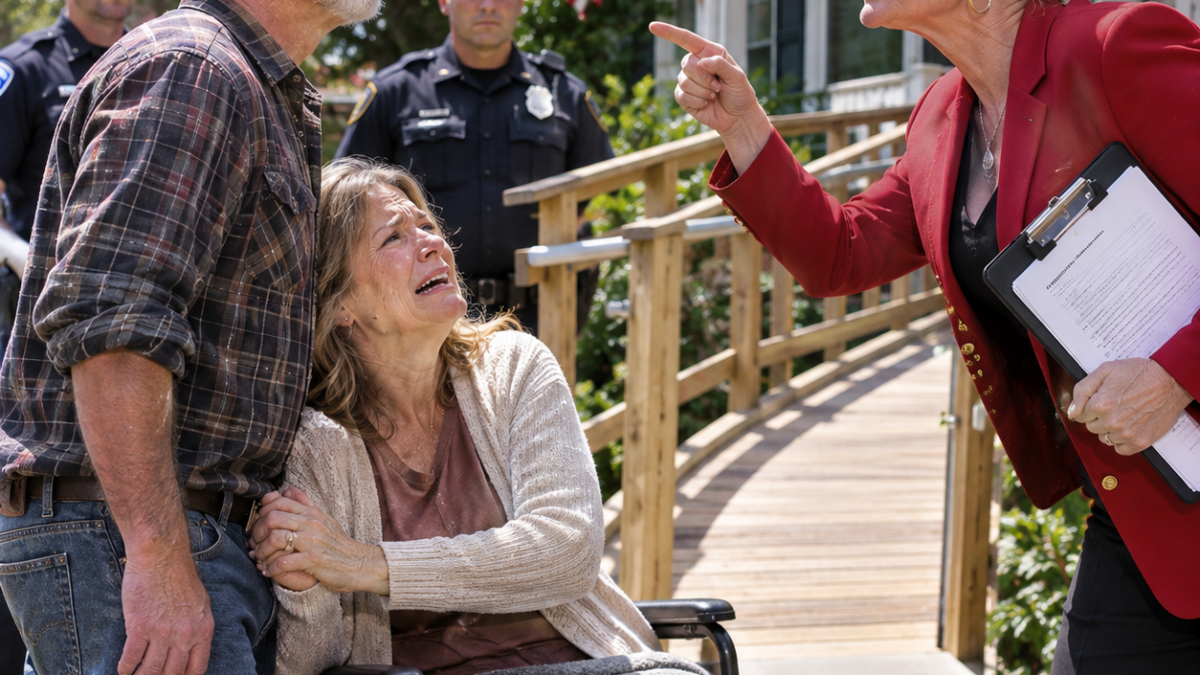
HOA Karen Ordered My Wife’s Wheelchair Ramp Demolished—Then the Federal Judge Who Signed the Order Protecting It Walked Up the Sidewalk
The demolition crew was already standing beside my wife’s wheelchair ramp with crowbars when the HOA president ordered two police officers to arrest me for refusing to let them tear it apart.
She had been served with a federal court order the night before, but she laughed at the paperwork, called it fake, and screamed that no judge in America could tell her what was allowed inside “her neighborhood.”
Then she turned toward the sidewalk and saw the same federal judge who had signed that order less than sixteen hours earlier walking straight toward her—and for the first time in eleven years, Colleen Strathmore stopped talking.
The first thing my wife said when the neurologist brought in the wheelchair was, “I’m sorry.”
Not to the doctor.
To me.
That nearly broke me.
Marlene sat on the edge of the hospital bed with both hands folded in her lap while the physical therapist adjusted the footrests.
Her legs rested uselessly in front of her.
Three days earlier, she had been walking.
Not well.
Not without pain.
But walking.
Multiple sclerosis had been part of our marriage for almost fifteen years.
We understood fatigue.
Numbness.
Weakness.
Bad days.
We had learned to rearrange vacations around flare-ups and keep medication schedules on the refrigerator.
But we had always believed we had more time before a wheelchair became permanent.
Then one Tuesday morning, Marlene stood beside our kitchen counter and her knees simply stopped holding her.
I caught her before she hit the floor.
At first she laughed.
She actually laughed.
“Well,” she said, holding my shoulders, “that’s new.”
By evening, she couldn’t stand without help.
By Thursday, the neurologist was using words like progression and mobility transition.
By Friday afternoon, a wheelchair stood beside her hospital bed.
Marlene touched one wheel.
Then looked at me.
“I’m sorry, Hank.”
I pulled a chair beside her.
“For what?”
“This.”
She gestured toward herself.
I understood immediately.
We had been married thirty-eight years.
You learn what your spouse means even when they say the wrong word.
I took her hand.
“You don’t apologize to me for being sick.”
“I know.”
“Then don’t.”
Her eyes filled.
“It changes everything.”
“No.”
“Hank.”
“It changes some things.”
I squeezed her fingers.
“Not everything.”
At the time, I believed that.
Then we went home.
My name is Hank Dillard.
PART2:
I was sixty-three years old and recently retired from thirty-nine years as a carpenter and general contractor.
Marlene and I had lived in Maple Ridge Estates for six years.
It was one of those communities that looked almost artificially peaceful from the road.
Brick houses.
Mature maples.
White fences.
Flower beds.
A clubhouse nobody used enough to justify the dues.
We bought there because we thought it would be the last house we ever needed.
One floor except for a bonus room.
Small yard.
Quiet neighbors.
Good hospital nearby.
We imagined growing old there.
Nobody thinks about three porch steps when they can still climb them.
The first afternoon after Marlene came home, I stood at the bottom of those steps looking upward.
Three steps.
Twenty-two inches total.
Might as well have been Everest.
I locked her wheelchair.
Then lifted her.
Marlene put both arms around my neck.
She weighed maybe 132 pounds.
When I was thirty, I could have carried her upstairs laughing.
At sixty-three, my lower back objected before I reached the second step.
“Careful,” she whispered.
“I’m fine.”
“You’re lying.”
“Married thirty-eight years and now you notice?”
She smiled.
I got her inside.
Then went back for the chair.
That became our routine.
Doctors.
Appointments.
Therapy.
Porch.
Lock wheels.
Lift Marlene.
Carry her.
Return for chair.
Every time:
“I’m sorry.”
Every time:
“Stop.”
For three weeks, I carried my wife across those steps.
Then one afternoon my back spasmed halfway down.
My right knee buckled.
I caught the railing.
Marlene tightened her arms around me.
“Hank.”
“I got you.”
“Put me down.”
“I got you.”
“You’re going to drop both of us.”
I made it.
Barely.
That night she sat by the living-room window looking toward her garden.
The roses were blooming.
She had not been outside alone since the wheelchair arrived.
I stood behind her.
“We’re building a ramp.”
She looked at me.
“What about the HOA?”
“I’ll file the plans.”
“Hank.”
“What?”
“You know Colleen.”
Unfortunately, I did.
Colleen Strathmore had been president of Maple Ridge Estates for eleven years.
That was longer than some dictators.
Sixty-one years old.
Perfect silver-blonde bob.
Clipboard.
Pearls.
An ability to turn the phrase “community standards” into something that sounded vaguely threatening.
She did not yell often.
She didn’t need to.
Colleen had mastered a different form of power.
Procedural exhaustion.
Want to repaint your front door?
Application.
Want a small shed?
Committee.
Want to replace dead shrubs with a different species?
Hearing.
Disagree?
Appeal.
Delay.
Fine.
Another appeal.
Most residents eventually surrendered because fighting Colleen took more energy than whatever they wanted was worth.
But this was not paint.
This was my wife getting out of her own house.
I spent that night drawing.
Carpentry had paid our mortgage, raised two daughters, and destroyed three pairs of knees between my employees and me.
I knew ramps.
I knew loads.
I knew slope.
I knew railings.
By midnight, I had a complete plan.
Pressure-treated lumber.
Thirty-six-inch clear width.
Proper turning platform.
Handrails.
Edge protection.
Non-slip surface.
Gentle one-to-twelve slope.
Anchoring designed to avoid damaging the brick facade.
I even designed landscaping around the exposed side.
The next morning I called the city building office.
The inspector reviewed my plan.
“Looks good.”
“Permit?”
“For this configuration, yes. I’ll issue it after site review.”
He came out that afternoon.
Measured.
Stamped.
Approved.
I assembled the HOA application.
Plans.
City approval.
Photographs.
A letter from Marlene’s neurologist stating that she required wheelchair access.
A short note from me explaining the medical necessity.
I even included a color sample.
Same brown as our porch.
I walked the packet to the HOA office myself.
Colleen was sitting behind a large desk.
She looked through the first three pages.
“What’s this?”
“Wheelchair ramp.”
“I can see that.”
“For Marlene.”
“I heard about her condition.”
Something about the way she said condition irritated me.
“She needs independent access.”
Colleen tapped the plan.
“This is visible from the street.”
“Yes.”
“That’s a problem.”
“It’s a ramp.”
“Yes.”
“She needs it.”
“Hank, architectural rules don’t disappear because circumstances are unfortunate.”
I stared at her.
“I’m requesting an accommodation.”
“You’re requesting an architectural alteration.”
“A medically necessary one.”
“Submit it and let the committee decide.”
I pointed to the packet.
“That’s what I’m doing.”
She smiled.
“Then we’ll review it.”
Five days later, the answer arrived.
One page.
REQUEST DENIED.
Reason:
PERMANENT EXTERIOR RAMPS VIOLATE SECTION 14.7 — COMMUNITY UNIFORMITY AND ARCHITECTURAL CONTINUITY.
Then beneath the printed language, Colleen had written by hand:
Consider an interior lift system or relocation to a more suitable residence.
I read that sentence three times.
Relocation.
Move.
Because my wife could no longer walk.
I took the letter inside.
Marlene read it.
Her face barely changed.
That was worse than anger.
“What?”
I asked.
“Nothing.”
“Marlene.”
She folded the letter.
“Maybe she’s right.”
“No.”
“Hank.”
“No.”
“Maybe this house doesn’t work anymore.”
“The house works.”
“The steps don’t.”
“So we change the steps.”
“The HOA says we can’t.”
I took the letter from her hand.
“The HOA is not God.”
“No.”
She looked toward the window.
“But they can make our life miserable.”
She was right about that.
Still.
I requested a board hearing.
Colleen gave me ninety seconds.
I know because a digital timer sat on the table.
One minute thirty.
The board sat in a row.
Colleen in the center.
Treasurer Al Fenwick to her left.
Three other members.
About twenty residents in folding chairs.
I stood at the podium with my plans.
“My wife has progressive multiple sclerosis.”
Colleen said, “We have read the application.”
“I’m asking you to reconsider.”
“We denied it under Section 14.7.”
“I’ve offered to match the house.”
“Not the issue.”
“I’ll landscape the side.”
“Not the issue.”
“It meets city code.”
“Not the issue.”
“Then what exactly is the issue?”
Colleen removed her glasses.
“Uniformity.”
I looked around the room.
“My wife cannot leave her home without me physically carrying her.”
Nobody moved.
“She is sixty-one years old.”
I held up the doctor’s letter.
“This is not a deck.”
“This is not decoration.”
“This is mobility.”
Colleen glanced at the timer.
“Thirty-eight seconds.”
I stared at her.
“Are you serious?”
“Rules exist for everyone.”
“If one of you needed a wheelchair tomorrow—”
Colleen interrupted.
“Mr. Dillard, emotional hypotheticals will not change recorded covenants.”
My hands tightened around the podium.
“Then record this.”
The timer showed twenty seconds.
“I will do whatever the law allows me to do so my wife can enter and leave her own house safely.”
Colleen smiled slightly.
“Nobody is above the rules.”
The buzzer sounded.
My time was over.
That night, Marlene sat by the window again.
“Maybe we should move.”
Her voice was almost a whisper.
That was the moment.
Not the denial.
Not Colleen’s timer.
That sentence.
In thirty-eight years, I had seen Marlene bury both parents.
Fight MS.
Raise two daughters.
Return to college at forty-four.
Spend nine months helping our youngest through chemotherapy.
She did not quit.
Now a woman with a clipboard had made her feel like the solution to disability was leaving her home.
I went to bed angry.
The next morning, somebody knocked.
Gladys Orr stood on my porch.
Seventy-four.
Three houses down.
Small woman.
Gray hair.
Cane.
She had lived in Maple Ridge longer than we had.
She looked over one shoulder before speaking.
“Hank.”
“Morning, Gladys.”
She handed me a large envelope.
“What’s this?”
“Don’t give up.”
Her eyes were wet.
“Ask her about Walter.”
Before I could answer, she walked away.
Inside the envelope was a photograph.
Gladys beside her husband Walter.
He was sitting in a wheelchair.
Smiling.
The second paper was an HOA request.
Three years earlier.
ACCESSIBILITY RAMP APPLICATION.
Applicant:
Walter and Gladys Orr.
Denied.
Same section.
14.7.
Same signature.
Colleen Strathmore.
On the back, Gladys had written:
Walter fell on the porch steps eight days later.
He broke his hip and struck his head.
He never came home.
I sat at my kitchen table for a long time.
Then called Gladys.
She answered after five rings.
“Did Colleen know why he needed the ramp?”
“Yes.”
“Did you have medical documentation?”
“Yes.”
“City approval?”
“Yes.”
“Did you appeal?”
“Twice.”
“What happened?”
“She said a ramp would hurt resale values.”
I closed my eyes.
“Gladys.”
“Yes?”
“Why didn’t anybody challenge her?”
“We didn’t know how.”
Her voice broke.
“And after Walter died, I didn’t have anything left for fighting.”
That afternoon, I called an attorney.
Beth Navarro.
Forty-something.
Fair housing and disability law.
Her receptionist asked what the matter involved.
“HOA denied my wife’s wheelchair ramp.”
Pause.
“Hold, please.”
Beth came on two minutes later.
She listened without interrupting.
I explained Marlene.
The plans.
The denial.
The hearing.
Gladys.
Walter.
When I finished, Beth asked:
“Do you own the house?”
“Yes.”
“Single-family?”
“Yes.”
“Ramp entirely within your property?”
“Yes.”
“City compliant?”
“Yes.”
“HOA’s stated reason?”
“Uniformity.”
“And they suggested you move?”
“In writing.”
Another pause.
“Hank.”
“Yes?”
“Keep that letter.”
“I was planning to.”
“No.”
Her tone sharpened.
“Keep everything.”
“What does federal law say?”
“It says housing providers and associations subject to federal fair housing requirements generally cannot simply use aesthetic rules to block reasonable disability-related modifications without considering their obligations.”
“Generally?”
“I’m a lawyer. We love generally.”
“Can I build it?”
She paused.
“I want to review your governing documents first.”
I sent them.
Two hours later she called.
“You have your city permit?”
“Yes.”
“Build the ramp.”
I looked at Marlene.
She had been pretending not to listen.
“Are you sure?”
“I’m sure enough to put my name on a letter.”
That weekend, I built.
Saturday morning at seven, lumber arrived.
By eight, neighbor Mike Delaney appeared carrying a drill.
“What are you doing here?”
“Helping.”
“Colleen will see.”
“I know.”
He looked toward the street.
Then lowered his voice.
“Can we work behind the hedge?”
I stared at him.
“You’re afraid of the HOA.”
He looked embarrassed.
“My wife’s on the garden committee.”
I almost laughed.
At nine, another neighbor came.
Then another.
They helped quietly.
Nobody parked in my driveway.
Nobody wanted photographs.
That told me how much control Colleen had accumulated.
People wanted to help a disabled woman but feared being seen holding a drill.
We worked until dark.
Sunday morning, I installed the last screw.
Then rolled my weight across every section.
Checked rails.
Checked slope.
Checked the landing.
Finally I opened the front door.
Marlene sat inside.
She had dressed.
Blue sweater.
Hair done.
She looked nervous.
“You ready?”
“No.”
“Good.”
I pushed her to the doorway.
Then stopped.
“This part is yours.”
She looked at me.
“Hank.”
“You said you wanted independence.”
Her hands moved to the wheels.
Slowly.
She rolled forward.
Front wheels crossed the threshold.
Onto the landing.
She looked down the ramp.
Then at me.
I walked beside her without touching the chair.
She started down.
One push.
Then another.
Halfway, she stopped.
“You okay?”
She nodded.
Tears were running down her face.
Then she continued.
At the bottom she turned the chair.
Looked back at the house.
And laughed.
Not polite laughter.
Not nervous laughter.
The real Marlene laugh.
Loud.
Ugly.
Wonderful.
“I did it.”
I had to look away.
She rolled toward her roses.
For forty minutes, she moved around the garden by herself.
That morning remains one of the best of my life.
At 8:05 Monday, somebody pounded on the door.
Colleen.
Violation notice.
Clipboard.
No hello.
She pointed at the ramp.
“What is that?”
I looked behind me.
“Looks like a ramp.”
“You were denied.”
“We disagreed.”
“You had no authority to proceed.”
“The city permitted it.”
“The city does not override the HOA.”
“Federal law might.”
I handed her Beth’s letter.
She read the first lines.
Reasonable modification.
Disability.
Fair Housing Act.
Demand to cease interference.
Preserve records.
Colleen laughed.
Then tore it in half.
Right there on my lawn.
“Federal law?”
She dropped the pieces.
“Honey, this is my neighborhood.”
That line would later become important.
Because Mike’s doorbell camera captured it.
Colleen held up the violation.
“Five hundred dollars a day.”
“Not paying.”
“Forty-eight hours to remove the ramp.”
“Not happening.”
“Then the association removes it.”
“No.”
“You signed the covenants.”
“I did not sign away my wife’s civil rights.”
She stepped closer.
“You are making this harder than necessary.”
“No.”
I looked directly at her.
“You are.”
Day one:
$500.
Day two:
Second notice.
$1,000 accrued.
Lien warning.
Day three:
Certified letter from HOA counsel.
DEMOLITION OF UNAUTHORIZED STRUCTURE.
Thursday.
9:00 a.m.
Contractor authorized.
Police assistance requested “to maintain order.”
Marlene read it at the kitchen table.
Then set it down carefully.
“They’re really coming.”
“I know.”
“What do we do?”
“Beth.”
I called.
Beth was furious.
Not theatrical.
That calm attorney anger that usually means somebody else is about to have a difficult week.
“They sent a demolition notice after receiving my letter?”
“She tore your letter in half.”
“Witness?”
“Doorbell camera.”
“Perfect.”
“Perfect?”
“For evidence.”
“I’d prefer sanity.”
“So would I.”
That night, at 10:41, my phone buzzed.
Unknown number.
Text:
Hardware store parking lot.
11:15.
Come alone.
Do not tell Colleen.
I stared at it.
Second message.
AL FENWICK.
HOA TREASURER.
I went.
Al stood beside a gray sedan beneath a parking-lot light.
Sixty-seven.
Thin.
Wire glasses.
He looked terrible.
He opened the trunk.
Inside sat a thick black binder.
“What’s this?”
“Something I should’ve given somebody years ago.”
He handed it to me.
Meeting records.
Invoices.
Ramp applications.
Four households.
Gladys and Walter.
The Kesslers.
Dana Price.
Miguel Santos.
All disabled residents.
All ramp requests denied.
Then invoices.
RIDGELINE ACCESS SOLUTIONS.
Walter’s proposed installation:
$11,400.
Dana Price:
$12,200.
Miguel:
$10,950.
I looked at Al.
“What am I looking at?”
“Colleen told them permanent homeowner-built ramps violated uniformity.”
“So?”
“She said removable professional systems might qualify.”
“From Ridgeline?”
He nodded.
“Who owns it?”
Al swallowed.
“Her brother-in-law.”
I stared.
“Did Colleen disclose that?”
“No.”
“Did the board know?”
“I figured it out later.”
“How?”
“The invoices.”
“Did anyone use Ridgeline?”
“Two families.”
“How much?”
“More than twenty thousand combined.”
“For ramps like mine?”
“Basically.”
“My materials cost fourteen hundred.”
“I know.”
“Kickbacks?”
Al opened another section.
Payments.
Consulting fees.
Transfers.
Not proof by themselves.
Enough to raise questions.
“Eleven thousand last year,” he whispered.
“To Colleen?”
“Through an LLC.”
My hands went cold.
“Why are you giving me this now?”
Al looked away.
“Because Walter died.”
“That was three years ago.”
“I know.”
“Why now?”
He looked at me.
“Because I watched Marlene use your ramp Sunday.”
Silence.
“I saw her laugh.”
His voice cracked.
“And I realized I helped make people afraid to build something that lets them leave their own house.”
I held the binder tighter.
“Did you vote with Colleen?”
“Twice.”
“You knew?”
“Not everything.”
“But enough.”
“Yes.”
At least he did not hide.
I called Beth at 11:03.
She answered sounding half asleep.
“Someone better be bleeding.”
“HOA treasurer gave me their internal files.”
Silence.
Then:
“I’m awake.”
I described the binder.
Beth did not speak for almost ten seconds.
“Hank.”
“Yes?”
“This is no longer only about Marlene.”
“I know.”
“We’re filing federal.”
“When?”
“Now.”
“Court’s closed.”
“Emergency motions don’t care.”
By midnight, Beth and two associates were drafting.
Federal complaint.
Emergency motion for temporary restraining order.
Declarations.
Photographs.
Doctor’s letter.
HOA denial.
Demolition notice.
Video of Colleen tearing Beth’s letter.
Gladys’s statement.
Walter’s ramp request.
Al’s preliminary affidavit.
The binder.
I sat at the dining table while Marlene slept.
At 3:20 a.m., Beth emailed:
FILED.
At 8:12, she called.
“Hearing this afternoon.”
Wednesday, 2:30 p.m.
Federal courthouse.
I had never been inside one except for jury duty decades earlier.
Colleen arrived with HOA attorney Preston Gale.
Expensive suit.
Silver hair.
Confidence.
Colleen wore navy.
Not the usual red.
She smiled at me.
“Hank.”
I said nothing.
Beth whispered:
“Do not engage.”
“I know.”
“You absolutely want to.”
“Yes.”
“Don’t.”
Judge Raymond Altis entered.
Late sixties.
Twenty-two years on the federal bench.
Calm face.
Glasses low on his nose.
Nobody mistook calm for softness.
Preston argued first.
“This is fundamentally a private architectural dispute.”
Judge Altis looked at him.
“Is it?”
“Yes, Your Honor.”
“Plaintiff requested a wheelchair ramp.”
“Yes.”
“For a documented disability.”
“Yes.”
“Association denied it based on aesthetic uniformity.”
“Among other considerations.”
The judge looked down.
“I have the denial letter.”
Preston shifted.
Judge Altis continued.
“It says, ‘Ramps violate Section 14.7.’”
“Yes.”
“Then handwritten beneath that: ‘Consider a lift chair or different home.’”
Silence.
“Who wrote that?”
Preston looked toward Colleen.
“My understanding is President Strathmore.”
The judge removed his glasses.
“Interesting.”
Beth presented our evidence.
Medical necessity.
Code compliance.
Federal notice.
Demolition deadline.
Prior denials.
Potential contractor conflict.
Gladys’s declaration.
Al’s records.
The judge asked precise questions.
Not dramatic.
That made it worse for the HOA.
“Why was Walter Orr denied?”
Preston could not answer.
“Why was Dana Price denied?”
No adequate answer.
“Why does Ridgeline Access Solutions appear in association correspondence?”
Preston asked for additional time.
Judge Altis looked at the demolition notice.
“You intend to demolish plaintiff’s ramp tomorrow morning?”
Preston said carefully:
“The association scheduled enforcement before this action was filed.”
“And now?”
“I would need to consult my client.”
Judge Altis’s expression changed.
“You need to consult your client about whether she intends to destroy the subject of an active federal proceeding tomorrow morning?”
Preston immediately said:
“No, Your Honor.”
At 4:52 p.m., the order was signed.
THE DEFENDANTS, THEIR OFFICERS, AGENTS, CONTRACTORS, EMPLOYEES, AND PERSONS ACTING IN CONCERT WITH THEM ARE TEMPORARILY RESTRAINED FROM REMOVING, ALTERING, DAMAGING, OBSTRUCTING, OR INTERFERING WITH THE ACCESSIBILITY RAMP LOCATED AT THE DILLARD RESIDENCE.
Beth looked at me.
“It stays.”
I exhaled for what felt like the first time in two weeks.
Marlene started crying.
Colleen did not.
She leaned toward Preston and whispered.
I could not hear.
But I saw his face.
Alarm.
He whispered back sharply.
She folded her arms.
A U.S. Marshal served the HOA office at 5:10 p.m.
Property manager signed.
Electronic copy went to Preston.
Certified notice to Colleen.
Everyone had it.
That should have ended the immediate crisis.
At 8:17 that evening, Al texted.
SHE’S GOING AHEAD.
I called him.
“What?”
“She says the order doesn’t apply until the next board meeting.”
“That is not how court orders work.”
“I know.”
“What exactly did she say?”
“Judges don’t live here.”
I closed my eyes.
“Did anyone else hear?”
“Three board members.”
“Will you say that under oath?”
“Yes.”
Beth answered my call before the second ring.
“She’s what?”
“Going ahead.”
Beth went silent.
Then:
“Do nothing stupid.”
“Everyone keeps telling me that.”
“Because you’re a retired carpenter with a hammer collection.”
“Fair.”
She called Preston.
He apparently called Colleen.
Then called Beth back fifteen minutes later.
His voice, Beth told me later, sounded terrified.
He had instructed his client explicitly not to proceed.
Thursday.
8:40 a.m.
The demolition truck turned onto Maple Ridge Drive.
Marlene saw it from the window.
“They came.”
I walked outside.
Truck.
Trailer.
Crew of three.
Two Maple Ridge security volunteers.
Then two city police cruisers.
Sergeant Dale Kimmel stepped out first.
Officer Troy Pace behind him.
Neither looked enthusiastic.
Colleen arrived last.
White SUV.
Red blazer.
Clipboard.
Of course.
Neighbors began coming outside.
Gladys stood on her porch.
Mike started recording.
I held the federal order in my hand.
Dale approached.
“Mr. Dillard.”
“Sergeant.”
“We were asked to keep the peace during a civil enforcement action.”
I handed him the order.
“This arrived yesterday.”
He read.
His face changed.
Read again.
Then looked toward Colleen.
“Ma’am.”
She walked over.
“Yes?”
“This says nobody touches the ramp.”
She snatched the copy.
Glanced at the first page.
“That is not enforceable.”
Dale stared.
“It’s signed by a federal judge.”
“It’s under appeal.”
“Is it stayed?”
“What?”
“Has another court stayed it?”
Colleen hesitated.
“No.”
“Then nobody touches the ramp.”
She pointed toward me.
“He’s violating HOA covenants.”
Dale held up the order.
“This outranks whatever I was called here for.”
The demolition foreman, a man named Chris Lyle, came closer.
“Mrs. Strathmore, you told us legal cleared this.”
“It has.”
Dale said, “No, sir. Do not touch it.”
Colleen turned furious.
“I am president of this association.”
Dale looked almost tired.
“Yes, ma’am.”
“The board authorized removal.”
“Federal court prohibited removal.”
“This is private property!”
Marlene rolled onto the porch.
Everyone turned.
She had insisted on coming outside.
I walked to her.
Colleen pointed at the ramp.
“That structure is illegal.”
Marlene said quietly:
“It is how I leave my house.”
For half a second, I thought that might reach her.
It didn’t.
Colleen turned toward Chris.
“Proceed.”
He did not move.
“Mr. Lyle.”
“Ma’am, police just told me not to.”
“I am the contracted authority.”
“No.”
Her face reddened.
“Do your job.”
Chris looked at me.
Then Dale.
Then the paper.
“Not until somebody clears this.”
Good man.
Colleen grabbed a crowbar from the truck herself.
That was the moment everything went completely insane.
She marched toward the first rail.
Dale stepped forward.
“Ma’am, put that down.”
“It is HOA property once attached to an HOA-regulated exterior.”
“No.”
I moved between her and the ramp.
“Stop.”
She pointed the crowbar toward me.
“Move.”
“No.”
“Officer!”
Troy Pace stiffened.
“Arrest him.”
Troy looked at Dale.
Dale said:
“Nobody is arresting Mr. Dillard.”
“He’s interfering with lawful HOA business!”
“Ma’am.”
Dale’s voice hardened.
“Put down the crowbar.”
Then Gladys came across the street.
Slowly.
Cane in one hand.
Framed photograph in the other.
Walter.
She stopped in front of Colleen.
“You did this to him.”
Colleen looked at her.
“Gladys, go home.”
“You denied his ramp.”
“This is not about Walter.”
“He fell because I had to help him down those steps.”
“Gladys—”
“He died.”
Neighbors went silent.
Gladys lifted the photograph.
“He never came home.”
Colleen’s face turned red.
“That was not my responsibility.”
Gladys’s voice trembled.
“You made it harder for him to be safe in his own house.”
Colleen snapped:
“The ramp was illegal!”
That carried down the whole street.
Phones rose.
She pointed toward my ramp.
“So is this one!”
I looked at her.
Then said the sentence I had been waiting all morning to say.
“Then tell that to the judge.”
Colleen laughed.
Short.
Ugly.
“What judge?”
I looked past her.
“Judge Altis.”
She turned.
A black government sedan had stopped near the curb.
Judge Raymond Altis was walking up the sidewalk.
Not alone.
A U.S. Marshal walked several paces behind him.
Beth Navarro was with them.
And Preston Gale.
Colleen’s attorney looked like a man attending his own funeral.
Nobody said anything.
Judge Altis stopped near the driveway.
He was not wearing a full courtroom robe.
That part of the story became exaggerated later.
He had come from a nearby federal proceeding and wore a dark judicial robe beneath an open overcoat because he was heading directly back to court.
Enough of the robe was visible that everyone understood exactly who he was.
Colleen lowered the crowbar.
“Your Honor.”
Judge Altis looked at it.
Then at the ramp.
Then at her.
“Ms. Strathmore.”
His voice was quiet.
“I signed an order yesterday at 4:52 p.m.”
Nobody moved.
“A United States Marshal served your association office at 5:10.”
He looked at Preston.
“Your attorney confirms he advised you of the order last night.”
Preston stared at the ground.
Judge Altis continued.
“Yet this morning I am informed that a demolition crew was dispatched anyway.”
Colleen swallowed.
“There has been a misunderstanding.”
The judge looked toward the truck.
Then the crowbar.
“What part?”
She opened her mouth.
Nothing came out.
“I was nearby for another matter.”
He continued.
“When counsel notified chambers that a potential violation of my order was unfolding in real time, I directed the Marshal Service to preserve the situation and came because I wanted to understand precisely what I was being asked to address at the emergency contempt hearing.”
He looked at the police officers.
Dale handed the order back.
“Your Honor, we have prevented anyone from touching the ramp.”
“Thank you, Sergeant.”
Then the judge looked at Colleen.
“Put the crowbar down.”
She did.
Very slowly.
The sound of metal touching pavement echoed.
Judge Altis turned toward Marlene.
“Mrs. Dillard?”
“Yes?”
“Has anyone damaged the ramp this morning?”
“No, Your Honor.”
“Has anyone prevented you from using it?”
“Not yet.”
He nodded.
Then looked at Colleen.
“You are ordered to appear in my courtroom at two o’clock today.”
Her mouth opened.
“Your Honor—”
“Two o’clock.”
“May I explain?”
“That is what two o’clock is for.”
He turned away.
That should have been humiliating enough.
But federal judges do not impose final contempt sanctions casually from suburban sidewalks.
That afternoon was where the real consequences began.
Courtroom packed.
Residents.
Reporters.
HUD investigator Anita Rosales.
Association counsel.
Board members.
Al Fenwick.
Gladys.
Marlene.
Me.
Colleen sat beside Preston.
No clipboard.
At 2:07, Judge Altis began.
First issue:
Did Colleen have actual notice of the order?
Yes.
Signed service confirmation.
Attorney email.
Phone call.
Board messages.
Second:
Did she authorize continued demolition activity afterward?
Al testified.
Board member Karen Lee testified.
Contractor Chris Lyle testified.
Then Beth introduced a text from Colleen sent at 8:06 that morning:
WE PROCEED. FEDERAL COURT DOES NOT CONTROL HOA ARCHITECTURAL ENFORCEMENT.
That did not help.
Judge Altis asked:
“Did you write this?”
Colleen said:
“Yes.”
“Were you represented by counsel when you wrote it?”
“Yes.”
“Had counsel advised you not to proceed?”
Long pause.
“Yes.”
Silence.
The contempt finding came later that afternoon.
But Beth was not finished.
The emergency case had uncovered the binder.
Four denied ramp requests.
Ridgeline Access Solutions.
The brother-in-law connection.
Financial transfers.
HUD had already opened an investigation.
Colleen’s face changed when Anita Rosales was identified.
That was the first time all day she looked genuinely frightened.
HUD requested association records.
Federal fair housing investigators interviewed families.
Gladys testified about Walter.
Dana Price testified.
Miguel Santos’s daughter testified because Miguel had died the year before.
Another family produced invoices.
One resident had paid Ridgeline $11,900 for a modular accessibility system after Colleen denied his proposed $1,800 ramp.
Records showed Colleen’s consulting LLC received payments from her brother-in-law’s company within weeks.
Not every payment proved a kickback by itself.
Together, the pattern became difficult to explain.
The litigation expanded.
So did the investigation.
The board suspended Colleen that evening.
Three members resigned within forty-eight hours.
Al stayed long enough to cooperate with investigators.
He expected neighbors to hate him.
Some did.
I didn’t know what I felt.
Months later he came to my house.
Marlene was trimming roses from her wheelchair.
Al stopped at the bottom of the ramp.
“I should’ve spoken sooner.”
“Yes.”
He nodded.
No excuse.
“I thought keeping quiet kept things stable.”
I leaned against the railing.
“Did it?”
“No.”
He looked toward Marlene.
“I’m sorry.”
She rolled closer.
“Did you vote against our ramp?”
“Yes.”
“Why?”
“Colleen said federal law didn’t apply the way Hank’s lawyer claimed.”
Marlene smiled sadly.
“And you believed her.”
“I wanted to.”
That was honest.
“Why?”
“Because if she was wrong, then we had done this to other people too.”
Marlene nodded.
“That’s usually why people defend bad decisions.”
Al looked at her.
“Do you forgive me?”
Marlene thought.
“No.”
He flinched.
Then she continued.
“But I probably will.”
That was my wife.
The court case ended in settlement and judgments more complicated than the neighborhood gossip suggested.
Colleen faced substantial personal financial consequences for contempt and related conduct.
The HOA paid damages and legal costs.
Federal fair housing enforcement required policy changes.
The association’s insurer covered some portions.
Others came from reserve funds.
Residents were furious.
Then they realized something uncomfortable.
Those reserves belonged to them.
When a board abuses people, sometimes the entire community pays for allowing the abuse to continue.
That lesson hurt.
The new board rewrote everything related to disability accommodations.
Accessibility requests received expedited review.
Architectural aesthetics could not automatically override disability-related needs.
Applicants received written explanations.
Legal counsel reviewed denials.
Emergency temporary modifications could be installed while requests were pending in certain situations.
No single board president could make unilateral decisions.
And no contractor with a family or financial relationship to a board member could be recommended without written disclosure.
Ridgeline Access Solutions disappeared from Maple Ridge.
Colleen’s brother-in-law eventually sold the company.
The most important change came from Gladys.
At the first community meeting after the settlement, she stood at the microphone.
Cane.
Walter’s photograph.
She said:
“I don’t want money named after me.”
Nobody knew what she meant.
The new board had proposed an accessibility assistance fund.
Gladys looked at the photograph.
“Name it after Walter.”
The room stood.
That was how the Walter Orr Access Fund began.
Voluntary donations.
Settlement money.
Later, a local foundation contribution.
It helped residents who could not afford modifications.
Ramps.
Handrails.
Doorway widening.
Bathroom safety equipment.
The first ramp funded through the program went to a retired teacher named Eleanor Briggs.
Eighty-two.
Widow.
She cried when workers finished.
Gladys attended.
So did Marlene.
I stood near the truck pretending sawdust had gotten in my eyes.
Marlene caught me.
“You’re crying.”
“No.”
“You absolutely are.”
“Dust.”
“Hank.”
“Fine.”
She laughed.
That laugh had become common again.
That mattered more than court.
Marlene’s MS continued progressing.
Federal judges cannot stop disease.
Neither can good carpentry.
Some months were hard.
She lost strength in one arm.
Needed help transferring.
Eventually we installed bathroom modifications.
A lowered kitchen counter.
Wider bedroom doorway.
Every change hurt at first because it represented something lost.
Then it became ordinary.
That is what accessibility does.
It takes a thing that feels like tragedy and turns part of it into architecture.
A ramp does not cure MS.
It does something almost as important.
It gives someone back a piece of life the disease tried to take.
Mail.
Garden.
Sunlight.
Neighbor.
Choice.
Marlene used our ramp every day.
Even when she had nowhere to go.
Morning:
Down.
Mailbox.
Garden.
Back up.
Sometimes she sat halfway and watched birds.
The ramp became part of the house so completely that I stopped noticing it.
That was the thing Colleen had never understood.
She saw ramps as visual disruption.
We saw one as a doorway that happened to slope.
Two years after the case, Judge Altis retired.
Beth invited us to his retirement reception.
I said:
“He probably doesn’t remember us.”
She laughed.
“He walked into your neighborhood because your HOA president was holding a crowbar beside a federal injunction.”
“He sees a lot.”
“Not that.”
We went.
Judge Altis recognized Marlene immediately.
“How’s the ramp?”
She smiled.
“Still offending architectural uniformity.”
He laughed.
“Good.”
I thanked him.
He shook his head.
“I signed an order.”
“You did more than that.”
“Hank.”
He became serious.
“Courts work because people obey orders even when judges are nowhere nearby.”
I understood.
“That morning worried me more than the underlying ramp dispute.”
“Why?”
“Because Ms. Strathmore had convinced herself her position exempted her from outside authority.”
He looked toward the reception room.
“That is dangerous at every level of society.”
Marlene said:
“She kept saying it was her neighborhood.”
Judge Altis nodded.
“Yes.”
“Was it strange coming to the house?”
“Very.”
“Would you do it again?”
He smiled.
“I would prefer everyone simply obey the order.”
Fair enough.
Gladys died three years later.
Seventy-seven.
Peacefully at home.
We attended the funeral.
Her daughter gave Marlene the framed photograph of Walter that Gladys had carried the morning of the demolition attempt.
On the back, Gladys had written one final note.
For Hank and Marlene.
You built the ramp Walter never got.
Make sure the next person doesn’t have to fight for theirs.
We hung the photo inside our hallway.
Not as sadness.
Instruction.
The Walter Orr Access Fund grew.
I volunteered.
Retired carpenter.
Cheap labor.
Terrible business model.
Wonderful retirement.
Over the next five years, I helped build twenty-seven ramps.
Not all in Maple Ridge.
Church referrals.
Veterans.
Older couples.
People recovering from strokes.
Children.
One was for a twelve-year-old girl named Lucy who used a power chair.
When we finished, she flew down the ramp so fast her mother screamed.
Lucy stopped at the sidewalk.
Turned.
Yelled:
“Again!”
I laughed harder than I had in months.
Another ramp went to a former construction worker named Ralph.
He watched me set posts.
“You’re putting too much concrete in there.”
“You want to build it?”
“I can’t walk.”
“Then hush.”
He smiled.
“Good answer.”
I met a lot of people.
Different homes.
Different diagnoses.
Same moment.
First independent trip down.
That pause at the top.
Then movement.
Then the realization:
I can leave by myself.
People who have always been mobile underestimate that sentence.
I can leave.
Without asking.
Without apologizing.
Without being carried.
Without waiting.
Freedom is often described in enormous words.
Sometimes it is thirty-six inches of clear width and a one-to-twelve slope.
Colleen eventually moved away from Maple Ridge.
Her house sold.
I saw her once before she left.
Grocery store parking lot.
She recognized me.
I recognized her.
She looked older.
No clipboard.
She almost walked past.
Then stopped.
“How is Marlene?”
The question surprised me.
“She’s okay.”
Colleen nodded.
“I’m glad.”
I waited.
She looked toward her car.
“I was wrong.”
I said nothing.
She continued.
“I thought if I made an exception, every rule would collapse.”
“That wasn’t an exception.”
“I know that now.”
“Do you?”
She looked at me.
“Yes.”
I believed she believed it.
That did not erase anything.
Walter remained dead.
Families had paid inflated costs.
Marlene had been humiliated.
A federal court had been forced to stop a demolition crew from tearing apart a medically necessary ramp.
Consequences remain even after insight arrives.
Colleen said:
“I’m sorry.”
I nodded.
“Thank you.”
She looked relieved.
Maybe she expected forgiveness.
I did not give it.
Not because I was still consumed by anger.
I wasn’t.
Because apology and absolution are different transactions.
She gave the apology.
I accepted hearing it.
That was enough.
As she walked away, I called:
“Colleen.”
She turned.
“If somebody asks you for help because they’re disabled?”
Her face tightened.
“I’ll listen.”
“Good.”
Then we left it there.
Marlene teased me when I told her.
“You gave her homework?”
“Apparently.”
“You’re insufferable.”
“Thirty-eight years and now you notice?”
By our forty-fifth anniversary, Marlene could no longer propel the manual chair far.
We bought a power chair.
First morning with it, she looked at the ramp.
Then at me.
“Think this thing is fast enough?”
“No.”
She smiled.
It was.
She hit the bottom too quickly and nearly ran over the mailbox.
I shouted.
She laughed.
Same laugh from that first Sunday.
Older now.
Still hers.
We sat in the garden afterward.
She looked at the ramp.
“Do you ever think about tearing it down?”
I stared.
“What?”
“When I’m gone.”
I hated that sentence immediately.
“Marlene.”
“I’m serious.”
“Don’t.”
“Hank.”
“No.”
She took my hand.
“Someday.”
I looked toward the roses.
“I’ll deal with someday on someday.”
She squeezed my fingers.
“I think you should keep it.”
“Why?”
“Because it changed this house.”
“For the better?”
“Yes.”
She smiled.
“And because it annoys the ghost of Colleen’s architectural standards.”
I laughed.
“Sold.”
Marlene died two years later.
Not suddenly.
MS complications.
Pneumonia.
Hospital.
Then home hospice because that was what she wanted.
Her final week, nurses came up and down that ramp.
Our daughters came.
Grandchildren.
Friends.
Marlene sat outside once on the last warm afternoon.
We stopped halfway down.
She looked over the yard.
Roses.
Mailbox.
Maples.
“I’m glad we didn’t move.”
I swallowed.
“Me too.”
“She almost made me.”
“I know.”
Marlene looked at me.
“You didn’t let her.”
“No.”
She shook her head.
“We didn’t let her.”
Correct.
After she died, the house became unbearably quiet.
For months, I avoided the ramp.
Used the garage door.
Then one morning a letter arrived from the Walter Orr Access Fund.
A family nearby needed a ramp.
Father had suffered a spinal cord injury.
No money.
Could I help?
I stared at Marlene’s empty chair.
Then went to the garage.
Loaded my tools.
That was how grief started moving.
One board.
One post.
One screw at a time.
I kept our ramp.
Still there today.
Neighbors occasionally ask why.
I tell them:
“It belongs to the house.”
That is true.
But it belongs to me too.
Every mark.
Every screw.
The place where Marlene stopped halfway the first time.
The scratch from her power-chair footplate.
The tiny gouge where our granddaughter dropped a flowerpot.
History.
Colleen saw a ramp and thought it would destroy neighborhood uniformity.
She was right in one sense.
It did.
After ours, another appeared.
Then another.
Handrails.
Accessible mailboxes.
A wider walkway.
Maple Ridge stopped looking perfectly identical.
It started looking like people actually lived there.
Old people.
Disabled people.
Families.
Bodies that changed.
Lives that refused to arrange themselves around an architectural handbook.
Property values did not collapse.
Houses still sold.
Children still played.
The world continued.
That may be the funniest part.
The disaster Colleen feared happened.
People got accommodations.
And nothing terrible occurred.
Except the neighborhood became kinder.
Years later, a young couple bought the house beside mine.
The husband saw my ramp.
“Previous owner disabled?”
“My wife.”
“Sorry.”
“Thank you.”
He examined the workmanship.
“You build it?”
“Yes.”
“Nice slope.”
“You know construction?”
“Physical therapist.”
I laughed.
Of course.
He said something I still remember.
“You know what people misunderstand about accessibility?”
“What?”
“They think it gives disabled people something extra.”
He touched the railing.
“Usually it just gives them access to what everyone else already has.”
Exactly.
That was the whole case in one sentence.
Marlene was not asking for a better porch.
A special privilege.
An advantage.
She wanted to cross her own front door.
Colleen saw exception.
Federal law saw access.
I saw my wife apologizing because her legs stopped working.
That was why I fought.
Not because I hated the HOA.
Not because I wanted a federal case.
Not because I enjoyed seeing Colleen embarrassed.
I wanted my wife to stop saying sorry every time she needed to leave home.
The first morning she used the ramp alone, she never apologized.
She laughed.
That is what I remember.
People still tell the dramatic version.
Demolition truck.
Police lights.
Crowbar.
Federal judge walking up the sidewalk.
It makes a good story.
But that was never the most important part.
The most important part happened quietly.
A woman in a wheelchair put both hands on her wheels.
Her husband stepped back.
And for the first time since her disease changed, nobody had to carry her.
She moved under her own power.
Out into her own yard.
Toward her own roses.
That was what Colleen was trying to tear down.
Not lumber.
Independence.
She never understood that until much later.
Maybe some people only understand rights after a judge writes them in large enough letters.
I wish Walter Orr had received his ramp.
I wish Gladys had never handed me that photograph.
I wish Al had spoken sooner.
I wish Colleen had read Beth’s first letter and simply said:
“We were wrong. Build it.”
But wishes do not change old steps.
What changes them is action.
One family pushes.
One neighbor speaks.
One treasurer finally opens the binder.
One lawyer files the motion.
One judge signs an order.
One police sergeant reads it instead of blindly following whoever called first.
One contractor refuses to swing the crowbar.
That is how systems are corrected.
People like to believe justice arrives all at once.
Usually it arrives in pieces.
Marlene taught me that.
So did Gladys.
So did Walter, though I never met him.
The plaque outside the community office still reads:
THE WALTER ORR ACCESS FUND
NO RESIDENT SHOULD HAVE TO RISK THEIR SAFETY TO ENTER OR LEAVE THEIR OWN HOME.
Every time I pass it, I think of Gladys walking across the street with Walter’s photograph.
Small woman.
Cane.
Voice shaking.
Still speaking.
Courage is overrated when people describe it as fearlessness.
Gladys was terrified.
Al was terrified.
Marlene was terrified.
I was terrified the demolition crew would destroy the ramp before the law could stop them.
Fear did not disqualify any of us.
It just came along.
That morning Colleen stood in my driveway believing authority was measured by how many people obeyed her.
The demolition crew.
Police.
Board.
Neighbors.
Me.
Then Judge Altis walked up the sidewalk and showed her something she should have understood years earlier.
Authority has limits.
Rules have limits.
HOAs have limits.
And when a rule collides with someone’s federally protected right to live with dignity in their own home, repeating “rules are rules” does not make the rule stronger.
It only makes the person enforcing it louder.
My wife’s ramp is still outside.
Weathered now.
I replaced several deck boards.
Repainted the rails.
Added grip strips.
Every spring, roses climb beside the lower landing.
Sometimes I sit there with coffee.
I can still see Marlene at the top.
Blue sweater.
Hands on the wheels.
Scared.
Determined.
Then laughing at the bottom.
That sound matters more than the judge.
More than the lawsuit.
More than every dollar Colleen paid.
The law stopped them from tearing down the ramp.
But the ramp gave Marlene something a court could never manufacture.
Her own way out.
That is why I kept it.
And that is why, whenever somebody tells me an accessibility request is ugly, inconvenient, against tradition, or bad for uniformity, I think about three little porch steps that became a prison for the woman I loved.
Then I think about the boards we built over them.
A ramp is not a special favor.
It is not a decoration.
Sometimes it is simply the difference between being trapped inside your home and being able to roll into the sunlight without asking another human being for permission.
Colleen Strathmore learned that lesson with a federal judge standing in my driveway.
I learned it much earlier.
The first time my wife reached the bottom of that ramp, turned around, and laughed.


