HOA President Dumped an Old Cowboy’s Lunch—Then Tried to Build a Restaurant on Land His Family Still Owned
PART3:
Cancer takes ordinary routines and turns them into ceremonies without asking permission.
Some weeks Margaret could still walk down the trail.
Other weeks I drove close and helped her.
Near the end, ten minutes beneath that oak exhausted her.
She would sit with one hand around her coffee cup and look at the water.
One afternoon she took my hand.
“Richard.”
“What?”
“Don’t let anybody talk you out of this tree.”
I laughed.
“Who wants the tree?”
“You know what I mean.”
“No, I don’t.”
“Yes, you do.”
She looked toward the new houses.
“Someday somebody will wave enough money or enough paperwork and tell you the past doesn’t matter.”
Then she squeezed my fingers.
“Don’t let them.”
“I won’t.”
“Say it properly.”
“I promise.”
“Again.”
“I promise.”
Margaret died the following spring.
I kept going on Thursdays.
Forty years of lunches by the time Linda found me there.
That morning, I had a ham sandwich.
Apple.
Coffee.
Nothing special.
I was sitting at the picnic table beneath the oak when a shadow crossed the paper plate.
I looked up.
Linda Carver.
She was in her early fifties.
Platinum-blond hair.
Light-blue blazer.
Dark slacks.
Shoes designed for boardrooms rather than lake trails.
Linda had been president of Willow Creek HOA for three years.
I knew who she was.
She knew who I was too.
At least she knew my name.
Apparently that was different from knowing anything about me.
“This is private association property.”
I kept chewing.
“I heard you.”
“You need to leave.”
I swallowed.
“Why?”
“We don’t feed drifters here.”
For a moment, I genuinely thought I had misheard.
“Drifters?”
She looked at my work jacket.
My old boots.
My hat.
Then at my lunch as if all of us belonged in the same trash can.
“This recreation area is for Willow Creek residents and authorized guests.”
“I’ve been eating here longer than Willow Creek has existed.”
“History doesn’t override current rules.”
Behind her stood a young security guard.
Maybe twenty-three.
Oversized polo.
Radio.
He looked less interested in enforcing anything than in becoming invisible.
I noticed something else.
Orange flags.
Construction stakes.
A line of them beginning near the gazebo and continuing west.
Past the picnic area.
Past the path.
Toward the willow stand.
Too many stakes for a new sign.
I looked back at Linda.
“What are those?”
“Association business.”
“What kind?”
She checked her watch.
“You need to go.”
Then she reached down.
Not toward me.
Toward the tray.
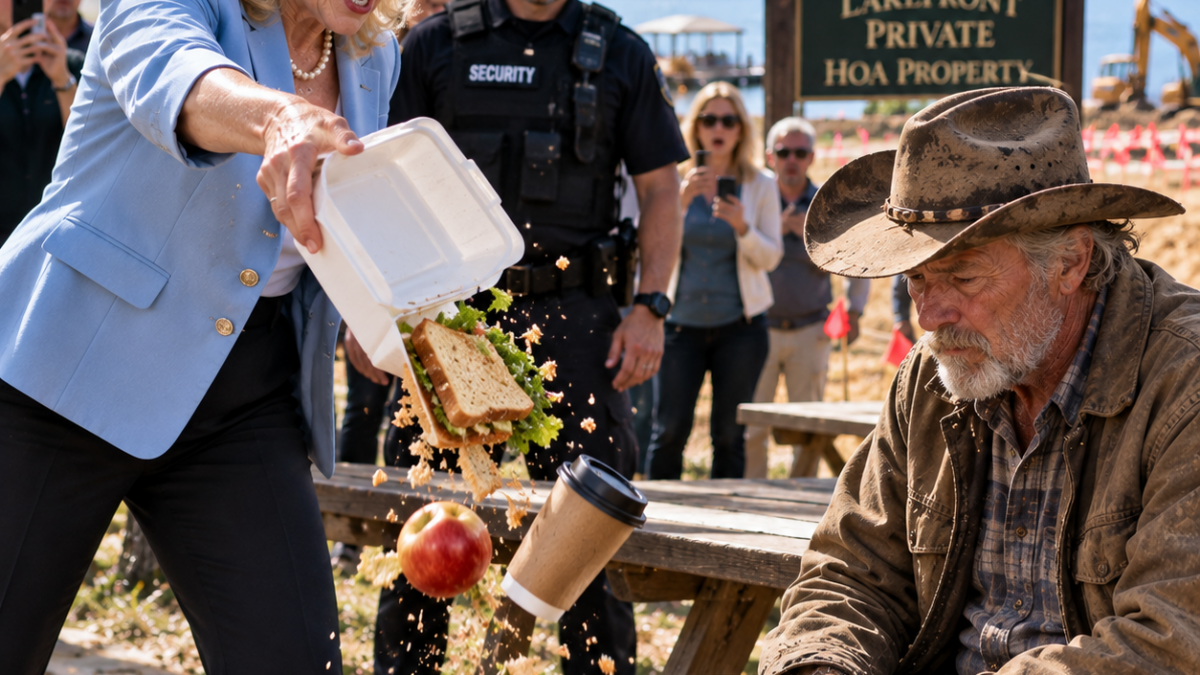
And tipped it.
Sandwich.
Apple.
Coffee.
Everything landed beside my boots.
Coffee soaked into the grass.
My cup rolled beneath the bench.
Margaret’s thermos hit the dirt hard enough to scratch the side.
Two people walking the trail stopped.
One man wore a Chicago Cubs cap.
He lifted his phone.
The security guard looked sick.
I stared at the thermos.
Something inside me went very quiet.
Forty years around cattle taught me a useful rule.
The loudest animal in the pen is often the frightened one.
So I did not yell.
I crouched.
Picked up the thermos.
Rubbed my thumb over the new scratch.
It did not disappear.
The Cubs-cap man knelt beside me and picked up the apple.
Then the napkins.
He stood.
“That wasn’t necessary.”
Linda did not look at him.
She kept looking at me.
“You have fourteen days, Mr. Mercer.”
“For what?”
“To stay off the lakefront unless you have written permission.”
I looked past her.
Toward the oak.
That was when I saw the wire.
A rusted strand buried deep inside the bark.
Most people would have missed it.
I had grown up repairing fences.
I knew what wire looked like after a tree spent decades swallowing it.
“Who told you the HOA owns this land?”
Linda laughed.
Short.
Bright.
Confident.
“Everyone who built this community.”
“That isn’t a deed.”
Her smile disappeared.
“This is an enforcement matter.”
Then she turned toward the security guard.
“Escort him out.”
The young man swallowed.
“Sir…”
He stared at my lunch in the dirt.
Then at me.
“I’m going to have to ask you to leave.”
“Son, I was eating here before your parents were born.”
His ears went red.
Linda stepped between us.
“His history does not change association rules.”
I picked up the thermos.
“Apparently neither do questions.”
She gave me fourteen days again.
Then walked toward the clubhouse.
The guard followed.
Not like security.
Like a boy carrying someone else’s coat.
The man in the Cubs cap stayed.
“Are you okay?”
“Lost my appetite.”
“I got the whole thing.”
He held up his phone.
“I wasn’t filming at first.”
“Then she touched the tray.”
“Name?”
“Paul Dwyer.”
I knew his face.
He had lived in Willow Creek at least ten years.
We had waved at each other plenty.
Never spoken.
“My son’s coming.”
Paul nodded.
“Send him the video?”
“Yes.”
Twenty minutes later, Daniel’s gray pickup rolled into the lot.
My son was forty-five.
Broad shoulders.
Sleeves rolled to the elbows.
Same expression he used when looking at broken fencing.
He watched Paul’s video once.
Then again.
His jaw moved.
“Did she touch you?”
“No.”
“Just lunch?”
“Just lunch.”
He nodded slowly.
That nod worried people.
On the way toward his truck, Daniel stopped beside a new sign.
Fresh brown board.
White lettering.
WILLOW CREEK HOA — CONTROLLED RECREATION AREA
Beyond it:
Orange flags.
Dozens.
Daniel followed them with his eyes.
“Dad.”
“Yes?”
“Those go way past the picnic ground.”
“I noticed.”
“That isn’t for a new bench.”
“No.”
He pointed toward the oak.
“There’s paint.”
I looked.
Bright orange X.
Chest high.
I had seen marks like that before.
Timber crews.
Utility clearance.
Construction.
It did not mean admire this tree.
It meant remove it.
My stomach turned.
Daniel looked at me.
“What agreement did Grandpa make when he sold the land?”
“Residents could reach the lake.”
“Walk the trail.”
“Use the picnic area.”
“Did he sell them the shoreline?”
I looked back toward the oak.
“No.”
“You sure?”
“No.”
Then:
“But I don’t remember him selling that part.”
“Where are the papers?”
That was when I remembered the barn cabinet.
The next morning, Daniel was at my kitchen table before six.
Laptop open.
He had found Willow Creek’s website.
The HOA was calling the project:
LAKEFRONT EXPANSION INITIATIVE.
Restaurant.
Larger boat dock.
Event lawn.
Expanded parking.
Groundbreaking in six weeks.
Projected rendering showed string lights.
Dining terrace.
Umbrellas.
People smiling beside the water.
Daniel turned the screen.
The restaurant terrace sat almost exactly where Margaret and I had eaten for forty years.
The oak was gone.
My hand shook.
I set the coffee down before I dropped it.
We drove to the public county road.
From there I could legally see the work area without stepping onto the disputed recreation land.
A crew was staking the meadow.
I stood on the shoulder.
One man wore a white hard hat.
Construction superintendent.
He eventually walked over.
“Can I help you?”
“Who told you where to put those stakes?”
He looked back at the crew.
“Miss Carver.”
“No survey?”
His expression changed.
“We’re working off the clubhouse plan.”
“You’re building a lakefront restaurant without a boundary survey?”
He rubbed the back of his neck.
“Thirty years in construction.”
“I don’t like staking ground nobody’s measured.”
“Then why are you?”
“Client wants preliminary layout.”
“Who owns the ground?”
He looked toward the clubhouse.
“You’d have to ask the association.”
“I did.”
“What’d they say?”
“Association.”
He nodded.
Not convinced.
Before he walked away, I looked toward the oak.
That orange X seemed brighter from the road.
Margaret’s voice came back.
Don’t let anybody talk you out of that tree.
That afternoon, I found an old photograph.
My father.
Young.
Maybe thirty.
Leaning against a cedar post.
Beside him:
A skinny oak sapling.
Wire looped around the trunk.
Daniel stared.
“That’s the tree.”
“Yes.”
“What was the fence?”
“Cattle boundary.”
“Which side was ours?”
I pointed.
“Water side.”
“Grandpa told you that?”
“Many times.”
Photographs are not deeds.
But they remember things maps sometimes forget.
Daniel called the HOA management office.
Patricia Moore answered.
“I’m calling regarding the lakefront parcel.”
“This is Daniel Mercer.”
“My family may still own part of the construction site.”
Patricia stayed professional.
“The association materials identify that area as community property.”
“Based on which recorded deed?”
Silence.
Clock ticking somewhere.
“I don’t have that document in front of me.”
“Can you send it?”
“I’ll review our records.”
The answer arrived that evening.
Not a deed.
A notice.
NOTICE OF ACCESS RESTRICTION
My name.
My address.
$250 per day if I entered the lakefront recreation area without written HOA authorization.
Second paragraph:
Association records confirm Willow Creek HOA holds title to the lakefront.
Association records.
Not recorded deed.
Not instrument number.
Not legal description.
I read it twice.
Daniel said:
“They just handed us page one of whatever they think their case is.”
Saturday evening, Willow Creek held a project meeting.
The restriction notice barred me from the lakefront.
It did not bar me from entering the clubhouse as a member of the public invited to a project presentation.
I stood in back.
Folding chairs.
Store-bought cookies.
Projector.
Linda stood in front.
No attorney.
No surveyor.
She told residents the shoreline had been underused.
That a restaurant and marina would modernize Willow Creek.
That new revenue would strengthen reserves.
A flyer reached me.
At the bottom, in blue handwriting:
Restaurant revenue will cover next year’s HOA dues as promised.
Linda’s handwriting.
That explained some of the urgency.
She had promised financial relief.
Now she needed the project to work.
A woman asked:
“Have the boundaries been surveyed?”
Linda smiled.
“The planning committee reviewed the community maps.”
Then clicked to the next slide.
Maps.
Not deeds.
Not survey.
I left before the applause.
In the hallway, I heard Patricia speaking through the management-office door.
“The Mercer family asked for the original shoreline documentation.”
Linda answered.
“Find whatever we have.”
Pause.
Then:
“We are not delaying this project over an old fence.”
Old fence.
The phrase bothered me.
Because my father had used the same words decades earlier.
The next morning, Daniel and I opened the metal cabinet in my barn.
It sat behind feed sacks.
Old saddle blanket.
Dust.
The drawer had rusted.
Daniel leaned into it.
Metal screamed.
Then opened.
Brown envelope.
Survey.
Developer correspondence.
Property descriptions.
Old deeds.
We carried everything to the kitchen.
One survey showed the original Mercer ranch before development.
Another showed acreage sold.
One line ran down the shoreline.
Daniel compared it to the conceptual restaurant plan.
“Looks like they’re crossing it.”
“Looks isn’t enough.”
“We need a surveyor.”
“And a lawyer.”
He looked at the roof.
A water stain had begun appearing near the kitchen corner.
“You’ve been saving for that roof.”
“Two years.”
“Dad.”
“Rain comes in either way.”
I rubbed the scratch in Margaret’s thermos.
“Find somebody.”
Daniel found Marcus Bell.
Property attorney.
Forty-four.
Office above the county courthouse.
Preferred documents to speeches.
I liked him immediately.
The retainer took most of my roof fund.
I signed anyway.
County records smelled like floor wax and old paper.
Marcus worked backward.
My father had once owned hundreds of acres around the lake.
Sales.
Transfers.
Development deeds.
Then:
1987 deed to the original Willow Creek developer.
Marcus read.
Most eastern acreage transferred.
But one section was identified as:
LAND RETAINED BY MERCER FAMILY.
Exhibit attached.
Near the waterline:
An inked tree symbol.
Daniel leaned forward.
“Is that the shoreline?”
“Part of it.”
Marcus kept reading.
Years later, the developer transferred:
Roads.
Utilities.
Common areas.
Recreation parcel.
To the HOA.
Then Marcus stopped.
The deed described the recreation area as:
bounded on the waterside to the old pasture fence.
He tapped the sentence.
“Whoever wrote this expected people to know where that fence was.”
I thought of the wire in the oak.
Marcus brought in Michael Grant.
Licensed land surveyor.
Quiet.
Weathered.
He studied the HOA development rendering.
Then:
“This is not a boundary survey.”
“It’s conceptual.”
Daniel asked:
“Could their restaurant be on Dad’s property?”
Michael looked at him.
“It could.”
“Is it?”
“I’ll tell you after I measure.”
That answer was worth the money.
Thursday morning, Michael and two technicians began locating monuments.
Old deed descriptions referred to iron markers.
Drainage points.
Fence corner.
For an hour they searched brush.
Then one technician knelt beside ferns.
Cleared dirt.
Iron pin.
Nearly flush with ground.
Michael checked the coordinates.
His shoulders eased.
“Possible original monument.”
By late morning:
Second monument.
Then additional measurements.
Orange survey flags marched across the meadow.
They crossed the recreation trail.
Then the gazebo edge.
Then directly through the planned restaurant site.
Daniel stared.
“How much belongs to us?”
Michael said:
“Substantial portion appears to.”
“I’ll confirm after I close the survey.”
Part of the gazebo crossed too.
I looked at it.
Birthday balloons had hung there.
Wedding photographs.
Fourth of July picnics.
I had no desire to tear it down.
That was never the point.
Michael said:
“We still need the fence corner.”
I pointed toward the oak.
“That fence used to run near the water.”
“Then that’s next.”
Linda arrived before they finished.
Gray SUV.
Good shoes.
Blue folder.
White-hard-hat superintendent trailing behind.
“What is going on?”
Daniel answered.
“Boundary survey.”
“On association property?”
Michael stepped forward.
“We’re retracing the Mercer deed.”
“You cannot change our property lines.”
“We’re not changing them.”
“We’re measuring them.”
“The HOA has maintained this land for decades.”
“That does not establish where the deed line is.”
Linda turned toward Daniel.
“This is interference.”
Daniel’s voice remained calm.
“There’s video of what happened to Dad.”
Her face tightened.
The superintendent looked at the orange flags.
Then his stakes.
Then the restaurant footprint.
“Are we still excavating?”
Linda said:
“Of course.”
He shook his head.
“I need written boundary confirmation before my crew digs.”
“We approved the design.”
“Yes.”
“I need the paper that says you own where I’m digging.”
Linda looked at him.
“This is an enforcement matter.”
I could not help myself.
“Anger isn’t evidence.”
Everyone turned.
“I’m asking for paper.”
She looked at me.
No answer.
Michael’s signed report arrived Monday.
Twenty-three pages.
Recovered monuments.
Measurements.
Plat.
Seal.
The restaurant footprint sat on Mercer property.
So did the event lawn.
Part of the gazebo.
Marcus ordered an appraisal.
Development assumptions included.
Conditional.
Not guaranteed sale value.
Preliminary number:
$8 million.
Daniel brought it to my farmhouse.
“Dad.”
“What?”
“You need to sit.”
“I’m already eating.”
He handed me the report.
Eight million dollars.
For land my father once used for cattle.
“You could sell.”
“Fix the roof.”
“Retire completely.”
“Never worry.”
I looked at Margaret’s photograph.
“No.”
“Dad.”
“I promised her.”
“A promise made before anyone knew it was worth eight million.”
“Does price change the sentence?”
He sat.
“No.”
“I don’t want those families losing the path.”
“I don’t want children locked out of the gazebo.”
“I don’t want the neighborhood punished because Linda didn’t read a deed.”
Daniel nodded.
“We can protect access.”
“Then we do that.”
Marcus sent formal notice.
Deed.
Survey.
Title chain.
Demand to suspend construction.
Request for HOA documentation.
No demand for $8 million.
No trail closure.
No demand to remove gazebo.
I specifically told him:
“Keep the residents’ access out of the fight unless we have no choice.”
Two days later, the construction company pulled off the western shoreline.
The superintendent visited my porch after dark.
He did not climb the steps.
Held his hard hat in both hands.
“Mr. Mercer.”
“Yes?”
“Our lawyers told us not to touch another stake.”
“Good.”
Then he swallowed.
“I want to show you something.”
He handed me a photocopy.
Work order.
Blue ink.
Owner of record:
WILLOW CREEK HOA
Special instructions:
NO SURVEY. CANNOT AFFORD DELAY BEFORE THE ELECTION.
Linda Carver’s signature at bottom.
Bold.
Looping.
The superintendent looked ashamed.
“She came into our office.”
“Said one old man’s lunch wasn’t going to hold the project hostage.”
“I’m protecting my crew.”
“I understand.”
“Don’t thank me.”
“I wasn’t going to.”
He almost smiled.
Then left.
I placed the work order beside Margaret’s thermos.
Who told you the HOA owned this land?
Linda had.
In writing.
And beneath her answer, she had told the contractor not to verify it.
She came to my porch the next afternoon.
This time with the HOA attorney.
Gray suit.
Briefcase.
She did most of the talking.
Thirty years of community use.
HOA maintenance.
Children growing up there.
Gazebo built with dues.
“A gift is a gift, Mr. Mercer.”
“I never took the path away.”
“Then why are you doing this?”
“Doing what?”
“Threatening the community.”
“I haven’t closed anything.”
“Your lawyer is costing everyone money.”
“You’re the one building.”
She leaned closer.
“Every dollar in legal fees comes from your neighbors.”
“You’ll empty their reserve.”
I waited.
Then asked the same question.
“Who told you the HOA owns the shoreline?”
Her eyes changed.
Only a fraction.
“It’s not about who told me.”
“What is it about?”
“Who stayed.”
She walked away.
The attorney lingered.
His eyes dropped toward the little table beside me.
Coffee mug.
Corner of the contractor work order visible underneath.
He stared a second too long.
Then followed her.
That night, I woke to chainsaws.
Eleven p.m.
The lake was almost a mile from my house, but sound travels over water.
Orange glow rose beyond the trees.
At dawn, I drove to the county road.
My stomach dropped.
Brush gone.
Bare dirt.
Cedar posts removed.
Nearly the entire old fence line pulled.
Wire stacked.
Posts piled like firewood.
The original construction superintendent was standing on the shoulder.
His company had already withdrawn.
“She hired another crew.”
He looked sick.
“Cleared it overnight.”
“Pulled the fence.”
I walked toward the edge.
The oak still stood.
Orange X freshly repainted.
Rusted wire still inside the bark.
Nobody had cut it yet.
Why that mattered, I could not fully explain then.
The fence was not just evidence.
It was the thing I understood.
My father’s hands.
Cattle.
Wire.
Boundaries.
Linda had torn it from the ground because she believed removing old evidence could make old facts less real.
The next Thursday, for the first time in forty years, I did not sit beneath the oak.
A chain blocked the HOA-controlled entrance to the lakefront.
Not my chain.
Linda’s.
Residents’ phones buzzed.
Paul Dwyer—the Cubs-cap neighbor—showed me the email.
Subject:
LAKEFRONT CLOSED
First paragraph:
Closure due to a private $8 million demand by Richard Mercer.
Second:
Possible special assessment of $2,400 per household if the association had to defend ownership.
I read it twice.
“I never demanded eight million.”
“I know.”
Paul put the phone away.
“Most people don’t.”
“Where did she get the number?”
“Appraisal probably made its way into a file.”
He looked toward the chain.
“She says you locked the lake.”
“She has the key.”
“I know.”
“A lot of people won’t.”
He was right.
At the feed store, people avoided me.
A mother called Daniel and canceled her daughter’s birthday reservation at the gazebo.
Not because she hated me.
Because she was afraid.
Paul received an HOA fine for posting the original lunch video.
He brought it to my farm folded small.
Like he was embarrassed.
“This isn’t your shame.”
Marcus came Sunday.
He offered the blunt option.
“We can ask for an injunction.”
“Close the entire disputed shoreline.”
“Trail.”
“Gazebo.”
“Everything.”
“That would bring them to the table fast.”
I poured coffee.
“That’s Linda’s game.”
“It would work.”
“I know.”
“No.”
Marcus nodded.
No argument.
He had probably hoped I would say that.
Daniel did not.
That night, he looked exhausted.
“Dad.”
“What?”
“Sell it.”
I stared.
“We are burning money.”
“The roof is leaking.”
“The lawyer costs money.”
“The survey costs money.”
“You’re seventy-two.”
“Take the eight million.”
“Make them build somewhere else.”
Something snapped in me.
Margaret’s thermos was on the counter.
I grabbed it.
Threw it.
It hit the cabinet.
Bounced.
Rolled beneath the table.
Silence.
Daniel looked at me.
I looked at the thermos.
Dent in its side now.
Beside the scratch Linda caused.
I picked it up.
Sat.
“I’m not selling.”
Daniel said nothing.
“But I’m done asking Linda for permission to prove what she never owned.”
Thursday at noon, I carried two folding chairs to the county road shoulder.
Public ground.
Marcus had confirmed it.
I spread a checkered cloth across my knees.
Coffee from the dented thermos.
Two sandwiches.
I sat facing the locked gate.
Not blocking traffic.
Not trespassing.
Not shouting.
The young security guard came first.
He approached.
“Sir, this is—”
He stopped.
I pointed at the pavement.
“County road.”
He looked toward the clubhouse.
Then me.
Then walked back to his little white car.
People drove slowly past.
A minivan.
Pickup.
Older couple.
Nobody honked.
They stared.
Around one, a little girl in a yellow raincoat stopped with her mother.
“Why’s the lake locked?”
Her mother looked miserable.
I said:
“Ask whoever has the key.”
The girl thought.
Then walked away asking:
“Who has the key?”
Paul arrived.
Opened the second chair.
Sat beside me.
Took my extra sandwich without permission.
“You’re not who she said you were.”
It took me a second.
“Thank you.”
At two, Patricia Moore drove up.
Silver car.
Window down.
She handed me an envelope.
“I found this nine years ago.”
She would not meet my eyes.
“I told myself it didn’t matter.”
Then she drove away.
Inside:
Printed email.
Nine years old.
Former property manager to board.
He warned:
Recreation map may not match recorded boundaries.
Recommended licensed survey before permanent lakefront improvements.
Below:
Linda’s reply.
One line.
TABLE IT. NOT BEFORE THE ELECTION. THE MAP IS THE MAP.
I read it twice.
Nine years.
Not a mistake.
Warning received.
Warning ignored.
Project continued anyway.
Linda’s gray SUV passed a few minutes later.
She saw the envelope in my hand.
Did not stop.
The following Tuesday, Michael returned.
The fence line had been stripped.
He walked slowly.
Then stopped at the oak.
He crouched.
Put gloved fingers against the embedded wire.
Followed it around the trunk.
“Here.”
“What?”
“This is a corner.”
“The tree grew around the fence turn.”
He pulled out the old photograph.
My father.
Young oak.
Wire.
Matched it against the living tree.
Same bend.
Same turn.
Marcus unfolded the HOA deed.
Read:
bounded on the waterside to the old pasture fence.
Then he looked at Michael.
“The deed calls the fence.”
Michael nodded.
“The physical evidence identifies the corner.”
Marcus looked at me.
“The association owns the land behind this fence.”
“And?”
He took a breath.
“Everything waterward is outside its deed.”
The world went quiet.
Not just the restaurant site.
Not just part of the event lawn.
The entire water frontage covered by the old Mercer reservation.
Picnic ground.
Oak.
Shoreline.
Land beneath Linda’s sign.
Every foot of it.
Daniel put a hand on my shoulder.
“Dad.”
“What do you want?”
I stared at the lake.
Margaret.
That was who I thought about.
Not eight million dollars.
Not Linda.
Not winning.
“Not yet.”
Michael needed another week to tie the evidence into his final report.
Thursday morning, Marcus called.
“The HOA attorney contacted me.”
“And?”
“He says he can no longer support Linda’s ownership position.”
I pictured the gray-suited lawyer staring at the work order under my coffee cup.
“Professional conscience?”
“Professional license.”
“Either works.”
Then Willow Creek announced:
LAKEFRONT DAY
Saturday.
9 a.m.
Golden shovel ceremony.
Restaurant operator.
Press photographer.
Free lunch.
Tree clearing crew.
Daniel read the flyer.
“She’s going to cut the oak.”
I looked.
He was right.
If the oak fell:
Embedded wire gone.
Visible corner evidence destroyed.
A piece of history everybody could understand reduced to sawdust.
And she planned to do it in front of the neighborhood.
A ceremony.
Make the project psychologically permanent before the paperwork caught up.
I packed lunch Friday night.
Two sandwiches.
Apple.
Thermos.
No speech.
Saturday at 9:15, I sat beneath the oak.
Same table.
Same place she dumped my tray.
Checkered cloth.
Coffee.
Michael’s tripod stood beside the tree.
Orange flag tied to the embedded wire.
Patricia stood nearby holding a banker’s box.
Marcus.
Daniel.
Then neighbors.
Restaurant operator.
Photographer.
Tree crew.
The original superintendent stood at the rear with his arms folded.
Linda arrived last.
Light-blue blazer.
Gold-painted shovel.
Blue folder.
She stopped when she saw me.
Still sitting.
Still eating.
“I told you no entry without written permission.”
“You did.”
“This is an enforcement matter.”
I set the sandwich down.
“You can lock your gate to the lake.”
“You cannot lock me off my land.”
Murmurs.
Linda laughed.
Too thin.
I pulled two pages from my jacket.
Placed them on the table.
Left:
HOA deed.
One sentence underlined.
BOUNDED ON THE WATERSIDE TO THE OLD PASTURE FENCE.
Right:
Contractor work order.
OWNER OF RECORD: WILLOW CREEK HOA
NO SURVEY. CANNOT AFFORD DELAY BEFORE THE ELECTION.
Linda Carver.
Signature.
Her eyes landed there.
Stopped.
Marcus stepped beside me.
“Mrs. Carver.”
“Your own recorded deed stops at the old pasture fence.”
“Every foot of shoreline on the water side lies outside the HOA parcel.”
“Picnic ground.”
“Restaurant site.”
“Land beneath your sign.”
Michael placed a gloved hand against the tree.
Right over the wire.
“This is the fence corner described by the deeds.”
Linda stared.
“It’s a rusted wire.”
Michael did not move.
“It’s your boundary.”
The white-hard-hat superintendent spoke from behind the crowd.
“Ma’am.”
“I need written ownership confirmation before anyone cuts.”
Linda turned toward the residents.
“For thirty years, this community has used this land.”
“Families have memories here.”
“A gift is a gift.”
Nobody answered.
She looked toward the young security guard.
“Escort Mr. Mercer off the property.”
The boy looked at her.
Then me.
Then the papers.
His face changed.
“Ma’am.”
“Yes?”
“I’d need written authorization from the owner.”
A sound moved through the crowd.
Not exactly laughter.
The restaurant operator lowered her clipboard.
“Mrs. Carver.”
“You represented that Willow Creek owned the lake frontage.”
“We do.”
Marcus shook his head.
The operator looked at him.
Then the survey flag.
Then Linda.
“I’m withdrawing.”
“What?”
“My company will not develop disputed private property.”
She turned.
Walked to her car.
Linda watched her leave.
The gold shovel slipped from her hand.
Hit the grass.
Then the blue folder fell.
Papers scattered.
Nobody bent down.
I stood.
Looked at the neighbors.
“The path remains open.”
Heads lifted.
“The picnic area remains open.”
“The gazebo remains available.”
A woman near the front covered her mouth.
I recognized her.
She was the one who had canceled the birthday party.
“I am not throwing anyone off the lake.”
I pointed at the shovel.
“I’m saying no to that.”
Linda finally spoke.
“Richard.”
First time she had used my first name.
“Let’s not do this here.”
I looked around.
“At your groundbreaking ceremony?”
She stepped closer.
“The association can buy an easement.”
“Name a number.”
“No.”
“Eight million?”
“I said no number.”
Her face tightened.
“Then what do you want?”
“A written agreement.”
“Through my attorney.”
“Discussed at the clubhouse.”
“In front of the people whose dues you used to claim this property.”
She looked smaller up close.
Older.
Tired.
For the first time, not certain.
“You could have told me you owned it.”
I stared at her.
“I asked you who owned it.”
“You dumped my lunch.”
She looked away.
Monday night, the clubhouse was full.
Standing room.
Board at front.
Linda in president’s chair.
I sat beside Marcus.
Hat on my knee.
The HOA attorney spoke first.
Four sentences.
Recorded deed did not include the shoreline claimed by the president.
Independent survey confirmed Mercer ownership.
Association could not proceed with restaurant or marina without owner authorization.
That was all.
Paper does not need drama when it is clear.
Then Patricia stood.
Opened the banker’s box.
Read the nine-year-old email.
Boundary warning.
Survey recommendation.
Then Linda’s response:
TABLE IT. NOT BEFORE THE ELECTION. THE MAP IS THE MAP.
Patricia’s hand shook.
Voice did not.
The vice president cleared his throat.
Quiet man.
Rarely spoke.
“I want the minutes to reflect something.”
He looked toward me.
“Mr. Mercer asked us a question before any of this escalated.”
“We never answered it.”
Then motions.
Cancel restaurant project.
Cancel marina expansion.
Withdraw any proposed special assessment.
Open formal negotiations with Mercer family.
Four votes yes.
One no.
Linda.
Then came censure.
Formal.
Dry.
Removed her from the lakefront project.
She sat straight through all of it.
Hands folded.
When the meeting ended, she approached me.
“Mr. Mercer.”
I looked up.
“I made assumptions about you.”
Pause.
“I should not have spoken to you that way.”
Another.
“And I should not have touched your lunch.”
I turned my hat in my hands.
“I appreciate you saying it.”
She waited.
Then:
“Why didn’t you tell me who you were?”
“I tried to tell you my family had history there.”
“You’d already decided I wasn’t worth listening to.”
That was the truth.
Her face changed.
No argument.
She walked away.
Her blue folder stayed on the board table.
Nobody wanted to carry it after her.
The legal resolution was less dramatic.
That is usually how real endings work.
We negotiated.
I refused to sell.
The HOA stopped asking.
Instead, we created a shoreline access license.
Recorded property description attached.
Michael’s survey attached.
The agreement covered:
Walking path.
Picnic ground.
Gazebo.
Oak.
Residents could keep using all of it.
Term of years.
Renewal provisions.
Insurance.
Maintenance responsibilities.
But one clause mattered most to me:
No permanent structure may be constructed on the Mercer shoreline parcel without the owner’s written authorization.
My signature.
Not a committee assumption.
Not a conceptual map.
Not a promise made before an election.
Permission.
The HOA installed a new sign.
Brown.
White letters.
PRIVATE SHORELINE
OPEN TO WILLOW CREEK NEIGHBORS WITH OWNER’S PERMISSION
I stood looking at that sign for a long time.
Daniel stood beside me.
“Feels strange?”
“Yes.”
“Good strange?”
“I don’t know yet.”
The association removed the orange X from the oak.
Contractor agreement canceled.
Restaurant gone.
Marina gone.
No $2,400 assessment.
Families kept their lake access.
The gazebo stayed.
Nobody lost a birthday party because of me.
A week later, Thursday came.
I drove the old Ford to the trail.
Margaret’s thermos in one hand.
Lunch bag in the other.
The thermos had two scars now.
Linda’s scratch.
My dent.
I thought about replacing it.
Never did.
Daniel arrived a few minutes later.
I had packed two sandwiches.
He sat across from me.
Children ran around the gazebo.
A couple walked the shoreline.
A heron stood in the shallows on one leg.
Patient.
Still.
I took Margaret’s photograph from my shirt pocket.
Propped it against the thermos.
Daniel looked at it.
“Mom would’ve liked this.”
“She would’ve complained about the new sign.”
“Definitely.”
I smiled.
Then looked at the oak.
Wire still visible in the bark.
The tree had grown around it without erasing it.
I suppose people do that too.
We grow around old lines.
Promises.
Losses.
Places.
Sometimes the past gets swallowed deep enough that nobody notices until someone tries to cut the tree down.
Linda believed the community map created reality because people had treated it like reality for years.
It didn’t.
A line on a map does not move the ground underneath it.
A sign does not create ownership.
Maintenance does not automatically rewrite a deed.
And a person who has been quiet for forty years is not necessarily a person without anything to say.
I never wanted Willow Creek’s families to lose the lake.
That was what Linda never understood.
She kept acting as if ownership and generosity could not exist together.
As if I had to choose:
Take everything back.
Or surrender everything permanently.
There was a third option.
Mine.
Share it.
On terms everyone understood.
The shoreline stayed private.
The path stayed open.
Children still ran beneath the oak.
Neighbors still used the gazebo.
And every permanent change required the signature of the person who actually owned the ground.
Sometimes people ask why I did not sell after the appraisal came back.
Eight million dollars is a lot of money.
More than I ever expected that pasture to be worth.
But the number only existed because somebody wanted to turn the shoreline into something else.
Margaret never asked me to preserve its market value.
She asked me not to let anybody talk me out of the tree.
I kept that promise.
Not because the tree belonged to the past.
Because keeping a promise does not require living backward.
Sometimes it simply means deciding which parts of the future are not for sale.
That Thursday, Daniel and I finished lunch.
He took the trash.
I poured the last coffee.
Sun moved across the lake.
Margaret’s photograph caught the light.
For forty years, I had sat beneath that oak because it reminded me where I came from.
Now I understood something else.
Knowing where a boundary is does not tell you how hard to defend it.
That part is character.
Linda used her authority to close a gate.
I could have used ownership to close another one.
I chose not to.
The law could tell me where the Mercer parcel began.
It could not tell me what kind of neighbor I wanted to be once I knew.
So the path stayed open.
The tree stayed standing.
And every Thursday, when I set Margaret’s thermos on that old picnic table, I could look across a lakefront that had never stopped belonging to my family and know that the most important thing I had protected was not eight million dollars of land.
It was the difference between being generous and being treated as if generosity had made you disappear.



