HOA Locked the Only Road to My $400,000 Harvest—They Never Checked the 1952 Federal Easement
PART3:
“Doesn’t look dead.”
I pointed.
Display was lit.
Camera above the gate was on.
The red light worked perfectly.
Manny frowned.
“You call the HOA?”
I reached for my phone.
Before I could dial, the small security booth beside the gate opened.
A man stepped out.
I’d seen him around Willow Crest Estates but didn’t know his name.
Mid-forties.
Gray polo.
Black tactical pants.
A patch on the shirt read:
WILLOW CREST COMMUNITY SECURITY.
He walked toward my truck with one hand resting near his belt.
Not a gun.
Radio.
Pepper spray.
Maybe handcuffs.
That bothered me more than if he’d simply carried a clipboard.
“Morning,” I said.
He stopped at my window.
“Sir, you’ll need to turn around.”
I laughed because I assumed he was joking.
“We’re going to the Calhoun farm.”
“I know.”
I waited.
He didn’t move.
“So open the gate.”
“Access has been revoked.”
I stared at him.
“What?”
“Your access code is no longer active.”
“Why?”
“Orders from the board.”
I looked through the gate.
Calhoun Ridge Road curved uphill through Willow Crest.
Beyond the subdivision, it continued another mile and a half to our farm.
Same road my father had driven before Willow Crest existed.
Same road my grandfather used when most of that land was still pasture.
“This is the only road to my farm.”
The guard nodded.
“I understand.”
“No, you don’t.”
“Sir—”
“I’ve got five combines sitting behind me.”
“I see them.”
“Beans ready to cut.”
He glanced past my truck.
“I see that too.”
“And you’re telling me we can’t drive through?”
“Correct.”
“On whose authority?”
“The Willow Crest Homeowners Association.”
I almost laughed again.
Then the anger arrived.
“You people built around us.”
“I don’t make policy.”
“Then call whoever does.”
“I’ve already notified the board you’re here.”
“Good.”
I opened my door.
He stepped back.
“Sir, remain on the public side of the gate.”
I looked at the painted line across the pavement.
On one side, county road.
Other side, HOA pavement.
“You planning to arrest me if I cross that paint?”
“No, sir.”
“Good.”
“Because you’re not crossing it.”
That was when Manny said quietly behind me:
“Bo.”
I turned.
A white Lexus SUV was coming down the hill.
I knew it before it reached us.
Vivian Archer.
If arrogance had a vehicle, it would have been that Lexus.
Pearl white.
Black windows.
Gold HOA decal on the windshield.
The SUV stopped inside the gate.
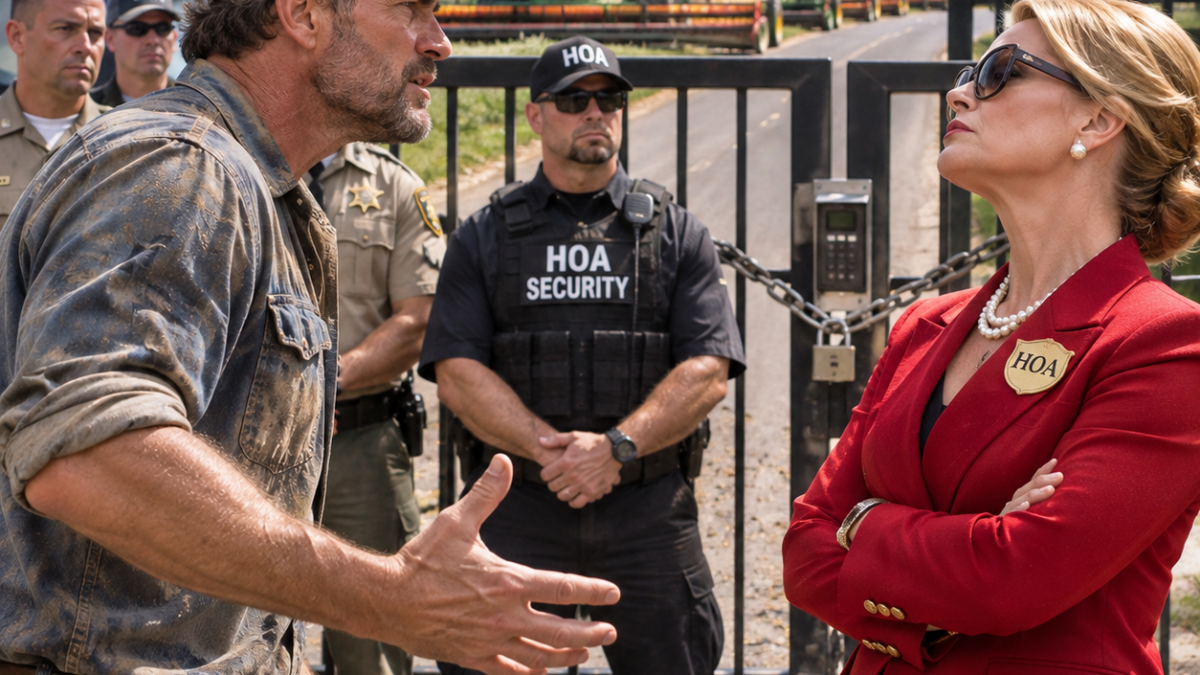
Vivian got out.
Bright red blazer.
Cream blouse.
Pearls.
Hair sprayed into a shape weather had apparently agreed not to disturb.
A gold pin on her lapel read:
HOA PRESIDENT.
She had been elected three months earlier.
Before Vivian, Willow Crest had been annoying in ordinary suburban ways.
Christmas-light rules.
Mailbox paint.
Trash-can placement.
One resident received a warning because his basketball hoop was visible from the street.
None of it mattered to us.
We weren’t in the HOA.
Never had been.
Our property existed decades before Willow Crest.
For twenty-five years, the relationship was simple.
We used Calhoun Ridge Road.
Residents waved at our trucks.
Dad plowed the road during bad snowstorms.
We donated pumpkins to their fall festival.
Their kids came to see newborn calves.
Nobody pretended the gate gave them ownership over the world beyond it.
Then Vivian Archer became president.
Within a month, signs appeared.
RESIDENTS AND AUTHORIZED GUESTS ONLY.
Then security patrols.
Then cameras.
Then a letter informing us that “commercial agricultural traffic” was inconsistent with the residential character of Willow Crest.
I had called the management company.
They told me not to worry.
Historical access would continue.
I believed them.
That was mistake number one.
Vivian walked toward the gate.
“Mr. Calhoun.”
I pointed at the lock.
“My code doesn’t work.”
“I know.”
“Then fix it.”
“No.”
Behind me, Manny muttered something in Spanish.
Vivian folded her hands.
“As I explained in last week’s notice, Willow Crest Road is privately maintained.”
“You never sent me a notice saying you were locking me out.”
“We informed you the board was reviewing nonresident access.”
“This isn’t nonresident access.”
“What would you call it?”
“My road to my farm.”
Vivian smiled.
“Your farm is not located within Willow Crest Estates.”
“I am aware.”
“Then you don’t have residential access privileges.”
“Privileges?”
My voice came out louder than I intended.
The security guard shifted.
Vivian didn’t.
She liked having witnesses.
“It isn’t a privilege. My family has used this road since before your subdivision existed.”
“Past practice doesn’t create ownership.”
“Neither does putting up a gate.”
Her smile tightened.
“Mr. Calhoun, I’m not going to debate property law beside a security booth.”
“Good. Open the gate.”
“No.”
I looked at the beans visible on the ridge beyond the rooftops.
Then at Manny’s combines.
“You understand what you’re doing?”
“Yes.”
“I’ve got a harvest.”
“That is not an HOA responsibility.”
“Storm coming tomorrow.”
“Again, not our responsibility.”
“This crop is worth four hundred thousand dollars.”
Vivian tilted her head.
“Perhaps that means you should have planned access more carefully.”
For a second, I couldn’t believe I’d heard her correctly.
“Planned?”
“You own agricultural property with no direct public-road frontage.”
“Because Willow Crest was built over the old access.”
“Your family’s decisions are not my responsibility.”
Manny stepped beside me.
“Ma’am, we’re not staying. We’re going through, cutting the crop, and leaving.”
Vivian looked at him as if he’d spoken from a television she wanted muted.
“This is between Mr. Calhoun and the association.”
Manny’s jaw tightened.
I held up my hand.
He stepped back.
I said:
“Open the gate.”
Vivian looked toward my farm.
Then back.
And she said the sentence that changed everything.
“If access is such a burden, perhaps you should consider selling.”
I stared at her.
She smiled.
Something clicked.
Three weeks earlier, I had received a letter from a company called Ridgeline Land Partners.
Cash offer.
No contingencies.
Close in thirty days.
The price had been insulting.
A little over half what the farm was conservatively worth.
I threw it away.
Two days later, another offer arrived.
Slightly higher.
I called the number and told the representative Calhoun Ridge wasn’t for sale.
He said:
“Everything is for sale at the right number.”
I replied:
“Then you don’t have the right number.”
I hadn’t thought much about it afterward.
Until Vivian said sell.
I looked at her differently.
“You know Ridgeline Land Partners?”
Nothing moved on her face.
That was answer enough.
“I know many local businesses.”
“Did they talk to you about my farm?”
“No.”
Too fast.
I smiled.
Her expression changed.
Then sirens sounded behind us.
Two sheriff’s cruisers pulled into the line of equipment.
Deputy Vaughn got out first.
I’d known Caleb Vaughn since high school.
Younger than me by ten years.
Good deputy.
Not interested in becoming anybody’s private security guard.
The second deputy, Dell Mercer, followed.
Vivian pointed through the gate.
“Deputies, this man is trespassing.”
Vaughn looked at me.
I was standing on the county side.
Then he looked at Vivian.
“Where?”
“He is attempting unauthorized entry.”
“Has he entered?”
“No, because our guard stopped him.”
Vaughn nodded.
“Then he isn’t trespassing.”
Vivian’s face tightened.
“He is disrupting the entrance.”
Manny laughed.
Vivian snapped toward him.
Vaughn raised both hands.
“Everybody calm down.”
I said:
“Caleb, this is the only access to my farm.”
“I know.”
“They changed my code this morning.”
Vaughn looked surprised.
“You own that lane?”
Vivian answered.
“The association does.”
Vaughn rubbed the back of his neck.
“Do you have an easement, Bo?”
“My family has used it seventy years.”
“That’s not what I asked.”
“I don’t know.”
That answer hurt to say.
Because farmers know their land.
We know fence lines.
Drainage.
Soil.
Old survey pins.
Which tree marks the corner between your property and your cousin’s.
But the legal road arrangement dated to my grandfather.
Dad handled the papers.
Then I started handling them after his heart problems.
Somewhere in that transition, I had assumed a road used for generations would remain a road.
Mistake number two.
Vivian crossed her arms.
“No recorded HOA easement appears on Mr. Calhoun’s current deed.”
Vaughn looked at her.
“You researched it?”
She hesitated.
“Of course.”
There it was again.
Too much preparation.
Too early.
I said:
“You knew exactly when I was harvesting.”
Vivian didn’t answer.
Manny whispered:
“Boss.”
I looked at him.
He nodded toward his watch.
Every minute mattered.
Vaughn said:
“This looks civil to me.”
Vivian’s face sharpened.
“I called law enforcement because he is threatening private property rights.”
Vaughn shook his head.
“My job is keeping everybody from punching each other while lawyers figure out whose road this is.”
“Then keep him on that side.”
“I already am.”
Manny stepped toward me.
“We need a decision.”
I looked at the combines.
Machines burned fuel even standing still.
Drivers cost money.
Trucks had schedules.
Other farms were waiting on Manny’s crew.
“Give me twenty minutes.”
He shook his head.
“Bo, if I send these machines somewhere else, I can’t promise they’re back today.”
My stomach tightened.
“How long?”
“Maybe tomorrow afternoon.”
Rain would already be starting.
I looked at Vivian.
She knew.
I could see it.
She wanted those combines gone.
I said:
“Keep them here.”
Manny lowered his voice.
“I’ll give you an hour.”
“Thank you.”
He nodded.
My phone rang.
DAD.
I answered immediately.
“Hey.”
All I heard at first was breathing.
“Dad?”
“Bo.”
His voice was thin.
“What happened?”
“The nurse can’t get through.”
My stomach dropped.
“What nurse?”
“Home-health woman.”
I looked at Vivian.
“She at the gate?”
“Called me. Said security turned her around.”
Dad had come home from bypass surgery eleven days earlier.
He was supposed to have a visiting cardiac nurse every morning.
“Are you okay?”
“I’m fine.”
That was a lie.
“Dad.”
“I said I’m fine.”
Then coughing.
“Where’s your oxygen?”
Pause.
“Running low.”
“How low?”
“The delivery truck was supposed to be here at seven.”
I closed my eyes.
“Did they turn that around too?”
“Driver called. Said the gate wouldn’t let him through.”
Everything inside me went cold.
I walked toward Vivian.
“You blocked my father’s nurse.”
She blinked.
“I don’t control individual visitors.”
“Your guard refused her.”
“She isn’t a resident.”
“He just had heart surgery.”
“Then she should have contacted the association in advance.”
“His oxygen delivery was turned around.”
Vivian looked uncomfortable for the first time.
Only briefly.
“Medical deliveries can request temporary authorization.”
“He needs oxygen now.”
“That isn’t something I can verify standing here.”
I stared.
Then dialed 911.
Vivian said:
“What are you doing?”
“Getting my father oxygen.”
“You’re calling an ambulance?”
“Yes.”
“That seems unnecessarily dramatic.”
I looked at her.
“Say that again.”
She didn’t.
The ambulance arrived eleven minutes later.
Gate still closed.
The guard picked up his radio instead of opening it.
I saw red.
Vaughn walked straight to the security booth.
“Open the gate.”
The guard looked toward Vivian.
Vivian said:
“This is private property.”
Vaughn stared at her.
“There’s a medical emergency.”
“We need confirmation.”
“I am confirming it.”
“Deputy—”
Vaughn reached through the open booth window.
Pressed the release button himself.
The gate swung open.
Vivian shouted:
“You cannot do that!”
Vaughn stepped into the lane.
“You can sue me tomorrow.”
The ambulance drove through.
“I’m not standing here while a seventy-eight-year-old heart patient runs out of oxygen because an HOA board wants to prove a point.”
Vivian looked furious.
“Your department will hear about this.”
Vaughn shrugged.
“Tell them I opened a gate for paramedics.”
The ambulance disappeared toward the farm.
I wanted to follow.
Vivian stepped in front of the gate as it began closing.
“Your truck is not authorized.”
I stared.
“My father is up there.”
“The ambulance is attending him.”
“You really want to do this?”
“I am enforcing association rules.”
Manny walked up behind me.
“Bo.”
His expression told me what I already knew.
He couldn’t wait.
“Take the crew.”
I hated saying it.
Manny shook his head.
“I can give—”
“Go.”
“What about tomorrow?”
“Keep your phone on.”
He grabbed my shoulder.
“We’ll come if you call.”
“Thanks.”
One by one, the combines turned around.
That hurt more than the gate.
The sound of diesel engines leaving.
A harvest crew disappearing down a road away from the crop.
Vivian watched too.
I wondered if she felt victory.
I think she did.
That afternoon, Deputy Vaughn drove me through the gate to my farm.
Not because Vivian allowed it.
Because he’d decided he needed to check on the medical patient himself.
Dad was sitting at the kitchen table with an oxygen cannula beneath his nose when I entered.
He looked furious.
Not sick.
Furious.
Good sign.
“You let her stop the combines?”
“Nice to see you too.”
“Four hundred thousand dollars standing out there.”
“And you’re seventy-eight years old with a chest zipper.”
He glared.
“Don’t call it that.”
“How do you feel?”
“Like they sawed me open.”
“Accurate.”
He looked toward the fields.
“You need Manny back.”
“I know.”
“The rain?”
“I know.”
Dad removed the cannula.
I put it back.
He slapped my hand.
“I’m breathing.”
“Then breathe with oxygen.”
He looked at me.
I looked at him.
For a second we were both too tired to argue.
Then a truck pulled into the yard.
Mail carrier.
Our rural deliveries usually came through the south utility path before Willow Crest, but heavy trucks couldn’t use it.
The carrier handed me a certified envelope.
Fairmont Agricultural Credit.
My lender.
I opened it at the counter.
Read.
Then read again.
PRE-DEFAULT NOTICE.
Concerns regarding interruption of legal access to collateral property.
Possible impairment of harvest income.
Meeting requested.
Dated Monday.
I looked at the calendar.
Wednesday.
The gate had been locked that morning.
Dad watched my face.
“What?”
I handed him the letter.
He read slowly.
His eyes narrowed.
“They knew.”
“Two days early.”
“Bank knew access was going to be disputed before they blocked you.”
I sat down.
“How?”
Dad’s expression changed.
Not fear.
Recognition.
He stared toward the barn.
“What?”
He said:
“Your grandfather.”
“What about him?”
“He told me something once.”
“Dad.”
“Long time ago.”
“What?”
Dad stood too quickly.
I caught his arm.
“Sit.”
He pushed me away.
“Barn.”
“What about the barn?”
“Third floorboard.”
“Which barn?”
“The old machine barn.”
“Third board from where?”
“The door.”
I stared.
Dad became frustrated.
“Steel tube.”
“What steel tube?”
“Your grandfather put it there.”
“When?”
“Before he died.”
Grandpa Calhoun died in 1999.
“What did he say?”
Dad’s face went distant.
“He said if somebody ever locks the road, open it.”
A chill moved through me.
“You’re remembering this now?”
“I thought he was being paranoid.”
“About what?”
“The subdivision.”
Willow Crest had been under construction in 1998.
Grandpa was seventy-three.
Already sick.
I crouched beside Dad.
“Tell me exactly what he said.”
Dad closed his eyes.
“Ed, if they ever put a lock between this house and the county road, third board in the barn.”
“That was it?”
“No.”
“What else?”
He looked at me.
“Don’t fight them until you read what’s inside.”
At 11:48 that night, I stood inside the old machine barn with a crowbar.
Rain hadn’t started.
Wind had.
The place smelled like oil, dust, dry wood, and seventy years of Calhoun men refusing to throw away anything made of steel.
Third floorboard from the main door.
I pried.
Nothing.
Second attempt.
Board came loose.
Beneath it was dirt.
I dug with my fingers.
Metal.
A rusted cylindrical tube about eighteen inches long.
Cap sealed with wax gone brittle from age.
My hands started shaking.
I carried it to Grandpa’s old workbench.
Used pliers.
Cap came free.
Inside was yellow paper rolled around a smaller envelope.
First document:
FEDERAL-AID FARM ACCESS AGREEMENT
United States Department of Agriculture.
County.
State highway representatives.
My grandfather:
Harold Calhoun.
The original road had been improved with federal assistance to provide agricultural access from the county highway to Calhoun parcel seven.
I read the paragraph twice.
Then a third time.
PERPETUAL ACCESS RIGHT.
Not HOA access.
Not residential permission.
Federal easement.
Attached was a handwritten note.
Grandpa’s handwriting.
Blocky.
Hard pencil.
BO OR ED—
He wrote both our names.
My throat tightened.
IF YOU ARE READING THIS, SOMEBODY HAS FORGOTTEN WHY THAT ROAD EXISTS.
I kept reading.
IT WAS BUILT TO GET CROPS OUT AND PEOPLE HOME. THEY CAN BUILD HOUSES BESIDE IT. THEY CAN PAVE IT. THEY CAN PUT FLOWERS ON IT. BUT THEY CANNOT CLOSE IT TO THIS FARM.
Then:
1998 SUBDIVISION PAPERS INCLUDE REVERSION LANGUAGE. COUNTY HAS COPY. DO NOT LOSE THIS.
I sat down.
Outside, wind pushed against the barn siding.
I thought about Vivian.
The red blazer.
Perhaps you should consider selling.
I photographed every page.
Texted the images to my attorney, Howard Winters.
It was after midnight.
His answer came six minutes later.
CALL ME. NOW.
Howard didn’t say hello.
“Where did you get this?”
“My barn.”
“Please tell me that’s the original.”
“I think so.”
“Don’t touch it more than necessary.”
“Howard—”
“This may be federally protected access.”
“I know.”
“No, Bo. I mean federally protected.”
He sounded awake now.
Fully.
“There may also be reversion rights depending on how the subdivision plat was written.”
“Grandpa’s note says there are.”
“Notes aren’t law.”
“County has copies.”
“Be at the records office when it opens.”
“I need to harvest.”
“You need a road first.”
At 7:55 Thursday morning, I was standing outside the county recorder’s office.
Doris Mayer unlocked the door at eight.
She’d known my family forever.
Gray hair.
Cat-eye glasses.
She looked at me.
“You look terrible.”
“Thank you.”
“Harvest?”
“Eventually.”
I placed the federal agreement on the counter.
Her expression changed.
“Where did you find that?”
“Barn.”
She adjusted her glasses.
Read.
Then disappeared into the records room.
Twenty minutes later, she returned carrying the original 1998 Willow Crest plat book.
We turned to the subdivision dedication.
Roads.
Utilities.
Drainage.
Then the language.
SUBJECT TO EXISTING FEDERAL AGRICULTURAL ACCESS EASEMENT SERVING PARCEL 7.
My finger stopped.
“Parcel seven.”
Doris nodded.
“Calhoun Ridge.”
“Keep going.”
She turned a page.
Page three.
Then page six.
I stared.
“Where are four and five?”
Doris frowned.
“They should be—”
She checked the binding.
Looked beneath the desk.
Returned to the records room.
When she came back, her face was pale.
“They were here.”
“When?”
“Last week.”
My stomach tightened.
“How do you know?”
“Attorney came in.”
“What attorney?”
“Man from Halpern, Cole and Merritt.”
I knew the firm.
Represented Willow Crest.
“What did he request?”
“This plat book.”
“Did he sign in?”
“Yes.”
“Did you watch him?”
“Mostly.”
“Mostly?”
“I was helping another customer.”
She looked sick.
“Bo, nobody removes pages from these.”
“Somebody did.”
Doris stood abruptly.
“Wait.”
She disappeared again.
Ten minutes.
Then fifteen.
She returned holding a small microfilm reel.
“Backup.”
We loaded it.
Pages four and five appeared on the screen.
Page four contained easement maps.
Page five contained the clause.
Howard joined us while the printer was running.
He read the first paragraph.
Then the second.
Then slowly removed his glasses.
“Bo.”
“What?”
“If this is valid…”
“What?”
He pointed.
The clause stated that if the subdivision association or successor entity ever materially obstructed or denied the protected agricultural access, ownership and maintenance rights to the affected segment of Calhoun Ridge Road could revert to the dominant estate holder.
My farm.
I stared.
Howard sat back.
“This isn’t just an easement fight.”
“What is it?”
“Potentially, the HOA just triggered a title reversion.”
Doris whispered:
“Meaning?”
Howard looked at me.
“Meaning the road they’re guarding may now belong to Bo.”
I laughed.
Couldn’t help it.
Not because it was funny.
Because sometimes the truth arrives so much larger than the problem that your body doesn’t know what else to do.
Howard didn’t laugh.
“And somebody removed the pages proving it.”
I stopped.
He looked at Doris.
“You need to report this.”
“I will.”
“To the county attorney.”
“Yes.”
“And preserve the access log.”
“Yes.”
“Camera footage?”
She nodded.
“Hall camera.”
Howard looked at me.
“Federal document, altered public records, land acquisition pressure.”
He closed the plat book.
“Do not talk to Vivian.”
“I want to.”
“I know.”
“That’s why I’m telling you not to.”
Outside, an eighty-year-old man named Walt Brewer was waiting beside my truck.
He lived in Willow Crest.
Retired accountant.
One of the original homeowners.
He wore a faded ball cap and looked around before approaching.
“Bo.”
“Morning, Walt.”
He handed me folded paper.
“What is this?”
“Don’t open it here.”
“Why?”
“Vivian watches everything.”
I looked toward the courthouse parking lot.
“Walt.”
He lowered his voice.
“Ridgeline Land Partners.”
My stomach tightened.
“What about them?”
“Registered address traces to a holding company.”
“And?”
“Owner is Carol Archer.”
I stared.
“Vivian’s sister?”
He nodded.
“How do you know?”
“I served as HOA treasurer twelve years.”
“Past tense.”
“Vivian pushed me out in June.”
“Why?”
“I kept asking questions.”
“What questions?”
Walt looked toward the street.
“Legal expenses.”
“Gate security.”
“Consulting.”
“She has pulled almost eighty thousand dollars from reserves since taking office.”
“For what?”
“That’s what I wanted to know.”
He tapped the folded paper.
“Copy of a payment approval.”
I opened it inside my truck.
Five thousand dollars.
Security consulting.
Recipient initials.
D.M.
Walt said:
“Guard captain.”
“You’re sure?”
“He bragged about being paid off-book.”
“Why tell me now?”
Walt’s face tightened.
“Because my wife had a stroke six years ago.”
I waited.
“That ambulance came through the same gate.”
His eyes filled.
“If somebody had told me then that an HOA president could decide whether emergency help reached my house…”
He stopped.
Then:
“This has gone too far.”
That afternoon, Vivian called an emergency board meeting.
Howard told me not to attend.
I attended anyway.
Willow Crest clubhouse.
Sixty residents.
Vivian at the front.
Red blazer again.
A lawyer beside her.
She opened with:
“This meeting concerns repeated harassment and attempted trespass by a nonresident agricultural operator.”
I raised my hand.
She ignored me.
She proposed a resolution permanently restricting commercial and nonresident use of the road.
A man in the second row stood.
“But Calhoun’s been using that road longer than we’ve lived here.”
Vivian smiled.
“Historical tolerance does not create entitlement.”
Walt called from the back:
“Federal easements do.”
The room changed.
Vivian looked at him.
Then me.
Howard whispered:
“Don’t.”
I smiled.
Vivian recovered quickly.
“I have no idea what Mr. Brewer is referring to.”
I said:
“You will.”
She slammed the gavel.
“You are out of order.”
“I don’t belong to your HOA.”
That got a few laughs.
Her face reddened.
I continued:
“And neither does my farm.”
Howard grabbed my sleeve.
“Enough.”
Vivian forced the vote.
Four board members approved.
One abstained.
A permanent closure notice was posted before sunset.
They added two guards.
Then parked a white HOA SUV sideways behind the gate.
TRESPASSERS WILL BE PROSECUTED.
Howard filed an emergency federal motion at 6:20.
Storm expected before noon Friday.
Crop loss estimates attached.
Medical-access issue attached.
1952 federal agreement.
1998 plat.
Microfilm copies.
Missing pages.
Lender notice dated before lockout.
Everything.
At 11:40 p.m., Howard called.
“Judge signed.”
I sat up.
“What?”
“Emergency injunction.”
My heart hammered.
“Gate opens?”
“Better.”
“What does better mean?”
“United States Marshals Service will execute the order.”
I was silent.
Howard laughed.
“Bo?”
“I’m here.”
“Nine a.m.”
“Will they let the combines through?”
“Yes.”
“You sure?”
“The order specifically authorizes agricultural equipment.”
I looked toward Dad sleeping in his recliner.
Oxygen machine humming.
“Howard.”
“Yeah?”
“What about the road?”
“That hearing comes later.”
“And Vivian?”
A pause.
“Bo, county investigators already referred the missing-record issue.”
“To who?”
“Let’s just say she has bigger problems than your harvest.”
I didn’t sleep.
At 8:42 Friday morning, storm clouds were building west of the ridge.
Manny’s crew waited behind me again.
Four combines.
Grain carts.
Trucks.
More equipment than before.
Manny climbed down.
“You got it?”
I held up the order.
He grinned.
“What if they don’t open?”
I looked down the road.
“They’ll open.”
At 8:55, Vivian arrived.
Red blazer.
Pearls.
White Lexus.
She walked to the gate with two guards.
Deputies Vaughn and Dell were already there.
Vivian pointed toward me.
“He violates that line, arrest him.”
Vaughn looked exhausted.
“Ma’am, I told you yesterday. This is civil unless somebody commits an actual offense.”
“He’s threatening private access.”
I smiled.
Vivian saw.
“You think this is funny?”
“No.”
I put my hands in my pockets.
“You’re locked out,” she said.
“Okay.”
“This harvest isn’t coming through.”
I nodded.
Manny whispered:
“Bo?”
“Wait.”
Vivian looked at the line of machines.
“You brought them back for nothing.”
I checked my watch.
8:59.
Then engines approached from behind us.
Not farm equipment.
SUVs.
Dark.
Government plates.
Three of them.
Vivian turned.
The first stopped inches from the gate.
A woman stepped out.
Navy-blue tactical jacket.
Gold letters across the back.
U.S. MARSHAL.
She walked toward us carrying a folded document.
“Bo Calhoun?”
I raised my hand.
“Yes, ma’am.”
“Elena Marquez. Deputy United States Marshal.”
Vivian stepped forward.
“This is private property.”
Marquez didn’t even look at her yet.
She handed me one copy.
Then faced Vivian.
“You Vivian Archer?”
“I am the elected president of the Willow Crest Homeowners Association.”
Marquez held up another copy.
“You’ve been served with a federal emergency injunction regarding access through Calhoun Ridge Road.”
Vivian didn’t take it.
“This is HOA property.”
Marquez’s expression didn’t change.
“Ma’am, open the gate.”
“You don’t understand our covenants.”
“I don’t need to.”
“We have legal authority—”
“Open.”
“The.”
“Gate.”
Every word separate.
Vivian’s lips tightened.
“You can’t intimidate me.”
Marquez stepped closer.
“This isn’t intimidation.”
She held up the order.
“This is enforcement.”
One of Vivian’s guards looked at her.
Then the remote in his hand.
Vivian said:
“Do not touch that.”
Marquez turned toward the guard.
“Sir, your name?”
He swallowed.
“Dale Morgan.”
“Mr. Morgan, you have been informed that this gate is obstructing access protected by federal court order.”
His face went pale.
“If you continue obstructing it after notice, you may be detained.”
Vivian snapped:
“I’m your employer.”
Morgan looked between them.
Marshal.
HOA president.
Federal court order.
He made the smartest decision of his career.
Pressed the remote.
The black gate began moving.
Vivian shouted:
“Dale!”
Nobody cared.
The gate opened completely.
Marquez pointed.
“Mr. Calhoun.”
I walked forward.
Vivian stepped into my path.
Marquez moved between us.
“Ma’am.”
Vivian froze.
I looked at her.
Yesterday, she had told me maybe I should sell.
Now I said:
“Morning.”
Then walked through.
The first marshal SUV followed.
Then my pickup.
Manny’s combine.
Second combine.
Third.
Fourth.
Grain carts.
Trucks.
A convoy rolling straight through Willow Crest.
Doors opened.
Residents stepped onto lawns.
Some stared.
Some filmed.
Walt Brewer stood at the end of his driveway.
He removed his cap.
Then started clapping.
One neighbor joined.
Then another.
By the time the last combine passed, people were applauding along the road.
Vivian stood at the gate.
Motionless.
I didn’t look back again.
Dad was on the farmhouse porch when we came over the final hill.
Oxygen tank beside his chair.
He stood.
I hated that he stood.
He raised one shaking hand.
Manny blasted the combine horn.
Dad laughed.
I parked.
Ran toward him.
“You’re supposed to sit.”
“I’ll sit when beans are moving.”
“Doctor said—”
“Doctor isn’t here.”
Manny climbed down.
“You ready, Ed?”
Dad pointed toward the west field.
“You standing there because you need directions?”
Manny laughed.
Twenty minutes later, combines entered the beans.
The sound was beautiful.
Crop moving into headers.
Beans filling hoppers.
Grain carts running.
Trucks rolling.
We had maybe three hours before rain.
Marquez stood near my pickup.
I walked over.
“Thank you.”
She looked toward the combines.
“Don’t thank me yet.”
My stomach tightened.
“What?”
A gray sedan was coming up the road.
Government plate.
Man in dark jacket stepped out.
Badge.
“Mr. Calhoun?”
“Yes.”
“Greg Hollander. FBI.”
I stared.
Marquez said:
“Told you.”
Hollander opened a folder.
“Your attorney sent the county-record information yesterday.”
“The missing pages?”
“Yes.”
“We were already reviewing Ridgeline Land Partners.”
My mouth went dry.
“For what?”
“Financial irregularities tied to a proposed development acquisition.”
He showed me a corporate filing.
Carol Archer.
Vivian’s sister.
Then emails.
One from Vivian.
Disable Parcel 7 access code effective harvest week.
I read it twice.
Another:
Pressure must coincide with crop exposure window.
Then:
Lender communication already initiated.
I looked up.
“She talked to my bank?”
“Through Ridgeline.”
Hollander turned a page.
“The basic plan appears to have been straightforward.”
“Lock you out.”
“Crop deteriorates.”
“Reduced harvest income creates loan stress.”
“Access dispute lowers marketability.”
“Ridgeline purchases property through distressed sale or foreclosure.”
“Then?”
He handed me a site plan.
Willow Crest Phase Three.
My farm.
Three hundred acres covered in streets and houses.
Projected gross development value:
More than twelve million dollars.
I stopped breathing.
Dad approached slowly.
“What is it?”
I handed him the plan.
He looked.
His face turned hard.
“They wanted the farm.”
Hollander nodded.
“That’s what the evidence suggests.”
Dad stared toward Willow Crest.
“My father told them no in 1998.”
“What?”
Dad looked at me.
“When developers first came.”
I hadn’t known.
“They wanted the ridge then.”
“Grandpa refused?”
“Wouldn’t sell.”
Dad smiled bitterly.
“Apparently they waited for another generation.”
Hollander continued.
“We also have reason to believe someone paid to remove pages from the county record.”
“Guard captain?”
“We’re interviewing him.”
“Five thousand dollars?”
Hollander looked at me.
“How do you know that?”
I pointed toward Walt’s copied payment approval.
Hollander took it.
Read.
His eyebrows rose.
“May I keep this?”
“Please.”
His phone rang.
He listened.
Then looked toward Marquez.
“She’s leaving.”
We all turned.
Far down Calhoun Ridge Road, a white Lexus was moving fast.
Vivian.
Marquez grabbed her radio.
Two marshal vehicles near the lower road shifted position.
The Lexus reached the gate.
Turned.
Stopped.
Blocked.
Vivian reversed.
Second vehicle behind her.
No exit.
Marquez drove down.
Hollander followed.
I didn’t.
The beans mattered.
That’s something people later never understood.
The woman who tried to steal my farm was being stopped by federal agents less than two miles away, and I went back to watching combines.
Because storms don’t care about justice.
Fields don’t pause for arrests.
Manny shouted:
“Bo!”
Grain cart full.
I climbed into a truck.
For the next two hours, we worked.
Hard.
Fast.
No speeches.
No celebration.
Neighbors joined.
Walt drove one of our trucks even though I told him he was too old.
He said:
“Ed is older.”
Dad shouted from the porch:
“I heard that!”
Two Willow Crest teenagers brought cases of water.
A woman named Susan from the subdivision made sandwiches for the crew.
Deputy Vaughn directed trucks at the gate.
Even Dale Morgan, the guard who had blocked me two days earlier, took off his security shirt and helped guide equipment through the intersection.
At 11:17, the first raindrop hit my windshield.
Manny called over the radio.
“Last pass.”
I stopped the truck.
Watched.
The fourth combine reached the end of the field.
Turned.
Header lifted.
Beans gone.
Every acre.
Rain began.
Not hard yet.
Enough.
Manny pulled beside me.
Window down.
“We got it.”
I couldn’t answer immediately.
He smiled.
“All of it, boss.”
I looked at the empty field.
Then the trucks.
Then my father’s porch.
Something inside me finally released.
We had saved the crop.
That evening, rain hammered the farmhouse roof.
Dad sat at the kitchen table holding Grandpa’s note.
He read it slowly.
Then stopped on the last paragraph.
His voice cracked.
“A road isn’t property.”
I looked up.
Dad continued.
“It’s a promise.”
Rain hit the windows.
“If somebody locks it, unlock it.”
He swallowed.
“Not just for yourself.”
“For everyone who needs to get home.”
Dad put the paper down.
We sat without speaking.
After a while he said:
“Your grandfather was dramatic.”
I laughed.
“Wonder where we get it.”
“Your mother.”
“Absolutely.”
Three weeks later, federal court ruled the access clause valid.
Then came the part nobody expected.
The reversion provision had been triggered by the HOA’s deliberate obstruction.
Calhoun Ridge Road—the main corridor through Willow Crest—legally reverted to the Calhoun property interest.
Mine.
Howard called.
“You own it.”
I thought he was joking.
“I own what?”
“The road.”
“Through the subdivision?”
“The relevant segment, yes.”
I sat down.
“You’re serious.”
“Dead serious.”
“What does that mean?”
“It means Willow Crest residents now cross your property to reach theirs.”
I started laughing.
Howard didn’t.
“Bo.”
“Sorry.”
“No, you’re not.”
“No.”
The HOA was ordered to pay damages.
Crop interruption.
Equipment standby.
Legal fees.
Emergency medical delay.
Other costs.
More than six hundred thousand dollars.
Insurance covered part.
Reserves covered some.
Individual board misconduct became a separate issue.
Vivian wasn’t in court.
She was in federal custody.
The guard captain cooperated.
Her sister took a plea agreement.
Ridgeline collapsed.
The development deal died.
Vivian eventually pleaded guilty to conspiracy, wire fraud, and tampering with public records.
She received prison time.
People asked whether that felt good.
Not really.
Consequences were necessary.
But nobody who has almost lost a family farm fantasizes about spending the rest of his life thinking about the person who tried to take it.
I had fields to plant.
A father to keep alive.
And a road.
That road created the final argument.
Howard came to my kitchen.
“You need to decide access terms.”
Dad sat across from him.
“What terms?”
“You can control the road now.”
Dad smiled.
“That’s funny.”
Howard didn’t.
“Legally, Ed.”
I asked:
“Can I install a toll?”
“Yes.”
Dad laughed.
“Do it.”
I stared at him.
“You want me charging two hundred families every time they drive home?”
“No.”
“Then why’d you say do it?”
“Wanted to see your face.”
Howard sighed.
“You two understand this is serious?”
I looked through the kitchen window.
Cars moved along Calhoun Ridge Road.
Neighbors going to work.
Kids returning from school.
Delivery trucks.
Home-health nurses.
Ambulances if somebody needed one.
The same families whose HOA president had locked me out.
Most of them hadn’t done anything.
Some had applauded when the gate opened.
Some had been afraid to speak.
A few had supported Vivian.
Didn’t matter.
Grandpa’s words were on the table.
A road is a promise.
I told Howard:
“Permanent easement.”
He looked at me.
“For whom?”
“Public access.”
“Bo.”
“Free.”
Dad smiled.
Howard stared like we’d both become incompetent.
“You understand you have significant leverage.”
“I’ve had enough leverage.”
“You could recover future maintenance costs.”
“County can work that out.”
“You could restrict HOA management.”
“Absolutely.”
Howard wrote that down.
“No private gate.”
I nodded.
“No gate.”
“Ever?”
“Ever.”
Dad tapped the table.
“That one.”
Howard looked between us.
“You’re giving away a very valuable property right.”
I shook my head.
“No.”
“What do you call it?”
“Making sure nobody can weaponize it again.”
The permanent easement was filed the following month.
No resident could be denied ordinary access based on HOA politics.
Emergency services unrestricted.
Agricultural access protected.
No private gate could obstruct the road.
Nobody could repeat what Vivian had done.
Walt Brewer became interim HOA president.
His first act was removing the gold HOA badges.
His second was canceling the private security contract.
His third was calling me.
“We need a new entrance sign.”
“Why are you asking me?”
“You own the road.”
“I gave you an easement.”
“You still own the dirt.”
I thought about it.
Then Dad said from the recliner:
“Calhoun Ridge Road.”
Walt laughed.
“Original name?”
“Original name.”
The new sign went up in spring.
Simple.
Green.
White letters.
CALHOUN RIDGE ROAD
Below it:
OPEN TO ALL
Dad sat on the porch almost every evening after that.
Oxygen disappeared eventually.
His heart improved.
Not enough for him to chase cattle, though he continued doing it when nobody watched.
Cars passed.
Residents waved.
Dad waved back.
Sometimes people stopped.
Not to apologize.
Most had nothing to apologize for.
Just to talk.
Susan brought pie.
Deputy Vaughn stopped by for coffee.
Dale Morgan, the former guard, started working for a landscaping company and once trimmed Dad’s hedges for free.
Dad complained they were too straight.
Walt finally admitted he hated HOA meetings.
“You’re president.”
“Exactly why I hate them.”
The next harvest came.
Manny lined up his combines at dawn.
We drove toward Willow Crest.
No keypad.
No guard.
No code.
Manny looked through my passenger window.
“Feels strange.”
“What?”
“Not stopping.”
I smiled.
“Keep moving.”
We did.
That year the beans were better.
Dad rode with Manny for two rounds despite explicit instructions from everyone with medical credentials.
At the end of the first pass, he called me from the combine.
“Bo.”
“What?”
“You remember last year?”
“Yes.”
“Vivian standing at that gate?”
“Yes.”
“Thought she had us.”
I looked toward the subdivision.
“What are you getting at?”
Dad laughed.
“Nothing.”
He paused.
“Just feels good to be moving.”
That became the part I remembered.
Not the handcuffs.
Not Vivian’s pearls snapping against the Lexus door and scattering across the pavement.
Not the federal vehicles.
Not even the judge.
Movement.
One year earlier, everything had been stopped.
Combines.
Nurse.
Oxygen.
Ambulance.
Our income.
Our future.
All because one person believed control over a gate meant control over everybody beyond it.
Then somebody opened it.
That’s why I refused to replace it with my own.
People asked if I regretted giving the residents free passage after what their HOA did.
No.
Because Vivian’s greatest mistake was believing ownership automatically justified exclusion.
I wasn’t going to prove her right from the other direction.
That road had carried my grandfather home from war.
It carried crops to market.
It carried my father to the hospital when his heart failed.
It carried paramedics back when he needed them.
It carried children to school.
Families to work.
It carried federal marshals the morning we needed justice.
And it carried five combines to a field with minutes to spare before the rain.
A road can be gravel.
Asphalt.
Survey coordinates.
A legal description.
But a road is also what happens when people are allowed to reach one another.
My grandfather understood that.
I didn’t.
Not until somebody locked mine.
The lender withdrew the default warning.
We paid down the operating loan with the harvest.
Not all of it.
Enough.
The farm survived.
Ridgeline never got one acre.
Willow Crest Phase Three became nothing more than a drawing in an FBI evidence file.
The north field remained soybeans.
The creek remained muddy.
Dad’s old cattle remained irritating.
Exactly as they should.
A few years later, I found myself standing in the old barn again.
Same floorboard.
Same workbench.
The steel tube sat open.
I had put the original federal agreement in a safe-deposit box.
Certified copies remained at the farm.
But I kept Grandpa’s handwritten note.
I read the final sentence.
IF SOMEBODY LOCKS IT, UNLOCK IT.
I added another note beneath his.
Not because I expected another Vivian.
Because Grandpa had thought ahead for me.
I figured I owed the next Calhoun the same.
I wrote:
THE ROAD IS PUBLIC NOW. KEEP IT THAT WAY.
Then:
IF ANYONE TELLS YOU THEIR POWER COMES FROM KEEPING OTHER PEOPLE OUT, ASK WHAT THEY’RE AFRAID WILL COME THROUGH THE GATE.
I almost stopped there.
Then added:
AND CHECK THE COUNTY RECORDS BEFORE HARVEST.
Dad saw it later.
He laughed for five minutes.
Said Grandpa would’ve liked that part best.
Maybe.
I like to think so.
Vivian believed she could take our farm because she understood money.
She understood leverage.
Loans.
Deadlines.
Weather.
Fear.
She knew a mature soybean crop was a clock.
She knew banks panic when collateral loses access.
She knew exhausted people accept bad offers when the alternative looks like losing everything.
She had calculated almost every pressure point correctly.
Almost.
She forgot history.
She forgot that land remembers through paper.
That old promises sometimes survive the people who made them.
That an easement signed when Harry Truman was president could still be stronger than an HOA rule written seventy years later.
Most of all, she forgot that the gate she used as a weapon didn’t actually belong to her.
The last time I saw Vivian was at sentencing.
I didn’t intend to go.
Howard convinced me.
She looked different.
No red blazer.
No pearls.
Gray jail clothing.
Hair pulled back.
She didn’t look at me until the judge allowed victim statements.
I had written three pages.
I used none of them.
I stood.
Said:
“You almost cost my family a farm we’ve spent seventy years building.”
Vivian stared ahead.
“You delayed medical care to my father.”
Nothing.
“You tried to destroy our harvest so you could buy the land cheaply.”
Her lawyer looked down.
I continued.
“But the part I still don’t understand is that you lived two miles from us.”
She finally looked at me.
“You drove past our fields.”
“You saw my father on his porch.”
“You watched Manny’s combines every harvest.”
“You knew we were people before you decided we were an opportunity.”
Vivian’s eyes changed.
I don’t know whether it was regret.
Maybe.
Maybe not.
I said:
“I don’t want revenge.”
That surprised her.
“I wanted the road open.”
Pause.
“It’s open.”
Then I sat.
The judge handled the rest.
Justice doesn’t always need a dramatic final sentence from the victim.
Sometimes paperwork does the job.
Today, when I drive Calhoun Ridge Road, I still see the patch of concrete where the gate used to stand.
They removed it completely.
Posts too.
Grass grows around the old foundations.
If you didn’t know what happened, you’d never notice.
That’s probably good.
The road doesn’t need a monument to the day it was closed.
Its monument is the fact that it isn’t.
Dad is eighty-one now.
Still sits on the porch.
Still waves.
Still tells everybody the federal government personally saved his beans, even though I keep explaining the federal government mostly saved our access and Manny saved the beans.
Dad says that’s too technical.
One evening, a new family drove up to Willow Crest.
Moving truck behind them.
They stopped at the sign.
The father rolled down his window.
“Is this the road to Willow Crest?”
I was repairing fence nearby.
“Yes.”
“Private?”
I looked at the words beneath the road name.
OPEN TO ALL.
“No.”
He smiled.
“Good.”
They drove on.
Dad watched from the porch.
Afterward he said:
“Grandpa would’ve liked that.”
I leaned against the fence.
“Yeah.”
Dad looked toward the road.
“A road is a promise.”
“I know.”
He smiled.
“Good.”
The following morning, another harvest started.
Sunrise spread across three hundred acres.
Manny’s combines rolled in.
No red light.
No keypad.
No guard.
No woman in pearls deciding whether we belonged.
Just diesel engines moving toward the field.
I stood beside the road as they passed.
The last driver waved.
I waved back.
Then I looked down Calhoun Ridge Road.
Open.
Quiet.
Ordinary.
Exactly what a road is supposed to be.
One locked gate almost cost us four hundred thousand dollars, my father’s safety, and seventy years of family land.
One old document stopped it.
But the federal easement wasn’t the part that stayed with me.
It was what my grandfather had written beside it.
Property can be bought.
Boards can vote.
Gates can be built.
People can convince themselves that ownership gives them the right to decide who belongs on the other side.
But a road has a different purpose.
It connects.
And once you understand that, the strongest thing you can do with a gate isn’t control who gets through it.
It’s make sure nobody can ever lock it again.


