HOA Karen Unlocked My Front Door With a Secret Key—Then My Wife Walked Downstairs in Full Police Uniform.
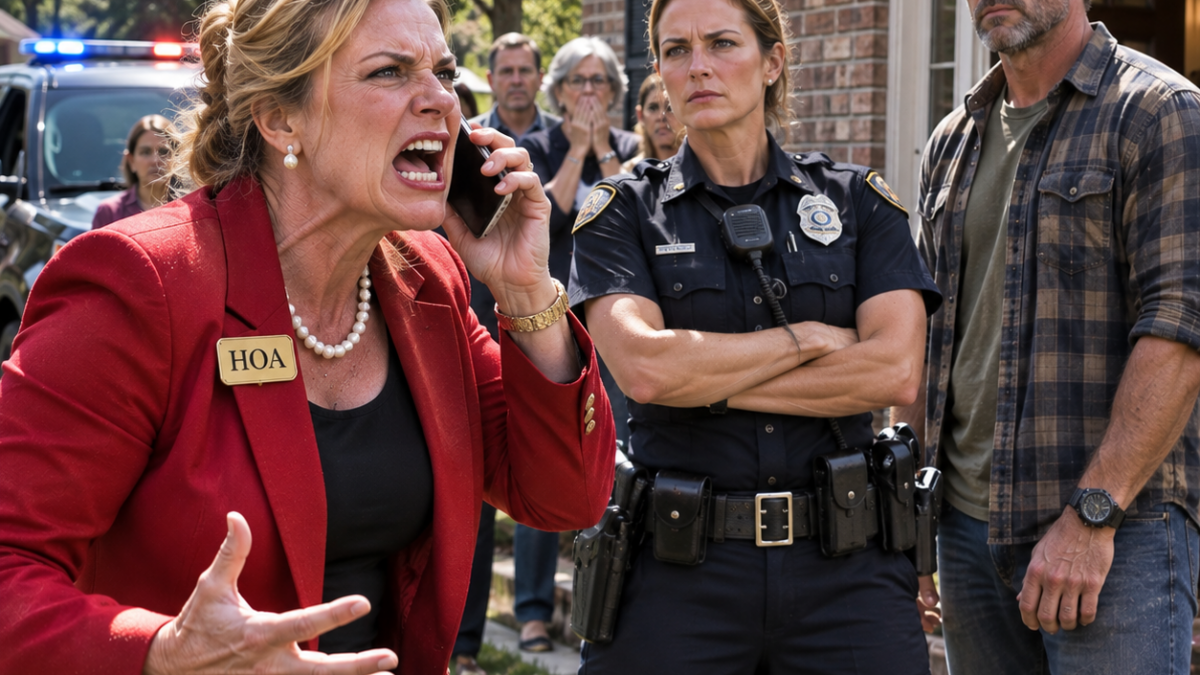
PART2
COMMUNITY RESERVE FUND REPLENISHMENT.
That was it.
No breakdown.
No project.
No explanation.
I read the notice twice.
Then checked the HOA’s last annual report.
The reserve fund had supposedly contained more than three hundred thousand dollars less than a year earlier.
No major road repairs.
No clubhouse renovation.
No storm damage.
No new roof on the pool house.
Nothing that explained why every household suddenly owed $1,900.
There were 112 homes in Maple Ridge.
One thousand nine hundred multiplied by 112 is $212,800.
Coincidentally, almost exactly the amount we would later discover was missing.
At the time, I didn’t know that.
I only knew the numbers didn’t make sense.
So I submitted a written records request.
Nothing aggressive.
Nothing accusatory.
I cited the relevant HOA provision.
Requested bank statements.
Board minutes.
Vendor invoices.
Reserve expenditures.
Contracts for the previous eighteen months.
I expected an email.
Instead, Gwen Halloran found me at the mailbox.
Three days after my request.
She was in her late fifties.
Perfect blond bob.
Expensive sunglasses.
Red blazer.
Black folder under one arm.
Gwen had been HOA president for six years.
People described her using words like organized, strong, demanding, and terrifying.
I had only spoken to her twice.
Both conversations had been unpleasant enough to make a third unnecessary.
“Nolan.”
I looked up.
“Gwen.”
She smiled.
“You’ve been busy.”
I knew immediately what she meant.
“Records request?”
“Very ambitious.”
“I wouldn’t call asking where two hundred thousand dollars is going ambitious.”
Her smile remained.
Her eyes didn’t.
“The reserve fund is a complicated matter.”
“That’s why I asked for records.”
“Most homeowners trust the elected board to manage community finances.”
“I’m sure.”
“You don’t?”
“I trust documents.”
She stared at me for a second.
Then stepped closer.
“People who dig into things tend to find trouble.”
I almost laughed.
“That sounds like something a villain says before the commercial break.”
Her jaw tightened.
“I am giving you friendly advice.”
“Then make it friendlier.”
She lowered her voice.
“Be careful what you ask for.”
I looked at her.
Not angry.
Interested.
Because intimidation is useful information.
It tells you which direction to look.
“I’ll see you at the next board meeting.”
Her gaze shifted past me toward our house.
Front door.
Living-room window.
Then back.
“Of course.”
She walked away.
That should have been the moment I called an attorney.
It wasn’t.
I still believed we were arguing about financial statements.
Then things began moving inside our house.
Not big things.
Small enough to doubt yourself.
The thermostat changed from seventy to sixty-seven.
I blamed Hannah.
She blamed me.
A desk drawer in my office sat half an inch open when I remembered closing it.
The back door was unlocked one afternoon.
Hannah insisted she locked it before going upstairs.
A stack of mail had shifted.
Once, the lid on the document box beneath my desk wasn’t completely seated.
Nothing missing.
Nothing obvious.
The kind of changes that make you question memory before suspecting intrusion.
I mentioned it to Hannah over breakfast.
She stopped eating.
“Say that again.”
“The back door?”
“All of it.”
I listed everything.
Thermostat.
Drawer.
Mail.
Document box.
She stared toward the hallway.
“You haven’t been doing that?”
“No.”
“You sure?”
“Yes.”
Hannah stood.
She checked the front lock.
Back lock.
Windows.
Then returned.
Her expression had changed.
Police face.
Not fear.
Assessment.
“When a house feels wrong,” she said, “it usually is.”
I smiled.
“That sentence sounds unhealthy.”
“Occupational hazard.”
“You think someone’s coming inside?”
“I think we stop guessing.”
That night, we installed a camera in the living room.
Wide angle.
Audio.
Cloud storage.
We mounted another facing my office door.
We also upgraded the smart lock.
Keypad entries logged.
App entries logged.
Manual interior unlocks logged.
Physical key use logged differently.
There were only four legitimate physical keys.
Mine.
Hannah’s.
One sealed backup in a bank box.
One with my brother in another state.
We told nobody.
Not neighbors.
Not HOA.
Not friends.
Then we waited.
For nine days, nothing happened.
I started feeling stupid.
Hannah didn’t.
“Good,” she said.
“What?”
“I hope we wasted the money.”
Then Tuesday came.
Hannah finished a double shift around 7:30 that morning.
She got home exhausted.
Ate half a bowl of cereal.
Went upstairs.
Her next shift started at six that evening.
Around two, I realized we’d run out of light bulbs for the basement.
Exciting married life.
I drove to the hardware store.
Nine minutes away.
At 2:14 p.m., I was standing in aisle nine comparing two identical-looking boxes of LED bulbs when my phone vibrated.
FRONT DOOR UNLOCKED.
I glanced at it.
Then frowned.
Underneath:
METHOD: PHYSICAL KEY.
Not Hannah.
Not keypad.
Not me.
Physical key.
My stomach dropped.
I opened the camera feed.
Our living room appeared.
Empty for two seconds.
Then the door moved.
Gwen Halloran stepped inside.
Red blazer.
Black pants.
Black folder.
She closed the door behind her.
Slowly.
My first thought wasn’t anger.
It was confusion.
How does the HOA president have a key to my house?
Then fear.
Hannah was upstairs.
Asleep.
Gwen stood still.
Listening.
She turned toward the staircase.
I stopped breathing.
Then she walked the opposite direction.
My office.
I left the light bulbs on the shelf.
Started walking.
Fast.
Still watching.
Gwen entered my office.
Opened the first drawer.
Looked through insurance paperwork.
Second drawer.
Photographed documents with her phone.
Third.
Tax records.
Mortgage papers.
Copies of my HOA correspondence.
She photographed those too.
My hands started shaking.
Not because of the papers.
Because my sleeping wife was thirty feet away from a stranger unlawfully inside our home.
I hit call.
Hannah.
Straight to voicemail.
Her phone was on Do Not Disturb.
I called again.
Voicemail.
I reached my truck.
Phone propped against the dash.
Live feed playing.
Gwen opened the black folder.
Removed a thick manila envelope.
Then looked toward the hallway.
She slid the envelope beneath my HOA file.
Closed the drawer.
My blood went cold.
She wasn’t searching.
She was planting evidence.
I called Hannah again.
Nothing.
I called 911.
Then stopped.
Hannah was an officer.
But this was her home.
Calling dispatch would send her coworkers screaming toward a scene where she might already be confronting someone.
Better than silence.
I dialed.
Before the call connected, movement appeared on the upstairs portion of the frame.
Not visible.
Sound.
A faint alarm.
Hannah’s phone alarm.
She had set it early.
5:00 usually.
But she’d changed it because she needed to finish paperwork before shift.
Gwen heard it too.
Her head snapped toward the staircase.
She moved into the hallway.
I was already driving.
Nine minutes.
That’s what the GPS said.
Nine minutes had never felt longer.
Upstairs, Hannah woke confused.
She later told me she initially thought I had come home.
Then she saw my side of the bed empty.
Heard the floorboard downstairs.
One slow creak.
Then another.
Hannah froze.
Her uniform was hanging over the bedroom chair.
Badge.
Duty belt.
Boots.
Radio charging on the dresser.
She texted me.
Are you downstairs?
I didn’t see it.
I was driving.
She waited ten seconds.
Another floorboard.
Hannah got up.
Pulled on her uniform pants.
Shirt.
Vest.
Badge.
Boots without fully tying them.
She did not draw her weapon.
That mattered.
This was her house.
Unknown intruder.
But no immediate evidence of a deadly threat.
She took her radio.
Stepped into the upstairs hallway.
“Who’s in my house?”
The camera caught Gwen’s reaction.
She froze.
The black folder slipped against her hip.
Hannah appeared at the top of the stairs.
Gwen saw dark uniform.
Badge not yet visible from below.
Then she ran.
She didn’t answer.
Didn’t explain.
Didn’t say she was HOA president.
She bolted through our front door.
Out onto the lawn.
By the time I turned onto Maple Ridge Drive, Gwen was standing in our front yard holding her phone.
Neighbors were appearing on porches.
She had called 911.
I heard part of the call because Mrs. Odessa Pruitt had walked close enough to hear Gwen shouting.
Odessa lived across the street.
Seventy-six.
Retired librarian.
Tiny.
Dangerously observant.
Her front curtains were essentially a neighborhood intelligence operation.
“911, what’s your emergency?”
Gwen’s voice was loud enough for half the block.
“There is a woman trespassing inside a home that’s under HOA review.”
Pause.
“She is wearing what appears to be a fake police uniform.”
Another pause.
“Yes.”
“She threatened me.”
I pulled into the driveway.
Gwen saw me.
Her expression changed.
Odessa stood beside her fence.
She whispered as I passed:
“Nolan.”
I stopped.
“I saw her unlock your door.”
“With what?”
“A key.”
“You saw it clearly?”
“Yes.”
“Please stay outside.”
She crossed her arms.
“I’m not going anywhere.”
I believed her.
Police lights appeared at the end of the street.
Gwen pointed toward me.
“You need to stay off this property.”
I stared.
“My property?”
“This home is under HOA compliance review.”
“What does that mean?”
“You know exactly what it means.”
“I genuinely don’t.”
She raised the black folder.
“You have been operating in violation of community covenants.”
I almost laughed.
Then our front door opened.
Hannah stepped outside.
Full uniform.
Badge visible.
Duty belt secured.
Hair pulled back.
Calm.
Very calm.
Gwen saw her.
For half a second, fear crossed her face.
Then something incredible happened.
She assumed Hannah was responding to her call.
Her face brightened.
She pointed at me.
“Finally!”
Hannah stopped.
Gwen marched toward her.
“Officer, arrest him.”
Hannah said nothing.
“He is an illegal occupant.”
Nothing.
“He has threatened HOA representatives.”
Hannah tilted her head slightly.
“And there is another woman inside impersonating law enforcement.”
Hannah looked at me.
I almost smiled.
Gwen pointed harder.
“Arrest him.”
Hannah finally spoke.
“Ma’am.”
Gwen stopped.
“My name is Officer Hannah Briggs.”
Pause.
“This is my residence.”
Gwen’s face emptied.
Hannah continued.
“And that is my husband.”
The street went silent.
Literally.
No cars.
No voices.
Even Odessa stopped muttering.
Gwen’s mouth opened.
Closed.
Then opened again.
“You live here?”
“Yes.”
“But—”
Hannah waited.
Gwen looked at her badge.
Then at me.
Then toward the house.
The understanding arrived piece by piece.
She had entered a police officer’s home.
While the officer was inside.
Then called police on the officer.
But Gwen Halloran had built her entire identity around never being wrong.
So rather than stop, she doubled down.
“I have authorization.”
Hannah’s expression remained neutral.
“Authorization for what?”
Gwen opened her folder.
Pulled out a document.
“Interior inspection.”
I stared.
“What?”
She unfolded it.
“This property is subject to compliance review due to suspected commercial activity.”
She held the paper toward Hannah.
“The homeowner signed authorization allowing the HOA to inspect.”
I walked closer.
“Let me see that.”
Gwen hesitated.
Hannah said:
“Give it to him.”
Gwen handed it over.
My name was at the bottom.
Nolan Briggs.
Signature.
My handwriting.
Almost perfect.
I felt cold.
“I didn’t sign this.”
Gwen laughed nervously.
“Of course you did.”
“No.”
“Then you’ve forgotten.”
“I don’t forget signing documents that authorize strangers to enter my home.”
The first patrol car arrived.
Officer Ryan Castillo got out.
Ryan had worked with Hannah for four years.
He took three steps.
Saw her.
Saw Gwen.
Saw me.
Then slowed.
“What happened?”
Gwen rushed toward him.
“Officer, thank God.”
Hannah rubbed her forehead.
Ryan looked at her.
“Long day?”
“You have no idea.”
Gwen pointed toward Hannah.
“That woman claims to be a police officer.”
Ryan stared.
Then looked at Hannah.
Then back at Gwen.
“Ma’am.”
“Yes?”
“That’s Officer Briggs.”
Gwen swallowed.
“I understand she’s claiming—”
“No.”
Ryan interrupted.
“I’ve worked beside her for four years.”
Gwen’s face tightened.
Ryan continued.
“She is a police officer.”
Hannah said:
“And this is my house.”
Ryan looked at her.
“Seriously?”
“Seriously.”
He glanced toward Gwen.
“Oh.”
That one word said more than it should have.
Gwen straightened.
“I did not enter the home.”
Odessa yelled from across the street:
“Yes, you did.”
Everybody turned.
Odessa pointed one bony finger.
“I watched you use a key.”
Gwen snapped:
“Mind your own business.”
Odessa smiled.
“This is my business now.”
I loved Odessa a little in that moment.
Ryan raised a hand.
“Everyone stop.”
Then he looked at Gwen.
“Did you enter the residence?”
“No.”
“Do you have a key?”
“No.”
“Did you use a key?”
“No.”
Hannah looked at me.
I took out my phone.
“Ryan.”
He looked.
“You should watch something before this goes any further.”
Gwen’s face went pale.
“What is that?”
I didn’t answer.
Opened the camera recording.
Hit play.
Ryan watched.
Hannah stood beside him.
Neighbors edged closer.
Gwen appeared on screen.
Unlocking the door.
Walking inside.
Closing it.
Entering my office.
Opening drawers.
Photographing papers.
Ryan’s expression changed.
Then the envelope.
Gwen sliding it beneath my files.
Someone behind me whispered:
“Oh my God.”
Odessa said:
“I knew it.”
Gwen stepped forward.
“That recording is illegal.”
I looked at her.
“In my own living room?”
“You can’t record people without consent.”
Hannah said:
“Ohio is a one-party-consent state for audio, and cameras inside your own residence are another issue entirely.”
Gwen looked at her.
Hannah’s expression was almost pitying.
“You should stop talking.”
Ryan paused the video.
“What’s in the envelope?”
“I don’t know.”
Gwen said quickly:
“Nothing illegal.”
Every head turned toward her.
Ryan slowly looked up.
“You said you weren’t inside.”
Silence.
Gwen’s eyes widened.
“I mean—I don’t know what he’s alleging is inside.”
Ryan nodded.
“Stay here.”
He looked at Hannah.
“Your scene technically.”
She shook her head.
“No.”
“What?”
“I live here.”
Conflict.
“Get another supervisor.”
Ryan nodded.
“Good call.”
That was one of the reasons Hannah was good at her job.
She knew when not to be the cop.
Sergeant Patrick Dwyer arrived eight minutes later.
Broad.
Bald.
Twenty years on the department.
He took control.
Hannah stepped back beside me.
Dwyer reviewed the footage.
Then the forged authorization.
Then the smart-lock log.
“Physical key at 2:14.”
He looked at Gwen.
“Where did you get the key?”
“I didn’t.”
Dwyer showed her the phone.
“We have you unlocking the door.”
“I had temporary inspection access.”
“With a key you just said you didn’t possess?”
Gwen’s breathing changed.
She was losing control of the story.
Dwyer asked:
“Who gave you permission to enter?”
“I told you.”
She pointed at the forged authorization.
“He did.”
I said:
“No.”
Dwyer looked at me.
“Ever signed anything like this?”
“No.”
“Ever provided the HOA a house key?”
“No.”
“Hannah?”
“Absolutely not.”
Dwyer nodded.
“Let’s look at the envelope.”
Ryan and another officer entered with us.
Gwen remained outside.
The desk drawer was exactly as shown.
I opened it only after Dwyer photographed everything.
Envelope inside.
Thick.
My name printed on the front.
Dwyer put on gloves.
Opened it.
Fake lease agreements.
Receipts.
Invoices.
Business records.
All bearing my name.
They made it appear I had been renting rooms.
Operating an unlicensed consulting business.
Running commercial activity from the property.
Several signatures looked like mine.
One lease listed a tenant who didn’t exist.
Another document showed cash payments.
Hannah stared.
“She was setting him up.”
Dwyer didn’t answer.
But his face said yes.
The HOA could use alleged commercial activity to fine us.
Possibly pursue liens.
Maybe pressure us to sell.
Maybe discredit my financial-record request.
The plan wasn’t completely clear yet.
It would become clear the next morning.
Before leaving, Dwyer asked Gwen the question that broke everything open.
“Where did the key come from?”
She refused to answer.
Then he asked another.
“How many keys do you have?”
Her eyes moved toward the ground.
Tiny movement.
But everyone saw it.
A warrant was executed at the Maple Ridge clubhouse the following morning.
By then, Gwen had retained an attorney.
She wasn’t talking.
The HOA office occupied two rooms behind the clubhouse.
Desk.
File cabinets.
Printer.
Storage closet.
And a locked metal cabinet behind Gwen’s desk.
Investigators found the cabinet key in a drawer.
Inside were forty-one house keys.
Forty-one.
Each labeled.
Address.
Lot number.
Some even had homeowner surnames.
Dwyer called me personally.
“Nolan.”
“Yeah?”
“You sitting?”
“No.”
“Sit.”
I did.
“We found keys.”
My chest tightened.
“How many?”
“Forty-one.”
I didn’t speak.
He continued.
“Yours is tagged Lot 64.”
“How did she get them?”
“Don’t know yet.”
“Forty-one homes?”
“Yes.”
I looked toward Hannah.
She saw my face.
“What?”
I put the phone on speaker.
Dwyer continued:
“Some are probably old emergency-access keys turned over by builders or previous management.”
“Probably?”
“That’s one theory.”
“Does that make it legal?”
“No.”
“Any authorization records?”
“None found yet.”
Hannah sat beside me.
Dwyer continued.
“We also found financial ledgers.”
My stomach tightened again.
“What kind?”
“The kind your records request was probably about.”
That afternoon, HOA treasurer Leonard Voss gave a statement.
Leonard was sixty-three.
Retired accountant.
Soft-spoken.
Always sat at the end of board meetings with a calculator.
He had known.
Not everything.
Enough.
When deputies showed him the gray ledger found in Gwen’s cabinet, he started crying.
According to Dwyer’s later report, Leonard said:
“I can’t do this anymore.”
Then:
“She made me sign everything.”
And then he started talking.
The reserve fund wasn’t low.
It had been stolen.
Two hundred twelve thousand dollars.
Almost exactly the amount the special assessment would replace.
Transfers disguised as emergency repairs.
Invoices from companies that either didn’t exist or belonged to Gwen’s relatives.
Landscaping work billed twice.
Roof repairs never performed.
Consulting fees.
Legal services.
Board votes that had never taken place.
Gwen had been using HOA money for years.
The $1,900 special assessment wasn’t for future repairs.
It was to refill the hole before homeowners saw the annual books.
Then I asked for the books.
That changed the timeline.
She needed a reason to discredit me.
Fake commercial leases.
Forged receipts.
Evidence I was violating covenants.
If necessary, she could claim the records request came from a disgruntled homeowner facing enforcement.
Maybe even place a lien on our house.
Maybe threaten litigation until I withdrew the request.
And apparently she believed entering our home to plant evidence was simply another administrative task.
The keys explained how.
What they didn’t explain was how many houses she’d entered.
That became the question that terrified Maple Ridge.
Residents lined up outside the police department.
Had Gwen been inside my house?
Did she go through bedrooms?
Did she copy documents?
Did she enter while my children were home?
Had she taken anything?
Some remembered odd things.
Drawers open.
Items shifted.
Doors inexplicably unlocked.
A jewelry box moved.
A medicine cabinet left open.
None proved Gwen had entered.
Some might have innocent explanations.
But once trust breaks, every old uncertainty becomes evidence in your mind.
That was Gwen’s real damage.
Not money.
Safety.
One hundred twelve families suddenly looked at their own front doors differently.
The emergency homeowners meeting was scheduled for Thursday night.
Police advised people not to turn it into a confrontation.
Nobody needed convincing.
They wanted answers.
The clubhouse couldn’t hold everyone.
Folding chairs filled the lawn.
Neighbors stood along sidewalks.
Local reporters arrived.
Leonard Voss sat in the front row.
He looked ten years older than he had a week earlier.
I sat beside Hannah.
Odessa sat on my other side.
She brought peppermint candies.
Because apparently criminal investigations required snacks.
At 7:06, Gordon Mercer, the HOA vice president, opened the meeting.
His hands shook.
“The board has received confirmation that President Gwen Halloran has been suspended from all association responsibilities pending criminal investigation.”
People started shouting.
“Where’s our money?”
“Why did she have keys?”
“How long did you know?”
Gordon raised both hands.
“I didn’t know.”
Someone yelled:
“That’s impossible!”
Maybe it was.
Maybe it wasn’t.
Leonard stood.
The crowd quieted.
He walked to the microphone.
“I knew some of it.”
People erupted.
He waited.
Then said:
“I signed things I should not have signed.”
The crowd got louder.
Hannah leaned toward me.
“Let him talk.”
I nodded.
Leonard continued.
“Gwen told me the transfers were temporary.”
“She said vendors needed payment before board ratification.”
“I believed her at first.”
Pause.
“Then I stopped believing her.”
A woman shouted:
“Then why didn’t you say anything?”
Leonard looked toward the crowd.
“Because I was afraid.”
That answer didn’t satisfy them.
It shouldn’t have.
But it was honest.
“She told me I would be personally liable.”
“She threatened to accuse me of stealing.”
“She had documents with my signature.”
His voice cracked.
“I kept thinking I could fix it quietly.”
I knew that feeling.
Problems grow inside silence because everyone believes quiet correction is still possible.
Leonard continued:
“The special assessment was meant to replace missing reserve funds.”
Anger moved through the crowd.
“How much?”
He swallowed.
“Two hundred twelve thousand dollars.”
For three seconds, nobody spoke.
Then chaos.
Gordon pounded the table.
“Please!”
It took five minutes to restore order.
Then the doors opened.
Sergeant Dwyer entered.
Two detectives behind him.
And Gwen.
Not in handcuffs yet.
Her attorney beside her.
Red blazer gone.
Dark coat.
Face hard.
The entire neighborhood stood.
Dwyer walked toward her.
Her attorney whispered something.
Gwen shook her head.
Then looked directly at me.
That surprised me.
Not Hannah.
Me.
I could see the hatred.
I had requested records.
That was all.
A letter.
Four paragraphs.
One signature.
Her entire system collapsed because somebody asked to see numbers.
Dwyer spoke.
“Gwen Halloran.”
The lawn became silent.
“You are under arrest.”
Her attorney touched her arm.
Gwen pulled away.
“For what?”
Dwyer began listing charges.
Burglary.
Forgery.
Filing a false police report.
Tampering with evidence.
Financial crimes related to alleged embezzlement.
Additional charges pending.
Gwen looked around.
At the residents.
At Leonard.
At me.
“This is because of him.”
She pointed.
I didn’t move.
“This man has been harassing the board for weeks.”
Odessa muttered:
“He wrote a letter.”
I almost laughed.
Gwen continued.
“He illegally recorded me.”
Dwyer said:
“Turn around.”
“You’re making a mistake.”
“Turn around.”
“I was authorized to inspect that home.”
“Turn around.”
“Those records were legitimate.”
Click.
First cuff.
Gwen’s face changed.
Not shame.
Disbelief.
The same disbelief I’d seen when Hannah told her:
This is my house.
Some people spend so long exercising authority without challenge that consequences feel illegal when they finally arrive.
Dwyer secured the second cuff.
Gwen shouted:
“You people have no idea what I’ve done for this community!”
Odessa called:
“We’re starting to.”
A few people laughed.
Gwen looked toward her.
If looks could kill, Odessa would’ve needed an ambulance.
Police led Gwen away.
Nobody applauded.
I was glad.
It wasn’t entertainment.
A neighborhood had discovered the woman entrusted with its money had apparently been entering homes and stealing from them.
There was nothing joyful about that.
After the meeting, Odessa hugged me.
“I told you I was watching.”
“You did.”
“You thought I was nosy.”
“I still do.”
She smiled.
“Nosy is why you’re not in jail.”
“Fair.”
Hannah joined us.
Odessa hugged her too.
Then whispered:
“I knew you were a real police officer.”
Hannah raised an eyebrow.
“You’d never met me.”
“No.”
“Then how?”
“Your pants fit correctly.”
Hannah looked at me.
I shrugged.
Odessa walked away before either of us could ask what that meant.
The investigation took months.
Gwen’s scheme was larger than the first headlines suggested.
The keys had accumulated over years.
Some dated back to original construction.
Developers had once maintained temporary contractor keys.
Others had been voluntarily provided during homeowner absences for emergency water shutoff or maintenance.
When management changed, they should have been returned or destroyed.
Instead, Gwen retained copies.
Investigators could prove unauthorized entry into at least seven homes.
Mine was one.
In two others, she had photographed documents.
Another involved planting a violation notice inside a kitchen because she later claimed it had been “personally served.”
One elderly homeowner discovered Gwen had photographed medication bottles during a dispute about whether her adult son lived there full-time.
That one made Hannah furious.
“That’s private medical information.”
“I know.”
“She photographed prescription bottles?”
“Yes.”
“What kind of person does that?”
I looked at her.
“The kind who had forty-one keys.”
The financial case became even worse.
Fake invoices.
Companies registered to Gwen’s cousin.
A maintenance contractor who admitted giving kickbacks.
Forged board minutes.
Electronic transfers.
Cashier’s checks.
More than $212,000 initially missing.
Eventually investigators identified almost $280,000 in questionable transactions over five years.
Some money was recoverable.
Some wasn’t.
Insurance covered part.
The special assessment was rescinded.
Homeowners who had already paid received refunds.
Every exterior lock in Maple Ridge was changed.
Not because all forty-one keys matched current locks.
Nobody cared.
People wanted certainty.
The HOA paid.
Rightfully.
Our own lock was replaced the same day Gwen entered.
Hannah chose the new hardware personally.
She also installed another camera.
Then another.
I said:
“This is becoming excessive.”
She stared.
“An HOA president unlocked our front door.”
“Fair.”
Our civil case settled before trial.
I hadn’t been eager to sue the association.
Most homeowners were victims too.
Lena structured the claim primarily against Gwen, the management insurer, and the relevant liability policies.
Emily—sorry, Hannah—laughed when I once accidentally called her Emily while telling the story to someone because another neighbor had an Emily.
She said:
“If you’re going to make me famous, remember my name.”
I told her nobody was becoming famous.
Then the local station ran the story for four straight nights.
HOA PRESIDENT ACCUSED OF ENTERING HOMES WITH SECRET KEYS.
That ended my argument.
The settlement covered legal expenses.
Security upgrades.
Damages.
Lost work.
And a formal acknowledgment that the HOA had never possessed authority to enter our home without consent.
We didn’t need all of the remaining money.
Hannah wanted to donate some.
“To what?”
She thought.
“Domestic violence lock-change program.”
That surprised me.
Then made perfect sense.
Victims leaving abusive partners often need locks replaced immediately.
Sometimes money delays that.
We had learned what it feels like to discover someone has access to your front door.
We donated enough to fund dozens of emergency lock replacements.
Hannah said:
“At least the key does something useful now.”
The police department investigated her involvement separately because she had been physically present during part of the incident.
Body-camera footage.
911 call.
Ryan’s report.
Dwyer’s report.
Hannah’s conduct was cleared.
She had done exactly what policy required.
Identified herself.
Avoided taking control of a scene involving her own residence.
Requested an uninvolved supervisor.
I was proud of her.
She hated when I said that.
“You’re my husband, not my commanding officer.”
“I can still be proud.”
“Fine.”
“I am.”
“Fine.”
Gwen eventually pleaded guilty.
The final agreement included felony burglary, forgery, theft-related charges, and false reporting.
Other counts were consolidated.
She received prison time.
Restitution.
Permanent prohibition from serving in HOA financial or management positions.
Her attorney released a statement describing her actions as “serious lapses in judgment during a period of personal and financial stress.”
Odessa read that aloud at the mailbox.
Then said:
“I once bought seventeen ceramic cats after my husband died.”
I stared.
“That was a lapse in judgment.”
She pointed toward Gwen’s former house.
“This was crime.”
Hard to argue.
Leonard Voss cooperated fully.
He wasn’t charged with the major theft counts, though he faced consequences for falsified records he had signed.
The neighborhood was divided about him.
Some hated him.
Some felt sorry.
I landed somewhere in the middle.
He had been afraid.
He had also helped silence the truth.
Both can be true.
Months later, Leonard came to our porch.
He looked smaller.
“Can we talk?”
I invited him in.
He stopped at the threshold.
“Permission?”
That almost made me smile.
“Come in.”
He sat at the kitchen table.
Hannah was at work.
Leonard folded his hands.
“I owe you an apology.”
“For what?”
“For not answering your records request.”
“You weren’t president.”
“I was treasurer.”
Fair.
He looked toward my office.
“I knew the numbers wouldn’t reconcile.”
“How long?”
“Maybe eight months.”
I felt anger rise.
“You knew two hundred thousand dollars was missing for eight months?”
“Not the exact amount.”
“But you knew.”
“Yes.”
“Why didn’t you call police?”
His eyes filled.
“Because Gwen had documents with my signatures.”
“You signed them.”
“Yes.”
“Then why wouldn’t she?”
He nodded.
“I kept thinking if I could get the money put back…”
I stopped him.
“How?”
He looked down.
“The assessment.”
There it was.
He had known.
Maybe not the burglary.
Maybe not the keys.
But he understood why the assessment existed.
“You were going to make one hundred twelve families replace money she stole.”
Leonard’s face crumpled.
“Yes.”
For a moment, I wanted him gone.
Then I remembered something Hannah said often after difficult arrests.
Understanding isn’t excusing.
It just helps you decide what happens next.
I said:
“Why are you here?”
Leonard wiped his eyes.
“Because I need to say it to someone.”
“What?”
“I was a coward.”
I studied him.
He continued.
“I told myself I was protecting the community from scandal.”
“I was protecting myself.”
That sounded true.
“What are you doing now?”
“I resigned.”
“I know.”
“I’m helping the new board reconstruct every account.”
“Good.”
“I’ve agreed to testify.”
“Good.”
He looked at me.
“Is there anything else I can do?”
I thought.
“Yes.”
“What?”
“When somebody tells you keeping quiet protects everyone, remember this table.”
He nodded.
“I will.”
After he left, I checked the front lock.
Automatic habit by then.
I hated that.
For months after Gwen’s entry, our house didn’t feel entirely ours.
Every unfamiliar sound mattered.
Every notification.
Every slight movement.
Hannah, who had entered dangerous buildings professionally without hesitation, became obsessive about the front door.
She checked it before bed.
Then checked again.
One night I caught her standing in the dark living room staring at the lock.
“You okay?”
“Yeah.”
“No.”
She looked at me.
Then sat on the couch.
I joined her.
She said:
“I’ve kicked doors for work.”
“I know.”
“I’ve arrested people in their houses.”
“I know.”
“But there’s process.”
“Warrants.”
“Probable cause.”
“Consent.”
“Backup.”
She looked toward the door.
“She just decided she could come in.”
I took her hand.
“That bothers you more than the fake cop accusation?”
“Way more.”
“Why?”
Hannah thought.
“Because the badge is a job.”
Pause.
“This is home.”
That was the part Gwen never understood.
A house isn’t valuable because of drywall.
Or square footage.
Or resale value.
It’s valuable because it’s the one place you expect the outside world to stop.
There should be a threshold.
A line.
Knock.
Wait.
Ask.
Gwen had erased that line for forty-one families without them knowing.
People asked whether we considered moving.
We did.
For maybe a week.
Then Hannah said:
“No.”
“Why?”
“Because I like this house.”
“That simple?”
“No.”
She looked out the front window.
“But I refuse to let Gwen decide where I live.”
So we stayed.
The neighborhood changed.
New board.
New management company.
Financial statements posted online every month.
Board meetings livestreamed.
No master-key retention.
No entry into owner property without explicit written consent except legally defined emergency access.
Independent annual audit.
Records requests acknowledged within three business days.
Odessa attended every meeting.
Nobody dared skip procedure with Odessa in the second row.
The funniest change was Gwen’s old red blazer.
Not literally.
That disappeared into evidence or storage.
But red blazers became an inside joke.
At the first annual block party after the scandal, six women arrived wearing red jackets.
Hannah laughed so hard she had to sit down.
I said:
“This neighborhood is unhealthy.”
She said:
“It’s healing.”
Maybe both.
Ryan Castillo became a regular visitor.
Usually because Hannah invited him.
Sometimes because he liked my grill.
One evening, he sat on our porch eating ribs.
He said:
“You know what bothered me most?”
“What?”
“Gwen telling me to check Hannah’s ID.”
Hannah smiled.
“You looked tempted.”
“I was trying not to laugh.”
“You failed.”
“I was professional.”
“You said ‘oh.’”
“That was a tactical ‘oh.’”
I laughed.
Ryan looked at me.
“You stayed calmer than I would’ve.”
“I wasn’t calm.”
“You looked calm.”
“Different thing.”
Hannah nodded.
“She says that too.”
Ryan asked:
“What were you thinking when you saw her inside?”
I looked toward my office.
“Honestly?”
“Yeah.”
“That I needed to get home before Hannah shot the HOA president.”
Hannah almost choked on her drink.
“I wasn’t going to shoot her.”
“I know that now.”
“I didn’t even draw.”
“I was watching a six-inch screen from nine minutes away.”
Ryan laughed.
Hannah pointed at me.
“You were driving like an idiot.”
“I drove responsibly.”
“You admitted you sped.”
“I said every red light felt long.”
“Same emotional category.”
Ryan raised both hands.
“Marriage dispute. I’m off duty.”
The years softened parts of the story.
Not all.
I still keep the forged inspection authorization.
Framed?
No.
That would be weird.
It’s in a file.
Beside our legitimate deed.
Beside the original $1,900 special-assessment notice.
Beside my records request.
Four pieces of paper.
The entire story in sequence.
Demand money.
Ask questions.
Intimidate the person asking.
Manufacture evidence.
That’s what scares me when I look at it.
Gwen’s burglary wasn’t random.
It was an escalation.
She didn’t wake up one Tuesday and suddenly decide to break into a house.
She had spent years getting away with smaller things.
Unauthorized transfers.
Fake votes.
Hidden keys.
Threats.
Selective enforcement.
People complying because fighting the HOA sounded exhausting.
Each success taught her the next step was safe.
Until she opened our door.
That’s what unchecked power does.
It doesn’t usually announce itself as tyranny.
It begins with:
“It’s just easier if you cooperate.”
“It’s just policy.”
“Everyone does it.”
“Don’t cause trouble.”
“Why do you need to see the records?”
“Trust us.”
Then one afternoon, somebody who thinks rules belong only to everyone else is standing inside your living room with a folder.
I sometimes wonder what would’ve happened if Hannah hadn’t woken early.
Gwen would have left.
I would have come home.
Maybe found the envelope.
Maybe not.
Weeks later, the HOA might have accused us of running an illegal business.
They would produce contracts.
Receipts.
My forged signature.
Then what?
Maybe we’d eventually prove fraud.
Maybe.
But proving a planted document is much harder when you don’t have video of the person planting it.
That nine-day-old camera changed everything.
Not Hannah’s badge.
Not Ryan knowing her.
Not Odessa seeing Gwen.
The camera.
Evidence.
That’s the part I tell neighbors whenever they want to make the story about the funny reveal.
Yes.
It was satisfying watching Gwen point at my wife and demand the “fake officer” arrest me.
Yes.
Watching her face when Hannah said, “This is my house,” was unforgettable.
But if Hannah had been a teacher?
Accountant?
Nurse?
Stay-at-home mother?
Gwen would still have been inside illegally.
The badge made the irony obvious.
It didn’t create the wrongdoing.
That distinction matters.
A few years later, Maple Ridge invited Hannah to speak at the annual safety meeting.
She refused.
Then Odessa asked.
Hannah agreed.
That woman had powers.
Hannah stood in the clubhouse where Gwen used to run meetings.
About seventy residents.
She wore civilian clothes.
No uniform.
She began:
“Most of you know me because Gwen once called 911 and reported me for impersonating myself.”
Everybody laughed.
Hannah waited.
Then:
“But that’s not why we’re here.”
She held up an ordinary house key.
“This is.”
The room quieted.
“You should know who has access to your home.”
“Contractors.”
“Family.”
“Previous owners.”
“Property managers.”
“HOAs.”
“Builders.”
She explained lock changes after purchase.
Smart-lock logs.
Cameras.
Not paranoia.
Control.
Then she said something I remember better than anything else.
“Privacy isn’t about having something to hide.”
Pause.
“It’s about having the right to decide when someone enters.”
I looked at her.
That was it.
The entire case.
Not money.
Not the uniform.
Not even Gwen.
Choice.
Who gets through your door?
Who gets your financial records?
Who gets to use your signature?
Who gets to decide what happens inside your own house?
Gwen believed authority meant making those choices for other people.
She was wrong.
When Hannah finished, everyone applauded.
Odessa shouted:
“Tell them about the pants!”
Hannah closed her eyes.
I laughed harder than anyone.
We still don’t know what Odessa meant.
Our front door has changed twice since then.
Once because of the case.
Once because Hannah decided the first replacement was ugly.
The current one is dark wood.
Simple.
Brass handle.
Camera above.
Smart lock.
Nothing special.
Sometimes I stand outside with groceries and get annoyed because the fingerprint reader doesn’t work when my hands are wet.
Normal problems.
I like normal problems.
The special assessment was refunded.
The reserve fund eventually recovered through restitution, insurance, and settlements.
Maple Ridge’s finances stabilized.
Property values did not collapse because residents learned their HOA president was a criminal.
That was another fear Gwen had used for years.
Question us and you’ll damage the neighborhood.
Turns out transparency didn’t destroy Maple Ridge.
Dishonesty almost did.
Odessa still lives across the street.
Still watches everything.
We gave her a camera for Christmas.
Hannah said that was dangerous.
I said she’d already been operating without equipment.
Now she had standards.
One evening, Odessa walked over carrying cookies.
She looked at our door.
“Locked?”
“Yes.”
“Camera working?”
“Yes.”
“Good.”
Then she handed me the plate.
“You’re welcome.”
“For what?”
“Everything.”
“I didn’t do anything.”
She stared.
“You asked for the records.”
I smiled.
“That’s all.”
“Exactly.”
Then she walked home.
That line stayed with me.
I asked.
Gwen reacted.
Her reaction exposed everything.
People sometimes imagine corruption is uncovered by geniuses.
Private investigators.
Secret recordings.
Dramatic whistleblowers.
Sometimes.
Other times, somebody simply says:
“Can I see the receipts?”
And the person stealing realizes receipts are dangerous.
That’s what happened to us.
One written request.
That’s why Gwen threatened me at the mailbox.
That’s why she watched our door.
That’s why she entered our home.
That’s why she planted the envelope.
The forged commercial records weren’t really about covenant violations.
They were about credibility.
If she could make me look dishonest, my questions became less dangerous.
That tactic is older than HOAs.
Can’t answer the question?
Attack the person asking it.
Fortunately, Gwen picked a house with a camera.
A neighbor with excellent eyesight.
And a sleeping police officer upstairs.
Bad operational planning.
Hannah loves when I call it that.
The funniest thing happened on the fifth anniversary of the incident.
The board sent a letter.
I opened it at breakfast.
Hannah watched.
“What?”
I read silently.
Then laughed.
“What?”
“Annual records notice.”
She raised an eyebrow.
The HOA now automatically sent every homeowner a link to all financial statements without anyone needing to request them.
At the bottom:
QUESTIONS AND RECORD INSPECTION REQUESTS ARE WELCOME.
Hannah smiled.
“Look at that.”
“What?”
“You traumatized


