HOA Karen Parked Her Lexus Across My Farm Gate for the 14th Time—So I Dug a 6-Foot Drainage Channel Around It and Left Her Car Stranded.
PART3:
My ranch was an inconvenience.
The subdivision had stone entry columns, ornamental landscaping, uniform mailboxes, and quarterly newsletters printed on glossy paper.
I had cattle.
Dust.
Trailers.
Hay.
Diesel engines.
Mud.
In her mind, progress had arrived in a white Lexus and everything older was supposed to get out of its way.
She had been treating my gate like her private parking space for eight months.
This was the fourteenth time.
But it was the first time she parked there after the county had approved my drainage project.
So I watched her disappear around the bend.
Then I pushed the throttle forward.
The D6 moved.
Let me tell you how we got there.
My grandfather, Thomas Dawson, bought the original ranch in 1951.
Six hundred forty acres outside Dripping Springs.
He came home from Korea with discharge pay, a bad knee, and a belief that land was the only thing a man could leave his children that couldn’t disappear inside a bank account.
He borrowed the rest from a banker in town who apparently approved loans after looking a man in the eye.
Different century.
Granddad ran Herefords.
My father did the same for thirty-one years.
When I took over in 2006, I switched most of herd to Black Angus and expanded hay operation.
The north three hundred acres grow coastal Bermuda.
Fourteen ranches buy from us regularly.
In a good year we cut multiple times.
In a bad year we pray and repair equipment.
I also spent twelve years in the Army as a combat engineer.
Iraq twice.
Afghanistan once.
I built roads, barriers, bridges, drainage, and landing strips in places where every shovel of earth had to be treated like it might be hiding something meant to kill you.
I learned machines.
More importantly, I learned preparation.
Before you move dirt, know terrain.
Before you cross bridge, know load.
Before you make decision, know what happens after.
I came home in 2009.
My wife Maggie said I had spent enough years building roads for everyone else.
“Build something here.”
So I did.
We rebuilt barn.
Improved pastures.
Regraded creek crossings.
Put in better water systems.
Expanded hay business.
Maggie taught middle-school science in Dripping Springs.
She was smarter than me in all the ways that matter.
She could walk into an argument where both people thought they were right and somehow leave with both apologizing.
I tend to solve things with measurements.
Maggie solved people.
Then ovarian cancer took her three years before Vicki parked her Lexus for the first time.
Fourteen months from diagnosis to silence.
There’s no way to explain what it feels like when a person has been woven into every routine for twenty-five years and then one day the routine keeps going without them.
The coffee still brews.
Cattle still need feed.
Hay still grows.
Invoices still arrive.
The sun remains offensively reliable.
I kept working because ranch gave grief somewhere to stand.
Six years before the Lexus incident, Coastal Land Partners bought the old Guthrie ranch north of us.
Two hundred eighty acres.
They built Ridgecrest Estates.
Sixty-eight homes.
Half-acre lots.
Stucco.
Three-car garages.
Community pool.
Wrought-iron entry arch.
Monthly HOA dues high enough to make my feed bill look reasonable.
The advertisements called it:
AUTHENTIC HILL COUNTRY LIVING.
Most buyers came from Austin or San Antonio.
They wanted views.
Live oaks.
Deer.
Sunsets.
Country quiet.
What they did not want was most actual country activity.
Cows.
Dust.
Roosters.
Hay equipment.
Fertilizer.
Diesel at sunrise.
That’s how these conflicts often start.
People fall in love with landscape and become offended by work that created it.
Still, most Ridgecrest residents were fine.
They waved.
Bought hay.
One family let their kids watch calves through fence.
Another brought cookies at Christmas.
Then Vicki Renner got herself elected HOA president.
She had moved in four years earlier with husband Todd.
Todd was quiet.
Not weak exactly.
Just permanently exhausted.
He wore expression of a man who had started one argument in 2014 and was still waiting for it to end.
Vicki had spent fifteen years in pharmaceutical sales.
She knew how to walk into a room.
She knew how to smile while telling you no.
She knew how to repeat same claim until everyone else started questioning whether they had misunderstood original facts.
Within six months she was president.
Unopposed.
Then chair of architectural review.
Landscape compliance.
Community standards.
And something called Neighborhood Harmony Council.
That last one still makes me laugh.
Vicki printed business cards.
For volunteer HOA office.
Embossed.
Her first complaint arrived three weeks after election.
My cattle were too close to her subdivision fence.
I read letter twice.
Then looked out window.
Cattle were on my grass.
Behind my fence.
Doing cattle things.
I called county.
They laughed politely.
Complaint dismissed.
Next:
equipment noise before 9 a.m.
Agricultural operation.
Existing decades before subdivision.
Dismissed.
Next:
dust.
Dismissed.
Next:
stock pond allegedly breeding mosquitoes.
Dismissed.
Then odor.
Cattle produce odor.
Nobody had yet persuaded them to join HOA.
Dismissed.
Every dismissal made Vicki worse.
She treated “no” like clerical error.
Then the gate blocking began.
October.
Tuesday morning.
7:15.
White Lexus across gravel apron.
Not shoulder.
My apron.
Main ranch gate was fourteen feet wide.
Large enough for semis and livestock trailers to swing through.
Vicki parked exactly where a truck needed turning radius.
My hay hauler Curtis arrived at eight in a Peterbilt with forty-foot trailer.
Stopped on county road.
Couldn’t turn.
I called sheriff.
Deputy Miguel Martinez arrived.
Ran plate.
Went to Ridgecrest.
Vicki appeared wearing tennis whites and carrying green smoothie.
“Oh.”
She looked at Lexus.
“I didn’t realize.”
Curtis muttered something I won’t repeat.
Vicki smiled.
“I park there when I walk my dog.”
I said:
“Move it.”
She looked at me.
“It’s public shoulder.”
“No.”
“County road.”
“Road is.”
“Apron isn’t.”
Martinez said situation needed formal clarification.
By time car moved, delivery window lost.
I paid $400 rescheduling charge.
That was first.
Eleven days later:
again.
Then again.
By fourth time, there was no plausible mistake.
She knew.
By seventh, timing became strategic.
Hay pickups.
Feed delivery.
Cattle moves.
Equipment.
Sometimes she left Lexus there two hours.
Sometimes four.
Every time sheriff was called, it was gone before towing process could finish.
She learned timing.
That was what made it harassment rather than parking.
She wanted disruption without consequence.
Twelfth incident cost us nearly everything.
Cow went into difficult labor.
Doc Patterson headed in with vet truck.
Main gate blocked.
He had to use east access.
One and a half miles around.
Forty-minute delay.
He got calf out alive.
Cow too.
Barely.
Afterward Doc wiped blood off his hands.
Looked at me.
“Caleb.”
“Yeah?”
“Twenty more minutes and you lose both.”
I went home.
Sat at kitchen table.
Started log.
Actually, I had been documenting already.
But that night I made it systematic.
Date.
Arrival.
Departure.
Photo.
GPS.
Sheriff call number.
Business disruption.
Cost.
Witnesses.
By twelfth incident:
$11,400 documented losses.
That included rescheduled loads, overtime, rerouting, and interrupted work.
Not including stress.
Stress doesn’t invoice well.
Then came HOA letter.
Community Standard 4.7.2.
It demanded I reduce agricultural noise and odor within something called “community impact zone.”
My ranch wasn’t in HOA.
Never had been.
Ridgecrest CC&Rs ended at its property lines.
But Vicki wrote as if authority radiated outward from clubhouse.
I called Roy Canfield, retired land-use attorney and rancher east of me.
He read letter.
Started laughing.
Hard enough I worried about him.
“Caleb.”
“What?”
“They can send letter saying you owe them moon.”
“Doesn’t mean you owe them rock.”
“What should I do?”
“File it.”
“Respond?”
“Not yet.”
Good advice.
Then came flyers.
Cattle contaminating aquifer.
Agricultural waste.
Children at risk.
She posted photo of brown foaming water online.
Caption:
THIS IS WHAT HAPPENS WHEN WE IGNORE THE PROBLEM NEXT DOOR.
Problem:
photo wasn’t mine.
Wasn’t Texas.
Reverse search found industrial runoff site in Louisiana.
Forty-three residents had shared before correction.
I saved screenshot.
Exhibit fourteen.
The Edwards Aquifer Authority tested Ridgecrest water.
No contamination from my ranch.
Vicki called test incomplete.
Then petitioned county to rezone my farm residential.
That was when I understood endgame.
Agricultural designation kept taxes around $4,800.
Residential valuation could push close to $78,000.
Yearly.
That doesn’t annoy rancher.
That removes rancher.
She wanted land unable to remain agriculture.
Why?
Maybe property values.
Maybe developer interest.
Maybe just control.
Didn’t matter.
Texas Right to Farm protections were clear enough.
Ranch had operated since 1951.
Subdivision came decades later.
County hearing lasted under hour.
Vicki brought lawyer Bradley Stokes, poster boards, aerial photos.
She spoke twelve minutes about quality of life.
I spoke four.
Presented water report.
Tax history.
Agricultural records.
Then read statute protecting established operations from later residential nuisance pressure.
Commission denied rezoning five to zero.
Commissioner Harold Upton told her:
“Ma’am, ranch was here first.”
“Law is clear.”
“I’d suggest finding way to be neighborly.”
She left without looking at me.
Maggie would have enjoyed that line.
I could almost hear her:
There goes neighborhood harmony.
But losing hearing didn’t stop Vicki.
It freed her from pretending process might work.
She began filming ranch hands.
Standing at fence.
Phone up.
Accusing us of labor violations.
OSHA.
Immigration issues.
One morning she filmed my foreman Luis Vega and said:
“I’ll find out if everybody working here is legal.”
Luis is a Marine veteran.
Born in San Antonio.
His family has been in Texas longer than mine.
He didn’t argue.
Just walked away.
That restraint impressed me more than anything I did later with bulldozer.
He told me afterward.
“Boss, handle it.”
“I will.”
Then May arrived.
Hay season.
Timing everything.
Cut.
Dry.
Ted.
Bale.
Load.
Move.
One bad day matters.
May 3.
6:45 a.m.
Lexus at gate.
7:15 hauler arrives.
Blocked.
Sheriff called.
Vicki at Pilates.
She returned 11:30 carrying yoga mat with serene smile while four hours of my operation sat still.
Hay in field over-dried in heat.
We had to rework.
Cost about $4,800.
I sat on porch that evening.
Maggie’s chair still beside mine.
Empty.
I said aloud:
“Don’t get mad.”
That had been her line.
Then second half:
“Get geometry.”
She used to say that whenever I was fixing fence or drainage.
Don’t force problem.
Change angle.
That night I realized I had been fighting Vicki in language she preferred.
Complaints.
Hearings.
Arguments.
I needed ground.
So I hired surveyor.
Dale Hutchins.
Thirty-four years licensed.
He spent two days with GPS, transit, plats.
Third morning:
“Caleb.”
“Yeah?”
“You need see this.”
We met gate.
He spread documents across hood.
Pointed.
“First.”
“This apron is absolutely yours.”
“County ROW ends thirty feet from center line.”
“Your gravel starts at thirty-one.”
I nodded.
Expected.
“Second.”
He moved finger.
Ridgecrest entrance road.
Decorative columns.
Main paved access.
“There is recorded sixty-foot drainage and utility easement in your chain of title.”
“1951.”
“Runs across here.”
I stared.
The easement cut diagonally beneath first 140 yards of Ridgecrest entrance.
“They paved over it.”
“Yes.”
“Permission?”
“None recorded.”
“Compensation?”
“None.”
“Release?”
“None.”
“Subdivision plat?”
He tapped tiny note.
NOTE 14: EXISTING DRAINAGE/UTILITY EASEMENT.
Developer knew easement existed.
But somehow no permanent agreement with me had been recorded.
For six years every Ridgecrest resident had entered subdivision over pavement crossing my easement rights.
I didn’t own their road outright.
Important distinction.
But I held recorded property interest they had encroached upon and altered without agreement.
That was leverage.
Real leverage.
I hired Harlan Webb.
Land-use attorney.
Sixty-eight.
Boots with suits.
He studied survey.
Then looked at me.
“This.”
He tapped easement.
“This is game changer.”
“What can I do?”
“Seek injunction.”
“Demand compensation.”
“Negotiate agreement.”
“Could road come out?”
“In extreme litigation, maybe.”
“But let’s not destroy access for sixty-eight families because president’s obnoxious.”
“Agreed.”
“Good.”
He smiled.
“Make developer nervous.”
While Harlan prepared demand, I moved on something already planned.
Drainage.
North pasture flooded every spring.
Seasonal creek cut low ground and left erosion near gate.
I had been planning stock pond and channel for two years.
NRCS plan existed.
Channel needed to run south from creek to collection basin near gate.
Exactly near gravel apron Vicki treated as valet parking.
I filed permit.
Agricultural drainage.
Routine.
Approved in nine business days.
NRCS cost-share.
Everything public.
Nothing secret.
Then Vicki learned about survey.
She filed for temporary restraining order.
Claimed industrial excavation disguised as agriculture.
Judge Linda Cavanaugh reviewed.
Denied in fourteen minutes.
Permitted agricultural drainage.
Protected use.
Vicki lost again.
Three days later she filed police report saying I threatened physical harm.
Claimed I said:
“If you come near my gate again, I’ll make sure they carry you out.”
I had never said it.
Gate camera had audio.
Footage showed Vicki yelling at Luis while I stood thirty yards away saying nothing.
Deputy Martinez watched.
Then looked at sworn report.
“This doesn’t match.”
“No.”
“Not even close.”
“No.”
He sighed.
“False report can be criminal.”
“Then do what you need.”
He forwarded.
That was when my sympathy ended.
Not because she lied about me.
Because false police reports create risk.
Uniformed deputies arrive believing threat occurred.
People get hurt from invented facts.
She had crossed line.
June 12.
5:30 a.m.
D6 started.
Permit posted in truck.
Survey stakes visible.
Drainage plan laminated.
Luis knew work zone.
Gate camera running.
By 6:42, Vicki parked anyway.
She didn’t ask.
Didn’t check.
Didn’t care.
She walked away.
I kept working.
At 8:15, channel reached gate area.
Lexus sat directly on planned grade.
I stopped machine.
Got down.
Measured.
Compared plan.
Photographed vehicle.
Called Harlan.
“She’s parked in work zone.”
Silence.
“Of course she is.”
“What do you want me to do?”
“You can continue permitted work as long as you do not touch or damage vehicle and stay within plan.”
“That’s what I thought.”
“Caleb.”
“Yes?”
“Do not improvise.”
“I don’t improvise.”
“You were combat engineer.”
“That sentence concerns me.”
“I’ll follow plan.”
“Exactly.”
I climbed back into D6.
Now, people tell story like I bulldozed around her Lexus because I wanted revenge.
I won’t insult you.
Did I understand what continuing work would do?
Yes.
Absolutely.
I’m not idiot.
But the path was already engineered.
Channel dimensions fixed.
I did not alter permit to create trap.
I simply declined to stop legal work because someone once again parked on my property after being told not to.
I cut east side first.
Blade dropped.
Earth rolled.
Six-foot grade.
Then south.
Then west.
Kept eight feet minimum from Lexus.
Never touched tires.
Never hit gravel beneath vehicle beyond permitted edges.
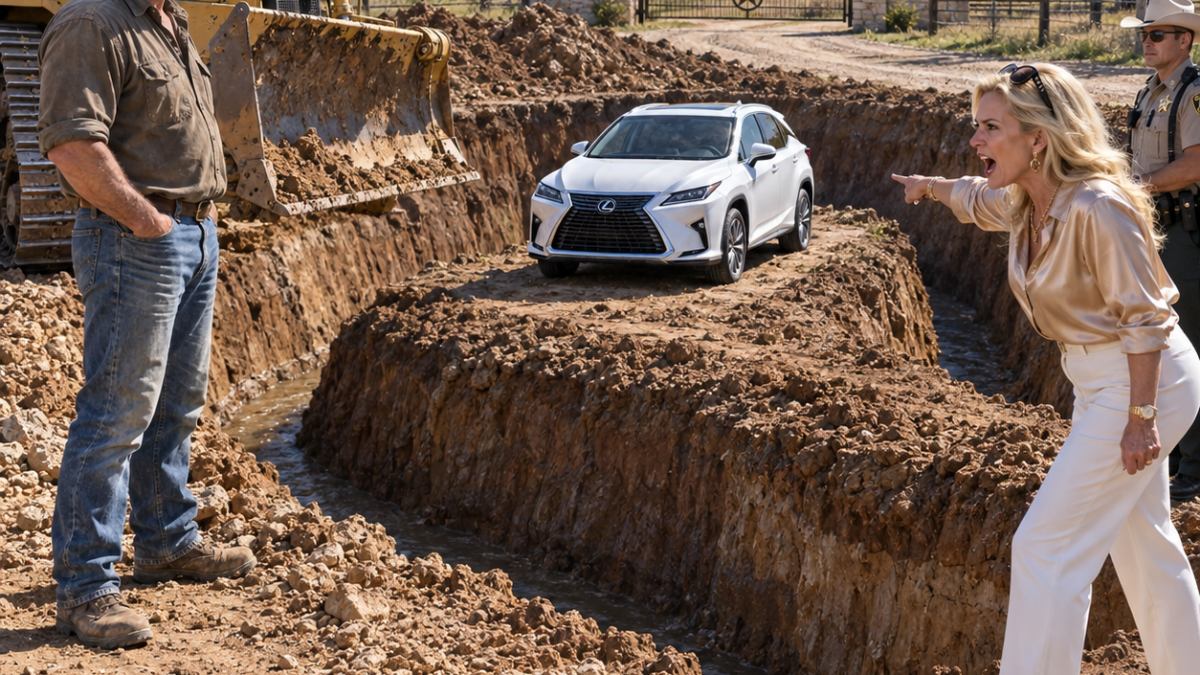
By time I finished, car remained on original apron.
Untouched.
But apron itself had become island.
Approximately twelve by twenty feet.
Six feet above channel floor.
Surrounded.
A white Lexus displayed like sculpture.
I parked D6.
Killed diesel.
Silence after heavy equipment is enormous.
Checked watch.
9:47.
Went inside.
Cold water.
Porch.
Waited.
Vicki returned 10:22.
I heard shoes before voice.
Then silence.
Then:
“What the hell?”
I almost smiled.
Stayed seated.
She stood at edge of channel.
Sunglasses up.
Mouth open.
Her Lexus eight feet away across six-foot drop.
“What did you do?”
I called:
“Drainage.”
“You trapped my car!”
“Your car is parked on my land.”
“You excavated around it!”
“Yes.”
“You can’t do that!”
“County permit’s in truck if you’d like copy.”
She looked at D6.
Then me.
“You did this on purpose.”
“I started at 5:30.”
“You parked at 6:42.”
“You knew!”
“Yes.”
“You should’ve stopped.”
I stood.
“Why?”
That stopped her.
“What?”
“Why should my permitted farm operation stop because you illegally parked where I’ve asked you not to park fourteen times?”
She pointed toward Lexus.
“How am I supposed to get it out?”
“Tow company.”
“You are paying.”
“No.”
“I’ll sue.”
“Okay.”
That word enraged her more than argument.
“Okay?”
“Yes.”
She called sheriff.
Seventeen minutes later Martinez arrived.
He parked carefully.
Walked to channel.
Looked at Lexus.
Looked at me.
Looked at Vicki.
He exhaled through nose.
“Mr. Dawson.”
“Yes?”
“Permit?”
I handed.
He read.
Compared scope.
Looked at stakes.
“Work began when?”
“5:30.”
Vicki shouted:
“He trapped my car!”
Martinez held hand.
“Ma’am.”
“This is criminal mischief!”
He walked around.
“No visible damage.”
“He made it impossible to move!”
“Vehicle is on private property.”
“I’ve parked here before!”
“That does not establish right.”
She stared.
“Arrest him.”
Martinez looked at permit.
Then me.
“Based on what I see, this is civil.”
Civil.
The word I had heard every time she blocked me.
Now it landed on her.
I admit that part felt satisfying.
She demanded tow.
Standard truck couldn’t reach.
Needed boom recovery.
Nearest heavy unit quoted $2,200.
She argued price.
Operator said:
“Ma’am, I can leave it there cheaper.”
She paid.
Yellow recovery truck arrived.
Operator surveyed.
Whistled.
“Lady, how’d your car get up there?”
She pointed at me.
“He put it there.”
I shook head.
“I moved dirt.”
The operator looked again.
“You drove onto it before ditch?”
“Yes,” Vicki snapped.
He nodded.
“Then he didn’t put it there.”
She nearly exploded.
Rigging took forty minutes.
Straps.
Boom.
Lexus lifted.
Swung.
Set onto county road.
Not scratch.
Not dent.
Nothing.
Operator handed invoice.
Before leaving he gave me thumbs-up.
I pretended not to see.
Vicki stood beside Lexus.
Dust on white pants.
Makeup streaked.
Not humiliated because she looked bad.
Humiliated because authority she’d performed for months had no effect on terrain.
She pointed.
“This isn’t over.”
I said:
“It’s been over since survey.”
“You just don’t know it yet.”
She drove away.
Three days later Harlan sent demand letter to Ridgecrest HOA and Coastal Land Partners.
Four pages.
Recorded easement.
Unauthorized road encroachment.
Six years use.
Potential injunctive relief.
Compensation.
Future access terms.
Developer’s Houston lawyers responded immediately.
They did not laugh.
They acknowledged easement.
Acknowledged no agreement.
Requested settlement.
Why?
Discovery would be ugly.
Subdivision plat already noted easement.
Someone had known.
Someone decided build road anyway.
Settlement took six weeks.
Coastal Land Partners paid $215,000 for past unauthorized use and damages.
More importantly, permanent easement agreement established annual compensation of $8,500 adjusted for inflation.
Road remained.
Families kept access.
Nobody had to tear pavement out.
I wasn’t interested in punishing homeowners.
Agreement also required clear procedures before HOA could assert claims impacting Dawson Ranch.
No more imaginary community impact zone.
No more bylaw letters pretending to govern me.
The false police report caught Vicki separately.
County attorney reviewed her statement.
Gate video.
Deputy body-camera.
No ambiguity.
She pleaded no contest to filing false report.
Probation.
Fine.
No prison.
That was appropriate.
I didn’t need prison.
I needed lying to stop.
Ridgecrest held special election in August.
Vicki ran.
Of course she ran.
White pantsuit.
Campaign emails.
Claims she was victim of “rural intimidation.”
She lost fifty-four to six.
Todd voted for her.
So did five others.
Four later claimed ballot confusing.
That remains funniest thing to come from entire mess.
New HOA president was Carolyn Marsh.
Retired teacher.
She mailed handwritten note.
No embossed cardstock.
No watermark.
Dear Mr. Dawson,
On behalf of Ridgecrest Estates, I apologize for the actions of the previous administration. We would like to start again as neighbors.
I wrote back:
Carolyn,
Good neighbors don’t need much policy. They need a fence to wave across and an understanding that the person on the other side has the same right to their land that you have to yours.
Caleb.
That fall, Carolyn came by.
Parked on county shoulder.
Not apron.
Walked to gate.
Pressed call button.
I almost hugged her for that alone.
We talked.
She asked about hay noise.
I explained cutting schedule.
She asked if I could give HOA rough notice before particularly early equipment work.
Not permission.
Notice.
I said yes.
Easy.
She asked whether kids could watch calves from public side of fence.
Yes.
No feeding without asking.
Also easy.
Amazing how many impossible neighborhood disputes become possible when nobody begins sentence with “You are required.”
Luis asked me later:
“Boss, think Vicki comes back?”
“To park?”
“To anything.”
“No.”
He nodded.
Then stared at north pasture.
“My abuelo came to San Antonio in 1948.”
I waited.
“He worked construction forty years.”
“Never had someone look at him like he didn’t belong.”
He kicked dirt.
“That woman looked at me like I was trespassing in my own country.”
I didn’t have good answer.
So I put hand on his shoulder.
We stood.
Sometimes silence is only respectful response.
August thunderstorms came hard.
Water rushed seasonal creek.
New channel carried exactly as designed.
Into stock pond.
Pond filled.
Two hundred twenty head had year-round water closer to north pasture.
Erosion dropped.
Mosquito issue improved once pond stabilized and we stocked bass.
The project Vicki tried to stop made ranch better.
Luis and I built new gate.
Welded steel pipe.
Fourteen feet.
Solar opener.
Camera.
Sign:
PRIVATE PROPERTY
NO PARKING
Luis wanted second line:
VIOLATORS WILL BE EXCAVATED AROUND.
I said:
“Legally questionable.”
He said:
“Morally perfect.”
We didn’t put it up.
For three weeks.
Then I gave him smaller sign for inside gate where only we could see it.
Maggie would’ve loved it.
Life calmed.
That’s the part viral stories skip.
After war ends, what happens Tuesday?
Cattle still need mineral.
Baler still breaks.
Fence still needs repair.
Neighbors still wave.
The Lexus disappears.
I liked normal.
For months, people drove out trying to photograph “Lexus Island.”
There was nothing to see.
Drainage channel worked.
Apron was later rebuilt with proper crossing according to design.
I wasn’t leaving monument.
The point was infrastructure.
Not humiliation.
A local reporter asked:
“Do you regret embarrassing Mrs. Renner?”
I said:
“I regret it took eight months to establish boundaries.”
“Not car?”
“I never touched car.”
“But you knew what would happen.”
“Yes.”
“Would you do it again?”
I thought.
“If someone knowingly parks in active permitted excavation zone on my private property after fourteen warnings?”
“Yes.”
Then added:
“But I would rather they didn’t.”
That was honest.
I was not hero.
I was angry man with bulldozer and unusually good paperwork.
Difference between justice and revenge can get thin when you’re angry.
Paperwork kept me on correct side.
Permit.
Survey.
Camera.
Attorney.
No damage.
No contact.
No threats.
Those things mattered more than machine.
Had I shoved Lexus with blade?
Different story.
Had I dug outside permit purely to trap it?
Different story.
Had I damaged car?
Different story.
I did none.
That’s why Deputy Martinez could stand there and say civil matter instead of handcuffing me.
Years in Army taught me force is easiest part.
Control is harder.
Maggie taught same without uniform.
She used to tell me:
“You don’t win an argument by becoming the worst version of yourself.”
I forgot sometimes.
Not that day.
Ridgecrest changed after Vicki.
Not because everyone suddenly loved ranching.
They didn’t.
Residents still complained about dust now and then.
Carolyn would call.
“Caleb, hay crew threw dust across two cars.”
“Wind was west.”
“I know.”
“Want me to stop wind?”
“No.”
“Then?”
“I’m just informing.”
“Thank you.”
That became our joke.
One resident bought pressure washer.
Problem solved.
Another complained cattle mooing at six.
Carolyn told him he had purchased house beside cattle ranch.
Problem solved.
That’s governance.
Not making every discomfort somebody else’s violation.
Coastal Land Partners eventually tried to renegotiate annual easement payment.
Harlan laughed.
They stopped.
My $215,000 settlement didn’t make me rich.
I reinvested.
Paid ranch debt.
Replaced old hay cutter.
Set aside legal reserve.
Gave Luis bonus large enough to make him suspicious.
He said:
“What’s this?”
“Hazard pay.”
“For Vicki?”
“Yes.”
He laughed.
The D6 stayed.
I maintained it.
Tracks.
Hydraulics.
Blade.
People assumed I kept it as threat.
No.
Bulldozers are useful.
We cleared cedar.
Repaired pond.
Regraded two roads.
Pushed storm debris.
One winter ice storm dropped live oak across Ridgecrest entrance.
Carolyn called.
“Caleb?”
“Yes?”
“I hate asking.”
“Tree?”
“How’d you know?”
“I can see it.”
County crew hours away.
I fired D6.
Pushed tree clear.
Opened road.
Residents stood watching.
One man said:
“This is same bulldozer?”
“What bulldozer?”
He smiled.
“The Lexus one.”
“It has no idea what Lexus is.”
Carolyn brought coffee.
I didn’t charge.
Good neighbors.
Two years after conflict, Vicki and Todd sold.
I wasn’t told until moving truck came.
White Lexus passed my gate one last time.
Slowed.
For half second I thought she might stop.
She didn’t.
I raised hand.
Not mockingly.
A wave.
She looked forward.
Then drove away.
I felt nothing.
That’s how I knew it was finished.
People think closure arrives as apology.
Sometimes it arrives as indifference.
I didn’t need her to admit anything.
Land was still here.
Luis still here.
Cattle.
Pond.
Hay.
Gate.
Life.
That was enough.
A year later, Todd emailed me.
That surprised me.
Short.
Mr. Dawson,
You and I never spoke much. I want you to know I disagreed with much of what happened, but I didn’t stop it either. I should have. I’m sorry for the trouble caused to you and your employees.
Todd Renner.
I read.
Didn’t answer immediately.
Then wrote:
Todd,
Thank you for saying it.
I hope you’re both doing well.
Caleb.
That was all.
No revenge.
No lecture.
People deserve possibility of becoming better somewhere you don’t have to witness it.
The ranch will outlive most of us.
That’s what land teaches.
Granddad bought in 1951.
My father worked until heart gave out.
Maggie planted two live oaks beside porch our first anniversary.
One now shades roof.
I still sit beneath it evenings.
The ridge turns gold.
Then copper.
Then violet.
Cattle move slowly when heat breaks.
Pond catches sky.
Some nights I talk to Maggie.
Not because I think she’s sitting there literally.
Because twenty-five years of conversation creates habit death doesn’t remove.
I told her whole Vicki story once.
Out loud.
From first parking to bulldozer.
Then I said:
“You’d say I enjoyed it too much.”
Wind moved oak leaves.
No answer.
I knew answer anyway.
Probably.
She would’ve been right.
There was satisfaction.
I’d be lying otherwise.
Watching someone who spent months weaponizing inconvenience suddenly face inconvenience herself?
Satisfying.
But satisfaction wasn’t reason to keep ranch.
Maggie once told me:
“Some things are worth more than the fight it takes to hold them.”
At the time she meant marriage.
Later land.
Later dignity.
Luis.
Work.
Not letting somebody who moved next door rewrite history so completely that a ranch operating since 1951 became trespasser against houses built yesterday.
That’s what fight was really about.
Not Lexus.
Lexus was symbol.
A white luxury SUV parked exactly where its owner had been told it did not belong.
Fourteen times.
Because she believed repetition would turn trespass into permission.
It didn’t.
Same with HOA letters.
Same with rezoning.
Same with false report.
Vicki’s mistake was assuming persistence and authority were interchangeable.
They aren’t.
You can repeat wrong thing a thousand times.
Still wrong.
Survey doesn’t care how confident you are.
Deed doesn’t care about business card.
Right-to-farm statute doesn’t care about sunglasses.
Security footage doesn’t care about accusation.
And a permitted drainage channel doesn’t curve around your ego just because your car costs more than bulldozer operator’s truck.
That is why title people gave story always makes me laugh:
HOA Karen Parked Her Lexus at My Farm Gate—My Bulldozer Was Already Moving Before She Came Back.
Sounds like I attacked car.
I didn’t.
I never touched it.
That’s the point.
If I had damaged her Lexus, story would be about rage.
Instead it became geometry.
She put herself in path of lawful project.
I completed project.
Consequences did rest.
Maggie would have appreciated elegance.
“Don’t get mad,” she used to say.
“Get geometry.”
I finally did.
And geometry uncovered more than Lexus island.
Survey found easement.
Easement forced developer to negotiate.
Negotiation protected ranch.
Documentation exposed false report.
Election removed Vicki.
Drainage fixed flooding.
Stock pond improved cattle water.
One decision to stop arguing and measure ground changed everything.
That lesson stuck.
Now when ranch hands bring me problem, first thing I ask:
“What do we actually know?”
Not:
What do you think?
Not:
Who’s wrong?
Facts first.
Fence coordinate.
Weather.
Invoice.
Camera.
Permit.
Measure before moving.
Luke—my nephew who helps seasonally—calls it the Vicki Rule.
I pretend not to like name.
I do.
One spring, young Ridgecrest family came to gate.
Their eight-year-old son had school project about agriculture.
They asked if he could interview rancher.
I agreed.
Kid came with notebook.
First question:
“Do cows sleep standing up?”
“Sometimes.”
Second:
“How much does tractor cost?”
“Too much.”
Third:
“Did you really bury lady’s Lexus?”
His mother turned red.
I laughed.
“No.”
“But everyone says.”
“I dug around it.”
“Why?”
“She parked where I was digging.”
“Why didn’t she move?”
“She wasn’t there.”
“Why’d she park there?”
“That is excellent question.”
He wrote seriously.
Then:
“Was she bad?”
I paused.
“No.”
His mother looked surprised.
“She did bad things.”
“There’s difference.”
“Did you hate her?”
“No.”
“Were you mad?”
“Very.”
“Did bulldozer make you happy?”
I looked toward shed.
“Yes.”
He wrote that too.
Children appreciate honesty.
Then he asked:
“What happened after?”
I pointed at pond.
“That.”
He looked.
“Bulldozer made pond?”
“Partly.”
“Cool.”
And that is probably better ending than anything online.
Not Vicki screaming.
Not tow bill.
Not losing election.
A kid looking at functioning drainage and saying cool.
Because land improvement was real purpose.
Everything else was noise.
Today the north gate still stands.
Automatic opener.
Camera.
Private property sign.
No parking.
Nobody blocks it.
Not because they’re scared of D6.
Because boundary became clear.
Ridgecrest HOA and ranch have written agreement about easement and communication.
Carolyn sends Christmas card.
Residents buy hay sometimes.
One family bought half beef from us last year.
Kids fish pond only when invited.
Luis still runs cattle.
The calf nearly lost during blocked-vet day grew into breeding cow.
Her name is Lexus.
That was Luis’s idea.
I objected.
He ignored me.
Every time I call:
“Lexus!”
I hear him laughing.
The cow is black, not white.
Life has humor.
As for D6, it is still fueled.
Still runs.
The permit from that original project did eventually expire.
I got new ones as needed.
Luis wanted sign changed.
I refused.
Inside barn, though, pinned above equipment maintenance chart, there’s photograph he printed.
White Lexus on gravel island.
Not public.
Just crew.
Below it he wrote:
CHECK YOUR PROPERTY LINE BEFORE YOU PARK YOUR EGO.
I leave it there.
Maybe that’s petty.
Maggie would call it educational.
I choose her version.
If there is lesson in all this, it isn’t to dig around cars.
Don’t.
Legal facts differ everywhere.
Permits matter.
Towing laws matter.
Property lines matter.
Acting in anger can cost more than inconvenience you’re trying to stop.
What saved me wasn’t owning bulldozer.
It was doing homework before blade moved.
Survey first.
Lawyer.
County permit.
NRCS plan.
Camera.
Documentation.
No improvisation.
By time Vicki saw Lexus surrounded by six feet of empty space, argument had already been decided by paper.
D6 only made invisible boundary visible.
She had spent eight months believing my patience meant weakness.
It didn’t.
I was waiting until facts were heavy enough.
Then one Thursday morning they weighed thirty-seven thousand pounds.
She parked at 6:42.
My bulldozer had already been running seventy-two minutes.
She walked away because she believed, as she had thirteen times before, that everyone else would rearrange their day around her car.
I didn’t.
I followed survey stakes.
I cut grade.
I moved dirt.
And when she came back, the Lexus was exactly where she’d left it.
Untouched.
Undamaged.
Perfectly safe.
It was just finally sitting inside the consequences of where she had chosen to park.
That’s different from revenge.
Revenge would have damaged car.
What happened was simpler.
For eight months Vicki Renner kept demanding that everybody respect the boundaries she invented.
On the fourteenth morning, she finally met one that had actually been surveyed.




