HOA Karen Parked Her $96,000 RV on My Land for 3 Years—So I Followed the Law, Towed It, and Bought My Meadow Back at Her Auction
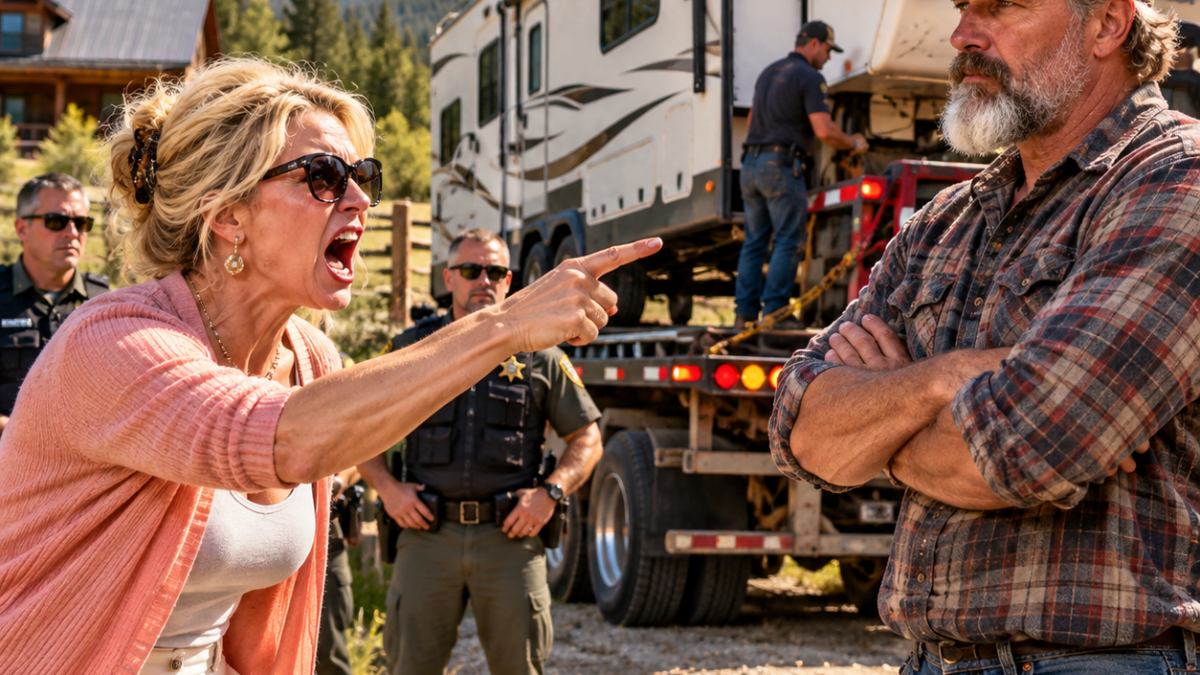
PART2:
My father kept the place.
Then me.
That meadow is not valuable because a developer could put six houses on it.
It is valuable because I can still stand near the old pond and remember where my grandfather parked his Caterpillar.
Some people understand that.
Drusilla Coltrane did not.
Across the county road sits Cedar Bay Reserve.
Ninety upscale homes built after 2019.
Pearl-painted entrance arch.
Private kayak dock.
Clubhouse.
Decorative stone.
HOA.
The whole package.
I had no objection to the subdivision.
Development happens.
People need homes.
What bothered me was the assumption that because my land remained open, wooded, and old-fashioned, it was somehow waiting for somebody with newer paperwork to improve it.
Drusilla became HOA president almost immediately.
She preferred Drew.
I preferred Drusilla because that was the name on her legal documents.
She drove a pearl-white Cadillac XT6.
Perfect hair.
Gold glasses.
The kind of person who could say something outrageous in a calm voice and make three people wonder whether they had misunderstood their own property deed.
The first problem arrived in May of 2021.
I came home from buying fencing supplies and found a forty-foot fifth-wheel RV sitting near the east edge of the home meadow.
White and silver.
Three slide-outs.
Full-size residential refrigerator.
Dual air conditioners.
Automatic leveling system.
The kind of fifth wheel that costs more than the house my grandparents raised children in.
A Cedar Bay Reserve sticker sat on the rear window.
I crossed the road.
Drusilla was at the HOA office.
“Morning.”
“Royce.”
“Whose fifth wheel is on my meadow?”
She did not even look surprised.
“Mine.”
“All right.”
I waited.
She smiled.
“What?”
“Why is it there?”
“Our driveway is being resurfaced.”
“And?”
“I needed somewhere temporary.”
I looked back across the road.
“How temporary?”
“Two weeks.”
“You could have asked.”
“I intended to.”
“Before or after?”
Her smile thinned.
“Royce, it’s six acres.”
“Yes.”
“And the trailer is taking up perhaps three hundred square feet.”
“Yes.”
“You’re not using that area.”
I leaned against the counter.
“That does not make it yours.”
She laughed softly.
Not because anything was funny.
Because people like Drusilla sometimes use laughter as punctuation when they want you to understand that your concern is beneath serious discussion.
“I’ll move it.”
“Two weeks.”
“Fine.”
Eleven days later, it disappeared.
I considered the matter closed.
I should have known better.
Five months later the RV came back.
Different position.
Same meadow.
This time I crossed over and found Drusilla in a board meeting.
She stepped outside.
“Your RV is back.”
“Yes.”
“Why?”
“Winter storage.”
“No.”
She blinked.
“No?”
“No winter storage.”
“Royce, you are not using the meadow from November through March.”
“That is irrelevant.”
“It seems wasteful.”
“It belongs to me.”
She folded her arms.
“We’ll move it in spring.”
“No.”
She stared.
I continued.
“Seven days.”
“You gave me two weeks last time.”
“I learned.”
She moved it on day seven.
The following year, June 2022, it came back.
That time she asked.
Sort of.
She called my landline.
“Royce, I’m having contractors at the house.”
“No.”
“You don’t know what I was going to ask.”
“Yes, I do.”
Pause.
“The fifth wheel needs to sit somewhere for perhaps three weeks.”
“No.”
“Why?”
That question told me everything.
Not:
Is there a problem?
Not:
Can we work something out?
Why?
As though my refusal needed to prove itself.
“Because I don’t want your RV on my property.”
“You have hundreds of acres.”
“And you have a driveway.”
“My driveway is under construction.”
“There are storage lots.”
“They’re expensive.”
I actually laughed.
“There it is.”
“What?”
“You want my land because it is free.”
“You’re being unnecessarily hostile.”
“And you’re asking me to subsidize your RV storage.”
“You’re not subsidizing anything.”
“Then pay a storage lot.”
She hung up.
Two days later, the fifth wheel was on my meadow.
That was the moment the problem stopped being about an RV.
I walked around it.
Photographed every side.
License plate.
VIN.
Position.
Tire tracks.
Date.
Time.
Then I placed a written notice beneath the windshield wiper and mailed a certified copy to her house.
REMOVE VEHICLE FROM PRIVATE PROPERTY.
SEVEN DAYS.
NO PERMISSION GRANTED.
She moved it after six.
Then came 2023.
That spring my wife Adair and I spent six weeks away.
Adair is a wildlife biologist.
Thirty-one years working in the Selkirks.
Grizzly telemetry.
Habitat.
Population studies.
She has more patience with actual bears than she has ever had with HOA boards.
When we returned, Drusilla’s fifth wheel was back.
Not near the road this time.
Farther into the meadow.
Leveled.
Stabilizers down.
Wheel covers installed.
Electrical cord running toward a portable solar setup.
Outdoor rug.
Two plastic chairs.
It no longer looked temporarily parked.
It looked established.
Adair got out of the truck.
Stared.
Then said:
“She put patio furniture on our meadow.”
“Yes.”
“That feels personal.”
I walked around the rig.
A small Cedar Bay Reserve sign hung from the hitch.
OVERFLOW GUEST LODGING — HOA AUTHORIZED.
I pulled it off.
Crossed the road.
Drusilla saw me coming.
She was drinking coffee with two board members.
“Royce.”
“What is overflow guest lodging?”
One board member looked confused.
Drusilla didn’t.
“It’s temporary community accommodation.”
“On my land?”
“There is an access easement.”
“For driving.”
“The easement language is broader than that.”
“No, it isn’t.”
“We’ve had counsel review it.”
“Then your counsel needs glasses.”
She smiled.
“This doesn’t need to become unpleasant.”
“It became unpleasant when you parked your house on wheels on my property after I told you no three separate times.”
“It is not a house.”
“Then move it.”
“Royce.”
“Seven days.”
“You keep creating arbitrary deadlines.”
“No.”
“I keep giving you opportunities before I call a tow company.”
One of the board members looked at her.
“A tow company?”
Drusilla waved him off.
“He isn’t going to tow anything.”
I looked at her.
“That confidence is going to get expensive.”
The RV moved nine days later.
Two days after my deadline.
I documented that too.
By then I had a file.
Nothing dramatic.
Photographs.
Certified letters.
Delivery receipts.
Dates.
Every time the fifth wheel appeared.
Every request.
Every removal.
Every refusal.
Adair watched me slide the latest photographs into a folder.
“How long are you going to keep doing this?”
“As long as she keeps doing it.”
“That is not what I asked.”
I looked at her.
Adair had known me thirty years.
She knew when I was treating an issue as inconvenience and when I had begun treating it as case.
“You’re building a record.”
“Yes.”
“For what?”
“Whatever she makes necessary.”
Summer 2024 changed everything.
Adair had field work.
I had agreed to consult on a timber theft matter near the Canadian border.
We were both gone six weeks.
When we came home, Drusilla’s RV was back.
Same fifth wheel.
Only this time it sat almost dead center in the home meadow.
And it had company.
A small utility trailer.
Two boat trailers.
An enclosed snowmobile hauler.
A vinyl sign near the entrance read:
CEDAR BAY RESERVE OVERFLOW STORAGE.
PERMITS AT HOA OFFICE.
I stopped the truck.
Adair read the sign twice.
Then said:
“No.”
That is all.
We walked the meadow.
The fifth wheel had been there long enough for grass beneath it to die.
Tires sat on plastic leveling pads.
The RV had a storage cover over the hitch.
Spiderwebs around stabilizers.
This was not three weeks.
Later I learned that while Adair and I had been traveling for work during parts of three consecutive summers, Drusilla had repeatedly returned the RV whenever she believed we would not be around.
Residents had come to think the meadow belonged to the HOA.
Some had paid storage fees.
Drusilla had turned my grandfather’s land into a business.
I crossed the road.
Drusilla sat at the HOA desk.
“Welcome back.”
I dropped the vinyl sign onto her desk.
“You’re charging people to use my property.”
She barely looked at it.
“We have clarification now.”
She opened a drawer.
Pulled out a document.
“Community easement amendment.”
I read the title.
Then the recording number.
Then the notary.
My irritation disappeared.
That may sound strange.
But twenty-eight years of investigations trained me this way.
When somebody annoys me, I get angry.
When somebody hands me evidence, I get calm.
The document claimed the original access easement over my front boundary had been amended to include storage rights for Cedar Bay Reserve.
It carried what looked like a county recording number.
Notary seal.
Signatures.
My family name.
Except the number was wrong.
The sequence did not match Bonner County’s system.
The notary commission number belonged to a notary whose authority had been suspended years earlier.
I knew her name.
I had testified in a federal timber case where fraudulent acknowledgments became part of the evidence.
The document was fake.
I folded it.
Handed it back.
“Where did you get this?”
“Our attorney prepared the filing.”
“No.”
“What do you mean, no?”
“I mean this is not a valid recorded amendment.”
She laughed.
“Royce, you’ve been retired.”
“The county recorder has not.”
Her smile weakened.
“The HOA’s legal position is—”
“Your legal position is currently sitting on my land with three slide-outs.”
She placed her hands on desk.
“You should be careful accusing people of forgery.”
“I didn’t accuse you of anything.”
I nodded toward paper.
“I said it isn’t valid.”
“You are threatening twenty-seven homeowners.”
“At the moment I’m discussing your RV.”
“It is permitted.”
“By you.”
“By the HOA.”
“The HOA does not own my meadow.”
“You’re becoming unreasonable.”
There it was.
The shift.
First my land was unnecessary.
Then wasteful.
Then shared.
Now my refusal was evidence something was wrong with me.
I knew the playbook.
So I did not argue.
“I’m going to verify the document.”
“Fine.”
“And then I’m posting the meadow.”
“For what?”
“Unauthorized vehicle removal.”
Her face changed.
“You wouldn’t.”
That was the first honest thing she had said in ten minutes.
“I will follow every required notice period.”
“You cannot tow my fifth wheel.”
“Move it.”
“You’ll be sued.”
“Move it.”
“It’s worth almost a hundred thousand dollars.”
“Then I would think you’d be especially motivated.”
She stood.
“Royce, the board will not tolerate intimidation.”
I looked around.
“Drew, we are standing in your office talking about a forty-foot RV that belongs to you and is sitting on land that belongs to me.”
“Only one of us is confused about who is intimidating whom.”
I left.
That afternoon, Adair and I documented every vehicle.
VIN.
Plate.
Owner where possible.
Time-stamped photographs.
The next morning I went to the county recorder.
No amendment.
No valid filing.
No document matching the number.
The original easement was exactly what I remembered.
Ingress and egress.
Travel.
No parking.
No storage.
No stationary occupancy.
I asked for certified copies.
Then I checked the notary record.
Suspended before the supposed amendment.
That gave me two questions.
Who created the fake document?
And how long had Drusilla been using it to collect money?
I called an attorney named Wilder Brimhall.
Property and natural resources.
He had worked enough rural easement fights to understand immediately.
I set the documents on his desk.
He read them.
Then looked up.
“How long has her RV been on your property?”
“Off and on since 2021.”
“Without permission?”
“After the first temporary stay, yes.”
“How many written demands?”
“Five.”
“Certified?”
“Three.”
“Any response?”
“Mostly insults.”
Wilder read more.
“You want the trailer gone?”
“Yes.”
“Do you want revenge?”
“No.”
“Good.”
He tapped the documents.
“Because revenge makes people sloppy.”
“What do I need?”
“Process.”
That was exactly the answer I wanted.
We treated the fifth wheel differently from the other trailers because it belonged to Drusilla and because she had accumulated years of documented notice.
Wilder helped prepare a formal private-property vehicle notice.
Owner identified.
VIN identified.
Plate identified.
Exact location.
No permission.
Existing easement did not authorize storage.
Certified notice.
Posted notice.
Notice to the appropriate vehicle records channels.
Tow-zone signage meeting the required local standards.
Nothing improvised.
Nothing hidden.
No midnight tow.
No chains across the road.
No threats.
Paper.
The final notice gave her more time than she deserved.
Thirty-one days before enforcement.
Drusilla received it.
Signed delivery card.
Her signature.
Not an assistant.
Not husband.
Hers.
The next afternoon she walked onto our porch.
No greeting.
She held the notice.
“This is harassment.”
Adair was inside.
I stayed seated.
“It’s a notice.”
“You know exactly what you’re doing.”
“Yes.”
“You can’t sell my RV.”
“I haven’t said anything about selling it.”
“It says unpaid towing and storage can lead to lien enforcement.”
“That is standard language.”
“You put that there to threaten me.”
“My attorney put it there because ignoring a lawful tow can become expensive.”
She threw the notice onto table.
“You think because you were a federal officer you can bully people.”
“No.”
“I think because I own the land, I can require your vehicle to leave.”
“The board rejected your notice this morning.”
I stared.
“The board rejected it?”
“Yes.”
She smiled.
“Six-to-one.”
“Drew.”
“Yes?”
“Your HOA board cannot vote to suspend my property rights.”
“They rejected the validity.”
“That is adorable.”
Her face flushed.
“Excuse me?”
“Put it in writing.”
“It already is.”
“Good.”
“What does that mean?”
“It means now I have written proof the board received the notice and knowingly voted to ignore it.”
She went quiet.
Adair appeared in doorway.
She had apparently heard enough.
Drusilla looked at her.
“Adair, perhaps you can explain to your husband that this crusade is becoming unhealthy.”
Wrong choice.
Adair stepped onto porch.
She was wearing field pants and a faded university sweatshirt.
Hair tied back.
No makeup.
She has tranquilized adult grizzly bears at ranges that would make me reconsider my career decisions.
She looked at Drusilla.
“My husband has spent twenty-eight years documenting people who thought signs and property lines were optional.”
Drusilla opened her mouth.
Adair continued:
“I have spent thirty-one years handling wildlife that can remove a car door.”
“Neither of us finds you particularly frightening.”
I looked away because smiling would not help.
Drusilla stared at us.
Then left.
The next week she escalated.
Facebook posts.
She suggested I was confused.
Possibly cognitively impaired.
Aggressive.
Hostile to neighborhood children.
Somebody from Cedar Bay sent screenshots.
Wilder saved them.
Adair told Drusilla in writing to stop making false statements about our health or competence.
The posts disappeared.
Then came a civil filing claiming a prescriptive storage easement.
The development had existed only a few years.
The filing was weak.
Its purpose was not to win quickly.
It was to create confusion.
Wilder filed response.
The tow notice remained.
Then Drusilla made the mistake that removed all ambiguity.
Nine o’clock on the evening before enforcement began, one of our cameras recorded her Cadillac pulling into the meadow.
She was towing the fifth wheel.
She had moved it off the property two days earlier.
I thought perhaps common sense had finally arrived.
Instead, she deliberately brought it back.
She parked it two feet beyond the reflective private-property tow sign.
Lowered the landing gear.
Unhitched.
Then propped a plywood sign against it.
HOA PROPERTY.
RESPECT THE BOARD.
She took a selfie.
Posted it online.
Caption:
WE DO NOT BACK DOWN TO BULLIES.
Adair showed me the screenshot.
I looked at the camera footage.
Then the signed receipt for the tow notice.
Then her post.
“She brought it back.”
Adair nodded.
“On purpose.”
“Yes.”
“She photographed herself doing it.”
“Yes.”
“Your job used to be much harder than this, didn’t it?”
“Usually.”
The next morning at six, the enforcement period began.
I did not touch Drusilla’s RV.
A licensed towing company did.
My brother Lyle operates wreckers near Coeur d’Alene.
I deliberately did not let him handle Drusilla’s unit because I wanted no claim of family favoritism or improper billing.
An independent heavy-recovery operator arrived.
The driver photographed everything.
Condition.
VIN.
Existing damage.
Hitch.
Tires.
Interior not entered.
Documentation.
Then he hooked the fifth wheel to a heavy-duty truck.
Drusilla arrived while he was connecting the safety chains.
Pajamas.
Robe.
Phone already recording.
“Stop!”
Nobody stopped.
“This is under litigation.”
The tow operator looked toward Wilder.
Wilder was present.
So was a sheriff’s deputy whose only purpose was to keep peace.
Wilder answered:
“There is no stay.”
Drusilla pointed at me.
“He cannot do this!”
Deputy said:
“Ma’am, step off the posted property.”
“This is an HOA easement.”
“No, ma’am.”
“You don’t know that.”
“I’ve seen the recorded easement.”
Her expression changed.
Behind her, residents were gathering across the road.
Phones.
Coffee mugs.
Bathrobes.
The fifth wheel’s landing gear rose.
Drusilla moved toward it.
The deputy stepped between.
“Ma’am.”
“You touch me and I’ll sue.”
“I’m asking you not to interfere with the tow.”
“This RV is worth ninety-six thousand dollars.”
The tow driver continued working.
I finally spoke.
“Then you should’ve moved it.”
Drusilla looked at me with a kind of hatred that almost felt calm.
“You planned this.”
“Yes.”
“You wanted my RV.”
“No.”
“I wanted my meadow.”
The truck pulled forward.
Slowly.
The fifth wheel rolled past the sign.
Onto the county road.
For the first time in months, the flattened grass underneath was visible.
Drusilla stood watching.
Then turned.
“I will have it back by noon.”
I believed her.
All she had to do was pay the tow.
The initial charges were nothing compared with the RV’s value.
Instead, she did what arrogant people often do when consequences remain affordable.
She refused because paying would mean admitting the consequence was legitimate.
At the impound facility, she demanded release without payment.
Denied.
She sent HOA counsel.
Denied.
She claimed the tow operator had stolen the unit.
The sheriff’s office had already documented the lawful private-property removal.
She claimed the easement granted storage.
Certified county records said otherwise.
She claimed she had never received proper notice.
Her signature was on the certified receipt.
Then she claimed the RV had been damaged during removal.
Pre-tow photographs contradicted her.
Every door she tried had paperwork behind it.
So she did not pay.
Day one became day seven.
Storage accrued.
Then day fifteen.
Wilder called me.
“She still hasn’t recovered it.”
“Why?”
“Principle, apparently.”
“That is an expensive principle.”
“Her attorney told her to pay under protest.”
“She refused.”
“Of course.”
The tow company mailed required lien notices.
To Drusilla.
To the lender listed in the vehicle record.
That surprised us.
I had assumed she owned it outright.
She did not.
There was still a balance.
Now the finance company entered the story.
They wanted the collateral protected.
Their representative called her.
Then counsel.
Then tow yard.
Drusilla still insisted the HOA easement made the tow invalid.
The lender’s attorney reviewed the county records.
They did not agree.
The fifth wheel stayed.
At some point, what began as a property dispute became a case study in pride.
She could have paid.
Recovered the RV.
Continued litigating if she wanted.
Instead she believed nobody would ever actually let a six-figure asset proceed through lien enforcement over a tow dispute.
She was wrong.
A lien sale is not instant.
Nor should it be.
There are notices.
Deadlines.
Records checks.
Opportunity to redeem.
Opportunity for secured parties to act.
Public advertisement.
Rules.
I watched each step happen from a distance.
The tow company handled it.
Their lawyer handled notices.
Wilder monitored only because Drusilla kept threatening me.
I did not decide whether her RV would be sold.
Her refusal to redeem it did that.
Around the same time, Detective Cassius Rourke from Idaho State Police called.
He had been looking at the forged easement.
That opened a separate problem for Drusilla and her husband Garrison.
Garrison was connected to the development company behind Cedar Bay Reserve.
There had been complaints in other counties.
Unauthorized storage.
Boundary disputes.
One settlement involving construction equipment placed on neighboring land.
Another involving an unlicensed RV operation.
Patterns again.
Cassius asked:
“Did the HOA charge for storage on your meadow?”
“Yes.”
“How much?”
“Two hundred dollars per month from what residents told me.”
“How many spaces?”
“It varied.”
“Drusilla’s RV too?”
“Hers was treated as HOA equipment some months.”
“Records?”
“Lisa Burchard may have them.”
Lisa had become the board member quietly helping residents figure out where their dues went.
She brought bank statements.
Storage revenue.
Payments.
Consulting checks to Drusilla’s sister.
The numbers were ugly.
The RV became almost secondary.
What mattered was that Drusilla had used a fake easement to represent private land as HOA-controlled property and collect money from residents.
The land was mine.
The fees went elsewhere.
Some residents were furious at me initially.
One man came to my gate.
“Where is my boat trailer?”
“Towed.”
“You can’t tow it.”
“It was on my property.”
“The HOA said we had permits.”
“Your permit was issued by someone who didn’t own the land.”
He went quiet.
“I paid eight hundred dollars this year.”
“I’d ask the HOA for it back.”
His face changed.
That happened again.
And again.
People slowly realized I was not stealing their trailers.
They had paid somebody else to put property where it never had a right to be.
Drusilla’s support collapsed.
The board that had voted to reject my tow notice now hired independent counsel.
Two members resigned.
One claimed he had never read the fake easement closely.
Lisa asked:
“You voted on it.”
He said:
“I trusted Drew.”
Those three words explain a lot of institutional failure.
I trusted her.
I assumed.
I didn’t check.
The auction notice appeared weeks later.
Public lien sale.
Date.
Time.
Location.
Description of fifth wheel.
VIN.
Minimum conditions.
Drusilla received another notice.
So did lender.
This time the lender tried harder.
They offered to satisfy charges and repossess the RV.
But there were disputes over title, balance, and the amounts due.
I am not going to pretend I understood every negotiation.
That belonged to attorneys.
What I know is the deadline approached and nobody redeemed the unit.
Then my brother called.
“You going?”
“To what?”
“The auction.”
“No.”
Long silence.
“Royce.”
“What?”
“You’re not curious?”
“No.”
“You’ve spent three years talking about that RV.”
“I’ve spent three years trying not to have it.”
“Fair.”
Adair overheard.
“Go.”
I looked at her.
“Why?”
“Closure.”
“I have closure.”
“No.”
“You have legal paperwork.”
“That is your version of closure.”
I went.
The auction took place at the storage yard on a cold morning.
Maybe twenty bidders.
Dealers.
RV resellers.
Private buyers.
Drusilla was not there.
Garrison was.
He stood near a black SUV speaking with his attorney.
He saw me.
Did not approach.
The fifth wheel looked exactly as it had on my meadow.
Clean.
Massive.
Unreasonably luxurious.
A dealer beside me whistled.
“That’s a lot of camper.”
“Yes.”
“You bidding?”
“No.”
He looked at me.
“You know it?”
“Unfortunately.”
Auctioneer started.
Numbers climbed.
Fifty.
Fifty-five.
Sixty.
The remaining lien and secured interests would be handled according to the sale process.
I stood with hands in coat pockets.
At sixty-three thousand, bidders slowed.
At sixty-five, two remained.
Then an RV dealer from Spokane won.
Not me.
That is the truth.
I did not buy Drusilla’s RV.
I did not want it.
I did not need a forty-foot reminder of three years of entitlement.
But the story people told afterward became:
Royce sold her RV.
In the sense that my lawful tow started the chain of events, yes.
In the legal sense, the lienholder/tow process conducted the auction.
That distinction matters.
Drusilla had multiple opportunities to stop it.
Move the RV before the tow.
Recover it afterward.
Pay under protest.
Let lender intervene cleanly.
Instead she kept betting that rules would become optional before the deadline did.
Deadlines are rude that way.
They arrive whether or not you respect them.
The Spokane dealer hauled the RV away that afternoon.
I watched it leave.
Adair asked later:
“How did it feel?”
“Quiet.”
“That’s it?”
“Yes.”
“You didn’t feel triumphant?”
“No.”
She studied me.
“Liar.”
I smiled.
“Maybe a little.”
Then the real consequences arrived.
The forged-easement investigation expanded.
I will not dress it up with impossible movie timing.
No army of federal agents arrived at dawn because one RV got towed.
Investigations take months.
Subpoenas.
Interviews.
Bank records.
Forensic document review.
But pressure accumulated.
The notary seal had been copied from old paperwork.
Electronic files linked the amendment draft to a computer used by a development company tied to Garrison.
Emails showed discussions about “formalizing meadow storage rights.”
One message from Drusilla said:
ROYCE WILL COMPLAIN BUT HE NEVER SUES.
Another:
ONCE RESIDENTS USE IT LONG ENOUGH HE CAN’T JUST TAKE IT BACK.
That one ended up framed in Wilder’s office after the case.
Not literally.
He threatened to.
The HOA accounts showed years of storage fees.
Drusilla’s sister received “consulting” payments.
Residents filed claims.
The board dissolved and reconstituted.
The criminal charges were narrower than neighborhood gossip claimed.
Forgery-related allegations.
Fraud.
Financial misuse.
Other charges related to their development business.
Some counts were dropped.
Some pled.
That is how real cases work.
Messier than viral stories.
What mattered to me was simpler.
The fake easement was declared invalid.
The Meadow belonged exclusively to us except for the actual road-access easement.
The HOA reimbursed residents for unauthorized storage fees from recovered funds and insurance settlements.
And nobody parked on my land again.
Drusilla eventually moved.
Not immediately.
She stayed long enough to attend one new-board meeting.
I went because Lisa asked me.
Drusilla sat in back.
No position.
No gavel.
No authority.
The new president was a retired hospice nurse named Tatum Burchard.
Tatum opened the meeting.
“I have one rule.”
Everyone waited.
“If a decision affects land we do not own, we ask the landowner.”
People laughed.
Drusilla did not.
Tatum continued:
“I have a second rule.”
“If someone produces an easement amendment, we verify it with the recorder before charging anybody money.”
More laughter.
Even I smiled.
Drusilla stood.
“This community has become vindictive.”
Tatum looked at her.
“No.”
“It has become curious.”
That may be the best sentence anybody said during the entire ordeal.
Curious.
Because Drusilla’s authority had depended on people not asking.
Who owns that land?
Where is the recorded document?
Where did the storage money go?
Why is the president’s sister receiving consulting checks?
Why does the recording number look wrong?
Why are we voting to reject a tow notice from someone who is not even part of our HOA?
Questions are dangerous to people who survive on confidence.
A few months later, a Cedar Bay resident named Wendell stopped by my property.
He had once stored his boat trailer on the meadow.
Paid the HOA.
He brought beer.
“I owe you an apology.”
“No.”
“Yes.”
“You didn’t know.”
“I saw your tow signs.”
“That you knew.”
“I thought Drew would handle it.”
I nodded.
“That is different.”
He looked toward meadow.
“Why didn’t you tow everything immediately?”
“Because people had been misled.”
“I wanted them to have time.”
“You gave us a month.”
“Yes.”
“Drew told us not to move.”
“I know.”
“Called your signs intimidation.”
“I know.”
Wendell shook his head.
“We believed her.”
“I know.”
“Doesn’t that make you mad?”
“It did.”
“What changed?”
“The trailers left.”
He laughed.
“Simple man.”
“No.”
“Old man.”
“Careful.”
The meadow recovered.
Grass came back where Drusilla’s fifth wheel had killed it.
Stellan—our son—helped reseed the worst area.
He works wildland fire.
Had been gone when most of the fight started.
When he came home and saw the dead rectangle in the grass where the RV sat, he said:
“So that’s ninety-six thousand dollars of shade.”
“Apparently.”
He spent a weekend repairing the ruts.
Adair planted native bunchgrass along one edge.
Then she proposed something I did not expect.
“Let’s stop using this as storage entirely.”
“We never used it as storage.”
“You know what I mean.”
“What do you want?”
“A preserve.”
I looked at her.
“For?”
“Granddad.”
She still called my grandfather Granddad even though she met him only twice.
“Native meadow.”
“Pollinator strip.”
“Education kiosk.”
“Three benches.”
“You’re turning my hay meadow into a biology lecture.”
“Yes.”
We did it.
Ansel Kallenbach Memorial Meadow.
Nothing grand.
Six acres.
Native grass.
Wildflowers.
A small pavilion made from larch milled from windfall timber on our own back forty.
Adair worked with state wildlife staff on a sign about lake ecology.
Stellan built a walking path.
I installed two benches badly enough that my grandfather would have complained.
A third properly.
Opening day, forty-three people came.
Tatum from Cedar Bay cut ribbon.
Wendell brought pie.
Lisa brought coffee.
Nobody from news.
Thank God.
Kids from the subdivision ran through the grass.
No trailers.
No RV.
No permits sold by somebody who did not own the ground.
That mattered more than auction.
The story still followed us.
People at the diner would say:
“You’re the guy who sold the HOA lady’s RV.”
I would correct them.
“Tow company sold it after the legal lien process.”
They would wave.
“Same thing.”
“No.”
“It’s not.”
Details matter.
Especially when the whole dispute began because somebody decided details did not matter.
The fifth wheel had been on my property, off and on, for almost three years.
Drusilla acted as though duration created permission.
It didn’t.
Her repeated return after written objections proved the opposite.
Every notice she ignored strengthened the record.
Every signature.
Every photograph.
Every email.
Every arrogant little social-media post.
People imagine legal victories happen because somebody finds one clever statute.
Usually they happen because one side does boring things correctly for a long time while the other side keeps believing boring things do not matter.
Certified mail is boring.
Photographs are boring.
VIN numbers are boring.
County records are boring.
Tow-zone signage is boring.
Receipts are boring.
Deadlines are boring.
Then suddenly somebody’s ninety-six-thousand-dollar RV is sitting at a public auction because they found boredom beneath them.
That was Drusilla.
Years later, I ran into her once.
Coeur d’Alene.
Home-improvement store.
I was buying deck screws.
She was near paint counter.
For a moment neither of us spoke.
She looked older.
So did I.
That is not insult.
Time works.
She said:
“Royce.”
“Drew.”
“I heard you turned meadow into a park.”
“Preserve.”
“Of course.”
She smiled faintly.
Not the old smile.
Tired.
“People still tell that story.”
“I know.”
“They make me sound insane.”
I did not answer.
She looked at me.
“You really would’ve let me have the RV back.”
It was almost a question.
“Yes.”
“If I paid the tow.”
“Yes.”
“Even after everything?”
“It was yours.”
She looked at floor.
“I thought you wanted to punish me.”
“No.”
“What did you want?”
“You to move it.”
She laughed once.
Softly.
“That simple?”
“That simple.”
Then I said something I had thought about for years.
“You kept assuming every boundary was negotiation.”
Her face changed.
I continued.
“The property line.”
“My no.”
“The notices.”
“The tow deadline.”
“The storage bill.”
“The auction date.”
“You thought if you resisted long enough, somebody would eventually make an exception.”
She looked toward paint samples.
“People usually did.”
“I know.”
That was the whole tragedy.
Not that Drusilla was uniquely powerful.
That enough people had rewarded the behavior.
She asked:
“Did you enjoy it?”
“What?”
“Watching the RV get sold.”
I thought.
“Not really.”
She looked surprised.
“I enjoyed seeing my meadow empty.”
Different thing.
Drusilla nodded.
We said goodbye.
No reconciliation.
No apology.
No dramatic forgiveness.
I bought deck screws.
She bought paint.
Life moved.
When I returned home, Adair was on porch.
“Saw Drew.”
“What happened?”
“Nothing.”
“That’s disappointing.”
“She asked about the RV.”
“What’d you say?”
“That I wanted my meadow.”
Adair nodded.
“Always did.”
We sat.
The preserve moved in wind.
Wildflowers.
Bunchgrass.
A red-tailed hawk over tree line.
The exact place where Drusilla’s fifth wheel had sat was impossible to identify.
Nature had erased the rectangle.
I liked that.
I did not put up a plaque saying:
HERE LAY THE RV OF DRUSILLA COLTRANE UNTIL HUBRIS AND CERTIFIED MAIL REMOVED IT.
Stellan suggested one.
Adair encouraged him.
I vetoed.
Barely.
My grandfather would have understood.
He did not believe land needed to remember every person who misused it.
He believed you repaired damage and got back to work.
So we did.
There is one artifact I kept.
Not the fake easement.
Wilder has a certified copy.
Not the auction notice.
Not the photographs.
In my workshop hangs the original reflective sign from meadow entrance.
PRIVATE PROPERTY.
UNAUTHORIZED VEHICLES WILL BE TOWED AT OWNER’S EXPENSE.
It is scratched.
Sun faded.
One corner bent.
Sometimes people see it.
Ask if that is the sign.
“Yes.”
“The one Karen ignored?”
“Her name is Drusilla.”
“The RV lady?”
“Yes.”
Then they expect a lesson about revenge.
I give them a different one.
Never threaten something you are not prepared to do legally.
Never improvise when documentation can do the work.
Never assume somebody else’s silence is permission.
And never mistake patience for surrender.
I gave Drusilla more chances than many people thought she deserved.
That was deliberate.
Every extra chance removed another excuse.
She could not say she did not know.
Could not say she misunderstood.
Could not say she lacked time.
Could not say the owner was unknown.
Could not say the boundary was unclear.
Could not say no warning existed.
Her own signature sat on the notice.
Her own social-media photograph showed her putting the fifth wheel back after receiving it.
By the morning of the tow, all argument had been stripped away.
Only choice remained.
Hers.
That is how I like cases.
Clean.
Years afterward, Cedar Bay Reserve is still there.
Different board.
Shorter rules.
Tatum lasted one term and refused a second.
She said anyone who desperately wants to be HOA president should automatically be placed under observation.
Adair agreed.
Lisa took over finances.
Every expenditure published quarterly.
Any easement reference checked against county records.
Storage?
They built an actual fenced storage facility.
On land the HOA bought.
That part makes me smile.
They purchased three acres away from lake.
Graded it.
Gravel.
Gate.
Cameras.
Residents pay.
The money goes into HOA account.
Legal.
Simple.
Tatum invited me to ribbon cutting.
I asked:
“Why?”
“Historical consultant.”
“I hate you.”
She laughed.
A small sign near gate says:
NO VEHICLE STORAGE OUTSIDE DESIGNATED AREA.
I suggested adding:
YES, WE CHECKED THE DEED.
They declined.
Cowards.
I sometimes drive by.
See fifth wheels behind fence.
Boat trailers.
Campers.
Exactly where they belong.
It turned out the community genuinely needed storage.
Drusilla had identified a real problem.
That is another uncomfortable truth.
Bad methods can attach themselves to legitimate needs.
Residents had boats.
Driveways were small.
HOA restrictions prohibited many trailers at homes.
They needed somewhere.
Instead of buying land, Drusilla found an open meadow and decided ownership was an inconvenience.
That decision infected everything after.
The fake amendment.
Fees.
Threats.
Tow fight.
Auction.
All because doing it correctly would have cost money and required consent.
Consent is expensive to people who think they deserve yes.
My son once asked:
“What would’ve happened if she’d just offered rent?”
I thought.
“I might’ve said yes.”
He looked stunned.
“What?”
“Maybe not for the giant RV.”
“But some seasonal trailer storage?”
“Could’ve discussed.”
“That’s insane.”
“No.”
“That’s the point.”
The entire conflict was unnecessary.
Drusilla could have knocked.
Proposed contract.
Insurance.
Defined area.
Storage fee.
Time limits.
Maybe I would have refused.
Maybe not.
But asking preserves dignity on both sides.
Taking destroys it.
She never understood difference until consequences arrived.
The auction itself brought less than people assume.
Used RV values fluctuate.
Dealer wanted margin.
Lien and secured interests took priority according to the process.
No giant check arrived at my house.
I did not become rich.
My recovery was my property.
That is enough.
People love endings where villain loses fortune and protagonist wins money.
Real property disputes usually end with attorney bills, paperwork boxes, and a sincere desire never to hear phrase “community easement” again.
My greatest luxury afterward was walking across my meadow without seeing somebody else’s RV.
No dollar figure.
Just space.
I retired because I wanted quiet.
Drusilla delayed that.
She did not take it permanently.
That matters.
One spring morning, little boy from Cedar Bay came with his grandfather to the preserve.
Maybe seven.
He pointed toward meadow.
“Is this where lady parked camper?”
His grandfather looked embarrassed.
“Eli.”
“What?”
I said:
“Yes.”
The boy stared.
“Why?”
“She thought she could.”
“Could she?”
“No.”
“What happened?”
“We moved it.”
He considered.
“Why didn’t she move it herself?”
Good question.
“She didn’t believe she had to.”
The boy frowned.
“But it wasn’t hers.”
“No.”
He shrugged.
“Then that’s dumb.”
Children are exhausting because they sometimes reduce years of litigation to one sentence.
His grandfather laughed.
I did too.
Yes.
It was dumb.
Sophisticated, expensive, lawyered-up dumb.
But dumb.
The child ran toward pollinator signs.
His grandfather lingered.
“I was on the board then.”
I recognized him vaguely.
One of the six who voted to reject my notice.
“Okay.”
“I owe you an apology.”
“You’re about seven years late.”
He winced.
I smiled.
“But late isn’t never.”
He looked relieved.
“We believed Drew.”
“I know.”
“She told us the amendment was valid.”
“I know.”
“We didn’t check.”
“That was the problem.”
He nodded.
“I don’t make that mistake anymore.”
“Then something useful came out.”
He left.
Adair had been standing by pavilion.
She came over.
“You’re getting soft.”
“I’m sixty-eight.”
“That’s not what I meant.”
“I know.”
She slipped hand into mine.
We watched people move through meadow.
Seven years earlier, those six acres had held an RV, boat trailers, and a sign selling permits for land the HOA did not own.
Now kids were reading about pollinators.
That is a better use.
Not because nature is morally superior to RV storage.
Because it is ours.
We chose.
That is what ownership means at its simplest.
The right to decide.
Yes.
No.
Maybe.
For a fee.
Never.
Drusilla tried to reduce ownership to unused capacity.
You have space.
Therefore I may use it.
That logic is dangerous far beyond land.
You have time.
You should give it.
You have money.
You can afford it.
You have a spare room.
You are not using it.
You have land.
Your meadow is empty.
Emptiness does not equal availability.
Silence does not equal consent.
Patience does not equal permission.
The RV taught half a subdivision that lesson.
Sometimes I wish it had been cheaper.
For everybody.
It could have been.
One conversation.
One honest agreement.
Or one respectful no.
Instead it became three years of escalating entitlement.
Then one tow.
Then a lien.
Then an auction.
That sequence sounds dramatic when compressed.
Living it was mostly boring.
Dates.
Receipts.
Phone calls.
County clerks.
Photographs.
Attorney meetings.
Waiting.
Always waiting.
The best revenge story is often not revenge at all.
It is refusing to become careless simply because the other person is outrageous.
That is why I never hooked Drusilla’s fifth wheel to my own truck.
I could have.
I had experience.
License.
Equipment available.
Would have been satisfying.
Also gave her arguments.
So I used independent operator.
Never moved it before the deadline.
Never touched her belongings.
Never entered it.
Never damaged it.
Never blocked her from recovering it.
Never hid auction.
Every step visible.
Boring.
Clean.
The louder Drusilla became, the quieter the record got.
By the end, she was fighting her own signature.
You rarely win that argument.
I think of my grandfather often when I walk the meadow.
Ansel hated lawyers.
Not because they were lawyers.
Because he said:
“If you need forty pages to explain whose fence it is, somebody’s lying.”
Not always true.
Funny though.
He would have despised the fake easement.
He would have liked the certified survey.
He would have understood the tow sign.
And I know exactly what he would have said about the RV auction.
“Should’ve moved it when asked.”
That would be whole opinion.
No speech.
No celebration.
Then he would have gone back to sharpening something.
I spent twenty-eight years enforcing rules on federal land.
The strange part is that the biggest property dispute of my life happened after retirement, on six acres my family had owned for generations.
No guns.
No chase.
No midnight timber thieves.
Just one HOA president who believed a meadow looked empty enough to become hers.
She was wrong.
Not because I shouted louder.
Not because I knew more powerful people.
Not because I found a loophole.
Because the deed was real.
The fake amendment wasn’t.
The notices were real.
Her signatures were real.
The tow deadline was real.
And eventually, the auction date became real too.
That is what entitled people often misunderstand about boundaries.
They think boundaries are words.
Sometimes they are.
Until they become actions.
“Move your RV” was a sentence.
Then it became a certified notice.
Then a tow sign.
Then a truck.
Then an impound invoice.
Then an auction notice.
At every stage, Drusilla had the option to stop.
She chose not to.
By the end, she was no longer arguing with me.
She was arguing with consequences she had personally scheduled.
The RV left the meadow years ago.
I barely remember the floor plan.
I remember the dead grass.
The leveling pads.
The plywood sign.
HOA PROPERTY.
RESPECT THE BOARD.
That sign stayed behind after tow truck pulled out.
It had fallen face-down in gravel.
I picked it up.
Stellan asked if we should keep it.
I looked.
Then carried it to workshop.
Cut it into strips.
Used the plywood as backing for shelves.
He laughed.
“What?”
“Nothing.”
“What?”
“You turned ‘HOA Property’ into tool storage.”
“Good plywood.”
That might be closest I came to revenge.
Useful material should not be wasted.
Today, one shelf holds fencing hardware.
Another electrical connectors.
Bottom one holds oil filters.
If you look closely behind the filters, you can still see the letters:
RESPECT THE—
The rest got cut off.
I left it.
Adair says I did it on purpose.
I deny everything.
The home meadow belongs to wind now.
And deer.
And children during stewardship workshops.
Sometimes elk.
Never RVs.
At sunset Lake Pend Oreille turns dark blue beyond the trees.
A loon calls.
The larches catch last light.
The old stock pond reflects sky.
Those evenings remind me why the fight mattered.
Not because an HOA Karen lost an expensive camper.
Not because I got a satisfying legal ending.
Because nobody should have to prove their land deserves respect simply because somebody wealthier sees unused space.
My grandfather cleared that meadow in 1948.
Drusilla looked at it in 2021 and saw free storage.
I looked at it and saw history.
Only one of those opinions came with the deed.
And in the end, that was the one that mattered.


