HOA Karen Marched Onto My Farm to Seize My Cattle—Then I Opened My FBI Badge and Her Whole Scheme Fell Apart
PART2:
“You were served with a final compliance notice seventy-two hours ago.”
“I received something laminated.”
“You were served.”
“Zip-tied to my gate.”
“Delivery method is irrelevant.”
“Legality usually isn’t.”
She smiled.
That smile had cost people money.
I already knew how much.
Not all of it.
Enough.
“Mr. Calloway, you have ten minutes to comply voluntarily.”
“With what?”
She looked down at her clipboard.
“Unauthorized livestock.”
I glanced toward the Angus.
“They’re pretty authorized by me.”
“Unapproved agricultural structure.”
“My barn was built in 1967.”
“Which means it predates compliance review.”
“By fifty-seven years.”
“Exactly.”
I almost laughed.
She continued.
“Unapproved fencing.”
“My grandfather installed half of it.”
“Again, prior to review.”
“Which HOA existed in 1967?”
Brooke looked up.
“Willow Bend governing authority attaches through the district covenant.”
There it was.
District covenant.
A phrase designed to sound legal to people who did not know enough to challenge it.
I had spent two decades listening to people invent phrases like that.
Investment protection fee.
Administrative recovery charge.
Collateral assurance agreement.
Emergency equity assessment.
Scammers love respectable nouns.
They hide theft inside vocabulary.
I asked, “Can I see the covenant?”
“You already received notice.”
“That wasn’t the question.”
Her eyes narrowed.
“You’re being difficult.”
“No.”
I stepped closer.
“I’m asking for the document you claim governs my property.”
She sighed theatrically.
Then removed a laminated sheet from her binder.
One page.
No cover.
No signature page.
No recording stamp.
No legal description.
At the top:
WILLOW BEND DISTRICT COMMUNITY COVENANT — SECTION 9.
Below that:
ALL PROPERTIES WITHIN THE DESIGNATED WILLOW BEND AGRICULTURAL BUFFER SHALL BE SUBJECT TO ASSOCIATION HEALTH, SAFETY, AESTHETIC, LIVESTOCK, AND ACCESS REGULATIONS.
I read it.
Then looked at her.
“This is one page.”
“It is the relevant page.”
“Where are the other thirteen?”
“You don’t need them.”
“You said Section Nine, page fourteen.”
“Yes.”
“There’s no page number.”
Her face did not move.
“Formatting changed during digitization.”
“Who recorded it?”
“County.”
“Which office?”
“Records.”
I almost smiled.
“Which county records office?”
Her tone hardened.
“Do not play games with me.”
I folded my arms.
“Who notarized it?”
That was the first crack.
A tiny movement in her left cheek.
Half a second.
Then gone.
“County business.”
“Name?”
“You’re asking questions you cannot afford to ask.”
That sentence would sound ridiculous later.
On the recording, it sounded even better.
Because everything she said was being captured by the microphone clipped beneath the collar of my flannel shirt.
The microphone fed directly to an encrypted recorder in my pocket.
A second device sat inside the barn.
Three trail cameras covered the drive.
And a mile away behind a creek bend, five federal agents were sitting in unmarked vehicles listening live.
Brooke had no idea.
Three weeks earlier, I had no idea either.
My name is Reed Calloway.
At the time I was fifty-three years old.
Special Agent, Federal Bureau of Investigation.
Financial Crimes.
Twenty years.
Fraud.
Wire schemes.
Elder exploitation.
Mortgage fraud.
Charity scams.
Investment theft.
People who stole retirement checks.
People who convinced widows to sign away houses.
People who built entire businesses around the fact that victims were often too embarrassed to admit they had been fooled.
I had spent most of my career working in cities.
Kansas City.
St. Louis.
Chicago for two years.
Washington assignments I hated.
Airports.
Conference rooms.
Interview rooms with bad fluorescent lighting.
My grandfather’s farm had always been the place I returned to when I needed to remember what normal looked like.
One hundred twenty acres outside Ridgeway County, Missouri.
Pasture.
Creek.
One old red barn.
A limestone farmhouse built in 1949.
My grandfather, Samuel Calloway, bought the original parcel after returning from Korea.
Dad grew up there.
So did I, mostly.
Summers.
Weekends.
Holidays.
When Grandpa died at ninety-one, the farm passed to my mother.
She lived in Florida and wanted nothing to do with cattle.
So I bought it from her.
Not cheaply.
Family property still requires lawyers and taxes.
I moved in the previous spring.
Forty head of Angus came with the operation.
One tractor that started only when insulted.
A barn roof that leaked in two places.
And the first real silence I had known in years.
I told my partner, Maya Aconquo, that I planned to retire there eventually.
She laughed.
“You’ll last six months before you start investigating your neighbors.”
“I hate people.”
“That’s why.”
Quiet lasted four months.
Then I found the first notice.
Bright white plastic sheet.
Laminated.
Zip-tied to my gate.
WILLOW BEND ESTATES HOA
NOTICE OF VIOLATION
UNAPPROVED LIVESTOCK — $2,400.
UNAPPROVED AGRICULTURAL STRUCTURE — $1,500.
VISUAL NUISANCE — $900.
TOTAL DUE: $4,800.
PAY WITHIN TEN DAYS TO AVOID ADDITIONAL ENFORCEMENT.
Signed:
BROOKE ALDRIDGE
PRESIDENT
I stood there for almost a minute.
Then laughed.
Willow Bend Estates was a subdivision northeast of my farm.
Nice houses.
Stone entrance.
Artificial pond.
Decorative lamps.
The nearest Willow Bend property line was more than a mile from my eastern fence.
My farm did not belong to their HOA.
Never had.
I went inside.
Pulled my deed.
Title report.
Survey.
No covenants.
No HOA declaration.
No easement.
No annexation.
Nothing.
I assumed mistake.
Until Walt Hanley drove up.
Walt lived on eighty acres south of me.
Seventy-seven.
Widower.
Raised cattle longer than I had been alive.
His blue Ford pickup rattled so badly I could identify it from half a mile away.
He parked near the porch.
Saw the notice in my hand.
His face changed.
“Son.”
Walt still called me son even though I was old enough to have gray in my beard.
“Don’t ignore that.”
I stopped smiling.
“You got one?”
He nodded.
“When?”
“February.”
“What happened?”
He looked toward the house.
“Can we talk inside?”
That scared me more than anything Brooke had written.
Walt did not scare easily.
At my kitchen table, he removed his cap.
Held it between both hands.
“She came with two men.”
“Brooke?”
“Yes.”
“What did she want?”
“Same thing.”
He pointed toward my notice.
“Livestock fine. Barn permit. Road access. She said my place had been absorbed into some agricultural district.”
“Did you check?”
“I called the HOA office.”
“And?”
“They said she was president.”
“That wasn’t the question.”
Walt’s eyes lowered.
“I know.”
“How much did you pay?”
He said nothing.
“Walt.”
“Sixty-two hundred.”
My stomach dropped.
“How?”
“Cash.”
“Why cash?”
“She said check processing would delay the lien release.”
“What lien?”
“She told me one was already being prepared.”
“Did you see it?”
“No.”
“Did she give you a receipt?”
He pulled a folded piece of paper from his shirt pocket.
I read it.
WILLOW BEND COMPLIANCE FUND.
$6,200.
PAID.
Initials:
B.A.
No corporate number.
No tax ID.
No formal HOA name.
“Where did you pay her?”
“Her office.”
“Who was present?”
“Man named Dutton.”
Hal.
I did not know him yet.
Walt stared at the table.
“I know what you’re thinking.”
“What?”
“That I’m an idiot.”
“No.”
“I should’ve checked.”
“Yes.”
He looked up.
I continued.
“But being frightened into paying doesn’t make you stupid.”
“She said they’d seize my cattle.”
“Can an HOA seize cattle?”
“I don’t know.”
“Neither does she.”
Walt swallowed.
“She knew my wife died.”
That changed my mood completely.
“What?”
“She said if I didn’t pay, legal costs could force me to sell.”
He looked toward the window.
“I didn’t want another fight.”
His wife had died eight months earlier.
Cancer.
Four years of treatment.
Medical bills.
Funeral.
Grief.
Brooke had not found a weak man.
She found a tired one.
Different thing.
“Did she target anyone else?”
Walt hesitated.
Then nodded.
“Four that I know.”
Names.
I wrote them down.
Mary Doyle.
Ben Carruthers.
Owen Vance.
Luis Ramirez.
All farmers.
All outside Willow Bend.
All older than sixty.
All living alone or with spouses in poor health.
That pattern felt familiar.
Too familiar.
After Walt left, I opened my FBI laptop.
Secure connection.
Logged into the financial crimes case system.
Searched Willow Bend.
Then Aldridge.
One file appeared.
Preliminary complaint.
Unsubstantiated association fraud.
Four civilian complaints.
Payments described as “compliance settlements.”
No documentary link strong enough for charges.
One anonymous complaint claimed farmers were being threatened with liens based on an unrecorded covenant.
I opened the case.
Assigned office:
Mine.
Lead:
Agent Maya Aconquo.
I sat back.
“Son of a…”
I called Maya.
She answered.
“If this is about your tractor, I’m not helping.”
“Willow Bend Estates.”
Silence.
“Why?”
“The president just fined my farm.”
Maya did not speak for three full seconds.
Then:
“You’re kidding.”
“I have a $4,800 laminated bill.”
“Brooke Aldridge?”
“Yes.”
Another silence.
Then I heard typing.
“Reed.”
“What?”
“Do not confront her.”
“I haven’t.”
“Good.”
“Walt Hanley paid her sixty-two hundred cash.”
Typing stopped.
“Who?”
“My neighbor.”
“Receipt?”
“Yes.”
“What fund?”
“Willow Bend Compliance Fund.”
Maya exhaled.
“We subpoenaed their office two weeks ago.”
“For?”
“Ledger records, covenant authority, payment accounts.”
“And?”
“Nothing.”
“They ignored a federal subpoena?”
“Counsel claimed records were being gathered.”
“Who’s counsel?”
“Some local attorney.”
“Do we have banking?”
“Not enough.”
“Victim statements?”
“Four.”
“Any cash proof?”
“Not yet.”
I looked at the receipt Walt left for me to copy.
“Now you do.”
Maya’s voice changed.
“Reed.”
“Yes?”
“This became your personal property dispute.”
“I know.”
“You’re a witness.”
“I know.”
“You do not get to run the investigation.”
“I know.”
“You sound irritated.”
“I am irritated.”
“That’s why I’m saying it.”
I closed my eyes.
“Maya.”
“Yes?”
“She threatened a seventy-seven-year-old widower with taking his farm.”
“I know.”
“No, you didn’t.”
Silence.
Then Maya said, “Come in tomorrow.”
The next morning, the case became real.
Four victims became nine within forty-eight hours.
Payments.
$3,800.
$5,200.
$7,100.
$9,400.
Cash.
Money orders.
Payment apps.
Some checks written to Willow Bend Compliance Fund.
Not Willow Bend Estates HOA.
Brooke’s signature or initials appeared repeatedly.
The HOA’s formal financial statements contained no matching income.
Then came the most troubling detail.
Three victims received unsolicited offers to buy their properties within weeks of paying.
All offers came through entities tied to Prairie Gate Development.
Owner:
Trent Maddox.
Developer.
Political donor.
County business figure.
Silver cufflinks in every photograph.
Maya pulled me into a conference room.
“Sit.”
“I am sitting.”
“Sit emotionally.”
“That phrase means nothing.”
She slid a file toward me.
Property map.
Nineteen farms around Willow Bend.
My farm among them.
Several shaded yellow.
“What’s yellow?”
“Properties where Brooke collected money.”
Five were red.
“Red?”
“Owners who later sold.”
“To Prairie Gate?”
Maya nodded.
“Below market?”
“Twenty to thirty-one percent.”
I stared.
“You think she was manufacturing distress.”
“We think she was creating fake liabilities.”
“Then Maddox makes low offers.”
“Maybe.”
“How do we prove connection?”
“We don’t yet.”
Maya leaned forward.
“That’s the problem.”
“What about Brooke?”
“Subpoena ignored.”
“Search warrant?”
“Not yet.”
“Why?”
“Because a bad HOA president and a developer buying land is suspicious, not probable cause by itself.”
I hated that she was right.
Maya continued.
“If Brooke contacts you again, you treat yourself as a witness.”
“She will.”
“How do you know?”
I pulled out the first notice.
Maya read it.
Then smiled.
“She’s coming back.”
Three days later, the second notice arrived.
FINAL ENFORCEMENT NOTICE.
ONSITE INSPECTION.
THURSDAY — 10:00 A.M.
FAILURE TO COMPLY MAY RESULT IN LIEN, STRUCTURE PENALTIES, AND LIVESTOCK SEIZURE.
Brooke Aldridge.
President.
I took a photograph.
Sent it to Maya.
She called.
“Congratulations.”
“For?”
“You’ve been invited to your own surveillance operation.”
That was when we set the cameras.
Federal agents did not magically wire my property because I owned it.
There were legal processes.
Consent.
Documentation.
Recording law.
Operational plan.
Everything done correctly.
I wore a concealed microphone.
Maya’s team staged beyond the creek road.
Sheriff Dale Pruitt was informed because local jurisdiction mattered.
We coordinated carefully.
No dramatic ambush.
No planned badge reveal.
The goal was evidence.
Let Brooke talk.
Let her explain authority.
Let her request money.
Let her make threats.
Do not provoke.
Do not invent.
Do not trap.
Simply record what she chose to say.
Thursday morning, I fed cattle.
Checked water.
Mended one section of fence.
Normal work.
Inside my jacket hung an FBI windbreaker.
Badge in pocket.
I did not intend to use either unless safety or operational necessity required it.
At 10:00, Brooke arrived.
Now she stood in front of me explaining my imaginary violations.
Hal pushed the measuring wheel around the barn.
He photographed manure.
“Odor violation,” he muttered.
I almost laughed.
“It’s a cattle farm.”
Hal looked miserable.
Brooke said, “Exactly.”
She marked something on the clipboard.
“Livestock density violation.”
“How many cattle am I allowed?”
“Depends on parcel classification.”
“What classification?”
“Agricultural residential transitional.”
“That’s not a county designation.”
“It’s an HOA designation.”
“I’m not in the HOA.”
She smiled.
“We’ve established that you disagree.”
“No.”
I looked at her.
“We’ve established you keep saying it.”
Her jaw tightened.
Then she held out a payment sheet.
“Your current total is eleven thousand eight hundred dollars.”
“Went up.”
“Inspection costs.”
“How much?”
“Three thousand.”
“For you driving here?”
“For enforcement.”
“And the balance?”
She read it.
“Livestock.”
“Barn.”
“Visual nuisance.”
“Fence.”
“Unapproved gate.”
I looked at my gate.
“My grandfather built that.”
“That does not exempt it.”
“Where do I pay?”
The question relaxed her.
Greed often hears cooperation where there is only curiosity.
She flipped a page.
“Cash is preferred.”
“Why?”
“Immediate compliance credit.”
“Check?”
“Payable to Willow Bend Compliance Fund.”
“Not Willow Bend Estates HOA?”
“No.”
“Why?”
“Separate enforcement account.”
“Tax ID?”
Her eyes narrowed.
“You’re not entitled to internal accounting records.”
“If I’m paying eleven-eight, I’d like to know who gets it.”
“You’re paying the association.”
“But not to the association.”
“It’s administrative.”
“What bank?”
“Mr. Calloway.”
I shrugged.
“Just checking the paperwork.”
She leaned closer.
“Walt Hanley paid cash.”
My pulse slowed.
There it was.
Victim identification.
Unprompted.
“Walt?”
“Yes.”
“Six thousand two hundred?”
Her eyes flickered.
“How do you know?”
“He’s my neighbor.”
Brooke recovered.
“He was thrilled to resolve his violations.”
I had never seen Walt thrilled about anything except a grandchild hitting a baseball.
I asked, “Did the HOA give him a lien release?”
“Of course.”
“Recorded?”
“Yes.”
“Instrument number?”
Brooke slammed the clipboard shut.
“Enough.”
Hal stopped measuring.
The microphone continued.
I asked calmly, “Who notarized the covenant?”
Her face twitched again.
“You’re obsessed with irrelevant details.”
“Notarization is irrelevant?”
“County process.”
“What’s the notary’s name?”
“Do not ask questions you cannot afford to hear the answer to.”
My partner’s voice came faintly through the earpiece concealed beneath my collar.
Keep going.
I said, “I’m trying to understand how your HOA gained authority over land that predates the subdivision by sixty years.”
Brooke stepped closer.
“You want me to make this simple?”
“Please.”
“Pay today.”
“And?”
“You keep your cattle.”
“If I don’t?”
“Sheriff comes Monday.”
“For what?”
“Seizure.”
“Under which order?”
“The lien.”
“Recorded where?”
“County.”
“Case number?”
She lost patience.
“Mr. Calloway, people like you always think paper protects you.”
That was interesting.
“People like me?”
“Farmers.”
She looked around.
“Old family land.”
Her voice became contemptuous.
“You inherit property and think nobody can touch it.”
I said nothing.
She continued.
“But taxes happen.”
“Liens happen.”
“Code enforcement happens.”
“And eventually somebody realizes holding onto a farm out of nostalgia is financially stupid.”
There it was.
Not merely enforcement.
A philosophy.
Maya heard it too.
I asked, “Then what?”
Brooke smiled.
“Then somebody sensible buys it.”
“Prairie Gate?”
She froze.
Not long.
But enough.
“Who?”
“Trent Maddox.”
“No idea.”
“Never met him?”
“Of course I’ve met developers.”
“So you know him.”
“I know many people.”
“Does he buy farms with HOA liens?”
Hal stopped completely.
Brooke pointed at me.
“You are getting very close to slander.”
“I’m asking.”
“Then stop asking.”
She snapped her fingers at Hal.
“Cut the lock.”
Hal looked up.
“What?”
“Open the cattle pen.”
His face drained.
“Brooke.”
“Do it.”
“That’s his gate.”
“It’s under enforcement authority.”
“You said we were inspecting.”
“We are enforcing.”
Hal stared at the bolt cutters.
Then at me.
He knew.
Maybe not everything.
Enough.
“That’s trespassing.”
Brooke stepped toward him.
“If you refuse a direct compliance instruction, you are finished.”
“I’m not cutting his lock.”
“You work for me.”
“No.”
Her face changed.
“Excuse me?”
Hal swallowed.
But stood still.
Good for him.
Then Brooke grabbed the bolt cutters herself.
Maya’s voice came quietly through my earpiece.
Reed, stand by.
Brooke walked toward the livestock gate.
I moved between her and the chain.
“Stop.”
She laughed.
“Or what?”
“Do not cut that lock.”
“You have been given notice.”
“You have no authority.”
She raised the cutters.
“Move.”
I didn’t.
She stepped close.
“What are you going to do?”
Then she smiled.
“Call the FBI?”
I almost laughed.
Behind the creek bend, Maya probably did.
Brooke shifted the cutters.
“Move, cowboy.”
My hand went inside my jacket.
Her eyes followed.
She actually smiled wider.
“Go ahead.”
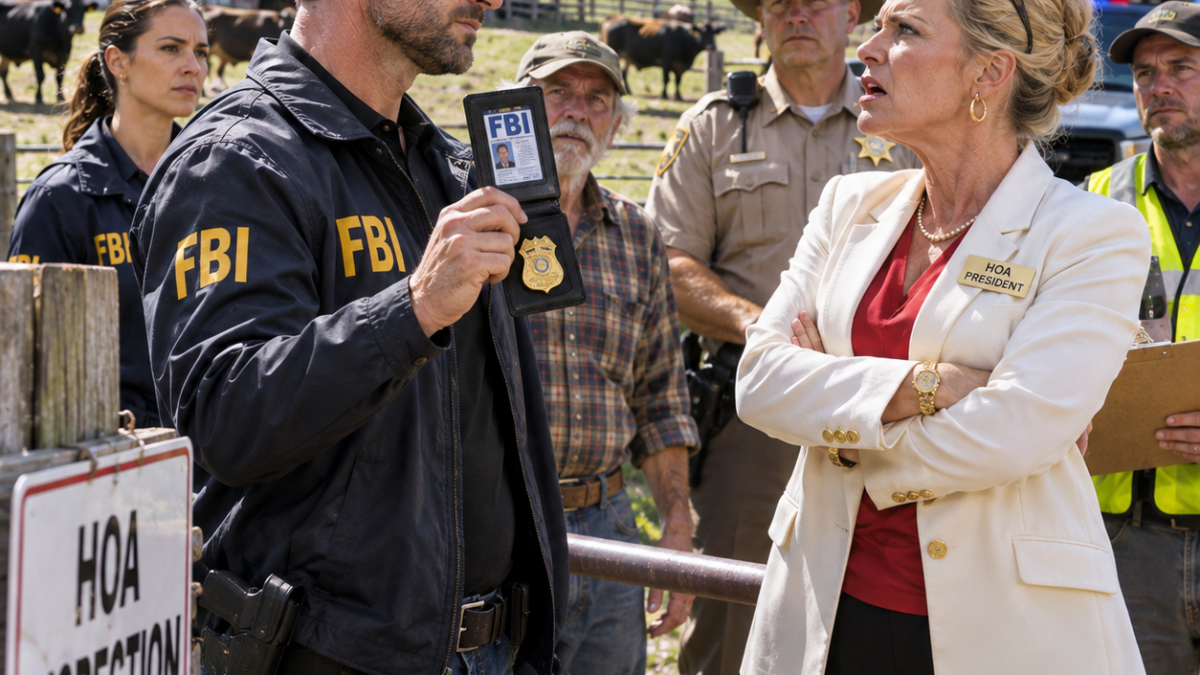
I pulled out the black leather credential wallet.
Opened it.
Gold shield.
Identification.
The wind moved across the pasture.
A crow called from the barn roof.
Otherwise, nothing.
Brooke stared.
Her mouth opened.
Closed.
Her eyes moved from the badge to my face.
I held it steady.
“Special Agent Reed Calloway.”
I let the words settle.
“Federal Bureau of Investigation.”
Her skin lost color.
I added:
“Financial Crimes.”
That was the moment she recognized the name.
Not the badge.
The name.
Her eyes changed completely.
“Calloway.”
“Yes.”
She whispered, “You’re…”
“The agent listed on the subpoena your office received two weeks ago?”
Silence.
Hal dropped the bolt cutters.
They hit gravel with a heavy metallic sound.
Brooke recovered faster than most people would.
“This is entrapment.”
“No.”
“You set me up.”
“You came to my farm.”
“You concealed your identity.”
“You never asked.”
“This is harassment.”
“No.”
“My husband knows the county commission.”
“Congratulations.”
“I know Sheriff Pruitt.”
“Good.”
She pulled out her phone.
“I called him before I came.”
As if summoned by arrogance itself, tires sounded at the road.
County cruiser.
Brooke’s face brightened.
“You’re finished.”
Sheriff Dale Pruitt stepped out.
Sixty-one.
Broad shoulders.
Tan uniform.
He walked up the drive.
Brooke pointed at me.
“Dale, arrest him.”
Dale looked at me.
Then the badge in my hand.
Then at Brooke.
“Ma’am.”
Her smile returned.
“He threatened me.”
Dale removed his hat.
“Step away from the gate.”
She stared.
“What?”
“Step away.”
“Dale.”
“He’s federal.”
“I know that now.”
“You told me you had an armed landowner refusing lawful inspection.”
“He is armed.”
Dale looked at me.
“You armed?”
“Yes.”
“Threaten her?”
“No.”
He nodded.
“Okay.”
Brooke almost exploded.
“That’s it?”
“No.”
Dale looked at the cut chain.
Because while she argued, Brooke had managed one bite with the cutters before I stopped her.
Metal damaged.
Not severed.
He looked at Hal.
“Who brought those?”
Hal pointed at Brooke.
“She did.”
Brooke spun.
“You coward.”
Then gravel began rumbling beyond the curve.
One SUV.
Then another.
Then another.
Dark.
Unmarked.
Doors opened.
Agents stepped out wearing navy FBI windbreakers.
Maya Aconquo walked at the front.
Five foot seven.
Dark hair.
Folder in her hand.
Expression completely neutral.
Brooke stared at her.
“No.”
Maya stopped.
“Brooke Aldridge?”
Brooke said nothing.
Maya opened the folder.
“Federal search warrant authorized by the United States District Court for the Western District of Missouri.”
She looked at Brooke.
“This warrant covers the Willow Bend Estates HOA office, associated financial records, the Willow Bend Compliance Fund, electronic devices identified in the affidavit, and related business records.”
Brooke’s knees softened.
She caught herself against the gate.
Maya continued.
“You are not required to answer questions.”
Brooke pointed at me.
“He orchestrated this.”
Maya looked at me.
“He’s a cooperating witness on this part of the investigation.”
That stung my professional pride.
Exactly as it should.
Brooke looked toward the road.
Maybe considering leaving.
Dale moved slightly.
Not blocking.
Watching.
Maya said, “Mrs. Aldridge, we also have agents executing the search warrant at the HOA office right now.”
Her face collapsed.
Hal whispered, “Oh God.”
Then Brooke did something astonishing.
She tried to negotiate.
“Agent.”
Maya waited.
“This is being misunderstood.”
“Okay.”
“The compliance fund is legitimate.”
“Okay.”
“The farmers are covered by a historic covenant.”
“Okay.”
“I have documents.”
“Excellent.”
Maya gave the smallest smile.
“We’d love those.”
Brooke stopped.
Because innocent people often believe documents save them.
Guilty people understand documents can do the opposite.
Two agents moved toward her SUV under warrant authority.
Brooke’s voice rose.
“You cannot search my personal vehicle.”
Maya held up the warrant.
“Actually, we can search the vehicle specifically identified in Attachment B.”
Brooke looked toward me again.
“You knew.”
“Yes.”
“How long?”
“Long enough.”
Then Maya took out a small recorder.
“You also might want to hear something.”
She pressed play.
Brooke’s voice.
Clear.
From ten minutes earlier.
“Cash is preferred.”
Then:
“Walt Hanley paid cash.”
Then:
“Pay today and you keep your cattle.”
Then:
“People like you inherit property and think nobody can touch it.”
Then the one that made Hal close his eyes.
“Eventually somebody sensible buys it.”
Maya stopped playback.
Brooke stared at the recorder.
That was the first moment she truly understood.
This was not an argument anymore.
Her words existed outside her control.
Two hours later, I stood outside the Willow Bend clubhouse while agents carried out boxes.
The search turned up more than we expected.
Laminating machine.
Blank violation forms.
County-record templates.
A forged notary stamp.
A copied county seal.
And a binder labeled:
AGRICULTURAL DISTRICT ENFORCEMENT.
Inside were nineteen farm names.
Mine.
Walt’s.
Mary’s.
Ben’s.
Luis’s.
Others.
Next to each:
Assessed compliance amount.
Payment.
Resistance level.
Property value.
Mortgage balance.
Family status.
Age.
Potential acquisition price.
Walt was listed:
WIDOWER — HIGH LIKELIHOOD OF SETTLEMENT.
I had to leave the room.
I went outside.
Walked around the building.
Put both hands on my truck.
Maya followed.
“You okay?”
“No.”
“Good.”
I looked at her.
“Why do you always say that?”
“Because people who say they’re okay after seeing something like that worry me.”
I stared across the parking lot.
“They profiled him.”
“Yes.”
“His wife died.”
“Yes.”
“They used it.”
“Yes.”
I hit the truck once with my palm.
Maya waited.
Then said:
“Don’t make him a victim twice by deciding he can’t handle knowing.”
I looked at her.
She always knew where to put the knife.
Not cruelly.
Precisely.
“What else?”
She handed me a photographed ledger page.
Total collections:
$312,450.
Nineteen farms.
Some paid once.
Some repeatedly.
Three had sold.
Two were in foreclosure after taking loans to pay fake compliance obligations.
One elderly couple had borrowed from their daughter.
Then came the development contracts.
Prairie Gate Development.
Trent Maddox.
Draft purchase agreements.
Maps.
Projected acquisitions.
Correspondence.
Brooke was not merely extorting money.
She was softening land.
Creating false debt.
Generating fear.
Identifying owners vulnerable to sale.
Then Prairie Gate approached.
Maya showed me an email.
BROOKE:
VANCE IS CLOSE. HIT HIM AGAIN WITH THE BARN PENALTY AND HE’LL SELL.
TRENT:
NEED HIM UNDER 420.
BROOKE:
HE THINKS HE OWES 18K. GIVE IT TWO WEEKS.
Another.
TRENT:
CALLAWAY?
BROOKE:
NEW OWNER. PROBABLY EASY.
I laughed when I read it.
Maya raised an eyebrow.
“Easy?”
“Apparently.”
“Should I put that on your retirement plaque?”
“Please don’t.”
Trent Maddox was arrested that evening.
Not because Brooke blamed him.
Because evidence did.
Agents went to his office.
Glass building.
Top floor.
Silver cufflinks.
He reportedly asked whether he could finish a call.
They said no.
His attorney arrived quickly.
The case took more than a year.
That matters.
People like neat endings.
Badge.
Handcuffs.
Money returned.
But federal cases move on paper.
Bank subpoenas.
Electronic records.
Expert analysis.
Victim interviews.
Grand jury.
Motions.
Plea negotiations.
Restitution calculations.
The glamorous part lasted approximately twenty minutes on my farm.
The real work took thousands of hours.
Because I was both an agent in the broader investigation and a victim/witness regarding my property, I was walled off from major portions after Brooke’s inspection.
I hated that.
Necessary.
I testified.
Turned over recordings.
Then other agents handled decisions.
That protected the case.
It also protected me from believing personal anger was the same thing as professional judgment.
Brooke’s attorneys attacked the recording.
Legal.
They attacked the warrant.
Valid.
They challenged jurisdiction.
Failed.
They argued the covenant had been drafted in good faith.
Then prosecutors produced the notary stamp.
The notary supposedly signing several documents had been dead six years.
That was difficult to explain.
Brooke eventually pleaded guilty to federal fraud and conspiracy-related charges.
Trent did too after his accountant cooperated.
Restitution orders exceeded three hundred thousand dollars.
Additional civil settlements followed.
Some money came back quickly.
Some took longer.
Not every dollar magically appeared.
That is another thing stories simplify.
Stolen money gets spent.
Moved.
Hidden.
Taxed.
Converted.
Recovered funds took time.
But eventually Walt received his $6,200.
I drove the check to his farm.
He stood on the porch wearing his straw hat.
“What’s that?”
“Government envelope.”
“Usually bad.”
“Today’s different.”
He opened it.
Stared.
Then sat down.
For almost a minute, he said nothing.
I sat beside him.
Finally:
“Reed.”
“Yeah?”
“They gave it back.”
“Most of it.”
He looked at me.
“All of it.”
I nodded.
Walt started crying.
Quietly.
I looked away because he deserved privacy even while I sat beside him.
Then he grabbed me.
Seventy-seven-year-old cattle farmer.
Arms like fence posts.
He hugged hard enough to hurt.
“Thank you.”
I shook my head.
“You talked.”
“What?”
“You told me.”
He released me.
“I almost didn’t.”
“I know.”
“I was embarrassed.”
“There it is.”
He looked confused.
“That’s what they count on.”
“What?”
“Silence after shame.”
Walt looked at the check.
Then said, “I’m not ashamed anymore.”
Good.
The federal court invalidated every fraudulent lien notice and covenant claim connected to the scheme.
County records issued warnings.
The real Willow Bend HOA went through its own crisis.
Most board members claimed they did not understand what Brooke had been doing.
Some genuinely didn’t.
One did.
Its treasurer had questioned irregular accounts twice and then stopped after Brooke threatened to remove him.
He cooperated.
The entire board resigned.
New management came in.
Every external property claim had to be independently verified.
No enforcement against nonmember landowners.
No cash compliance funds.
No separate president-controlled accounts.
Obvious rules.
Apparently necessary.
Hal Dutton became an important witness.
He came to my farm two weeks after Brooke’s arrest.
No measuring wheel.
No clipboard.
Just himself.
I met him at the gate.
He stood there awkwardly.
“I’m sorry.”
“For?”
“The chain.”
“You didn’t cut it.”
“I brought the cutters.”
“True.”
“I should’ve quit before that day.”
“Why didn’t you?”
He looked at the pasture.
“Needed the job.”
I waited.
He continued.
“My wife has MS.”
There it was.
Again.
Not excuse.
Context.
“Brooke knew.”
I nodded.
“She always knew where to push.”
Hal looked at me.
“I measured farms.”
“How many?”
“Fourteen.”
“Did you know the covenant was fake?”
“Not at first.”
“When did you suspect?”
“After Walt.”
I felt anger.
Hal saw it.
“I know.”
“Why did you keep going?”
He swallowed.
“Cowardice.”
That honesty stopped me.
Most people say pressure.
Confusion.
Orders.
He said cowardice.
“I kept telling myself I wasn’t taking the money.”
He continued.
“I wasn’t writing the notices.”
“I was just measuring.”
He looked down.
“That’s how I slept.”
I said, “Did you tell investigators everything?”
“Yes.”
“Then keep doing that.”
He nodded.
“I don’t expect forgiveness.”
“Good.”
He almost smiled.
“That bad?”
“Forgiveness is expensive.”
“I deserve that.”
“Probably.”
Hal later testified.
He helped identify every farm Brooke visited.
His cooperation reduced his legal exposure.
He never worked HOA compliance again.
He became a dispatcher for an agricultural supply company.
Walt still dislikes him.
That is allowed.
Not every story requires reconciliation.
My farm eventually became quiet again.
Mostly.
I replaced the damaged lock.
Added better cameras.
Not because I expected another Brooke.
Because twenty years in law enforcement ruins your ability to believe locks are symbolic.
The laminated notice hangs inside the barn now.
Framed.
Under it I put a little brass plate:
ALWAYS CHECK THE PAPERWORK.
Maya saw it.
“You framed evidence?”
“Copy.”
“Still weird.”
“Art is subjective.”
“You’re becoming a farmer.”
“I resent that.”
The cattle do not care about federal cases.
That is one reason I like them.
Morning feed.
Water.
Fence.
Calves.
Vet.
Weather.
Nothing about fraud changes what a cow needs at 6:00 a.m.
The simplicity became therapeutic.
After Brooke’s case, I started volunteering once a month with a rural elder financial-protection group.
Not as FBI.
Just Reed.
We helped older landowners review suspicious notices.
Fake tax liens.
Roofing scams.
Land-purchase pressure.
Predatory contracts.
I saw Brooke’s pattern everywhere in smaller forms.
A document arrives.
Looks official.
Deadline short.
Threat severe.
Pay immediately.
Do not ask anyone.
Do not call county offices.
Do not consult family.
Urgency is one of fraud’s favorite tools.
One afternoon, an eighty-four-year-old man handed me a notice claiming he owed $9,700 for “watershed compliance.”
Fake.
He said, “I almost paid.”
“Why?”
“It had a seal.”
That sentence stayed with me.
It had a seal.
Paper can frighten people because official-looking design borrows authority from institutions it does not belong to.
So I started giving the same advice.
Slow down.
Check the county record.
Call the agency using a number you find independently.
Ask for the case number.
Ask who signed.
Ask who notarized.
Never pay cash because somebody threatens immediate seizure.
And if they get angry because you verify?
Verify harder.
Walt became good at giving that speech too.
He joined me at community meetings.
At first he refused.
“I’m not standing in front of people telling them I got fooled.”
“That’s exactly why you should.”
“No.”
“Why?”
“Because I got fooled.”
“Walt.”
He looked at me.
“If you tell them, the shame belongs to Brooke.”
That convinced him.
His first talk lasted four minutes.
He stood at the front of a church hall.
Straw hat in both hands.
Thirty farmers listening.
He said:
“My name’s Walt Hanley.”
“I paid a woman sixty-two hundred dollars because she scared me.”
Silence.
“I thought that made me stupid.”
He looked toward me.
“It didn’t.”
Then he told them everything.
Afterward, three people stayed behind.
One had received a suspicious land-assessment notice.
One had paid a fake drainage fee.
One had been approached by an investment buyer using pressure tactics.
Walt drove home quiet.
Then said:
“Maybe getting fooled once is worth something if you stop the next one.”
I said, “Careful.”
“What?”
“You sound wise.”
“Shut up.”
I laughed.
Two years later, I attended Brooke’s restitution hearing.
I did not need to.
I wanted to.
She looked different.
No white blazer.
No gold hoops.
Plain navy suit.
Hair shorter.
When Walt’s name was read among the victims, she looked down.
I wondered whether she felt shame.
Maybe.
I stopped needing to know.
One of the hardest lessons in law enforcement is that justice cannot depend on an offender emotionally understanding what they did.
Courts can impose consequences.
They cannot manufacture conscience.
After the hearing, Brooke’s attorney approached.
“She would like to apologize.”
I stared at him.
“To me?”
“Yes.”
“Why?”
“She’s trying to make amends.”
I looked across the hall.
Brooke stood near a wall.
Hands clasped.
Older.
Smaller.
I thought about Walt.
Mary.
Ben.
Nineteen farms.
Then said:
“She can write.”
The letter arrived three weeks later.
I read it once.
Brooke wrote that she had convinced herself she was helping “modernize” rural property.
That developers brought tax revenue.
That farmers were “underutilizing valuable land.”
That the compliance money began as a way to force negotiations.
Then became personal income.
Then grew.
She wrote:
I kept telling myself the farmers could afford it because they owned land.
I did not think about the difference between owning something valuable and having cash.
That line was the first thing in her letter that felt honest.
Then:
I also convinced myself that if people paid, that meant the rules were valid.
There it was.
Compliance mistaken for legitimacy.
I did not respond.
I gave Walt a copy of the portion mentioning victims.
He read it.
Then asked:
“You forgive her?”
“No.”
“Ever?”
“Maybe.”
He nodded.
“Me neither.”
We sat quietly.
Then he said, “I’m not mad every day anymore.”
That is a kind of freedom.
Maybe better than forgiveness.
Prairie Gate’s development plan collapsed.
Parts of the land were eventually sold to smaller buyers.
Some stayed agricultural.
One parcel became a county conservation area.
My farm stayed mine.
No fake covenant.
No HOA.
No developer road.
I did sell ten acres.
That surprises people.
Three years after the case, a young couple named Jared and Melissa Boone approached me.
Not developers.
They wanted land for a small veterinary practice and house.
They asked.
Presented plans.
Offered fair market value.
Gave me three months to decide.
No threats.
No fake deadlines.
I sold.
Walt nearly had a heart attack.
“You fought a federal case to keep your land and then sold ten acres?”
“Yes.”
“You make no sense.”
I looked at him.
“It was my choice.”
He stopped.
Then nodded.
“That’s the point.”
Exactly.
The crime was never that someone wanted the land.
People buy land.
Sell land.
Develop land.
That is ordinary.
The crime was trying to make my no meaningless.
Brooke used false authority.
Trent used financial pressure.
Together they manufactured distress until owners became cheaper.
That was the scheme.
Not acquisition.
Coercion.
My grandfather understood that in simpler language.
He once told me:
“If somebody asks for your fence post, you can give it to them.”
“If they take it while you’re asleep, that’s different.”
I was twelve.
We were fixing cattle wire.
I thought he was talking about fence posts.
Maybe he was.
Good principles survive translation.
I retired from the Bureau five years after Brooke’s arrest.
Twenty-five years total.
At my retirement dinner, Maya spoke.
That was a mistake.
She told stories I had specifically asked her not to tell.
Including the time I fell into a drainage ditch while surveilling a mortgage fraud suspect.
“You left out that it was dark.”
“It was noon.”
“Cloudy.”
People laughed.
Then she became serious.
“The Reed Calloway most of you know is the guy who never trusts a document until he sees the document behind it.”
More laughter.
She looked at me.
“That got worse after a woman zip-tied an HOA notice to his gate.”
I shook my head.
Maya continued.
“But the thing I remember is that Reed did not arrest her.”
People quieted.
“He wanted to.”
I mouthed, absolutely.
“He had every emotional reason.”
She continued.
“But he let the case become a case.”
“He followed procedure.”
“He allowed other agents to lead once his personal property became part of the evidence.”
“He accepted that being right did not give him the right to control the outcome.”
Maya looked toward younger agents.
“That is harder than kicking a door.”
I had not expected that.
She raised her glass.
“To paperwork.”
Everyone groaned.
I laughed.
After retirement, I farmed full time.
Forty cattle became fifty-two.
Then forty-six because drought taught me humility.
The barn got a new roof.
The tractor finally died.
Walt said I murdered it through neglect.
I said it had been attempting suicide for twenty years.
Hal occasionally delivers feed.
We are not friends exactly.
But we nod.
That is enough.
One spring morning, a white SUV came up my driveway.
For half a second my body remembered Brooke.
Then a young woman stepped out.
Clipboard.
I almost laughed.
She wore county identification.
“Mr. Calloway?”
“Yes.”
“Annual agricultural land-use survey.”
“Do you have paperwork?”
Her face went nervous.
“Yes.”
She produced everything.
County ID.
Form.
Contact number.
Authorization letter.
I read it carefully.
She watched.
Finally:
“Everything okay?”
“Perfect.”
She smiled.
“You really check.”
“Always.”
That word has become a joke around Ridgeway County.
Always check.
Farmers say it when opening mail.
Walt says it before buying equipment.
Maya writes it on birthday cards.
But underneath the joke is something serious.
Brooke succeeded because people assumed official-looking documents had already been checked by somebody smarter.
They had not.
The county had not approved the covenant.
The sheriff had not authorized seizure.
The HOA did not control the farms.
The notary was dead.
The compliance account was personal.
Every piece fell apart when one person asked a basic question.
Where is it recorded?
That is often how fraud dies.
Not with genius.
Verification.
The framed notice in my barn is fading now.
Sunlight gets through one window in the afternoon.
The letters have turned slightly yellow.
UNAPPROVED LIVESTOCK.
I sometimes stand there with visitors.
They laugh.
“An HOA fined you for cows?”
“Yes.”
“On a 120-acre farm?”
“Yes.”
“A mile away?”
“Yes.”
Then they ask the obvious question.
“How did she think she’d get away with that?”
Because she had before.
That is the answer people do not like.
Brooke was not stupid.
She was experienced.
She had tested the method.
Older farmer.
Official notice.
Large fine.
Short deadline.
Threat.
Cash option.
Some paid.
Each successful payment taught her the scheme worked.
Walt’s $6,200 was not just money.
It was positive reinforcement.
So was Mary’s.
Ben’s.
Every quiet payment built Brooke’s confidence.
By the time she reached my gate, she was not improvising.
She was executing a process.
That is why her white blazer mattered less than it seemed.
The real costume was authority.
Clipboard.
Laminated notice.
Legal language.
Confidence.
She gave people a familiar shape and let fear fill in the legitimacy.
It worked.
Until the shape met someone who knew what authority actually looked like on paper.
I sometimes wonder what would have happened if I had not been FBI.
The answer matters.
Because the lesson cannot be:
Hope the scammer picks a federal agent.
Walt was not FBI.
Mary was not.
Ben was not.
They deserved protection anyway.
The case eventually worked because victims talked.
Because receipts existed.
Because county records contradicted Brooke.
Because banks kept transactions.
Because Hal cooperated.
Because Maya built probable cause properly.
My badge created a dramatic moment.
It did not create the truth.
That distinction matters.
If Brooke had walked onto the farm of a retired teacher instead of mine, the covenant would still have been fake.
If she threatened a mechanic, still fake.
If she threatened somebody too poor to hire a lawyer, still fake.
Rights are not stronger because the person holding them has a badge.
That became something I repeated during retirement workshops.
One man asked:
“But Agent Calloway, what if we don’t know anybody in law enforcement?”
“You don’t need to.”
“What do we do?”
“Call the county clerk.”
“Then?”
“Attorney if you can.”
“And if you can’t?”
“Legal aid.”
“Sheriff if there’s trespass.”
“State consumer protection.”
“Federal agencies if the facts fit.”
I looked around the room.
“Most important?”
They waited.
“Tell somebody.”
Silence protects schemes.
Brooke’s nineteen victims thought each case was separate.
The moment we put them on one map, the crime became visible.
That is why fraudsters isolate.
Your situation is unique.
Don’t embarrass yourself.
Nobody else is complaining.
Pay quietly.
Resolve it.
Move on.
Walt believed he was the only one.
So did Mary.
So did Ben.
Brooke knew they did not talk.
Farms can be lonely places.
That helped her.
After the case, those same farmers started meeting monthly at a diner.
They called it the Fence Line Breakfast.
Not my name.
Walt’s.
They talked taxes.
Cattle.
Weather.
Suspicious letters.
One morning a farmer brought in a “mandatory agricultural cybersecurity assessment” invoice for $1,200.
Everyone laughed.
Fake.
Another time, someone caught a legitimate county notice and almost ignored it because they had become suspicious of everything.
That was a useful correction too.
Verification does not mean cynicism.
Some paperwork is real.
You check so you can know the difference.
When Walt turned eighty, we held his birthday in my barn.
Fifty people.
Cattle outside.
Long tables.
Maya came.
Dale Pruitt came.
Even Hal stood near the door.
Walt’s granddaughter gave a speech.
Then she handed him a framed copy of the returned $6,200 check.
Void, obviously.
Walt stared.
“You people are strange.”
She said, “Grandpa, this is when you stopped hiding.”
He became quiet.
Then hugged her.
Later, he sat beside me.
“I used to think the worst thing Brooke stole was the money.”
“What was?”
“Confidence.”
He looked toward the party.
“I felt stupid every time I drove past that HOA office.”
I nodded.
“Then when the check came back…”
He smiled.
“Wasn’t really about the money.”
I knew.
Restitution matters.
But sometimes the bigger restoration is internal.
You stop seeing yourself through the criminal’s eyes.
Brooke needed victims to believe they were unsophisticated.
Difficult.
Old.
Alone.
She called me a farmer playing cowboy.
She meant it as contempt.
Funny thing is, she was right about one part.
I am a farmer now.
Proudly.
No federal jacket.
No badge in my pocket most days.
Just boots.
Fence pliers.
Feed.
Mud.
If she walked up my driveway today and looked only at clothes, she might make the same mistake.
That is another lesson.
Competence does not dress consistently.
Neither does vulnerability.
The farmer in front of you may be federal.
The widow may have perfect records.
The quiet compliance inspector may eventually testify.
The frightened neighbor may become the witness who breaks the case.
You never know.
So maybe the safest policy is simpler.
Do not exploit people.
Hard to go wrong.
The last time I visited the FBI field office, Maya had become supervisor.
Her office was too clean.
I told her that.
“You’re retired.”
“I can still criticize.”
She handed me coffee.
On her wall hung a small photograph.
Brooke standing at my farm gate.
Taken by one of the surveillance cameras.
White blazer.
Clipboard.
Bolt cutters in the dirt.
My badge visible between us.
I stared.
“You framed it?”
“Copy.”
“That’s weird.”
“Art is subjective.”
I laughed.
“Thief.”
Maya looked at the photo.
“You know what I like about it?”
“What?”
“Your cattle.”
I looked.
Behind Brooke, three Angus stood near the fence.
Watching.
“What about them?”
“They look unimpressed.”
“They were.”
Maya smiled.
Then said:
“That whole case came down to one thing.”
“Money?”
“No.”
“Records?”
“No.”
“What?”
“She expected fear.”
I waited.
Maya continued.
“And you gave her questions.”
That may be the simplest version.
Brooke’s power worked when people skipped questions.
Who says I owe this?
Where is it recorded?
What court issued that lien?
What statute lets you seize cattle?
Who notarized this?
Why is the check payable to a separate fund?
Why cash?
Why does the developer show up after the fine?
Fraud hates questions because questions force claims to touch reality.
That morning on my farm, Brooke had answers for everything until I asked for details.
County business.
Internal process.
Don’t ask.
Pay now.
Those are not answers.
They are smoke.
Then came the badge.
Everyone remembers the badge.
I understand why.
Good visual.
Gold shield in sunlight.
White blazer.
Silence.
But the badge was not what ended Brooke Aldridge.
The evidence had already done that.
Walt’s receipt.
Bank records.
The fake covenant.
The dead notary.
The payment ledger.
The developer emails.
The camera footage.
Hal’s testimony.
My microphone.
The badge only told Brooke one thing.
The man standing in front of her understood exactly how much trouble she was already in.
That was why she went silent.
Not because FBI letters are magical.
Because for the first time, she knew someone had checked the paperwork.
Today the farm is quiet again.
Morning wind across pasture.
Forty-some cattle.
Barn swallows.
Creek water.
The kind of quiet I wanted when I moved there.
Walt still comes by.
Less often.
His knees hurt.
He complains that my coffee is weak.
I tell him his taste buds died in the Carter administration.
He threatens to leave.
Never does.
Sometimes we stand at the gate where Brooke tried to cut the lock.
The chain is newer.
The post stronger.
I keep one camera there.
Mostly deer.
Coyotes.
Delivery drivers.
Once, Maya drove up and waved directly into the lens.
Message arrived five seconds later:
AM I IN VIOLATION?
I replied:
$4,800.
She sent back:
CASH PREFERRED?
I laughed for ten minutes.
Humor returns when fear leaves.
That is another kind of restitution.
The laminated notice still hangs inside my barn.
Visitors ask why I did not throw it away.
Because memory is useful when it does not own you.
The notice no longer makes me angry.
It reminds me.
A document can be fake.
A threat can be empty.
Authority can be invented.
Confidence can be counterfeit.
And sometimes the person trying hardest to stop you from checking is the person whose paperwork needs checking most.
Brooke marched onto my farm believing fear would do the work for her.
She had used it nineteen times.
She thought the twentieth would be the same.
She believed the old pattern would hold.
Clipboard.
Threat.
Deadline.
Cash.
Silence.
But that morning, standing beside my cattle with her fake covenant in one hand and bolt cutters in the other, Brooke finally met the one thing her scheme had been designed to avoid.
Verification.
I asked her to show me the covenant.
She gave me one page.
I asked who recorded it.
She gave me vague words.
I asked who notarized it.
She threatened me.
I asked why the money went into a separate fund.
She told me not to ask questions.
Then she tried to cut my lock.
That was when the conversation ended.
I reached into my jacket.
Brooke expected fear.
Maybe a phone.
Maybe a wallet.
Maybe nothing.
Instead I opened the black leather credentials I had carried for two decades.
Her eyes dropped to the badge.
Then to my name.
And in that exact second, she understood something every fraud investigator eventually teaches someone.
The most dangerous victim is not the richest.
Not the strongest.
Not even the most powerful.
It is the one who stops being afraid long enough to ask for proof.
Brooke Aldridge built an entire scheme around people being too frightened to check.
Walt taught me how much that fear can cost.
Nineteen families taught me how quickly isolation can become a criminal’s best protection.
And that framed laminated notice in my barn reminds me of the simplest rule I learned in twenty-five years carrying a federal badge.
When someone tells you the paperwork gives them power over your home, your land, your money, or your life, do not be impressed by the seal.
Do not be intimidated by the clipboard.
Do not let a deadline make you surrender your judgment.
Ask where it was filed.
Ask who signed it.
Ask who benefits.
Then check.
Always check.


