HOA Karen Hijacked My Yacht for Her Daughter’s Wedding—Then the Coast Guard Arrived Before the Toast
PART3:
Blood tests.
Scans.
Waiting rooms.
Insurance calls.
The strange language sick people and their spouses learn without ever wanting to.
After one brutal year, she went into remission.
The first thing she said when the oncologist used the phrase “no evidence of disease” was:
“We’re buying the boat.”
I laughed.
She didn’t.
So we did.
A fifty-eight-foot motor yacht.
White hull.
Blue canvas.
Twin diesels.
Nothing flashy by Harbor Point standards.
But ours.
We spent almost a year restoring her.
Grace chose the interior wood.
I handled mechanical work.
She insisted on one chair near the stern where she could read without hearing me complain about engine temperatures.
Then she painted the name herself on a piece of cardboard before we ordered the lettering.
SECOND WIND.
“Too obvious?” she asked.
“Extremely.”
“Perfect.”
We launched her that spring.
Grace survived eleven more Sundays.
That is the number I remember.
Eleven.
Some were full days.
Some only an hour.
Near the end, I would help her aboard.
She would sit in that chair wrapped in a blanket.
We would motor past the inlet.
Sometimes not even that far.
She never complained.
After she died, I transferred ownership of the vessel into the Grace Whitaker Memorial Trust.
Part estate planning.
Part emotion.
Maybe more emotion than law.
The trust owned Second Wind.
I served as trustee and operator.
I maintained her.
Insured her.
Took her out occasionally.
But Sundays remained Grace’s.
Even after she was gone.
Harbor Point was the kind of Florida waterfront community people put on postcards.
Palm trees.
Private slips.
White stucco homes.
Perfect hedges.
Security gates.
Golf carts.
Marina.
Clubhouse.
And an HOA president named Patricia Langford who had slowly convinced herself that managing common property meant supervising every object visible from it.
Patricia was in her late fifties.
Always polished.
Always smiling until someone said no.
She had been president for four years.
At first, she seemed merely controlling.
Boat covers.
Dock boxes.
Patio umbrellas.
Outdoor lighting.
Parking.
Then she became something else.
Every decision turned into proof of loyalty.
Support the board.
Support the community.
Support Patricia.
If you disagreed, you were “creating division.”
I stayed out of most of it.
I had spent enough of my career inside command structures to know the difference between legitimate authority and a person who enjoyed giving orders.
Then one morning I found a note clipped to my dock gate.
ELLIS — PLEASE SEE ME AT CLUBHOUSE. URGENT COMMUNITY MATTER. — P. LANGFORD
I went.
Patricia sat inside the conference room.
Coffee.
Tablet.
Smiling.
That smile should have warned me.
“My daughter Madison is getting married.”
“Congratulations.”
“Next month.”
“Good.”
She leaned forward.
“We want something special.”
I waited.
She smiled wider.
“Second Wind.”
I actually thought she meant a photograph.
“What about her?”
“The wedding.”
I stared.
“You want to take pictures on the dock?”
“No.”
“The ceremony.”
“Reception too, ideally.”
“On my boat?”
“Yes.”
I laughed once.
She did not.
“Patricia.”
“It would be one day.”
“No.”
“You haven’t heard the plan.”
“I don’t need the plan.”
Her smile changed.
Slightly.
“Ellis, Madison grew up in Harbor Point.”
“I know.”
“This community has watched her become a wonderful young woman.”
“I’m sure.”
“This would mean a lot.”
“I’m not insured to run wedding events.”
“We can get event insurance.”
“No.”
“We would hire staff.”
“No.”
“It’s just sitting there most Sundays.”
That sentence did it.
Second Wind was not sitting there.
She was not unused space.
“She isn’t available.”
Patricia leaned back.
“Everything in Harbor Point exists within a community.”
“My boat does not.”
“She occupies a Harbor Point slip.”
“I pay for that slip.”
“We manage the marina.”
“You manage the marina.”
“You do not own vessels inside it.”
She gave a short laugh.
“This doesn’t need to become adversarial.”
“It isn’t.”
“I’m saying no.”
Then she reached into a folder.
Pulled out a check.
Five thousand dollars.
Placed it on the table.
“Name your price.”
I looked at the check.
Then her.
“Some things aren’t for sale.”
Her smile disappeared.
That was the moment this stopped being about a wedding.
Three days later, my first violation arrived.
UNAPPROVED VESSEL MODIFICATION.
No explanation.
I requested clarification.
They cited a replacement antenna mount I had installed eight months earlier.
Previously inspected.
Previously ignored.
Second notice:
IMPROPER DOCK LIGHTING.
Third:
POTENTIAL COMMERCIAL USE OF PRIVATE SLIP.
That one almost made me laugh.
The woman trying to turn my yacht into a wedding venue was accusing me of commercial use.
Fines came weekly.
I documented all of them.
Dates.
Amounts.
Photos.
Responses.
Old Coast Guard habit.
If something becomes strange, start a log.
At the next board meeting, Patricia gave a speech about “members who refuse to support important community traditions.”
She never said my name.
She did not need to.
Everyone looked at me.
I stayed seated.
Anger makes people careless.
Carelessness makes good evidence harder to use.
Then my phone rang two days later.
Chief Bill Harrington had died.
Bill and I served together twelve years.
Norfolk.
Charleston.
Two different cutters.
A hurricane response that nearly killed both of us.
He had been the kind of man who could fix a pump with safety wire and profanity.
I flew to Virginia for the memorial.
Five days.
Before leaving, I locked Second Wind.
Checked the onboard cameras.
Cabin sensors.
Dock camera.
Motion alerts.
After a burglary the year before, I had upgraded everything.
I also told Hank Mercer, Harbor Point’s dock manager:
“Keep an eye on her.”
He nodded.
“Always do.”
I trusted Hank.
That was my mistake.
What I did not know was that Hank owed Harbor Point more than forty-one thousand dollars.
Back marina fees.
Personal loans tied through one of the association’s emergency payment arrangements.
Patricia knew every cent.
Later, Hank told investigators exactly what she said.
“Forty-one thousand.”
Then:
“Gone.”
“All of it.”
“You give me Ellis’s spare key.”
Hank asked what she intended to do.
Patricia told him not to worry.
“Community event.”
“He already said no.”
“He’ll get over it.”
Hank said no again.
Then Patricia threatened his job.
His slip.
Collections.
His debt.
Eventually he gave her the key.
I still believe Hank made a choice.
Pressure does not erase responsibility.
But coercion explains how somebody gets from “I would never” to standing at a lockbox with shaking hands.
Patricia took more than the key.
She found an old HOA form bearing my signature.
Then created a charter agreement.
She copied the signature.
Listed herself as event organizer.
Listed me as vessel owner.
Claimed I had authorized use of Second Wind for Madison’s wedding.
One problem.
I was not the owner.
The Grace Whitaker Memorial Trust was.
I served as trustee.
That distinction would become important.
Patricia invited 142 guests.
Spent roughly $180,000 on the wedding.
Flowers.
Catering.
String quartet.
Five-tier cake.
Champagne.
Décor.
Photography.
Staff.
She also needed someone to operate the vessel.
A legitimate licensed captain taking more than one hundred passengers aboard a private yacht would have asked some obvious questions.
Passenger certification.
Inspection status.
Safety equipment.
Owner authorization.
Patricia found a man less interested in paperwork.
Rusty Bly.
Former charter guide.
He had once held the appropriate credential.
It had expired twenty-six months earlier.
Cash arrangement.
Few questions.
Two days before the wedding, I was standing at Bill Harrington’s memorial reception in Norfolk when my phone vibrated.
SECOND WIND — DOOR SENSOR TRIGGERED
For one second, I thought burglary.
I opened the camera app.
White flowers.
That was the first thing I saw.
Strangers carrying arrangements aboard.
Then cases of champagne.
Then a cake box.
People were hanging white roses above Grace’s chair.
I stopped breathing.
Someone moved across the camera.
Hank.
He unlocked the cabin with my spare key.
I watched him.
On my boat.
Opening Grace’s cabin.
I called.
He answered quickly.
“Ellis.”
“You on the dock?”
“Yeah.”
“Everything okay?”
A pause.
“Just checking your boat.”
His voice shook.
I looked at the live video.
Workers everywhere.
“Thanks, Hank.”
Then I hung up.
I wanted to yell.
I wanted to call Patricia.
I wanted to get on the next plane, walk down that dock, and physically remove every flower myself.
Instead, I made the calls that mattered.
First:
Sheriff’s Marine Unit.
Unauthorized access and use of documented vessel.
I gave them my information.
Vessel documentation.
Marina location.
Camera evidence.
Report number.
Second:
Coast Guard Sector.
I explained:
Private uninspected yacht.
Planned passenger count over one hundred.
Possible unlicensed operator.
No owner authorization.
Potential departure from Harbor Point marina.
Lieutenant Rachel Ortega took the call.
Professional.
Calm.
Exactly what I needed.
“Mr. Whitaker, do not confront anyone aboard.”
“I understand.”
“Do not create a safety issue on the dock.”
“Understood.”
“Send us the vessel particulars, images, planned passenger count, and operator information if you have it.”
I did.
She said:
“If federal passenger-vessel requirements are implicated, we’ll address them.”
No promises.
No drama.
Good enforcement rarely sounds dramatic before it arrives.
I flew back Friday night.
Wedding was Saturday.
My attorney, Nora Bell, met me at an all-night coffee shop.
I put the forged charter agreement in front of her.
She read it.
Then raised one eyebrow.
“Ellis.”
“What?”
“This is terrible.”
“Thank you.”
“No.”
“I mean legally terrible.”
She pointed.
“Owner: Ellis Whitaker.”
“Correct.”
“Except?”
“The Grace Whitaker Memorial Trust owns Second Wind.”
“Exactly.”
She looked at the signature.
“Did you sign this?”
“No.”
“Did you authorize anyone to sign?”
“No.”
“Did the trust charter the vessel?”
“No.”
“Then Patricia has a document authorizing something from a person who legally did not own the vessel individually, carrying a signature you say was copied.”
“Yes.”
Nora leaned back.
“Do nothing stupid tomorrow.”
“I am deeply offended by that advice.”
“I know you.”
She tapped the folder.
“Stand on the dock.”
“Keep your hands visible.”
“Bring your documents.”
“Let everybody else explain themselves.”
That night I sat in my kitchen with Grace’s photograph.
The one from our first Sunday aboard Second Wind.
Blue scarf.
Big sunglasses.
Still thin from treatment.
Grinning like she had stolen the boat.
“I’m sorry,” I told the picture.
I wasn’t sure what for.
Maybe for letting people onto the boat.
Even though I had not.
Grief does that.
Makes responsibility expand beyond reason.
Saturday arrived perfect.
Blue sky.
Light breeze.
Wedding weather.
By noon, Harbor Point looked like a magazine spread.
Black cars.
Valet attendants.
Guests in suits and gowns.
Flowers.
Music.
White chairs.
Second Wind was covered in decorations.
At exactly two, I walked down the dock.
Navy jacket.
Khakis.
Folder under one arm.
No hat.
Hands visible.
People began noticing.
Phones came up.
Whispers.
“Is that him?”
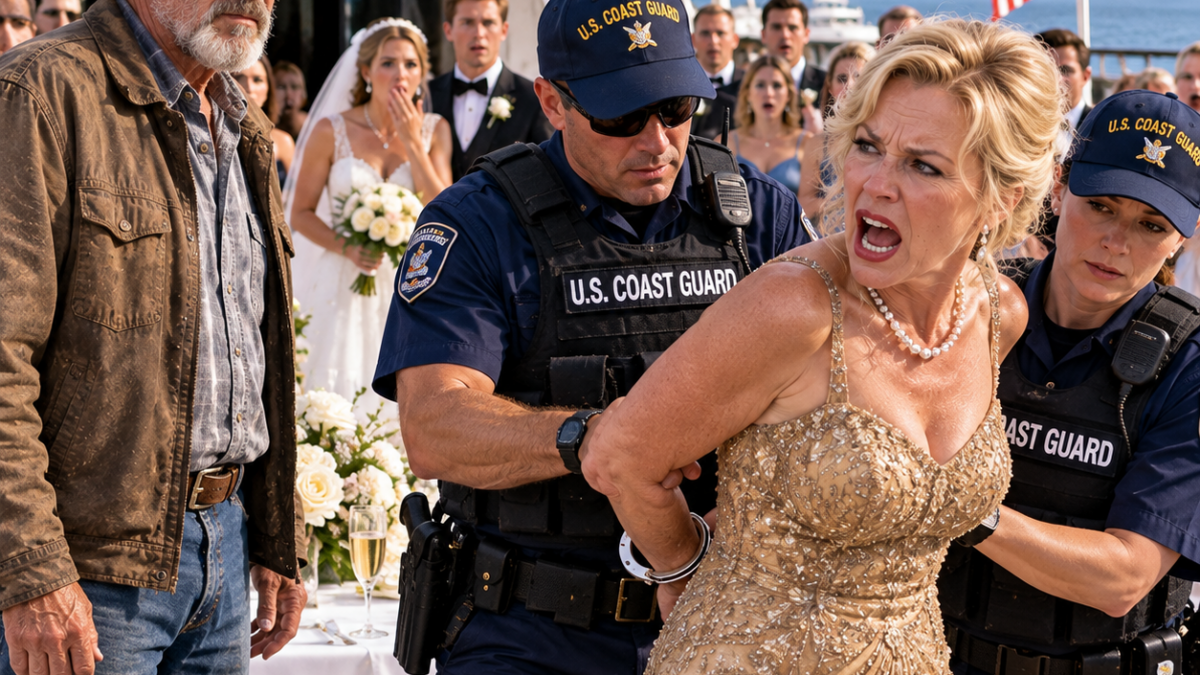
Patricia stood at the gangway in a champagne-gold dress.
For a second, her face froze.
Then the public smile returned.
“Ellis!”
Too bright.
“So glad you could make it.”
I stopped ten feet from her.
“Get everyone off my boat.”
Her smile cracked.
“Excuse me?”
“This event was not authorized.”
She raised the charter agreement.
“Yes, it was.”
“You signed.”
“No.”
She waved the paper.
“Your signature.”
“Show me where I signed it.”
She stared.
Then recovered.
“Don’t do this today.”
“I told you no three weeks ago.”
“You accepted an arrangement.”
“No.”
“You’re ruining my daughter’s wedding.”
“I am trying to stop an unauthorized passenger operation from leaving this dock.”
Guests were recording now.
Hank stood by the marina gate.
Gray.
Sweating.
Could not look at me.
Patricia snapped toward security.
“Remove him.”
Nobody moved.
Then engines started aboard Second Wind.
My stomach dropped.
Rusty.
Bridge.
I walked to the edge of the dock.
Looked up.
“Captain.”
Rusty leaned out.
“Yeah?”
“May I see your Coast Guard credential?”
His face changed instantly.
“What?”
“Your license.”
“I’m busy.”
“So am I.”
The engines dropped to idle.
I said:
“When did your credential expire?”
Patricia stepped toward me.
“This is harassment.”
I ignored her.
“Rusty?”
He did not answer.
I looked at the guests.
Then Patricia.
“You have one hundred forty-two invited passengers.”
“It’s a wedding.”
“This yacht is not certificated to carry that passenger load.”
“Stop trying to scare people.”
“I’m not.”
I pointed at the vessel.
“That is exactly why I told you no.”
Madison appeared on the upper deck.
Wedding gown.
Veil.
Flowers.
She looked down.
First at me.
Then her mother.
Confused.
“Mom?”
Patricia turned.
“Go inside, honey.”
“What’s happening?”
“Nothing.”
I hated that word.
Nothing.
When clearly everything was happening.
Patricia came closer to me.
“You will leave.”
“No.”
“This is my daughter’s wedding.”
“This is Grace’s boat.”
That stopped her.
Only a second.
Then she got louder.
“You cannot stop this wedding.”
At the far end of the dock, three harbor officers appeared.
One of the guests had called.
Patricia saw uniforms and immediately pointed at me.
“Officers!”
“He is trespassing.”
“He is harassing my family.”
“Arrest him.”
Officer Dan Keller approached.
He looked at Patricia.
Then me.
Then the vessel.
“Everybody stay calm.”
I held out the folder.
“My name is Ellis Whitaker.”
“I am trustee and authorized operator for the vessel.”
“This event is unauthorized.”
“Marine report number is inside.”
Keller took the documents.
Vessel documentation.
Trust certificate.
Report.
Identification.
He read.
Patricia thrust the charter at him.
“He signed that.”
Keller compared.
Then looked back at me.
“Your signature?”
“No.”
“Did you authorize it?”
“No.”
He read the owner line.
Then vessel documentation again.
“Ma’am.”
Patricia crossed her arms.
“Yes?”
“This charter identifies Mr. Whitaker individually as vessel owner.”
“He is.”
Keller shook his head.
“The federal documentation identifies a trust.”
“That’s a technicality.”
“It’s a federal record.”
Then we heard engines.
Not Second Wind.
Outside the marina.
A response boat rounded the breakwater.
Coast Guard.
Blue lights.
The string quartet stopped halfway through a song.
Guests turned toward the water.
Some moved toward railings.
I felt no triumph.
Only relief.
Because once 142 people start drinking champagne on an overloaded private yacht with an improperly credentialed operator, pride stops being the main problem.
Lieutenant Rachel Ortega stepped onto the dock with boarding officers.
She recognized me.
Small nod.
Nothing theatrical.
Then:
“Attention aboard Second Wind.”
“The vessel is not authorized to depart pending boarding and safety review.”
Everything went quiet.
Ortega boarded.
Rusty came down from the bridge.
She asked for his credential.
He dug through his wallet.
Found an old card.
Ortega read the date.
“Expired twenty-six months.”
Rusty stared at the deck.
Then she asked for passenger-vessel certification.
None.
Passenger manifest.
Incomplete.
Safety equipment count.
Boarding officers began checking.
Life jackets.
Fourteen readily available.
For a vessel filled with more than one hundred guests.
One officer looked at me.
Then at the crowd.
“If this boat had gotten underway and anything happened…”
He did not finish.
He did not need to.
Fire.
Collision.
Flooding.
Medical emergency.
Evacuation.
Panic.
People think calm water means safe water.
It does not.
A docked boat can become a casualty scene faster than anyone imagines.
Hank finally stepped forward.
Cap in his hands.
“It was me.”
Patricia turned.
“What?”
Hank looked at Officer Keller.
“I gave her the key.”
His voice shook.
“She said she’d erase my debt.”
Patricia’s face changed.
“He’s lying.”
“She threatened my job.”
“Hank.”
“She knew what I owed.”
“Forty-one thousand.”
“I gave her the spare.”
Patricia stepped toward him.
“You stole that key.”
“No.”
He looked at me.
“I’m sorry, Ellis.”
Then back at Keller.
“I have the messages.”
“Everything.”
The dock went silent.
Patricia shouted:
“He is a thief.”
Hank lowered his head.
“Maybe.”
“But I’m not the one who wrote his name.”
He pointed toward the forged charter.
Madison had come down the gangway.
Her veil trailed over the deck.
She was crying now.
Not loudly.
Worse.
Quietly.
“Mom.”
Patricia turned.
“Madison, please.”
“You said Mr. Whitaker gave us the boat.”
“He did.”
“No.”
Madison looked at me.
“Did you?”
I shook my head.
“I told her no.”
Her face collapsed.
“Why?”
“I wasn’t insured for it.”
“It isn’t a passenger vessel.”
“And…”
I looked toward Grace’s chair.
“It belonged to my wife.”
Madison followed my eyes.
White roses hung above it.
She covered her mouth.
“I didn’t know.”
“I believe you.”
She looked back at Patricia.
“You made me part of this.”
That sentence seemed to hurt Patricia more than anything law enforcement had said.
For one second, she looked like a mother instead of a board president.
Then the instinct to control returned.
She grabbed a champagne bottle from the bar table.
“We are not letting this destroy the day.”
She raised it.
“We’ll do the toast here.”
Lieutenant Ortega stepped toward her.
“Ma’am.”
“Put the bottle down.”
Patricia stared.
“This is private property.”
Ortega’s expression did not change.
“We are conducting a boarding and safety action involving this vessel.”
“Put the bottle down.”
Officer Keller approached from the other side.
“Mrs. Langford, I also need you to come with us regarding the unauthorized vessel-use report and suspected forged authorization.”
“This is insane.”
“Ma’am.”
“I am the HOA president.”
Keller said:
“That does not affect the ownership documents.”
The bottle lowered.
Then Patricia saw the cameras.
Neighbors.
Guests.
Her daughter.
Every attempt to control the room failed at once.
Keller detained her.
No grand speech.
No heroic announcement.
Just procedure.
Questions.
Rights.
Handcuffs.
The champagne bottle remained on the table.
Never opened.
The toast never happened.
Rusty was removed from operating responsibility.
The Coast Guard continued the vessel-safety investigation.
Guests disembarked.
Slowly.
Some embarrassed.
Some angry.
Most confused.
Nobody celebrated.
That was important.
Madison sat on a dock bench in her wedding dress while Tyler, her fiancé, knelt beside her.
I did not know what to say.
Eventually she stood.
Walked to me.
“Mr. Whitaker.”
“Yes?”
“I’m sorry.”
“You already said that.”
“I need to say it again.”
“All right.”
She looked toward Second Wind.
“Was Grace your wife?”
“Yes.”
“How long?”
“Twenty-eight years.”
Madison cried again.
“My mom told me you were happy to lend it.”
“I know.”
“She said you barely used it.”
That hurt.
Not because Madison said it.
Because Patricia had.
I looked toward Grace’s chair.
“I use it.”
“Just not always by leaving the dock.”
Madison nodded.
Then:
“I’m sorry about the flowers.”
I surprised myself.
“Flowers can come down.”
Some things can be fixed.
Not all.
But some.
Hank turned over his phone before the evening was over.
Messages.
Audio.
Payment records.
Copies of HOA communications.
What began as unauthorized use of Second Wind widened.
The marina accounting deserved attention.
Residents had been paying “special slip surcharges” for nearly two years.
Emergency dredging.
Security improvements.
Dock repair reserves.
At least that was what the notices said.
The invoices did not line up.
Money moved.
Some vendors could not be verified.
Some costs appeared twice.
Then investigators traced more than $300,000 in marina and association funds through expenses that did not match the stated purpose.
Wedding vendors.
Personal travel.
Luxury purchases.
Payments connected to Patricia’s household.
The wedding itself had cost approximately $180,000.
I was careful when people later asked what Patricia “stole.”
That word belongs to prosecutors and evidence.
What the accounting established was that association money had been diverted or improperly charged in ways that required repayment and legal resolution.
Hank’s own conduct remained part of the investigation.
He had given out my key.
He had lied to me.
He had allowed strangers onto the boat.
His debt explained why.
It did not erase it.
I told him that when he came to my house three days later.
He stood on my porch.
Cap in hands.
Again.
“Ellis.”
“Hank.”
“I deserve whatever happens.”
“Probably.”
He looked surprised.
“I thought you might tell me it was okay.”
“It wasn’t.”
His eyes dropped.
“I know.”
“You could have called.”
“I was scared.”
“I know.”
“She had you under forty-one thousand dollars.”
“Yes.”
“You still opened my cabin.”
“Yes.”
“You still looked me in the face over the phone and lied.”
His eyes filled.
“Yes.”
I opened the door wider.
“Coffee?”
He looked up.
“You still want me inside?”
“I didn’t say I trust you.”
Pause.
“I said coffee.”
That is the thing people misunderstand about forgiveness.
It does not need to happen all at once.
Sometimes it starts as allowing a man to sit down while still keeping the keys in your own pocket.
The HOA board held an emergency meeting.
Patricia was removed as president.
Fast.
Not because everybody suddenly became brave.
Because federal authorities, local investigators, lawyers, accounting records, and one disastrous wedding had made denial impossible.
The marina charges were reviewed.
Unsupported fees stopped.
Repayment plan created.
Residents received credits and refunds as the accounting was reconciled.
Patricia eventually reached a criminal resolution involving the forged authorization and financial misconduct.
Restitution was required.
She was barred from holding an HOA leadership position again.
I did not attend every hearing.
I had no interest in building a second career around Patricia Langford.
I wanted my boat back.
Second Wind needed cleaning.
Deep cleaning.
Wedding tape adhesive.
Flower wire.
Wax.
Drink stains.
A cake box had leaked frosting onto a teak bench.
Someone had moved Grace’s chair.
That bothered me most.
I put it back myself.
Exact angle.
Starboard stern.
Facing west.
Then I removed the white roses.
One at a time.
Madison called a week later.
I almost let it go to voicemail.
Then answered.
“Mr. Whitaker?”
“Ellis is fine.”
“Ellis.”
Pause.
“Tyler and I canceled the big wedding.”
“I heard.”
“We’re still getting married.”
“That sounds wise.”
She laughed weakly.
“We don’t want anything like that day.”
“Probably wiser.”
Then:
“I want to ask you something.”
I already knew.
“No.”
She stopped.
“I haven’t asked.”
“You were going to ask about Second Wind.”
Silence.
“Yes.”
“No.”
“That’s okay.”
She said it immediately.
No pressure.
No argument.
That mattered.
Then she continued:
“We’re thinking courthouse.”
“Maybe dinner with ten people.”
“Good.”
“I just wanted…”
She stopped.
“What?”
“To make one memory that isn’t what my mom did.”
I understood that.
More than I wanted to.
“Give me a few days.”
Three days later, I called her.
“Madison.”
“Yes?”
“Twelve people.”
Silence.
“What?”
“Twelve maximum.”
“My dock.”
“Not offshore.”
“Second Wind stays tied.”
“Licensed captain present because I say so.”
“No charter.”
“No payment.”
“No alcohol until after ceremony.”
“And if the Coast Guard happens to inspect something, everybody smiles.”
She was crying.
“I don’t know what to say.”
“Say you understand the rules.”
“Yes.”
“I understand.”
“And Madison?”
“Yes?”
“This is my decision.”
“Not repayment.”
“Not because I owe you.”
“I know.”
“Good.”
A month later, she married Tyler again.
Or for the first time, depending on how you define a wedding that never reached the vows.
Twelve guests.
Immediate family.
No gold shovel equivalent.
No press.
No association board.
No violin quartet.
One acoustic guitar.
Licensed captain friend of mine named Marcus Reed stood nearby mostly because I wanted him there.
Second Wind remained secured to the dock.
Madison wore a simple dress.
White roses.
I let her place three of them beside Grace’s chair.
She asked first.
That mattered too.
Before the ceremony, she came over.
“Ellis?”
“Yes?”
“Can I sit here?”
Grace’s chair.
I looked at it.
Then her.
“For five minutes.”
Madison sat.
Held the flowers.
Looked across the water.
“She must have loved this.”
“She did.”
“What was she like?”
I thought.
“Stubborn.”
Madison smiled.
“Good.”
“She liked people more than I do.”
“That’s probably why you miss her.”
“Partly.”
She touched one rose.
“Thank you for letting me do this.”
I looked at the dock.
At Tyler.
At twelve people.
At the boat.
At Grace’s name on the stern.
“Do it right.”
Madison nodded.
“We will.”
They married in sunlight.
No engines.
No federal violations.
No forged paperwork.
No one shouting.
The toast happened after.
On the dock.
Patricia was not there.
That was Madison’s decision.
I did not ask about it.
When glasses lifted, Tyler said only:
“To doing this honestly.”
Everybody drank.
I looked at Second Wind.
Grace’s chair.
Three white roses.
And for the first time since the attempted wedding, the flowers did not make me angry.
That surprised me.
Later, after everyone left, I sat aboard alone.
Sun going down.
Water turning orange.
The same way it had on eleven Sundays with Grace.
I thought about Patricia’s sentence from the clubhouse.
Everything in Harbor Point is a community asset.
She had been wrong in a way bigger than boats.
A community does not own everything inside it.
Not every dock.
Not every decision.
Not every person’s grief.
Being part of a neighborhood does not mean surrendering the right to say no.
And being president of an association does not turn someone else’s private property into a favor you may assign to yourself.
The opposite is true too.
Ownership does not require cruelty.
I could have told Madison never to come near my dock again.
No one would have blamed me.
But Madison had not forged anything.
She had believed her mother.
Then, when the truth came, she did not defend the lie simply because it would have saved her wedding day.
She asked.
She apologized.
She accepted no.
That is why I eventually said yes.
Grace used to tell me that second chances only matter if the second choice is different.
Maybe that was what Second Wind had always meant.
Not pretending the storm never happened.
Learning what to do when the wind changes.
Hank lost his marina position.
For a while.
He cooperated fully.
Worked out legal repayment obligations.
Took another job.
A year later he sent me a Christmas card.
No request.
No explanation.
Inside:
I still think about the key. Thank you for making me understand why “I was scared” explains something without excusing it.
I kept the card.
Not because everything was forgotten.
Because it was true.
Madison and Tyler still live in Harbor Point.
They have a little boy now.
He thinks Second Wind is a pirate ship.
I have not corrected him.
Some Sundays, they walk past the marina.
If I’m aboard, Madison waves.
I wave back.
Sometimes that is all.
The HOA changed too.
New marina controls.
Dual authorization for major expenditures.
Independent accounting review.
Clear limits on board access to private vessels.
No master spare keys available to one dock manager without logging and owner authorization.
Boring rules.
Good rules are often boring.
Patricia preferred the exciting kind.
The kind where one person decides what everybody else should do.
Those rules lasted until somebody asked to see the actual authority behind them.
Every now and then someone tells me:
“You really got her.”
I hate that phrase.
I did not get Patricia.
She made decisions.
Then documents, cameras, witnesses, federal safety rules, local law, and her own messages caught up with those decisions.
I stood on the dock.
That was my part.
Calm.
Folder under my arm.
Hands visible.
Exactly as Nora told me.
I did not win because I yelled louder.
Patricia did plenty of that.
I did not win because I was retired Coast Guard.
That helped me understand the safety issue.
Nothing more.
And the Coast Guard did not arrive to defend my pride.
They arrived because 142 people were about to depart on a vessel that was not authorized or equipped to operate as the passenger vessel Patricia had decided it would become.
That distinction matters.
Local officers handled the alleged forged authorization and unauthorized use.
The Coast Guard handled the vessel.
Different authorities.
Different questions.
Same paperwork.
That is how real systems work when people let them.
The most difficult part was never seeing Patricia detained.
It was seeing strangers hanging roses above Grace’s chair.
That was when the whole thing stopped being a property dispute.
For me, anyway.
A person can replace a lock.
Clean teak.
Remove decorations.
File claims.
A memory is harder.
For a few weeks, I thought Patricia had ruined Second Wind for me.
Every time I stepped aboard, I saw the wedding flowers.
Then Madison married on the dock.
Quietly.
Honestly.
She asked before touching Grace’s chair.
She accepted every limit.
And afterward, she left three roses there.
For Grace.
I kept them until they dried.
They are pressed inside the maintenance log now.
Between engine service pages.
Grace would have laughed at that.
Romance filed between oil changes.
Very me.
Second Wind still sits at Harbor Point.
Still owned by the trust.
Still mine to care for.
I take her out sometimes.
Not every Sunday.
Some Sundays I simply sit aboard with coffee.
Watch the inlet.
Listen to halyards tapping against masts.
Think about eleven Sundays.
Not Patricia.
Not the handcuffs.
Not the wedding that never happened.
Grace.
That is what I protected.
Not a yacht worth money.
A place where the last good part of our marriage still had somewhere physical to exist.
Patricia thought a community vote, a check, and a forged signature could turn that place into a venue.
She was wrong.
Madison learned the difference before the toast.
So did everybody else on that dock.
There are things you can rent.
Things you can buy.
Things you can borrow when someone says yes.
And things that remain someone else’s even when you want them badly enough to convince yourself otherwise.
Second Wind was never a community asset.
It was Grace’s name on my stern.
And saying no was always enough.



