HOA Karen Cut the Black Federal Cable on My Ranch—Then 23 Armed Contractors Learned What They Had Just Interrupted
PART2:
“Ranch manager.”
“Then tell your people to cooperate.”
“Cooperate with what?”
Rourke smiled.
“Official property action.”
Daniel looked around.
“Official for who?”
That was when Karen Vale stepped into frame.
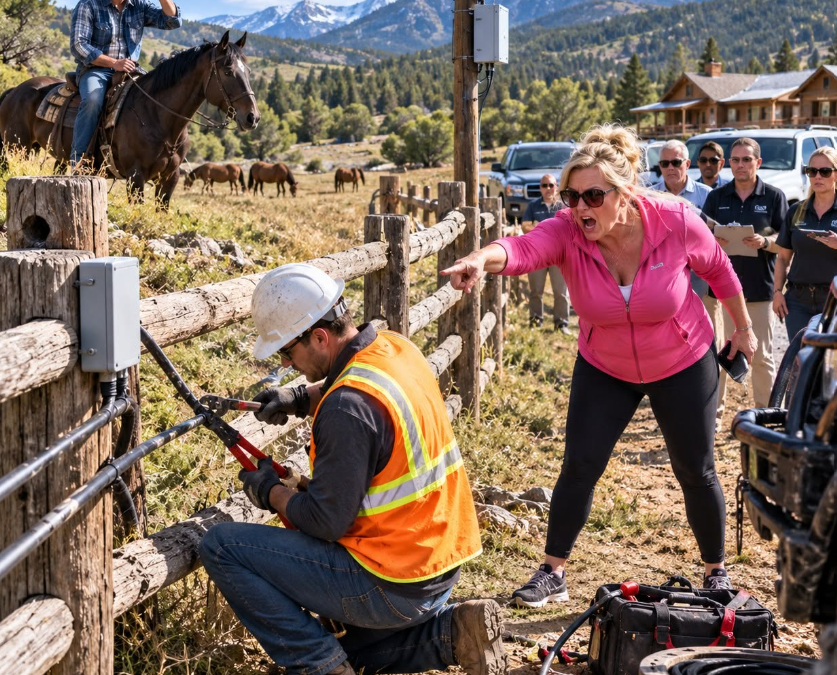
She moved out from behind the third SUV wearing white jeans, tan boots, a cream blouse, and a navy blazer that probably cost more than the weekly payroll of the crew she had just detained. Her hair was perfect. Her sunglasses were oversized. Her mouth wore the calm little smile of a woman who believed paperwork became truth when placed inside an expensive leather binder.
Karen was president of the Cedar Ridge Estates Homeowners Association.
My ranch was not in Cedar Ridge Estates.
That detail had been explained to her by me, my attorney, the county recorder, two sheriff’s deputies, a district judge, and eventually the United States Attorney’s Office.
Karen never let facts interfere with her preferred version of the world.
Black Creek Ranch covered 620 acres outside Harlan County, Texas. My grandfather bought the first two hundred in 1968, back when the county road was gravel and the creek still ran clear enough for children to catch minnows with coffee cans. My father expanded it. I expanded it more after the oilfield service company I built got bought out.
I did not live rich in the way people expected. I kept the old stone house, the same barn, the same windmill, the same pecan trees. I upgraded systems, yes. Irrigation. Power. Security. A proper equipment yard. A fiber line. A drainage network. A hardened communications shelter at the north ridge.
That last part was where the trouble really began.
The black cable Karen would later order cut was not decorative.
It was not abandoned.
It was not some forgotten ranch utility.
It was part of a federally funded emergency communications link that crossed my land under a recorded easement, tying a county disaster repeater, a wildfire detection relay, and a federal law enforcement surveillance node into a secure communications backbone.
Most people never noticed it.
A black-jacketed line ran from the north communications shelter toward the ridge conduit. It crossed a service trench near the access road before disappearing underground. There were warning posts. There were signs. There were locked cabinets and tamper sensors and enough documentation to satisfy every agency that had touched the project.
Karen had seen the signs.
She had ignored them.
But I’m getting ahead of myself.
Fourteen months before that Tuesday morning, Cedar Ridge Estates discovered they had a drainage problem.
Not a small one.
Cedar Ridge had been built in phases behind my southern fence. Big homes. Stucco walls. Copper gutters. Artificial ponds. Lawn crews. A gated entrance with limestone columns and a bronze sign that said LUXURY COUNTRY LIVING.
I always hated that sign.
Not because people shouldn’t have nice homes.
Because there is something dishonest about bulldozing mesquite, flattening pasture, importing sod, and then selling the result as country living.
For the first few years, Cedar Ridge mostly kept to itself.
Then Karen Vale became HOA president.
She arrived like a weather system.
Letters started coming.
Dear Mr. Mercer,
Residents have expressed concern regarding the visibility of livestock trailers from the Cedar Ridge walking path.
Dear Mr. Mercer,
The board requests that you address dust generated by ranch vehicles along the southern access road.
Dear Mr. Mercer,
Your fencing does not align with the aesthetic character of adjacent residential property.
My name is Nathan Mercer.
I had spent forty-eight years answering to Nate from people I liked and Mr. Mercer from people who wanted something. Karen never called me Nate.
The first few letters I ignored.
The next few my attorney answered.
The last one, asking that I “harmonize” my fence line with Cedar Ridge’s exterior design standards, I responded to myself.
Dear Mrs. Vale,
Black Creek Ranch does not harmonize on request.
Nathan Mercer
My attorney told me that was unhelpful.
He was right.
I sent it anyway.
Karen did not appreciate humor.
Then Cedar Ridge’s drainage basin failed after a spring storm.
Water overtopped one of their decorative ponds, crossed three backyards, flooded two finished basements, and washed mulch, pool toys, and patio furniture into my south pasture. Their residents blamed the developer. The developer blamed the HOA for improper maintenance. The HOA blamed county stormwater design. County engineers blamed the fact that Cedar Ridge kept approving landscape modifications and patio expansions without revising drainage calculations.
Karen blamed me.
According to her, my ranch’s “uncooperative topography” prevented Cedar Ridge stormwater from dispersing naturally.
Uncooperative topography.
That phrase told me everything I needed to know about her.
She believed even the ground was being rude if it did not accommodate her.
What she wanted was access across my ranch to build an overflow drainage channel and emergency maintenance road connecting Cedar Ridge’s retention pond to the dry wash beyond my east pasture. That route would cross a section of my land containing irrigation controls, buried utilities, the access road to the communications shelter, and the black cable corridor.
I said no.
Not because I wanted Cedar Ridge homeowners flooded.
Because Karen’s plan was rushed, illegal, poorly engineered, and designed to solve her neighborhood’s problem by making it mine.
I suggested a lawful alternative.
Hire a real drainage engineer.
Rebuild the retention basin.
Acquire county-approved discharge rights.
Stop expanding impervious surfaces without stormwater review.
Karen heard only one word.
No.
After that, she became obsessed.
She claimed Cedar Ridge had an “implied emergency maintenance easement.”
It did not.
She claimed the developer reserved “community infrastructure rights.”
They hadn’t.
She claimed my grandfather had orally promised access to a prior owner of the Cedar Ridge parcel in 1981.
My grandfather had been in the hospital after a tractor accident during the week she cited, which made that particular lie easier to enjoy.
She claimed the county could condemn my land if I refused “reasonable cooperation.”
The county attorney sent her a letter explaining condemnation was not an HOA power.
She claimed my ranch was interfering with public safety.
The fire marshal inspected the access issue and concluded Cedar Ridge’s own internal gates and narrow roads were the problem.
Every time someone told Karen no, she found another person to ask.
Every time a document contradicted her, she produced a binder with tabs.
Every time I refused to meet without counsel, she accused me of bad faith.
Then came the first trespass.
Three men in orange vests walked through my south gate with survey equipment and a drone case. Daniel found them near the irrigation pump house.
They said they were “mapping community infrastructure.”
Daniel said they were on private property.
They produced a work order from Cedar Ridge HOA.
Daniel told them to leave.
They refused until the sheriff arrived.
Karen called it a misunderstanding.
Then came the second trespass.
A landscaping crew cut a gap in the southern brush line and began marking trees with pink ribbon. They said they were identifying “obstruction removal zones.” Daniel photographed them. They left before deputies arrived.
Karen denied authorizing it.
We later found her signature on the vendor request.
Then came the fake order.
A document titled TEMPORARY COMMUNITY ACCESS DIRECTIVE arrived by courier, printed on heavy paper with Cedar Ridge’s logo and Karen’s signature. It ordered Black Creek Ranch to provide immediate access to Cedar Ridge contractors for “stormwater hazard mitigation” and warned that refusal would result in “civil enforcement, fines, and cost recovery.”
My attorney laughed for a full ten seconds when he read it.
Then he stopped laughing and said, “Nate, she’s escalating.”
He was right.
My attorney’s name was Stephen Cho. He had handled my business sale, land matters, and enough fights with county officials to know the difference between nuisance and danger. Stephen was not dramatic. When he became concerned, I listened.
“She’s trying to create a record,” he said.
“For what?”
“To make her illegal access look inevitable. She wants to show attempts, notices, supposed emergency findings, vendor delays. If she breaks in later, she’ll argue necessity.”
“That won’t work.”
“In court? Probably not. On the day it happens? It might get people hurt.”
So we prepared.
Not with guns.
Not with threats.
Not with men at the gate looking for a fight.
With cameras.
Audio.
Motion sensors.
GPS boundary logs.
Certified letters.
County filings.
Recorded notices.
Employee instructions.
We turned Black Creek Ranch into a witness.
That was my idea.
Or maybe it was my guilt.
Because I had learned the hard way that by the time people want video, memory is already under attack.
Four years before Karen Vale ever marched onto my land, I lost my younger brother, Luke, in a dispute that should never have become violent.
Luke was thirty-nine, wild-hearted, funny, and too quick to step toward trouble. He ran cattle on leased land north of the county line. One morning, a pipeline contractor crossed onto the lease without notice to move equipment. Luke confronted them. There were words. One operator claimed Luke threatened him. Luke said he only told them to leave. A deputy arrived. Somebody shoved somebody. Luke ended up on the ground with a head injury. He died two days later.
The body cameras had not recorded the beginning.
The contractor’s dashcam “malfunctioned.”
Witnesses disagreed.
The official report used words like unfortunate escalation and conflicting accounts.
My mother never recovered from the uncertainty.
I did not want another person I loved, worked with, or employed turned into a paragraph because someone powerful knew how to create confusion.
So when Karen began escalating, I made one rule absolute.
The ranch would not fight.
The ranch would record.
For fourteen months, it did.
Karen at the gate shouting at Daniel.
Karen’s contractors photographing locks.
Karen sticking fake notices to my fence.
Karen calling my workers “mercenaries” because they refused to move cones.
Karen’s attorney insisting Cedar Ridge had rights while refusing to identify them.
Karen at a county meeting saying my “aggressive surveillance posture” was proof of hostile intent.
That last phrase became a joke around the ranch.
Daniel once looked straight into a camera and said, “Morning, hostile surveillance posture. Coffee?”
I laughed when I saw it.
That was before the federal part became real.
The black cable had been installed under a joint public safety communications project after three wildfires and one cartel trafficking investigation exposed gaps in radio coverage along the county ridge line. My land, unfortunately for everyone who preferred simplicity, had the high ground.
The county needed the ridge.
The federal task force needed a secure relay path.
I negotiated the easement carefully.
Limited access.
Strict maintenance protocol.
Compensation.
No public disclosure of certain equipment specifications.
No interference with ranch operations beyond agreed corridors.
The arrangement was legal, recorded, and boring until Karen decided that any corridor across my ranch must be available to her.
Fourteen months into the dispute, Stephen called and told me federal agents wanted to speak.
That was when I met Special Agent Mara Ellison.
She was with the FBI, assigned to a public corruption and infrastructure interference task force. I first met her in a windowless conference room at the federal building downtown. She wore a plain gray suit, no-nonsense shoes, and the expression of someone who had heard too many people say, “I didn’t know that was illegal.”
Beside her sat Deputy U.S. Marshal Evan Brooks and an Assistant U.S. Attorney named Priya Shah.
Stephen sat with me.
Agent Ellison opened a folder.
“Mr. Mercer, how much do you know about Cedar Ridge Estates HOA?”
“More than I want.”
She almost smiled.
“We’re looking at several issues involving their board, vendors, and private security contractors.”
“Because of my ranch?”
“Partly.”
She slid photographs across the table.
BlackStone Protective Services vehicles outside Cedar Ridge.
Cedar Ridge checks.
Emails.
Vendor contracts.
Then a map of my ranch.
The communications corridor marked in red.
“Our concern,” she said, “is that Mrs. Vale has repeatedly discussed forced access across an easement corridor containing federally supported communications infrastructure.”
“She knows what the signs say.”
“We know.”
“How?”
Agent Ellison looked at me.
“Because she emailed photos of them to her attorney asking whether the warning language was ‘intimidation theater.’”
Stephen closed his eyes briefly.
I said, “Of course she did.”
Agent Ellison continued.
“We don’t want a confrontation. But we believe Mrs. Vale may attempt one. If she does, we need clean evidence, especially if private security detains workers, disables cameras, damages communications equipment, or interferes with federal infrastructure.”
I leaned back.
“You’re asking me to let her come?”
“No,” she said. “We’re asking you not to create a physical confrontation if she does. Continue documenting. Call local law enforcement. Notify us immediately.”
I looked at the map.
“What aren’t you telling me?”
Agent Ellison and AUSA Shah exchanged a glance.
Priya Shah answered.
“We are investigating whether Cedar Ridge HOA funds were used to hire private security for actions the board knew were unlawful, and whether certain contractors connected to Mrs. Vale have been paid through emergency drainage assessments. If she proceeds onto your property, it may establish intent.”
That was careful lawyer language.
It meant they needed Karen to stop pretending.
For two months after that, nothing happened.
Then Karen called a special HOA meeting and announced “Phase One Emergency Access Enforcement.”
A Cedar Ridge resident recorded it and sent it to me anonymously.
Karen stood at a podium in the clubhouse, binder open, voice ringing with righteous certainty.
“For too long, one adjacent landowner has placed personal hostility above the safety of this community. We have attempted dialogue. We have attempted legal coordination. We have attempted county involvement. Every reasonable path has been obstructed. At some point, leadership requires action.”
A man in the crowd asked, “Do we actually have access rights?”
Karen smiled.
“The board has reviewed the matter extensively.”
That was not an answer.
It never is.
The next morning, I sent the recording to Stephen.
Stephen sent it to Agent Ellison.
Agent Ellison said, “Be ready.”
Then, three days later, Karen came.
Not with surveyors.
Not with landscapers.
With nine black vehicles and twenty-three private security contractors.
Which brings me back to the tablet in the federal SUV.
I watched Daniel keep his hands visible.
Rourke, the security chief, unfolded a paper and held it like a warrant.
“This property is subject to emergency community access,” he said.
Daniel looked at the paper without touching it.
“That’s not a court order.”
“It’s an enforcement directive.”
“From who?”
“Cedar Ridge Estates Homeowners Association.”
Daniel’s expression did not change.
“This ranch isn’t in Cedar Ridge.”
Karen stepped forward.
“It is burdened by Cedar Ridge infrastructure necessity.”
Daniel looked at her.
“That’s not a thing.”
Her mouth tightened.
“You are not qualified to interpret legal documents.”
“Maybe not. But I can read a gate sign.”
The microphone picked up a few nervous laughs from my workers.
Rourke did not like that.
He stepped closer to Daniel.
“Hands behind your back.”
Daniel’s face changed.
Not fear.
Calculation.
“Am I being detained?”
“Yes.”
“By who?”
“Authorized security personnel.”
“Under what law?”
Rourke smiled again.
“Under the authority of the property action.”
Daniel looked straight toward camera two.
That was for me.
Then he put his hands behind his back.
“Do not resist,” he called to the crew. “Everybody stay calm.”
My grip tightened around the tablet.
In the driver’s seat, Agent Ellison glanced at me.
“You okay?”
“No.”
“You want us to move faster?”
“How far?”
“Eight minutes.”
I looked back at the screen.
“Move faster.”
She picked up the radio.
On camera three, two contractors zip-tied Daniel’s wrists behind him.
Another guard patted him down.
They took his phone.
They lined him beside the irrigation crew against the fence.
Seventeen workers.
Zip ties.
Phones confiscated.
No court order.
No sheriff.
No lawful authority.
Karen stood near the gate, flipping through her leather binder as if searching for the page where reality surrendered.
Then camera four showed the front-end loader.
It rolled slowly off a flatbed trailer near the county road, yellow bucket raised slightly, engine coughing black smoke. Behind it came two utility trucks carrying orange cones, chain saws, trench plates, and a spool of temporary drainage pipe.
They had not come to inspect.
They had come to build.
Rourke spoke into his radio.
“Gate secure. Personnel controlled. Bring the loader up.”
Karen walked beside him.
“Start with the south service road,” she said. “Remove any obstruction fencing, then proceed to the black cable markers. That cable has to be disconnected before trenching.”
Agent Ellison’s head snapped toward the tablet.
AUSA Shah, sitting behind us, leaned forward.
“Say that again.”
The ranch microphone had caught it.
Clearly.
The black cable markers.
That cable has to be disconnected before trenching.
I felt something inside me go very cold.
For fourteen months, Karen had been arrogant, reckless, cruel, dishonest, and obsessive.
But until that sentence, she had still been playing neighborhood dictator.
Now she was ordering interference with federal communications infrastructure.
Rourke said, “We cutting or pulling?”
Karen answered, “Cut it. We’re not waiting for Mercer to weaponize another utility claim.”
The SUV accelerated.
Agent Ellison spoke into the radio.
“Primary target has ordered cable cut. Move all units. Move now.”
On the tablet, Daniel lifted his head.
He had heard it too.
“Karen,” he called out.
She ignored him.
“Karen!” Daniel shouted.
Rourke walked over and grabbed him by the shirt.
“Quiet.”
Daniel looked past him at Karen.
“That cable is federal infrastructure. You touch it, you are committing a felony.”
Karen turned slowly.
“You are not an attorney.”
“No. I’m the guy who watched them install it.”
Her expression hardened.
“That cable was installed under a private agreement with Mercer. We are not bound by his intimidation props.”
Daniel’s voice stayed calm.
“There are federal warning signs on the posts.”
“Signs are not law.”
“No. But the law behind them is.”
For one moment, I thought she might hesitate.
She did not.
That was the thing about Karen.
She never stopped at the edge of a cliff if stopping meant admitting someone else had drawn the map correctly.
She pointed toward the black cable running along the marked service trench.
“Cut it.”
A contractor with bolt cutters stepped forward.
He was younger than the others, maybe thirty. Hesitated slightly. Looked at Rourke.
Rourke nodded.
The contractor moved toward the cable.
The warning post beside it was bright white with red lettering.
FEDERAL COMMUNICATIONS LINE
AUTHORIZED ACCESS ONLY
DO NOT CUT, MOVE, OR TAMPER
VIOLATORS SUBJECT TO PROSECUTION
The contractor read it.
I saw him read it.
He looked back.
Karen snapped, “Do your job.”
He set the jaws of the bolt cutters around the black cable.
Daniel shouted, “Stop!”
The contractor cut.
The screen flickered.
Not all feeds.
Just one.
The north fence camera went black.
In the SUV, nobody spoke for half a second.
Then Agent Ellison said, “That’s it.”
The first federal vehicles hit my access road two minutes later.
You could hear them before you saw them.
Sirens.
Tires on gravel.
Multiple engines.
On camera one, Karen turned toward the gate, annoyed at first, then confused when she saw the vehicles. Black SUVs. County sheriff units. A communications response truck. Two marked federal vehicles. Dust rose behind them in a wall.
Rourke spoke into his radio.
“Hold positions.”
Karen said, “Who called them?”
Daniel, zip-tied against the fence, said quietly, “The cable did.”
A deputy’s voice came over a loudspeaker before the vehicles even stopped.
“Everyone on the property, stand still. Drop all tools. Keep your hands visible.”
Chaos tried to start and failed.
One BlackStone contractor reached toward his belt.
Three rifles came up from federal tactical agents taking position behind open doors.
“Do not touch it!” someone shouted.
The contractor froze.
Rourke raised both hands slowly.
Karen did not.
She marched toward the lead SUV as Agent Ellison stepped out.
“This is private HOA enforcement action,” Karen shouted. “You have no jurisdiction here.”
Agent Ellison walked toward her with the calm of a woman whose jurisdiction had just been cut with bolt cutters.
“Karen Vale?”
Karen blinked.
“I am Karen Vale, president of Cedar Ridge Estates Homeowners Association.”
“I’m Special Agent Mara Ellison, FBI. Put your hands where I can see them.”
Karen looked genuinely offended.
“Excuse me?”
Behind Agent Ellison, deputies moved to the fence and began cutting zip ties off my workers. Daniel flexed his wrists but stayed still. Mateo looked shaken. One of the landscapers was crying quietly.
Rourke tried to speak.
“Agent, we’re licensed private security operating under client authority—”
A deputy turned him around and disarmed him.
Agent Ellison kept her eyes on Karen.
“You ordered a communications cable cut after being warned it was federal infrastructure. You detained workers on private property. You confiscated phones. You chained a gate. You brought heavy equipment onto land without a court order. You need to stop talking now.”
Karen’s face flushed.
“I did no such thing.”
Agent Ellison looked toward the nearest ranch camera.
“Mrs. Vale, you did it on video.”
That was when I stepped out of the federal SUV.
Karen saw me and everything in her face changed.
For the first time in fourteen months, she looked less like a president and more like a person who had just realized the stage was not facing the direction she thought it was.
“Mercer,” she said.
I walked through the dust toward my workers.
Not toward her.
Toward Daniel.
A deputy had just cut his zip ties. His wrists were red.
“You all right?” I asked.
He nodded.
“Been better.”
“You warned her.”
“Didn’t take.”
“It never does.”
Mateo stood nearby rubbing his shoulder.
“I’m sorry, Mr. Mercer,” he said.
“For what?”
“They took our phones.”
“You did exactly right.”
He looked toward Karen.
“She said we were trespassing on community land.”
I looked at him.
“You were at work.”
His eyes filled with anger he was trying not to show.
That was the part Karen would never understand.
People like her think humiliation disappears when authority changes hands.
It does not.
It settles into bodies.
Wrists.
Shoulders.
The throat of a grown man trying not to cry in front of coworkers because someone zip-tied him like a criminal for showing up to repair irrigation lines.
Agent Ellison’s team secured the site.
The contractor who cut the cable was separated from the others. He looked terrified. His name was Noah Price. He kept saying, “She told me it was abandoned. She told me it was legal. I read the sign, but Rourke said signs are scare tactics.”
Rourke said nothing.
He had finally learned a useful skill.
Karen kept talking.
She demanded to call the governor.
She demanded to see a warrant.
She insisted the HOA had emergency powers.
She said the cable had been unlawfully installed.
She said I had set a trap.
She said the workers were not detained but “held for site safety.”
She said the phones were collected to prevent “misinformation.”
She said the gate was chained to “secure the action.”
Every sentence made things worse.
AUSA Shah eventually stepped in.
“Mrs. Vale,” she said, “your attorney will thank you if you stop now.”
Karen stared at her.
“And you are?”
“Assistant United States Attorney Priya Shah.”
For the first time, Karen shut her mouth.
Not for long.
But long enough to be handcuffed.
When Agent Ellison told her she was being detained pending investigation into interference with protected communications infrastructure, unlawful restraint, conspiracy, trespass, and related offenses, Karen looked past her at me.
“You did this,” she said.
It is amazing how often people say that while standing in the wreckage of their own decisions.
I looked at the cut cable.
The black end lay in the dirt, cleanly severed, fiber strands exposed like nerves.
“No,” I said. “You finally did.”
The arrests did not all happen that day.
That is not how real life works.
Rourke was arrested on site for unlawful restraint and weapons-related violations connected to private security conduct. Two supervisors were detained. Several contractors were interviewed and released pending charges. Noah Price, the man with the bolt cutters, eventually cooperated. Karen was taken in but bonded out two days later, which gave her just enough freedom to destroy herself publicly.
Cedar Ridge’s emergency board meeting happened that Friday.
I did not attend.
I watched the recording later because three residents sent it to me independently.
Karen stood at the front of the clubhouse, still president, still wearing pearls, still convinced she could outrun what everyone had seen on the news.
The local station had aired helicopter footage of federal vehicles on my ranch.
The headline was simple.
HOA PRESIDENT DETAINED AFTER PRIVATE SECURITY RAID ON RANCH
Karen called the meeting to order and said, “We are facing a coordinated attack by Nathan Mercer and federal agencies misled by his political connections.”
That sentence told the room she had learned nothing.
A resident named Claire Bowers stood up.
“My husband was on that security contract review committee,” she said. “You told him this was court-approved.”
Karen lifted a hand.
“I told him counsel had reviewed our authority.”
“That’s not the same thing.”
“It is when emergency conditions exist.”
A man shouted, “You zip-tied ranch workers!”
Karen said, “Temporary restraint was implemented by security professionals for site safety.”
Another resident yelled, “You cut a federal cable!”
Karen replied, “We disconnected an unauthorized private line.”
Someone played the video.
Not mine.
A ranch worker’s body camera.
Daniel had insisted that several foremen wear small body cameras after the first trespass. Karen’s contractors had confiscated phones but missed the body cameras clipped under reflective vests.
The clubhouse screen showed Karen pointing.
Cut it.
We’re not waiting for Mercer to weaponize another utility claim.
Then Noah Price cutting the cable.
Then Daniel shouting.
Then the screen going black.
Silence filled the clubhouse.
Karen stood frozen.
Claire Bowers said, “You lied to us.”
Karen turned slowly.
“I protected you.”
“No,” Claire said. “You used us.”
The recall petition began that night.
But Cedar Ridge residents had only seen the surface.
Federal subpoenas uncovered the rest.
Karen had used HOA emergency assessments to fund BlackStone Protective Services. She had told residents the money was for stormwater mitigation and legal access coordination. She had routed contracts through a consulting company called Vale Community Solutions, owned by her brother-in-law. She had paid BlackStone a premium rate for “property action readiness.” She had authorized surveillance of my gate. She had instructed vendors to prepare for “rapid corridor establishment.” She had drafted talking points claiming federal warning signs were “private intimidation markers.”
And she had ignored at least nine separate legal warnings.
One from my attorney.
One from the county attorney.
Two from the sheriff’s office.
One from the fire marshal.
One from the public safety communications authority.
Two from Cedar Ridge’s own outside counsel.
And one from AUSA Shah, sent after Karen threatened in writing to “remove unauthorized communication obstructions” from the proposed access route.
Karen had responded to that one with a sentence prosecutors would later read in court.
Federal agencies do not get to convert private land into a shield against community necessity.
In her mind, she was always the community.
Anyone opposing her opposed the public good.
That belief had carried her from letters to trespass, from trespass to threats, from threats to private security, from private security to zip ties, and from zip ties to bolt cutters.
People kept asking me why I waited fourteen months.
Why not sue sooner?
Why not block the gate permanently?
Why not stand there with armed guards of my own?
The answer was Luke.
My brother had died inside confusion.
I wanted Karen to have none.
No conflicting stories.
No missing footage.
No “he said, she said.”
No excuse that she was surprised, rushed, misinformed, or reacting to my aggression.
I wanted her on video, in daylight, surrounded by her own contractors, making her own choices.
That may sound cold.
Maybe it was.
But justice sometimes needs patience more than fury.
The grand jury returned indictments two months later.
Karen Vale was charged with conspiracy, interference with federally protected communications infrastructure, unlawful restraint through agents, trespass, obstruction, wire fraud connected to HOA fund use, and several state charges referred separately.
Rourke and two BlackStone supervisors were charged as well.
BlackStone’s owner cooperated after investigators found emails proving Karen had demanded “intimidating optics” and “full personnel control” during the property action.
The Cedar Ridge board collapsed.
Residents discovered more money missing than expected.
The drainage project Karen claimed justified the raid had never been properly engineered. The funds collected for emergency mitigation had largely gone to legal fees, security contracts, consulting payments, and public relations.
The actual retention basin still needed repairs.
The homeowners were furious.
Some at Karen.
Some at me.
That surprised people, but not me.
When a lie supports a comfortable life, the person who removes it often gets blamed for the collapse.
I received letters.
Some apologetic.
Some threatening.
One said, “You could have just let us fix the drainage.”
I wrote back, “You could have asked legally.”
Most I ignored.
Then, one afternoon, Claire Bowers came to my ranch gate.
Daniel called me from the office.
“There’s a Cedar Ridge resident here. Says she wants to talk.”
“Angry?”
“Looks tired.”
That covered a lot of people.
I drove down from the house.
Claire stood outside the gate holding a cardboard box. She was in her late thirties, wearing jeans, sneakers, and the expression of someone who had not slept well for weeks.
I recognized her from the meeting video.
“You’re Claire Bowers,” I said.
“Yes.”
“What can I do for you?”
She looked at the gate, then at the repaired cable marker beyond it.
“I came to apologize.”
“You don’t have to.”
“I do.”
She shifted the box in her arms.
“My husband, Matt, was on the security review committee. He believed Karen. I believed him. We thought you were refusing emergency access because you hated the neighborhood.”
“I don’t hate the neighborhood.”
“I know that now.”
I waited.
She looked toward the ranch road.
“Matt resigned from the committee. He also found documents in his email that prosecutors asked for. We gave them everything.”
“That helps.”
“I also brought phones.”
She lifted the box.
“What?”
“Some of your workers’ phones. BlackStone took them. Karen had them brought to the clubhouse because she said they were evidence of trespass coordination. They were in a locked cabinet.”
I stared at the box.
Seventeen phones.
Some cracked.
All tagged.
A small thing, maybe, after everything else.
But seeing them hit me harder than I expected.
Phones are ordinary until someone takes one from your hand and decides your voice belongs to them.
“Thank you,” I said.
Claire’s eyes filled.
“I’m sorry,” she said. “I watched the video of your ranch manager telling everyone to stay calm. He protected your people from becoming what Karen wanted them to look like.”
“Yes,” I said. “He did.”
“I hope our neighborhood can become better than what she made it.”
I looked past her toward the road that led to Cedar Ridge.
“That depends on who you become when nobody is shouting.”
She nodded.
“That’s fair.”
The criminal case took nearly a year.
Karen fought everything.
She claimed political persecution.
She claimed selective prosecution.
She claimed she thought the cable was private.
She claimed the workers were free to leave, despite video showing the chained gate and zip ties.
She claimed BlackStone exceeded instructions, despite recordings of her giving them.
She claimed Cedar Ridge residents demanded action, despite residents testifying she had misled them.
At trial, prosecutors played the footage in chronological order.
The convoy.
The gate chain.
The workers lined up.
Daniel asking under what law.
Rourke saying official property action.
Karen ordering the loader forward.
Daniel warning her about the cable.
Karen saying signs are not law.
Karen ordering Noah Price to cut it.
The screen going black.
The federal response.
Her saying, “You did this.”
Then prosecutors showed emails.
So many emails.
Karen asking whether private security could detain “hostile ranch personnel.”
Karen asking if warning signs were enforceable.
Karen calling the federal easement “Mercer’s shield.”
Karen telling BlackStone, “The key is control before he mobilizes.”
Karen writing to her brother-in-law, “Once we establish physical access, the legal argument changes.”
That sentence echoed in the courtroom.
Once we establish physical access, the legal argument changes.
She believed possession would become leverage.
She believed force would become fact.
She believed if she moved fast enough, the law would have to negotiate with what she had already done.
She was wrong.
Daniel testified.
He wore a dark suit he clearly hated.
The prosecutor asked him why he told the workers not to resist.
Daniel looked at the jury.
“Because Mr. Mercer told us from the beginning that nobody’s pride was worth anyone getting hurt.”
“Were you afraid?”
Daniel paused.
“Yes.”
“What were you afraid of?”
“That one of my guys would flinch and those security men would call it resistance.”
The courtroom was silent.
“Why did you warn Mrs. Vale about the cable?”
“Because even then, I didn’t want anybody making it worse.”
“Did she listen?”
“No.”
The prosecutor played the clip again.
Cut it.
The jurors watched Karen’s finger point toward the cable.
I watched Karen.
She stared at the table.
Not ashamed.
Angry.
Still angry that the evidence had refused to obey her.
When it was my turn, Karen’s attorney tried to make me look manipulative.
“You had cameras everywhere, didn’t you, Mr. Mercer?”
“Yes.”
“You were waiting for Mrs. Vale.”
“I was preparing for trespass.”
“You wanted her to get caught.”
“I wanted her to stop.”
“But you didn’t go to the ranch that morning to stop her.”
“I was with federal agents because we believed she might interfere with protected infrastructure.”
“You could have warned her one more time.”
“She had been warned for fourteen months.”
He walked closer.
“Isn’t it true that you personally disliked Mrs. Vale?”
“Yes.”
A few people shifted.
He looked pleased.
“And isn’t it true that dislike influenced your actions?”
“Yes.”
His smile widened.
I continued.
“I disliked her enough to make sure no one had to rely on my word alone.”
The smile disappeared.
The jury convicted Karen on most counts.
Not all.
Real justice is rarely complete.
But enough.
At sentencing, AUSA Shah spoke about infrastructure, public safety, and abuse of private authority. BlackStone supervisors received lesser sentences after cooperation. Rourke received prison time. Karen received more.
Before sentencing, she was allowed to speak.
She stood in a navy dress, thinner than before, hair still neat, voice still controlled.
“I made decisions under extraordinary pressure to protect my community,” she said. “I regret that events escalated, but I maintain that no one in government listened until Cedar Ridge was desperate. I was forced to choose between inaction and leadership.”
Then she looked at me.
“Some people with wealth and influence can hide behind private land and federal connections. My only mistake was believing ordinary homeowners deserved the same protection.”
Even then.
Even standing before a federal judge.
She was still campaigning.
Judge Elena Marsh let the silence stretch after Karen finished.
Then she said, “Mrs. Vale, leadership is not the power to invent authority when the law denies it. It is not the power to restrain workers, seize phones, chain gates, or destroy infrastructure because you consider your goal important. You did not protect your community. You endangered it, misled it, and used it as justification for your own defiance.”
Karen’s face hardened.
The judge continued.
“You were told no by land records, by attorneys, by law enforcement, by public officials, and by posted warnings. You decided no was an obstacle to be overcome by force. That is not leadership. That is lawlessness dressed as civic duty.”
That sentence made the papers.
Lawlessness dressed as civic duty.
Cedar Ridge removed Karen’s name from every committee record, newsletter archive, and clubhouse plaque within a month.
The HOA held new elections.
Claire Bowers became interim president, mostly because no one else wanted to inherit the ashes. Her first letter to residents was short.
Cedar Ridge Estates does not own or control Black Creek Ranch. We will pursue drainage repairs through lawful engineering, county approval, and respectful negotiation with affected landowners. The prior board’s actions were wrong.
I appreciated that.
Not enough to trust them blindly.
But enough to answer when Claire later requested a meeting with engineers present.
We eventually negotiated a proper drainage solution.
Not the route Karen wanted.
Not across the communications corridor.
Not through my equipment yard.
The new plan widened Cedar Ridge’s retention basin, added a pump station, redirected overflow through an approved county channel, and required homeowners to stop unauthorized hardscape expansions. It cost more than Karen’s fantasy. It took longer. It was legal.
Black Creek Ranch granted a narrow temporary construction staging license for one week, far from the federal cable, with insurance, supervision, and compensation.
Daniel asked if I had lost my mind.
“No,” I said. “Just found the difference between a request and an invasion.”
He nodded.
“That’s a useful distinction.”
The repaired black cable got a new warning post.
Bigger.
Brighter.
Harder to dismiss.
For months afterward, I found myself driving to the north ridge just to look at it. The communications shelter sat quiet behind its fence, sun glinting off the metal roof. The land around it looked ordinary again. Grass grew over tire tracks. Dust settled. Workers stopped glancing at the gate every time a vehicle turned off the highway.
But ordinary is not the same as unchanged.
The ranch remembered.
So did I.
One evening almost a year after the raid, Daniel and I stood by the repaired gate watching a storm build over Cedar Ridge. Dark clouds stacked above the subdivision. Lightning flickered behind rooftops.
“Think their basin holds?” Daniel asked.
“If their engineers did their job.”
“And if they didn’t?”
“Then Claire will call before sending troops.”
He laughed.
Then grew quiet.
“You ever think about what would’ve happened if the cameras weren’t running?”
“All the time.”
“Me too.”
The wind pushed dust across the road.
Daniel flexed his wrists unconsciously. The zip-tie marks were long gone, but memory has its own scars.
“I hated standing there,” he said. “Letting them tie us up.”
“I know.”
“I kept thinking the guys would think I was weak.”
I looked at him.
“They think you saved them.”
He shook his head slightly.
“Still felt wrong.”
“Doing the right thing often does when the wrong people are holding the power.”
He looked toward Cedar Ridge.
“Karen thought power was whoever moved first.”
“Yes.”
“What do you think it is?”
I thought about Luke.
About my mother asking what really happened.
About video feeds and federal SUVs and Daniel telling frightened workers to stay calm.
“Power is making sure the truth survives the first story,” I said.
Daniel nodded.
“That sounds like something expensive lawyers say.”
“I’ll bill you.”
He laughed.
The storm broke twenty minutes later.
Rain hit the ranch hard, drumming on barn roofs, washing dust from the gate, running in clean sheets along the ditches. Cedar Ridge’s new basin held. For once, their water stayed where their engineers said it would.
I stood on the porch and watched the rain.
My wife, Rachel, came outside and handed me coffee.
I haven’t mentioned Rachel until now because she was away visiting her sister when the raid happened, and because some stories have so many moving parts that the quiet people holding you together can disappear from the telling.
She did not disappear from my life.
Rachel had married me after Luke died, after the business sale, after I had become more guarded than any man should be. She was a school counselor, patient in ways that made me feel both grateful and unworthy. She had been the first person to say, “Nate, cameras won’t bring your brother back.”
I had said, “No. But they might save someone else.”
After the raid, she sat with Mateo’s wife at the courthouse. Brought food to the ranch workers. Made Daniel see a therapist after he started snapping at people over small things. Made me admit that watching Karen get arrested had not healed what happened to Luke.
That night, as rain fell over the ranch, she leaned against the porch rail beside me.
“You’re thinking about him,” she said.
“Luke?”
“Yes.”
“I think about him every time somebody says escalation.”
She wrapped both hands around her mug.
“He would’ve been proud of you.”
“Luke would’ve wanted to punch Rourke.”
“Yes,” she said. “And then he would’ve been proud of you for not letting anyone else do it.”
I smiled sadly.
“That sounds right.”
Rain softened the whole yard.
For a while, neither of us spoke.
Then Rachel said, “You waited fourteen months for Karen to reveal herself.”
“Yes.”
“Don’t spend the next fourteen waiting for it to feel good.”
I looked at her.
“It doesn’t.”
“I know.”
“I thought it would.”
“No,” she said. “You thought truth would feel like justice. Sometimes it just feels like everyone finally knows why you were tired.”
That went through me deeper than I expected.
Because she was right.
The world had seen Karen for what she was.
The court had punished her.
The cable had been repaired.
My workers had been compensated.
BlackStone lost its license.
Cedar Ridge rebuilt its board.
And still, there were mornings I woke up angry.
Not at Karen.
At the fact that decency required so much proof.
That my workers had to be zip-tied for people to understand boundaries.
That Daniel had to warn someone not to commit a felony and be ignored on video before the truth became undeniable.
That Luke never got that kind of clarity.
Rachel touched my arm.
“Come inside before you drown dramatically.”
I laughed.
She always knew when to pull me back.
Two years later, the north gate looks different.
Not fortress different.
Just clearer.
New signs.
Better lighting.
A keypad with logging.
A camera visible enough to discourage performance.
The old black cable corridor is marked by posts and low fencing. The communications shelter is still there, humming quietly with equipment most people will never notice unless it fails.
Cedar Ridge residents sometimes walk the county road beyond my fence.
Most don’t look toward the ranch.
A few wave.
Claire does.
Her husband Matt once stopped at the gate and apologized in person for serving on Karen’s committee. He looked miserable doing it, which helped.
“I should’ve asked harder questions,” he said.
“Yes,” I told him.
He nodded.
No absolution.
No handshake that magically made everything clean.
Just truth.
Sometimes that is enough.
The funniest part, if any of this has one, is that Karen’s original problem got solved without touching my ranch.
It required boring things.
Engineering.
Permits.
Money.
A board willing to tell residents the truth.
A county inspector who refused to sign off on shortcuts.
A contractor who followed plans instead of pressure.
No tactical uniforms.
No fake orders.
No chained gates.
No bolt cutters.
Just the slow, unglamorous work of doing something legally.
Karen could have chosen that from the beginning.
But legal work does not flatter people who need to feel historic.
It does not give speeches.
It does not let a woman stand in front of homeowners and call herself the only thing between them and disaster.
That was what Karen wanted most.
Not drainage.
Importance.
She wanted to be the person who took action when everyone else hesitated. She wanted to be obeyed. She wanted cameras only when she controlled where they pointed. She wanted my ranch to become proof of her power.
Instead, it became evidence.
There is a difference.
I still have the tablet.
Not the same one from the SUV. That stayed in evidence for a while. But I kept a copy of the compiled footage on a hard drive in my office. I do not watch it often.
Once was enough for most parts.
But sometimes, when a new employee asks why we have such strict rules about trespass, phones, body cameras, and de-escalation, I show them one clip.
Not Karen cutting the cable.
Not the arrests.
Not the sirens.
I show them Daniel.
Hands zip-tied behind his back.
Voice steady.
“Nobody here is resisting you. Everybody stay calm.”
Then I stop the video.
“That,” I tell them, “is what strength looked like that day.”
Not Rourke’s vest.
Not Karen’s binder.
Not the front-end loader.
Not federal agents with rifles.
Strength was a ranch manager standing bound at a fence, refusing to give liars the reaction they needed.
The employees understand after that.
Most people do.
Karen never did.
From prison, she filed a handwritten complaint claiming the prosecution had been politically motivated and that Cedar Ridge’s “collective property rights” had been ignored.
It went nowhere.
She also wrote me a letter.
I almost threw it away.
Rachel said, “Read it or burn it, but don’t keep it sitting on the counter like a cursed menu.”
So I read it.
Karen wrote that I had humiliated her.
That I could have prevented everything by cooperating.
That federal involvement was excessive.
That Cedar Ridge families still suffered financially.
That history would understand her better than the court did.
At the end, she wrote:
You won because you had cameras. I was trying to protect people.
I folded the letter.
Then I took it outside to the burn barrel.
Rachel stood with me while it caught fire.
As the paper curled black, I thought about that sentence.
You won because you had cameras.
No.
I won because I had boundaries.
The cameras only proved who crossed them.
The ranch is quiet tonight as I write this.
Daniel is still ranch manager.
Mateo still works irrigation, though he now jokes that he prefers water lines that don’t come with private security.
The communications cable still runs beneath the ridge.
The gate still opens for people with permission.
The warning signs still face the road.
And somewhere beyond the southern fence, Cedar Ridge Estates is learning, slowly and expensively, that a community is not made safer by giving one arrogant person permission to ignore the law.
People think the moment that mattered most was when Karen ordered the cable cut.
I understand why.
It was dramatic.
It turned the case federal in a way even she could not talk around.
But for me, the most important moment came earlier.
When Daniel looked into the camera before putting his hands behind his back.
He trusted me.
He trusted the plan.
He trusted that staying calm would not mean being forgotten.
That is a heavy kind of trust.
I carry it still.
So when people ask why I waited fourteen months, I tell them this:
Because bullies are experts at creating fog.
They provoke.
They accuse.
They rewrite.
They move fast and talk faster.
They want you angry, loud, sloppy, and alone.
If you meet them only with rage, they will use your rage as a curtain.
So I gave Karen Vale all the room she needed.
Room to write the letters.
Room to hire the guards.
Room to chain the gate.
Room to zip-tie my workers.
Room to order the cut.
Room to show every homeowner, every deputy, every federal agent, every juror, and every judge exactly what kind of authority she believed she had.
And when she finally stepped across the last line, the truth was already watching.
That is what she never understood.
A fence can be crossed.
A gate can be chained.
A phone can be taken.
A cable can be cut.
But when a man has spent fourteen months teaching his land to remember, the lie has nowhere left to hide.



