PART 2: HOA Built a Luxury Resort on My Private Island—So I Let Them Finish Before I Took the Deed to Court
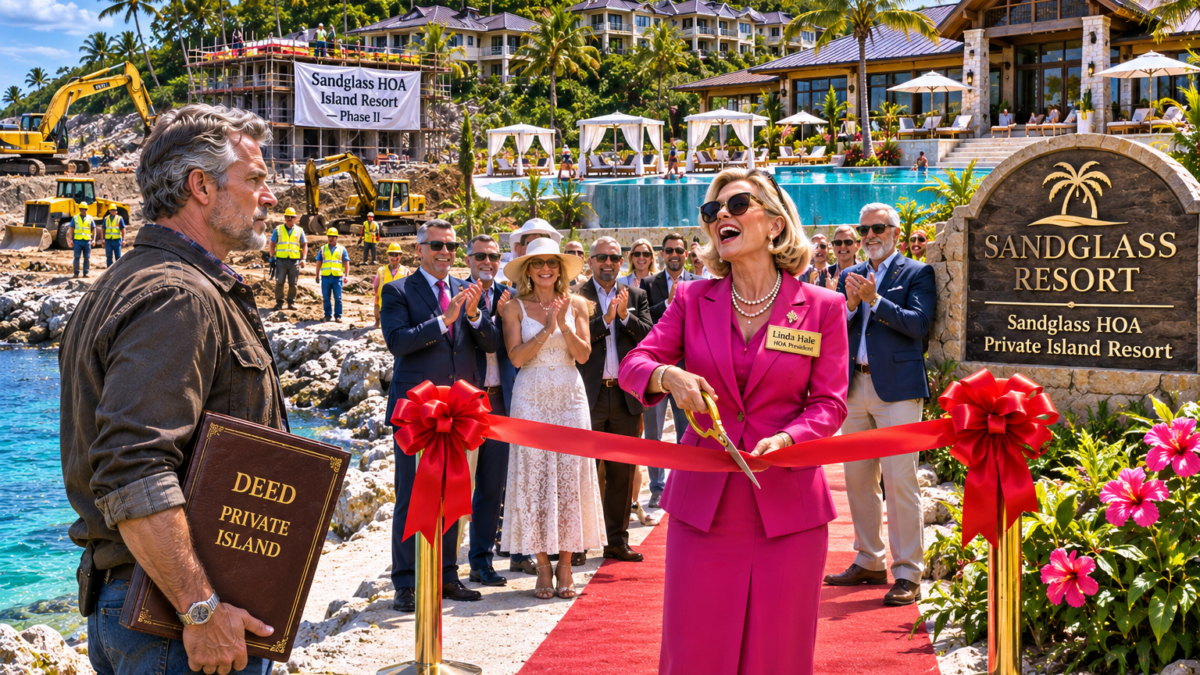
The champagne corks were still popping when Linda Hale cut a white ribbon across the entrance to a multimillion-dollar luxury resort built on my private island, smiling for television cameras while guests applauded beside an infinity pool that sat less than thirty yards from the spot where a bulldozer had torn through my late wife’s memorial.
For sixty days I had watched the Sandglass HOA pour concrete, drive pilings, build villas, advertise “community shoreline access,” and treat me like a bitter old trespasser, even though the original deed to the island was locked in my briefcase and every new wall they raised gave me one more timestamped photograph, permit violation, survey coordinate, and financial risk I could eventually put in front of a judge.
They thought my silence meant I had surrendered, but while Linda stood beneath confetti promising her members a paradise they believed they finally owned, I had already found a signature that wasn’t mine, a notary stamp from a business that had been closed on the day it supposedly witnessed the transfer, and one old line in my father’s papers that made me decide not to stop the construction—not yet.
I had owned the island long before Sandglass began calling it an amenity.
It sat about a mile off the harbor, a half-moon of white beach, marsh grass, palms, and an old boat shed that leaned farther every hurricane season without ever quite falling. My father bought it decades ago, and when he died, he left me the deed and a waterproof journal full of tide notes, survey marks, and advice that made more sense as I got older.
The only real house was a one-story cabin behind the palms.
My wife Caroline loved that place.
She would sit on the porch with coffee and count pelicans until she decided one of them looked friendly enough to deserve a name. Frederick was her favorite, although I’m fairly certain there were at least seven different Fredericks over the years.
After the cancer took her, I bolted a small brass memorial plaque beneath the porch rail.
Nothing elaborate.
Just her name, two dates, and one sentence:
SHE ALWAYS KNEW WHEN THE TIDE WAS TURNING.
I was a coastal engineer for twenty years, so shoreline movement wasn’t scenery to me. It was evidence. I measured mean high water lines, photographed accretion, tracked storm changes, and maintained updated surveys because my father had drilled one thing into me: if you own land beside moving water, you document what moves and what doesn’t.
Linda Hale apparently believed confidence could replace that work.
She was president of the Sandglass Community Association on the mainland, a gated development that had slowly transformed an old fishing town into a collection of private roads, custom mailboxes, and bylaws thick enough to stun a horse.
Our first real conversation happened at a county meeting.
“So you’re the gentleman with the island?” she asked.
“The island is with me,” I said. “It belongs to my deed.”
She smiled.
“Deeds can be corrected.”
Everyone around us chuckled.
I didn’t.
Three months later, I heard a barge engine crossing the inlet.
Men stepped onto my beach carrying stakes and fluorescent flagging.
A foreman waved a printed map.
“We’re here to stake the pier.”
“What pier?”
“HOA access project.”
“This is private property.”
He shrugged and showed me a recorded quitclaim deed claiming I had transferred the island to Sandglass.
I stared at the signature.
Not mine.
Then I looked at the bulldozer waiting on the barge.
For nine seconds, rage told me to cut their fuel lines, block the landing, and make them drag me off my own beach.
Instead, I pulled out my phone.
“Say your name again.”
The foreman blinked.
“What?”
“For the record.”
That was the moment my fight changed.
I stopped arguing.
I started documenting.
For three days I photographed equipment, workers, stakes, deliveries, and every inch of disturbance above the tide line.
Then, on the fourth morning, the bulldozer came up the beach.
I stood on the cabin porch with my camera running as its blade pushed through dune grass, crossed the path Caroline used to walk barefoot, and struck the edge of the porch.
The driver hesitated.
I saw the brass plaque catch the sun.
Then he lowered the blade again.
PART 2
The blade came down.
The porch rail snapped with a sound far smaller than grief deserved.
Caroline’s brass plaque twisted loose, struck the sand, and disappeared beneath a rolling wave of dirt and tire tracks.
I didn’t move.
The driver glanced at me through the cab glass.
For maybe two seconds, he looked ashamed.
Then someone behind him waved for him to continue.
The machine lurched forward.
I kept recording.
That was one of the hardest things I have ever done.
Every muscle in my body wanted to run down those steps, climb onto the bulldozer, and drag somebody out by his shirt.
Instead, I held the phone steady.
The red recording light blinked.
Behind the machine, the porch where Caroline and I had drunk coffee for nearly twenty years looked like a mouth with a broken tooth.
I whispered her name.
Then I went inside.
There was a photograph of her in the kitchen drawer beside the good scissors.
She was laughing in it, head tilted back, one hand holding her hat against the wind.
I propped it on the counter.
“I’m sorry.”
The generator outside droned.
I imagined what she would have said.
Probably something dry.
Something like, *You can apologize after you make them pay for the lumber.*
That was Caroline.
She believed anger was useful for approximately ten minutes.
After that, she preferred plans.
So did my father.
I took his waterproof journal from the shelf.
The first page had one word underlined twice.
**ACCRETION.**
Below it, in his neat handwriting:
**Water remembers what men forget.**
I looked toward the bulldozer.
“Fine,” I said.
“Let’s remember.”
***
The first thing I did was nothing dramatic.
I made coffee.
Then I wrote down the exact time the bulldozer struck the porch.
8:43 a.m.
Weather.
Tide.
Wind direction.
Equipment number.
Operator description.
Foreman present.
Photographs taken before and after.
Video file backed up.
I transferred the original footage onto two hard drives and uploaded another copy to encrypted cloud storage.
One drive stayed with me.
The second went into a safe-deposit box on the mainland.
By noon, the crew had cut a path through the dune grass.
By sunset, I had twenty-seven photographs, four video files, and a written log.
It felt absurd.
A memorial had been crushed and I was cataloging memory cards.
But evidence has one advantage rage doesn’t.
It survives the morning after.
***
The resort had a name before it had legal ground beneath it.
**SANDGLASS SHORES.**
A vinyl banner appeared on the construction barge the next week.
The rendering showed a glass lodge, six villas, a boardwalk, restaurant terraces, an infinity pool, and a long pier reaching into the inlet.
My cabin wasn’t included.
Neither was the marsh.
The rendering replaced most of the marsh with an artistic green blur.
Caroline would have hated that more than the resort.
She loved marshes.
“Everybody loves beaches,” she once told me. “Marshes are where you find out whether somebody has patience.”
I had patience now.
More than Linda understood.
***
The day after the plaque was destroyed, I went to the county recorder’s office.
I knew half the staff because coastal engineering turns government clerks into family whether either side wants it.
A woman named Denise pulled the recorded quitclaim deed for me.
The document looked convincing.
Parcel number.
Legal description.
Notary block.
My supposed signature.
It claimed I had conveyed all right, title, and interest in the island to Sandglass Community Association.
I stared at my fake name.
“That isn’t my signature.”
Denise’s expression changed.
“We record what’s presented. We don’t authenticate signatures at the counter.”
“I know.”
She leaned over.
“If you’re challenging the acknowledgment, the notary information is public.”
She pointed at the stamp number.
Tiny.
Easy to miss.
I copied it.
Then I drove two towns inland.
The notary worked from a shipping and print store in a strip mall.
The manager was a man named Harold who wore reading glasses on top of his head and another pair around his neck.
I gave him the date.
He opened the log.
Turned one page.
Then another.
His eyebrows rose.
“That’s odd.”
“What?”
“We were closed.”
“What?”
“That date was a Sunday.”
“So?”
“We weren’t open Sundays then.”
My fingers tightened around the edge of the counter.
“Could someone have met the notary elsewhere?”
Harold shook his head.
“Not according to the journal.”
He turned the book toward me.
Saturday.
Entries.
Monday.
Entries.
Sunday.
Nothing.
A clean blank line where my supposedly notarized transfer was supposed to exist.
I asked permission to photograph the relevant pages.
He let me.
I took three pictures.
Then I asked for a written confirmation of the store hours from that period.
He printed one.
I thanked him.
As I walked back to my truck, I felt something inside me settle.
The first real crack.
***
That evening I wrote three letters.
The first went to Sandglass Community Association.
**CEASE TRESPASS. PRESERVE ALL RECORDS. ALL FURTHER COMMUNICATION IN WRITING.**
The second went to Blue Harbor Resorts, the developer.
I informed them of a title defect, disputed ownership, alleged forgery, and my reservation of all rights.
I also notified their insurer.
The third letter wasn’t mailed.
I wrote it to myself.
One sentence.
**DO NOT SAY ANYTHING YOU WOULD NOT WANT READ ALOUD IN COURT.**
I taped it above the kitchen sink beside Caroline’s photograph.
That sentence probably saved me more money than any lawyer eventually did.
***
Linda Hale arrived personally on day ten.
Her pontoon boat touched the beach just after noon.
She wore a white linen suit.
White.
On a construction site.
I knew immediately we were dealing with a person who expected dirt to respect authority.
Three board members followed her.
Linda stepped onto the sand.
“I’m glad we can finally discuss this reasonably.”
“You forged my signature.”
One board member looked at her.
Linda’s smile didn’t move.
“That allegation is defamatory.”
“Good thing I sent it to your attorney instead of a newspaper.”
She lifted a folder.
“We acted on recorded instruments.”
“You recorded a document I didn’t sign.”
“That will be determined.”
“Correct.”
I pointed toward the bulldozer trench.
“And somebody will determine why your contractor destroyed my wife’s memorial.”
For the first time, Linda looked toward the damaged porch.
Something human flickered across her face.
Then disappeared.
“We regret incidental property disturbance.”
I laughed once.
“Incidental.”
“We are prepared to resolve that.”
She handed me a document.
“License agreement.”
I didn’t take it.
“What does it license?”
“Your continued use of the cabin.”
I stared at her.
“On my island.”
“On property now administered by Sandglass.”
One of the men behind her shifted uncomfortably.
Linda continued.
“We’re offering generous terms. You could retain seasonal access.”
I said nothing.
“And,” she added, “the board is willing to name the fishing pier after your wife.”
That landed harder than I expected.
They had bulldozed Caroline’s plaque and were offering me naming rights to the structure they built beside the wreckage.
I looked at Linda.
“You think putting her name on your pier fixes what you did?”
“It would preserve her memory.”
“No.”
“Please be reasonable.”
I finally took the document.
Not because I intended to sign it.
Because documents become evidence.
Linda relaxed slightly.
Then I said:
“Your problem isn’t access.”
“What?”
“It’s the tide.”
She frowned.
“You built your entire claim on a shoreline line that moves.”
I tapped the folder.
“And I measure moving shorelines for a living.”
Her smile tightened.
“We open in sixty days.”
“I know.”
“Then you understand the reality.”
“I do.”
“What reality?”
I looked at the half-built pier.
“The longer you build, the more expensive reality becomes.”
She stared.
Then turned toward the boat.
“You’ll come around.”
“Maybe.”
I smiled.
“In court.”
***
That night, I spread five years of shoreline photographs across the porch table.
My father had taught me to photograph fixed reference points after every major storm.
Palm cluster.
Boat shed corner.
Old dock piling.
Dune marker.
Marsh edge.
Over twenty years, the island had changed.
Sand accumulated along the southern crescent.
A new spit had grown after two hurricanes and several calmer seasons.
That process—accretion—mattered because gradual natural additions to shoreline property can become part of the upland owner’s property depending on local law and circumstances.
My deed anticipated it.
The language had been there for decades.
**Together with all accretions thereto.**
Sandglass’s annexation map relied on an older county base layer showing a much straighter shoreline.
That map shaved off a piece of land that physically existed now.
And Blue Harbor was building on it.
I overlaid current drone photographs.
The infinity pool footprint crossed onto the newer accreted area.
Two proposed villas did too.
The pier complicated everything further because some pilings extended below the mean high water line where state submerged-land rules became relevant.
Linda had not stolen one simple square.
She had built a legal puzzle.
Unfortunately for her, puzzles were the closest thing I had left to a hobby.
***
I began flying the drone every morning.
Same altitude.
Same route.
Same camera angle.
I placed datum boards along the dune.
Each board had a letter.
A.
B.
C.
D.
The drone captured them in relation to construction.
Date.
Time.
GPS position.
Tide stage.
By the second week, I could create a visual timeline of the resort growing across disputed land.
Pilings.
Foundation forms.
Rebar.
Concrete.
Utilities.
Boardwalk.
Pool.
Nothing disappeared.
***
I also requested every public record I could legally obtain.
County communications.
Environmental permits.
Dredging correspondence.
Planning emails.
Harbor logs.
Blue Harbor permit applications.
The returns came slowly.
Mostly boring.
Boring is useful.
Buried inside one packet was a scanned meeting note from a county planner.
**Private title issue may exist at island shoreline. Recommend independent verification before construction.**
In the margin, someone representing the HOA had written:
**Record first. Challenge later. Possession matters.**
I read that twice.
Then printed it on heavy paper.
Not because heavy paper has greater evidentiary value.
Because sometimes I am petty in ways that do not harm the case.
***
The construction crews grew accustomed to me.
I learned their names.
Denny was the foreman.
Kendrick operated the crane.
The environmental subcontractor was a young man who referred to cattails as “nice reeds,” which told me almost everything I needed to know.
I greeted them.
Never threatened them.
Never blocked equipment.
Never touched materials.
My cameras remained visible.
One afternoon, Kendrick climbed down from his crane.
“You really own this?”
“Yes.”
“All of it?”
“The parts above lawful private boundary, yes. State interests apply below high water.”
He looked toward the lodge.
“They told us the title was clean.”
“They told you wrong.”
He glanced at my drone.
“You documenting everything?”
“Yes.”
He shook his head.
“Man.”
“What?”
“If you’re right, somebody’s going to have a terrible year.”
“That’s the plan.”
He laughed.
Then stopped.
“Not for us, right?”
“Workers get paid to build what employers tell them to build. My fight is with the people who knew.”
That mattered to me.
The guy carrying lumber didn’t forge a deed.
The woman wiring the kitchen didn’t annex anything.
I had no interest in making ordinary workers collateral damage.
***
The environmental problems began piling up on their own.
No dramatic sabotage required.
One night, Blue Harbor scheduled a concrete pour.
I filmed from my porch.
A pump boom stretched over the dune.
After the pour, a worker rinsed residue near the marsh fringe.
Gray water moved into grass.
I sent the video to the state environmental office.
Subject line:
**POTENTIAL CONCRETE WASHOUT INTO JURISDICTIONAL WETLAND AREA**
A biologist named Dr. Lena Ortiz called the next afternoon.
“You have timestamps?”
“Yes.”
“Tide?”
“Yes.”
“Location?”
“Yes.”
“Prior condition photographs?”
“Yes.”
She was quiet.
“You’re an engineer.”
“Unfortunately.”
She laughed.
“We’ll inspect.”
Three days later, she arrived.
She spent hours measuring.
Nest depressions.
Vegetation.
Washout.
Construction setbacks.
At one point she looked at me.
“We receive a lot of angry complaints.”
“I imagine.”
“Most people send a blurry photograph and the sentence, ‘Do something.’”
“I used to review permit complaints.”
“I noticed.”
She looked toward the pool structure.
“This is going to be interesting.”
That was the most excited sentence I had heard from a regulator in twenty years.
***
On day twenty-one, Blue Harbor’s insurer sent an adjuster.
My notice of title defect had forced them to pay attention.
The adjuster photographed everything.
Read my deed.
Looked at the fake quitclaim.
Asked whether I intended to sue.
“Yes.”
“When?”
“When the timing makes sense.”
He frowned.
“That’s an unusual answer.”
“I’m an unusual claimant.”
He left with more questions than he arrived with.
Good.
Insurers understand risk in a language developers often ignore.
***
Sandglass began fining me.
That part almost became funny.
Fifty dollars a day for “obstruction of authorized amenity access.”
One hundred dollars for “shoreline debris.”
The debris was from their bulldozer trench.
Two hundred dollars a day for “noncooperation with authorized board representatives.”
The notices arrived on stationery decorated with a tiny smiling lighthouse.
I kept every one.
Photographed the postmarks.
Logged the dates.
Filed them beside construction images from the same day.
If they wanted to produce documents, I was happy to organize them.
***
Then came the newsletter.
My photograph appeared beneath the headline:
**HOLDOUT BLOCKS SHORELINE ACCESS FOR ALL**
The article called me unreasonable.
It suggested I was squatting on community shoreline.
It claimed workers had experienced hostility and intimidation.
I had body-camera footage of nearly every interaction.
Their article became another file.
Not anger.
File.
That became my rhythm.
They lied.
I archived.
They threatened.
I logged.
They built.
I measured.
***
One afternoon, a Sandglass board member arrived carrying a beach towel.
He stepped onto the sand in front of my cabin.
Set down the towel.
Turned on his phone.
“This is public shoreline,” he announced.
I walked into frame.
“You’re above the mean high water line.”
He smiled at his camera.
“So?”
“You’re on private property.”
“There. Threat.”
“What threat?”
“You told me I’m trespassing.”
“That is a description.”
He uploaded an edited version that evening.
The clip cut my explanation and made my voice sound harsher.
Unfortunately for him, my body camera had the entire interaction.
I saved both versions.
Original.
Edited.
Side by side.
Caroline would have appreciated that one.
She taught journalism before she got sick.
“Never argue with an edit,” she once told students. “Find the source.”
I had the source.
***
The resort grew.
Walls rose.
Glass arrived.
The infinity pool became a concrete shell.
Boardwalk framing stretched across the marsh.
A pier pushed deeper into the inlet.
Sandglass created a website.
**72 DAYS TO PARADISE.**
Then sixty-eight.
Sixty-one.
Fifty-nine.
The marketing page called the project a “public-private coastal partnership.”
It wasn’t.
I archived the website three ways.
PDF.
Screenshots.
Web capture.
On the resort rendering, my cabin vanished entirely.
I stared at that more than I should have.
They hadn’t only claimed my island.
They had edited me out of it.
***
At the county GIS office, an analyst showed me something important.
An older aerial mosaic used by Sandglass’s planning consultant had a known positional offset near the shoreline.
A few meters.
Not dramatic on a computer screen.
Very dramatic when somebody uses that screen to decide who owns land worth millions.
The analyst emailed me metadata.
I added it to the file.
Then I located the surveyor who had prepared an old plat on which Sandglass heavily relied.
He was retired.
He invited me to his house.
Garden out back.
Iced tea.
A dog that disliked my shoes.
He studied the old map.
“I hated that job.”
“Why?”
“No budget.”
He pointed at the shoreline.
“We used county base imagery. Didn’t establish enough ground control.”
“So this straight line?”
“Approximation.”
“Could it establish title?”
He laughed.
“Absolutely not.”
“Would you say that in court?”
His eyes lit up.
“I’m retired.”
“That sounds like yes.”
“That is a yes.”
He drew a correction on my overlay.
Initialed it.
Then handed it back.
“Maps are dangerous when people confuse convenience with truth.”
I put that sentence in my notebook.
***
My father had also maintained an old submerged-lands option near the dock.
Years earlier, he had worried that someone might moor a floating billboard in our inlet.
That sounds ridiculous.
It nearly happened.
His paperwork gave me additional standing in a small underwater notch near where Blue Harbor had placed part of its pier.
The file had nearly expired.
I renewed it.
Quietly.
No social-media post.
No threat.
Just another door locked from my side.
***
Then I found the HOA voting clause.
Page seventeen of their own bylaws.
It required a two-thirds vote of the full membership before conveyance or encumbrance of common property.
Sandglass’s annexation theory claimed the island had somehow become associated common area before being committed to the resort project.
Even if I pretended that nonsense were true, the board still hadn’t held the required member vote.
They had approved the project in an internal meeting.
Linda and a few directors.
That was it.
No two-thirds vote.
No properly noticed membership action.
No authority even under the fiction they had created.
I circled the clause.
Red pen.
Then made three copies.
***
The pressure campaign intensified when Linda realized I wasn’t leaving.
A code officer came to inspect my cabin.
Two HOA volunteers followed him with cameras.
One narrated.
“Subject is approaching.”
I was holding coffee.
“Morning,” I said.
The officer looked embarrassed.
“We received a complaint about an illegal structure.”
“This cabin predates Sandglass.”
“I understand.”
“Your county jurisdiction ends differently from HOA jurisdiction. And the HOA has no jurisdiction here.”
The volunteers kept filming.
I pointed toward the dock.
“You’re also standing on disputed private property.”
The officer swallowed.
“I’d like to review the records.”
“Happy to provide them.”
I handed him water.
That was the footage Sandglass got.
Me offering a nervous code officer bottled water.
Their propaganda department did not use it.
***
The sheriff’s office came once.
A deputy idled near the cove.
He waved.
I waved back.
Eventually he called from his boat.
“Got a minute?”
“Sure.”
“We’ve had complaints about escalating conflict.”
“From Linda?”
He smiled slightly.
“I don’t discuss complainants.”
“Fair.”
I handed him the deed copy.
Then the notary information.
Then the HOA bylaw clause.
He stared.
“You carry all this?”
“I have a waterproof folder.”
“You’re recording me?”
“Yes.”
He pointed toward his body camera.
“So am I.”
“I’ll request yours later so our memories match.”
He laughed.
“Keep this boring.”
“I’m trying.”
“That’s good.”
He motored away.
Two days later, I saw him in the grocery store.
He tapped his shopping cart against mine.
“Still boring?”
“Painfully.”
“Perfect.”
***
The state issued a notice of probable environmental violation.
Blue Harbor denied everything.
Their project manager sent me an email.
**OUR OPERATIONS MEET OR EXCEED ALL APPLICABLE REQUIREMENTS.**
His signature block included their slogan:
**BUILDING TOMORROW.**
I replied with a timestamped photograph of concrete slurry in marsh grass.
One sentence.
**Please preserve this with your compliance records.**
Sarah—my eventual attorney—would later tell me that was one of her favorite emails in the case.
At the time, I didn’t even have Sarah.
I was still building the file.
***
The next move was the bank.
Blue Harbor’s glossy brochure listed the construction lender.
I sent the bank a professional notice.
No theatrics.
I attached the disputed deed.
Notary log.
Shoreline overlay.
Environmental notice.
HOA voting clause.
I wrote:
**Your collateral may include improvements located on land subject to a substantial title dispute. I intend to pursue record notice and judicial relief. Please govern future disbursements accordingly.**
Banks do not fear insults.
Banks fear uncertain collateral.
A loan officer called the next afternoon.
“Could we discuss your concerns?”
“Everything is in the letter.”
“We’d like clarification.”
“So would I.”
“About what?”
“How your borrower obtained clean title.”
Silence.
“We’ll review.”
“Good.”
I hung up.
***
Linda responded by staging a “Community Shoreline Day.”
Families came by boat.
Branded shirts.
Lemonade tables.
Local television.
Children with plastic shovels.
Linda stood in front of the resort site.
“This project represents what happens when shared vision overcomes individual obstruction.”
I watched from my porch.
Behind the television camera, one volunteer drove a decorative pennant stake through a protected patch of seagrass.
Another stepped into a marked nesting depression.
My drone captured both.
The evening news showed smiling children.
My archive showed Exhibit 32.
Same event.
Different purpose.
***
Then someone inside Sandglass began leaking emails.
The first came from an address I didn’t recognize.
No message.
Just a forwarded thread.
Treasurer to Linda:
**We cannot afford continued environmental exposure if the state formalizes violations. Members are also asking why there was no vote on annexation.**
Linda replied:
**WE WILL NOT BLINK.**
I printed it.
Taped a copy above my sink beneath my own promise.
**DO NOT SAY ANYTHING YOU WOULD NOT WANT READ ALOUD IN COURT.**
Beside it:
**WE WILL NOT BLINK.**
Caroline’s photograph sat between them.
My wife had become the neutral referee in the world’s strangest argument.
***
By then, I had retained counsel.
Her name was Rebecca Sloan.
She had handled coastal title disputes, riparian boundaries, and more than one developer who believed maps were decorations.
She came to the island carrying two briefcases and wearing boots.
Smart woman.
She spent four hours reviewing my evidence.
When she finished, she stared at me.
“You’ve done more pre-litigation preservation than half the corporate clients I represent.”
“I was bored.”
“You were not bored.”
“No.”
She looked toward the resort.
“Why haven’t you sued yet?”
“Because they haven’t finished.”
Rebecca’s eyebrows rose.
“You want them to finish?”
“I want them comfortable.”
“That’s dangerous.”
“I know.”
“You could seek an injunction now.”
“I know.”
“You may have a duty to mitigate certain damages.”
“I know.”
“So explain.”
I showed her the shoreline overlay.
The bank letter.
The insurer’s claim number.
The bylaw clause.
The environmental violations.
Then the resort rendering.
“The more permanent the improvements become, the harder it is for them to pretend the title problem is theoretical.”
Rebecca leaned back.
“You understand we cannot intentionally manufacture damages.”
“Yes.”
“I will not advise you to sit silently if safety or irreversible environmental harm demands action.”
“Agreed.”
“But you’re saying you have repeatedly warned them.”
“Certified mail. Insurer. Bank. Developer. HOA. County.”
“And they keep building.”
“Yes.”
She looked toward the infinity pool.
“Arrogance is expensive.”
“That’s what I’m counting on.”
She smiled for the first time.
“Fine.”
Then she pointed at me.
“But from now on, I decide when patience becomes negligence.”
“Deal.”
***
Rebecca improved everything.
My litigation holds became formal.
HOA.
Blue Harbor.
Engineer of record.
Environmental consultant.
PR firm.
Bank where appropriate.
Preserve emails.
Texts.
Messaging applications.
Project logs.
Inspection notes.
Photographs.
Website drafts.
Board communications.
Permit correspondence.
Notary materials.
No deletion.
No cleanup.
No disappearing messages.
Their attorneys responded with polished indifference.
That made Rebecca happy.
“Why?”
“Because if they destroy something later, I get to use words judges dislike.”
“Such as?”
“Spoliation.”
“That is a good word.”
“It’s an expensive word.”
Even better.
***
As opening day approached, the resort became almost beautiful.
That bothered me.
Glass walls caught sunsets.
The pool reflected the sky.
The villas looked clean and expensive.
Landscaping softened the scars.
If I didn’t know what sat underneath it, I might have admired the work.
That taught me something uncomfortable.
Wrong things can be beautiful.
Beauty doesn’t cure title.
It doesn’t fix fraud.
It doesn’t resurrect a memorial.
Still, I had to keep reminding myself that most of the craftsmen had simply done their jobs.
My anger belonged higher up the chain.
***
The night before the ribbon cutting, I sat where Caroline’s plaque had been.
I could still see a brass-colored corner under compacted sand.
I dug with my fingers.
Nothing.
The fragment disappeared deeper.
I stopped.
Rebecca had warned me not to disturb active construction areas unnecessarily.
So I sat.
The resort lights glowed behind me.
Caroline and I had once spent entire evenings in darkness there.
No electricity beyond the cabin.
No music.
Just tide.
She had said once:
“Waiting isn’t doing nothing.”
We were discussing chemotherapy.
The weeks between scans.
The hours between lab calls.
“Waiting is pressure pointed in a direction you can’t see yet.”
At the time, I thought she was trying to make fear sound intelligent.
Now I understood.
I took out my phone.
Sent Rebecca one message.
**Tomorrow they cut ribbon. Monday we file.**
She responded:
**8:01 a.m.**
I slept eight hours.
First full night in weeks.
***
Saturday arrived blue and bright.
Boats filled the inlet.
Yachts anchored.
Television crews unloaded.
Influencers posed beside dunes they couldn’t identify.
A quartet played near the pool.
White chairs faced a podium.
Linda wore cream linen.
Of course she did.
I wore a clean shirt and the hat I usually saved for funerals.
Nobody stopped me.
Perhaps they had been told not to create a scene.
Perhaps Linda wanted cameras to capture how little power I supposedly had.
She took the stage.
“Today, Sandglass Shores becomes a shared legacy.”
Applause.
Behind her, the resort shimmered.
“Our community refused to be divided by obstruction.”
More applause.
I looked at my watch.
12:03 p.m.
Drone overhead.
Timestamp running.
Linda lifted oversized ceremonial scissors.
“Today we open our shoreline to the future.”
She cut.
Ribbon snapped.
Confetti cannons fired.
Champagne sprayed.
People cheered.
The infinity pool glittered.
A child jumped.
A photographer shouted for Linda to turn toward the water.
She did.
For one moment, she looked directly at me.
Ten feet away.
She smiled.
Not cruelly.
Triumphantly.
Like a person who believed patience belonged to the loser.
I smiled back.
That unsettled her.
Good.
***
Monday morning, 8:01 a.m.
Rebecca and I stood at the county clerk’s counter.
We recorded a **lis pendens** giving public notice that title to the resort property was in active litigation.
Then we filed the quiet-title complaint.
Ejectment claims.
Trespass.
Damages.
Declaratory relief.
Environmental-related claims where appropriate.
Claims challenging the HOA’s asserted annexation and authority.
The filing attached my chain of title.
The accretion language.
Current shoreline evidence.
The notary contradiction.
HOA voting requirements.
Construction notices.
Bank correspondence.
Blue Harbor notice.
My sworn declaration.
Caroline’s memorial photographs.
Everything.
The clerk stamped the papers.
One sound.
Thunk.
Sixty days of steel, concrete, PR campaigns, security guards, newsletters, and champagne met a rubber stamp.
Rebecca looked at me.
“Feel better?”
“No.”
“Good.”
“Why good?”
“Because now we work.”
***
Service went out that afternoon.
Sandglass HOA.
Blue Harbor Resorts.
Their attorneys.
Linda personally.
Engineer.
Relevant contractors.
By 4:12 p.m., the bank emailed Rebecca requesting “urgent discussion of resolution pathways.”
She forwarded it to me.
I called her.
“Should we answer?”
“No.”
“I like you.”
“I’m billing you for that compliment.”
***
We also filed for temporary emergency relief.
The resort had already begun taking bookings.
That increased the stakes.
Rebecca argued occupancy should stop until title and environmental issues were clarified.
Blue Harbor responded immediately.
They called me a disgruntled holdout.
A former resident.
I had never been a Sandglass resident.
They called the island “community common area.”
Their evidence was the same straight-line plat and disputed deed.
They claimed pausing the resort would cause severe economic harm.
Rebecca read the brief.
“Economic harm.”
“Sounds serious.”
“It is.”
“Do they own the island?”
“That is more serious.”
***
Judge Talia Morgan got the case.
Former admiralty lawyer.
Reputation for reading everything.
Rebecca told me that was either excellent or terrifying.
The emergency hearing was Friday.
I spent Thursday preparing exhibits.
Notary log beside recorded deed.
Shoreline map beside updated drone overlay.
Bylaws beside meeting minutes showing no membership vote.
Environmental permit conditions beside photographs.
Harbor records beside night delivery footage.
Bank warning beside continued construction invoices.
Every exhibit had a partner.
Cause.
Contradiction.
Evidence.
***
Blue Harbor’s attorney began Friday morning.
Expensive suit.
Excellent voice.
He spoke about hundreds of families.
Seasonal jobs.
Community expectations.
Tourism.
Financial harm.
Public interest.
He described my decision to wait as evidence that I had accepted the project.
Rebecca wrote something on a pad and slid it toward me.
**HE IS HELPING US.**
I almost smiled.
Then the attorney held up the old plat.
Straight shoreline.
Simple.
Comforting.
Wrong.
When it was our turn, Rebecca stood.
“Your Honor, this case contains many emotionally attractive words—community, amenity, access, opportunity.”
Judge Morgan looked over her glasses.
Rebecca continued.
“None of those words convey title.”
Then she called me.
I testified to the chain of ownership.
My father’s deed.
Accretion language.
Survey practices.
The first barge.
The fake transfer.
Notary log.
Written notices.
My repeated objections.
“Why did you not physically stop construction?”
Blue Harbor objected to form.
Overruled.
I answered.
“Because I notified the parties, their insurer, and their lender that title was disputed. I did not believe I was required to risk a confrontation with heavy equipment to preserve ownership.”
Rebecca showed the letters.
Certified receipts.
Delivery dates.
Blue Harbor knew.
Sandglass knew.
Their insurer knew.
The bank knew.
And construction continued.
***
Dr. Ortiz testified next.
Nest sites.
Marsh impacts.
Washout.
Permit setbacks.
Photographs.
Then the retired surveyor.
He admitted his old map was simplified.
“Would you use this plat alone to establish a current shoreline ownership boundary?”
“No.”
“Why?”
“Because water moves and the image source had limitations.”
Blue Harbor tried to attack him for earlier sloppiness.
He nodded.
“Yes.”
The lawyer paused.
The surveyor continued.
“I did imperfect work. That doesn’t make later misuse of it accurate.”
Judge Morgan wrote something down.
***
Then Rebecca placed the notary log on the screen.
Recorded deed date.
Sunday.
Store closed.
No journal entry.
Blue Harbor objected.
The judge leaned toward the screen.
“Counsel.”
“Yes, Your Honor?”
“Who authenticated the deed?”
Their lawyer began explaining recording presumptions.
Judge Morgan stopped him.
“I understand recording law.”
Silence.
“I’m asking a simpler question.”
She tapped the page.
“Who watched the plaintiff sign?”
No one had a clean answer.
That mattered.
***
Judge Morgan granted the temporary restraining order.
No new occupancy.
No additional disputed construction.
Preservation of documents.
Access for court-authorized surveying and regulatory inspection.
No interference with evidence.
The sheriff posted the order on the resort’s glass doors.
Guests arriving for their first weekend stared at it.
One couple still wore matching white resort clothes.
The woman read the notice twice.
Then looked at the infinity pool.
Then at me.
I almost felt sorry for them.
They had booked a vacation.
They hadn’t forged anything.
***
The bank froze additional construction draws pending clarification.
The insurer issued a reservation-of-rights letter.
The countdown clock disappeared from Sandglass Shores’ website.
The HOA newsletter called the closure a “temporary compliance pause.”
Rebecca printed it.
“Why?”
“Because words are funny.”
“You’re becoming me.”
“Don’t insult me.”
***
Linda held an emergency town hall.
For once, I attended.
Members packed the room.
Less champagne.
More receipts.
Linda opened with a speech about “a vocal minority.”
A man interrupted.
“Who voted for the island?”
Linda stopped.
She tried to continue.
Another woman stood.
“The bylaws say two-thirds.”
Linda looked toward counsel.
Counsel looked down.
I raised my hand.
Linda ignored me.
Someone shouted:
“Let him speak.”
That was new.
Linda reluctantly nodded.
I stood.
“Did Sandglass hold the required membership vote before claiming or conveying any interest in the island?”
“Our legal team advised—”
“Yes or no?”
“This is more complicated.”
A builder in the back stood.
“No, it isn’t.”
Linda’s jaw tightened.
He held up a highlighted copy of the bylaws.
“Did we vote?”
Silence.
He repeated:
“Did we vote?”
“No.”
The room erupted.
Not because everyone suddenly loved me.
Because millions of dollars of member assessments had gone into a resort that their own board may not have had authority to commit.
People become interested in governance when invoices arrive.
***
Discovery followed.
Emails.
Texts.
Group chats.
Meeting minutes.
PR drafts.
Permit communications.
Internal warnings.
Most were dull.
Then came the message.
Linda to board members.
Two days before the questionable Sunday notarization.
**We must have this recorded by Monday. If the notary won’t meet, find someone who will stamp. Eyes on the prize.**
Rebecca read it at our office.
Then read it again.
“What?”
I asked.
She looked at me.
“This is very bad.”
“For her?”
“For everyone who thought settlement leverage had peaked.”
***
The preliminary-injunction hearing was set for the following week.
By then, the court-authorized county surveyor had begun a retracement.
The state had expanded its inspection.
The bank had hired separate counsel.
The insurer had hired separate counsel.
Blue Harbor had hired a second law firm.
Nothing says confidence like four sets of attorneys.
***
Judge Morgan’s courtroom was full again.
The county surveyor testified first.
She projected a fresh mylar drawing.
Current control points.
Current shoreline.
Accreted uplands.
Mean high water.
Pier location.
Pool deck.
Villas.
The annexation map.
She pointed.
“The HOA map relies on an older imagery layer with known positional error.”
Blue Harbor’s lawyer said:
“Offsets occur commonly.”
She looked at him.
“Yes.”
“So this is not extraordinary.”
“No.”
He smiled.
Then she added:
“Using an image with known offset as a substitute for a boundary survey is extraordinary.”
His smile disappeared.
She clicked to the next overlay.
“Portions of the infinity-pool deck and two villas are on accreted uplands associated with plaintiff’s titled property.”
Next.
“Several pier components extend into areas subject to state submerged-land jurisdiction.”
Judge Morgan leaned forward.
Blue Harbor’s attorney tried again.
“Surveying along dynamic coastlines contains interpretation.”
The county surveyor looked at him.
“Interpretation is not invention.”
Rebecca wrote something.
I glanced.
**I WANT HER ON EVERY CASE.**
***
Then came the forensic-document examiner.
She enlarged the quitclaim signature.
Notary stamp.
Known handwriting.
Seal examples.
She identified inconsistencies.
Not absolute magic.
Not television certainty.
But enough to reinforce what every other fact already suggested.
The notary journal contradiction remained devastating.
Store closed.
No entry.
No credible explanation for how the acknowledgment happened.
Then Rebecca displayed Linda’s message.
**IF THE NOTARY WON’T MEET, FIND SOMEONE WHO WILL STAMP.**
The courtroom made that small collective sound human beings make when a lie loses oxygen.
Judge Morgan looked at Linda.
“Ms. Hale.”
Linda sat perfectly still.
The judge continued.
“You should discuss this communication carefully with your counsel.”
Linda’s attorney whispered to her.
For the first time since I met her, Linda looked frightened.
Not angry.
Frightened.
***
My testimony was simpler.
Dates.
Coordinates.
Photographs.
Letters.
No speeches.
Blue Harbor’s attorney cross-examined me.
“You dislike Sandglass Community Association.”
“I dislike forged property documents.”
“You deliberately allowed construction to continue.”
“I repeatedly notified every relevant decision-maker that ownership was disputed.”
“You wanted costs to increase.”
“I wanted them to stop.”
“But you didn’t file immediately.”
“I was gathering evidence and attempting nonjudicial notice.”
“You enjoyed watching the project become financially vulnerable.”
Rebecca objected.
Judge Morgan allowed limited answer.
I looked at the lawyer.
“No.”
He waited.
“I watched a bulldozer crush my wife’s memorial.”
The courtroom became quiet.
“I did not enjoy any part of this.”
He shifted.
“Yet you waited until after the ribbon cutting.”
“Yes.”
“Why?”
That was the question.
The defense finally had something that sounded ugly.
I told the truth.
“Because after written notice, after the title warning, after the insurer was notified, after the bank was notified, and after regulators had raised issues, they kept building.”
I looked toward Linda.
“They were creating permanent facts on the ground to make me look unreasonable if I resisted.”
Then back at the lawyer.
“So I documented those permanent facts.”
“You wanted leverage.”
“I wanted proof.”
“Same thing?”
“No.”
I paused.
“Leverage disappears when facts change.”
I looked at my binders.
“Proof stays.”
***
The state biologist testified.
Harbor master.
Retired surveyor.
Bank representative.
Then the HOA presented a “community benefits expert.”
He talked about recreation.
Social value.
Coastal access.
Children seeing sunsets.
Judge Morgan listened politely.
Then asked:
“Did the membership approve the conveyance required under Section 7.3?”
He hesitated.
“I’m not a governance expert.”
“That was not my question.”
“No.”
“Thank you.”
The community-benefits testimony ended quickly after that.
***
The PR firm made things worse.
Subpoenaed drafts included internal messaging documents.
One was titled:
**HOLDOUT RESPONSE — FINAL**
Then:
**HOLDOUT RESPONSE — FINAL 2**
Then:
**HOLDOUT RESPONSE — FINAL REALLY FINAL**
Rebecca loved that.
Inside was a strategy note:
**FRAME: ECCENTRIC PRIVATE OWNER VS. COMMUNITY PROGRESS**
Another:
**IF LITIGATION FILED, EMPHASIZE SHARED VISION, COMPROMISE, AND OFFER MEMORIAL NAMING OPPORTUNITY.**
My stomach turned.
Caroline’s pier.
Not kindness.
Strategy.
They had planned the offer before Linda arrived.
Rebecca looked toward Linda.
Linda looked down.
That hurt differently.
I had thought, briefly, that maybe Linda’s offer to name the pier after Caroline was a clumsy human attempt at compassion.
It wasn’t.
It was a messaging pillar.
I stopped looking at Linda after that.
***
Judge Morgan issued the preliminary injunction the next morning.
She spoke for seventeen minutes.
Ownership evidence strongly favored me.
The HOA lacked required membership authority for the claimed conveyance.
The quitclaim deed showed serious authenticity problems.
The shoreline map was unreliable.
Current surveying indicated encroachments on accreted uplands.
State interests were implicated at the pier.
Environmental issues remained unresolved.
Operations would remain closed.
No occupancy.
No further disputed construction.
Blue Harbor had to post a bond.
Sandglass had to escrow certain amenity funds.
A special master would complete an independent retracement.
State regulators would continue their work.
Then Judge Morgan addressed document preservation.
Any destruction after litigation holds could lead to sanctions.
Phones would be preserved for forensic imaging.
Relevant PR materials produced with metadata.
Original acknowledgment materials produced if they existed.
Then the line that finally made Linda blink.
“The court is referring the circumstances surrounding the disputed quitclaim instrument to appropriate state authorities for review.”
Not conviction.
Not arrest.
Referral.
Still enough.
A storm warning.
***
That afternoon I found Caroline’s plaque.
A bent brass corner stuck out of a spoil pile behind the dune.
I knelt.
Pulled carefully.
Half the plaque came free.
Her name remained visible.
CAROL—
The rest had been torn away.
I sat in the sand holding it.
For months, I had been good at being controlled.
Professional.
Methodical.
Useful.
That afternoon, I cried.
Not dramatically.
No collapse.
Just tears falling onto dirty brass.
I carried the fragment to the porch.
Washed it.
Set it beside her photograph.
“We’re getting there.”
The resort stood silent behind me.
No generators.
No music.
No guests.
The infinity pool held perfectly still.
For the first time since construction began, the island sounded like itself.
***
Linda passed my dock the next morning alone.
Small skiff.
No cameras.
No linen.
She throttled down.
“You could have taken the agreement.”
I looked at her.
“What agreement?”
“The license.”
“On my own island?”
“We offered to honor Caroline.”
“You offered a PR strategy.”
Her face changed.
I held up the printed messaging document.
She looked away.
“That wasn’t my language.”
“You signed off on it.”
Silence.
Then she looked toward the broken porch.
“We were wrong about the memorial.”
“You bulldozed her name.”
“I know.”
“No.”
I shook my head.
“You know it looks bad.”
She flinched.
“Knowing what you did would require you to stop defending it.”
Her hands tightened on the wheel.
“We believed the project served people.”
“Maybe it could have.”
That surprised her.
I continued.
“If you’d asked.”
She said nothing.
“If you’d come to me with a plan. A conservation boardwalk. Limited access. Education. Something that respected title and marsh.”
“You would have said no.”
“Maybe.”
I looked at her.
“That was my right.”
The tide pulled gently against her hull.
She started the engine.
Before leaving, she said:
“This will bankrupt people.”
“So did building first and checking ownership later.”
She drove away.
***
Special Master Abel Ramsey arrived the next week.
He was a surveyor old enough to distrust every electronic device until it proved itself twice.
Yellow tripod.
Field book.
No patience for speeches.
He spent three mornings with the county surveyor.
On the fourth, he closed his notebook.
“The line isn’t where their map says.”
That was all he told me.
His report later confirmed it.
A significant portion of the pool deck.
Two villas.
Part of the boardwalk.
All on accreted uplands associated with my title.
Several pier components implicated submerged-land jurisdiction.
Judge Morgan adopted the report.
At that point, the case changed.
Before, Sandglass argued uncertainty.
After Ramsey, uncertainty became arithmetic.
***
The bank called again.
“Could we discuss a structured resolution?”
This time Rebecca answered.
We agreed to meet.
The conference room was on the mainland.
Glass walls.
Ocean paintings.
A table long enough to land a small plane.
Present:
Bank counsel.
Blue Harbor.
Insurer.
Sandglass’s new outside counsel.
Rebecca.
Me.
Linda sat near the far end.
No clipboard.
The bank lawyer began with euphemisms.
“Process failures.”
“Cartographic misunderstanding.”
“Accelerated timeline.”
“Unfortunate documentation.”
“Reliance.”
I let him finish.
Then Rebecca slid my term sheet across.
The room got quieter.
Number one:
Quiet title fully recognizing my ownership of the island and lawful accretions.
Number two:
Sandglass annexation declared void.
All disputed maps corrected.
Number three:
Quitclaim instrument withdrawn and corrected in public records as allowed by court process.
Number four:
Environmental remediation funded in full.
Marsh restoration.
Removal or modification of unlawful pilings.
Long-term monitoring.
Number five:
Caroline’s memorial rebuilt in stone in a protected garden.
Not a marketing feature.
Not naming rights.
Restitution.
Number six:
Governance changes.
Board resignations as negotiated.
Independent review.
Required member votes respected.
New rules protecting private title and coastal boundaries.
Number seven:
The resort.
That was the difficult one.
Blue Harbor’s lawyer looked at me.
“You want demolition.”
“No.”
That surprised everyone.
“What do you want?”
“I want options.”
Rebecca outlined them.
Remove encroachments and restore the island.
Transfer improvements at an adjusted value recognizing title defects and trespass.
Or convert the project into a noncommercial use under my control through a negotiated structure.
The developer stared.
“You expect us to hand you a resort?”
I looked at him.
“You built it on land you didn’t own after written notice.”
His jaw tightened.
“That doesn’t make every improvement yours.”
“Correct.”
I nodded.
“That’s why we’re negotiating instead of setting fire to it.”
The insurer’s representative almost smiled.
The developer didn’t.
***
Then the bank officer surprised everyone.
“What if commercial operations never begin?”
Blue Harbor’s lawyer turned.
“What?”
The banker looked at me.
“You have a conservation background.”
“Yes.”
“You’ve worked with coastal programs.”
“Yes.”
“What if the villas become research housing?”
The room went quiet.
He continued.
“University leases. State partnerships. Coastal monitoring.”
He pointed toward the pool.
“Dive training.”
Then the pier.
“Observation station.”
Linda finally spoke.
“That destroys the project.”
I looked at her.
“The project is already destroyed.”
She looked away.
The banker continued.
“Blue Harbor takes the financial loss. Bank restructures what it can. Insurer funds portions of remediation subject to coverage settlement. New entity operates the site.”
Rebecca watched me.
I pictured Caroline.
Not the plaque.
Her.
Sitting on the porch naming pelicans.
She would have hated a luxury resort.
A research station?
She would have walked around asking scientists questions until they hid from her.
I looked at the infinity pool.
Rescue divers instead of champagne.
The villas.
Students instead of vacation rentals.
The boardwalk.
Children learning marsh ecology.
The pier.
Tide gauges.
Something shifted.
“What about public access?” the bank asked.
“Controlled.”
I said it carefully.
“Sunrise to sunset on a state-approved non-sensitive route.”
Linda looked at me.
“You’d give access now?”
“I would design access.”
“That’s what we wanted.”
“No.”
I looked directly at her.
“You wanted ownership.”
Silence.
“Access and ownership are not the same thing.”
***
I added conditions.
Operational control through an independent coastal research reserve.
Environmental decisions supervised by qualified professionals.
No commercial resort bookings.
No private HOA ownership claim.
The boardwalk redesigned around habitat.
Educational plaques.
One on accretion.
One on coastal stewardship.
One telling Caroline’s story.
Not sentimental nonsense.
Just true.
The insurer’s representative asked:
“Who pays for the memorial stone?”
“You.”
He nodded.
No argument.
That was progress.
***
Negotiations lasted another week.
Hundreds of pages.
Definitions.
Escrow.
Insurance.
Bank concessions.
Developer transfer of specified improvements.
Ground lease.
Environmental consent order.
Member refunds.
Governance reforms.
Monitoring requirements.
Judge Morgan retained jurisdiction.
Nobody trusted anybody enough to call that excessive.
Eventually, we signed.
Blue Harbor took a painful write-down.
The bank took one too.
The insurer funded covered portions without admitting more than lawyers permit anyone to admit.
Sandglass returned certain assessments.
Old board members resigned.
New elections were scheduled.
The annexation died.
Title quieted.
My island remained mine.
The resort never opened as a resort.
***
Linda’s apology came last.
Public.
On the island.
She stood near the place where the old plaque had been destroyed.
Two former directors beside her.
No ribbon.
No confetti.
A few cameras.
More residents.
Linda held one page.
Her hands shook slightly.
“Sandglass Community Association acknowledges that it asserted authority over property it did not lawfully own.”
Wind moved her hair.
“We failed to obtain the membership approval required by our own governing documents.”
She swallowed.
“We relied on a disputed instrument that should not have been used.”
Another pause.
“Our actions harmed protected coastal habitat, damaged private property, and violated the trust of residents.”
Then she looked at me.
“We were wrong.”
Her voice almost broke.
“I was wrong.”
No explanation.
No “but.”
That mattered.
I nodded once.
That was all.
Then we turned toward Caroline’s new memorial.
***
Two masons lowered the stone into place.
Granite.
Deep foundation.
Protected by a small native garden.
Sea oats.
Cypress bench.
A little bronze pelican.
I had argued against the pelican.
Rebecca overruled me.
“It needs something warm.”
“Lawyers aren’t supposed to have design opinions.”
“We contain multitudes.”
The stone read:
**CAROLINE**
Then her dates.
Then:
**SHE ALWAYS KNEW WHEN THE TIDE WAS TURNING.**
I placed my palm against the granite.
Cold at first.
Then warm beneath my hand.
Behind me, nobody spoke.
For once, silence belonged to Caroline instead of lawyers.
***
The first students arrived the following month.
Graduate researchers.
Marine-biology interns.
Coastal-engineering students.
The villas became bunk housing and field offices.
The restaurant kitchen became a shared laboratory and cafeteria.
The luxury lobby lost half its furniture and gained maps.
The infinity pool became a controlled training basin for rescue divers and marine-safety teams.
The boardwalk was partially removed and rerouted around sensitive habitat.
The pier got monitoring equipment.
Tide gauge.
Water-quality sensors.
Educational signage.
No cocktail service.
Caroline would have considered that an improvement.
***
The first group of children came from the mainland elementary school.
They carried notebooks.
Dr. Ortiz showed them how to recognize nesting areas.
One boy asked whether marsh grass was “just weeds.”
She made him repeat the question after thirty minutes of learning what the roots did for erosion.
He looked embarrassed.
“No.”
“Good.”
I stood nearby.
A little girl pointed toward the accretion sign.
“So the island got bigger by itself?”
“Slowly,” I said.
“Then you owned the new part?”
“Under the circumstances described in our deed and the applicable law, yes.”
She frowned.
“Why didn’t the HOA know?”
I looked toward the mainland.
“They didn’t ask enough questions.”
That was the child-friendly version.
She nodded.
“Adults do that.”
“Yes.”
Frequently.
***
Sandglass elected a new board.
The first meeting began with the new president saying:
“We own only what we own.”
I almost applauded.
They revised the bylaws.
Any project touching outside property boundaries required independent title review.
Projects involving coastal water required appropriate professional review.
Member-vote requirements could not be bypassed by “emergency ratification” unless a real emergency existed and law allowed it.
Board communications became more transparent.
The organization became boring.
That was an achievement.
Good governance should rarely need theme music.
***
Linda disappeared from public leadership.
For several months, I barely saw her.
Then one afternoon, I found her on the reserve boardwalk.
No cameras.
Jeans.
Work gloves.
She was carrying lumber with a volunteer crew.
I walked past.
She stopped.
“I signed up for habitat work.”
“I see that.”
“Patricia said the reserve needed hands.”
“It does.”
She looked toward the memorial.
“I read the accretion sign.”
“Congratulations.”
A small smile.
“I didn’t know any of that.”
“That was part of the problem.”
“I know.”
She didn’t argue.
That was new.
She looked at the students farther down the boardwalk.
“This is better than the resort.”
I didn’t answer immediately.
Then:
“Yes.”
She nodded.
“I’m sorry it took court orders for me to see that.”
“So am I.”
She returned to work.
That was enough.
***
Months after settlement, I reopened one piece of my father’s file I had deliberately kept quiet.
It was a rider to the original purchase agreement.
Brittle paper.
Typed decades ago.
**FIXTURES AND UNCONSENTED COMMERCIAL USE.**
The language was old-fashioned but clear.
Commercial improvements erected on the property without the owner’s written consent could, under specified circumstances and subject to applicable law, be treated as fixtures associated with the land.
I had known about it.
Rebecca had known.
We had never needed to swing it like a club because the settlement gave us something better.
Still, I recorded the rider properly into the updated chain where appropriate so nobody could pretend it didn’t exist later.
The clerk looked at the old paper.
“You saved this for dessert?”
“I saved it because I hoped not to need it.”
“Are you invoking it against the reserve improvements?”
“No.”
She raised an eyebrow.
“Then why record it?”
“So the next person reads before building.”
That was enough.
***
The state investigation into the fraudulent instrument moved separately.
It was slower.
Less cinematic than television.
Exactly as it should be.
The notary issue produced charges tied to improper acknowledgment.
One board officer faced consequences for knowingly submitting a false instrument.
Linda was not sent to prison.
Despite what the internet later invented.
She faced civil consequences, loss of office, financial exposure, reputational damage, and years of being associated with the project she had mishandled.
That was enough for me.
I didn’t need her destroyed.
I needed the island protected.
There is a difference.
***
One evening, Linda found me at the end of the pier.
She held my father’s journal.
I had loaned it to the reserve for an exhibit and allowed her to read selected sections.
She handed it back.
“I read the part about patience.”
“Dangerous material.”
She laughed quietly.
“We built Sandglass around applause.”
I looked at her.
“What does that mean?”
“Everything had to look successful.”
She stared at the water.
“Newsletters. Events. Landscaping. Property values. Ribbon cuttings.”
She tapped the pier rail.
“You measured success in inches.”
“Tide lines.”
“Same difference.”
“No.”
She almost smiled.
“See? That.”
We stood quietly.
Then she said:
“I thought if I hesitated, people would think I was weak.”
“That’s common.”
“I kept moving because stopping felt like admitting I had been wrong.”
“That’s also common.”
She looked toward the memorial garden.
“How do you stop doing that?”
“Practice.”
“That’s all?”
“No.”
I pointed toward the community-center schedule pinned to the reserve board.
“Meetings.”
She groaned.
“My punishment is meetings.”
“That seems proportional.”
We both laughed.
I never expected to laugh with Linda Hale.
Life is annoying that way.
It refuses to keep people inside the roles you assign them.
***
The reserve’s first major study tracked marsh recovery.
Concrete residue diminished.
Replanted grasses took hold.
Nesting activity improved.
Shoreline erosion stabilized where the boardwalk was removed.
Researchers installed acoustic monitors.
At night, microphones captured water, insects, birds, wind.
One graduate student built an online stream.
Thousands of people listened.
I found that hilarious.
Blue Harbor had spent millions trying to sell the sound of waves to tourists.
The reserve gave it away.
***
The developer returned for the first rescue-diver training.
I had not expected him.
He stood near the pool watching a nineteen-year-old trainee surface after a difficult drill.
The young woman pulled off her mask and grinned.
Her instructor slapped the water.
“Again.”
The developer clapped.
Then seemed embarrassed that I noticed.
He approached.
“Looks useful.”
“It is.”
“I lost a lot of money here.”
“I know.”
He stared at the pool.
“Still think you should’ve stopped us earlier.”
“Still think you should’ve stopped when I notified you.”
He laughed without humor.
“Fair.”
A pause.
“We’re changing our coastal due-diligence procedures.”
“That is the most romantic thing you’ve ever said.”
He laughed for real.
Then:
“Caroline would’ve liked this?”
I looked toward the memorial.
“Yes.”
That surprised me.
I realized I meant it.
***
On the anniversary of the original ribbon cutting, we held another ceremony.
No champagne.
No influencers.
No glitter cannons.
Just a brass ship’s bell.
We rang it for the people who had held their line when it was easier not to.
Denise at the recorder’s office.
Harold with the honest notary log.
The retired surveyor who admitted his old map was imperfect.
The county surveyor.
Dr. Ortiz.
The harbor master.
Judge Morgan wasn’t there, obviously, but someone rang once for a judge willing to read Section 7.3.
The anonymous neighbor who forwarded the first email.
Rebecca.
My father.
Then I rang it once for Caroline.
The sound carried over the water.
Past the pier.
Across the marsh.
Into the palms.
It lasted longer than I expected.
Everyone stayed quiet until it disappeared.
***
Later, children gathered around a small display inside what used to be the resort lobby.
Under glass sat a copy of the disputed deed.
The accurate shoreline map.
A reproduction of the HOA bylaw clause.
One piece of Caroline’s damaged brass plaque.
And a copy of my father’s old fixture rider.
A boy asked:
“How can words turn a hotel into a school?”
I looked at him.
“They didn’t.”
He frowned.
“What did?”
“People.”
He waited.
I pointed at the papers.
“Words just helped us remember what people had agreed to.”
He seemed disappointed.
Kids prefer magic.
So do adults.
But there hadn’t been magic.
There had been records.
Dates.
Measurements.
People willing to tell the truth when it became inconvenient.
That was better.
***
My father’s journal stayed with me.
The cover had cracked.
Salt had curled some pages.
On the first page:
**ACCRETION.**
On another:
**HOLD YOUR LINE.**
I added one sentence beneath it.
**A LINE IS NOT A WALL. IT TELLS PEOPLE WHERE ASKING BEGINS.**
That was the part Linda never understood at first.
A property boundary wasn’t hatred.
It wasn’t selfishness.
It wasn’t opposition to community.
It was the place where her authority ended and my consent became necessary.
If she had started there, none of the rest had to happen.
Maybe I would have rejected a resort.
I probably would have.
But I might have considered a research pier.
A limited educational boardwalk.
A conservation partnership.
Controlled public access.
Something respectful.
Something Caroline would have enjoyed.
Instead, Linda tried to convert permission into paperwork after the fact.
That cost everyone millions.
***
Years later, you could still tell which parts of the reserve had once been designed as a resort.
The villas were too luxurious for student housing.
The pool had a ridiculously beautiful view for rescue training.
The lobby ceiling was unnecessarily tall.
The pier lighting remained more elegant than a tide gauge required.
I liked that.
Not because luxury mattered.
Because the buildings carried a visible memory of arrogance repurposed.
Nothing was demolished simply for the pleasure of watching it fall.
That might have felt satisfying for a day.
What we built instead kept paying us back.
Research.
Education.
Habitat.
Safety training.
Public access where the environment could handle it.
A memorial no bulldozer would casually scrape away.
That lasted longer.
***
Some mornings I still sit in Caroline’s empty rocking chair.
I moved mine beside it after the porch was repaired.
Frederick—or one of his descendants, or a completely unrelated pelican who has inherited an unfortunate name—sometimes lands near the pier.
I count anyway.
One.
Two.
Three.
The students think I’m monitoring wildlife.
Usually I’m just talking to my wife.
Quietly.
About nothing important.
The weather.
The reserve budget.
A boardwalk screw working loose.
Linda showing up for another volunteer day.
The fact that college students still cannot wash dishes no matter how intelligent they are.
Ordinary things.
The kind grief makes holy because you would give almost anything to complain about them with the person who left.
***
One morning I watched a class gather around the accretion sign.
Their instructor asked:
“What’s the first thing you do when the shoreline changes?”
A kid raised his hand.
“Measure it.”
Another:
“Photograph it.”
Another:
“Check the deed.”
I smiled.
Then a girl in the back said:
“Ask who owns it before building anything.”
I laughed so loudly they turned around.
The instructor pointed at me.
“Apparently that’s the correct answer.”
“It’s an excellent start.”
***
Linda was there that day.
She stood beside the memorial after the students left.
Hands in her pockets.
No audience.
“You still hate me?”
The question surprised me.
I thought about it.
“No.”
She looked almost disappointed.
“Why?”
“Too much work.”
“That’s it?”
“No.”
I looked toward the marsh.
“I hated you for a while.”
“I know.”
“I hated what you did longer.”
She nodded.
“Fair.”
“But the island is better now than before.”
Her eyes widened.
“That doesn’t make what happened good.”
“No.”
“It doesn’t justify it.”
“No.”
“It just means damage isn’t always the last thing a place becomes.”
She looked at Caroline’s stone.
“I’m glad.”
“So am I.”
Linda started walking away.
Then stopped.
“For what it’s worth, I never knew they were going to bulldoze the plaque.”
I believed her.
That surprised me too.
“I know.”
She looked back.
“How?”
“Your face when I told you.”
She nodded.
Then left.
I watched her walk the boardwalk she once wanted to own.
Now she used it like everyone else.
By permission.
Under rules.
Within limits.
That seemed right.
***
My father once wrote that an island keeps a ledger.
At the time I thought he meant erosion.
Sand lost.
Sand gained.
Storm in.
Tide out.
Now I think he meant something larger.
Places remember what we do to them.
The bulldozer scar became a garden.
The fake resort became a reserve.
The infinity pool became a rescue-training basin.
The luxury villas became rooms full of microscopes, wet boots, and students complaining about mosquitoes.
The pier became a place to measure water instead of sell sunsets.
Even Linda changed.
Not enough to rewrite history.
Enough to add another page.
***
The original fake deed remains in the evidence archive.
I kept a certified copy.
Sometimes I take it out beside my real deed.
The forgery looks cleaner.
Newer paper.
Sharper printing.
Computer-perfect legal description.
My real deed looks tired.
Old folds.
Margin marks.
My father’s handwritten note.
A coffee stain from sometime in the nineties.
But ownership was never a beauty contest.
One document told the truth.
The other dressed a lie professionally.
That distinction nearly cost millions of dollars to establish.
It should not have.
But sometimes the most expensive lessons are the ones somebody could have learned by asking a simple question before pouring concrete.
***
The old fixture rider sits beneath glass now.
I never had to use it like a weapon.
That became important to me.
Knowing I might have had another powerful claim gave me a strange peace.
Mercy feels different when you have no choice.
If you cannot strike back, restraint is simply circumstance.
But when you have leverage and choose conversion over destruction, restraint becomes an action.
I’m not pretending that makes me noble.
I was angry.
I wanted Linda humiliated.
I wanted bulldozers to tear down every expensive wall the way hers tore through Caroline’s plaque.
For weeks, I pictured it.
Then the bank suggested research housing.
And I saw another ending.
Engineering trains you to look for useful outcomes.
Demolition is sometimes necessary.
Sometimes adaptation is better.
The lab conducts more justice than a wrecking crew ever could.
***
One stormy night, years after the case, the reserve lost power.
Emergency lights came on.
Students gathered in the old lobby.
Rain hammered the glass.
The marsh disappeared beneath darkness.
I walked to the porch.
Wind pushed spray across the boards.
Caroline loved storms from safe places.
I could almost hear her saying:
“Frederick has terrible timing.”
A pelican flew past.
I laughed.
Then I looked across the island.
Buildings Linda had once called Sandglass Shores stood dark but secure.
Not a resort.
Not an HOA trophy.
Not mine in the possessive way Linda always misunderstood.
Protected.
Useful.
Accountable.
The storm passed after midnight.
No major damage.
At sunrise, students walked the shoreline recording erosion.
One pointed toward a new strip of sand.
“Accretion?”
“Maybe.”
“How do we know?”
I handed her a survey rod.
“Measure.”
She groaned.
“Can’t we just look at the drone?”
I smiled.
“That’s how this whole mess started.”
She took the rod.
***
I rebuilt the cabin porch one final time the next spring.
Cypress boards.
Stainless fasteners.
Same dimensions my father used.
Two rocking chairs.
Caroline’s remained empty.
Not because I expected her ghost.
Because some spaces are allowed to belong to memory.
Her memorial garden sat twenty yards away.
The bronze pelican had weathered beautifully.
One afternoon a real pelican landed beside it.
I took a photograph.
Sent it to Rebecca.
She replied:
**FREDERICK?**
I wrote:
**OBVIOUSLY.**
She sent back:
**BILLABLE IDENTIFICATION.**
Lawyers.
***
That evening, I sat alone until the students’ voices faded.
The tide went out.
Mud flats appeared.
Marsh grass moved in the breeze.
The reserve lights came on one by one.
Nothing dramatic.
No champagne.
No cameras.
No court reporter.
Just a place working.
I opened my father’s journal.
The pages smelled faintly of salt.
At the bottom of the page where he had written **HOLD YOUR LINE**, I added another sentence.
**AND KNOW WHY YOU’RE HOLDING IT.**
That was what took me longest to learn.
At first, I held the island because it was mine.
Then because it was Dad’s legacy.
Then because Caroline’s memorial had been destroyed.
Then because Linda lied.
Then because Blue Harbor kept building.
All true.
But ownership alone wasn’t the ending.
The real victory was choosing what the island became once the law gave the choice back to me.
I could have turned it into a monument to anger.
Instead, children learned tides there.
Researchers restored marsh.
Divers trained to save people.
Residents walked a legal path without pretending access meant possession.
Caroline’s name sat in stone where nobody would ever bulldoze it for a ribbon cutting again.
That was enough.
More than enough.
***
The next morning, I walked down to the shore before sunrise.
The water was flat.
A single skiff crossed the harbor.
On the mainland, Sandglass houses glowed faintly between palms.
The development still existed.
The HOA still existed.
That surprised people when they heard the story.
They expected me to destroy it.
I never wanted that.
A neighborhood is not its worst board president.
An institution can be repaired if enough people decide rules should restrain power instead of decorate it.
The new Sandglass president understood that.
So did most members.
They asked better questions now.
Who owns this?
Who voted?
Where does our authority stop?
What will this cost if we are wrong?
Those questions are boring.
Boring questions prevent spectacular disasters.
***
I reached the place where Linda had once stood before the cameras and cut the ribbon.
There was no podium.
No champagne.
The resort sign was gone.
In its place stood a smaller wooden marker.
**CAROLINE COASTAL RESEARCH RESERVE**
Below it:
**PRIVATE LAND — EDUCATIONAL ACCESS BY PERMISSION**
I ran my hand across the lettering.
Not because the word *private* mattered more than everything else.
Because the second line finally got the relationship right.
Access by permission.
Not seizure.
Not annexation.
Not entitlement dressed as community.
Permission.
The tide moved slowly toward my boots.
A pelican landed on a piling.
“Morning, Frederick.”
He ignored me.
Reasonable.
I looked back at the villas, the pool, the pier, the marsh, and Caroline’s garden.
Linda Hale had once believed the best way to defeat me was to build so much, spend so much, and invite so many people that I would eventually become too embarrassed or too financially outmatched to keep saying the island was mine.
So I let every warning letter sit in their inbox.
I let every camera run.
I let their permits contradict their photographs.
I let their own bylaws contradict their board.
I let their forged deed meet the notary’s empty Sunday log.
I let concrete harden around the mistake.
Then, when the ribbon was cut and they believed the argument was finally over, I carried the deed into court.
The ground beneath their resort didn’t move.
The truth about it did.
And when the tide finally turned, I didn’t have to destroy what they built.
I simply made sure it could never again belong to the lie that created it.
I turned toward the cabin.
Behind me, the reserve woke slowly.
A laboratory door opened.
Someone laughed.
A dive instructor shouted for fins.
The brass bell near the memorial moved once in the morning breeze.
One clean note crossed the island.
I kept walking.
[END OF STORY]

