HOA Karen Claimed My Family Farm—She Didn’t Know My Cameras Had Already Recorded Her Moving the Boundary at 2:14 A.M.
PART2:
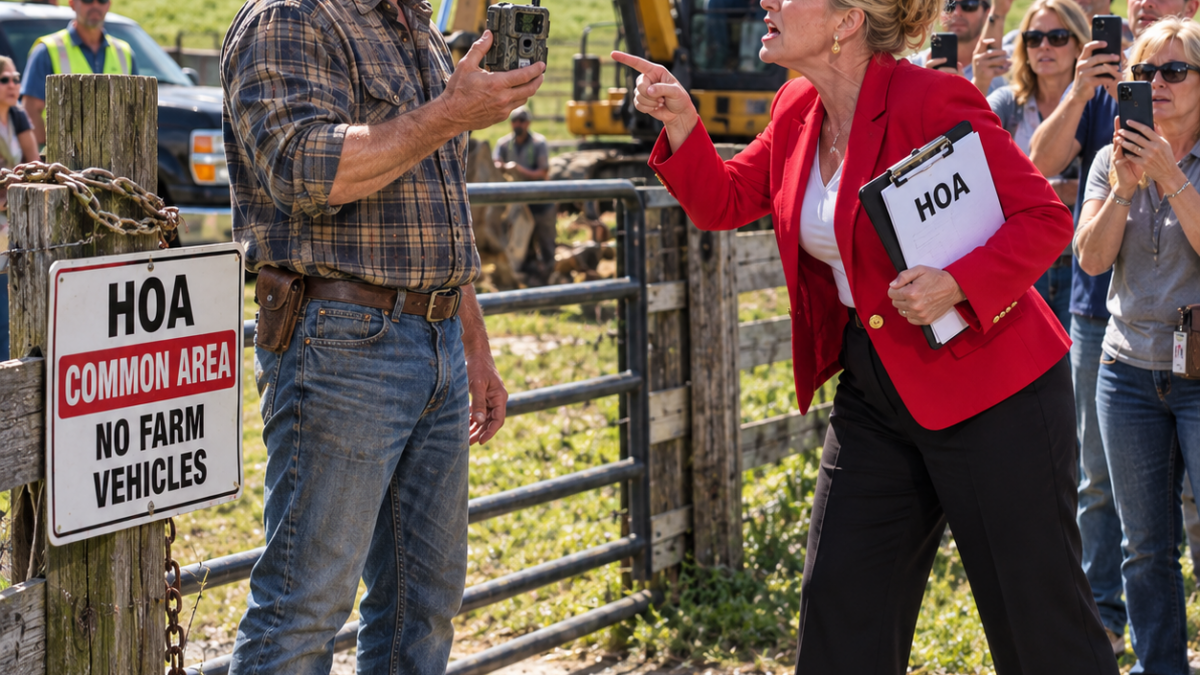
“Dean, we are past the stage where you get to pretend this is negotiable.”
Behind her stood a white SUV with a Willow Ridge placard in the windshield.
Beside it, an equipment trailer carried a mini excavator.
The operator sat behind the controls.
Engine running.
Waiting.
Cheryl pointed toward my fence.
“Willow Ridge is reclaiming its common access property this morning.”
I noticed two of the neighbors exchange looks.
Reclaiming.
Good word.
Clean word.
Sounded better than stealing.
Cheryl stepped closer.
“You were given ten days to remove farm equipment and personal obstructions.”
“My fence?”
“Yes.”
“My gate?”
“Yes.”
“My hay wagon?”
“If necessary.”
“My grandfather’s stone marker?”
Her expression flickered.
Only slightly.
“That depends on the survey.”
PART3:
I almost smiled.
Because I already knew exactly what the survey would say.
And I knew what had happened to that marker at 2:14 Friday morning.
I reached toward the camera on the oak.
Cheryl stiffened.
“What are you doing?”
I released the strap and held the little camera in my hand.
Four inches wide.
Camouflage housing.
Solar panel.
Nothing dramatic.
Then I looked at the phones pointed at me.
“Go ahead.”
Cheryl frowned.
“Excuse me?”
“I’m recording.”
For the first time that morning, she stopped talking.
My name is Dean Mallory.
I was fifty-two years old then, and I had worked the same Tennessee farm my entire adult life.
My grandfather, Thomas Mallory, bought the original forty acres in 1948 after coming home from the war.
The deed cost him less than some people now pay for a used pickup.
He cleared the lower field himself.
Built the first barn.
Dug fence-post holes by hand.
My father added cattle.
I added hay and leased eight acres to a neighbor for horses.
We were never rich.
That wasn’t why the farm mattered.
Land doesn’t have to make you rich to make you belong somewhere.
My grandfather died in 1989.
Dad died twelve years later.
By then, I knew every dip in the fields.
Every tree that dropped limbs during storms.
Every place the creek overran after three days of rain.
The farm wasn’t scenery.
It was memory with property lines.
For most of my life, the people around us understood that.
Then Willow Ridge Estates arrived.
Six years before Cheryl marched toward my gate, a development company bought an old soybean property east of us.
Within eighteen months, pasture became cul-de-sacs.
Then came stone entry monuments.
Identical black mailboxes.
Decorative streetlights.
Three approved roof colors.
Two approved fence colors.
And enough covenants to regulate the private behavior of livestock that didn’t live there.
I had no problem with Willow Ridge.
Not at first.
People bought houses.
Families moved in.
Children rode bicycles past my road.
Some neighbors bought eggs from me.
A few asked permission to walk the creek.
I said yes.
The HOA occasionally sent notices by mistake.
Grass.
Fence.
Farm machinery visible from the street.
I sent one letter back every time.
Property predates and is not subject to Willow Ridge covenants.
Eventually they stopped.
Then Cheryl Dunmore became president.
Cheryl had moved to Willow Ridge from Nashville.
She told people she had worked in “property consulting.”
Later I learned that meant she had sold real estate, managed two condo boards, and sued one of them after being removed.
At Willow Ridge, she found her natural habitat.
Meetings.
Rules.
Committees.
People required to listen while she spoke.
She started with small things.
Holiday decorations had to come down by January 10.
Trash cans had to disappear from public view by 8:00 p.m.
Basketball hoops required written approval.
Then came the fines.
Fifty dollars.
One hundred.
Two hundred.
Each violation created another reason for somebody to come before the board.
People grumbled.
Then paid.
Cheryl learned the lesson many people in small positions of power eventually learn.
If everyone gives in on little things, you begin believing they will give in on large ones.
Her large thing was my road frontage.
My farm sat between Willow Ridge and another parcel to the west that developer Landon Price had been quietly assembling.
Price wanted to build forty high-end houses on rolling land behind my creek.
There was one expensive problem.
Access.
The most practical route to the county highway crossed a strip of my property along Creek Road.
Without that strip, Landon would need to build a longer road, bridge a drainage area, and negotiate another easement.
The difference was millions.
With my strip, easy.
Without it, maybe the project died.
At first I didn’t know any of that.
I only knew Cheryl had begun appearing near my gate.
Once in her SUV.
Once walking.
Once with a man wearing loafers worth more than my work boots.
They would stop.
Look.
Point.
Leave.
Then on a Tuesday morning in October, the certified letter arrived.
I signed for it at 10:17.
Went inside.
Made coffee.
Opened the envelope.
NOTICE OF COMMON AREA DESIGNATION.
I read the first paragraph twice.
According to the letter, Willow Ridge HOA had adopted “Recorded Amendment No. 7,” which supposedly reclassified my front pasture, my gate, and the Creek Road strip as “legacy community access and common recreational property.”
I laughed.
Actually laughed.
Then I reached the last page.
TEN-DAY COMPLIANCE NOTICE.
REMOVE FARM MACHINERY.
REMOVE LIVESTOCK BARRIERS.
CEASE PRIVATE USE.
ALLOW ASSOCIATION ACCESS.
That was when I stopped laughing.
My parcel number was correct.
My legal description looked almost correct.
There was even what appeared to be a county recording reference.
I called my attorney.
He was in court.
Called the county recorder.
The clerk told me to come in.
I drove there that afternoon.
The clerk’s name was Melanie Brooks.
I had known her since high school.
She typed the alleged instrument number.
Frowned.
Typed again.
Then looked at me.
“Dean.”
“What?”
“This doesn’t exist.”
“The number?”
“The amendment.”
She turned the monitor.
No filing against my property.
No declaration.
No easement.
No HOA interest.
Nothing.
I showed her the letter.
She read it.
Her eyes narrowed.
“This reference number belongs to something else.”
“What?”
“A water-district easement filed eighteen months ago.”
“So somebody copied the number.”
“Looks that way.”
I sat down.
Melanie pulled up my parcel.
“Your deed is clean.”
“I know.”
“No HOA restrictions.”
“I know.”
She hesitated.
“What?”
“Somebody from Willow Ridge has been in here recently.”
My attention sharpened.
“Who?”
“Woman.”
“Red blazer?”
Melanie looked at me.
“Actually, yes.”
“Cheryl.”
“She asked about amendment processing.”
“When?”
“Twice this month.”
“What exactly?”
“How quickly something could be recorded. Whether electronic instruments appear immediately. Whether corrections can be submitted after filing.”
I felt the room change.
“Did she file anything?”
“No.”
“Was she with anyone?”
“Second time, a man.”
“Name?”
“She introduced him as Landon.”
That was the first time I heard Landon Price’s name.
I drove home.
At 3:40, a pickup was parked beside my fence.
Four men stood in the pasture.
One was hammering a white metal sign into the ground.
HOA COMMON AREA.
NO FARM VEHICLES.
I got out.
“Hey.”
The hammer stopped.
A man wearing a Willow Ridge volunteer shirt turned.
“You Dean?”
“Yes.”
“We’re posting community markers.”
“You’re trespassing.”
He looked confused.
“Mrs. Dunmore said this is HOA property.”
“It isn’t.”
He pointed toward the sign.
“She said it was all recorded.”
“Pull it out.”
“Sir—”
“Pull it out.”
They hesitated.
I did it myself.
The metal post came free.
I laid it in their pickup.
One of the men raised his phone.
I smiled.
“Good. Record this.”
That evening Cheryl came personally.
Red blazer.
Sunglasses pushed up into her blond hair.
Binder against her hip.
She stood outside my gate.
“Mr. Mallory.”
“Cheryl.”
“President Dunmore.”
“Not on my side of the fence.”
Her mouth tightened.
“You removed association property.”
“You mean the sign your volunteers put on my land?”
“Common land.”
“County recorder says otherwise.”
Something moved behind her eyes.
Then vanished.
“Records take time to update.”
“I checked this afternoon.”
“You’re not an attorney.”
“No.”
She smiled.
“My advice is to comply by Friday.”
“Show me the amendment.”
“You’ll see it soon enough.”
That line bothered me.
Not because it sounded mysterious.
Because it sounded like a deadline.
She was not claiming something had happened.
She was claiming something was about to happen.
“Cheryl.”
She turned.
“If you come onto my property again without permission, I’m calling the sheriff.”
She laughed.
“Dean, you cannot trespass on property you own.”
I watched her drive away.
My neighbor Hal Peterson came over after dark.
Hal was seventy-one.
Retired lineman.
Lived west of me in a farmhouse that looked as if it had been painted once during the Reagan administration and had been reconsidering the decision ever since.
He brought two beers.
We sat on my porch.
“You got trouble.”
“I noticed.”
“I saw Cheryl at the clubhouse.”
“When?”
“Monday night.”
“With who?”
“Black SUV. Man in a suit.”
“Landon Price?”
Hal nodded.
“He had plans.”
“What plans?”
“Your farm.”
That made me sit forward.
“He unrolled them on the big conference table. I was fixing that stupid ice maker.”
Hal volunteered for anything mechanical because retirement bored him.
“What did you see?”
“Lots.”
“How much?”
“Forty lots.”
My stomach turned.
“On my property?”
“Most behind you. But the access road ran straight through your Creek Road frontage.”
“Did they say anything?”
Hal stared at his beer.
“Cheryl told him she could ‘control the frontage.’”
“What else?”
“He asked how secure the title position was.”
“And?”
“She said, ‘Secure enough once the amendment hits.’”
I leaned back.
Hal continued.
“Then Landon said the whole project depended on road access.”
My anger started arriving in a slow, cold way.
“How much?”
“Didn’t say.”
“Anything about money?”
Hal nodded.
“Ten percent.”
I looked at him.
“Ten percent of what?”
“No idea.”
He rubbed his jaw.
“But Cheryl said, ‘I’m not doing this for free.’”
For the first time, the fake HOA notice made sense.
Not completely.
But enough.
My farm was not the goal.
My frontage was.
If they could create a convincing paper trail showing the HOA controlled that strip, Landon could use it as leverage.
Maybe they believed I would negotiate after the fact.
Maybe they thought they could bury me in legal fees.
Maybe the forged record was supposed to become real before I caught up.
I called my attorney again.
We talked for thirty minutes.
He said something I didn’t like.
“We can file immediately.”
“How much?”
“Initial injunction and title work? Could be five to ten thousand quickly.”
I looked through the window toward the pasture.
“What if they haven’t filed anything yet?”
“Then we stop them preemptively.”
“What if they’re about to?”
“Dean.”
“I want proof.”
“You already have the fake notice.”
“I want proof of who is doing what.”
My lawyer sighed.
“Do not do anything stupid.”
That advice followed me through much of my life.
I drove to an outdoor-supply store the next morning.
Bought four cellular trail cameras.
Solar-powered.
Night vision.
Motion alerts.
Cloud backup.
The cashier asked if deer were tearing up crops.
“Something like that.”
I installed one on the oak beside my front gate.
One on a fence post farther south.
One inside the hay barn aimed toward the drive.
And one high on a sycamore overlooking Creek Road.
Then I added a plain NO TRESPASSING sign.
Nothing aggressive.
No threats.
I took photographs of every existing boundary marker.
Every fence corner.
Every survey pin I could identify.
Then I called Ruth Garner.
Ruth was the county surveyor who had reestablished portions of our line back in the 1990s.
She was sixty-three now.
Still worked.
Still swore at GPS equipment as if satellites were personally disappointing her.
“I need copies of my old surveys.”
“Why?”
“HOA says they own my road frontage.”
Silence.
Then laughter.
Not polite laughter.
Full-body laughter.
When she recovered, she said, “No.”
“That was my reaction.”
“Your frontage follows the old Mallory tract description.”
“I know.”
“The iron pins are still there?”
“As of yesterday.”
“Photograph them.”
“Already did.”
Ruth paused.
“Somebody moving things?”
“Not yet.”
“Call me if that changes.”
That Thursday, Hal called.
“You seen the clubhouse flyer?”
“No.”
“They’re having a ‘Community Reclamation Walk.’”
I almost dropped the wrench in my hand.
“A what?”
“Saturday. Nine in the morning.”
“You’re joking.”
“Flyer says bring phones and ‘document community restoration.’”
I closed my eyes.
Cheryl wanted an audience.
Why?
Pressure.
If twelve neighbors showed up filming while she tore down my fence under color of HOA authority, the footage would create a visual story.
Cheryl reclaiming community property from stubborn farmer.
Me yelling.
Maybe pushing somebody.
Maybe blocking equipment.
Then she would have footage of me looking unreasonable while she looked procedural.
I understood people like Cheryl.
They didn’t merely want power.
They wanted witnesses to their power.
That was useful.
Because witnesses can see the wrong thing too.
Friday night I checked every camera.
Oak.
Fence.
Barn.
Creek Road.
Full battery.
Cloud sync.
Good signal.
Then I went to bed.
At 2:14 a.m., my phone buzzed.
Motion detected.
CAMERA 4 — CREEK ROAD.
I opened the live feed.
Infrared image.
Trees pale gray.
Fence bright against darkness.
A person came into frame.
Dark hoodie.
Work gloves.
Bolt cutters.
I sat upright.
The figure stepped closer.
Face visible.
Cheryl.
For one second I thought about going outside.
My boots were beside the bed.
Truck keys on the dresser.
I could reach Creek Road in four minutes.
Then she pulled wooden stakes from beneath her arm.
Pink survey flags.
She walked thirty feet inside my actual fence line.
Hammered one into the ground.
Moved another twenty yards.
Hammered another.
Then another.
I switched camera views.
Fence camera picked up her vehicle parked with lights off near the old drainage entrance.
Black SUV.
Not hers.
Landon’s, maybe.
Cheryl returned to my gate.
She took the bolt cutters.
Cut my chain.
Then produced a new padlock.
HOA PROPERTY stamped across a cheap laminated tag.
She locked my own gate against me.
I stared at the screen.
Everything in me wanted confrontation.
My grandfather’s gate.
My father’s fence.
A woman trespassing at two in the morning.
But anger is expensive when someone wants you angry.
So I stayed in bed.
Recorded.
Saved.
Backed up.
Sent copies to two separate accounts.
Then Cheryl did the best thing she could possibly have done for me.
She started talking.
Maybe to herself.
Maybe on a voice message.
The camera microphone caught it clearly.
“Once the strip gets recorded Monday, Landon gets access.”
She hammered another stake.
“And I get my ten percent.”
A pause.
Then a little laugh.
“This stupid farmer will never fight it.”
I sat in the darkness of my bedroom.
“Thank you, Cheryl.”
Then she looked toward the road.
“She told me it was all ready.”
Different voice now.
Maybe she was on the phone.
“I moved the markers tonight.”
Pause.
“No, nobody saw.”
Another pause.
“Monday. Yes. Once it’s in the system, we proceed.”
She disconnected.
Walked out.
The camera captured her face again.
Perfectly.
I called the sheriff’s non-emergency line.
Deputy Nate Whitlock answered because rural counties rarely have the luxury of specialized overnight staffing.
“Nate, it’s Dean Mallory.”
“You bleeding?”
“No.”
“Fire?”
“No.”
“Then why are you calling me at two forty in the morning?”
“HOA president just moved my property markers.”
Silence.
“Say that again.”
“She also cut my chain.”
“On camera?”
“Four cameras.”
“Don’t touch anything.”
“I wasn’t planning to.”
“You confronting her tomorrow?”
“She’s bringing half the neighborhood and an excavator.”
Nate sighed.
“I hate HOAs.”
“You live outside one.”
“Exactly.”
“I need you here by nine.”
“I’ll be there.”
At sunrise, I called Ruth Garner.
“Remember how you asked if somebody moved things?”
“Oh no.”
“Pink stakes thirty feet inside.”
“Do not touch them.”
“I know.”
“Original iron pins?”
“I haven’t checked.”
“I’m bringing instruments.”
Then my attorney.
He listened.
“Dean.”
“Yes?”
“You understand you now have evidence of possible criminal conduct.”
“Yes.”
“Do not make a speech.”
“I wasn’t planning to.”
“You absolutely were.”
“Maybe a short one.”
“No.”
I smiled.
“Fine.”
Saturday morning was beautiful.
Cool air.
Blue sky.
Sunlight across the pasture.
Exactly the kind of Tennessee morning my father used to call a waste if you spent it indoors.
At 8:55, engines approached.
First Cheryl’s white SUV.
Then a pickup towing a mini excavator.
Then cars.
Neighbors.
Phones already out.
Hal parked on the shoulder but walked toward me.
He whispered, “Looks like a parade.”
“Where are the balloons?”
He smiled nervously.
Tom Rigby, the HOA treasurer, climbed out of a silver sedan.
Late sixties.
Accountant.
Usually reasonable.
Today he looked sick.
Cheryl emerged last.
Red blazer.
White pants.
Dark sunglasses.
She stood beside the road while people gathered.
Then she raised her voice.
“Good morning, everyone.”
I leaned against my gatepost.
Technically, there was no functioning chain anymore because Cheryl had cut it.
I had left her replacement HOA padlock exactly where she put it.
Evidence.
Cheryl gestured toward my land.
“As you all know, Willow Ridge recently discovered that this frontage was improperly treated as private property for many years despite being designated community access under our amended declaration.”
One woman nodded confidently.
Tom did not.
Cheryl continued.
“Today we are restoring lawful access.”
I looked at the excavator operator.
Gil Brandt.
I knew him.
He had done pond work for a neighbor.
Gil avoided my eyes.
Cheryl pointed toward the gate.
“Mr. Mallory has refused repeated compliance notices.”
I lifted my coffee.
“Morning, Cheryl.”
Her jaw tightened.
“Dean, you are being given one final opportunity.”
“To do what?”
“Stand aside.”
“Or?”
“We will remove the obstruction.”
“The obstruction being my fence.”
“Association property.”
“According to?”
“Recorded Amendment Seven.”
“Show me.”
She held up a binder.
“Right here.”
“No.”
Her smile disappeared.
“I mean show me the county record.”
“It is in the binder.”
“County website?”
“Dean.”
“Book and page?”
“Instrument number is listed.”
“Then say it.”
Her voice sharpened.
“You have been provided sufficient notice.”
The neighbors watched.
Phones recorded.
Perfect.
I knelt beside the oak.
Removed the trail camera.
Held it up.
Cheryl stared.
“What do you think you’re doing?”
“Protecting my land.”
“You have no right to record HOA common property.”
I looked around at the twelve phones.
“Interesting concern today.”
A few people chuckled.
Cheryl did not.
I said, “Go ahead. I’m recording.”
Then she made the mistake.
She turned toward Gil.
“Take the fence down.”
Gil did not move.
“Mr. Brandt.”
He rubbed his beard.
“Ma’am, you told me county ownership was confirmed.”
“It is.”
“You said recorded.”
“It is.”
Gil looked at me.
“Dean?”
“Not recorded.”
Cheryl snapped, “He is lying.”
Then tires crunched behind the crowd.
Sheriff’s SUV.
Deputy Nate Whitlock climbed out.
Tan uniform.
Sunglasses.
Coffee in one hand.
No urgency.
That was Nate.
He could walk into a burning barn looking mildly inconvenienced.
“Morning.”
Nobody answered.
He looked around.
“Somebody having a land dispute?”
Cheryl’s personality changed instantly.
Her shoulders softened.
Voice sweetened.
“Deputy Whitlock. Thank goodness.”
Nate looked at me.
I almost laughed.
Cheryl walked to him with the binder.
“This man has refused to recognize a duly recorded HOA amendment and is physically obstructing community property.”
Nate took the binder.
“Is he threatening anybody?”
“No.”
“Brandishing anything?”
“No.”
“Damaging property?”
“Our property.”
“Ma’am.”
“No.”
Nate nodded.
“Then let’s look at your paper.”
Cheryl stood beside him.
He studied the first page.
I watched his eyes move.
Instrument number.
Stamp.
Signature.
Legal description.
He looked up.
“County recorder open Saturday?”
“No,” Cheryl said quickly.
Nate took out his phone.
“I have a number.”
Her expression changed.
Small.
But there.
The first crack.
A white county truck appeared.
Surveyor’s seal on the door.
Ruth Garner climbed out wearing work boots, jeans, and an orange vest.
She unloaded a tripod.
Data collector.
Survey rod.
Old plat maps.
Cheryl went pale.
Ruth walked toward Nate.
“Morning.”
“You Ruth Garner?”
“Last I checked.”
“You here for Mr. Mallory?”
“He asked me to verify an alleged boundary relocation.”
Cheryl interrupted.
“This is private HOA business.”
Ruth looked at her.
“Property boundaries are literally my business.”
Hal coughed to hide a laugh.
Ruth set up.
Nobody spoke much for the next fifteen minutes.
That made Cheryl nervous.
Powerful people often become uncomfortable when experts stop arguing and start measuring.
Ruth shot the southeast corner.
Then the road monument.
Then the creek reference.
Then walked toward Cheryl’s pink stakes.
She bent.
Touched the soil.
Pulled one out with two fingers.
Loose earth clung to the bottom.
She looked at Nate.
“These were installed recently.”
“How recently?”
“Ground is disturbed. Could be last night.”
Cheryl crossed her arms.
“That proves nothing.”
Ruth walked thirty feet west.
Knelt.
Brushed grass away.
Metal appeared.
Old iron pin.
Rust.
Solid.
She put the survey rod over it.
Checked the reading.
Then pointed toward another corner.
“Original monument.”
She looked at me.
“This is exactly where we established it in 1996.”
Cheryl said, “Boundaries can be amended.”
Ruth turned.
“Not by moving iron.”
Nate’s phone rang.
Everyone watched him answer.
“Whitlock.”
Pause.
“Yes.”
He looked at the binder.
“Instrument ending 4817.”
Pause.
“All right.”
His eyes moved to Cheryl.
“Thanks, Melanie.”
He hung up.
“Recorder says this instrument number belongs to a water-district easement on another parcel.”
Nobody spoke.
Nate turned the page.
“She also confirms no HOA amendment has ever been recorded against Dean Mallory’s property.”
Cheryl’s face stiffened.
“That’s impossible.”
Nate held up the document.
“And this county stamp?”
“Yes?”
“It’s a photocopy.”
“No.”
“Yes.”
“My attorney prepared that.”
Nate looked at her.
“Name?”
“Landon—”
She stopped.
Too late.
A neighbor said, “Landon?”
Cheryl blinked.
“I misspoke.”
Tom Rigby’s face drained.
“Landon Price?”
Cheryl turned.
“Tom, stay out of this.”
His expression changed.
“Why?”
“Because you don’t understand.”
“You told me the amendment came from county counsel.”
“It did.”
“Then why did you just say Landon?”
She stepped toward him.
“Tom.”
He stepped back.
Not physically afraid.
Morally separating.
That mattered more.
Hal raised his voice.
“I saw Landon’s plans.”
Every head turned.
Cheryl looked murderous.
Hal continued.
“Forty houses.”
One neighbor whispered, “What?”
“The road runs through Dean’s creek frontage.”
Cheryl said, “He’s lying.”
Hal shrugged.
“I’m seventy-one. Not much left to impress anybody with.”
A woman in the crowd lowered her phone.
“You said this land was becoming a park.”
Another neighbor nodded.
“You said community green space.”
Tom looked at Cheryl.
“You told the board that.”
Cheryl’s control began collapsing.
She looked toward Nate.
“This is a coordinated attack.”
I finally moved.
“Would you like to hear the recording?”
Her eyes snapped to me.
“What recording?”
I held up the trail camera.
“Friday night.”
Something in her face died.
Not guilt.
Calculation.
She knew.
I connected my phone to a portable speaker I had brought specifically because my lawyer told me not to make a speech but said nothing about audio evidence.
The first clip played.
Infrared.
Cheryl entering my pasture.
Phones shifted.
People crowded.
She watched herself place pink stakes.
Someone whispered, “Oh my God.”
Then came the bolt cutters.
The cut chain.
Her replacement lock.
Cheryl said, “This is edited.”
I played the second clip.
Audio clear.
Her voice.
“Once the strip gets recorded Monday, Landon gets access.”
Pause.
“And I get my ten percent.”
The crowd stopped breathing.
Then:
“This stupid farmer will never fight it.”
I looked at her.
She looked at me.
The third clip was worse.
“I moved the markers tonight.”
Pause.
“No, nobody saw.”
Another pause.
“Monday. Once it’s in the system, we proceed.”
Silence after the clip ended.
Pure.
Heavy.
No phones moving.
No neighbors whispering.
Cheryl stood completely alone without physically moving an inch.
Tom Rigby covered his mouth.
“I signed the excavator invoice.”
Nate looked at him.
“What?”
Tom pointed toward Gil.
“She said we were clearing an illegal obstruction on association property.”
Gil climbed down from the excavator.
“Deputy, I haven’t touched anything.”
“I know.”
“I want that on record.”
“Smart.”
Tom looked devastated.
“She made me approve four thousand eight hundred dollars.”
Cheryl shouted, “Nobody made you do anything!”
Tom stared at her.
“You lied.”
The woman in the blue jacket spoke.
“You told us Dean owed property taxes.”
Another voice.
“You said the county was taking the land.”
Another.
“You said he abandoned part of it.”
The crowd transformed.
Not into a mob.
Something worse for Cheryl.
Witnesses.
People remembering.
People comparing lies.
Nate walked toward the cut chain.
Photographed it.
Then the relocated stakes.
Then Cheryl.
“Mrs. Dunmore.”
Her chin rose.
“I’m not discussing anything further without counsel.”
“Good decision.”
He removed handcuffs.
Her confidence broke.
“You cannot arrest me over an HOA dispute.”
“This stopped being an HOA dispute around two fourteen this morning.”
Her eyes flashed toward me.
Nate continued.
“You are being detained in connection with criminal trespass, property damage, suspected tampering with survey markers, and possible forgery.”
“You know who I am?”
Nate almost smiled.
“Yes, ma’am.”
He glanced at the camera.
“You’re the one on video.”
I wish I could tell you everyone cheered.
They didn’t.
Real moments are stranger than that.
People watched.
Some looked embarrassed.
Some angry.
Tom looked sick.
Hal looked relieved.
Cheryl looked smaller in handcuffs.
Red blazer.
White pants.
Pearls.
All the symbols of control suddenly meaningless.
She was placed in the back of Nate’s SUV.
Before the door closed, she looked at me.
“This isn’t over.”
I said, “I know.”
Because it wasn’t.
Arrest was the beginning.
Investigators executed warrants.
County officials reviewed the fake amendment.
The forged page had been created from multiple public documents.
The instrument number belonged to a water easement.
The county stamp had been copied from another filing.
The legal description had been lifted from my deed and modified.
A signature purporting to belong to a land-recording official was false.
Then came Landon Price.
His black SUV was the one my camera had captured Friday night.
License plate confirmed it.
Phone records showed repeated calls between him and Cheryl.
Emails gave investigators the rest.
The proposed development was called Silver Creek Reserve.
Forty-one lots.
Average projected sale price: $780,000.
The access road through my land would save approximately $1.9 million in infrastructure costs.
Cheryl’s promised “consulting fee” was ten percent of Landon’s projected savings after acquisition.
Roughly $190,000.
But investigators found another agreement.
If the project received final approval, she would receive an additional percentage through a shell consulting company.
Her total potential payout exceeded $400,000.
For my gate.
My frontage.
My creek.
The part that still makes me angry is how small they thought my attachment would be compared to their money.
Landon wrote in one email:
MALLORY IS ONE GUY ON OLD LAND. PRESSURE HIM THROUGH HOA PROCESS UNTIL HE SELLS.
Cheryl replied:
HE’S STUBBORN BUT UNSOPHISTICATED.
I printed that one.
Framed it.
Hal said that was petty.
I agreed.
Investigators also discovered that Cheryl had tried to create a fake board record approving Amendment Seven.
She backdated meeting minutes.
Inserted language into a digital file.
Claimed the board had voted.
The problem?
Tom Rigby kept paper minutes.
Accountants.
Never trust a criminal plan that depends on an accountant not keeping originals.
Tom handed investigators the real records.
No vote.
No amendment.
No discussion of my parcel as common property.
The board had approved only a vague “access feasibility study.”
Cheryl turned that phrase into permission for theft.
Landon was arrested six days later on charges connected to forgery, conspiracy, fraud, and attempted property interference.
His attorneys immediately argued he believed Cheryl had legitimate authority.
Then prosecutors produced his text:
CAN YOU MAKE THE PAPER LOOK RECORDED BEFORE MALLORY GETS LAWYERED UP?
That shortened the argument.
Three weeks later, Cheryl appeared in court.
No red blazer.
Gray cardigan.
Hair pulled back.
No sunglasses.
I sat behind the prosecutor.
Tom sat two rows away.
Hal beside me.
My attorney whispered, “Do not smile.”
“I’m not smiling.”
“You’re thinking about it.”
“Thinking is protected.”
The case took longer than the version neighbors later told.
Months, not weeks.
Eventually Cheryl pleaded guilty to several counts including forgery-related conduct, criminal trespass, and property interference.
She paid restitution.
Survey costs.
Fence repair.
Attorney fees.
She received probation with strict conditions, community service, and was prohibited from serving on any HOA or similar board during the period imposed by the court.
Other civil consequences followed.
Landon’s case was more serious because of the financial scheme and supporting documentation.
His development approval collapsed.
Investors walked.
The project died.
Some people in Willow Ridge felt sorry for him.
I didn’t.
Not because I enjoyed seeing a man lose millions.
Because he had treated my family history like a line item.
There is a difference between wanting land and believing the person who owns it is merely an administrative obstacle.
The morning after Cheryl’s arrest, I walked the property with Ruth Garner.
She reset anything disturbed.
Verified every corner.
Filed a fresh certified survey.
I asked, “How long are these good?”
She looked offended.
“Forever if lunatics stop moving them.”
“Can I pour concrete around them?”
“No.”
“Electrify them?”
“Also no.”
“Can I put cameras on every one?”
She smiled.
“That, I recommend.”
The HOA held an emergency meeting.
I almost didn’t go.
Hal insisted.
“They need to see you.”
“Why?”
“Because half of them were standing at your gate filming you like a criminal.”
“That sounds like their problem.”
“It becomes your problem if nobody fixes it.”
He was right.
I hated that.
The clubhouse was full.
More than sixty people.
Tom Rigby stood in front.
He looked ten years older.
“Dean.”
I sat in the back.
Tom continued.
“On behalf of the Willow Ridge board, I want to apologize.”
I shook my head.
“You don’t owe me Cheryl’s apology.”
“No.”
He swallowed.
“But we owe you ours.”
That quieted the room.
Tom looked at the neighbors.
“We believed something because it arrived in a binder.”
Nobody moved.
“We accepted that a county document existed without verifying it.”
His voice tightened.
“We authorized equipment because our president told us the authority had already been established.”
He looked at me.
“We let confidence replace evidence.”
That was the best thing anyone said all night.
A woman stood.
The same woman in the blue jacket.
“My name is Ellen.”
I nodded.
“I was filming you.”
“I noticed.”
Her face reddened.
“I expected you to lose your temper.”
“Why?”
She hesitated.
“Because Cheryl said you were hostile.”
“Had we met?”
“No.”
That answer hurt her more than me.
She continued.
“I’m sorry.”
Another neighbor stood.
Then another.
I started feeling uncomfortable.
Apology ceremonies are strange things when you are the object.
Finally I raised my hand.
“Can I say something?”
Tom nodded.
I stood.
My lawyer was not there to stop me.
“I don’t need sixty apologies.”
People looked relieved and ashamed at once.
“I don’t want Willow Ridge.”
A few laughed nervously.
“I don’t want a seat on your board.”
More laughter.
“I don’t want money.”
I looked around.
“I want neighbors.”
The room went still.
“My grandfather bought that farm before most of these roads existed.”
I pointed toward the windows.
“That does not make me better than anybody who bought a house here six months ago.”
I paused.
“But it also does not make my land available because somebody builds around it.”
Several people nodded.
I continued.
“If my cattle get out, call me.”
“If my fence falls across the road, call me.”
“If somebody’s kid chases a ball onto my property, I’m not filing a lawsuit.”
A few smiled.
“But if your board says it owns my pasture, check before bringing an excavator.”
That got a real laugh.
Even me.
Then I said, “That’s all.”
Afterward, people came up individually.
Not to apologize.
Mostly to talk.
One man asked about buying hay.
A woman asked whether her children could still walk near the creek with permission.
Someone else brought casserole.
Why do rural Americans believe casserole repairs institutional betrayal?
I don’t know.
It helps.
The HOA formally rescinded every claimed interest in my property.
Then hired an independent attorney to review boundaries.
New bylaws required any land-use assertion involving property outside the HOA to be supported by certified county records and legal review before notices could be issued.
No president could unilaterally direct vendors onto disputed property.
Large expenditures required two signatures.
Document changes created automatic board notifications.
Boring rules.
Good rules.
The most important safeguards usually are.
Tom became interim president.
He hated it.
Hal found that hilarious.
One Saturday, Hal and eleven Willow Ridge neighbors arrived at my gate.
No cameras.
No blazers.
Just trucks.
Tools.
Concrete.
A new chain.
A heavier gate latch.
Ellen brought biscuits.
Tom handed me an envelope.
Formal apology from the HOA.
I put it in my pocket.
Then we worked.
The old gatepost had been damaged.
We removed it.
Reset it.
Poured fresh concrete.
Rehung the gate.
When everything was finished, Hal pulled a wooden board from his truck.
Letters burned into it.
BORN HERE. STAYING HERE.
I stared.
“That is unbelievably corny.”
“Yep.”
“I wasn’t born on the farm.”
“Nearby counts.”
“Legally inaccurate.”
“Shut up.”
We nailed it beneath my farm sign.
It stayed.
So did the cameras.
At first I checked them constantly.
Motion alert?
Phone out.
Vehicle?
Zoom.
Person near fence?
Record.
Trauma comes in odd forms.
Nobody kidnapped me.
Nobody physically attacked me.
Yet for months, every unfamiliar truck made my shoulders tighten.
Because Cheryl had changed something.
Before her, my fence had been a boundary.
After her, it felt like a question.
Would somebody respect it?
That takes time to undo.
Eventually the cameras became boring again.
Deer.
Raccoons.
Hal walking home after borrowing tools he had not asked to borrow.
Kids bicycling past.
Neighbors waving.
One afternoon, camera four captured Ellen leaving a pie on my gatepost because I wasn’t home.
That was better footage.
My attorney asked if I would remove the system after the cases ended.
“No.”
“Why?”
“Deer are shady.”
He laughed.
I kept the original recording on three drives.
Not because I expected another trial.
Because I wanted to remember the lesson.
People assume cameras reveal crime.
Sometimes.
But what they really reveal is sequence.
Who arrived first.
Who touched what.
What was said before everybody created a cleaner story afterward.
Cheryl later claimed she had believed the boundary markers were wrong.
The video showed her moving them deliberately.
She claimed Landon was merely advising the HOA.
The audio captured her discussing a percentage.
She claimed she did not damage my property.
The camera watched her cut my chain.
Without video, every one of those facts would have become an argument.
Her word.
Mine.
Board politics.
Neighbor gossip.
Instead, the truth had a timestamp.
2:14 a.m.
That mattered.
A year after the arrest, Hal and I sat on my porch.
He had brought beer again.
“Think you would’ve sold if Landon asked honestly?”
“No.”
“What if he offered a million?”
“No.”
“Two?”
I thought.
“No.”
“Five?”
I looked at him.
“Are you working for Landon?”
Hal laughed.
“I’m checking your principles.”
“They get flexible around eight.”
“Good to know.”
I looked toward the creek road.
The sun was dropping behind the trees.
“I might have given him a different route.”
Hal turned.
“What?”
“If they had come honestly.”
That surprised him.
“I might’ve negotiated a narrow easement somewhere else if it didn’t hurt the farm.”
“You’re serious?”
“Maybe.”
Hal shook his head.
“They blew up a forty-million-dollar project because they didn’t want to ask.”
“That’s not exactly it.”
“What is?”
“They did ask.”
I remembered Cheryl’s first visit.
Before the fake notice.
Before the stakes.
Before the cameras.
She had come to my porch with maps and an offer.
I said no.
That was the problem.
Some people understand negotiation only until the other side refuses.
Then they start believing refusal is unfair.
Hal said, “They thought you had the wrong answer.”
“Exactly.”
That was the heart of it.
Not documents.
Not cameras.
Not HOA bylaws.
Consent.
I owned the land.
They wanted it.
I said no.
Everything that followed was an attempt to change my no into something they could ignore.
Cheryl tried authority.
Fake paperwork.
Public pressure.
Humiliation.
Property markers.
An excavator.
She needed the neighborhood to believe my refusal was illegitimate.
Stubborn farmer.
Tax delinquent.
Obstacle to a park.
Enemy of progress.
Anything except owner.
Because owner is harder to argue around.
Two years later, Willow Ridge elected a new permanent board.
Ellen became president.
She called me before accepting.
“Is this a terrible idea?”
“Yes.”
“I’m serious.”
“So am I.”
“What advice?”
“Never wear a red blazer.”
She laughed.
Then asked, “Anything real?”
I thought.
“Verify before you accuse.”
She went quiet.
Then said, “That’s going on my wall.”
“Don’t make it inspirational.”
“Too late.”
Under Ellen, the relationship between Willow Ridge and my farm changed.
The HOA paid me to mow a drainage strip.
I sold hay to three residents with horses outside the development.
Every December, families came by for a farm Christmas bonfire.
I let children fish the creek during a neighborhood picnic.
Nobody called it common property.
They asked.
That was all I had wanted.
Ask.
Accept the answer.
One summer afternoon, a man stopped at my gate.
Black SUV.
For one second, my body reacted.
Then he stepped out.
Young guy.
Maybe thirty.
He held rolled plans.
I almost laughed.
“Can I help you?”
“Mr. Mallory?”
“Yes.”
“My name is Evan Price.”
I stared at him.
“Related to Landon?”
“My father.”
I said nothing.
“He told me not to come.”
“Good advice.”
“I wanted to anyway.”
He held out the plans.
I didn’t take them.
“What do you want?”
“To apologize.”
“For?”
“My father.”
“That’s not yours.”
“I know.”
He looked at the farm.
“I’m an engineer.”
“Sorry.”
He smiled slightly.
“I found the old project files.”
My expression changed.
“Why?”
“I was closing his company records.”
Landon’s business had collapsed after the criminal case and investor lawsuits.
Evan continued.
“I saw what he planned.”
“Everybody did.”
“I saw the alternative road.”
That got my attention.
“What alternative?”
He unrolled a map on the hood of his SUV.
There it was.
A western access route.
Longer.
More expensive.
But perfectly viable.
No need for my land.
“He said it would add one-point-seven million,” Evan said.
I stared at it.
“All of this over one-point-seven?”
“For him, apparently.”
He rolled the plans back up.
“I thought you should know.”
“Why?”
“Because people kept saying your farm killed the project.”
He looked embarrassed.
“It didn’t.”
“No.”
“My father’s greed did.”
I respected him for saying that.
Evan left.
I never saw him again.
But that map settled something inside me.
For years, a tiny part of me wondered whether I had been too stubborn.
Not legally.
Emotionally.
Maybe progress needed compromise.
Maybe forty families lost potential homes because I refused a road.
Then I saw the alternative.
The project had another path.
It just cost more.
They had not needed my land.
They wanted the cheapest version of their plan.
That was worth destroying my peace to them.
Not anymore.
The old Creek Road remains gravel.
It floods twice a year.
My tractor gets stuck there every third spring.
I love it.
The pasture remains pasture.
No forty houses.
No entrance boulevard.
No decorative median.
Just hay.
Birds.
Occasional cattle.
And one camera on an oak tree.
The original camera finally died after four years.
Water damage.
I kept it.
Hal asked why.
“Evidence.”
“The case is over.”
“Sentimental evidence.”
“That is the saddest thing I’ve ever heard.”
I put it on a shelf in the barn.
The plastic housing still carried scratches from the strap.
When I see it, I remember Cheryl standing by my gate that Saturday.
Red blazer.
Twelve phones pointed at me.
She thought the camera in my hand was a threat because it could record what she was about to do.
She didn’t understand.
The important recording had already happened.
That’s often how truth works.
By the time a liar begins worrying about evidence, the evidence already exists.
An email.
A receipt.
A timestamp.
A neighbor who remembers.
A clerk who checked.
A survey pin that does not move merely because somebody wishes the boundary were different.
People later asked why I didn’t confront Cheryl Friday night.
I wanted to.
More than I can explain.
Watching her cut that chain felt personal in a way the forged paperwork didn’t.
That chain had belonged to Dad.
Old steel.
Rusty.
Nothing valuable.
He had wrapped it around the gate every evening for twenty years.
When Cheryl cut it, I felt something primitive.
Get off my land.
But if I had driven out there, what happens?
I shout.
She shouts.
Maybe she records me.
Maybe she claims I threatened her.
Maybe Landon’s person appears.
Maybe the evidence becomes complicated.
Instead, I stayed still.
That was harder.
People think restraint is weakness because it looks like nothing.
Sometimes nothing is work.
Not moving.
Not shouting.
Not taking the bait.
Letting somebody finish what they believe nobody can see.
That was the trap.
Not my loose chain.
Not the cameras.
Cheryl’s confidence.
She believed I was exactly what she called me on the recording.
A stupid farmer.
She mistook quiet for ignorance.
Old land for weak land.
No HOA for no protection.
She believed paper could manufacture ownership faster than truth could defend it.
She was wrong.
The county record mattered.
Ruth’s survey mattered.
Hal’s memory mattered.
Tom’s minutes mattered.
My cameras mattered.
Even Gil refusing to start the excavator mattered.
Nobody saved the farm alone.
That is another part people simplify.
They tell the story as though I outsmarted Cheryl.
I put up cameras.
Caught her.
Won.
Nice story.
Incomplete.
Melanie Brooks checked the recorder.
Hal told me about Landon.
Ruth protected the boundary.
Nate showed up before tempers became something else.
Tom preserved original minutes.
Gil refused to tear down a fence without confirmation.
Neighbors changed sides when evidence changed.
My attorney kept me from turning anger into stupidity.
Truth often wins because several ordinary people do one ordinary thing correctly.
That matters more than clever traps.
Three years after everything ended, my mother’s old Bible came to me after she died.
Inside the cover was a handwritten note from my grandfather.
It had nothing to do with Cheryl.
Written sometime in the 1950s.
One sentence:
LAND ISN’T YOURS BECAUSE YOU CAN HOLD IT. IT’S YOURS BECAUSE YOU TAKE CARE OF IT LONG ENOUGH TO HAND IT TO SOMEBODY ELSE.
I read that line for a long time.
Granddad never imagined HOAs.
Cellular cameras.
Developers.
County databases.
But he understood stewardship.
The farm will not belong to me forever.
That is important.
Ownership is temporary even when deeds feel permanent.
Someday my daughter will decide what happens.
Maybe she farms it.
Maybe she preserves it.
Maybe she sells part.
That will be her decision.
The thing I fought for was not that the land could never change.
I fought for who gets to choose.
That distinction is everything.
Cheryl wanted to change my farm without my consent.
Landon wanted to convert family history into project efficiency.
I wanted the right to decide.
That right survived.
My daughter, Claire, lives in Knoxville now.
Architect.
Much smarter than me.
She comes home twice a month.
The first time I showed her Granddad’s note, she cried.
Then she said, “Dad, I don’t know if I want to farm.”
“I know.”
“You’re not disappointed?”
“No.”
She looked suspicious.
“You’re lying.”
“Maybe a little.”
She laughed.
I continued.
“I didn’t protect this place so you’d owe it your life.”
She stared.
“I protected it so nobody else could choose for you.”
That seemed to matter.
It mattered to me too.
Last summer, Claire helped redesign the old barn roof.
Willow Ridge neighbors helped raise it.
Ellen brought food.
Tom brought a nail gun and nearly shot his boot.
Hal mostly supervised while doing almost nothing.
At sunset, we sat outside.
Children ran across the grass.
Somebody asked Claire about the sign on the gate.
BORN HERE. STAYING HERE.
She laughed.
“My dad hates that sign.”
“I do.”
“Then why keep it?”
I looked toward Hal.
He grinned.
“Because friendship occasionally requires tolerating bad carpentry.”
The whole group laughed.
Later, after everyone left, I checked the trail-camera feed.
One deer.
Two raccoons.
Hal driving home and waving directly at the lens.
Then darkness.
No bolt cutters.
No fake stakes.
No red blazer.
I closed the app.
That is what safety looks like after a conflict.
Boring.
People underestimate boring.
Boring is wonderful.
Boring means the gate is still there in the morning.
Boring means the county record says the same thing today it said yesterday.
Boring means neighbors drive past without thinking they own what is behind your fence.
Boring means a camera mostly records deer.
I learned to love boring.
Once in a while somebody new hears the story.
They ask if the HOA really tried to “take” my farm.
I tell them no.
Not exactly.
They tried something more believable.
They tried to create enough paperwork, pressure, and public certainty that everyone would act as though they already had.
That is how some theft works.
Not a man sneaking into a barn.
A binder.
A stamp.
A meeting.
A confident announcement.
A machine waiting beside a fence.
Then everybody looks at the owner and says:
Why are you making trouble?
That is why documentation matters.
Not because cameras are magic.
Because memory bends.
Confidence persuades.
People get nervous.
Stories change.
A timestamp does not care who wears the blazer.
The camera did not know I owned the farm.
It did not know Cheryl was HOA president.
It did not know Landon was rich.
It did not know my grandfather’s history.
It simply recorded what happened.
2:14 a.m.
Woman enters.
Woman moves stakes.
Woman cuts chain.
Woman discusses money.
Woman leaves.
Truth without personality.
Sometimes that is exactly what a situation needs.
The last time I saw Cheryl was outside the county courthouse about eighteen months after sentencing.
She looked older.
No red blazer.
Plain coat.
We ended up six feet apart while waiting for traffic to clear.
She looked at me.
I looked at her.
Neither spoke.
Then she said, “You ruined my life.”
I could have laughed.
Could have insulted her.
Could have listed every choice she made.
Instead, I said, “No.”
She stared.
“You did.”
Her face tightened.
“You set me up.”
“No.”
“The loose chain.”
“Yes.”
“The cameras.”
“Yes.”
“You wanted me to trespass.”
“I thought you might.”
“That’s entrapment.”
“You were HOA president, Cheryl. I’m a farmer.”
She said nothing.
I continued.
“I didn’t make you bring bolt cutters.”
Traffic stopped.
I stepped into the crosswalk.
Behind me she called, “You could have just sold.”
I turned.
There it was.
After everything.
Still the same belief.
That my refusal was the original offense.
I said, “And you could have accepted no.”
Then I left.
I never saw her again.
That conversation taught me more than the trial did.
Some people apologize when consequences arrive.
Others rewrite the story until they become the victim.
I stopped needing Cheryl to understand.
Consequences did not require insight.
My farm remained.
That was enough.
Today the oak beside my gate is larger.
The camera strap had to be replaced because the trunk grew around it.
The creek road still bends north.
The original 1948 iron pin still sits beneath grass near the corner.
Every spring Ruth Garner threatens retirement.
Every summer she is still working.
Hal is seventy-five now and claims everything hurts except his opinions.
Ellen is still HOA president, though she says every election is “the final one.”
Tom handles finances but refuses all documents in binders.
He says binders trigger him.
Willow Ridge children know they may enter my pasture only if they ask.
Most do.
One boy named Mason once climbed my fence without permission.
The camera caught him.
I showed his mother.
She marched him over to apologize.
He stood on my porch staring at his shoes.
“Sorry, Mr. Mallory.”
“What for?”
“Trespassing.”
“Why’d you do it?”
He shrugged.
“My football went over.”
“Next time?”
“Ask.”
I handed him the football.
That was the whole punishment.
Afterward his mother said, “You could have been harder.”
I looked toward Willow Ridge.
“I’ve seen enough people enjoy enforcement.”
She understood.
That may be the biggest thing Cheryl changed in me.
Before her, property lines were physical.
Fence.
Pin.
Deed.
After her, I understood the human part.
Boundaries mean nothing if people see them only as things to push until someone pushes back.
Respect matters earlier.
Before lawyers.
Before cameras.
Before deputies.
Before humiliation.
No means no before a judge confirms it.
Permission matters before consequences.
That applies to farms.
Homes.
Bodies.
Money.
Time.
Everything.
When you respect somebody’s boundary because you fear punishment, that is compliance.
When you respect it because it belongs to them, that is character.
Cheryl never learned the difference.
Most of Willow Ridge did.
That is why I no longer look at the development and see enemies.
I see neighbors.
People who were misled.
Some too willing to believe.
Some cowardly.
Some careless.
But also people capable of admitting they were wrong.
That mattered.
The Saturday after Cheryl’s sentencing, Tom brought me the formal HOA apology.
I told him I didn’t need it.
He said, “Take it anyway.”
I did.
Then he asked, “What do you need?”
I looked around.
Hal held a shovel.
Ellen carried biscuits.
Gil had brought fence tools without charging a dime.
A dozen people stood where they had once stood holding phones.
This time nobody was filming.
I said, “I need my neighbors back.”
Hal grinned.
“Then you’ve got us.”
That remains my favorite moment of the whole story.
Not the arrest.
Not Cheryl’s face when the audio played.
Not Nate saying, “You’re the one on camera.”
That line was good.
I admit it.
But the better moment came later.
People returning without cameras.
Not to watch a fight.
To fix a gate.
There are plenty of stories about catching bad people.
Fewer about rebuilding after they are gone.
Rebuilding is slower.
Less satisfying in the moment.
Nobody applauds fresh concrete.
But that concrete is still holding my gatepost.
The old chain is gone.
I kept one cut section.
It hangs inside the barn.
Beside the dead trail camera.
Two pieces of evidence from a week when somebody tried to turn forty acres of family history into a development shortcut.
Visitors sometimes ask why I keep them.
I tell them:
“So I remember not to confuse peace with nobody trying anything.”
Then I smile.
“Also because I’m sentimental.”
The truth is simpler.
The chain reminds me what Cheryl tried to cut.
The camera reminds me that she failed.
Not because technology defeated her.
Because truth caught up.
She could move stakes.
Forge paper.
Lie to neighbors.
Hire an excavator.
Copy a county stamp.
But she could not change where the iron pin had been since 1948.
She could not change the deed.
Could not erase the old plat.
Could not make Hal forget the plans.
Could not make Tom’s real minutes disappear.
Could not make my cameras unrecord what they saw.
She needed everybody to accept a new reality quickly.
We slowed it down.
Checked.
Measured.
Verified.
That was enough.
Most fraud hates time.
Give truth enough time to look around and the cracks begin showing.
The farm is quiet tonight as I write this.
Wind through sycamores.
Coyotes somewhere beyond the creek.
One camera notification on my phone.
Probably deer.
I check anyway.
A buck stands beside the gate.
He sniffs the BORN HERE. STAYING HERE sign.
Then walks into the pasture like rules are for humans.
I laugh.
Maybe Hal was right to make the sign.
I still think it’s corny.
I’ll never remove it.
Because four words became a promise I did not know I was making.
Not that I would stay forever.
Nobody does.
But that while the land is mine, I will care for it.
Protect it.
Decide honestly what happens to it.
And when the day comes to hand it to somebody else, I will hand them the choice too.
That is all ownership should ever mean.
Cheryl thought ownership was something a document could manufacture if she moved fast enough.
My grandfather taught me differently.
It is not the paper alone.
Not the fence.
Not the camera.
Not even the soil.
It is responsibility carried long enough that the next person gets to choose freely.
That Saturday morning, twelve neighbors arrived expecting to watch an angry farmer lose control.
Instead, they watched a surveyor pull a fresh pink stake from loose dirt.
A deputy verify a fake filing.
A treasurer realize he had been lied to.
A developer’s secret deal begin collapsing.
And an HOA president hear her own voice explain the crime.
All because I did the one thing Cheryl was certain I would not do.
I waited.
I let the camera watch.
And when she finally stood in daylight claiming the farm belonged to her, I didn’t have to shout louder.
I only had to press play.


