HOA Karen Called 911 to Have My Jeep Towed—Then the Dispatcher Said, “Ma’am, That’s Our Police Chief”
PART3:
Not because she believed Tina.
Because she believed uniforms would restore the world to the arrangement she understood.
Three Pine Valley cruisers turned onto the street.
Lights flashing.
No sirens now.
Lieutenant Daniel Pruitt led.
Dan had been with the department sixteen years.
Six foot four.
Former Marine.
The kind of man who could make a traffic stop feel polite while giving you absolutely no illusion that you were leaving before he finished.
He parked.
Stepped out.
Saw me.
Stopped.
Jillian marched toward him.
“Officer, thank God.”
Dan’s eyes moved from her to me.
Then the lawn.
Phones.
Party.
Jeep.
He already knew the call details.
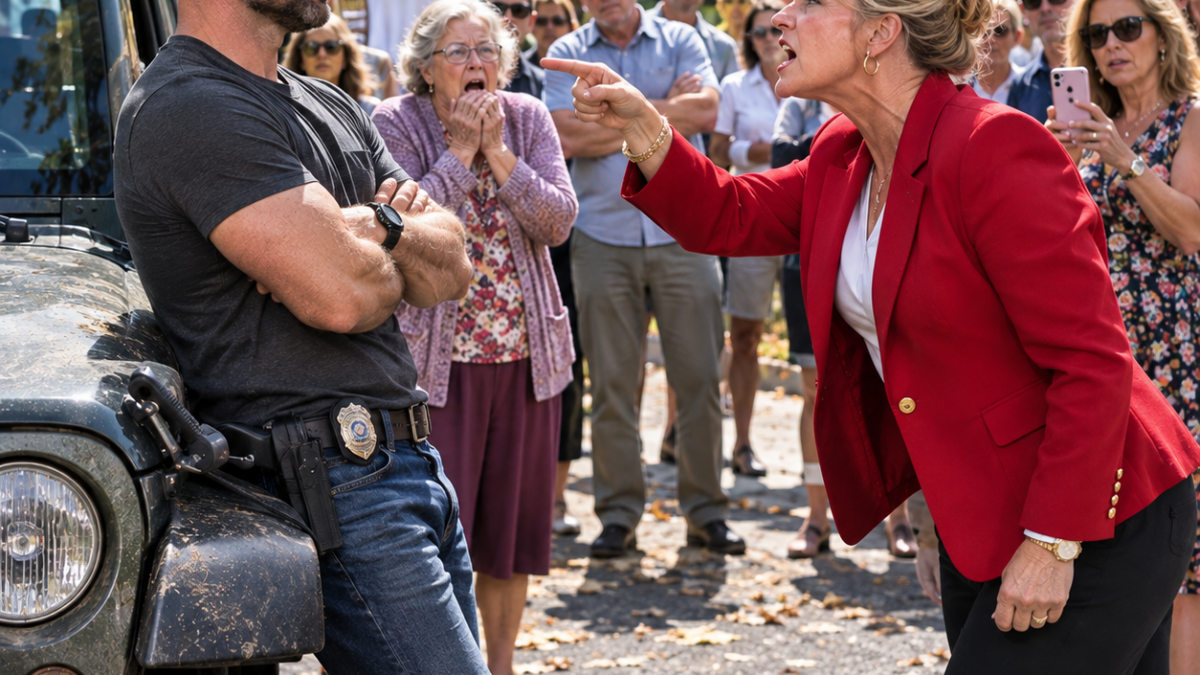
Jillian pointed.
“That man refused to move his vehicle. He threatened me, and I believe he is armed.”
Dan looked at me.
“Chief?”
That one word killed the last conversation on the lawn.
Jillian’s hand lowered.
Dan asked, “Everything all right?”
I nodded.
“So far.”
Jillian stared.
“Chief of what?”
Officer Marcos Reyes stepped out of the second cruiser.
He looked toward me.
Then toward Jillian.
Dan answered.
“Of us, ma’am.”
The quartet violinist slowly lowered her bow.
Somebody near the catering table whispered, “Oh my God.”
Jillian’s face changed from red to pale and then back again.
But people like Jillian do not survive years of petty power by accepting embarrassment gracefully.
They escalate.
“This is outrageous.”
She turned toward the crowd.
“Do all of you see this?”
Nobody answered.
She pointed at my Jeep.
“The HOA owns the street.”
“No,” I said.
She spun toward me.
“This road is governed by Willow Creek Estates.”
“The houses are.”
“So is parking.”
“No.”
“You received notice.”
“I received a pink piece of paper you printed at home.”
Her jaw tightened.
“You received an official violation.”
“On a public road.”
“It is not public.”
That was when I went to the Jeep.
Jillian followed me with her eyes.
Dan asked, “Chief?”
“Just getting something.”
I opened the passenger door.
Inside the glove compartment was a plain white envelope.
I had put it there two weeks earlier.
I took it out.
Walked back.
Handed it to Dan.
He opened it.
One page.
County seal.
Recorded dedication.
MAPLE CREST LANE — PUBLIC RIGHT OF WAY.
Recorded 1998.
Accepted for county maintenance.
Transferred to municipal road jurisdiction after Pine Valley’s annexation.
I watched Dan read it.
Jillian said, “That document is outdated.”
Dan looked at her.
“It’s a recorded road dedication.”
“The HOA has enforcement rights.”
“Over HOA property.”
“This is HOA property.”
“No, ma’am.”
Her voice rose.
“Yes, it is.”
Then behind me came another voice.
Soft.
Shaking.
“Then why did I pay her?”
Everyone turned.
Rosa Alvarez stood at the edge of her porch.
Seventy-eight years old.
Five feet tall on a generous day.
Silver hair.
Purple cardigan.
Cane in one hand.
A thick envelope in the other.
Rosa had lived across from Jillian for twelve years.
She was the first person in Willow Creek to welcome me.
Three weeks earlier, when I moved into my late father’s house, Rosa knocked on my door carrying a plate of cinnamon cookies.
“You’re Charlie Brooks’s boy.”
I smiled.
“I’m fifty-one, Mrs. Alvarez.”
“You’re still Charlie Brooks’s boy.”
Fair enough.
My father had lived on Maple Crest Lane for twenty-eight years.
He died the previous winter.
Heart attack.
Quick.
Too quick for everything I had meant to say.
His house sat empty six months.
Then I bought out my sister’s share and moved in.
I had just been sworn in as Pine Valley’s new police chief.
After twenty-six years in law enforcement, I wanted my home life to be boring.
No department parties.
No city politics.
No radio in the kitchen.
No people calling me Chief while I took out the trash.
At home, I wanted to be Ethan.
That lasted nine days.
Day nine, I walked outside at six-thirty in the morning and found a bright pink paper taped to my windshield.
UNAUTHORIZED VEHICLE.
$250 HOA FINE.
PARKING WITHOUT RESIDENT PERMIT.
Signed:
JILLIAN RADCLIFFE
PRESIDENT, WILLOW CREEK ESTATES HOA
I laughed.
Folded it.
Put it in my glove compartment.
I assumed it was a mistake.
Two days later, another appeared.
$400.
Repeat violation.
Then a letter arrived.
Failure to comply could result in towing.
That interested me.
Not because I was worried about the Jeep.
Because the Jeep was on a public street.
I pulled the county record.
Confirmed it.
Then I started asking neighbors casual questions.
Police work trains you to notice fear before people admit it.
Rosa’s came first.
I found her sitting on her porch one afternoon with papers in her lap.
Her hands were trembling.
“What happened?”
“Nothing.”
“Mrs. Alvarez.”
She sighed.
“You sound like your father.”
“I’ll take that as a compliment.”
She looked at the papers.
“They say I owe forty-eight hundred dollars.”
“For what?”
“Parking permits.”
I sat beside her.
“Where do you park?”
She pointed toward the street.
“Right there.”
Public roadway.
“How long have you been paying?”
“Two years.”
My stomach tightened.
“How much?”
“Two hundred some months. More when my grandson visits.”
“Who collects it?”
Her eyes moved toward Jillian’s house.
I did not react.
That mattered.
People stop talking when they believe your anger is about to become their problem.
“Mrs. Radcliffe?”
Rosa nodded.
“She says the HOA controls overnight parking.”
“Does she give receipts?”
Rosa went inside.
Returned with an envelope.
Handwritten slips.
WC PARKING FUND.
Dates.
House number.
Amounts.
J. RADCLIFFE.
Some cash.
Some electronic payments.
Total:
$4,800.
“Why did you pay?”
Rosa looked embarrassed.
“She said they could tow Mateo’s truck.”
“Your grandson?”
“Yes.”
“And if you didn’t pay?”
“She said repeated violations could affect my HOA standing.”
“What does that mean?”
“I don’t know.”
Exactly.
Vague authority works best when people are afraid to ask what it means.
I asked Rosa, “Has anybody else paid?”
She looked across the street.
“Everybody.”
That night I made calls.
Quiet ones.
County clerk.
City public works.
Municipal attorney.
The answer never changed.
Maple Crest Lane was public.
The HOA had no authority to charge anyone simply for legally parking there.
None.
Then I reviewed 911 activity tied to the neighborhood.
Not as Chief Brooks trying to punish someone.
As part of legitimate departmental oversight after learning residents might have been using emergency services as a private enforcement mechanism.
Jillian’s number appeared repeatedly.
Noise complaint.
Suspicious vehicle.
Trespassing.
Parking obstruction.
“Unknown man loitering.”
“Possible intoxicated woman.”
Nine calls in a year.
All involving residents who had disputed HOA enforcement.
All unfounded.
That bothered me.
911 is not a customer-service department.
It is not an HOA intimidation line.
Misusing it can get somebody hurt.
The incident that convinced me something larger was happening involved a widower named Harold Kim.
Sixty-four.
Retired electrician.
He had parked his daughter’s rental car in front of his own house for one night.
Jillian called police claiming an abandoned vehicle was obstructing access.
An officer responded.
Found nothing illegal.
Jillian later fined Harold $600 for “emergency response costs.”
There were no emergency response costs.
Pine Valley Police had never billed anyone.
Harold paid anyway.
“Why?”
I asked him.
He looked down.
“Because she said she could put a lien on my house.”
That was when I contacted the state’s financial crimes unit.
Investigator Nina Castellano met me at a diner outside town.
Forty-two.
Black coffee.
No patience for nonsense.
I put copies of the receipts on the table.
She examined them.
“Where does WC Parking Fund bank?”
“Don’t know.”
“HOA financial statements?”
“I have the publicly shared member reports.”
“Parking revenue listed?”
“No.”
Nina looked at me.
“How many households?”
“Potentially forty.”
“How long?”
“Two years.”
“Could be theft.”
“Could be.”
She tapped the receipts.
“Could also be an HOA account poorly disclosed.”
“That’s why I’m not arresting anyone.”
Nina smiled slightly.
“You’re learning politics fast, Chief.”
“I hate politics.”
“Then taking a chief job was an interesting decision.”
She was right.
Over the next week, Nina pulled what she could legally access.
A payment account existed.
WC Parking Fund.
Account holder:
Jillian Marie Radcliffe.
Not Willow Creek Estates Homeowners Association.
Not the HOA corporation.
Jillian personally.
That still did not automatically prove theft.
She could claim reimbursement.
Administrative collection.
Some bizarre board-approved structure.
We needed records.
Then came Saturday.
The autumn gala.
Jillian hosted it every year.
Large tents.
String quartet.
Catering.
Wine.
Local business owners.
Councilman Robert Hutchins.
A few realtors.
The kind of event where Jillian could stand in her yard and feel like mayor of a tiny country.
I had no intention of attending.
Rosa’s grandson Mateo was visiting.
She called that morning because her arthritis had flared and asked if I could help carry groceries from his truck.
That was it.
No raid.
No sting.
No dramatic setup.
I drove the Jeep thirty yards.
Parked outside Rosa’s house.
Started carrying groceries.
Jillian saw the Jeep.
Five minutes later, she was shouting.
Now Rosa stood before eighty guests holding her receipts.
“Then why did I pay her?”
Jillian’s eyes snapped toward her.
“Rosa, this is not your concern.”
Rosa straightened.
“It’s my money.”
Jillian softened instantly.
“Those fees were valid.”
“Chief Brooks says the road is public.”
“He is new.”
That made Dan Pruitt visibly react.
I almost smiled.
Jillian continued.
“He clearly does not understand our governing documents.”
Dan looked at me.
I said nothing.
Rosa walked down the porch steps.
Slowly.
Cane.
One step.
Then another.
She reached Dan.
Handed him the envelope.
“I paid every month because she said Mateo would be towed.”
Dan examined the slips.
Officer Reyes stepped closer.
“Ma’am, were you told these payments went to the HOA?”
“Yes.”
“Who collected them?”
Rosa pointed at Jillian.
Jillian’s face hardened.
“These officers have no authority to interrogate HOA finances in the street.”
Nina Castellano stepped out of a white sedan parked near the corner.
She had been there since shortly before the gala began.
Not because I knew Jillian would call 911.
Because Nina had planned to speak with the HOA treasurer that afternoon and wanted to observe the event discreetly first.
She wore a black blazer.
State investigator badge visible.
She walked toward us.
“Actually, I do.”
Jillian stared.
“Who are you?”
“Nina Castellano. State Financial Crimes Division.”
That quieted the lawn again.
Councilman Hutchins slowly lowered his champagne glass.
Nina stopped beside Dan.
“Mrs. Radcliffe, we’ve been reviewing the WC Parking Fund.”
Jillian’s face changed.
Small change.
Enough.
“What about it?”
“Is that your account?”
“It’s an administrative account.”
“Belonging to you personally?”
“I manage it.”
“On behalf of the HOA?”
“Yes.”
“Do the HOA financial records reflect the funds?”
“You’ll have to ask the treasurer.”
Everyone turned toward Gilbert Sutter.
Gil stood near the buffet in a purple shirt.
Mid-sixties.
Glasses.
HOA treasurer for four years.
He suddenly looked like he wanted the earth to open.
Jillian called to him.
“Gil.”
He did not move.
“Tell them.”
Gil looked at Nina.
Then at me.
Then Jillian.
“I told you.”
Jillian’s mouth tightened.
“What?”
“I told you it wasn’t legal.”
Several guests shifted.
Gil continued.
“I told her three times.”
Jillian walked toward him.
“Gil.”
“No.”
His voice shook.
But he said it louder.
“No.”
He removed his glasses.
Wiped them with his shirt.
“You told me the HOA could charge for street permits.”
“You approved the program.”
“I approved permits for the clubhouse lot.”
Jillian stopped.
Gil continued.
“Private HOA property.”
His voice grew steadier.
“Not Maple Crest.”
A murmur ran through the crowd.
Gil looked at Nina.
“I never saw this account.”
Jillian said, “That is a lie.”
He shook his head.
“The board account is at Pine Valley Community Bank.”
Nina asked, “Is WC Parking Fund an HOA account?”
“No.”
Jillian raised both hands.
“This is ridiculous.”
Then Tina Morales’s voice came over Dan’s radio.
“Lieutenant Pruitt.”
Dan lifted it.
“Go ahead.”
“For documentation, communications has completed a preliminary search of calls associated with today’s caller.”
Jillian looked toward the radio.
Tina continued.
“Nine calls in the prior twelve months involving residents of Willow Creek Estates. All coded unfounded or no enforcement action.”
Dan looked at me.
I nodded.
“Copy.”
Jillian’s voice went sharp.
“That is confidential information.”
Nina said, “Not the way you think it is.”
Jillian looked around.
The crowd was no longer looking at me.
They were looking at her.
That frightened her more.
A woman named Margaret Dale stepped forward.
“I paid parking fees.”
Another voice.
“So did I.”
A man near the quartet raised his hand.
“She charged me three hundred when my son came home from college.”
Then another.
“Six hundred last Christmas.”
Another.
“She told me the police required permits.”
My stomach tightened.
That was new.
I stepped forward.
“Who was told Pine Valley Police required HOA parking permits?”
Seven hands went up.
Jillian snapped, “Do not answer that.”
Nina turned.
“Mrs. Radcliffe, I strongly suggest you stop directing potential witnesses.”
Councilman Hutchins moved away from Jillian.
She noticed.
“Robert.”
He stopped.
“You know this is political retaliation.”
The councilman looked horrified.
“I know absolutely nothing about your parking account.”
“You approved our neighborhood safety initiative.”
“I approved additional streetlights.”
“Same initiative.”
“No.”
He stepped farther away.
Jillian looked around for another ally.
None appeared.
Then she decided to leave.
“I am done being publicly harassed.”
She reached for her handbag.
Nina said, “Mrs. Radcliffe, we need you to remain.”
“Am I under arrest?”
“Not at this moment.”
“Then I’m leaving.”
Officer Reyes stepped into her path.
Respectful.
Hands visible.
No aggression.
“Ma’am, we also need to resolve the false information provided during the 911 call.”
“I did not give false information.”
“You reported an armed man threatening you.”
“He is armed.”
I said, “I never displayed a weapon.”
Jillian pointed at me.
“He has one.”
“I’m a police officer.”
“You’re in plain clothes.”
“That doesn’t make your statement true.”
She turned toward Reyes.
“He threatened me.”
“With what?”
Jillian opened her mouth.
Stopped.
I asked, “What did I say?”
“You said I couldn’t tow you.”
“That’s not a threat.”
“You were intimidating.”
“I was carrying canned tomatoes.”
Someone in the crowd laughed.
Then several people did.
Jillian’s face flushed.
She pushed past Reyes.
Not violently.
But forcefully enough that he caught her forearm to prevent her from walking into the active scene.
“Ma’am, stop.”
She yanked away.
Her handbag slipped.
Hit the pavement.
The clasp opened.
Envelopes spilled across Maple Crest Lane.
White.
Yellow.
Brown.
Some thick.
Some thin.
Each labeled in black marker.
House numbers.
Cash slid from one.
Nobody moved.
Jillian stared down.
So did Nina.
Gil whispered, “Oh God.”
Nina crouched.
Did not touch anything at first.
Looked.
Then called for evidence gloves.
One envelope had ROSA A. written across it.
Rosa saw.
Her face changed.
Jillian lunged toward the bag.
Reyes blocked her.
“Do not touch it.”
“That is my personal property!”
Nina stood.
“Then you definitely shouldn’t want it mixed with evidence.”
Jillian stared at me.
Her voice dropped.
“My husband is an attorney.”
I nodded.
“Then call him.”
She narrowed her eyes.
“You will regret humiliating me.”
Nina replied before I could.
“Mrs. Radcliffe, your husband should probably meet you at the station.”
Jillian turned.
“Why?”
Nina looked at the cash envelopes.
“Because I think we’re going to have several questions.”
The entire scene lasted eleven minutes from the moment Jillian dialed 911 until Officer Reyes told her she was being detained.
Eleven minutes.
People later said it looked like her life collapsed instantly.
It didn’t.
It had been collapsing for two years.
The only thing that happened quickly was everyone seeing it at once.
Dan pulled me aside.
“Chief.”
“What?”
“You need to separate.”
“I know.”
“You’re a witness.”
“I know.”
“You’re also technically the complainant on the false report.”
“I know.”
“You cannot direct the arrest.”
“I’m not.”
He studied me.
“You good?”
“No.”
He nodded.
“Good answer.”
I watched from Rosa’s porch while Nina and Dan handled the scene.
That mattered.
Being chief does not mean every badge becomes an extension of your anger.
Especially when you are personally involved.
I called the assistant chief.
Transferred operational authority on anything connected to Jillian.
Then called the city manager.
Then the district attorney.
Boring calls.
Necessary calls.
Meanwhile the gala dissolved.
Caterers packed trays.
The quartet put instruments into black cases.
People left wine glasses on tables.
Nobody finished dessert.
Jillian sat in the back of a cruiser.
Her red blazer looked almost orange through tinted glass.
Rosa stood beside me.
“I ruined her party.”
I looked down.
“You?”
“I brought the receipts.”
I smiled.
“Mrs. Alvarez, Jillian ruined her own party.”
She squeezed my hand.
“Thank you.”
“For what?”
“Carrying my groceries.”
I laughed.
“That’s all I came over for.”
“I know.”
Then her smile faded.
“Chief?”
“Ethan at home.”
“Ethan.”
“Yes?”
“I thought I was stupid.”
My smile disappeared.
“Why?”
“For paying.”
I looked at her.
“No.”
“She kept saying everyone else paid.”
“That’s how pressure works.”
“I should have asked.”
“You did eventually.”
“After forty-eight hundred dollars.”
I sat beside her.
“Mrs. Alvarez, people who exploit trust depend on decent people being embarrassed afterward.”
She looked at me.
“Don’t help her by taking over the shame.”
Rosa’s eyes filled.
“You really do sound like your father.”
That hit harder than I expected.
The investigation widened immediately.
Nina obtained warrants.
Bank records.
HOA books.
Payment-app histories.
Phone records.
Emails.
Forty households had paid some version of a parking permit, violation charge, emergency response fee, visitor fee, towing prevention fee, or “road protection assessment.”
Twenty-six months.
Total collected:
$63,400.
Amount deposited into Willow Creek Estates’ official operating account:
Zero.
Not one dollar.
Instead, money went into the WC Parking Fund account controlled by Jillian.
Then transferred.
Some to personal accounts.
Some to credit-card payments.
Some to cash withdrawals.
The HOA itself was struggling financially.
Pool maintenance delayed.
Clubhouse roof leaking.
Landscaping contract overdue.
Residents had recently been told dues might increase.
Meanwhile Jillian’s HOA credit card showed charges for a luxury spa resort.
Three nights.
Massage package.
Dinner.
Wine.
Total:
$2,860.
The charge was coded:
BOARD STRATEGIC RETREAT.
Gil Sutter nearly cried when Nina showed him.
“There was no retreat.”
“Did you approve the charge?”
“No.”
“How did she have the card?”
“President’s purchasing authority under five thousand.”
Nina stared at him.
“Without secondary approval?”
Gil looked ashamed.
“Yes.”
“Change that.”
He did.
The board’s problems went deeper than Jillian.
Not criminally for most of them.
Culturally.
Nobody questioned her.
She wrote notices.
She controlled the management-company relationship.
She ran meetings.
She told everyone she had checked with counsel.
People assumed somebody else had verified.
That phrase appeared again and again during interviews.
I assumed.
I thought.
She told us.
Everyone pays.
I didn’t want trouble.
That is how petty corruption grows.
Rarely because everyone agrees.
Usually because nobody wants to be first to say, “Show me.”
Rosa became the case investigators returned to repeatedly.
She kept receipts.
Every one.
Paper clipped by month.
Dates.
Amounts.
Why?
Because Rosa’s late husband, Miguel, had handled family finances for forty-six years.
After he died, she became terrified of making mistakes.
So she kept everything.
Electric bill.
Grocery receipt.
Pharmacy slips.
Parking extortion.
All of it.
Jillian had mistaken Rosa’s age for weakness.
Her carefulness became evidence.
Harold Kim had screenshots.
Another neighbor saved payment-app records.
A younger resident named Casey Monroe had recorded an HOA meeting in which Jillian said, “Pine Valley Police supports aggressive parking enforcement.”
Pine Valley Police had never heard of the policy.
The recording made me furious.
Dan noticed.
“You need to go home.”
“I’m fine.”
“Your jaw says otherwise.”
“She used the department.”
“I know.”
“To scare old people.”
“I know.”
“I want—”
Dan raised one hand.
“I know what you want.”
I stopped.
He continued.
“You hired me to tell you when you’re getting too close.”
“I inherited you.”
“Still counts.”
He was right.
Again.
That was becoming irritating.
I went home.
My father’s house was quiet.
Same hallway.
Same kitchen.
His coffee mug still on the top shelf because I had not had the nerve to move it.
I sat on the porch.
Across the street, Rosa’s light was on.
Two houses down, Jillian’s lawn was still littered with gala decorations.
A string of lights glowed beneath the empty tent.
No music.
No guests.
Just silence.
Three weeks earlier, I had moved there believing anonymity would be possible.
I thought I could be Chief Brooks at the station and Ethan at home.
Jillian had destroyed that division.
For several days I resented her for it.
Then something unexpected happened.
Neighbors started knocking.
Not because they wanted police favors.
Because they wanted to tell somebody.
The first was Margaret Dale.
Then Harold.
Then a young couple named Tasha and Eric Greene.
Then an Army veteran named Cole Benson.
Stories.
Not all criminal.
Most petty.
Jillian threatening fines.
Jillian humiliating residents at meetings.
Jillian sending photographs of trash cans in group emails.
Jillian telling a grieving widower his lawn was “damaging community morale.”
Jillian charging a mother $150 because her daughter’s wheelchair-access van remained parked overnight.
That one almost sent me through a wall.
“Did she know why the van was there?”
I asked.
The mother nodded.
“She said rules were rules.”
“Did you pay?”
“Yes.”
“Why?”
“Because my daughter had surgery that week and I didn’t have energy to fight.”
There it was.
Not fear exactly.
Exhaustion.
Power often targets the exhausted before the weak.
People who could fight in theory.
But have jobs.
Children.
Illness.
Grief.
Bills.
Life.
Jillian understood that most people would pay two hundred dollars rather than spend twenty hours proving they shouldn’t have to.
Multiply that by forty households.
For two years.
There’s your scheme.
Nine days after the gala, Nina completed the first financial audit.
$63,400 in improper parking-related payments.
Additional HOA funds potentially misused.
False financial representations.
Potential theft by deception.
Possible fraudulent billing.
The false 911 report became its own charge.
Jillian’s attorney—her husband, Stephen—came to the station.
To his credit, he looked more horrified than defensive.
He did not represent her.
Conflict of interest.
He brought another lawyer.
When he saw Nina’s evidence binder, he sat down heavily.
“I didn’t know.”
Nina said, “We’ll determine that.”
He nodded.
That was the correct answer.
Investigators eventually found no evidence Stephen participated in the parking account scheme.
Jillian had told him the fees were HOA assessments.
He had not reviewed the records.
That created an interesting question inside their marriage that was none of my business.
The criminal part was.
Jillian’s defense initially argued that she believed the HOA possessed parking authority.
That explanation collapsed because of emails between Jillian and Gil.
One from Gil:
MAPLE CREST IS PUBLIC. WE CANNOT FINE STREET PARKING.
Jillian replied:
WE CAN CALL IT A COMMUNITY ACCESS PERMIT.
Gil:
CHANGING THE NAME DOESN’T CHANGE AUTHORITY.
Jillian:
PEOPLE WILL PAY.
That email did more damage than any angry witness could.
Then another.
From Jillian to a friend:
THE OLD ONES ARE THE EASIEST. THEY DON’T WANT THEIR CARS TOWED.
I read it once.
Then again.
Then closed the file.
I did not need a third.
When Rosa learned about that email, she sat quietly for almost a minute.
Then said, “She meant me.”
I wanted to soften it.
Couldn’t.
“Yes.”
Rosa nodded.
“She thought I was easy.”
I said nothing.
Then she smiled.
Not kindly.
“Keep my receipts.”
The HOA board called an emergency meeting.
The clubhouse filled beyond capacity.
People stood in the hall.
The board president’s chair was empty.
Jillian had been suspended.
Gil sat at the front.
He looked miserable.
The vice president, Marlene Cox, opened the meeting.
“We owe this community an explanation.”
A man shouted from the back.
“We need our money back!”
Applause.
Marlene raised her hands.
“I agree.”
That surprised people.
She continued.
“The board failed.”
Not Jillian.
The board.
That mattered.
“We trusted one person with too much authority.”
She looked at Gil.
“We did not verify.”
Then at residents.
“We treated questions like disloyalty.”
The room became quiet.
“We allowed rules to become a substitute for judgment.”
I sat in the back with Rosa.
No uniform.
No badge visible.
Just neighbor.
Marlene announced that the entire board would resign after ensuring records were transferred to an independent management company.
Gil would stay temporarily to cooperate with investigators and auditors.
Then a new election.
A forensic accounting review.
Refund plan.
Someone asked whether I would supervise.
“No.”
Half the room turned.
I stood.
“I’m your police chief.”
I pointed toward myself.
“I am not becoming HOA dictator because the last one was crooked.”
A few people laughed.
“I’ll enforce law.”
I gestured toward the board.
“You run your neighborhood.”
Rosa whispered, “Good.”
I sat.
Then Marlene called Rosa’s name.
She looked startled.
“What?”
“Mrs. Alvarez, would you come forward?”
Rosa glared at me.
“Did you know?”
“No.”
“If you’re lying, I’ll tell your officers.”
“I believe you.”
She walked slowly to the front.
Marlene handed her an envelope.
Full refund.
$4,800.
Rosa opened it.
Looked at the check.
Her hands shook.
Then the entire room stood.
Applause.
Rosa began crying.
So did Gil.
So did three people behind me.
I didn’t.
Until Rosa turned and looked directly at me.
Then I had to pretend something was in my eye.
Three months later, Jillian appeared before a judge.
No red blazer.
No expensive necklace.
Plain gray blouse.
Hair pulled back.
She pleaded guilty to theft by deception and filing a false emergency report, along with additional related counts resolved in the plea agreement.
Full restitution.
Probation with strict conditions.
Community service.
Financial penalties.
A court order prohibiting her from serving in HOA or similar fiduciary board positions during the period imposed by the judgment.
People wanted prison.
Some neighbors were furious she did not receive years.
I understood.
But criminal sentencing is not theater.
The judge considered record.
Restitution.
Plea.
Evidence.
State guidelines.
Actual charges.
Not Facebook comments.
When Jillian addressed the court, she said, “I believed I was protecting the community.”
The judge looked at her.
“By putting community money into your personal account?”
Jillian lowered her eyes.
“No, Your Honor.”
“By calling 911 on residents who questioned you?”
“No.”
“By charging an elderly widow for parking on a public street?”
Jillian said nothing.
The judge leaned forward.
“Ms. Radcliffe, the word ‘community’ does not transform theft into governance.”
That line made the local newspaper.
Outside court, reporters waited.
I avoided them.
Rosa did not.
One asked, “Mrs. Alvarez, do you feel justice was served?”
Rosa looked at the camera.
“I got my money.”
Then she thought.
“And I got my street back.”
That was the quote they used.
A few weeks later, I parked the Jeep in the same place outside Rosa’s house.
No pink notice.
No confrontation.
I carried in a bag of potting soil because apparently once you help a seventy-eight-year-old woman with groceries, you become permanent unpaid labor.
When I came back outside, a boy on a bicycle rode past.
“Hi, Chief!”
“Hey, Tyler.”
Rosa emerged with cookies.
“You’re going to get fat.”
“Your fault.”
“You need it.”
“I do not.”
“You’re too thin.”
“I’m six-two and two hundred pounds.”
“Thin.”
There is no legal appeal from an elderly Hispanic grandmother.
I accepted the cookies.
Across the street, Jillian’s old house had a FOR SALE sign.
Stephen had moved out months earlier.
The gala tent was gone.
The lawn looked ordinary.
That felt right.
The neighborhood changed after Jillian.
At first, everyone overcorrected.
No fines.
No enforcement.
Trash cans everywhere.
One resident parked a boat on his lawn.
The new board eventually had to remind people that the HOA still existed.
Rules were not the problem.
Unchecked power was.
That took time to understand.
The new board published every expenditure online.
Any fine above $100 required review by two board members.
No HOA representative could threaten police action for civil rule disputes.
All parking policies had to identify whether the roadway was private or public.
Residents could appeal decisions to an independent committee.
Boring governance.
Beautifully boring.
Rosa attended every meeting.
Front row.
Cane.
Receipts folder.
Nobody ignored her again.
One night the board debated whether basketball hoops could remain near curbs.
A member said, “The rules are clear.”
Rosa raised her hand.
Everyone stopped.
She asked, “Is it dangerous?”
“No.”
“Is it ugly?”
“Not particularly.”
“Then why are we talking?”
The motion died.
I loved her.
Six months after Jillian’s case ended, Tina Morales asked me to stop by dispatch.
“Problem?”
“Maybe.”
She handed me a printout.
911 calls from Willow Creek.
Down eighty-two percent.
I looked at her.
“Seriously?”
“Yep.”
“Any actual emergencies missed?”
“No.”
“Then what were they calling about before?”
She raised one eyebrow.
“You know.”
Parking.
Noise.
Neighbors.
HOA fights.
Tiny conflicts weaponized through emergency services.
Tina leaned back.
“You know what bothered me most about Jillian?”
“What?”
“She knew exactly how to sound urgent.”
I understood.
Dispatchers are trained to take callers seriously.
They have to.
Jillian exploited that.
“She’d say ‘unsafe.’”
Tina counted.
“‘Threatening.’”
Another finger.
“‘Blocking emergency access.’”
Another.
“Words that make us send someone.”
I nodded.
“And officers arrive, which makes her look official.”
“Exactly.”
That was her power loop.
Create conflict.
Call police.
Police appear.
Tell neighbors, See? I told you this was serious.
The department had unknowingly become stage scenery for her authority.
I changed policy.
Not to ignore HOA calls.
That would be dangerous.
Instead, repeat noncriminal civil disputes received supervisory review.
Dispatch training emphasized identifying actual emergency facts rather than adopting caller conclusions.
Is somebody threatening you?
What exactly did they say?
Is access physically blocked?
Can vehicles pass?
Do you see a weapon?
Was it displayed?
Simple questions.
Specific facts.
Language matters.
The year after the gala, Pine Valley asked me to give a leadership talk at a municipal conference.
I said no.
City manager said yes.
Chiefs technically outrank many people.
City managers outrank chiefs in very inconvenient ways.
I stood before a hundred department heads.
They expected police stories.
I told them about parking permits.
Somebody laughed.
I said, “That’s exactly why this matters.”
Then told the story.
Not Jillian’s name.
No gossip.
The structure.
One person accumulates authority.
Everyone assumes someone else is verifying.
Small rules become tests of obedience.
Questions become disloyalty.
People learn paying is easier than fighting.
Then the person in charge stops distinguishing between their role and their identity.
I said, “The dangerous sentence isn’t ‘I’m in charge.’”
People listened.
“The dangerous sentence is ‘Because I’m in charge, I must be right.’”
Afterward a city clerk approached.
“My town has somebody like that.”
I asked, “Criminal?”
“No.”
“Then don’t turn them into a criminal because you dislike them.”
She laughed.
“What do I do?”
“Documentation.”
“Anything else?”
“Checks and balances.”
“Anything else?”
“Stop rewarding intimidation because it’s efficient.”
That last one was harder.
Bullies are efficient.
They decide quickly.
Speak confidently.
Make meetings short.
People confuse that with leadership.
Until the bill comes.
My father would have understood.
He had been a mechanic.
Never wore a badge.
Never managed anyone except two apprentices who still sent Christmas cards.
When I was sixteen, I watched him argue with a man who tried to charge an elderly customer for a transmission she didn’t need.
Dad fired the customer.
Not the mechanic.
I remember asking why.
“She’s annoying.”
He stared at me.
“She’s being cheated.”
“But she complains constantly.”
“What does that have to do with it?”
At sixteen, I had no answer.
At fifty-one, I finally understood the question.
Rights do not depend on likability.
Rosa deserved protection even if she had been difficult.
Harold deserved it.
The mother with the wheelchair van.
Even Jillian deserved lawful treatment when she became a suspect.
Especially then.
The badge matters most when you refuse to use it as revenge.
That became harder when Jillian filed a civil complaint against me.
Yes.
After pleading guilty.
She claimed I had used my office to orchestrate public humiliation.
The city’s outside counsel handled it.
Body-camera footage.
911 recording.
Witness statements.
My early recusal from the investigation.
State investigator involvement.
Complaint dismissed.
When Dan told me, he waited for a reaction.
I said, “Okay.”
“That’s it?”
“What do you want?”
“Maybe joy.”
“I’m tired.”
He nodded.
“You’re becoming a chief.”
“I hate you.”
“See? Leadership.”
The complaint taught me something useful.
Even when you know you are right, procedure protects you.
If I had ordered Jillian arrested personally that day?
Problem.
If I had searched her bag myself?
Problem.
If I had directed Nina’s financial investigation?
Problem.
Instead, I stepped back.
At the time it felt frustrating.
Later it became protection.
Not only mine.
The legitimacy of the case.
People often see restraint as weakness.
In law enforcement, restraint is frequently the difference between authority and abuse.
That distinction mattered more after Willow Creek than before.
A year later, Rosa’s grandson Mateo became a police recruit.
I thought she was joking when she told me.
“You inspired him.”
“I carried groceries.”
“Same thing.”
Mateo was twenty-four.
Good kid.
Too eager.
First month at the academy, he called me Chief every time he saw me.
Rosa corrected him.
“His name is Ethan.”
“Grandma, he’s my chief.”
“He was my grocery boy first.”
There was no recovering from that.
Mateo graduated.
At his ceremony, Rosa sat front row.
He received his badge from me.
Before pinning it, I said quietly, “You know what this doesn’t make you?”
“What?”
“Right.”
He frowned.
I smiled.
“It makes you responsible.”
He nodded.
Years later, he told me he remembered that on every traffic stop.
That mattered more to me than any award.
Willow Creek became quiet again.
Not perfect.
People still fought about lawns.
Dogs barked.
Teenagers parked badly.
One couple had a legendary argument about Christmas lights that resulted in a thirty-seven-email thread.
But nobody was afraid of the HOA.
That was the difference.
Rules became something people could question without fearing retaliation.
Rosa eventually joined the appeal committee.
Of course she did.
At eighty.
She became terrifying.
A board member once proposed a $500 fine against a young family because their grass had grown too tall while the father was hospitalized.
Rosa asked, “Did anyone knock on the door?”
Silence.
“Did anyone ask if they need help?”
Silence.
She closed the folder.
“No fine.”
The board member said, “The covenant—”
Rosa pointed her cane.
“The grass will still be there next week.”
Motion denied.
Pine Valley’s most effective community reformer was a five-foot widow carrying a cane and cookies.
Jillian had created her.
That is the irony.
Sometimes people become powerful because someone tried too hard to make them feel powerless.
Three years after I moved into Dad’s house, I finally replaced the Jeep.
Sort of.
I bought a newer SUV for daily use.
The old Cherokee remained in the garage.
Rosa protested.
“That Jeep started everything.”
“No. Jillian started everything.”
“The Jeep helped.”
“The Jeep needed a transmission.”
“Your father would fix it.”
“My father is dead.”
She stared at me.
I immediately regretted saying it so sharply.
Then she said softly, “I know.”
Silence.
I looked at the Jeep.
Dad had driven me to my first police academy interview in it.
He used it to haul tools.
Take Mom to chemotherapy years earlier.
Drive Rosa’s late husband to the hospital once when an ambulance was delayed during a storm.
It was more than a vehicle.
That was why I kept repairing it.
“I’ll fix it.”
Rosa smiled.
“I know a mechanic.”
“You know me.”
“No. A good mechanic.”
I laughed.
The Jeep eventually ran again.
Every fall, on the anniversary of the gala, Rosa insisted I park it in front of her house.
“Why?”
“Tradition.”
“Tradition requires more than one stupid incident.”
“Not anymore.”
She would bring cookies.
Kids waved.
Neighbors joked.
One year somebody taped a pink fake violation notice to the windshield.
$0 FINE.
AUTHORIZED FOREVER.
I kept it.
The real original notice stayed in my glove box.
Sometimes I pulled it out.
Bright pink faded now.
$250.
Unauthorized vehicle.
Signed Jillian Radcliffe.
It reminded me how small things begin.
A paper.
A threat.
A payment.
People laugh at petty authority.
Until petty authority learns nobody will stop it.
Jillian did not wake up one morning and decide to steal sixty-three thousand dollars.
At least I doubt it.
More likely she charged one fee.
Nobody challenged it.
Then another.
Someone paid.
Then ten.
Then she began believing payment proved legitimacy.
That is a human danger far bigger than HOAs.
Compliance is not consent.
Silence is not agreement.
Fear is not respect.
A person giving you money because they are afraid of what happens if they refuse is not the same as a person recognizing your authority.
Jillian never understood that.
The neighborhood eventually did.
I did too.
Before becoming chief, I believed leadership was mostly decisions.
Make the right call.
Issue clear direction.
Accept responsibility.
After Willow Creek, I added another obligation.
Create conditions where people can tell you you’re wrong.
That sounds easy.
It isn’t.
Rank changes rooms.
Titles change voices.
People start sentences differently.
“Chief, maybe…”
“Chief, I’m not sure…”
“Chief, if you don’t mind…”
The first time a young officer told me flatly, “Chief, I think that policy is a mistake,” I felt irritation before curiosity.
That frightened me.
Because Jillian had probably felt the same thing.
So I asked:
“Why?”
He explained.
He was right.
We changed the policy.
That became my private test.
Not whether I never became defensive.
Humans do.
The test was what happened next.
Do you punish the person?
Or examine the idea?
Years later, Dan Pruitt retired.
At his party he told the Willow Creek story.
Naturally, he exaggerated.
“Chief was standing there with canned tomatoes looking like Clint Eastwood.”
“I was carrying pasta sauce.”
“Ruins the story.”
“You ruin everything.”
Dan continued.
“Mrs. HOA points at him and says, ‘Arrest that man.’”
People laughed.
Then Dan imitated my face when Jillian called me “armed.”
“I was armed.”
“Yes, Chief. We’re police.”
More laughter.
Then he became serious.
“I learned something that day.”
I expected a joke.
Dan said, “The most powerful thing Ethan did was nothing.”
The room quieted.
“He could’ve taken over.”
Dan looked at younger officers.
“He didn’t.”
“He let the responding lieutenant handle the call.”
“That was me.”
“He handed the case to the state.”
“He recused.”
“Because when you’re angry and powerful, the first person you need protection from is sometimes yourself.”
I looked at him.
“That’s annoyingly good.”
“I’ve been saving it.”
That sentence stuck.
Power is not proven by using every piece you have.
Sometimes power is proven by leaving some of it untouched.
Jillian used everything.
HOA title.
Emergency services.
Public embarrassment.
Threats.
Money.
Social influence.
She needed every lever pulled toward herself.
When those levers stopped working, she had nothing underneath.
The badge taught me the opposite.
If I need everyone to know I’m chief before I can get respect, I probably don’t have much.
That Saturday, Tina knew my plate.
Dan knew my face.
But Rosa didn’t trust me because of either.
She trusted me because I carried groceries.
That embarrasses every leadership seminar ever created.
Maybe it should.
Rosa died five years after Jillian’s arrest.
Eighty-three.
Stroke.
Peaceful.
Mateo called me from the hospital.
I got there before she passed.
She could not speak.
But she recognized us.
Mateo held one hand.
I held the other.
On the bedside table sat a plastic container.
Cookies.
Of course.
After the funeral, Mateo handed me an envelope.
“She left this for you.”
Inside was a handwritten note.
Ethan,
Your father raised you right.
Do not let the uniform make you forget the man carrying the groceries.
Love,
Rosa
I sat in my Jeep outside the church and cried until everyone else left.
That note is framed in my office.
Not my commendations.
Not newspaper clippings.
Rosa.
When young officers ask why, I tell them the story.
Not all of it.
Only enough.
One of them once asked, “Chief, did you know Jillian would get arrested when she called 911?”
“No.”
“But you had an investigator there.”
“Yes.”
“So it was kind of a sting.”
“No.”
“Really?”
“Really.”
“What would have happened if she hadn’t called?”
“Nina would’ve kept investigating.”
“And if the bag hadn’t opened?”
“We’d have sought evidence legally another way.”
“And if Rosa didn’t have receipts?”
“Other people did.”
He looked disappointed.
“But the dispatcher saying, ‘That’s our chief’—”
“That part happened.”
He smiled.
“Cool.”
“Yes.”
Then I said, “But don’t learn the wrong lesson.”
“What’s the wrong lesson?”
“That Jillian was wrong because she called 911 on the chief.”
He frowned.
“She was wrong because she lied about anybody.”
That is the part people miss when they retell the story.
They love the reveal.
Karen calls cops.
Man turns out to be chief.
Tables turn.
Satisfying.
But if I had been a plumber?
Teacher?
Warehouse worker?
Retired veteran?
Unemployed father?
She would still have been wrong.
My job made the lie easier to expose.
It did not make my rights more important.
Rosa’s rights mattered just as much.
Harold’s.
The mother with the medical van.
Every neighbor who paid because Jillian convinced them they were too small to question her.
That was why the case mattered.
Not because she picked the wrong target.
Because she had spent years believing some people were safe targets at all.
The day after Rosa’s funeral, I parked the old Jeep outside her empty house.
Same spot.
I sat there for maybe twenty minutes.
Maple Crest Lane was quiet.
Public street.
Always had been.
A young couple had bought Jillian’s former house years earlier.
Nice people.
Two kids.
No gala.
The woman came outside while I sat there.
“You okay, Chief?”
“Yeah.”
She glanced toward Rosa’s house.
“I’m sorry.”
“Thank you.”
She went back inside.
I looked down the street.
No cameras.
No crowd.
No sirens.
Just a road.
That is what Jillian had tried to turn into a weapon.
A place everyone already owned together.
She made people pay for permission to use what was already theirs.
There is something especially ugly about that kind of theft.
Not taking a thing.
Selling somebody back their own right.
That is why Rosa’s sentence stayed with me.
I got my street back.
Money mattered.
Four thousand eight hundred dollars mattered.
But dignity mattered more.
Not having to look through the curtains every time your grandson parked.
Not fearing the president’s clipboard.
Not wondering whether police would arrive because you had annoyed someone.
That was what came back.
The street.
The neighborhood.
Their voices.
Years later, Pine Valley grew.
I eventually retired.
Mateo became lieutenant.
Then captain.
Tina finally left dispatch after thirty-one years.
At her retirement party, she saw me and laughed.
“What?”
“You still have the Jeep?”
“Yes.”
“That thing should be evidence.”
“Evidence of what?”
“Poor judgment.”
I pointed at her.
“You’re the one who caused the whole scene.”
“I answered the phone.”
“You said it.”
“What?”
I imitated her.
“Ma’am… that’s our chief.”
Tina laughed.
“I was trying so hard not to laugh.”
“I knew.”
“Jillian said, ‘Then send the chief.’”
“I remember.”
Tina shook her head.
“I almost muted the call.”
“Why?”
“To swear.”
That seemed reasonable.
Then she became serious.
“You know what I remember?”
“What?”
“The calls before yours.”
I understood.
“Nine.”
“Nine that year.”
She nodded.
“Every time, somebody sounded scared.”
“Jillian?”
“No.”
“The neighbors.”
Tina looked at me.
“They would whisper in the background.”
She remembered a woman saying, Please don’t tow it.
An older man asking, Am I being arrested?
A teenager saying, My mom said I can park here.
Tina shook her head.
“We should have noticed the pattern earlier.”
“Maybe.”
“I still think about that.”
“So do I.”
She asked, “Does that bother you?”
“Yes.”
“What do you do with it?”
I thought of Rosa.
“Change the next call.”
Tina smiled.
“That sounds like something dispatch says.”
“Probably stole it from you.”
That is how institutions improve when they actually improve.
Not by claiming they never failed.
By noticing patterns sooner next time.
Pine Valley added recurring-caller review partly because of Jillian.
Other departments copied it.
HOA complaints received clearer coding.
Dispatchers received more training about civil-versus-criminal issues.
Nothing dramatic.
No ribbon cutting.
No cameras.
Just fewer people using emergency systems as intimidation.
That is the kind of outcome I trust most.
Quiet ones.
The neighborhood still holds an autumn event every year.
Not Jillian’s gala.
They renamed it Maple Crest Block Night.
Potluck.
Kids.
Music from somebody’s Bluetooth speaker instead of a string quartet.
No champagne tower.
Rosa’s cookie recipe appears every year.
Mateo makes them badly.
One year he burned four trays.
We ate them anyway.
At sunset, neighbors bring folding chairs into the street.
Yes.
The public street.
The city issues the closure permit.
Properly.
Free.
Every year someone parks the old Jeep near Rosa’s former house.
Usually me.
Sometimes Mateo.
Nobody fines it.
One year a kid asked, “Why is this old car famous?”
I said, “Because somebody didn’t like where it was parked.”
“That’s dumb.”
Exactly.
Children often reach the right conclusion faster.
On my final day as chief, the department gave me a plaque.
City council gave me a proclamation.
Officers gave speeches.
Dan came back.
Tina came.
Mateo stood near the front.
At the end, the mayor said, “Any final words?”
I hate final words.
They make ordinary people attempt poetry.
I looked at the room.
Officers.
Dispatchers.
City employees.
My family.
Then I thought of a pink parking notice.
An old woman holding receipts.
A woman in a red blazer telling emergency services to arrest somebody because she did not like hearing no.
I said:
“When you have authority, people will sometimes obey you even when you are wrong.”
The room became quiet.
“That means obedience is not evidence that you’re right.”
I looked at the younger officers.
“A badge does not make your judgment better.”
I looked toward city officials.
“A title does not make your idea better.”
Then at Mateo.
“And somebody being afraid to argue with you does not mean you’ve earned respect.”
I paused.
“The test is what happens when somebody tells you no.”
No applause immediately.
Good.
Then Dan started clapping.
Everybody followed.
Afterward Mateo asked, “Was that about Jillian?”
“Partly.”
“Grandma Rosa?”
“Mostly.”
He smiled.
“She’d like that.”
“Yes.”
“She’d still say you’re too thin.”
“Absolutely.”
I drove home in Dad’s Jeep.
The transmission whined.
Check-engine light came on.
Again.
I laughed.
Parked on Maple Crest Lane.
Legally.
Walked onto the porch.
The house was mine now in a way it had not been when I moved in.
Not because of the deed.
Because enough life had happened there.
Dad.
Rosa.
Neighbors.
The ridiculous Jeep.
The day eighty people watched one woman call 911 believing police were another tool she could order around.
She asked the dispatcher to do her job.
That part still makes me think.
Do your job and arrest him.
Doing your job does not mean doing what the loudest person demands.
Sometimes it means slowing down.
Checking.
Running the plate.
Looking at the map.
Asking one more question.
Refusing to let somebody else’s confidence become your conclusion.
Tina did her job.
Dan did his.
Nina did hers.
Gil eventually did his by telling the truth.
Rosa did hers by keeping receipts.
Even the neighbors who had stayed quiet eventually did theirs by speaking.
My job that morning?
Carry groceries.
Then stay out of the way when the investigation became personal.
That was enough.
People still send me versions of the story they heard online.
Some get details wrong.
They say I was in uniform.
I wasn’t.
They say Jillian slapped me.
She didn’t.
They say I personally handcuffed her.
Absolutely not.
One version says twelve SWAT officers stormed the gala.
There were three cruisers.
Another says I had been investigating her for six months.
I had lived there three weeks.
Real stories do not need extra explosions.
Sometimes a woman calls 911 on the wrong person and accidentally exposes something much larger than the thing she called about.
That is dramatic enough.
The line everyone remembers is Tina’s.
“Ma’am, that’s our chief.”
But the line I remember came from Rosa.
“Then why did I pay her?”
That question changed the scene.
Because my identity embarrassed Jillian.
Rosa’s receipts exposed her.
One was reversal.
The other was evidence.
There is a difference.
Jillian could have survived being embarrassed.
She could not survive the truth.
The money.
The calls.
The lies.
The account.
The envelopes.
The people finally comparing stories.
That is how abusive little systems collapse.
Not because one powerful person arrives.
Because the people who thought they were alone discover they were all being told the same lie.
Rosa thought she was the only one paying.
Harold thought he was the only one threatened.
The mother with the wheelchair van thought she had simply broken some obscure rule.
Each one felt embarrassed.
That isolation protected Jillian.
The moment they spoke together, her authority shrank to actual size.
One woman.
One title.
One account.
No magic.
No ownership of the street.
No special police power.
Just confidence.
And confidence is fragile when receipts appear.
I still have Rosa’s first envelope.
Not the originals.
Those became evidence.
She gave me an empty replacement after the case.
On the front she wrote:
FOR THE NEXT PERSON WHO THINKS I’M EASY.
I framed that too.
My office after retirement has two things on the wall.
Her note to me.
That envelope.
Visitors ask about awards.
They’re in a box.
Maybe I’ll hang them someday.
Probably not.
The lessons that mattered most didn’t come with medals.
They came from a public road.
An old Jeep.
A dispatcher who checked before assuming.
And a seventy-eight-year-old widow who finally asked out loud why she had spent two years paying someone for a right she already had.
Jillian believed power came from getting people to comply.
Rosa taught me something better.
Power is knowing you are allowed to ask why.
And leadership?
Leadership is being willing to answer.
Even when the answer proves you were wrong.
Especially then.
That autumn morning, Jillian looked at eighty guests, three police cruisers, a state investigator, and a street full of neighbors and realized the machinery she had used against everyone else would not move for her anymore.
Not because I was chief.
Because facts finally entered the room.
The road was public.
The Jeep was legal.
The threat was invented.
The 911 report was false.
The parking account was hers.
The money was missing from HOA books.
The envelopes had house numbers.
The neighbors remembered.
Gil had warned her.
And Rosa had receipts.
A title can survive an argument.
It cannot survive evidence forever.
That was the real reason Jillian lost control in eleven minutes.
The truth had been building for twenty-six months.
All it needed was one moment when everybody could finally see it at the same time.
She thought she was calling police on a Jeep.
What she actually did was call witnesses to her own downfall.


