HOA Guards Pinned My Wife Against Our Gate—Then One Saw My Faded Navy SEAL Trident
PART2:
“It doesn’t conform to Cedar Ridge architectural standards.”
I thought she was joking.
She wasn’t.
I wiped my hands on my jeans.
“That’s convenient.”
Her smile tightened.
“How so?”
“Because I’m not in Cedar Ridge.”
She glanced toward the farmhouse.
“Your property borders the development.”
“Yes.”
“And your gate is visible from Cedar Ridge Parkway.”
“Also true.”
“Our covenants include visual-impact provisions affecting adjacent structures.”
I laughed.
Not aggressively.
I genuinely couldn’t help it.
Tiffany’s face changed.
“You find that amusing?”
“I find the idea that your HOA controls something on my land amusing.”
She lowered the clipboard.
“Mr. Rollins, we all have an interest in protecting property values.”
“So protect yours.”
“Our residents paid substantial amounts to live in a cohesive community.”
“Good for them.”
Her eyes cooled.
“Black wrought iron isn’t an approved entrance material.”
“It was here before Cedar Ridge.”
“That doesn’t necessarily exempt it.”
“Yes, it does.”
“You seem very sure.”
“I own the deed.”
Tiffany looked toward the gate again.
Then my American flag near the barn.
Then the stack of oak firewood by the workshop.
Then my old truck.
She had the expression of somebody walking through a store making a list of things she planned to return.
“I’ll send you the relevant standards.”
“Save the postage.”
Her smile disappeared.
“Excuse me?”
“I am not part of your HOA.”
I pointed toward the road.
“Your boundary ends over there.”
“I haven’t signed your covenants.”
“I don’t pay your dues.”
“You don’t have authority here.”
Tiffany stared at me.
Then said something I would remember later.
“In this neighborhood, Mr. Rollins, nobody tells me no.”
I smiled.
“Then you’re overdue.”
She drove away.
The first violation letter arrived six days later.
UNAPPROVED GATE STRUCTURE.
Thirty days to remove or replace.
I read it twice.
Then showed Emily.
She laughed so hard she almost spilled coffee.
“Is she serious?”
“Appears to be.”
“What happens if we don’t remove it?”
I flipped the page.
“Apparently, the HOA may pursue corrective action.”
Emily raised an eyebrow.
“On our land?”
“That’s what it says.”
She handed the letter back.
“Frame it.”
I didn’t.
I filed it.
That was an old habit.
Dates.
Paper.
Records.
You never know what matters until much later.
The second letter came by certified mail.
Five-hundred-dollar daily fine.
Failure to correct.
Potential enforcement.
I drove to the Cedar Ridge clubhouse.
Not angry.
Not confrontational.
I brought a certified copy of our deed and county parcel map.
Tiffany was in a glass office overlooking the community pool.
She didn’t invite me to sit.
I placed the documents on her desk.
“This should end the confusion.”
She looked at them.
Didn’t touch them.
“What am I looking at?”
“My deed.”
“I know what a deed looks like.”
“Then this should be easy.”
I slid the parcel map toward her.
“Our forty acres are outside Cedar Ridge.”
She leaned back.
“That is your interpretation.”
I stared.
“No.”
I tapped the county seal.
“That’s the county’s interpretation.”
Tiffany pushed the papers back without reading them.
“Mr. Rollins, we have legal counsel.”
“Good.”
“So do I.”
“You really want to turn a gate into a legal dispute?”
“No.”
I picked up my deed.
“You do.”
Her voice changed.
Less polished.
More honest.
“You people move out here because you think owning a few acres means rules no longer apply.”
I looked at her.
“You people?”
“Rural owners.”
I smiled.
“That was almost convincing.”
“What?”
“You were going to say veterans, weren’t you?”
Her expression flickered.
She had looked me up.
Of course she had.
“I don’t care what you did before you moved here.”
“That makes two of us.”
I turned toward the door.
Behind me she said:
“Nobody tells me no.”
I looked back.
“I already did.”
Two weeks later, another letter arrived.
Then another.
Gate.
Flagpole.
Fence color.
Outdoor lighting.
Barn roof.
Firewood.
Trailer parking.
Cattle fencing.
Eleven notices in total.
All nonsense.
All filed.
Emily became angrier than I did.
“Why aren’t you responding?”
“Because she wants a fight.”
“So?”
“So she doesn’t get to choose the battlefield.”
Emily crossed her arms.
“You sound annoyingly pleased with yourself.”
“I spent twenty years making people regret choosing bad terrain.”
She tried not to smile.
Failed.
Then Tiffany came onto our property.
Emily found her at the gate one afternoon photographing the hinges.
She called me from the house afterward.
“I told her to leave.”
“What did she say?”
“She said we’re going to learn what happens when we challenge the HOA.”
I stopped moving.
Emily noticed the silence.
“Jake?”
“Exactly what words?”
She repeated them.
“Did she step inside the gate?”
“Maybe two feet.”
“Did you film it?”
“No.”
“Okay.”
“Okay?”
“From now on, film everything.”
That evening, I called Lena Brooks.
Lena had been my attorney since before I retired.
Former Army JAG.
Forty-six.
Smart enough to make expensive people nervous.
She listened without interrupting.
Then gave me three rules.
“Document everything.”
“I am.”
“Never threaten anyone.”
“I haven’t.”
“And Jake?”
“Yeah?”
“Never touch them.”
I frowned.
“If they come onto my property—”
“Call the sheriff.”
“If they try removing something—”
“Film.”
“If they touch Emily?”
Lena went quiet.
“Defend her if necessary.”
Then:
“But understand exactly what Tiffany wants.”
I waited.
“She knows your background.”
“Probably.”
“If this turns physical, what headline helps her?”
I understood.
RETIRED NAVY SEAL ATTACKS HOA SECURITY.
Lena said:
“They don’t need to beat you.”
“They need you to become useful.”
I looked toward the gate through the kitchen window.
“So what do I do?”
“You make yourself boring.”
I laughed.
“That’s insulting.”
“Boring wins civil cases.”
That weekend, I installed four cameras.
One above the gate.
One along the driveway.
One facing the barn.
One hidden in an oak overlooking the road.
Continuous cloud upload.
Time stamps.
Audio.
Emily watched me climbing the ladder.
“This is overkill.”
“Cheaper than regret.”
“Normal people use doorbells.”
“Normal people didn’t marry you.”
She smiled.
“You mean I didn’t marry normal.”
“Also true.”
A week later, Opal Ferris stopped me at the mailbox.
Opal was seventy-four.
Retired English teacher.
Small.
White hair.
The kind of woman who could politely destroy you with grammar.
She lived in Cedar Ridge near our property line.
“Jake.”
“Yes, ma’am.”
“Can we talk?”
“Sure.”
She lowered her voice.
“Tiffany hired security.”
“I’ve seen the trucks.”
“Ironclad Patrol.”
“Okay.”
“No board vote.”
That got my attention.
“None?”
“No.”
“How do you know?”
“I attend every meeting.”
“Why?”
Opal smiled.
“I am old and angry.”
Fair.
She continued.
“Black SUVs have been coming through at night.”
“Security patrols?”
“They’ve been asking residents where property lines run.”
My stomach tightened.
“Whose property lines?”
“Yours mostly.”
I looked toward Cedar Ridge.
“Anything else?”
“HOA treasurer is upset.”
“Name?”
“Gordon Pike.”
“Why?”
“I heard him arguing with Tiffany about reserve funds.”
“How much?”
“No idea.”
She took my wrist.
“Jake, this isn’t about your gate.”
I already knew.
But hearing it from someone else mattered.
I called Lena.
She told me to keep filming.
Thursday morning, I drove to a cattle auction in Kerrville.
Three hours away.
Emily stayed home.
At 10:42 a.m., my phone vibrated.
Motion alert.
Gate camera.
I was standing beside a sale pen holding a lead rope.
I opened the application expecting FedEx.
Instead, a white SUV stopped outside our gate.
Tiffany.
Second vehicle behind it.
Black Chevrolet Tahoe.
Two men stepped out.
Black tactical vests.
IRONCLAD PATROL patches.
One carried red-handled bolt cutters.
My whole body changed.
Not visibly.
Inside.
There is a switch combat training teaches you to recognize.
Heart rate rises.
Vision sharpens.
Time seems slower.
Emotion wants to move first.
Training puts it in the back seat.
I watched.
Emily came from the house.
Jeans.
Blue shirt.
Hair tied back.
She walked toward the gate.
Camera audio picked up Tiffany’s voice.
“Mrs. Rollins, you’ve been notified repeatedly.”
Emily stopped several feet away.
“Leave.”
Tiffany held up her black folder.
“We’re here to remove an illegal structure.”
“This gate belongs to us.”
“It violates community standards.”
“We aren’t in your community.”
Tiffany looked at the guard holding the bolt cutters.
“Cut the chain.”
My hand tightened around the phone.
Emily stepped directly in front of the lock.
“No.”
Tiffany’s voice hardened.
“Move.”
“No.”
The larger guard stepped forward.
Later, I learned his name was Marcus Doyle.
Emily looked at him.
“This is private property.”
He hesitated.
Tiffany snapped:
“You’re being paid to do a job.”
Marcus looked at the other guard.
Cody Burke.
Then Tiffany.
Emily said:
“Touch that gate and I’m calling the sheriff.”
Tiffany smiled.
“You are obstructing lawful HOA action.”
Emily laughed.
“On my property?”
Tiffany said:
“Move her.”
Everything inside me went silent.
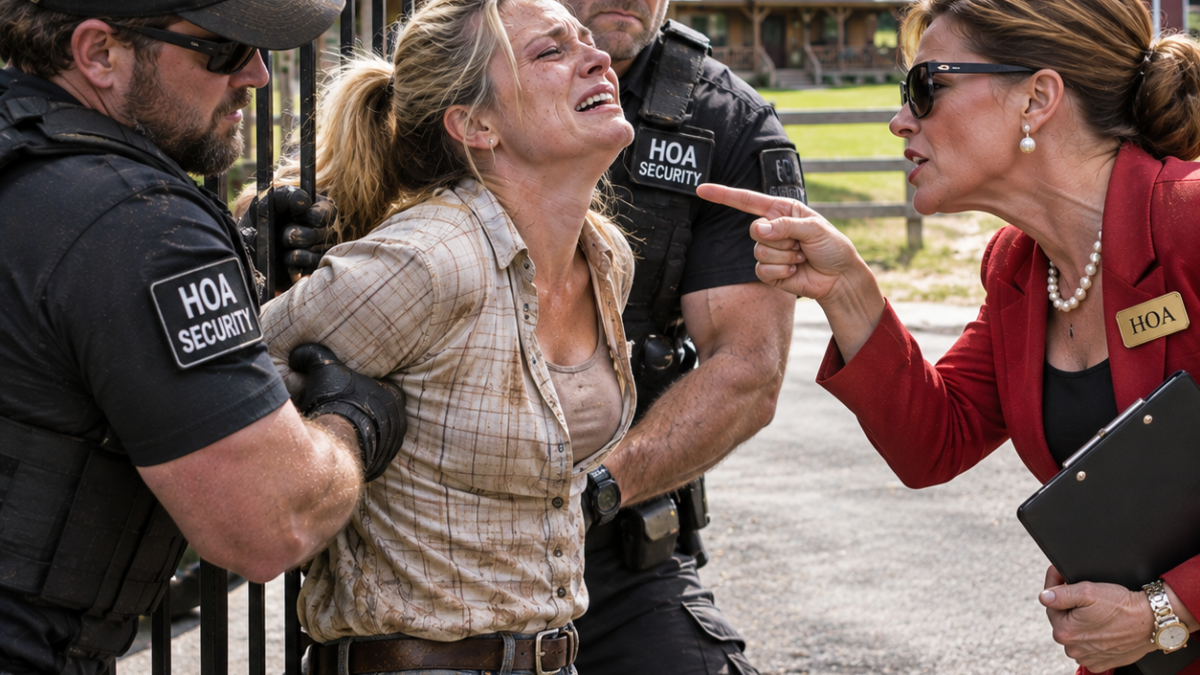
Marcus grabbed Emily’s left arm.
Cody took her right.
She pulled back.
“Get your hands off me!”
They pushed her against the iron gate.
Her shoulder struck first.
Then her cheek.
I heard the sound through my phone.
Three hours away.
Six-inch screen.
My wife’s face twisting in pain.
Tiffany pointed.
“Hold her!”
Emily yelled:
“Let go!”
Tiffany shouted:
“You’re interfering with HOA business!”
For approximately two seconds, I forgot every rule Lena had given me.
I imagined driving as fast as the truck would go.
I imagined Marcus Doyle’s wrist in my hand.
I imagined exactly how quickly I could put both men on the ground.
I had spent twenty years knowing those answers.
Then I saw Emily’s face.
And I heard Lena’s voice.
They need you to become useful.
I took one breath.
Then another.
I dropped the lead rope.
Walked to my truck.
Made the first call.
Sheriff Tom Garrison.
“Tom.”
“Jake?”
“Two private guards are assaulting Emily at my gate.”
His voice changed immediately.
“Right now?”
“Camera live.”
“You there?”
“Kerrville.”
“Send me the feed.”
“I will.”
“I’m dispatching units.”
“Thank you.”
Second call.
Lena.
“They put hands on Emily.”
“Is she injured?”
“Don’t know yet.”
“Jake, listen to me.”
“I am.”
“When you arrive, hands visible.”
“Yes.”
“Do not threaten them.”
“Yes.”
“Do not touch anyone unless Emily is in immediate danger.”
“Yes.”
“And keep recording.”
“Yes.”
Pause.
“You okay?”
“No.”
“Good answer.”
Third call.
Opal.
She answered immediately.
“I see them.”
“Film.”
“Already am.”
“Do not confront anyone.”
“I am seventy-four, not stupid.”
“Thank you.”
Then I drove.
Speed limit.
That was the hardest part.
People imagine calm means you don’t feel rage.
Wrong.
Calm means rage doesn’t get the steering wheel.
Every mile, my mind replayed the video.
Emily’s cheek against iron.
Her arm twisted.
Tiffany pointing.
I kept both hands at ten and two.
No siren.
No speeding.
No reckless passing.
Because if I got pulled over or wrecked, I helped nobody.
Two hours and fifty-six minutes later, I turned onto our road.
The scene was still happening.
Not exactly as before.
Emily was no longer struggling.
Marcus held her left arm against the gate.
Cody still had her right wrist.
Tiffany stood three feet away with the folder.
The bolt cutters lay on the gravel.
Opal was across the road filming.
Two Cedar Ridge residents had stopped nearby.
I parked fifty feet away.
Engine off.
Opened the door.
Got out.
Closed it gently.
No rush.
No clenched fists.
Hands visible.
Marcus saw me first.
His posture changed.
Tiffany turned.
Emily looked at me.
The anger in her face nearly broke my control.
I walked forward.
Stopped ten feet away.
Then said two words.
“Unhand her.”
Quiet.
Cody released Emily immediately.
Not because he knew me.
Because something in my voice told him the situation had changed.
Marcus didn’t.
He kept hold of her upper arm.
“Sir, stay back.”
I stopped.
“I said unhand her.”
“This is an authorized security action.”
“No.”
Tiffany stepped in.
“You don’t get to intimidate my staff.”
I didn’t look at her.
Marcus looked at my hands.
Then my forearms.
My shirt sleeve had ridden slightly upward.
The faded trident tattoo near my left wrist was visible.
His eyes locked onto it.
His expression changed.
He looked at my face again.
Then the tattoo.
“Sir.”
I waited.
“Are you Jake Rollins?”
“Yes.”
“Team Three?”
I didn’t answer immediately.
Then:
“Yes.”
Marcus released Emily as if he’d touched a live wire.
He stepped backward.
Cody stared at him.
“What?”
Marcus shook his head.
Nothing.
I walked to Emily.
Did not touch either guard.
Did not touch Tiffany.
I checked Emily’s face.
Red mark along the cheekbone.
Left upper arm already bruising.
Right wrist scraped.
“You okay?”
She whispered:
“I didn’t let them cut it.”
That sentence almost destroyed me.
I touched her cheek gently.
“I know.”
She looked into my eyes.
“Jake.”
“I know.”
She knew me well enough to see what nobody else did.
The anger underneath.
She squeezed my hand.
“Don’t.”
I nodded.
Then Tiffany started shouting.
“You cannot come onto a scene and threaten private security officers.”
I turned.
“I gave them an instruction regarding my wife.”
“You intimidated them.”
“No.”
“You used your military background—”
I pointed above her head.
Camera.
“That has been recording since 10:42.”
Tiffany stopped.
Only for a second.
Then:
“Good.”
She smiled.
“Then it recorded your wife obstructing lawful corrective action.”
I almost admired the confidence.
Almost.
“You should call the sheriff.”
“I already have.”
Her smile widened.
“Excellent.”
Two minutes later, Sheriff Garrison’s Tahoe turned onto the road with two patrol cars behind it.
Tiffany moved toward him before he had fully parked.
“Sheriff, thank God.”
Tom stepped out.
Gray hair.
Tan uniform.
Heavyset.
Twenty-seven years in law enforcement.
He knew me.
But not from the Navy.
We had met through cattle permits, road issues, and one unfortunate incident involving a neighbor’s bull.
Tiffany started:
“These people have been obstructing a lawful HOA enforcement action—”
Tom held up one hand.
“Ma’am.”
She kept talking.
“Our contracted security personnel were authorized to—”
“Ma’am.”
She stopped.
“I’m going to ask you not to talk for a minute.”
Her face changed.
Tom looked at me.
“Emily need medical?”
“I want her checked.”
He nodded to a deputy.
“Call EMS.”
Then:
“Video?”
I handed him my phone.
Full clip already saved.
He watched.
Nobody spoke.
The first violation.
Tiffany.
Bolt cutters.
Emily saying leave.
Tiffany ordering them forward.
Marcus grabbing her.
Cody joining.
Emily against the gate.
“Hold her.”
When the video ended, Tom looked at Marcus.
Then Cody.
“Gentlemen.”
Neither answered.
“Security licenses.”
Marcus swallowed.
Cody looked at Tiffany.
Tom’s eyes sharpened.
“I asked you.”
Marcus slowly said:
“We don’t carry individual state licenses.”
Tom stared.
“You’re working private armed security in Texas without a license?”
Marcus looked down.
“Our supervisor said the company license covered us.”
“Company?”
“Ironclad Patrol.”
Tom looked at one of his deputies.
“Run it.”
Tiffany stepped forward.
“This is completely irrelevant.”
Tom looked at her.
“No.”
She blinked.
“It’s becoming very relevant.”
A black SUV turned into the driveway.
IRONCLAD PATROL on the door.
A man climbed out.
Late forties.
Tan polo.
Gold watch.
Large stomach.
Big smile.
“Sheriff.”
Tom didn’t return the smile.
“You are?”
“Rick Halland. Owner, Ironclad Patrol.”
“Your men?”
“Yes.”
“They licensed?”
Rick chuckled.
“Our company operates under a service agreement with Cedar Ridge Estates.”
“Didn’t ask.”
Rick’s smile weakened.
“We’re fully authorized.”
“By whom?”
“The HOA.”
Tom looked toward Tiffany.
“Which board vote?”
Silence.
Rick looked at her.
She looked at him.
Tom waited.
“Meeting date?”
Nothing.
“Minutes?”
Tiffany said:
“This is an administrative matter.”
Tom nodded.
“Exactly.”
Then Lena Brooks’s car came up the drive.
Charcoal sedan.
No flashing lights.
No drama.
She stepped out carrying a brown leather case.
Walked directly toward Tom.
“Sheriff Garrison.”
“Lena.”
“I represent Jake and Emily Rollins.”
She opened the case.
Three documents.
First:
Certified deed.
1974 parcel origin.
Current ownership.
Private land.
Outside Cedar Ridge.
Second:
County map.
No HOA easement over the gate.
No authority for Cedar Ridge to enter or remove structures.
Third:
Letter from Texas Department of Public Safety regulatory services.
Ironclad Patrol’s required operating license had expired fourteen months earlier.
Tom read it.
Then looked at Rick.
Rick’s face changed.
“That’s a clerical issue.”
Lena said:
“Operating fourteen months under an expired license is a long clerical issue.”
Tiffany snapped:
“You have no right to interfere with a private HOA contract.”
A voice behind us answered.
“She might.”
We turned.
Gordon Pike.
HOA treasurer.
Sixty.
Thin.
Nervous.
He stood beside Opal’s car holding an envelope.
Tiffany’s face went white.
“Gordon.”
He ignored her.
“Sheriff, I need to make a statement.”
Tom nodded.
“Go ahead.”
Gordon looked toward the neighbors gathering along the road.
Then Tiffany.
“For eight months, she has been paying Ironclad from the Cedar Ridge reserve fund.”
Tiffany stepped toward him.
“Don’t.”
Tom said:
“Stay where you are.”
Gordon continued.
“Over two hundred thousand dollars.”
Residents gasped.
I looked at Rick.
Gold watch.
Black SUV.
Expired license.
Gordon said:
“There was never a board authorization.”
Tiffany shouted:
“That is false!”
Gordon’s hands shook.
“I refused the last payment.”
“You signed it!”
“Because you threatened to accuse me of embezzlement if I didn’t.”
Tiffany looked around.
Her control was cracking.
Gordon continued:
“Rick Halland is her brother-in-law.”
Silence.
Even Tom looked surprised.
Rick said:
“That isn’t illegal.”
“No,” Lena answered.
“Concealing a related-party transaction from an HOA board while spending community reserves may be.”
Tiffany turned quickly.
The black folder slipped from under her arm.
Hit the gravel.
Opened.
Pages scattered.
Wind caught some.
A deputy stepped on one before it blew away.
Another page landed near my boot.
I looked down.
Ironclad invoice.
Thirty-two thousand dollars.
Another.
Twenty-eight thousand.
Another page.
Letterhead:
CEDAR RIDGE HOMEOWNERS ASSOCIATION.
Signed:
Tiffany Vance.
Authorization granted to Ironclad Patrol to remove noncompliant entrance structure at Rollins parcel by any means necessary. Occupants may be physically relocated from the work area if required.
I stared.
Tom picked it up.
Read slowly.
Then looked at Tiffany.
“Ma’am.”
She didn’t answer.
“You signed this?”
Her mouth opened.
Closed.
Marcus Doyle stepped forward.
Hands visible.
“Sheriff.”
Tom looked at him.
“I’ll give you a statement.”
Rick snapped:
“Shut up.”
Tom turned.
“You don’t tell witnesses what to say on my scene.”
Rick raised his hands.
Marcus continued.
“Mr. Halland told us the HOA owned the strip outside the gate.”
I said:
“You were inside the gate.”
Marcus nodded.
“I know.”
His face carried shame now.
“He said Mrs. Rollins had already been served.”
“She had been,” Tiffany said desperately.
Marcus looked at Emily’s bruised arm.
Then down.
“I should not have touched her.”
Emily said nothing.
Marcus looked at me.
“Sir, I’m sorry.”
I didn’t answer.
Not yet.
Tom asked:
“Did Mrs. Vance order you to physically restrain Emily Rollins?”
“Yes.”
Tiffany shouted:
“Liar!”
Cody said:
“She did.”
Everyone turned.
Tiffany stared at him.
Cody continued.
“She told us before we got here that the Rollins woman might interfere.”
Rick swore.
Cody looked toward Tom.
“She said we had authority to move her.”
Tom nodded to the deputies.
“Marcus Doyle, Cody Burke, turn around.”
Tiffany stepped forward.
“For what?”
Tom didn’t look at her.
“Probable cause for assault.”
Marcus complied.
No argument.
Cody did too.
Click.
Handcuffs.
Rick backed toward his SUV.
Tom said:
“Mr. Halland.”
Rick stopped.
“I wouldn’t.”
Rick turned.
“You can’t arrest me because my license paperwork expired.”
“Maybe not for that alone.”
Lena held up another document.
“But operating an unlicensed security firm while accepting concealed HOA funds is going to create an interesting afternoon.”
Rick’s face drained.
Tom looked at the deputy who had checked the database.
The deputy nodded.
“Expired. No active renewal.”
Tom said:
“Rick Halland, we’re going to have a conversation at the office.”
Rick said:
“I want an attorney.”
“Good idea.”
The deputy escorted him toward a patrol car.
Tiffany began walking toward her Lexus.
Tom watched.
“Mrs. Vance.”
She kept going.
“Ma’am.”
She stopped.
Tom’s voice dropped.
“I wouldn’t.”
She turned.
“You’re arresting me?”
“Right now, you’re being detained pending investigation.”
“For what?”
Lena looked at the paper Tiffany had signed.
Tom said:
“Let’s start with conspiracy to commit unlawful entry, potential misuse of HOA funds, and your recorded order resulting in the assault of a property owner.”
Tiffany’s face twisted.
“This is ridiculous.”
Tom didn’t respond.
“You know who I am?”
That sentence always tells you something about a person.
People with real authority rarely ask it.
Tom nodded.
“Yes, ma’am.”
Then opened the rear door.
“That’s why I’m asking you to get in.”
Three days later, Cedar Ridge held an emergency meeting.
The clubhouse was packed.
Emily and I didn’t intend to go.
Opal insisted.
“You two started this.”
Emily said:
“No, Tiffany started it.”
Opal considered.
“Fine.”
“You finished it.”
So we went.
Gordon Pike stood at the front.
Behind him was a projector screen.
He displayed bank records.
Contracts.
Reserve statements.
Payments.
Two hundred twelve thousand dollars transferred to Ironclad-related accounts over eight months.
No board vote.
No competitive bidding.
No disclosure that Rick Halland was Tiffany’s brother-in-law.
Then Gordon showed emails.
Tiffany to Rick:
ROLLINS PROPERTY IS THE TEST CASE. IF WE ESTABLISH VISUAL CONTROL OVER ADJACENT PARCELS, WE CAN EXPAND ENFORCEMENT ZONE.
Another:
HE IS RETIRED MILITARY. DO NOT PROVOKE HIM INTO VIOLENCE UNLESS CAMERAS ARE PRESENT.
The room went silent.
I felt Emily’s hand tighten around mine.
There it was.
Exactly what Lena had warned me.
They wanted a reaction.
If I had grabbed Marcus.
If I’d shoved Cody.
If I’d threatened Tiffany.
Everything would have changed.
Tiffany knew my background.
She wanted me angry.
She needed me dangerous.
Instead, I’d driven the speed limit.
That may be the hardest tactical decision I ever made.
Gordon continued.
Another email:
IF ROLLINS RESISTS PHYSICALLY, WE HAVE THE LEVERAGE TO SEEK INJUNCTIVE ACCESS AND EMERGENCY SECURITY AUTHORITY.
Emily whispered:
“She planned it.”
I nodded.
Not just the gate.
Me.
Tiffany had constructed a story.
Retired SEAL.
Aggressive.
Uncooperative.
Dangerous rural landowner.
HOA trying to protect residents.
Private security assaulted.
Then court.
She wanted me to play the role.
I hadn’t.
The homeowners voted unanimously to remove her.
Then voted to authorize a forensic audit.
The state opened an investigation.
Ironclad was shut down within a week.
Rick was charged later with multiple licensing and financial offenses.
Tiffany faced charges related to misuse of funds, conspiracy, and unlawful activity connected to the gate incident.
The criminal cases moved slowly.
Civil court moved faster.
Lena filed before noon the following Monday.
Emily Rollins.
Assault.
Trespass.
Civil conspiracy.
Intentional infliction of emotional distress.
Against Ironclad.
Rick.
Tiffany.
And certain HOA actions.
The HOA’s insurer contacted us almost immediately.
Lena refused the first offer.
Second too.
Third got serious.
Emily hated all of it.
Depositions.
Photographs of bruises.
Medical reports.
Questions.
“Why did you stand in front of the gate?”
“Why didn’t you retreat?”
“Did you provoke the guards?”
That last one made me stand up during prep.
Lena pointed at my chair.
“Sit.”
I sat.
Reluctantly.
Emily laughed.
“You’re worse than they are.”
“I’m your husband.”
“Exactly.”
The final settlement covered every medical expense.
Legal fees.
Damages.
A formal written admission that our property was outside HOA jurisdiction.
Permanent agreement that Cedar Ridge would make no future attempt to enforce covenants against our land.
There was money beyond that.
We didn’t need all of it.
Emily suggested the veterans legal-aid fund.
I looked at her.
“You sure?”
“Yes.”
“Why veterans?”
She smiled.
“Because if Lena hadn’t taught one stubborn retired SEAL how not to get baited, I’d be married to a defendant.”
Fair.
We donated most of the remainder.
The bruises faded.
The gate stayed.
Exactly where it had always been.
Black.
Iron.
Unapproved by Cedar Ridge.
I considered painting it red just to be difficult.
Emily stopped me.
“Do not let Tiffany influence our decorating.”
She was right.
Again.
What surprised me most afterward was the neighbors.
Cedar Ridge residents started stopping at our gate.
At first, apologizing.
Then talking.
Opal came often.
Gordon too.
A young family named the Parkers brought homemade bread.
A retired firefighter named Ben Wallace helped repair a fence after a storm.
People who had lived two hundred yards away for three years became actual neighbors only after their HOA president tried turning us into enemies.
One Saturday, Emily opened the gate.
Not because we had to.
Because she wanted to.
Cedar Ridge was holding a children’s bike ride.
Their planned route had been shortened because of construction.
Emily told Opal they could use our lower pasture road.
I stared at her.
“What?”
“You heard me.”
“After all this?”
“Kids didn’t pin me against the gate.”
“No.”
“Most residents didn’t either.”
“True.”
“And I refuse to let Tiffany decide what kind of neighbors we become.”
That was Emily.
She could forgive without becoming stupid.
I was still learning the difference.
The morning of the bike ride, twenty-seven kids came through our gate.
Parents.
Helmets.
Tiny bikes.
One child on training wheels.
I stood beside the road directing them away from a cattle trough.
A little boy stopped.
“Are you the Navy guy?”
His mother looked horrified.
“Tyler.”
“What?”
I smiled.
“Yes.”
“Did you beat up the bad guys?”
His mother closed her eyes.
I looked at him.
“No.”
He frowned.
“But they hurt your wife.”
“Yes.”
“So why didn’t you beat them up?”
I thought about it.
Because an eight-year-old deserves better than a slogan.
I crouched.
“Because I didn’t need to.”
He looked disappointed.
I pointed toward the gate.
“See that?”
“Yes.”
“Still there?”
He nodded.
“Is my wife okay?”
He looked toward Emily handing out water.
“Yes.”
“Did the police find out what happened?”
“Yes.”
“Then fighting them would’ve made everything harder.”
The boy considered.
“Even if you could win?”
I smiled.
“Especially if you can win.”
His mother looked at me differently after that.
The boy pedaled away.
Later, Emily said:
“Especially if you can win?”
“I was improvising.”
“Not bad.”
“I have moments.”
“You should write that down.”
I didn’t.
Didn’t need to.
I remembered it.
Marcus Doyle came back six months later.
That surprised me.
He drove an old pickup.
No security vest.
No Ironclad logo.
He stopped outside the gate and waited.
I walked down.
Emily stayed near the porch.
Marcus kept his hands visible.
I appreciated that.
“Mr. Rollins.”
“Marcus.”
“I wanted to apologize.”
“You already did.”
“Not really.”
He looked at the gate.
“I said words because the sheriff was standing there.”
Honest.
I waited.
“I knew something felt wrong when we got here.”
“Why?”
“Your wife kept saying it was private land.”
He looked ashamed.
“We’d been told she was lying.”
“You believed Tiffany?”
“I believed the paycheck.”
That was more honest.
He continued.
“My dad was military.”
“What branch?”
“Army.”
“Still alive?”
“No.”
He looked at my forearm.
“When I saw your trident, I let go because I suddenly realized you might kill me.”
I stared.
He gave a nervous laugh.
“Stupid.”
“Yes.”
He nodded.
“I know.”
He looked toward Emily.
“The truth is, I should’ve let go because she told me to.”
That mattered.
I said nothing.
Marcus continued.
“Not because of you.”
“Not because you were SEAL.”
“Because I had no right to hold her.”
I nodded.
“That’s the correct lesson.”
He looked relieved.
Then:
“I lost my job.”
“I know.”
“License application denied.”
“I heard.”
“I work construction now.”
“How’s that?”
“Hard.”
“Good for you.”
He almost smiled.
Then looked at Emily.
“Can I apologize to her?”
I turned.
Emily had already heard.
She walked down.
Marcus’s face reddened.
“Mrs. Rollins.”
“Emily.”
“Emily.”
He swallowed.
“I am sorry.”
She waited.
“For putting my hands on you.”
“Yes.”
“For listening to someone else’s authority instead of checking whether that authority was real.”
Emily’s expression changed slightly.
“And?”
Marcus looked confused.
She said:
“You scared me.”
His eyes dropped.
“I know.”
“No.”
She stepped closer.
“You don’t.”
He looked up.
“I didn’t know whether you were going to break my arm.”
Marcus went pale.
“I didn’t—”
“I know what you intended.”
She pointed toward the gate.
“But I didn’t know that while my face was against those bars.”
He swallowed.
Emily continued.
“If you want the apology to matter, remember that the next time somebody in a uniform tells you a person deserves to be handled.”
Marcus nodded.
“I will.”
She looked at me.
Then him.
“I accept your apology.”
Not forgiveness for everything.
Not friendship.
Just acceptance.
Marcus left.
I watched the truck disappear.
Emily said:
“You think he’ll change?”
“Maybe.”
“Good enough?”
“For today.”
The criminal case against Tiffany eventually ended in a plea agreement.
Misappropriation.
Conspiracy.
Unlawful directives connected to Ironclad.
She paid restitution.
Lost her position.
Probation and custody followed under the final judgment.
Rick’s case was worse.
Ironclad had operated elsewhere under the same expired licensing arrangement.
Other complaints surfaced.
Other homeowners.
Other incidents.
The gate confrontation wasn’t an isolated mistake.
It was simply the one with cameras.
That thought bothered me.
How many people had been intimidated because they didn’t have four cameras?
How many elderly residents paid nonsense fines because arguing felt impossible?
How many board members kept quiet because Tiffany spoke louder?
How many guards accepted an order because a paycheck made it feel official?
That’s why I kept the original folder.
Eleven violation notices.
Certified letters.
Photographs.
The Ironclad documents.
The county map.
Not because I enjoy remembering.
Because paperwork tells the story differently than memory.
If I ever start convincing myself the whole thing was ridiculous and harmless, I can open that folder and see the progression.
First letter.
Second.
Fine.
Threat.
Security contract.
Physical enforcement.
Bruises.
Systems rarely become abusive all at once.
They teach people to accept one small step at a time.
That may be the most important thing Cedar Ridge learned.
The new board changed its bylaws.
No private security contracts without homeowner vote.
Related-party transactions disclosed.
Financials published quarterly.
Outside property clearly excluded from HOA enforcement.
Complaints against residents reviewed by more than one board member.
Not revolutionary.
Just boring guardrails.
Lena loved it.
“Boring wins.”
I said:
“You’ve been waiting years to say that again.”
“Yes.”
Emily and I went back to our life.
Cattle.
Garden.
Fence repairs.
Texas heat.
The flag stayed up.
The gate stayed black.
Sometimes people drove by slowly because they’d heard the story.
I hated that.
Once, a man pulled over and asked if he could photograph the “famous SEAL gate.”
I told him no.
He looked disappointed.
Emily laughed for an hour.
“You have a famous gate.”
“Absolutely not.”
“Maybe we should sell T-shirts.”
“I’ll move.”
She kissed me.
“You love it here.”
I did.
More than before.
Not because we’d won.
Because the place survived somebody else’s attempt to redefine it.
The property was still ours.
The gate was still ours.
And the woman who had been pinned against it still walked through every morning carrying coffee, usually barefoot, sometimes yelling at cattle.
That’s what mattered.
One evening, a year after the incident, Emily and I sat on the porch.
Sunset burned orange behind the oaks.
She rubbed her left arm absently.
The bruises were long gone.
I noticed.
“You still think about it?”
She knew what I meant.
“Sometimes.”
“I should’ve been there.”
She looked at me.
“No.”
“I was three hours away.”
“I know.”
“If I’d been home—”
“Jake.”
I stopped.
“You did exactly what I needed.”
“After three hours.”
“You called the sheriff.”
“I drove.”
“You didn’t get arrested.”
I smiled slightly.
“Low standard.”
“For you?”
“Fair.”
She took my hand.
“I was more scared when you pulled up than when they grabbed me.”
That hurt.
“Why?”
“Because I knew what you were capable of.”
I looked toward the gate.
She continued.
“I saw your face.”
“I was calm.”
“You were terrifying.”
“That’s different.”
She laughed softly.
Then became serious.
“I thought you were going to hurt them.”
“So did I.”
She squeezed my hand.
“But you didn’t.”
“No.”
“That’s the thing I remember.”
Not the tattoo.
Not Marcus recognizing my name.
Not the sheriff.
Restraint.
Emily leaned against me.
“People tell the story wrong.”
“How?”
“They say those guards didn’t know my husband was a Navy SEAL.”
I looked at her.
“They didn’t.”
“That’s not why they were wrong.”
She was right.
It had taken me a year to see it that clearly.
They were wrong before they knew who I was.
Marcus had no more right to pin Emily against our gate if I had been an accountant.
A plumber.
A schoolteacher.
Or nobody at all.
Tiffany had no more authority over our land if I had never worn a uniform.
The trident changed Marcus’s behavior.
It should not have been necessary.
That became the part of the story I started correcting whenever somebody brought it up.
A veteran group once invited me to speak at a dinner.
I initially refused.
Emily convinced me.
There were two hundred people.
Veterans.
Families.
Law enforcement.
Young service members.
The emcee introduced me using the version everyone knew.
“HOA security guards pinned his wife against their gate without realizing her husband was a retired Navy SEAL.”
People applauded.
I walked to the microphone.
Then said:
“That’s a good headline.”
Laughter.
“But it’s the wrong lesson.”
The room quieted.
I continued.
“The guards shouldn’t have let go because they saw a trident tattoo.”
“They should’ve never touched her.”
Pause.
“Not because she was married to me.”
“Because she said no.”
The room became still.
I told them what Lena had told me.
Don’t let somebody else choose your battlefield.
I told them about driving the speed limit.
About the camera.
About Tiffany wanting me to react.
Then:
“People confuse strength with the ability to inflict consequences.”
I looked around the room.
“Sometimes strength is having every ability to escalate a situation and choosing the one action that makes escalation unnecessary.”
No applause at first.
That was good.
They were listening.
Then someone in the back stood.
Others followed.
I hated standing ovations.
Still do.
But Emily was sitting near the front.
She smiled.
So I stayed.
Years later, people still occasionally recognize my name.
Not often.
Fine by me.
Cedar Ridge has changed.
Opal still attends every HOA meeting.
Gordon refuses to run for president because he says treasurer was traumatic enough.
The families use our lower path once a year for the children’s bike ride.
Emily’s garden has doubled.
The cattle have multiplied despite my repeated objections.
And the black iron gate remains exactly where it was.
No architectural approval.
No HOA sticker.
No apology plaque.
Just a gate.
Some mornings, I stop beside it.
Not because of what happened.
Because it represents something I didn’t understand when we first bought the property.
A gate can keep people out.
But a gate can also mark a line.
This side is mine.
That side is yours.
Respect doesn’t require agreement.
It requires understanding where your authority ends.
Tiffany never understood that.
She believed position extended her boundaries.
HOA president.
Red blazer.
Black folder.
Private security.
Official-looking notices.
She surrounded herself with symbols of authority until she confused them with actual authority.
Then she met a deed.
A camera.
A county map.
A sheriff who watched the evidence before choosing a side.
And one bruised woman who refused to step away from a gate she owned.
That was what beat her.
Not me.
Not my military record.
Not a tattoo.
Truth.
Documented carefully enough that nobody could shout over it.
I still have the video.
I rarely watch it.
The first fifteen seconds are the hardest.
Emily walking toward the gate.
Tiffany pointing.
Marcus reaching.
Cody grabbing.
Then my wife’s cheek against iron.
I always want to stop it.
Even though I know how it ends.
Then the video jumps ahead.
My truck arrives.
I walk into frame.
Hands empty.
Two words.
“Unhand her.”
Cody releases.
Marcus sees the tattoo.
Lets go.
That is the moment most people share.
The dramatic moment.
The Navy SEAL reveal.
But if you keep watching, the important moment comes later.
After the sheriff arrives.
After Lena.
After Gordon.
After Tiffany’s papers scatter.
There is a point where Emily stands beside me.
Her arm bruised.
Tired.
Angry.
And she reaches down and takes my hand.
I look at her.
She nods once.
That’s all.
Nobody notices that part.
I do.
Because I know what the nod meant.
You stayed you.
Not the man I knew you could become.
Not the man Tiffany wanted on camera.
You came home as Jake.
I think about that more than the trident.
Twenty years in the Teams taught me many things.
How to move toward danger.
How to make decisions when people panic.
How to keep working when tired.
How to survive.
But retirement taught me something harder.
You don’t have to answer every threat with the strongest weapon you possess.
Sometimes your greatest advantage is the one nobody can provoke you into using.
Tiffany thought my military past made me predictable.
She believed if she pushed hard enough, I’d explode.
Then she’d have what she needed.
A violent veteran.
A frightened HOA.
An emergency.
A justification.
She almost understood me.
Almost.
What she didn’t understand was that the same years that taught me how to fight also taught me when not to.
So when I turned onto my driveway and saw the woman I loved pinned against our gate, I did the hardest thing I knew how to do.
I walked.
I breathed.
I kept my hands open.
And I let the truth hit harder than I ever could.
That’s why, when people tell this story now, I correct the title in my head.
It wasn’t:
HOA Guards Pinned a Navy SEAL’s Wife Against Her Gate.
It was simpler.
Two men put their hands on a woman because someone with a clipboard told them she had no right to stand on her own land.
They were wrong before they knew my name.
They were wrong before they saw the trident.
And the strongest thing I did that day wasn’t making them afraid of who I had been.
It was refusing to give them any reason to forget who they had become.


