HOA Guards Dragged My 68-Year-Old Mother Into a Van—Five Minutes Later, My U.S. Marshal Convoy Sealed the Only Road Out
PART2:
The phone was hidden somewhere on her body.
Probably the cardigan pocket she always used because she still refused to buy pants with “those ridiculous tiny women’s pockets.”
She wanted me to hear.
She wanted me to know.
A man spoke again.
“Mrs. Pierce, this will be easier if you cooperate.”
My mother answered immediately.
“Show me a judge’s order.”
“We already showed you the paperwork.”
“You waved a piece of paper at me. I asked for a court order.”
“You’re confused.”
My hand closed so hard around the phone that my knuckles hurt.
Mom said, “I am not confused.”
Then the first voice changed.
Less patient.
“Get her into the van.”
I heard her scream my name.
“Nathan!”
I was already moving.
My name is Nathan Pierce.
At the time, I was forty-four years old.
For eighteen years, I had worked for the United States Marshals Service.
I had transported prisoners.
Tracked fugitives.
Served federal warrants.
PART3:
Walked into motel rooms where armed men had promised they would never be taken alive.
I had worked long enough to understand that panic ruins good decisions.
So I did not panic.
That does not mean I was calm.
There is a difference.
My training told me to gather facts.
My body wanted me to drive through a wall.
I got into my government SUV and put the phone on speaker.
“Mom, I’m here.”
I did not know whether she could hear me.
Then came the unmistakable sound of a vehicle door sliding shut.
A man said, “Drive.”
Engine.
My mother’s breathing.
I opened the location-sharing app.
Years earlier, after Dad died, I had convinced Mom to keep her phone location shared with me.
She complained for three days.
“You’re turning me into a tracked package.”
“You live alone.”
“I have lived alone successfully since before you learned to shave.”
“Just leave it on.”
“Bossy.”
She left it on.
The red dot appeared.
Moving.
County Road 9.
Northwest.
Fast.
Away from Willow Ridge.
I dialed my partner.
Tony Branson answered after one ring.
“What’s up?”
“My mother’s been taken.”
Silence.
Tony knew me well enough not to waste time asking if I was joking.
“Who?”
“Two private security guards. White van. Leaving Willow Ridge on County Nine.”
“Legal custody?”
“I’m listening to her tell them no. She says there’s no valid court order.”
“Location?”
I sent it.
Tony’s voice changed.
Professional.
“What do you want?”
“Team mobile.”
“We need jurisdiction.”
“They’re moving toward the state line.”
“How close?”
“Twenty-two miles.”
Tony paused.
“If they cross while transporting her by force under forged authority—”
“I know.”
“You sure it’s forged?”
“No.”
“Then we stop, verify, and hand local primary if necessary.”
That was why Tony was my partner.
Not because he agreed with me.
Because when emotion made my world narrow, he kept the law wider.
“Correct,” I said.
“I’m calling field supervisor.”
“Do it.”
“Where are you?”
“Exit 74.”
“We’re eight minutes behind.”
“I’ll meet you at Willow Ridge road.”
“Nathan.”
“What?”
“Do not go cowboy because it’s your mother.”
I gripped the steering wheel.
“I know.”
“Say it.”
“I do not go cowboy.”
“Good.”
He hung up.
My mother’s call was still connected.
I could hear road noise.
The van turned.
She said, “Where are you taking me?”
A guard replied, “Silver Birch Care Center.”
“I have never agreed to go there.”
“Your guardian did.”
“I don’t have a guardian.”
“You do now.”
My jaw tightened.
There it was.
That word.
Guardian.
Three months earlier, I would have thought the whole thing impossible.
Then Constance Aldrich became president of the Willow Ridge Homeowners Association.
Mom’s house had been built in 1992.
My father, James Pierce, had designed most of it himself.
Two-story brick colonial.
Wide porch.
Detached workshop.
Vegetable garden.
Hydrangeas lining the western fence.
Behind the house sat twelve acres of mixed meadow and hardwood trees.
To most people, it was pretty land.
To my mother, it was Dad.
They had bought those acres when I was eleven.
He planted oak trees there.
Built a footbridge over the creek.
Taught me how to drive an old pickup in the back field.
After he died from pancreatic cancer, Mom scattered part of his ashes beneath the largest oak.
She never considered selling.
Willow Ridge came later.
Developers bought farmland around our property.
Streets went in.
Large houses.
Decorative stone entrance.
Then an HOA.
Dad refused membership.
The deed predated the association.
His property was legally outside its authority.
That irritated people occasionally.
Mom’s mailbox was different.
Her fence was older.
Her garden grew vegetables instead of ornamental grass.
But for years, neighbors coexisted.
Then Constance arrived.
Constance Aldrich was fifty-nine.
Former real estate broker.
Widowed.
Always perfectly dressed.
Always smiling exactly enough.
She became HOA president by promising “property-value protection” and “responsible expansion.”
The responsible expansion turned out to be a luxury development called Willow Ridge Estates Phase Four.
There was one problem.
Access.
The cheapest road connection between the existing neighborhood and the proposed development crossed the rear edge of Mom’s acreage.
The developer needed an easement.
Preferably more.
Constance came to Mom’s house carrying a leather binder.
I happened to be there.
“Nathan,” Mom said when she opened the door, “this is Mrs. Aldrich.”
Constance smiled.
“President Aldrich, technically.”
My mother looked at her.
“Of the United States?”
I coughed into my fist to hide a laugh.
Constance did not.
“The association.”
“Then Mrs. Aldrich is fine.”
We sat in the kitchen.
Constance opened diagrams.
Maps.
Projections.
She offered Mom $280,000 for a strip of land.
Mom listened politely.
Then said, “No.”
Constance smiled.
“You haven’t heard the full offer.”
“I heard enough.”
“It is considerably above assessed value.”
“My husband is under one of those trees.”
The smile weakened.
“Mrs. Pierce, progress sometimes requires difficult choices.”
Mom took off her glasses.
“I was a school librarian for thirty-six years.”
Constance looked confused.
“Congratulations.”
“That means I spent thirty-six years listening to children explain why rules should change when they inconvenienced them.”
I looked down at the table.
Mom continued.
“You want my land because your road is inconvenient somewhere else.”
Constance’s face cooled.
“The development benefits the entire community.”
“Then build it somewhere that doesn’t require my husband’s trees.”
She closed the binder.
“This may not remain entirely your choice.”
That sentence changed everything.
I leaned forward.
“What does that mean?”
Constance looked at me as though she had only just remembered I existed.
“Nothing threatening.”
“It sounded threatening.”
“Mr. Pierce, HOAs have legal mechanisms for addressing properties that affect community planning.”
“My mother’s property is not in your HOA.”
“Boundaries can be complicated.”
“They aren’t.”
I had already checked.
Constance stood.
“Well.”
She gathered her papers.
“I hope we can revisit the conversation.”
Mom smiled.
“You’re welcome to revisit it.”
Constance paused.
“The answer will still be no.”
Two weeks later, Mom received her first violation notice.
Mailbox color.
$250.
She laughed.
Then came another.
Improper exterior lighting.
$400.
Then landscaping noncompliance.
Hydrangeas.
$600.
Mom mailed copies back with a letter.
Dear Willow Ridge HOA,
My property is not subject to your covenants.
Please stop sending me invoices for rules I did not agree to.
Sincerely,
Ruth Pierce
Retired Librarian and Current Hydrangea Criminal.
I told her not to write the last line.
She refused.
More notices came.
Then a man calling himself an HOA compliance officer photographed her yard from the road.
Then Constance began telling neighbors that Mom “seemed confused.”
Carol Benton heard it first.
Carol lived across the street.
Seventy-two.
Widowed.
Retired nurse.
She and Mom drank coffee twice a week and traded baked goods while insisting neither was lonely.
Carol called me.
“Nathan, something is wrong.”
“What?”
“Constance keeps asking questions.”
“What kind?”
“Does Ruth drive?”
“Sometimes.”
“Does she forget appointments?”
“Everybody does.”
“Does she leave the stove on?”
“No.”
“Does she wander?”
I went silent.
Carol continued.
“She’s building a story.”
That frightened me more than the fines.
Money is visible.
A lie about competence can become infrastructure.
I talked to Mom.
She became angry.
“I am not taking some cognitive test because Constance Aldrich wants my dirt.”
“I didn’t say you had to.”
“You were thinking it.”
“I was thinking we document your health before somebody else lies about it.”
Mom looked at me.
“You really think she would do that?”
“I think she told you your decision might stop being yours.”
That sobered her.
We scheduled a routine evaluation with Mom’s actual physician.
No dementia.
No cognitive impairment.
Mild arthritis.
Blood pressure controlled.
Sharp enough to correct the doctor when he confused two medication dates.
We kept the report.
I also called an attorney.
Naomi Sharp.
Elder law and property litigation.
She sent the HOA a formal cease-and-desist letter.
The fines stopped.
For eleven days.
Then came a notice claiming Mom’s porch steps constituted an “immediate community safety concern.”
Naomi laughed when she read it.
“They’re desperate.”
I asked, “For what?”
“A paper trail.”
That answer came back to me now as I watched my mother’s location dot move toward the state line.
Paper trail.
Confusion.
Safety.
Guardian.
None of it was random.
My phone buzzed.
Carol.
I answered on the second line while keeping Mom connected.
“Nathan.”
“What happened?”
Her voice shook.
“They took Ruth.”
“I know.”
“I have the video.”
“Send it.”
“My doorbell camera caught everything.”
“Did you see their vehicle?”
“White Ford Transit. No company markings.”
“License?”
“Video should have it.”
“Anyone else witness it?”
“Half the street.”
“Did anyone intervene?”
Silence.
That told me enough.
Carol whispered, “We didn’t know what was happening.”
I closed my eyes briefly.
“Carol, I’m not blaming you.”
“I should have gone outside.”
“No.”
“I saw them pulling her.”
“You called me.”
“After.”
“Stay on your porch.”
“What?”
“Do not go to the clubhouse. Do not confront Constance. Send me the video and call Sheriff Dempsey.”
“I already did.”
“Good.”
“Nathan?”
“Yes?”
“Bring her home.”
The line went quiet.
“I will.”
The video arrived.
I opened it at a red light.
There was Mom.
Blue cardigan.
Gray slacks.
Glasses.
Holding a watering can.
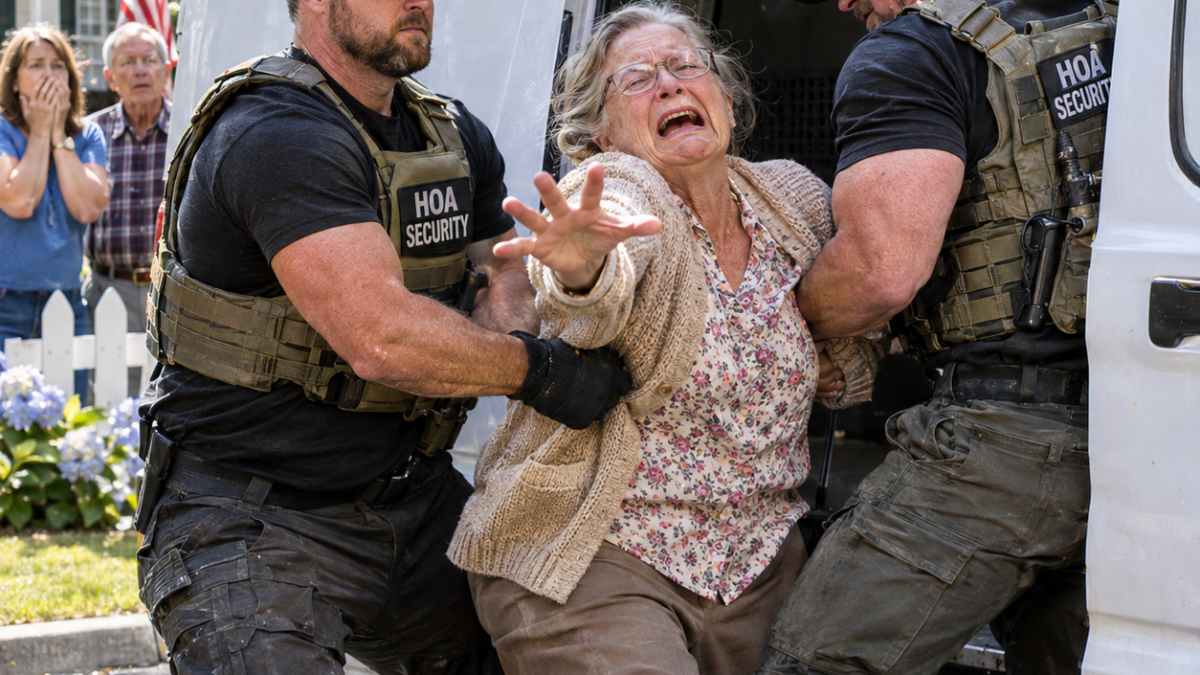
Two men approached from a white van.
One large.
One thin.
Black polo shirts.
Security patches.
The large man showed Mom a document.
She took it.
Read for approximately three seconds.
Then shook her head.
He reached for her arm.
Mom pulled away.
The second man stepped behind her.
They physically dragged her toward the van.
Carol’s door opened across the street.
Her voice on the recording.
“Hey! What are you doing?”
The large guard shouted, “Medical transport! Court ordered!”
Mom yelled, “It is not!”
Then they pushed her inside.
The license plate was visible.
Kansas temporary registration.
I sent everything to Tony.
His response came instantly.
GOT IT.
Thirty seconds later, another message.
TEAM MOBILE. STATE + COUNTY ADVISED.
I drove faster.
Not recklessly.
Faster.
There is a terrible discipline in knowing exactly how much speed the law allows you when someone you love is being carried away.
Inside the van, my mother was still talking.
“May I see the court order again?”
“No.”
“Then give me the name of the judge.”
“Mrs. Pierce—”
“Judge.”
The large man said, “You are in no position to interrogate us.”
“I am the person you kidnapped.”
“We did not kidnap you.”
“You put me in a vehicle while I said no.”
“You have been declared unable to care for yourself.”
“By whom?”
“Dr. Strand.”
A name.
I memorized it.
Mom answered, “I have never met a Dr. Strand.”
Silence.
Then the thin man said, “Brock, just stop talking.”
Brock.
Large guard.
Good.
Mom continued.
“Where is the hearing?”
Nobody answered.
“What county court?”
Nothing.
“Who filed the guardianship petition?”
Brock finally snapped.
“Ma’am, you are not qualified to read legal documents.”
My mother laughed.
Actually laughed.
“I catalogued federal depository materials before you were born.”
I nearly smiled.
Even terrified, she was Mom.
Then Brock said something that made every part of me sharpen.
“Your nephew is handling it.”
Mom stopped.
“My nephew?”
“Your guardian.”
“I don’t have a nephew.”
Silence.
The thin guard whispered, “You said she had one.”
Brock hissed, “Shut up.”
There it was.
Fraud unraveling in real time.
I sent Tony another message.
NO NEPHEW. FALSE GUARDIAN IDENTITY.
The location dot turned onto Willow Ridge Parkway.
I frowned.
They were not heading directly toward the highway.
They were approaching the main gate.
The development had one practical road out because construction blocked the eastern service route.
That gave us a choke point.
Tony called.
“We’re two minutes out.”
“I’m thirty seconds from the gate.”
“Do not initiate alone.”
“I know.”
“Five units behind me.”
“You got federal authority?”
“Field supervisor approved assist pending confirmation. Sheriff is primary stop. We support.”
Perfect.
No hero nonsense.
No son-with-a-badge fantasy.
Law mattered most when emotion wanted shortcuts.
I reached the road first.
Sheriff Walt Dempsey’s cruiser appeared from the south almost simultaneously.
Walt had known my parents for twenty years.
Tall.
Gray mustache.
Old-school sheriff who still remembered people’s children.
He lowered his window.
“Nathan.”
“They’re coming.”
His face was hard.
“We stop clean.”
“Yes.”
“Your mother means you stand back until vehicle secure.”
I hated it.
“Yes.”
He saw that.
“Son.”
“I said yes.”
Then we heard engines.
Tony’s convoy.
Five black Suburbans.
Not because my mother required five federal vehicles.
Because Tony had been mobilizing a fugitive-operations team for another task when I called.
They were already staged.
Now they arrived one after another.
Lights active.
Controlled.
They positioned behind Dempsey’s two county units.
Road sealed.
No dramatic weapons waving.
No shouting.
Just trained people creating an impossible route forward.
The white Transit appeared around the bend.
It slowed.
Then stopped.
For a second nobody moved.
Then the driver tried reversing.
Another county cruiser slid into position behind it.
Done.
The van sat boxed between law enforcement vehicles.
I could see the driver through the windshield.
His face changed.
Brock turned in the passenger seat.
The rear windows were tinted.
I could not see Mom.
My radio crackled.
“Driver, hands visible.”
Sheriff’s deputy approached from the left.
Tony’s team took positions.
I stayed where Walt had told me.
Every instinct screamed.
Then the side door moved.
Someone inside tried opening it.
A deputy shouted.
“Keep that door closed!”
My mother’s voice came faintly.
“My son is out there!”
I moved before I meant to.
Tony caught my vest.
“Not yet.”
“That’s my mother.”
“I know.”
I looked at him.
He did not release me.
“Ten seconds, Nathan.”
Longest ten seconds of my life.
Driver controlled.
Passenger hands visible.
Rear occupants identified.
No obvious weapons.
Walt nodded.
“Go.”
I walked toward the driver’s side.
Brock saw me.
He apparently did not know who I was.
Not yet.
The window lowered three inches.
“Private medical transport,” he called.
His voice shook.
“We have lawful custody of a patient.”
I said nothing.
“We have a court order.”
Still nothing.
“You federal guys can’t interfere with a state guardianship order.”
I reached into my vest.
Brock’s eyes followed my hand.
I showed him my credentials.
“Nathan Pierce. United States Marshals Service.”
He stared.
Then I said the sentence I had been holding inside me since the gas station.
“The woman in the back of your van is my mother.”
Color left his face.
Completely.
I heard someone behind him whisper, “Oh, shit.”
Tony moved toward the side door.
The thin guard inside reached toward the handle.
Tony opened it.
There she was.
Mom sat on the bench seat.
Her hair had come loose.
Glasses crooked.
One cardigan button torn.
Both hands in her lap.
She was shaking.
But her back was straight.
“Nathan.”
I climbed in.
For eighteen years I had been taught to assess scenes before emotion.
At that moment, I stopped being good at it.
I put my arms around my mother.
She grabbed the back of my vest.
“I knew you heard me.”
“I heard you.”
“I left the phone on.”
“I know.”
“I thought they’d take it.”
“You did perfect.”
Her face pressed against my shoulder.
“I was scared.”
That sentence almost broke me.
My mother rarely admitted fear.
I held her tighter.
“You’re safe.”
Then I saw her wrist.
Red marks.
Finger-shaped.
Already darkening.
My voice changed.
“Who did this?”
Mom looked toward Brock.
“He grabbed me.”
I stepped out.
Tony read my face.
“Nathan.”
I stopped.
Again.
Law.
Not rage.
Law.
I pointed at Brock.
“That man is accused of using force against her.”
Tony nodded.
“Got it.”
Brock said, “She resisted lawful transport!”
Mom’s voice came from behind me.
“I resisted being kidnapped.”
Walt almost smiled.
Then he took the paperwork from the dashboard.
One page.
Two signatures.
No embossed seal.
Case number.
Emergency guardianship order.
He read it.
Frowned.
“County prefix is wrong.”
Tony looked.
“The judge signature?”
Walt’s face hardened.
“Judge Eleanor Whitmore.”
I knew the name.
Retired fourteen months earlier.
Walt turned the page.
“Order dated Sunday.”
Tony looked at me.
“Court wasn’t in session.”
Brock began sweating.
“We were given that.”
“By who?” Walt asked.
“Agency dispatcher.”
“What agency?”
“Silver Birch Behavioral Transport.”
“Where is your state medical transport license?”
Brock said nothing.
The thin guard lowered his head.
“Name?” Walt asked him.
“Kyle Madsen.”
“You want to tell me what this is, Kyle?”
Brock snapped, “Don’t answer.”
Kyle looked at him.
Then at my mother.
Then at the convoy.
He made a decision.
“Mrs. Aldrich hired us.”
Silence.
My mother closed her eyes.
Constance.
Of course.
Kyle kept going.
“She said Mrs. Pierce had been declared incompetent.”
Brock shouted, “Shut your mouth.”
Tony stepped between them.
“You don’t talk to him.”
Kyle’s words came faster.
“Five hundred each. Pickup and delivery.”
“Delivery where?”
“Silver Birch Center.”
“Across the state line?”
Kyle nodded.
That mattered.
A lot.
Tony looked at me.
We both understood.
Interstate transport would take the case somewhere much larger than an HOA dispute.
Brock’s phone began ringing.
He ignored it.
Then again.
Tony said, “Whose phone?”
Brock stared forward.
Walt removed it during the search following detention.
Caller ID.
CONSTANCE A.
Everyone looked at it.
Walt answered.
Speaker.
Constance did not wait.
“Why are you still in Willow Ridge?”
Nobody spoke.
“Brock?”
I held the phone.
“This isn’t Brock.”
Silence.
“Nathan?”
She recognized my voice.
“Hello, Constance.”
Her breathing changed.
“I don’t know what you think is happening.”
“I think two men dragged my mother into a van using a forged guardianship order.”
“That is completely false.”
“Good.”
I looked at Walt.
“Then you’ll have no problem explaining the documents.”
Constance hung up.
Tony smiled without humor.
“Productive call.”
Mom was examined by paramedics.
Bruising.
Elevated blood pressure.
No fractures.
She refused transport to the hospital until I promised we would have tea afterward.
That was Mom.
Meanwhile Kyle talked.
Not because he suddenly became noble.
Because frightened people often discover morality at the same time they discover consequences.
He said Constance had hired them through a private intermediary.
They had been told Mom suffered from progressive dementia.
That she might resist.
That a court had approved emergency placement.
Kyle had questioned the lack of law enforcement escort.
Brock told him wealthy families handled things privately all the time.
They were supposed to deliver Mom to Silver Birch.
A man would meet them there.
“Who?” Tony asked.
“Daniel Aldrich.”
My mother frowned.
“Who is that?”
Kyle looked confused.
“Your nephew.”
Mom stared at him.
“I have one sister.”
She looked at me.
“Her children are women.”
I nodded.
Kyle went pale.
Constance’s nephew.
Not Mom’s.
The forged guardianship petition would apparently name Constance’s nephew as if he were Mom’s relative.
That was not sloppy.
That was a plan.
Sheriff Dempsey called county investigators.
Tony contacted the FBI field office because of the attempted interstate movement and suspected conspiracy involving forged legal documents.
Agent Dana Whitlow arrived forty minutes later.
Calm.
Fast.
Unimpressed by titles.
She interviewed Kyle separately.
Brock asked for a lawyer.
Smartest thing he did all day.
I sat with Mom in the back of an ambulance.
She sipped water.
Her hands still shook.
“I feel ridiculous.”
“Why?”
“I let them take me.”
I stared at her.
“Mom.”
“I should have screamed sooner.”
“You screamed.”
“I should have gone inside when I saw the van.”
“You were watering flowers.”
“I should have—”
“Stop.”
She looked at me.
“This is what victims do after something happens.”
Her eyes narrowed.
“Do not give me marshal psychology.”
“I’m giving you son psychology.”
“That sounds less qualified.”
“It is.”
She smiled faintly.
Then started crying.
I moved closer.
“They told me I was confused.”
“I know.”
“They kept saying it.”
“I heard.”
“For a minute…”
She wiped her face.
“For a minute I thought maybe I had missed something.”
That sentence told me exactly how cruel the plan was.
Not merely taking her body.
Making her question her mind.
I took her hand.
“You didn’t miss anything.”
“I know.”
“You knew enough to leave the phone open.”
She looked down at it.
“I remembered what you said.”
“What?”
“When you set up the location sharing.”
I smiled.
“You called it spying.”
“It is spying.”
“Helpful spying.”
“Don’t get smug.”
That was when Dana Whitlow approached.
“Mrs. Pierce?”
Mom straightened.
“Yes?”
“I’m Special Agent Whitlow.”
“FBI?”
“Yes, ma’am.”
Mom looked at me.
“You brought everybody.”
“I’m popular.”
Dana almost smiled.
“We need to ask about Constance Aldrich.”
Mom’s expression hardened.
“You’ll need a longer notebook.”
We did not storm the HOA clubhouse like an action movie.
The truth was better.
We arrived with warrants.
County investigators.
FBI.
Sheriff’s deputies.
My Marshals team supporting because of the active detention and potential flight risk identified through the evolving investigation.
Constance was inside.
So was developer Garrett Lowell.
So were five HOA board members who looked as though someone had interrupted a luncheon.
Neighbors gathered outside because Willow Ridge had never seen that many government vehicles in one place.
Constance came onto the steps wearing a red blazer and pearls.
Of course she wore pearls.
She lifted her chin.
“What is the meaning of this?”
Walt walked forward.
“We have a search warrant.”
“For what?”
“Records relating to Ruth Pierce.”
Her eyes found Mom.
My mother stood beside Carol.
Not hidden.
Not trembling now.
Constance pointed.
“She should not be here.”
Mom said, “It’s my neighborhood.”
“You are medically compromised.”
Agent Whitlow stepped forward.
“Based on whose evaluation?”
Constance’s mouth tightened.
“Confidential medical information.”
Dana held up the warrant.
“Excellent. We’ll collect it inside.”
Board members started shifting.
One woman whispered, “Constance, what did you do?”
“Nothing.”
Constance’s voice sharpened.
“This is intimidation.”
I stayed back.
I did not need to dominate the scene.
Evidence does that better.
Carol walked toward Mom.
Then turned to the neighbors.
“I want everybody to see something.”
She held up her phone.
Constance snapped, “Carol, don’t.”
That command was a mistake.
Every neighbor looked.
Carol played the doorbell video.
No narration.
No interpretation.
Just Mom standing on her lawn.
Two men taking her.
Her voice saying no.
The crowd changed.
Silence first.
Then anger.
A man near the back shouted, “They grabbed her?”
Another woman said, “You told us she went voluntarily!”
Constance turned.
“I told nobody anything.”
“Yes, you did,” someone answered.
Then another.
“You said her family agreed.”
My mother looked at me.
We had agreed to nothing.
Constance retreated toward the clubhouse.
Dana stepped aside to let investigators continue the search.
Inside Constance’s office, they found the binder.
The same kind she had carried to Mom’s kitchen months earlier.
Property maps.
Development plans.
Correspondence with Garrett Lowell.
A draft purchase agreement for Mom’s acreage.
A payment schedule.
And a line item that changed the entire case.
CONSULTING FEE — C.A. — $410,000.
Four hundred ten thousand dollars.
Constance was not protecting property values.
She was selling access.
Investigators found emails between Constance and Lowell.
One read:
RUTH WILL NOT AGREE VOLUNTARILY. WE NEED AN ALTERNATIVE CONTROL MECHANISM.
Another:
ONCE GUARDIANSHIP IS ENTERED, DANIEL CAN EXECUTE.
Then:
SILVER BIRCH CONFIRMED. MOVE HER BEFORE PIERCE INTERFERES.
Pierce.
Me.
They knew exactly who I was.
That was the part I found almost insulting.
They had planned around my schedule.
One email from Constance to Lowell:
NATHAN IS OUT OF DISTRICT THURSDAY THROUGH SUNDAY.
Wrong.
My assignment ended early.
I was coming home Saturday.
Chance.
The whole case turned partly because my schedule changed.
That bothered me for a long time.
What if it hadn’t?
What if Mom had reached Silver Birch?
What if they had taken her phone?
What if somebody there accepted forged paperwork?
How long before I found her?
How much could be signed in the meantime?
People think major crimes require brilliant plans.
Often they require ordinary systems to trust paperwork.
That was the real danger.
A van.
A letterhead.
A doctor’s signature.
A confident person saying, “This is legal.”
Sometimes that is enough to make everyone else step aside.
Investigators also found the guardianship petition.
Mom’s date of birth correct.
Address correct.
Medical history mostly fabricated.
Allegations of wandering.
Medication misuse.
Memory loss.
Unsafe driving.
A statement supposedly signed by a relative named Daniel Pierce.
No such person existed in our family.
Daniel Aldrich, Constance’s nephew, had signed related documents using the false relationship.
He was arrested two days later.
Then came Dr. Alan Strand.
The physician whose name appeared on the competency affidavit.
Mom had never met him.
Investigators compared appointment records.
No visit.
No telehealth appointment.
No examination.
No legitimate basis.
Bank records showed a payment from a consulting company tied to Garrett Lowell.
Dr. Strand initially called it an “administrative review fee.”
The state medical board did not find that explanation persuasive.
Neither did federal prosecutors.
Garrett Lowell tried leaving the clubhouse through a rear door during the search.
Tony was standing outside.
“Mr. Lowell?”
Garrett froze.
“I’m going to my car.”
“Not right now.”
“I’m not under arrest.”
“Correct.”
“Then move.”
Tony smiled.
“Also no.”
Garrett made the mistake of reaching into his jacket quickly.
Three agents reacted.
He stopped.
Slowly removed his hand.
Inside it was a check.
Unsigned.
Four hundred ten thousand dollars.
Payable through a consulting entity investigators later connected to Constance.
Sometimes evidence has a sense of humor.
Constance did not.
When Dana informed her she was being detained, she became furious.
“You cannot humiliate me in front of my community.”
My mother heard.
She stepped closer.
“You humiliated yourself.”
Constance stared at her.
“You have no idea what you’ve done.”
Mom adjusted her glasses.
“I said no.”
“What?”
“You asked for my land.”
Mom’s voice remained soft.
“I said no.”
She looked at the neighbors.
“That should have been the end.”
Constance’s face twisted.
“You were standing in the way of millions of dollars in development.”
“There it is,” Dana said quietly.
Constance realized too late what she had admitted.
My mother almost smiled.
Then Constance looked at me.
“This is because of you.”
“No.”
I shook my head.
“This is because you thought an old woman without a husband was easier to erase than a deed problem.”
Her face went white.
I continued.
“You mistook politeness for weakness.”
Mom touched my arm.
“Enough.”
I stopped.
Because she was right.
The day belonged to evidence now.
Not speeches.
Constance was arrested.
Brock was arrested.
Garrett Lowell was arrested later after additional financial records were reviewed.
Dr. Strand followed.
Daniel Aldrich too.
Kyle cooperated early.
The investigation widened.
Silver Birch Care Center claimed it believed the placement was legitimate.
That became its own inquiry.
Staff had received advance instructions stating Mom might be “combative” and should not be permitted outside contact during an initial seventy-two-hour stabilization period.
When I read that, I had to stand up and leave the room.
Seventy-two hours.
Three days.
No phone.
No contact.
A fake guardianship order.
A development contract waiting.
By the time I found her, they might have built an entire paper reality around her absence.
Naomi Sharp explained it to Mom more clearly than anyone.
“They weren’t merely trying to get your signature.”
Mom sat at our kitchen table.
“What were they doing?”
“Replacing your legal voice.”
Mom went quiet.
Naomi continued.
“If the guardianship had been accepted and the guardian gained authority over property decisions, they could attempt to execute documents on your behalf.”
“But I would object.”
“Of course.”
“Then a judge would hear me.”
“Eventually.”
Mom stared at her.
“Eventually.”
“Yes.”
That word frightened Mom.
It frightened me too.
Justice can fix things.
But time matters.
A wrongful act that lasts three days is still three days of someone’s life.
The HOA board collapsed almost immediately.
Three members resigned claiming they had no knowledge of Constance’s activities.
That was mostly true.
One member had approved “wellness intervention procedures” without asking what those words meant.
He resigned too.
Carol Benton did not want to become HOA president.
Naturally, everyone asked her.
“No.”
She told them.
“I am seventy-two years old.”
Nobody cared.
“I hate meetings.”
Still no.
“I refuse to use PowerPoint.”
That almost convinced them.
Mom said, “Do it.”
Carol stared at her.
“You’re supposed to be my friend.”
“Exactly.”
Carol became interim president.
Her first act was suspending every enforcement action pending an independent legal review.
Her second was hiring an attorney who explained, in language even the most enthusiastic HOA volunteer could understand, that the association had absolutely no authority over Mom’s property.
Her third was removing three years’ worth of fake violations from the system.
Mom asked if she could frame them first.
Carol said yes.
The criminal case took more than a year.
That surprised neighbors.
Television makes arrests feel like endings.
They are beginnings.
Discovery.
Motions.
Hearings.
Plea negotiations.
Financial tracing.
Expert evaluations.
Victim statements.
Mom had to tell the story repeatedly.
That was the part nobody applauds.
Every retelling required her to walk onto that lawn again.
Feel Brock’s hand on her wrist.
Hear the van door close.
For months she stopped wearing the blue cardigan.
I found it in a donation box.
“Mom.”
She looked up.
“What?”
“You’re giving this away?”
“Yes.”
“Why?”
“Does it matter?”
I sat beside her.
“You loved it.”
She stared at the sweater.
Then said, “It smells like that van.”
It had been washed six times.
The smell was memory.
Not fabric.
I took it out.
“What are you doing?”
“Keeping it.”
“Nathan.”
“You don’t have to wear it.”
“I don’t want it.”
“Then I’ll keep it until you decide.”
“Why?”
“Because they already took enough things.”
She looked at me for a long time.
Then cried.
So did I.
Months later, she asked for the cardigan back.
She wore it to court.
That was Mom.
Constance entered a guilty plea rather than face trial on the full set of charges.
The final counts were complicated and did not match the simple headlines people wanted.
Conspiracy.
Fraud-related offenses.
Kidnapping-related charges.
Forgery.
Financial crimes.
Abuse of legal processes.
State and federal charges overlapped.
Sentencing took months.
Garrett Lowell also pleaded guilty after prosecutors produced bank records and correspondence.
Dr. Strand lost his medical license and was convicted for his role in falsifying medical documentation.
Brock received prison time.
Kyle, because he cooperated early and had a lesser role, received probation and other penalties after testifying.
Daniel Aldrich’s case resolved separately.
No sentence felt large enough to Mom.
Then one day Naomi asked her:
“What would enough look like?”
Mom thought for nearly a minute.
Finally she said, “My house still mine.”
“Yes.”
“My land still mine.”
“Yes.”
“My mind still legally mine.”
“Yes.”
“Then maybe enough isn’t a number of years.”
That did not mean she opposed prison.
She simply understood justice differently.
The civil case restored money, paid damages, invalidated every fraudulent instrument, and permanently killed the development deal that depended on her property.
The county also reviewed emergency guardianship procedures.
New verification requirements were adopted.
Private transport companies could no longer rely on copied orders without direct validation in certain circumstances.
The state medical board changed guidance around competency affidavits.
Carol’s HOA rewrote its bylaws.
One section became famous locally:
THE ASSOCIATION SHALL HAVE NO AUTHORITY TO DETAIN, TRANSPORT, CONFINE, OR DIRECT MEDICAL OR PERSONAL CUSTODY OF ANY RESIDENT.
Mom read it.
Then looked at Carol.
“This needed to be written?”
Carol said, “Apparently.”
The new board also prohibited HOA-funded private security from acting beyond ordinary property-protection functions.
And because my mother had a sense of humor, she proposed another amendment.
“No regulation of hydrangeas.”
The attorney refused.
Carol added it to the meeting minutes anyway.
The strangest moment came on sentencing day.
Reporters gathered outside the courthouse.
Mom had become something of a local symbol.
She hated that.
“You survived an extraordinary ordeal,” one reporter said.
Mom adjusted her glasses.
“I survived two idiots with a van.”
I nearly laughed.
Another asked, “Do you feel vindicated?”
Mom considered.
“No.”
The reporter looked surprised.
“What do you feel?”
“Tired.”
That was the most truthful answer anybody gave all day.
Then someone asked what she would say to older people who feared losing control of their lives.
Mom looked directly at the cameras.
“Keep copies.”
People laughed nervously.
She didn’t.
“Keep copies of your deeds.”
She counted on her fingers.
“Your medical records. Your attorney’s number. Your family contacts.”
Then her voice softened.
“And if somebody tells you that you’re confused because you disagree with them, disagreement is not dementia.”
The crowd became quiet.
Mom continued.
“Age does not cancel consent.”
That line ended up everywhere.
Newspapers.
Television.
Social media.
Someone printed it on a shirt.
Mom hated the shirt.
I bought three.
After sentencing, another reporter asked how it felt knowing Constance would spend years in prison.
Mom smiled faintly.
“Like a librarian who finally got to close a very long book.”
That was the quote everybody remembered.
What they did not see happened afterward.
Mom went home.
Changed out of her court clothes.
Put on gardening gloves.
And replanted hydrangeas.
The plants near the walkway had been damaged during the kidnapping.
Two died.
Carol bought replacements.
Then neighbors started bringing more.
Pink.
Blue.
Purple.
Within weeks, Mom had too many.
“What am I supposed to do with seventeen hydrangeas?”
Carol shrugged.
“Start a rebellion.”
So they planted them along the Willow Ridge entrance.
The same entrance where the van had been stopped.
The new HOA board voted unanimously.
A small plaque appeared beneath them.
No dramatic language.
No names of criminals.
Just:
RUTH’S GARDEN
IN HONOR OF EVERY NEIGHBOR’S RIGHT TO BE HEARD.
Mom cried when she saw it.
Then complained that the spacing was uneven.
I knew she was okay.
Mostly.
Trauma does not disappear because court ends.
For almost a year, white vans made her nervous.
Once, at a grocery store, a delivery van parked beside her car.
Mom stood inside the store for twenty minutes rather than walk past it.
She told nobody.
Carol noticed.
Called me.
I drove over.
Mom was furious.
“I do not need rescuing every time I see a van.”
“I know.”
“Then why are you here?”
“Carol told me there were cinnamon rolls.”
“There are.”
“See?”
I sat with her.
Eventually she said, “I hate that they made me afraid of something stupid.”
“It’s not stupid.”
“It’s a van.”
“It was a room you couldn’t leave.”
She looked at me.
That was what the van had become.
Not transportation.
Captivity.
Mom began seeing a trauma counselor.
She complained about that too.
“She asks too many questions.”
“That is historically how therapy works.”
“She has decorative pillows with words on them.”
“That does sound serious.”
“One says BREATHE.”
“Unacceptable.”
Mom laughed.
Slowly, white vans became vans again.
She drove herself to the library.
Joined Carol for lunch.
Worked in the garden.
Started volunteering twice a week with an adult-literacy program.
Life returned.
Not to what it had been.
To something new.
I changed too.
For eighteen years, I thought the hardest part of my work was hunting people who ran.
It wasn’t.
The hardest part was learning that institutions can become weapons when nobody checks what a piece of paper actually authorizes.
A badge can intimidate.
A medical letter can intimidate.
A security uniform can intimidate.
An HOA title can intimidate.
The language of “safety” can intimidate.
People hear official words and assume someone else must have verified them.
That day in Willow Ridge, neighbors watched two men drag a woman into a van because the men confidently said “court order.”
Carol questioned it.
Mom questioned it.
Most people didn’t.
I never blamed them individually.
But afterward, Willow Ridge held a community meeting.
I attended as Ruth Pierce’s son.
Not as a marshal.
A man asked, “What should we have done?”
I answered carefully.
“Not fight armed or unknown people.”
Everyone listened.
“Call 911.”
I pointed toward Carol.
“Record from a safe place.”
Then I said the thing that mattered most.
“And ask for identification.”
A woman raised her hand.
“What if they say it’s legal?”
“Legal authority can be verified.”
Another neighbor asked, “What if it’s medical?”
“Call emergency services.”
Another.
“What if they say family agreed?”
“Family can be called.”
I looked around the room.
“You do not have to physically intervene to refuse silence.”
Carol sat in the front row.
Mom beside her.
The woman who had once watched from her porch had become the person neighbors trusted when something felt wrong.
That was another kind of justice.
Willow Ridge changed.
Not perfectly.
Some people still argued about trash cans.
Some complained about lawn heights.
One board meeting lasted forty-five minutes because two residents disagreed about decorative flags.
Human beings remain human beings even after dramatic lessons.
That was comforting.
Ordinary arguments meant nobody was plotting guardianship fraud.
Three years after the kidnapping, the proposed Phase Four property was sold to a conservation partnership instead of becoming a luxury development.
Mom donated a narrow walking easement along the edge of her land.
Her choice.
That distinction mattered.
The path was named James Pierce Trail after Dad.
On the opening day, Mom stood beneath the oak where part of his ashes rested.
“You would have hated all this attention,” she whispered.
I stood beside her.
“So would Dad.”
“He would have threatened Constance with a shovel.”
“He probably would have.”
Mom smiled.
“You got his temper.”
“You got his stubbornness.”
“I prefer principles.”
“Of course.”
We walked the trail.
Children ran ahead.
Neighbors followed.
Carol complained about her knees.
The land remained Mom’s.
Nobody stole it.
Nobody paved through the oak grove.
And every time I drove into Willow Ridge afterward, I passed the hydrangeas near the gate.
For a long time, I also saw the roadblock in my head.
Five black Suburbans.
Sheriff’s cruisers.
A white van.
Mom behind tinted glass.
People told the story afterward as though that was the heroic moment.
My convoy arrived.
The road closed.
Federal officers stepped out.
Bad guys caught.
It made a good headline.
But that was not what saved my mother.
The first thing that saved her was smaller.
Her thumb touching my name on her phone.
One open line.
One decision not to let fear make her passive.
Then Carol’s doorbell camera.
Then a neighbor calling the sheriff.
Then Tony refusing to let me become careless because I was angry.
Then Walt insisting the stop happen lawfully.
Then Kyle talking.
Then investigators following paper.
Then attorneys checking records.
Then a judge refusing to let confidence substitute for evidence.
That is how people are actually protected.
Not by one person.
Systems work when enough people inside them decide to do their jobs correctly.
Systems become dangerous when people stop asking whether the paperwork in front of them is true.
I still work fugitives.
Tony still reminds everyone about the day I almost violated three traffic laws at once.
“I didn’t.”
“You considered them aggressively.”
“Thinking is legal.”
“Your face committed felonies.”
Mom loves that joke.
She calls Tony on his birthday now.
He regrets becoming family.
Every Sunday I visit Mom when work permits.
Usually we drink tea on the porch.
She complains if I carry anything for her.
“I am sixty-eight, not made of glass.”
“Seventy-one now.”
“That was unnecessary.”
The bruises disappeared years ago.
The cardigan still hangs inside her hall closet.
She wears it sometimes.
The first time she put it back on, I noticed.
I said nothing.
Mom noticed me noticing.
“Don’t.”
“I didn’t say anything.”
“Your eyebrows did.”
We went outside.
The porch swing creaked.
The western field turned gold as the sun lowered behind Dad’s oak trees.
Mom handed me tea.
For a while neither of us spoke.
Then she said, “Do you know what scared me most?”
“The van?”
“No.”
“The men?”
“No.”
“What?”
She looked across the field.
“That people believed them.”
I understood.
“They had shirts.”
“Yes.”
“Paperwork.”
“Yes.”
“They spoke confidently.”
She nodded.
“They kept telling me it was for my own good.”
Her voice became quiet.
“That is a dangerous sentence, Nathan.”
I waited.
“When somebody takes your choices away and then tells you it is kindness.”
I looked at my mother.
She had spent her whole career teaching children to read.
Maybe that was why she understood language so well.
She continued.
“I kept thinking if I could just get one person to listen to the words I was actually saying.”
“No.”
“No?”
“You got me.”
She smiled.
“Yes.”
“You got Carol too.”
“She was terrified.”
“She still recorded it.”
Mom nodded.
Then laughed softly.
“And apparently I got five Suburbans.”
“Technically Tony got those.”
“Tell him I said thank you.”
“He already knows.”
The sun disappeared slowly.
Mom leaned back.
For thirty-one years that porch had faced the land Dad loved.
For three months Constance Aldrich had treated that land like an obstacle.
A line on a development map.
A financial opportunity.
A thing that could be taken if the person holding it could be made legally invisible.
She had misunderstood my mother.
Constance thought Mom’s power came from having a federal-agent son.
It didn’t.
My badge helped stop a van.
That is true.
But Mom had been fighting before I arrived.
She refused the offer.
Rejected fake fines.
Called an attorney.
Obtained medical documentation.
Kept records.
Left the phone open.
Asked for the judge’s name while two men were holding her against her will.
That was Ruth Pierce.
Not a helpless grandmother waiting for a convoy.
A frightened woman refusing to let fear rewrite reality.
Years later, a new resident moved into Willow Ridge and asked Carol why there were so many hydrangeas near the entrance.
Carol told her.
Apparently the woman later approached Mom while she was getting the mail.
“Are you Ruth?”
Mom immediately looked suspicious.
“Depends.”
The woman laughed.
“I heard what happened.”
“Oh.”
“You must be incredibly brave.”
Mom considered.
Then said, “I was incredibly angry.”
The woman laughed.
Mom continued.
“Bravery gets overused.”
She pointed at the flowers.
“I was scared the whole time.”
That was another thing I learned.
Courage does not always look like somebody standing tall while sirens approach.
Sometimes courage is sixty-eight years old.
Small.
Bruised.
Sitting between two strangers in a van.
A phone hidden in a cardigan pocket.
Voice shaking.
Still asking:
“What judge signed this?”
Still saying:
“No.”
Still insisting:
“I am not confused.”
Still believing somebody will hear.
Five minutes later, we did.
But by then my mother had already done the hardest part.
She had refused to surrender her own version of the truth.
That was what Constance needed from her.
Not merely land.
Surrender.
Agreement.
Silence.
She never got any of them.
The last time a reporter contacted Mom, it was for an anniversary piece.
She declined.
The reporter asked why.
Mom said, “Because I am tired of being the woman somebody kidnapped.”
“What would you rather be known for?”
The reporter probably expected something profound.
Mom answered immediately.
“My tomatoes.”
The article never ran.
Mom was delighted.
That summer, her tomatoes were excellent.
She brought Tony a basket.
Carol received two.
I got none because apparently I “already take enough things from her refrigerator.”
Normal life.
That was the ending she wanted.
Not courtrooms.
Not headlines.
Not handcuffs.
A porch.
A garden.
A house in her own name.
Twelve acres behind it.
Her husband’s trees still standing.
The freedom to say yes.
The freedom to say no.
And the certainty that both answers belonged to her.
Sometimes when I drive past the Willow Ridge gate, I remember Brock’s face when I showed him my badge.
People tell me that must have been satisfying.
It was.
For about three seconds.
Then the van opened and I saw Mom shaking.
Nothing about that was satisfying.
Justice is not revenge.
Justice is getting the person you love back safely and making sure the mechanism used against them cannot easily be used against the next person.
That is what mattered.
The HOA changed.
The development failed.
The forged guardianship was erased.
The doctor lost his license.
The people who planned the scheme faced consequences.
Mom kept her land.
But the part I hold closest happened before any arrest.
At the gas station.
The call.
Her voice almost hidden beneath fabric.
“Let go of me.”
Then later:
“Nathan.”
She had no idea how far away I was.
No idea whether the connection would hold.
No idea whether I could reach her before the state line.
She only knew one thing.
Someone needed to know.
So she kept the line open.
Power depends on silence more often than people admit.
Constance had power because board members stopped questioning her.
Brock acted powerful because a uniform made neighbors hesitate.
Dr. Strand’s signature looked powerful because people assumed a doctor must have examined the woman he described.
Garrett Lowell had money, and money makes bad plans look official.
But none of their power survived scrutiny.
One video.
One live phone call.
One bank record.
One real doctor.
One clerk checking a case number.
One neighbor willing to say, “I saw what happened.”
One guard finally admitting, “She paid us.”
Truth does not always arrive dramatically.
Sometimes it accumulates.
Piece by piece.
Until the lie has nowhere left to stand.
My mother taught me that.
Not the Marshals Service.
Not a federal academy.
My mother.
A retired librarian in a blue cardigan who was dragged into a van and still had the presence of mind to ask for the judge’s name.
She taught me that dignity is not something another person grants you.
They can bruise you.
Confine you.
Lie about you.
Put your name onto fraudulent paper.
Call you confused.
Call you difficult.
Call what they are doing “for your own good.”
But your dignity remains yours unless you accept their definition of you.
Mom never did.
Neither did Carol.
Eventually, neither did the neighborhood.
That is why the last image I keep from that day is not Constance in handcuffs.
Not Brock on the roadside.
Not five black Suburbans blocking the gate.
It is my mother on her porch later that night.
Same blue cardigan.
A bandage around one wrist.
Two cups of tea.
Sunset behind my father’s land.
She looked across those twelve acres for a long time.
Then she said, “Your father would be furious.”
“At them?”
“At me.”
I turned.
“Why?”
“He always told me not to argue with idiots.”
I laughed so hard tea came out of my nose.
Mom smiled.
Then she reached over and squeezed my hand.
“He would have been proud of you.”
My laughter stopped.
“He would’ve been proud of you.”
She looked at the trees.
“I was scared.”
“I know.”
“I thought they might actually make people believe I was losing my mind.”
“I know.”
She squeezed my hand again.
“Then I heard the sirens.”
I looked toward the road.
“What did you think?”
Mom smiled.
“I thought, Nathan is going to be very annoying about this.”
“That’s fair.”
“And then I thought…”
Her voice softened.
“I’m going home.”
That is what those sirens meant to her.
Not federal power.
Not punishment.
Home.
Years later, that remains the only part worth remembering.
They tried to take an old woman’s freedom because she refused to sell something they wanted.
They tried to turn her age into a weapon against her.
They tried to use signatures, uniforms, money, and authority to make a crime look like care.
For five terrifying minutes, they believed it had worked.
Then the road closed.
The paperwork was checked.
The cameras were played.
The money was traced.
And every person who had treated Ruth Pierce’s “no” as an obstacle was forced to hear it one final time in the only place they could no longer ignore it.
Under oath.
My mother still lives in the house Dad built.
The hydrangeas still bloom near the gate.
The oaks are taller now.
Carol still runs the HOA and still hates meetings.
Tony still claims he deserves free tomatoes for life.
And every Sunday evening, when work allows, I sit beside Mom on that porch and watch the sun disappear across the twelve acres they once tried to steal.
Nobody took her home.
Nobody took her land.
Nobody took her mind.
And nobody in Willow Ridge has ever again mistaken an elderly woman saying “no” for permission to decide for her.


