HOA Forged a Map to Steal My 40-Acre Mountain Lodge—Then the Sheriff Looked at Me and Said My Old SEAL Call Sign.
PART2:
He pointed down the hill.
“Creek marker is the eastern reference.”
Then toward the trees.
“Survey recorded in 1989. Updated in 2016.”
I nodded.
Raymond stared at me.
“Know your lines.”
“I will.”
“I’m serious.”
“So am I.”
He nodded.
“Good.”
Three weeks later, I owned the place.
And three days after I moved in, Marsha Ashby showed up.
I was replacing a rotten porch board when her white Mercedes SUV stopped outside the gate.
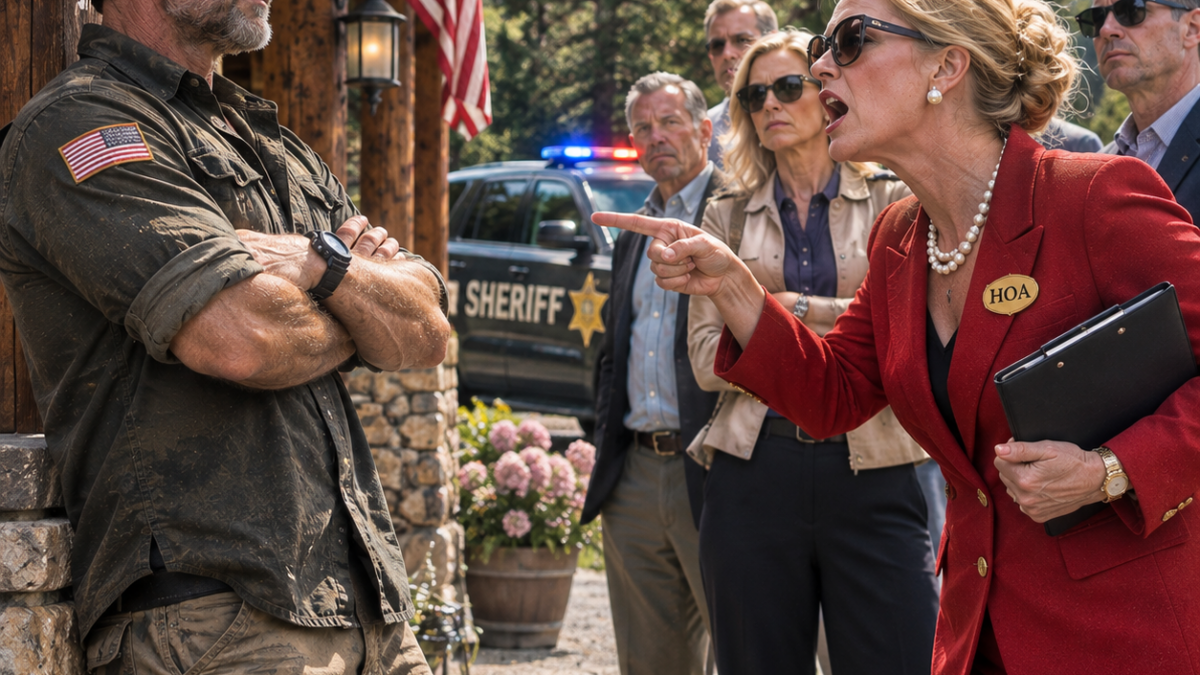
She stepped out wearing cream-colored slacks, a navy sweater, pearls, and shoes that had probably never touched actual dirt before that morning.
Clipboard under one arm.
Smile already installed.
“Mr. Garrett?”
I put down the drill.
“Yes.”
“Marsha Ashby.”
She waited as though the name should mean something.
I said:
“Nice to meet you.”
Her smile tightened.
“President of the Eagle Ridge Homeowners Association.”
There it was.
I stood.
“Can I help you?”
“Welcome to the neighborhood.”
“Thank you.”
She looked at the lodge.
Then at my flagpole.
Then at the stacked firewood beside the workshop.
Then at my gate.
“I wanted to introduce myself and go over a few community standards.”
I almost laughed.
“I think there’s been a misunderstanding.”
Her eyes returned to mine.
“Oh?”
“My property isn’t inside Eagle Ridge.”
“I know the lodge predates the development.”
“Not just the lodge.”
I pointed around us.
“All forty acres.”
Her smile stayed.
Her eyes didn’t.
“Eagle Ridge has certain aesthetic standards that affect all properties visible from our common areas.”
“I don’t.”
She blinked.
“Excuse me?”
“I don’t have Eagle Ridge aesthetic standards.”
She laughed lightly.
“Mr. Garrett, nobody likes regulations at first.”
“This isn’t about liking them.”
I wiped sawdust from my hands.
“I’m not a member.”
“Your access uses Aspen Hollow Road.”
“Recorded easement.”
“Which passes through association-managed land.”
“Doesn’t make me a member.”
She tilted her head.
“You’ve certainly done your homework.”
“I read things before I sign them.”
That irritated her.
I could see it.
She lowered her clipboard.
“Well, let’s start with something simple.”
She pointed to the American flag flying near the lodge.
“Flagpole placement must be approved.”
I stared at her.
“Approved by whom?”
“The architectural review committee.”
I looked toward the woods.
Then back.
“Tell them no.”
Her smile disappeared for half a second.
“I’m trying to be welcoming.”
“And I’m trying to save us both time.”
I walked toward the porch steps.
“My property isn’t in your HOA.”
She followed me with her eyes.
“Everyone around here eventually understands that cooperation is easier than conflict.”
I stopped.
“Is that a threat?”
The smile came back.
“Of course not.”
“Good.”
“Just advice.”
“I didn’t ask for any.”
Marsha studied me.
Then looked toward the lodge again.
“You live alone?”
That question changed the conversation.
Maybe she didn’t mean it the way it sounded.
Maybe she did.
I answered:
“Why?”
“Just making conversation.”
“Then let’s talk about weather.”
Her jaw tightened.
She opened her clipboard.
“Your front gate doesn’t conform to Eagle Ridge design standards.”
I laughed.
Couldn’t help it.
“What part?”
“Black metal isn’t among approved finishes.”
“That’s Raymond’s gate.”
“It may need replacement.”
“No.”
“And the stacked wood—”
“No.”
“The flagpole—”
“No.”
She stopped.
“You haven’t even heard the issue.”
“Doesn’t matter.”
I walked back toward my tools.
“You have no jurisdiction here.”
Behind me, she said:
“Everyone ends up dealing with the HOA eventually, Mr. Garrett.”
I turned.
“I’m sure they do.”
Her eyes were cold now.
“But I’m not everyone.”
She got into the Mercedes.
Drove away.
I went back to the porch.
But Raymond’s words returned.
Know your lines.
Three days later, the first violation notice arrived.
UNAPPROVED GATE MATERIAL.
I laughed.
Filed it.
Four days later:
UNAPPROVED FLAGPOLE LOCATION.
Filed.
Then:
IMPROPER OUTDOOR WOOD STORAGE.
Filed.
EXTERIOR LIGHTING NONCOMPLIANCE.
Filed.
COMMERCIAL VEHICLE PARKING.
That one referred to my fifteen-year-old Ford F-250.
Filed.
Within a month, I had eleven notices.
Every single one contained the Eagle Ridge HOA letterhead.
Every single one threatened fines.
Every single one cited covenants that did not apply to my parcel.
I didn’t call Marsha.
I didn’t argue at meetings.
I didn’t post angry messages online.
I created a folder.
Date received.
Photograph.
Copy.
Envelope.
Certified mail tracking where applicable.
Old habit.
People sometimes think military training is all shooting and running.
A lot of it is documentation.
You learn quickly that memory becomes unreliable under stress.
Paper doesn’t get nervous.
Paper doesn’t exaggerate.
Paper doesn’t forget.
By the fifth notice, I installed cameras.
Not because I feared the HOA.
At least that’s what I told myself.
The lodge already had a basic security system.
I added six trail cameras along the property perimeter.
North gate.
Old logging road.
Creek.
Eastern ridge.
Workshop.
Lower meadow.
Motion activated.
Infrared.
Timestamped.
Cloud backup.
For the first two weeks, I recorded deer.
Raccoons.
One black bear.
A fox.
Gil Dawson accidentally relieving himself beside a pine tree.
Gil was my nearest human neighbor.
Eighty-one years old.
Retired high-school principal.
Widower.
Eagle Ridge resident from before Marsha became president.
I deleted that clip immediately.
Some intelligence doesn’t need archiving.
Then one Tuesday morning, I opened the camera application over coffee.
Creek camera.
Motion event.
2:14 a.m.
I almost skipped it.
Probably deer.
Then I saw the flashlight.
I replayed the clip.
A person in a dark hoodie came through the trees.
Male.
Average height.
Heavy build.
He carried a small sledgehammer and something long.
He stopped beside one of my survey stakes.
Looked around.
Then pulled it out.
I leaned closer to the screen.
The man walked approximately thirty feet toward my lodge.
Hammered a new pink-flagged stake into the ground.
Then returned.
Pulled another.
I watched the clip three times.
On the fourth viewing, I noticed the gait.
Left leg.
Slight limp.
The man favored it every few steps.
The next clip caught him moving a second marker.
Another camera caught the glow of his flashlight.
No face.
No vehicle.
He knew where the cameras usually weren’t.
Unfortunately for him, I’d moved one.
At sunrise, I walked the creek line.
Seven stakes.
All relocated.
Thirty to thirty-five feet inward.
Fresh orange paint marked three trees.
Survey ribbon.
Someone had begun creating a new boundary.
I stood beside the creek with my hands in my jacket pockets.
Angry men make noise.
Scared men move too fast.
I had spent too many years learning what those mistakes cost.
So I stood there.
Looked.
Counted.
Photographed.
Marked GPS coordinates.
Measured distances.
I didn’t move the stakes back.
Not yet.
If someone was changing my line, I wanted to know why.
Forty acres of mountain timber had value.
But stealing a thirty-foot strip didn’t explain the risk.
Unless the strip wasn’t the goal.
I went home.
Pulled my closing documents.
Survey.
Title insurance.
Recorded plat.
Everything matched what Raymond showed me.
My gate was mine.
The creek boundary was mine.
No dispute.
At 2:30 that afternoon, Gil Dawson walked up the driveway.
He carried a cane he mostly used for dramatic effect.
“Coffee?”
I poured two mugs.
We sat on the porch.
Gil stared at the mountains.
Then said:
“You’ve annoyed Marsha.”
I smiled.
“I’ve noticed.”
“She doesn’t like people who tell her no.”
“Common condition.”
Gil looked toward Eagle Ridge.
“You hear about Project Ridge?”
“No.”
“That answer worries me.”
“What is it?”
He lowered his voice.
“Closed board meetings.”
“About?”
“Expansion.”
I turned.
“What expansion?”
“Sixty lots.”
“Where?”
Gil looked at me.
I knew before he answered.
“The Ridge.”
My land.
I put the coffee down.
“Forty acres isn’t enough for sixty luxury lots.”
“With the southern common area and your forty?”
It was.
Barely.
I thought about the two purchase offers I’d received since closing.
Anonymous investment company.
Mountain Crest Development Holdings.
First offer twenty percent below what I’d paid.
Second slightly higher.
Both cash.
Both refused.
I said:
“Developer name?”
“Colton Reeve.”
I knew it.
Reeve Development Group.
Big projects around Asheville and Hendersonville.
Gil continued:
“Marsha had him at the clubhouse twice.”
“When?”
“Last month.”
“What did they discuss?”
“I don’t know.”
“Who does?”
“Three board members.”
“Names?”
Gil gave them.
Then looked toward my gate.
“She keeps telling people your lodge is technically inside Eagle Ridge.”
“It isn’t.”
“I know.”
“You’ve seen the plat?”
“Yes.”
“Then why would she say that?”
Gil tapped his cane against the porch.
“Because if she says something long enough, people start remembering the claim instead of the evidence.”
That sentence stayed with me.
The next morning, Marsha arrived at 8:07.
White SUV.
No smile.
Certified envelope.
She stood outside my gate.
I walked down.
“What now?”
She handed me the envelope.
“Formal notice.”
I opened it.
NOTICE OF TRESPASSING AND COMMON-AREA ENCROACHMENT.
I read slowly.
According to the document, my lodge occupied land within Eagle Ridge’s designated Ridge Reserve tract.
I had seventy-two hours to vacate.
My gate, porch, outbuildings, and “personal improvements” were subject to removal.
I looked up.
Marsha was watching my face.
Waiting.
I gave her nothing.
She pulled out a folded map.
County plat.
Official-looking seal.
Survey stamp.
Notary certification.
Boundary line.
My stomach tightened.
On this version, Eagle Ridge’s property extended through nearly all forty acres.
My lodge sat inside HOA land.
It looked good.
Very good.
If I hadn’t held the real survey three weeks earlier, I might have doubted myself.
Marsha said:
“I tried to avoid this.”
“By sending me eleven fake violation notices?”
“They weren’t fake.”
I studied the map.
“Who prepared this?”
“Licensed surveyor.”
“Name?”
“Brent Kovacs.”
At the bottom.
Kovacs Land Surveying.
License number.
Notary seal.
I looked closer.
Notary date.
February 2024.
Name underneath:
Eleanor Bishop.
Something bothered me.
Couldn’t identify it immediately.
Marsha said:
“You have three days.”
“To do what?”
“Vacate.”
I laughed once.
She didn’t.
“You think I’m leaving my house because you brought me a map?”
“It is a certified survey.”
“Not recorded.”
Her eyes shifted.
Small.
Enough.
“How do you know?”
“Because if it were recorded, you’d have brought me the book and page number.”
She smiled again.
“You should speak with an attorney.”
“I will.”
“You could avoid expensive litigation.”
“How?”
“Sell.”
There it was.
“What price?”
Marsha paused.
“I could put you in touch with interested parties.”
“Mountain Crest?”
Her face froze.
I watched.
Then she said:
“I don’t know what you’re referring to.”
“Good.”
I folded the map.
“Then you won’t mind if I verify this.”
“Verify anything you want.”
“I will.”
She started toward her SUV.
I called:
“Marsha.”
She turned.
“If this map is fake, we’re going to have a different conversation.”
She smiled.
“Be careful making accusations.”
I nodded.
“Always am.”
At 8:01 the next morning, I stood in front of Joan Pruitt at the county recorder’s office.
Joan was probably sixty-five.
White hair.
Pink glasses.
The kind of county employee who knew three generations of families by parcel number.
I gave her my deed.
“Need the recorded survey.”
She pulled it.
Same one I’d already seen.
My boundary.
My gate.
My lodge.
Everything correct.
Then I showed her Marsha’s map.
Joan adjusted her glasses.
Looked once.
Then again.
Her face changed.
“Where did you get this?”
“HOA president.”
She leaned toward the notary block.
“Eleanor Bishop?”
“Yes.”
Joan looked at me.
“Eleanor retired in 2019.”
I felt cold.
“Could someone still use her seal?”
“Not legally.”
“Is this map recorded?”
She searched.
No.
County GIS.
No.
Survey registry.
No.
She called the survey licensing portal.
Kovacs existed.
Licensed.
But no survey had been filed for my parcel.
Joan lowered her voice.
“Mason, this isn’t a bad copy.”
“I know.”
“This looks fabricated.”
“I know.”
“You need the sheriff.”
“Eventually.”
She stared.
“Eventually?”
“I want a certified copy of the real plat.”
She printed it.
Raised seal.
Signature.
I put it in a plastic sleeve.
Then asked:
“Can you certify that their map isn’t recorded?”
“Yes.”
“Do that too.”
She did.
I drove home.
I did not call the sheriff.
That may sound strange.
One forged document was enough to start an investigation.
But whoever moved my stakes was still out there.
Whoever created the map had accomplices.
And if I called too early, everyone would stop moving.
I didn’t want the hand holding the fake paper.
I wanted the arm.
Gil came over that afternoon.
I showed him both maps.
He sat very still.
“She forged the county seal?”
“Looks that way.”
“Call the police.”
“Not yet.”
“Mason.”
“Gil.”
“You’re sixty-one.”
“And?”
“You don’t need to run military operations against an HOA.”
“I am not.”
“You’ve got six cameras, printed timelines, duplicate drives, and three notebooks.”
I considered that.
“Fair.”
Gil sighed.
“What are you waiting for?”
“The man who moved the stakes.”
“You know who?”
“No.”
“Then?”
“I know he limps.”
Gil stopped.
Then his eyes narrowed.
“Dale.”
“Who?”
“Marsha’s husband.”
“What about him?”
“Motorcycle accident.”
“When?”
“Seven years ago.”
“Which leg?”
Gil stared.
“Left.”
That night, I repositioned cameras.
Two visible.
Four concealed.
One high on the creek line.
One pointed toward the old logging trail.
Every feed linked to my phone.
Motion alerts immediate.
I asked Gil for one favor.
“Saturday morning, sit on your porch.”
He frowned.
“I do that every morning.”
“Phone charged.”
“Why?”
“If you see anything unusual, record it.”
“Mason.”
“Please.”
He studied me.
Then nodded.
“What are you expecting?”
I looked toward Eagle Ridge.
“Confidence.”
Saturday arrived clear and cool.
At 8:52 a.m., Marsha’s white SUV turned into my driveway.
Three board members followed.
Then neighbors.
Cars lined Aspen Hollow Road.
At least forty people.
Phones already out.
Marsha had invited an audience.
That told me she believed the forged map was enough.
She stepped through my open gate.
I was on the porch drinking coffee.
“Mason Garrett.”
“Morning.”
“Your seventy-two hours expired.”
“I know.”
“You were ordered to vacate.”
“I read it.”
“And yet you’re still here.”
“Sharp observation.”
She looked toward the neighbors.
People were watching from the road.
Marsha’s performance began.
“I’ve tried to handle this privately.”
“No, you haven’t.”
She ignored me.
“This property belongs to Eagle Ridge Estates.”
“No.”
“You are unlawfully occupying HOA land.”
“No.”
One board member unfolded the fake plat.
Marsha held up her phone.
“I’m calling law enforcement.”
“Okay.”
She looked surprised.
Probably expected resistance.
She dialed.
Put it on speaker.
“Yes, this is Marsha Ashby, president of Eagle Ridge Estates.”
Pause.
“I need a deputy.”
Another pause.
“We have a trespasser refusing to vacate association property.”
She looked directly at me.
“Yes, he’s here now.”
I crossed my arms.
Leaned against the porch rail.
Marsha smiled.
Twenty minutes later, a sheriff’s SUV came up Aspen Hollow Road.
Lights flashing.
Neighbors raised phones.
Marsha stepped into the driveway.
She was almost vibrating with excitement.
The SUV stopped.
Driver’s door opened.
The sheriff stepped out.
Tall.
Black campaign hat.
Tan uniform.
Mirrored aviators.
I knew the posture before I saw the face.
Not the man.
The posture.
A way certain people stand after years of wearing body armor.
I straightened without realizing it.
Marsha pointed toward me.
“Sheriff, that’s him.”
The sheriff looked at her.
Then at me.
He stopped.
For three seconds, nobody spoke.
He reached up.
Removed his sunglasses.
I felt the world narrow.
Luke Branigan.
Older.
Gray at his temples.
Scar on his jaw.
But Luke.
The last time I’d seen him, he was twenty-six years old and bleeding through a corpsman uniform in Afghanistan.
His eyes widened.
Then he said one word.
“Anchor.”
Nobody around us understood.
I did.
My call sign.
A name I had not heard spoken aloud in twelve years.
My heart hit my ribs.
“Doc?”
Luke smiled.
Just barely.
“Been a while.”
Marsha looked between us.
“What is happening?”
Luke didn’t take his eyes off me.
“Didn’t know you lived up here.”
“Didn’t know you were sheriff.”
“Twelve years, Mason.”
“Yeah.”
Then his expression changed.
Professional again.
He put the sunglasses in his pocket.
Marsha said:
“Sheriff Branigan, do you know this man?”
Luke looked at her.
“Yes, ma’am.”
Her smile returned.
“Wonderful. Then perhaps you can explain that friendship doesn’t supersede property law.”
Luke’s expression hardened.
“Absolutely.”
That answer pleased her.
Then he added:
“Which is why we’re doing this by the book.”
He pulled out a notebook.
“Nobody gets special treatment.”
I nodded.
Exactly right.
Marsha looked almost disappointed.
Luke asked:
“Who’s alleging trespass?”
“I am.”
“Documentation?”
She practically shoved the fake map into his hands.
“Certified survey.”
Luke studied it.
No reaction.
He looked toward me.
“Mason?”
I walked down the porch.
Took the certified county copy from my folder.
Handed it over.
Luke placed them side by side.
Neighbors moved closer.
Two maps.
Two boundaries.
Two seals.
Luke looked at the real copy.
Then the fake.
“One of these is wrong.”
I said:
“County recorder confirms mine is the only recorded plat.”
Marsha snapped:
“His is outdated.”
I handed Luke Joan’s certification.
He read.
Then looked at Marsha.
“Who produced yours?”
“Brent Kovacs.”
“Licensed surveyor?”
“Yes.”
“Where is the recording information?”
She hesitated.
“It hasn’t been entered yet.”
“Then why does it contain a county certification seal?”
Silence.
Marsha’s face tightened.
“Our attorney handled that.”
Luke pointed to the notary.
“Eleanor Bishop.”
“Yes.”
“You know her?”
“No.”
I said:
“Retired in 2019.”
Marsha looked at me.
Luke’s eyes sharpened.
“Who gave you that information?”
“County recorder.”
Luke folded neither map.
He held both.
“Mrs. Ashby, until I verify this, nobody is being removed from this property.”
“This is outrageous.”
“It’s procedure.”
“He’s trespassing.”
“You’ve provided a disputed document.”
“Disputed by him.”
“Disputed by county records.”
Marsha’s face flushed.
Then my phone vibrated.
One alert.
Creek camera.
I almost ignored it.
Then another.
Motion.
Camera 4.
I pulled out the phone.
Live feed.
Two men.
One wore a neon surveying vest.
Tripod.
Equipment.
The second wore a tan jacket.
Hammer.
Pink stakes.
My pulse changed.
The tan-jacketed man walked.
Left-leg limp.
Dale Ashby.
I watched him hammer a marker.
At the exact moment his wife had summoned the sheriff to my front porch.
There it was.
The plan.
Create public confrontation.
Keep law enforcement occupied.
Move the boundary while everyone watched me.
Later, newly placed markers would appear to support the fake survey.
Marsha hadn’t called the sheriff because she needed police.
She needed witnesses and an alibi.
I turned the phone toward Luke.
“Sheriff.”
He watched five seconds.
His face became stone.
“Where?”
“Eastern creek line.”
“How far?”
“About half a mile.”
Marsha moved toward us.
“What is that?”
Luke looked at her.
“Your husband.”
The color left her face.
She lunged for my phone.
“That’s private!”
Deputy Miguel Alvarez, who had arrived behind Luke without me noticing, stepped between us.
“Ma’am, stay back.”
Marsha shouted:
“He has no right to film us!”
I said:
“It’s my land.”
Luke looked at Alvarez.
“Two units.”
“Creek line.”
“Now.”
Then he looked at me.
“Show me.”
We were moving before Marsha finished protesting.
I took my ATV.
Luke rode with me.
Alvarez followed in a side-by-side with another deputy.
The creek was less than two minutes away.
We came around a bend.
There they were.
Dale Ashby had the sledgehammer raised.
Brent Kovacs stood beside the tripod.
Both froze.
Luke shouted:
“Sheriff’s Office! Hands where I can see them!”
Dale dropped the hammer.
Kovacs ran.
Bad decision.
He made it maybe sixty yards.
Mud.
Brush.
Steep ground.
Alvarez caught him before the logging trail.
Dale didn’t run.
His left leg wouldn’t have helped.
Luke looked at the pink stakes.
Then the original iron monument lying on the ground beside Dale.
“What are you doing?”
Dale stared at Marsha’s husband-sized version of the future and decided silence might save him.
Kovacs decided differently.
They brought him back breathing hard.
Luke looked at the surveyor vest.
“You Brent Kovacs?”
Kovacs didn’t answer.
Alvarez said:
“We found identification.”
Luke nodded.
“You want to tell me why you’re conducting a survey while the property owner is at the front gate disputing a survey bearing your name?”
Kovacs’s face was already sweating.
“It’s complicated.”
Luke looked at the body camera on Alvarez’s chest.
“Good.”
“We record complicated.”
Dale said:
“Brent, shut up.”
That was the wrong thing to say.
Kovacs looked at him.
“You’re telling me to shut up?”
Dale’s face hardened.
Kovacs pointed.
“Your wife dragged me into this.”
Luke said nothing.
Kovacs kept going.
People who are guilty often fear silence more than questioning.
“She paid me.”
Dale whispered:
“Brent.”
“Forty thousand.”
Luke’s eyes narrowed.
“For what?”
Kovacs looked at me.
Then the fake stake.
“The plat.”
My jaw tightened.
Luke asked:
“You forged it?”
Kovacs swallowed.
“I altered an existing survey.”
“County seal?”
“No.”
He looked toward Dale.
“She gave me the template.”
“Who?”
“Marsha.”
Dale closed his eyes.
Luke asked:
“Why?”
Kovacs started shaking.
“Developer.”
“What developer?”
“Colton Reeve.”
I felt anger rise.
“What was the deal?”
Kovacs looked at me.
“Expansion.”
“How much?”
“Sixty lots.”
Luke asked:
“How was Mr. Garrett’s land supposed to become HOA property?”
Kovacs laughed bitterly.
“Paper.”
Nobody spoke.
He continued.
“Change the historical plat.”
“Move the markers.”
“Create a boundary conflict.”
“HOA files a claim.”
“Garrett spends years fighting.”
Dale said:
“Stop.”
Kovacs turned on him.
“You think I’m going to prison alone?”
Luke’s expression never changed.
“What was Marsha being paid?”
Kovacs hesitated.
Dale looked sick.
Luke waited.
Kovacs finally said:
“One-eighty.”
“One hundred eighty thousand dollars?”
“Yes.”
“From Reeve?”
“Success fee.”
My hands curled into fists.
Luke looked at me once.
That old look.
Anchor.
Stay still.
I did.
Kovacs continued.
“Reeve couldn’t fit the expansion without the forty acres.”
Luke nodded.
“So Mrs. Ashby allegedly agreed to obtain control of Garrett’s property.”
“Yes.”
“By forging a survey.”
“Yes.”
“Moving survey monuments.”
“Yes.”
“And calling law enforcement to remove him.”
Kovacs looked toward the ground.
“Yes.”
Every word lived on the body cameras.
Luke turned toward Dale.
“Anything you’d like to add?”
Dale stared at his shoes.
Then:
“I told her this was a bad idea.”
Kovacs laughed.
“You moved seven stakes.”
Dale’s face collapsed.
Luke said:
“Mr. Ashby, turn around.”
Back at the lodge, the crowd had doubled.
Marsha stood near the porch with the three board members.
The moment she saw Dale in handcuffs, her expression changed.
Not fear.
Calculation.
She walked toward Luke.
“This is a misunderstanding.”
Luke stopped.
“No, ma’am.”
“Dale was checking the boundary.”
“With a sledgehammer?”
“He’s on the property committee.”
“Your HOA doesn’t own this land.”
“That remains disputed.”
Luke held up the forged map.
“It’s becoming less disputed by the minute.”
Marsha looked at Kovacs.
He wouldn’t meet her eyes.
She whispered:
“What did you say?”
That was the moment she knew.
Her body almost sagged.
Then she recovered.
“This is all his fault.”
She pointed at Kovacs.
“He told us the survey was legitimate.”
Kovacs looked at her in disbelief.
“You gave me the old plat.”
“Shut up!”
Neighbors murmured.
Phones rose again.
Marsha turned toward me.
“You did this.”
I said nothing.
She walked closer.
“You trapped us.”
“No.”
My voice stayed calm.
“You walked onto my land with a fake map.”
“You installed cameras without notifying the HOA.”
I almost laughed.
Luke did.
Just one short breath.
Marsha turned on him.
“You think this is funny?”
“No, ma’am.”
He pulled out handcuffs.
“Marsha Ashby, you’re under arrest on suspicion of forgery, conspiracy to commit fraud, filing a false police report, attempted property fraud, and tampering with survey monuments.”
Marsha stared at him.
Then at the neighbors.
“You can’t arrest me.”
Luke stepped closer.
“I can.”
“Do you know who I am?”
Luke took her wrist.
“Yes, ma’am.”
Click.
“Now I do.”
The crowd went silent.
Marsha started shouting.
“Call our attorney!”
One board member stepped backward.
“Marsha, I didn’t know about any of this.”
She turned.
“You signed the resolution!”
“You told us the property was ours!”
Another board member raised both hands.
“I want a lawyer.”
Gil Dawson came through the crowd.
His cane hit the gravel.
“Sheriff.”
Luke looked at him.
Gil held up his phone.
“I’ve got three board meetings recorded.”
Marsha went white.
Luke said:
“Sir, we’ll take a statement.”
Gil nodded.
“She promised Reeve the Ridge before she ever sent Mason his first violation notice.”
Neighbors started talking.
One woman said:
“She told us the lawsuit was already won.”
A man near the road added:
“She said dues would increase temporarily to fund legal action.”
Another:
“She said Mason was a squatter.”
Another:
“She showed us the fake map at a closed meeting.”
The wall collapsed quickly after that.
Confidence holds conspiracies together.
Once confidence breaks, people start protecting themselves.
By Monday morning, the state bureau of investigation was involved.
County survey officials.
District attorney.
Forgery investigators.
The developer’s offices were searched two weeks later.
The evidence was worse than I expected.
Emails.
Contracts.
Draft development maps.
Private messages.
Marsha to Reeve:
GARRETT WILL EVENTUALLY SELL IF WE MAKE OWNERSHIP EXPENSIVE ENOUGH.
Another:
IF THE BOUNDARY BECOMES A LEGAL DISPUTE, HIS TITLE COMPANY WILL PRESSURE SETTLEMENT.
Another:
WE ONLY NEED CONTROL LONG ENOUGH TO GET HIM TO THE TABLE.
And then the payment agreement.
One hundred eighty thousand dollars to a consulting company owned by Marsha.
Due upon acquisition of my parcel.
Forty thousand to Kovacs.
Ten thousand cash to Dale for “field expenses.”
More money routed into an HOA legal reserve without board disclosure.
My eleven violation notices weren’t random harassment.
They were groundwork.
Each one built a record suggesting my lodge was subject to Eagle Ridge authority.
Each one created evidence they could later point to:
Look.
We’ve been regulating this property for months.
Why didn’t the owner object more aggressively?
That was the part that made me laugh.
Because I had objected.
I just hadn’t shouted.
I had filed everything.
Every envelope.
Every notice.
Every response.
Dates.
Copies.
Photographs.
One investigator looked at my folder and said:
“You kept all this?”
“Yes.”
“Why?”
“Because people lie.”
He nodded.
“Fair.”
The trial came eight months later.
By then, Eagle Ridge looked different.
Not physically.
Same stone entrance.
Same expensive houses.
But the HOA board had dissolved.
A temporary committee managed utilities and common maintenance until residents elected replacements.
Marsha pleaded guilty before the main trial.
Felony fraud.
Forgery.
Conspiracy.
Filing false reports.
Her cooperation reduced the sentence.
Dale testified.
Kovacs lost his surveying license and took a plea agreement.
Colton Reeve tried fighting.
Bad decision.
Prosecutors had his emails.
Financial transfers.
Development plans.
The jury took less than five hours.
My title was confirmed.
Every boundary monument was professionally reset under court supervision.
County surveyors installed permanent steel markers.
The court ordered the defendants to reimburse my legal costs.
Eagle Ridge paid nothing for Marsha’s personal criminal conduct, which mattered to me.
The homeowners had been stupid in places.
Some had enabled her.
But most were simply lied to.
I didn’t want two hundred families bankrupted because one woman thought she was a real-estate kingmaker.
The strangest change came after the trial.
I became friendly with some of them.
Gil first, obviously.
Then Susan Pierce from Lot 14.
Carlos and Elena Martinez near the lower gate.
A retired firefighter named Tom Weaver.
People who had originally watched me like I was some hostile stranger suddenly stopped by the lodge.
Some apologized.
Some didn’t need to.
One afternoon, a woman named Rebecca came with her fourteen-year-old son.
She had filmed the morning Marsha tried to have me arrested.
“I owe you an apology.”
“For what?”
“I believed her.”
I leaned against the porch.
“Why?”
Rebecca looked embarrassed.
“She was HOA president.”
“That isn’t an answer.”
“I know.”
She thought.
“I guess because she spoke like she couldn’t possibly be wrong.”
I nodded.
“That gets people.”
She looked toward the mountains.
“My husband said the same thing.”
“What?”
“That confidence isn’t evidence.”
“Smart husband.”
“He’s unbearable.”
I smiled.
Her son asked:
“Were you really a Navy SEAL?”
Rebecca closed her eyes.
“Evan.”
“What?”
I looked at the kid.
“Yes.”
His eyes widened.
“Did you kill—”
His mother said:
“Car.”
Evan sighed.
“Sorry.”
I smiled.
“Your mother just saved both of us from an uncomfortable conversation.”
He laughed.
They left.
I sat down.
The truth was, the SEAL part of my life became public because of Luke.
Not because he told classified stories.
He didn’t.
But body-camera footage from the driveway eventually became public.
Sheriff steps from SUV.
Removes sunglasses.
“Anchor.”
The internet did the rest.
Old service photos surfaced.
Veteran groups contacted me.
Local reporters wanted interviews.
I refused almost all of them.
One headline read:
HOA TRIED TO STEAL LAND FROM RETIRED SEAL—SHERIFF WHO OWED HIM HIS LIFE RESPONDED.
I hated that headline.
Not because it was completely wrong.
Because it turned Luke into somebody who helped me out of personal debt.
He didn’t.
That morning, he treated me exactly the way I wanted.
By the book.
If my map had been fake, he would’ve arrested me.
I respected him more because of that.
A week after the convictions, Luke came to the lodge without uniform.
Jeans.
Boots.
Old Navy sweatshirt.
He carried a six-pack.
We sat on the porch.
Sun dropping behind the ridge.
For a while we didn’t talk about Afghanistan.
We talked about ordinary things.
His wife.
Two daughters.
My divorce.
The lodge.
Hunting.
The county.
Then Luke said:
“Dispatcher said minor trespass.”
I laughed.
“Minor.”
“I was doing paperwork.”
“What made you come?”
He looked at the bottle.
“Name.”
“Mason Garrett?”
“Yeah.”
“How many Mason Garretts are in the county?”
“One now.”
He smiled.
“I asked the address.”
“Aspen Hollow.”
“Then I thought maybe.”
I looked at him.
“You knew I bought the lodge?”
“No.”
“You looked me up?”
“After dispatch.”
“How?”
“Date of birth.”
I laughed.
“Sheriff abusing databases.”
“Official call.”
“Convenient.”
He smiled.
Then became quiet.
“I’ve been looking for you.”
“For what?”
Luke stared toward the mountains.
“Twelve years.”
I knew where this was going.
“Don’t.”
“Mason.”
“Luke.”
“You carried me two miles.”
“Approximately.”
“You had a fractured wrist.”
“Didn’t know that at the time.”
“You were taking fire.”
“So were you.”
“I was unconscious for half of it.”
“Lucky.”
He laughed once.
Then his eyes filled.
“You saved my life.”
I looked away.
“No.”
“You did.”
“Team did.”
“You.”
His voice hardened.
“Stop.”
I looked at him.
Luke continued.
“I remember waking up halfway down that mountain.”
I didn’t.
“You had me across your shoulders.”
I stared toward the tree line.
“You were bleeding too.”
“I was fine.”
“You kept saying that.”
“Still true.”
Luke shook his head.
“Anchor.”
I closed my eyes.
Nobody had called me that since retirement.
The name came from an operation years earlier when I held a defensive position longer than planned.
It stuck.
In teams like ours, names often come from mistakes or jokes.
Mine became something else.
The man who stayed.
The man who held.
That reputation had cost me more than Luke knew.
I said:
“I never wanted thanks.”
“I know.”
“Then why look for me?”
Luke’s voice softened.
“To tell you I had a life.”
I looked at him.
He pulled out his phone.
Showed me a photograph.
His wife.
Two daughters.
Christmas tree.
Dog.
Ordinary living room.
“I met Sarah three years after Afghanistan.”
He swiped.
Wedding photograph.
Another.
Baby.
Another.
Graduation.
“My oldest is eleven.”
I swallowed.
“Good-looking kid.”
“She wants to be a veterinarian.”
“Expensive.”
“Tell me about it.”
He looked at the photographs.
“None of that happens if you leave me in that ravine.”
I stared at him.
Luke’s voice cracked.
“I needed you to know what you carried.”
That sentence broke through something I had spent years keeping shut.
Not the weight of Luke.
The life after.
Military service teaches you to count losses.
Names.
Faces.
Empty bunks.
Flags folded into triangles.
We rarely get to see the opposite ledger.
Birthdays that happened because somebody survived.
Children.
Marriages.
Bad mortgages.
Dogs.
School plays.
Ordinary Tuesday nights.
Things nobody writes medals for.
I handed his phone back.
“I’m glad.”
Luke nodded.
We sat quietly.
Then he said:
“I was going to thank you.”
“You just did.”
“No.”
He smiled.
“I was going to make some big speech.”
“What stopped you?”
“You look like you’d throw me off the porch.”
“Correct.”
We laughed.
Sunset spread orange across the mountains.
Luke looked toward the creek.
“Marsha picked the wrong guy.”
I shook my head.
“No.”
He frowned.
“She picked the wrong paperwork.”
He laughed.
“That’s your lesson?”
“That’s my lesson.”
“What about twenty-two years of SEAL experience?”
“Cameras helped.”
“What about instincts?”
“County recorder helped.”
“What about combat training?”
“Joan Pruitt knew the notary retired.”
Luke shook his head.
“You’re ruining a good legend.”
“Good.”
He leaned back.
“People like legends.”
“Legends get people careless.”
Luke looked at me.
“Meaning?”
I pointed toward the road.
“Everybody thinks Marsha lost because I was a SEAL and the sheriff knew me.”
“She lost because she forged a map.”
“And because she thought nobody would verify it.”
Luke nodded.
“She thought status mattered more than evidence.”
“Exactly.”
That became the lesson Eagle Ridge needed too.
The new HOA president was Gil Dawson.
He fought the nomination for three weeks.
Then lost the election by winning too many votes.
He showed up at my lodge holding the results.
“You did this.”
“I don’t live in the HOA.”
“Exactly.”
“Then how?”
“You told Susan I’d be good.”
“I said you’d be less terrible than most people.”
Gil glared.
“That’s apparently an endorsement.”
His first meeting changed the rules.
All board meetings recorded.
Financial statements available online.
Any property dispute required independent legal review.
No board member could negotiate development contracts without full homeowner disclosure.
Survey conflicts automatically referred to county records.
I said:
“Seems obvious.”
Gil replied:
“So does not forging maps.”
Fair.
The old expansion plan disappeared.
My forty acres remained woods.
I repaired the lodge.
Built a larger deck.
Added a small shooting bench on the western ridge.
Not because I needed tactical readiness.
Because I liked punching paper at distance.
I kept the cameras.
Never know.
The first winter, snow covered the creek line.
I walked down one morning.
The new steel monuments stood where Raymond had shown me.
Thirty feet beyond Marsha’s fake pink stakes.
I found one of the old pink flags beneath the snow.
Faded.
Bent.
I pulled it out.
For a moment, I considered throwing it away.
Instead, I brought it home.
Mounted it beside the certified survey in my workshop.
Under it, I wrote:
CONFIDENCE IS NOT OWNERSHIP.
Gil saw it.
“You’re becoming philosophical.”
“Retirement.”
“Dangerous.”
The following spring, Colton Reeve’s development company declared bankruptcy after several projects collapsed under investigation.
Marsha was serving her sentence.
Dale moved out of Eagle Ridge.
Kovacs worked construction after losing his license.
I heard people occasionally ask whether I felt sorry for them.
No.
I also didn’t wake up happy they were suffering.
There’s a difference between revenge and consequence.
I wanted my land.
I kept it.
I wanted the truth on the record.
It was.
I wanted nobody moving my boundary at 2:14 in the morning.
Mission accomplished.
The rest belonged to courts.
One evening, Raymond Carlisle visited.
The man who sold me the lodge.
Eighty-five now.
His daughter drove him.
He walked slowly toward the northwest survey monument.
Tapped it with his cane.
“Still there.”
“Yes.”
He looked at me.
“Heard somebody tried moving them.”
“Seven.”
Raymond shook his head.
“Told you.”
“Know your lines.”
“Exactly.”
We sat on the porch.
I showed him the fake map.
His hands shook with age as he held it.
“They almost got you.”
“Not really.”
He looked at me sharply.
“Don’t be arrogant.”
I smiled.
“Yes, sir.”
“If you’d thrown those violation letters away?”
I stopped smiling.
“If you hadn’t had cameras?”
I nodded.
“If you hadn’t checked the county record?”
He handed the fake map back.
“People don’t lose land only because somebody steals it.”
I waited.
“They lose it because they stop paying attention.”
That was better than anything I’d said.
I wrote it down later.
The lodge became what I wanted from the beginning.
Peace.
Mostly.
Eagle Ridge kids occasionally wandered up asking whether I had really been a SEAL.
Gil came over almost every day.
Luke visited once a month.
Sometimes we went fishing.
Sometimes we sat without talking.
The mountain got quiet again.
But peace meant something different now.
I used to believe peace was the absence of conflict.
A place far enough from everyone that nobody could bother me.
That’s why I’d bought forty acres.
Isolation.
Distance.
Control.
Then Marsha came.
And Gil warned me.
Joan found the real plat.
Luke answered the call.
Alvarez chased Kovacs.
Neighbors testified.
Raymond reminded me to know my lines.
I kept my property because I wasn’t alone.
That’s a difficult admission for a man who spent most of his life believing self-reliance was a virtue.
Sometimes it is.
Sometimes it’s just loneliness with better branding.
Luke taught me that without trying.
One summer evening, we sat on the porch during a thunderstorm.
He asked:
“Why’d you retire out here?”
“Quiet.”
“That’s the official answer.”
“What’s wrong with it?”
“Nothing.”
He waited.
I knew the tactic.
Silence.
Interrogation technique.
Eventually people fill it.
I said:
“Didn’t want anyone expecting things.”
Luke nodded.
“Teams?”
“People.”
“Same thing.”
I watched rain hit the trees.
“My marriage ended.”
“I know.”
“Who told you?”
“County.”
I stared.
He laughed.
“Kidding.”
“Not funny.”
“A little.”
I shook my head.
Then:
“She said I was physically present and emotionally deployed.”
Luke winced.
“That’s a line.”
“She was smart.”
“You regret it?”
“Yes.”
“Want her back?”
“No.”
“That was fast.”
“She remarried.”
“Ah.”
I smiled.
“She looks happy.”
“Good.”
“Yeah.”
Rain thickened.
Luke asked:
“You ever think maybe the lodge isn’t peace?”
“What is it?”
“Cover.”
I looked at him.
He shrugged.
“You taught us to recognize defensive positions.”
I hated that he was right.
“Sheriffs shouldn’t psychoanalyze.”
“Budget cuts.”
We laughed.
Over the next year, I started doing something I never expected.
Helping veterans.
Not formally at first.
Luke knew guys through county services.
One former Marine needed work repairing a deck.
I hired him.
Another needed somewhere quiet to spend weekends while getting sober.
I let him use the spare bedroom.
Then another.
Eventually, the lodge became a meeting place twice a month.
No organization name.
No grants.
No matching shirts.
Coffee.
Food.
Fire.
Men who understood silence.
Sometimes women too.
Combat veterans.
First responders.
People who had carried things they didn’t know where to put.
We never called it therapy.
That helped.
One night, a twenty-nine-year-old Army veteran named Kyle sat beside the fireplace.
He had barely spoken all evening.
Then he asked:
“Were you really Anchor?”
I looked at Luke.
He had clearly been talking.
“Unfortunately.”
Kyle stared at the fire.
“What did that mean?”
“Nothing important.”
Luke said:
“Bull.”
I gave him a look.
Kyle smiled.
Then his face became serious.
“I’m tired.”
Nobody rushed to answer.
He continued.
“Like really tired.”
The room changed.
Every veteran knows that sentence can mean more than sleep.
I asked:
“Want to stay here tonight?”
Kyle looked at me.
“I don’t want to be somebody’s problem.”
“You aren’t.”
“Everybody says that.”
“I didn’t say you aren’t a problem.”
He looked surprised.
A few men laughed.
I continued:
“Everybody’s a problem.”
“Stay anyway.”
Kyle stayed.
Then another night.
Then entered treatment.
Months later, he told me he probably wouldn’t have made it through that week alone.
I thought about Luke.
The ravine.
The porch.
The forged map.
Strange how one life carries another forward without planning it.
Maybe Luke was right.
Maybe the things we carry matter beyond the moment.
Two years after Marsha’s arrest, Eagle Ridge held a summer picnic.
Gil insisted I come.
I said:
“I don’t belong to your HOA.”
He replied:
“Best thing about you.”
So I went.
Kids ran around.
Older people complained about food.
A band played badly.
Normal neighborhood.
At one point, a new resident walked over.
Young couple had bought a house near the gate.
The husband asked:
“Are you Mason Garrett?”
“Depends.”
“My realtor told us about the boundary scandal.”
I sighed.
“Of course.”
“He said the sheriff recognized you.”
“That’s what everybody remembers.”
“Was it true?”
“Yes.”
“He called you Anchor?”
“Yes.”
“Because you saved his life?”
I looked toward Luke across the lawn.
Talking to Gil.
Laughing.
I said:
“That’s his version.”
The man smiled.
“What would you say happened?”
I thought.
Then answered:
“A woman forged a map.”
He looked disappointed.
“That simple?”
“No.”
I took a drink.
“But that’s the important part.”
He frowned.
I continued.
“Everybody loves the moment the sheriff recognizes the retired SEAL.”
“Sure.”
“It makes a good story.”
“It does.”
“But if Luke had never met me before, the result should have been the same.”
The man nodded slowly.
“Because your deed was real.”
“And hers wasn’t.”
That was the victory I cared about.
Not that a sheriff knew my call sign.
That it didn’t matter.
Luke did not arrest Marsha because she tried to steal from his old rescuer.
He arrested her because the evidence led there.
The law worked because, for once, the people holding authority cared more about documents than status.
Marsha’s biggest mistake wasn’t underestimating a retired SEAL.
She underestimated boring things.
Survey pins.
County records.
Timestamped cameras.
Notary dates.
Homeowner testimony.
A man with a limp caught at the wrong place at the wrong time.
She believed spectacle could create truth.
She had neighbors.
Board members.
A forged official-looking map.
She had already called me a trespasser so many times people were starting to believe it.
Then reality arrived.
Quietly.
In a plastic folder with a county seal.
That’s usually how truth works.
Less dramatic than lies.
Heavier.
Three years after I bought the lodge, I still wake before sunrise.
Coffee on the porch.
Mountains turning blue.
Creek below.
Flag moving above the lodge.
Same flag Marsha cited as a violation.
I never moved it.
Gate still black metal.
Woodpile still visible.
Truck still parked wherever I want.
Not because I enjoy irritating the HOA.
Okay.
Maybe a little.
Mostly because they’re mine.
Some mornings, Gil walks up.
Some mornings Luke does.
Some mornings nobody comes.
Those are good too.
The pink survey flag remains in the workshop.
Underneath it now are three things.
The real plat.
A photograph of Luke and me in uniform taken years before Afghanistan.
And one sentence Raymond Carlisle gave me the last time he visited.
KNOW YOUR LINES.
Not only property lines.
That’s what I’ve learned.
Know the line between authority and intimidation.
Between confidence and evidence.
Between cooperation and surrender.
Between privacy and isolation.
Between keeping the peace and letting somebody take what belongs to you because fighting back feels inconvenient.
Know your lines.
Then hold them.
Not with rage.
Not with threats.
Not with whatever weapon makes you feel powerful.
Hold them with facts.
Patience.
Proof.
And people you trust.
Marsha Ashby came to my mountain because she believed I was alone.
An older man.
No family in the house.
Forty acres a developer needed.
She saw solitude and mistook it for weakness.
She saw silence and assumed fear.
She watched me collect eleven violation notices without shouting and decided I wouldn’t fight.
She was right about one thing.
I didn’t fight the way she expected.
I didn’t scream at her gate.
Didn’t threaten lawsuits I hadn’t prepared.
Didn’t post accusations.
Didn’t move the fake survey markers after I found them.
I waited.
Documented.
Checked the real map.
Found the false seal.
Moved my cameras.
And let her become confident enough to call the sheriff herself.
That was the beautiful part.
Marsha didn’t get caught because I chased her.
She brought law enforcement to my driveway.
She gathered the witnesses.
She held up the forged document.
And while she tried to turn the entire neighborhood into an audience for my humiliation, her husband was standing half a mile away with a hammer in his hand moving the evidence.
All I had to do was let the truth arrive.
It arrived in a sheriff’s SUV.
Luke Branigan stepped out.
Removed his sunglasses.
Looked at a man he hadn’t seen in twelve years.
And called me Anchor.
Everyone remembers that moment.
I do too.
But not because it saved me.
Because for three seconds, I wasn’t sixty-one years old on a porch fighting an HOA.
I was back in the Kunar mountains carrying a bleeding twenty-six-year-old corpsman down a slope while he drifted in and out of consciousness.
I had thought that story ended when we got him onto the helicopter.
It didn’t.
Twelve years later, he stepped out of a sheriff’s SUV with a wedding ring on his hand, photographs of two daughters in his phone, and an entire life that had happened after I thought my part was over.
He showed me something Marsha never understood.
What you do to people doesn’t end when they leave your sight.
Cruelty travels.
So does kindness.
So does courage.
Sometimes twelve years.
Sometimes two miles down a mountain.
Sometimes across forty acres.
Sometimes all the way back to your own front porch.
Marsha tried to take everything from me with a fake line on a map.
Instead, she reminded me that the most important boundaries in life aren’t the ones you draw around yourself to keep everyone out.
They’re the ones you refuse to let dishonest people cross.
And when they do?
You don’t need to become louder than them.
You don’t need more money.
You don’t need a title.
You don’t even need the sheriff to know your old call sign.
You need to know where the real line is.
You need proof.
And when the time comes, you need to stand on your own side of it.
Calm as stone.


