HOA Fined Me $1,500 and Blocked the Road to My Mountain—Then I Discovered Their Entire 200-Home Community Was Drinking From My Private Spring.
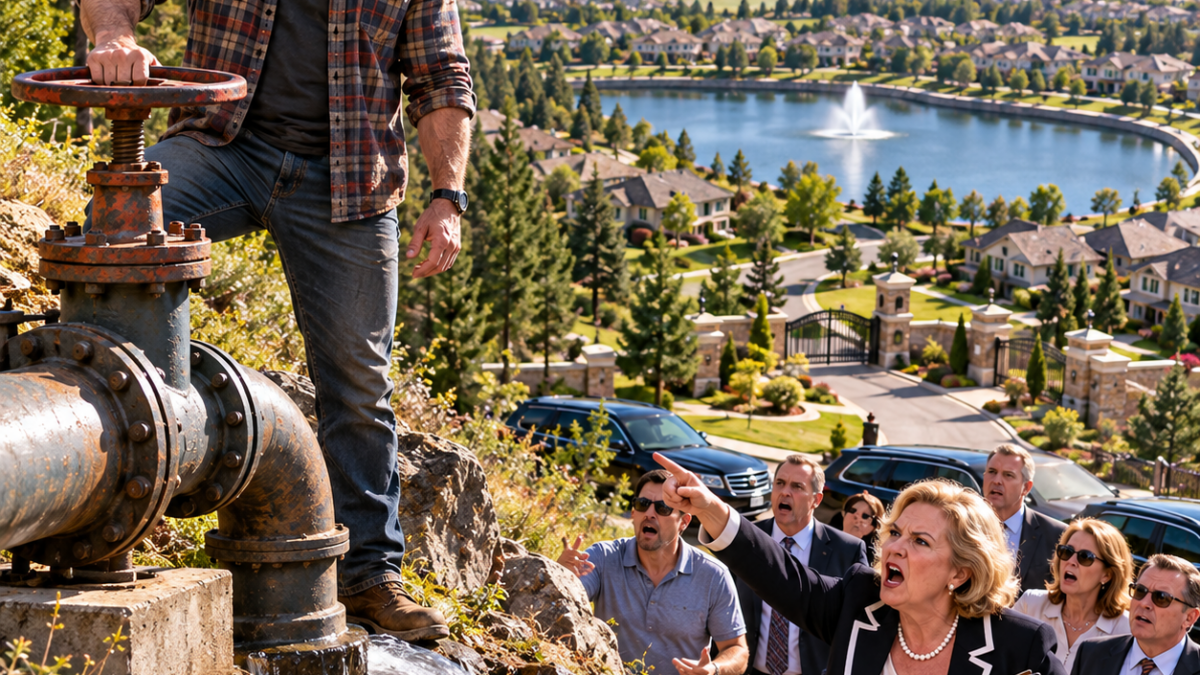
HOA Fined Me $1,500 and Blocked the Road to My Mountain—Then I Discovered Their Entire 200-Home Community Was Drinking From My Private Spring.
The Oakridge HOA fined me $500 for a rusted truck and threatened to put a lien on a cabin that was not even inside their subdivision, because they assumed the broke-looking man living above their luxury homes would eventually get tired enough to sell.
Then I discovered their perfect green lawns, swimming pools, entrance waterfall, and two hundred expensive houses all depended on a spring that crossed my forty-two acres under a fifty-year lease nobody had bothered to renew.
By the time their president came pounding on my gate demanding I “turn their water back on,” she finally understood the one thing her husband’s development company should have checked before trying to steal my mountain: water runs downhill, and I owned the hill.
My name is Arthur Pendleton.
I bought Miller’s Ridge because I wanted to be left alone.
That was it.
No grand investment plan.
No dream of becoming a developer.
No intention of subdividing the property, building vacation cabins, opening a campground, drilling for oil, starting a vineyard, or doing any of the other things people with money apparently believe every untouched piece of land needs.
I wanted trees.
Silence.
A porch.
A workshop.
And enough distance between my front door and everybody else’s opinions that I could paint the house purple if the mood ever struck me.
Miller’s Ridge gave me forty-two acres of exactly that.
It sat above a wealthy development called Oakridge Estates on the eastern side of a mountain valley about an hour from a midsized western city.
The land was steep.
Rocky.
Heavily wooded.
Beautiful if you appreciated things that did not care whether human beings found them convenient.
The cabin had been built sometime in the early 1960s.
A-frame.
Stone chimney.
One bedroom downstairs.
A loft upstairs.
Tin roof.
Windows that whistled when the wind blew north.
The previous owner had died at ninety-two.
His estate had done almost nothing to prepare the place for sale.
There was an old tractor beneath a tarp.
A rusted fuel tank that had been professionally emptied years earlier.
Three stacks of lumber.
A shed leaning six degrees farther east than any shed should.
The driveway was gravel for the first quarter mile and dirt after that.
I loved every inch.
At fifty-four, I had spent more than three decades working jobs that required me to deal with other people’s emergencies.
Industrial maintenance.
Municipal equipment repair.
Ten years supervising pump stations.
PART2:
Another eleven working for a company that maintained water-treatment equipment across three counties.
Then private contracting.
Good money.
Long hours.
Constant phone calls.
Everything always broken.
Everybody always angry.
My wife, Susan, used to joke that I knew more about valves than people.
She was probably right.
Susan died four years before I bought Miller’s Ridge.
Cancer.
Fast at the end.
Afterward the suburban house we had shared felt like a museum where every room held something I could not touch.
So I sold it.
Worked two more years.
Saved.
Then started looking for somewhere quiet.
The listing for Miller’s Ridge had been sitting online for almost nine months.
PRICE REDUCED.
AS-IS.
LIMITED WINTER ACCESS.
NO MUNICIPAL WATER.
That last line scared away nearly everybody.
Didn’t scare me.
PART3:
The cabin used an old well.
The spring on the upper ridge supplied an auxiliary cistern nobody seemed to understand.
The estate lawyer said:
“Utilities are unconventional.”
I said:
“So am I.”
He didn’t laugh.
The purchase took almost everything I had saved that wasn’t retirement money.
I signed the papers on a Monday.
By Wednesday I had my battered Ford F-150 parked outside the cabin.
By Friday I had repaired the porch steps.
By Sunday I had learned two things.
First, the mountain had more wind than I expected.
Second, the valley below me was insane.
Oakridge Estates looked fake.
That is the only word.
Two hundred large craftsman-style homes arranged along curving streets.
Half-acre lots.
No fences.
Perfect turf.
Stone mailboxes.
Matching decorative street signs.
A monumental entrance made from stacked rock and timber.
And directly beneath the OAKRIDGE ESTATES sign was a cascading waterfall.
Not a fountain.
A waterfall.
Three levels.
Twenty feet across.
Water poured over polished stone twenty-four hours a day.
In a region where summer water restrictions were normal.
I remember standing on my porch looking down through binoculars.
“What kind of idiot builds that?”
The mountain did not answer.
I assumed Oakridge and I would ignore each other.
They had their lawns.
I had my trees.
That arrangement lasted twenty-nine days.
I was on the cabin roof replacing rusted flashing when something bright green caught my eye down at the property entrance.
My gate was simple.
Two wooden posts.
Steel cattle gate.
Padlock.
No stone columns.
No keypad.
No guardhouse.
The green object was taped to the middle rail inside a plastic sleeve.
I climbed down.
Walked the quarter mile.
Opened it.
Heavy paper.
Gold crest.
OAKRIDGE ESTATES HOMEOWNERS ASSOCIATION.
NOTICE OF ARCHITECTURAL VIOLATION.
Owner: Arthur Pendleton.
Parcel: Miller’s Ridge.
Violation:
UNSIGHTLY MATERIALS VISIBLE FROM COMMUNITY ROADWAY.
UNAPPROVED EXTERIOR METAL FINISH.
VEHICLE CONDITION INCOMPATIBLE WITH VISUAL STANDARDS.
Initial fine:
$500.
I read it twice.
Then looked uphill.
My truck sat beside the cabin.
It had surface rust around one rear wheel arch.
The roof was unfinished.
Lumber was stacked beneath tarps.
Then I looked downhill.
Oakridge’s nearest house was maybe six hundred feet away.
The subdivision boundary stopped below my deed line.
I wasn’t in their HOA.
Not adjacent in the contractual sense.
Not part of their plat.
Not listed in their covenants.
Nothing.
I laughed.
Crumpled the letter.
Tossed it into the truck bed.
Went back to work.
Two weeks later another arrived.
$1,000.
FINAL NOTICE BEFORE COLLECTION.
I called the number.
“Oakridge Community Management, Brenda speaking.”
“Hi, Brenda. Arthur Pendleton.”
Silence.
Then:
“Miller’s Ridge?”
That told me she knew exactly why I was calling.
“Yes.”
“Your account is delinquent.”
“I don’t have an account.”
“You have two outstanding architectural assessments.”
“No.”
Pause.
“No?”
“I don’t belong to Oakridge.”
Brenda sighed.
Not confused.
Annoyed.
“Mr. Pendleton, your parcel is within Oakridge’s designated visual impact corridor.”
“What does that mean?”
“It means conditions visible from Phase Two affect community values.”
“That still doesn’t make me part of your HOA.”
“You share access with Oakridge infrastructure.”
“I have a recorded right-of-way across the end of Sycamore Drive.”
“Yes.”
“That gives me access.”
“It also creates obligations.”
“What obligations?”
“Reasonable aesthetic compatibility.”
“According to what?”
“The Municipal Expansion Act.”
I laughed.
“What year?”
“2018.”
I wrote it down.
“Section?”
Silence.
“Brenda?”
“Our legal counsel has reviewed this.”
“Give me the section.”
Her tone cooled.
“Mr. Pendleton, I am not providing legal advice over the phone.”
“Good, because I didn’t ask for advice.”
Another pause.
Then she said:
“Your property has become a visual problem.”
There it was.
Not law.
Problem.
“For who?”
“Our homeowners.”
“Can they see it?”
“Select elevated portions.”
I looked through the window toward forty acres of trees.
“Brenda, my cabin is barely visible.”
“Your roof reflects sunlight.”
“It’s galvanized steel.”
“Exactly.”
She continued.
“Carmichael Development is preparing future expansion plans.”
That caught my attention.
“What does Carmichael Development have to do with my roof?”
Another tiny pause.
Too long.
Then:
“Nothing.”
Now I knew it was something.
Brenda recovered quickly.
“You will remove the derelict vehicle, clean construction debris, and repaint the roof in an approved neutral tone.”
“Or?”
“Collection action.”
“You don’t have jurisdiction over my property.”
“That is your opinion.”
“No. It’s my deed.”
Brenda’s voice became very calm.
“Then I suggest you consult counsel.”
“I intend to.”
“Good.”
Then she said the sentence that started the war.
“Perhaps your counsel can also explain what happens when liens accumulate against rural property with limited liquidity.”
I stopped smiling.
“What did you say?”
“If fines remain unpaid, recovery options expand.”
“Are you threatening to take my land?”
“I am explaining the process.”
“No, Brenda. You are threatening to take land you have no contractual authority over.”
She became icy.
“Have a pleasant afternoon, Mr. Pendleton.”
Click.
I called my lawyer.
His name was Martin Shaw.
We had worked together years earlier when one of my contracting companies got dragged into a municipal bid dispute.
Martin charged too much.
Complained constantly.
And could smell fraudulent paperwork at forty paces.
I emailed the notices.
He called twelve minutes later.
“This is garbage.”
“I figured.”
“You’re not in their declarations.”
“Correct.”
“No annexation amendment.”
“No.”
“No covenant.”
“No.”
“What is a visual impact corridor?”
“You tell me.”
“I think it’s a phrase somebody invented after lunch.”
“So they can’t lien me?”
“Not legitimately under these documents.”
“Could they try?”
“Anybody can file something stupid.”
“Great.”
“We’d clear it.”
“Cost?”
Martin sighed.
“That is the annoying part.”
There it was.
Brenda’s real weapon.
Not authority.
Expense.
If Oakridge spent association money harassing me and I spent personal money defending myself, they could lose repeatedly and still make my life miserable.
Martin said:
“Send them a cease-and-desist.”
“How much?”
“About six hundred.”
“For a letter?”
“For a good letter.”
“I’ll write it myself.”
“You’ll write an angry letter.”
“Yes.”
“Which becomes Exhibit A when they call you unstable.”
I hated lawyers.
“Send the good letter.”
He did.
Oakridge ignored it.
Then the drone appeared.
Saturday evening.
I was on the porch.
Cold beer.
Sunset.
Mechanical whine.
White quadcopter rose over the trees.
Hovered maybe fifty feet from the cabin.
Camera facing me.
I waved.
The drone shifted.
Pointed toward the tractor.
Then lumber.
Then roof.
I took out my phone.
Recorded it.
Did not shoot it.
Did not throw anything.
Did not do all the stupid things anger suggests when you own tools and too much land.
Next came county zoning.
Anonymous complaint:
UNLICENSED VEHICLE DISMANTLING OPERATION.
Inspector came.
Saw one old tractor.
One F-150.
A utility trailer.
Nothing.
Closed complaint.
Week after:
Fire marshal.
Report of hazardous open burning.
He found my fire ring.
Permit valid.
No violation.
Then environmental quality.
Report:
POSSIBLE CHEMICAL DISCHARGE INTO NATURAL WATERCOURSE.
They sampled runoff near the shed.
Nothing.
The inspector apologized.
“Somebody doesn’t like you.”
“Guess.”
He looked downhill.
“Oakridge?”
“Seems likely.”
He didn’t answer.
County deputy Jim Miller came after the third noise complaint.
I had known Jim casually for years.
His department used equipment from one of the municipal shops I once serviced.
He got out of the cruiser looking tired.
“Art.”
“Jim.”
“Running a salvage operation?”
“Absolutely.”
I pointed at the tractor.
“My empire.”
He laughed.
Then sighed.
“They called three times this week.”
“Brenda?”
“Different names.”
“Same office?”
He didn’t answer directly.
“You have enemies.”
“I’ve been here three months.”
“You bought something somebody else wanted.”
I stopped.
“What?”
Jim glanced toward Oakridge.
“Carmichael Development bid on this property.”
I stared.
“When?”
“Before you.”
“How do you know?”
“My cousin works county planning.”
“Why did they want it?”
“Phase Three.”
That explained everything.
Oakridge had filled most of the lower valley.
The only direction left was up.
My mountain controlled upper access.
View corridors.
Potential building sites.
And probably utilities.
“They couldn’t get it?”
“Estate rejected the first offer.”
“Why?”
“Low.”
“How low?”
“Don’t know.”
“They came back?”
“Supposedly.”
“I bought before they did.”
Jim nodded.
“So the fines aren’t about my truck.”
“They might care about the truck.”
“Jim.”
He smiled.
“No.”
He looked around my land.
“They want you tired.”
That sentence made more sense than anything Brenda had said.
A siege.
Not enforcement.
Make the place annoying.
Expensive.
Unpleasant.
Then offer to buy.
I asked:
“Can I prove it?”
“Not from me.”
“Helpful.”
“I’m a deputy, not your private investigator.”
“Never liked you.”
“Likewise.”
Two days later Oakridge escalated.
I came home from the grocery store at six.
Frozen food in the truck.
Thirty-eight degrees outside.
At the top of Sycamore Drive, where pavement ended and my recorded access easement continued toward the ridge, somebody had installed a gate.
Not a temporary barrier.
A serious steel gate between stone columns.
Keypad.
Camera.
OAKRIDGE PRIVATE ACCESS.
I stared for a full minute.
Then pressed the intercom.
A guard answered.
“Oakridge Security.”
“Arthur Pendleton.”
Pause.
“I own the ridge property.”
“Yes, sir.”
“You built a gate across my deeded right-of-way.”
“You’ll need an access credential.”
“Fine. Give me one.”
“You need HOA approval.”
“I’m not an HOA member.”
“I can’t help you.”
“Get Brenda.”
Another pause.
Then her voice.
“Mr. Pendleton.”
“Open the gate.”
“You do not have community access privileges.”
“I have a recorded easement.”
“You have been repeatedly advised you are delinquent.”
“My easement is not conditional on your fake fines.”
“Take it up with a judge.”
I felt my face get hot.
“You installed this knowing I live above it.”
“Yes.”
“My groceries are in the truck.”
“That isn’t our concern.”
“I have legal access.”
“That is disputed.”
“It isn’t.”
“Then I’m sure the courts will clarify.”
“How long do you expect that to take?”
Brenda laughed softly.
“Civil calendars are very crowded.”
That was the moment I understood how confident she was.
Not legally.
Financially.
She believed delay itself would defeat me.
I stood beside the truck.
Looked at the gate.
Looked at the mountain.
I did not drive through it.
Did not damage it.
Did not give Brenda the criminal complaint she wanted.
I called Jim.
He came.
Read the easement copy on my phone.
Called a supervisor.
Then told Oakridge security:
“He has recorded access.”
The guard shrugged.
“HOA counsel says otherwise.”
Jim couldn’t order a private gate removed without process.
But he documented everything.
Martin filed for an emergency injunction the next morning.
I hated the cost.
He won temporary access within forty-eight hours.
The judge’s order was short.
Oakridge shall not interfere with plaintiff’s recorded ingress and egress pending further proceedings.
The gate remained.
They had to give me a code.
I drove through it.
Every day.
That should have been enough.
Instead it made me angrier.
Not because I wanted revenge.
Because Brenda had been right about one thing.
Courts cost money.
Two weeks.
Thousands in fees.
For access I already owned.
I needed leverage.
So I went to the county records office.
The basement smelled exactly like old paper and floor polish.
Behind the counter sat Helen Rusk.
Sixty-eight.
Cat-eye glasses.
Gray hair pinned up.
Crossword puzzle.
She looked at my parcel number.
Then me.
“Miller’s Ridge?”
“Yes.”
“You the one fighting Carmichael?”
“Apparently.”
She put her pencil down.
“Take a seat.”
“Why?”
“Because those people have been annoying me since 1999.”
I liked Helen immediately.
We started with my deed.
Then previous deeds.
Plats.
Easements.
Rights-of-way.
Water records.
Utility district filings.
Carmichael development documents.
Hours passed.
At one point Helen brought coffee.
It tasted like liquid roofing tar.
Perfect county-government coffee.
My access easement was solid.
Brenda’s visual corridor theory did not exist in any recorded authority we found.
No surprise.
Then Helen pulled the original Oakridge development application.
“What are you looking for?” she asked.
“Anything they need from me.”
“Road access?”
“They already need that.”
“Drainage?”
“Maybe.”
“Utilities?”
I looked down at the map.
Something bothered me.
Oakridge had no visible city water infrastructure coming in from the south.
I had spent too many years around utility maps not to notice.
“Where’s their water main?”
Helen adjusted her glasses.
“Private district.”
“What?”
“Oakridge Water Cooperative.”
“Not city?”
“No.”
“Wells?”
“Partly.”
“How many?”
She pulled another map.
Three lower wells.
Reservoir.
Treatment shed.
Then a blue line.
Coming from the north.
Up the mountain.
My mountain.
I leaned closer.
“What is that?”
“Transmission line.”
“From where?”
She traced it.
Parcel 8842.
Miller’s Ridge.
My heart changed rhythm.
“Helen.”
“Yeah?”
“That line ends on my parcel.”
She stared.
Then stopped moving.
“Oh.”
“What?”
“Let’s not get excited yet.”
“Helen.”
“Water rights are ugly.”
“I know.”
“Surface rights, groundwater, utility easements, appropriative rights—”
“I used to maintain municipal systems.”
She looked over her glasses.
“You didn’t mention that.”
“Didn’t seem relevant until thirty seconds ago.”
“Then you know enough to be dangerous.”
“Story of my life.”
We pulled everything.
The original land had belonged to a dairy farmer in the valley and a reclusive timber owner named Elias Miller on the ridge.
Agreement.
HIGHLAND SPRING WATER CONVEYANCE LEASE.
Not easement.
Lease.
That word mattered.
Helen read aloud.
“Grantor permits grantee access to Highland Spring intake and transmission line…”
“Keep going.”
“Term fifty years.”
We both stopped.
“What date?”
“August 14, 1972.”
I did the math.
“Expired 2022.”
“Unless renewed.”
Search.
Nothing.
Amendment?
Nothing.
Extension?
Nothing.
Recorded assignment?
The dairy’s interests transferred to Carmichael entities when the farm was purchased.
But the underlying term did not become permanent.
Then we found paragraph four.
Annual consideration.
Maintenance obligations.
Written permission required for structural alteration.
Automatic termination upon term expiration unless renewed by mutual written agreement.
I sat back.
“They’re using expired rights.”
Helen tapped the paper.
“Looks that way.”
“Could there be an unrecorded renewal?”
“Possible.”
“Wouldn’t something like this normally be recorded?”
“Should be.”
“Estate file?”
“Check it.”
I called the estate attorney.
No renewal.
No current water lease.
No payment after Elias Miller’s death.
Not even the old nominal annual payment.
I stared at the map.
Two hundred homes.
Pools.
Irrigation.
Entrance waterfall.
All fed partly by Highland Spring.
“How much water?”
Helen pulled utility filings.
Summer peak demand was enormous.
The lower wells contributed.
The spring supplied the bulk of stored irrigation water and a significant portion of domestic use during high-demand months.
I did not own all of Oakridge’s water.
That would have been too simple.
But I controlled the source keeping their reservoir comfortable during summer.
Without it, the lower wells could not maintain normal unrestricted demand.
Especially not landscaping.
Helen leaned back.
“Arthur.”
“Yeah.”
“Do not go up there and start closing valves.”
I looked at her.
“Wasn’t planning to.”
“You had valve face.”
“What?”
“My late husband was a plumber.”
“I don’t have valve face.”
“You absolutely do.”
I laughed.
Then she became serious.
“Get counsel.”
I hated that answer.
She pointed at me.
“Water isn’t a fence.”
“I know.”
“People need it.”
“I know.”
“You shut something wrong, somebody gets hurt, you’ll spend your retirement paying attorneys.”
I nodded.
That was why Helen was useful.
She liked revenge.
She liked records more.
I called Martin.
He didn’t believe me initially.
Then I emailed the 1972 agreement.
Twenty minutes later:
“Do not touch anything.”
“Helen said the same.”
“I love Helen.”
“You’ve never met.”
“I love anyone who stops my clients from doing stupid things.”
“What now?”
“Title review.”
“Then?”
“Utility counsel.”
“How much?”
“Don’t ask.”
“I hate you.”
“Frequently.”
For the next week three lawyers reviewed documents.
Property.
Water.
Municipal utility regulation.
The answer was more complicated than the source of my anger wanted.
Yes, the lease appeared expired.
Yes, Oakridge had no recorded current access agreement for Highland Spring.
No, that did not automatically mean I could cut drinking water to two hundred households at midnight and laugh from the porch.
There were public-health issues.
Utility-regulation questions.
Possible implied-right arguments.
Emergency court authority.
Historic use.
State water doctrine.
Martin summarized it:
“You have leverage.”
“How much?”
“Potentially enormous.”
“Can I shut them off?”
“Don’t ask it that way.”
“How should I ask?”
“Can they continue drawing water from your property without resolving the expired agreement?”
“And?”
“Probably not indefinitely.”
“Indefinitely is lawyer for what?”
“It means we send notice.”
So we did.
Formal notice of lease expiration.
Demand to cease unauthorized entry.
Demand to negotiate a new access and water-conveyance agreement.
Notice that continued diversion after a specified date would be contested.
Copies went to:
Oakridge HOA.
Oakridge Water Cooperative.
Carmichael Development.
County public-health authority.
State water resources office.
Utility regulator.
Everybody.
No surprise shutoff.
No secret sabotage.
No midnight wrench.
Paper.
Brenda called within an hour.
“What game are you playing?”
“Hello, Brenda.”
“You are threatening the water supply.”
“No.”
“You sent a termination notice.”
“My lawyer sent notice that your lease expired four years ago.”
“This is extortion.”
“Talk to Martin.”
“You think you can hold two hundred families hostage because you’re angry over an architectural dispute?”
“No.”
“What exactly do you want?”
“Legal access to my property.”
“You have it.”
“After I got a court order.”
Silence.
“No more fake fines.”
“Those are separate.”
“No more drones.”
“We don’t control—”
“I have footage showing one launching from an Oakridge maintenance truck.”
Silence.
“No more anonymous agency complaints.”
“You can’t prove—”
“Maybe.”
I continued:
“And your utility needs a new water agreement.”
Brenda’s voice became cold.
“My husband will bury you.”
Finally.
There he was.
Richard.
I said:
“Tell him to read the lease first.”
She hung up.
Richard called the next morning.
No hello.
“You’re Pendleton.”
“That’s what my mother claimed.”
“This isn’t funny.”
“Agreed.”
“You bought a distressed parcel and now you’re trying to shake down a community.”
“I bought property you apparently wanted.”
“I still want it.”
“Not for sale.”
“Everything is for sale.”
“No.”
“You have any idea what litigation costs?”
“Yes.”
“I’ll spend more on lawyers in a month than that cabin is worth.”
“Probably.”
“Then be reasonable.”
“Stop harassing me.”
“You’re hurting property values.”
“I exist.”
“Your place is a dump.”
“Then don’t look uphill.”
He breathed hard.
“Sell.”
“No.”
“Name a price.”
“No.”
“You’re making a mistake.”
“Richard.”
“What?”
“Your water lease expired.”
Silence.
Then:
“Those rights run with the land.”
“The document says otherwise.”
“My attorneys disagree.”
“Good.”
“Good?”
“That’s what court is for.”
He hung up.
Two days later Oakridge filed for emergency declaratory relief.
They wanted a judge to recognize continued water rights and bar me from interfering with the spring.
Martin called.
“Congratulations.”
“For?”
“They sued you.”
“I thought that was bad.”
“It means they have to put their theory on paper.”
I attended the hearing.
Richard sat behind three attorneys.
Brenda beside him.
I had Martin and a specialist named Priya Desai who understood western water law well enough to make my head hurt.
Oakridge argued decades of continuous use.
Community reliance.
Utility necessity.
Historic conveyance.
Implied renewal.
Equitable estoppel.
Priya held up the 1972 lease.
“Fifty years.”
Then the clause requiring written renewal.
No renewal.
No payment.
No amendment.
No permanent easement.
The judge did not rule the entire dispute in one afternoon.
That would have been unrealistic.
But he refused Oakridge’s request for unrestricted continued access under the old agreement.
Instead, he ordered a short emergency standstill.
Water would continue temporarily.
Neither side could alter infrastructure.
Oakridge had fourteen days to negotiate or return for further orders.
Richard walked out smiling.
“See?”
I looked at him.
“You bought fourteen days.”
His smile faded.
That was when residents began learning what had happened.
Until then Brenda had told them:
“Routine utility-rights clarification.”
Then somebody posted the lease online.
Not me.
Helen claimed innocence with the least convincing face I had ever seen.
The Oakridge community forum exploded.
WHY DID OUR WATER RIGHTS EXPIRE?
WHO WAS RESPONSIBLE FOR RENEWAL?
WHY ARE WE FIGHTING THE RIDGE OWNER?
IS THIS RELATED TO PHASE THREE?
That last question mattered.
A resident named Kevin Morales started pulling planning records.
Turns out Carmichael Development had already submitted preliminary concepts for forty-six new homes on upper-slope land.
Access required my ridge.
Utility expansion required continued spring use.
And months before I purchased Miller’s Ridge, Richard’s company had offered the estate thirty percent below asking price.
Brenda’s HOA harassment began weeks after my closing.
Residents did the math.
So did the press.
LOCAL DEVELOPER, HOA IN WATER DISPUTE WITH RIDGE OWNER.
The story stayed small at first.
Then Mrs. Lorraine Webb called me.
She lived in Oakridge.
Seventy-six.
Widow.
“Mr. Pendleton?”
“Yes.”
“I hope you aren’t actually going to make us go without toilets.”
I closed my eyes.
“No, ma’am.”
“Oh.”
“I have no intention of surprising residents with a loss of household water.”
“Brenda says you’re threatening the neighborhood.”
“Brenda has said a lot of things.”
Mrs. Webb paused.
“That’s true.”
I explained what I could.
Expired contract.
Ongoing negotiation.
Utility responsible for contingency planning.
She listened.
Then:
“Do you need money for your lawyer?”
That caught me off guard.
“No.”
“I have some.”
“Keep it.”
“Good. I didn’t really want to give it to you.”
I laughed.
She said:
“I don’t care what you do to Brenda’s fountain.”
That conversation changed something.
I did not hate Oakridge residents.
Why would I?
Most hadn’t fined me.
Most hadn’t flown drones.
Most had purchased homes believing water arrangements were somebody else’s job.
The fight needed to stay with the people responsible.
At the next negotiation, I put conditions on the table.
First:
Permanent recognition that Miller’s Ridge was outside HOA jurisdiction.
Second:
All fines withdrawn.
Third:
Written noninterference agreement regarding my cabin, vehicles, and land use subject only to county law.
Fourth:
Remove or relocate the Sycamore gate so it could never obstruct my easement.
Fifth:
No HOA drones over my parcel absent lawful emergency or specific consent.
Sixth:
Reimbursement of a portion of legal fees caused by the gate dispute and fraudulent enforcement.
Seventh:
A new water license.
Richard laughed when he saw the price.
“You’ve lost your mind.”
Maybe.
The old contract’s payment had been practically symbolic.
Modern water rights were not.
Priya commissioned an appraisal.
The spring’s contribution had substantial economic value.
Not infinite.
Not whatever revenge number I could imagine.
Actual value.
We proposed:
Fixed annual access fee.
Per-volume charge above a baseline.
Capital-maintenance responsibilities.
Environmental protections.
Inspection rights.
Insurance.
A ten-year term.
Renegotiation before Phase Three expansion.
Richard wanted permanent rights for almost nothing.
“No.”
He threatened eminent domain.
Priya smiled.
“Have fun.”
The water cooperative was technically private.
County had no immediate interest in condemning my property to rescue a developer from an expired commercial lease.
Could government intervene if public health were threatened?
Possibly.
Could Richard force a permanent free easement because he wanted green lawns and future development?
Much harder.
Day twelve of the court-ordered standstill, negotiations failed.
Oakridge returned to court.
This time residents packed the room.
The judge ruled that the expired lease did not grant indefinite permanent access.
He ordered a controlled transition.
Domestic health-and-safety supply had to be preserved for a limited emergency period through the utility’s contingency measures.
Nonessential spring diversion for ornamental irrigation and decorative uses could be suspended unless a temporary agreement was reached.
That was the order that changed the valley.
Not me sneaking up a mountain with a wrench.
A judge.
Paper.
Signed.
Very satisfying paper.
Oakridge Water Cooperative immediately imposed emergency restrictions.
No lawn irrigation.
No pool refilling.
Entrance waterfall off.
No decorative water.
Domestic conservation.
Tankers contracted as backup.
The spring flow allocation to Oakridge was reduced according to the court-approved transition while parties negotiated.
For the first time since I bought the mountain, the waterfall stopped.
I watched from my porch.
One minute:
Water.
Next:
Thin stream.
Then stone.
Silence.
I expected triumph.
What I felt was something quieter.
Relief.
They finally had to take me seriously.
The lawns changed within days.
Late August.
Heat.
Bluegrass hates reality.
Emerald became pale.
Pale became yellow.
Residents got angry.
Not at me.
At first, yes.
Then the documents spread.
People learned why.
Brenda’s fines.
The gate.
The drones.
Carmichael’s Phase Three plans.
The expired lease nobody renewed.
The lowball offer on my land.
The story changed.
Emergency HOA meeting.
I did not attend.
Kevin Morales sent me the recording.
Brenda stood at the front in her navy blazer.
“This water emergency is the direct result of retaliatory conduct by an adjacent landowner.”
Boos.
She stopped.
A man shouted:
“Why were you fining land that isn’t in the HOA?”
Another:
“Why did you block his road?”
Another:
“Why did Carmichael try to buy his property?”
Richard took the microphone.
“We are not discussing private development negotiations.”
Wrong answer.
Mrs. Webb stood.
Seventy-six years old.
Five-foot-two.
“You’re discussing them now.”
The room erupted.
Richard tried:
“The water lease issue predates our management.”
A resident shouted:
“You bought the dairy property in 1998!”
Another:
“You’ve controlled the utility for twenty-eight years!”
Brenda said:
“The original agreement was believed to be perpetual.”
Kevin held up a copy.
“It says fifty years in the first paragraph!”
That video was beautiful.
Not because people screamed.
Because information had arrived.
Authority hates shared information.
Richard proposed a special assessment to finance emergency water hauling, legal expenses, and settlement.
Homeowners nearly revolted.
One chair did fall over.
Nobody threw it.
Real life doesn’t need that much decoration.
The board demanded Brenda recuse herself due to her husband’s development interests.
She refused.
Three members resigned.
A recall petition started that night.
Meanwhile the lower wells struggled.
Domestic supply remained available under restrictions, but pressure dipped during peak periods.
Tankers came.
Not seven hundred fifty.
They weren’t filling the reservoir from empty.
They were maintaining emergency buffer volume.
Expensive.
Very expensive.
Every truck cost money.
Fuel.
Drivers.
Treatment.
Testing.
Coordination.
Oakridge residents could now calculate exactly what the spring had been worth.
Suddenly my proposed license fee looked less like robbery.
Richard called.
His voice had changed.
“What will it take?”
“I sent terms.”
“Lower the rate.”
“No.”
“Arthur.”
“Richard.”
“We can’t sustain tanker operations.”
“Then sign.”
“The back-charge is unreasonable.”
The back-charge wasn’t half a million dollars of fantasy “stolen water.”
My lawyers calculated reasonable compensation for post-expiration use based on market value, minus disputed offsets.
It was still substantial.
Richard said:
“You’re punishing homeowners.”
“No.”
“They pay HOA money.”
“Your development company can pay.”
“Why would we?”
“Because this happened while you and your wife tried to force me off land you wanted for Phase Three.”
Silence.
“You can’t prove that.”
“Then don’t pay.”
He exhaled.
“Brenda made mistakes.”
“Interesting passive voice.”
“What do you want from me?”
“The written agreement.”
“I mean personally.”
That question surprised me.
I looked down the mountain.
Brown lawns.
Dry fountain.
Trucks moving along Sycamore.
“I want you to understand you cannot make somebody else’s property expensive enough to steal cheaply.”
Richard became quiet.
“I wasn’t stealing.”
“You installed a gate across my access.”
“That was HOA.”
“Your wife runs it.”
“Ran.”
Interesting.
“What?”
“She lost the recall vote.”
I sat straighter.
“When?”
“Last night.”
I smiled.
“Didn’t hear.”
“I assume you’re enjoying this.”
“Less than you think.”
“Bull.”
“You want truth?”
“Yes.”
“I wanted quiet.”
That silenced him.
“I bought forty-two acres because my wife died and I wanted somewhere nobody needed anything from me.”
Richard said nothing.
“Then your company saw land.”
Pause.
“Your wife saw a roof color.”
Pause.
“Your HOA saw fines.”
Pause.
“Your security people saw a gate.”
I looked at the pine trees.
“Nobody saw a man who just wanted to fix his cabin.”
Richard’s voice lowered.
“I didn’t know about your wife.”
“Why would you?”
“I…”
“No.”
I stopped him.
“Don’t make this sentimental.”
Silence.
“Sign the contract because it’s fair, not because you feel sorry for me.”
Richard said:
“Our lawyers will respond.”
“Good.”
The new HOA board contacted me the next day.
Interim president:
Kevin Morales.
He came up the mountain alone.
No SUV convoy.
No lawyer.
No Brenda.
He parked before my gate.
Called.
“Arthur?”
“Yes.”
“This is Kevin.”
“I can see you.”
He looked toward the cabin.
“That’s disturbing.”
“Binoculars.”
“More disturbing.”
I laughed.
“Come up.”
First Oakridge resident I voluntarily invited onto the property.
Kevin was forty-three.
Civil engineer.
Two kids.
Mortgage he described as “criminal.”
He sat on my porch.
Looked over the valley.
“Damn.”
“What?”
“View.”
“That’s why I bought it.”
“I thought you bought it to destroy our landscaping.”
“Secondary benefit.”
He laughed.
Then became serious.
“The board wants a deal.”
“I want one too.”
“Residents are angry.”
“I know.”
“Some at you.”
“I know.”
“Most at Brenda and Richard.”
“I figured.”
“We don’t want to depend on tankers.”
“Reasonable.”
“We also don’t want Carmichael Development controlling negotiation anymore.”
“Better.”
Kevin placed a folder on the table.
The board had voted to separate the water cooperative’s interests from Carmichael Development as much as existing corporate structure allowed.
Independent utility counsel.
Independent engineer.
Independent financial review.
And:
No Phase Three negotiations until water security was resolved.
That was the first adult document Oakridge had sent me.
Kevin said:
“We need something long term.”
“So do I.”
“You really don’t want to sell?”
“No.”
“Not even the pipeline corridor?”
“No.”
“Okay.”
He accepted the answer.
Immediately.
That alone made me like him.
“What would you consider?”
“License.”
“Twenty years?”
“Ten.”
“Fifteen?”
“Twelve with renewal option.”
“Rate?”
We talked.
Not dramatic.
Numbers.
Maintenance.
Metering.
Environmental flow.
Emergency access.
Insurance.
Domestic priority in drought.
No expansion of service to new development without separate written consent.
That last clause mattered.
Kevin read it.
“So Phase Three would need you.”
“Yes.”
He smiled.
“Richard’s going to love that.”
“I hope he finds a hobby.”
The financial settlement changed too.
Instead of bankrupting homeowners with a sudden assessment, the board negotiated for Carmichael Development to contribute most of the past-use settlement because it had controlled the relevant utility entities during the lease lapse.
That became ugly.
Richard resisted.
The board threatened litigation over disclosures made when homes were sold.
Did buyers receive accurate information about long-term water-source rights?
Nobody wanted that question tested publicly.
Carmichael Development agreed to pay.
Not because I had defeated a millionaire with a valve.
Because paperwork, exposure, and economics lined up against him.
The final signing happened three months after my first green envelope.
Martin came.
Priya came.
Kevin.
Utility counsel.
Two engineers.
Richard.
No Brenda.
The agreement was thick.
Ninety-four pages.
I hated every page.
Then Martin showed me the signature line.
ARTHUR PENDLETON, OWNER, MILLER’S RIDGE.
I signed.
Kevin signed for the cooperative.
Richard signed the settlement contribution.
Then slid his pen away.
“You happy?”
I thought.
“Yes.”
He seemed surprised.
“Really?”
“Yes.”
“Because you beat us?”
“No.”
“Then why?”
I looked at Martin.
He was already packing.
At Priya.
At Kevin.
Then out the window toward the ridge.
“Because now nobody can pretend.”
Richard frowned.
“Pretend what?”
“That my land is theirs when it’s convenient.”
He looked down.
I almost felt sorry for him.
Almost.
The court approved restoration of full spring supply under the new agreement.
That afternoon I hiked up to the old intake structure with the utility engineer.
Not alone.
Not secret.
Official inspection.
The concrete bunker was older than I expected.
Moss.
Rust.
Twelve-inch transmission pipe.
Ancient control valve.
The engineer stared.
“You know this should be replaced.”
“I know.”
“Expensive.”
“I know.”
“Contract says cooperative pays seventy percent.”
“I wrote that.”
He smiled.
“You really worked utilities?”
“Twenty years.”
“That explains a lot.”
“What?”
“Most landowners don’t ask about isolation points and backflow protection during contract negotiations.”
I shrugged.
“People contain multitudes.”
Under the engineer’s supervision, normal flow was restored.
No cinematic explosion.
No brown sludge blasting fifty feet.
Water moved.
Meters registered.
Reservoir levels began recovering.
An hour later Kevin texted me a photograph.
Oakridge entrance.
Waterfall running.
Message:
Never thought I’d be happy to see that ridiculous thing again.
I replied:
Still ridiculous.
He answered:
Agreed.
The lawns eventually recovered.
Grass does.
People too, sometimes.
Brenda did not.
She challenged the recall.
Lost.
Then resigned from the board entirely before the next scheduled meeting.
For several months she remained in Oakridge.
Residents avoided her.
Some openly blamed her for the assessment increases and legal expenses.
I didn’t celebrate that.
Public humiliation is satisfying from a distance.
Up close, it is usually ugly.
She sent me one letter.
Not through counsel.
Handwritten.
Mr. Pendleton,
I disagree with much of how events have been portrayed.
However, I acknowledge the association should not have issued violations against your parcel without clear authority, and the access gate should not have obstructed your recorded easement.
I regret the escalation.
Not exactly:
I am sorry.
Still more than I expected.
I wrote back:
Mrs. Carmichael,
Thank you for acknowledging those points.
Please do not send drones over my property again.
Arthur Pendleton.
Martin called it “emotionally constipated but legally excellent.”
Fair.
Richard’s development company abandoned Phase Three.
Without automatic spring expansion rights, road control, and my willingness to sell ridge acreage, the economics no longer worked.
Another factor appeared later.
Geotechnical studies suggested portions of the upper slope would have required substantial stabilization.
My “worthless dirt pile” saved him from an expensive mistake.
He never thanked me.
Six months later the Carmichaels listed their Oakridge home.
Sold.
Moved to Arizona, I heard.
Maybe somewhere with a stricter HOA.
Justice has a sense of humor.
The new board changed dramatically.
Not because everyone became noble.
Because residents were furious enough to pay attention.
Meetings streamed online.
Contracts posted.
Conflict-of-interest disclosures.
Independent counsel.
No spouse of a developer could control community enforcement while the developer pursued adjacent land.
Drones prohibited for covenant inspection without express owner authorization.
Not that the HOA had jurisdiction over me anyway.
Kevin sent me the amended policy.
I framed the page about drones.
Helen retired the next spring.
I attended her party at the records office.
She pointed at me across the cake table.
“This man ruined my final year.”
“You enjoyed every second.”
“Absolutely.”
I gave her a bottle of good bourbon.
She gave me a photocopy of the 1972 lease.
Laminated.
At the bottom she had written:
READ THE DAMN DEED.
I hung it beside my workshop door.
The settlement money wasn’t cartoonishly life-changing, but it was enough.
Reimbursed my legal expenses.
Covered past unauthorized water use under negotiated valuation.
Funded improvements.
The ongoing license payments provided steady income.
I replaced the cabin roof.
Metal.
Dark forest green.
I asked Martin:
“Should I check Oakridge’s approved colors?”
He told me to go to hell.
I paved the worst section of driveway.
Not all.
I liked gravel.
Rebuilt the shed.
Bought a used tractor in much better shape.
Fixed the F-150’s rust.
Then regretted it because the rust had become symbolic.
Mrs. Webb invited me to Oakridge’s neighborhood barbecue.
I initially refused.
She called again.
“Arthur.”
“No.”
“You caused six months of meetings. You’re eating a hamburger.”
“I did not cause—”
“Hush.”
I went.
Walking through Oakridge felt strange.
Children ran across lawns that had been brown a few months earlier.
Sprinklers operated under new conservation rules.
The waterfall still ran but shut off overnight.
Good.
Waste bothered me.
Kevin handed me a beer.
“Welcome to enemy territory.”
“I have a license.”
“For water.”
“Close enough.”
Some residents avoided me.
One man confronted me.
“You cost us thousands.”
I looked at him.
“I understand why you’re angry.”
“You could have handled it without threatening the water.”
“Yes.”
He seemed surprised.
“What?”
“I could have.”
“Then why didn’t you?”
“I sent notice.”
“You had leverage.”
“I used it.”
He crossed his arms.
“People were scared.”
“I know.”
“Would you do it again?”
I considered.
“Not exactly the same way.”
That answer irritated him.
But it was honest.
The conflict had begun because Brenda and Richard believed hardship would force me to surrender.
I had to be careful not to become the same person with different leverage.
“Your board should’ve known the lease.”
“Yes.”
“Richard should’ve renewed it.”
“Yes.”
“Brenda shouldn’t have targeted me.”
“Yes.”
He waited.
“But residents didn’t make those decisions.”
“No.”
I nodded.
“If I had it again, I’d communicate with residents earlier.”
He studied me.
Then said:
“Fair.”
We didn’t become friends.
Not every conversation needs that ending.
Mrs. Webb arrived holding potato salad.
“What are you two arguing about?”
“Water.”
She rolled her eyes.
“Men.”
Then walked away.
A year passed.
The mountain got quiet again.
That was the real victory.
Not money.
Not Brenda losing the presidency.
Not Richard abandoning Phase Three.
Quiet.
No drones.
No inspectors responding to nonsense complaints.
No green envelopes.
No gate blocking my road.
The utility sent a technician quarterly.
He called first.
Signed in.
Stayed within the licensed corridor.
Professional.
Normal.
On the first of each month, payment arrived electronically.
No dramatic $10,000 check.
Automatic transfer.
Modern life ruins good revenge imagery.
Still satisfying.
One morning I was repairing the tractor when a white Oakridge utility truck came up.
New technician.
Young guy.
Maybe twenty-five.
He looked at the cabin.
“You Arthur?”
“Depends.”
He laughed.
“I’m Devin.”
He pointed toward the upper ridge.
“Quarterly inspection.”
“You call?”
“Yesterday.”
“I forgot.”
“Old age.”
“Leave.”
He laughed.
Then noticed the laminated lease copy in my workshop.
“Is that the famous contract?”
“Which?”
“The 1972 one.”
“Apparently.”
He walked closer.
“People still talk about you.”
“That’s unfortunate.”
“They say you shut the whole neighborhood off.”
“People enjoy exaggerating.”
“Did you?”
“No.”
His disappointment was almost insulting.
“What really happened?”
“Lawyers.”
“That’s boring.”
“Extremely.”
He nodded toward the mountain.
“But you own the spring.”
“I own the land and relevant rights subject to the current agreements.”
He stared.
“You definitely had lawyers.”
“Too many.”
Then he said:
“My mom lives in Phase One.”
“Oh.”
“She hated Brenda.”
“Common hobby.”
“She says you saved everybody money long-term.”
“That sounds wrong.”
“No.”
He explained.
The new water agreement forced metering and infrastructure inspections.
Engineers discovered leaks.
Big ones.
The old transmission system had been losing significant water.
Repairs cut summer consumption.
Lower wells recovered.
Emergency plan established.
Reservoir management improved.
Oakridge stopped pretending spring water was endless.
“Bills actually stabilized,” Devin said.
I leaned against the tractor.
“Huh.”
“You didn’t know?”
“No.”
“My mom says the crisis was the first time anyone asked where the water came from.”
That stayed with me.
Where water comes from.
Simple question.
Most people turn a faucet and never ask.
Same with power.
Roads.
Trash.
Internet.
Institutions.
Everything feels permanent until it stops.
Oakridge had built a luxury identity around abundance.
Perfect grass.
Pools.
Waterfall.
Nobody asked what fed it.
Richard knew there was a spring.
He assumed the right was permanent.
Brenda knew there was infrastructure.
She assumed control came with the development.
Homeowners knew nothing.
Until scarcity forced everyone to read the paperwork.
That was the deeper lesson.
Not:
Never anger a man who owns a mountain.
Although useful.
The lesson was:
Never confuse long use with permanent entitlement.
Two years after the settlement, a wildfire started fifteen miles west.
Dry summer.
Wind.
Evacuations.
Oakridge opened its community center.
Miller’s Ridge went under pre-evacuation warning.
Kevin called.
“You leaving?”
“Not yet.”
“Don’t be stupid.”
“I have a truck packed.”
“What about the spring infrastructure?”
“Utility knows.”
An hour later the fire chief called.
They wanted access to the upper spring and storage lines for emergency fire support if needed.
“Absolutely.”
No lawyers.
No negotiation.
No fee.
“Use whatever you need.”
That night I watched red glow behind the ridge.
Oakridge residents were under the same sky.
Same smoke.
Same risk.
For all our fighting, mountains don’t care about property disputes.
The fire turned north.
We got lucky.
Afterward Kevin drove up.
“Thanks.”
“For?”
“Fire access.”
“Of course.”
He gave me a look.
“You charged us for water.”
“Commercial residential supply.”
“And fire?”
“Emergency.”
“Difference?”
“Yes.”
He smiled.
“I knew I liked you.”
“Questionable judgment.”
That moment mattered to me.
I did not want the spring to become a weapon.
I wanted the agreement to become a boundary.
There is a difference.
Boundaries say:
This is mine.
Here are the terms for using it.
Weapons say:
I can hurt you, therefore obey.
Brenda had confused those.
I nearly did too.
Susan would have hated that.
She was better at seeing when I became stubborn for emotional reasons.
Sometimes I talked to her on the porch.
Not because I thought she heard.
Because thirty years of marriage creates habits death doesn’t remove.
One evening I said:
“You would’ve liked Helen.”
Wind through pines.
“You would’ve hated Brenda.”
Pause.
“Actually, maybe you would’ve felt sorry for her.”
Susan always did that.
Found the lonely thing inside irritating people.
I looked down at Oakridge.
Lights coming on.
Waterfall off for the night.
Good policy.
“I almost became ridiculous.”
The mountain gave no opinion.
“I know. Shocking.”
I drank my beer.
Quiet.
That was why I’d come.
Five years after buying Miller’s Ridge, Kevin called with another problem.
Water cooperative wanted to drill a new backup well.
“On my property?”
“No.”
“Then why call?”
“Because the board wants your opinion.”
I laughed.
“That’s new.”
“You know systems.”
“Unfortunately.”
I attended.
Engineer proposed redundancy.
Excellent.
No community should depend heavily on one source controlled by one private parcel.
I told them so.
A resident joked:
“You trying to make yourself less powerful?”
“Yes.”
They thought I was kidding.
I wasn’t.
Leverage is exhausting when people depend on you.
The new well took two years.
Expensive.
But once operational, Oakridge had three genuine supply paths.
Spring.
Wells.
Emergency interconnect to neighboring district.
Better.
Kevin asked if I was worried license payments would eventually decrease.
“No.”
“Really?”
“I didn’t buy the mountain to become a utility company.”
He laughed.
“What did you buy it for?”
I pointed at the trees.
“That.”
The original ten-year license eventually came up for renewal.
By then Brenda was a story older residents told new residents.
Richard’s Phase Three drawings were gone.
Oakridge was less perfect.
Better because of it.
Some lawns were xeriscaped.
Native grasses.
Rock gardens.
Lower water use.
The entrance waterfall had been redesigned to recirculate more efficiently.
Still ridiculous.
But less.
The renewal negotiations took one afternoon.
Kevin had moved away.
New HOA president was a woman named Sofia Ramirez.
Civil attorney.
She arrived with three binders.
“I read everything.”
I liked her immediately.
“Dangerous.”
“That’s what my husband says.”
We renewed for another ten years.
Lower guaranteed volume because Oakridge now had backups.
Adjusted price.
Environmental monitoring.
No drama.
At the end Sofia said:
“I have one question.”
“Go.”
“Did Brenda really fine your roof?”
“Yes.”
“Five hundred?”
“First one.”
“What color was it?”
“Galvanized.”
“And now?”
“Forest green.”
She looked uphill.
“Looks nice.”
“Careful.”
“What?”
“You almost sound like an HOA president.”
She laughed.
“Get off my porch.”
“You’re on mine.”
“Fair.”
I was sixty-nine when I finally sold part of Miller’s Ridge.
Not to a developer.
Conservation trust.
Thirty acres on the upper slope.
Protected permanently from subdivision.
I kept twelve acres around the cabin and spring corridor.
Carmichael Development would have hated it.
That added some pleasure.
The conservation attorney asked why.
“Don’t you want your children to inherit development value?”
“No kids.”
“Nieces?”
“One.”
“She might appreciate it.”
“She appreciates trees.”
The mountain would remain mostly mountain.
That mattered.
At the signing, Helen came.
Eighty-three.
Still wearing cat-eye glasses.
“About time.”
“For what?”
“Making sure nobody puts forty-six beige houses up there.”
“They would’ve been craftsman.”
“Same thing.”
She looked older.
Smaller.
Still dangerous.
I asked:
“Remember the first day?”
“You looked pissed.”
“I was.”
“You still are.”
“Less.”
She smiled.
“Shame.”
We drank bourbon on the porch.
Down below, Oakridge’s lawns looked different.
Less uniformly green.
More human.
Somebody had painted a house dark blue.
The old Brenda board would have had a stroke.
Helen pointed.
“Illegal color?”
“Hope so.”
We laughed.
The original green violation notice is still in my workshop.
I rescued it from the truck bed after realizing evidence mattered.
Wrinkled.
Oil stain.
Gold crest faded.
$500.
Sometimes visitors read it.
“Did they really think they could fine you?”
“Yes.”
“Were they stupid?”
“No.”
That answer surprises people.
Brenda wasn’t stupid.
Richard wasn’t stupid.
That would make the story easier.
They were experienced.
Successful.
Organized.
Confident.
And they had been able to push smaller people around often enough that they stopped distinguishing influence from authority.
That is more dangerous than stupidity.
Stupid people doubt themselves occasionally.
Powerful people who believe their own assumptions rarely do.
They saw a rusted truck.
Old cabin.
One man.
No family.
No visible money.
They assumed I was weak.
Then they learned I had savings.
Lawyers.
Records.
Experience.
Water.
But the thing that beat them wasn’t any one of those.
It was the deed.
A document written by two men in 1972 who probably never imagined Oakridge Estates.
Elias Miller.
Dairy farmer Thomas Beale.
Fifty-year term.
Written renewal required.
Simple.
Richard built two hundred luxury houses over a business assumption nobody checked carefully enough.
Brenda then picked a fight with the person who inherited the other side of that assumption.
That is almost too perfect.
But life occasionally writes cleaner revenge than fiction.
People still tell the dramatic version.
Arthur Pendleton shut off the HOA’s water.
They imagine me climbing into a bunker, laughing while sprinklers die.
Not exactly.
The truth was slower.
More expensive.
More paperwork.
Less cinematic.
And much more satisfying.
Because they couldn’t call me vandal.
Couldn’t call me criminal.
Couldn’t say I sabotaged infrastructure.
I forced them to confront the contract.
They hired lawyers.
I hired lawyers.
They asked a judge.
I asked a judge.
The expired lease stayed expired.
Then they negotiated.
That was the victory.
Not destroying their water.
Making them ask permission to use mine.
The last time I spoke with Richard Carmichael was years later.
I was buying bolts at a hardware store three counties away.
A man said:
“Pendleton?”
I turned.
Richard.
Older.
Thinner.
No Rolex that I noticed.
We stared at each other.
“Richard.”
He laughed awkwardly.
“Of all places.”
“Hardware stores are known for hardware.”
He smiled.
Then:
“How’s the mountain?”
“Still there.”
“Oakridge?”
“Still below it.”
He nodded.
We stood beside bins of stainless-steel fasteners like two men who had once fought a war over civilization.
Finally he said:
“I should’ve renewed the lease.”
“Yes.”
“I should’ve bought your land at asking price.”
“No.”
He looked at me.
“Why?”
“Estate still would’ve sold to me.”
“How do you know?”
“I paid first.”
He laughed.
Real laugh.
Then became serious.
“Brenda and I divorced.”
“I heard.”
“She never got over Oakridge.”
“I’m sorry.”
“She hated you.”
“I assumed.”
“I did too.”
“Also assumed.”
He looked at the bolts in my hand.
“Don’t anymore.”
That surprised me.
“No?”
“No.”
He shrugged.
“You were right.”
I almost asked him to repeat it.
Instead:
“About what?”
“We acted entitled.”
He looked down.
“I thought because we’d built the development, everything feeding it belonged to the development.”
“That isn’t how ownership works.”
“I know now.”
Silence.
He continued.
“You know the worst part?”
“What?”
“I had the lease in a box.”
I stared.
“What?”
“Old acquisition documents.”
His face twisted.
“Somebody scanned it in 2003.”
“You had it.”
“Yeah.”
“And nobody read it?”
“Probably an assistant did.”
“Richard.”
“I know.”
“Fifty years.”
“I know.”
“First page.”
“I know.”
I laughed.
Could not help it.
Richard started laughing too.
Two old men in a hardware aisle.
One missing mountain.
One laminated lease.
He wiped his eyes.
“I deserved that.”
“Yes.”
Then he said:
“I really did like your land.”
“So did I.”
We shook hands.
Not friends.
Not enemies anymore.
Just two men who had spent enough years learning what pride costs.
On my seventieth birthday, my niece Emily came to visit.
She lives two states away.
She brought her son, Noah.
Nine.
He loved the spring.
Not the legal significance.
The water.
We hiked up.
He looked inside the modernized intake building.
Most old equipment had been replaced.
Meters.
Sensors.
New valve assembly.
Backup bypass.
Professional system now.
No rusted Cold War bunker.
No drama.
Noah asked:
“Is this the water for all those houses?”
“Some of it.”
“You own it?”
“I own the land.”
“Can you turn it off?”
Children ask dangerous questions directly.
I said:
“There are agreements.”
“That means yes?”
“It means grown-ups invented paperwork so nobody can do whatever they want.”
He looked disappointed.
“Boring.”
“Very.”
We walked back.
He looked down at Oakridge.
“Why did they build houses there?”
“People like views.”
“We have better view.”
“Exactly.”
He pointed toward the entrance waterfall.
“That’s dumb.”
“Finally, someone sensible.”
At the cabin, Emily found the original green fine.
“You kept this?”
“Evidence.”
“You’re sentimental.”
“No.”
“Uncle Arthur.”
“Evidence.”
She read it.
“Vehicle condition incompatible with visual standards.”
She looked at my restored F-150.
“You fixed the rust.”
“Eventually.”
“So they won.”
I stared at her.
“Leave my property.”
She laughed.
That evening we sat on the porch.
Noah asleep inside.
Emily looked over the valley.
“You happy here?”
“Yes.”
“Still miss Aunt Susan?”
Every day.
“Yes.”
“You ever wish you hadn’t bought this place?”
I thought.
“No.”
“Even with all the HOA stuff?”
“That gave me something to be angry at.”
“Healthy.”
“For a while.”
She smiled.
Then:
“What did it give you after?”
I looked at the trees.
The roof.
The road.
The faint sound of water high above us.
“A boundary.”
“What do you mean?”
“For years after Susan died, everything felt like something could disappear without asking me.”
Emily went quiet.
“Job.”
“House.”
“Plans.”
“Her.”
I swallowed.
“This place was the first thing I chose after.”
She waited.
“When Brenda tried to tell me what color it had to be, it wasn’t really about green paper.”
“No?”
“No.”
“It was somebody telling me the one thing I had chosen wasn’t mine either.”
Emily touched my arm.
“That explains a lot.”
“Don’t psychoanalyze me.”
“I’m a dentist.”
“Worse.”
She laughed.
I looked down at Oakridge.
“They taught me something useful.”
“Who?”
“Brenda and Richard.”
“What?”
“If you don’t know exactly where your boundaries are, somebody confident enough will eventually explain them incorrectly.”
Emily smiled.
“That sounds like something you’d put on a sign.”
“No signs.”
“You should.”
“No.”
The next Christmas she gave me one.
It hangs inside the cabin.
KNOW YOUR BOUNDARIES.
Underneath, in smaller letters:
AND READ THE DAMN DEED.
Helen approved.
Today Miller’s Ridge is quieter than when I bought it.
More protected.
More valuable.
Not because of houses.
Because there won’t be houses.
The spring still runs.
Cold.
Clear.
Reliable.
Oakridge pays for what it uses.
Maintains the infrastructure.
Keeps backups.
Nobody depends on assumptions anymore.
Sometimes I walk to the property line.
The old illegal gate is long gone.
Sycamore Drive ends neatly at the easement.
There’s a small sign.
PRIVATE ROAD BEYOND THIS POINT.
AUTHORIZED ACCESS ONLY.
Mine.
County approved.
No gold crest.
No fake authority.
Just a boundary.
People respect it.
Funny how simple that becomes when everyone knows where the line actually is.
Every so often somebody asks whether I feel guilty about the water crisis.
The honest answer is complicated.
I regret that ordinary residents were frightened.
I don’t regret forcing the issue.
Had I surrendered, Carmichael would have kept using an expired agreement indefinitely.
Brenda would have kept pretending her board had authority over my land.
Phase Three might have crawled up the ridge.
The spring might have been expanded without negotiation.
The mountain would probably have become streets.
So no.
I don’t regret standing my ground.
I regret only that everybody waited until the system failed before reading the documents holding it together.
That happens more often than people realize.
A neighborhood gate looks permanent.
A road looks public.
A water line looks owned.
A rule looks legitimate because it arrives on heavy paper with a gold seal.
A powerful person sounds correct because they speak without hesitation.
Then somebody asks:
Show me where it says that.
Everything changes.
That question saved my mountain.
Show me.
Show me the covenant.
Show me the easement.
Show me the water right.
Show me the authority.
Brenda couldn’t.
Richard couldn’t.
The records could.
And records don’t care about pastel golf shirts, expensive lawyers, green lawns, or whether your entrance has a waterfall.
They say what they say.
The original lease said fifty years.
The fifty years ended.
The rest was negotiation.
That’s the story.
Not that I bought a mountain and became king of the valley.
I never wanted to be king.
Kings have meetings.
I hate meetings.
I wanted a porch.
I wanted quiet.
I wanted my truck where I parked it.
I wanted my roof whatever color I chose.
I wanted no one sending a drone over my beer because a stack of firewood offended their architectural standards.
And eventually, I got exactly that.
Some mornings I wake before sunrise.
Make coffee.
Sit outside.
Mist fills the valley.
Oakridge nearly disappears beneath it.
Only rooftops.
A few streetlights.
The mountain feels separate from everything.
Then the sun rises.
The neighborhood appears.
Lawns.
Roads.
Homes.
Families.
People living ordinary lives.
I don’t hate them.
Never did.
Up above them, the Highland Spring moves through stone exactly as it did before Oakridge existed.
Before Elias Miller.
Before the dairy farm.
Before anybody wrote a lease.
Gravity takes the water downhill.
Humans take the rest and turn it into ownership, contracts, disputes, fountains, lawns, and monthly invoices.
The spring doesn’t care.
I find that comforting.
My kitchen faucet runs from my own domestic system, not directly from Oakridge’s line.
But every time I hear water moving through the pipes, I remember the first green envelope.
UNAPPROVED EXTERIOR CONDITION.
Five hundred dollars.
I remember Brenda saying:
We will take the property from you.
I remember Richard saying:
Everything has a price.
They were both wrong.
Some things have terms.
That’s different.
The mountain had terms.
The spring had terms.
My access had terms.
And once everybody was forced to read them, the people who had spent months telling me the rules finally learned the rule that mattered most.
They owned the houses.
They owned the streets.
They owned the reservoir.
But they did not own the mountain above them.
And they never owned the water just because it had been flowing downhill for fifty years.



